Psalms 138:7

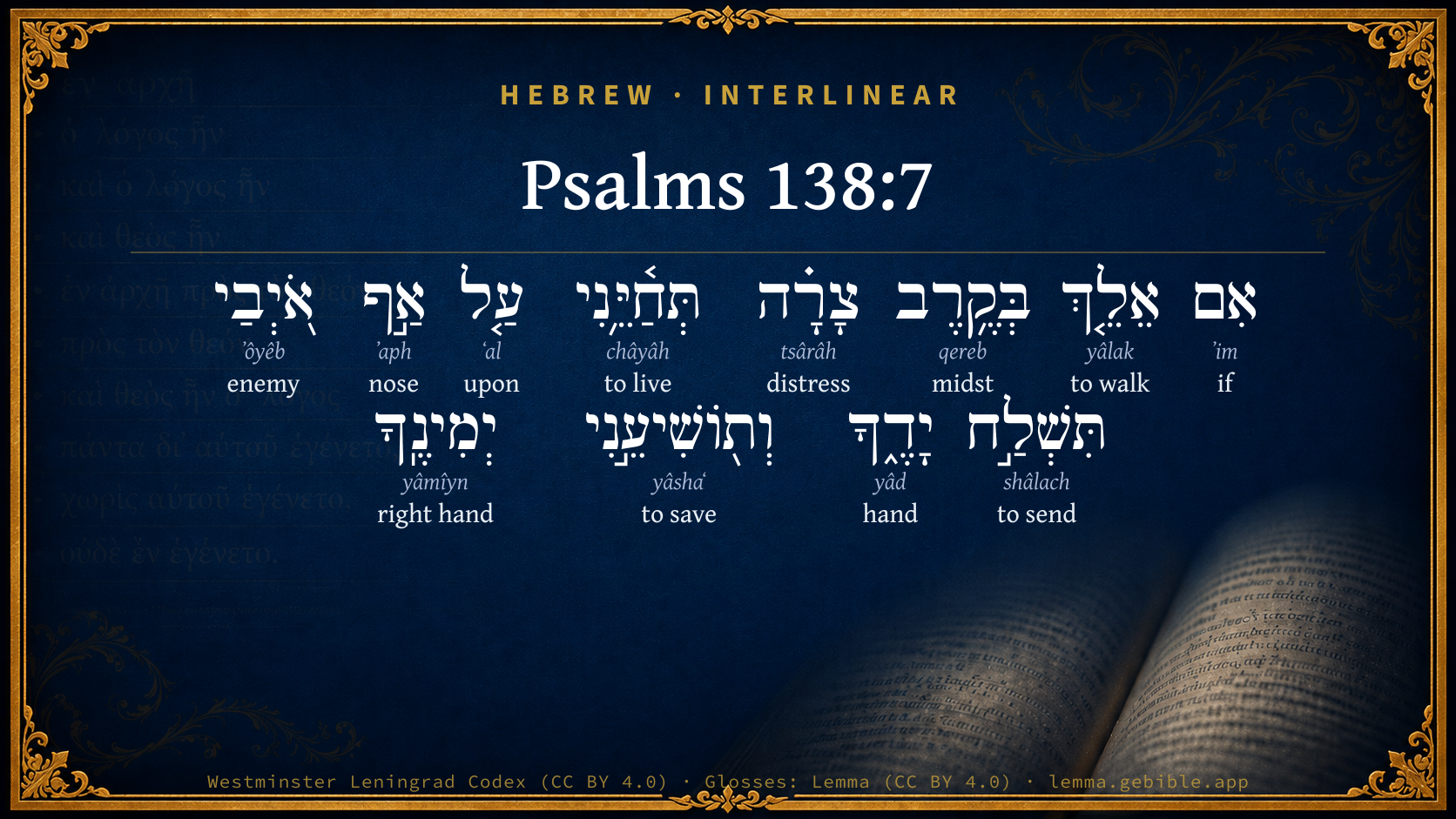
Hebrew (Westminster Leningrad Codex) Psalms 138:7 appears in the Hebrew Old Testament. The text above is from the Westminster Leningrad Codex. Each word links to its Strong’s number, a concise gloss, and parsing drawn from the Open Scriptures Hebrew Bible morphology. Click any word for its full Brown-Driver-Briggs (BDB) entry.
Download image
Cite this verse

Psalms 138:7 (World English Bible). Public Domain. Lemma interlinear Bible study tool, https://lemma.gebible.app/v/psalms/138/7.

Show BibTeX & RIS
BibTeX
RIS
English Translation
Though I walk in the midst of trouble, you will revive me. You will stretch forth your hand against the wrath of my enemies. Your right hand will save me.
World English Bible · Public Domain
Download a study sheet

One document with this verse’s original text, its word-by-word gloss line, the meaning frame, cross-references with their text, attributed commentary, and full source and license credits — printable, and it pastes into notes with its structure intact.

This verse Autodidact and up

Study sheet (.html) Plain text (.txt)

A passage Seminary Student

Up to 50 verses in one chapter. A passage sheet keeps up to 6 commentary sources and 12 cross-references per verse, in the order this page ranks them, and says so on the sheet whenever that leaves anything out. Ask for a single verse and you get the Autodidact verse sheet above.

Everything on this page stays free to read, with no account — the sheet is a download of what is already on screen, not access to it.

Want to remove ads? Support Godless Engineer
Compare translations 3

The same verse in 3 English versions, stacked beneath the original-language interlinear above. Click any original word for its lexicon entry.

Each is an independent rendering of the whole verse — the interlinear is not word-aligned to these translations.

Highlighted words mark where these versions differ — a whole-verse word diff, not a word-by-word alignment.

  • World English Bible Public Domain
    Though I walk in the midst of trouble, you will revive me. You will stretch forth your hand against the wrath of my enemies. Your right hand will save me.
  • King James Version Public Domain
    Though I walk in the midst of trouble, thou wilt revive me: thou shalt stretch forth thine hand against the wrath of mine enemies, and thy right hand shall save me.
  • unfoldingWord Literal Text CC BY-SA 4.0
    Though I walk in the middle of trouble, you will keep me alive; you will stretch out your hand against the nose of my enemies, and your right hand will save me.

unfoldingWord Literal Text — © unfoldingWord, licensed CC BY-SA 4.0. Word-aligned USFM3 via Door43 (git.door43.org/unfoldingWord/en_ult).

Versions to compare (up to 4)

3 of 4 selected

Show all 18 translations

Every available English version of this verse, each an independent rendering of the whole verse.

  • World English Bible Public Domain
    Though I walk in the midst of trouble, you will revive me. You will stretch forth your hand against the wrath of my enemies. Your right hand will save me.
  • Berean Standard Bible Public Domain
    If I walk in the midst of trouble, You preserve me from the anger of my foes; You extend Your hand, and Your right hand saves me.
  • Majority Standard Bible Public Domain
    If I walk in the midst of trouble, You preserve me from the anger of my foes; You extend Your hand, and Your right hand saves me.
  • King James Version Public Domain
    Though I walk in the midst of trouble, thou wilt revive me: thou shalt stretch forth thine hand against the wrath of mine enemies, and thy right hand shall save me.
  • American Standard Version (1901) Public Domain
    Though I walk in the midst of trouble, thou wilt revive me; Thou wilt stretch forth thy hand against the wrath of mine enemies, And thy right hand will save me.
  • Revised Version (1885) Public Domain
    Though I walk in the midst of trouble, thou wilt revive me; thou shalt stretch forth thine hand against the wrath of mine enemies, and thy right hand shall save me.
  • Geneva Bible (1599) Public Domain
    Though I walke in the middes of trouble, yet wilt thou reuiue me: thou wilt stretch foorth thine hand vpon the wrath of mine enemies, and thy right hand shall saue me.
  • Douay-Rheims (1899) Public Domain
    Remember, O Lord, the children of Edom, in the day of Jerusalem: Who say: Rase it, rase it, even to the foundation thereof.
  • Young's Literal Translation Public Domain
    If I walk in the midst of distress Thou quickenest me, Against the anger of mine enemies Thou sendest forth Thy hand, And Thy right hand doth save me.
  • Literal Standard Version CC BY-SA 4.0
    If I walk in the midst of distress You quicken me, || You send forth Your hand against the anger of my enemies, || And Your right hand saves me.
  • Unlocked Literal Bible CC BY-SA 4.0
    Though I walk in the middle of danger, you will preserve my life; you will reach out with your hand against the anger of my enemies, and your right hand will save me.
  • unfoldingWord Literal Text CC BY-SA 4.0
    Though I walk in the middle of trouble, you will keep me alive; you will stretch out your hand against the nose of my enemies, and your right hand will save me.
  • Darby Bible Public Domain
    Though I walk in the midst of trouble, thou wilt revive me: thou wilt stretch forth thy hand against the anger of mine enemies, and thy right hand shall save me.
  • World Messianic Bible Public Domain
    Though I walk in the middle of trouble, you will revive me. You will stretch out your hand against the wrath of my enemies. Your right hand will save me.
  • Webster's Bible Public Domain
    Though I walk in the midst of trouble, thou wilt revive me: thou wilt stretch forth thy hand against the wrath of my enemies, and thy right hand will save me.
  • Free Bible Version CC BY-SA 4.0
    Even though I walk into a great deal of trouble, you protect me. You reach out to defend me from the anger of those who hate me—your strong hand saves me.
  • Bible in Basic English Public Domain
    Even when trouble is round me, you will give me life; your hand will be stretched out against the wrath of my haters, and your right hand will be my salvation.
  • JPS Tanakh (1917) Public Domain
    Though I walk in the midst of trouble, Thou quickenest me; Thou stretchest forth Thy hand against the wrath of mine enemies, and Thy right hand doth save me.

Literal Standard Version (2020), Covenant Press — licensed CC BY-SA 4.0. Text via the HelloAO Bible API (eBible.org). Unlocked Literal Bible (unfoldingWord) — licensed CC BY-SA 4.0. Text via the HelloAO Bible API (eBible.org). unfoldingWord Literal Text — © unfoldingWord, licensed CC BY-SA 4.0. Word-aligned USFM3 via Door43 (git.door43.org/unfoldingWord/en_ult). Free Bible Version, Dr. Jonathan Gallagher — licensed CC BY-SA 4.0. Text via the HelloAO Bible API (eBible.org).

Word by word

More ways to search: Search by grammar → Find every occurrence → Compare this word →

Practice this passage: Drill this verse → Learn its vocabulary →

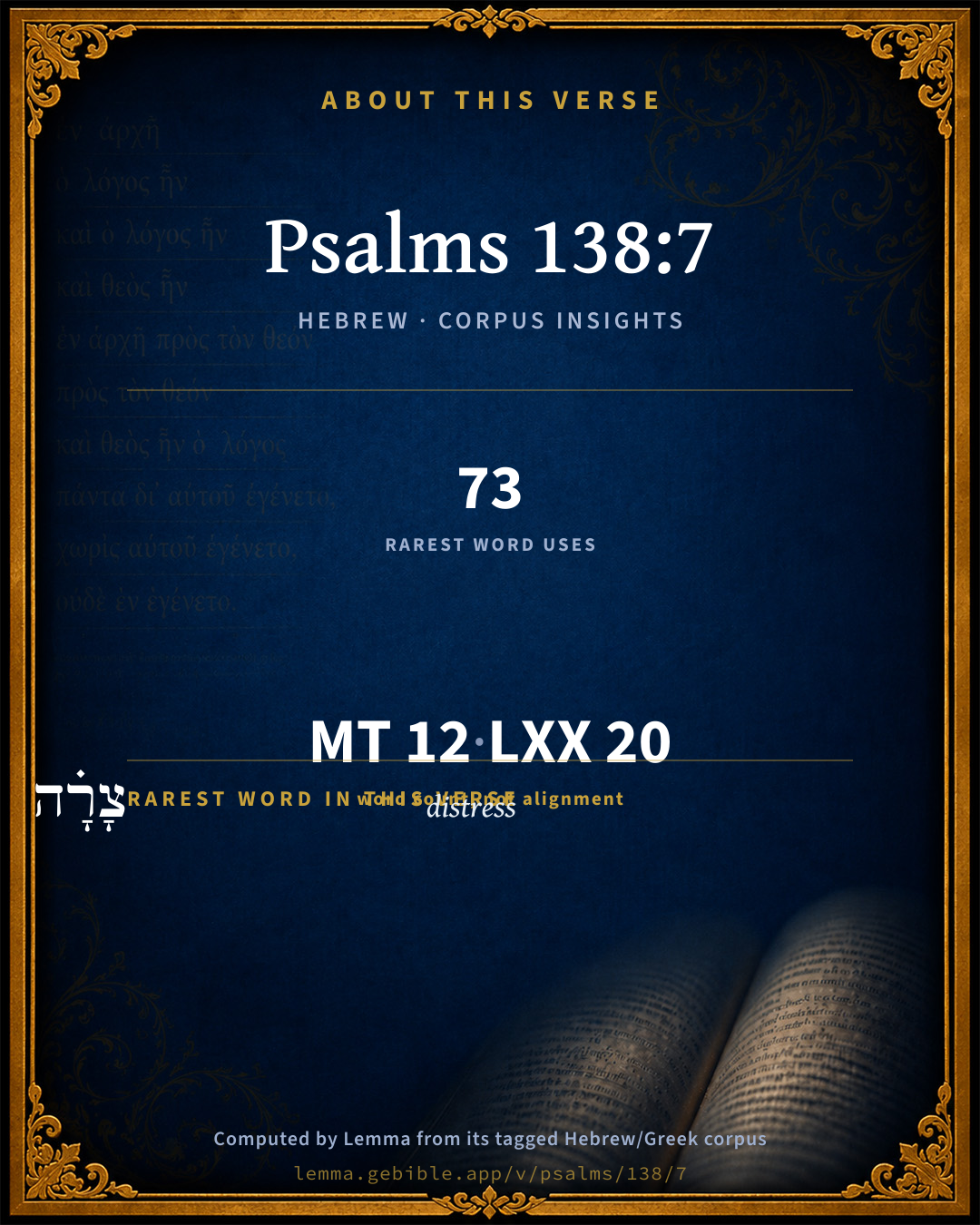
צָרָ֗ה
tsârâh
H6869
“distress”
Noun, Common, Feminine, Singular, Absolute
Part of Speech
Noun
Type
Common
Gender
Feminine
Number
Singular
State
Absolute
Full BDB Definition

Origin: from H6862

TWOT: 1973c , 1974b

straits, distress, trouble - vexer, rival wife
  1. אִם ʼim H518 “if” Conjunction
  2. אֵלֵ֤ךְ yâlak H3212 “to walk” Verb, Qal, Imperfect, 1st Person, Common, Singular
  3. בְּקֶ֥רֶב qereb H7130 “in/at · midst of” Preposition + Noun, Common, Masculine, Singular, Construct
  4. תְּחַ֫יֵּ֥נִי châyâh H2421 “to live · me” Verb, Piel, Imperfect, 2nd Person, Masculine, Singular + Suffix, Personal, 1st Person, Common, Singular
  5. עַ֤ל ʻal H5921 “upon” Preposition
  6. אַ֣ף ʼaph H639 “nose” Particle, Accusative
  7. אֹ֭יְבַי ʼôyêb H341 “enemy · me” Verb, Qal, Participle Active, Masculine, Plural, Construct + Suffix, Personal, 1st Person, Common, Singular
  8. תִּשְׁלַ֣ח shâlach H7971 “to send” Verb, Qal, Imperfect, 2nd Person, Masculine, Singular
  9. יָדֶ֑ךָ yâd H3027 “hand · your” Noun, Common, Both, Singular, Construct + Suffix, Personal, 2nd Person, Masculine, Singular
  10. וְת֖וֹשִׁיעֵ֣נִי yâshaʻ H3467 “and · to save · me” Conjunction + Verb, Hiphil, Imperfect, 3rd Person, Feminine, Singular + Suffix, Personal, 1st Person, Common, Singular
  11. יְמִינֶֽךָ yâmîyn H3225 “right hand · your” Noun, Common, Feminine, Singular, Construct + Suffix, Personal, 2nd Person, Masculine, Singular

About this verse

These counts appear in no published source. They are computed here, from the morphology-tagged text and Lemma’s own curated glosses. What Lemma adds →

12
words
12
distinct lemmas
Wisdom
section

Grammatical profile

  • 5 verbs
  • 4 nouns
  • 1 preposition
  • 1 conjunction
  • 1 particle

Verb forms

  • אֵלֵ֤ךְ Qal · Imperfect
  • תְּחַ֫יֵּ֥נִי Piel · Imperfect
  • אֹ֭יְבַי Qal · Participle Active
  • תִּשְׁלַ֣ח Qal · Imperfect
  • וְת֖וֹשִׁיעֵ֣נִי Hiphil · Imperfect

Hebrew & Septuagint length

In English translation the verse runs 30 words from the Hebrew and 32 from the Septuagint (LXX English) — closely comparable.

A rough comparison of the two English renderings, which tokenize alike — not a word-level alignment.

Word counts can differ between the Hebrew and the Greek without any difference in meaning — e.g. the Hebrew direct-object marker אֵת has no separate Greek word, and Greek often adds the article ὁ.

In the original languages it is 12 Hebrew tokens and 20 Greek tokens — but the two are counted differently (Hebrew bundles its prefixes and suffixes into one token; the Greek is in lemma form), so that isn’t a like-for-like length.

Cross-references

30

Topical passages linked to Psalms 138:7 in the Treasury of Scripture Knowledge — connected by theme and wording, ordered by reader-vote popularity; previews shown in the World English Bible.

  • Isaiah 41:10 Don't you be afraid, for I am with you; don't be dismayed, for I am your God; I will strengthen you; yes, I will help you; yes, I will uphold you with the right hand of my righteousness.
  • Psalms 23:3–4 He restores my soul. He guides me in the paths of righteousness for his name's sake.
  • Psalms 71:20–21 You, who have shown us many and bitter troubles, You will let me live. You will bring us up again from the depths of the earth.
  • Psalms 85:6 Won't you revive us again, That your people may rejoice in you?
  • Isaiah 5:25 Therefore Yahweh's anger burns against his people, And he has stretched out his hand against them, and has struck them. The mountains tremble, And their dead bodies are as refuse in the midst of the streets. For all this, his anger is not turned away, But his hand is still stretched out.
  • Acts 2:33 Being therefore exalted by the right hand of God, and having received from the Father the promise of the Holy Spirit, he has poured out this, which you now see and hear.
  • Micah 7:8–10 Don't rejoice against me, my enemy. When I fall, I will arise. When I sit in darkness, Yahweh will be a light to me.
  • Psalms 144:1–2 Blessed be Yahweh, my rock, Who teaches my hands to war, And my fingers to battle:
  • Job 13:15 Behold, he will kill me; I have no hope. Nevertheless, I will maintain my ways before him.
  • Job 19:25–26 But as for me, I know that my Redeemer lives. In the end, he will stand upon the earth.
  • Isaiah 10:4 They shall only bow down under the prisoners, and shall fall under the slain. For all this his anger is not turned away, but his hand is stretched out still.
  • Psalms 119:49–50 Remember your word to your servant, Because you gave me hope.
  • Psalms 44:5–7 Through you, will we push down our adversaries. Through your name, will we tread them under who rise up against us.
  • Psalms 66:10–12 For you, God, have tested us. You have refined us, as silver is refined.
  • Psalms 17:7 Show your marvelous loving kindness, You who save those who take refuge by your right hand from their enemies.
  • Psalms 60:5 So that your beloved may be delivered, Save with your right hand, and answer us.
  • Jeremiah 51:25 Behold, I am against you, destroying mountain, says Yahweh, which destroy all the earth; and I will stretch out my hand on you, and roll you down from the rocks, and will make you a burnt mountain.
  • Psalms 18:35 You have also given me the shield of your salvation. Your right hand sustains me. Your gentleness has made me great.
  • Psalms 35:1–3 Contend, Yahweh, with those who contend with me. Fight against those who fight against me.
  • Psalms 44:3 For they didn't get the land in possession by their own sword, Neither did their own arm save them; But your right hand, and your arm, and the light of your face, Because you were favorable to them.
  • Psalms 64:7–8 But God will shoot at them. They will be suddenly struck down with an arrow.
  • Psalms 20:6 Now I know that Yahweh saves his anointed. He will answer him from his holy heaven, With the saving strength of his right hand.
  • Psalms 41:7–8 All who hate me whisper together against me. They imagine the worst for me.
  • Psalms 56:1–2 Be merciful to me, God, for man wants to swallow me up. All day long, he attacks and oppresses me.
  • Psalms 56:9 Then my enemies shall turn back in the day that I call. I know this, that God is for me.
  • Psalms 77:10 Then I thought, "I will appeal to this: The years of the right hand of the Most High."
  • Isaiah 9:12 the Syrians before, and the Philistines behind; and they shall devour Israel with open mouth. For all this his anger is not turned away, but his hand is stretched out still.
  • Isaiah 9:17 Therefore the Lord will not rejoice over their young men, neither will he have compassion on their fatherless and widows; for everyone is profane and an evil-doer, and every mouth speaks folly. For all this his anger is not turned away, but his hand is stretched out still.
  • Isaiah 9:21 Manasseh, Ephraim; and Ephraim, Manasseh; and they together shall be against Judah. For all this his anger is not turned away, but his hand is stretched out still.
  • Isaiah 57:16 For I will not contend forever, neither will I be always angry; for the spirit would faint before me, and the souls who I have made.

Cross-references courtesy of OpenBible.info (CC BY 4.0).

Hebrew and Greek witnesses Masoretic Hebrew ↔ Greek Septuagint

The same verse in the two great witnesses to the Old Testament, shown verse-for-verse.

You’re reading Greek Psalm 137 (Hebrew Psalm 138). The Septuagint counts the superscription, so verse numbers can differ from the Hebrew — chapter-level alignment, not verse-by-verse. Numbering follows Rahlfs.

These are two independent witnesses, not word-aligned to each other, and the Septuagint is shown in lemma (dictionary) form.

Hebrew Psalms 138:7 Masoretic · Westminster Leningrad Codex

אִם אֵלֵ֤ךְ בְּקֶ֥רֶב צָרָ֗ה תְּחַ֫יֵּ֥נִי עַ֤ל אַ֣ף אֹ֭יְבַי תִּשְׁלַ֣ח יָדֶ֑ךָ וְת֖וֹשִׁיעֵ֣נִי יְמִינֶֽךָ

Though I walk in the midst of trouble, you will revive me. You will stretch forth your hand against the wrath of my enemies. Your right hand will save me.

World English Bible · Public Domain

Greek LXX Greek Psalm 137:7 Septuagint · lemma form

ἐάν πορεύομαι ἐν μέσος θλῖψις ζάω ἐγώ ἐπί ὀργή ἐχθρός ἐγώ ἐκτείνω χείρ σύ καί σώζω ἐγώ ὁ δεξιός σύ

Though I should walk in the midst of affliction, you will quicken me; you have stretched forth your hands against the wrath of my enemies, and your right hand has saved me.

LXX2012 (modern English Septuagint) · Public Domain

Hebrew: Westminster Leningrad Codex (CC BY 4.0). Greek: Septuagint (public domain); English from LXX2012 (modern English Septuagint) (Public Domain). How the Septuagint differs from the Hebrew →

Commentary

Notes on Psalms 138:7 from classic Christian and Jewish commentators (each source and its license shown beneath its notes). The classic Christian expositions comment on the surrounding passage and are grouped to its opening verse, so a note may address several verses; the Jewish commentaries on the Tanakh (Rashi and others) are per-verse, so they appear only where the commentator wrote on this verse.

Lemma curates 59 commentaries, every one of them public domain or Creative Commons licensed, each selected and text-cleaned for this edition rather than reprinted as found. About our sources →

Trapp's Complete Commentary

John Trapp

Psa 138:7 Though I walk in the midst of trouble, thou wilt revive me: thou shalt stretch forth thine hand against the wrath of mine enemies, and thy right hand shall save me.

Ver. 7. Though I walk in the midst of trouble] Even in the vale of the shadow of death, so that I seem little different from a dead man.

Thou wilt revive me] That is, restore me from so great a death, as 2Co 1:10.

Thou shall stretch forth thine hand] Thou shall interpose thy help between me and them, and save me harmless; as the poets feign their gods did those whom they favoured. Thou shall strike them with thy left hand, and save me with thy right; so Tremellius senseth it.

John Trapp, A Commentary or Exposition upon All the Books of the Old and New Testament (1647–1656) — public domain. Text from a community e-Sword module.

The Biblical Illustrator

Joseph S. Exell

Psa_138:7

Though I walk in the midst of trouble, Thou wilt revive me.

Human life

I. The universal law of human life. What is it? It is expressed in one word--walking. Life is a walk, a journey. It is constant action, and constant action onward. Life is never stationary; it is always on the move; it is motion.

1. Constant change of position. Every step puts us in a fresh point of space, and surrounds us with something new in scenery. So with life.

2. Constant approximation to destiny. The grave for the body; retribution for the soul.

II. The saddening probabilities of human life. Life is not only a walk, but a walk often in the midst of trouble. Since the introduction of sin into our world, it has never been a walk of unmingled pleasure. All here meet with trials on the way; but some more than others. Physical--bodily pains and diseases; moral--the conflict of passions, the remorse of conscience, and the dread of death; social--disappointments in business, the treachery of false friends, the corruption of the world, and the bereavement of death.

III. The grand support of human life. Thou wilt revive me.

1. God is an all-sufficient support. He is equal to all our emergencies. He is our refuge and strength, etc. There is no enemy from which He cannot deliver us; there is no trial under which He cannot support us; there is no danger from which lie cannot rescue us. In the fiery furnace, in the surging waters, in the valley of the shadow of death, He is all-sufficient.

2. He is the only effective support. No one else can support you. Put not your trust in princes.

3. He is an available support. Available to all at any time. Call upon Me in the time of trouble and I will deliver you. (Homilist.)

The Christians comfort in the midst of troubles

I. The Christians troubles. They arise from--

1. The world within. An evil heart of unbelief; prone to distrust God, to dishonour God, to wander from God.

2. The world without. Bodily affliction, worldly trials, opposition from the world, etc.

3. The world beneath. Satan distils his venom in secret.

II. The Christians comforter. Though he walks in trouble, he does not walk alone. Though persecuted, he is not forsaken; though cast down, not destroyed.

1. God can enter the inner world and bring comfort there, and spread a banquet within, and open a little paradise (Psa_94:19; Job_35:10; Psa_27:5).

2. God can enable us to meet the world without. So He enabled Jacob to meet Esau; Elijah, Baals priests; David, Goliath.

3. God can effectually subdue the world beneath. Bruise Satan under your feet.

III. The Christians confidence. What it is proved.

1. What He is--God of mercy.

2. What He has done.

3. What He has promised to do. (Evangelist.)

The Biblical Illustrator, edited by Joseph S. Exell (c. 1880s–1900s) — public domain. Text from a community e-Sword module.

Joseph Benson's Commentary

Psa 138:7-8. Though I walk in the midst of trouble — That is, be compassed with dangers; thou wilt revive me — Thou wilt cheer my spirit and preserve my life. Thou shalt stretch forth thy hand — Put forth thy almighty power; against the wrath of mine enemies — To oppose and restrain their rage. The Lord will perfect that which concerneth me — Will finish that great work of my deliverance and advancement, which he hath undertaken, and carried on hitherto. Thy mercy endureth for ever — It is not inconstant and changeable, as men’s affections are, but everlasting. And this may be either produced as a proof of the foregoing assertion, The Lord will perfect, &c. — Or, as an argument to enforce the following petition. Forsake not — Do not withdraw thy presence from me, who am thy creature, but continue to support and save me. Or, leave not, or, do not desist from, or, cease to carry on, as תרŠ, rather signifies, the work, namely of my salvation, which is thus far advanced, not by any human help, but by thy power and providence.

Joseph Benson's Commentary on the Old and New Testaments (1811–1818) — public domain. Text from a community e-Sword module.

J. A. Alexander on Psalms

Joseph Addison Alexander

7. (Psa 138:7) If Ig o through the midst of distress, thou wilt save (or make) me alive; upon the wrath of my enemies thou wilt stretch forth thy hand, and save me (with) thy right hand. The first clause resembles that of Psa 23:4. Go through or walk in the midst of trouble. To quicken or revive, as in Psa 30:3; Psa 71:20. Upon the wrath, implying motion from above, which significant and graphic than against implying common version of the last words (and thy right hand shall save me) is equally grammatical, and found in all the ancient versions; but the other is recommended by its ascribing the deliverance directly to God, and by the analogy of Psa 60:5, where hand is adverbially construed with the same verb. See also Psa 17:14.

Joseph Addison Alexander, The Psalms Translated and Explained (1850) — public domain. Text from a community e-Sword module.

Adam Clarke's Commentary

Verse 7. Though I walk in the midst of trouble] I have had such experience of thy mercy, that let me fall into whatsoever trouble I may, yet I will trust in thee. Thou wilt quicken me, though I were ready to die; and thou wilt deliver me from the wrath of my enemies.

Adam Clarke's Commentary on the Bible (1810–1826) — public domain. Text from a community e-Sword/MySword module.

John Calvin's Commentaries

7. Should I walk in the midst of trouble, etc. Here David declares the sense in which he looked flint God would act the part of his preserver — by giving him life from the dead, were that necessary. The passage is well deserving our attention for by nature we are so delicately averse to suffering as to wish that we might all live safely beyond shot of its arrows, and shrink from close contact with the fear of death, as something altogether intolerable. On the slightest approach of danger we are immoderately afraid, as if our emergencies precluded the hope of Divine deliverance. This is faith’s true office, to see life in the midst of death, and to trust the mercy of God — not as that which will procure us universal exemption from evil, but as that which will quicken us in the midst of death every moment of our lives; for God humbles his children under various trials, that his defense of them may be the more remarkable, and that he may show himself to be their deliverer, as well as their preserver. In the world believers are constantly exposed to enemies, and David asserts, that he will be safe under God’s protection from all their machinations. He declares his hope of life to lie in this, that the hand of God was stretched out for his help, that hand which he knew to be invincible, and victorious over every foe. And from all this we are taught, that it is God’s method to exercise his children with a continual conflict, that, having one foot as it were in the grave, they may flee with alarm to hide themselves under his wings, where they malt abide in peace. Some translate the particle אף, aph, also, instead of anger, reading — thou wilt also extend over mine; enemies, etc. But I have followed the more commonly received sense, as both fuller and more natural.

John Calvin's Commentaries (1540-1563) — public domain. Text from the Calvin Translation Society English edition (1840s-50s) via the Christian Classics Ethereal Library (ccel.org). Calvin's coverage is partial (roughly two-thirds of the Bible); uncommented books and verses are honest gaps, never fabricated. The 19th-century editor's footnotes and remarks are omitted so the notes are faithfully Calvin's own voice.

Ellicott's Commentary for English Readers

(7) This verse echoes Psa_23:4; Psa_30:3; Psa_71:20.

Against the wrath.—Or perhaps, upon the wrath.

A Bible Commentary for English Readers, edited by Charles John Ellicott (1878–1897) — public domain. Text from a community e-Sword module.

The Cambridge Bible for Schools and Colleges

gen. ed. J. J. S. Perowne

7. wilt revive me] Or, preserve me alive. Cp. Psa_71:20; Psa_119:25 &c.; Psa_143:11.

thou shalt stretch forth thine hand] A common figure for the exertion of Divine power to help or punish. Cp. Psa_144:7; Exo_3:20; Exo_9:15.

thy right hand &c.] Cp. Psa_17:7; Psa_139:10.

7, 8. Though fresh troubles may still await Israel, Jehovah will not fail to carry out His purposes for them.

The Cambridge Bible for Schools and Colleges (gen. ed. J. J. S. Perowne; Cambridge University Press, 1878–1918) — public domain. Text from a community e-Sword module.

John Gill's Exposition

Though I walk in the midst of trouble,.... Trouble attends the best of men; both outward and inward trouble, from sin, Satan, and the world; yea, they are in the midst of it, surrounded with it; and it is a way in which they walk through this world, and enter the kingdom of heaven; it is continued unto them; it is a long walk, and yet will have an end; see Psa 23:4;

thou wilt revive me; preserve his life amidst all his troubles, support him under them, make him cheerful and fearless; revive his work of grace in him, quicken him to the lively exercise of grace, and fervent discharge of duty: this the Lord does by his gracious presence, by the discoveries of his love, and by the application of precious promises;

thou shalt stretch forth thine hand against the wrath of mine enemies; to stop and restrain it; which he can easily do, when most violent and outrageous, Psa 76:10. Or, "against the nose of mine enemies" (w); strike them on the nose, as men do unruly horses to stop them: or give a slap on their face with the left hand, as Arama observes, the right being after mentioned;

and thy right hand shall save me; for that has saving strength in it, Psa 20:6. This may be understood of Christ, who is not only the man of his right hand, but is the right hand of his righteousness; by whom he saves his people with a spiritual and eternal salvation, as well as with a temporal one, Isa 41:10.

(w) "super nasum inimicorum meorum", Montanus, Tigurine version; so Gussetius; "in faciem", Junius & Tremellius, Piscator.

John Gill's Exposition of the Whole Bible (1746–1763) — public domain (CC PDM 1.0). Text via the HelloAO Bible API.

Albert Barnes' Notes on the Bible

Though I walk in the midst of trouble - Though I am in the low vale of sorrow, I shall not be overlooked or forgotten. This implies that the writer was then in trouble, and it expresses the conviction that whenever he should be in trouble God would remember him, and give him life and strength.

Thou wilt revive me - Thou wilt cause me to live; thou wilt give me life. Psa 30:3. Compare the notes at Psa 71:20. The meaning is, Thou wilt give me life - vigor - strength - to bear the trouble.

Thou shalt stretch forth thine hand - As one does when he is about to inflict a blow.

Against the wrath of mine enemies ... - In reference to all their attempts to destroy me. Thou wilt meet their wrath by thy power, and I shall be safe.

Albert Barnes' Notes on the Bible (1834–1885) — public domain. Text from a community e-Sword/MySword module.

Matthew Poole's English Annotations

Walk in the midst of trouble, i.e. be encompassed with dangers.

Thou wilt revive me; thou wilt cheer my spirit, and preserve my life.

Thou shalt stretch forth thine hand; put forth thy almighty power, to oppose and restrain their rage, and to save me from them, as it follows.

Matthew Poole's English Annotations on the Holy Bible (1683–1685) — public domain. Text from a community e-Sword/MySword module.

The Treasury of David

Charles H. Spurgeon

Ver. 7. Though I walk in the midst of trouble, thou wilt revive me. If I am walking there now, or shall be doing so in years to come, I have no cause for fear; for God is with me, and will give me new life. When we are somewhat in trouble it is bad enough, but it is worse to penetrate into the centre of that dark continent and traverse its midst: yet in such a case the believer makes progress, for he walks; he keeps to a quiet pace, for he does no more than walk; and he is not without the best of company, for his God is near to pour fresh life into him. It is a happy circumstance that, if God be away at any other time, yet he is pledged to be with us in trying hours: "when thou passest through the rivers I will be with thee." He is in a blessed condition who can confidently use the language of David, "thou wilt revive me." He shall not make his boast of God in vain: he shall be kept alive, and made more alive than ever. How often has the Lord quickened us by our sorrows! Are they not his readiest means of exciting to fulness of energy the holy life which dwells within us? If we receive reviving, we need not regret affliction. When God revives us, trouble will never harm us.

Thou shalt stretch forth thine hand against the wrath of mine enemies, and thy right hand shall save me. This is the fact which would revive fainting David. Our foes fall when the Lord comes to deal with them; he makes short work of the enemies of his people, with one hand he routs them. His wrath soon quenches their wrath; his hand stays their hand. Adversaries may be many, and malicious, and mighty; but our glorious Defender has only to stretch out his arm and their armies vanish. The sweet singer rehearses his assurance of salvation, and sings of it in the ears of the Lord, addressing him with this confident language. He will be saved, saved dexterously, decidedly, divinely; he has no doubt about it. God's right hand cannot forget its cunning; Jerusalem is his chief joy, and he will defend his own elect.

Ver. 7. Though a walk in the midst of trouble, thou wilt revive me. So as to the three youths in the fiery furnace, their persecutor, Nebuchadnezzar, said, "Lo, I see four men loose, walking in the midst of the fire, and they have no hurt, and the form of the fourth is like the Son of God." Andrew Robert Fausset.

Ver. 7. In the midst of trouble thou wilt revive me. The wisdom of God is seen in helping in desperate cases. God loves to show his wisdom when human help and wisdom fail. Exquisite lawyers love to wrestle with niceties and difficulties in the law, to show their skill the more. God's wisdom is never at a loss; but when providences are darkest, then the morning star of deliverance appears. Sometimes God melts away the spirits of his enemies. Jos 2:24. Sometimes he finds them other work to do, and sounds a retreat to them, as he did to Saul when he was pursuing David. "The Philistines are in the land." "In the mount God will be seen." When the church seems to be upon the altar, her peace and liberty ready to be sacrificed, then the angel comes. Thomas Watson.

Ver. 7. Thou shalt stretch forth thine hand, etc. Thou shalt interpose thine help betwixt me and them, and save me harmless; as the poets feign their gods did those whom they favoured. Thou shalt strike them with thy left hand, and save me with thy right; so Tremellius senses it. John Trapp.

Ver. 7. (first clause).

1. The Psalmist's dismal excursion: walking "in the midst of trouble"; this is not a spectator, but one assailed. Troublespersonal, social, ecclesiastical, national.

2. His cheering anticipationof revival, defence, deliverance.

W.J.

Ver. 7.

1. Good men are sometimes in the midst of troubles: these are many, and continue long.

2. They interfere not with their progress. They "walk in the midst" of them; faint, yet pursuing; sometimes they "run with patience", etc.

3. They have comfort in them: "Though I walk", etc., "thou wilt revive me."

4. They are benefited by them.

a) Their enemies are overthrown.

b) Their deliverance is complete.

G.R.

Ver. 7. The child of God often revived out of trouble; more frequently in trouble; not seldom through trouble. Delivered from, sustained in, sanctified through, trouble.

A.G.B.

Ver. 7. An incident of the road to the city.

1. Pilgrims beset by thieves and struck down.

2. The arrival of Great heart and flight of the enemy.

3. The flask to the lips: "thou wilt revive me." Sweet awakening to know the beauty of his face and strength of his hand!

W.B.H.

Ver. 7. (third clause). Right hand salvation.

1. It shall be wrought of God.

2. He shall throw his strength into the deed.

3. His utmost dexterity shall be displayed.

Psalms 138:8*

Charles H. Spurgeon's The Treasury of David (1869–1885) — public domain. Psalms only. Text from a community e-Sword/MySword module.

The Pulpit Commentary

Though I walk in the midst of trouble, thou wilt revive me. (comp. Psa_23:4) David "walked in the midst of trouble" during the greater part of his life. When the persecution of Saul was over, he had trouble from foreign enemies; (2Sa 5-12) when these were subdued, his domestic troubles began. (2Sa 13-19 1Ki 5:53) God, however, from time to time "gave him a reviving." Thou shalt stretch forth thine hand against the wrath of mine enemies. (comp. Psa_3:7 Psa_9:3-6 Psa_18:14-17, etc.) What God had so often done for him, David is confident that he will do again. He will break the power of his enemies, and deliver him from their machinations. And thy right hand. The symbol of strength. Shall save me; or, "deliver me". (comp. Psa_18:35 Psa_60:5 Psa_63:8 Psa_108:6, etc.)

Walking in trouble.

"Though I walk in the midst of trouble." This suggests a particular phase of human experience. Sometimes troubles come upon us, crash after crash, until we are, like Job, utterly crushed; and can but clothe our selves with sackcloth, and sit in ashes. But the text indicates a more frequent, if less readily recognized, experience. The tone is gentler; there is no crashing of sudden calamity, no bursting of wild and desolating storms. The man is moving to and fro in the ordinary scenes of life, meeting his obligations and doing his duties. But everywhere things seem to go wrong; on all sides trouble, anxiety, worry, seem to attend him. He cannot get free night or day. These dog his steps continually. He walks in the midst of trouble. How true to universal experience all this is!

I WALKING IN TROUBLE IS A MOST DEPRESSING EXPERIENCE. The constant wearing produces a fixed weariness; the constant worry produces a fixed fretfulness; the constant fear of some new anxiety produces a fixed hopelessness. Because nothing goes right, we are too ready to say nothing ever will go right. And then the heart is taken out of us; we become unfitted for battling with difficulty, and so largely increase our troubles; we make them for ourselves, as well as have them made for us. And those we make for ourselves are always the worst to deal with. There is one striking illustration of this depressed mood in the life of David. He walked in the midst of various and well-nigh overwhelming troubles, and in a hopelessness that was both pitiful and sinful, he exclaimed, "I shall now one day perish by the hand of Saul!" It may further be shown that such depressed moods, responsive to surrounding worry, very much depend on natural disposition, especially on that nervous irritability which can always see, or expect, evil.

II WALKING IN TROUBLE MAKES US CRY FOR DIVINE REVIVING. "Thou wilt revive me." The state of mind induced by the circumstances is much more important in the sight of God than the circumstances. And this the good man recognizes. His hope is in God"s soul-cheering, God"s inward reviving, God"s keeping from despair, and freshening trust and hope. And God does lead the walker out "into a large place," in his own good time. R.T.

The Pulpit Commentary (1880–1919), ed. H.D.M. Spence-Jones & Joseph S. Exell — public domain. Text from a community e-Sword module.

Keil & Delitzsch

C. F. Keil & F. Delitzsch

Out of these experiences-so important for all mankind - of David, who has been exalted by passing through humiliation, there arise from him confident hopes concerning the future. The beginning of this strophe calls Psa 23:4 to mind. Though his way may lead through the midst of heart - oppressing trouble, Jahve will loose these bands of death and quicken him afresh (חיּה as in Psa 30:4; Psa 71:20, and frequently). Though his enemies may rage, Jahve will stretch forth His hand threateningly and tranquillizingly over their wrath, and His right hand will save him. ימינך is the subject according to Psa 139:10 and other passages, and not (for why should it be supposed to be this?) accus. instrumenti (vid., Psa 60:7). In Psa 138:8 יגמר is intended just as in Psa 57:3 : the word begun He will carry out, ἐπιτελεῖν (Phi 1:6); and בּעדי (according to its meaning, properly: covering me) is the same as עלי in that passage (cf. Psa 13:6; 142:8). The pledge of this completion is Jahve's everlasting mercy, which will not rest until the promise is become perfect truth and reality. Thus, therefore, He will not leave, forsake the works of His hands (vid., Psa 90:16.), i.e., as Hengstenberg correctly explains, everything that He has hitherto accomplished for David, from his deliverance out of the hands of Saul down to the bestowment of the promise - He will not let one of His works stand still, and least of all one that has been so gloriously begun. הרפּה (whence תּרף) signifies to slacken, to leave slack, i.e., leave uncarried out, to leave to itself, as in Neh 6:3. אל expresses a negation with a measure of inward excitement.

Keil & Delitzsch — Biblical Commentary on the Old Testament (1861–1891) — public domain (CC PDM 1.0). Text via the HelloAO Bible API. (Old Testament only.)

unfoldingWord translationNotes

Door43 World Missions Community

walk

live, exist

in the middle of danger

Being in danger is spoken of as being in a physical place. (See: Metaphor)

you will reach out with your hand against the anger of my enemies

God is spoken of as if he will strike the enemies with his hand. (See: Metaphor)

anger of my enemies

The abstract noun "anger" can be stated as "angry." AT: "my enemies, who are angry" (See: Abstract Nouns)

your covenant faithfulness, Yahweh, endures forever

The abstract noun "faithfulness" can be translated with an adjective. AT: "you, Yahweh, remain faithful to your covenant forever" (See: Abstract Nouns)

the ones whom your hands have made

This expression probably refers to the nation of Israel.

your hands have made

God is spoken of as if he had physically used hands to create. AT: "you have created" (See: Metaphor)

translationWords

walk

life

hand

anger

adversary

right hand

save

eternity

forsake

unfoldingWord translationNotes — © Distant Shores Media and the Door43 World Missions Community, licensed CC BY-SA 4.0. Source: git.door43.org/Door43/en_tn.

Lesson kit

Teaching starters — assembled from the data on this page, not authored interpretation. Every prompt links to the verse data it draws on. Edit before teaching.

Psalms, in the Wisdom, opens this verse with 12 words (12 distinct Hebrew lemmas). Its most distinctive word is tsârâh (“distress”). A historical commentator’s framing appears above. Read the whole chapter for the surrounding context.

Discussion questions

  1. The word tsârâh carries the sense “distress.” How does it shape the verse?
  2. How does Isaiah 41:10, which shares this passage’s theme, read alongside this verse?
  3. The translations on this page render this verse differently — a whole-verse word diff, not a word-by-word alignment. What might account for the different wordings?
  4. «אֵלֵ֤ךְ» is a Qal Imperfect verb. How does that grammatical form shape the action described?
  5. Compare how Trapp's Complete Commentary and The Biblical Illustrator read this verse. Where do they agree or differ?

Things to notice

Reading settings

Reading text

Shown beneath each verse's original-language words.

Old Testament
Old Testament edition

Read the OT as the Masoretic Hebrew (MT) or the Greek Septuagint (LXX).

English shown for the Greek Septuagint (in the Hebrew ↔ Greek comparison).

Comparing translations? Open the Compare panel on any verse page to stack up to four side by side.