
Amos 5:17

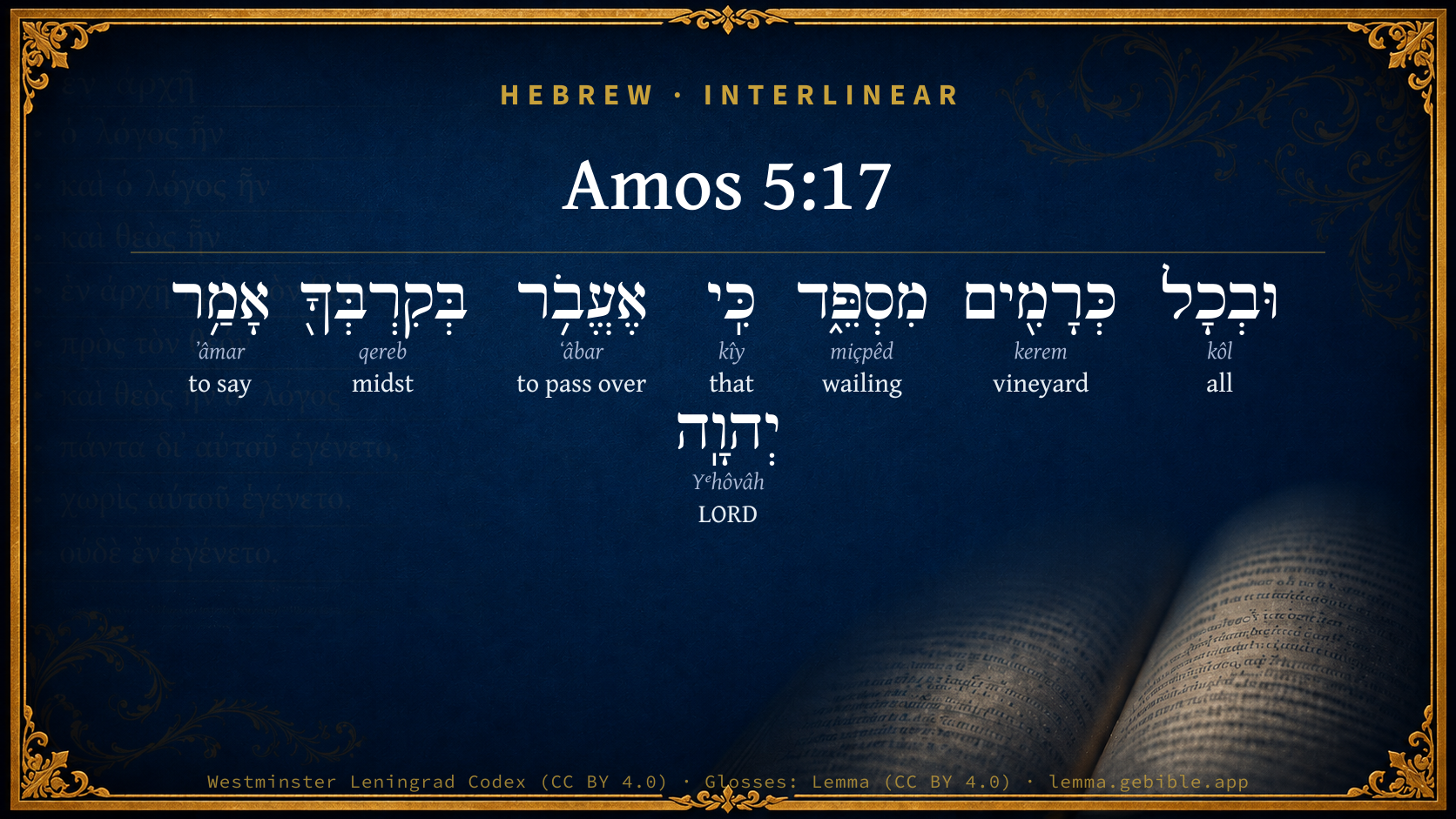
Hebrew (Westminster Leningrad Codex) Amos 5:17 appears in the Hebrew Old Testament. The text above is from the Westminster Leningrad Codex. Each word links to its Strong’s number, a concise gloss, and parsing drawn from the Open Scriptures Hebrew Bible morphology. Click any word for its full Brown-Driver-Briggs (BDB) entry.
Download image
Cite this verse

Amos 5:17 (World English Bible). Public Domain. Lemma interlinear Bible study tool, https://lemma.gebible.app/v/amos/5/17.

Show BibTeX & RIS
BibTeX
RIS
English Translation
In all vineyards there will be wailing; For I will pass through the midst of you," says Yahweh.
World English Bible · Public Domain
Download a study sheet

One document with this verse’s original text, its word-by-word gloss line, the meaning frame, cross-references with their text, attributed commentary, and full source and license credits — printable, and it pastes into notes with its structure intact.

This verse Autodidact and up

Study sheet (.html) Plain text (.txt)

A passage Seminary Student

Up to 50 verses in one chapter. A passage sheet keeps up to 6 commentary sources and 12 cross-references per verse, in the order this page ranks them, and says so on the sheet whenever that leaves anything out. Ask for a single verse and you get the Autodidact verse sheet above.

Everything on this page stays free to read, with no account — the sheet is a download of what is already on screen, not access to it.

Want to remove ads? Support Godless Engineer
Compare translations 3

The same verse in 3 English versions, stacked beneath the original-language interlinear above. Click any original word for its lexicon entry.

Each is an independent rendering of the whole verse — the interlinear is not word-aligned to these translations.

Highlighted words mark where these versions differ — a whole-verse word diff, not a word-by-word alignment.

  • World English Bible Public Domain
    In all vineyards there will be wailing; For I will pass through the midst of you," says Yahweh.
  • King James Version Public Domain
    And in all vineyards shall be wailing: for I will pass through thee, saith the LORD.
  • unfoldingWord Literal Text CC BY-SA 4.0
    In all vineyards there will be wailing, for I will pass through your midst,” says Yahweh.

unfoldingWord Literal Text — © unfoldingWord, licensed CC BY-SA 4.0. Word-aligned USFM3 via Door43 (git.door43.org/unfoldingWord/en_ult).

Versions to compare (up to 4)

3 of 4 selected

Show all 18 translations

Every available English version of this verse, each an independent rendering of the whole verse.

  • World English Bible Public Domain
    In all vineyards there will be wailing; For I will pass through the midst of you," says Yahweh.
  • Berean Standard Bible Public Domain
    There will be wailing in all the vineyards, for I will pass through your midst,” says the LORD.
  • Majority Standard Bible Public Domain
    There will be wailing in all the vineyards, for I will pass through your midst,” says the LORD.
  • King James Version Public Domain
    And in all vineyards shall be wailing: for I will pass through thee, saith the LORD.
  • American Standard Version (1901) Public Domain
    And in all vineyards shall be wailing; for I will pass through the midst of thee, saith Jehovah.
  • Revised Version (1885) Public Domain
    And in all vineyards shall be wailing: for I will pass through the midst of thee, saith the LORD.
  • Geneva Bible (1599) Public Domain
    And in al the vines shalbe lamentation: for I wil passe through thee, saith the Lord.
  • Douay-Rheims (1899) Public Domain
    And in all vineyards there shall be wailing: because I will pass through in the midst of thee, saith the Lord.
  • Young's Literal Translation Public Domain
    And in all vineyards `is' lamentation, For I pass into thy midst, said Jehovah.
  • Literal Standard Version CC BY-SA 4.0
    And in all vineyards [is] lamentation, || For I pass into your midst,” said YHWH.
  • Unlocked Literal Bible CC BY-SA 4.0
    In all vineyards there will be wailing, for I will pass through your midst,” says Yahweh.
  • unfoldingWord Literal Text CC BY-SA 4.0
    In all vineyards there will be wailing, for I will pass through your midst,” says Yahweh.
  • Darby Bible Public Domain
    And in all vineyards shall be wailing; for I will pass through the midst of thee, saith Jehovah.
  • World Messianic Bible Public Domain
    In all vineyards there will be wailing, for I will pass through the middle of you,” says the LORD.
  • Webster's Bible Public Domain
    And in all vineyards shall be wailing: for I will pass through thee, saith the LORD.
  • Free Bible Version CC BY-SA 4.0
    There will be wailing in every vineyard, for I will pass through the midst of you, says the Lord.
  • Bible in Basic English Public Domain
    In all the vine-gardens there will be cries of grief: for I will go through among you, says the Lord.
  • JPS Tanakh (1917) Public Domain
    And in all vineyards shall be lamentation; for I will pass through the midst of thee, saith the LORD.

Literal Standard Version (2020), Covenant Press — licensed CC BY-SA 4.0. Text via the HelloAO Bible API (eBible.org). Unlocked Literal Bible (unfoldingWord) — licensed CC BY-SA 4.0. Text via the HelloAO Bible API (eBible.org). unfoldingWord Literal Text — © unfoldingWord, licensed CC BY-SA 4.0. Word-aligned USFM3 via Door43 (git.door43.org/unfoldingWord/en_ult). Free Bible Version, Dr. Jonathan Gallagher — licensed CC BY-SA 4.0. Text via the HelloAO Bible API (eBible.org).

Word by word

More ways to search: Search by grammar → Find every occurrence → Compare this word →

Practice this passage: Drill this verse → Learn its vocabulary →

About this verse

These counts appear in no published source. They are computed here, from the morphology-tagged text and Lemma’s own curated glosses. What Lemma adds →

8
words
8
distinct lemmas
Prophets
section

Notable vocabulary

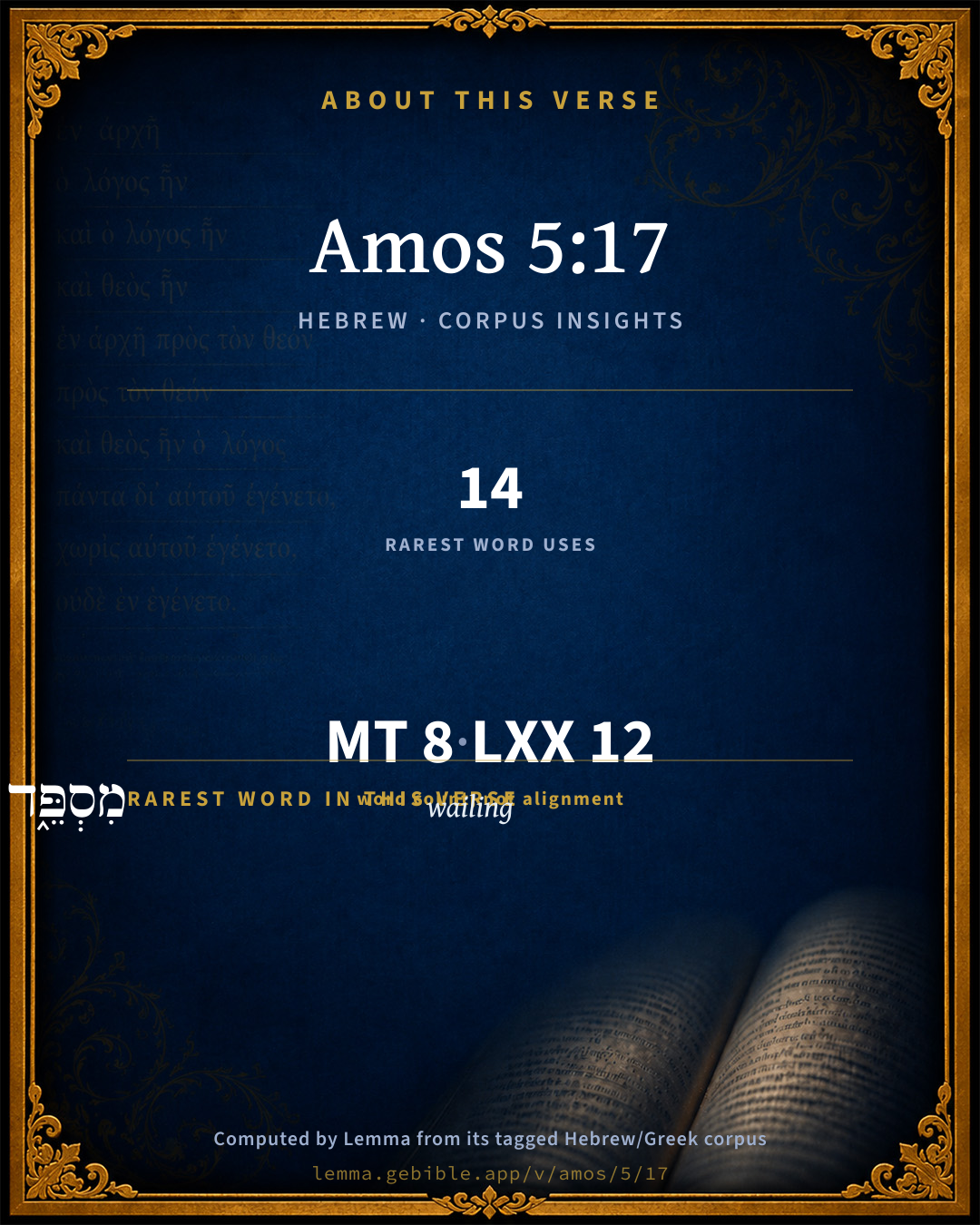
The rarest word here is מִסְפֵּ֑ד wailing H4553 — appearing just 14 times in the whole Hebrew Bible.

Shared distinctive vocabulary

מִסְפֵּ֑ד wailing H4553 occurs in 12 verses of the Hebrew Bible. Also found in:

Grammatical profile

  • 2 verbs
  • 5 nouns
  • 1 conjunction

Verb forms

  • אֶעֱבֹ֥ר Qal · Imperfect
  • אָמַ֥ר Qal · Perfect

Hebrew & Septuagint length

In English translation the verse runs 18 words from the Hebrew and 21 from the Septuagint (LXX English) — closely comparable.

A rough comparison of the two English renderings, which tokenize alike — not a word-level alignment.

Word counts can differ between the Hebrew and the Greek without any difference in meaning — e.g. the Hebrew direct-object marker אֵת has no separate Greek word, and Greek often adds the article ὁ.

In the original languages it is 8 Hebrew tokens and 12 Greek tokens — but the two are counted differently (Hebrew bundles its prefixes and suffixes into one token; the Greek is in lemma form), so that isn’t a like-for-like length.

Cross-references

10

Topical passages linked to Amos 5:17 in the Treasury of Scripture Knowledge — connected by theme and wording, ordered by reader-vote popularity; previews shown in the World English Bible.

  • Exodus 12:12 For I will go through the land of Egypt in that night, and will strike all the firstborn in the land of Egypt, both man and animal. Against all the gods of Egypt I will execute judgments: I am Yahweh.
  • Isaiah 16:10 Gladness is taken away, and joy out of the fruitful field; and in the vineyards there shall be no singing, neither joyful noise: nobody shall tread out wine in the presses; I have made the [vintage] shout to cease.
  • Jeremiah 48:33 Gladness and joy is taken away from the fruitful field and from the land of Moab; and I have caused wine to cease from the wine presses: none shall tread with shouting; the shouting shall be no shouting.
  • Exodus 12:23 For Yahweh will pass through to strike the Egyptians; and when he sees the blood on the lintel, and on the two side-posts, Yahweh will pass over the door, and will not allow the destroyer to come in to your houses to strike you.
  • Isaiah 32:10–12 For days beyond a year shall you be troubled, you careless women; for the vintage shall fail, the harvest shall not come.
  • Hosea 9:1–2 Don't rejoice, Israel, to jubilation like the nations; For you were unfaithful to your God. You love the wages of a prostitute at every grain threshing floor.
  • Joel 3:17 "So you will know that I am Yahweh, your God, Dwelling in Zion, my holy mountain. Then Jerusalem will be holy, And no strangers will pass through her any more.
  • Nahum 1:12 Thus says Yahweh: "Though they be in full strength, and likewise many, even so they will be cut down, and he shall pass away. Though I have afflicted you, I will afflict you no more.
  • Nahum 1:15 Behold, on the mountains the feet of him who brings good news, who publishes peace! Keep your feasts, Judah! Perform your vows, for the wicked one will no more pass through you. He is utterly cut off.
  • Zechariah 9:8 I will encamp around my house against the army, That none pass through or return; And no oppressor will pass through them any more: For now I have seen with my eyes.

Cross-references courtesy of OpenBible.info (CC BY 4.0).

Hebrew and Greek witnesses Masoretic Hebrew ↔ Greek Septuagint

The same verse in the two great witnesses to the Old Testament, shown verse-for-verse.

These are two independent witnesses, not word-aligned to each other, and the Septuagint is shown in lemma (dictionary) form.

Hebrew Amos 5:17 Masoretic · Westminster Leningrad Codex

וּבְכָל כְּרָמִ֖ים מִסְפֵּ֑ד כִּֽי אֶעֱבֹ֥ר בְּקִרְבְּךָ֖ אָמַ֥ר יְהוָֽה

In all vineyards there will be wailing; For I will pass through the midst of you," says Yahweh.

World English Bible · Public Domain

Greek LXX Amos 5:17 Septuagint · lemma form

καί ἐν πᾶς ὁδός κοπετός διότι διαἔρχομαι διά μέσος σύ εἶπον κύριος

And there shall be lamentation in all the ways; because I will pass through the midst of you, says the Lord.

LXX2012 (modern English Septuagint) · Public Domain

Hebrew: Westminster Leningrad Codex (CC BY 4.0). Greek: Septuagint (public domain); English from LXX2012 (modern English Septuagint) (Public Domain). How the Septuagint differs from the Hebrew →

Targum (Aramaic paraphrase)

1

The Targum is the ancient Jewish Aramaic paraphrase of the Hebrew Scriptures — an interpretive translation, not the Hebrew text itself. Onkelos (literal) and Pseudo-Jonathan (expansive) render the Torah, and Jonathan the Prophets. Coverage is partial: where no permissively-licensed English translation exists for a verse, only the Aramaic is shown. This is verse-level text, not a word-by-word alignment to the Hebrew.

  1. Targum Jonathan Prophets (Joshua–Malachi)
    וּבְכָל כַּרְמַיָא מִסְפְּדָא אֲרֵי אִתְגְלֵי לְמֶעְבַּד פּוּרְעֲנוּת דִין בְּגַוֵיךְ אֲמַר יְיָ:

    (no public-domain English translation for this verse)

    Targum Jonathan — Aramaic: “Mikraot Gedolot” (public domain). English: “Sefaria Community Translation” (CC0 1.0 (public-domain dedication)); “London "Chaldee Paraphrase," 1871” (public domain). Text via Sefaria.

Commentary

Notes on Amos 5:17 from classic Christian and Jewish commentators (each source and its license shown beneath its notes). The classic Christian expositions comment on the surrounding passage and are grouped to its opening verse, so a note may address several verses; the Jewish commentaries on the Tanakh (Rashi and others) are per-verse, so they appear only where the commentator wrote on this verse.

Lemma curates 59 commentaries, every one of them public domain or Creative Commons licensed, each selected and text-cleaned for this edition rather than reprinted as found. About our sources →

Trapp's Complete Commentary

John Trapp

Amo 5:17 And in all vineyards [shall be] wailing: for I will pass through thee, saith the LORD.

Ver. 17. And in all vineyards shall be wailing] Where used to be great jollity and revelry riot in time of vintage, Psa 4:7. The calamity shall be common, the scourge overflowing; and all sorts shall have their share. See Joe 1:5; Joe 1:11; Joe 1:13.

For I will pass through thee, saith the Lord] As a fire in a thick wood, Jas 3:5, or dry stubble, Joe 2:5 Nah 1:10. I will go through them, I will burn them together, Isa 27:4, make a short work with them, Rom 9:28. So fearful a thing it is to fall into the punishing hands of the living God, Heb 10:31, to stand in his way, when his sword is in commission, and he saith to it, "Sword, go through the land; cut off man and beast from it," Eze 14:17. Let this be thought on by those secure ones that live as if they were out of the reach of God’s rod; for "what if the sword contemn even the rod?" Eze 21:13, and be drenched in the gall of these sturdy rebels? what then?

John Trapp, A Commentary or Exposition upon All the Books of the Old and New Testament (1647–1656) — public domain. Text from a community e-Sword module.

Jamieson, Fausset & Brown

Robert Jamieson, A. R. Fausset & David Brown

in all vineyards . . . wailing--where usually songs of joy were heard.

pass through thee--taking vengeance (Exo 12:12, Exo 12:23; Nah 1:12). "Pass over" and "pass by," on the contrary, are used of God's forgiving (Exo 12:23; Mic 7:18; compare Amo 7:8).

Jamieson, Fausset & Brown — Commentary Critical and Explanatory on the Whole Bible (1871) — public domain (CC PDM 1.0). Text via the HelloAO Bible API.

Adam Clarke's Commentary

Verse 17. And in all vineyards shall be wailing] The places where festivity especially used to prevail.

I will pass through thee] As I passed, by the ministry of the destroying angel, through Egypt, not to spare, but to destroy.

Adam Clarke's Commentary on the Bible (1810–1826) — public domain. Text from a community e-Sword/MySword module.

John Calvin's Commentaries

A reason is now added, why the whole country would be taken up with lamentation and mourning; for the Lord would pass through the whole land. Surely nothing was more to be desired, than that God should visit his own land; but he here declares that he would pass through as an enemy. As then an enemy runs through a country and spreads devastation wherever he comes, such would be the passing through, which the Prophet now threatens. “God, then, of whom ye boast, as dwelling in the midst of you, will come forth, lay waste, and consume the whole land, as when an enemy spreads ruin far and wide.”

But the Prophet seems to allude to the passing of God, described by Moses in Exodus 11. The Lord then passed through the middle of Egypt; that is, his wrath pervaded the whole land; no corner was safe or tranquil, for God’s vengeance penetrated through every part of it. So also now the Prophet intimates, that the land of Israel would be like that of Egypt; for the Lord, who then testified his love towards the children of Abraham, would now, on the contrary, show himself an enemy to them, while passing through the midst of them. And the Prophet again indirectly ridicules the vain confidence by which the Israelites were blinded, while they used God’s name as a pretext, as it will more clearly appear from what follows, for he says —

John Calvin's Commentaries (1540-1563) — public domain. Text from the Calvin Translation Society English edition (1840s-50s) via the Christian Classics Ethereal Library (ccel.org). Calvin's coverage is partial (roughly two-thirds of the Bible); uncommented books and verses are honest gaps, never fabricated. The 19th-century editor's footnotes and remarks are omitted so the notes are faithfully Calvin's own voice.

The Cambridge Bible for Schools and Colleges

gen. ed. J. J. S. Perowne

17. The wailing will embrace even the vineyards, which, as the season of vintage came round, were annually the scenes of mirth and hilarity (Isa_16:10).

for I will pass through the midst of thee] viz. as a destroyer (cf. Exo_12:12), guiding, as it were, the foe by whose agency Amos conceives the disaster to be accomplished.

(2) Amo_5:18-27. A rebuke, addressed to those who desired the “Day of Jehovah,” and trusted to the splendour and regularity of their religious services, to secure for them Jehovah’s favour. They have mistaken the principles upon which Jehovah acts: His ‘day,’ when it arrives, will be a day on which, so far from sparing them for their zealous discharge of ritual observances, He will consign them to exile for their disregard of moral obligations.

The Cambridge Bible for Schools and Colleges (gen. ed. J. J. S. Perowne; Cambridge University Press, 1878–1918) — public domain. Text from a community e-Sword module.

John Gill's Exposition

And in all vineyards shall be wailing,.... The vines being destroyed, and no grapes to be gathered, and put into the press; when there used to be great shoutings, and large expressions of joy, at the gathering in of the vintage, and pressing the grapes; but now there shall be a different tone; see Jer 48:32;

for I will pass through thee, saith the Lord; through their cities, towns, and country, fields and vineyards, and destroy all in his way, as he passed through Egypt when he destroyed their firstborn.

John Gill's Exposition of the Whole Bible (1746–1763) — public domain (CC PDM 1.0). Text via the HelloAO Bible API.

Albert Barnes' Notes on the Bible

And in all vineyards shall be wailing - All joy should be turned into sorrow. Where aforetime was the vintage-shout in thankfulness for the ingathering, and anticipating gladness to come, there, in the source of their luxury, should be wailing, the forerunner of sorrow to come. it was a vintage, not of wine, but of woe.

For I will pass through thee - In the destruction of the firstborn in Egypt, God did not “pass through” but “passed over” them, and they kept, in memory thereof the feast of the Passover. Now God would no longer “pass over” them and their sins. He says, “I will pass through thee,” as He then said, “I will pass through the land of Egypt this night, and will smite all the firstborn of the land of Egypt - and against all the gods of Egypt I will execute judgment” Exo 12:12. As God says by Hosea, “I will not enter the city” Hos 11:9, that is, He would not make His presence felt, or take cognizance, when to take cognizance would be to punish, so here, contrariwise, He says, “I will pass through,” taking exact and severe account, in judgment. Jerome further says, “so often as this word is used in Holy Scripture, in the person of God, it denotes punishment, that He would not abide among them, but would pass through and leave them. Surely, it is an image of this, that, when the Jews would have cast our Lord headlong from the brow of the hill whereon their city was built, “He passed through the midst of them Luk 4:30, so that they could not see Him nor know Him, “and so went His way.” And this, when He had just told them, that none of the widows of Israel were fed by Elias, or the lepers cleansed by Elisha, save the widow of Sarepta, and Naaman the Syrian. So should their leprosy cleave to them, and the famine of the word of God and of the oil of the Holy Spirit abide among them, while the Gentiles were washed by His laver and fed with the bread of life.”

Albert Barnes' Notes on the Bible (1834–1885) — public domain. Text from a community e-Sword/MySword module.

Matthew Poole's English Annotations

In all vineyards shall be wailing: in these places was usually the greatest jollity, and they gathered their vintage with joy; but now it is quite contrary, either vines are blasted, or eaten up, or destroyed of the enemy.

I will pass through thee, as an incensed God, punishing all, every where, who have sinned against him; and therefore every place now shall be full of sorrow, because every place hath been full of sin.

Matthew Poole's English Annotations on the Holy Bible (1683–1685) — public domain. Text from a community e-Sword/MySword module.

The Pulpit Commentary

Vineyards. The place of mirth and gladness, that, says St. Jerome, "ubi quondam fuit materia laetitiae, sit origo lacrymarum". (Isa_16:10) I will pass through thee. A terrible echo of the last plague of Egypt, (Exo_12:12) when God will not "pass over" thee as he did then, but treat thee as Egypt, and "pass through" to smite and punish. (Nah_1:12)

The Pulpit Commentary (1880–1919), ed. H.D.M. Spence-Jones & Joseph S. Exell — public domain. Text from a community e-Sword module.

John Wesley's Explanatory Notes

Vineyards - In these places were usually the greatest joy. Pass through - To punish all everywhere.

John Wesley, Explanatory Notes Upon the Whole Bible (1754–1765) — public domain. Text via the GEBible commentary corpus.

Lesson kit

Teaching starters — assembled from the data on this page, not authored interpretation. Every prompt links to the verse data it draws on. Edit before teaching.

Amos, in the Prophets, opens this verse with 8 words (8 distinct Hebrew lemmas). Its most distinctive word is miçpêd (“wailing”). A historical commentator’s framing appears above. Read the whole chapter for the surrounding context.

Discussion questions

  1. How does “wailing” (miçpêd) shape what this verse is saying?
  2. How does Genesis 50:10, which shares the word «wailing», read alongside this verse?
  3. The translations on this page render this verse differently — a whole-verse word diff, not a word-by-word alignment. What might account for the different wordings?
  4. «אֶעֱבֹ֥ר» is a Qal Imperfect verb. How does that grammatical form shape the action described?
  5. Compare how Trapp's Complete Commentary and Jamieson, Fausset & Brown read this verse. Where do they agree or differ?

Things to notice

Reading settings

Reading text

Shown beneath each verse's original-language words.

Old Testament
Old Testament edition

Read the OT as the Masoretic Hebrew (MT) or the Greek Septuagint (LXX).

English shown for the Greek Septuagint (in the Hebrew ↔ Greek comparison).

Comparing translations? Open the Compare panel on any verse page to stack up to four side by side.