Psalms 62:4

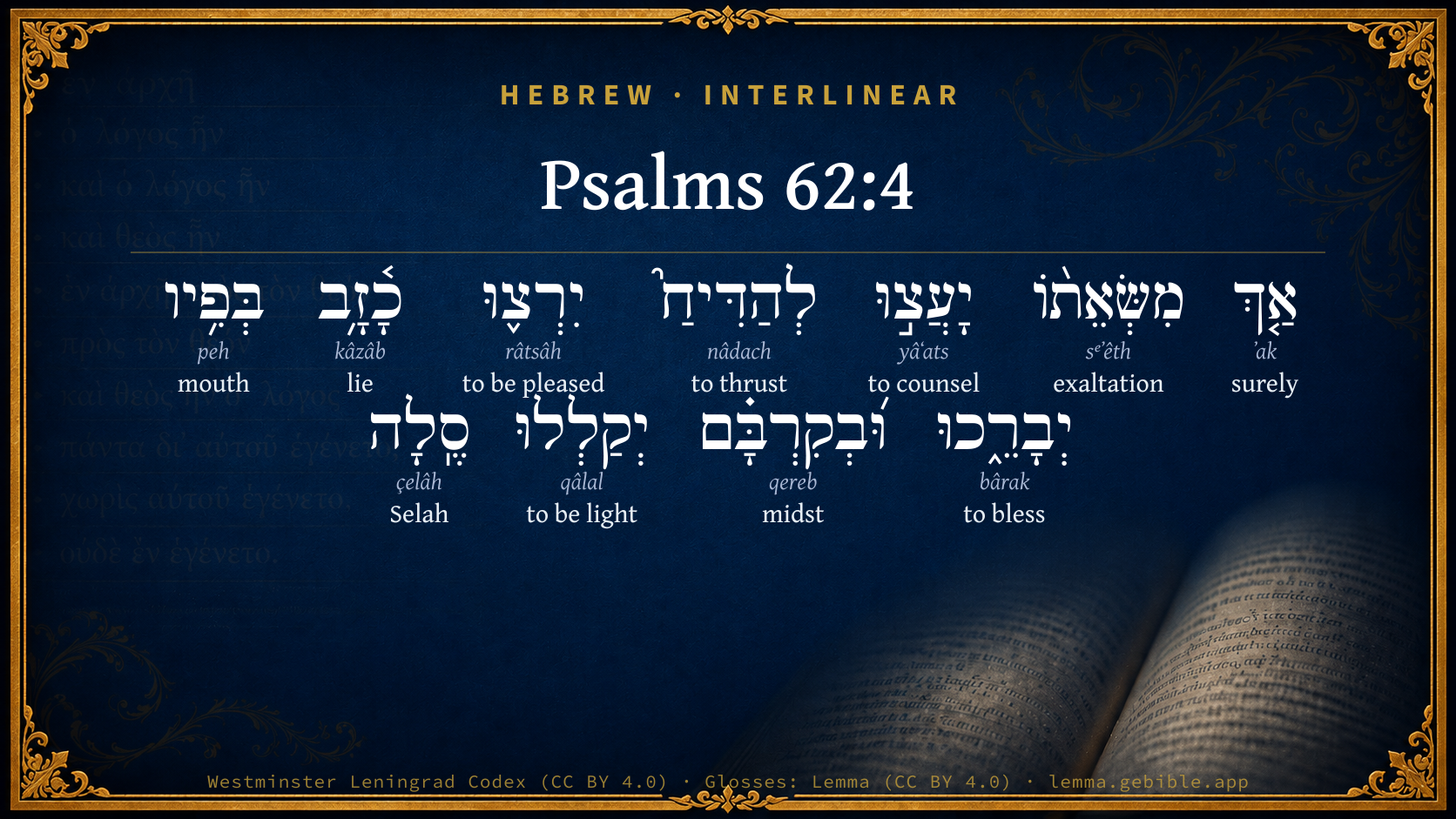
Hebrew (Westminster Leningrad Codex) Psalms 62:4 appears in the Hebrew Old Testament. The text above is from the Westminster Leningrad Codex. Each word links to its Strong’s number, a concise gloss, and parsing drawn from the Open Scriptures Hebrew Bible morphology. Click any word for its full Brown-Driver-Briggs (BDB) entry.
Download image
Cite this verse

Psalms 62:4 (World English Bible). Public Domain. Lemma interlinear Bible study tool, https://lemma.gebible.app/v/psalms/62/4.

Show BibTeX & RIS
BibTeX
RIS
English Translation
They fully intend to throw him down from his lofty place. They delight in lies. They bless with their mouth, but they curse inwardly. Selah.
World English Bible · Public Domain
Download a study sheet

One document with this verse’s original text, its word-by-word gloss line, the meaning frame, cross-references with their text, attributed commentary, and full source and license credits — printable, and it pastes into notes with its structure intact.

This verse Autodidact and up

Study sheet (.html) Plain text (.txt)

A passage Seminary Student

Up to 50 verses in one chapter. A passage sheet keeps up to 6 commentary sources and 12 cross-references per verse, in the order this page ranks them, and says so on the sheet whenever that leaves anything out. Ask for a single verse and you get the Autodidact verse sheet above.

Everything on this page stays free to read, with no account — the sheet is a download of what is already on screen, not access to it.

Want to remove ads? Support Godless Engineer
Compare translations 3

The same verse in 3 English versions, stacked beneath the original-language interlinear above. Click any original word for its lexicon entry.

Each is an independent rendering of the whole verse — the interlinear is not word-aligned to these translations.

Highlighted words mark where these versions differ — a whole-verse word diff, not a word-by-word alignment.

  • World English Bible Public Domain
    They fully intend to throw him down from his lofty place. They delight in lies. They bless with their mouth, but they curse inwardly. Selah.
  • King James Version Public Domain
    They only consult to cast him down from his excellency: they delight in lies: they bless with their mouth, but they curse inwardly. Selah.
  • unfoldingWord Literal Text CC BY-SA 4.0
    They consult only to cast down from his elevation. They delight a lie; with his mouth, they bless, but in their inside, they curse. Selah

unfoldingWord Literal Text — © unfoldingWord, licensed CC BY-SA 4.0. Word-aligned USFM3 via Door43 (git.door43.org/unfoldingWord/en_ult).

Versions to compare (up to 4)

3 of 4 selected

Show all 18 translations

Every available English version of this verse, each an independent rendering of the whole verse.

  • World English Bible Public Domain
    They fully intend to throw him down from his lofty place. They delight in lies. They bless with their mouth, but they curse inwardly. Selah.
  • Berean Standard Bible Public Domain
    They fully intend to cast him down from his lofty perch; they delight in lies; with their mouths they bless, but inwardly they curse. Selah
  • Majority Standard Bible Public Domain
    They fully intend to cast him down from his lofty perch; they delight in lies; with their mouths they bless, but inwardly they curse. Selah
  • King James Version Public Domain
    They only consult to cast him down from his excellency: they delight in lies: they bless with their mouth, but they curse inwardly. Selah.
  • American Standard Version (1901) Public Domain
    They only consult to thrust him down from his dignity; They delight in lies; They bless with their mouth, but they curse inwardly. Selah
  • Revised Version (1885) Public Domain
    They only consult to thrust him down from his excellency; they delight in lies: they bless with their mouth, but they curse inwardly. Selah
  • Geneva Bible (1599) Public Domain
    Yet they consult to cast him downe from his dignitie: their delight is in lies, they blesse with their mouthes, but curse with their hearts. Selah.
  • Douay-Rheims (1899) Public Domain
    How long do you rush in upon a man? you all kill, as if you were thrusting down a leaning wall, and a tottering fence.
  • Young's Literal Translation Public Domain
    Only -- from his excellency They have consulted to drive away, They enjoy a lie, with their mouth they bless, And with their heart revile. Selah.
  • Literal Standard Version CC BY-SA 4.0
    Only—from his excellence || They have consulted to drive away, || They enjoy a lie, they bless with their mouth, || And revile with their heart. Selah.
  • Unlocked Literal Bible CC BY-SA 4.0
    They consult with him only to bring him down from his honorable position; they love to tell lies; they bless him with their mouths, but in their hearts they curse him. Selah
  • unfoldingWord Literal Text CC BY-SA 4.0
    They consult only to cast down from his elevation. They delight a lie; with his mouth, they bless, but in their inside, they curse. Selah
  • Darby Bible Public Domain
    They only consult to thrust [him] down from his excellency; they delight in lies; they bless with their mouth, but in their inward part they curse. Selah.
  • World Messianic Bible Public Domain
    They fully intend to throw him down from his lofty place. They delight in lies. They bless with their mouth, but they curse inwardly. Selah.
  • Webster's Bible Public Domain
    \\62:3\\How long will ye imagine mischief against a man? ye shall be slain all of you: as a bowing wall shall ye be, and as a tottering fence.
  • Free Bible Version CC BY-SA 4.0
    They plan to throw me down from my high position; they love to tell lies. They say nice things to me, but inside they're cursing me. Selah.
  • Bible in Basic English Public Domain
    Their only thought is to put him down from his place of honour; their delight is in deceit: blessing is in their mouths but cursing in their hearts. (Selah.)
  • JPS Tanakh (1917) Public Domain
    (62-5) They only devise to thrust him down from his height, delighting in lies; they bless with their mouth, but they curse inwardly. Selah

Literal Standard Version (2020), Covenant Press — licensed CC BY-SA 4.0. Text via the HelloAO Bible API (eBible.org). Unlocked Literal Bible (unfoldingWord) — licensed CC BY-SA 4.0. Text via the HelloAO Bible API (eBible.org). unfoldingWord Literal Text — © unfoldingWord, licensed CC BY-SA 4.0. Word-aligned USFM3 via Door43 (git.door43.org/unfoldingWord/en_ult). Free Bible Version, Dr. Jonathan Gallagher — licensed CC BY-SA 4.0. Text via the HelloAO Bible API (eBible.org).

Word by word

More ways to search: Search by grammar → Find every occurrence → Compare this word →

Practice this passage: Drill this verse → Learn its vocabulary →

מִשְּׂאֵת֨וֹ
sᵉʼêth
H7613
“from · exaltation · his”
Preposition + Noun, Common, Feminine, Singular, Construct + Suffix, Personal, 3rd Person, Masculine, Singular
Part of Speech
Preposition + Noun
Type
Common
Gender
Feminine
Number
Singular
State
Construct
Full BDB Definition

Origin: from H5375

TWOT: 1421j

elevation, exaltation, dignity, swelling, uprising - dignity, exaltation, loftiness - swelling - uprising
  1. אַ֤ךְ ʼak H389 “surely” Particle, Accusative
  2. יָעֲצ֣וּ yâʻats H3289 “to counsel” Verb, Qal, Perfect, 3rd Person, Common, Plural
  3. לְהַדִּיחַ֮ nâdach H5080 “to thrust” Preposition + Verb, Hiphil, Infinitive Construct
  4. יִרְצ֪וּ râtsâh H7521 “to be pleased” Verb, Qal, Imperfect, 3rd Person, Masculine, Plural
  5. כָ֫זָ֥ב kâzâb H3577 “lie” Noun, Common, Masculine, Singular, Absolute
  6. בְּפִ֥יו peh H6310 “in/at · mouth · his” Preposition + Noun, Common, Masculine, Singular, Construct + Suffix, Personal, 3rd Person, Masculine, Singular
  7. יְבָרֵ֑כוּ bârak H1288 “to bless” Verb, Piel, Imperfect, 3rd Person, Masculine, Plural
  8. וּ֝בְקִרְבָּ֗ם qereb H7130 “and · in/at · midst · their” Conjunction + Preposition + Noun, Common, Masculine, Singular, Construct + Suffix, Personal, 3rd Person, Masculine, Plural
  9. יְקַלְלוּ qâlal H7043 “to be light” Verb, Piel, Imperfect, 3rd Person, Masculine, Plural
  10. סֶֽלָה çelâh H5542 “Selah” Particle, Interjection

About this verse

These counts appear in no published source. They are computed here, from the morphology-tagged text and Lemma’s own curated glosses. What Lemma adds →

11
words
11
distinct lemmas
Wisdom
section

Notable vocabulary

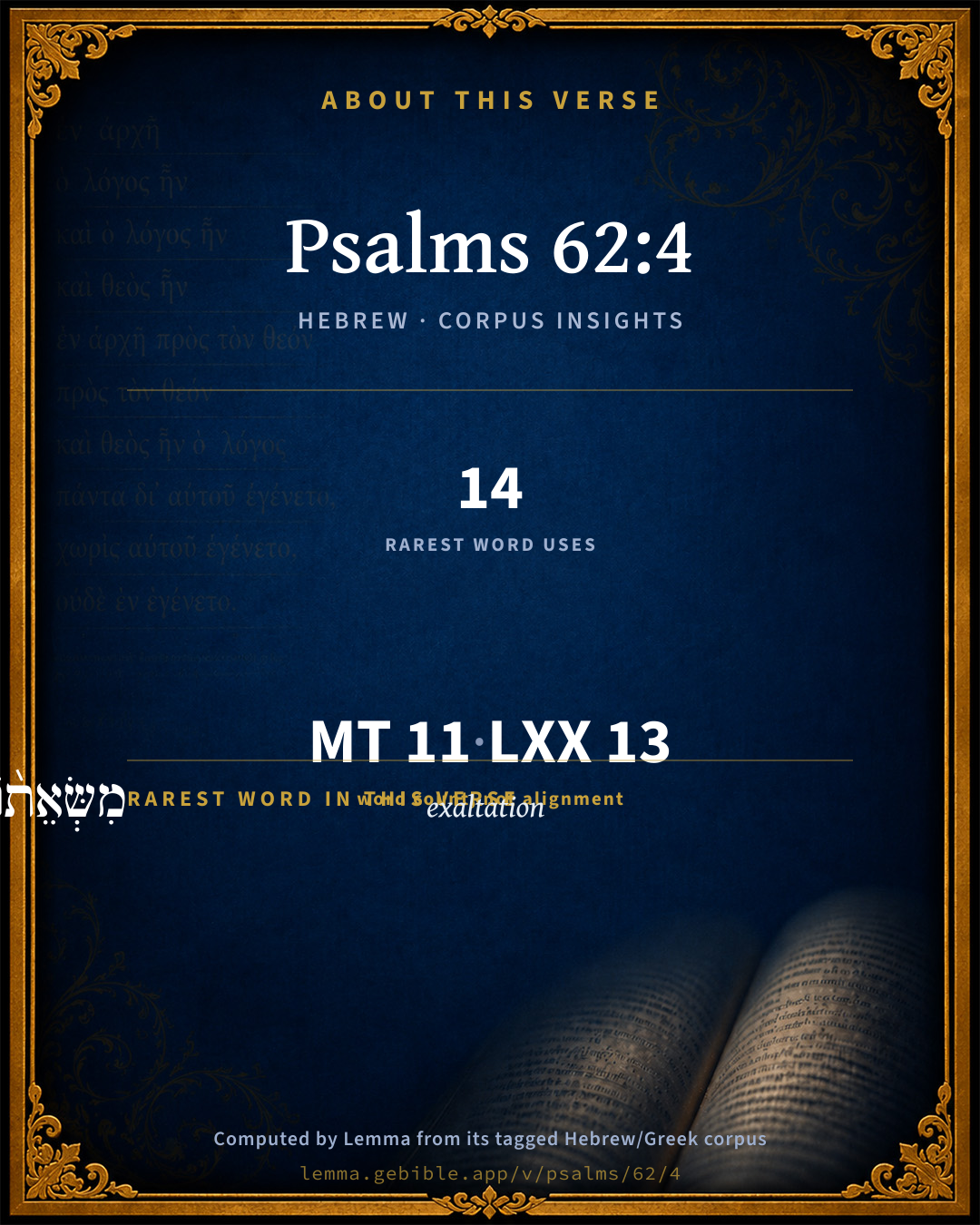
The rarest word here is מִשְּׂאֵת֨וֹ exaltation H7613 — appearing just 14 times in the whole Hebrew Bible.

Shared distinctive vocabulary

מִשְּׂאֵת֨וֹ exaltation H7613 occurs in 13 verses of the Hebrew Bible. Also found in:

Grammatical profile

  • 5 verbs
  • 4 nouns
  • 2 particles

Verb forms

  • יָעֲצ֣וּ Qal · Perfect
  • לְהַדִּיחַ֮ Hiphil · Infinitive Construct
  • יִרְצ֪וּ Qal · Imperfect
  • יְבָרֵ֑כוּ Piel · Imperfect
  • יְקַלְלוּ Piel · Imperfect

Hebrew & Septuagint length

In English translation the verse runs 25 words from the Hebrew and 26 from the Septuagint (LXX English) — closely comparable.

A rough comparison of the two English renderings, which tokenize alike — not a word-level alignment.

Word counts can differ between the Hebrew and the Greek without any difference in meaning — e.g. the Hebrew direct-object marker אֵת has no separate Greek word, and Greek often adds the article ὁ.

In the original languages it is 11 Hebrew tokens and 13 Greek tokens — but the two are counted differently (Hebrew bundles its prefixes and suffixes into one token; the Greek is in lemma form), so that isn’t a like-for-like length.

Cross-references

26

Topical passages linked to Psalms 62:4 in the Treasury of Scripture Knowledge — connected by theme and wording, ordered by reader-vote popularity; previews shown in the World English Bible.

  • Psalms 55:21 His mouth was smooth as butter, But his heart was war. His words were softer than oil, Yet they were drawn swords.
  • Psalms 28:3 Don't draw me away with the wicked, With the workers of iniquity who speak peace with their neighbors, But mischief is in their hearts.
  • Psalms 5:9 For there is no faithfulness in their mouth. Their heart is destruction. Their throat is an open tomb. They flatter with their tongue.
  • Romans 7:22 For I delight in God's law after the inward man,
  • Romans 1:32 who, knowing the ordinance of God, that those who practice such things are worthy of death, not only do the same, but also approve of those who practice them.
  • Revelation 22:15 Outside are the dogs, the sorcerers, the sexually immoral, the murderers, the idolaters, and everyone who loves and practices falsehood.
  • Psalms 52:3 You love evil more than good, Lying rather than speaking the truth. Selah.
  • John 8:44 You are of your Father, the devil, and you want to do the desires of your father. He was a murderer from the beginning, and doesn't stand in the truth, because there is no truth in him. When he speaks a lie, he speaks on his own; for he is a liar, and the father of it.
  • John 11:47–50 The chief priests therefore and the Pharisees gathered a council, and said, "What are we doing? For this man does many signs.
  • Acts 4:16–17 saying, "What shall we do to these men? Because indeed a notable miracle has been done through them, as can be plainly seen by all who dwell in Jerusalem, and we can't deny it.
  • Acts 4:25–28 who by the mouth of your servant, David, said, 'Why do the nations rage, And the peoples plot a vain thing?
  • Psalms 2:1–3 Why do the nations rage, And the peoples plot a vain thing?
  • Psalms 51:6 Behold, you desire truth in the inward parts. You teach me wisdom in the inmost place.
  • Psalms 119:163 I hate and abhor falsehood. I love your law.
  • Proverbs 6:17 Haughty eyes, a lying tongue, Hands that shed innocent blood;
  • Proverbs 13:5 A righteous man hates lies, But a wicked man brings shame and disgrace.
  • Hosea 7:3 They make the king glad with their wickedness, And the princes with their lies.
  • Matthew 2:3–4 When Herod the king heard it, he was troubled, and all Jerusalem with him.
  • Matthew 2:16 Then Herod, when he saw that he was mocked by the wise men, was exceedingly angry, and sent out, and killed all the male children who were in Bethlehem and in all the surrounding countryside, from two years old and under, according to the exact time which he had learned from the wise men.
  • Matthew 22:15 Then the Pharisees went and took counsel how they might entrap him in his talk.
  • Matthew 22:23 On that day Sadducees (those who say that there is no resurrection) came to him. They asked him,
  • Matthew 22:34–35 But the Pharisees, when they heard that he had put the Sadducees to silence, gathered themselves together.
  • Matthew 26:3–4 Then the chief priests, the scribes, and the elders of the people were gathered together in the court of the high priest, who was called Caiaphas.
  • Matthew 27:1 Now when morning had come, all the chief priests and the elders of the people took counsel against Jesus to put him to death:
  • Luke 11:39 The Lord said to him, "Now you Pharisees cleanse the outside of the cup and of the platter, but your inward part is full of extortion and wickedness.
  • Luke 20:20 They watched him, and sent out spies, who pretended to be righteous, that they might trap him in something he said, so as to deliver him up to the power and authority of the governor.

Cross-references courtesy of OpenBible.info (CC BY 4.0).

Hebrew and Greek witnesses Masoretic Hebrew ↔ Greek Septuagint

The same verse in the two great witnesses to the Old Testament, shown verse-for-verse.

You’re reading Greek Psalm 61 (Hebrew Psalm 62). The Septuagint counts the superscription, so verse numbers can differ from the Hebrew — chapter-level alignment, not verse-by-verse. Numbering follows Rahlfs.

These are two independent witnesses, not word-aligned to each other, and the Septuagint is shown in lemma (dictionary) form.

Hebrew Psalms 62:4 Masoretic · Westminster Leningrad Codex

אַ֤ךְ מִשְּׂאֵת֨וֹ יָעֲצ֣וּ לְהַדִּיחַ֮ יִרְצ֪וּ כָ֫זָ֥ב בְּפִ֥יו יְבָרֵ֑כוּ וּ֝בְקִרְבָּ֗ם יְקַלְלוּ סֶֽלָה

They fully intend to throw him down from his lofty place. They delight in lies. They bless with their mouth, but they curse inwardly. Selah.

World English Bible · Public Domain

Greek LXX Greek Psalm 61:4 Septuagint · lemma form

ἕως πότε ἐπιτίθημι ἐπί ἄνθρωπος φονεύω πᾶς ὡς τοῖχος κλίνω καί φραγμός ὠθέω

They only took counsel to set at nothing my honor: I ran in thirst: with their mouth they blessed, but with their heart they cursed. Pause.

LXX2012 (modern English Septuagint) · Public Domain

Hebrew: Westminster Leningrad Codex (CC BY 4.0). Greek: Septuagint (public domain); English from LXX2012 (modern English Septuagint) (Public Domain). How the Septuagint differs from the Hebrew →

Commentary

Notes on Psalms 62:4 from classic Christian and Jewish commentators (each source and its license shown beneath its notes). The classic Christian expositions comment on the surrounding passage and are grouped to its opening verse, so a note may address several verses; the Jewish commentaries on the Tanakh (Rashi and others) are per-verse, so they appear only where the commentator wrote on this verse.

Lemma curates 59 commentaries, every one of them public domain or Creative Commons licensed, each selected and text-cleaned for this edition rather than reprinted as found. About our sources →

Trapp's Complete Commentary

John Trapp

Psa 62:4 They only consult to cast [him] down from his excellency: they delight in lies: they bless with their mouth, but they curse inwardly. Selah.

Ver. 4. They only consult to cast him down from his excellency] Or, yet they consult; q.d. Notwithstanding all that I can say or that God will do to them, they will on in their evil devices and endeavours against me; there is no reclaiming of them. Deus quos destruit dementat.

They delight in lies] Not only he that maketh a lie, but he that loveth and delighteth in it when made by another, shall be shut out of heaven, Rev 22:15 Rom 1:32.

They bless with their mouths] Heb. with his mouth, that is, every one doth so; neither is there ever a better of these glavering companions, dissembling scrubs.

John Trapp, A Commentary or Exposition upon All the Books of the Old and New Testament (1647–1656) — public domain. Text from a community e-Sword module.

Joseph Benson's Commentary

Psa 62:4. They only consult to cast him down — Namely, the man mentioned Psa 62:3. He means himself, of whom he continues to speak in the third person. From his excellency — From the hopes and attainment of that royal dignity to which God hath designed and anointed me. They delight in lies, &c. — In secret slanders and execrations, covered with flatteries and fair speeches, as it here follows.

Joseph Benson's Commentary on the Old and New Testaments (1811–1818) — public domain. Text from a community e-Sword module.

J. A. Alexander on Psalms

Joseph Addison Alexander

5. (Psa 62:4). Only from his elevation they consult to thrust (him, and as a means to this end) they delight in falsehood; with his mouth, (i.e. with their mouths) they will bless, and in their inside (inwardly, or with their heart) they will curse. Selah. The sudden change of number in the middle of the verse, and indeed the whole description, are like those in Psa 5:9.

Joseph Addison Alexander, The Psalms Translated and Explained (1850) — public domain. Text from a community e-Sword module.

Tyndale Open Study Notes

Tyndale Open Resources

62:4 My high position refers to the royal throne.

Tyndale Open Study Notes — © Tyndale Open Resources, licensed CC BY-SA 4.0. Text via the HelloAO Bible API.

Jamieson, Fausset & Brown

Robert Jamieson, A. R. Fausset & David Brown

his excellency--or, elevation to which God had raised him (Psa 4:2). This they try to do by lies and duplicity (Psa 5:9).

Jamieson, Fausset & Brown — Commentary Critical and Explanatory on the Whole Bible (1871) — public domain (CC PDM 1.0). Text via the HelloAO Bible API.

Adam Clarke's Commentary

Verse 4. To cast him down from his excellency] They are consulting to dethrone me, and use treachery and falsehood in order to bring it about: "They delight in lies."

They bless with their mouth] Probably alluding to Absalom's blandishments of the people. He flattered them in order to get the sovereign rule. Or it may refer to the people of Jerusalem, whose perfidy he saw, while they were full of professions of loyalty, c. but he could not trust them, and therefore retired from Jerusalem.

Adam Clarke's Commentary on the Bible (1810–1826) — public domain. Text from a community e-Sword/MySword module.

John Calvin's Commentaries

4. Yet they consult to cast him down from his elevation I still would interpret the particle אך, ach, in an adversative sense. David, on the one hand, encouraged himself by determining to rest steadfastly upon the promise of divine favor; but, upon the other, he had before him the machinations of his enemies, characterised by cruelty, audacity, pride, and deceit. By all their attempts, as if he had said, they do nothing but precipitate their own fall; still such are the frenzy and the fury by which they are actuated, that they persist in their intrigues against me. He insinuates that their attacks were directed, not so much against himself as against God — agreeably to the picture which is given us of impiety by the poets in their fable of the Giants. Nothing will satisfy the enemies of God but setting themselves above the heavens. David is to be understood as primarily speaking here of himself in the third person, but of himself as elevated expressly by the divine hand. Accordingly, though we might consider that God is the party directly intended, the scope of the words rather intimates that they aimed at the overthrow of one whom God had exalted, and desired to establish in honor. In thus attempting to thwart his purpose, they were really fighting against God. The clause which follows, they delight in lies, has reference to the same thing. Refusing to acknowledge his divine vocation, they persevered in following such corrupt designs, as could only recoil upon them to their own confusion, as the Psalmist exclaims,

“O ye sons of men! how long is my glory made matter of your reproach? how long will ye love vanity, and seek after leasing? Selah.” — (Psalm 4:2)

Or the expression may denote the hidden and deceitful measures which they adopted in their persecution of this saint of God; for it is immediately added, that they blessed with their mouth, but cursed inwardly Whatever may be the meaning, it is evident that David, contemplating all the treachery, intrigues, and wickedness of his enemies, supports himself by the single consideration, that his help was in God, and that every opposing instrumentality was therefore vain.

John Calvin's Commentaries (1540-1563) — public domain. Text from the Calvin Translation Society English edition (1840s-50s) via the Christian Classics Ethereal Library (ccel.org). Calvin's coverage is partial (roughly two-thirds of the Bible); uncommented books and verses are honest gaps, never fabricated. The 19th-century editor's footnotes and remarks are omitted so the notes are faithfully Calvin's own voice.

Ellicott's Commentary for English Readers

(4) Their mouth.—Literally, his mouth. They bless each with his mouth, &c

Excellency.—Rather, height, carrying on the metaphor of preceding verse.

A Bible Commentary for English Readers, edited by Charles John Ellicott (1878–1897) — public domain. Text from a community e-Sword module.

The Cambridge Bible for Schools and Colleges

gen. ed. J. J. S. Perowne

4. Only to thrust him down from his dignity have they taken counsel, delighting in a lie:

With his mouth doth each of them bless, but inwardly they curse.

Their plot is ‘a lie,’ false in its principle and in its aim (Psa_4:2, note); and they have been guilty of the grossest hypocrisy and duplicity in promoting it. Cp. Psa_12:2; Psa_28:3; Psa_55:21.

The Cambridge Bible for Schools and Colleges (gen. ed. J. J. S. Perowne; Cambridge University Press, 1878–1918) — public domain. Text from a community e-Sword module.

John Gill's Exposition

They only consult to cast him down from his excellency,.... Either from the excellency of God, from his greatness, and from his height, as Kimchi; or from his grace, as the Arabic version: that is, they consulted to discourage him from looking to God, his rock and fortress, and from trusting in him; or rather, from his own excellency, from what high estate of dignity and honour he was advanced to, or designed for, namely his kingly office. Saul and his courtiers consulted how to prevent his coming to the throne, and Absalom and Ahithophel how to pull him down from it, and seize his crown and kingdom; which latter best agrees with the expression here;

they delight in lies; in making and in spreading them, in order to hurt his character, and give his subjects an ill opinion of him; and thereby alienate their affections from him, and weaken their allegiance and obedience to him; see Rev 22:15;

they bless with their mouth: saying, God bless the king, or save the king:

but they curse inwardly; they curse the king in their hearts, and when by themselves in private, when they imagine nobody hears them; see Ecc 10:20.

Selah; on this word; see Gill on Psa 3:2.

John Gill's Exposition of the Whole Bible (1746–1763) — public domain (CC PDM 1.0). Text via the HelloAO Bible API.

Albert Barnes' Notes on the Bible

They only consult to cast him down from his excellency - This is the object of all their counsels and plans. They aim at one high in rank - and their purpose, their sole purpose, is to bring him down. This would apply well to the case of David in the time of the rebellion of Absalom.

They delight in lies - In false pretences; in secret plans of evil; in hypocritical assurances. This was eminently true of Absalom, who made use of these arts to seduce the people from allegiance to his father. 2Sa 15:1-6.

They bless with their mouth, but they curse inwardly - They profess true attachment and zeal, but they are traitors at heart. See the notes at Psa 28:3. This, too, would apply well to the conduct of Absalom and those associated with him.

Albert Barnes' Notes on the Bible (1834–1885) — public domain. Text from a community e-Sword/MySword module.

Matthew Poole's English Annotations

Him, to wit, the man mentioned Psa 62:3, i.e. himself; of whom he continues to speak in the third person.

From his excellency; from the hopes and attainment of that royal dignity, to which God hath designed and anointed me.

In lies; in secret slanders and execrations, covered with flatteries and fair speeches, as it here follows.

Matthew Poole's English Annotations on the Holy Bible (1683–1685) — public domain. Text from a community e-Sword/MySword module.

The Treasury of David

Charles H. Spurgeon

Ver. 4. They only consult to cast him down from his excellency. The excellencies of the righteous are obnoxious to the wicked, and the main object of their fury. The elevation which God gives to the godly in Providence, or in dispute, is also the envy of the baser sort, and they labour to pull them down to their own level. Observe the concentration of malice upon our point only, as here set in contrast with the sole reliance of the gracious one upon his Lord. If the wicked could but ruin the work of grace in us, they would be content; to crush our character, to overturn our influence, is the object of their consultation.

They delight in lies; hence they hate the truth and the truthful, and by falsehood endeavour to compass their overthrow. To lie is base enough, but to delight in it is one of the blackest marks of infamy.

They bless with their mouth, but they curse inwardly. Flattery has ever been a favourite weapon with the enemies of good men; they can curse bitterly enough when it serves their turn; meanwhile, since it answers their purpose, they mask their wrath, and with smooth words pretend to bless those whom they would willingly tear in pieces. It was fortunate for David that he was well practised in silence, for to cozening deceivers there is no other safe reply.

Selah. Here pause, and consider with astonishment the futile rancour of unholy men, and the perfect security of such as rest themselves upon the Lord.

Ver. 4. They only consult, etc. Truly I am he whom if they shall consult to cast down from his excellency, they shall delight in a lie, they shall bless with their mouth and curse inwardly. That is: what I have said of worldly men, boasting themselves upon a man, falling into ruin, I desire that you should know that the same fate shall never befall me who trust in God; for otherwise does the matter stand. Hermann Venema.

Ver. 4. Excellency. Rather, elevation; the figure of the preceding verse being followed out. Religious Tract Society's Notes.

Ver. 4. Wherein lies a believer's excellency? Who would cast him down, and why, and how they seek to do it?

Ver. 4. They delight in lies. Those who invent them, or spread them, or laugh at them, or readily believe them. Romanists, self righteous persons, the presumptuous, persecutors, zealous errorists, etc.

Psalms 62:5*

Charles H. Spurgeon's The Treasury of David (1869–1885) — public domain. Psalms only. Text from a community e-Sword/MySword module.

Whedon's Commentary on the Bible

Daniel D. Whedon

4. They only consult to cast him down—On only, truly, see Psa_62:1. The object of the conspiracy was to cast David down from the height of his kingly power and honour, to which God had exalted him; and he here submits the issue between them and God.

They delight in lies—As their object is unjust and dishonourable, so they do not scruple to adopt the basest hypocrisy and falsehood in order to accomplish it.

They bless with their mouth—Literally, they bless each one with his mouth. They profess openly to the people that they are doing all for the public good.

Daniel D. Whedon (gen. ed.), Commentary on the Old and New Testaments (1874–1909) — public domain. Text from a community e-Sword module.

The Pulpit Commentary

They only consult to cast him down from his excellency; i.e. they have no other thought but this to cast me down from my high station, while I have no other thought but to trust in God, and to look to him for support and protection (vers. 1, 2, 6). They delight in lies. Some indication of the "lies" circulated against David at this Time is given in 2Sa_15:3-5 2Sa_16:7, 2Sa_16:8. They bless with their mouth, but they curse inwardly; literally, they bless with his mouth, which may be explained as meaning either, "They bless, each of them, with his mouth" (Kay, Cheyne), or "they Bless through the mouth of their leaderi.e. Ahithophel (Canon Cook).

The Pulpit Commentary (1880–1919), ed. H.D.M. Spence-Jones & Joseph S. Exell — public domain. Text from a community e-Sword module.

Rashi

Rabbi Shlomo Yitzchaki (Rashi)

will you plan destruction Heb. תהותתו. Menachem (p. 69) explained it as derived from (Jer. 12: 9): “come (התיו) to eat”; (Deut. 33:21), “He came (ויתא) to the head of the people.” How long will you gather against a man? But it appears to me that it should be interpreted as an expression of הַוּוֹת destruction, and the “hey” and “tav” are the radical. As one says from מֵת, מוֹת, so shall we say from the root הֵת, הוֹת, and the plural is הוּוֹת. It is an expression of a destructive and deceitful plot. Others explain תְּהוֹתֲתוּ as “you extend.” i.e., you extend your tongue on the sons of men with evil, and they compared it to Arabic, when one speaks overly much.

as a leaning wall which is ready to fall upon the sons of men.

Rashi on the Tanakh — English translations: “The Judaica Press complete Tanach with Rashi, translated by A. J. Rosenberg” (CC BY 4.0); “Pentateuch with Rashi's commentary by M. Rosenbaum and A.M. Silbermann, 1929-1934” (public domain); “The Metsudah Tanach series, Lakewood, N.J” (CC BY 4.0); and “The Book of Joshua, Metsudah Publications, 1997” (CC BY 4.0). Text via Sefaria.

Lesson kit

Teaching starters — assembled from the data on this page, not authored interpretation. Every prompt links to the verse data it draws on. Edit before teaching.

Psalms, in the Wisdom, opens this verse with 11 words (11 distinct Hebrew lemmas). Its most distinctive word is sᵉʼêth (“exaltation”). A historical commentator’s framing appears above. Read the whole chapter for the surrounding context.

Discussion questions

  1. What does “exaltation” (sᵉʼêth) contribute to the verse as a whole?
  2. Genesis 4:7 shares the word «exaltation» with this verse. How do the two illuminate each other?
  3. The translations on this page render this verse differently — a whole-verse word diff, not a word-by-word alignment. What might account for the different wordings?
  4. The verb «יָעֲצ֣וּ» is Qal Perfect. How does its form color the action?
  5. Reading how Trapp's Complete Commentary and Joseph Benson's Commentary read this verse, where do the two commentators agree and where do they part?

Things to notice

Reading settings

Reading text

Shown beneath each verse's original-language words.

Old Testament
Old Testament edition

Read the OT as the Masoretic Hebrew (MT) or the Greek Septuagint (LXX).

English shown for the Greek Septuagint (in the Hebrew ↔ Greek comparison).

Comparing translations? Open the Compare panel on any verse page to stack up to four side by side.