
Psalms 55:10

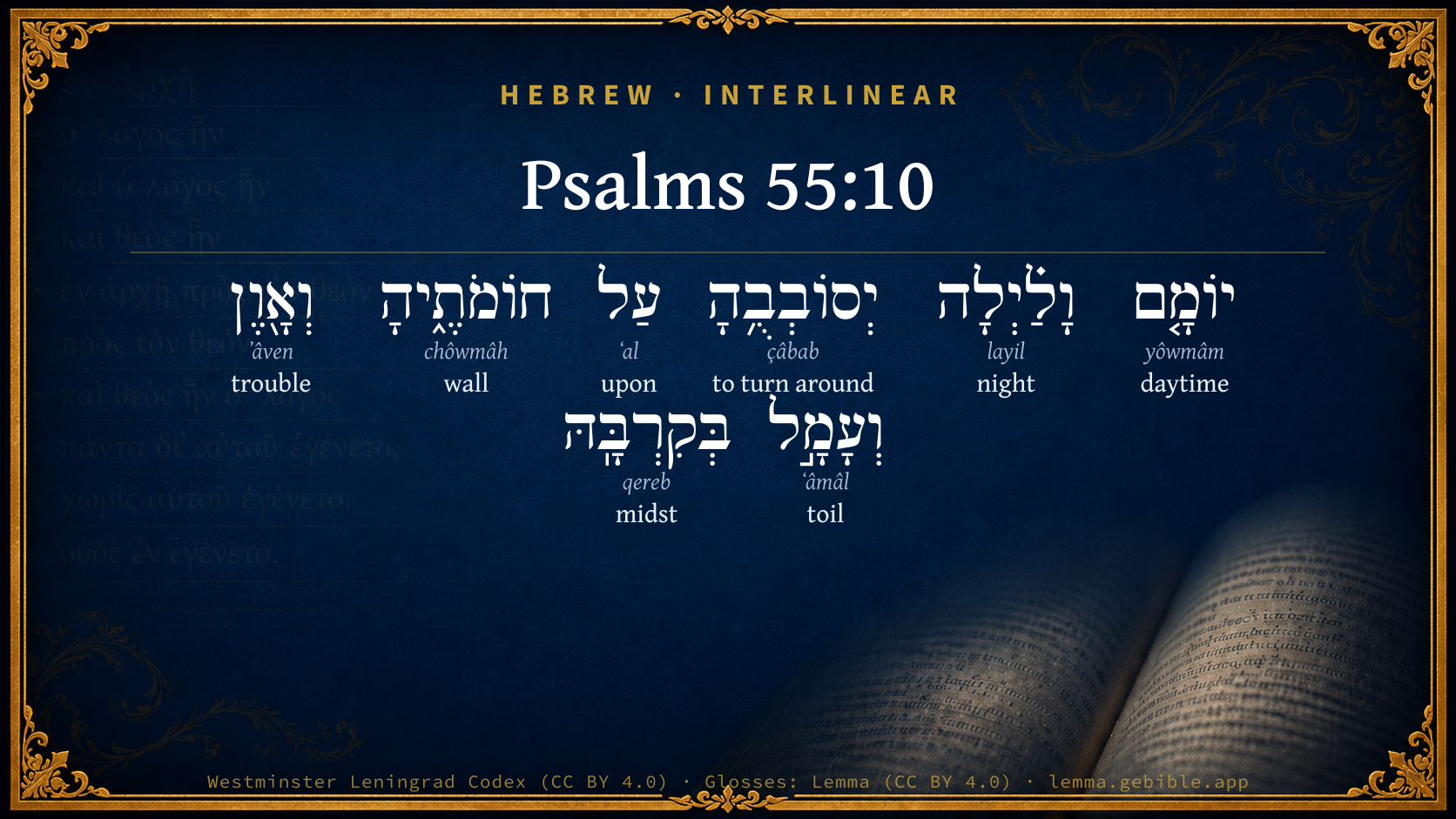
Hebrew (Westminster Leningrad Codex) Psalms 55:10 appears in the Hebrew Old Testament. The text above is from the Westminster Leningrad Codex. Each word links to its Strong’s number, a concise gloss, and parsing drawn from the Open Scriptures Hebrew Bible morphology. Click any word for its full Brown-Driver-Briggs (BDB) entry.
Download image
Cite this verse

Psalms 55:10 (World English Bible). Public Domain. Lemma interlinear Bible study tool, https://lemma.gebible.app/v/psalms/55/10.

Show BibTeX & RIS
BibTeX
RIS
English Translation
Day and night they prowl around on its walls. Malice and abuse are also within her.
World English Bible · Public Domain
Download a study sheet

One document with this verse’s original text, its word-by-word gloss line, the meaning frame, cross-references with their text, attributed commentary, and full source and license credits — printable, and it pastes into notes with its structure intact.

This verse Autodidact and up

Study sheet (.html) Plain text (.txt)

A passage Seminary Student

Up to 50 verses in one chapter. A passage sheet keeps up to 6 commentary sources and 12 cross-references per verse, in the order this page ranks them, and says so on the sheet whenever that leaves anything out. Ask for a single verse and you get the Autodidact verse sheet above.

Everything on this page stays free to read, with no account — the sheet is a download of what is already on screen, not access to it.

Want to remove ads? Support Godless Engineer
Compare translations 3

The same verse in 3 English versions, stacked beneath the original-language interlinear above. Click any original word for its lexicon entry.

Each is an independent rendering of the whole verse — the interlinear is not word-aligned to these translations.

Highlighted words mark where these versions differ — a whole-verse word diff, not a word-by-word alignment.

  • World English Bible Public Domain
    Day and night they prowl around on its walls. Malice and abuse are also within her.
  • King James Version Public Domain
    Day and night they go about it upon the walls thereof: mischief also and sorrow are in the midst of it.
  • unfoldingWord Literal Text CC BY-SA 4.0
    Day and night they go around it on its walls, and iniquity and trouble in the midst of it.

unfoldingWord Literal Text — © unfoldingWord, licensed CC BY-SA 4.0. Word-aligned USFM3 via Door43 (git.door43.org/unfoldingWord/en_ult).

Versions to compare (up to 4)

3 of 4 selected

Show all 18 translations

Every available English version of this verse, each an independent rendering of the whole verse.

  • World English Bible Public Domain
    Day and night they prowl around on its walls. Malice and abuse are also within her.
  • Berean Standard Bible Public Domain
    Day and night they encircle the walls, while malice and trouble lie within.
  • Majority Standard Bible Public Domain
    Day and night they encircle the walls, while malice and trouble lie within.
  • King James Version Public Domain
    Day and night they go about it upon the walls thereof: mischief also and sorrow are in the midst of it.
  • American Standard Version (1901) Public Domain
    Day and night they go about it upon the walls thereof: Iniquity also and mischief are in the midst of it.
  • Revised Version (1885) Public Domain
    Day and night they go about upon the walls thereof: iniquity also and mischief are in the midst of it.
  • Geneva Bible (1599) Public Domain
    Day and night they goe about it vpon the walles thereof: both iniquitie and mischiefe are in the middes of it.
  • Douay-Rheims (1899) Public Domain
    Lo, I have gone far off flying away; and I abode in the wilderness.
  • Young's Literal Translation Public Domain
    By day and by night they go round it, on its walls. Both iniquity and perverseness `are' in its midst,
  • Literal Standard Version CC BY-SA 4.0
    By day and by night they go around it, on its walls. Both iniquity and perverseness [are] in its midst,
  • Unlocked Literal Bible CC BY-SA 4.0
    Day and night they go about on its walls; iniquity and mischief are in the middle of it.
  • unfoldingWord Literal Text CC BY-SA 4.0
    Day and night they go around it on its walls, and iniquity and trouble in the midst of it.
  • Darby Bible Public Domain
    Day and night they go about it upon the walls thereof; and iniquity and mischief are in the midst of it.
  • World Messianic Bible Public Domain
    Day and night they prowl around on its walls. Malice and abuse are also within her.
  • Webster's Bible Public Domain
    \\55:9\\Destroy, O Lord, and divide their tongues: for I have seen violence and strife in the city.
  • Free Bible Version CC BY-SA 4.0
    They patrol the city walls day and night, and wickedness and trouble are within the city.
  • Bible in Basic English Public Domain
    By day and night they go round the town, on the walls; trouble and sorrow are in the heart of it.
  • JPS Tanakh (1917) Public Domain
    (55-11) Day and night they go about it upon the walls thereof; iniquity also and mischief are in the midst of it.

Literal Standard Version (2020), Covenant Press — licensed CC BY-SA 4.0. Text via the HelloAO Bible API (eBible.org). Unlocked Literal Bible (unfoldingWord) — licensed CC BY-SA 4.0. Text via the HelloAO Bible API (eBible.org). unfoldingWord Literal Text — © unfoldingWord, licensed CC BY-SA 4.0. Word-aligned USFM3 via Door43 (git.door43.org/unfoldingWord/en_ult). Free Bible Version, Dr. Jonathan Gallagher — licensed CC BY-SA 4.0. Text via the HelloAO Bible API (eBible.org).

Word by word

More ways to search: Search by grammar → Find every occurrence → Compare this word →

Practice this passage: Drill this verse → Learn its vocabulary →

About this verse

These counts appear in no published source. They are computed here, from the morphology-tagged text and Lemma’s own curated glosses. What Lemma adds →

8
words
8
distinct lemmas
Wisdom
section

Shared distinctive vocabulary

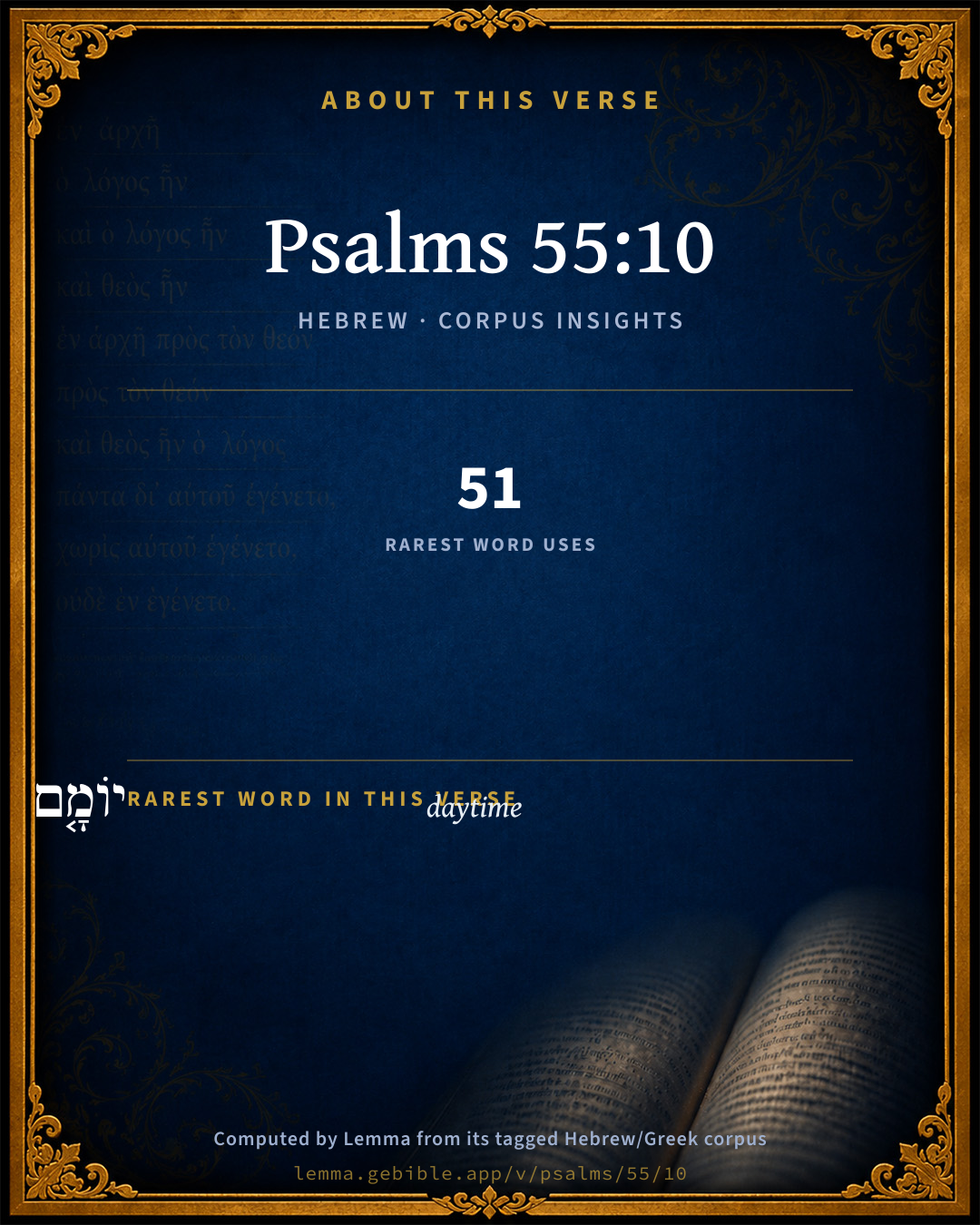
יוֹמָ֤ם daytime H3119 occurs in 50 verses of the Hebrew Bible. Also found in:

Grammatical profile

  • 1 verb
  • 5 nouns
  • 1 preposition
  • 1 adverb

Verb forms

  • יְסוֹבְבֻ֥הָ Poel · Imperfect

Hebrew & Septuagint length

In English translation the verse runs 16 words from the Hebrew and 23 from the Septuagint (LXX English) — closely comparable.

A rough comparison of the two English renderings, which tokenize alike — not a word-level alignment.

Word counts can differ between the Hebrew and the Greek without any difference in meaning — e.g. the Hebrew direct-object marker אֵת has no separate Greek word, and Greek often adds the article ὁ.

Cross-references

13

Topical passages linked to Psalms 55:10 in the Treasury of Scripture Knowledge — connected by theme and wording, ordered by reader-vote popularity; previews shown in the World English Bible.

  • Psalms 59:14–15 At evening let them return. Let them howl like a dog, and go around the city.
  • Isaiah 59:6–15 Their webs shall not become garments, neither shall they cover themselves with their works: their works are works of iniquity, and the act of violence is in their hands.
  • John 18:28 They led Jesus therefore from Caiaphas into the Praetorium. It was early, and they themselves didn't enter into the Praetorium, that they might not be defiled, but might eat the Passover.
  • Psalms 59:6 They return at evening, howling like dogs, And prowl around the city.
  • Ezekiel 9:4 Yahweh said to him, Go through the midst of the city, through the midst of Jerusalem, and set a mark on the foreheads of the men that sigh and that cry over all the abominations that are done in the midst of it.
  • Acts 9:24 but their plot became known to Saul. They watched the gates both day and night that they might kill him,
  • 1 Samuel 19:11 Saul sent messengers to David's house, to watch him, and to kill him in the morning: and Michal, David's wife, told him, saying, If you don't save your life tonight, tomorrow you will be slain.
  • 2 Samuel 16:21–22 Ahithophel said to Absalom, Go in to your father's concubines, that he has left to keep the house; and all Israel will hear that you are abhorred of your father: then will the hands of all who are with you be strong.
  • 2 Samuel 17:1–2 Moreover Ahithophel said to Absalom, Let me now choose out twelve thousand men, and I will arise and pursue after David this night:
  • Hosea 7:6 For they have made ready their heart like an oven, While they lie in wait. Their baker sleeps all the night. In the morning it burns as a flaming fire.
  • Micah 2:1–2 Woe to those who devise iniquity And work evil on their beds! When the morning is light, they practice it, Because it is in the power of their hand.
  • Zephaniah 3:1–3 Woe to her who is rebellious and polluted, the oppressing city!
  • John 18:3 Judas then, having taken a detachment of soldiers and officers from the chief priests and the Pharisees, came there with lanterns, torches, and weapons.

Cross-references courtesy of OpenBible.info (CC BY 4.0).

Hebrew and Greek witnesses Masoretic Hebrew ↔ Greek Septuagint

The same verse in the two great witnesses to the Old Testament, shown verse-for-verse.

You’re reading Greek Psalm 54 (Hebrew Psalm 55). The Septuagint counts the superscription, so verse numbers can differ from the Hebrew — chapter-level alignment, not verse-by-verse. Numbering follows Rahlfs.

These are two independent witnesses, not word-aligned to each other, and the Septuagint is shown in lemma (dictionary) form.

Hebrew Psalms 55:10 Masoretic · Westminster Leningrad Codex

יוֹמָ֤ם וָלַ֗יְלָה יְסוֹבְבֻ֥הָ עַל חוֹמֹתֶ֑יהָ וְאָ֖וֶן וְעָמָ֣ל בְּקִרְבָּֽהּ

Day and night they prowl around on its walls. Malice and abuse are also within her.

World English Bible · Public Domain

Greek LXX Greek Psalm 54:10 Septuagint · lemma form

καταποντίζω κύριος καί κατα διααἱρέω ὁ γλῶσσα αὐτός ὅτι ὁράω ἀνομία καί ἀντιλογία ἐν ὁ πόλις

Day and night he shall go round about it upon its walls: iniquity and sorrow and unrighteousness are in the midst of it;

LXX2012 (modern English Septuagint) · Public Domain

Hebrew: Westminster Leningrad Codex (CC BY 4.0). Greek: Septuagint (public domain); English from LXX2012 (modern English Septuagint) (Public Domain). How the Septuagint differs from the Hebrew →

Commentary

Notes on Psalms 55:10 from classic Christian and Jewish commentators (each source and its license shown beneath its notes). The classic Christian expositions comment on the surrounding passage and are grouped to its opening verse, so a note may address several verses; the Jewish commentaries on the Tanakh (Rashi and others) are per-verse, so they appear only where the commentator wrote on this verse.

Lemma curates 59 commentaries, every one of them public domain or Creative Commons licensed, each selected and text-cleaned for this edition rather than reprinted as found. About our sources →

Trapp's Complete Commentary

John Trapp

Psa 55:10 Day and night they go about it upon the walls thereof: mischief also and sorrow [are] in the midst of it.

Ver. 10. Day and night they go about it, upon the walls thereof] The ruffian soldiers do, as in garrisons is usual; or violence and strife do; so that in no place are good men in safety from rapines and robberies.

Mischief also and sorrow are in the midst of it] What work may be thought to be made the common soldiers, among the women especially, when Absalom openly defileth his father’s concubines in the sight of all Israel! 2Sa 16:22. When Tilly took Magdeburg in the late German wars, besides many other outrages, the ladies, gentlewomen, and others, like beasts and dogs, they yoked and coupled together, leading them into the woods to ravish them. Such as resisted they stripped naked, whipped them, cropped their ears, and so sent them home again.

John Trapp, A Commentary or Exposition upon All the Books of the Old and New Testament (1647–1656) — public domain. Text from a community e-Sword module.

Joseph Benson's Commentary

Psa 55:10-11. Day and night they — That is, the violence and strife, last mentioned; go about — Do encompass it, as it were a garrison. Upon the walls thereof — In the outward parts, as also in the very midst of it — So that all parts were horribly corrupted. Deceit and guile depart not from her streets — The places of buying and selling, and of public commerce. So their sins were both universal and impudent.

Joseph Benson's Commentary on the Old and New Testaments (1811–1818) — public domain. Text from a community e-Sword module.

Whedon's Commentary on the Bible

Daniel D. Whedon

10. They go about it upon the walls—That is, the conspirators, or their spies, mentioned Psa_55:3. A strict watch was kept against the friends and emissaries of David, but little attention was given to the public order and peace.

Sorrow—Rather, iniquity, wrong doing, as the word more commonly denotes, (Psa_55:10-11,) describe the misrule of the city during the whirl of revolution. In the midst contrasts with “upon the walls” of the city. Sharp espionage and confusion were everywhere.

Daniel D. Whedon (gen. ed.), Commentary on the Old and New Testaments (1874–1909) — public domain. Text from a community e-Sword module.

J. A. Alexander on Psalms

Joseph Addison Alexander

11. (Psa 55:10). Day and night they will surround her on her wall; and iniquity and trouble will be in the midst of her. The Violence and Strife of the preceding verse are here personified as a besieging enemy. At the same time the interior is occupied by Iniquity and Trouble, no less formidable enemies. Her walls, those of the city mentioned in the foregoing verse. Iniquity and trouble are here, and often elsewhere, put together as cause and effect, the last denoting the distress or trouble which the wickedness of one man brings upon another. See above, on Psa 7:14.

Joseph Addison Alexander, The Psalms Translated and Explained (1850) — public domain. Text from a community e-Sword module.

Geneva Bible (1599)

Geneva Bible translators

All laws and good orders are broken, and only vice and dissolation reigneth under Saul.

Geneva Bible (1599) marginal notes — public domain. Text via Bolls.life.

Jamieson, Fausset & Brown

Robert Jamieson, A. R. Fausset & David Brown

which is described in detail (compare Psa 7:14-16).

Jamieson, Fausset & Brown — Commentary Critical and Explanatory on the Whole Bible (1871) — public domain (CC PDM 1.0). Text via the HelloAO Bible API.

Adam Clarke's Commentary

Verse 10. Day and night they go about] This and the following verse show the state of Jerusalem at this time. Indeed, they exhibit a fair view of the state of any city in the beginning of an insurrection. The leaders are plotting continually; going about to strengthen their party, and to sow new dissensions by misrepresentation, hypocrisy, calumny, and lies.

Adam Clarke's Commentary on the Bible (1810–1826) — public domain. Text from a community e-Sword/MySword module.

Ellicott's Commentary for English Readers

(10) They go.—It is quite in keeping with the Hebrew style to suppose mischief and strife personified here as the ancient versions do, and not only occupying the city as inhabitants, but prowling about its walls. So in the next verse corruption (see Psa_5:9, Note), deceit, and guile are personified. Comp. Virgil’s

“ubique

Luctus, ubique Pavor, et plurima mortis imago.”

A Bible Commentary for English Readers, edited by Charles John Ellicott (1878–1897) — public domain. Text from a community e-Sword module.

The Cambridge Bible for Schools and Colleges

gen. ed. J. J. S. Perowne

10. they go about it upon the walls thereof] A metaphor from watchmen going their rounds on the city walls. But who are meant by they? Perhaps the party hostile to the Psalmist, who are ever patrolling the city, on the alert for mischief. Cp. Isa_29:20. But perhaps rather Violence and Strife personified. These he implies with a bitter irony are the watchmen who are now in charge of order and safety in the city. This explanation agrees well with the following lines:

Iniquity also and Mischief are in the midst of it,

Destruction is in the midst thereof:

Oppression and Deceit depart not from her streets.

The Cambridge Bible for Schools and Colleges (gen. ed. J. J. S. Perowne; Cambridge University Press, 1878–1918) — public domain. Text from a community e-Sword module.

John Gill's Exposition

Wickedness is in the midst thereof,.... All manner of wickedness; abominable wickedness; wickedness as arrived to its highest pitch, and as having filled up its measure; see Eze 9:4;

deceit and guile depart not from her streets; where truth was fallen, and equity could not enter, Isa 59:14; for these are contrary the one to the other, and are incompatible; where the one prevails, the other must give way. This whole account shows the aboundings of sin in Jerusalem at this time, and that it was openly and publicly committed, and contains so many reasons of the imprecations in Psa 55:9.

John Gill's Exposition of the Whole Bible (1746–1763) — public domain (CC PDM 1.0). Text via the HelloAO Bible API.

Albert Barnes' Notes on the Bible

Day and night they go about it, upon the walls thereof - That is, continually. The word “they” in this place probably refers to the violence and strife mentioned in the preceding verse. They are here personified, and they seem to surround the city; to be everywhere moving, even on the very walls. They are like a besieging army. Inside and outside; in the midst of the city and on the walls, there was nothing but violence and strife - conspiracy, rebellion, and crime.

Mischief also and sorrow are in the midst of it - Crime abounded, and the result was anguish or sorrow. This language would well describe the scenes when Absalom rebelled; when the city was filled with conspirators and rebels; and when crime and anguish seemed to prevail in every part of it.

Albert Barnes' Notes on the Bible (1834–1885) — public domain. Text from a community e-Sword/MySword module.

Matthew Poole's English Annotations

They, i.e. the violence and strife last mentioned, Psa 55:9, go about it; do encompass it, and are as it were the garrison by which they design to defend it.

Upon the walls thereof; in the more outward parts, as also in the very midst of it, as it follows. So that all parts were horribly corrupted.

Matthew Poole's English Annotations on the Holy Bible (1683–1685) — public domain. Text from a community e-Sword/MySword module.

The Treasury of David

Charles H. Spurgeon

Ver. 10. Day and night they go about it upon the walls thereof. The city, the holy city had become a den of wickedness; conspirators met in the dark, and talked in little knots in the streets even in broad daylight. Meanwhile the country was being roused to revolt, and the traitors without threatened to environ the city, and act in concert with the rebels within. No doubt there was a smothered fire of insurrection which Absalom kindled and fanned, which David perceived with alarm some time before he left Jerusalem; and when he quitted the city it broke out into an open flame.

Mischief also and sorrow are in the midst of it. Unhappy capital to be thus beset by foes, left by her monarch, and filled with all those elements of turbulence which breed evil and trouble. Unhappy king to be thus compelled to see the mischief which he could not avert laying waste the city which he loved so well. There was another King whose many tears watered the rebellious city, and who said, "O Jerusalem, Jerusalem, how often would I have gathered thy children together, even as a hen gathereth her chickens under her wings, and ye would not!"

Ver. 10. Mischief also and sorrow are in the midst of it. The city, as Abenezra observes, was like a circle; violence and strife were as a line round about it, and mischief and sorrow the centre of it; and these two commonly go together: where mischief is, sorrow soon follows. John Gill.

Ver. 10. (first clause). The activity of evil.

Ver. 10. (second clause). The diabolical twins, or cause and effect.

Psalms 55:11*

Charles H. Spurgeon's The Treasury of David (1869–1885) — public domain. Psalms only. Text from a community e-Sword/MySword module.

The Pulpit Commentary

Day and night they go about it upon the walls thereof. "It is not a siege or blockade that is described; and the persons spoken of are not foreign, but native enemies. These are compared to watchmen on the walls; only, instead of keeping watch against the enemy, they "watch for iniquity" "(Cheyne). Mischief also and sorrow are in the midst of it; rather, iniquity also and trouble. Compare the "violence and strife" of ver. 9. Society is disorganized. It is not only that wickedness prevails, but throughout the city there is violence and contention.

The Pulpit Commentary (1880–1919), ed. H.D.M. Spence-Jones & Joseph S. Exell — public domain. Text from a community e-Sword module.

John Wesley's Explanatory Notes

They - Violence and strife. Go about - Do encompass it, as it were a garrison. Walls - In the outward parts, as also in the very midst of it. So that all parts were horribly corrupted.

John Wesley, Explanatory Notes Upon the Whole Bible (1754–1765) — public domain. Text via the GEBible commentary corpus.

unfoldingWord translationNotes

Door43 World Missions Community

they go about on its walls

"violence and strife go about on her walls." (See: Psalms 55:9) Violence and strife are spoken of as if they were people. This can be expressed by telling about the people who cause violence and strife. AT: "people walk about on the city's walls, being violent and fighting" (See: Personification)

on its walls

"along the tops of the city walls." Cities had thick walls around them to protect them from enemies. People could walk along the tops of the walls to see if any enemies were coming to the city.

iniquity and mischief are in the middle of it

Iniquity and mischief are spoken of as if they were people. This can be expressed by telling about the people who do iniquity and mischief. AT: "people do iniquity and cause mischief in the middle of the city" or "people do sinful things and cause trouble in it" (See: Personification)

mischief

trouble

Wickedness is in the middle of it

Wickedness is spoken of as if it were a person. This can be expressed by telling about the people who do wicked things. AT: "People do wicked things in the middle of the city" or "people destroy things in the city" (See: Personification)

oppression and deceit do not leave its streets

Oppression and deceit are spoken of as if they were people. This can be expressed by telling about the people who oppress and deceive others. AT: "People oppress and deceive others in the city streets, and they do not leave" or "People are always oppressing and deceiving others in the city streets" (See: Personification)

its streets

This may refer to the marketplaces in the city.

translationWords

iniquity

evil

oppress

deceive

unfoldingWord translationNotes — © Distant Shores Media and the Door43 World Missions Community, licensed CC BY-SA 4.0. Source: git.door43.org/Door43/en_tn.

Rashi

Rabbi Shlomo Yitzchaki (Rashi)

divide their tongue Divide it so that no one should pay them heed. And Menachem (p. 142) interpreted פלג as an expression of division.

Destroy (Defey or defay in Old French, destroy, defais in modern French,) like (Lam. 2:8): “He did not restrain his hand from destroying (מבלע).” So did Menachem interpret it [p. 46].

for I have seen violence and strife in the city through them.

Rashi on the Tanakh — English translations: “The Judaica Press complete Tanach with Rashi, translated by A. J. Rosenberg” (CC BY 4.0); “Pentateuch with Rashi's commentary by M. Rosenbaum and A.M. Silbermann, 1929-1934” (public domain); “The Metsudah Tanach series, Lakewood, N.J” (CC BY 4.0); and “The Book of Joshua, Metsudah Publications, 1997” (CC BY 4.0). Text via Sefaria.

Lesson kit

Teaching starters — assembled from the data on this page, not authored interpretation. Every prompt links to the verse data it draws on. Edit before teaching.

Psalms, in the Wisdom, opens this verse with 8 words (8 distinct Hebrew lemmas). Its most distinctive word is yôwmâm (“daytime”). A historical commentator’s framing appears above. Read the whole chapter for the surrounding context.

Discussion questions

  1. The word yôwmâm carries the sense “daytime.” How does it shape the verse?
  2. How does Exodus 13:21, which shares the word «daytime», read alongside this verse?
  3. The translations on this page render this verse differently — a whole-verse word diff, not a word-by-word alignment. What might account for the different wordings?
  4. «יְסוֹבְבֻ֥הָ» is a Poel Imperfect verb. How does that grammatical form shape the action described?
  5. Compare how Trapp's Complete Commentary and Joseph Benson's Commentary read this verse. Where do they agree or differ?

Things to notice

Reading settings

Reading text

Shown beneath each verse's original-language words.

Old Testament
Old Testament edition

Read the OT as the Masoretic Hebrew (MT) or the Greek Septuagint (LXX).

English shown for the Greek Septuagint (in the Hebrew ↔ Greek comparison).

Comparing translations? Open the Compare panel on any verse page to stack up to four side by side.