
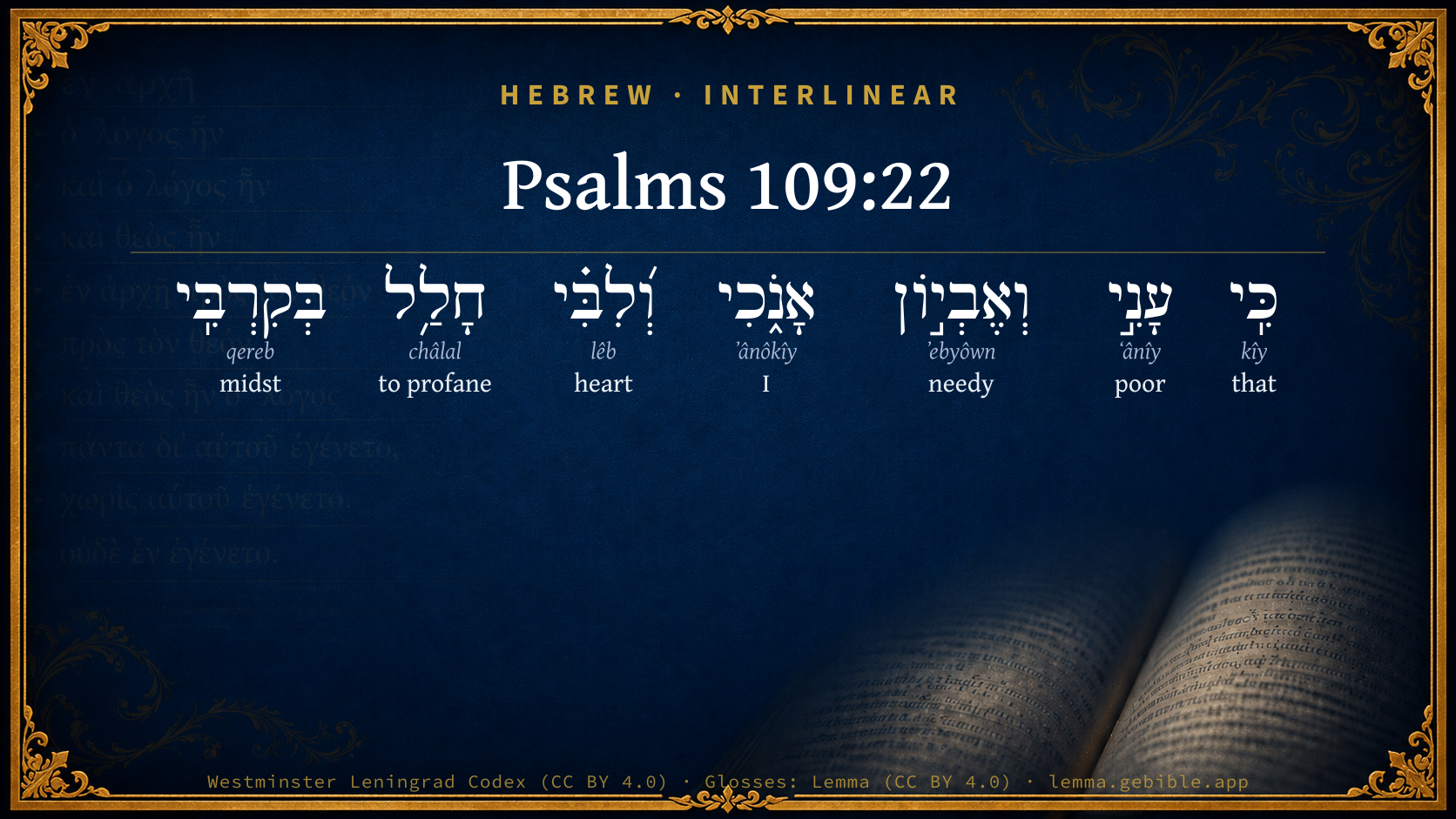
Psalms 109:22

Hebrew (Westminster Leningrad Codex) Psalms 109:22 appears in the Hebrew Old Testament. The text above is from the Westminster Leningrad Codex. Each word links to its Strong’s number, a concise gloss, and parsing drawn from the Open Scriptures Hebrew Bible morphology. Click any word for its full Brown-Driver-Briggs (BDB) entry.
Download image
Cite this verse

Psalms 109:22 (World English Bible). Public Domain. Lemma interlinear Bible study tool, https://lemma.gebible.app/v/psalms/109/22.

Show BibTeX & RIS
BibTeX
RIS
English Translation
For I am poor and needy. My heart is wounded within me.
World English Bible · Public Domain
Download a study sheet

One document with this verse’s original text, its word-by-word gloss line, the meaning frame, cross-references with their text, attributed commentary, and full source and license credits — printable, and it pastes into notes with its structure intact.

This verse Autodidact and up

Study sheet (.html) Plain text (.txt)

A passage Seminary Student

Up to 50 verses in one chapter. A passage sheet keeps up to 6 commentary sources and 12 cross-references per verse, in the order this page ranks them, and says so on the sheet whenever that leaves anything out. Ask for a single verse and you get the Autodidact verse sheet above.

Everything on this page stays free to read, with no account — the sheet is a download of what is already on screen, not access to it.

Want to remove ads? Support Godless Engineer
Compare translations 3

The same verse in 3 English versions, stacked beneath the original-language interlinear above. Click any original word for its lexicon entry.

Each is an independent rendering of the whole verse — the interlinear is not word-aligned to these translations.

Highlighted words mark where these versions differ — a whole-verse word diff, not a word-by-word alignment.

  • World English Bible Public Domain
    For I am poor and needy. My heart is wounded within me.
  • King James Version Public Domain
    For I am poor and needy, and my heart is wounded within me.
  • unfoldingWord Literal Text CC BY-SA 4.0
    For I am poor and needy, and my heart breaks within me.

unfoldingWord Literal Text — © unfoldingWord, licensed CC BY-SA 4.0. Word-aligned USFM3 via Door43 (git.door43.org/unfoldingWord/en_ult).

Versions to compare (up to 4)

3 of 4 selected

Show all 18 translations

Every available English version of this verse, each an independent rendering of the whole verse.

  • World English Bible Public Domain
    For I am poor and needy. My heart is wounded within me.
  • Berean Standard Bible Public Domain
    For I am poor and needy; my heart is wounded within me.
  • Majority Standard Bible Public Domain
    For I am poor and needy; my heart is wounded within me.
  • King James Version Public Domain
    For I am poor and needy, and my heart is wounded within me.
  • American Standard Version (1901) Public Domain
    For I am poor and needy, And my heart is wounded within me.
  • Revised Version (1885) Public Domain
    For I am poor and needy, and my heart is wounded within me.
  • Geneva Bible (1599) Public Domain
    Because I am poore and needie, and mine heart is wounded within me.
  • Douay-Rheims (1899) Public Domain
    for I am poor and needy, and my heart is troubled within me.
  • Young's Literal Translation Public Domain
    For I `am' poor and needy, And my heart hath been pierced in my midst.
  • Literal Standard Version CC BY-SA 4.0
    For I [am] poor and needy, || And my heart has been pierced in my midst.
  • Unlocked Literal Bible CC BY-SA 4.0
    For I am oppressed and needy, and my heart is wounded within me.
  • unfoldingWord Literal Text CC BY-SA 4.0
    For I am poor and needy, and my heart breaks within me.
  • Darby Bible Public Domain
    For I am afflicted and needy, and my heart is wounded within me.
  • World Messianic Bible Public Domain
    for I am poor and needy. My heart is wounded within me.
  • Webster's Bible Public Domain
    For I am poor and needy, and my heart is wounded within me.
  • Free Bible Version CC BY-SA 4.0
    For I am poor and needy, and my heart is breaking.
  • Bible in Basic English Public Domain
    For I am poor and in need, and my heart is wounded in me.
  • JPS Tanakh (1917) Public Domain
    For I am poor and needy, and my heart is wounded within me.

Literal Standard Version (2020), Covenant Press — licensed CC BY-SA 4.0. Text via the HelloAO Bible API (eBible.org). Unlocked Literal Bible (unfoldingWord) — licensed CC BY-SA 4.0. Text via the HelloAO Bible API (eBible.org). unfoldingWord Literal Text — © unfoldingWord, licensed CC BY-SA 4.0. Word-aligned USFM3 via Door43 (git.door43.org/unfoldingWord/en_ult). Free Bible Version, Dr. Jonathan Gallagher — licensed CC BY-SA 4.0. Text via the HelloAO Bible API (eBible.org).

Word by word

More ways to search: Search by grammar → Find every occurrence → Compare this word →

Practice this passage: Drill this verse → Learn its vocabulary →

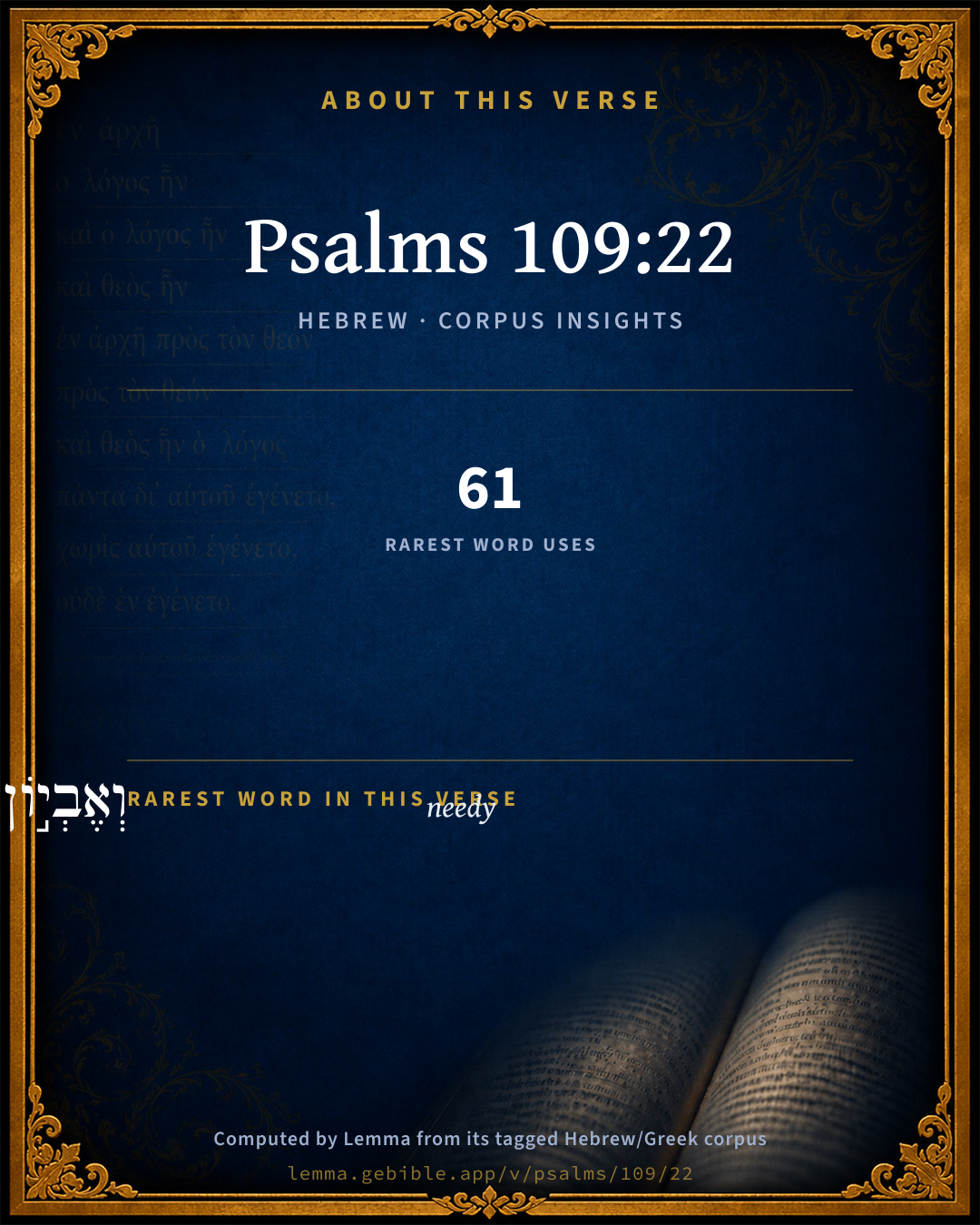
וְאֶבְי֣וֹן
ʼebyôwn
H34
“and · needy”
Conjunction + Adjective, Adjective, Masculine, Singular, Absolute
Part of Speech
Conjunction + Adjective
Type
Adjective
Gender
Masculine
Number
Singular
State
Absolute
Full BDB Definition

Origin: from H14 , in the sense of want (especially in feeling)

TWOT: 3a

in want, needy, chiefly poor, needy person - subject to oppression and abuse - needing help, deliverance from trouble, especially as delivered by God - general reference to lowest class
  1. כִּֽי kîy H3588 “that” Conjunction
  2. עָנִ֣י ʻânîy H6041 “poor” Adjective, Adjective, Masculine, Singular, Absolute
  3. אָנֹ֑כִי ʼânôkîy H595 “I” Pronoun, Personal, 1st Person, Common, Singular
  4. וְ֝לִבִּ֗י lêb H3820 “and · heart · my” Conjunction + Noun, Common, Masculine, Singular, Construct + Suffix, Personal, 1st Person, Common, Singular
  5. חָלַ֥ל châlal H2490 “to profane” Verb, Qal, Perfect, 3rd Person, Masculine, Singular
  6. בְּקִרְבִּֽי qereb H7130 “in/at · midst · my” Preposition + Noun, Common, Masculine, Singular, Construct + Suffix, Personal, 1st Person, Common, Singular

About this verse

These counts appear in no published source. They are computed here, from the morphology-tagged text and Lemma’s own curated glosses. What Lemma adds →

7
words
7
distinct lemmas
Wisdom
section

Grammatical profile

  • 1 verb
  • 2 nouns
  • 2 adjectives
  • 1 pronoun
  • 1 conjunction

Verb forms

  • חָלַ֥ל Qal · Perfect

Hebrew & Septuagint length

In English translation the verse runs 12 words from the Hebrew and 15 from the Septuagint (LXX English) — closely comparable.

A rough comparison of the two English renderings, which tokenize alike — not a word-level alignment.

Word counts can differ between the Hebrew and the Greek without any difference in meaning — e.g. the Hebrew direct-object marker אֵת has no separate Greek word, and Greek often adds the article ὁ.

Cross-references

14

Topical passages linked to Psalms 109:22 in the Treasury of Scripture Knowledge — connected by theme and wording, ordered by reader-vote popularity; previews shown in the World English Bible.

  • Psalms 86:1 Hear, Yahweh, and answer me, For I am poor and needy.
  • Psalms 40:17 But I am poor and needy; May the Lord think about me. You are my help and my deliverer. Don't delay, my God.
  • Psalms 102:4 My heart is blighted like grass, and withered, For I forget to eat my bread.
  • 2 Kings 4:27 When she came to the man of God to the hill, she caught hold of his feet. Gehazi came near to thrust her away; but the man of God said, Let her alone: for her soul is vexed within her; and Yahweh has hid it from me, and has not told me.
  • Psalms 22:6 But I am a worm, and no man; A reproach of men, and despised by the people.
  • John 12:27 "Now my soul is troubled. What shall I say? 'Father, save me from this time?' But for this cause I came to this time.
  • 2 Corinthians 8:9 For you know the grace of our Lord Jesus Christ, that, though he was rich, yet for your sakes he became poor, that you through his poverty might become rich.
  • Job 6:4 For the arrows of the Almighty are within me, My spirit drinks up their poison. The terrors of God set themselves in array against me.
  • Psalms 88:15–16 I am afflicted and ready to die from my youth up. While I suffer your terrors, I am distracted.
  • Psalms 102:17–20 He has responded to the prayer of the destitute, And has not despised their prayer.
  • Psalms 109:16 Because he didn't remember to show kindness, But persecuted the poor and needy man, The broken in heart, to kill them.
  • Isaiah 53:3 He was despised, and rejected by men; a man of suffering, and acquainted with disease: and as one from whom men hide their face he was despised; and we didn't respect him.
  • Matthew 8:20 Jesus said to him, "The foxes have holes, and the birds of the sky have nests, but the Son of Man has nowhere to lay his head."
  • Luke 22:44 Being in agony he prayed more earnestly. His sweat became like great drops of blood falling down on the ground.

Cross-references courtesy of OpenBible.info (CC BY 4.0).

Hebrew and Greek witnesses Masoretic Hebrew ↔ Greek Septuagint

The same verse in the two great witnesses to the Old Testament, shown verse-for-verse.

You’re reading Greek Psalm 108 (Hebrew Psalm 109). The Septuagint counts the superscription, so verse numbers can differ from the Hebrew — chapter-level alignment, not verse-by-verse. Numbering follows Rahlfs.

These are two independent witnesses, not word-aligned to each other, and the Septuagint is shown in lemma (dictionary) form.

Hebrew Psalms 109:22 Masoretic · Westminster Leningrad Codex

כִּֽי עָנִ֣י וְאֶבְי֣וֹן אָנֹ֑כִי וְ֝לִבִּ֗י חָלַ֥ל בְּקִרְבִּֽי

For I am poor and needy. My heart is wounded within me.

World English Bible · Public Domain

Greek LXX Greek Psalm 108:22 Septuagint · lemma form

ῥύομαι ἐγώ ὅτι πτωχός καί πένης ἐγώ εἰμί καί ὁ καρδία ἐγώ τεράσσω ἐντός ἐγώ

Deliver me, for I am poor and needy; and my heart is troubled within me.

LXX2012 (modern English Septuagint) · Public Domain

Hebrew: Westminster Leningrad Codex (CC BY 4.0). Greek: Septuagint (public domain); English from LXX2012 (modern English Septuagint) (Public Domain). How the Septuagint differs from the Hebrew →

Commentary

Notes on Psalms 109:22 from classic Christian and Jewish commentators (each source and its license shown beneath its notes). The classic Christian expositions comment on the surrounding passage and are grouped to its opening verse, so a note may address several verses; the Jewish commentaries on the Tanakh (Rashi and others) are per-verse, so they appear only where the commentator wrote on this verse.

Lemma curates 59 commentaries, every one of them public domain or Creative Commons licensed, each selected and text-cleaned for this edition rather than reprinted as found. About our sources →

Trapp's Complete Commentary

John Trapp

Psa 109:22 For I [am] poor and needy, and my heart is wounded within me.

Ver. 22. For I am poor and needy] As a leper showeth his ulcers to move pity, so doth David his indigency and ailments.

And my heart is wounded] I have my inward troubles also: or I am cordicitus vulneratus, almost dead, animam ago.

John Trapp, A Commentary or Exposition upon All the Books of the Old and New Testament (1647–1656) — public domain. Text from a community e-Sword module.

J. A. Alexander on Psalms

Joseph Addison Alexander

22. (Psa 109:22) For afflicted and poor (am) I, and my heart is wounded within me. This, though indefinite in form, is equivalent to saying, I am the afflicted and poor man whom the malignant adversary persecuted, as was said, in Psa 109:16. The word translated wounded strictly means pierced or perforated, a stronger expression than the one in ver. 16. With the first clause compare Psa 11:1-7, Psa 69:29.

Joseph Addison Alexander, The Psalms Translated and Explained (1850) — public domain. Text from a community e-Sword module.

Adam Clarke's Commentary

Verse 22. I am poor and needy] I am afflicted and impoverished; and my heart is wounded - my very life is sinking through distress.

Adam Clarke's Commentary on the Bible (1810–1826) — public domain. Text from a community e-Sword/MySword module.

The Cambridge Bible for Schools and Colleges

gen. ed. J. J. S. Perowne

22. Cp. Psa_109:16; Psa_40:17; Psa_55:4.

The Cambridge Bible for Schools and Colleges (gen. ed. J. J. S. Perowne; Cambridge University Press, 1878–1918) — public domain. Text from a community e-Sword module.

John Gill's Exposition

I am gone like the shadow when it declineth,.... When the sun is setting, and the shadow is going off; man's life is often compared to a shadow, because fleeting, momentary, and soon gone, Ch1 29:15 and death is expressed by going the way of all flesh; and by going to the grave, the house for all living, a man's long home, Jos 23:14 and so is the death of Christ, Luk 22:22, it may be rendered, "I am made to go" (h), denoting the violent death of Christ, who was cut off out of the land of the living, and whose life was taken away from the earth, Isa 53:8.

I am tossed up and down as the locust; or "shaken out" (i) by the wind, as the locust is by the east wind, and carried from place to place, Exo 10:13, or when a swarm of them by a strong wind are crowded together and thrown upon one another; or like the grasshopper, which leaps from hedge to hedge, and has no certain abode: and such was the case of Christ here on earth; and especially it may have respect not only to his being sometimes in Judea and sometimes in Galilee, sometimes in the temple and sometimes in the mount of Olives; but to his being tossed about after his apprehension, when he was led to Annas, and then to Caiaphas, then to Pilate, then to Herod, then delivered to the soldiers, and by them led to Calvary, and crucified.

(h) "cogor abire", Junius & Tremellius, Piscator, Cocceius; "abire factus sum", Gejerus, Michaelis. (i) "excussus sum", Montanus, Vatablus Gejerus, Michaelis; "excutior", Tigurine version, Musculus, Cocceius.

John Gill's Exposition of the Whole Bible (1746–1763) — public domain (CC PDM 1.0). Text via the HelloAO Bible API.

Albert Barnes' Notes on the Bible

For I am poor and needy - I am helpless and dependent. I am in a condition where I need thy gracious interposition.

And my heart is wounded within me - I am as one that is prostrated by a weapon - as if my heart had been pierced. I have no courage, no strength. I am like one who lies wounded on a battlefield.

Albert Barnes' Notes on the Bible (1834–1885) — public domain. Text from a community e-Sword/MySword module.

Matthew Poole's English Annotations

I am poor and needy; and therefore a very proper object for thy pity and help. I am wounded not slightly, but to the very heart with soul-piercing sorrows.

Matthew Poole's English Annotations on the Holy Bible (1683–1685) — public domain. Text from a community e-Sword/MySword module.

The Treasury of David

Charles H. Spurgeon

Ver. 22. For I am poor and needy. When he does plead anything about himself he urges not his riches or his merits, but his poverty and his necessities: this is gospel supplication, such as only the Spirit of God can indite upon the heart. This lowliness does not comport with the supposed vengeful spirit of the preceding verses: there must therefore be some interpretation of them which would make them suitable in the lips of a lowly minded man of God.

And my heart is wounded within me. The Lord has always a tender regard to broken hearted ones, and such the psalmist had become: the undeserved cruelty, the baseness, the slander of his remorseless enemies had pierced him to the soul, and this sad condition he pleads as a reason for speedy help. It is time for a friend to step in when the adversary cuts so deep. The case has become desperate without divine aid; now, therefore, is the Lord's time.

Ver. 22. For I am poor and needy, and my heart is wounded within me. Note here, how beautifully he unites these arguments. He had said, Because Thy mercy is good; and he adds, "Because I am poor and needy." He could not have added anything more appropriate: for this is the nature of goodness and mercy, even in the human heart, much more in God, the best and most merciful of all beings, that nothing more easily moves it to give succour, than the affliction, calamity, and misery of those by whom it is invoked. Wolfgang Musculus.

Ver. 22. My heart is wounded within me. The hearts of the saints and pious men are not as brass or stone, that the apathy of the Stoics should have lodging in them, but are susceptible to griefs and passions. Musculus.

Ver. 22. The inward sorrows of a saint. Their cause, effects, consolations and cure.

Psalms 109:23*

Charles H. Spurgeon's The Treasury of David (1869–1885) — public domain. Psalms only. Text from a community e-Sword/MySword module.

Whedon's Commentary on the Bible

Daniel D. Whedon

22. I am poor and needy—A plaintive confession, often made, and always urged as the counterpart of exclusive hope in God.

My heart is wounded—Pierced as with a sword. So the word, Eze_32:26. The adjective almost always has this sense, as Lam_2:12. In this pathetic strain the psalmist tells his misery and suffering in the three verses following.

Daniel D. Whedon (gen. ed.), Commentary on the Old and New Testaments (1874–1909) — public domain. Text from a community e-Sword module.

The Pulpit Commentary

For I am poor and needy (comp. ver. 16). David was "poor and needy" both when hunted upon the mountains by Saul, and when forced to flee from Absalom. And my heart is wounded within me. The wound to David"s heart was, on the former occasion, from the malignity of Saul; on the latter, especially from the desertion of his "own familiar friend whom he trusted."

The Pulpit Commentary (1880–1919), ed. H.D.M. Spence-Jones & Joseph S. Exell — public domain. Text from a community e-Sword module.

Lesson kit

Teaching starters — assembled from the data on this page, not authored interpretation. Every prompt links to the verse data it draws on. Edit before teaching.

Psalms, in the Wisdom, opens this verse with 7 words (7 distinct Hebrew lemmas). Its most distinctive word is ʼebyôwn (“needy”). A historical commentator’s framing appears above. Read the whole chapter for the surrounding context.

Discussion questions

  1. How does “needy” (ʼebyôwn) shape what this verse is saying?
  2. Psalms 86:1 shares this passage’s theme. How do the two illuminate each other?
  3. The translations on this page render this verse differently — a whole-verse word diff, not a word-by-word alignment. What might account for the different wordings?
  4. The verb «חָלַ֥ל» is Qal Perfect. How does its form color the action?
  5. Reading how Trapp's Complete Commentary and J. A. Alexander on Psalms read this verse, where do the two commentators agree and where do they part?

Things to notice

Reading settings

Reading text

Shown beneath each verse's original-language words.

Old Testament
Old Testament edition

Read the OT as the Masoretic Hebrew (MT) or the Greek Septuagint (LXX).

English shown for the Greek Septuagint (in the Hebrew ↔ Greek comparison).

Comparing translations? Open the Compare panel on any verse page to stack up to four side by side.