Joel 2:27

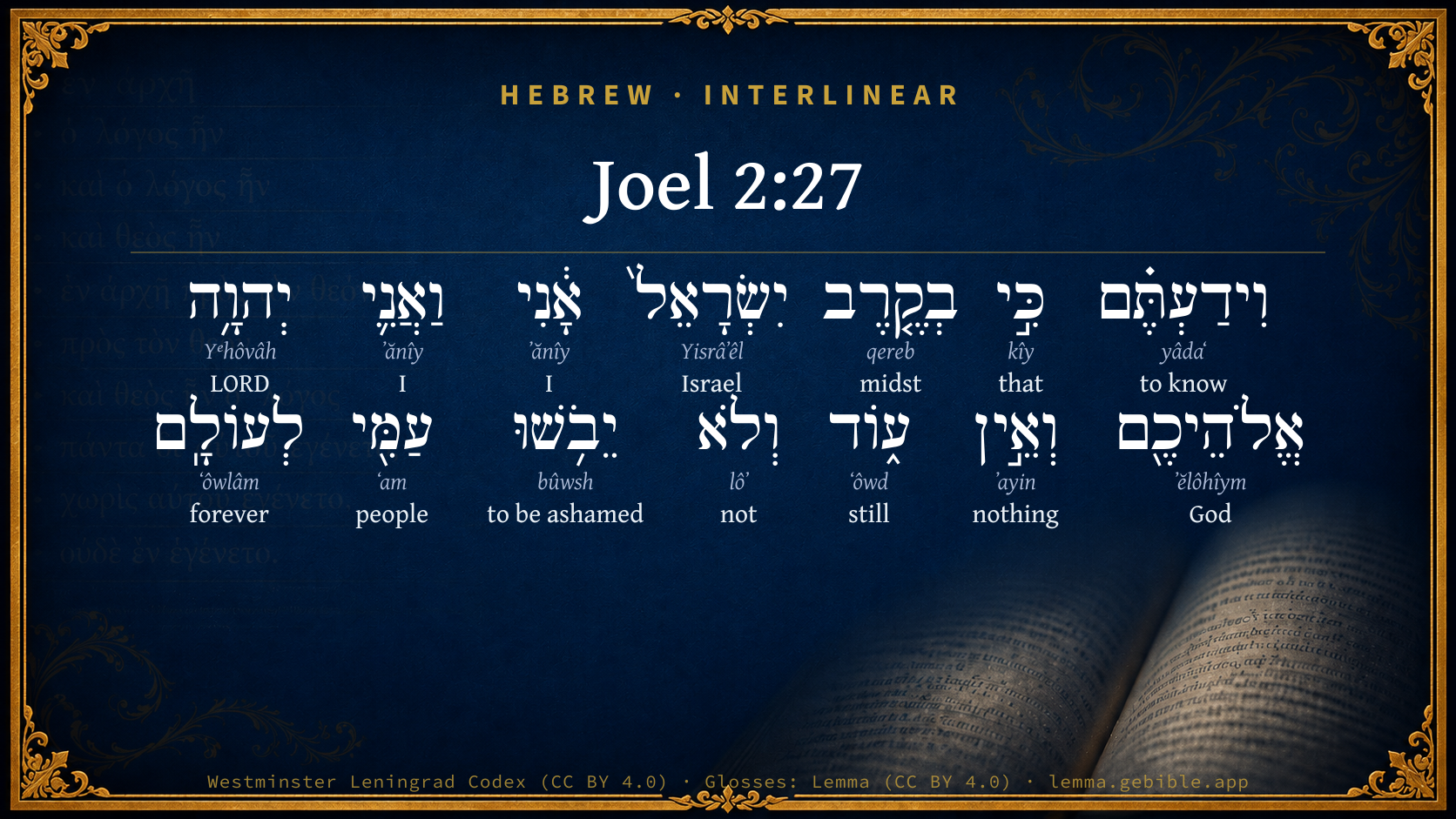
Hebrew (Westminster Leningrad Codex) Joel 2:27 appears in the Hebrew Old Testament. The text above is from the Westminster Leningrad Codex. Each word links to its Strong’s number, a concise gloss, and parsing drawn from the Open Scriptures Hebrew Bible morphology. Click any word for its full Brown-Driver-Briggs (BDB) entry.
Download image
Cite this verse

Joel 2:27 (World English Bible). Public Domain. Lemma interlinear Bible study tool, https://lemma.gebible.app/v/joel/2/27.

Show BibTeX & RIS
BibTeX
RIS
English Translation
You will know that I am in the midst of Israel, And that I am Yahweh, your God, and there is no one else; And my people will never again be disappointed.
World English Bible · Public Domain
Download a study sheet

One document with this verse’s original text, its word-by-word gloss line, the meaning frame, cross-references with their text, attributed commentary, and full source and license credits — printable, and it pastes into notes with its structure intact.

This verse Autodidact and up

Study sheet (.html) Plain text (.txt)

A passage Seminary Student

Up to 50 verses in one chapter. A passage sheet keeps up to 6 commentary sources and 12 cross-references per verse, in the order this page ranks them, and says so on the sheet whenever that leaves anything out. Ask for a single verse and you get the Autodidact verse sheet above.

Everything on this page stays free to read, with no account — the sheet is a download of what is already on screen, not access to it.

Want to remove ads? Support Godless Engineer
Compare translations 3

The same verse in 3 English versions, stacked beneath the original-language interlinear above. Click any original word for its lexicon entry.

Each is an independent rendering of the whole verse — the interlinear is not word-aligned to these translations.

Highlighted words mark where these versions differ — a whole-verse word diff, not a word-by-word alignment.

  • World English Bible Public Domain
    You will know that I am in the midst of Israel, And that I am Yahweh, your God, and there is no one else; And my people will never again be disappointed.
  • King James Version Public Domain
    And ye shall know that I am in the midst of Israel, and that I am the LORD your God, and none else: and my people shall never be ashamed.
  • unfoldingWord Literal Text CC BY-SA 4.0
    And you will know that I in the midst of Israel, that I Yahweh your God and there is no other, and forever my people will not feel shame.

unfoldingWord Literal Text — © unfoldingWord, licensed CC BY-SA 4.0. Word-aligned USFM3 via Door43 (git.door43.org/unfoldingWord/en_ult).

Versions to compare (up to 4)

3 of 4 selected

Show all 18 translations

Every available English version of this verse, each an independent rendering of the whole verse.

  • World English Bible Public Domain
    You will know that I am in the midst of Israel, And that I am Yahweh, your God, and there is no one else; And my people will never again be disappointed.
  • Berean Standard Bible Public Domain
    Then you will know that I am present in Israel and that I am the LORD your God, and there is no other. My people will never again be put to shame.
  • Majority Standard Bible Public Domain
    Then you will know that I am present in Israel and that I am the LORD your God, and there is no other. My people will never again be put to shame.
  • King James Version Public Domain
    And ye shall know that I am in the midst of Israel, and that I am the LORD your God, and none else: and my people shall never be ashamed.
  • American Standard Version (1901) Public Domain
    And ye shall know that I am in the midst of Israel, and that I am Jehovah your God, and there is none else; and my people shall never be put to shame.
  • Revised Version (1885) Public Domain
    And ye shall know that I am in the midst of Israel, and that I am the LORD your God, and there is none else: and my people shall never be ashamed.
  • Geneva Bible (1599) Public Domain
    Ye shall also know, that I am in the middes of Israel, and that I am the Lord your God and none other, and my people shall neuer be ashamed.
  • Douay-Rheims (1899) Public Domain
    And you shall know that I am in the midst of Israel: and I am the Lord your God, and there is none besides: and my people shall not be confounded for ever.
  • Young's Literal Translation Public Domain
    And ye have known that in the midst of Israel `am' I, And I `am' Jehovah your God, and there is none else, And not ashamed are My people to the age.
  • Literal Standard Version CC BY-SA 4.0
    And you have known that I [am] in the midst of Israel, || And I [am] your God YHWH, and there is none else, || And My people are not ashamed for all time.
  • Unlocked Literal Bible CC BY-SA 4.0
    You will know that I am among Israel, and that I am Yahweh your God, and there is none else, and I will never bring shame on my people.
  • unfoldingWord Literal Text CC BY-SA 4.0
    And you will know that I in the midst of Israel, that I Yahweh your God and there is no other, and forever my people will not feel shame.
  • Darby Bible Public Domain
    And ye shall know that I am in the midst of Israel, and that I, Jehovah, [am] your God, and there is none else: and my people shall never be ashamed.
  • World Messianic Bible Public Domain
    You will know that I am among Israel, and that I am the LORD, your God, and there is no one else; and my people will never again be disappointed.
  • Webster's Bible Public Domain
    And ye shall know that I am in the midst of Israel, and that I am the LORD your God, and none else: and my people shall never be ashamed.
  • Free Bible Version CC BY-SA 4.0
    You will know that I am in the midst of my people Israel, that I am the Lord your God, and that there is no other. My people will never again be ashamed.
  • Bible in Basic English Public Domain
    And you will be certain that I am in Israel, and that I am the Lord your God, and there is no other: and my people will never be shamed.
  • JPS Tanakh (1917) Public Domain
    And ye shall know that I am in the midst of Israel, and that I am the LORD your God, and there is none else; and My people shall never be ashamed.

Literal Standard Version (2020), Covenant Press — licensed CC BY-SA 4.0. Text via the HelloAO Bible API (eBible.org). Unlocked Literal Bible (unfoldingWord) — licensed CC BY-SA 4.0. Text via the HelloAO Bible API (eBible.org). unfoldingWord Literal Text — © unfoldingWord, licensed CC BY-SA 4.0. Word-aligned USFM3 via Door43 (git.door43.org/unfoldingWord/en_ult). Free Bible Version, Dr. Jonathan Gallagher — licensed CC BY-SA 4.0. Text via the HelloAO Bible API (eBible.org).

Word by word

More ways to search: Search by grammar → Find every occurrence → Compare this word →

Practice this passage: Drill this verse → Learn its vocabulary →

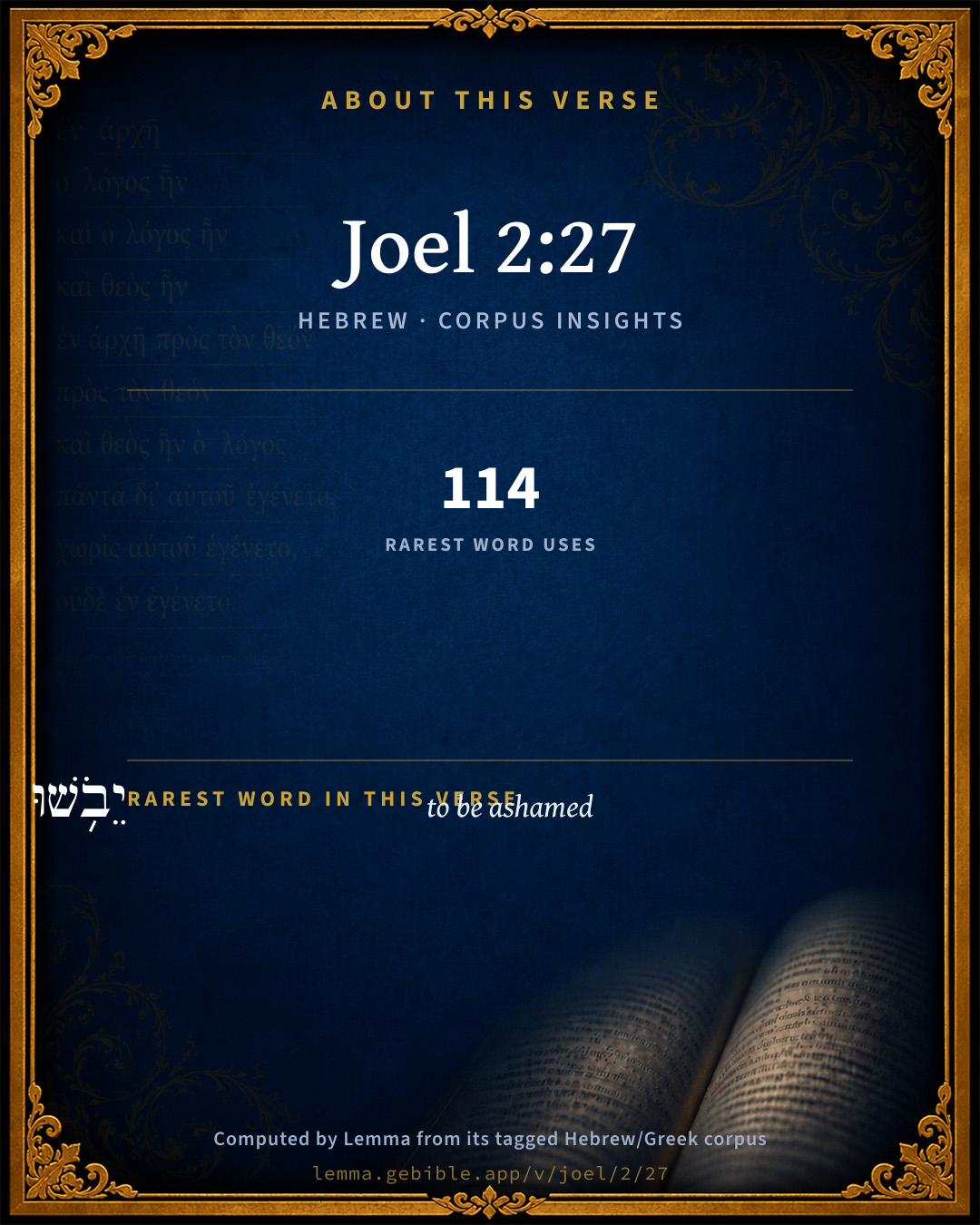
יֵבֹ֥שׁוּ
bûwsh
H954
“to be ashamed”
Verb, Qal, Imperfect, 3rd Person, Masculine, Plural
Part of Speech
Verb
Stem
Qal
Form
Imperfect
Person
3rd Person
Gender
Masculine
Number
Plural
Full BDB Definition

Origin: a primitive root

TWOT: 222

to put to shame, be ashamed, be disconcerted, be disappointed - (Qal) - to feel shame - to be ashamed, disconcerted, disappointed (by reason of) - (Piel) to delay (in shame) - (Hiphil) - to put to shame - to act shamefully - to be ashamed - (Hithpolel) to be ashamed before one another
  1. וִידַעְתֶּ֗ם yâdaʻ H3045 “and · to know” Conjunction + Verb, Qal, Sequential Perfect, 2nd Person, Masculine, Plural
  2. כִּ֣י kîy H3588 “that” Conjunction
  3. בְקֶ֤רֶב qereb H7130 “in/at · midst of” Preposition + Noun, Common, Masculine, Singular, Construct
  4. יִשְׂרָאֵל֙ Yisrâʼêl H3478 “Israel” Noun, Proper
  5. אָ֔נִי ʼănîy H589 “I” Pronoun, Personal, 1st Person, Common, Singular
  6. וַאֲנִ֛י ʼănîy H589 “and · I” Conjunction + Pronoun, Personal, 1st Person, Common, Singular
  7. יְהוָ֥ה Yᵉhôvâh H3068 “LORD” Noun, Proper
  8. אֱלֹהֵיכֶ֖ם ʼĕlôhîym H430 “God(s) · your” Noun, Common, Masculine, Plural, Construct + Suffix, Personal, 2nd Person, Masculine, Plural
  9. וְאֵ֣ין ʼayin H369 “and · nothing” Conjunction + Particle, Negative
  10. ע֑וֹד ʻôwd H5750 “still” Adverb
  11. וְלֹא lôʼ H3808 “and · not” Conjunction + Particle, Negative
  12. עַמִּ֖י ʻam H5971 “people · my” Noun, Common, Masculine, Singular, Construct + Suffix, Personal, 1st Person, Common, Singular
  13. לְעוֹלָֽם ʻôwlâm H5769 “to/for · forever” Preposition + Noun, Common, Masculine, Singular, Absolute

About this verse

These counts appear in no published source. They are computed here, from the morphology-tagged text and Lemma’s own curated glosses. What Lemma adds →

14
words
13
distinct lemmas
Prophets
section

Grammatical profile

  • 2 verbs
  • 6 nouns
  • 2 pronouns
  • 1 conjunction
  • 1 adverb
  • 2 particles

Verb forms

  • וִידַעְתֶּ֗ם Qal · Sequential Perfect
  • יֵבֹ֥שׁוּ Qal · Imperfect

Repetition

A word recurs within this verse — often emphatic in Hebrew:

  • אָ֔נִי I H589 ×2

Hebrew & Septuagint length

In English translation the verse runs 32 words from the Hebrew and 38 from the Septuagint (LXX English) — closely comparable.

A rough comparison of the two English renderings, which tokenize alike — not a word-level alignment.

Word counts can differ between the Hebrew and the Greek without any difference in meaning — e.g. the Hebrew direct-object marker אֵת has no separate Greek word, and Greek often adds the article ὁ.

Cross-references

17

Topical passages linked to Joel 2:27 in the Treasury of Scripture Knowledge — connected by theme and wording, ordered by reader-vote popularity; previews shown in the World English Bible.

  • Ezekiel 37:26–28 Moreover I will make a covenant of peace with them; it shall be an everlasting covenant with them; and I will place them, and multiply them, and will set my sanctuary in the midst of them forevermore.
  • Leviticus 26:11–12 I will set my tent among you: and my soul won't abhor you.
  • Zephaniah 3:17 Yahweh, your God, is in the midst of you, a mighty one who will save. He will rejoice over you with joy. He will rest in his love. He will rejoice over you with singing.
  • Isaiah 45:5 I am Yahweh, and there is none else; besides me there is no God. I will gird you, though you have not known me;
  • Ezekiel 39:28 They shall know that I am Yahweh their God, in that I caused them to go into captivity among the nations, and have gathered them to their own land; and I will leave none of them any more there;
  • Joel 3:17 "So you will know that I am Yahweh, your God, Dwelling in Zion, my holy mountain. Then Jerusalem will be holy, And no strangers will pass through her any more.
  • Deuteronomy 23:14 for Yahweh your God walks in the midst of your camp, to deliver you, and to give up your enemies before you; therefore shall your camp be holy, that he may not see an unclean thing in you, and turn away from you.
  • Psalms 46:5 God is in her midst. She shall not be moved. God will help her at dawn.
  • Isaiah 12:6 Cry aloud and shout, you inhabitant of Zion; for great in the midst of you is the Holy One of Israel!"
  • Joel 2:26 You will have plenty to eat, and be satisfied, And will praise the name of Yahweh, your God, Who has dealt wondrously with you; And my people will never again be disappointed.
  • Revelation 21:3 I heard a loud voice out of heaven saying, "Behold, God's dwelling is with people, and he will dwell with them, and they will be his people, and God himself will be with them as their God.
  • Isaiah 45:21–22 Declare you, and bring [it] forth; yes, let them take counsel together: who has shown this from ancient time? who has declared it of old? Haven't I, Yahweh? and there is no God else besides me, a just God and a Savior; there is no one besides me.
  • 1 Peter 2:6 Because it is contained in Scripture, "Behold, I lay in Zion a chief cornerstone, chosen, and precious: He who believes in him will not be disappointed."
  • Psalms 68:18 You have ascended on high. You have led away captives. You have received gifts among men, Yes, among the rebellious also, that Yah God might dwell there.
  • Isaiah 53:6 All we like sheep have gone astray; everyone has turned to his own way; and Yahweh has laid on him the iniquity of us all.
  • Ezekiel 39:22 So the house of Israel shall know that I am Yahweh their God, from that day and forward.
  • 2 Corinthians 6:16 What agreement has a temple of God with idols? For you are a temple of the living God. Even as God said, "I will dwell in them, and walk in them; and I will be their God, and they will be my people."

Cross-references courtesy of OpenBible.info (CC BY 4.0).

Hebrew and Greek witnesses Masoretic Hebrew ↔ Greek Septuagint

The same verse in the two great witnesses to the Old Testament, shown verse-for-verse.

These are two independent witnesses, not word-aligned to each other, and the Septuagint is shown in lemma (dictionary) form.

Hebrew Joel 2:27 Masoretic · Westminster Leningrad Codex

וִידַעְתֶּ֗ם כִּ֣י בְקֶ֤רֶב יִשְׂרָאֵל֙ אָ֔נִי וַאֲנִ֛י יְהוָ֥ה אֱלֹהֵיכֶ֖ם וְאֵ֣ין ע֑וֹד וְלֹא יֵבֹ֥שׁוּ עַמִּ֖י לְעוֹלָֽם

You will know that I am in the midst of Israel, And that I am Yahweh, your God, and there is no one else; And my people will never again be disappointed.

World English Bible · Public Domain

Greek LXX Joel 2:27 Septuagint · lemma form

καί ἐπιγιγνώσκω ὅτι ἐν μέσος ὁ ἰσραήλ ἐγώ εἰμί καί ἐγώ κύριος ὁ θεός σύ καί οὐ εἰμί ἔτι πλήν ἐγώ καί οὐ μή κατααἰσχύνω οὐκέτι πᾶς ὁ λαός ἐγώ εἰς ὁ αἰών

And you⌃ shall know that I am in the midst of Israel, and that I am the Lord your God, and that there is none else beside me; and my people shall no more be ashamed for ever.

LXX2012 (modern English Septuagint) · Public Domain

On this verse, The Pulpit Commentary discusses the Septuagint’s reading. Read the note in Commentary ↓

Hebrew: Westminster Leningrad Codex (CC BY 4.0). Greek: Septuagint (public domain); English from LXX2012 (modern English Septuagint) (Public Domain). How the Septuagint differs from the Hebrew →

Targum (Aramaic paraphrase)

1

The Targum is the ancient Jewish Aramaic paraphrase of the Hebrew Scriptures — an interpretive translation, not the Hebrew text itself. Onkelos (literal) and Pseudo-Jonathan (expansive) render the Torah, and Jonathan the Prophets. Coverage is partial: where no permissively-licensed English translation exists for a verse, only the Aramaic is shown. This is verse-level text, not a word-by-word alignment to the Hebrew.

  1. Targum Jonathan Prophets (Joshua–Malachi)
    וְתֵדְעוּן אֲרֵי בְּגוֹ בֵּית יִשְׂרָאֵל אַשְׁרֵיתִי שְׁכִנְתִּי וַאֲנָא יְיָ אֱלָהָכוֹן וְלֵית עוֹד וְלָא יִבְהֲתוּן עַמִי בֵּית יִשְׂרָאֵל לַעֲלָם:

    (no public-domain English translation for this verse)

    Targum Jonathan — Aramaic: “Mikraot Gedolot” (public domain). English: “Sefaria Community Translation” (CC0 1.0 (public-domain dedication)); “London "Chaldee Paraphrase," 1871” (public domain). Text via Sefaria.

Commentary

Notes on Joel 2:27 from classic Christian and Jewish commentators (each source and its license shown beneath its notes). The classic Christian expositions comment on the surrounding passage and are grouped to its opening verse, so a note may address several verses; the Jewish commentaries on the Tanakh (Rashi and others) are per-verse, so they appear only where the commentator wrote on this verse.

Lemma curates 59 commentaries, every one of them public domain or Creative Commons licensed, each selected and text-cleaned for this edition rather than reprinted as found. About our sources →

Trapp's Complete Commentary

John Trapp

Joe 2:27 And ye shall know that I [am] in the midst of Israel, and [that] I [am] the LORD your God, and none else: and my people shall never be ashamed.

Ver. 27. And ye shall know that I am in the midst of Israel] These temporal blessings shall seal up my love to you and presence of grace with you. True it is that no man knoweth either love or hatred by all that is before them, Ecc 9:1; because all things come alike to all, Joe 2:2. But yet from this text we may comfortably conclude, that if the good things of this life make us more cheerful, thankful, hopeful; if mercy excite us to duty, and the sense of God’s love make us love God, his ways, and people, with a desire to love them more; then we are loved of God, who is in us of a truth, 1Jn 4:10; 1Jn 4:19, and we may know it too. For if instinct of nature teach dams to know their young ones, and the young their dams, shall not God’s Spirit teach us to know him, that he is in the midst of us, not by his omnipresence only, but by his gracious presence? yea, that he is the Lord our God, and none else; and that while we hold us to this anchorhold of the faithful soul, we shall never be ashamed, Psa 31:1. That was a brave speech of Luther, and one of those that a man would fetch upon his knees from Rome or Jerusalem to be author of them, Ipse videret ubi anima mea mansura sit, qui pro ea sic solicitus fuit, ut vitam pro ea posuerit, Let him see to it where my soul shall rest, who took so much care for it as that he laid down his life for it (Joh. Manl. loc. com.).

John Trapp, A Commentary or Exposition upon All the Books of the Old and New Testament (1647–1656) — public domain. Text from a community e-Sword module.

The Biblical Illustrator

Joseph S. Exell

Joe_2:27

My people shall never be ashamed.

Religion, a source of constant confidence

Joel was the bearer of very heavy tidings. Their sins had exceeded the bounds of Divine patience.

I. The character under which the persons mentioned in the text appear before us. He calls them My people. This shows that they belong to God by some peculiar appropriation. He speaks of them as having His favour, as deriving blessings from Him, and as feeling, under a consciousness of His presence abiding with them, a confidence which the wicked never possess. They are a chosen people; a sanctified people; and an obedient people. They are always set upon obedience, and sorry when they do not render it.

II. The honourable and encouraging statement which God makes concerning them. My people shall never be ashamed.

1. They shall not be ashamed of their principles. Which serve them at all times. And they are good, profitable to society, and calculated to advance the interests of men!

2. They are not ashamed of the singularity which distinguishes their conduct.

3. Of the confidence which they repose in God. And they shall not be ashamed amid the terrors of the last great day. (W. Curling, M. A.)

Not ashamed

After the desolation caused by the locusts is to come a time of great fruitfulness. In the words, My people shall never be ashamed, we have a great principle of Gods government announced, and the promise is emphatically repeated.

I. The significance of the promise. It covers all history, and the whole individual life, and reaches on within the veil. The promise involves--

1. An implied assertion of surrounding troubles and conflict. Much which is calculated to put men to shame, and to cause doubt and sorrow; e.g., loathsome diseases, fearful crimes, error perverting and hindering truth, drunkenness, ignorance, immorality at our doors and in our streets. Where sin is, there must be shame.

2. An express encouragement to stedfast faith. God undertakes for His people.

3. A sure prediction of final triumph. The promise has progressive fulfilment. Shame and fear are again and again beaten back until the last victory comes, and shame and sin are left behind for ever.

II. The character of those to whom the promise is made. Gods people are put in antithesis with the heathen, the ungodly, the unbelieving. They are those who have turned to Him in true penitence, have experienced His pardoning love, and now trust in Him. They are led by the Spirit. Can we take the comfort of this promise? On one side of mans destinies is certainty of shame; on the other, assurance of glory. Troubles shall issue in joy; trials shall conduct to triumph. (W. Saumarez Smith, B. D.)

The Biblical Illustrator, edited by Joseph S. Exell (c. 1880s–1900s) — public domain. Text from a community e-Sword module.

Jamieson, Fausset & Brown

Robert Jamieson, A. R. Fausset & David Brown

know that I am in the midst of Israel--As in the Old Testament dispensation God was present by the Shekinah, so in the New Testament first, for a brief time by the Word made flesh dwelling among us (Joh 1:14), and to the close of this dispensation by the Holy Spirit in the Church (Mat 28:20), and probably in a more perceptible manner with Israel when restored (Eze 37:26-28).

never be ashamed--not an unmeaning repetition from Joe 2:26. The twice-asserted truth enforces its unfailing certainty. As the "shame" in Joe 2:26 refers to temporal blessings, so in this verse it refers to the spiritual blessings flowing from the presence of God with His people (compare Jer 3:16-17; Rev 21:3).

Jamieson, Fausset & Brown — Commentary Critical and Explanatory on the Whole Bible (1871) — public domain (CC PDM 1.0). Text via the HelloAO Bible API.

John Calvin's Commentaries

He repeats the same sentence; and in the beginning of the verse he unfolds what I have already said — that the miracle would be such as to constrain the people to praise God. Ye shall know that I am in the midst of Israel: and this was the case, because God showed not in an ordinary way his kindness to them, and especially because it had been foretold, and also because this reason had been adduced — that God was mindful of his covenant. The manner, then, in which he dealt with them, and farther, the prediction itself, left to the people no pretext for ignorance. Hence the Prophet now says, ‘Ye shall know that I am in the midst of Israel,’ and still more, ‘that I am Jehovah your God.’ By these words the Prophet reminds us, that the deliverance of the people from their evils was to be wholly ascribed to the gratuitous mercy of God; for we have already seen, that things would have been past hope, had not this consolation been added — ‘Turn ye even now to me.’ The Prophet therefore repeats, that there would be no other reason why God would deal so kindly with his people, and so mercifully spare them, but this — that he dwelt in the midst of Israel: but whence was this dwelling, except that God had gratuitously chosen this people? This indeed availed much to raise up the people; for how could they have hoped that God would be propitious to them, had they not been reminded of this truth that God was dwelling in the midst of them? Not because they were worthy, but because he deigned to come down to them.

He afterwards adds, And none else. By this sentence the Prophet more sharply stimulates them to return immediately to God; for if they deferred longer disappointment would be in delay. That the Jews, then, might not, after their usual manner, procrastinate, he says that there is no other God; and thus he shows that there was no remedy for their evils, except they sought to be reconciled to God. “There is then no God besides me, and I dwell in the midst of thee.” The Lord claims to himself every power, and then kindly invites the people to himself, and for this reason, — because he dwells in the midst of them. That the people, then, might not form other expectations, God shows that all their hope was in him alone. He farther shows, that salvation was not to be sought afar off, provided the people had not forgotten the covenant, that God was dwelling in the midst of them. But a higher doctrine follows —

John Calvin's Commentaries (1540-1563) — public domain. Text from the Calvin Translation Society English edition (1840s-50s) via the Christian Classics Ethereal Library (ccel.org). Calvin's coverage is partial (roughly two-thirds of the Bible); uncommented books and verses are honest gaps, never fabricated. The 19th-century editor's footnotes and remarks are omitted so the notes are faithfully Calvin's own voice.

Ellicott's Commentary for English Readers

(27) I am in the midst of Israel.—This Divine assurance, similar to that with which the book ends, prepares the way for the spiritual blessings about to be announced.

A Bible Commentary for English Readers, edited by Charles John Ellicott (1878–1897) — public domain. Text from a community e-Sword module.

The Cambridge Bible for Schools and Colleges

gen. ed. J. J. S. Perowne

27. The restoration of the people’s prosperity will further give them the assurance that Jehovah is in their midst, and will continue their defender and deliverer for ever.

in the midst of Israel] as its present helper and saviour: comp. Exo_17:7; Num_11:20; Num_14:14; Deu_7:21; Deu_31:17; Jos_3:10; Hos_11:9; Isa_12:6 al.

and that I am Jehovah your God] Cf. Joe_3:17, “And ye shall know that I am Jehovah your God.” The phrase is a stereotyped one, which occurs (with or without your God) often in certain parts of the O.T., usually to denote the conviction produced by some great act of judgment or deliverance upon those who witness it. In Ezekiel (who uses it—with ye, they, or thou, as the case may be—more than 50 times) it is a standing refrain, coming often at the end of a paragraph, or a prophecy, as Eze_6:7; Eze_6:10; Eze_6:13-14, Eze_7:4; Eze_7:9; Eze_7:27, Eze_20:42, Eze_25:5; Eze_25:7; Eze_25:11; Eze_25:17, Eze_36:38, Eze_37:13; Eze_37:28, Eze_39:6-7; Eze_39:22; Eze_39:28 : it occurs also several times in the priestly sections of the Pent. (Exo_6:7; Exo_7:5; Exo_14:4; Exo_14:18; Exo_16:12; Exo_29:46), and occasionally besides (Exo_10:2 [cf. Exo_8:18 b]; 1Ki_20:13; 1Ki_20:28; Isa_49:23; Isa_49:26; Isa_60:16). Comp. the writer’s Introduction, p. 276 f.

and (that) there is none else] For who but Jehovah can cause the heavens to give forth rain (Jer_14:22), or the earth to bear fruit abundantly? Comp. Isa_45:5-6; Isa_45:18; also Deu_4:35; Deu_4:39, 1Ki_8:60.

28–32 (ch. 3 in the Hebrew). The hearts of His people having been directed towards Him (Joe_2:26-27) by the material benefits conferred in Joe_2:23-25, Jehovah promises next to superadd spiritual gifts; He pours forth His spirit upon them, with the result that all are endowed with clearer perceptions of Divine truth (Joe_2:28-29): His own people being thus provided for, the signs of an approaching judgement upon the nations will then manifest themselves (Joe_2:30 f.); amid which, however, those who, in virtue of the regenerating influence of the spirit (Joe_2:28), are become the true children of God, will be delivered (Joe_2:32).

The Cambridge Bible for Schools and Colleges (gen. ed. J. J. S. Perowne; Cambridge University Press, 1878–1918) — public domain. Text from a community e-Sword module.

John Gill's Exposition

And ye shall know that I am in the midst of Israel,.... The presence of God among his people shall be so manifest, the tokens of it so clear, that it shall be easily known, by the impressions of his love upon them; the teachings of his Spirit in them; the usefulness of the word and ordinances to them; the spiritual and heavenly frame of soul they shall be favoured with, and the savouriness of their conversation; this is the blessing Christ has promised to Gospel ministers and churches, Mat 28:20;

and that I am the Lord your God, and none else; that he is their covenant God and Father, and acknowledge none else:

and my people shall never be ashamed; which is repeated for the certainty of it; see Joe 2:26.

John Gill's Exposition of the Whole Bible (1746–1763) — public domain (CC PDM 1.0). Text via the HelloAO Bible API.

Albert Barnes' Notes on the Bible

And ye shall know that I am in the midst of Israel - God had foretold their rebellion His forsaking them, “the troubles” which should “find” them, and that they should say, “Are not these evils come upon us, because our God is not among us?” Deu 31:17. It had been the mockery of the Pagan in their distress, “Where is their God?” Joe 2:17. “Now, by the fulfillment of His promises and by all God’s benefits, they should know that He was among them by special grace as His own peculiar people.” Still more was this to be fulfilled to Christians, in whose heart He dwells by love and grace, and of whom He says, “Where two or three are gathered together in My name, there will I be in the midst of them.” In the highest sense, “God was in the midst of them,” in that “God the Son, equal to God the Father as touching His Godhead, did, in the truth of human nature, take our flesh. This to see and know, is glory and bliss ineffable. Therefore He repeats, and by repeating, confirms, what he had said, “And My people shall never be ashamed.” Yea, glorious, magnified, honored, shall be the people, to whom such a Son was promised, and of whom He was born. Glorious to them is that which the Apostle saith, that “He took not on Him the nature of Angels, but He took the seed of Abraham,” and this glory shall be eternal.”

Albert Barnes' Notes on the Bible (1834–1885) — public domain. Text from a community e-Sword/MySword module.

Matthew Poole's English Annotations

And ye, who repent, pray, are blessed with such answer to your prayers,

shall know; by experience shall see, and acknowledge.

That I am in the midst of Israel; my true Israel, obedient Israel; I am with them to bless them, defend them, guide them, and provide for them.

That I am the Lord; the almighty and everlasting God.

Your God, as I was the God of your father Abraham; yours in peculiar manner by covenant, and to redeem you from evil.

And none else; that there is not a god beside me, that the idols you formerly doted upon were no gods, that the idols the heathen boast of are a doctrine of lies, and deceive them that trust on them.

My people shall never be ashamed: see Joe 2:26.

Matthew Poole's English Annotations on the Holy Bible (1683–1685) — public domain. Text from a community e-Sword/MySword module.

The Pulpit Commentary

The God of Israel.

No doubt the less enlightened among the Jews may have cherished superstitious views regarding Jehovah, and have regarded him as their tutelary Deity, just as neighbouring nations thought of Baal or Ashtoreth. But the devout and intelligent believed both in the universal Lordship of Jehovah, and in his special interest in and care for his chosen nation Israel. Thus we, as Christians, holding the Supreme to be God over all the earth, yet consider him to be in a very special sense the God of his own Church, purchased with the precious blood of his Son.

I THE EVIDENCE WHICH CONVINCES US THAT THE LORD IS OUR GOD.

1. As in the case of Israel, so in our case, God is known by his delivering mercy. He who saved the Jews from locusts and from armies, delivers us from the bondage of sin and death.

2. And, as Jehovah crowned the national life of Israel with plenty and prosperity, so has he made all provision for our spiritual well-being and happiness, in the gift of his Son and in the dispensation of his Spirit.

II THE CONSEQUENCES OF OUR CONVICTION THAT THE LORD IS OUR GOD. "My people," says the Lord, "shall never be ashamed;" i.e. because:

1. They shall never be disregarded; their prayers shall always be heard with favour.

2. They shall never be disappointed; the expectations which the Lord awakens he will fulfil.

3. They shall never be forsaken; for he says, "I will never leave thee. T.

This denotes either Vers. 28-32. These verses form a chapter (the third) by themselves in the Hebrew text, but in the LXX and the Authorized Version they conclude ch. 2. In them the prophet passes on to spiritual blessings.

The Pulpit Commentary (1880–1919), ed. H.D.M. Spence-Jones & Joseph S. Exell — public domain. Text from a community e-Sword module.

Keil & Delitzsch

C. F. Keil & F. Delitzsch

They will learn thereby that Jehovah is present among His people, and the only true God, who does not suffer His people to be put to shame. The repetition of ולא יבשׁוּ וגו, by which the promised grace is guaranteed to the people for all ages, serves as a rhetorical rounding off of the section (see at Joe 2:20).

Keil & Delitzsch — Biblical Commentary on the Old Testament (1861–1891) — public domain (CC PDM 1.0). Text via the HelloAO Bible API. (Old Testament only.)

Lesson kit

Teaching starters — assembled from the data on this page, not authored interpretation. Every prompt links to the verse data it draws on. Edit before teaching.

Joel, in the Prophets, opens this verse with 14 words (13 distinct Hebrew lemmas). Its most distinctive word is bûwsh (“to be ashamed”). A historical commentator’s framing appears above. Read the whole chapter for the surrounding context.

Discussion questions

  1. What does “to be ashamed” (bûwsh) contribute to the verse as a whole?
  2. How does Ezekiel 37:26–28, which shares this passage’s theme, read alongside this verse?
  3. What does the repetition of “I” (2× in this one verse) do in this verse?
  4. These translations render this verse differently; the difference is in the English rendering, not the original. What questions does that raise?
  5. «וִידַעְתֶּ֗ם» is a Qal Sequential Perfect verb. How does that grammatical form shape the action described?
  6. Compare how Trapp's Complete Commentary and The Biblical Illustrator read this verse. Where do they agree or differ?

Things to notice

Reading settings

Reading text

Shown beneath each verse's original-language words.

Old Testament
Old Testament edition

Read the OT as the Masoretic Hebrew (MT) or the Greek Septuagint (LXX).

English shown for the Greek Septuagint (in the Hebrew ↔ Greek comparison).

Comparing translations? Open the Compare panel on any verse page to stack up to four side by side.