Psalms 109:18

Hebrew (Westminster Leningrad Codex) Psalms 109:18 appears in the Hebrew Old Testament. The text above is from the Westminster Leningrad Codex. Each word links to its Strong’s number, a concise gloss, and parsing drawn from the Open Scriptures Hebrew Bible morphology. Click any word for its full Brown-Driver-Briggs (BDB) entry.
Download image
Cite this verse

Psalms 109:18 (World English Bible). Public Domain. Lemma interlinear Bible study tool, https://lemma.gebible.app/v/psalms/109/18.

Show BibTeX & RIS
BibTeX
RIS
English Translation
He clothed himself also with cursing as with his garment. It came into his inward parts like water, Like oil into his bones.
World English Bible · Public Domain
Download a study sheet

One document with this verse’s original text, its word-by-word gloss line, the meaning frame, cross-references with their text, attributed commentary, and full source and license credits — printable, and it pastes into notes with its structure intact.

This verse Autodidact and up

Study sheet (.html) Plain text (.txt)

A passage Seminary Student

Up to 50 verses in one chapter. A passage sheet keeps up to 6 commentary sources and 12 cross-references per verse, in the order this page ranks them, and says so on the sheet whenever that leaves anything out. Ask for a single verse and you get the Autodidact verse sheet above.

Everything on this page stays free to read, with no account — the sheet is a download of what is already on screen, not access to it.

Want to remove ads? Support Godless Engineer
Compare translations 3

The same verse in 3 English versions, stacked beneath the original-language interlinear above. Click any original word for its lexicon entry.

Each is an independent rendering of the whole verse — the interlinear is not word-aligned to these translations.

Highlighted words mark where these versions differ — a whole-verse word diff, not a word-by-word alignment.

  • World English Bible Public Domain
    He clothed himself also with cursing as with his garment. It came into his inward parts like water, Like oil into his bones.
  • King James Version Public Domain
    As he clothed himself with cursing like as with his garment, so let it come into his bowels like water, and like oil into his bones.
  • unfoldingWord Literal Text CC BY-SA 4.0
    And he put on cursing as his garment, and it entered into his inner being like water, and like oil into his bones.

unfoldingWord Literal Text — © unfoldingWord, licensed CC BY-SA 4.0. Word-aligned USFM3 via Door43 (git.door43.org/unfoldingWord/en_ult).

Versions to compare (up to 4)

3 of 4 selected

Show all 18 translations

Every available English version of this verse, each an independent rendering of the whole verse.

  • World English Bible Public Domain
    He clothed himself also with cursing as with his garment. It came into his inward parts like water, Like oil into his bones.
  • Berean Standard Bible Public Domain
    The cursing that he wore like a coat, may it soak into his body like water, and into his bones like oil.
  • Majority Standard Bible Public Domain
    The cursing that he wore like a coat, may it soak into his body like water, and into his bones like oil.
  • King James Version Public Domain
    As he clothed himself with cursing like as with his garment, so let it come into his bowels like water, and like oil into his bones.
  • American Standard Version (1901) Public Domain
    He clothed himself also with cursing as with his garment, And it came into his inward parts like water, And like oil into his bones.
  • Revised Version (1885) Public Domain
    He clothed himself also with cursing as with his garment, and it came into his inward parts like water, and like oil into his bones. Let it be unto him as the raiment
  • Geneva Bible (1599) Public Domain
    As he clothed himselfe with cursing like a rayment, so shall it come into his bowels like water, and like oyle into his bones.
  • Douay-Rheims (1899) Public Domain
    And he loved cursing, and it shall come unto him: and he would not have blessing, and it shall be far from him. And he put on cursing, like a garment: and it went in like water into his entrails, and like oil in his bones.
  • Young's Literal Translation Public Domain
    And he putteth on reviling as his robe, And it cometh in as water into his midst, And as oil into his bones.
  • Literal Standard Version CC BY-SA 4.0
    And he puts on reviling as his robe, || And it comes in as water into his midst, || And as oil into his bones.
  • Unlocked Literal Bible CC BY-SA 4.0
    He clothed himself with cursing as his garment, and his curse came into his inner being like water, like oil into his bones.
  • unfoldingWord Literal Text CC BY-SA 4.0
    And he put on cursing as his garment, and it entered into his inner being like water, and like oil into his bones.
  • Darby Bible Public Domain
    And he clothed himself with cursing like his vestment; so let it come into his bowels like water, and like oil into his bones;
  • World Messianic Bible Public Domain
    He clothed himself also with cursing as with his garment. It came into his inward parts like water, like oil into his bones.
  • Webster's Bible Public Domain
    As he clothed himself with cursing like as with his garment, so let it come into his bowels like water, and like oil into his bones.
  • Free Bible Version CC BY-SA 4.0
    He cursed as often as he got dressed. May his curses go into him like the water he drinks, like the olive oil he rubs on his skin that enters his bones.
  • Bible in Basic English Public Domain
    He put on cursing like a robe, and it has come into his body like water, and into his bones like oil.
  • JPS Tanakh (1917) Public Domain
    He clothed himself also with cursing as with his raiment, and it is come into his inward parts like water, and like oil into his bones.

Literal Standard Version (2020), Covenant Press — licensed CC BY-SA 4.0. Text via the HelloAO Bible API (eBible.org). Unlocked Literal Bible (unfoldingWord) — licensed CC BY-SA 4.0. Text via the HelloAO Bible API (eBible.org). unfoldingWord Literal Text — © unfoldingWord, licensed CC BY-SA 4.0. Word-aligned USFM3 via Door43 (git.door43.org/unfoldingWord/en_ult). Free Bible Version, Dr. Jonathan Gallagher — licensed CC BY-SA 4.0. Text via the HelloAO Bible API (eBible.org).

Word by word

More ways to search: Search by grammar → Find every occurrence → Compare this word →

Practice this passage: Drill this verse → Learn its vocabulary →

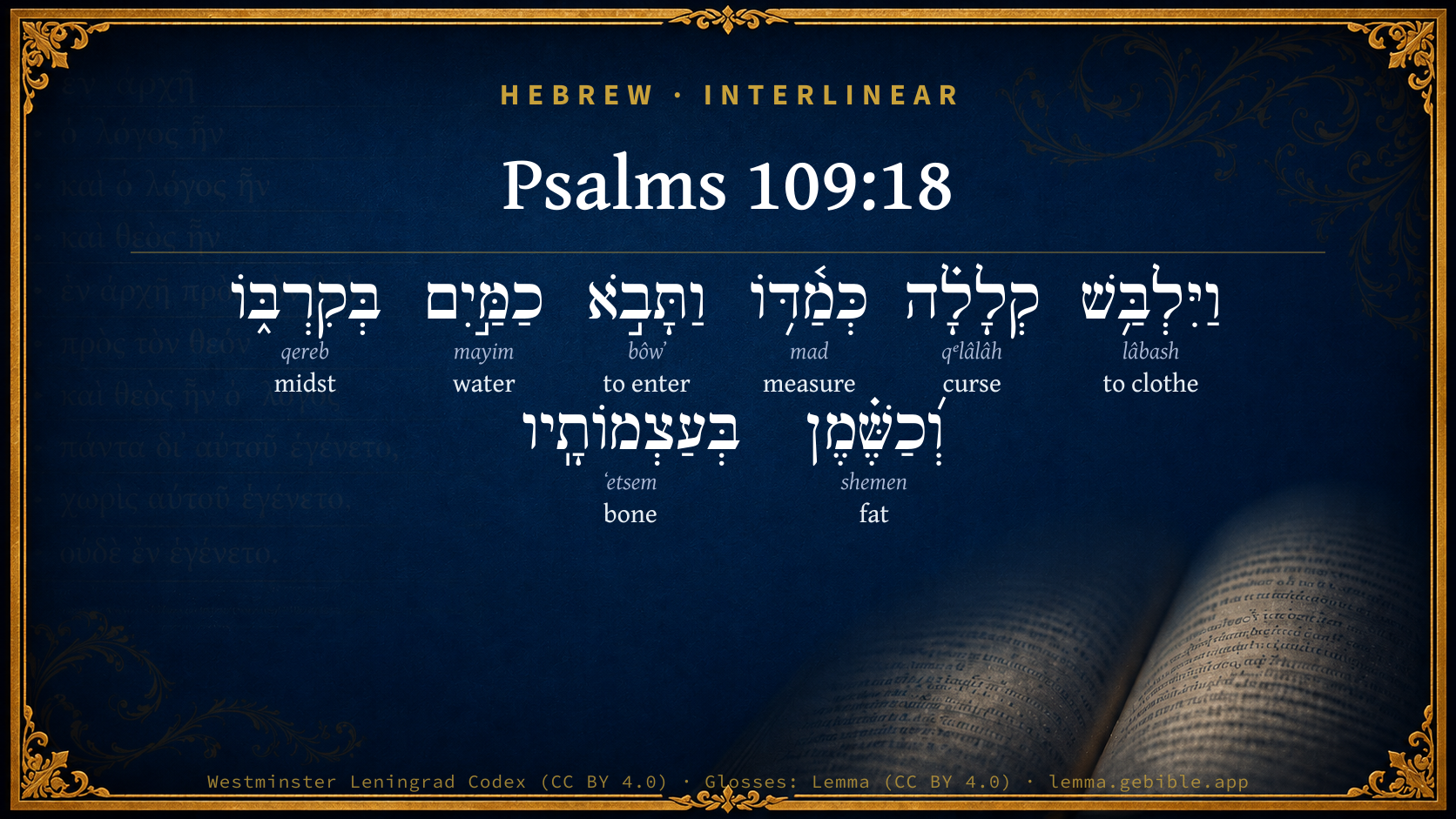
כְּמַ֫דּ֥וֹ
mad
H4055
“like/as · measure · his”
Preposition + Noun, Common, Masculine, Singular, Construct + Suffix, Personal, 3rd Person, Masculine, Singular
Part of Speech
Preposition + Noun
Type
Common
Gender
Masculine
Number
Singular
State
Construct
Full BDB Definition

Origin: from H4058

TWOT: 1146a

measure, cloth garment - measure - cloth, carpet - garment (outer)
  1. וַיִּלְבַּ֥שׁ lâbash H3847 “and · to clothe” Conjunction + Verb, Qal, Sequential Imperfect, 3rd Person, Masculine, Singular
  2. קְלָלָ֗ה qᵉlâlâh H7045 “curse” Noun, Common, Feminine, Singular, Absolute
  3. וַתָּבֹ֣א bôwʼ H935 “and · to enter” Conjunction + Verb, Qal, Sequential Imperfect, 3rd Person, Feminine, Singular
  4. כַמַּ֣יִם mayim H4325 “like/as the · water(s)” Preposition, Determined + Noun, Common, Masculine, Plural, Absolute
  5. בְּקִרְבּ֑וֹ qereb H7130 “in/at · midst · his” Preposition + Noun, Common, Masculine, Singular, Construct + Suffix, Personal, 3rd Person, Masculine, Singular
  6. וְ֝כַשֶּׁ֗מֶן shemen H8081 “and · like/as the · fat” Conjunction + Preposition, Determined + Noun, Common, Masculine, Singular, Absolute
  7. בְּעַצְמוֹתָֽיו ʻetsem H6106 “in/at · bones · his” Preposition + Noun, Common, Feminine, Plural, Construct + Suffix, Personal, 3rd Person, Masculine, Singular

About this verse

These counts appear in no published source. They are computed here, from the morphology-tagged text and Lemma’s own curated glosses. What Lemma adds →

8
words
8
distinct lemmas
Wisdom
section

Notable vocabulary

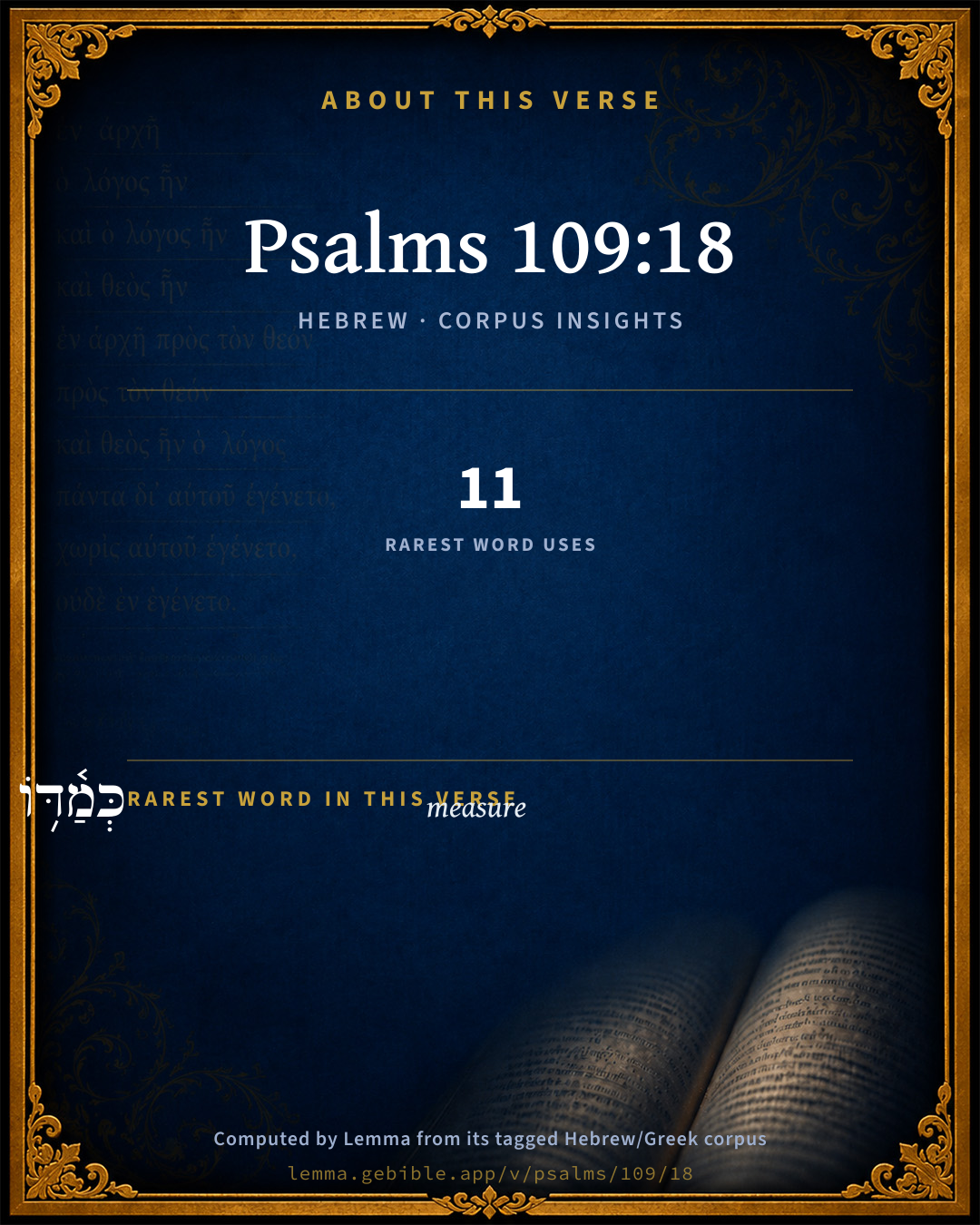
The rarest word here is כְּמַ֫דּ֥וֹ measure H4055 — appearing just 11 times in the whole Hebrew Bible.

Shared distinctive vocabulary

כְּמַ֫דּ֥וֹ measure H4055 occurs in 11 verses of the Hebrew Bible. Also found in:

Grammatical profile

  • 2 verbs
  • 6 nouns

Verb forms

  • וַיִּלְבַּ֥שׁ Qal · Sequential Imperfect
  • וַתָּבֹ֣א Qal · Sequential Imperfect

Hebrew & Septuagint length

In English translation the verse runs 23 words from the Hebrew and 23 from the Septuagint (LXX English) — the same length.

A rough comparison of the two English renderings, which tokenize alike — not a word-level alignment.

Word counts can differ between the Hebrew and the Greek without any difference in meaning — e.g. the Hebrew direct-object marker אֵת has no separate Greek word, and Greek often adds the article ὁ.

Cross-references

13

Topical passages linked to Psalms 109:18 in the Treasury of Scripture Knowledge — connected by theme and wording, ordered by reader-vote popularity; previews shown in the World English Bible.

  • Psalms 73:6 Therefore pride is like a chain around their neck. Violence covers them like a garment.
  • Numbers 5:22 and this water that brings a curse will go into your bowels, and make your body swell, and your thigh fall away.' The woman shall say, 'Amen, Amen.'
  • Matthew 27:3–5 Then Judas, who betrayed him, when he saw that Jesus was condemned, felt remorse, and brought back the thirty pieces of silver to the chief priests and elders,
  • Colossians 3:12 Put on therefore, as God's chosen ones, holy and beloved, a heart of compassion, kindness, lowliness, humility, and perseverance;
  • Numbers 5:27 When he has made her drink the water, then it shall happen, if she is defiled, and has committed a trespass against her husband, that the water that causes the curse will enter into her and become bitter, and her body will swell, and her thigh will fall away: and the woman will be a curse among her people.
  • Job 20:12–16 "Though wickedness is sweet in his mouth, Though he hide it under his tongue,
  • Job 20:20–23 "Because he knew no quietness within him, He shall not save anything of that in which he delights.
  • Job 29:14 I put on righteousness, and it clothed me. My justice was as a robe and a diadem.
  • Matthew 26:24 The Son of Man goes, even as it is written of him, but woe to that man through whom the Son of Man is betrayed! It would be better for that man if he had not been born."
  • Acts 1:18 Now this man obtained a field with the reward for his wickedness, and falling headlong, his body burst open, and all his intestines gushed out.
  • Acts 1:25 to take part in this ministry and apostleship from which Judas fell away, that he might go to his own place."
  • Colossians 3:8 but now you also put them all away: anger, wrath, malice, slander, and shameful speaking out of your mouth.
  • 1 Peter 5:5 Likewise, you younger ones, be subject to the elder. Yes, all of you gird yourselves with humility, to subject yourselves to one another; for "God resists the proud, but gives grace to the humble."

Cross-references courtesy of OpenBible.info (CC BY 4.0).

Hebrew and Greek witnesses Masoretic Hebrew ↔ Greek Septuagint

The same verse in the two great witnesses to the Old Testament, shown verse-for-verse.

You’re reading Greek Psalm 108 (Hebrew Psalm 109). The Septuagint counts the superscription, so verse numbers can differ from the Hebrew — chapter-level alignment, not verse-by-verse. Numbering follows Rahlfs.

These are two independent witnesses, not word-aligned to each other, and the Septuagint is shown in lemma (dictionary) form.

Hebrew Psalms 109:18 Masoretic · Westminster Leningrad Codex

וַיִּלְבַּ֥שׁ קְלָלָ֗ה כְּמַ֫דּ֥וֹ וַתָּבֹ֣א כַמַּ֣יִם בְּקִרְבּ֑וֹ וְ֝כַשֶּׁ֗מֶן בְּעַצְמוֹתָֽיו

He clothed himself also with cursing as with his garment. It came into his inward parts like water, Like oil into his bones.

World English Bible · Public Domain

Greek LXX Greek Psalm 108:18 Septuagint · lemma form

καί ἐνδύω κατάρα ὡς ἱμάτιον καί εἰςἔρχομαι ὡς ὕδωρ εἰς ὁ ἔγκατα αὐτός καί ὡσεί ἔλαιον ἐν ὁ ὀστέον αὐτός

Yes, he put on cursing as a garment, and it is come as water into his bowels, and as oil into his bones.

LXX2012 (modern English Septuagint) · Public Domain

Hebrew: Westminster Leningrad Codex (CC BY 4.0). Greek: Septuagint (public domain); English from LXX2012 (modern English Septuagint) (Public Domain). How the Septuagint differs from the Hebrew →

Commentary

Notes on Psalms 109:18 from classic Christian and Jewish commentators (each source and its license shown beneath its notes). The classic Christian expositions comment on the surrounding passage and are grouped to its opening verse, so a note may address several verses; the Jewish commentaries on the Tanakh (Rashi and others) are per-verse, so they appear only where the commentator wrote on this verse.

Lemma curates 59 commentaries, every one of them public domain or Creative Commons licensed, each selected and text-cleaned for this edition rather than reprinted as found. About our sources →

Trapp's Complete Commentary

John Trapp

Psa 109:18 As he clothed himself with cursing like as with his garment, so let it come into his bowels like water, and like oil into his bones.

Ver. 18. As he clothed himself with cursing like as with his garment] Ut vestis commensurata corpori, as the inner garment that sticks closest to the body, and is not done off but with much ado, as he hath wrapped, and trussed up himself in cursing.

So let it come into his bowels like water] Let him have his belly full of it, and his bones full too.

And like oil] Which easily soaketh through. See Num 5:22.

John Trapp, A Commentary or Exposition upon All the Books of the Old and New Testament (1647–1656) — public domain. Text from a community e-Sword module.

J. A. Alexander on Psalms

Joseph Addison Alexander

18. (Psa 109:18) And he has put on cursing as his garment, and it has come like water into his inside, and like oil into his bones. There is an obvious climax in this verse. That which is first described as the man's exterior covering, is then said to be within him, first as water, then as oil or fat, first in the vessels of his body, then in his very bones. The general idea is that the curse, which he denounced and endeavoured to inflict on others, has taken possession of himself, both within and without. Compare Num 5:22; Num 5:24; Num 5:27. The first clause admits of a different construction, which would make it descriptive of the crime and not the punishment. He put on cursing as his garment, and (now) it has come, etc. This construction introduces an antithesis, and thereby adds to the point of the sentence, and is also recommended by the analogy of Psa 109:17.

Joseph Addison Alexander, The Psalms Translated and Explained (1850) — public domain. Text from a community e-Sword module.

Tyndale Open Study Notes

Tyndale Open Resources

109:18 Cursing is the accused person’s whole way of life.

Tyndale Open Study Notes — © Tyndale Open Resources, licensed CC BY-SA 4.0. Text via the HelloAO Bible API.

Adam Clarke's Commentary

Verse 18. Let it come into his bowels like water] Houbigant thinks this is an allusion to the waters of jealousy; and he is probably right, - the bitter waters that produce the curse. See Nu 5:18.

Adam Clarke's Commentary on the Bible (1810–1826) — public domain. Text from a community e-Sword/MySword module.

John Calvin's Commentaries

Not a few interpreters translate the next two verses in the past form, he clothed himself with cursing, etc., which would be tantamount to saying that the enemy was as fond of cursing as of costly apparel, or that he clothed himself with it as with a garment, and that, like an inveterate disease, it was deeply seated in the marrow of his bones. The other interpretation is more simple, That cursing should cleave to the wicked, that it should envelop him like a cloak, gird him about as his girdle, and should even penetrate to his bones. And that no one may rashly take for an example what David here spoke by the special influence of the Holy Spirit, let him keep in mind that the Psalmist is not pleading here in reference to any personal interest, and that it is no ordinary character to whom he refers. Belonging to the number of the faithful, he would not omit the law of charity, in desiring the salvation of all men. But in this instance God elevated his spirit above all earthly considerations, stript him of all malice, and delivered him from the influence of turbulent passion, so that he might, with holy calmness and spiritual wisdom, doom the reprobate and castaway to destruction. Others, would have the phrase, he loved cursing, to mean that he purposely drew down the vengeance of God upon himself, as it were procuring destruction for himself by his open hostility to him; but this is an unnatural construction of the passage. The interpretation which I have given is preferable, That he was so addicted to mischief and wrong, that no act of justice or kindness was to be expected from him. In the meantime, let it be observed, that all the machinations of the wicked will eventually recoil upon their own heads, and that when they are raging more violently against others, then it is that the mischief, which they so eagerly desire may come upon them, falls upon themselves, even as the wind called Cecias by blowing attracts the clouds unto him.

John Calvin's Commentaries (1540-1563) — public domain. Text from the Calvin Translation Society English edition (1840s-50s) via the Christian Classics Ethereal Library (ccel.org). Calvin's coverage is partial (roughly two-thirds of the Bible); uncommented books and verses are honest gaps, never fabricated. The 19th-century editor's footnotes and remarks are omitted so the notes are faithfully Calvin's own voice.

The Cambridge Bible for Schools and Colleges

gen. ed. J. J. S. Perowne

18. And he clad himself with cursing as with his robe,

And It came into his inward parts like water, and like oil into his bones:

The Cambridge Bible for Schools and Colleges (gen. ed. J. J. S. Perowne; Cambridge University Press, 1878–1918) — public domain. Text from a community e-Sword module.

John Gill's Exposition

Let it be unto him as the garment which covereth him,.... Let him be surrounded on all sides with the wrath of God; and let it be visible to all, as a man's garment on him is: see Isa 66:24.

And for a girdle wherewith he is girded continually; let him be in the utmost straits and distress, being encompassed about with the curse and wrath of God; and let that stick close unto him as a man's belt does; and let him not be able to get clear of it, or extricate himself out of it, as no man can on whom it is.

John Gill's Exposition of the Whole Bible (1746–1763) — public domain (CC PDM 1.0). Text via the HelloAO Bible API.

Albert Barnes' Notes on the Bible

As he clothed himself with cursing like as with a garment - Moral qualities are often compared with raiment - as that in which we “appear” to our fellow-men. See 1Pe 5:5; Job 29:14.

So let it come into his bowels like water - Margin, “within him.” Hebrew, “In his midst.” Let it penetrate him through and through. Let no part of him be unaffected by it.

And like oil into his bones - As if oil flowed through all his bones, so let the effects of cursing pervade his whole frame. The prayer is, that his entire nature might feel the effects of cursing; that he might know to the full what he was endeavoring to bring on others.

Albert Barnes' Notes on the Bible (1834–1885) — public domain. Text from a community e-Sword/MySword module.

Matthew Poole's English Annotations

A garment; which a man wears constantly, and that as

Like water; which when a man drinks, goes bowels, and searcheth all the inwards of his belly.

Like oil; which is more piercing than water, and being applied to outward parts, reacheth even to the bones and marrow

Matthew Poole's English Annotations on the Holy Bible (1683–1685) — public domain. Text from a community e-Sword/MySword module.

The Treasury of David

Charles H. Spurgeon

Ver. 18-19. He was so openly in the habit of wishing ill to others that he seemed to wear robes of cursing, therefore let it be as his raiment girded and belted about him, yea, let it enter as water into his bowels, and search the very marrow of his bones like a penetrating oil. It is but common justice that he should receive a return for his malice, and receive it in kind, too.

Ver. 18. The three figures in this verse are climatic: he has clothed himself in cursing, he has drunk it in like water (Job 15:16, 34:7), it has penetrated to the marrow of his bones, like the oily preparations which are rubbed in and penetrate to the bones. Franz Delitzsch.

Ver. 18. We must not pass this verse without remarking that there is an allusion in its tone to Nu 5:21-22, 24 the unfaithful wife. Her curse was to penetrate into her bowels; "the water that causeth the curse shall enter into her"; and such a curse comes on unfaithful Judas, who violates his engagement to the Lord, and upon Israel at large also, who have departed from him "as a wife treacherously departeth from her husband", and have committed adultery against the Bridegroom. Andrew A. Bonar.

Ver. 18-19. Peter, in Ac 1:20, applies this psalm to Christ when the Jews cried, "His blood be upon us and upon our children"; then did they put on the envenomed garment which has tormented them ever since. It is girded about their loins; the curse has penetrated like water, and entered the very bones like oil. How awful will be the state of those who crucify him afresh, and again put him to open shame. Samuel Horsley.

Psalms 109:19*

See Exposition for Verse 18.

See Sayings for Verse 18.

Psalms 109:20*

Charles H. Spurgeon's The Treasury of David (1869–1885) — public domain. Psalms only. Text from a community e-Sword/MySword module.

Whedon's Commentary on the Bible

Daniel D. Whedon

18. Into his bowels—Hebrew, his inward parts; penetrating like oil his whole being. It is an advance upon the figure of clothing—garment—as an outside covering, in the previous member. The allusion is to the waters of jealousy, (Num_5:22,) “And this water that causeth the curse shall go into thy bowels.”

Daniel D. Whedon (gen. ed.), Commentary on the Old and New Testaments (1874–1909) — public domain. Text from a community e-Sword module.

The Pulpit Commentary

As he clothed himself with cursing like as with his garment. (comp. Psa_10:7 Psa_59:12 Psa_62:4) Extreme malevolence vents itself in curses, which tend to become frequent, and, so to speak, habitual. So let it come; rather, so it cams, or so it will come. Into his bowels like water. Dr. Kay sees here an allusion to the "water of cursing" which was drunk by the woman whose husband taxed her with unfaithfulness; (Num_5:22) and so also Hengstenberg. But this is doubtful. Perhaps the mere penetrative power of water is alluded to. See the next clause. And like oil into his bones. The oil, wherewith it was usual to anoint the frame, was believed to penetrate, not only into the tissues, but into the very bones and marrow.

The Pulpit Commentary (1880–1919), ed. H.D.M. Spence-Jones & Joseph S. Exell — public domain. Text from a community e-Sword module.

John Wesley's Explanatory Notes

Garment - Which a man wears constantly. Like water - Water in the cavity of the belly, between the bowels, is almost certain death. And oil soaking into any of the bones, will soon utterly destroy it.

John Wesley, Explanatory Notes Upon the Whole Bible (1754–1765) — public domain. Text via the GEBible commentary corpus.

Rashi

Rabbi Shlomo Yitzchaki (Rashi)

And he donned a curse He brought himself into a curse and was satisfied with breaking off the yoke of the sacrifice and the priestly blessing and the curse of the heathens.

Rashi on the Tanakh — English translations: “The Judaica Press complete Tanach with Rashi, translated by A. J. Rosenberg” (CC BY 4.0); “Pentateuch with Rashi's commentary by M. Rosenbaum and A.M. Silbermann, 1929-1934” (public domain); “The Metsudah Tanach series, Lakewood, N.J” (CC BY 4.0); and “The Book of Joshua, Metsudah Publications, 1997” (CC BY 4.0). Text via Sefaria.

Lesson kit

Teaching starters — assembled from the data on this page, not authored interpretation. Every prompt links to the verse data it draws on. Edit before teaching.

Psalms, in the Wisdom, opens this verse with 8 words (8 distinct Hebrew lemmas). Its most distinctive word is mad (“measure”). A historical commentator’s framing appears above. Read the whole chapter for the surrounding context.

Discussion questions

  1. How does “measure” (mad) shape what this verse is saying?
  2. How does Leviticus 6:10, which shares the word «measure», read alongside this verse?
  3. These translations render this verse differently; the difference is in the English rendering, not the original. What questions does that raise?
  4. «וַיִּלְבַּ֥שׁ» is a Qal Sequential Imperfect verb. How does that grammatical form shape the action described?
  5. Compare how Trapp's Complete Commentary and J. A. Alexander on Psalms read this verse. Where do they agree or differ?

Things to notice

Reading settings

Reading text

Shown beneath each verse's original-language words.

Old Testament
Old Testament edition

Read the OT as the Masoretic Hebrew (MT) or the Greek Septuagint (LXX).

English shown for the Greek Septuagint (in the Hebrew ↔ Greek comparison).

Comparing translations? Open the Compare panel on any verse page to stack up to four side by side.