
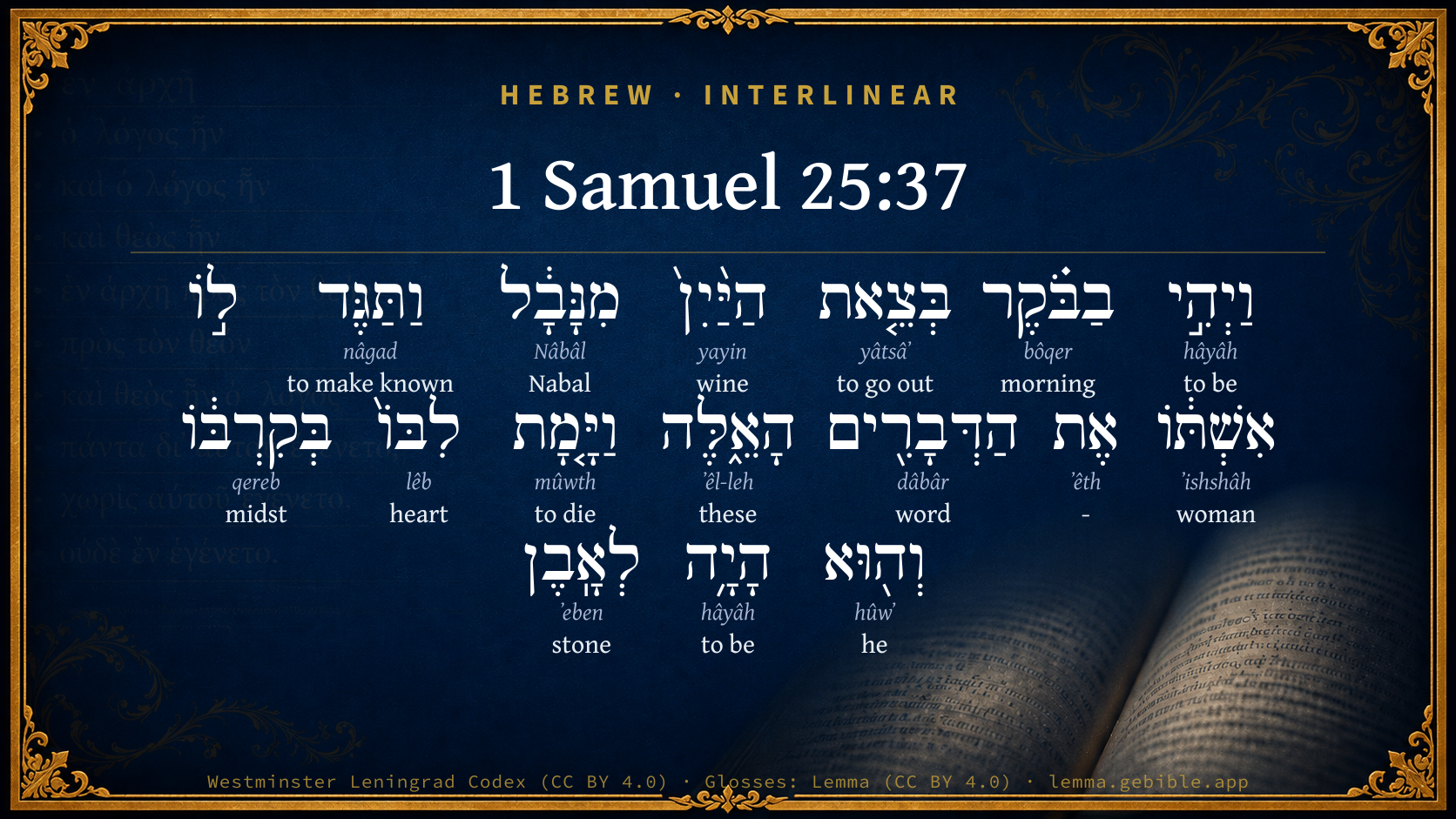
1 Samuel 25:37

Hebrew (Westminster Leningrad Codex) 1 Samuel 25:37 appears in the Hebrew Old Testament. The text above is from the Westminster Leningrad Codex. Each word links to its Strong’s number, a concise gloss, and parsing drawn from the Open Scriptures Hebrew Bible morphology. Click any word for its full Brown-Driver-Briggs (BDB) entry.
Download image
Cite this verse

1 Samuel 25:37 (World English Bible). Public Domain. Lemma interlinear Bible study tool, https://lemma.gebible.app/v/1-samuel/25/37.

Show BibTeX & RIS
BibTeX
RIS
English Translation
It happened in the morning, when the wine was gone out of Nabal, that his wife told him these things, and his heart died within him, and he became as a stone.
World English Bible · Public Domain
Download a study sheet

One document with this verse’s original text, its word-by-word gloss line, the meaning frame, cross-references with their text, attributed commentary, and full source and license credits — printable, and it pastes into notes with its structure intact.

This verse Autodidact and up

Study sheet (.html) Plain text (.txt)

A passage Seminary Student

Up to 50 verses in one chapter. A passage sheet keeps up to 6 commentary sources and 12 cross-references per verse, in the order this page ranks them, and says so on the sheet whenever that leaves anything out. Ask for a single verse and you get the Autodidact verse sheet above.

Everything on this page stays free to read, with no account — the sheet is a download of what is already on screen, not access to it.

Want to remove ads? Support Godless Engineer
Compare translations 3

The same verse in 3 English versions, stacked beneath the original-language interlinear above. Click any original word for its lexicon entry.

Each is an independent rendering of the whole verse — the interlinear is not word-aligned to these translations.

Highlighted words mark where these versions differ — a whole-verse word diff, not a word-by-word alignment.

  • World English Bible Public Domain
    It happened in the morning, when the wine was gone out of Nabal, that his wife told him these things, and his heart died within him, and he became as a stone.
  • King James Version Public Domain
    But it came to pass in the morning, when the wine was gone out of Nabal, and his wife had told him these things, that his heart died within him, and he became as a stone.
  • unfoldingWord Literal Text CC BY-SA 4.0
    And it happened in the morning, when the wine had gone out from Nabal, that his wife declared to him these things. And his heart died in the midst of him, and he became a stone.

unfoldingWord Literal Text — © unfoldingWord, licensed CC BY-SA 4.0. Word-aligned USFM3 via Door43 (git.door43.org/unfoldingWord/en_ult).

Versions to compare (up to 4)

3 of 4 selected

Show all 18 translations

Every available English version of this verse, each an independent rendering of the whole verse.

  • World English Bible Public Domain
    It happened in the morning, when the wine was gone out of Nabal, that his wife told him these things, and his heart died within him, and he became as a stone.
  • Berean Standard Bible Public Domain
    In the morning when Nabal was sober, his wife told him about these events, and his heart failed within him and he became like a stone.
  • Majority Standard Bible Public Domain
    In the morning when Nabal was sober, his wife told him about these events, and his heart failed within him, and he became like a stone.
  • King James Version Public Domain
    But it came to pass in the morning, when the wine was gone out of Nabal, and his wife had told him these things, that his heart died within him, and he became as a stone.
  • American Standard Version (1901) Public Domain
    And it came to pass in the morning, when the wine was gone out of Nabal, that his wife told him these things, and his heart died within him, and he became as a stone.
  • Revised Version (1885) Public Domain
    And it came to pass in the morning, when the wine was gone out of Nabal, that his wife told him these things, and his heart died within him, and he became as a stone.
  • Geneva Bible (1599) Public Domain
    Then in the morning when the wine was gone out of Nabal, his wife tolde him those wordes, and his heart died within him, and he was like a stone.
  • Douay-Rheims (1899) Public Domain
    But early in the morning when Nabal had digested his wine, his wife told him these words, and his heart died within him, and he became as a stone.
  • Young's Literal Translation Public Domain
    And it cometh to pass in the morning, when the wine is gone out from Nabal, that his wife declareth to him these things, and his heart dieth within him, and he hath been as a stone.
  • Literal Standard Version CC BY-SA 4.0
    And it comes to pass in the morning, when the wine is gone out from Nabal, that his wife declares these things to him, and his heart dies within him, and he has been as a stone.
  • Unlocked Literal Bible CC BY-SA 4.0
    It came about in the morning, when the wine had gone out of Nabal, that his wife told him these things; his heart died within him, and he became like a stone.
  • unfoldingWord Literal Text CC BY-SA 4.0
    And it happened in the morning, when the wine had gone out from Nabal, that his wife declared to him these things. And his heart died in the midst of him, and he became a stone.
  • Darby Bible Public Domain
    And it came to pass in the morning, when the wine was gone out of Nabal, that his wife told him these things; and his heart died within him, and he became [as] a stone.
  • World Messianic Bible Public Domain
    In the morning, when the wine had gone out of Nabal, his wife told him these things; and his heart died within him, and he became as a stone.
  • Webster's Bible Public Domain
    But it came to pass in the morning, when the wine had left Nabal, and his wife had told him these things, that his heart died within him, and he became as a stone.
  • Free Bible Version CC BY-SA 4.0
    When Nabal had sobered up the next morning, his wife told him what had happened. When he heard what she had to say he had a heart attack and was paralyzed.
  • Bible in Basic English Public Domain
    And in the morning, when the effect of the wine was gone, Nabal's wife gave him an account of all these things, and all the heart went out of him, and he became like stone.
  • JPS Tanakh (1917) Public Domain
    And it came to pass in the morning, when the wine was gone out of Nabal, that his wife told him these things, and his heart died within him, and he became as a stone.

Literal Standard Version (2020), Covenant Press — licensed CC BY-SA 4.0. Text via the HelloAO Bible API (eBible.org). Unlocked Literal Bible (unfoldingWord) — licensed CC BY-SA 4.0. Text via the HelloAO Bible API (eBible.org). unfoldingWord Literal Text — © unfoldingWord, licensed CC BY-SA 4.0. Word-aligned USFM3 via Door43 (git.door43.org/unfoldingWord/en_ult). Free Bible Version, Dr. Jonathan Gallagher — licensed CC BY-SA 4.0. Text via the HelloAO Bible API (eBible.org).

Word by word

More ways to search: Search by grammar → Find every occurrence → Compare this word →

Practice this passage: Drill this verse → Learn its vocabulary →

מִנָּבָ֔ל
Nâbâl
H5037
“from · Nabal”
Preposition + Noun, Proper
Part of Speech
Preposition + Noun
Type
Proper
Full BDB Definition

Origin: the same as H5036

TWOT: None

Nabhal or Nabal = "fool" - a man of Carmel who spurned David's messengers, then died of shock when he realised it might cause his death; his case was pleaded by his wife Abigail who became David's wife after his death
  1. וַיְהִ֣י hâyâh H1961 “and · to be” Conjunction + Verb, Qal, Sequential Imperfect, 3rd Person, Masculine, Singular
  2. בַבֹּ֗קֶר bôqer H1242 “in/at the · morning” Preposition, Determined + Noun, Common, Masculine, Singular, Absolute
  3. בְּצֵ֤את yâtsâʼ H3318 “in/at · to go out” Preposition + Verb, Qal, Infinitive Construct
  4. הַיַּ֨יִן֙ yayin H3196 “the · wine” Particle, Definite Article + Noun, Common, Masculine, Singular, Absolute
  5. וַתַּגֶּד nâgad H5046 “and · to make known” Conjunction + Verb, Hiphil, Sequential Imperfect, 3rd Person, Feminine, Singular
  6. אִשְׁתּ֔וֹ ʼishshâh H802 “woman · his” Noun, Common, Feminine, Singular, Construct + Suffix, Personal, 3rd Person, Masculine, Singular
  7. אֶת ʼêth H853 “-” Particle, Direct Object
  8. הַדְּבָרִ֖ים dâbâr H1697 “the · words” Particle, Definite Article + Noun, Common, Masculine, Plural, Absolute
  9. הָאֵ֑לֶּה ʼêl-leh H428 “the · these” Particle, Definite Article + Pronoun, Demonstrative, Common, Plural
  10. וַיָּ֤מָת mûwth H4191 “and · to die” Conjunction + Verb, Qal, Sequential Imperfect, 3rd Person, Masculine, Singular
  11. לִבּוֹ֙ lêb H3820 “heart · his” Noun, Common, Masculine, Singular, Construct + Suffix, Personal, 3rd Person, Masculine, Singular
  12. בְּקִרְבּ֔וֹ qereb H7130 “in/at · midst · his” Preposition + Noun, Common, Masculine, Singular, Construct + Suffix, Personal, 3rd Person, Masculine, Singular
  13. וְה֖וּא hûwʼ H1931 “and · he” Conjunction + Pronoun, Personal, 3rd Person, Masculine, Singular
  14. הָיָ֥ה hâyâh H1961 “to be” Verb, Qal, Perfect, 3rd Person, Masculine, Singular
  15. לְאָֽבֶן ʼeben H68 “to/for · stone” Preposition + Noun, Common, Feminine, Singular, Absolute

About this verse

These counts appear in no published source. They are computed here, from the morphology-tagged text and Lemma’s own curated glosses. What Lemma adds →

17
words
15
distinct lemmas
Historical
section

Notable vocabulary

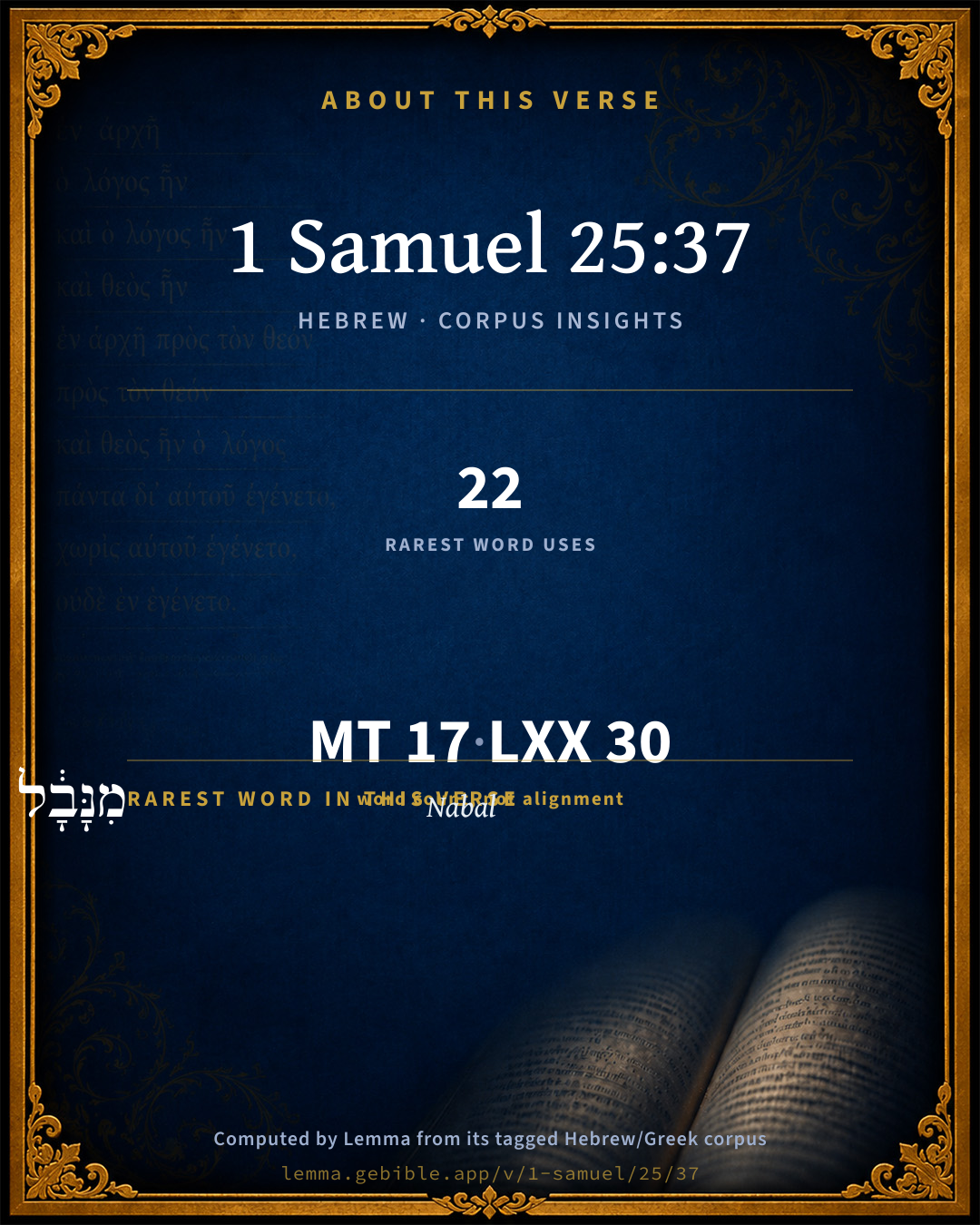
The rarest word here is מִנָּבָ֔ל Nabal H5037 — appearing just 22 times in the whole Hebrew Bible.

Shared distinctive vocabulary

מִנָּבָ֔ל Nabal H5037 occurs in 18 verses of the Hebrew Bible. Also found in:

Grammatical profile

  • 5 verbs
  • 8 nouns
  • 2 pronouns
  • 1 preposition
  • 1 particle

Verb forms

  • וַיְהִ֣י Qal · Sequential Imperfect
  • בְּצֵ֤את Qal · Infinitive Construct
  • וַתַּגֶּד Hiphil · Sequential Imperfect
  • וַיָּ֤מָת Qal · Sequential Imperfect
  • הָיָ֥ה Qal · Perfect

Repetition

A word recurs within this verse — often emphatic in Hebrew:

  • וַיְהִ֣י to be H1961 ×2

Hebrew & Septuagint length

In English translation the verse runs 32 words from the Hebrew and 32 from the Septuagint (LXX English) — the same length.

A rough comparison of the two English renderings, which tokenize alike — not a word-level alignment.

Word counts can differ between the Hebrew and the Greek without any difference in meaning — e.g. the Hebrew direct-object marker אֵת has no separate Greek word, and Greek often adds the article ὁ.

In the original languages it is 17 Hebrew tokens and 30 Greek tokens — but the two are counted differently (Hebrew bundles its prefixes and suffixes into one token; the Greek is in lemma form), so that isn’t a like-for-like length.

Cross-references

5

Topical passages linked to 1 Samuel 25:37 in the Treasury of Scripture Knowledge — connected by theme and wording, ordered by reader-vote popularity; previews shown in the World English Bible.

  • Deuteronomy 28:28 Yahweh will strike you with madness, and with blindness, and with astonishment of heart;
  • 1 Samuel 25:22 God do so to the enemies of David, and more also, if I leave of all that belongs to him by the morning light so much as one man-child.
  • 1 Samuel 25:34 For in very deed, as Yahweh, the God of Israel, lives, who has withheld me from hurting you, except you had hurried and come to meet me, surely there wouldn't have been left to Nabal by the morning light so much as one man-child.
  • Job 15:21–22 A sound of terrors is in his ears; In prosperity the destroyer shall come on him.
  • Proverbs 23:29–35 Who has woe? Who has sorrow? Who has strife? Who has complaints? Who has needless bruises? Who has bloodshot eyes?

Cross-references courtesy of OpenBible.info (CC BY 4.0).

Hebrew and Greek witnesses Masoretic Hebrew ↔ Greek Septuagint

The same verse in the two great witnesses to the Old Testament, shown verse-for-verse.

These are two independent witnesses, not word-aligned to each other, and the Septuagint is shown in lemma (dictionary) form.

Hebrew 1 Samuel 25:37 Masoretic · Westminster Leningrad Codex

וַיְהִ֣י בַבֹּ֗קֶר בְּצֵ֤את הַיַּ֨יִן֙ מִנָּבָ֔ל וַתַּגֶּד ל֣וֹ אִשְׁתּ֔וֹ אֶת הַדְּבָרִ֖ים הָאֵ֑לֶּה וַיָּ֤מָת לִבּוֹ֙ בְּקִרְבּ֔וֹ וְה֖וּא הָיָ֥ה לְאָֽבֶן

It happened in the morning, when the wine was gone out of Nabal, that his wife told him these things, and his heart died within him, and he became as a stone.

World English Bible · Public Domain

Greek LXX 1 Samuel 25:37 Septuagint · lemma form

καί γίγνομαι πρωΐ ὡς ἐκνήφω ἀπό ὁ οἶνος ναβαλ ἀποἀγγέλλω αὐτός ὁ γυνή αὐτός ὁ ῥῆμα οὗτος καί ἐν ἀποθνήσκω ὁ καρδία αὐτός ἐν αὐτός καί αὐτός γίγνομαι ὡς λίθος

And it came to pass in the morning, when Nabal recovered from his wine, his wife told him these words; and his heart died within him, and he became as a stone.

LXX2012 (modern English Septuagint) · Public Domain

Hebrew: Westminster Leningrad Codex (CC BY 4.0). Greek: Septuagint (public domain); English from LXX2012 (modern English Septuagint) (Public Domain). How the Septuagint differs from the Hebrew →

Targum (Aramaic paraphrase)

1

The Targum is the ancient Jewish Aramaic paraphrase of the Hebrew Scriptures — an interpretive translation, not the Hebrew text itself. Onkelos (literal) and Pseudo-Jonathan (expansive) render the Torah, and Jonathan the Prophets. Coverage is partial: where no permissively-licensed English translation exists for a verse, only the Aramaic is shown. This is verse-level text, not a word-by-word alignment to the Hebrew.

  1. Targum Jonathan Prophets (Joshua–Malachi)
    וַהֲוָה בְצַפְרָא כַּד פָּג חַמְרָא מִנָבָל וְחַוִיאַת לֵיהּ אִתְּתֵיהּ יַת פִּתְגָמַיָא הָאִלֵין וּמִית לִבֵּיהּ בִּמְעוֹהִי וְהוּא הֲוָא כְאַבְנָא:

    (no public-domain English translation for this verse)

    Targum Jonathan — Aramaic: “Mikraot Gedolot” (public domain). English: “Sefaria Community Translation” (CC0 1.0 (public-domain dedication)); “London "Chaldee Paraphrase," 1871” (public domain). Text via Sefaria.

Commentary

Notes on 1 Samuel 25:37 from classic Christian and Jewish commentators (each source and its license shown beneath its notes). The classic Christian expositions comment on the surrounding passage and are grouped to its opening verse, so a note may address several verses; the Jewish commentaries on the Tanakh (Rashi and others) are per-verse, so they appear only where the commentator wrote on this verse.

Lemma curates 59 commentaries, every one of them public domain or Creative Commons licensed, each selected and text-cleaned for this edition rather than reprinted as found. About our sources →

Trapp's Complete Commentary

John Trapp

1Sa 25:37 But it came to pass in the morning, when the wine was gone out of Nabal, and his wife had told him these things, that his heart died within him, and he became [as] a stone.

Ver. 37. When the wine was gone out of Nabal.] That is, The perturbation of his brain, the alienation of his mind, - when sleep had cooled his head, and restored him to himself.

And his wife had told him these things.] In a pathetical manner no doubt, as she could well do it. That tongue of hers had oft advised him well and prevailed not. Now it occasioneth his death, whose reformation it could not effect. She meant nothing but his amendment. God meant to make that loving instrument the means of his revenge. Wonderful, saith one, {a} was the force of this woman’s speech, that as it before allayed David’s rage, so now it pierceth Nabal to the heart. This power was not in her human eloquence, but proceeded from the Spirit of God.

That his heart died within him.] Through fear, which hath a deadly force upon feeble spirits; for some have died for fear they should die: as a gentleman at the siege of St Paul, in France, fell down stark dead in the breach, without any stroke or touch, save what his heart gave him by a fearful apprehension of danger near at hand. {b} And at the massacre of Paris, where Peter Ramus was slain in his study, Lambinus, a learned man, but a Papist - through fear of his adversary, Carpenter, a Sorbonnist, who had slain Ramus - was so frightened, that he died shortly after. {c}

And he became as a stone.] A sot he had been in his life, and as senseless he lay at his death, though he had the benefit of ten days’ sickness. {d} Who then would defer to do the great work?

“ Non aliter stupuit quam qui Iovis ignibus ictus

Vivit, at est vitae nescius ipse sum. ”

- Ovid. Trist., lib. i. eleg. iii.

{a} Dr Willet.

{b} Dr Hall, of Christ. Moder., lib. i. sect. 14.

{c} Epit. Hist. Gallic., p. 148.

{d} Praeclusis sensibus rigebat. - Jun.

John Trapp, A Commentary or Exposition upon All the Books of the Old and New Testament (1647–1656) — public domain. Text from a community e-Sword module.

Joseph Benson's Commentary

1Sa 25:37-38. His heart died — He fainted away through the fear and horror of so great a mischief, though it was past. As one, who, having in the night galloped over a narrow plank, laid upon a broken bridge over a deep river, when in the morning he came to review it, was struck dead with the horror of the danger he had been in. The Lord smote Nabal — God either inflicted some other stroke upon him, or increased his grief and fear to such a height as killed him.

Joseph Benson's Commentary on the Old and New Testaments (1811–1818) — public domain. Text from a community e-Sword module.

Tyndale Open Study Notes

Tyndale Open Resources

25:37 Nabal was so stunned by the revelation that he had a stroke or a heart attack.

Tyndale Open Study Notes — © Tyndale Open Resources, licensed CC BY-SA 4.0. Text via the HelloAO Bible API.

Geneva Bible (1599)

Geneva Bible translators

For fear of the great danger.

Geneva Bible (1599) marginal notes — public domain. Text via Bolls.life.

Jamieson, Fausset & Brown

Robert Jamieson, A. R. Fausset & David Brown

in the morning . . . his wife had told him these things, that his heart died within him--He probably fainted from horror at the perilous situation in which he had unconsciously placed himself; and such a shock had been given him by the fright to his whole system, that he rapidly pined and died.

Jamieson, Fausset & Brown — Commentary Critical and Explanatory on the Whole Bible (1871) — public domain (CC PDM 1.0). Text via the HelloAO Bible API.

Adam Clarke's Commentary

Verse 37. His heart died within him, and he became as a stone.] He was thunderstruck, and was so terrified at the apprehension of what he had escaped, that the fear overcame his mind, he became insensible to all things around him, probably refused all kinds of nourishment, and died in ten days.

Adam Clarke's Commentary on the Bible (1810–1826) — public domain. Text from a community e-Sword/MySword module.

Ellicott's Commentary for English Readers

(37) When the wine was gone out.—Simply, when the brutish, selfish reveller had become sober by lapse of time.

His heart died within him.—These words are generally understood as signifying that an attack of apoplexy had seized the intemperate man. Commentators are a little divided as to the immediate cause of the stroke. (a) It was brought on by fear, hearing to what a terrible danger he had been, through his reckless, unguarded language and churlish conduct, exposed. In that drunken sleep, out of which he was then scarcely awakened, he and all his family would have perished miserably had it not been for his wife’s forethought. In his enfeebled state, feverish and excited still with the strong drink, terror and horror seized him, and the “stroke” followed. (b) A furious burst of anger at his wife’s intelligence swept over him: that she should have humiliated herself before one whom he evidently hated, like David, was to him unbearable; and the wild burst of anger acting on the ruined, drink-shattered frame completed the mischief, and the result was the stroke of apoplexy. The first is, however, the more probable.

A Bible Commentary for English Readers, edited by Charles John Ellicott (1878–1897) — public domain. Text from a community e-Sword module.

The Cambridge Bible for Schools and Colleges

gen. ed. J. J. S. Perowne

37. and his wife, &c.] Better, that his wife told him … and his heart died, &c. An outburst of passion on hearing that his will had been thwarted brought on a fit of apoplexy, in which he lingered on insensible for ten days, until

The Cambridge Bible for Schools and Colleges (gen. ed. J. J. S. Perowne; Cambridge University Press, 1878–1918) — public domain. Text from a community e-Sword module.

John Gill's Exposition

But it came to pass in the morning, when the wine was gone out of Nabal,.... When he had slept, and was become sober, and so capable of attending to and understanding what might be related to him:

and his wife had told him these things; recorded in this chapter, before observed:

that his heart died within him, and he became as a stone; he swooned away, became as cold as a stone, and remained as senseless, spoke not a word, but lay in a stupor; the Jewish writers generally say this was occasioned by the distress and uneasiness the present his wife carried to David gave him; but it is more likely the sense of the danger that was impressed upon his mind, which he had been exposed to through his carriage to David and his men; who, he feared, notwithstanding all his wife said would return and take vengeance on him.

John Gill's Exposition of the Whole Bible (1746–1763) — public domain (CC PDM 1.0). Text via the HelloAO Bible API.

Albert Barnes' Notes on the Bible

He became as a stone - Probably his violent anger at hearing it brought on a fit of apoplexy to which he was disposed by the drunken revel of the night before. After lying senseless for ten days he died.

Albert Barnes' Notes on the Bible (1834–1885) — public domain. Text from a community e-Sword/MySword module.

Haydock's Catholic Bible Commentary

Stone. Stupified at the thought of the imminent danger to which he had foolishly exposed himself. So the poets represent Niobe as metamorphosed into a stone, at the hearing of her children’s death. (Tirinus) --- Josephus intimates that Nabal was killed by the malignant influence of the stars, sideratus. (Antiquities, vi. 14.) Thus, says he, David "learnt that no wicked person can escape the vengeance of God, and that Providence does not neglect human affairs, and abandon them to chance."

George Leo Haydock (1774–1849), Haydock's Catholic Family Bible and Commentary, 1859 edition — public domain. Excludes Psalms (Douay-Rheims chapter numbering differs from Protestant) and Deuterocanonical books (Catholic canon only).

Matthew Poole's English Annotations

He was oppressed with grief, and fainted away through the fear and horror of so great a mischief, though it was past. As one who, having in the night galloped over a narrow plank, laid upon a broken bridge, over a deep river, when in the morning he came to review it, was struck dead with. the horror of the danger he was in.

Matthew Poole's English Annotations on the Holy Bible (1683–1685) — public domain. Text from a community e-Sword/MySword module.

Whedon's Commentary on the Bible

Daniel D. Whedon

37. His heart died within him — Through vexation, as some suppose, that his wife had so far complied with the desires of David; but more likely through excessive terror at learning the danger from which he had so narrowly escaped.

He became as a stone — Utterly paralyzed with horror and fear.

Daniel D. Whedon (gen. ed.), Commentary on the Old and New Testaments (1874–1909) — public domain. Text from a community e-Sword module.

John Wesley's Explanatory Notes

His heart died - He fainted away through the fear and horror of so great a mischief though it was past. As one, who having in the night galloped over a narrow plank, laid upon a broken bridge, over a deep river; when in the morning he came to review it, was struck dead with the horror of the danger he had been in.

John Wesley, Explanatory Notes Upon the Whole Bible (1754–1765) — public domain. Text via the GEBible commentary corpus.

unfoldingWord translationNotes

Door43 World Missions Community

General Information:

Yahweh's judgment on Nabal

the wine had gone out of Nabal

Nabal was no longer drunk and so was no longer feeling happy.

his heart died within him

Nabal was unable to move because was so afraid that he was no longer physically healthy, probably because he had suffered a stroke.

translationWords

wine

heart

die

stone

Yahweh

unfoldingWord translationNotes — © Distant Shores Media and the Door43 World Missions Community, licensed CC BY-SA 4.0. Source: git.door43.org/Door43/en_tn.

Rashi

Rabbi Shlomo Yitzchaki (Rashi)

When Novol had sobered up. When the wine's effect had left Novol.

And his heart sank within him. He was extremely upset over the gift presented to Dovid.

Rashi on the Tanakh — English translations: “The Judaica Press complete Tanach with Rashi, translated by A. J. Rosenberg” (CC BY 4.0); “Pentateuch with Rashi's commentary by M. Rosenbaum and A.M. Silbermann, 1929-1934” (public domain); “The Metsudah Tanach series, Lakewood, N.J” (CC BY 4.0); and “The Book of Joshua, Metsudah Publications, 1997” (CC BY 4.0). Text via Sefaria.

Lesson kit

Teaching starters — assembled from the data on this page, not authored interpretation. Every prompt links to the verse data it draws on. Edit before teaching.

1 Samuel, in the Historical, opens this verse with 17 words (15 distinct Hebrew lemmas). Its most distinctive word is Nâbâl (“Nabal”). A historical commentator’s framing appears above. Read the whole chapter for the surrounding context.

Discussion questions

  1. What does “Nabal” (Nâbâl) contribute to the verse as a whole?
  2. How does 1 Samuel 25:3, which shares the word «Nabal», read alongside this verse?
  3. What does the repetition of “to be” (2× in this one verse) do in this verse?
  4. The translations on this page render this verse differently — a whole-verse word diff, not a word-by-word alignment. What might account for the different wordings?
  5. «וַיְהִ֣י» is a Qal Sequential Imperfect verb. How does that grammatical form shape the action described?
  6. Compare how Trapp's Complete Commentary and Joseph Benson's Commentary read this verse. Where do they agree or differ?

Things to notice

Reading settings

Reading text

Shown beneath each verse's original-language words.

Old Testament
Old Testament edition

Read the OT as the Masoretic Hebrew (MT) or the Greek Septuagint (LXX).

English shown for the Greek Septuagint (in the Hebrew ↔ Greek comparison).

Comparing translations? Open the Compare panel on any verse page to stack up to four side by side.