
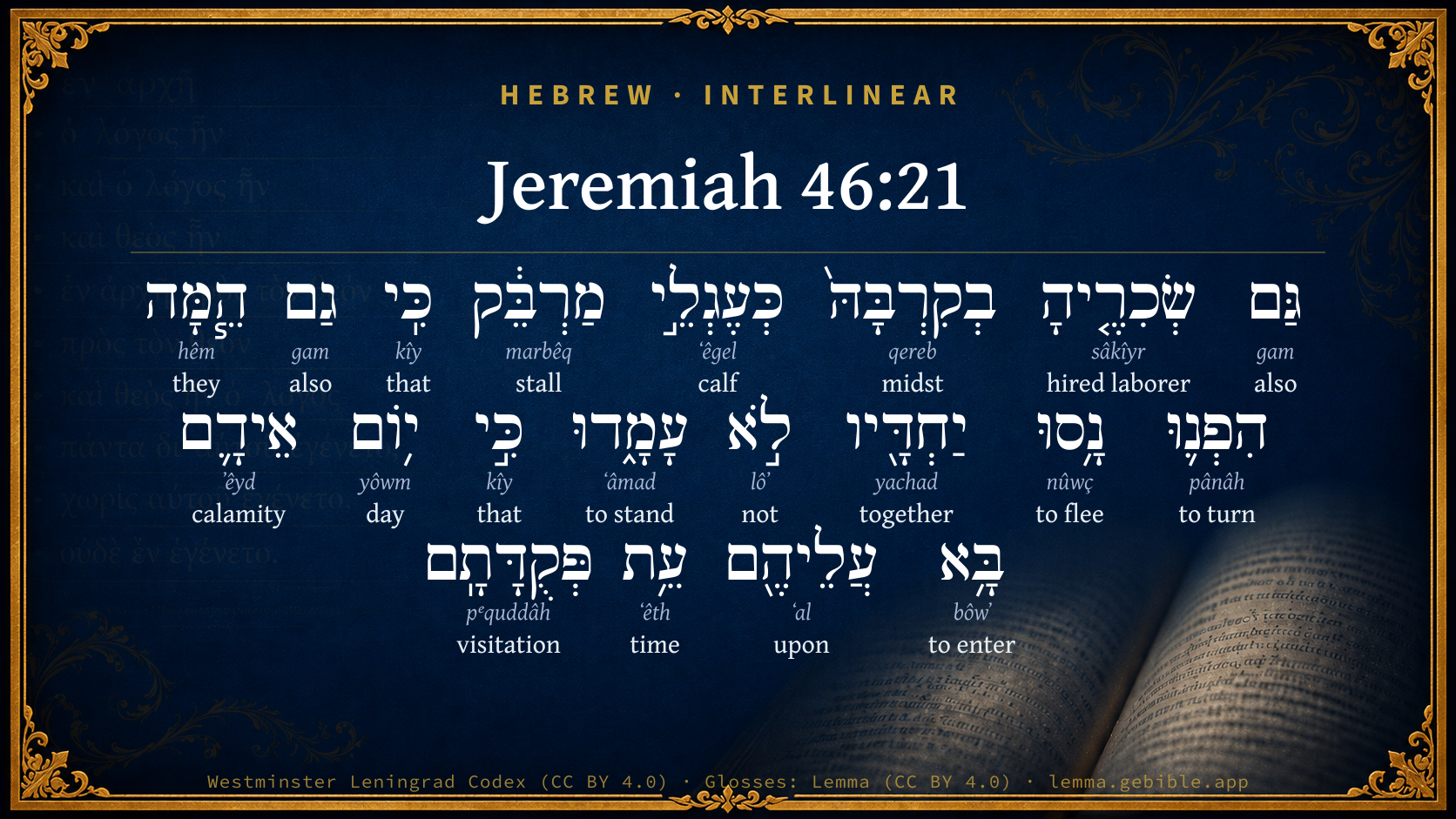
Jeremiah 46:21

Hebrew (Westminster Leningrad Codex) Jeremiah 46:21 appears in the Hebrew Old Testament. The text above is from the Westminster Leningrad Codex. Each word links to its Strong’s number, a concise gloss, and parsing drawn from the Open Scriptures Hebrew Bible morphology. Click any word for its full Brown-Driver-Briggs (BDB) entry.
Download image
Cite this verse

Jeremiah 46:21 (World English Bible). Public Domain. Lemma interlinear Bible study tool, https://lemma.gebible.app/v/jeremiah/46/21.

Show BibTeX & RIS
BibTeX
RIS
English Translation
Also her hired men in the midst of her are like calves of the stall; for they also are turned back, they are fled away together, they didn't stand: for the day of their calamity is come on them, the time of their visitation.
World English Bible · Public Domain
Download a study sheet

One document with this verse’s original text, its word-by-word gloss line, the meaning frame, cross-references with their text, attributed commentary, and full source and license credits — printable, and it pastes into notes with its structure intact.

This verse Autodidact and up

Study sheet (.html) Plain text (.txt)

A passage Seminary Student

Up to 50 verses in one chapter. A passage sheet keeps up to 6 commentary sources and 12 cross-references per verse, in the order this page ranks them, and says so on the sheet whenever that leaves anything out. Ask for a single verse and you get the Autodidact verse sheet above.

Everything on this page stays free to read, with no account — the sheet is a download of what is already on screen, not access to it.

Want to remove ads? Support Godless Engineer
Compare translations 3

The same verse in 3 English versions, stacked beneath the original-language interlinear above. Click any original word for its lexicon entry.

Each is an independent rendering of the whole verse — the interlinear is not word-aligned to these translations.

Highlighted words mark where these versions differ — a whole-verse word diff, not a word-by-word alignment.

  • World English Bible Public Domain
    Also her hired men in the midst of her are like calves of the stall; for they also are turned back, they are fled away together, they didn't stand: for the day of their calamity is come on them, the time of their visitation.
  • King James Version Public Domain
    Also her hired men are in the midst of her like fatted bullocks; for they also are turned back, and are fled away together: they did not stand, because the day of their calamity was come upon them, and the time of their visitation.
  • unfoldingWord Literal Text CC BY-SA 4.0
    The hired soldiers in her midst are like a fattened bull, but they will also turn away and run away. They will not stand together, for the day of their disaster is coming against them, the time of their punishment.

unfoldingWord Literal Text — © unfoldingWord, licensed CC BY-SA 4.0. Word-aligned USFM3 via Door43 (git.door43.org/unfoldingWord/en_ult).

Versions to compare (up to 4)

3 of 4 selected

Show all 18 translations

Every available English version of this verse, each an independent rendering of the whole verse.

  • World English Bible Public Domain
    Also her hired men in the midst of her are like calves of the stall; for they also are turned back, they are fled away together, they didn't stand: for the day of their calamity is come on them, the time of their visitation.
  • Berean Standard Bible Public Domain
    Even the mercenaries among her are like fattened calves. They too will turn back; together they will flee, they will not stand their ground, for the day of calamity is coming upon them—the time of their punishment.
  • Majority Standard Bible Public Domain
    Even the mercenaries among her are like fattened calves. They too will turn back; together they will flee, they will not stand their ground, for the day of calamity is coming upon them—the time of their punishment.
  • King James Version Public Domain
    Also her hired men are in the midst of her like fatted bullocks; for they also are turned back, and are fled away together: they did not stand, because the day of their calamity was come upon them, and the time of their visitation.
  • American Standard Version (1901) Public Domain
    Also her hired men in the midst of her are like calves of the stall; for they also are turned back, they are fled away together, they did not stand: for the day of their calamity is come upon them, the time of their visitation.
  • Revised Version (1885) Public Domain
    Also her hired men in the midst of her are like calves of the stall; for they also are turned back, they are fled away together, they did not stand: for the day of their calamity is come upon them, the time of their visitation.
  • Geneva Bible (1599) Public Domain
    Also her hired men are in the middes of her like fat calues: they are also turned backe and fled away together: they could not stand, because the day of their destruction was come vpon them, and the time of their visitation.
  • Douay-Rheims (1899) Public Domain
    Her hirelings also that lived in the midst of her, like fatted calves are turned back, and are fled away together, and they could not stand, for the day of their slaughter is come upon them, the time of their visitation.
  • Young's Literal Translation Public Domain
    Even her hired ones in her midst `are' as calves of the stall, For even they have turned, They have fled together, they have not stood, For the day of their calamity hath come on them, The time of their inspection.
  • Literal Standard Version CC BY-SA 4.0
    Even her hired ones in her midst [are] as calves of the stall, || For even they have turned, || They have fled together, they have not stood, || For the day of their calamity has come on them, || The time of their inspection.
  • Unlocked Literal Bible CC BY-SA 4.0
    The hired soldiers in her midst are like a fattened bull, but they will also turn away and run away. They will not stand together, for the day of their disaster is coming against them, the time of their punishment.
  • unfoldingWord Literal Text CC BY-SA 4.0
    The hired soldiers in her midst are like a fattened bull, but they will also turn away and run away. They will not stand together, for the day of their disaster is coming against them, the time of their punishment.
  • Darby Bible Public Domain
    Also her hired men in the midst of her are like fatted bullocks; for they also have turned back, they have fled away together, they did not stand; for the day of their calamity is come upon them, the time of their visitation.
  • World Messianic Bible Public Domain
    Also her hired men in the middle of her are like calves of the stall, for they also are turned back. They have fled away together. They didn’t stand, for the day of their calamity has come on them, the time of their visitation.
  • Webster's Bible Public Domain
    Also her hired men are in the midst of her like fatted bullocks; for they also have turned back, and have fled away together: they did not stand, because the day of their calamity had come upon them, and the time of their visitation.
  • Free Bible Version CC BY-SA 4.0
    The soldiers that Egypt hired are like calves made fat for slaughter. They will also retreat. They won't stand and fight—they will all run away. Their day of destruction is coming; the time when they'll be punished.
  • Bible in Basic English Public Domain
    And those who were her fighters for payment are like fat oxen; for they are turned back, they have gone in flight together, they do not keep their place: for the day of their fate has come on them, the time of their punishment.
  • JPS Tanakh (1917) Public Domain
    Also her mercenaries in the midst of her are like calves of the stall, for they also are turned back, they are fled away together, they did not stand; for the day of their calamity is come upon them, the time of their visitation.

Literal Standard Version (2020), Covenant Press — licensed CC BY-SA 4.0. Text via the HelloAO Bible API (eBible.org). Unlocked Literal Bible (unfoldingWord) — licensed CC BY-SA 4.0. Text via the HelloAO Bible API (eBible.org). unfoldingWord Literal Text — © unfoldingWord, licensed CC BY-SA 4.0. Word-aligned USFM3 via Door43 (git.door43.org/unfoldingWord/en_ult). Free Bible Version, Dr. Jonathan Gallagher — licensed CC BY-SA 4.0. Text via the HelloAO Bible API (eBible.org).

Word by word

More ways to search: Search by grammar → Find every occurrence → Compare this word →

Practice this passage: Drill this verse → Learn its vocabulary →

מַרְבֵּ֔ק
marbêq
H4770
“stall”
Noun, Common, Masculine, Singular, Absolute
Part of Speech
Noun
Type
Common
Gender
Masculine
Number
Singular
State
Absolute
Full BDB Definition

Origin: from an unused root meaning to tie up

TWOT: 2110a

stall (of animals)
  1. גַּם gam H1571 “also” Particle, Accusative
  2. שְׂכִרֶ֤יהָ sâkîyr H7916 “hired laborer · her” Adjective, Adjective, Masculine, Plural, Construct + Suffix, Personal, 3rd Person, Feminine, Singular
  3. בְקִרְבָּהּ֙ qereb H7130 “in/at · midst · her” Preposition + Noun, Common, Masculine, Singular, Construct + Suffix, Personal, 3rd Person, Feminine, Singular
  4. כְּעֶגְלֵ֣י ʻêgel H5695 “like/as · calves of” Preposition + Noun, Common, Masculine, Plural, Construct
  5. כִּֽי kîy H3588 “that” Conjunction
  6. גַם gam H1571 “also” Adverb
  7. הֵ֧מָּה hêm H1992 “they” Pronoun, Personal, 3rd Person, Masculine, Plural
  8. הִפְנ֛וּ pânâh H6437 “to turn” Verb, Hiphil, Perfect, 3rd Person, Common, Plural
  9. נָ֥סוּ nûwç H5127 “to flee” Verb, Qal, Perfect, 3rd Person, Common, Plural
  10. יַחְדָּ֖יו yachad H3162 “together” Adverb
  11. לֹ֣א lôʼ H3808 “not” Particle, Negative
  12. עָמָ֑דוּ ʻâmad H5975 “to stand” Verb, Qal, Perfect, 3rd Person, Common, Plural
  13. כִּ֣י kîy H3588 “that” Conjunction
  14. י֥וֹם yôwm H3117 “day of” Noun, Common, Masculine, Singular, Construct
  15. אֵידָ֛ם ʼêyd H343 “calamity · their” Noun, Common, Masculine, Singular, Construct + Suffix, Personal, 3rd Person, Masculine, Plural
  16. בָּ֥א bôwʼ H935 “to enter” Verb, Qal, Perfect, 3rd Person, Masculine, Singular
  17. עֲלֵיהֶ֖ם ʻal H5921 “upon · them” Preposition + Suffix, Personal, 3rd Person, Masculine, Plural
  18. עֵ֥ת ʻêth H6256 “time of” Noun, Common, Both, Singular, Construct
  19. פְּקֻדָּתָֽם pᵉquddâh H6486 “visitation · their” Noun, Common, Feminine, Singular, Construct + Suffix, Personal, 3rd Person, Masculine, Plural

About this verse

These counts appear in no published source. They are computed here, from the morphology-tagged text and Lemma’s own curated glosses. What Lemma adds →

20
words
18
distinct lemmas
Prophets
section

Notable vocabulary

The rarest word here is מַרְבֵּ֔ק stall H4770 — appearing just 4 times in the whole Hebrew Bible.

Shared distinctive vocabulary

מַרְבֵּ֔ק stall H4770 occurs in 4 verses of the Hebrew Bible. Also found in:

Grammatical profile

  • 4 verbs
  • 7 nouns
  • 1 adjective
  • 1 pronoun
  • 1 preposition
  • 2 conjunctions
  • 2 adverbs
  • 2 particles

Verb forms

  • הִפְנ֛וּ Hiphil · Perfect
  • נָ֥סוּ Qal · Perfect
  • עָמָ֑דוּ Qal · Perfect
  • בָּ֥א Qal · Perfect

Repetition

Words recur within this verse — often emphatic in Hebrew:

  • גַּם also H1571 ×2
  • כִּֽי that H3588 ×2

Cross-references

20

Topical passages linked to Jeremiah 46:21 in the Treasury of Scripture Knowledge — connected by theme and wording, ordered by reader-vote popularity; previews shown in the World English Bible.

  • 2 Kings 7:6 For the Lord had made the host of the Syrians to hear a noise of chariots, and a noise of horses, even the noise of a great host: and they said one to another, Behold, the king of Israel has hired against us the kings of the Hittites, and the kings of the Egyptians, to come on us.
  • Jeremiah 46:5 Why have I seen it? they are dismayed and are turned backward; and their mighty ones are beaten down, and have fled apace, and don't look back: terror is on every side, says Yahweh.
  • Obadiah 1:13 Don't enter into the gate of my people in the day of their calamity. Don't look down on their affliction in the day of their calamity, neither seize their wealth on the day of their calamity.
  • 2 Samuel 10:6 When the children of Ammon saw that they were become odious to David, the children of Ammon sent and hired the Syrians of Beth Rehob, and the Syrians of Zobah, twenty thousand footmen, and the king of Maacah with one thousand men, and the men of Tob twelve thousand men.
  • Psalms 37:13 The Lord will laugh at him, For he sees that his day is coming.
  • Isaiah 34:7 The wild-oxen shall come down with them, and the bulls with the bulls: and their land shall be drunken with blood, and their dust made fat with fatness.
  • Jeremiah 50:27 Kill all her bulls; let them go down to the slaughter: woe to them! for their day is come, the time of their visitation.
  • Hosea 9:7 The days of visitation have come. The days of reckoning have come. Israel will consider the prophet to be a fool, And the man who is inspired to be insane, Because of the abundance of your sins, And because your hostility is great.
  • Amos 6:4 Who lie on beds of ivory, And stretch themselves on their couches, And eat the lambs out of the flock, And the calves out of the midst of the stall;
  • Micah 7:4 The best of them is like a brier. The most upright is worse than a thorn hedge. The day of your watchmen, Even your visitation, has come; Now is the time of their confusion.
  • Deuteronomy 32:15 But Jeshurun grew fat, and kicked: You have grown fat, you are grown thick, you are become sleek; Then he forsook God who made him, Lightly esteemed the Rock of his salvation.
  • Proverbs 15:17 Better is a dinner of herbs, where love is, Than a fattened calf with hatred.
  • Isaiah 10:3 What will you do in the day of visitation, and in the desolation which shall come from far? to whom will you flee for help? and where will you leave your glory?
  • Jeremiah 18:17 I will scatter them as with an east wind before the enemy; I will show them the back, and not the face, in the day of their calamity.
  • Jeremiah 46:9 Go up, you horses; and rage, you chariots; and let the mighty men go forth: Cush and Put, who handle the shield; and the Ludim, who handle and bend the bow.
  • Jeremiah 46:15–16 Why are your strong ones swept away? they didn't stand, because Yahweh did drive them.
  • Jeremiah 50:11 Because you are glad, because you rejoice, O you who plunder my heritage, because you are wanton as a heifer that treads out [the grain], and neigh as strong horses;
  • Ezekiel 27:10–11 Persia and Lud and Put were in your army, your men of war: they hanged the shield and helmet in you; they set forth your comeliness.
  • Ezekiel 30:4–6 A sword shall come on Egypt, and anguish shall be in Ethiopia, when the slain shall fall in Egypt; and they shall take away her multitude, and her foundations shall be broken down.
  • Ezekiel 35:5 Because you have had a perpetual enmity, and have given over the children of Israel to the power of the sword in the time of their calamity, in the time of the iniquity of the end;

Cross-references courtesy of OpenBible.info (CC BY 4.0).

Hebrew and Greek witnesses Masoretic Hebrew ↔ Greek Septuagint

The same verse in the two great witnesses to the Old Testament, shown verse-for-verse.

These are two independent witnesses, not word-aligned to each other, and the Septuagint is shown in lemma (dictionary) form.

Hebrew Jeremiah 46:21 Masoretic · Westminster Leningrad Codex

גַּם שְׂכִרֶ֤יהָ בְקִרְבָּהּ֙ כְּעֶגְלֵ֣י מַרְבֵּ֔ק כִּֽי גַם הֵ֧מָּה הִפְנ֛וּ נָ֥סוּ יַחְדָּ֖יו לֹ֣א עָמָ֑דוּ כִּ֣י י֥וֹם אֵידָ֛ם בָּ֥א עֲלֵיהֶ֖ם עֵ֥ת פְּקֻדָּתָֽם

Also her hired men in the midst of her are like calves of the stall; for they also are turned back, they are fled away together, they didn't stand: for the day of their calamity is come on them, the time of their visitation.

World English Bible · Public Domain

Greek LXX Structure differs

In the Septuagint, Jeremiah is about an eighth shorter than the Hebrew and arranges its material differently — the Oracles Against the Nations (Hebrew chapters 46–51) appear in the middle of the Greek book, after 25:13. Because the chapter and verse boundaries do not line up, a verse-for-verse comparison with the Hebrew is not shown.

A verse-for-verse comparison isn’t shown here because the chapters and verses don’t line up. Switch to the LXX edition with the MT / LXX toggle above to read the Greek directly.

Hebrew: Westminster Leningrad Codex (CC BY 4.0). Greek: Septuagint (public domain); English from a public-domain English Septuagint. How the Septuagint differs from the Hebrew →

Targum (Aramaic paraphrase)

1

The Targum is the ancient Jewish Aramaic paraphrase of the Hebrew Scriptures — an interpretive translation, not the Hebrew text itself. Onkelos (literal) and Pseudo-Jonathan (expansive) render the Torah, and Jonathan the Prophets. Coverage is partial: where no permissively-licensed English translation exists for a verse, only the Aramaic is shown. This is verse-level text, not a word-by-word alignment to the Hebrew.

  1. Targum Jonathan Prophets (Joshua–Malachi)
    אַף רַבְרְבָהָא בְגַוָהּ כְּעִגְלֵי רִבְקָא אֲרֵי אַף אִינוּן אִתְפְּנִיאוּ עֲרָקוּ כַּחֲדָא לָא יָכִילוּ לְמֵיקַם אֲרֵי יוֹם תְּבַרְהוֹן אָתָא עֲלֵיהוֹן עִידַן סְעוּדָן בִּישְׁתֵּהוֹן:

    (no public-domain English translation for this verse)

    Targum Jonathan — Aramaic: “Mikraot Gedolot” (public domain). English: “Sefaria Community Translation” (CC0 1.0 (public-domain dedication)); “London "Chaldee Paraphrase," 1871” (public domain). Text via Sefaria.

Commentary

Notes on Jeremiah 46:21 from classic Christian and Jewish commentators (each source and its license shown beneath its notes). The classic Christian expositions comment on the surrounding passage and are grouped to its opening verse, so a note may address several verses; the Jewish commentaries on the Tanakh (Rashi and others) are per-verse, so they appear only where the commentator wrote on this verse.

Lemma curates 59 commentaries, every one of them public domain or Creative Commons licensed, each selected and text-cleaned for this edition rather than reprinted as found. About our sources →

Trapp's Complete Commentary

John Trapp

Jer 46:21 Also her hired men [are] in the midst of her like fatted bullocks; for they also are turned back, [and] are fled away together: they did not stand, because the day of their calamity was come upon them, [and] the time of their visitation.

Ver. 21. Also her hired men in the midst of her like fatted bullocks.] Heb., Bullocks of the stall, not like to do much good service in respect of their luxury and petulancy; fat Eglon had but sluggish soldiers. Campania with her delicacies marred Hannibal’s forces. These mercenaries carried themselves as if hired non ad militiam sed saginam. not to fight, but to fat themselves

John Trapp, A Commentary or Exposition upon All the Books of the Old and New Testament (1647–1656) — public domain. Text from a community e-Sword module.

Tyndale Open Study Notes

Tyndale Open Resources

46:21 Egypt depended on hired mercenaries from other countries who had no interest in dying for Egypt. Under threat, they would turn and run.

Tyndale Open Study Notes — © Tyndale Open Resources, licensed CC BY-SA 4.0. Text via the HelloAO Bible API.

Geneva Bible (1599)

Geneva Bible translators

As verse 9.

Geneva Bible (1599) marginal notes — public domain. Text via Bolls.life.

Jamieson, Fausset & Brown

Robert Jamieson, A. R. Fausset & David Brown

Translate, "Also her hired men (mercenary soldiers, Jer 46:9, Jer 46:16), who are in the midst of her like fatted bullocks, even they also are turned back," that is, shall turn their backs to flee. The same image, "heifer . . . bullocks" (Jer 46:20-21), is applied to Egypt's foreign mercenaries, as to herself. Pampered with the luxuries of Egypt, they become as enervated for battle as the natives themselves.

Jamieson, Fausset & Brown — Commentary Critical and Explanatory on the Whole Bible (1871) — public domain (CC PDM 1.0). Text via the HelloAO Bible API.

Adam Clarke's Commentary

Verse 21. Are fled away together] Perhaps there is a reference here to the case of a cow stung with gnats. She runs hither and thither not knowing where to go; so shall it be with this scattered people.

Adam Clarke's Commentary on the Bible (1810–1826) — public domain. Text from a community e-Sword/MySword module.

John Calvin's Commentaries

Here the Prophet represents the mercenaries of Egypt, as we have already said, as being foreign soldiers, who had been hired here and there, and from far countries, such as Lydia was. It may yet have been, that there were not many at that time who had come from beyond the sea to the Egyptians; but they had the Ethiopians, for Ezekiel says that many came from Cush, that is, Ethiopia; and then they had some from Libya and the neighboring countries. Then Jeremiah includes them under one name, and says that they were mercenaries. Now, they who hire themselves seem to be more warlike than others; for they who defend their own country do this from necessity; but those who of themselves seek war, and depart from their own borders for the purpose of engaging in war, seem to be men fit for any bold undertaking.

But the Prophet says, also, גם, gam, also mercenaries; that is, not only the Egyptians were accustomed to a delicate and indulgent life, but also the Ethiopians and others who had been hired, They are also in the midst of it as fatted bullocks, that is, they fill themselves with the abundance of Egypt; and hence it was that they became a prey to their enemies; for we know that nothing is more injurious to soldiers than to live delicately and luxuriously. Of all ancient generals, the most celebrated is Hannibal; but how did it happen, that having an invincible army, by which he had terrified all Italy, he afterwards fell? because Campania, with its luxuries, enervated him, for he lived there not like a soldier, but had tables richly furnished for himself and for his army. Hence it was, that they were no more what they had been. So also the Prophet says, “Egypt will ruin its hired soldiers; for she will satiate them with luxuries.” What did at length happen to them? he compares them to bullocks of the stall, מרבק, merebec; some read bullocks of the pasture, but not correctly; for רבק, rebec, is properly to fatten. He then calls them the bullocks of the stall, which are fed that they may become fat and be soon slaughtered. He therefore says, They also shall turn their backs; and then he says, They shall not stand, because the time of calamity is come I cannot finish this subject now.

John Calvin's Commentaries (1540-1563) — public domain. Text from the Calvin Translation Society English edition (1840s-50s) via the Christian Classics Ethereal Library (ccel.org). Calvin's coverage is partial (roughly two-thirds of the Bible); uncommented books and verses are honest gaps, never fabricated. The 19th-century editor's footnotes and remarks are omitted so the notes are faithfully Calvin's own voice.

Ellicott's Commentary for English Readers

(21) Her hired men are in the midst of her like fatted bullocks.—Literally, bullocks of the stall. The prophet harps, as it were, on the same image. The mercenaries—Ionians, Carians, and others—in the army of Pharaoh-Hophra, who had their camp at Bubastis (Herod. ii. 152, 163), should be like a drove of terrified cattle, fed to the full, driven to the slaughter-house.

A Bible Commentary for English Readers, edited by Charles John Ellicott (1878–1897) — public domain. Text from a community e-Sword module.

The Cambridge Bible for Schools and Colleges

gen. ed. J. J. S. Perowne

21. her hired men] her mercenary troops.

like calves of the stall] See on Jer_44:30. The reference is to the Ionian and Carian soldiers, who (Herod. II. 163) numbered 30,000, and lived on the Pelusiac branch of the Nile in a fertile district. Hence they seem to have earned the description given of them here, and were useless in war (Herod. II. 152 ff.). Cp. Mal_4:2.

The Cambridge Bible for Schools and Colleges (gen. ed. J. J. S. Perowne; Cambridge University Press, 1878–1918) — public domain. Text from a community e-Sword module.

John Gill's Exposition

All her hired men are in the midst of her like fatted bullocks,.... Or, "bullocks of the stall" (k); soldiers of other countries, that were hired into the service of Egypt, and lived so deliciously there, that they were unfit for war, and were like fatted beasts prepared for the slaughter. The Targum and Jarchi interpret it, her princes (l); who had the care of this heifer, and of the feeding of it; these themselves were like that, nourished for the day of slaughter:

for they also are turned back, and are fled away together; they turned their backs upon the enemy in battle, and fled in great confusion and precipitancy; see Jer 46:15;

they did not stand; and face the enemy, and light him, but fell or fled before him:

because the day of their calamity was come upon them, and the time of their visitation; the time appointed by the Lord to visit and punish them, and bring destruction on them for their sins.

(k) "velut vituli saginae", Montanus, Cocceius, (l) So R. Sol. Urbin. Ohel Moed, fol. 50. 2.

John Gill's Exposition of the Whole Bible (1746–1763) — public domain (CC PDM 1.0). Text via the HelloAO Bible API.

Albert Barnes' Notes on the Bible

Rather, “Also her hirelings in the midst of her are like calves of the stall.” The mercenaries of Egypt - Nubians, Moors, and Lydians Jer 46:9 - were destroyed at the battle of Carchemish, and their place was taken by hirelings from Asia Minor, Carians, and Ionians, whom Hophra took into his pay to the number of 30,000 men. These he settled in the midst of Egypt, in the fertile lands above Bubastis, in the Delta, where, well paid and fed and with great privileges, they became as calves of the stall. Their mutiny cost Hophra his crown.

For they also are turned back ... - literally, “for they also have lurched the back, they flee together, they stand not: for the day of their destruction is come upon them, the time of their visitations.”

Albert Barnes' Notes on the Bible (1834–1885) — public domain. Text from a community e-Sword/MySword module.

Haydock's Catholic Bible Commentary

Hirelings. Apries had thirty thousand Carians, &c., who were defeated by Amasis. (Herodotus ii. 163.)

George Leo Haydock (1774–1849), Haydock's Catholic Family Bible and Commentary, 1859 edition — public domain. Excludes Psalms (Douay-Rheims chapter numbering differs from Protestant) and Deuterocanonical books (Catholic canon only).

Matthew Poole's English Annotations

Also her hired men are in the midst of her like fatted bullocks; the mercenary soldiers also, which the Egyptians have hired from Cush and Phut, and other parts, are at present in a flourishing, prosperous state.

For they also are turned back, and are fled away together; they did not stand: we have translated כי here ill, it had been better translated but, for that is manifestly the sense. Though they at present lying in garrisons be fat and flourishing, like bullocks in the stalls, yet when it cometh to it they shall not stand, but turn back, and flee as well as the rest. Because the day of their calamity was come upon them, and the time of their visitation; because the time is come when God resolveth to punish them, and bring calamity upon them. When the time is come which God hath set in his counsels, wherein he will punish persons or nations, no probabilities to the contrary are much considerable.

Matthew Poole's English Annotations on the Holy Bible (1683–1685) — public domain. Text from a community e-Sword/MySword module.

Whedon's Commentary on the Bible

Daniel D. Whedon

21. Hired men — Mercenary soldiers.

Fatted bullocks — The soldiers mentioned in Jer_46:9, the Ethiopians, Libyans, and Lydians, were allies; but after their destruction in the battle of Carchemish mercenaries were engaged from Asia Minor — Carians and Ionians. As we learn from Herodotus, Pharaoh-hophra took these into his pay to the number of thirty thousand, and they were settled in the fertile lands of the Delta between Bubastis and Pelusium. So pampered were they, that in the war against Cyrene he would not expose them, but sent native soldiers instead, and this cost him his crown. In describing, then, these mercenaries as “fatted bullocks” we have an extraordinary and minute faithfulness to history.

Daniel D. Whedon (gen. ed.), Commentary on the Old and New Testaments (1874–1909) — public domain. Text from a community e-Sword module.

The Pulpit Commentary

Also her hired men are in the midst of her, etc.; rather, also her hirelings in the midst of her are like, etc. These seem to be distinguished from the mercenaries mentioned in ver. 9, the Ethiopians, Libyans, and Arabs, who were never adopted into the midst of the Egyptian people. On the other hand, the description will exactly apply to the Caftans and Ionians in the service of Psammetichus and Apries (Herod., 2:152, 163), who were "for many years" settled "a little below the city of Bubastis, on the Pelusiac mouth of the Nile." In this fertile country, itself comparable to "a very fair heifer" (ver. 20), these pampered and privileged mercenaries became "like calves of the stall." They did not stand, etc.; rather, they have not stood (firm), for the day of their destruction is come upon them.

The Pulpit Commentary (1880–1919), ed. H.D.M. Spence-Jones & Joseph S. Exell — public domain. Text from a community e-Sword module.

Rashi

Rabbi Shlomo Yitzchaki (Rashi)

Also her princes Heb. שְׂכִרֶיהָ, her princes. Cf. “with the great razor (הַשְׂכִירָה)” (Isa. 7:20).

fattened (kopla in O.F., couple in modern French).

turn around Turned their back to seek to flee.

Rashi on the Tanakh — English translations: “The Judaica Press complete Tanach with Rashi, translated by A. J. Rosenberg” (CC BY 4.0); “Pentateuch with Rashi's commentary by M. Rosenbaum and A.M. Silbermann, 1929-1934” (public domain); “The Metsudah Tanach series, Lakewood, N.J” (CC BY 4.0); and “The Book of Joshua, Metsudah Publications, 1997” (CC BY 4.0). Text via Sefaria.

Lesson kit

Teaching starters — assembled from the data on this page, not authored interpretation. Every prompt links to the verse data it draws on. Edit before teaching.

Jeremiah, in the Prophets, opens this verse with 20 words (18 distinct Hebrew lemmas). Its most distinctive word is marbêq (“stall”). A historical commentator’s framing appears above. Read the whole chapter for the surrounding context.

Discussion questions

  1. The word marbêq carries the sense “stall.” How does it shape the verse?
  2. 1 Samuel 28:24 shares the word «stall» with this verse. How do the two illuminate each other?
  3. “also” occurs 2× in this one verse. What is the effect of the repetition?
  4. These translations render this verse differently. What is at stake in choosing one wording over another?
  5. The verb «הִפְנ֛וּ» is Hiphil Perfect. How does its form color the action?
  6. Reading how Trapp's Complete Commentary and Tyndale Open Study Notes read this verse, where do the two commentators agree and where do they part?

Things to notice

Reading settings

Reading text

Shown beneath each verse's original-language words.

Old Testament
Old Testament edition

Read the OT as the Masoretic Hebrew (MT) or the Greek Septuagint (LXX).

English shown for the Greek Septuagint (in the Hebrew ↔ Greek comparison).

Comparing translations? Open the Compare panel on any verse page to stack up to four side by side.