Leviticus 23:30

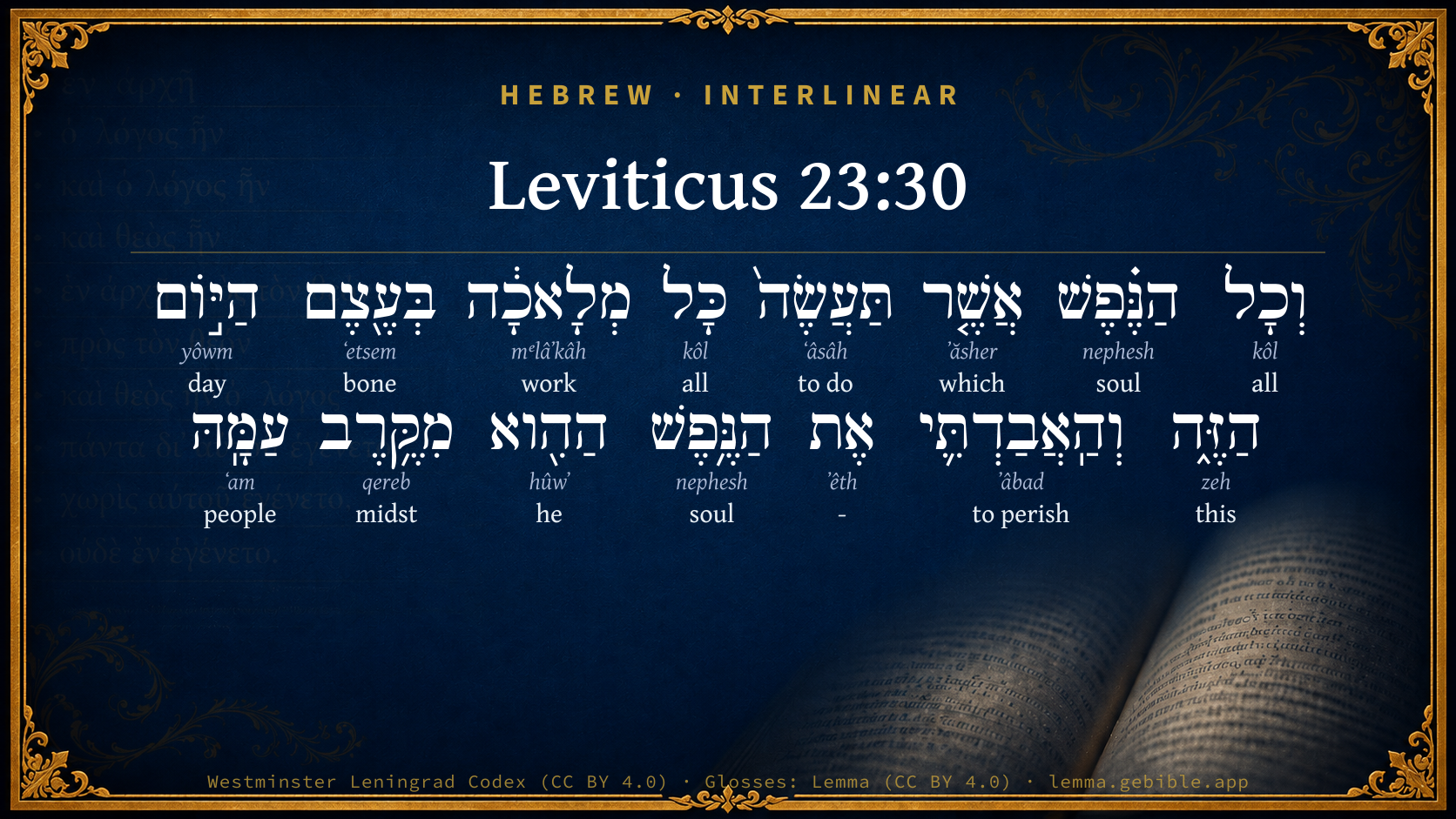
Hebrew (Westminster Leningrad Codex) Leviticus 23:30 appears in the Hebrew Old Testament. The text above is from the Westminster Leningrad Codex. Each word links to its Strong’s number, a concise gloss, and parsing drawn from the Open Scriptures Hebrew Bible morphology. Click any word for its full Brown-Driver-Briggs (BDB) entry.
Download image
Cite this verse

Leviticus 23:30 (World English Bible). Public Domain. Lemma interlinear Bible study tool, https://lemma.gebible.app/v/leviticus/23/30.

Show BibTeX & RIS
BibTeX
RIS
English Translation
Whoever it is who does any manner of work in that same day, that person I will destroy from among his people.
World English Bible · Public Domain
Download a study sheet

One document with this verse’s original text, its word-by-word gloss line, the meaning frame, cross-references with their text, attributed commentary, and full source and license credits — printable, and it pastes into notes with its structure intact.

This verse Autodidact and up

Study sheet (.html) Plain text (.txt)

A passage Seminary Student

Up to 50 verses in one chapter. A passage sheet keeps up to 6 commentary sources and 12 cross-references per verse, in the order this page ranks them, and says so on the sheet whenever that leaves anything out. Ask for a single verse and you get the Autodidact verse sheet above.

Everything on this page stays free to read, with no account — the sheet is a download of what is already on screen, not access to it.

Want to remove ads? Support Godless Engineer
Compare translations 3

The same verse in 3 English versions, stacked beneath the original-language interlinear above. Click any original word for its lexicon entry.

Each is an independent rendering of the whole verse — the interlinear is not word-aligned to these translations.

Highlighted words mark where these versions differ — a whole-verse word diff, not a word-by-word alignment.

  • World English Bible Public Domain
    Whoever it is who does any manner of work in that same day, that person I will destroy from among his people.
  • King James Version Public Domain
    And whatsoever soul it be that doeth any work in that same day, the same soul will I destroy from among his people.
  • unfoldingWord Literal Text CC BY-SA 4.0
    And any person who does any work on this same day, I will destroy that person from among his people.

unfoldingWord Literal Text — © unfoldingWord, licensed CC BY-SA 4.0. Word-aligned USFM3 via Door43 (git.door43.org/unfoldingWord/en_ult).

Versions to compare (up to 4)

3 of 4 selected

Show all 18 translations

Every available English version of this verse, each an independent rendering of the whole verse.

  • World English Bible Public Domain
    Whoever it is who does any manner of work in that same day, that person I will destroy from among his people.
  • Berean Standard Bible Public Domain
    I will destroy from among his people anyone who does any work on this day.
  • Majority Standard Bible Public Domain
    I will destroy from among his people anyone who does any work on this day.
  • King James Version Public Domain
    And whatsoever soul it be that doeth any work in that same day, the same soul will I destroy from among his people.
  • American Standard Version (1901) Public Domain
    And whatsoever soul it be that doeth any manner of work in that same day, that soul will I destroy from among his people.
  • Revised Version (1885) Public Domain
    And whatsoever soul it be that doeth any manner of work in that same day, that soul will I destroy from among his people.
  • Geneva Bible (1599) Public Domain
    And euery person that shall doe any work that same day, the same person also will I destroy from among his people.
  • Douay-Rheims (1899) Public Domain
    And every soul that shall do any work, the same will I destroy from among his people.
  • Young's Literal Translation Public Domain
    and any person who doth any work in this self-same day I have even destroyed that person from the midst of his people;
  • Literal Standard Version CC BY-SA 4.0
    and any person who does any work in this very day, I have even destroyed that person from the midst of his people;
  • Unlocked Literal Bible CC BY-SA 4.0
    Whoever does any work on that day, I, Yahweh, will destroy him from among his people.
  • unfoldingWord Literal Text CC BY-SA 4.0
    And any person who does any work on this same day, I will destroy that person from among his people.
  • Darby Bible Public Domain
    And every soul that doeth any manner of work on that same day, the same soul will I destroy from among his people.
  • World Messianic Bible Public Domain
    Whoever does any kind of work in that same day, I will destroy that person from among his people.
  • Webster's Bible Public Domain
    And whatever soul it may be that doeth any work in that same day, the same soul will I destroy from among his people.
  • Free Bible Version CC BY-SA 4.0
    I will destroy anyone of you who does any work on this day.
  • Bible in Basic English Public Domain
    And if any person, whoever he may be, on that day does any sort of work, I will send destruction on him from among his people.
  • JPS Tanakh (1917) Public Domain
    And whatsoever soul it be that doeth any manner of work in that same day, that soul will I destroy from among his people.

Literal Standard Version (2020), Covenant Press — licensed CC BY-SA 4.0. Text via the HelloAO Bible API (eBible.org). Unlocked Literal Bible (unfoldingWord) — licensed CC BY-SA 4.0. Text via the HelloAO Bible API (eBible.org). unfoldingWord Literal Text — © unfoldingWord, licensed CC BY-SA 4.0. Word-aligned USFM3 via Door43 (git.door43.org/unfoldingWord/en_ult). Free Bible Version, Dr. Jonathan Gallagher — licensed CC BY-SA 4.0. Text via the HelloAO Bible API (eBible.org).

Word by word

More ways to search: Search by grammar → Find every occurrence → Compare this word →

Practice this passage: Drill this verse → Learn its vocabulary →

בְּעֶ֖צֶם
ʻetsem
H6106
“in/at · bone of”
Preposition + Noun, Common, Feminine, Singular, Construct
Part of Speech
Preposition + Noun
Type
Common
Gender
Feminine
Number
Singular
State
Construct
Full BDB Definition

Origin: from H6105

TWOT: 1673c

bone, essence, substance - bone - body, limbs, members, external body - bone (of animal) - substance, self
  1. וְכָל kôl H3605 “and · all of” Conjunction + Noun, Common, Masculine, Singular, Construct
  2. הַנֶּ֗פֶשׁ nephesh H5315 “the · soul” Particle, Definite Article + Noun, Common, Both, Singular, Absolute
  3. אֲשֶׁ֤ר ʼăsher H834 “which” Particle, Relative
  4. תַּעֲשֶׂה֙ ʻâsâh H6213 “to do” Verb, Qal, Imperfect, 3rd Person, Feminine, Singular
  5. כָּל kôl H3605 “all of” Noun, Common, Masculine, Singular, Construct
  6. מְלָאכָ֔ה mᵉlâʼkâh H4399 “work” Noun, Common, Feminine, Singular, Absolute
  7. הַיּ֣וֹם yôwm H3117 “the · day” Particle, Definite Article + Noun, Common, Masculine, Singular, Absolute
  8. הַזֶּ֑ה zeh H2088 “the · this” Particle, Definite Article + Pronoun, Demonstrative, Masculine, Singular
  9. וְהַֽאֲבַדְתִּ֛י ʼâbad H6 “and · to perish” Conjunction + Verb, Hiphil, Sequential Perfect, 1st Person, Common, Singular
  10. אֶת ʼêth H853 “-” Particle, Direct Object
  11. הַנֶּ֥פֶשׁ nephesh H5315 “the · soul” Particle, Definite Article + Noun, Common, Both, Singular, Absolute
  12. הַהִ֖וא hûwʼ H1931 “the · he” Particle, Definite Article + Pronoun, Personal, 3rd Person, Feminine, Singular
  13. מִקֶּ֥רֶב qereb H7130 “from · midst of” Preposition + Noun, Common, Masculine, Singular, Construct
  14. עַמָּֽהּ ʻam H5971 “people · her” Noun, Common, Masculine, Singular, Construct + Suffix, Personal, 3rd Person, Feminine, Singular

About this verse

These counts appear in no published source. They are computed here, from the morphology-tagged text and Lemma’s own curated glosses. What Lemma adds →

15
words
13
distinct lemmas
Pentateuch
section

Grammatical profile

  • 2 verbs
  • 9 nouns
  • 2 pronouns
  • 2 particles

Verb forms

  • תַּעֲשֶׂה֙ Qal · Imperfect
  • וְהַֽאֲבַדְתִּ֛י Hiphil · Sequential Perfect

Repetition

Words recur within this verse — often emphatic in Hebrew:

  • וְכָל all H3605 ×2
  • הַנֶּ֗פֶשׁ soul H5315 ×2

Hebrew & Septuagint length

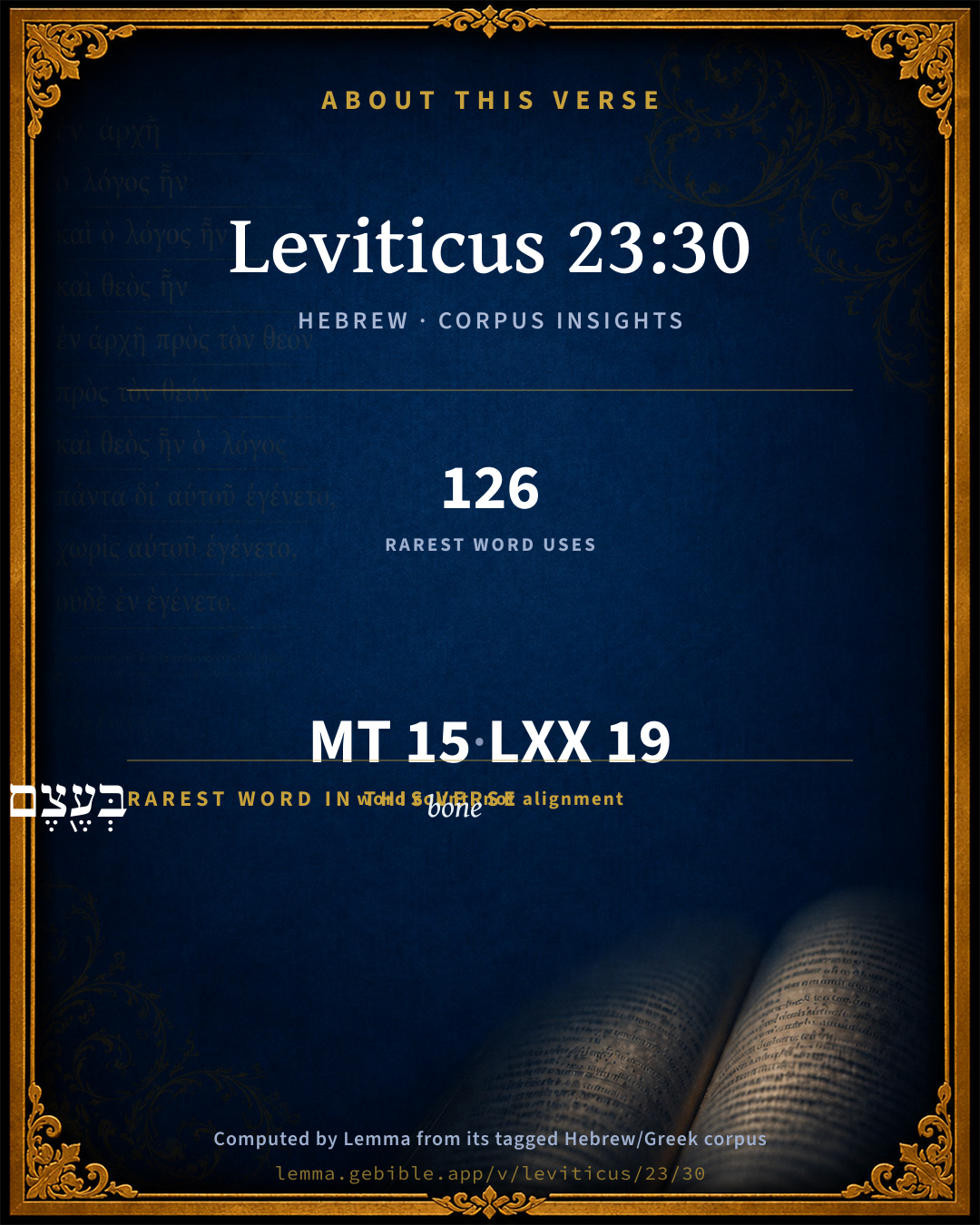
In English translation the verse runs 22 words from the Hebrew and 19 from the Septuagint (LXX English) — closely comparable.

A rough comparison of the two English renderings, which tokenize alike — not a word-level alignment.

Word counts can differ between the Hebrew and the Greek without any difference in meaning — e.g. the Hebrew direct-object marker אֵת has no separate Greek word, and Greek often adds the article ὁ.

In the original languages it is 15 Hebrew tokens and 19 Greek tokens — but the two are counted differently (Hebrew bundles its prefixes and suffixes into one token; the Greek is in lemma form), so that isn’t a like-for-like length.

Cross-references

7

Topical passages linked to Leviticus 23:30 in the Treasury of Scripture Knowledge — connected by theme and wording, ordered by reader-vote popularity; previews shown in the World English Bible.

  • Leviticus 20:3 I also will set my face against that person, and will cut him off from among his people because he has given of his seed to Molech, to defile my sanctuary, and to profane my holy name.
  • Genesis 17:14 The uncircumcised male who is not circumcised in the flesh of his foreskin, that soul shall be cut off from his people. He has broken my covenant."
  • Leviticus 20:5–6 then I will set my face against that man, and against his family, and will cut him off, and all who play the prostitute after him, to play the prostitute with Molech, from among their people.
  • Jeremiah 15:7 I have winnowed them with a fan in the gates of the land; I have bereaved [them] of children, I have destroyed my people; they didn't return from their ways.
  • Ezekiel 14:9 If the prophet be deceived and speak a word, I, Yahweh, have deceived that prophet, and I will stretch out my hand on him, and will destroy him from the midst of my people Israel.
  • Zephaniah 2:5 Woe to the inhabitants of the sea coast, the nation of the Cherethites! The word of Yahweh is against you, Canaan, the land of the Philistines. I will destroy you, that there will be no inhabitant.
  • 1 Corinthians 3:17 If anyone destroys the temple of God, God will destroy him; for God's temple is holy, which you are.

Cross-references courtesy of OpenBible.info (CC BY 4.0).

Hebrew and Greek witnesses Masoretic Hebrew ↔ Greek Septuagint

The same verse in the two great witnesses to the Old Testament, shown verse-for-verse.

These are two independent witnesses, not word-aligned to each other, and the Septuagint is shown in lemma (dictionary) form.

Hebrew Leviticus 23:30 Masoretic · Westminster Leningrad Codex

וְכָל הַנֶּ֗פֶשׁ אֲשֶׁ֤ר תַּעֲשֶׂה֙ כָּל מְלָאכָ֔ה בְּעֶ֖צֶם הַיּ֣וֹם הַזֶּ֑ה וְהַֽאֲבַדְתִּ֛י אֶת הַנֶּ֥פֶשׁ הַהִ֖וא מִקֶּ֥רֶב עַמָּֽהּ

Whoever it is who does any manner of work in that same day, that person I will destroy from among his people.

World English Bible · Public Domain

Greek LXX Leviticus 23:30 Septuagint · lemma form

καί πᾶς ψυχή ὅστις ποιέω ἔργον ἐν αὐτός ὁ ἡμέρα οὗτος ἀποὀλλύω ὁ ψυχή ἐκεῖνος ἐκ ὁ λαός αὐτός

And every soul which shall do work on that day, that soul shall be destroyed from among its people.

LXX2012 (modern English Septuagint) · Public Domain

Hebrew: Westminster Leningrad Codex (CC BY 4.0). Greek: Septuagint (public domain); English from LXX2012 (modern English Septuagint) (Public Domain). How the Septuagint differs from the Hebrew →

Targum (Aramaic paraphrase)

2

The Targum is the ancient Jewish Aramaic paraphrase of the Hebrew Scriptures — an interpretive translation, not the Hebrew text itself. Onkelos (literal) and Pseudo-Jonathan (expansive) render the Torah, and Jonathan the Prophets. Coverage is partial: where no permissively-licensed English translation exists for a verse, only the Aramaic is shown. This is verse-level text, not a word-by-word alignment to the Hebrew.

  1. Targum Onkelos Torah (Genesis–Deuteronomy)
    וְכָל אֱנַשׁ דִי תַעְבֵּד כָּל עִבִידָא בִּכְרַן יוֹמָא הָדֵין וְאוֹבֵד יָת אֲנָשָׁא הַהִיא מִגוֹ עַמָהּ

    (no public-domain English translation for this verse)

    Targum Onkelos — Aramaic: “Onkelos Genesis” (public domain); “Onkelos Exodus” (public domain); “Onkelos Leviticus” (public domain); “Onkelos Numbers” (public domain); “Onkelos Deuteronomy” (public domain). English: “Sefaria Community Translation” (CC0 1.0 (public-domain dedication)); “J.W. Etheridge. The Targums of Onkelos and Jonathan Ben Uzziel on the Pentateuch. London: Longmans, Green, 1862” (public domain). Text via Sefaria.

  2. Targum Pseudo-Jonathan Torah (Genesis–Deuteronomy)
    וְכָל בַּר נַשׁ דְיַעֲבֵיד כָּל עִיבִידָא בִּכְרַן יוֹמָא הָדֵין וְאוֹבִיד יַת בַּר נְשָׁא הַהוּא בְּמוֹתָנָא מִגוֹ עַמֵיהּ

    And every man who doeth any work on that same day, that man will I destroy with death from among his people.

    Targum Pseudo-Jonathan — Aramaic: “Targum Jonathan on Genesis” (public domain); “Targum Jonathan on Exodus” (public domain); “Targum Jonathan on Leviticus” (public domain); “Targum Jonathan on Numbers” (public domain); “Targum Jonathan on Deuteronomy” (public domain). English: “The Targum of Jonathan ben Uzziel, trans. J. W. Etheridge, London, 1862” (public domain). Text via Sefaria.

Commentary

Notes on Leviticus 23:30 from classic Christian and Jewish commentators (each source and its license shown beneath its notes). The classic Christian expositions comment on the surrounding passage and are grouped to its opening verse, so a note may address several verses; the Jewish commentaries on the Tanakh (Rashi and others) are per-verse, so they appear only where the commentator wrote on this verse.

Lemma curates 59 commentaries, every one of them public domain or Creative Commons licensed, each selected and text-cleaned for this edition rather than reprinted as found. About our sources →

Ellicott's Commentary for English Readers

(30) That doeth any work.—That is, engages in any kind of work whatsoever, since this is the only festival which is to be kept like the sabbath.

Will I destroy.—Whilst in all other instances where God threatens the offender with the penalty of excision the expression “cut off” is used, in the passage before us the word is “destroy.” This stronger term may be owing to the fact that the day of Atonement is the most solemn day in the whole year, and that violating its sanctity will be visited more severely. Hence the severer expression used on this occasion. It is, however, to be remarked that whilst working on the sabbath was punished with death by stoning, he who transgressed the law of labour on the day of Atonement was punished with excision.

A Bible Commentary for English Readers, edited by Charles John Ellicott (1878–1897) — public domain. Text from a community e-Sword module.

John Gill's Exposition

And whatsoever soul it be that doeth any work in that same day,.... Any sort of work whatever; for, as before observed, it was to be kept as strictly as the weekly sabbath:

the same soul will I destroy from among his people; with the pestilence, as the above Targum; it seems to be but another phrase for cutting them off, and to signify the same thing.

John Gill's Exposition of the Whole Bible (1746–1763) — public domain (CC PDM 1.0). Text via the HelloAO Bible API.

unfoldingWord translationNotes

Door43 World Missions Community

Connecting Statement:

Yahweh continues telling Moses what the people must do every year.

on that day

"on the Day of Atonement"

This will be a permanent statute throughout your people's generations

This means that they and their descendants must obey this command forever. See how you translated a similar phrase in Leviticus 3:17.

a Sabbath of solemn rest

This is not the same as the Sabbath they observed every week on the seventh day. This was a special Sabbath on the Day of Atonement.

you must humble yourselves

In this case humbling themselves implies that they would not eat any food. This can be stated clearly. AT: "you must humble yourselves and eat nothing" (See: Assumed Knowledge and Implicit Information)

the ninth day of the month

This refers to the seventh month of the Hebrew calendar. The ninth day is near the end of September on Western calendars. This can be made explicit. AT: "the ninth day of the seventh month" (See: Assumed Knowledge and Implicit Information)

From evening to evening

"From sunset to sunset on the next day"

translationWords

day

people group

statute

generation

life

Sabbath

rest

unfoldingWord translationNotes — © Distant Shores Media and the Door43 World Missions Community, licensed CC BY-SA 4.0. Source: git.door43.org/Door43/en_tn.

Rashi

Rabbi Shlomo Yitzchaki (Rashi)

והאבדתי I WILL DESTROY — This expression “destroying” is employed here because Scripture uses everywhere in similar cases the term כרת, “cutting off” without clearly defining it, so that I do not know exactly what it implies; but when it states here והאבדתי, it teaches in respect of the term כרת that it implies nothing else than becoming lost” (Sifra, Emor, Chapter 14 4).

Rashi on the Tanakh — English translations: “The Judaica Press complete Tanach with Rashi, translated by A. J. Rosenberg” (CC BY 4.0); “Pentateuch with Rashi's commentary by M. Rosenbaum and A.M. Silbermann, 1929-1934” (public domain); “The Metsudah Tanach series, Lakewood, N.J” (CC BY 4.0); and “The Book of Joshua, Metsudah Publications, 1997” (CC BY 4.0). Text via Sefaria.

Lesson kit

Teaching starters — assembled from the data on this page, not authored interpretation. Every prompt links to the verse data it draws on. Edit before teaching.

Leviticus, in the Pentateuch, opens this verse with 15 words (13 distinct Hebrew lemmas). Its most distinctive word is ʻetsem (“bone”). A historical commentator’s framing appears above. Read the whole chapter for the surrounding context.

Discussion questions

  1. What does “bone” (ʻetsem) contribute to the verse as a whole?
  2. Leviticus 20:3 shares this passage’s theme. How do the two illuminate each other?
  3. “all” occurs 2× in this one verse. What is the effect of the repetition?
  4. The translations on this page render this verse differently — a whole-verse word diff, not a word-by-word alignment. What might account for the different wordings?
  5. The verb «תַּעֲשֶׂה֙» is Qal Imperfect. How does its form color the action?
  6. Reading how Ellicott's Commentary for English Readers and John Gill's Exposition read this verse, where do the two commentators agree and where do they part?

Things to notice

Reading settings

Reading text

Shown beneath each verse's original-language words.

Old Testament
Old Testament edition

Read the OT as the Masoretic Hebrew (MT) or the Greek Septuagint (LXX).

English shown for the Greek Septuagint (in the Hebrew ↔ Greek comparison).

Comparing translations? Open the Compare panel on any verse page to stack up to four side by side.