
Joshua 9:22

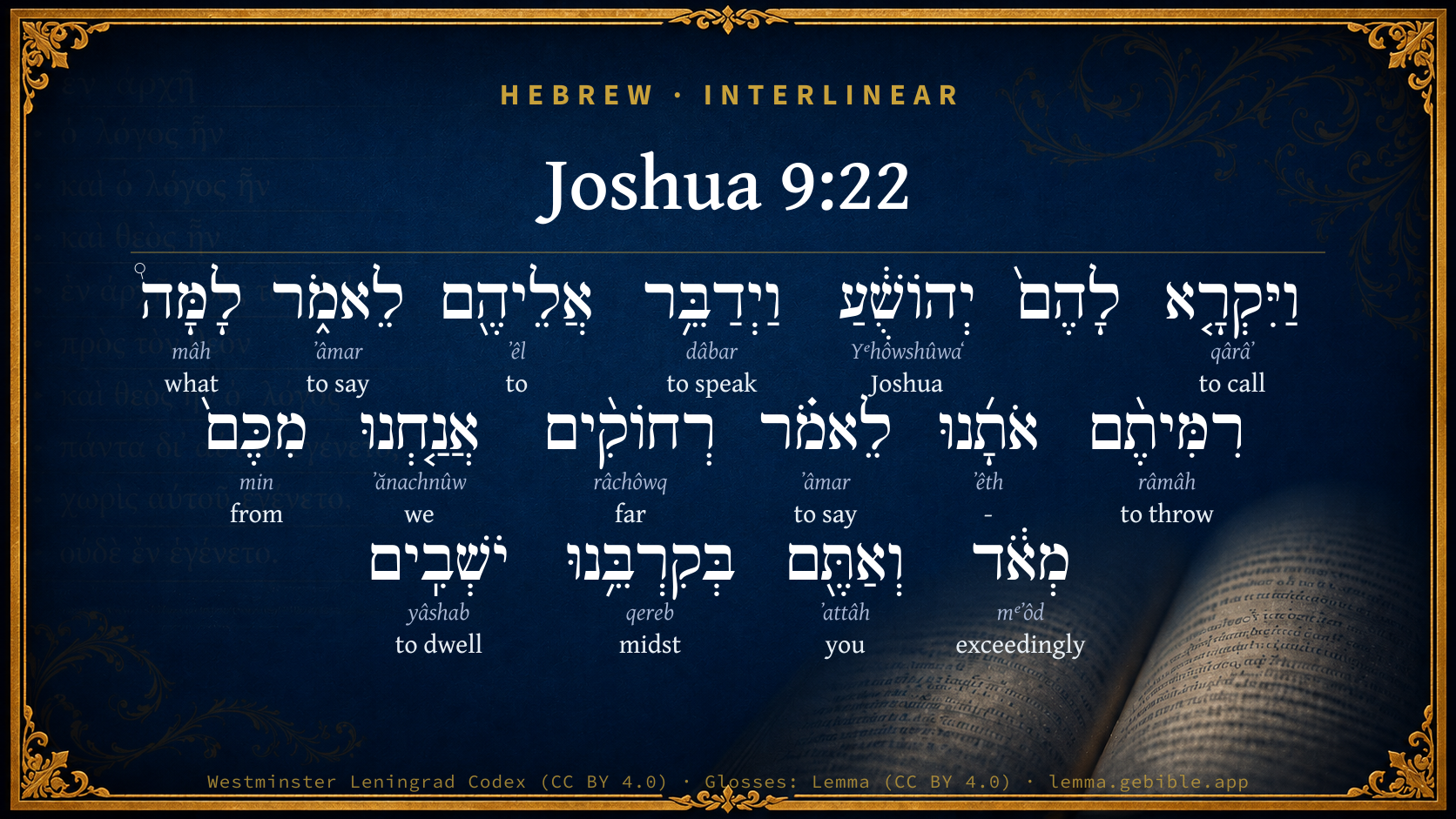
Hebrew (Westminster Leningrad Codex) Joshua 9:22 appears in the Hebrew Old Testament. The text above is from the Westminster Leningrad Codex. Each word links to its Strong’s number, a concise gloss, and parsing drawn from the Open Scriptures Hebrew Bible morphology. Click any word for its full Brown-Driver-Briggs (BDB) entry.
Download image
Cite this verse

Joshua 9:22 (World English Bible). Public Domain. Lemma interlinear Bible study tool, https://lemma.gebible.app/v/joshua/9/22.

Show BibTeX & RIS
BibTeX
RIS
English Translation
Joshua called for them, and he spoke to them, saying, Why have you deceived us, saying, We are very far from you; when you dwell among us?
World English Bible · Public Domain
Download a study sheet

One document with this verse’s original text, its word-by-word gloss line, the meaning frame, cross-references with their text, attributed commentary, and full source and license credits — printable, and it pastes into notes with its structure intact.

This verse Autodidact and up

Study sheet (.html) Plain text (.txt)

A passage Seminary Student

Up to 50 verses in one chapter. A passage sheet keeps up to 6 commentary sources and 12 cross-references per verse, in the order this page ranks them, and says so on the sheet whenever that leaves anything out. Ask for a single verse and you get the Autodidact verse sheet above.

Everything on this page stays free to read, with no account — the sheet is a download of what is already on screen, not access to it.

Want to remove ads? Support Godless Engineer
Compare translations 3

The same verse in 3 English versions, stacked beneath the original-language interlinear above. Click any original word for its lexicon entry.

Each is an independent rendering of the whole verse — the interlinear is not word-aligned to these translations.

Highlighted words mark where these versions differ — a whole-verse word diff, not a word-by-word alignment.

  • World English Bible Public Domain
    Joshua called for them, and he spoke to them, saying, Why have you deceived us, saying, We are very far from you; when you dwell among us?
  • King James Version Public Domain
    And Joshua called for them, and he spake unto them, saying, Wherefore have ye beguiled us, saying, We are very far from you; when ye dwell among us?
  • unfoldingWord Literal Text CC BY-SA 4.0
    And Joshua called for them and spoke to them, saying, “Why have you deceived us, saying, ‘We very far from you,’ but you dwelling among us?

unfoldingWord Literal Text — © unfoldingWord, licensed CC BY-SA 4.0. Word-aligned USFM3 via Door43 (git.door43.org/unfoldingWord/en_ult).

Versions to compare (up to 4)

3 of 4 selected

Show all 18 translations

Every available English version of this verse, each an independent rendering of the whole verse.

  • World English Bible Public Domain
    Joshua called for them, and he spoke to them, saying, Why have you deceived us, saying, We are very far from you; when you dwell among us?
  • Berean Standard Bible Public Domain
    Then Joshua summoned the Gibeonites and said, “Why did you deceive us by telling us you live far away from us, when in fact you live among us?
  • Majority Standard Bible Public Domain
    Then Joshua summoned the Gibeonites and said, “Why did you deceive us by telling us you live far away from us, when in fact you live among us?
  • King James Version Public Domain
    And Joshua called for them, and he spake unto them, saying, Wherefore have ye beguiled us, saying, We are very far from you; when ye dwell among us?
  • American Standard Version (1901) Public Domain
    And Joshua called for them, and he spake unto them, saying, Wherefore have ye beguiled us, saying, We are very far from you; when ye dwell among us?
  • Revised Version (1885) Public Domain
    And Joshua called for them, and he spake unto them, saying, Wherefore have ye beguiled us, saying, We are very far from you; when ye dwell among us?
  • Geneva Bible (1599) Public Domain
    Ioshua then called them, and talked with them, and sayd, Wherefore haue ye beguiled vs, saying, We are very farre from you, when ye dwel among vs?
  • Douay-Rheims (1899) Public Domain
    Josue called the Gabaonites and said to them: Why would you impose upon us, saying: We dwell far off from you, whereas you are in the midst of us?
  • Young's Literal Translation Public Domain
    And Joshua calleth for them, and speaketh unto them, saying, `Why have ye deceived us, saying, We are very far from you, and ye in our midst dwelling?
  • Literal Standard Version CC BY-SA 4.0
    And Joshua calls for them, and speaks to them, saying, “Why have you deceived us, saying, We are very far from you, yet you [are] dwelling in our midst?
  • Unlocked Literal Bible CC BY-SA 4.0
    Joshua called for them and said, “Why did you deceive us when you said, 'We are very far from you', when you live right here among us?
  • unfoldingWord Literal Text CC BY-SA 4.0
    And Joshua called for them and spoke to them, saying, “Why have you deceived us, saying, ‘We very far from you,’ but you dwelling among us?
  • Darby Bible Public Domain
    And Joshua called for them, and he spoke to them, saying, Why have ye deceived us, saying, We are very far from you; whereas ye dwell in our midst?
  • World Messianic Bible Public Domain
    Joshua called for them, and he spoke to them, saying, “Why have you deceived us, saying, ‘We are very far from you,’ when you live among us?
  • Webster's Bible Public Domain
    And Joshua called for them, and he spoke to them, saying, Why have ye deceived us, saying, We are very far from you; when ye dwell among us?
  • Free Bible Version CC BY-SA 4.0
    Then Joshua summoned the Gibeonites and asked them, “Why did you trick us? You told us, ‘We live a long way from you,’ but you live right next door to us!
  • Bible in Basic English Public Domain
    Then Joshua sent for them, and said to them, Why have you been false to us, saying, We are very far from you, when you are living among us?
  • JPS Tanakh (1917) Public Domain
    And Joshua called for them, and he spoke unto them, saying: 'Wherefore have ye beguiled us, saying: We are very far from you, when ye dwell among us?

Literal Standard Version (2020), Covenant Press — licensed CC BY-SA 4.0. Text via the HelloAO Bible API (eBible.org). Unlocked Literal Bible (unfoldingWord) — licensed CC BY-SA 4.0. Text via the HelloAO Bible API (eBible.org). unfoldingWord Literal Text — © unfoldingWord, licensed CC BY-SA 4.0. Word-aligned USFM3 via Door43 (git.door43.org/unfoldingWord/en_ult). Free Bible Version, Dr. Jonathan Gallagher — licensed CC BY-SA 4.0. Text via the HelloAO Bible API (eBible.org).

Word by word

More ways to search: Search by grammar → Find every occurrence → Compare this word →

Practice this passage: Drill this verse → Learn its vocabulary →

רִמִּיתֶ֨ם
râmâh
H7411
“to throw”
Verb, Piel, Perfect, 2nd Person, Masculine, Plural
Part of Speech
Verb
Stem
Piel
Form
Perfect
Person
2nd Person
Gender
Masculine
Number
Plural
Full BDB Definition

Origin: a primitive root

TWOT: 2168 , 2169

to cast, shoot, hurl - (Qal) - to throw - bow-shooters, bowmen (participle) - (Piel) to throw down - to beguile, deceive, mislead, deal treacherously - (Piel) - to beguile, deceive, mislead, trick - to deal treacherously with, betray
  1. וַיִּקְרָ֤א qârâʼ H7121 “and · to call” Conjunction + Verb, Qal, Sequential Imperfect, 3rd Person, Masculine, Singular
  2. יְהוֹשֻׁ֔עַ Yᵉhôwshûwaʻ H3091 “Joshua” Noun, Proper
  3. וַיְדַבֵּ֥ר dâbar H1696 “and · to speak” Conjunction + Verb, Piel, Sequential Imperfect, 3rd Person, Masculine, Singular
  4. אֲלֵיהֶ֖ם ʼêl H413 “to · them” Preposition + Suffix, Personal, 3rd Person, Masculine, Plural
  5. לֵאמֹ֑ר ʼâmar H559 “to say” Preposition + Verb, Qal, Infinitive Construct
  6. לָמָּה֩ mâh H4100 “to/for · what” Preposition + Particle, Interrogative
  7. אֹתָ֜נוּ ʼêth H853 “- · us” Particle, Direct Object + Suffix, Personal, 1st Person, Common, Plural
  8. לֵאמֹ֗ר ʼâmar H559 “to say” Preposition + Verb, Qal, Infinitive Construct
  9. רְחוֹקִ֨ים râchôwq H7350 “far” Adjective, Adjective, Masculine, Plural, Absolute
  10. אֲנַ֤חְנוּ ʼănachnûw H587 “we” Pronoun, Personal, 1st Person, Common, Plural
  11. מִכֶּם֙ min H4480 “from · you” Preposition + Suffix, Personal, 2nd Person, Masculine, Plural
  12. מְאֹ֔ד mᵉʼôd H3966 “exceedingly” Adverb
  13. וְאַתֶּ֖ם ʼattâh H859 “and · you” Conjunction + Pronoun, Personal, 2nd Person, Masculine, Plural
  14. בְּקִרְבֵּ֥נוּ qereb H7130 “in/at · midst · our” Preposition + Noun, Common, Masculine, Singular, Construct + Suffix, Personal, 1st Person, Common, Plural
  15. יֹשְׁבִֽים yâshab H3427 “dwelling” Verb, Qal, Participle Active, Masculine, Plural, Absolute

About this verse

These counts appear in no published source. They are computed here, from the morphology-tagged text and Lemma’s own curated glosses. What Lemma adds →

17
words
15
distinct lemmas
Historical
section

Notable vocabulary

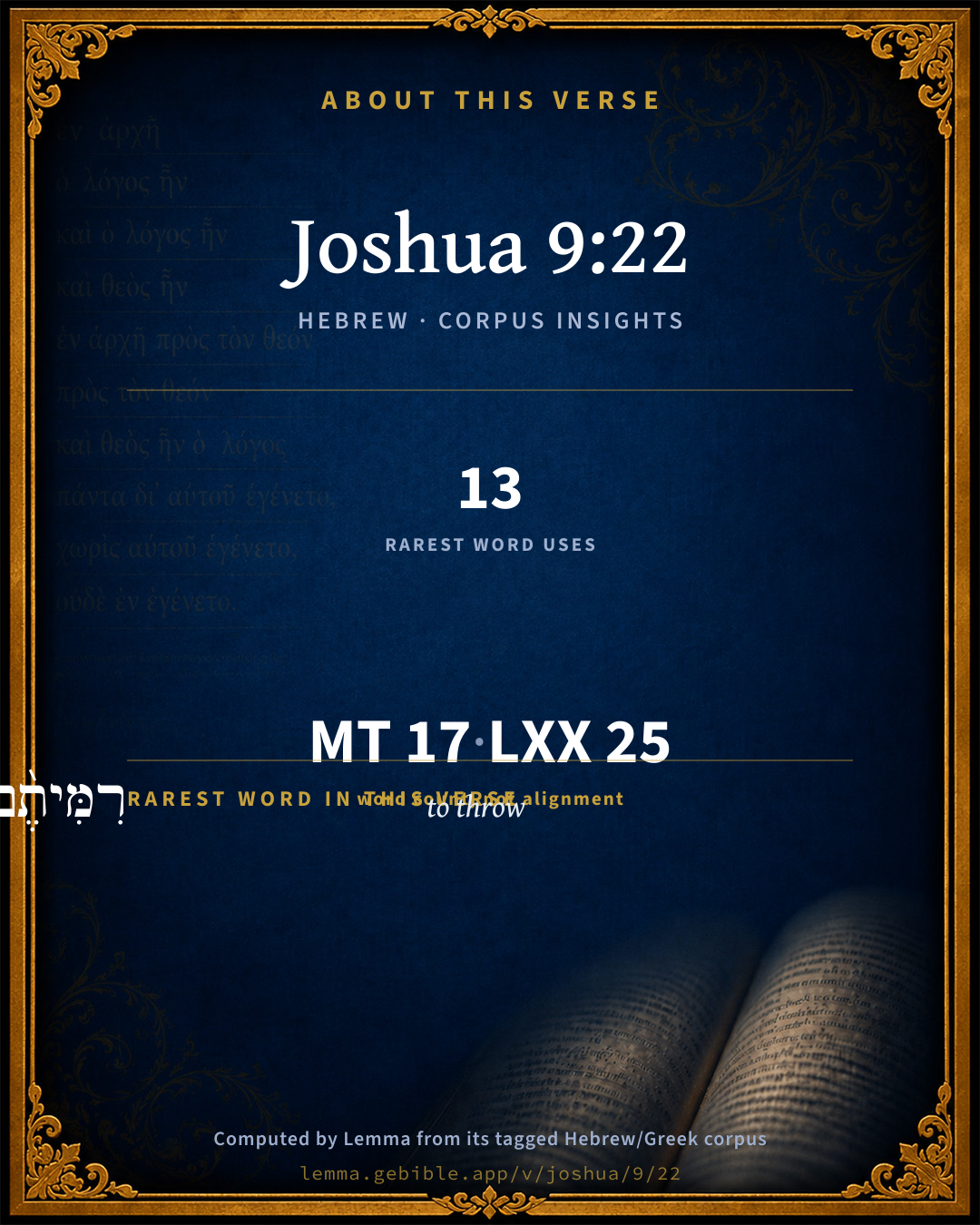
The rarest word here is רִמִּיתֶ֨ם to throw H7411 — appearing just 13 times in the whole Hebrew Bible.

Shared distinctive vocabulary

רִמִּיתֶ֨ם to throw H7411 occurs in 13 verses of the Hebrew Bible. Also found in:

Grammatical profile

  • 6 verbs
  • 2 nouns
  • 1 adjective
  • 2 pronouns
  • 3 prepositions
  • 1 adverb
  • 2 particles

Verb forms

  • וַיִּקְרָ֤א Qal · Sequential Imperfect
  • וַיְדַבֵּ֥ר Piel · Sequential Imperfect
  • לֵאמֹ֑ר Qal · Infinitive Construct
  • רִמִּיתֶ֨ם Piel · Perfect
  • לֵאמֹ֗ר Qal · Infinitive Construct
  • יֹשְׁבִֽים Qal · Participle Active

Repetition

A word recurs within this verse — often emphatic in Hebrew:

  • לֵאמֹ֑ר to say H559 ×2

Hebrew & Septuagint length

In English translation the verse runs 27 words from the Hebrew and 31 from the Septuagint (LXX English) — closely comparable.

A rough comparison of the two English renderings, which tokenize alike — not a word-level alignment.

Word counts can differ between the Hebrew and the Greek without any difference in meaning — e.g. the Hebrew direct-object marker אֵת has no separate Greek word, and Greek often adds the article ὁ.

In the original languages it is 17 Hebrew tokens and 25 Greek tokens — but the two are counted differently (Hebrew bundles its prefixes and suffixes into one token; the Greek is in lemma form), so that isn’t a like-for-like length.

Cross-references

8

Topical passages linked to Joshua 9:22 in the Treasury of Scripture Knowledge — connected by theme and wording, ordered by reader-vote popularity; previews shown in the World English Bible.

  • Joshua 9:6 They went to Joshua to the camp at Gilgal, and said to him, and to the men of Israel, We are come from a far country: now therefore make you a covenant with us.
  • Joshua 9:16 It happened at the end of three days after they had made a covenant with them, that they heard that they were their neighbors, and that they lived among them.
  • Genesis 3:13–14 Yahweh God said to the woman, "What is this you have done?" The woman said, "The serpent deceived me, and I ate."
  • Genesis 27:35–36 He said, "Your brother came with deceit, and has taken away your blessing."
  • Genesis 27:41–45 Esau hated Jacob because of the blessing with which his father blessed him. Esau said in his heart, "The days of mourning for my father are at hand. Then I will kill my brother Jacob."
  • Genesis 29:25 It happened in the morning that, behold, it was Leah. He said to Laban, "What is this you have done to me? Didn't I serve with you for Rachel? Why then have you deceived me?"
  • Joshua 9:9–10 They said to him, From a very far country your servants are come because of the name of Yahweh your God: for we have heard the fame of him, and all that he did in Egypt,
  • 2 Corinthians 11:3 But I am afraid that somehow, as the serpent deceived Eve in his craftiness, so your minds might be corrupted from the simplicity that is in Christ.

Cross-references courtesy of OpenBible.info (CC BY 4.0).

Hebrew and Greek witnesses Masoretic Hebrew ↔ Greek Septuagint

The same verse in the two great witnesses to the Old Testament, shown verse-for-verse.

These are two independent witnesses, not word-aligned to each other, and the Septuagint is shown in lemma (dictionary) form.

Hebrew Joshua 9:22 Masoretic · Westminster Leningrad Codex

וַיִּקְרָ֤א לָהֶם֙ יְהוֹשֻׁ֔עַ וַיְדַבֵּ֥ר אֲלֵיהֶ֖ם לֵאמֹ֑ר לָמָּה֩ רִמִּיתֶ֨ם אֹתָ֜נוּ לֵאמֹ֗ר רְחוֹקִ֨ים אֲנַ֤חְנוּ מִכֶּם֙ מְאֹ֔ד וְאַתֶּ֖ם בְּקִרְבֵּ֥נוּ יֹשְׁבִֽים

Joshua called for them, and he spoke to them, saying, Why have you deceived us, saying, We are very far from you; when you dwell among us?

World English Bible · Public Domain

Greek LXX Joshua 9:22 Septuagint · lemma form

καί συνκαλέω αὐτός ἰησοῦς καί εἶπον αὐτός διά τίς παραλογίζομαι ἐγώ λέγω μακράν ἀπό σύ εἰμί σφόδρα σύ δέ ἐγχώριος εἰμί ὁ καταοἰκέω ἐν ἐγώ

And Joshua called them together and said to them, Why have you⌃ deceived me, saying, We live very far from you; whereas you⌃ are fellow-countrymen of those who dwell among us?

LXX2012 (modern English Septuagint) · Public Domain

Hebrew: Westminster Leningrad Codex (CC BY 4.0). Greek: Septuagint (public domain); English from LXX2012 (modern English Septuagint) (Public Domain). How the Septuagint differs from the Hebrew →

Targum (Aramaic paraphrase)

1

The Targum is the ancient Jewish Aramaic paraphrase of the Hebrew Scriptures — an interpretive translation, not the Hebrew text itself. Onkelos (literal) and Pseudo-Jonathan (expansive) render the Torah, and Jonathan the Prophets. Coverage is partial: where no permissively-licensed English translation exists for a verse, only the Aramaic is shown. This is verse-level text, not a word-by-word alignment to the Hebrew.

  1. Targum Jonathan Prophets (Joshua–Malachi)
    וּקְרָא לְהוֹן יְהוֹשֻׁעַ וּמַלֵיל עִמְהוֹן לְמֵימָר לְמָא שְׁקַרְתּוּן בָּנָא לְמֵימָר רְחִיקִין אֲנַחְנָא מִנְכוֹן לַחֲדָא וְאַתּוּן בֵּינָנָא יָתְבִין:

    (no public-domain English translation for this verse)

    Targum Jonathan — Aramaic: “Mikraot Gedolot” (public domain). English: “Sefaria Community Translation” (CC0 1.0 (public-domain dedication)); “London "Chaldee Paraphrase," 1871” (public domain). Text via Sefaria.

Commentary

Notes on Joshua 9:22 from classic Christian and Jewish commentators (each source and its license shown beneath its notes). The classic Christian expositions comment on the surrounding passage and are grouped to its opening verse, so a note may address several verses; the Jewish commentaries on the Tanakh (Rashi and others) are per-verse, so they appear only where the commentator wrote on this verse.

Lemma curates 59 commentaries, every one of them public domain or Creative Commons licensed, each selected and text-cleaned for this edition rather than reprinted as found. About our sources →

Matthew Henry's Commentary

The matter is here settled between Joshua and the Gibeonites, and an explanation of the league agreed upon. We may suppose that now, not the messengers who were first sent, but the elders of Gibeon, and of the cities that were dependent upon it, were themselves present and treated with, that the matter might be fully compromised.

I. Joshua reproves them for their fraud, Jos 9:22. And they excuse it as well as they can, Jos 9:24. 1. Joshua gives the reproof very mildly: Wherefore have you beguiled us? He does not load them with any ill names, does not give them any harsh provoking language, does not call them, as they deserved to be called, base liars, but only asks them, Why have you beguiled us? Under the greatest provocations, it is our wisdom and duty to keep our temper, and to bridle our passion; a just cause needs not anger to defend it, and a bad one is made never the better by it. 2. They make the best excuse for themselves, that the thing would bear, Jos 9:24. They found by the word of God that sentence of death was passed upon them (the command was to destroy all the inhabitants of the land, without exception), and they found by the works of God already wrought that there was no opposing the execution of this sentence; they considered that God's sovereignty is incontestable, his justice inflexible, his power irresistible, and therefore resolved to try what his mercy was, and found it was not in vain to cast themselves upon it. They do not go about to justify their lie, but in effect beg pardon for it, pleading it was purely to save their lives that they did it, which every man that finds in himself the force of the law of self-preservation will therefore make great allowances for, especially in such a case as this, where the fear was not merely of the power of man (if that were all, one might flee from that to the divine protection), but of the power of God himself, which they saw engaged against them.

II. Joshua condemns them to servitude, as a punishment of their fraud (Jos 9:23), and they submit to the sentence (Jos 9:25), and for aught that appears both sides are pleased.

1. Joshua pronounces them perpetual bondmen. They had purchased their lives with a lie, but, that being no good consideration, he obliges them to hold their lives under the rent and reservation of their continual labours, in hewing wood and drawing water, the meanest and most toilsome employments. Thus their lie was punished; had they dealt fairly and plainly with Israel, perhaps they would have had more honourable conditions granted them, but now, since they gain their lives with ragged clothes and clouted shoes, the badges of servitude, they are condemned for ever to wear such, so must their doom be. And thus the ransom of their lives is paid; dominion is acquired by the preservation of a life that lies at mercy (servus dicitur a servando - a servant is so called from the act of saving); they owe their service to those to whom they owe their lives. Observe how the judgment is given against them. (1.) Their servitude is made a curse to them. "Now you are cursed with the ancient curse of Canaan," from whom these Hivites descended, a servant of servants shalt thou be, Gen 9:25. What shall be done to the false tongue but this? Cursed shall it be. (2.) Yet this curse is turned into a blessing; they must be servants, but it shall be for the house of my God. The princes would have them slaves unto all the congregation (Jos 9:21), at least they chose to express themselves so, for the pacifying of the people that were discontented; but Joshua mitigates the sentence, both in honour to God and in favour to the Gibeonites: it would be too hard upon them to make them every man's drudge; if they must be hewers of wood and drawers of water, than which there cannot be a greater disparagement, especially to those who are citizens of a royal city, and all mighty men (Jos 10:2), yet they shall be so to the house of my God, than which there cannot be a greater preferment: David himself could have wished to be a door-keeper there. Even servile work becomes honourable when it is done for the house of our God and the offices thereof. [1.] They were hereby excluded from the liberties and privileges of true-born Israelites, and a remaining mark of distinction was put upon their posterity throughout all their generations. [2.] They were hereby employed in such services as required their personal attendance upon the altar of God in the place which he should choose (Jos 9:27), which would bring them to the knowledge of the law of God, keep them strictly to that holy religion to which they were proselyted, and prevent their revolt to the idolatries of their fathers. [3.] This would be a great advantage to the priests and Levites to have so many, and those mighty men, constant attendants upon them, and engaged by office to do all the drudgery of the tabernacle. A great deal of wood must be hewed for fuel for God's house, not only to keep the fire burning continually upon the altar, but to boil the flesh of the peace-offerings, etc. And a great deal of water must be drawn for the divers washings which the law prescribed. These and other such servile works, such as washing the vessels, carrying out ashes, sweeping the courts, etc., which otherwise the Levites must have done themselves, these Gibeonites were appointed to do. [4.] They were herein servants to the congregation too; for whatever promotes and helps forward the worship of God is real service to the commonwealth. It is the interest of every Israelite that the altar of God be well attended. Hereby also the congregation was excused from much of that servile work which perhaps would otherwise have been expected from some of them. God had made a law that the Israelites should never make any of their brethren bondmen; if they had slaves, they must be of the heathen that were round about them, Lev 25:44. Now in honour of this law, and of Israel that was honoured by it, God would not have the drudgery, no, not of the tabernacle itself, to be done by Israelites, but by Gibeonites, who were afterwards called Nethinim, men given to the Levites, as the Levites were to the priests (Num 3:9), to minister to them in the service of God. [5.] This may be looked upon as typifying the admission of the Gentiles into the gospel church. Now they were taken in upon their submission to be under-officers, but afterwards God promises that he will take of them for priests and Levites, Isa 66:21.

2. They submit to this condition, Jos 9:25. Conscious of a fault in framing a lie whereby to deceive the Israelites, and sensible also how narrowly they escaped with their lives and what a kindness it was to have them spared, they acquiesce in the proposal: Do as it seemeth right unto thee. Better live in servitude, especially such servitude, than not live at all. Those of the very meanest and most despicable condition are described to be hewers of wood and drawers of water, Deu 29:11. But skin for skin, liberty, and labour, and all that a man has, will he give for his life, and no ill bargain. Accordingly the matter was determined. (1.) Joshua delivered them out of the hands of the Israelites that they should not be slain, Jos 9:26. It seems there were those who would have fallen upon them with the sword if Joshua had not interposed with his authority; but wise generals know when to sheathe the sword, as well as when to draw it. (2.) He then delivered them again into the hands of the Israelites to be enslaved, Jos 9:27. They were not to keep possession of their cities, for we find afterwards that three of them fell to the lot of Benjamin and one to that of Judah; nor were they themselves to be at their own disposal, but, as bishop Patrick thinks, were dispersed into the cities of the priests and Levites, and came up with them in their courses to serve at the altar, out of the profits of which, it is probable, they were maintained. And thus Israel's bondmen became the Lord's freemen, for his service in the meanest office is liberty, and his work is its own wages. And this they got by their early submission. Let us, in like manner, submit to our Lord Jesus, and refer our lives to him, saying, "We are in thy hand, do unto us as seemeth good and right unto thee; only save our souls, and we shall not repent it:" if he appoint us to bear his cross, and draw in his yoke, and serve at his altar, this shall be afterwards neither shame nor grief to us, while the meanest office in God's service will entitle us to a dwelling in the house of the Lord all the days of our life.

Matthew Henry's Commentary on the Whole Bible (1708–1710) — public domain (CC PDM 1.0). Text via the HelloAO Bible API.

Trapp's Complete Commentary

John Trapp

Jos 9:22 And Joshua called for them, and he spake unto them, saying, Wherefore have ye beguiled us, saying, We [are] very far from you; when ye dwell among us?

Ver. 22. Wherefore have ye beguiled us?] {See Trapp on "Jos 9:6"} {See Trapp on "Jos 9:7"} But was Joshua so light of belief? knew he not that Multis annis iam transactis? &c.

John Trapp, A Commentary or Exposition upon All the Books of the Old and New Testament (1647–1656) — public domain. Text from a community e-Sword module.

Joseph Benson's Commentary

Jos 9:22-23. Called for them — Probably not only the messengers, but the elders of Gibeon were now present. Therefore ye are cursed — You shall not escape the curse of God, which, by divine sentence, belongs to all the Canaanites; but only change the quality of it. You shall feel that curse of bondage, which is proper to your race by virtue of that ancient decree, Gen 9:25. Bondmen — The slavery which is upon you shall be entailed on your posterity. The house of my God — This only service they mention here, because it was their durable servitude, being first in the tabernacle, and then in the temple, whence they were called Nethinim, 1

Chronicles Jos 9:2; Ezr 2:43; whereas their servitude to the whole congregation, in a great measure, ceased when the Israelites were dispersed to their several habitations.

Joseph Benson's Commentary on the Old and New Testaments (1811–1818) — public domain. Text from a community e-Sword module.

Tyndale Open Study Notes

Tyndale Open Resources

9:22 As the leader of Israel, Joshua was within his rights when he called together the Gibeonites to question them. • you live right here among us? Joshua’s use of this phrase tacitly acknowledged that he should not have accepted the word of the Gibeonites without consulting the Lord.

Tyndale Open Study Notes — © Tyndale Open Resources, licensed CC BY-SA 4.0. Text via the HelloAO Bible API.

John Calvin's Commentaries

22. And Joshua called for them, etc. As he was to deliver a sad and severe sentence, he premises that the resolution involves no injustice, because nothing would be more unbecoming than to allow tricks and wiles to be profitable to those who employ them. He therefore first expostulates with them for having warded off danger by falsehood, and then immediately pronounces them cursed. By this I understand that he throws the blame of their servitude upon themselves, because they bear nothing worse than they have deserved by their guile or perfidy; as if he had said that the ground of the condemnation which he pronounces is in themselves. It is hard, indeed, that no end is assigned to the labors to which they are doomed, for this is implied in the words, Slaves shall never cease from among you: but he declares that no injustice is done them, as they were cursed of their own accord, or by their own fault. They, indeed, extenuate the offense, by alleging the necessity which compelled them, and yet they decline not the punishment, which they acknowledge to be justly inflicted. It may indeed be, that overcome with fear, they refused nothing, nay, calmly and flatteringly acquiesced in the terms imposed on them. For what could they gain by disputing? I have no doubt, however, that as they were conscious of having done wrong, and had no means of completely exculpating themselves, they considered themselves very humanely dealt with, so long as their lives were saved,

John Calvin's Commentaries (1540-1563) — public domain. Text from the Calvin Translation Society English edition (1840s-50s) via the Christian Classics Ethereal Library (ccel.org). Calvin's coverage is partial (roughly two-thirds of the Bible); uncommented books and verses are honest gaps, never fabricated. The 19th-century editor's footnotes and remarks are omitted so the notes are faithfully Calvin's own voice.

John Gill's Exposition

And Joshua called for them,.... The Gibeonites, who came as ambassadors for their people, who were detained at Gilgal until the children of Israel returned from Gibeon; and upon their return, and having made their report to Joshua that they found it to be true that they were near neighbours, Joshua ordered them to be brought before him:

and he spake unto them, saying, wherefore have ye beguiled us? what is your reason and motive for so doing? what has induced you to act such a deceitful part, to tell such lies and falsehoods, and impose upon us after this manner?

saying, we are very far from you, when ye dwell among us: pretending to come from a very far country, when they were inhabitants of the land Israel were come to possess.

John Gill's Exposition of the Whole Bible (1746–1763) — public domain (CC PDM 1.0). Text via the HelloAO Bible API.

Albert Barnes' Notes on the Bible

Were the Israelites bound to respect an oath thus procured by fraud? Were they right in doing so? Dr. Sanderson (“Works,” vol. iv. 4 pp. 269, 300, Oxford edition), determines these questions in the affirmative; and rightly, since the oath, though unlawfully taken, was not an oath taken to do an unlawful thing, i. e. a thing in itself unlawful. It was the carelessness of the Israelites themselves which betrayed them into this league. It was therefore their duty when they found themselves entrapped into this unlawful covenant, to devise means by which they might respect both their own oath and God’s purposes as intimated in His injunctions Deu 7:2 against sparing the Canaanites. This was accomplished by granting their lives to the Gibeonites, but reducing them to a servile condition, which might be expected to disable them from influencing the Israelites to do wrong. It may be added, that had the Israelites broken their oath, taken solemnly in the Name of the Lord, they would have brought that Name into contempt among the pagan; and, while punishing perfidy in others, would have themselves, the Lord’s people, incurred the reproach of perjury. The result showed that Joshua and the princes judged rightly in this matter. God gave to Israel a notable victory, crowned with special miracles, over the kings who were confederated against Gibeon, because of the treaty made with Israel Jos 10:4, Jos 10:8,Jos 10:13; and God punished as a national act of blood-guiltiness the slaughter of the Gibeonites by Saul, which was a distinct violation of the covenant here before us (compare 2Sa 21:1). This sparing of the Gibeonites, as well as the previous sparing of Rahab and her household, must be borne in mind when the massacre of the Canaanites by Joshua and the Israelites is discussed.

Albert Barnes' Notes on the Bible (1834–1885) — public domain. Text from a community e-Sword/MySword module.

John Wesley's Explanatory Notes

Called for them - Probably not only the messengers, but the elders of Gibeon were now present.

John Wesley, Explanatory Notes Upon the Whole Bible (1754–1765) — public domain. Text via the GEBible commentary corpus.

Keil & Delitzsch

C. F. Keil & F. Delitzsch

Joshua then summoned the Gibeonites, charged them with their deceit, and pronounced upon them the curse of eternal servitude: "There shall not be cut off from you a servant," i.e., ye shall never cease to be servants, ye shall remain servants for ever (vid., Sa2 3:29; Kg1 2:4), "and that as hewers of wood and drawers of waters for our God's house." This is a fuller definition of the expression "for all the congregation" in Jos 9:21. The Gibeonites were to perform for the congregation the slaves' labour of hewing wood and drawing water for the worship of the sanctuary-a duty which was performed, according to Deu 29:10, by the lowest classes of people. In this way the curse of Noah upon Canaan (Gen 9:25) was literally fulfilled upon the Hivites of the Gibeonitish republic.

Keil & Delitzsch — Biblical Commentary on the Old Testament (1861–1891) — public domain (CC PDM 1.0). Text via the HelloAO Bible API. (Old Testament only.)

unfoldingWord translationNotes

Door43 World Missions Community

house of my God

Here this phrase refers to the dwelling place of Yahweh, the Tabernacle. (See: Metonymy)

translationWords

Joshua

deceive

curse

unfoldingWord translationNotes — © Distant Shores Media and the Door43 World Missions Community, licensed CC BY-SA 4.0. Source: git.door43.org/Door43/en_tn.

Lesson kit

Teaching starters — assembled from the data on this page, not authored interpretation. Every prompt links to the verse data it draws on. Edit before teaching.

Joshua, in the Historical, opens this verse with 17 words (15 distinct Hebrew lemmas). Its most distinctive word is râmâh (“to throw”). A historical commentator’s framing appears above. Read the whole chapter for the surrounding context.

Discussion questions

  1. What does “to throw” (râmâh) contribute to the verse as a whole?
  2. How does Genesis 29:25, which shares the word «to throw», read alongside this verse?
  3. What does the repetition of “to say” (2× in this one verse) do in this verse?
  4. These translations render this verse differently; the difference is in the English rendering, not the original. What questions does that raise?
  5. «וַיִּקְרָ֤א» is a Qal Sequential Imperfect verb. How does that grammatical form shape the action described?
  6. Compare how Matthew Henry's Commentary and Trapp's Complete Commentary read this verse. Where do they agree or differ?

Things to notice

Reading settings

Reading text

Shown beneath each verse's original-language words.

Old Testament
Old Testament edition

Read the OT as the Masoretic Hebrew (MT) or the Greek Septuagint (LXX).

English shown for the Greek Septuagint (in the Hebrew ↔ Greek comparison).

Comparing translations? Open the Compare panel on any verse page to stack up to four side by side.