
Deuteronomy 22:21

Hebrew (Westminster Leningrad Codex) Deuteronomy 22:21 appears in the Hebrew Old Testament. The text above is from the Westminster Leningrad Codex. Each word links to its Strong’s number, a concise gloss, and parsing drawn from the Open Scriptures Hebrew Bible morphology. Click any word for its full Brown-Driver-Briggs (BDB) entry.
Download image
Cite this verse

Deuteronomy 22:21 (World English Bible). Public Domain. Lemma interlinear Bible study tool, https://lemma.gebible.app/v/deuteronomy/22/21.

Show BibTeX & RIS
BibTeX
RIS
English Translation
then they shall bring out the young lady to the door of her father's house, and the men of her city shall stone her to death with stones, because she has done folly in Israel, to play the prostitute in her father's house: so shall you put away the evil from the midst of you.
World English Bible · Public Domain
Download a study sheet

One document with this verse’s original text, its word-by-word gloss line, the meaning frame, cross-references with their text, attributed commentary, and full source and license credits — printable, and it pastes into notes with its structure intact.

This verse Autodidact and up

Study sheet (.html) Plain text (.txt)

A passage Seminary Student

Up to 50 verses in one chapter. A passage sheet keeps up to 6 commentary sources and 12 cross-references per verse, in the order this page ranks them, and says so on the sheet whenever that leaves anything out. Ask for a single verse and you get the Autodidact verse sheet above.

Everything on this page stays free to read, with no account — the sheet is a download of what is already on screen, not access to it.

Want to remove ads? Support Godless Engineer
Compare translations 3

The same verse in 3 English versions, stacked beneath the original-language interlinear above. Click any original word for its lexicon entry.

Each is an independent rendering of the whole verse — the interlinear is not word-aligned to these translations.

Highlighted words mark where these versions differ — a whole-verse word diff, not a word-by-word alignment.

  • World English Bible Public Domain
    then they shall bring out the young lady to the door of her father's house, and the men of her city shall stone her to death with stones, because she has done folly in Israel, to play the prostitute in her father's house: so shall you put away the evil from the midst of you.
  • King James Version Public Domain
    Then they shall bring out the damsel to the door of her father's house, and the men of her city shall stone her with stones that she die: because she hath wrought folly in Israel, to play the whore in her father's house: so shalt thou put evil away from among you.
  • unfoldingWord Literal Text CC BY-SA 4.0
    then they shall bring out the girl to the door of the house of her father, and the men of her city shall stone her with stones, and she shall die, because she has done a disgraceful thing in Israel, to commit fornication the house of her father; and you shall remove the evil from among you.

unfoldingWord Literal Text — © unfoldingWord, licensed CC BY-SA 4.0. Word-aligned USFM3 via Door43 (git.door43.org/unfoldingWord/en_ult).

Versions to compare (up to 4)

3 of 4 selected

Show all 18 translations

Every available English version of this verse, each an independent rendering of the whole verse.

  • World English Bible Public Domain
    then they shall bring out the young lady to the door of her father's house, and the men of her city shall stone her to death with stones, because she has done folly in Israel, to play the prostitute in her father's house: so shall you put away the evil from the midst of you.
  • Berean Standard Bible Public Domain
    she shall be brought to the door of her father’s house, and there the men of her city will stone her to death. For she has committed an outrage in Israel by being promiscuous in her father’s house. So you must purge the evil from among you.
  • Majority Standard Bible Public Domain
    she shall be brought to the door of her father’s house, and there the men of her city will stone her to death. For she has committed an outrage in Israel by being promiscuous in her father’s house. So you must purge the evil from among you.
  • King James Version Public Domain
    Then they shall bring out the damsel to the door of her father's house, and the men of her city shall stone her with stones that she die: because she hath wrought folly in Israel, to play the whore in her father's house: so shalt thou put evil away from among you.
  • American Standard Version (1901) Public Domain
    then they shall bring out the damsel to the door of her father's house, and the men of her city shall stone her to death with stones, because she hath wrought folly in Israel, to play the harlot in her father's house: so shalt thou put away the evil from the midst of thee.
  • Revised Version (1885) Public Domain
    then they shall bring out the damsel to the door of her father’s house, and the men of her city shall stone her with stones that she die: because she hath wrought folly in Israel, to play the harlot in her father’s house: so shalt thou put away the evil from the midst of thee.
  • Geneva Bible (1599) Public Domain
    Then shall they bring forth the mayde to the doore of her fathers house, and the men of her citie shall stone her with stones to death: for shee hath wrought follie in Israel, by playing ye whore in her fathers house: so thou shalt put euill away from among you.
  • Douay-Rheims (1899) Public Domain
    They shall cast her out of the doors of her father's house, and the men of the city shall stone her to death, and she shall die: because she hath done a wicked thing in Israel, to play the whore in her father's house: and thou shalt take away the evil out of the midst of thee.
  • Young's Literal Translation Public Domain
    then they have brought out the damsel unto the opening of her father's house, and stoned her have the men of her city with stones, and she hath died, for she hath done folly in Israel, to go a-whoring `in' her father's house; and thou hast put away the evil thing out of thy midst.
  • Literal Standard Version CC BY-SA 4.0
    then they have brought out the girl to the opening of her father’s house, and the men of her city have stoned her with stones and she has died, for she has done folly in Israel, to go whoring [in] her father’s house; and you have put away evil out of your midst.
  • Unlocked Literal Bible CC BY-SA 4.0
    then they must bring out the girl to the door of her father's house, and the men of her city must stone her to death with stones, because she has committed a disgraceful action in Israel, to act as a harlot in her father's house; and you will remove the evil from among you.
  • unfoldingWord Literal Text CC BY-SA 4.0
    then they shall bring out the girl to the door of the house of her father, and the men of her city shall stone her with stones, and she shall die, because she has done a disgraceful thing in Israel, to commit fornication the house of her father; and you shall remove the evil from among you.
  • Darby Bible Public Domain
    then they shall bring out the damsel unto the entrance of her father's house, and the men of her city shall stone her with stones that she die: because she hath wrought infamy in Israel, committing fornication in her father's house; and thou shalt put evil away from thy midst.
  • World Messianic Bible Public Domain
    then they shall bring out the young lady to the door of her father’s house, and the men of her city shall stone her to death with stones, because she has done folly in Israel, to play the prostitute in her father’s house. So you shall remove the evil from among you.
  • Webster's Bible Public Domain
    Then they shall bring out the damsel to the door of her father's house, and the men of her city shall stone her with stones that she may die: because she hath wrought folly in Israel, to be guilty of lewdness in her father's house: so shalt thou remove evil from among you.
  • Free Bible Version CC BY-SA 4.0
    she is to be taken to the door of her father's house, and there the men of her town are to stone her to death. She has done something disgraceful in Israel by acting immorally in her father's house. You must eliminate the evil from among you.
  • Bible in Basic English Public Domain
    Then they are to make the girl come to the door of her father's house and she will be stoned to death by the men of the town, because she has done evil and put shame on Israel, by acting as a loose woman in her father's house: so you are to put away evil from among you.
  • JPS Tanakh (1917) Public Domain
    then they shall bring out the damsel to the door of her father's house, and the men of her city shall stone her with stones that she die; because she hath wrought a wanton deed in Israel, to play the harlot in her father's house; so shalt thou put away the evil from the midst of thee.

Literal Standard Version (2020), Covenant Press — licensed CC BY-SA 4.0. Text via the HelloAO Bible API (eBible.org). Unlocked Literal Bible (unfoldingWord) — licensed CC BY-SA 4.0. Text via the HelloAO Bible API (eBible.org). unfoldingWord Literal Text — © unfoldingWord, licensed CC BY-SA 4.0. Word-aligned USFM3 via Door43 (git.door43.org/unfoldingWord/en_ult). Free Bible Version, Dr. Jonathan Gallagher — licensed CC BY-SA 4.0. Text via the HelloAO Bible API (eBible.org).

Word by word

More ways to search: Search by grammar → Find every occurrence → Compare this word →

Practice this passage: Drill this verse → Learn its vocabulary →

נְבָלָה֙
nᵉbâlâh
H5039
“folly”
Noun, Common, Feminine, Singular, Absolute
Part of Speech
Noun
Type
Common
Gender
Feminine
Number
Singular
State
Absolute
Full BDB Definition

Origin: from H5036

TWOT: 1285b

senselessness, folly - disgraceful folly - of immorality, profane actions - disgrace, contumely disgrace
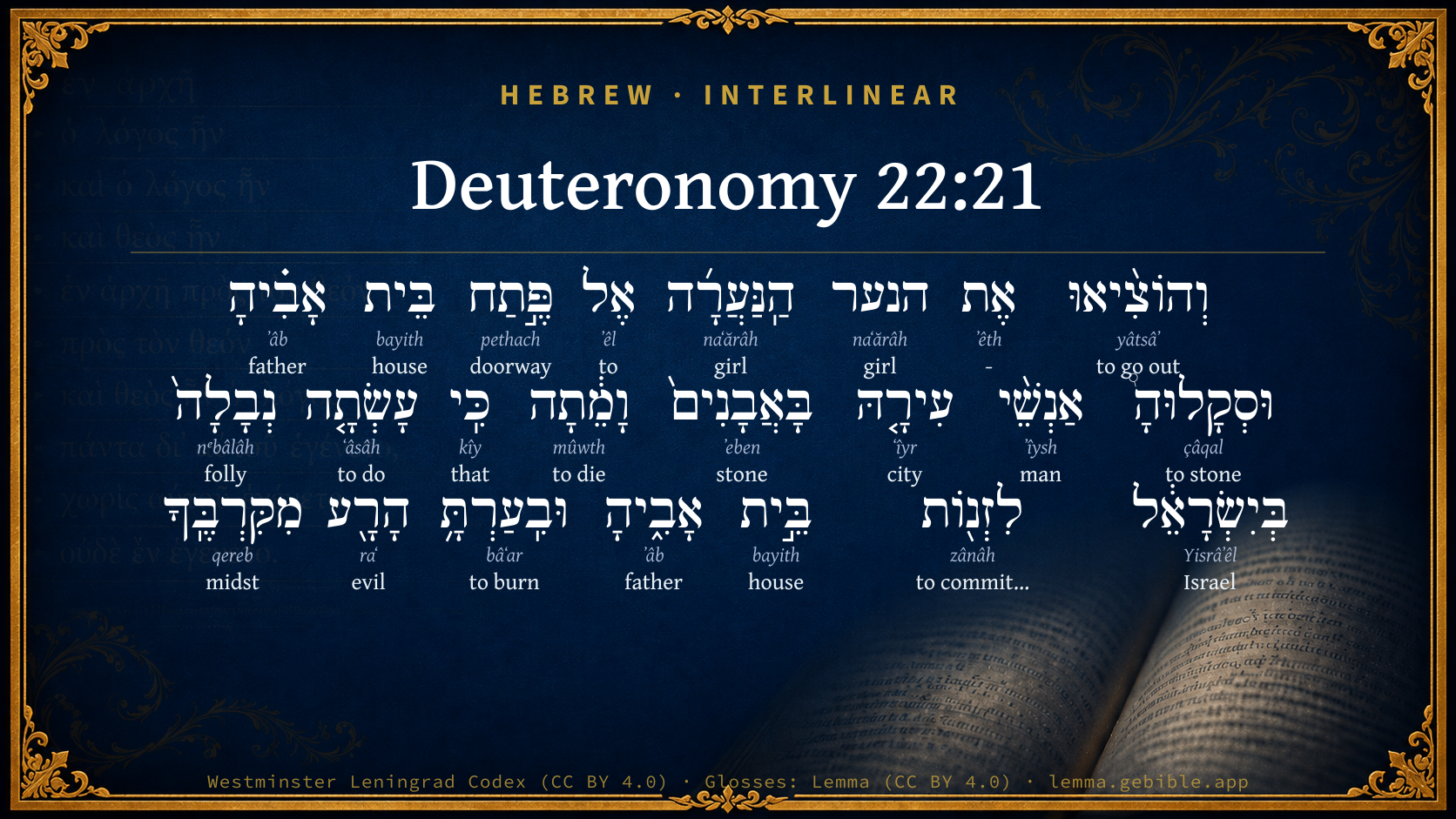
  1. וְהוֹצִ֨יאוּ yâtsâʼ H3318 “and · to go out” Conjunction + Verb, Hiphil, Sequential Perfect, 3rd Person, Common, Plural
  2. אֶת ʼêth H853 “-” Particle, Direct Object
  3. הנער naʻărâh H5291 “the · girl” Particle, Definite Article + Noun, Common, Feminine, Singular, Absolute
  4. הַֽנַּעֲרָ֜ה naʻărâh H5291 “the · girl” Particle, Definite Article + Noun, Common, Feminine, Singular, Absolute
  5. אֶל ʼêl H413 “to” Preposition
  6. פֶּ֣תַח pethach H6607 “doorway of” Noun, Common, Masculine, Singular, Construct
  7. בֵּית bayith H1004 “house of” Noun, Common, Masculine, Singular, Construct
  8. אָבִ֗יהָ ʼâb H1 “father · her” Noun, Common, Masculine, Singular, Construct + Suffix, Personal, 3rd Person, Feminine, Singular
  9. וּסְקָלוּהָ֩ çâqal H5619 “and · to stone · her” Conjunction + Verb, Qal, Sequential Perfect, 3rd Person, Common, Plural + Suffix, Personal, 3rd Person, Feminine, Singular
  10. אַנְשֵׁ֨י ʼîysh H376 “men of” Noun, Common, Masculine, Plural, Construct
  11. עִירָ֤הּ ʻîyr H5892 “city · her” Noun, Common, Feminine, Singular, Construct + Suffix, Personal, 3rd Person, Feminine, Singular
  12. בָּאֲבָנִים֙ ʼeben H68 “in/at the · stones” Preposition, Determined + Noun, Common, Feminine, Plural, Absolute
  13. וָמֵ֔תָה mûwth H4191 “and · to die” Conjunction + Verb, Qal, Sequential Perfect, 3rd Person, Feminine, Singular
  14. כִּֽי kîy H3588 “that” Conjunction
  15. עָשְׂתָ֤ה ʻâsâh H6213 “to do” Verb, Qal, Perfect, 3rd Person, Feminine, Singular
  16. בְּיִשְׂרָאֵ֔ל Yisrâʼêl H3478 “in/at · Israel” Preposition + Noun, Proper
  17. לִזְנ֖וֹת zânâh H2181 “to commit fornication” Preposition + Verb, Qal, Infinitive Construct
  18. בֵּ֣ית bayith H1004 “house of” Noun, Common, Masculine, Singular, Construct
  19. אָבִ֑יהָ ʼâb H1 “father · her” Noun, Common, Masculine, Singular, Construct + Suffix, Personal, 3rd Person, Feminine, Singular
  20. וּבִֽעַרְתָּ֥ bâʻar H1197 “and · to burn” Conjunction + Verb, Piel, Sequential Perfect, 2nd Person, Masculine, Singular
  21. הָרָ֖ע raʻ H7451 “the · evil” Particle, Definite Article + Adjective, Adjective, Masculine, Singular, Absolute
  22. מִקִּרְבֶּֽךָ qereb H7130 “from · midst · your” Preposition + Noun, Common, Masculine, Singular, Construct + Suffix, Personal, 2nd Person, Masculine, Singular

About this verse

These counts appear in no published source. They are computed here, from the morphology-tagged text and Lemma’s own curated glosses. What Lemma adds →

23
words
20
distinct lemmas
Pentateuch
section

Notable vocabulary

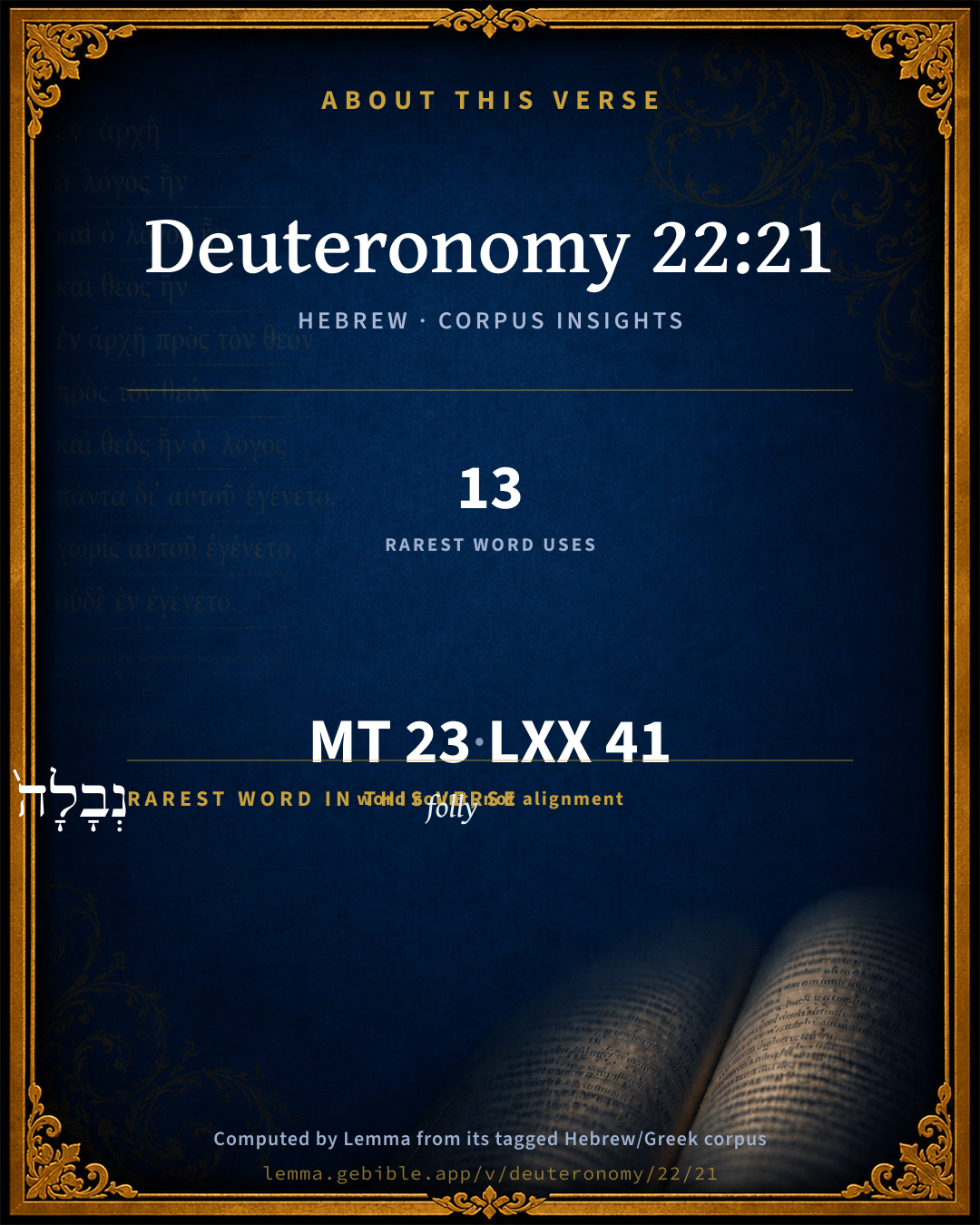
The rarest word here is נְבָלָה֙ folly H5039 — appearing just 13 times in the whole Hebrew Bible.

Shared distinctive vocabulary

נְבָלָה֙ folly H5039 occurs in 13 verses of the Hebrew Bible. Also found in:

Grammatical profile

  • 6 verbs
  • 13 nouns
  • 1 adjective
  • 1 preposition
  • 1 conjunction
  • 1 particle

Verb forms

  • וְהוֹצִ֨יאוּ Hiphil · Sequential Perfect
  • וּסְקָלוּהָ֩ Qal · Sequential Perfect
  • וָמֵ֔תָה Qal · Sequential Perfect
  • עָשְׂתָ֤ה Qal · Perfect
  • לִזְנ֖וֹת Qal · Infinitive Construct
  • וּבִֽעַרְתָּ֥ Piel · Sequential Perfect

Repetition

Words recur within this verse — often emphatic in Hebrew:

  • הנער girl H5291 ×2
  • בֵּית house H1004 ×2
  • אָבִ֗יהָ father H1 ×2

Hebrew & Septuagint length

In English translation the verse runs 55 words from the Hebrew and 53 from the Septuagint (LXX English) — closely comparable.

A rough comparison of the two English renderings, which tokenize alike — not a word-level alignment.

Word counts can differ between the Hebrew and the Greek without any difference in meaning — e.g. the Hebrew direct-object marker אֵת has no separate Greek word, and Greek often adds the article ὁ.

In the original languages it is 23 Hebrew tokens and 41 Greek tokens — but the two are counted differently (Hebrew bundles its prefixes and suffixes into one token; the Greek is in lemma form), so that isn’t a like-for-like length.

Cross-references

17

Topical passages linked to Deuteronomy 22:21 in the Treasury of Scripture Knowledge — connected by theme and wording, ordered by reader-vote popularity; previews shown in the World English Bible.

  • Genesis 34:7 The sons of Jacob came in from the field when they heard it. The men were grieved, and they were very angry, because he had done folly in Israel in lying with Jacob's daughter; which thing ought not to be done.
  • Deuteronomy 13:5 That prophet, or that dreamer of dreams, shall be put to death, because he has spoken rebellion against Yahweh your God, who brought you out of the land of Egypt, and redeemed you out of the house of bondage, to draw you aside out of the way which Yahweh your God commanded you to walk in. So shall you put away the evil from the midst of you.
  • Judges 20:6 I took my concubine, and cut her in pieces, and sent her throughout all the country of the inheritance of Israel; for they have committed lewdness and folly in Israel.
  • Leviticus 21:9 "'The daughter of any priest, if she profanes herself by playing the prostitute, she profanes her father: she shall be burned with fire.
  • Deuteronomy 17:7 The hand of the witnesses shall be first on him to put him to death, and afterward the hand of all the people. So you shall put away the evil from the midst of you.
  • Deuteronomy 19:19 then shall you do to him, as he had thought to do to his brother: so shall you put away the evil from the midst of you.
  • Deuteronomy 21:21 All the men of his city shall stone him to death with stones: so shall you put away the evil from the midst of you; and all Israel shall hear, and fear.
  • Judges 20:10 and we will take ten men of one hundred throughout all the tribes of Israel, and one hundred of one thousand, and a thousand out of ten thousand, to get food for the people, that they may do, when they come to Gibeah of Benjamin, according to all the folly that they have worked in Israel.
  • 2 Samuel 13:12–13 She answered him, No, my brother, do not force me; for no such thing ought to be done in Israel. Don't you do this folly.
  • Leviticus 24:16 He who blasphemes the name of Yahweh, he shall surely be put to death; all the congregation shall certainly stone him: the foreigner as well as the native-born, when he blasphemes the Name, shall be put to death.
  • Leviticus 24:23 Moses spoke to the children of Israel; and they brought forth him who had cursed out of the camp, and stoned him with stones. The children of Israel did as Yahweh commanded Moses.
  • Numbers 15:35–36 Yahweh said to Moses, The man shall surely be put to death: all the congregation shall stone him with stones outside of the camp.
  • Deuteronomy 13:10 You shall stone him to death with stones, because he has sought to draw you away from Yahweh your God, who brought you out of the land of Egypt, out of the house of bondage.
  • Deuteronomy 17:5 then shall you bring forth that man or that woman, who has done this evil thing, to your gates, even the man or the woman; and you shall stone them to death with stones.
  • Deuteronomy 22:22 If a man be found lying with a woman married to a husband, then they shall both of them die, the man who lay with the woman, and the woman: so shall you put away the evil from Israel.
  • Deuteronomy 22:24 then you shall bring them both out to the gate of that city, and you shall stone them to death with stones; the lady, because she didn't cry, being in the city; and the man, because he has humbled his neighbor's wife: so you shall put away the evil from the midst of you.
  • Deuteronomy 23:17–18 There shall be no prostitute of the daughters of Israel, neither shall there be a sodomite of the sons of Israel.

Cross-references courtesy of OpenBible.info (CC BY 4.0).

Hebrew and Greek witnesses Masoretic Hebrew ↔ Greek Septuagint

The same verse in the two great witnesses to the Old Testament, shown verse-for-verse.

These are two independent witnesses, not word-aligned to each other, and the Septuagint is shown in lemma (dictionary) form.

Hebrew Deuteronomy 22:21 Masoretic · Westminster Leningrad Codex

וְהוֹצִ֨יאוּ אֶת הנער הַֽנַּעֲרָ֜ה אֶל פֶּ֣תַח בֵּית אָבִ֗יהָ וּסְקָלוּהָ֩ אַנְשֵׁ֨י עִירָ֤הּ בָּאֲבָנִים֙ וָמֵ֔תָה כִּֽי עָשְׂתָ֤ה נְבָלָה֙ בְּיִשְׂרָאֵ֔ל לִזְנ֖וֹת בֵּ֣ית אָבִ֑יהָ וּבִֽעַרְתָּ֥ הָרָ֖ע מִקִּרְבֶּֽךָ

then they shall bring out the young lady to the door of her father's house, and the men of her city shall stone her to death with stones, because she has done folly in Israel, to play the prostitute in her father's house: so shall you put away the evil from the midst of you.

World English Bible · Public Domain

Greek LXX Deuteronomy 22:21 Septuagint · lemma form

καί ἐκἄγω ὁ νεᾶνις ἐπί ὁ θύρα οἶκος πατήρ αὐτός καί λιθοβολέω αὐτός ὁ ἀνήρ ὁ πόλις αὐτός ἐν λίθος καί ἀποθνήσκω ὅτι ποιέω ἀφροσύνη ἐν υἱός ἰσραήλ ἐκπορνεύω ὁ οἶκος ὁ πατήρ αὐτός καί ἐκαἴρω ὁ πονηρός ἐκ σύ αὐτός

then shall they bring out the damsel to the doors of her father's house, and shall stone her with stones, and she shall die; because she has wrought folly among the children of Israel, to defile the house of her father by whoring: so you shall remove the evil one from among you.

LXX2012 (modern English Septuagint) · Public Domain

On this verse, The Cambridge Bible for Schools and Colleges discusses the Septuagint’s reading. Read the note in Commentary ↓

Hebrew: Westminster Leningrad Codex (CC BY 4.0). Greek: Septuagint (public domain); English from LXX2012 (modern English Septuagint) (Public Domain). How the Septuagint differs from the Hebrew →

Targum (Aramaic paraphrase)

2

The Targum is the ancient Jewish Aramaic paraphrase of the Hebrew Scriptures — an interpretive translation, not the Hebrew text itself. Onkelos (literal) and Pseudo-Jonathan (expansive) render the Torah, and Jonathan the Prophets. Coverage is partial: where no permissively-licensed English translation exists for a verse, only the Aramaic is shown. This is verse-level text, not a word-by-word alignment to the Hebrew.

  1. Targum Onkelos Torah (Genesis–Deuteronomy)
    וְיַפְּקוּן יָת עוּלֶמְתָּא לִתְרַע בֵּית אָבוּהָא וְיִרְגְמֻנַהּ אֱנָשֵׁי קַרְתַּהּ בְּאַבְנַיָא וּתְמוּת אֲרֵי עָבְדַת קְלָנָא בְּיִשְׂרָאֵל לְזַנָאָה בֵּית אֲבוּהָא וּתְפַלֵי עָבֵד דְבִישׁ מִבֵּינָךְ

    (no public-domain English translation for this verse)

    Targum Onkelos — Aramaic: “Onkelos Genesis” (public domain); “Onkelos Exodus” (public domain); “Onkelos Leviticus” (public domain); “Onkelos Numbers” (public domain); “Onkelos Deuteronomy” (public domain). English: “Sefaria Community Translation” (CC0 1.0 (public-domain dedication)); “J.W. Etheridge. The Targums of Onkelos and Jonathan Ben Uzziel on the Pentateuch. London: Longmans, Green, 1862” (public domain). Text via Sefaria.

  2. Targum Pseudo-Jonathan Torah (Genesis–Deuteronomy)
    וְיִפְקוּן יַת עוּלֵימְתָּא לִתְרַע בֵּית אָבוּהָא וִיאַטְלוּנָהּ אִינְשֵׁי קַרְתָּא בְּאַבְנַיָא וְתֵימוּת אֲרוּם עָבְדַת קְלָנָא בְּיִשְרָאֵל לְמַפְקָא שׁוּם בִּישׁ דִּזְנוּ עַל בֵּית אָבוּהָא וּתְפַלּוּן עֲבִיד דְּבִישׁ מִבֵּינֵיכוֹן

    then shall they bring her forth to the door of her father’s house, and the men of that city shall stone her with stones that she die; for she had wrought dishonour in Israel in bringing the ill fame of whoredom against her father’s house; and so shall they put away the evil doer from Israel.

    Targum Pseudo-Jonathan — Aramaic: “Targum Jonathan on Genesis” (public domain); “Targum Jonathan on Exodus” (public domain); “Targum Jonathan on Leviticus” (public domain); “Targum Jonathan on Numbers” (public domain); “Targum Jonathan on Deuteronomy” (public domain). English: “The Targum of Jonathan ben Uzziel, trans. J. W. Etheridge, London, 1862” (public domain). Text via Sefaria.

Commentary

Notes on Deuteronomy 22:21 from classic Christian and Jewish commentators (each source and its license shown beneath its notes). The classic Christian expositions comment on the surrounding passage and are grouped to its opening verse, so a note may address several verses; the Jewish commentaries on the Tanakh (Rashi and others) are per-verse, so they appear only where the commentator wrote on this verse.

Lemma curates 59 commentaries, every one of them public domain or Creative Commons licensed, each selected and text-cleaned for this edition rather than reprinted as found. About our sources →

John Gill's Exposition

If a man be found lying with a woman married to an husband,..... This law respects adultery, and is the same with that in Lev 20:10.

then they shall both of them die; with the strangling of a napkin, as the Targum of Jonathan, which is the death such persons were put to; and is always meant when death is simply spoken of, and it is not specified what death; See Gill on Lev 20:10,

both the man that lay with the woman, and the woman; they were both to die, and to die the same death:

so shalt thou put away evil from Israel; such that do it, as the above Targum; See Gill on Deu 22:21.

John Gill's Exposition of the Whole Bible (1746–1763) — public domain (CC PDM 1.0). Text via the HelloAO Bible API.

Tyndale Open Study Notes

Tyndale Open Resources

22:21 by being promiscuous (literally acting as a prostitute): A single act of sexual intercourse by an unmarried woman was enough to earn this disgraceful label and the death penalty.

Tyndale Open Study Notes — © Tyndale Open Resources, licensed CC BY-SA 4.0. Text via the HelloAO Bible API.

The Cambridge Bible for Schools and Colleges

gen. ed. J. J. S. Perowne

21. the door of her father’s house] Not at the town’s gate (as in other cases, Deu_22:24, Deu_17:5), because it was her father’s house which she had dishonoured. Therefore instead of to play the harlot, etc., read with Sam. LXX. turning her father’s house into a harlot’s.

folly] Rather, senselessness.

Heb. nebalah from nabal; ‘very difficult to render in English. “Fool” and “folly” are inadequate … The fault of the nabal is not weakness of reason, but moral and religious insensibility, a rooted incapacity to discern moral and religious relations, leading to an intolerant repudiation in practice of the claims which they impose … The cognate nabluth occurs Hos_2:10 (12) in the sense of immodesty. Senseless and senselessness may be suggested as fair English equivalents …’ (Driver).

folly in Israel] this phrase, implying the sense of a national ideal and standard, a national conscience, which is found in J, Gen_34:7, Jos_7:15, and in Jdg_20:6; Jdg_20:10, does not elsewhere occur in D, and is evidence (so far) that we have here an earlier law interpreted by D.

so shalt thou put away] See on Deu_13:6 (5); and introd. note to this law.

The Cambridge Bible for Schools and Colleges (gen. ed. J. J. S. Perowne; Cambridge University Press, 1878–1918) — public domain. Text from a community e-Sword module.

Haydock's Catholic Bible Commentary

Die. It was concluded that she had committed the sin after her espousal. If it had happened before, she was to receive only 25 sicles for a dowry; though, if she took an oath that violence had been offered to her, she was entitled to 50: which opinion of the Rabbins seems very equitable. Æschines (in Timarch.) relates, that a man at Athens punished the transgression of which his daughter had been guilty, while she was at home, by shutting her up with a horse, in order that she might be torn in pieces by the famished animal. (Calmet)

George Leo Haydock (1774–1849), Haydock's Catholic Family Bible and Commentary, 1859 edition — public domain. Excludes Psalms (Douay-Rheims chapter numbering differs from Protestant) and Deuterocanonical books (Catholic canon only).

Matthew Poole's English Annotations

Quest. Why should she die when her crime was only fornication, which was not punished in a woman with death, Exo 22:16,17?

Answ. Because there was not only fornication in this case, as Exo 22, but this was accompanied with deep dissimulation and injury to her husband in the false profession of virginity, and it might be presumed that she committed this folly after she was betrothed to him, and therefore so obstinately denied it, as knowing the danger of it in that case; or God ordered it thus for the honour and custody of the matrimonial bed from all defilement, that she, who being defiled before she was married or betrothed, and therefore not punishable by death, yet if she should presume to carry her defilement into the married estate with a pretence of virginity, she should then be put to death.

Matthew Poole's English Annotations on the Holy Bible (1683–1685) — public domain. Text from a community e-Sword/MySword module.

Rashi

Rabbi Shlomo Yitzchaki (Rashi)

אל פתח בית אביה [THEN THEY SHALL BRING THE DAMSEL] TO THE ENTRANCE OF HER FATHER’S HOUSE — suggesting: “See what a child (lit., a plant) you have reared!” (Ketubot 45a).

אנשי עירה [AND] THE MEN OF HER CITY [SHALL OVERWHELM HER WITH STONES] — This means, the witnesses shall stone her, all the men of her city standing by (Sifrei Devarim 240:1; cf. Rashi on Leviticus 24:14).

לזנות בית אביה TO PLAY THE WHORE “IN” HER FATHER’S HOUSE — The word בית is equivalent to בבית.

Rashi on the Tanakh — English translations: “The Judaica Press complete Tanach with Rashi, translated by A. J. Rosenberg” (CC BY 4.0); “Pentateuch with Rashi's commentary by M. Rosenbaum and A.M. Silbermann, 1929-1934” (public domain); “The Metsudah Tanach series, Lakewood, N.J” (CC BY 4.0); and “The Book of Joshua, Metsudah Publications, 1997” (CC BY 4.0). Text via Sefaria.

Lesson kit

Teaching starters — assembled from the data on this page, not authored interpretation. Every prompt links to the verse data it draws on. Edit before teaching.

Deuteronomy, in the Pentateuch, opens this verse with 23 words (20 distinct Hebrew lemmas). Its most distinctive word is nᵉbâlâh (“folly”). A historical commentator’s framing appears above. Read the whole chapter for the surrounding context.

Discussion questions

  1. The word nᵉbâlâh carries the sense “folly.” How does it shape the verse?
  2. Genesis 34:7 shares the word «folly» with this verse. How do the two illuminate each other?
  3. “girl” occurs 2× in this one verse. What is the effect of the repetition?
  4. The translations on this page render this verse differently — a whole-verse word diff, not a word-by-word alignment. What might account for the different wordings?
  5. The verb «וְהוֹצִ֨יאוּ» is Hiphil Sequential Perfect. How does its form color the action?
  6. Reading how John Gill's Exposition and Tyndale Open Study Notes read this verse, where do the two commentators agree and where do they part?

Things to notice

Reading settings

Reading text

Shown beneath each verse's original-language words.

Old Testament
Old Testament edition

Read the OT as the Masoretic Hebrew (MT) or the Greek Septuagint (LXX).

English shown for the Greek Septuagint (in the Hebrew ↔ Greek comparison).

Comparing translations? Open the Compare panel on any verse page to stack up to four side by side.