
Jeremiah 30:21

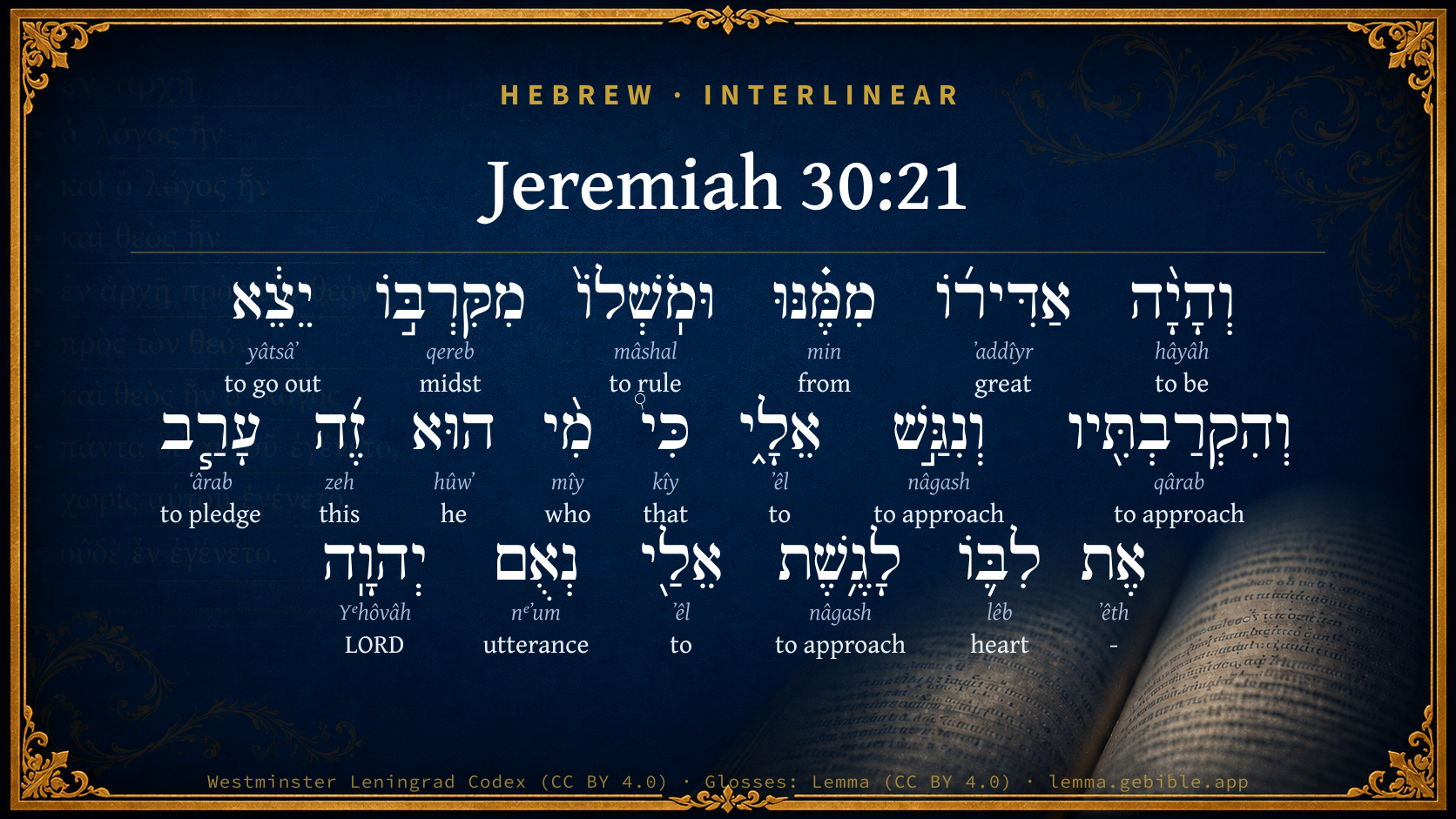
Hebrew (Westminster Leningrad Codex) Jeremiah 30:21 appears in the Hebrew Old Testament. The text above is from the Westminster Leningrad Codex. Each word links to its Strong’s number, a concise gloss, and parsing drawn from the Open Scriptures Hebrew Bible morphology. Click any word for its full Brown-Driver-Briggs (BDB) entry.
Download image
Cite this verse

Jeremiah 30:21 (World English Bible). Public Domain. Lemma interlinear Bible study tool, https://lemma.gebible.app/v/jeremiah/30/21.

Show BibTeX & RIS
BibTeX
RIS
English Translation
Their prince shall be of themselves, and their ruler shall proceed from the midst of them; and I will cause him to draw near, and he shall approach to me: for who is he who has had boldness to approach to me? says Yahweh.
World English Bible · Public Domain
Download a study sheet

One document with this verse’s original text, its word-by-word gloss line, the meaning frame, cross-references with their text, attributed commentary, and full source and license credits — printable, and it pastes into notes with its structure intact.

This verse Autodidact and up

Study sheet (.html) Plain text (.txt)

A passage Seminary Student

Up to 50 verses in one chapter. A passage sheet keeps up to 6 commentary sources and 12 cross-references per verse, in the order this page ranks them, and says so on the sheet whenever that leaves anything out. Ask for a single verse and you get the Autodidact verse sheet above.

Everything on this page stays free to read, with no account — the sheet is a download of what is already on screen, not access to it.

Want to remove ads? Support Godless Engineer
Compare translations 3

The same verse in 3 English versions, stacked beneath the original-language interlinear above. Click any original word for its lexicon entry.

Each is an independent rendering of the whole verse — the interlinear is not word-aligned to these translations.

Highlighted words mark where these versions differ — a whole-verse word diff, not a word-by-word alignment.

  • World English Bible Public Domain
    Their prince shall be of themselves, and their ruler shall proceed from the midst of them; and I will cause him to draw near, and he shall approach to me: for who is he who has had boldness to approach to me? says Yahweh.
  • King James Version Public Domain
    And their nobles shall be of themselves, and their governor shall proceed from the midst of them; and I will cause him to draw near, and he shall approach unto me: for who is this that engaged his heart to approach unto me? saith the LORD.
  • unfoldingWord Literal Text CC BY-SA 4.0
    Their leader will come from among them. He will emerge from their midst when I draw him near and when he approaches me. If I do not do this, who would dare come close to me?—this is Yahweh’s declaration.

unfoldingWord Literal Text — © unfoldingWord, licensed CC BY-SA 4.0. Word-aligned USFM3 via Door43 (git.door43.org/unfoldingWord/en_ult).

Versions to compare (up to 4)

3 of 4 selected

Show all 18 translations

Every available English version of this verse, each an independent rendering of the whole verse.

  • World English Bible Public Domain
    Their prince shall be of themselves, and their ruler shall proceed from the midst of them; and I will cause him to draw near, and he shall approach to me: for who is he who has had boldness to approach to me? says Yahweh.
  • Berean Standard Bible Public Domain
    Their leader will be one of their own, and their ruler will arise from their midst. And I will bring him near, and he will approach Me, for who would dare on his own to approach Me?” declares the LORD.
  • Majority Standard Bible Public Domain
    Their leader will be one of their own, and their ruler will arise from their midst. And I will bring him near, and he will approach Me, for who would dare on his own to approach Me?” declares the LORD.
  • King James Version Public Domain
    And their nobles shall be of themselves, and their governor shall proceed from the midst of them; and I will cause him to draw near, and he shall approach unto me: for who is this that engaged his heart to approach unto me? saith the LORD.
  • American Standard Version (1901) Public Domain
    And their prince shall be of themselves, and their ruler shall proceed from the midst of them; and I will cause him to draw near, and he shall approach unto me: for who is he that hath had boldness to approach unto me? saith Jehovah.
  • Revised Version (1885) Public Domain
    And their prince shall be of themselves, and their ruler shall proceed from the midst of them; and I will cause him to draw near, and he shall approach unto me: for who is he that hath had boldness to approach unto me? saith the LORD.
  • Geneva Bible (1599) Public Domain
    And their noble ruler shall be of themselues, and their gouernour shall proceede from the middes of them, and I will cause him to draw neere, and approche vnto me: for who is this that directeth his heart to come vnto mee, saith the Lord?
  • Douay-Rheims (1899) Public Domain
    And their leader shall be of themselves: and their prince shall come forth from the midst of them: and I will bring him near, and he shall come to me: for who is this that setteth his heart to approach to me, saith the Lord?
  • Young's Literal Translation Public Domain
    And his honourable one hath been of himself, And his ruler from his midst goeth forth, And I have caused him to draw near, And he hath drawn nigh unto Me, For who `is' he who hath pledged his heart To draw nigh unto Me? An affirmation of Jehovah.
  • Literal Standard Version CC BY-SA 4.0
    And his majestic one has been of himself, || And his ruler goes forth from his midst, || And I have caused him to draw near, || And he has drawn near to Me, || For who [is] he who has pledged his heart || To draw near to Me?” A declaration of YHWH.
  • Unlocked Literal Bible CC BY-SA 4.0
    Their leader will come from among them. He will emerge from their midst when I draw him near and when he approaches me. If I do not do this, who would dare come close to me?—this is Yahweh's declaration.
  • unfoldingWord Literal Text CC BY-SA 4.0
    Their leader will come from among them. He will emerge from their midst when I draw him near and when he approaches me. If I do not do this, who would dare come close to me?—this is Yahweh’s declaration.
  • Darby Bible Public Domain
    And their prince shall be of themselves, and their ruler shall proceed from the midst of them; and I will cause him to approach, and he shall draw near unto me. For who is this that engageth his heart to draw near unto me? saith Jehovah.
  • World Messianic Bible Public Domain
    Their prince will be one of them, and their ruler will proceed from among them. I will cause him to draw near, and he will approach me; for who is he who has had boldness to approach me?” says the LORD.
  • Webster's Bible Public Domain
    And their nobles shall be from themselves, and their governor shall proceed from the midst of them; and I will cause him to draw near, and he shall approach time: for who is this that engaged his heart to approach to me? saith the LORD.
  • Free Bible Version CC BY-SA 4.0
    Their leader will be from their own country, their ruler will be chosen from among them. I will invite him to come close to me, and he will do so, for would anyone dare to approach me without being asked? declares the Lord.
  • Bible in Basic English Public Domain
    And their chief will be of their number; their ruler will come from among themselves; and I will let him be present before me, so that he may come near to me: for who may have strength of heart to come near me? says the Lord.
  • JPS Tanakh (1917) Public Domain
    And their prince shall be of themselves, and their ruler shall proceed from the midst of them; and I will cause him to draw near, and he shall approach unto Me; for who is he that hath pledged his heart to approach unto Me? saith the LORD.

Literal Standard Version (2020), Covenant Press — licensed CC BY-SA 4.0. Text via the HelloAO Bible API (eBible.org). Unlocked Literal Bible (unfoldingWord) — licensed CC BY-SA 4.0. Text via the HelloAO Bible API (eBible.org). unfoldingWord Literal Text — © unfoldingWord, licensed CC BY-SA 4.0. Word-aligned USFM3 via Door43 (git.door43.org/unfoldingWord/en_ult). Free Bible Version, Dr. Jonathan Gallagher — licensed CC BY-SA 4.0. Text via the HelloAO Bible API (eBible.org).

Word by word

More ways to search: Search by grammar → Find every occurrence → Compare this word →

Practice this passage: Drill this verse → Learn its vocabulary →

עָרַ֧ב
ʻârab
H6148
“to pledge”
Verb, Qal, Perfect, 3rd Person, Masculine, Singular
Part of Speech
Verb
Stem
Qal
Form
Perfect
Person
3rd Person
Gender
Masculine
Number
Singular
Full BDB Definition

Origin: a primitive root

TWOT: 1686

to pledge, exchange, mortgage, engage, occupy, undertake for, give pledges, be or become surety, take on pledge, give in pledge - (Qal) - to take on pledge, go surety for - to give in pledge - to exchange - to pledge - (Hithpael) - to exchange pledges - to have fellowship with, share
  1. וְהָיָ֨ה hâyâh H1961 “and · to be” Conjunction + Verb, Qal, Sequential Perfect, 3rd Person, Masculine, Singular
  2. אַדִּיר֜וֹ ʼaddîyr H117 “great · his” Adjective, Adjective, Masculine, Singular, Construct + Suffix, Personal, 3rd Person, Masculine, Singular
  3. מִמֶּ֗נּוּ min H4480 “from · us” Preposition + Suffix, Personal, 1st Person, Common, Plural
  4. וּמֹֽשְׁלוֹ֙ mâshal H4910 “and · ruling · him” Conjunction + Verb, Qal, Participle Active, Masculine, Singular, Construct + Suffix, Personal, 3rd Person, Masculine, Singular
  5. מִקִּרְבּ֣וֹ qereb H7130 “from · midst · his” Preposition + Noun, Common, Masculine, Singular, Construct + Suffix, Personal, 3rd Person, Masculine, Singular
  6. יֵצֵ֔א yâtsâʼ H3318 “to go out” Verb, Qal, Imperfect, 3rd Person, Masculine, Singular
  7. וְהִקְרַבְתִּ֖יו qârab H7126 “and · to approach · him” Conjunction + Verb, Hiphil, Sequential Perfect, 1st Person, Common, Singular + Suffix, Personal, 3rd Person, Masculine, Singular
  8. וְנִגַּ֣שׁ nâgash H5066 “and · to approach” Conjunction + Verb, Niphal, Sequential Perfect, 3rd Person, Masculine, Singular
  9. אֵלָ֑י ʼêl H413 “to · me” Preposition + Suffix, Personal, 1st Person, Common, Singular
  10. כִּי֩ kîy H3588 “that” Conjunction
  11. מִ֨י mîy H4310 “who” Particle, Interrogative
  12. הוּא hûwʼ H1931 “he” Pronoun, Personal, 3rd Person, Masculine, Singular
  13. זֶ֜ה zeh H2088 “this” Pronoun, Demonstrative, Masculine, Singular
  14. אֶת ʼêth H853 “-” Particle, Direct Object
  15. לִבּ֛וֹ lêb H3820 “heart · his” Noun, Common, Masculine, Singular, Construct + Suffix, Personal, 3rd Person, Masculine, Singular
  16. לָגֶ֥שֶׁת nâgash H5066 “to approach” Preposition + Verb, Qal, Infinitive Construct
  17. אֵלַ֖י ʼêl H413 “to · me” Preposition + Suffix, Personal, 1st Person, Common, Singular
  18. נְאֻם nᵉʼum H5002 “utterance of” Noun, Common, Masculine, Singular, Construct
  19. יְהוָֽה Yᵉhôvâh H3068 “LORD” Noun, Proper

About this verse

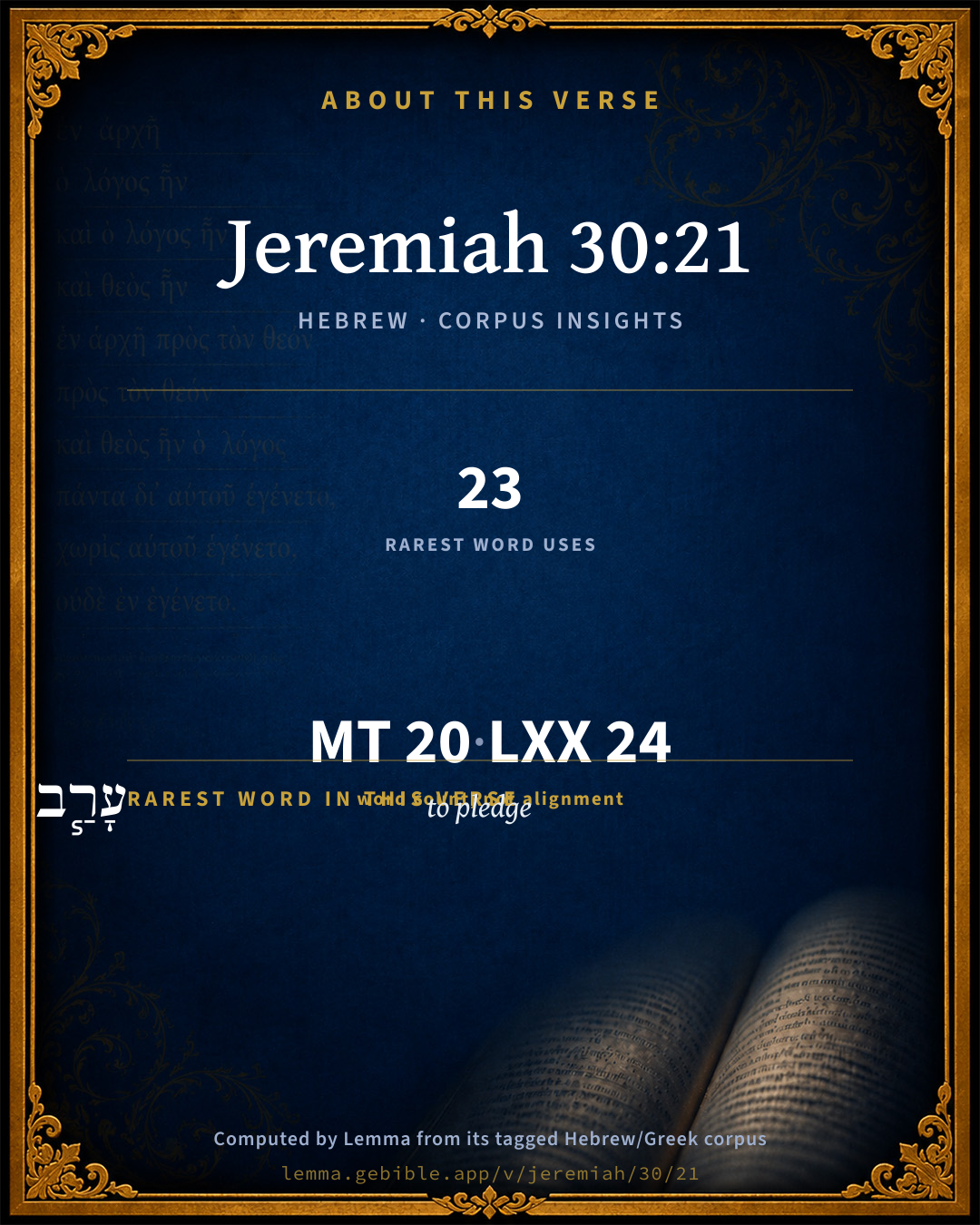
These counts appear in no published source. They are computed here, from the morphology-tagged text and Lemma’s own curated glosses. What Lemma adds →

20
words
18
distinct lemmas
Prophets
section

Notable vocabulary

The rarest word here is עָרַ֧ב to pledge H6148 — appearing just 23 times in the whole Hebrew Bible.

Shared distinctive vocabulary

עָרַ֧ב to pledge H6148 occurs in 23 verses of the Hebrew Bible. Also found in:

Grammatical profile

  • 7 verbs
  • 4 nouns
  • 1 adjective
  • 2 pronouns
  • 3 prepositions
  • 1 conjunction
  • 2 particles

Verb forms

  • וְהָיָ֨ה Qal · Sequential Perfect
  • וּמֹֽשְׁלוֹ֙ Qal · Participle Active
  • יֵצֵ֔א Qal · Imperfect
  • וְהִקְרַבְתִּ֖יו Hiphil · Sequential Perfect
  • וְנִגַּ֣שׁ Niphal · Sequential Perfect
  • עָרַ֧ב Qal · Perfect
  • לָגֶ֥שֶׁת Qal · Infinitive Construct

Repetition

Words recur within this verse — often emphatic in Hebrew:

  • וְנִגַּ֣שׁ to approach H5066 ×2
  • אֵלָ֑י to H413 ×2

Hebrew & Septuagint length

In the original languages it is 20 Hebrew tokens and 24 Greek tokens — but the two are counted differently (Hebrew bundles its prefixes and suffixes into one token; the Greek is in lemma form), so that isn’t a like-for-like length.

Cross-references

49

Topical passages linked to Jeremiah 30:21 in the Treasury of Scripture Knowledge — connected by theme and wording, ordered by reader-vote popularity; previews shown in the World English Bible.

  • Numbers 16:5 and he spoke to Korah and to all his company, saying, In the morning Yahweh will show who are his, and who is holy, and will cause him to come near to him: even him whom he shall choose will he cause to come near to him.
  • Ezekiel 34:23–24 I will set up one shepherd over them, and he shall feed them, even my servant David; he shall feed them, and he shall be their shepherd.
  • Ezekiel 37:24 My servant David shall be king over them; and they all shall have one shepherd: they shall also walk in my ordinances, and observe my statutes, and do them.
  • Acts 5:31 God exalted him with his right hand to be a Prince and a Savior, to give repentance to Israel, and remission of sins.
  • Mark 11:9–10 Those who went in front, and those who followed, cried out, "Hosanna! Blessed is he who comes in the name of the Lord!
  • Deuteronomy 18:18 I will raise them up a prophet from among their brothers, like you; and I will put my words in his mouth, and he shall speak to them all that I shall command him.
  • Deuteronomy 33:5 He was king in Jeshurun, When the heads of the people were gathered, All the tribes of Israel together.
  • 2 Samuel 7:13 He shall build a house for my name, and I will establish the throne of his kingdom forever.
  • Psalms 110:1–4 Yahweh says to my Lord, "Sit at my right hand, Until I make your enemies your footstool for your feet."
  • Isaiah 9:6–7 For to us a child is born, to us a son is given; and the government shall be on his shoulder: and his name shall be called Wonderful, Counselor, Mighty God, Everlasting Father, Prince of Peace.
  • Zechariah 6:12–13 and speak to him, saying, 'Thus says Yahweh of Hosts, "Behold, the man whose name is the Branch: and he shall grow up out of his place; and he shall build the temple of Yahweh;
  • Hebrews 7:21–26 (for they indeed have been made priests without an oath), but he with an oath by him that says of him, "The Lord swore and will not change his mind, 'You are a priest forever, According to the order of Melchizedek'".
  • 1 John 2:2 And he is the atoning sacrifice for our sins, and not for ours only, but also for the whole world.
  • Genesis 18:27 Abraham answered, "See now, I have taken it on myself to speak to the Lord, who am but dust and ashes.
  • Genesis 49:10 The scepter will not depart from Judah, Nor the ruler's staff from between his feet, Until he comes to whom it belongs. To him will the obedience of the peoples be.
  • Jeremiah 49:19 Behold, he shall come up like a lion from the pride of the Jordan against the strong habitation: for I will suddenly make them run away from it; and whoever is chosen, him will I appoint over it: for who is like me? and who will appoint me a time? and who is the shepherd who will stand before me?
  • Jeremiah 50:44 Behold, [the enemy] shall come up like a lion from the pride of the Jordan against the strong habitation: for I will suddenly make them run away from it; and whoever is chosen, him will I appoint over it: for who is like me? and who will appoint me a time? and who is the shepherd who can stand before me?
  • Matthew 2:2 "Where is he who is born King of the Jews? For we saw his star in the east, and have come to worship him."
  • Matthew 3:17 Behold, a voice out of the heavens said, "This is my beloved Son, with whom I am well pleased."
  • Matthew 21:5–11 "Tell the daughter of Zion, Behold, your King comes to you, Humble, and riding on a donkey, On a colt, the foal of a donkey."
  • Matthew 27:37 They set up over his head the accusation against him written, "THIS IS JESUS, THE KING OF THE JEWS."
  • John 18:36–37 Jesus answered, "My Kingdom is not of this world. If my Kingdom were of this world, then my servants would fight, that I wouldn't be delivered to the Jews. But now my Kingdom is not from here."
  • Hebrews 4:14–16 Having then a great high priest, who has passed through the heavens, Jesus, the Son of God, let us hold tightly to our confession.
  • Revelation 19:16 He has on his garment and on his thigh a name written, "KING OF KINGS, AND LORD OF LORDS."
  • Genesis 18:30 He said, "Oh don't let the Lord be angry, and I will speak. What if there are thirty found there?" He said, "I will not do it, if I find thirty there."
  • Genesis 18:32 He said, "Oh don't let the Lord be angry, and I will speak yet but this once. What if ten are found there?" He said, "I will not destroy it for the ten's sake."
  • Nehemiah 2:9–10 Then I came to the governors beyond the River, and gave them the king's letters. Now the king had sent with me captains of the army and horsemen.
  • Nehemiah 7:2 that I gave my brother Hanani, and Hananiah the governor of the castle, charge over Jerusalem; for he was a faithful man, and feared God above many.
  • Job 42:3–6 You asked, 'Who is this who hides counsel without knowledge?' Therefore I have uttered that which I did not understand, Things too wonderful for me, which I didn't know.
  • Psalms 89:29 I will also make his seed endure forever, And his throne as the days of heaven.
  • Isaiah 63:1 Who is this who comes from Edom, with dyed garments from Bozrah? this who is glorious in his clothing, marching in the greatness of his strength? I who speak in righteousness, mighty to save.
  • Jeremiah 23:5–6 Behold, the days come, says Yahweh, that I will raise to David a righteous Branch, and he shall reign as king and deal wisely, and shall execute justice and righteousness in the land.
  • Jeremiah 30:9 but they shall serve Yahweh their God, and David their king, whom I will raise up to them.
  • Jeremiah 33:15 In those days, and at that time, will I cause a Branch of righteousness to grow up to David; and he shall execute justice and righteousness in the land.
  • Micah 5:2–4 But you, Bethlehem Ephrathah, Being small among the clans of Judah, Out of you one will come forth to me that is to be ruler in Israel; Whose goings forth are from of old, from everlasting.
  • Luke 1:32–33 He will be great, and will be called the Son of the Most High. The Lord God will give him the throne of his father, David,
  • John 19:19–22 Pilate wrote a title also, and put it on the cross. There was written, "JESUS OF NAZARETH, THE KING OF THE JEWS."
  • Acts 2:34–36 For David didn't ascend into the heavens, but he says himself, 'The Lord said to my Lord, "Sit by my right hand,
  • Hebrews 1:3 His Son is the radiance of his glory, the very image of his substance, and upholding all things by the word of his power, when he had by himself made purification for our sins, sat down on the right hand of the Majesty on high;
  • Hebrews 9:15–24 For this reason he is the mediator of a new covenant, since a death has occurred for the redemption of the transgressions that were under the first covenant, that those who have been called may receive the promise of the eternal inheritance.
  • Revelation 5:9–10 They sang a new song, saying, "You are worthy to take the book, And to open its seals: For you were killed, And bought us for God with your blood, Out of every tribe, language, people, and nation,
  • Numbers 16:40 to be a memorial to the children of Israel, to the end that no stranger, who isn't of the seed of Aaron, comes near to burn incense before Yahweh; that he not be as Korah, and as his company: as Yahweh spoke to him by Moses.
  • Ezra 2:2 who came with Zerubbabel, Jeshua, Nehemiah, Seraiah, Reelaiah, Mordecai, Bilshan, Mispar, Bigvai, Rehum, Baanah. The number of the men of the people of Israel:
  • Ezra 7:25–26 You, Ezra, after the wisdom of your God who is in your hand, appoint magistrates and judges, who may judge all the people who are beyond the River, all such as know the laws of your God; and teach you him who doesn't know them.
  • Job 23:3–5 Oh that I knew where I might find him! That I might come even to his seat!
  • Numbers 17:12–13 The children of Israel spoke to Moses, saying, Behold, we perish, we are undone, we are all undone.
  • Zechariah 9:9–10 Rejoice greatly, daughter of Zion! Shout, daughter of Jerusalem! Behold, your king comes to you! He is righteous, and having salvation; Lowly, and riding on a donkey, Even on a colt, the foal of a donkey.
  • Luke 24:26 Didn't the Christ have to suffer these things and to enter into his glory?"
  • Romans 8:34 Who is he who condemns? It is Christ who died, yes rather, who was raised from the dead, who is at the right hand of God, who also makes intercession for us.

Cross-references courtesy of OpenBible.info (CC BY 4.0).

Hebrew and Greek witnesses Masoretic Hebrew ↔ Greek Septuagint

The same verse in the two great witnesses to the Old Testament, shown verse-for-verse.

These are two independent witnesses, not word-aligned to each other, and the Septuagint is shown in lemma (dictionary) form.

Hebrew Jeremiah 30:21 Masoretic · Westminster Leningrad Codex

וְהָיָ֨ה אַדִּיר֜וֹ מִמֶּ֗נּוּ וּמֹֽשְׁלוֹ֙ מִקִּרְבּ֣וֹ יֵצֵ֔א וְהִקְרַבְתִּ֖יו וְנִגַּ֣שׁ אֵלָ֑י כִּי֩ מִ֨י הוּא זֶ֜ה עָרַ֧ב אֶת לִבּ֛וֹ לָגֶ֥שֶׁת אֵלַ֖י נְאֻם יְהוָֽה

Their prince shall be of themselves, and their ruler shall proceed from the midst of them; and I will cause him to draw near, and he shall approach to me: for who is he who has had boldness to approach to me? says Yahweh.

World English Bible · Public Domain

Greek LXX Structure differs

In the Septuagint, Jeremiah is about an eighth shorter than the Hebrew and arranges its material differently — the Oracles Against the Nations (Hebrew chapters 46–51) appear in the middle of the Greek book, after 25:13. Because the chapter and verse boundaries do not line up, a verse-for-verse comparison with the Hebrew is not shown.

A verse-for-verse comparison isn’t shown here because the chapters and verses don’t line up. Switch to the LXX edition with the MT / LXX toggle above to read the Greek directly.

Hebrew: Westminster Leningrad Codex (CC BY 4.0). Greek: Septuagint (public domain); English from a public-domain English Septuagint. How the Septuagint differs from the Hebrew →

Targum (Aramaic paraphrase)

1

The Targum is the ancient Jewish Aramaic paraphrase of the Hebrew Scriptures — an interpretive translation, not the Hebrew text itself. Onkelos (literal) and Pseudo-Jonathan (expansive) render the Torah, and Jonathan the Prophets. Coverage is partial: where no permissively-licensed English translation exists for a verse, only the Aramaic is shown. This is verse-level text, not a word-by-word alignment to the Hebrew.

  1. Targum Jonathan Prophets (Joshua–Malachi)
    וְיִתְרַבָּא מַלְכֵיהוֹן מִנְהוֹן וּמְשִׁיחֵיהוֹן מִבֵּינֵיהוֹן יִתְגְלֵי וֶאֶקְרְבִינוּן וְיִתְּנְהוֹן לְפּוּלְחָנִי אֲרֵי מַן הוּא דֵין דְאִתְרְעִי לִבֵּיהּ לְאִתְקְרָבָא לְפוּלְחָנִי אֲמַר יְיָ:

    (no public-domain English translation for this verse)

    Targum Jonathan — Aramaic: “Mikraot Gedolot” (public domain). English: “Sefaria Community Translation” (CC0 1.0 (public-domain dedication)); “London "Chaldee Paraphrase," 1871” (public domain). Text via Sefaria.

Commentary

Notes on Jeremiah 30:21 from classic Christian and Jewish commentators (each source and its license shown beneath its notes). The classic Christian expositions comment on the surrounding passage and are grouped to its opening verse, so a note may address several verses; the Jewish commentaries on the Tanakh (Rashi and others) are per-verse, so they appear only where the commentator wrote on this verse.

Lemma curates 59 commentaries, every one of them public domain or Creative Commons licensed, each selected and text-cleaned for this edition rather than reprinted as found. About our sources →

Trapp's Complete Commentary

John Trapp

Jer 30:21 And their nobles shall be of themselves, and their governor shall proceed from the midst of them; and I will cause him to draw near, and he shall approach unto me: for who [is] this that engaged his heart to approach unto me? saith the LORD.

Ver. 21. And their nobles shall be of themselves.] Foreigners shall no more domineer over them, but they shall have governors of their own nation, who shall be more tender of them, and careful of their good. Some apply all this, and well they may, to Jesus Christ, who is here called Magnificus et Domigrator, his magnificent or honourable one and his ruler, {a} who also is one of them, and proceedeth from among them. See Deu 18:18.

And I will cause him to draw near, and he shall approach unto me.] Either as God, co-equal and coessential with me, or as Mediator; and so he shall approach unto me by the hypostatical union (in respect of which he came the nearest unto God of any that ever was or could), and by the execution of his priestly office, wherein he intercedeth for my people, and reconcileth them unto me.

For who is this that engaged his heart?] Who but my Son Christ durst do it, or was fit to do it? He is a super-excellent person, as is imported by this Mi-hu-ze, Who this he?

{a} Christus Fortis ille et Gigas est. - Oecol.

John Trapp, A Commentary or Exposition upon All the Books of the Old and New Testament (1647–1656) — public domain. Text from a community e-Sword module.

The Biblical Illustrator

Joseph S. Exell

Jer_30:21

And their nobles shall be of themselves, and their governor shall proceed from the midst of them.

The choice of their rulers the privilege of the people

1. The power of choosing their own rulers is a privilege which but very few of mankind have ever enjoyed. There is not one nation in all Asia and Africa which enjoys the power of electing its own rulers; and scarcely one in all Europe which enjoys this privilege in its full extent.

2. The power of choosing their own rulers is a privilege which all nations who are destitute of it wish to enjoy.

3. It must be a great privilege to any people, to have the power of choosing their best men to rule over them. Rulers who understand the genius and disposition of their people, who are acquainted with their laws and constitutions, who have a comprehensive view of their various interests and connections, and who are men of tried integrity, are well qualified to fill every department of government. No people can desire better rulers than these; and such as these, the power of election gives them the best opportunity of appointing to office.

4. It is a great privilege for a people to have a power of choosing their own rulers, because good rulers are a very great blessing. They are the guardians of all that a people hold most dear and sacred; and so can do them greater service, and more essentially promote their temporal good, than any other men in any other public or private stations of life.

Reflections--

1. No nation which chooses its own rulers can be enslaved without its own consent. The privilege of election is the grand palladium of civil liberty.

2. If a people who choose their own rulers have not good rulers, it must be owing to their own fault. If they choose their best men, there can be no doubt but their rulers will be good.

3. A people who choose their own rulers, cannot reasonably expect to have better rulers than themselves

4. This subject directs us where to look for the origin of the political distresses and embarrassments in which we have been, and still are, involved. They have originated from the abuse of the power of election.

5. This subject suggests to us the best, and perhaps the only possible way of alleviating present, and of preventing future calamities. The way is, wisely and faithfully to improve our important privilege of election, and commit the direction of our national concerns to greater and better men. (N. Emmons, D. D.)

The blessing of freedom

Our subject is the blessing of freedom; the advantages of that political condition in which we are placed. There are various causes in operation which tend to lesson in us the due sense of these advantages. Extravagance of praise; asserting too much with regard to any principle; overdrawn statements of its nature, and perpetual boasting of its effects, are likely in all cases, sooner or later, to bring about a reaction. The abuses of the principle of liberty also; the out-breakings of popular violence, mobs, and tumults, prostrating the law under foot; and the tyranny, moreover, of legal majorities; and, withal, the bitter animosities of party strife, and the consequent incessant fluctuations of public policy, constantly deranging the business of the country; all these things are leading some to say, but with more rashness than wisdom, I must think, that even political oppression and injustice, which should make all strong, and firm, and permanent, would be better than that state of things in which we live. Add to all this, that the blessings which are common, like the air we breathe and the light of day--blessings which are invested with the familiar livery of our earliest and most constant experience--are apt to pass by us unregarded; while the evils of life, calamities and concussions of the elements, shipwrecks, and storms, and earthquakes, rise into portentous and heart-thrilling significance; and we see another and final reason why the advantages of our political condition are liable to be undervalued. The first step which I shall take in defending the ground which we as a nation have taken, win be carefully to define it. What is the principle of a democratic or representative government? It is, that no restraints, disabilities, or penalties shall be laid upon any person, and that no immunities, privileges, or charters shall be conferred on any person, or any class of persons, but such as tend to promote the general welfare. This exception, be it remembered, is an essential part of our theory. Our principle is not, as I conceive, that no privileges shall be granted to one person more than to another. If bank charters, for instance, can be proved to be advantageous to the community, our principle must allow them. It is upon the same principle that we grant acts of incorporation to the governors of colleges, academies, and hospitals, and to many other benevolent and literary societies: it is upon the ground that they benefit the public. And what is government itself, but a corporation possessing and exercising certain exclusive powers for the general weal? Again, I maintain that our democratic principle is not that the people are always right. It is this rather: that although the people may sometimes be wrong, yet that they are not so likely to be wrong, and to do wrong, as irresponsible, hereditary magistrates and legislators; that it is safer to trust the many with the keeping of their own interests, than it is to trust the few to keep those interests for them. Let me now proceed to speak of liberty as a blessing, and the highest blessing that can appertain to the condition of a people.

1. I value our political constitution because it is the only system that accords with the truth of things, the only system that recognises the great claims and inalienable rights of humanity.

2. I value our liberty, and deem it a just cause of thankfulness to Heaven, because it fosters and develops all the intellectual and moral powers of the country.

3. I value political liberty because of that which a free and unfettered energy obtains, it gives the freest and amplest use. What is the effect, nay, what is the design of a despotic Government, but to deprive the people of the largest amount that it can, or dare, of the proceeds of their honest industry and laudable enterprise? Under its grossest forms, it levies direct contributions; in its more plausible administration it levies taxes; but in either case its end is the same--to feed and batten a few at the expense of the many. Let me not be told, that differences in the form of government are mere matters of speculation; that they have very little to do with our private welfare; that a man may be as happy under one form as another. I think it was on occasion of our revolution that Dr. Johnson put forth some such oracle as this; but it is not true; it may pass for good-nature, or for smooth philosophy, if anyone pleases so to call it, but it is not true. What more obvious interest of human life is there, than that a mans labour shall produce for him the greatest possible amount of comfort; that he should enjoy, as far as it is compatible with the support of civil order, the proceeds of his toil? Labour, honourable and useful as it is, is not so very agreeable that a man should recklessly give it for that which is not bread. And that he emphatically does who gives it for pensions, sinecures, and monopolies, and establishments, and wars, which benefit him not at all.

4. I should not exhaust the subject, even in this most general view of it, if I did not add one further consideration in behalf of freedom; a consideration that is higher and stronger than any reason--I mean, the intrinsic desirableness of this condition to every human being. In this respect, freedom is like virtue, like happiness; we value it for its own sake. God has stamped upon our very humanity this impress of freedom; it is the unchartered prerogative of human nature. (O. Dewey, D. D.)

Who is this that engaged his heart to approach unto Me?--

Who is this?

I. The question of our text is asked to direct attention to this glorious person. Who is this that engaged his heart to approach unto Me? saith the Lord. The person who must draw near to God must be one of ourselves. It is clear that a fit representative for men must be himself a man. In Adam we transgressed and died to God: in another Adam must we be restored. Now, where is this man to be found? Who is this? If he is to come of ourselves, where is he? Not among this assemblage; nor if all the myriads that dwell on the face of the earth could be gathered together would there be found one who could undertake this enterprise,--For all have sinned, and come short of the glory of God. Nor is it merit alone that is needed, for he that would approach unto the Lord as mediator must be prepared with strength to suffer. Who can sustain the load of human sin? Who can endure the indignation of the Lord against iniquity? Assuredly none of us could do it: the fire would consume him as stubble. Oh, for an interposer; but where can he be found? Now look at the context, and you will see that the person who must approach to God for us must be a prince-priest; for He is called their glorious One and their Governor, and yet it is said of Him, I will cause Him to draw near, which work of drawing near is in other places ascribed to priests, for these God had set apart for the service of His sanctuary. The person, then, must be a priest, and yet a prince. Who is He, and where is He? You know Him--the true Priest of God, not of the order of Aaron, and the King eternal, immortal, invisible, King of kings, and Lord of lords. It is He that engaged His heart to draw near to God on our behalf. The question, however, may be answered in another way, so as to bring out more clearly the matchless Person whom our hearts adore. It was necessary that He who should draw near to God should be chosen to that office by God Himself, and should be qualified for it by Divine power. I will cause Him to draw near, and He shall approach to Me. Now, is there any one among us all that God has ever chosen to represent our fellow-men as their mediator, acting as the head of the race, and as such entering into the immediate presence of God on his own merits? We have not, I hope, the presumption to imagine such a thing. There is one Mediator between God and man, the Man, Jesus Christ. Moreover, to close this description, He was not only appointed of God and qualified, but He was one who was willing to undertake the task and ready to pledge Himself to it. He voluntarily covenanted to do it, as it is written, Lo, I come; in the volume of the Book it is written of Me, to do Thy will, O God: yea, Thy law is My delight.

II. To excite admiration of His matchless work. If Jesus Christ is to approach to God for us, it is clear that He must come down into our condition, for He must first descend or He cannot ascend. He descended into our depths to engineer a way from the lowest to the highest, to come back from Bashan, and from the depths of the sea, leading the van of the armies of His chosen as they return unto God with songs and everlasting joy upon their heads. This lowly place being taken, behold our Lord actually approaching unto the offended Majesty on high. Though found in fashion as a man, and by reason of His becoming a curse for us, denied the presence of the Father, so that He cried in anguish, My God, My God, why hast Thou forsaken Me? yet He did approach unto God: He did come near; nay, He remaineth near, able to save them to the uttermost that come unto God by Him. Our Lord with all His heart desired to do this: He engaged His heart to perform it. But why this readiness, this eagerness? Love is the one reply. His heart was occupied with love to God and love to man, and He could not rest till He had restored the broken concord between these divided ones. With all the forcefulness of His Divine nature, and with all the energy of His perfect humanity, He was resolved to bring men back to God. Having thus determined that He would approach unto God on our behalf, He took all the consequences. A correct reading of the passage would be, Who is this that hath pledged his heart or his life to approach unto Me? saith the Lord. If you take the meaning of the word heart to be life, since the heart is the source of life, then we read that our Lord pledged His life, put His life in surety that He would approach unto God, the Judge of all, and bring us near to Him. When He came as the representative of sinful men--then vengeance with its sword must smite Him, and He was willing to be smitten. And now to-day, beloved, Jesus Christ rejoices to think that He has approached unto God on our behalf, and made eternal amity between God and man Let us rejoice with Him. Let us become happy in fellowship with our God.

III. To arouse your interest in the sweet results of Jesus Christs having approached to God for us. The first result is found in the chapter. Read that twenty-second verse. Who is this that engaged his heart to approach unto Me? saith the Lord. And ye shall be My people, and I will be your God. That is, because our royal High Priest approached unto God for us, therefore we who were called outcasts, we whose wound was incurable and grievous, we that were utterly ruined and undone; we, believing in this Jesus, shall in Him become the people of God. I seem to see in my spirit that old legend of Rome worked out in very deed. So saith the story: in the Roman Forum there gaped a vast chasm which threatened the destruction of the Forum, if not of Rome. The wise men declared that the gulf would never close unless the most precious thing in Rome was cast into it. See how it yawns and cracks every moment more horribly. Hasten to bring this noblest thing! For love of Rome sacrifice your best! But what, or who is this? Where is a treasure meet for sacrifice? Then Curtius, a belted knight, mounted his charger, and rightly judging that valour and love of country were the noblest treasures of Rome, he leaped into the gulf. The yawning earth closed upon a great-hearted Roman, for her hunger was appeased. Perchance it is but an idle tale: but what I have declared is truth. There gaped between God and man a dread abyss, deep as hell, wide as eternity, and only the best thing that heaven contained could fill it. That best thing was He, the peerless Son of God, the matchless, perfect man, and He came, laying aside His glory, making Himself of no reputation, and He sprang, into the gulf, which there and then closed, once for all One great result of Christ s having died is to leave us a way of access, which is freely opened to every poor, penitent sinner. Come. Are you using that way of access? Do you use it every day! Having used it, and thus having drawn near to God, do you dwell near to God! Do you abide in God? Is God the main thought of your life, the chief delight and object of your being? (C. H. Spurgeon.)

.

The Biblical Illustrator, edited by Joseph S. Exell (c. 1880s–1900s) — public domain. Text from a community e-Sword module.

Geneva Bible (1599)

Geneva Bible translators

Meaning, Zerubbabel, who was the figure of Christ, in whom this was accomplished.

Signifying, that Christ doth willingly submit himself to the obedience of God his father.

Geneva Bible (1599) marginal notes — public domain. Text via Bolls.life.

Jamieson, Fausset & Brown

Robert Jamieson, A. R. Fausset & David Brown

their nobles--rather, "their Glorious One," or "Leader" (compare Act 3:15; Heb 2:10), answering to "their Governor" in the parallel clause.

of themselves--of their own nation, a Jew, not a foreigner; applicable to Zerubbabel, or J. Hyrcanus (hereditary high priest and governor), only as types of Christ (Gen 49:10; Mic 5:2; Rom 9:5), the antitypical "David" (Jer 30:9).

cause him to draw near--as the great Priest (Exo 19:22; Lev 21:17), through whom believers also have access to God (Heb 10:19-22). His priestly and kingly characters are similarly combined (Psa 110:4; Zac 6:13).

who . . . engaged . . . heart to approach--literally, "pledged his heart," that is, his life; a thing unique; Messiah alone has made His life responsible as the surety (Heb 7:22; Heb 9:11-15), in order to gain access not only for Himself, but for us to God. Heart is here used for life, to express the courage which it needed to undertake such a tremendous suretyship. The question implies admiration at one being found competent by His twofold nature, as God and man, for the task. Compare the interrogation (Isa 63:1-3).

Jamieson, Fausset & Brown — Commentary Critical and Explanatory on the Whole Bible (1871) — public domain (CC PDM 1.0). Text via the HelloAO Bible API.

Adam Clarke's Commentary

Verse 21. Their nobles shall be of themselves] Strangers shall not rule over them; and-

Their governor shall proceed from the midst of them] Both Nehemiah and Zerubbabel, their nobles and governors after the return from Babylon, were Jews.

Adam Clarke's Commentary on the Bible (1810–1826) — public domain. Text from a community e-Sword/MySword module.

John Calvin's Commentaries

The Prophet, no doubt, explains here more at large what he had said of the restoration of the Church; for we know that the Jews had been so taught, that they were to place their whole confidence as to their salvation on David, that is, on the king whom God had set over them. Then the happiness and safety of the Church was always founded on the king; he being taken away, it was all over with the Church, as the Anointed is said to be the Lord, in whose spirit is our spirit. (Lamentations 4:20) Hence God has even from the beginning directed the attention of his people to their king, that they might depend on him, not that David was able by his own power to save the people, but because he typically personated Christ. We have not now an earthly king who is Christ’s image; but it is Christ alone who vivifies the Church. But it was at that time set forth figuratively, that the king was, as it were, the soul of the community; and we have before seen, that when the Prophet animated the Jews with hope, he set before them David, and afterwards the Son of David.

For the same reason, he says here, His valiant one, or, illustrious one, shall be from himself For we must remember the condition of that miserable and calamitous time when God took away every source of joy, by depriving the people of all the dignity with which they had been honored. It was the same then as though Jeremiah had promised the Jews a resurrection, for they were in their exile as dead men, as their hope of public safety had vanished when their king was destroyed. Here, then, he bids them to entertain good hope, because the Lord was able to raise them from death to life. And doubtless it was a wonderful resurrection when the Jews returned to their own country, a way having been opened for them; for they had been driven away, as it were, into another world. And who could have ever thought that so many obstacles could have been removed, when the Chaldeans extended their dominion even over Judea? The miserable exiles had certainly no refuge. It was not then to no purpose that Jeremiah testifies here, that the strong or valiant, that is, the king, would be from the people, and that there would come forth a Ruler from the midst of them. To come or go forth does not mean here to depart, as though the king would go elsewhere; but to go forth signifies here to proceed: Go forth then, or proceed, shall a Ruler from the midst of the people: how this took place it is well known.

But Isaiah had foretold what his successor here confirms, saying,

“Come forth shall a shoot from the root (or stem) of Jesse, and a rod shall spring up from the root of his tree.” (Isaiah 11:1)

He calls it there the house of Jesse, which was a private house: he would have dignified the favor with a more glorious name, had he mentioned David; but as there was then no kingdom, he refers to Jesse; for as David came forth as an unknown rustic from the folds of the sheep, so also the Lord would raise up a shoot from the stem of a tree that had been cut down. We hence see in what sense Jeremiah uses the expression, “Come forth;” for Christ rose up beyond the expectation of men, and rose up as a shoot when a tree is cut down, that is, when there was no resemblance of majesty among the people.

He afterwards adds, I will cause him to draw near, and he will come to me This may be either confined to the head or extended to the whole body; and the second idea is what I mostly approve; for the people were a long time removed from the presence of God, even as long as they were exiled from their country. Hence God adds, “I will cause them again to draw nigh, and they shall come to me.” If, however, any one prefers to explain this of the head, or of the king himself, I offer no objection.

Now, we are taught from this passage, that whenever God speaks of the restoration of the Church, he ever declares that he will be entreated by us; in short, that whenever he invites us to the hope of favor and salvation, we ought always to look to Christ; for except we direct all our thoughts to him, all the promises will vanish away, for they cannot be valid except through him; because in Christ only, as Paul says, they are yea and amen. (2 Corinthians 1:19, 20) But as this truth often occurs in the Prophets, it is enough here to touch on it by the way, as I have handled it more fully elsewhere.

As to the latter part of the verse, there is some ambiguity, — for who is he, this, etc There are two demonstrative pronouns, הוא זה hua, ze. Afterwards comes ערב oreb, fitting his heart. The verb ערב oreb, means to be a surety, and also to fit, to adapt, to accommodate, or to form, and sometimes to render sweet or pleasant; and on this account some have thus translated, “Who will allure his heart?” He then adds, that he may come to me, saith Jehovah? I have said that this passage is obscure, and it has hence been turned into various meanings by interpreters. Some apply the words to Christ, that he alone has of his own accord come to the Father. Others consider a negative to be understood, as though it was said, that no one prepares his heart to come to God. But there are some who regard the passage as an exhortation, “Who is he who will apply his heart that he may come to me?” Now, if we read it as expressing astonishment or wonder, it would be, in my view, its real meaning. I am not aware that any one has mentioned this; but the Prophet, I have no doubt, intended his words to be so understood.

He said before, “I will cause him to draw nigh; that he may come to me.” I have already explained this of the people, who had been long rejected. God then promises here a gathering, as though he had said, “For a time I scattered the people here and there like chaff; I will now gather them again together, and they shall be under my care and protection as formerly.” Having said this, he now touches on the ingratitude of the people by this question, “Who is there who comes to me? who will frame his heart that he may be reconciled to me?” It is, then, an expression of wonder, intended to make the Jews know that their hardness and insensibility are condemned; for when God kindly invited them, they rejected his favor, when he sought to embrace them, they fled far off from him.

But an objection may be here made, “Why then did God promise that he would cause the Jews to come to him?” To this I answer, that God performs or fulfils this promise in various ways: he might have called the Jews to himself by an outward invitation, as he did when the liberty of returning was given them: and then, indeed, a few of the Jews accepted his favor; but all the Israelites, already habituated to the pleasures and enjoyments of those countries, regarded as nothing what God had promised. Thus very few returned to their own country, and restoration was despised by them, though they had once been very anxious about it. God, however, even then made the people to draw nigh; for he stretched forth his hand as though he would gather them and cherish them under his wings. But as the greatest part despised his invaluable favor, God here justly complains of so great an impiety, and exclaims as through wonder or astonishment, Who is he who will form his heart, that, he may come to me?

Had it been simply said, “Who is he who comes to me?” the meaning, through brevity, would have been obscure. But God here clearly distinguishes between the two kinds of access: the first was, when liberty was given to the people, by the decree of Cyrus, and a permission given to build the city and the temple. God, therefore, caused them then to draw nigh that they might come to him; this was the first access. But he now adds, that the Jews did not form or prepare their heart. He indeed speaks of future time, but yet he charges them with ingratitude, which afterwards was fully manifested. Hence he says, “Who is this, that he may come to me?” that is, “I will contrive means that they may unite again in one body, call on me and enjoy their inheritance: this will I do that they may come to me; but many will still live in their own dregs, and prefer Chaldea and other countries to the temple and religion. Many, then, will be they who will not form their heart to come to me.”

We now understand the meaning of the Prophet. But we must at the same time bear in mind, that by saying above, “I will cause him to draw near that he may come to me,” God does not speak of the hidden working of his Spirit; for it is in his power, as we shall presently remark, to draw the hearts of men to himself whenever he pleases. But when he said, I will cause him to draw nigh, etc., he spoke only of an outward restoration; and now he adds a complaint, that the Jews would wickedly repudiate this favor, for no one would prepare his heart. We yet see that the whole fault is cast on the Jews, that they were to be deprived of their own country: for it was owing to nothing on God’s part that they were not restored, but to themselves, because they were devoted to their own pleasure, and regarded their return and to be counted God’s people as nothing. It was therefore the object of the Prophet to ascribe to the Jews the whole fault that God’s favor would not come to them, or that it would not be effectual as to the greatest part of them, even because they would not prepare or form their heart, that they might come to God, in order that they might be partakers of that invaluable privilege offered to them.

Now, the Papists lay hold on this passage to prove that there is a free-will in man to come to God; but to do so is indeed very absurd. For whenever God condemns the hardness of the people, he doubtless does not argue the question, what power there is in men, whether they can turn to do what is good, whether they can guide their own hearts. To hold this would be extremely foolish. When it is said in Psalm 45:8,

“To-day, if ye will hear his voice, harden not your hearts, as your fathers in the wilderness,”

shall we say that as they hardened their hearts they were capable of turning, so that they could by the power of free-will choose either good or evil? To say this would be puerile and extremely sottish. We hence see that the Papists are unworthy of being reasoned with, when they seek to prove free-will by such arguments. They would, indeed, adduce something plausible were their exposition adopted; for they render the words thus, “Who is this,” etc., as though God praised the promptitude of the faithful, who willingly offer themselves and prepare their hearts. But opposed to this view is the whole context. It hence appears that it was very far from the Prophet’s design to represent God as commending the obedience of the godly; but, on the contrary, he exclaims with wonder, as Isaiah does when he says,

“Who hath believed our report? and to whom hath the arm of the Lord been revealed?” (Isaiah 53:1)

He surely does not set forth the obedience of the faithful in receiving promptly and gladly the Gospel; but, on the contrary, (as though something monstrous terrified him) that the world would not believe the Gospel, when yet it offered to them salvation and eternal life. So also in this place, Who is he? etc. For what could have been more desirable than that God should at length, by outstretched arms, gather the Jews to himself? ”I wish you to draw nigh, ye have been for a time, as it were, banished from me, I had driven you to distant lands; but I am now ready to gather you.” As, then, God so sweetly and kindly allured them to himself, it was doubtless a most abominable and monstrous ingratitude for them to reject the offer and to turn their backs as it were on God, who so kindly invited them. As, then, the Prophet is here only condemning such insensibility and perverse wickedness in the Jews, there is no reason why we should be in quest of a proof in favor of free-will.

We may add, that David uses the same verb in Psalm 119:73, 125, when he says,

“Cause thy servant to approach thee, that he may learn thy commandments.”

Some render the words, “Be a surety for thy servant,” etc.; for the verb: ערב, which is here, is found there also. Therefore the passage might be aptly turned against the Papists, who hold that it is in the power of man to form his own heart. But David testifies that this is peculiarly the office and work of God; for by asking this from him he doubtless confesses that it was not in his own power. It afterwards follows, —

John Calvin's Commentaries (1540-1563) — public domain. Text from the Calvin Translation Society English edition (1840s-50s) via the Christian Classics Ethereal Library (ccel.org). Calvin's coverage is partial (roughly two-thirds of the Bible); uncommented books and verses are honest gaps, never fabricated. The 19th-century editor's footnotes and remarks are omitted so the notes are faithfully Calvin's own voice.

Ellicott's Commentary for English Readers

(21) Their nobles.—Literally, His glorious one, as pointing to some single ruler. The word is the same as the “excellent” of Psa_8:1.

Who is this that engaged his heart to approach unto me?—The question points to the ruler of the house of David whom the prophet sees in visions—in other words, to the far-off Messiah. So in Isaiah we have a like introduction of the figure of the conqueror, “Who is this that cometh from Edom?” (Isa_63:1). As in Isa_11:1-3; Isa_42:1-4, the dominant thought is that of one who will not be treacherous or faithless, like the degenerate heirs of the house of David whom Jeremiah had known, but one who would “engage” (literally, pledge, or give as security) his heart and soul to the service of Jehovah. In the advent of such a king the true relation between God and His people (Hos_1:10; Jer_24:7) should yet be re-established. In the words “to approach unto me” we have the germ of the thought that the true King will also be a priest, and will enter, as others could not enter, into the Holy Place (see Note on Jer_35:19, and Num_16:5); a priest, such as Psa_110:4 had spoken of, after the order of Melchizedek.

A Bible Commentary for English Readers, edited by Charles John Ellicott (1878–1897) — public domain. Text from a community e-Sword module.

The Cambridge Bible for Schools and Colleges

gen. ed. J. J. S. Perowne

21. The Jews shall again be placed under a Prince of their own. This Prince shall draw near to God without a go-between, in other words he shall be Priest as well as King.

their prince] lit. his (Jacob’s) mighty one.

that hath had boldness to approach] rather, as mg. that hath been surety for his heart to approach, i.e. no one would venture upon such a step, unless he were fully conscious of authorisation. None but the priests were permitted to enter the Lord’s presence, and the Holy of Holies was open but once a year to the high-priest himself. To all others this was a profanity to be punished with death.

The Cambridge Bible for Schools and Colleges (gen. ed. J. J. S. Perowne; Cambridge University Press, 1878–1918) — public domain. Text from a community e-Sword module.

John Gill's Exposition

And their nobles shall be of themselves,.... Or, "his noble One" (d); Jacob's noble One, the Messiah, in whom all the promises centre; and whose incarnation and priesthood are the foundation of all the things above predicted. The Targum interprets these words of him;

"their King shall be anointed from them, and their Messiah shall be revealed from the midst of them.''

And so it is applied to him in the Talmud (e), and in other writings of the Jews (f). Kimchi on the place says,

"it is known that the King Messiah shall be of Israel.''

He may be called a "noble One", as he is a Nobleman in Luk 19:12; because he descended from illustrious persons; from David king of Israel, and from a race of kings in his line, as the genealogy of Matthew shows. Or, "his glorious One" (g), as it may be rendered; he is glorious in his nature, being the brightness of his Father's glory; glorious in his perfections, which are the same with his divine Father's; glorious in his names and titles, the King and Lord of glory; glorious in his works and worship, which are the same that are ascribed to God the Father; glorious in his office as Mediator, which he has so well performed; glorious when he was raised from the dead, and had a glory given him; and when he ascended on high, and sat down at his Father's right hand, crowned with glory and honour; glorious in the eyes of God, and of all his people; and, when his kingdom shall be in a more glorious condition, he will reign before his ancients gloriously; and when he comes a second time, he will come in exceeding great glory. Or, his "mighty One" (h); Christ is the mighty God, the mighty Mediator, the mighty Saviour; he is the most Mighty, he is the Almighty. Now, as man, his descent was from them, the Israelites; from Abraham, from Jacob, from Judah, from Jesse and David, and from the people of the Jews; see Rom 9:4;

and their Governor shall proceed from the midst of them; meaning the King Messiah, as before; who has the government of the church upon his shoulders; is worthy of all power and authority and has received it; has a power of making laws, and of obliging men to keep them; has a power of pardoning, justifying, and saving men; is the lawgiver that is able to save, and to destroy; and can subject all to his feet, as he will in a short time. This seems to refer to a law in Israel, that not a stranger, but one of their brethren, should be set as king over them, Deu 17:15; which is true of the Messiah;

and I will cause him to draw near, and he shall approach unto me; expressive of his priestly office; it being the business of a priest to draw nigh to God with the sacrifices of the people, and to intercede for them, Lev 10:3. Christ in eternity drew nigh to his Father, and offered himself as a surety for his people, and became one; and the Greek word for surety, has the signification of being "near": he drew nigh and interposed between them and his father, and became a Mediator for them; he proposed to do everything for them law and justice required, and whatsoever was his Father's will should be done: he drew nigh and struck hands, stipulated and agreed with him, about the salvation of his people; he asked them of him, and all blessings of grace and glory for them: he drew nigh in time, having assumed their nature, and offered himself a sacrifice unto God, made satisfaction to his justice for them, and redeemed them unto God by his blood; by which means they are made nigh to God, and draw near to him with humble boldness; and now he is gone to heaven, and has taken his place at the right hand of God, where he appears in the presence of God, and makes intercession for them, presenting himself, his blood, righteousness, and sacrifice. Now this is ascribed unto God, as causing him to draw nigh; because he chose, appointed, and called him to be a priest, Mediator, and surety, to which he was entirely free of himself; and therefore it follows,

for who is this that engaged his heart to approach unto me? saith the Lord; his drawing to God in the council and covenant of grace, to be the surety of his people, and his undertaking for them, were quite free and voluntary; he came of himself, and surrendered himself into the hands of justice at the time of his sufferings and death; and his intercession in heaven flows from his hearty love to his people; his heart has been, and is, engaged in every branch of his mediatorial work, which is a very singular and wonderful thing. No mere man could have engaged his heart to draw nigh to God, who is a consuming fire; no angel in heaven could have presumed to have done it on the behalf of sinful men; none but Christ himself could, and which is owing to the dignity of his person, and to his wondrous love; for this is a marvellous event. Now, though this is a prophecy of Christ's incarnation and priesthood, yet it is suitably introduced here; because, at the time of the Jews' conversion, he will be made known unto them, as being come of them, and as their Prophet, Priest, and King.

(d) "praestans ejus", Montanus. (e) T. Bab. Sanhedrin, fol. 98. 2. (f) Midrash Tillim apud Galatin. de Cathot. Ver. l. 10. c. 1. p. 648. (g) "Magnificus ejus", Junius & Tremellius, Piscator; "dux ejus", V. L. "magnificus dux ejus", Munster, Tigurine version; "Rex eorum", Syr. (h) "Fortis ejus", Pagninus; "potens ejus", Schmidt.

John Gill's Exposition of the Whole Bible (1746–1763) — public domain (CC PDM 1.0). Text via the HelloAO Bible API.

Haydock's Catholic Bible Commentary

Leader. Zorobabel, the figure (Theodoret) of Christ, who is here meant. (Calmet) --- He springs from Jacob. (Worthington) --- The sceptre was not taken away till his coming, Genesis xlix. (Haydock) --- Who. Cyrus alludes to this passage in his decree, 1 Esdras i. (Calmet) --- The prediction is fully verified in Christians. (St. Jerome) --- Christ is near to God, being one, John xiv. (Worthington)

George Leo Haydock (1774–1849), Haydock's Catholic Family Bible and Commentary, 1859 edition — public domain. Excludes Psalms (Douay-Rheims chapter numbering differs from Protestant) and Deuterocanonical books (Catholic canon only).

Matthew Poole's English Annotations

Their governor shall proceed from the midst of them: this promise was made good in Zerobabel, and other governors of the Jews after their return out of captivity, till they came to be subdued by the Romans. Some restrain this unto Christ, and make it a prophecy of Christ being born of the Jewish nation; it is he, they say, that was meant by David, Jer 30:9; and it is not improbable that the sense of the text may reach unto Christ, but it seems literally to be understood of Zerobabel, and to be opposed to strangers ruling over them, which was no small piece of their calamity while they were in captivity.

He shall approach unto me; that is, he shall serve me, and I will favour him; or, this people shall serve me, and I will favour them, and not be as one at a distance or far off from them. Some understand this of the civil governor that should be after the captivity; some understand it of the people; some understand it of Christ. Those that understand it of the governor, make it to signify the special favour that governor should be in with God and his religion; those that understand it of the people, make it to signify the religion of the people, and the favour they should be in with God; those who understand it of Christ, interpret it of his favour with God, by whom also the saints have their access.

For who is this that engaged his heart to approach unto me? Interpreters are yet more divided about this phrase; some apply it to Christ, either as an admiration of his excellency, or as denoting that none but he could draw near to God in that manner as he did, nor had any such a delight in the sons of men as he, so as for him to be a Mediator betwixt offenders and an offended God; none but he durst look in the face of an angry God. Others understand it of God’s people, intimating that in the day when they should return out of captivity there would be but few that with any serious purpose of heart would apply themselves unto God, or signifying the impotency that is in man heartily to draw nigh to God, till (as it is before said) God causeth him so to do; and some think the words have a reference to the covenant mentioned in the next verse.

Matthew Poole's English Annotations on the Holy Bible (1683–1685) — public domain. Text from a community e-Sword/MySword module.

Whedon's Commentary on the Bible

Daniel D. Whedon

21-24. Their nobles, etc. — The real thought in this text is much obscured in the translation. Keil renders the passage thus: And his leader shall spring from himself; and his ruler shall go forth from his midst; and I will bring him near, so that he shall approach to me: for who is he that became surety for his life in drawing near to me? saith Jehovah. This text had but a partial fulfilment in the partial independency which the Jews enjoyed subsequent to the captivity; its complete fulfilment comes only in the Messianic reign. “Out of thee shall come a governor that shall rule my people Israel.” The language, I will cause him to draw near, etc., has a technical sense, involving the priestly idea. It implies that the King from among themselves will be also their Priest, thus uniting in himself all that is profoundly representative of the people’s life. The phrase performed (or pledged) the intents of his heart, looks primarily to the terrors which were made to surround the person of an oriental monarch, (see Est_4:11,) but really to the necessity of entering into the holy of holies in behalf of sinners only by blood, by offering up the life of an acceptable victim. The full and ultimate reference, then, is to the vicarious death of the true Israel’s divine King.

Daniel D. Whedon (gen. ed.), Commentary on the Old and New Testaments (1874–1909) — public domain. Text from a community e-Sword module.

The Pulpit Commentary

The future rulers of Israel shall be of the native stock, not foreign tyrants. Their nobles; rather, his noble one, a synonym for "his ruler," i.e. the (earthly) king of Israel. It is remarkable that no reference is made here to the Messiah, who, in fact, is not as conspicuous a figure in the prophecies of Jeremiah as in those of Isaiah. And yet even in Isaiah there is one striking prophecy in which the inspired seer uses language not (in the hands of a literalist) reconcilable with the prospect of the personal Messiah. The Messiah appears, as it were, in a lightning flash, and then disappears for a time. The prophecy of Isaiah referred to is Isa_32:1, Isa_32:2, (comp. Jer_33:17) in which the prospect of a truly God-fearing king, with princes of the same high character, entirely occupies the mind of the writer. "Nothing indicates that the Messiah is intended; king and princes are placed quite on a level, in accordance with the actual state of things under the so called monarchy." And I will cause him to draw near. It is doubtful whether Israel or Israel"s ruler is referred to. A priestly relation (such as "drawing near" implies, see Num_16:5) might be predicated of either, at any rate in the regenerate form of the Israelitish commonwealth; but it is more natural to suppose the ruler to be here indicated, for it is scarcely descriptive enough to say that he shall belong to the chosen people. Who is this that engaged his heart; rather, that pledgeth his heart (or, courage); i.e. that ventureth. The rejection of thee old line of Davidic kings might well raise the thought that the intimate relation between Jehovah and his earthly representative for Israel, promised of old to David, (2Sa 7) could no longer be hoped for. But with this renewed promise the kings of the new Davidic line may venture to "draw near;" otherwise who is he that ventureth?

The ideal ruler.

The immediate reference is to Zerubbabel and the elders who returned from the Captivity; but there is a larger significance than any merely human personage could exhaust or satisfactorily correspond to. There can be no doubt as to the Messianic character of this promise. But it is precisely the vagueness of the reference, the primary uncertainty as to who it was to be in whom all the hope of Israel was to be realized, that constituted the moral force of the prediction. In Israel was the secular government to be identified with and crowned by the moral and spiritual; but to the very last was it kept in reserve as to whether or not the kingdom thus foretold was to be of this world. Jesus Christ had himself to declare the real essence and nature of his kingdom. He constituted the ideal Ruler of Israel

I IN HIS RELATION TO HIS SUBJECTS.

1. He was to be of the same kindred. A stronger guarantee of the Divine favour could not be given. No foreigner was to hold permanent sway over the Israel of God. In one of themselves the holy people would find a legitimate centre for loyal attachment and patriotic devotion. That from their own midst their Prince should spring was proof that their independence, liberty, and national individuality should be preserved. He would therefore represent its honour, and secure for himself the strongest personal attachment. The hopes of the race would be embodied in such a personage, who would vitally perpetuate its glory.

2. He was to be allied to them in their experience and sympathies. As their fellow countryman he will understand their aims and aspirations, By the vicissitudes of their fortune his sympathies will be drawn forth, and he will share the enthusiasm of their future. In Jesus Christ these conditions were fulfilled.

II IN HIS MEDIATORIAL INFLUENCE. "To draw near" is used in a priestly or mediatorial sense. Israel as a people, or as represented in its ruler, was to have this privilege conferred upon it. A Divine as well as a human qualification is therefore requisite for the perfect governor; he must not only belong to the people but he must please God.

1. The grace of God will rest upon him and work within him. Of Zerubbabel in the first instance, but much more of Christ, is this statement true. He was "full of grace and truth," He is the great Temple builder and Restorer of the kingdom; and he is the Accepted of God: "Thou art my beloved Son; in thee I am well pleased". (Luk_3:22)

2. His own nature will respond to the Divine influence. He is to be one who "engages his heart to approach unto" God. Responsibility drives him to no rash or illegitimate expedients, but to a Divine trust and a desire to please his God. In all this there is evinced the utmost freedom. (cf. Mat_4:1 Mat_16:22 Luk_12:50 Joh_12:27 Mat_27:42)

3. The admiration and delight of God are to be called forth by him. "Who is this" etc.? is no inquiry for the sake of information, but an expression of complacency and satisfaction. This feeling finds frequent expression in the prophets, and is noticed in the Gospels. It is for the subjects of such a King to yield themselves to his rule, and identify themselves with his priestly intercession. It should be their great desire to be in him, "who of God is made unto us wisdom, and righteousness, and sanctification, and redemption". M. (1Co_1:30)

The Pulpit Commentary (1880–1919), ed. H.D.M. Spence-Jones & Joseph S. Exell — public domain. Text from a community e-Sword module.

Rashi

Rabbi Shlomo Yitzchaki (Rashi)

their prince lit., his mighty one.

pledged his heart an expression of a pledge (fermaille, aatine in French).

to approach Me to war, to stop Me.

Rashi on the Tanakh — English translations: “The Judaica Press complete Tanach with Rashi, translated by A. J. Rosenberg” (CC BY 4.0); “Pentateuch with Rashi's commentary by M. Rosenbaum and A.M. Silbermann, 1929-1934” (public domain); “The Metsudah Tanach series, Lakewood, N.J” (CC BY 4.0); and “The Book of Joshua, Metsudah Publications, 1997” (CC BY 4.0). Text via Sefaria.

Lesson kit

Teaching starters — assembled from the data on this page, not authored interpretation. Every prompt links to the verse data it draws on. Edit before teaching.

Jeremiah, in the Prophets, opens this verse with 20 words (18 distinct Hebrew lemmas). Its most distinctive word is ʻârab (“to pledge”). A historical commentator’s framing appears above. Read the whole chapter for the surrounding context.

Discussion questions

  1. What does “to pledge” (ʻârab) contribute to the verse as a whole?
  2. How does Genesis 43:9, which shares the word «to pledge», read alongside this verse?
  3. What does the repetition of “to approach” (2× in this one verse) do in this verse?
  4. These translations render this verse differently. What is at stake in choosing one wording over another?
  5. «וְהָיָ֨ה» is a Qal Sequential Perfect verb. How does that grammatical form shape the action described?
  6. Compare how Trapp's Complete Commentary and The Biblical Illustrator read this verse. Where do they agree or differ?

Things to notice

Reading settings

Reading text

Shown beneath each verse's original-language words.

Old Testament
Old Testament edition

Read the OT as the Masoretic Hebrew (MT) or the Greek Septuagint (LXX).

English shown for the Greek Septuagint (in the Hebrew ↔ Greek comparison).

Comparing translations? Open the Compare panel on any verse page to stack up to four side by side.