
Joshua 16:10

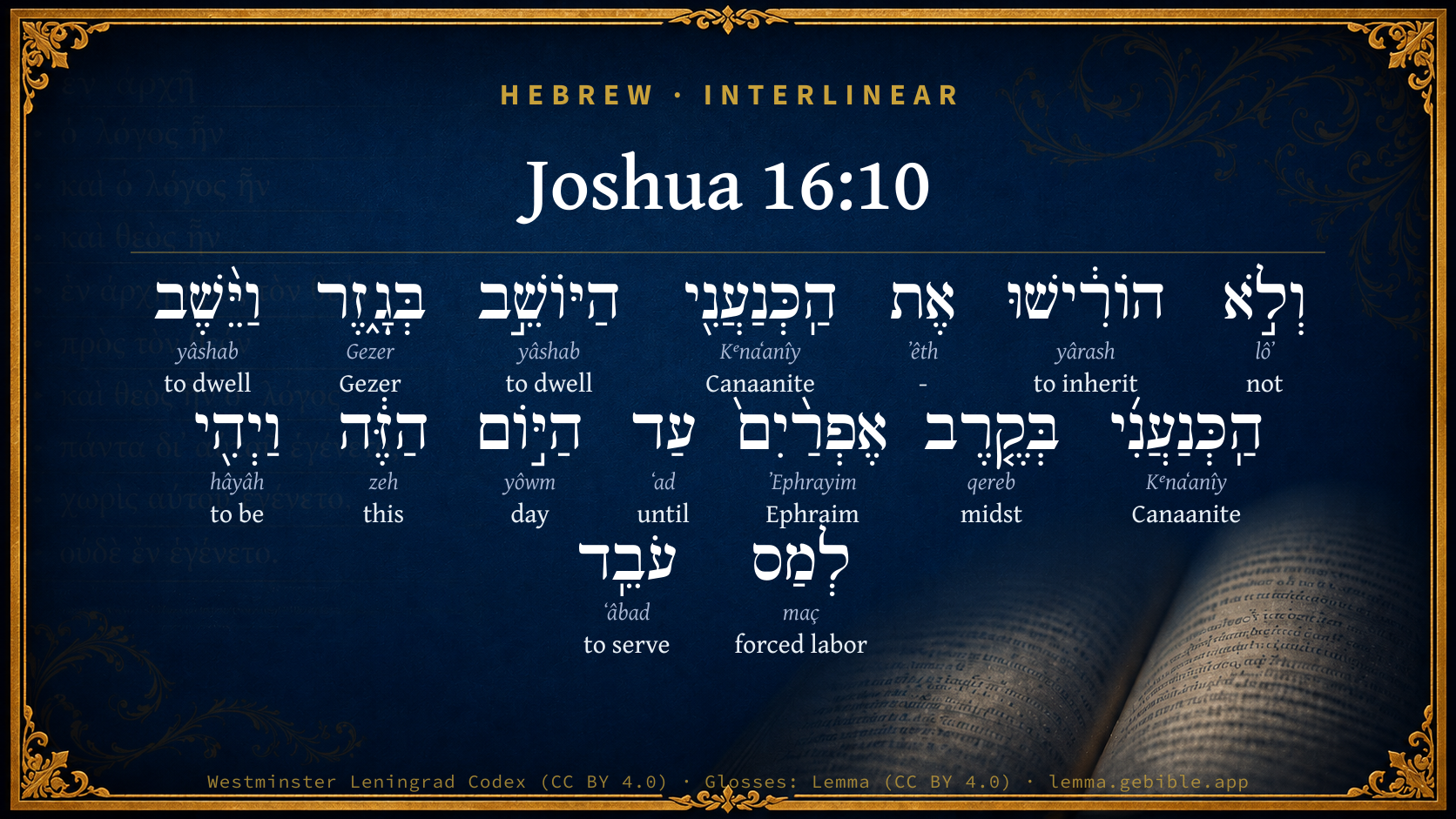
Hebrew (Westminster Leningrad Codex) Joshua 16:10 appears in the Hebrew Old Testament. The text above is from the Westminster Leningrad Codex. Each word links to its Strong’s number, a concise gloss, and parsing drawn from the Open Scriptures Hebrew Bible morphology. Click any word for its full Brown-Driver-Briggs (BDB) entry.
Download image
Cite this verse

Joshua 16:10 (World English Bible). Public Domain. Lemma interlinear Bible study tool, https://lemma.gebible.app/v/joshua/16/10.

Show BibTeX & RIS
BibTeX
RIS
English Translation
They didn't drive out the Canaanites who lived in Gezer: but the Canaanites dwell in the midst of Ephraim to this day, and are become servants to do forced labor.
World English Bible · Public Domain
Download a study sheet

One document with this verse’s original text, its word-by-word gloss line, the meaning frame, cross-references with their text, attributed commentary, and full source and license credits — printable, and it pastes into notes with its structure intact.

This verse Autodidact and up

Study sheet (.html) Plain text (.txt)

A passage Seminary Student

Up to 50 verses in one chapter. A passage sheet keeps up to 6 commentary sources and 12 cross-references per verse, in the order this page ranks them, and says so on the sheet whenever that leaves anything out. Ask for a single verse and you get the Autodidact verse sheet above.

Everything on this page stays free to read, with no account — the sheet is a download of what is already on screen, not access to it.

Want to remove ads? Support Godless Engineer
Compare translations 3

The same verse in 3 English versions, stacked beneath the original-language interlinear above. Click any original word for its lexicon entry.

Each is an independent rendering of the whole verse — the interlinear is not word-aligned to these translations.

Highlighted words mark where these versions differ — a whole-verse word diff, not a word-by-word alignment.

  • World English Bible Public Domain
    They didn't drive out the Canaanites who lived in Gezer: but the Canaanites dwell in the midst of Ephraim to this day, and are become servants to do forced labor.
  • King James Version Public Domain
    And they drave not out the Canaanites that dwelt in Gezer: but the Canaanites dwell among the Ephraimites unto this day, and serve under tribute.
  • unfoldingWord Literal Text CC BY-SA 4.0
    But they did not dispossess the Canaanite, the dweller of Gezer, so the Canaanite has dwelled within Ephraim to this day, but he has become a serving forced laborer.

unfoldingWord Literal Text — © unfoldingWord, licensed CC BY-SA 4.0. Word-aligned USFM3 via Door43 (git.door43.org/unfoldingWord/en_ult).

Versions to compare (up to 4)

3 of 4 selected

Show all 18 translations

Every available English version of this verse, each an independent rendering of the whole verse.

  • World English Bible Public Domain
    They didn't drive out the Canaanites who lived in Gezer: but the Canaanites dwell in the midst of Ephraim to this day, and are become servants to do forced labor.
  • Berean Standard Bible Public Domain
    But they did not drive out the Canaanites who lived in Gezer. So the Canaanites dwell among the Ephraimites to this day, but they are forced laborers.
  • Majority Standard Bible Public Domain
    But they did not drive out the Canaanites who lived in Gezer. So the Canaanites dwell among the Ephraimites to this day, but they are forced laborers.
  • King James Version Public Domain
    And they drave not out the Canaanites that dwelt in Gezer: but the Canaanites dwell among the Ephraimites unto this day, and serve under tribute.
  • American Standard Version (1901) Public Domain
    And they drove not out the Canaanites that dwelt in Gezer: but the Canaanites dwell in the midst of Ephraim unto this day, and are become servants to do taskwork.
  • Revised Version (1885) Public Domain
    And they drave not out the Canaanites that dwelt in Gezer: but the Canaanites dwelt in the midst of Ephraim, unto this day, and became servants to do taskwork.
  • Geneva Bible (1599) Public Domain
    And they cast not out the Canaanite that dwelt in Gezer, but the Canaanite dwelt among the Ephraimites vnto this day, and serued vnder tribute.
  • Douay-Rheims (1899) Public Domain
    And the children of Ephraim slew not the Chanaanite, who dwelt in Gazer: and the Chanaanite dwelt in the midst of Ephraim until this day, paying tribute.
  • Young's Literal Translation Public Domain
    and they have not dispossessed the Canaanite who is dwelling in Gezer, and the Canaanite dwelleth in the midst of Ephraim unto this day, and is to tribute -- a servant.
  • Literal Standard Version CC BY-SA 4.0
    and they have not dispossessed the Canaanite who is dwelling in Gezer, and the Canaanite dwells in the midst of Ephraim to this day, and is for forced labor—serving.
  • Unlocked Literal Bible CC BY-SA 4.0
    They did not drive out the Canaanites who lived in Gezer, so that the Canaanites live within Ephraim to this day, but these people were made to do forced labor.
  • unfoldingWord Literal Text CC BY-SA 4.0
    But they did not dispossess the Canaanite, the dweller of Gezer, so the Canaanite has dwelled within Ephraim to this day, but he has become a serving forced laborer.
  • Darby Bible Public Domain
    But they did not dispossess the Canaanites that dwelt at Gezer; and the Canaanites dwell in the midst of Ephraim to this day, and serve under tribute.
  • World Messianic Bible Public Domain
    They didn’t drive out the Canaanites who lived in Gezer; but the Canaanites dwell in the territory of Ephraim to this day, and have become servants to do forced labor.
  • Webster's Bible Public Domain
    And they did not expel the Canaanites that dwelt in Gezer: but the Canaanites dwell among the Ephraimites to this day, and serve under tribute.
  • Free Bible Version CC BY-SA 4.0
    However, they did not drive out the Canaanites living in Gezer, so the Canaanites live among the tribe of Ephraim to this very day, but as forced laborers.
  • Bible in Basic English Public Domain
    And the Canaanites who were living in Gezer were not forced out; but the Canaanites have been living among Ephraim, to this day, as servants, doing forced work.
  • JPS Tanakh (1917) Public Domain
    And they drove not out the Canaanites that dwelt in Gezer; but the Canaanites dwelt in the midst of Ephraim, unto this day, and became servants to do taskwork.

Literal Standard Version (2020), Covenant Press — licensed CC BY-SA 4.0. Text via the HelloAO Bible API (eBible.org). Unlocked Literal Bible (unfoldingWord) — licensed CC BY-SA 4.0. Text via the HelloAO Bible API (eBible.org). unfoldingWord Literal Text — © unfoldingWord, licensed CC BY-SA 4.0. Word-aligned USFM3 via Door43 (git.door43.org/unfoldingWord/en_ult). Free Bible Version, Dr. Jonathan Gallagher — licensed CC BY-SA 4.0. Text via the HelloAO Bible API (eBible.org).

Word by word

More ways to search: Search by grammar → Find every occurrence → Compare this word →

Practice this passage: Drill this verse → Learn its vocabulary →

בְּגָ֑זֶר
Gezer
H1507
“in/at · Gezer”
Preposition + Noun, Proper
Part of Speech
Preposition + Noun
Type
Proper
Full BDB Definition

Origin: the same as H1506

TWOT: None

Gazer or Gezer = "portion" - a Levitical city on the border of Ephraim
  1. וְלֹ֣א lôʼ H3808 “and · not” Conjunction + Particle, Negative
  2. הוֹרִ֔ישׁוּ yârash H3423 “to inherit” Verb, Hiphil, Perfect, 3rd Person, Common, Plural
  3. אֶת ʼêth H853 “-” Particle, Direct Object
  4. הַֽכְּנַעֲנִ֖י Kᵉnaʻanîy H3669 “the · Canaanite” Particle, Definite Article + Noun, Gentilic, Masculine, Singular, Absolute
  5. הַיּוֹשֵׁ֣ב yâshab H3427 “the · dwelling” Particle, Definite Article + Verb, Qal, Participle Active, Masculine, Singular, Absolute
  6. וַיֵּ֨שֶׁב yâshab H3427 “and · to dwell” Conjunction + Verb, Qal, Sequential Imperfect, 3rd Person, Masculine, Singular
  7. הַֽכְּנַעֲנִ֜י Kᵉnaʻanîy H3669 “the · Canaanite” Particle, Definite Article + Noun, Gentilic, Masculine, Singular, Absolute
  8. בְּקֶ֤רֶב qereb H7130 “in/at · midst of” Preposition + Noun, Common, Masculine, Singular, Construct
  9. אֶפְרַ֨יִם֙ ʼEphrayim H669 “Ephraim” Noun, Proper
  10. עַד ʻad H5704 “until” Preposition
  11. הַיּ֣וֹם yôwm H3117 “the · day” Particle, Definite Article + Noun, Common, Masculine, Singular, Absolute
  12. הַזֶּ֔ה zeh H2088 “the · this” Particle, Definite Article + Pronoun, Demonstrative, Masculine, Singular
  13. וַיְהִ֖י hâyâh H1961 “and · to be” Conjunction + Verb, Qal, Sequential Imperfect, 3rd Person, Masculine, Singular
  14. לְמַס maç H4522 “to/for · forced labor of” Preposition + Noun, Common, Masculine, Singular, Construct
  15. עֹבֵֽד ʻâbad H5647 “serving” Verb, Qal, Participle Active, Masculine, Singular, Absolute

About this verse

These counts appear in no published source. They are computed here, from the morphology-tagged text and Lemma’s own curated glosses. What Lemma adds →

16
words
14
distinct lemmas
Historical
section

Notable vocabulary

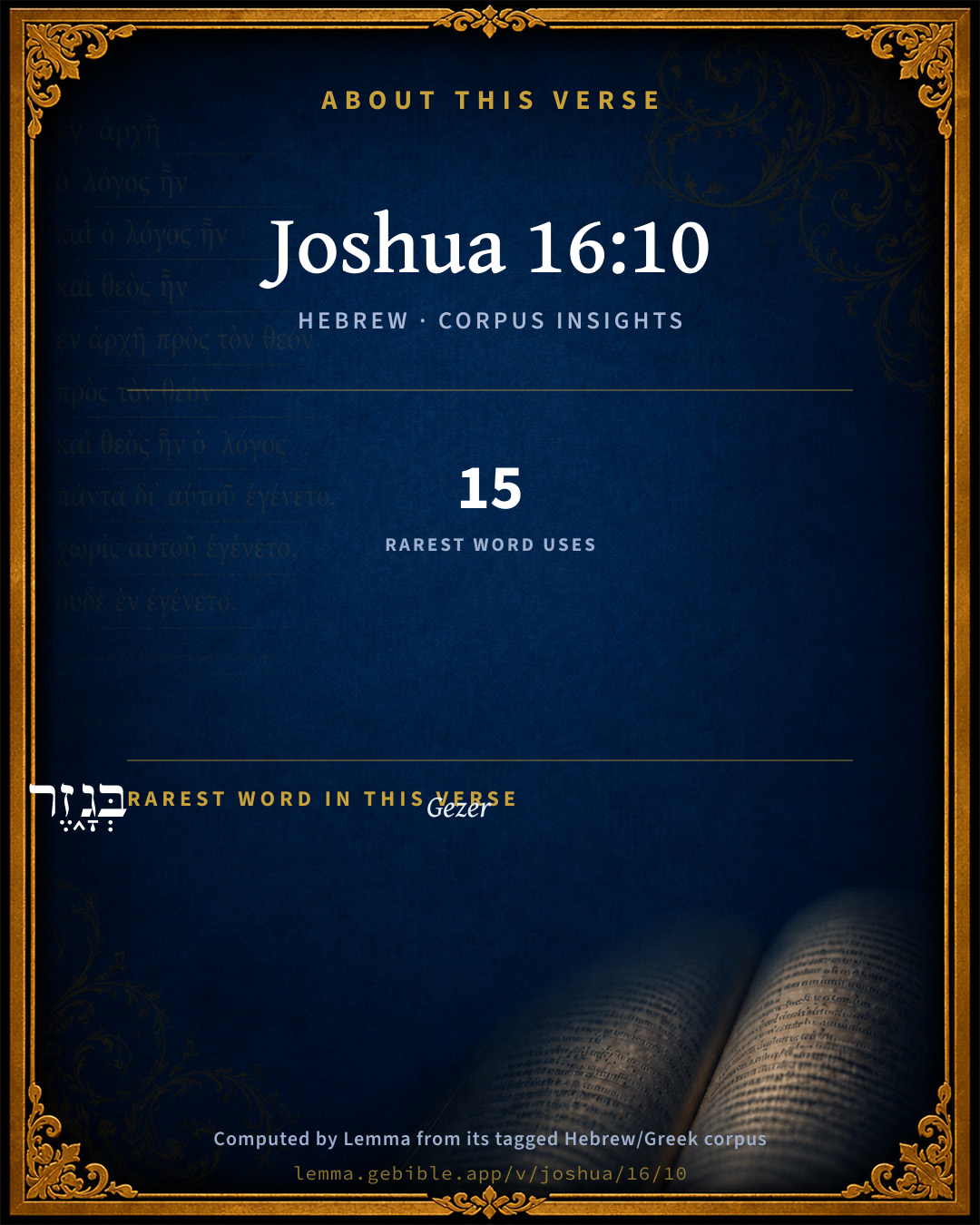
The rarest word here is בְּגָ֑זֶר Gezer H1507 — appearing just 15 times in the whole Hebrew Bible.

Shared distinctive vocabulary

בְּגָ֑זֶר Gezer H1507 occurs in 14 verses of the Hebrew Bible. Also found in:

Grammatical profile

  • 5 verbs
  • 7 nouns
  • 1 pronoun
  • 1 preposition
  • 2 particles

Verb forms

  • הוֹרִ֔ישׁוּ Hiphil · Perfect
  • הַיּוֹשֵׁ֣ב Qal · Participle Active
  • וַיֵּ֨שֶׁב Qal · Sequential Imperfect
  • וַיְהִ֖י Qal · Sequential Imperfect
  • עֹבֵֽד Qal · Participle Active

Repetition

Words recur within this verse — often emphatic in Hebrew:

  • הַֽכְּנַעֲנִ֖י Canaanite H3669 ×2
  • הַיּוֹשֵׁ֣ב to dwell H3427 ×2

Hebrew & Septuagint length

In English translation the verse runs 30 words from the Hebrew and 58 from the Septuagint (LXX English) — the Septuagint runs noticeably longer here. See the side-by-side →

A rough comparison of the two English renderings, which tokenize alike — not a word-level alignment.

Word counts can differ between the Hebrew and the Greek without any difference in meaning — e.g. the Hebrew direct-object marker אֵת has no separate Greek word, and Greek often adds the article ὁ.

Cross-references

7

Topical passages linked to Joshua 16:10 in the Treasury of Scripture Knowledge — connected by theme and wording, ordered by reader-vote popularity; previews shown in the World English Bible.

  • Judges 1:29 Ephraim didn't drive out the Canaanites who lived in Gezer; but the Canaanites lived in Gezer among them.
  • Deuteronomy 7:1–2 When Yahweh your God shall bring you into the land where you go to possess it, and shall cast out many nations before you, the Hittite, and the Girgashite, and the Amorite, and the Canaanite, and the Perizzite, and the Hivite, and the Jebusite, seven nations greater and mightier than you;
  • Joshua 17:13 It happened, when the children of Israel had grown strong, that they put the Canaanites to forced labor, and didn't utterly drive them out.
  • 1 Kings 9:16 Pharaoh king of Egypt had gone up, and taken Gezer, and burnt it with fire, and slain the Canaanites who lived in the city, and given it for a portion to his daughter, Solomon's wife.
  • Numbers 33:52–55 then you shall drive out all the inhabitants of the land from before you, and destroy all their figured [stones], and destroy all their molten images, and demolish all their high places:
  • 1 Kings 9:21 their children who were left after them in the land, whom the children of Israel were not able utterly to destroy, of them did Solomon raise a levy of bondservants to this day.
  • Joshua 15:63 As for the Jebusites, the inhabitants of Jerusalem, the children of Judah couldn't drive them out: but the Jebusites dwell with the children of Judah at Jerusalem to this day.

Cross-references courtesy of OpenBible.info (CC BY 4.0).

Hebrew and Greek witnesses Masoretic Hebrew ↔ Greek Septuagint

The same verse in the two great witnesses to the Old Testament, shown verse-for-verse.

Here the Septuagint runs noticeably longer than the Hebrew — LXX2012 (modern English Septuagint) 58 words vs World English Bible 30. A rough length comparison of the two English translations, not a word-level alignment — read both below.

These are two independent witnesses, not word-aligned to each other, and the Septuagint is shown in lemma (dictionary) form.

Hebrew Joshua 16:10 Masoretic · Westminster Leningrad Codex

וְלֹ֣א הוֹרִ֔ישׁוּ אֶת הַֽכְּנַעֲנִ֖י הַיּוֹשֵׁ֣ב בְּגָ֑זֶר וַיֵּ֨שֶׁב הַֽכְּנַעֲנִ֜י בְּקֶ֤רֶב אֶפְרַ֨יִם֙ עַד הַיּ֣וֹם הַזֶּ֔ה וַיְהִ֖י לְמַס עֹבֵֽד

They didn't drive out the Canaanites who lived in Gezer: but the Canaanites dwell in the midst of Ephraim to this day, and are become servants to do forced labor.

World English Bible · Public Domain

Greek LXX Joshua 16:10 Septuagint · lemma form

καί οὐ ἀποὀλλύω ἐφράιμ ὁ χαναναῖος ὁ καταοἰκέω ἐν γαζερ καί καταοἰκέω ὁ χαναναῖος ἐν ὁ ἐφράιμ ἕως ὁ ἡμέρα οὗτος ἕως ἀναβαίνω φαραώ βασιλεύς αἴγυπτος καί λαμβάνω αὐτός καί ἐνπίμπρημι αὐτός ἐν πῦρ καί ὁ χαναναῖος καί ὁ φερεζαῖος καί ὁ καταοἰκέω ἐν γαζερ ἐκκεντέω καί δίδωμι αὐτός φαραώ ἐν φερνή ὁ θυγάτηρ αὐτός

And Ephraim did not destroy the Chananite who lived in Gazer; and the Chananite lived in Ephraim until this day, until Pharao the king of Egypt went up and took it, and burnt it with fire; and the Chananites, and Pherezites, and the dwellers in Gaza they destroyed, and Pharao gave them for a dowry to his daughter.

LXX2012 (modern English Septuagint) · Public Domain

On this verse, Haydock's Catholic Bible Commentary discusses the Septuagint’s reading. Read the note in Commentary ↓

Hebrew: Westminster Leningrad Codex (CC BY 4.0). Greek: Septuagint (public domain); English from LXX2012 (modern English Septuagint) (Public Domain). How the Septuagint differs from the Hebrew →

Targum (Aramaic paraphrase)

1

The Targum is the ancient Jewish Aramaic paraphrase of the Hebrew Scriptures — an interpretive translation, not the Hebrew text itself. Onkelos (literal) and Pseudo-Jonathan (expansive) render the Torah, and Jonathan the Prophets. Coverage is partial: where no permissively-licensed English translation exists for a verse, only the Aramaic is shown. This is verse-level text, not a word-by-word alignment to the Hebrew.

  1. Targum Jonathan Prophets (Joshua–Malachi)
    וְלָא תָרִיכוּ יַת כְּנַעֲנָאֵי דְיָתֵיב בְּגָזֶר וִיתִיבוּ כְּנַעֲנָאֵי בְּגוֹ בֵּית אֶפְרַיִם עַד יוֹמָא הָדֵין וַהֲווֹ לְמַסְקֵי מִסִין פַּלְחִין:

    (no public-domain English translation for this verse)

    Targum Jonathan — Aramaic: “Mikraot Gedolot” (public domain). English: “Sefaria Community Translation” (CC0 1.0 (public-domain dedication)); “London "Chaldee Paraphrase," 1871” (public domain). Text via Sefaria.

Commentary

Notes on Joshua 16:10 from classic Christian and Jewish commentators (each source and its license shown beneath its notes). The classic Christian expositions comment on the surrounding passage and are grouped to its opening verse, so a note may address several verses; the Jewish commentaries on the Tanakh (Rashi and others) are per-verse, so they appear only where the commentator wrote on this verse.

Lemma curates 59 commentaries, every one of them public domain or Creative Commons licensed, each selected and text-cleaned for this edition rather than reprinted as found. About our sources →

Trapp's Complete Commentary

John Trapp

Jos 16:10 And they drave not out the Canaanites that dwelt in Gezer: but the Canaanites dwell among the Ephraimites unto this day, and serve under tribute.

Ver. 10. And they drave not out.] Which is nothing for their commendation; but discovereth either their cowardice or covetousness, or both.

But the Canaanites dwell, &c.] {See Trapp on "Jos 16:3"} They would not yield: so that Pharaoh was forced to fire their town. {1Ki 9:16}

John Trapp, A Commentary or Exposition upon All the Books of the Old and New Testament (1647–1656) — public domain. Text from a community e-Sword module.

Jamieson, Fausset & Brown

Robert Jamieson, A. R. Fausset & David Brown

they drave not out the Canaanites . . . but the Canaanites dwell among the Ephraimites unto this day, and serve under tribute--This is the first mention of the fatal policy of the Israelites, in neglecting the divine command (Deu 20:16) to exterminate the idolaters.

Next: Joshua Chapter 17

Jamieson, Fausset & Brown — Commentary Critical and Explanatory on the Whole Bible (1871) — public domain (CC PDM 1.0). Text via the HelloAO Bible API.

Adam Clarke's Commentary

Verse 10. The Canaanites that dwelt in Gezer] It appears that the Canaanites were not expelled from this city till the days of Solomon, when it was taken by the king of Egypt his father-in-law, who made it a present to his daughter, Solomon's queen. See 1Kg 9:16. And see the note on Jos 10:33. The Ephraimites, however, had so far succeeded in subjecting these people as to oblige them to pay tribute, though they could not, or at least did not, totally expel them.

OF the names and places in this chapter, we may say the same as of others already mentioned. See Clarke on Jos 15:1. Many of those towns were small, and, we may rationally conclude, slightly built, and consequently have perished perhaps more than a thousand years ago. It would be therefore useless to look for such places now. Several of the towns in England, a land not exposed to such revolutions as that of Palestine has ever been, mentioned by Caesar and other ancient writers, are no longer discernible. Several have changed their names, and not a few their situation. Tradition states that the city of Norwich anciently stood some miles from its present situation; and we have the fullest proof that this was the case with the city of Salisbury. Such changes do not affect the truth of the ancient geography of our own country; nor can they impeach that of the sacred historian before us.

Adam Clarke's Commentary on the Bible (1810–1826) — public domain. Text from a community e-Sword/MySword module.

Ellicott's Commentary for English Readers

(10) They drave not out.—The failure of Ephraim here is noticed, as was the failure of Judah above (Jos_15:63).

A Bible Commentary for English Readers, edited by Charles John Ellicott (1878–1897) — public domain. Text from a community e-Sword module.

The Cambridge Bible for Schools and Colleges

gen. ed. J. J. S. Perowne

10. that dwelt in Gezer] Comp. above, Jos_10:33 and Jos_12:12.

The Cambridge Bible for Schools and Colleges (gen. ed. J. J. S. Perowne; Cambridge University Press, 1878–1918) — public domain. Text from a community e-Sword module.

Haydock's Catholic Bible Commentary

Gazer. It is not certain when the Ephraimites rendered this city tributary, or when it threw off the yoke. The king of Egypt afterwards conquered it, and gave it with his daughter to Solomon, chap. x. 33. (Calmet) See Judges i. 29. --- The negligence of Ephraim was contrary to God’s order, Exodus xx. (Menochius) --- The Alexandrian Septuagint here inserts after day, "till Pharao, king of Egypt, went up and took the city, and burnt it with fire, and the Chanaanites and Pherezites, and the inhabitants of Gazer, he slew; and Pharao gave it as a dowry to his daughter." Grabe adds what seems deficient, "and they became tributary slaves." (Haydock)

George Leo Haydock (1774–1849), Haydock's Catholic Family Bible and Commentary, 1859 edition — public domain. Excludes Psalms (Douay-Rheims chapter numbering differs from Protestant) and Deuterocanonical books (Catholic canon only).

Matthew Poole's English Annotations

The Canaanites were not driven out until Solomon’s time, 1Ki 9:16.

Under tribute, as Jos 17:13; 1Ki 9:16.

Matthew Poole's English Annotations on the Holy Bible (1683–1685) — public domain. Text from a community e-Sword/MySword module.

The Pulpit Commentary

And they drave not out. The Ephraimites soon grew slack in the fulfilment of the Divine command. There is a distinction, apparently, between this passage and Jos_15:63. There the tribe of Judah was unable to drive out the Jebusites from their stronghold, and no mention is made of tribute. Here the Ephraimites seem deliberately to have preferred the easier task of reducing the Canaanites to tribute to the sterner and more difficult task of destroying them utterly.

HOMILIES BY W.F. ADENEY Ver. 10. Canaanites still in the land.

I CANAANITES STILL IN THE LAND WERE A WITNESS TO THE FAILURE OF THE JEWS TO ACCOMPLISH GOD"S WILL. They may have failed

(1) from weakness and indolence,

(2) from mercenary motives, thinking to make profit out of the Canaanites with their tribute.

But these Canaanites were a cause of future trouble and a constant temptation to idolatry and immorality. We shall always suffer when we neglect God"s will for worldly convenience.

II CANAANITES REMAINING IN THE LAND WERE AN INSTANCE OF THE MIXED CONDITION OF HUMAN SOCIETY. Wheat and tares grow together. The Church and the world are in close contact. It is dangerous to associate with evil company when we can avoid it. (Psa_1:1) But it is also wrong for Christians to neglect their duty to the world in order to escape the contamination of the world"s wickedness.

III CANAANITES REMAINING IN THE LAND WERE AN EXAMPLE OF A COMMON CAUSE OF NATIONAL WEAKNESS. Much of the trouble of the dark age of the Judges arose from this fact. A nation to be strong must be united as one body, and it can only be so united when there are common sympathies binding the people together. The government which is effected through the forcible subjugation of unwilling peoples must always rest on an unstable basis, and can never accomplish the highest good of the subject races. Therefore it should be the aim of a government to avoid, if possible, the conquest of new, unwilling subjects, to cultivate the affections of all classes beneath it, and to weld them together by just equality of administration, and the development of common interests. Where national assimilation is impossible it is better that a common government should not be attempted.

IV CANAANITES REMAINING IN THE LAND WERE A TYPE OF SINS REMAINING IN THE HEART OF THE CHRISTIAN.

(1) Most of the land was conquered. The heart of the Christian is conquered by Christ. Christ sits enthroned there. Sin is dispossessed of the citadel.

(2) Canaanites still lurked in obscure corners of the land. Sin still lingers about the life of the Christian. It retains its old character unaltered, and must be regarded as dangerous. (Rom_7:23)

(3) These Canaanites were so far subdued that they served under tribute. The sin that remains in the Christian"s heart no longer reigns there. It is a defeated enemy. It will be ultimately exterminated. The temptation to it may be converted into an instrument of wholesome discipline. W.F.A.

The Pulpit Commentary (1880–1919), ed. H.D.M. Spence-Jones & Joseph S. Exell — public domain. Text from a community e-Sword module.

Keil & Delitzsch

C. F. Keil & F. Delitzsch

From Gezer, however (see Jos 16:3), they could not drive out the Canaanites, so that they still dwelt among the Ephraimites, but were reduced to a state of serfdom. This notice resembles the one in Jos 15:63, and is to be interpreted in the same way.

Keil & Delitzsch — Biblical Commentary on the Old Testament (1861–1891) — public domain (CC PDM 1.0). Text via the HelloAO Bible API. (Old Testament only.)

unfoldingWord translationNotes

Door43 World Missions Community

to this day

This refers to the period of time in which the author wrote this book.

these people were made to do forced labor

This can be stated in active form. AT: "the Israelites forced these people to work as slaves" (See: Active or Passive)

translationWords

Canaan

Ephraim

labor

unfoldingWord translationNotes — © Distant Shores Media and the Door43 World Missions Community, licensed CC BY-SA 4.0. Source: git.door43.org/Door43/en_tn.

Lesson kit

Teaching starters — assembled from the data on this page, not authored interpretation. Every prompt links to the verse data it draws on. Edit before teaching.

Joshua, in the Historical, opens this verse with 16 words (14 distinct Hebrew lemmas). Its most distinctive word is Gezer (“Gezer”). The Greek Septuagint runs longer here. A historical commentator’s framing appears above. Read the whole chapter for the surrounding context.

Discussion questions

  1. The word Gezer carries the sense “Gezer.” How does it shape the verse?
  2. Joshua 10:33 shares the word «Gezer» with this verse. How do the two illuminate each other?
  3. “Canaanite” occurs 2× in this one verse. What is the effect of the repetition?
  4. Compared with the Hebrew, the Septuagint runs longer here. What questions does that raise?
  5. The translations on this page render this verse differently — a whole-verse word diff, not a word-by-word alignment. What might account for the different wordings?
  6. The verb «הוֹרִ֔ישׁוּ» is Hiphil Perfect. How does its form color the action?
  7. Reading how Trapp's Complete Commentary and Jamieson, Fausset & Brown read this verse, where do the two commentators agree and where do they part?

Things to notice

Reading settings

Reading text

Shown beneath each verse's original-language words.

Old Testament
Old Testament edition

Read the OT as the Masoretic Hebrew (MT) or the Greek Septuagint (LXX).

English shown for the Greek Septuagint (in the Hebrew ↔ Greek comparison).

Comparing translations? Open the Compare panel on any verse page to stack up to four side by side.