Genesis 25:22

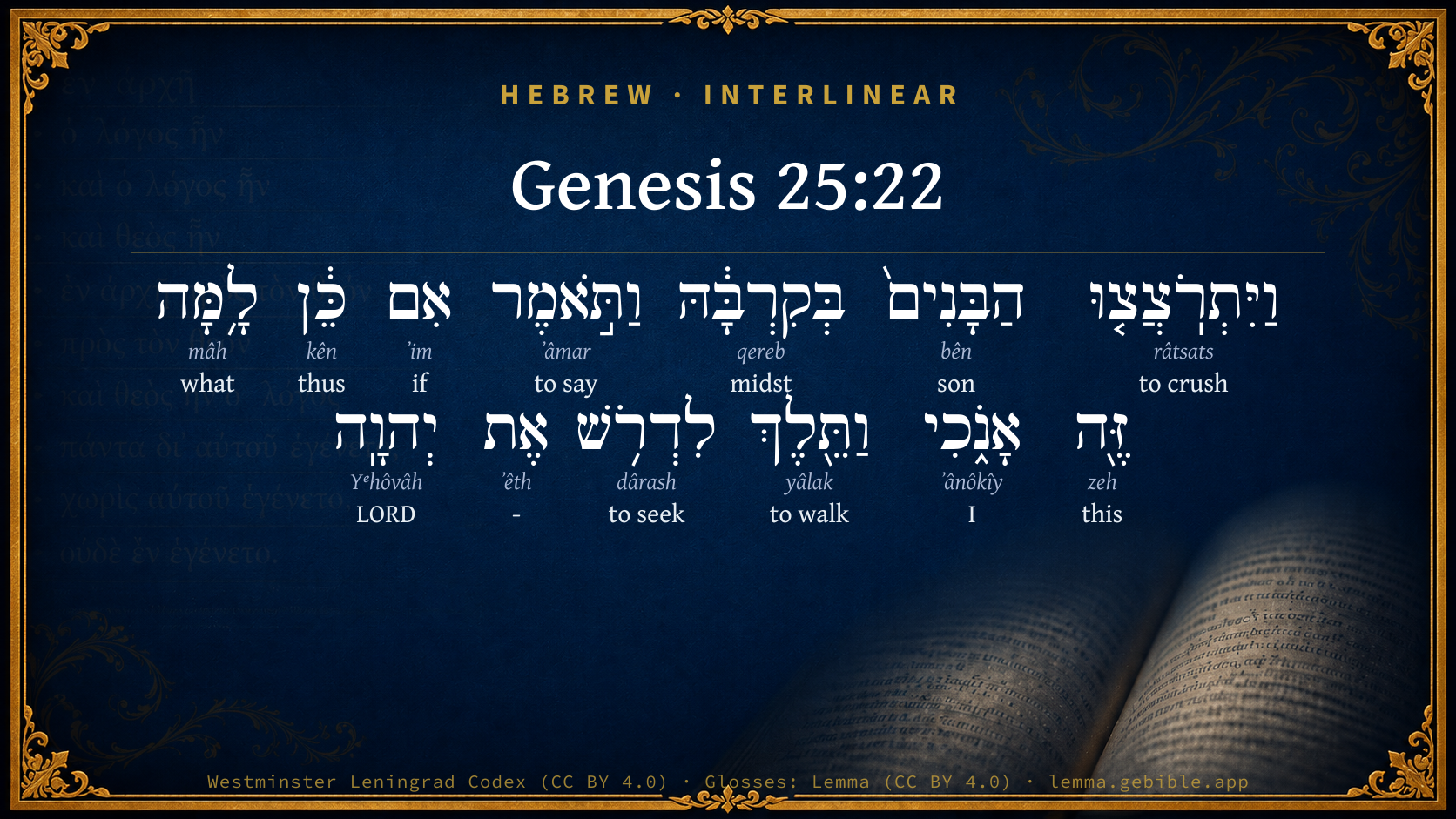
Hebrew (Westminster Leningrad Codex) Genesis 25:22 appears in the Hebrew Old Testament. The text above is from the Westminster Leningrad Codex. Each word links to its Strong’s number, a concise gloss, and parsing drawn from the Open Scriptures Hebrew Bible morphology. Click any word for its full Brown-Driver-Briggs (BDB) entry.
Download image
Cite this verse

Genesis 25:22 (World English Bible). Public Domain. Lemma interlinear Bible study tool, https://lemma.gebible.app/v/genesis/25/22.

Show BibTeX & RIS
BibTeX
RIS
English Translation
The children struggled together within her. She said, "If it be so, why do I live?" She went to inquire of Yahweh.
World English Bible · Public Domain
Highlights
  • 1 first appearance in the Hebrew Bible
Full analysis ↓
Download a study sheet

One document with this verse’s original text, its word-by-word gloss line, the meaning frame, cross-references with their text, attributed commentary, and full source and license credits — printable, and it pastes into notes with its structure intact.

This verse Autodidact and up

Study sheet (.html) Plain text (.txt)

A passage Seminary Student

Up to 50 verses in one chapter. A passage sheet keeps up to 6 commentary sources and 12 cross-references per verse, in the order this page ranks them, and says so on the sheet whenever that leaves anything out. Ask for a single verse and you get the Autodidact verse sheet above.

Everything on this page stays free to read, with no account — the sheet is a download of what is already on screen, not access to it.

Want to remove ads? Support Godless Engineer
Compare translations 3

The same verse in 3 English versions, stacked beneath the original-language interlinear above. Click any original word for its lexicon entry.

Each is an independent rendering of the whole verse — the interlinear is not word-aligned to these translations.

Highlighted words mark where these versions differ — a whole-verse word diff, not a word-by-word alignment.

  • World English Bible Public Domain
    The children struggled together within her. She said, "If it be so, why do I live?" She went to inquire of Yahweh.
  • King James Version Public Domain
    And the children struggled together within her; and she said, If it be so, why am I thus? And she went to inquire of the LORD.
  • unfoldingWord Literal Text CC BY-SA 4.0
    And the children struggled against each other inside her, so she said, “Why so? Why I this?” And she went to inquire of Yahweh.

unfoldingWord Literal Text — © unfoldingWord, licensed CC BY-SA 4.0. Word-aligned USFM3 via Door43 (git.door43.org/unfoldingWord/en_ult).

Versions to compare (up to 4)

3 of 4 selected

Show all 18 translations

Every available English version of this verse, each an independent rendering of the whole verse.

  • World English Bible Public Domain
    The children struggled together within her. She said, "If it be so, why do I live?" She went to inquire of Yahweh.
  • Berean Standard Bible Public Domain
    But the children inside her struggled with each other, and she said, “Why is this happening to me?” So Rebekah went to inquire of the LORD,
  • Majority Standard Bible Public Domain
    But the children inside her struggled with each other, and she said, “Why is this happening to me?” So Rebekah went to inquire of the LORD,
  • King James Version Public Domain
    And the children struggled together within her; and she said, If it be so, why am I thus? And she went to inquire of the LORD.
  • American Standard Version (1901) Public Domain
    And the children struggled together within her. And she said, If it be so, wherefore do I live? And she went to inquire of Jehovah.
  • Revised Version (1885) Public Domain
    And the children struggled together within her; and she said, If it be so, wherefore do I live? And she went to inquire of the LORD.
  • Geneva Bible (1599) Public Domain
    But the children stroue together within her: therefore shee sayde, Seeing it is so, why am I thus? wherefore she went to aske the Lord.
  • Douay-Rheims (1899) Public Domain
    But the children struggled in her womb: and she said: If it were to be so with me, what need was there to conceive? And she went to consult the Lord.
  • Young's Literal Translation Public Domain
    and the children struggle together within her, and she saith, `If `it is' right -- why `am' I thus?' and she goeth to seek Jehovah.
  • Literal Standard Version CC BY-SA 4.0
    and the children struggle together within her, and she says, “If [it is] right—why [am] I thus?” And she goes to seek YHWH.
  • Unlocked Literal Bible CC BY-SA 4.0
    The children struggled together within her, and she said, “Why is this happening to me?” She went to ask Yahweh about this.
  • unfoldingWord Literal Text CC BY-SA 4.0
    And the children struggled against each other inside her, so she said, “Why so? Why I this?” And she went to inquire of Yahweh.
  • Darby Bible Public Domain
    And the children struggled together within her; and she said, If [it be] so, why am I thus? And she went to inquire of Jehovah.
  • World Messianic Bible Public Domain
    The children struggled together within her. She said, “If it is like this, why do I live?” She went to inquire of the LORD.
  • Webster's Bible Public Domain
    And the children struggled together within her: and she said, If it is so, why am I thus? And she went to inquire of the LORD.
  • Free Bible Version CC BY-SA 4.0
    The twin babies inside her struggled with each other. So she asked the Lord, “Why is this happening to me?”
  • Bible in Basic English Public Domain
    And the children were fighting together inside her, and she said, If it is to be so, why am I like this? So she went to put her question to the Lord.
  • JPS Tanakh (1917) Public Domain
    And the children struggled together within her; and she said: 'If it be so, wherefore do I live?' And she went to inquire of the LORD.

Literal Standard Version (2020), Covenant Press — licensed CC BY-SA 4.0. Text via the HelloAO Bible API (eBible.org). Unlocked Literal Bible (unfoldingWord) — licensed CC BY-SA 4.0. Text via the HelloAO Bible API (eBible.org). unfoldingWord Literal Text — © unfoldingWord, licensed CC BY-SA 4.0. Word-aligned USFM3 via Door43 (git.door43.org/unfoldingWord/en_ult). Free Bible Version, Dr. Jonathan Gallagher — licensed CC BY-SA 4.0. Text via the HelloAO Bible API (eBible.org).

Word by word

More ways to search: Search by grammar → Find every occurrence → Compare this word →

Practice this passage: Drill this verse → Learn its vocabulary →

וַיִּתְרֹֽצֲצ֤וּ
râtsats
H7533
“and · to crush”
Conjunction + Verb, Hithpolel, Sequential Imperfect, 3rd Person, Masculine, Plural
Part of Speech
Conjunction + Verb
Stem
Hithpolel
Form
Sequential Imperfect
Person
3rd Person
Gender
Masculine
Number
Plural
Full BDB Definition

Origin: a primitive root

TWOT: 2212

to crush, oppress - (Qal) - to crush, get crushed, be crushed - to crush, oppress (figuratively) - crushed (participle passive) - (Niphal) to be crushed, be broken - (Piel) - to crush in pieces - to grievously oppress (figuratively) - (Poel) to oppress (figuratively) - (Hiphil) to crush - (Hithpoel) to crush each other
  1. הַבָּנִים֙ bên H1121 “the · sons” Particle, Definite Article + Noun, Common, Masculine, Plural, Absolute
  2. בְּקִרְבָּ֔הּ qereb H7130 “in/at · midst · her” Preposition + Noun, Common, Masculine, Singular, Construct + Suffix, Personal, 3rd Person, Feminine, Singular
  3. וַתֹּ֣אמֶר ʼâmar H559 “and · to say” Conjunction + Verb, Qal, Sequential Imperfect, 3rd Person, Feminine, Singular
  4. אִם ʼim H518 “if” Conjunction
  5. כֵּ֔ן kên H3651 “thus” Particle, Demonstrative
  6. לָ֥מָּה mâh H4100 “to/for · what” Preposition + Particle, Interrogative
  7. זֶּ֖ה zeh H2088 “this” Pronoun, Demonstrative, Masculine, Singular
  8. אָנֹ֑כִי ʼânôkîy H595 “I” Pronoun, Personal, 1st Person, Common, Singular
  9. וַתֵּ֖לֶךְ yâlak H3212 “and · to walk” Conjunction + Verb, Qal, Sequential Imperfect, 3rd Person, Feminine, Singular
  10. לִדְרֹ֥שׁ dârash H1875 “to seek” Preposition + Verb, Qal, Infinitive Construct
  11. אֶת ʼêth H853 “-” Particle, Direct Object
  12. יְהוָֽה Yᵉhôvâh H3068 “LORD” Noun, Proper

About this verse

These counts appear in no published source. They are computed here, from the morphology-tagged text and Lemma’s own curated glosses. What Lemma adds →

13
words
13
distinct lemmas
Pentateuch
section

Notable vocabulary

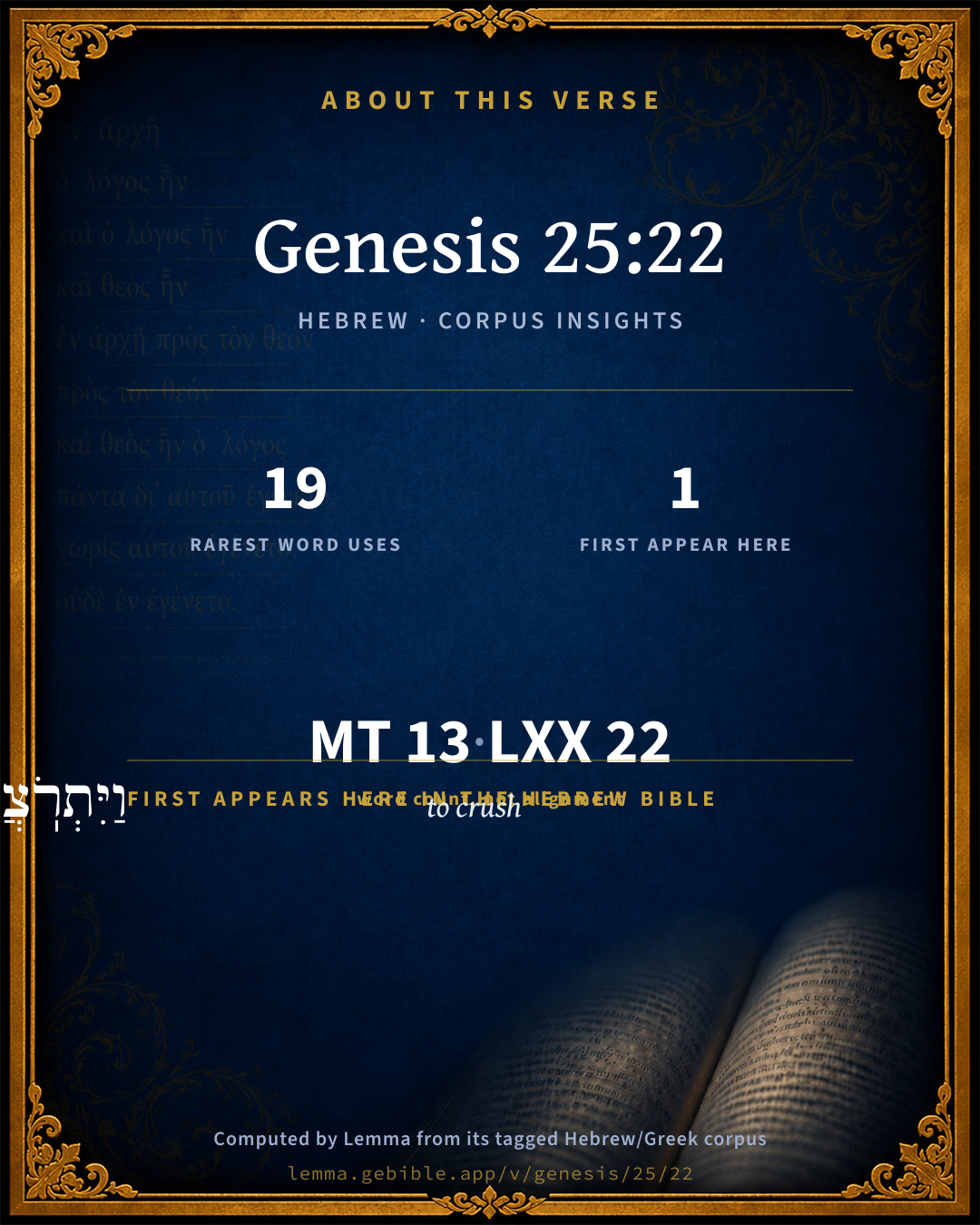
The rarest word here is וַיִּתְרֹֽצֲצ֤וּ to crush H7533 — appearing just 19 times in the whole Hebrew Bible.

First appearance in Scripture

This word makes its first canonical appearance in the Hebrew Bible here:

  • וַיִּתְרֹֽצֲצ֤וּ to crush H7533

Shared distinctive vocabulary

וַיִּתְרֹֽצֲצ֤וּ to crush H7533 occurs in 18 verses of the Hebrew Bible. Also found in:

Grammatical profile

  • 4 verbs
  • 3 nouns
  • 2 pronouns
  • 1 conjunction
  • 3 particles

Verb forms

  • וַיִּתְרֹֽצֲצ֤וּ Hithpolel · Sequential Imperfect
  • וַתֹּ֣אמֶר Qal · Sequential Imperfect
  • וַתֵּ֖לֶךְ Qal · Sequential Imperfect
  • לִדְרֹ֥שׁ Qal · Infinitive Construct

Hebrew & Septuagint length

In English translation the verse runs 22 words from the Hebrew and 29 from the Septuagint (LXX English) — closely comparable.

A rough comparison of the two English renderings, which tokenize alike — not a word-level alignment.

Word counts can differ between the Hebrew and the Greek without any difference in meaning — e.g. the Hebrew direct-object marker אֵת has no separate Greek word, and Greek often adds the article ὁ.

In the original languages it is 13 Hebrew tokens and 22 Greek tokens — but the two are counted differently (Hebrew bundles its prefixes and suffixes into one token; the Greek is in lemma form), so that isn’t a like-for-like length.

Cross-references

7

Topical passages linked to Genesis 25:22 in the Treasury of Scripture Knowledge — connected by theme and wording, ordered by reader-vote popularity; previews shown in the World English Bible.

  • 1 Samuel 9:9 (In earlier times in Israel, when a man went to inquire of God, thus he said, Come, and let us go to the seer; for he who is now called a Prophet was before called a Seer.)
  • 1 Samuel 10:22 Therefore they asked of Yahweh further, Is there yet a man to come here? Yahweh answered, Behold, he has hid himself among the baggage.
  • 1 Samuel 28:6 When Saul inquired of Yahweh, Yahweh didn't answer him, neither by dreams, nor by Urim, nor by prophets.
  • 1 Samuel 30:8 David inquired of Yahweh, saying, If I pursue after this troop, shall I overtake them? He answered him, Pursue; for you shall surely overtake [them], and shall without fail recover [all].
  • Ezekiel 20:31 and when you offer your gifts, when you make your sons to pass through the fire, do you pollute yourselves with all your idols to this day? and shall I be inquired of by you, house of Israel? As I live, says the Lord Yahweh, I will not be inquired of by you;
  • Ezekiel 36:37 Thus says the Lord Yahweh: For this, moreover, will I be inquired of by the house of Israel, to do it for them: I will increase them with men like a flock.
  • 1 Samuel 22:15 Have I today begun to inquire of God for him? be it far from me: don't let the king impute anything to his servant, nor to all the house of my father; for your servant knows nothing of all this, less or more.

Cross-references courtesy of OpenBible.info (CC BY 4.0).

Hebrew and Greek witnesses Masoretic Hebrew ↔ Greek Septuagint

The same verse in the two great witnesses to the Old Testament, shown verse-for-verse.

These are two independent witnesses, not word-aligned to each other, and the Septuagint is shown in lemma (dictionary) form.

Hebrew Genesis 25:22 Masoretic · Westminster Leningrad Codex

וַיִּתְרֹֽצֲצ֤וּ הַבָּנִים֙ בְּקִרְבָּ֔הּ וַתֹּ֣אמֶר אִם כֵּ֔ן לָ֥מָּה זֶּ֖ה אָנֹ֑כִי וַתֵּ֖לֶךְ לִדְרֹ֥שׁ אֶת יְהוָֽה

The children struggled together within her. She said, "If it be so, why do I live?" She went to inquire of Yahweh.

World English Bible · Public Domain

Greek LXX Genesis 25:22 Septuagint · lemma form

ἐσκίρτων δέ ὁ παιδίον ἐν αὐτός εἶπον δέ εἰ οὕτως ἐγώ μέλλω γίγνομαι ἵνα τίς ἐγώ οὗτος πορεύομαι δέ πυνθάνομαι παρά κύριος

And the babes leaped within her; and she said, If it will be so with me, why is this to me? And she went to enquire of the Lord.

LXX2012 (modern English Septuagint) · Public Domain

On this verse, The Cambridge Bible for Schools and Colleges discusses the Septuagint’s reading. Read the note in Commentary ↓

Hebrew: Westminster Leningrad Codex (CC BY 4.0). Greek: Septuagint (public domain); English from LXX2012 (modern English Septuagint) (Public Domain). How the Septuagint differs from the Hebrew →

Targum (Aramaic paraphrase)

2

The Targum is the ancient Jewish Aramaic paraphrase of the Hebrew Scriptures — an interpretive translation, not the Hebrew text itself. Onkelos (literal) and Pseudo-Jonathan (expansive) render the Torah, and Jonathan the Prophets. Coverage is partial: where no permissively-licensed English translation exists for a verse, only the Aramaic is shown. This is verse-level text, not a word-by-word alignment to the Hebrew.

  1. Targum Onkelos Torah (Genesis–Deuteronomy)
    וְדַחֲקִין בְּנַיָּא בִּמְעָהָא וַאֲמֶרֶת אִם כֵּן לְמָה דְּנַן אֲנָא וַאֲזָלַת לְמִתְבַּע אוּלְפַן מִן קֳדָם יְיָ

    (no public-domain English translation for this verse)

    Targum Onkelos — Aramaic: “Onkelos Genesis” (public domain); “Onkelos Exodus” (public domain); “Onkelos Leviticus” (public domain); “Onkelos Numbers” (public domain); “Onkelos Deuteronomy” (public domain). English: “Sefaria Community Translation” (CC0 1.0 (public-domain dedication)); “J.W. Etheridge. The Targums of Onkelos and Jonathan Ben Uzziel on the Pentateuch. London: Longmans, Green, 1862” (public domain). Text via Sefaria.

  2. Targum Pseudo-Jonathan Torah (Genesis–Deuteronomy)
    וְאַדְחִיקוּ בְּנַיָא בְּמֵיעָהָא הֵי כְּגוּבְרִין עָבְדוּ קְרָבָא וַאֲמָרַת אִם כְּדֵין הוּא צַעֲרָא דִילִדְתָּא לְמָא דֵין לִי בְּנִין וַאֲזָלַת לְבֵי מֶדְרָשָׁא דְשֵׁם רַבָּא לְמִבְעֵיהּ רַחֲמִין מִן קֳדָם יְיָ

    And the children pressed in her womb as men doing battle. And she said, If this is the anguish of a mother, what then are children to me? And she went into the school of Shem Rabba to supplicate mercy before the Lord.

    Targum Pseudo-Jonathan — Aramaic: “Targum Jonathan on Genesis” (public domain); “Targum Jonathan on Exodus” (public domain); “Targum Jonathan on Leviticus” (public domain); “Targum Jonathan on Numbers” (public domain); “Targum Jonathan on Deuteronomy” (public domain). English: “The Targum of Jonathan ben Uzziel, trans. J. W. Etheridge, London, 1862” (public domain). Text via Sefaria.

Commentary

Notes on Genesis 25:22 from classic Christian and Jewish commentators (each source and its license shown beneath its notes). The classic Christian expositions comment on the surrounding passage and are grouped to its opening verse, so a note may address several verses; the Jewish commentaries on the Tanakh (Rashi and others) are per-verse, so they appear only where the commentator wrote on this verse.

Lemma curates 59 commentaries, every one of them public domain or Creative Commons licensed, each selected and text-cleaned for this edition rather than reprinted as found. About our sources →

Trapp's Complete Commentary

John Trapp

Gen 25:22 And the children struggled together within her; and she said, If [it be] so, why [am] I thus? And she went to enquire of the LORD.

Ver. 22. And the children struggled together.] Heb., Jithrotsatsu. They ran at tilt, as it were, and jostled one against another, even to bruising and hurting. Esau, that he might lose no time, began to set against Jacob before he was born.

If it be so, why am I thus?] A passionate abrupt speech: q.d., Better no children, than so troubled with them. {See Trapp on "Gen 27:46"} {See Trapp on "Gen 3:16"} "I will greatly multiply thy sorrow and thy conception." This she should have borne more patiently: but she presently bethought her of the best course; for "she went to inquire of the Lord": she got into a corner, and prayed, and was answered. She prayed down her passions, as a man sleeps out his drunkenness, and set to work lustily, and so got the ensuing oracle.

John Trapp, A Commentary or Exposition upon All the Books of the Old and New Testament (1647–1656) — public domain. Text from a community e-Sword module.

Joseph Benson's Commentary

Gen 25:22. The children struggled within her — In an unusual and painful manner; a presage of the enmity of these two sons and their posterities. If it be so, or since it is so, why am I thus? — That is, as some interpret it, “If I am with child, what is the reason of this unusual commotion I feel?” Or, as others explain her exclamation, “If I must suffer such uncommon pangs, why did I conceive?” Before, the want of children was her trouble; now, the struggle of her children is no less so. She went to inquire of the Lord — Probably she consulted Melchizedek, or some other holy person, who was favoured with divine revelations: or perhaps the expression only means that she addressed herself to God in prayer. The Word of God and prayer, by which we now inquire of him, give great relief to those that are, upon any account, perplexed. It is a mighty ease to spread our case before the Lord, and ask counsel at his mouth. Reader, let this be thy practice in all thy difficulties and perplexities.

Joseph Benson's Commentary on the Old and New Testaments (1811–1818) — public domain. Text from a community e-Sword module.

Tyndale Open Study Notes

Tyndale Open Resources

25:22 When the pregnancy was difficult, Rebekah went to ask the Lord about it, probably by visiting a prophet—perhaps Abraham (20:7; see study note on 25:7-8).

Tyndale Open Study Notes — © Tyndale Open Resources, licensed CC BY-SA 4.0. Text via the HelloAO Bible API.

Geneva Bible (1599)

Geneva Bible translators

For that is the only refuge in all our miseries.

Or, hurt one another.

That is, with child, seeing one shall destroy another.

Geneva Bible (1599) marginal notes — public domain. Text via Bolls.life.

Adam Clarke's Commentary

Verse 22. The children struggled together] יתרצצו yithrotsatsu, they dashed against or bruised each other, there was a violent agitation, so that the mother was apprehensive both of her own and her children's safety; and, supposing this was an uncommon case, she went to inquire of the Lord, as the good women in the present day would go to consult a surgeon or physician; for intercourse with God is not so common now, as it was in those times of great primitive simplicity. There are different opinions concerning the manner in which Rebekah inquired of the Lord. Some think it was by faith and prayer simply; others, that she went to Shem or Melchizedek; but Shem is supposed to have been dead ten years before this time; but as Abraham was yet alive, she might have gone to him, and consulted the Lord through his means. It is most likely that a prophet or priest was applied to on this occasion. It appears she was in considerable perplexity, hence that imperfect speech, If so, why am I thus? the simple meaning of which is probably this; if I must suffer such things, why did I ever wish to have a child? A speech not uncommon to mothers in their first pregnancy.

Adam Clarke's Commentary on the Bible (1810–1826) — public domain. Text from a community e-Sword/MySword module.

John Calvin's Commentaries

22. And the children struggled together. Here a new temptation suddenly arises, namely, that the infants struggle together in their mother’s womb. This conflict occasions the mother such grief that she wishes for death. And no wonder; for she thinks that it would be a hundred times better for her to die, than that she have within her the horrible prodigy of twin — brothers, shut up in her womb, carrying on intestine war. They, therefore, are mistaken, who attribute this complaint to female impatience, since it was not so much extorted by pain or torture, as by abhorrence of the prodigy. For she doubtless perceived that this conflict did not arise from natural causes, but was a prodigy portending some dreadful and tragic end. She also necessarily felt some fear of the divine anger stealing over her: as it is usual with the faithful not to confine their thoughts to the evil immediately present with them, but to trace it to its cause; and hence they tremble through the apprehension of divine judgment. But though in the beginning she was more grievously disturbed than she ought to have been, and, breaking out into murmurings, preserved neither moderation nor temper; yet she soon afterwards receives a remedy and solace to her grief. We are thus taught by her example to take care that we do not give excessive indulgence to sorrow in affairs of perplexity, nor inflame our minds by inwardly cherishing secret causes of distress. It is, indeed, difficult to restrain the first emotions of our minds; but before they become ungovernable, we must bridle them, and bring them into subjection. And chiefly we must pray to the Lord for moderation; as Moses here relates that Rebekah went to ask counsel from the Lord; because, indeed, she perceived that nothing would be more effectual in tranquilizing her mind, than to aim at obedience to the will of God, under the conviction that she was directed by him. For although the response given might be adverse, or, at least, not such as she would desire, she yet hoped for some alleviation from a gracious God, with which she might be satisfied. A question here arises respecting the way in which Rebekah asked counsel of God. It is the commonly received opinion that she inquired of some prophet what was the nature of this prodigy: and Moses seems to intimate that she had gone to some place to hear the oracle. But since that conjecture has no probability, I rather incline to a different interpretation; namely, that she, having sought retirement, prayed more earnestly that she might receive a revelation from heaven. For, at that time, what prophets, except her husband and her father-in-law, would she have found in the world, still less in that neighborhood? Moreover, I perceive that God then commonly made known his will by oracles. Once more, if we consider the magnitude of the affair, it was more fitting that the secret should be revealed by the mouth of God, than manifested by the testimony of man. In our times a different method prevails. For God does not, at this day, reveal things future by such miracles; and the teaching of the Law, the Prophets, and the Gospel, which comprises the perfection of wisdom, is abundantly sufficient for the regulation of our course of life.

John Calvin's Commentaries (1540-1563) — public domain. Text from the Calvin Translation Society English edition (1840s-50s) via the Christian Classics Ethereal Library (ccel.org). Calvin's coverage is partial (roughly two-thirds of the Bible); uncommented books and verses are honest gaps, never fabricated. The 19th-century editor's footnotes and remarks are omitted so the notes are faithfully Calvin's own voice.

The Cambridge Bible for Schools and Colleges

gen. ed. J. J. S. Perowne

22. struggled together] LXX ἐσκίρτων. Cf. Luk_1:41. The future hostility between Israel and Edom was thus prefigured before their birth. Rebekah, afraid of some betokening of evil, becomes fearful and despondent.

Aquila συνεθλάσθησαν, Symmachus διεπάλαιον.

wherefore do I live] R.V. marg. wherefore am I thus? So LXX ἵνα τί μοι τοῦτο, Lat. quid necesse fuit concipere?

to inquire of the Lord] A technical phrase for seeking an answer from a Divine source. Cf. 1Sa_9:9; Amo_5:4-6. We may suppose that Rebekah sought an oracle from Jehovah at some sacred place at which a Divine revelation was granted, e.g. at Beer-sheba, Gen_21:33, Gen_26:25.

The Cambridge Bible for Schools and Colleges (gen. ed. J. J. S. Perowne; Cambridge University Press, 1878–1918) — public domain. Text from a community e-Sword module.

John Gill's Exposition

And the children struggled together within her,.... When she was quick with child: this was some time before her delivery, and was not a common and ordinary motion felt by women in such circumstances, but an extraordinary one; the two children in her strove with each other, as if it was for mastery, or who should get out first before the proper time; which not only gave her great uneasiness of mind, but pain of body: this was an emblem of the future difference between those two children, Esau and Jacob, and of the contentions that would be between their respective offspring, and of the enmity and war between good and bad men in all ages, and of the conflict between flesh and spirit in all good men:

and she said, if it be so, why am I thus? that is, either if it be so with me as is not with others in the like condition; for, as Aben Ezra suggests, she had inquired of other women, whether it had ever been so with them, and they replied, no: then, says she, how comes it to pass that it should be different with me from others? or, if those children by struggling should kill one another, or be abortive and kill me, why should I have been so desirous of conception? or prayed for it, as Jarchi observes? or, if so it is, and this will be the case, "why am I thus" (c)? this unhappy woman, to be in such circumstances, to endure so much pain, and to no purpose? why have I conceived and carried my burden so long, and at last cannot be delivered, or bring forth a live child? all my prayers and pains have been in vain:

and she went to inquire of the Lord; to the school of Shem the great, say the Targums of Jonathan and Jerusalem, and so Jarchi: the Arabic writers say (d), she inquired of Melchizedek; and, according to Aben Ezra, of some prophet, or of Abraham, who lived fifteen years after this event: and indeed, if she inquired of any particular person of note for religion, and as a prophet, there is none so likely as he, who was the friend of God, and had great intimacy with him, and to whom he revealed his secrets. But perhaps no more is meant by it, than that she went either to some proper and private place, and prayed unto the Lord that he would show her the reason of what had happened unto her; or to some public place of worship, and where prayer was wont to be made, and where she inquired by means of such as were engaged therein concerning this matter; see Psa 73:17.

(c) "eur ego hoc?" Tigurine version, Montanus, Fagius. (d) Patricides, apud Hottinger, Smegma Oriental. p. 335. Abulpharag. Hist. Dynast. p. 15.

John Gill's Exposition of the Whole Bible (1746–1763) — public domain (CC PDM 1.0). Text via the HelloAO Bible API.

Haydock's Catholic Bible Commentary

To be so. That is, if I must die, and my children also. She feared the worst; and immediately had recourse to the Lord, either in her oratory, or at one of his altars erected by Abraham; and received a gracious answer from him by means of an angel. (Haydock) --- Others think she consulted Melchisedech at Mount Moria. (Menochius)

George Leo Haydock (1774–1849), Haydock's Catholic Family Bible and Commentary, 1859 edition — public domain. Excludes Psalms (Douay-Rheims chapter numbering differs from Protestant) and Deuterocanonical books (Catholic canon only).

Matthew Poole's English Annotations

The children struggled, in a violent and extraordinary manner, which was likely to cause both pain and fear in her. The sense may be either,

1. If it be

thus with me, that there be two children contending and fighting within me, likely to destroy one the other, and both threatening my death, why did I desire and pray for this as a great mercy? Or, why is it thus with me? Why hath God dealt thus with me, to continue my life till it be a burden to me, and to give me conception which is so painful and hazardous? Or rather,

2. If God hath granted me my desire in the conception of a child, what means this disturbance and conflict within me, which threatens me with loss of the mercy before I enjoy it? For she seems not so much to murmur at it, as to wonder and to inquire about it, as it here follows.

She went to inquire of the Lord; either immediately, by ardent prayers to God that he would reveal his mind to her herein; or mediately, by her father Abraham, who lived fifteen years after this time, Gen 25:7, or by some other godly patriarch yet surviving, by whom God used to manifest his will and counsels to others, when he thought fit.

Matthew Poole's English Annotations on the Holy Bible (1683–1685) — public domain. Text from a community e-Sword/MySword module.

Whedon's Commentary on the Bible

Daniel D. Whedon

22. Struggled together within her — Hebrews, dashed against one another. Premonition of the coming differences between the offspring.

If it be so, why am I thus — The Vulgate reads: “If it was to have been so with me, why should I have conceived?” Rebekah was evidently of an excitable and emotional temperament, (compare Gen_27:46,) and under the pains of maturing pregnancy yielded fitfully to despondency and gloom.

Went to inquire of the Lord — Where and how, has been often asked, but not so easily answered. The old Jewish interpreters suppose she went to Shem, or to Melchizedek, who were still living. Much more probable is the supposition that she went to Abraham, who was still living, and known as a prophet, (Gen_20:7, compare 1Sa_9:9,) and doubtless intensely interested in the prospective offspring of Isaac. But, perhaps, she went to that domestic altar where Isaac had so earnestly besought Jehovah for her, (Gen_25:21,) and Jehovah answered by his angel as he spoke to Hagar. Gen_16:11.

Daniel D. Whedon (gen. ed.), Commentary on the Old and New Testaments (1874–1909) — public domain. Text from a community e-Sword module.

The Pulpit Commentary

And the children struggled together within her. The verb is expressive of a violent internal commotion, as if the unborn children had been dashing against one another in her womb. Cf. the story of Acrisius and Praetus, who quarreled before birth about their subsequent dominion (Apollod., II 2. 1). Vide Rosenm Scholia, in loco. And she said, If it be so, why am I thus? Literally, If so, why thus (am) I? Of obscure import, but probably meaning, "If so," i.e. flit is the case that I have conceived, "for what am I thus?" what is the reason of these unwonted sensations that accompany my pregnancy? Aben Ezra, Calvin, Lange, Murphy); rather than, "If such be the sufferings of pregnancy, why did I seek to conceive?" (Rashi, Rosenm or, why have I conceived? (Vulgate, Onkelos, Bush, Ainsworth), or, why do I yet live? (Syriac, Keil, Kalisch, Delitzsch). And she went to inquire of the Lord. Not by Urim (Bohlen), since this method of inquiring at the Deity did not then exist; (Num_27:21) but either through a prophet, Shem (Luther), Melchisedeck (Jewish interpreters), Heber (Lyra); more likely Abraham (Grotius, Ainsworth, Wordsworth, Kalisch, "Speaker"s Commentary"), or Isaac, the prophet nearest her (Lange), or through herself by prayer, as Psa_34:5 (Calvin, Rosenm Lange, Murphy, Inglis) The language seems to imply that by this time there was a regularly-appointed place for the worship of God by prayer and sacrifice Theodoret suggests the family altar; Delitzsch, Hagar"s well.

The Pulpit Commentary (1880–1919), ed. H.D.M. Spence-Jones & Joseph S. Exell — public domain. Text from a community e-Sword module.

John Wesley's Explanatory Notes

The children struggled within her - The commotion was altogether extra-ordinary, and made her very uneasy: If it be so, or, since it is so, why am I thus? - Before the want of children was her trouble, now the struggle of the children is no less so. And she went to inquire of the Lord - Some think Melchizedek was now consulted as an oracle, or perhaps some Urim or Teraphim were now used to inquire of God by, as afterwards in the breast-plate of judgment. The word and prayer, by which we now inquire of the Lord, give great relief to those that are upon any account perplexed: it is a mighty ease to spread our case before the Lord, and ask council at his mouth.

John Wesley, Explanatory Notes Upon the Whole Bible (1754–1765) — public domain. Text via the GEBible commentary corpus.

Rashi

Rabbi Shlomo Yitzchaki (Rashi)

ויתרצצו AND [THE CHILDREN] STRUGGLED — You must admit that this verse calls for a Midrashic interpretation since it leaves unexplained what this struggling was about and it states that she exclaimed “If it be so, wherefore did I desire this” (i.e. she asked whether this was the normal course of child-bearing, feeling that something extraordinary was happening). Our Rabbis explain that the word ויתרוצצו has the meaning of running, moving quickly: whenever she passed by the doors of the Torah (i. e. the Schools of Shem and Eber) Jacob moved convulsively in his efforts to come to birth, but whenever she passed by the gate of a pagan temple Esau moved convulsively in his efforts to come to birth (Genesis Rabbah 63:6). Another explanation is: they struggled with one another and quarrelled as to how they should divide the two worlds as their inheritance (Yalkut Shimoni on Torah 111:2).

ותאמר אם כן means AND SHE SAID, “IF the pain of pregnancy be so great,

למה זה אנכי WHY IS IT that I longed and prayed to become pregnant?” (Genesis Rabbah 63:6).

ותלך לדרש AND SHE WENT TO ENQUIRE at the school of Shem (Genesis Rabbah 63:6).

'לדרש את ה, TO ENQUIRE OF THE LORD, that He might tell her what would happen to her at the end.

Rashi on the Tanakh — English translations: “The Judaica Press complete Tanach with Rashi, translated by A. J. Rosenberg” (CC BY 4.0); “Pentateuch with Rashi's commentary by M. Rosenbaum and A.M. Silbermann, 1929-1934” (public domain); “The Metsudah Tanach series, Lakewood, N.J” (CC BY 4.0); and “The Book of Joshua, Metsudah Publications, 1997” (CC BY 4.0). Text via Sefaria.

Ramban (Nachmanides)

Rabbi Moshe ben Nachman (Ramban / Nachmanides)

AND SHE SAID: IF IT BE SO, ‘LAMAH ZEH ANOCHI?’”If the pain of pregnancy is so great, lamah zeh anochi (why did I) pray for and aspire to pregnancy?” Thus Rashi. But it is not correct. (I), according to Rashi, implies “I prayed for pregnancy.” And this, comments Ramban, is not correct. (Gur Aryeh.) Rabbi Abraham ibn Ezra says that she asked the women if they had experienced such pains, and they said, “No,” whereupon she said, “If the matter and custom of pregnancy be as they said, lamah zeh anochi, why am I beset with an unusual pregnancy?” Now according to this exposition, the verse is missing and not complete. The correct interpretation in my opinion is that she said, “If it shall be so with me, lamah zeh anochi, [why am I in the world]? Would that I did not exist, that I should die or never have come into existence.”, follows Ramban’s interpretation. This is similar to the verse, I should have been as though I had not been.

AND SHE WENT ‘LIDROSH’ (TO INQUIRE) OF THE ETERNAL. Rashi comments: “To tell what her outcome will be.” Now I have not discovered the word drishah [lidrosh, to inquire] in relation to G-d except in the context of prayer, as in the verses: I sought (‘darashti’) the Eternal and He answered me; seek ye Me, (‘dirshuni’) and live; As I live, saith G-d the Eternal, I will not be inquired of (‘edareish’) by you.

Ramban (Nachmanides) on the Tanakh — English translation: “Commentary on the Torah by Ramban (Nachmanides). Translated and annotated by Charles B. Chavel. New York, Shilo Pub. House, 1971-1976” (CC BY 4.0). Text via Sefaria.

Radak

Rabbi David Kimhi (Radak)

ויתרוצצו, as soon as the fetuses had developed to the point where they were able to move, they moved far more violently than is the custom, so that Rivkah had the impression that quarrelling was going on inside her.

ותאמר אם כן, after she felt these strange movements she consulted with other women who were pregnant or who had born children if they too had experienced such a phenomenon. After they all denied ever having experienced such feelings, she burst out asking: אם כן למה זה אנכי, why should such a thing be reserved for me?

'ותלך לדרוש את ה, some of our sages (quoted by Rashi) say that she went to the academy of Shem in order to inquire from him about the meaning of such strange goings on inside her. The truth is that Shem was still alive at that time for he survived Avraham by 31 years. If Shem was identical with Malki Tzedek he would have resided in Jerusalem at that time. Why are we told all this? To draw our attention to the fact that she bypassed her father-in-law Avraham, who we would think, was better qualified than Shem to answer her question. Avraham remained alive until Esau and Yaakov were 15 years of age.

ותלך, perhaps Avraham and Keturah lived in the same house together with Keturah’s children.

Radak on the Tanakh — English translations: “Sefaria Community Translation” (CC0 1.0 (public-domain dedication)); “Eliyahu Munk, HaChut Hameshulash” (CC BY 4.0); “Rabbi Mike Feuer, Jerusalem Anthology” (CC BY 4.0); and “R. David Kimhi on the first book of Psalms, Translated by R.G. Finch, London, 1919” (public domain). Text via Sefaria.

Ibn Ezra

Rabbi Abraham ibn Ezra

Why did I desire this (or, “why am I [so different]”). She asked experienced mothers whether what she was going through was normal and was told that it was not.

Ibn Ezra on the Tanakh — English translations: “Sefaria Community Translation” (CC0 1.0 (public-domain dedication)); “Yalkut, Sifsei Chachomim Chumash, Metsudah Publications, 2009” (CC BY 4.0); and “Commentary of Ibn Ezra on Isaiah - trans. by M. Friedlander, 1873” (public domain). Text via Sefaria.

Lesson kit

Teaching starters — assembled from the data on this page, not authored interpretation. Every prompt links to the verse data it draws on. Edit before teaching.

Genesis, in the Pentateuch, opens this verse with 13 words (13 distinct Hebrew lemmas). Its most distinctive word is râtsats (“to crush”). A historical commentator’s framing appears above. Read the whole chapter for the surrounding context.

Discussion questions

  1. The word râtsats carries the sense “to crush.” How does it shape the verse?
  2. This is the first place “to crush” appears in Scripture (first appears here). What does its debut here establish?
  3. How does Deuteronomy 28:33, which shares the word «to crush», read alongside this verse?
  4. The translations on this page render this verse differently — a whole-verse word diff, not a word-by-word alignment. What might account for the different wordings?
  5. «וַיִּתְרֹֽצֲצ֤וּ» is a Hithpolel Sequential Imperfect verb. How does that grammatical form shape the action described?
  6. Compare how Trapp's Complete Commentary and Joseph Benson's Commentary read this verse. Where do they agree or differ?

Things to notice

Reading settings

Reading text

Shown beneath each verse's original-language words.

Old Testament
Old Testament edition

Read the OT as the Masoretic Hebrew (MT) or the Greek Septuagint (LXX).

English shown for the Greek Septuagint (in the Hebrew ↔ Greek comparison).

Comparing translations? Open the Compare panel on any verse page to stack up to four side by side.