Psalms 5:9

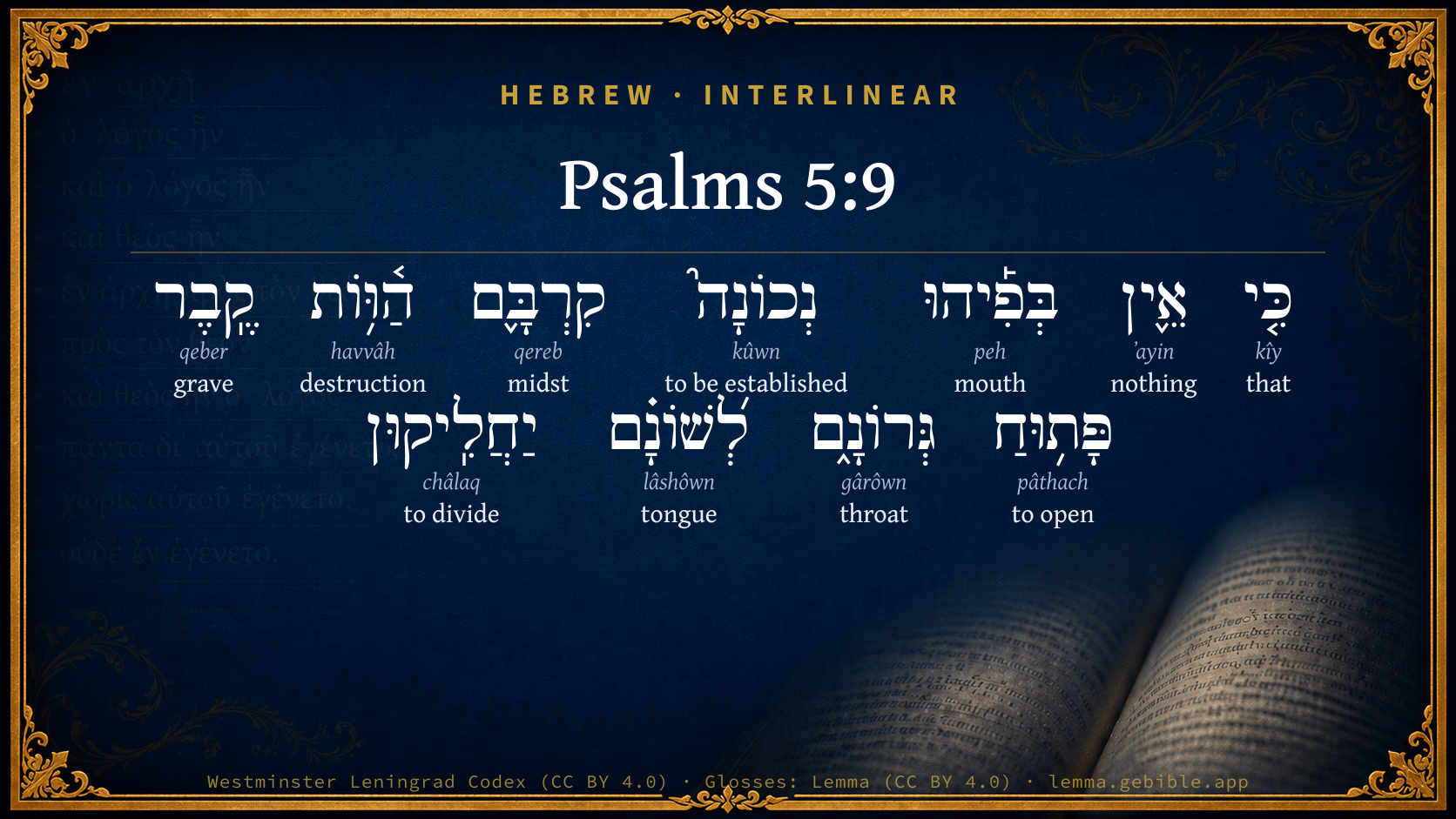
Hebrew (Westminster Leningrad Codex) Psalms 5:9 appears in the Hebrew Old Testament. The text above is from the Westminster Leningrad Codex. Each word links to its Strong’s number, a concise gloss, and parsing drawn from the Open Scriptures Hebrew Bible morphology. Click any word for its full Brown-Driver-Briggs (BDB) entry.
Download image
Cite this verse

Psalms 5:9 (World English Bible). Public Domain. Lemma interlinear Bible study tool, https://lemma.gebible.app/v/psalms/5/9.

Show BibTeX & RIS
BibTeX
RIS
English Translation
For there is no faithfulness in their mouth. Their heart is destruction. Their throat is an open tomb. They flatter with their tongue.
World English Bible · Public Domain
Highlights
  • 1 first appearance in the Hebrew Bible
Full analysis ↓
Download a study sheet

One document with this verse’s original text, its word-by-word gloss line, the meaning frame, cross-references with their text, attributed commentary, and full source and license credits — printable, and it pastes into notes with its structure intact.

This verse Autodidact and up

Study sheet (.html) Plain text (.txt)

A passage Seminary Student

Up to 50 verses in one chapter. A passage sheet keeps up to 6 commentary sources and 12 cross-references per verse, in the order this page ranks them, and says so on the sheet whenever that leaves anything out. Ask for a single verse and you get the Autodidact verse sheet above.

Everything on this page stays free to read, with no account — the sheet is a download of what is already on screen, not access to it.

Want to remove ads? Support Godless Engineer
Compare translations 3

The same verse in 3 English versions, stacked beneath the original-language interlinear above. Click any original word for its lexicon entry.

Each is an independent rendering of the whole verse — the interlinear is not word-aligned to these translations.

Highlighted words mark where these versions differ — a whole-verse word diff, not a word-by-word alignment.

  • World English Bible Public Domain
    For there is no faithfulness in their mouth. Their heart is destruction. Their throat is an open tomb. They flatter with their tongue.
  • King James Version Public Domain
    For there is no faithfulness in their mouth; their inward part is very wickedness; their throat is an open sepulchre; they flatter with their tongue.
  • unfoldingWord Literal Text CC BY-SA 4.0
    For there is no firmness in his mouth; their inward being is destruction. An open tomb is their throat; their tongue they make smooth.

unfoldingWord Literal Text — © unfoldingWord, licensed CC BY-SA 4.0. Word-aligned USFM3 via Door43 (git.door43.org/unfoldingWord/en_ult).

Versions to compare (up to 4)

3 of 4 selected

Show all 18 translations

Every available English version of this verse, each an independent rendering of the whole verse.

  • World English Bible Public Domain
    For there is no faithfulness in their mouth. Their heart is destruction. Their throat is an open tomb. They flatter with their tongue.
  • Berean Standard Bible Public Domain
    For not a word they speak can be trusted; destruction lies within them. Their throats are open graves; their tongues practice deceit.
  • Majority Standard Bible Public Domain
    For not a word they speak can be trusted; destruction lies within them. Their throats are open graves; their tongues practice deceit.
  • King James Version Public Domain
    For there is no faithfulness in their mouth; their inward part is very wickedness; their throat is an open sepulchre; they flatter with their tongue.
  • American Standard Version (1901) Public Domain
    For there is no faithfulness in their mouth; Their inward part is very wickedness; Their throat is an open sepulchre; They flatter with their tongue.
  • Revised Version (1885) Public Domain
    For there is no faithfulness in their mouth; their inward part is very wickedness: their throat is an open sepulchre; they flatter with their tongue.
  • Geneva Bible (1599) Public Domain
    For no constancie is in their mouth: within, they are very corruption: their throte is an open sepulchre, and they flatter with their tongue.
  • Douay-Rheims (1899) Public Domain
    Conduct me, O Lord, in thy justice: because of my enemies, direct my way in thy sight.
  • Young's Literal Translation Public Domain
    For there is no stability in their mouth. Their heart `is' mischiefs, An open grave `is' their throat, Their tongue they make smooth.
  • Literal Standard Version CC BY-SA 4.0
    For there is no stability in their mouth. Their heart [is] mischiefs, || Their throat [is] an open grave, || They make their tongue smooth.
  • Unlocked Literal Bible CC BY-SA 4.0
    For there is no truth in their mouth; their inward being is wicked; their throat is an open tomb; they flatter with their tongue.
  • unfoldingWord Literal Text CC BY-SA 4.0
    For there is no firmness in his mouth; their inward being is destruction. An open tomb is their throat; their tongue they make smooth.
  • Darby Bible Public Domain
    For there is no certainty in their mouth; their inward part is perversion, their throat is an open sepulchre; they flatter with their tongue.
  • World Messianic Bible Public Domain
    For there is no faithfulness in their mouth. Their heart is destruction. Their throat is an open tomb. They flatter with their tongue.
  • Webster's Bible Public Domain
    \\5:8\\Lead me, O LORD, in thy righteousness, because of my enemies; make thy way straight before my face.
  • Free Bible Version CC BY-SA 4.0
    Nothing they say can be trusted; their main desire is to destroy. Their throat is like an open grave; their tongues are full of flattery.
  • Bible in Basic English Public Domain
    For no faith may be put in their words; their inner part is nothing but evil; their throat is like an open place for the dead; smooth are the words of their tongues.
  • JPS Tanakh (1917) Public Domain
    (5-10) For there is no sincerity in their mouth; their inward part is a yawning gulf, their throat is an open sepulchre; they make smooth their tongue.

Literal Standard Version (2020), Covenant Press — licensed CC BY-SA 4.0. Text via the HelloAO Bible API (eBible.org). Unlocked Literal Bible (unfoldingWord) — licensed CC BY-SA 4.0. Text via the HelloAO Bible API (eBible.org). unfoldingWord Literal Text — © unfoldingWord, licensed CC BY-SA 4.0. Word-aligned USFM3 via Door43 (git.door43.org/unfoldingWord/en_ult). Free Bible Version, Dr. Jonathan Gallagher — licensed CC BY-SA 4.0. Text via the HelloAO Bible API (eBible.org).

Word by word

More ways to search: Search by grammar → Find every occurrence → Compare this word →

Practice this passage: Drill this verse → Learn its vocabulary →

גְּרוֹנָ֑ם
gârôwn
H1627
“throat · their”
Noun, Common, Masculine, Singular, Construct + Suffix, Personal, 3rd Person, Masculine, Plural
Part of Speech
Noun
Type
Common
Gender
Masculine
Number
Singular
State
Construct
Full BDB Definition

Origin: from H1641

TWOT: 378a

neck, throat - neck - throat - of open sepulchre (figuratively)
  1. כִּ֤י kîy H3588 “that” Conjunction
  2. אֵ֪ין ʼayin H369 “nothing” Particle, Negative
  3. בְּפִ֡יהוּ peh H6310 “in/at · mouth · his” Preposition + Noun, Common, Masculine, Singular, Construct + Suffix, Personal, 3rd Person, Masculine, Singular
  4. נְכוֹנָה֮ kûwn H3559 “being established” Verb, Niphal, Participle Active, Feminine, Singular, Absolute
  5. קִרְבָּ֪ם qereb H7130 “midst · their” Noun, Common, Masculine, Singular, Construct + Suffix, Personal, 3rd Person, Masculine, Plural
  6. הַ֫וּ֥וֹת havvâh H1942 “destruction” Noun, Common, Feminine, Plural, Absolute
  7. קֶֽבֶר qeber H6913 “grave” Noun, Common, Masculine, Singular, Absolute
  8. פָּת֥וּחַ pâthach H6605 “opened” Verb, Qal, Participle Passive, Masculine, Singular, Absolute
  9. לְ֝שׁוֹנָ֗ם lâshôwn H3956 “tongue · their” Noun, Common, Both, Singular, Construct + Suffix, Personal, 3rd Person, Masculine, Plural
  10. יַחֲלִֽיקוּן châlaq H2505 “to divide” Verb, Hiphil, Imperfect, 3rd Person, Masculine, Plural + Suffix, n

About this verse

These counts appear in no published source. They are computed here, from the morphology-tagged text and Lemma’s own curated glosses. What Lemma adds →

11
words
11
distinct lemmas
Wisdom
section

Notable vocabulary

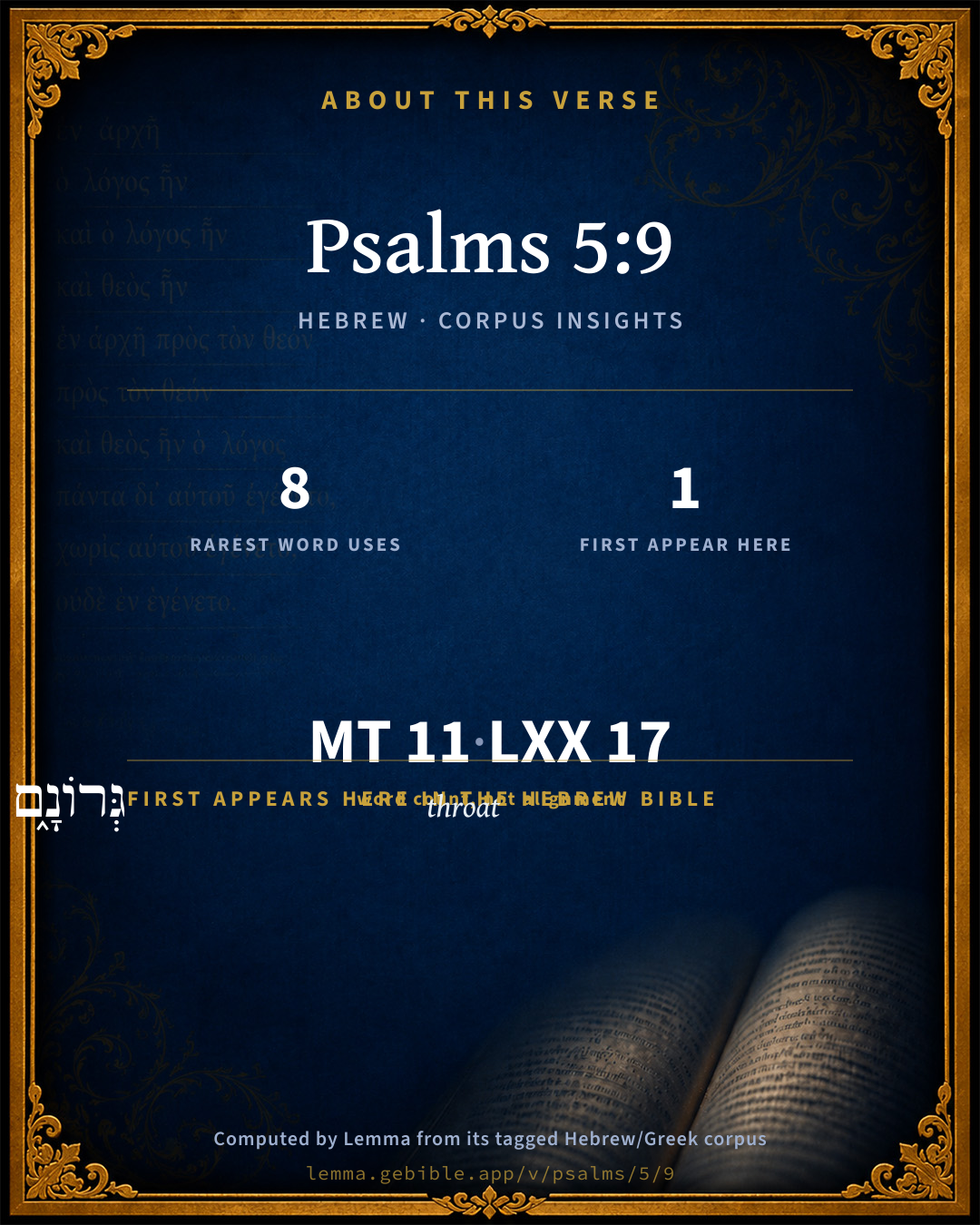
The rarest word here is גְּרוֹנָ֑ם throat H1627 — appearing just 8 times in the whole Hebrew Bible.

First appearance in Scripture

This word makes its first canonical appearance in the Hebrew Bible here:

  • גְּרוֹנָ֑ם throat H1627

Shared distinctive vocabulary

גְּרוֹנָ֑ם throat H1627 occurs in 8 verses of the Hebrew Bible. Also found in:

Grammatical profile

  • 3 verbs
  • 6 nouns
  • 1 conjunction
  • 1 particle

Verb forms

  • נְכוֹנָה֮ Niphal · Participle Active
  • פָּת֥וּחַ Qal · Participle Passive
  • יַחֲלִֽיקוּן Hiphil · Imperfect

Hebrew & Septuagint length

In English translation the verse runs 23 words from the Hebrew and 25 from the Septuagint (LXX English) — closely comparable.

A rough comparison of the two English renderings, which tokenize alike — not a word-level alignment.

Word counts can differ between the Hebrew and the Greek without any difference in meaning — e.g. the Hebrew direct-object marker אֵת has no separate Greek word, and Greek often adds the article ὁ.

In the original languages it is 11 Hebrew tokens and 17 Greek tokens — but the two are counted differently (Hebrew bundles its prefixes and suffixes into one token; the Greek is in lemma form), so that isn’t a like-for-like length.

Cross-references

21

Topical passages linked to Psalms 5:9 in the Treasury of Scripture Knowledge — connected by theme and wording, ordered by reader-vote popularity; previews shown in the World English Bible.

  • Jeremiah 9:3–6 They bend their tongue, [as it were] their bow, for falsehood; and they are grown strong in the land, but not for truth: for they proceed from evil to evil, and they don't know me, says Yahweh.
  • Romans 3:13 "Their throat is an open tomb. With their tongues they have used deceit." "The poison of vipers is under their lips;"
  • Psalms 62:4 They fully intend to throw him down from his lofty place. They delight in lies. They bless with their mouth, but they curse inwardly. Selah.
  • Micah 6:12 Her rich men are full of violence, Her inhabitants speak lies, And their tongue is deceitful in their speech.
  • Proverbs 29:5 A man who flatters his neighbor, Spreads a net for his feet.
  • Psalms 51:6 Behold, you desire truth in the inward parts. You teach me wisdom in the inmost place.
  • Psalms 52:2 Your tongue plots destruction, Like a sharp razor, working deceitfully.
  • Luke 11:44 Woe to you, scribes and Pharisees, hypocrites! For you are like hidden graves, and the men who walk over them don't know it."
  • Psalms 12:2–3 Everyone lies to his neighbor. They speak with flattering lips, and with a double heart.
  • Psalms 64:6 They plot injustice, saying, "We have made a perfect plan!" Surely man's mind and heart are cunning.
  • Jeremiah 17:9 The heart is deceitful above all things, and it is exceedingly corrupt: who can know it?
  • Job 32:21–22 Please don't let me respect any man's person, Neither will I give flattering titles to any man.
  • Psalms 36:1–4 An oracle is within my heart about the disobedience of the wicked: "There is no fear of God before his eyes."
  • Psalms 58:2–3 No, in your heart you plot injustice. You measure out the violence of your hands in the earth.
  • Psalms 62:9 Surely men of low degree are just a breath, And men of high degree are a lie. In the balances they will go up. They are together lighter than a breath.
  • Psalms 111:1–3 Praise Yah! I will give thanks to Yahweh with my whole heart, In the council of the upright, and in the congregation.
  • Jeremiah 4:14 Jerusalem, wash your heart from wickedness, that you may be saved. How long shall your evil thoughts lodge within you?
  • Mark 7:21–22 For from within, out of the hearts of men, proceed evil thoughts, adulteries, sexual sins, murders, thefts,
  • Romans 1:29–31 being filled with all unrighteousness, sexual immorality, wickedness, covetousness, maliciousness; full of envy, murder, strife, deceit, evil habits, secret slanderers,
  • Luke 11:39 The Lord said to him, "Now you Pharisees cleanse the outside of the cup and of the platter, but your inward part is full of extortion and wickedness.
  • 1 Thessalonians 2:5 For neither were we at any time found using words of flattery, as you know, nor a cloak of covetousness (God is witness),

Cross-references courtesy of OpenBible.info (CC BY 4.0).

Hebrew and Greek witnesses Masoretic Hebrew ↔ Greek Septuagint

The same verse in the two great witnesses to the Old Testament, shown verse-for-verse.

You’re reading Greek Psalm 5 (Hebrew Psalm 5). The Septuagint counts the superscription, so verse numbers can differ from the Hebrew — chapter-level alignment, not verse-by-verse. Numbering follows Rahlfs.

These are two independent witnesses, not word-aligned to each other, and the Septuagint is shown in lemma (dictionary) form.

Hebrew Psalms 5:9 Masoretic · Westminster Leningrad Codex

כִּ֤י אֵ֪ין בְּפִ֡יהוּ נְכוֹנָה֮ קִרְבָּ֪ם הַ֫וּ֥וֹת קֶֽבֶר פָּת֥וּחַ גְּרוֹנָ֑ם לְ֝שׁוֹנָ֗ם יַחֲלִֽיקוּן

For there is no faithfulness in their mouth. Their heart is destruction. Their throat is an open tomb. They flatter with their tongue.

World English Bible · Public Domain

Greek LXX Greek Psalm 5:9 Septuagint · lemma form

κύριος ὁδηγέω ἐγώ ἐν ὁ δικαιοσύνη σύ ἕνεκα ὁ ἐχθρός ἐγώ καταεὐθύνω ἐνώπιον ἐγώ ὁ ὁδός σύ

For there is no truth in their mouth; their heart is vain; their throat is an open sepulchre; with their tongues they have used deceit.

LXX2012 (modern English Septuagint) · Public Domain

On this verse, John Gill's Exposition discusses the Septuagint’s reading. Read the note in Commentary ↓

Hebrew: Westminster Leningrad Codex (CC BY 4.0). Greek: Septuagint (public domain); English from LXX2012 (modern English Septuagint) (Public Domain). How the Septuagint differs from the Hebrew →

Commentary

Notes on Psalms 5:9 from classic Christian and Jewish commentators (each source and its license shown beneath its notes). The classic Christian expositions comment on the surrounding passage and are grouped to its opening verse, so a note may address several verses; the Jewish commentaries on the Tanakh (Rashi and others) are per-verse, so they appear only where the commentator wrote on this verse.

Lemma curates 59 commentaries, every one of them public domain or Creative Commons licensed, each selected and text-cleaned for this edition rather than reprinted as found. About our sources →

Trapp's Complete Commentary

John Trapp

Psa 5:9 For [there is] no faithfulness in their mouth; their inward part [is] very wickedness; their throat [is] an open sepulchre; they flatter with their tongue.

Ver. 9. Nor there is no faithfulness in their mouth] Or, stedfastness; nothing that a man may bind or build upon, so slippery they are and untrustworthy.

Their inward part is very wickedness] Heb. woeful evils, heavy annoyances; their hearts are the devil’s storehouses.

Their throat is an open sepulchre] And so more dangerous than if it were shut, saith Aben Ezra here. In these open sepulchres, sending out much foul stench, they frequently bury the good names of their betters. But the comfort is, that there shall one day be a resurrection as well of names as of bodies. This the apostle accommodateth, Rom 3:13, to the universal corruption of mankind; and well he might, forasmuch as by nature there is never a better of us, but as there were many Marii in one Caesar, so are there many Doegs and Absaloms in the best of us all. As in water face answereth to face, so doth the heart of a man to a man.

They flatter with their tongue] The apostle, Rom 3:13, rendereth it, "With their tongues they have used deceit." And it is remarkable, that in the anatomy of a natural man there he stands more on the organs of speech, tongue, lips, mouth, throat, than on all the rest of the members.

John Trapp, A Commentary or Exposition upon All the Books of the Old and New Testament (1647–1656) — public domain. Text from a community e-Sword module.

Joseph Benson's Commentary

Psa 5:9. There is no faithfulness in their mouth — They speak one thing and mean another, and under a pretence of kindness seek my destruction; which renders it difficult for me to know how I ought to carry myself toward them, and therefore I have asked thy direction. Their inward part is very wickedness — Hebrew, קרבם הוות, kirbam havvoth, literally, woes, sorrows, or mischiefs, are within them. The word seems to have a meaning derived from the sound, הוה, eue, or הוי, hoe, any thing upon which we pronounce a wo; evil of any kind, natural or moral. “Their inward part is all woful, execrable stuff, or rottenness, which sends forth nauseous steams, as though it were a sepulchre open.” — Mudge. Their throat is an open sepulchre — Their speech coming out of their throat though smooth and subtle, is most pernicious: or, their mouth and throat are opened wide, ready to devour all that come within their reach: a metaphor taken from wild beasts gaping for the prey. They flatter with their tongue — They make a show of piety and friendship that they may more easily deceive and destroy. The reader will recollect that “a part of this verse is cited, Rom 3:13, together with several other passages from the Psalms and prophets, to evince the depravity of mankind; whether Jews or Gentiles, till justified by faith, and renewed by grace. It is plain, therefore, that the description was designed for others besides the enemies of the literal David, and is of more general import, reaching to the world of the ungodly, and the enemies of all righteousness, as manifested in the person of the Messiah, and in his church.” — Horne.

Joseph Benson's Commentary on the Old and New Testaments (1811–1818) — public domain. Text from a community e-Sword module.

Tyndale Open Study Notes

Tyndale Open Resources

5:9-10 The psalmist again describes the vile acts of the wicked, who cannot stand in God’s presence.

Tyndale Open Study Notes — © Tyndale Open Resources, licensed CC BY-SA 4.0. Text via the HelloAO Bible API.

Jamieson, Fausset & Brown

Robert Jamieson, A. R. Fausset & David Brown

The wicked are not reliable because by nature they are full of wickedness, or literally, "wickednesses," of every kind (Rom 8:7).

sepulchre--a dwelling-place of corruption, emitting moral putridness.

flatter--or, "make smooth."

their tongue--speaks deceitfully.

Jamieson, Fausset & Brown — Commentary Critical and Explanatory on the Whole Bible (1871) — public domain (CC PDM 1.0). Text via the HelloAO Bible API.

Adam Clarke's Commentary

Verse 9. No faithfulness in their mouth] They make professions of friendship; but all is hollow and deceitful: "They flatter with their tongue."

Very wickedness] Their heart is full of all kinds of depravity.

Their throat is an open sepulchre] It is continually gaping for the dead; and sends forth effluvia destructive to the living. I fear that this is too true a picture of the whole human race, totally corrupt within, and abominable without. The heart is the centre and spring of this corruption; and the words and actions of men, which proceed from this source, will send out incessant streams of various impurity; and thus they continue till the grace of God changes and purifies the heart.

Adam Clarke's Commentary on the Bible (1810–1826) — public domain. Text from a community e-Sword/MySword module.

John Calvin's Commentaries

9. For there is no faithfulness in their mouth. He still repeats the same complaints which he made before, in order thereby to render his enemies the more odious in the sight of God, and to call forth in his own behalf the mercy of God, who has promised to succor those who are unjustly oppressed. And this is to be particularly attended to, that the more our enemies manifest their cruelty against us, or the more wickedly they vex us, we ought, with so much the greater confidence, to send up our groanings to heaven, because God will not suffer their rage to proceed to the uttermost, but will bring forth their malice and wicked devices to the light. In the first place, he accuses them of treachery, because they speak nothing uprightly, or in sincerity; and the cause which he assigns for this is, that inwardly they are full of iniquity. He next compares them to sepulchres, their throat is an open sepulcher; as if he had said, they are devouring gulfs; “Gouffres qui devorent tout.” — Fr. “Gulfs which devour all.”

When Paul, (Romans 3:13,) in quoting this passage, extends it to all mankind, both Jews and Gentiles, he does not give to it a meaning of greater latitude than the Holy Spirit intended to give. Since he takes it as an undeniable point, that under the person of David, there is here described to us the church, both in the person of Christ, who is the head, and in his members, it follows that all those ought to be reckoned among the number of his enemies, who have not been regenerated by the Spirit of God, whether they are without the pale of the visible church, or within it. For David, in this passage, does not summons either the Assyrians or the Egyptians to the judgment-seat of God, but the degenerate Jews, who, being circumcised in the flesh, gloried in their descent from the holy lineage of Abraham. Paul, therefore, does not wrest these words from their genuine meaning when he applies them to all mankind, but asserts, with truth, that David showed in them what is the character of the whole human family by nature.

John Calvin's Commentaries (1540-1563) — public domain. Text from the Calvin Translation Society English edition (1840s-50s) via the Christian Classics Ethereal Library (ccel.org). Calvin's coverage is partial (roughly two-thirds of the Bible); uncommented books and verses are honest gaps, never fabricated. The 19th-century editor's footnotes and remarks are omitted so the notes are faithfully Calvin's own voice.

Ellicott's Commentary for English Readers

(9) In their mouth.—See margin.

Wickedness.—Properly, an abyss, from root “to fall,” hence in parallelism with “open sepulcher” in next clause. This is an instance of introverted parallelism, “mouth” answering to “tongue.” (See Bible Educator, iii. 50.)

An open sepulchre.—At once dangerous and noisome.

Flatter.—Literally, make smooth the tongue. (Comp. Psa_12:2.) Shakespeare uses “smooth tongue.” Comp. also—

“The subtle flend,

Though only strong with anger and disdain,

Dissembled, and this answer smooth returned.”

MILTON, Par. Lost.

A Bible Commentary for English Readers, edited by Charles John Ellicott (1878–1897) — public domain. Text from a community e-Sword module.

The Cambridge Bible for Schools and Colleges

gen. ed. J. J. S. Perowne

9. The reason for the Psalmist’s special need of guidance is the treacherous character of his enemies. There is no stedfastness, nothing upon which he can depend, in their talk: their inmost heart is bent on destruction (lit. is destructions, or perhaps, as R.V. marg., a yawning gulf): their throat, the instrument of speech (Psa_115:7, Psa_149:6), threatens death like an open grave, though their words are so smooth and specious.

The Cambridge Bible for Schools and Colleges (gen. ed. J. J. S. Perowne; Cambridge University Press, 1878–1918) — public domain. Text from a community e-Sword module.

John Gill's Exposition

For there is no faithfulness in their mouth,.... In the mouth of the ungodly, as the Chaldee paraphrase; in the mouth of every one of them, as Aben Ezra interprets it: that is, in the mouth of every wicked, bloody, and deceitful man; of everyone of David's enemies, as Saul, or the conspirators with Absalom his son. There was no steadfastness in them; nothing right, sure, or firm said by them; nothing that could be depended upon; there was "no truth" in them, as the Septuagint, Vulgate Latin, Arabic, and Ethiopic versions render it. And as this was true of David's, so of Christ's enemies; of Herod, and of the Herodians, and of the Scribes and Pharisees; see Mat 2:8; and of the enemies of Christ's Gospel; of all false teachers, who speak not the word faithfully; tell dreams, use the hidden things of dishonesty, walk in craftiness, handle the word of God deceitfully, and speak lies in hypocrisy: there is no certainty in them, nor is any thing they say to be trusted to. And this is the character of wicked men in common: they are an assembly of treacherous men; there is none upright among them; nor is any confidence to be placed in them: the people of God are in danger of being imposed upon and misled by them to their hurt; and therefore the psalmist prays, that the Lord would lead him in his righteousness;

their inward part is very wickedness; their heart, which is desperately wicked, exceeding sinful; not only wicked, and very wicked, but wickedness itself. This is the root and fountain of all wickedness, and the reason why there is no faithfulness in their mouth: the word (m) is sometimes rendered, "their inward thought", Psa 49:11; which is the inmost of man, the nearest to him; and which, and even the imagination of it, is evil, and that continually: the word (n) translated "wickedness" signifies woes, calamities, and mischiefs; and such the wicked hearts of men are full of, and are continually devising against the people of God, and his righteous cause. And this is the just character of ungodly men, even though they may profess to know God, have a form of godliness, and be outwardly righteous before men; as these were David was concerned with;

their throat is an open sepulchre; or as one, as the Targum paraphrases it; to which the throat of wicked men may be compared for its voracity and insatiableness; the grave being one of those three or four things, which never has enough or is satisfied. And this is true of the throat, whether it be considered as an instrument of speech, and throws out devouring words to the prejudice of the characters and reputations of others; or as an instrument of swallowing meat and drink, and where the pleasure of appetite is; and so may be expressive of the eager desire of the wicked after sin, who drink up iniquity like water; and of their delight in it, and their fulness of it, and yet still greedy, insatiable, and not to be satisfied: and their throat may be compared to an open grave for the nauseous stench it emits; corrupt communication, filthiness, and foolish talking, proceeding out of it; and horrible oaths, curses, imprecations, and blasphemies, being belched out through it; and for the danger which is by it, since into it men may fall unawares; and so the evil communications of wicked men corrupt good manners, and do great mischief to those who fall into company with them;

they flatter with their tongue; or, "make it smooth" (o); use oily expressions, soft language: or, "part" or "divide" (p) their tongue; are double tongued and double hearted; and so deceive persons, as the apostle interprets it in Rom 3:13. They flatter God himself, drawing nigh to him in an hypocritical way; they flatter men, their neighbours, and impose upon them; they flatter princes, and such parasitic people were about David. And such are false teachers, who prophesy smooth things, and with good words and fair speeches deceive the hearts of the simple; or, which account there is great reason to pray to be led and directed by the Lord.

(m) , Sept. "cor", V. L. i.e. "cogitatio", Muis. (n) "aerumuae", Junius & Tremellius, Piscator, Gejerus; "calamitates", Cocceius; so Ainsworth. (o) "levigant, seu emolliunt", Piscator, Gejerus. (p) "Divident vel dispertient", Mariana.

John Gill's Exposition of the Whole Bible (1746–1763) — public domain (CC PDM 1.0). Text via the HelloAO Bible API.

Albert Barnes' Notes on the Bible

For there is no faithfulness in their mouth - There is nothing in them which can be confided in; nothing in their promises and declarations. They are false and treacherous, and I can, therefore, only appeal to thee. It is easy to see the propriety of this statement, and of those which follow, on the supposition that this refers to the rebellion of Absalom. Absalom had gone to Hebron on a false pretence 2Sa 15:7-10, and every act of his in this whole transaction had been treacherous and false.

Their inward part - Not only their external conduct, but their hearts, their principles, their motives. This was fairly to be inferred from their conduct. The object of the psalmist is to show that they were wholly depraved in all that properly constitutes character or that entered into moral conduct.

Their throat is an open sepulchre - That is, as the grave is open to receive its victim, so is their throat open to devour or swallow up the peace and happiness of others. The main idea is that they are false, treacherous, not to be confided in, slanderous. This passage, with the following, is employed by the apostle Paul to demonstrate the universal depravity of man. See the notes at Rom 3:13.

They flatter with their tongue - He had referred to the “inward part,” or the “heart,” and to the “throat” as being depraved and evil; he now refers to another member of the body as being equally depraved - the “tongue.” Instead of being employed to utter truth, and to give expression to the real feelings of the heart, it was employed to flatter others, with a view to lead them astray, or to make use of them for base and selfish purposes. The propriety of this representation as applicable to Absalom and his coadjutors no one can fail to see (compare 2Sa 15:1-6). It is also to an eminent degree the characteristic of the wicked in general. On this, also, see the notes at Rom 3:13.

Albert Barnes' Notes on the Bible (1834–1885) — public domain. Text from a community e-Sword/MySword module.

Matthew Poole's English Annotations

They speak one thing, and mean another, and under a pretence of kindness they seek my destruction; which makes it difficult for me to know how I should carry myself to them; wherein therefore I have begged thy direction.

Their throat; either,

1. Metonymically; their speech coming out of their throat, though smooth and subtle, yet is most pernicious. Or,

2. Properly; their throat and mouth are wide opened, ready to devour all that come within their reach. A metaphor from wild beasts gaping for the prey.

They flatter with their tongue; they make show of piety and friendship, that they may more easily deceive and destroy me.

Matthew Poole's English Annotations on the Holy Bible (1683–1685) — public domain. Text from a community e-Sword/MySword module.

The Treasury of David

Charles H. Spurgeon

Ver. 9. Their throat is an open sepulchre. This figure graphically portrays the filthy conversation of the wicked. Nothing can be more abominable to the senses than an open sepulchre, when a dead body beginning to putrefy steams forth its tainted exhalations. What proceeds out of their mouth is infected and putrid; and, as the exhalation from a sepulchre proves the corruption within, so it is with the corrupt conversation of sinners. Robert Haldane's "Expositions of the Epistle to the Romans," 1835.

Ver. 9. Their throat is an open sepulchre. This doth admonish us, (1) that the speeches of natural unregenerate men are unsavory, rotten, and hurtful to others; for, as a sepulchre doth send out noisome savours and filthy smells, so evil men do utter rotten and filthy words. (2) As a sepulchre doth consume and devour bodies cast into it, so wicked men do with their cruel words destroy others; they are like a gulf to destroy others. (3) As a sepulchre, having devoured many corpses, is still ready to consume more, being never satisfied, so wicked men, having overthrown many with their words, do proceed in their outrage, seeking whom they may devour. Thomas Wilson, 1653.

Ver. 9. Their inward part, etc. Their hearts are storehouses for the devil. John Trapp.

None.

Ver. 10. Against thee: not against me. If they were my enemies I would forgive them, but I cannot forgive thine. We are to forgive our enemies, but God's enemies it is not in our power to forgive. These expressions have often been noticed by men of over refinement as being harsh, and grating on the ear. "Oh!" say they, "they are vindictive and revengeful." Let us remember that they might be translated as prophecies, not as wishes; but we do not care to avail ourselves of this method of escape. We have never heard of a reader of the Bible who, after perusing these passages, was made revengeful by reading them, and it is but fair to test the nature of a writing by its effects. When we hear a judge condemning a murderer, however severe his sentence, we do not feel that we should be justified in condemning others for any private injury done to us. The Psalmist here speaks as a judge, ex officio; he speaks as God's mouth, and in condemning the wicked he gives us no excuse whatever for uttering anything in the way of malediction upon those who have caused us personal offence. The most shameful way of cursing another is by pretending to bless him. We were all somewhat amused by noticing the toothless malice of that wretched old priest of Rome, when he foolishly cursed the Emperor of France with his blessing. He was blessing him in form and cursing him in reality. Now, in direct contrast we put this healthy commination of David, which is intended to be a blessing by warning the sinner of the impending curse. O impenitent man, be it known unto thee that all thy godly friends will give their solemn assent to the awful sentence of the Lord, which he shall pronounce upon thee in the day of doom! Our verdict shall applaud the condemning curse which the Judge of all the earth shall thunder against the godless.

In the following verse we once more find the contrast which has marked the preceeding Psalms.

Ver.10. All those portions where we find apparently prayers that breathe revenge, are never to be thought of as anything else than the breathed assent of righteous souls to the justice of their God, who taketh vengeance on sin. When taken as the words of Christ himself, they are no other than an echo of the Intercessor's acquiescence at last in the sentence on the barren fig-tree. It is as if he cried aloud, "Hew it down now, I will intercede no longer, the doom is righteous, destroy them, O God; cast them out in (or, for) the multitude of their transgressions, for they have rebelled against thee." And in the same moment he may be supposed to invite his saints to sympathise in his decision; just as in #Re 18:20, "Rejoice over her, thou heaven, and ye holy apostles and prophets." In like manner when one of Christ's members, in entire sympathy with his Head, views the barren fig-tree from the same point of observation, and sees the glory of God concerned in inflicting the blow, he too can cry, "Let the axe smite!" Had Abraham stood beside the angel who destroyed Sodom, and seen how Jehovah's name required the ruin of these impenitent rebels, he would have cried out, "Let the shower descend; let the fire and brimstone come down!" not in any spirit of revenge; not from want of tender love to souls, but from intense earnestness of concern for the glory of his God. We consider this explanation to be the real key that opens all the difficult passages in this book, where curses seem to be called for on the head of the ungodly. They are no more than a carrying out of #De 27:15-26, "Let all the people say, Amen," and an entering into the Lord's holy abhorrence of sin, and delight in acts of justice expressed in the "Amen, hallelujah," of #Re 19:3. Andrew A. Bonar, 1859.

Ver.10. (Or imprecatory passages generally.) Lord, when in my daily service I read David's Psalms, give me to alter the accent of my soul according to their several subjects. In such Psalms wherein he confesseth his sins, or requesteth thy pardon, or praiseth for former, or prayeth for future favours, in all these give me to raise my soul to as high a pitch as may be. But when I come to such Psalms wherein he curseth his enemies, O there let me bring my soul down to a lower note. For those words were made only to fit David's mouth. I have the like breath, but not the same spirit to pronounce them. Nor let me flatter myself, that it is lawful for me, with David, to curse thine enemies, lest my deceitful heart entitle mine enemies to be thine, and so what was religion in David, prove malice in me, whilst I act revenge under the pretense of piety. Thomas Fuller, D.D., 1608-1661.

Ver.10. Viewed as a threatening. The sentence, Cast them out in the multitude of their transgressions, is specially fitted to be the groundwork of a very solemn discourse.

Ver. 11. Joy is the privilege of the believer. When sinners are destroyed our rejoicing shall be full. They laugh first and weep ever after; we weep now, but shall rejoice eternally. When they howl we shall shout, and as they must groan for ever, so shall we ever shout for joy. This holy bliss of ours has a firm foundation, for, O Lord, we are joyful in thee. The eternal God is the well-spring of our bliss. We love God, and therefore we delight in him. Our heart is at ease in our God. We fare sumptuously every day because we feed on him. We have music in the house, music in the heart, and music in heaven, for the Lord Jehovah is our strength and our song; he also is become our salvation.

None.

Charles H. Spurgeon's The Treasury of David (1869–1885) — public domain. Psalms only. Text from a community e-Sword/MySword module.

Whedon's Commentary on the Bible

Daniel D. Whedon

9. For there is no faithfulness—The particle “for” gives the reason for the prayer in Psa_5:8, namely, the character of his enemies. They have, first, no faithfulness, no fixedness or stability, in their mouth. There is no reliance upon their words, because they seek not truth, and have no settled principles.

In their mouth—Literally, in his mouth; that is, in the month of any one of them.

Their inward part—The word קרב, (kereb,) inward part, when used psychologically, as here, is one of the strongest words in Hebrew to denote inwardness, internality. The word לב, (lebh,) heart, is more local, but not more intensely inward in signification. In the text “inward part” denotes the seat of thought, volition, and desire, which is “wickedness:” Hebrew, wickednesses, the plural used for intensity; hence our Version, “very wickedness.” Here, then, the fountain head, the inmost origin of moral action, is called thorough wickedness, or corruption.

Throat is an open sepulchre—As if ready to receive its victim. Also within is the seat of corruption from which the fumes of death proceed. Mat_23:27. One more touch of the pencil finishes the picture.

They flatter with their tongue—This is the lure to draw unwary souls through the open doorway of the sepulchre into the pit of death.

Daniel D. Whedon (gen. ed.), Commentary on the Old and New Testaments (1874–1909) — public domain. Text from a community e-Sword module.

The Pulpit Commentary

For there is no faithfulness in their mouth; or, no steadfastness sincerity" (Kay, Cheyne); see the comment on ver. 6. Their inward part is very wickedness; literally, wickednesses; i.e. nothing but wickedness. Their throat is an open sepulchre. "Emitting the noisome exhalations of a putrid heart" (Bishop Horns). They flatter with their tongue; literally, they make smooth their tongues, which may, perhaps, include flattery, but points rather to smooth arguments, specious reasonings, and the habit of making the worse appear the better cause (see the comment of Bishop Horsley, "Book of Psalms," vol. 1. pp. 154, 155).

The last two clauses of this verse are quoted by St. Paul, (Rom_3:13) and applied generally to the character of the ungodly.

The Pulpit Commentary (1880–1919), ed. H.D.M. Spence-Jones & Joseph S. Exell — public domain. Text from a community e-Sword module.

John Wesley's Explanatory Notes

Throat - Wide opened ready to devour all that come within their reach. A metaphor from wild beasts gaping for the prey.

John Wesley, Explanatory Notes Upon the Whole Bible (1754–1765) — public domain. Text via the GEBible commentary corpus.

J. A. Alexander on Psalms

Joseph Addison Alexander

9. The Psalmist here begins his prayer and argument anew, pursuing the same order as before. O Lord, Jehovah, lead me, guide me safely, in thy righteousness, i. e. in the exercise of that same justice which destroys my enemies, on account of my enemies, that they may not triumph; make straight before my face thy way, i. e. mark out a safe and easy path for me to tread. The explanation of the way as that of duty and obedience, although not at variance with scriptural usage, is less suited to the context here, in which the prayer throughout is for protection and deliverance.

Joseph Addison Alexander, The Psalms Translated and Explained (1850) — public domain. Text from a community e-Sword module.

unfoldingWord translationNotes

Door43 World Missions Community

General Information:

David talks about his enemies.

For there is no truth in their mouth

Truth being in the mouth represents speaking truthfully. AT: "For they never say what is true" (See: Metonymy)

their inward being is wicked

The inward being represents people's thoughts and desires. AT: "their thoughts and desires are wicked" (See: Metonymy)

their throat

The throat represents people's speech. AT: "their speech" or "what they say" (See: Metonymy)

their throat is an open tomb

Their throat is spoken of as if it were an open tomb, ready for dead bodies to put into it. Possible meanings are 1) "they say that they will kill people" or 2) "What they say kills people" (See: Metaphor)

they flatter with their tongue

"they say nice things about people without really meaning it"

their tongue

The tongue represents what people say. (See: Metonymy)

may their schemes be their downfall

"may their schemes cause them to experience disasters" or "may they become less important because of their schemes"

schemes

plans to harm people

downfall

This is something that causes a person to experience disasters or to lose power. Experiencing disaster or becoming less important is spoken of as falling. (See: Metaphor)

translationWords

true

evil

grave

tongue

guilt

transgress

rebel

unfoldingWord translationNotes — © Distant Shores Media and the Door43 World Missions Community, licensed CC BY-SA 4.0. Source: git.door43.org/Door43/en_tn.

Rashi

Rabbi Shlomo Yitzchaki (Rashi)

those who lie in wait for me Heb. שוררי, those who look after me, who look forward to my betraying You, so that You should forsake me. [The word] שוררי is like (Num. 24:17): “I behold it (אשורינו), but it is not near.”

Rashi on the Tanakh — English translations: “The Judaica Press complete Tanach with Rashi, translated by A. J. Rosenberg” (CC BY 4.0); “Pentateuch with Rashi's commentary by M. Rosenbaum and A.M. Silbermann, 1929-1934” (public domain); “The Metsudah Tanach series, Lakewood, N.J” (CC BY 4.0); and “The Book of Joshua, Metsudah Publications, 1997” (CC BY 4.0). Text via Sefaria.

Radak

Rabbi David Kimhi (Radak)

Lead me, O Lord, in Thy righteousness: – This is my prayer unto Thee, that Thou shouldest lead me in Thy righteousness, meaning that Thou shouldest help me to go in the way of righteousness and justice, and lead me in it so that I may not stumble.

Because of my watchful foes: – That they may not be able to rejoice over me through my stumbling, make straight Thy way before my face. And my watchful foes (שׁררי) – is the equivalent of “my enemies,” and is derived from (the verb) “I spy him (אשׁורנו), but not nigh” (Num. 24:17), because he is looking for evil, as (in the verse) “Saul eyed David” (1 Sam. 18:9). And this prayer is that He (God) should deliver him from faults and from deliberate sins, as he says (in the verses Ps. 19:13, 14): “Clear me from hidden (faults); moreover, from deliberate sins restrain Thy servant.”

Make Thy way plain before my face: – הישׁר (“make plain”) has the yodh of the first radical pronounced, unlike verbs in which the first radical is quiescent; and a similar case to it is אתך היצא (“Bring forth with thee,” Gen. 8:17). And Kethib has waw on the analogy of verbs with the first radical quiescent; and so with the pathah of the second radical (הושר הישַׁר), as also (in the verse): “Cause Thy mighty ones to come down (המחת), O Lord” (Joel 4:11).

Radak on the Tanakh — English translations: “Sefaria Community Translation” (CC0 1.0 (public-domain dedication)); “Eliyahu Munk, HaChut Hameshulash” (CC BY 4.0); “Rabbi Mike Feuer, Jerusalem Anthology” (CC BY 4.0); and “R. David Kimhi on the first book of Psalms, Translated by R.G. Finch, London, 1919” (public domain). Text via Sefaria.

Ibn Ezra

Rabbi Abraham ibn Ezra

Ad-nai [lead me] (ה' - Ad-nai): The beginning/essence of my prayer (techilat tefilati) is that You lead me (she-tancheni) in the way of Your righteousness (be-derekh tzidkatekha).

Because of my watchful foes (לְמַעַן שׁוֹרְרָי - lema'an shorerai): For I fear that my foot will slip (she-tim'ad ragli) and You will punish me (ve-ta'anisheni); then my watchful foes (shorerai) will rejoice. And its meaning [the meaning of shorerai] is from the root/sector (mi-gizrat) of (Numbers 24:17): "I behold him" (ashurennu), but not near." [It means] like one who eyes David hostilely (עוֹיֵן אֶת דָּוִד - o'yen et David, cf. I Samuel 18:9), those who watch intently (ha-mistaklim) for a day of calamity (be-yom ra'ah).

And the word Make straight (הַיְשַׁר - hay'shar) is [an imperative form] like [hay'tze] in (Genesis 8:17): "Bring out with you" (hay'tze itakh).

Ibn Ezra on the Tanakh — English translations: “Sefaria Community Translation” (CC0 1.0 (public-domain dedication)); “Yalkut, Sifsei Chachomim Chumash, Metsudah Publications, 2009” (CC BY 4.0); and “Commentary of Ibn Ezra on Isaiah - trans. by M. Friedlander, 1873” (public domain). Text via Sefaria.

Lesson kit

Teaching starters — assembled from the data on this page, not authored interpretation. Every prompt links to the verse data it draws on. Edit before teaching.

Psalms, in the Wisdom, opens this verse with 11 words (11 distinct Hebrew lemmas). Its most distinctive word is gârôwn (“throat”). A historical commentator’s framing appears above. Read the whole chapter for the surrounding context.

Discussion questions

  1. What does “throat” (gârôwn) contribute to the verse as a whole?
  2. The word “throat” first appears here in Scripture. What is being introduced at this debut?
  3. Psalms 69:3 shares the word «throat» with this verse. How do the two illuminate each other?
  4. These translations render this verse differently. What is at stake in choosing one wording over another?
  5. The verb «נְכוֹנָה֮» is Niphal Participle Active. How does its form color the action?
  6. Reading how Trapp's Complete Commentary and Joseph Benson's Commentary read this verse, where do the two commentators agree and where do they part?

Things to notice

Reading settings

Reading text

Shown beneath each verse's original-language words.

Old Testament
Old Testament edition

Read the OT as the Masoretic Hebrew (MT) or the Greek Septuagint (LXX).

English shown for the Greek Septuagint (in the Hebrew ↔ Greek comparison).

Comparing translations? Open the Compare panel on any verse page to stack up to four side by side.