
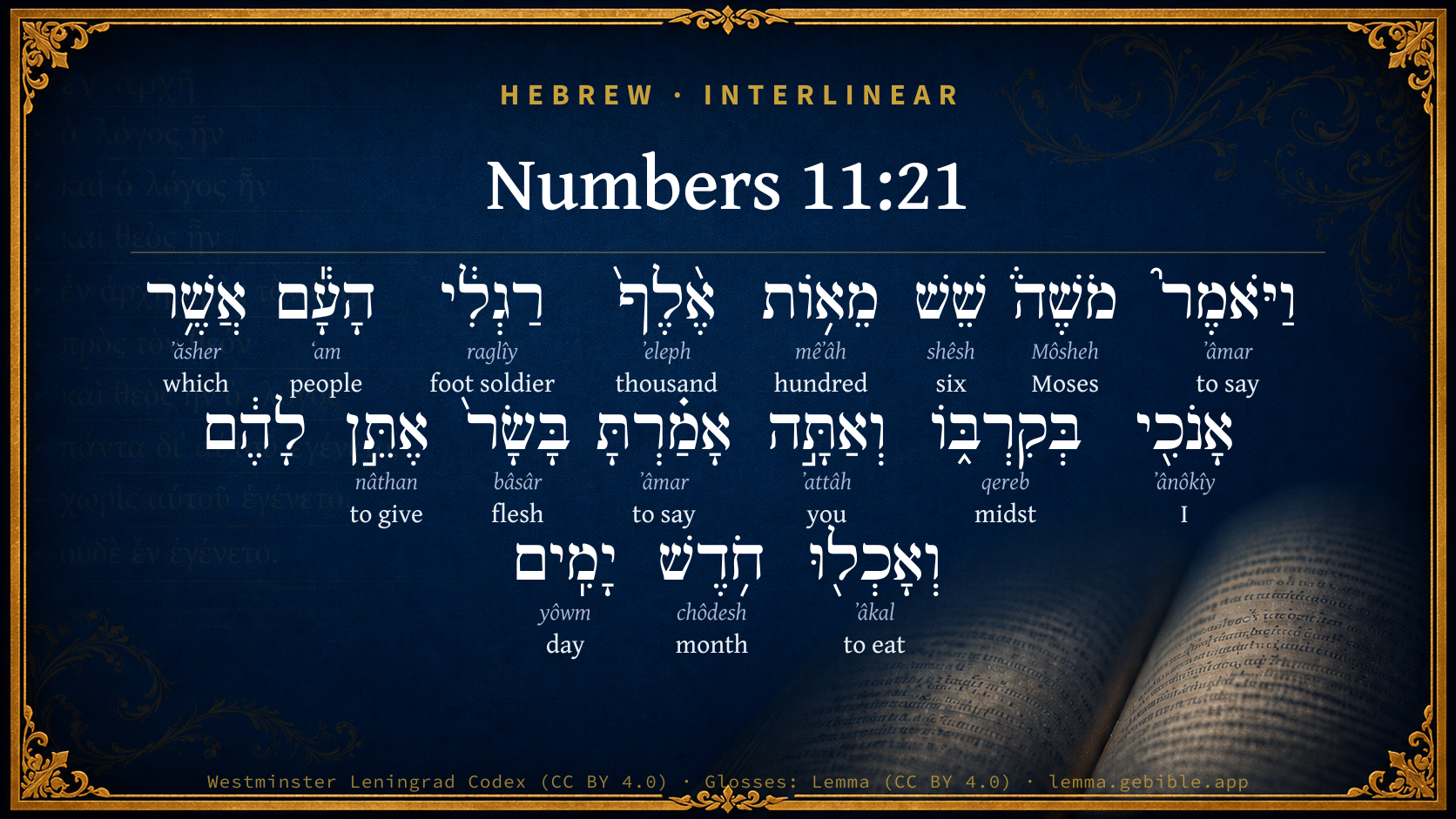
Numbers 11:21

Hebrew (Westminster Leningrad Codex) Numbers 11:21 appears in the Hebrew Old Testament. The text above is from the Westminster Leningrad Codex. Each word links to its Strong’s number, a concise gloss, and parsing drawn from the Open Scriptures Hebrew Bible morphology. Click any word for its full Brown-Driver-Briggs (BDB) entry.
Download image
Cite this verse

Numbers 11:21 (World English Bible). Public Domain. Lemma interlinear Bible study tool, https://lemma.gebible.app/v/numbers/11/21.

Show BibTeX & RIS
BibTeX
RIS
English Translation
Moses said, The people, among whom I am, are six hundred thousand footmen; and you have said, I will give them flesh, that they may eat a whole month.
World English Bible · Public Domain
Download a study sheet

One document with this verse’s original text, its word-by-word gloss line, the meaning frame, cross-references with their text, attributed commentary, and full source and license credits — printable, and it pastes into notes with its structure intact.

This verse Autodidact and up

Study sheet (.html) Plain text (.txt)

A passage Seminary Student

Up to 50 verses in one chapter. A passage sheet keeps up to 6 commentary sources and 12 cross-references per verse, in the order this page ranks them, and says so on the sheet whenever that leaves anything out. Ask for a single verse and you get the Autodidact verse sheet above.

Everything on this page stays free to read, with no account — the sheet is a download of what is already on screen, not access to it.

Want to remove ads? Support Godless Engineer
Compare translations 3

The same verse in 3 English versions, stacked beneath the original-language interlinear above. Click any original word for its lexicon entry.

Each is an independent rendering of the whole verse — the interlinear is not word-aligned to these translations.

Highlighted words mark where these versions differ — a whole-verse word diff, not a word-by-word alignment.

  • World English Bible Public Domain
    Moses said, The people, among whom I am, are six hundred thousand footmen; and you have said, I will give them flesh, that they may eat a whole month.
  • King James Version Public Domain
    And Moses said, The people, among whom I am, are six hundred thousand footmen; and thou hast said, I will give them flesh, that they may eat a whole month.
  • unfoldingWord Literal Text CC BY-SA 4.0
    And Moses said, “The people in whose midst I 600, 000 on foot, but you, you said, ‘I shall give flesh to them, and they shall eat a month of days.’

unfoldingWord Literal Text — © unfoldingWord, licensed CC BY-SA 4.0. Word-aligned USFM3 via Door43 (git.door43.org/unfoldingWord/en_ult).

Versions to compare (up to 4)

3 of 4 selected

Show all 18 translations

Every available English version of this verse, each an independent rendering of the whole verse.

  • World English Bible Public Domain
    Moses said, The people, among whom I am, are six hundred thousand footmen; and you have said, I will give them flesh, that they may eat a whole month.
  • Berean Standard Bible Public Domain
    But Moses replied, “Here I am among 600,000 men on foot, yet You say, ‘I will give them meat, and they will eat for a month.’
  • Majority Standard Bible Public Domain
    But Moses replied, “Here I am among 600,000 men on foot, yet You say, ‘I will give them meat, and they will eat for a month.’
  • King James Version Public Domain
    And Moses said, The people, among whom I am, are six hundred thousand footmen; and thou hast said, I will give them flesh, that they may eat a whole month.
  • American Standard Version (1901) Public Domain
    And Moses said, The people, among whom I am, are six hundred thousand footmen; and thou hast said, I will give them flesh, that they may eat a whole month.
  • Revised Version (1885) Public Domain
    And Moses said, The people, among whom I am, are six hundred thousand footmen; and thou hast said, I will give them flesh, that they may eat a whole month.
  • Geneva Bible (1599) Public Domain
    And Moses saide, Six hundreth thousande footemen are there of the people, among whom I am: and thou saiest, I will giue them flesh, that they may eate a moneth long.
  • Douay-Rheims (1899) Public Domain
    And Moses said: There are six hundred thousand footmen of this people, and sayest thou: I will give them flesh to eat a whole month?
  • Young's Literal Translation Public Domain
    And Moses saith, `Six hundred thousand footmen `are' the people in whose midst I `am'; and Thou, Thou hast said, Flesh I give to them, and they have eaten, a month of days!
  • Literal Standard Version CC BY-SA 4.0
    And Moses says, “Six hundred thousand footmen [are] the people in whose midst I [dwell]; and You, You have said, I give flesh to them, and they have eaten [for] a month of days!
  • Unlocked Literal Bible CC BY-SA 4.0
    Then Moses said, “I am with 600,000 people, and you have said, 'I will give them meat to eat for a whole month.'
  • unfoldingWord Literal Text CC BY-SA 4.0
    And Moses said, “The people in whose midst I 600, 000 on foot, but you, you said, ‘I shall give flesh to them, and they shall eat a month of days.’
  • Darby Bible Public Domain
    And Moses said, The people in whose midst I am are six hundred thousand footmen; and thou sayest, I will give them flesh that they may eat a whole month.
  • World Messianic Bible Public Domain
    Moses said, “The people, among whom I am, are six hundred thousand men on foot; and you have said, ‘I will give them meat, that they may eat a whole month.’
  • Webster's Bible Public Domain
    And Moses said, The people among whom I am, are six hundred thousand footmen; and thou hast said, I will give them flesh, that they may eat a whole month.
  • Free Bible Version CC BY-SA 4.0
    But Moses replied, “Here I am with 600,000 people and you're telling me, ‘I'm going to give them meat and they'll eat it for a month’?
  • Bible in Basic English Public Domain
    Then Moses said, The people, among whom I am, are six hundred thousand men on foot; and you have said, I will give them flesh to be their food for a month.
  • JPS Tanakh (1917) Public Domain
    And Moses said: 'The people, among whom I am, are six hundred thousand men on foot; and yet Thou hast said: I will give them flesh, that they may eat a whole month!

Literal Standard Version (2020), Covenant Press — licensed CC BY-SA 4.0. Text via the HelloAO Bible API (eBible.org). Unlocked Literal Bible (unfoldingWord) — licensed CC BY-SA 4.0. Text via the HelloAO Bible API (eBible.org). unfoldingWord Literal Text — © unfoldingWord, licensed CC BY-SA 4.0. Word-aligned USFM3 via Door43 (git.door43.org/unfoldingWord/en_ult). Free Bible Version, Dr. Jonathan Gallagher — licensed CC BY-SA 4.0. Text via the HelloAO Bible API (eBible.org).

Word by word

More ways to search: Search by grammar → Find every occurrence → Compare this word →

Practice this passage: Drill this verse → Learn its vocabulary →

רַגְלִ֔י
raglîy
H7273
“foot soldier”
Adjective, Adjective, Masculine, Singular, Absolute
Part of Speech
Adjective
Type
Adjective
Gender
Masculine
Number
Singular
State
Absolute
Full BDB Definition

Origin: from H7272

TWOT: 2113b

on foot - man on foot, footman, foot soldier
  1. וַיֹּאמֶר֮ ʼâmar H559 “and · to say” Conjunction + Verb, Qal, Sequential Imperfect, 3rd Person, Masculine, Singular
  2. מֹשֶׁה֒ Môsheh H4872 “Moses” Noun, Proper
  3. שֵׁשׁ shêsh H8337 “six” Adjective, Cardinal number, Feminine, Singular, Absolute
  4. מֵא֥וֹת mêʼâh H3967 “hundred” Adjective, Cardinal number, Both, Plural, Absolute
  5. אֶ֨לֶף֙ ʼeleph H505 “thousand” Adjective, Cardinal number, Both, Singular, Absolute
  6. הָעָ֕ם ʻam H5971 “the · people” Particle, Definite Article + Noun, Common, Masculine, Singular, Absolute
  7. אֲשֶׁ֥ר ʼăsher H834 “which” Particle, Relative
  8. אָנֹכִ֖י ʼânôkîy H595 “I” Pronoun, Personal, 1st Person, Common, Singular
  9. בְּקִרְבּ֑וֹ qereb H7130 “in/at · midst · his” Preposition + Noun, Common, Masculine, Singular, Construct + Suffix, Personal, 3rd Person, Masculine, Singular
  10. וְאַתָּ֣ה ʼattâh H859 “and · you” Conjunction + Pronoun, Personal, 2nd Person, Masculine, Singular
  11. אָמַ֗רְתָּ ʼâmar H559 “to say” Verb, Qal, Perfect, 2nd Person, Masculine, Singular
  12. בָּשָׂר֙ bâsâr H1320 “flesh” Noun, Common, Masculine, Singular, Absolute
  13. אֶתֵּ֣ן nâthan H5414 “to give” Verb, Qal, Imperfect, 1st Person, Common, Singular
  14. וְאָכְל֖וּ ʼâkal H398 “and · to eat” Conjunction + Verb, Qal, Sequential Perfect, 1st Person, Common, Plural
  15. חֹ֥דֶשׁ chôdesh H2320 “month of” Noun, Common, Masculine, Singular, Construct
  16. יָמִֽים yôwm H3117 “days” Noun, Common, Masculine, Plural, Absolute

About this verse

These counts appear in no published source. They are computed here, from the morphology-tagged text and Lemma’s own curated glosses. What Lemma adds →

18
words
16
distinct lemmas
Pentateuch
section

Notable vocabulary

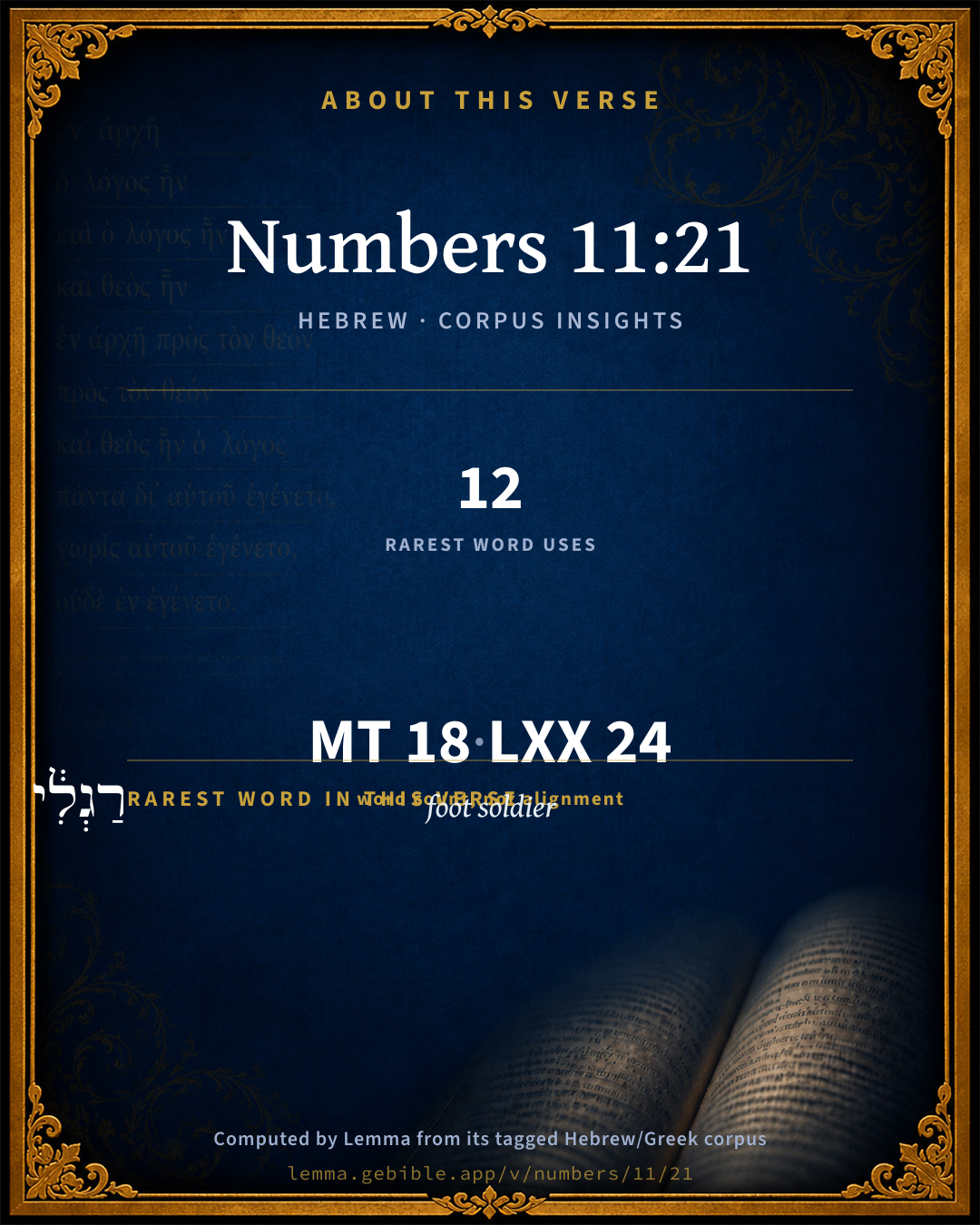
The rarest word here is רַגְלִ֔י foot soldier H7273 — appearing just 12 times in the whole Hebrew Bible.

Shared distinctive vocabulary

רַגְלִ֔י foot soldier H7273 occurs in 12 verses of the Hebrew Bible. Also found in:

Grammatical profile

  • 4 verbs
  • 6 nouns
  • 4 adjectives
  • 2 pronouns
  • 1 preposition
  • 1 particle

Verb forms

  • וַיֹּאמֶר֮ Qal · Sequential Imperfect
  • אָמַ֗רְתָּ Qal · Perfect
  • אֶתֵּ֣ן Qal · Imperfect
  • וְאָכְל֖וּ Qal · Sequential Perfect

Repetition

A word recurs within this verse — often emphatic in Hebrew:

  • וַיֹּאמֶר֮ to say H559 ×2

Hebrew & Septuagint length

In English translation the verse runs 29 words from the Hebrew and 31 from the Septuagint (LXX English) — closely comparable.

A rough comparison of the two English renderings, which tokenize alike — not a word-level alignment.

Word counts can differ between the Hebrew and the Greek without any difference in meaning — e.g. the Hebrew direct-object marker אֵת has no separate Greek word, and Greek often adds the article ὁ.

In the original languages it is 18 Hebrew tokens and 24 Greek tokens — but the two are counted differently (Hebrew bundles its prefixes and suffixes into one token; the Greek is in lemma form), so that isn’t a like-for-like length.

Cross-references

5

Topical passages linked to Numbers 11:21 in the Treasury of Scripture Knowledge — connected by theme and wording, ordered by reader-vote popularity; previews shown in the World English Bible.

  • Exodus 12:37 The children of Israel traveled from Rameses to Succoth, about six hundred thousand on foot who were men, besides children.
  • Numbers 1:46 even all those who were numbered were six hundred three thousand five hundred fifty.
  • Genesis 12:2 I will make of you a great nation. I will bless you, and make your name great. You will be a blessing.
  • Exodus 38:26 a beka a head, that is, half a shekel, after the shekel of the sanctuary, for everyone who passed over to those who were numbered, from twenty years old and upward, for six hundred three thousand five hundred fifty men.
  • Numbers 2:32 These are those who were numbered of the children of Israel by their fathers' houses. All who were numbered of the camps according to their hosts were six hundred three thousand five hundred fifty.

Cross-references courtesy of OpenBible.info (CC BY 4.0).

Hebrew and Greek witnesses Masoretic Hebrew ↔ Greek Septuagint

The same verse in the two great witnesses to the Old Testament, shown verse-for-verse.

These are two independent witnesses, not word-aligned to each other, and the Septuagint is shown in lemma (dictionary) form.

Hebrew Numbers 11:21 Masoretic · Westminster Leningrad Codex

וַיֹּאמֶר֮ מֹשֶׁה֒ שֵׁשׁ מֵא֥וֹת אֶ֨לֶף֙ רַגְלִ֔י הָעָ֕ם אֲשֶׁ֥ר אָנֹכִ֖י בְּקִרְבּ֑וֹ וְאַתָּ֣ה אָמַ֗רְתָּ בָּשָׂר֙ אֶתֵּ֣ן לָהֶ֔ם וְאָכְל֖וּ חֹ֥דֶשׁ יָמִֽים

Moses said, The people, among whom I am, are six hundred thousand footmen; and you have said, I will give them flesh, that they may eat a whole month.

World English Bible · Public Domain

Greek LXX Numbers 11:21 Septuagint · lemma form

καί εἶπον μωυσῆς ἑξακόσιοι χιλιάς πεζός ὁ λαός ἐν ὅς εἰμί ἐν αὐτός καί σύ εἶπον κρέας δίδωμι αὐτός ἐσθίω καί ἐσθίω μήν ἡμέρα

And Moses said, The people among whom I am are six hundred thousand footmen; and you said, I will give them flesh to eat, and they shall eat a whole month.

LXX2012 (modern English Septuagint) · Public Domain

Hebrew: Westminster Leningrad Codex (CC BY 4.0). Greek: Septuagint (public domain); English from LXX2012 (modern English Septuagint) (Public Domain). How the Septuagint differs from the Hebrew →

Targum (Aramaic paraphrase)

2

The Targum is the ancient Jewish Aramaic paraphrase of the Hebrew Scriptures — an interpretive translation, not the Hebrew text itself. Onkelos (literal) and Pseudo-Jonathan (expansive) render the Torah, and Jonathan the Prophets. Coverage is partial: where no permissively-licensed English translation exists for a verse, only the Aramaic is shown. This is verse-level text, not a word-by-word alignment to the Hebrew.

  1. Targum Onkelos Torah (Genesis–Deuteronomy)
    וַאֲמַר משֶׁה שִׁית מְאָה אַלְפִין גַבְרָא רִגְלָאָה עַמָא דִי אֲנָא בֵינֵיהוֹן וְאַתְּ אֲמַרְתְּ בִּשְׂרָא אֶתֵּן לְהוֹן וְיֵיכְלוּן יְרַח יוֹמִין

    (no public-domain English translation for this verse)

    Targum Onkelos — Aramaic: “Onkelos Genesis” (public domain); “Onkelos Exodus” (public domain); “Onkelos Leviticus” (public domain); “Onkelos Numbers” (public domain); “Onkelos Deuteronomy” (public domain). English: “Sefaria Community Translation” (CC0 1.0 (public-domain dedication)); “J.W. Etheridge. The Targums of Onkelos and Jonathan Ben Uzziel on the Pentateuch. London: Longmans, Green, 1862” (public domain). Text via Sefaria.

  2. Targum Pseudo-Jonathan Torah (Genesis–Deuteronomy)
    וַאֲמַר משֶׁה שִׁית מְאָה אַלְפִין גַבְרִין רִגְלְיַין עַמָא דַאֲנָא שָׁרֵי בֵּינֵיהוֹן וְאַנְתְּ אַמְרַתְּ בִּישְרָא אֶתֵּן לְהוֹן וְיֵיכְלוּן יֶרַח יוֹמִין

    But Mosheh said, Six hundred thousand footmen are the people among whom I dwell, and Thou hast said, I will give them flesh to eat for a month of days!

    Targum Pseudo-Jonathan — Aramaic: “Targum Jonathan on Genesis” (public domain); “Targum Jonathan on Exodus” (public domain); “Targum Jonathan on Leviticus” (public domain); “Targum Jonathan on Numbers” (public domain); “Targum Jonathan on Deuteronomy” (public domain). English: “The Targum of Jonathan ben Uzziel, trans. J. W. Etheridge, London, 1862” (public domain). Text via Sefaria.

Commentary

Notes on Numbers 11:21 from classic Christian and Jewish commentators (each source and its license shown beneath its notes). The classic Christian expositions comment on the surrounding passage and are grouped to its opening verse, so a note may address several verses; the Jewish commentaries on the Tanakh (Rashi and others) are per-verse, so they appear only where the commentator wrote on this verse.

Lemma curates 59 commentaries, every one of them public domain or Creative Commons licensed, each selected and text-cleaned for this edition rather than reprinted as found. About our sources →

Trapp's Complete Commentary

John Trapp

Num 11:21 And Moses said, The people, among whom I [am], [are] six hundred thousand footmen; and thou hast said, I will give them flesh, that they may eat a whole month.

Ver. 21. Six hundred thousand footmen.] In the conquest of Canaan, there is no mention of horsemen. The adversaries, both Egyptians and Canaanites, had horses and chariots; not so this people of Israel. See Psa 33:17.

John Trapp, A Commentary or Exposition upon All the Books of the Old and New Testament (1647–1656) — public domain. Text from a community e-Sword module.

Joseph Benson's Commentary

Num 11:21. Six hundred thousand footmen — Fit for war, besides women and children. That Moses speaks this as distrusting God’s word, is evident; and that Moses was not remarkably punished for this as he was afterward for the same sin, (Numbers 20.,) may be imputed to the different circumstances of this and that sin; this was the first offence of the kind, and therefore more easily passed by; that was after warning, and against more light and experience. This seems to have been spoken secretly; that openly, before the people; and therefore it was fit to be openly and severely punished, to prevent the contagion of that example.

Joseph Benson's Commentary on the Old and New Testaments (1811–1818) — public domain. Text from a community e-Sword module.

Geneva Bible (1599)

Geneva Bible translators

Of whom I have the charge.

Geneva Bible (1599) marginal notes — public domain. Text via Bolls.life.

Jamieson, Fausset & Brown

Robert Jamieson, A. R. Fausset & David Brown

Moses said, The people, among whom I am, are six hundred thousand . . . Shall the flocks and herds be slain for them, to suffice them?--The great leader, struck with a promise so astonishing as that of suddenly furnishing, in the midst of the desert, more than two millions of people with flesh for a whole month, betrayed an incredulous spirit, surprising in one who had witnessed so many stupendous miracles. But it is probable that it was only a feeling of the moment--at all events, the incredulous doubt was uttered only to himself--and not, as afterwards, publicly and to the scandal of the people. (See on Num 20:10). It was, therefore, sharply reproved, but not punished.

Jamieson, Fausset & Brown — Commentary Critical and Explanatory on the Whole Bible (1871) — public domain (CC PDM 1.0). Text via the HelloAO Bible API.

Ellicott's Commentary for English Readers

(21) Six hundred thousand footmen.—In Num_1:46 the number is stated to be 603,550; but here, as elsewhere, a round number is mentioned.

A Bible Commentary for English Readers, edited by Charles John Ellicott (1878–1897) — public domain. Text from a community e-Sword module.

The Cambridge Bible for Schools and Colleges

gen. ed. J. J. S. Perowne

21. footmen] on foot. Exo_12:37.

(III) 24b–30. The Elders.

24b. and he gathered &c.] With the second half of this verse the narrative begun in Num_11:16-17 a is continued.

The Cambridge Bible for Schools and Colleges (gen. ed. J. J. S. Perowne; Cambridge University Press, 1878–1918) — public domain. Text from a community e-Sword module.

John Gill's Exposition

And Moses said,.... By way of objection to what God had promised, distrusting his power to perform:

the people amongst whom I am; among whom he dwelt, of whom he was a part, and over whom he was a ruler:

are six hundred thousand footmen; that were able to travel on foot, and were fit for war: this was the number of them when they came out of Egypt, Exo 12:37; they amounted in their last numbering to 3,550 more, which lesser number is here omitted, as Aben Ezra and Jarchi observe, and only the round number given: some say that all above the six hundred thousand were destroyed by the fire at Taberah, Num 11:1,

and thou hast said, one will give them flesh, that they may eat a whole month; this Moses could not tell how to credit.

John Gill's Exposition of the Whole Bible (1746–1763) — public domain (CC PDM 1.0). Text via the HelloAO Bible API.

Haydock's Catholic Bible Commentary

People, able to bear arms. (Haydock) --- In all there were above two millions. (Calmet)

George Leo Haydock (1774–1849), Haydock's Catholic Family Bible and Commentary, 1859 edition — public domain. Excludes Psalms (Douay-Rheims chapter numbering differs from Protestant) and Deuterocanonical books (Catholic canon only).

Matthew Poole's English Annotations

Six hundred thousand footmen, fit for war, Exo 12:37, besides women, children, &c. That Moses speaks this as doubting or distrusting God’s words is evident enough from Num 11:22,23. And that Moses was not remarkably punished for this as he was afterward for the same sin, Num 20 next to God’s good pleasure may be imputed to the different circumstances of this and that sin: this was the first great offence of this kind, and therefore more easily passed by; that was after warning, and against more light and experience. This seems to have been spoken secretly in Moses’s breast; that openly and publicly before the people, and to their scandal, and therefore it was fit to be openly and severely punished to prevent the contagion of that example.

Matthew Poole's English Annotations on the Holy Bible (1683–1685) — public domain. Text from a community e-Sword/MySword module.

Whedon's Commentary on the Bible

Daniel D. Whedon

21. Six hundred thousand footmen — This, in round numbers, is the census of men fit for military service. See Num_1:21-46, notes. Hence the entire population must have exceeded two millions. “In view of the demands of such an immense host the faith of Moses seems to have wavered. Either from the discomposure of his spirit by reason of the affronts of the people, or from a fear that they might be commanded to feed upon the cattle required for sacrifice, or from sheer incredulity, he is prompted to enquire how it can be possible that so many mouths should be fed with flesh for a whole month together.” — Bush. Reason looks at natural causes alone. Faith brings God into the scene, and therefore knows absolutely nothing of difficulties; yea, she laughs at impossibilities.

Daniel D. Whedon (gen. ed.), Commentary on the Old and New Testaments (1874–1909) — public domain. Text from a community e-Sword module.

The Pulpit Commentary

And Moses said. Moses had not recovered from the impatient and despairing temper into which the ill-behaviour of the people had betrayed him. He could not really have doubted the Divine power to do this, after what he had seen in the desert of Sin, (Exo_16:13) but he spoke petulantly, and indeed insolently, out of the misery which was yet in his heart.

Vers. 21-23. Deeper in unbelief.

I MOSES IN HIS REPLY SNOWS AN IMPERFECT APPRECIATION OF WHAT GOD HAD SAID.

1. As to God"s purpose. He had spoken in holy anger, promising flesh, but threatening retribution along with it. The threat is quite as emphatic,s the promise, but somehow Moses does not heed. At Sinai, when the people made the golden calf, he was so oppressed with the sense of their great sin, and so solicitous for their pardon, as to beg if the pardon were not granted that he might himself be blotted out of God"s book. Where was this anxiety now? His great concern is, not how God may be propitiated and the people spared, but how the people may be propitiated and he himself spared. Contrast Moses here with Christ at all times. Think of the Son"s never-failing remembrance of the Father"s glory. The Son saw and appreciated all things the Father showed him; hence the confidence with which we look to Christ for a revelation of all God"s purposes concerning us, so far as it is right for us to know them. Jesus could ever go out and declare in fitting words and with proper emphasis all the will of God, for he had a perfect appreciation of that will himself. But how was Moses to go out and speak properly to the people when he himself had only half-heard, as it were, what God had said to him? Doubtless he repeated the message of God in the very same words; but one fears that while he made it quite clear to the people they should have flesh, he made it not quite so clear that God was sending it in anger. Let us ever get to the spirit of God"s messages to us; never content till their fullness of meaning has passed into our heart, so that something like the fullness of service may pass out of it again.

2. As to God"s power. History repeats itself. Unbelief, natural ignorance of God, slowness of heart to take in what he has spoken, these repeat themselves in their manner of receiving God"s promises. Moses talks here as the disciples did at the feeding of the five thousand. (Mat_14:15) And yet, after all his wonderful experiences, there should not have been the slightest difficulty in receiving what God had said. Of all possible convictions, this should have rested on solid ground that what God had promised he assuredly had power to perform. Is not this one of the great differences between God and men? Men promise and forget, or fall short; God is always better than his promises, for they have to be spoken in defective human words, while they are fulfilled in complete Divine actions.

II THE CAUSE OF THIS IMPERFECT APPRECIATION. Can we not detect, and especially in the light of his subsequent language, something like doubt, something like leaning upon creature supports instead of God, in the invitation which he gave to Hobab? If this be so, we wonder little at his language of bitter complaint and despair (verses 11-15); and we wonder less that he so soon showed himself out of sympathy with the Divine purposes. The eye of faith had become dim; self-preservation, escape from an intolerable burden, occupied his thoughts. Was it astonishing that, unbelief having found a temporary lodgment in the heart of the leader, the followers should have failed to take in all the purport of God"s message? Learn from this how carefully spirituality of mind needs to be guarded. We must not be seduced into leaning upon men instead of trusting in God. Men may solace and encourage us as companions; they are never to take the place of Providence. So neither are we to be terrified and paralyzed by sudden and stupendous revelations of human wickedness. In the midst of them all we hear the one voice speaking, "Be still, and know that I am God. Y.

The Pulpit Commentary (1880–1919), ed. H.D.M. Spence-Jones & Joseph S. Exell — public domain. Text from a community e-Sword module.

John Wesley's Explanatory Notes

Six hundred thousand footmen - Fit for war, besides women and children. That Moses speaks this as distrusting God's word is evident; and that Moses was not remarkably punished for this as he was afterward for the same sin, chap. xx, 12, may be imputed to the different circumstances of this and that sin: this was the first offense of the kind, and therefore more easily passed by; that was after warning and against more light and experience. This seems to have been spoken secretly: that openly before the people; and therefore it was fit to be openly and severely punished to prevent the contagion of that example.

John Wesley, Explanatory Notes Upon the Whole Bible (1754–1765) — public domain. Text via the GEBible commentary corpus.

Keil & Delitzsch

C. F. Keil & F. Delitzsch

When Moses thereupon expressed his amazement at the promise of God to provide flesh for 600,000 men for a whole month long even to satiety, and said, "Shall flocks and herds be slain for them, to suffice them? or shall all the fish of the sea be gathered together for them, to suffice them?" he was answered by the words, "Is the arm of Jehovah too short (i.e., does it not reach far enough; is it too weak and powerless)? Thou shalt see now whether My word shall come to pass unto thee or not."

Keil & Delitzsch — Biblical Commentary on the Old Testament (1861–1891) — public domain (CC PDM 1.0). Text via the HelloAO Bible API. (Old Testament only.)

unfoldingWord translationNotes

Door43 World Missions Community

600,000 people

"six hundred thousand people" (See: Numbers)

Should we kill flocks and herds to satisfy them? Should we catch all the fish in the sea to satisfy them?

Moses uses these questions to express his doubt that there could be enough meat to feed all of the people. AT: "We would have to kill entire flocks and herds and catch all the fish in the sea to satisfy them!" (See: Rhetorical Question)

flocks and herds

These two words mean basically the same thing. Together they emphasize a great number of animals. (See: Doublet)

all the fish in the sea

The word "all" is an exaggeration to show how impossible it was to provide food for all the people of Israel. (See: Hyperbole and Generalization)

to satisfy them

"to satisfy their hunger"

Is my hand short?

Here the word "hand" represents God's power. God uses this question to rebuke Moses for thinking that God did not have the power to provide enough meat for the people. AT: "Do you think that I am not powerful enough to do this?" or "You should know I am more than strong enough to do this." (See: Metonymy and Rhetorical Question)

translationWords

flocks

hand

word of God

true

unfoldingWord translationNotes — © Distant Shores Media and the Door43 World Missions Community, licensed CC BY-SA 4.0. Source: git.door43.org/Door43/en_tn.

Rashi

Rabbi Shlomo Yitzchaki (Rashi)

שש מאות אלף רגלי [THE PEOPLE AMONGST WHOM I AM ARE] SIX HUNDRED THOUSAND FOOTMEN — He was not particular to mention also the odd number — the remaining three thousand. But Rabbi Moses the Preacher explained that the number 600,000 is exact because only those who went forth from Egypt wept (since only they could have said, (v. 5) “We remember the fish which we did eat in Egypt”, and they who left Egypt are described, as here, by the term רגלי added to the number 600,000; cf. Exodus 12:37).

Rashi on the Tanakh — English translations: “The Judaica Press complete Tanach with Rashi, translated by A. J. Rosenberg” (CC BY 4.0); “Pentateuch with Rashi's commentary by M. Rosenbaum and A.M. Silbermann, 1929-1934” (public domain); “The Metsudah Tanach series, Lakewood, N.J” (CC BY 4.0); and “The Book of Joshua, Metsudah Publications, 1997” (CC BY 4.0). Text via Sefaria.

Lesson kit

Teaching starters — assembled from the data on this page, not authored interpretation. Every prompt links to the verse data it draws on. Edit before teaching.

Numbers, in the Pentateuch, opens this verse with 18 words (16 distinct Hebrew lemmas). Its most distinctive word is raglîy (“foot soldier”). A historical commentator’s framing appears above. Read the whole chapter for the surrounding context.

Discussion questions

  1. The word raglîy carries the sense “foot soldier.” How does it shape the verse?
  2. How does Exodus 12:37, which shares the word «foot soldier», read alongside this verse?
  3. What does the repetition of “to say” (2× in this one verse) do in this verse?
  4. These translations render this verse differently; the difference is in the English rendering, not the original. What questions does that raise?
  5. «וַיֹּאמֶר֮» is a Qal Sequential Imperfect verb. How does that grammatical form shape the action described?
  6. Compare how Trapp's Complete Commentary and Joseph Benson's Commentary read this verse. Where do they agree or differ?

Things to notice

Reading settings

Reading text

Shown beneath each verse's original-language words.

Old Testament
Old Testament edition

Read the OT as the Masoretic Hebrew (MT) or the Greek Septuagint (LXX).

English shown for the Greek Septuagint (in the Hebrew ↔ Greek comparison).

Comparing translations? Open the Compare panel on any verse page to stack up to four side by side.