Judges 18:20

Hebrew (Westminster Leningrad Codex) Judges 18:20 appears in the Hebrew Old Testament. The text above is from the Westminster Leningrad Codex. Each word links to its Strong’s number, a concise gloss, and parsing drawn from the Open Scriptures Hebrew Bible morphology. Click any word for its full Brown-Driver-Briggs (BDB) entry.
Download image
Cite this verse

Judges 18:20 (World English Bible). Public Domain. Lemma interlinear Bible study tool, https://lemma.gebible.app/v/judges/18/20.

Show BibTeX & RIS
BibTeX
RIS
English Translation
The priest's heart was glad, and he took the ephod, and the teraphim, and the engraved image, and went in the midst of the people.
World English Bible · Public Domain
Download a study sheet

One document with this verse’s original text, its word-by-word gloss line, the meaning frame, cross-references with their text, attributed commentary, and full source and license credits — printable, and it pastes into notes with its structure intact.

This verse Autodidact and up

Study sheet (.html) Plain text (.txt)

A passage Seminary Student

Up to 50 verses in one chapter. A passage sheet keeps up to 6 commentary sources and 12 cross-references per verse, in the order this page ranks them, and says so on the sheet whenever that leaves anything out. Ask for a single verse and you get the Autodidact verse sheet above.

Everything on this page stays free to read, with no account — the sheet is a download of what is already on screen, not access to it.

Want to remove ads? Support Godless Engineer
Compare translations 3

The same verse in 3 English versions, stacked beneath the original-language interlinear above. Click any original word for its lexicon entry.

Each is an independent rendering of the whole verse — the interlinear is not word-aligned to these translations.

Highlighted words mark where these versions differ — a whole-verse word diff, not a word-by-word alignment.

  • World English Bible Public Domain
    The priest's heart was glad, and he took the ephod, and the teraphim, and the engraved image, and went in the midst of the people.
  • King James Version Public Domain
    And the priest's heart was glad, and he took the ephod, and the teraphim, and the graven image, and went in the midst of the people.
  • unfoldingWord Literal Text CC BY-SA 4.0
    And the heart of the priest was good, and he took the ephod and the teraphim and the idol, and he went in the midst of the people.

unfoldingWord Literal Text — © unfoldingWord, licensed CC BY-SA 4.0. Word-aligned USFM3 via Door43 (git.door43.org/unfoldingWord/en_ult).

Versions to compare (up to 4)

3 of 4 selected

Show all 18 translations

Every available English version of this verse, each an independent rendering of the whole verse.

  • World English Bible Public Domain
    The priest's heart was glad, and he took the ephod, and the teraphim, and the engraved image, and went in the midst of the people.
  • Berean Standard Bible Public Domain
    So the priest was glad and took the ephod, the household idols, and the graven image, and went with the people.
  • Majority Standard Bible Public Domain
    So the priest was glad and took the ephod, the household idols, and the graven image, and went with the people.
  • King James Version Public Domain
    And the priest's heart was glad, and he took the ephod, and the teraphim, and the graven image, and went in the midst of the people.
  • American Standard Version (1901) Public Domain
    And the priest's heart was glad, and he took the ephod, and the teraphim, and the graven image, and went in the midst of the people.
  • Revised Version (1885) Public Domain
    And the priest’s heart was glad, and he took the ephod, and the teraphim, and the graven image, and went in the midst of the people.
  • Geneva Bible (1599) Public Domain
    And the Priestes heart was glad, and hee tooke the Ephod and the Teraphim, and the grauen image, and went among the people.
  • Douay-Rheims (1899) Public Domain
    When he had heard this, he agreed to their words, and took the ephod, and the idols, and the graven god, and departed with them.
  • Young's Literal Translation Public Domain
    And the heart of the priest is glad, and he taketh the ephod, and the teraphim, and the graven image, and goeth into the midst of the people,
  • Literal Standard Version CC BY-SA 4.0
    And the heart of the priest is glad, and he takes the ephod, and the teraphim, and the carved image, and goes into the midst of the people,
  • Unlocked Literal Bible CC BY-SA 4.0
    The priest's heart was glad. He took the ephod, the household gods, and the carved figure, and went along with the people.
  • unfoldingWord Literal Text CC BY-SA 4.0
    And the heart of the priest was good, and he took the ephod and the teraphim and the idol, and he went in the midst of the people.
  • Darby Bible Public Domain
    And the priest's heart was glad; he took the ephod, and the teraphim, and the graven image, and went in the midst of the people.
  • World Messianic Bible Public Domain
    The priest’s heart was glad, and he took the ephod, the teraphim, and the engraved image, and went with the people.
  • Webster's Bible Public Domain
    And the priest's heart was glad, and he took the ephod, and the teraphim, and the graven image, and went in the midst of the people.
  • Free Bible Version CC BY-SA 4.0
    This seemed like a good idea to the priest and he left with them. Carrying the ephod, the household idols, and the image made with molten silver, he marched with the people all around him.
  • Bible in Basic English Public Domain
    Then the priest's heart was glad, and he took the ephod and the family gods and the pictured image and went with the people.
  • JPS Tanakh (1917) Public Domain
    And the priest's heart was glad, and he took the ephod, and the teraphim, and the graven image, and went in the midst of the people.

Literal Standard Version (2020), Covenant Press — licensed CC BY-SA 4.0. Text via the HelloAO Bible API (eBible.org). Unlocked Literal Bible (unfoldingWord) — licensed CC BY-SA 4.0. Text via the HelloAO Bible API (eBible.org). unfoldingWord Literal Text — © unfoldingWord, licensed CC BY-SA 4.0. Word-aligned USFM3 via Door43 (git.door43.org/unfoldingWord/en_ult). Free Bible Version, Dr. Jonathan Gallagher — licensed CC BY-SA 4.0. Text via the HelloAO Bible API (eBible.org).

Word by word

More ways to search: Search by grammar → Find every occurrence → Compare this word →

Practice this passage: Drill this verse → Learn its vocabulary →

הַתְּרָפִ֖ים
tᵉrâphîym
H8655
“the · teraphim”
Particle, Definite Article + Noun, Common, Masculine, Plural, Absolute
Part of Speech
Particle + Noun
Type
Common
Gender
Masculine
Number
Plural
State
Absolute
Full BDB Definition

Origin: pl. from H7495

TWOT: 2545

idolatry, idols, image(s), teraphim, family idol - a kind of idol used in household shrine or worship
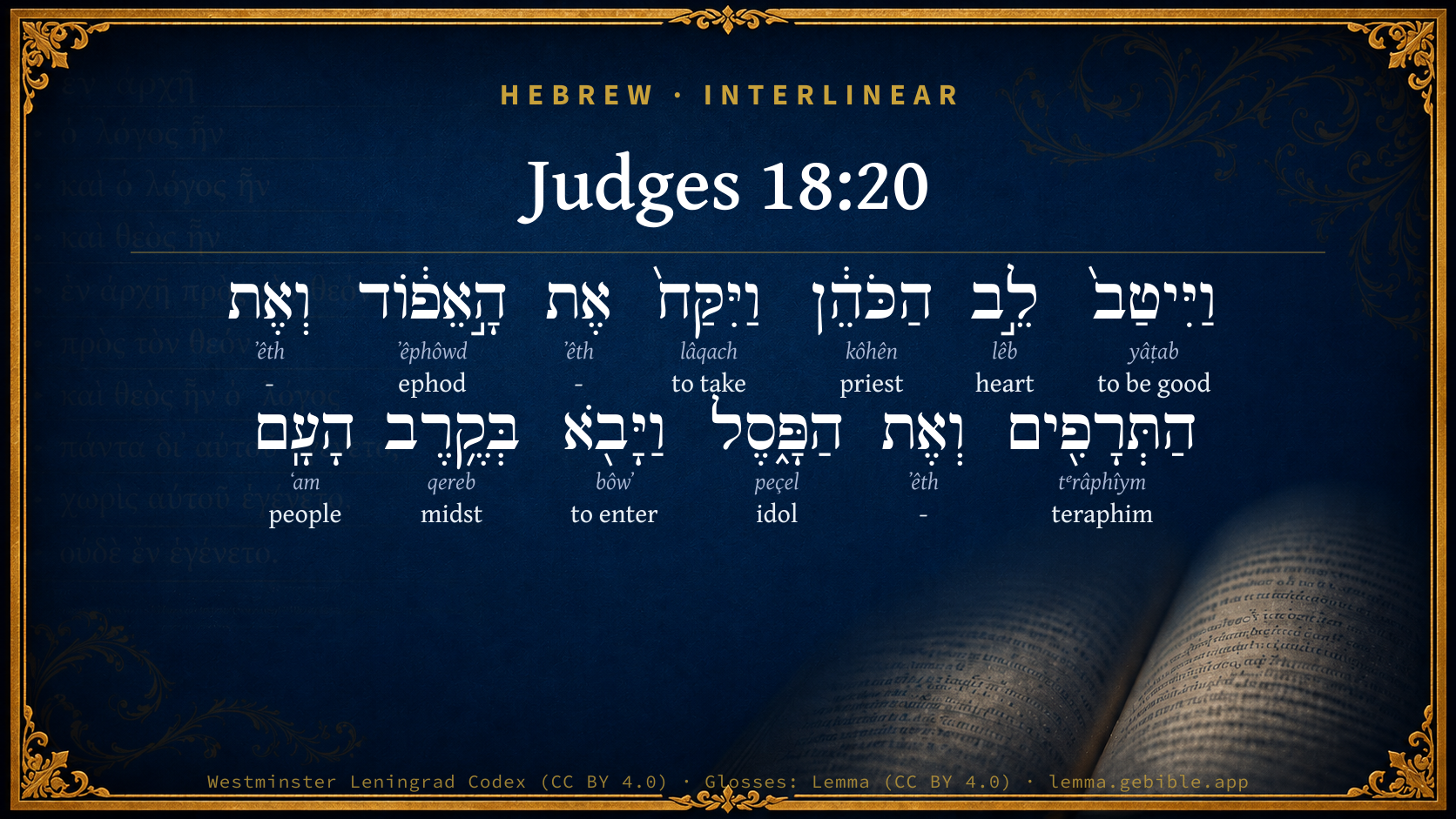
  1. וַיִּיטַב֙ yâṭab H3190 “and · to be good” Conjunction + Verb, Qal, Sequential Imperfect, 3rd Person, Masculine, Singular
  2. לֵ֣ב lêb H3820 “heart of” Noun, Common, Masculine, Singular, Construct
  3. הַכֹּהֵ֔ן kôhên H3548 “the · priest” Particle, Definite Article + Noun, Common, Masculine, Singular, Absolute
  4. וַיִּקַּח֙ lâqach H3947 “and · to take” Conjunction + Verb, Qal, Sequential Imperfect, 3rd Person, Masculine, Singular
  5. אֶת ʼêth H853 “-” Particle, Direct Object
  6. הָ֣אֵפ֔וֹד ʼêphôwd H646 “the · ephod” Particle, Definite Article + Noun, Common, Masculine, Singular, Absolute
  7. וְאֶת ʼêth H853 “and · -” Conjunction + Particle, Direct Object
  8. וְאֶת ʼêth H853 “and · -” Conjunction + Particle, Direct Object
  9. הַפָּ֑סֶל peçel H6459 “the · idol” Particle, Definite Article + Noun, Common, Masculine, Singular, Absolute
  10. וַיָּבֹ֖א bôwʼ H935 “and · to enter” Conjunction + Verb, Qal, Sequential Imperfect, 3rd Person, Masculine, Singular
  11. בְּקֶ֥רֶב qereb H7130 “in/at · midst of” Preposition + Noun, Common, Masculine, Singular, Construct
  12. הָעָֽם ʻam H5971 “the · people” Particle, Definite Article + Noun, Common, Masculine, Singular, Absolute

About this verse

These counts appear in no published source. They are computed here, from the morphology-tagged text and Lemma’s own curated glosses. What Lemma adds →

13
words
11
distinct lemmas
Historical
section

Notable vocabulary

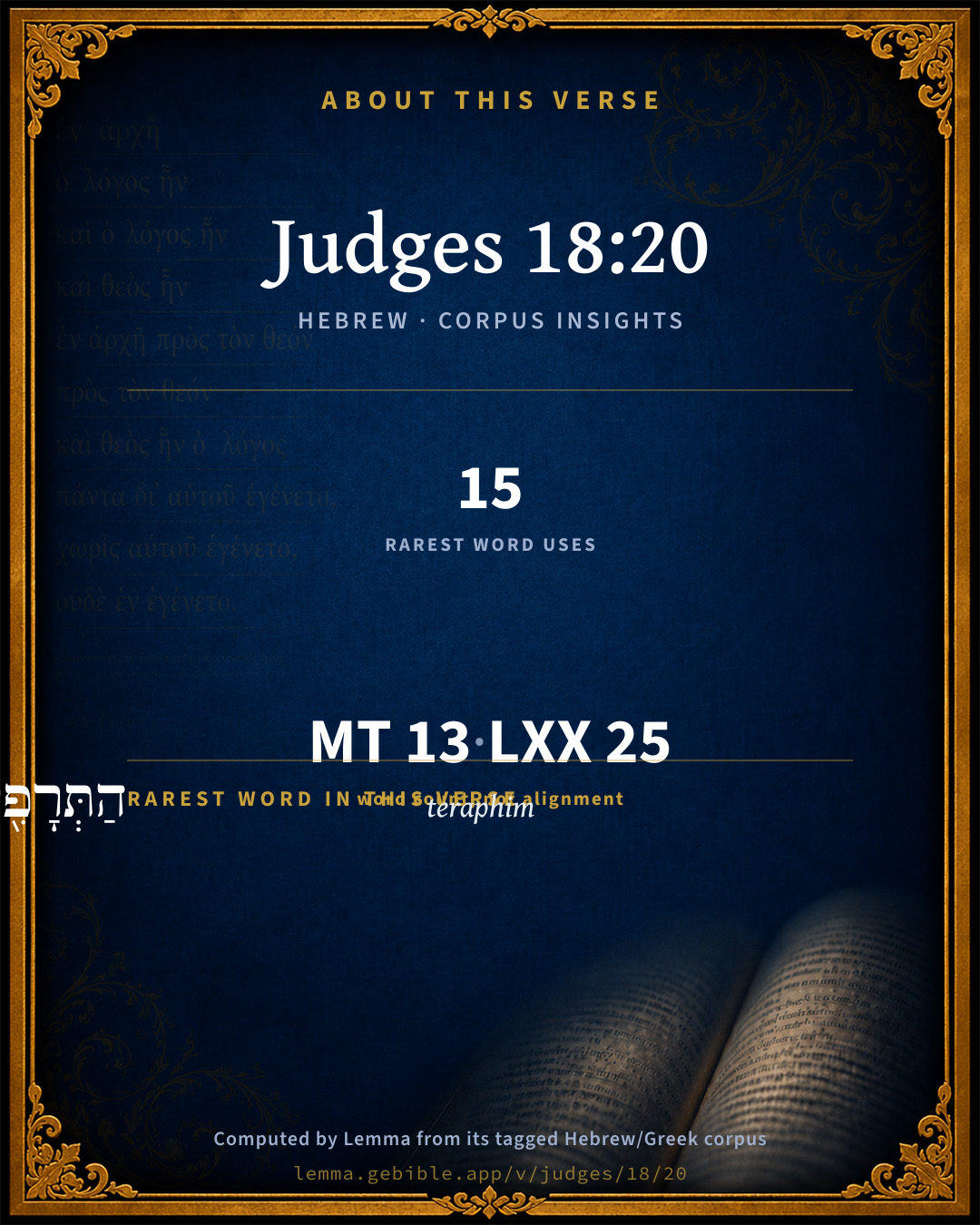
The rarest word here is הַתְּרָפִ֖ים teraphim H8655 — appearing just 15 times in the whole Hebrew Bible.

Shared distinctive vocabulary

הַתְּרָפִ֖ים teraphim H8655 occurs in 15 verses of the Hebrew Bible. Also found in:

Grammatical profile

  • 3 verbs
  • 7 nouns
  • 3 particles

Verb forms

  • וַיִּיטַב֙ Qal · Sequential Imperfect
  • וַיִּקַּח֙ Qal · Sequential Imperfect
  • וַיָּבֹ֖א Qal · Sequential Imperfect

Hebrew & Septuagint length

In English translation the verse runs 25 words from the Hebrew and 32 from the Septuagint (LXX English) — closely comparable.

A rough comparison of the two English renderings, which tokenize alike — not a word-level alignment.

Word counts can differ between the Hebrew and the Greek without any difference in meaning — e.g. the Hebrew direct-object marker אֵת has no separate Greek word, and Greek often adds the article ὁ.

In the original languages it is 13 Hebrew tokens and 25 Greek tokens — but the two are counted differently (Hebrew bundles its prefixes and suffixes into one token; the Greek is in lemma form), so that isn’t a like-for-like length.

Cross-references

9

Topical passages linked to Judges 18:20 in the Treasury of Scripture Knowledge — connected by theme and wording, ordered by reader-vote popularity; previews shown in the World English Bible.

  • Isaiah 56:11 Yes, the dogs are greedy, they can never have enough; and these are shepherds who can't understand: they have all turned to their own way, each one to his gain, from every quarter.
  • Judges 17:10 Micah said to him, Dwell with me, and be to me a father and a priest, and I will give you ten [pieces] of silver by the year, and a suit of clothing, and your food. So the Levite went in.
  • Proverbs 30:15 "The leach has two daughters: 'Give, give.' "There are three things that are never satisfied; Four that don't say, 'Enough:'
  • Ezekiel 13:19 You have profaned me among my people for handfuls of barley and for pieces of bread, to kill the souls who should not die, and to save the souls alive who should not live, by your lying to my people who listen to lies.
  • Hosea 4:3 Therefore the land will mourn, And everyone who dwells therein will waste away. All living things in her, Even the animals of the field and the birds of the sky; Yes, the fish of the sea also die.
  • Acts 20:33 I coveted no one's silver, or gold, or clothing.
  • Philippians 3:19 whose end is destruction, whose god is the belly, and whose glory is in their shame, who think about earthly things.
  • 2 Peter 2:3 In covetousness they will exploit you with deceptive words: whose sentence now from of old doesn't linger, and their destruction will not slumber.
  • 2 Peter 2:15–16 forsaking the right way, they went astray, having followed the way of Balaam the son of Beor, who loved the wages of wrong-doing;

Cross-references courtesy of OpenBible.info (CC BY 4.0).

Hebrew and Greek witnesses Masoretic Hebrew ↔ Greek Septuagint

The same verse in the two great witnesses to the Old Testament, shown verse-for-verse.

These are two independent witnesses, not word-aligned to each other, and the Septuagint is shown in lemma (dictionary) form.

Hebrew Judges 18:20 Masoretic · Westminster Leningrad Codex

וַיִּיטַב֙ לֵ֣ב הַכֹּהֵ֔ן וַיִּקַּח֙ אֶת הָ֣אֵפ֔וֹד וְאֶת הַתְּרָפִ֖ים וְאֶת הַפָּ֑סֶל וַיָּבֹ֖א בְּקֶ֥רֶב הָעָֽם

The priest's heart was glad, and he took the ephod, and the teraphim, and the engraved image, and went in the midst of the people.

World English Bible · Public Domain

Greek LXX Judges 18:20 Septuagint · lemma form

καί ἀγαθύνω ὁ καρδία ὁ ἱερεύς καί λαμβάνω ὁ εφωδ καί ὁ θεραφιν καί ὁ γλυπτός καί ὁ χωνευτός καί ἔρχομαι ἐν μέσος ὁ λαός

And the heart of the priest was glad, and he took the ephod, and the theraphin, and the graven image, and the molten image, and went in the midst of the people.

LXX2012 (modern English Septuagint) · Public Domain

Hebrew: Westminster Leningrad Codex (CC BY 4.0). Greek: Septuagint (public domain); English from LXX2012 (modern English Septuagint) (Public Domain). How the Septuagint differs from the Hebrew →

Targum (Aramaic paraphrase)

1

The Targum is the ancient Jewish Aramaic paraphrase of the Hebrew Scriptures — an interpretive translation, not the Hebrew text itself. Onkelos (literal) and Pseudo-Jonathan (expansive) render the Torah, and Jonathan the Prophets. Coverage is partial: where no permissively-licensed English translation exists for a verse, only the Aramaic is shown. This is verse-level text, not a word-by-word alignment to the Hebrew.

  1. Targum Jonathan Prophets (Joshua–Malachi)
    וּשְׁפַר לִבָּא דְכַהֲנָא וּנְסִיב יַת אֵפוֹדָא וְיַת דְמָאִין וְיַת צַלְמָא וְעַל בְּגוֹ עַמָא:

    (no public-domain English translation for this verse)

    Targum Jonathan — Aramaic: “Mikraot Gedolot” (public domain). English: “Sefaria Community Translation” (CC0 1.0 (public-domain dedication)); “London "Chaldee Paraphrase," 1871” (public domain). Text via Sefaria.

Commentary

Notes on Judges 18:20 from classic Christian and Jewish commentators (each source and its license shown beneath its notes). The classic Christian expositions comment on the surrounding passage and are grouped to its opening verse, so a note may address several verses; the Jewish commentaries on the Tanakh (Rashi and others) are per-verse, so they appear only where the commentator wrote on this verse.

Lemma curates 59 commentaries, every one of them public domain or Creative Commons licensed, each selected and text-cleaned for this edition rather than reprinted as found. About our sources →

Trapp's Complete Commentary

John Trapp

Jdg 18:20 And the priest’s heart was glad, and he took the ephod, and the teraphim, and the graven image, and went in the midst of the people.

Ver. 20. And the priest’s heart was glad.] Every wind can raise a bubble: profit and preferment carry those any way that are worldly minded in the ministry. It was therefore excellent counsel Luther gave preachers, to see to it, that these three dogs did not follow them into the pulpit, - ambition, covetousness, and envy or contentiousness.

And went in the midst of the people.] With all his trash and trinkets; either for his own greater security, or else in an apish imitation of the ark’s marching in the midst of the tribes.

John Trapp, A Commentary or Exposition upon All the Books of the Old and New Testament (1647–1656) — public domain. Text from a community e-Sword module.

Joseph Benson's Commentary

Jdg 18:20-21. The priest’s heart was glad — As he was promised promotion, he not only consented to the fact, but assisted them in it, being wholly governed by a regard to his own secular interest. He went in the midst of the people — Both for the greater security of such precious things, and that Micah might not be able to come near him to injure or upbraid him; and, perhaps, also, because that was the place where the ark used to be carried. They put the little ones, and the cattle, &c., before them — For their greater security, if Micah should pursue them.

Joseph Benson's Commentary on the Old and New Testaments (1811–1818) — public domain. Text from a community e-Sword module.

Geneva Bible (1599)

Geneva Bible translators

With the six hundred men.

Geneva Bible (1599) marginal notes — public domain. Text via Bolls.life.

Adam Clarke's Commentary

Verse 20. Went to the midst of the people.] He was glad to be employed by the Danites; and went into the crowd, that he might not be discovered by Micah or his family.

Adam Clarke's Commentary on the Bible (1810–1826) — public domain. Text from a community e-Sword/MySword module.

Ellicott's Commentary for English Readers

(20) The priest’s heart was glad.—Jdg_19:6; Jdg_19:9; Rth_3:7. The disgraceful alacrity with which he sanctions the theft, and abandons for self-interest the cause of Micah, is very unworthy of a grandson of Moses. Dean Stanley appositely compares the bribe offered in 1176 to the monk Roger of Canterbury:—“Give us the portion of St. Thomas’s skull which is in thy custody, and thou shalt cease to be a simple monk; thou shalt be Abbot of St. Augustine’s.”

In the midst of the people.—That they might guard his person. It is not necessarily implied that he carried all these sacred objects himself; he may have done so, for the molten image, which was perhaps the heaviest object, is not here mentioned.

A Bible Commentary for English Readers, edited by Charles John Ellicott (1878–1897) — public domain. Text from a community e-Sword module.

John Gill's Exposition

And the priest's heart was glad,.... He rejoiced that such an opportunity offered; it suited well with his covetous, ambitious, rambling, and unsettled disposition of mind:

and he took the ephod, and the teraphim, and the graven image; and no doubt the molten image also, out of the hands of the five men into his own, agreeing to go with them, and officiate for them:

and went in the midst of the people; the six hundred armed men, either for the security of himself, if Micah should raise his servants, and his neighbours, to pursue after him, and fetch him back, with his images; or, as others think, in imitation of the priests bearing the ark, who in journeying marched in the middle of the camp.

John Gill's Exposition of the Whole Bible (1746–1763) — public domain (CC PDM 1.0). Text via the HelloAO Bible API.

Matthew Poole's English Annotations

The priest’s heart was glad; being wholly governed by his own interest, and making all his obligations of justice and gratitude give place to it. But it is not strange, if he who was before perfidious to God, should prove so to men.

In the midst of the people, i.e. among the people; or properly in the midst, both for the greater security of such precious things, and that Micah might not be able to come at him, either to injure or upbraid him; and it may be, because that was the place where the ark used to be carried.

Matthew Poole's English Annotations on the Holy Bible (1683–1685) — public domain. Text from a community e-Sword/MySword module.

Whedon's Commentary on the Bible

Daniel D. Whedon

20. The priest’s heart was glad — It was an honourable promotion, as they suggested, to be advanced from being a priest unto one man to that of a tribe in Israel, and he who had sold his service to Micah for little more than his food and clothes (Jdg_17:10) would surely be happy in the change.

Daniel D. Whedon (gen. ed.), Commentary on the Old and New Testaments (1874–1909) — public domain. Text from a community e-Sword module.

The Pulpit Commentary

The priest"s heart was glad, etc. The prospect of greater dignity and greater emolument stifled all sentiments of gratitude and loyalty to Micah, and made him cheerfully connive at an act of theft and sacrilege.

The Pulpit Commentary (1880–1919), ed. H.D.M. Spence-Jones & Joseph S. Exell — public domain. Text from a community e-Sword module.

John Wesley's Explanatory Notes

Was glad - Being wholly governed by his own interest. The midst - Both for the greater security of such precious things, and that Micah might not be able to come at him, to injure or upbraid him; and, it may be, because that was the place where the ark used to be carried.

John Wesley, Explanatory Notes Upon the Whole Bible (1754–1765) — public domain. Text via the GEBible commentary corpus.

Keil & Delitzsch

C. F. Keil & F. Delitzsch

Then was the priest's heart glad (merry; cf. Jdg 19:6, Jdg 19:9; Rut 3:7), and he took the ephod, etc., and came amongst the people (the Danites). The first clause of this verse is attached to the supplementary statement in Jdg 18:18, Jdg 18:19, for the purpose of linking on the further progress of the affair, which is given in the second clause; for, according to Jdg 18:17, the priest could only receive the ephod, etc., into his charge from the hands of the Danites, since they had taken them out of Micah's God's house.

Keil & Delitzsch — Biblical Commentary on the Old Testament (1861–1891) — public domain (CC PDM 1.0). Text via the HelloAO Bible API. (Old Testament only.)

Lesson kit

Teaching starters — assembled from the data on this page, not authored interpretation. Every prompt links to the verse data it draws on. Edit before teaching.

Judges, in the Historical, opens this verse with 13 words (11 distinct Hebrew lemmas). Its most distinctive word is tᵉrâphîym (“teraphim”). A historical commentator’s framing appears above. Read the whole chapter for the surrounding context.

Discussion questions

  1. What does “teraphim” (tᵉrâphîym) contribute to the verse as a whole?
  2. How does Genesis 31:19, which shares the word «teraphim», read alongside this verse?
  3. The translations on this page render this verse differently — a whole-verse word diff, not a word-by-word alignment. What might account for the different wordings?
  4. «וַיִּיטַב֙» is a Qal Sequential Imperfect verb. How does that grammatical form shape the action described?
  5. Compare how Trapp's Complete Commentary and Joseph Benson's Commentary read this verse. Where do they agree or differ?

Things to notice

Reading settings

Reading text

Shown beneath each verse's original-language words.

Old Testament
Old Testament edition

Read the OT as the Masoretic Hebrew (MT) or the Greek Septuagint (LXX).

English shown for the Greek Septuagint (in the Hebrew ↔ Greek comparison).

Comparing translations? Open the Compare panel on any verse page to stack up to four side by side.