
Psalms 74:12

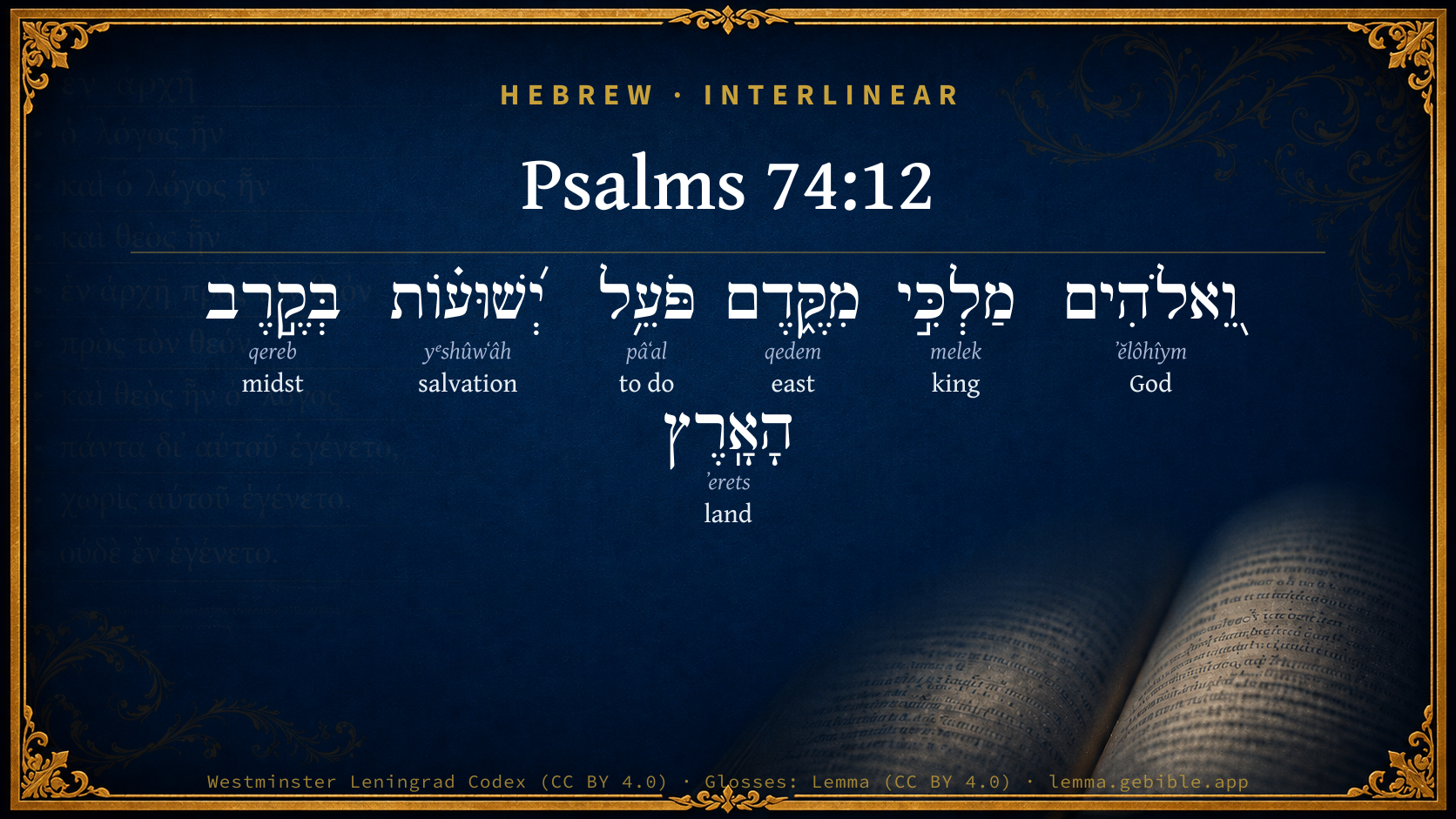
Hebrew (Westminster Leningrad Codex) Psalms 74:12 appears in the Hebrew Old Testament. The text above is from the Westminster Leningrad Codex. Each word links to its Strong’s number, a concise gloss, and parsing drawn from the Open Scriptures Hebrew Bible morphology. Click any word for its full Brown-Driver-Briggs (BDB) entry.
Download image
Cite this verse

Psalms 74:12 (World English Bible). Public Domain. Lemma interlinear Bible study tool, https://lemma.gebible.app/v/psalms/74/12.

Show BibTeX & RIS
BibTeX
RIS
English Translation
Yet God is my King of old, Working salvation in the midst of the earth.
World English Bible · Public Domain
Download a study sheet

One document with this verse’s original text, its word-by-word gloss line, the meaning frame, cross-references with their text, attributed commentary, and full source and license credits — printable, and it pastes into notes with its structure intact.

This verse Autodidact and up

Study sheet (.html) Plain text (.txt)

A passage Seminary Student

Up to 50 verses in one chapter. A passage sheet keeps up to 6 commentary sources and 12 cross-references per verse, in the order this page ranks them, and says so on the sheet whenever that leaves anything out. Ask for a single verse and you get the Autodidact verse sheet above.

Everything on this page stays free to read, with no account — the sheet is a download of what is already on screen, not access to it.

Want to remove ads? Support Godless Engineer
Compare translations 3

The same verse in 3 English versions, stacked beneath the original-language interlinear above. Click any original word for its lexicon entry.

Each is an independent rendering of the whole verse — the interlinear is not word-aligned to these translations.

Highlighted words mark where these versions differ — a whole-verse word diff, not a word-by-word alignment.

  • World English Bible Public Domain
    Yet God is my King of old, Working salvation in the midst of the earth.
  • King James Version Public Domain
    For God is my King of old, working salvation in the midst of the earth.
  • unfoldingWord Literal Text CC BY-SA 4.0
    But God my king from antiquity, working salvations in the midst of the earth.

unfoldingWord Literal Text — © unfoldingWord, licensed CC BY-SA 4.0. Word-aligned USFM3 via Door43 (git.door43.org/unfoldingWord/en_ult).

Versions to compare (up to 4)

3 of 4 selected

Show all 18 translations

Every available English version of this verse, each an independent rendering of the whole verse.

  • World English Bible Public Domain
    Yet God is my King of old, Working salvation in the midst of the earth.
  • Berean Standard Bible Public Domain
    Yet God is my King from ancient times, working salvation on the earth.
  • Majority Standard Bible Public Domain
    Yet God is my King from ancient times, working salvation on the earth.
  • King James Version Public Domain
    For God is my King of old, working salvation in the midst of the earth.
  • American Standard Version (1901) Public Domain
    Yet God is my King of old, Working salvation in the midst of the earth.
  • Revised Version (1885) Public Domain
    Yet God is my King of old, working salvation in the midst of the earth.
  • Geneva Bible (1599) Public Domain
    Euen God is my King of olde, working saluation in the middes of the earth.
  • Douay-Rheims (1899) Public Domain
    But God is our king before ages: he hath wrought salvation in the midst of the earth.
  • Young's Literal Translation Public Domain
    And God `is' my king of old, Working salvation in the midst of the earth.
  • Literal Standard Version CC BY-SA 4.0
    And God [is] my king of old, || Working salvation in the midst of the earth.
  • Unlocked Literal Bible CC BY-SA 4.0
    Yet God has been my king from ancient times, bringing salvation on the earth.
  • unfoldingWord Literal Text CC BY-SA 4.0
    But God my king from antiquity, working salvations in the midst of the earth.
  • Darby Bible Public Domain
    But God is my king of old, accomplishing deliverances in the midst of the earth.
  • World Messianic Bible Public Domain
    Yet God is my King of old, working salvation throughout the earth.
  • Webster's Bible Public Domain
    For God is my King of old, working salvation in the midst of the earth.
  • Free Bible Version CC BY-SA 4.0
    But you, God, are our king from long ago. You have saved us many times in the land.
  • Bible in Basic English Public Domain
    For from the past God is my King, working salvation in the earth.
  • JPS Tanakh (1917) Public Domain
    Yet God is my King of old, working salvation in the midst of the earth.

Literal Standard Version (2020), Covenant Press — licensed CC BY-SA 4.0. Text via the HelloAO Bible API (eBible.org). Unlocked Literal Bible (unfoldingWord) — licensed CC BY-SA 4.0. Text via the HelloAO Bible API (eBible.org). unfoldingWord Literal Text — © unfoldingWord, licensed CC BY-SA 4.0. Word-aligned USFM3 via Door43 (git.door43.org/unfoldingWord/en_ult). Free Bible Version, Dr. Jonathan Gallagher — licensed CC BY-SA 4.0. Text via the HelloAO Bible API (eBible.org).

Word by word

More ways to search: Search by grammar → Find every occurrence → Compare this word →

Practice this passage: Drill this verse → Learn its vocabulary →

About this verse

These counts appear in no published source. They are computed here, from the morphology-tagged text and Lemma’s own curated glosses. What Lemma adds →

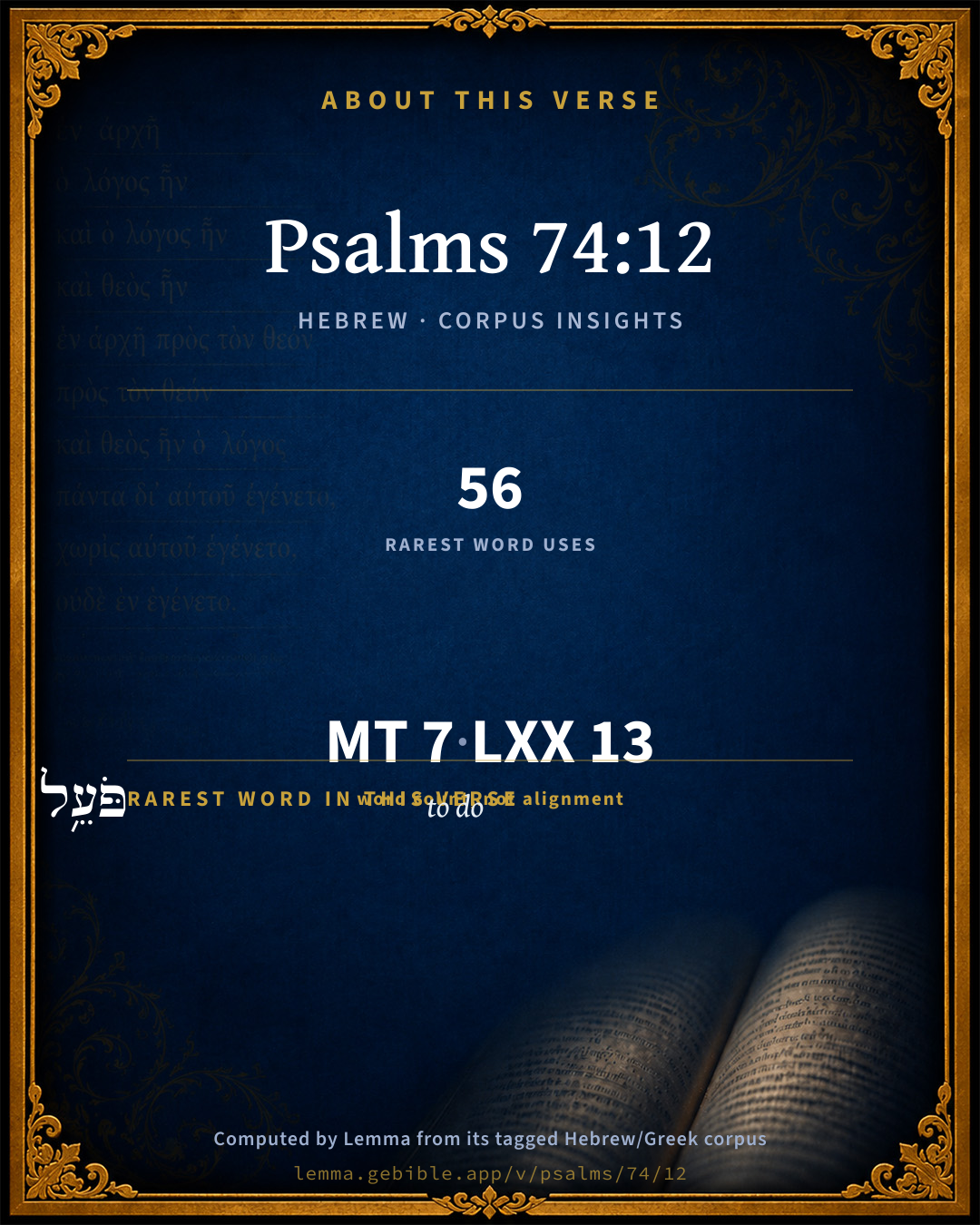
7
words
7
distinct lemmas
Wisdom
section

Shared distinctive vocabulary

פֹּעֵ֥ל to do H6466 occurs in 55 verses of the Hebrew Bible. Also found in:

Grammatical profile

  • 1 verb
  • 6 nouns

Verb forms

  • פֹּעֵ֥ל Qal · Participle Active

Hebrew & Septuagint length

In English translation the verse runs 15 words from the Hebrew and 17 from the Septuagint (LXX English) — closely comparable.

A rough comparison of the two English renderings, which tokenize alike — not a word-level alignment.

Word counts can differ between the Hebrew and the Greek without any difference in meaning — e.g. the Hebrew direct-object marker אֵת has no separate Greek word, and Greek often adds the article ὁ.

In the original languages it is 7 Hebrew tokens and 13 Greek tokens — but the two are counted differently (Hebrew bundles its prefixes and suffixes into one token; the Greek is in lemma form), so that isn’t a like-for-like length.

Cross-references

9

Topical passages linked to Psalms 74:12 in the Treasury of Scripture Knowledge — connected by theme and wording, ordered by reader-vote popularity; previews shown in the World English Bible.

  • Psalms 44:4 You are my King, God. Command victories for Jacob!
  • Isaiah 33:22 For Yahweh is our judge, Yahweh is our lawgiver, Yahweh is our king; he will save us.
  • Exodus 19:5–6 Now therefore, if you will indeed obey my voice, and keep my covenant, then you shall be my own possession from among all peoples; for all the earth is mine;
  • Exodus 15:2–15 Yah is my strength and song, He has become my salvation: This is my God, and I will praise him; My father's God, and I will exalt him.
  • Numbers 23:21–22 He has not saw iniquity in Jacob; Neither has he seen perverseness in Israel: Yahweh his God is with him, The shout of a king is among them.
  • Judges 4:23–24 So God subdued on that day Jabin the king of Canaan before the children of Israel.
  • 1 Samuel 19:5 for he put his life in his hand, and struck the Philistine, and Yahweh worked a great victory for all Israel: you saw it, and did rejoice; why then will you sin against innocent blood, to kill David without a cause?
  • Isaiah 63:8 For he said, Surely, they are my people, children who will not deal falsely: so he was their Savior.
  • Habakkuk 3:12–14 You marched through the land in wrath. You threshed the nations in anger.

Cross-references courtesy of OpenBible.info (CC BY 4.0).

Hebrew and Greek witnesses Masoretic Hebrew ↔ Greek Septuagint

The same verse in the two great witnesses to the Old Testament, shown verse-for-verse.

You’re reading Greek Psalm 73 (Hebrew Psalm 74). The Septuagint counts the superscription, so verse numbers can differ from the Hebrew — chapter-level alignment, not verse-by-verse. Numbering follows Rahlfs.

These are two independent witnesses, not word-aligned to each other, and the Septuagint is shown in lemma (dictionary) form.

Hebrew Psalms 74:12 Masoretic · Westminster Leningrad Codex

וֵ֭אלֹהִים מַלְכִּ֣י מִקֶּ֑דֶם פֹּעֵ֥ל יְ֝שׁוּע֗וֹת בְּקֶ֣רֶב הָאָֽרֶץ

Yet God is my King of old, Working salvation in the midst of the earth.

World English Bible · Public Domain

Greek LXX Greek Psalm 73:12 Septuagint · lemma form

ὁ δέ θεός βασιλεύς ἐγώ πρό αἰών ἐργάζομαι σωτηρία ἐν μέσος ὁ γῆ

But God is our King of old; he has wrought salvation in the midst of the earth.

LXX2012 (modern English Septuagint) · Public Domain

On this verse, John Gill's Exposition discusses the Septuagint’s reading. Read the note in Commentary ↓

Hebrew: Westminster Leningrad Codex (CC BY 4.0). Greek: Septuagint (public domain); English from LXX2012 (modern English Septuagint) (Public Domain). How the Septuagint differs from the Hebrew →

Commentary

Notes on Psalms 74:12 from classic Christian and Jewish commentators (each source and its license shown beneath its notes). The classic Christian expositions comment on the surrounding passage and are grouped to its opening verse, so a note may address several verses; the Jewish commentaries on the Tanakh (Rashi and others) are per-verse, so they appear only where the commentator wrote on this verse.

Lemma curates 59 commentaries, every one of them public domain or Creative Commons licensed, each selected and text-cleaned for this edition rather than reprinted as found. About our sources →

Matthew Henry's Commentary

The lamenting church fastens upon something here which she calls to mind, and therefore hath she hope (as Lam 3:21), with which she encourages herself and silences her own complaints. Two things quiet the minds of those that are here sorrowing for the solemn assembly: -

I. That God is the God of Israel, a God in covenant with his people (Psa 74:12): God is my King of old. This comes in both as a plea in prayer to God (Psa 44:4, thou art my King, O God!) and as a prop to their own faith and hope, to encourage themselves to expect deliverance, considering the days of old, Psa 77:5. The church speaks as a complex body, the same in every age, and therefore calls God, "My King, my King of old," or, "from antiquity;" he of old put himself into that relation to them and appeared and acted for them in that relation. As Israel's King, he wrought salvation in the midst of the nations of the earth; for what he did, in the government of the world, tended towards the salvation of his church. Several things are here mentioned which God had done for his people as their King of old, which encouraged them to commit themselves to him and depend upon him.

1. He had divided the sea before them when they came out of Egypt, not by the strength of Moses or his rod, but by his own strength; and he that could do that could do any thing.

2. He had destroyed Pharaoh and the Egyptians. Pharaoh was the leviathan; the Egyptians were the dragons, fierce and cruel. Observe, (1.) The victory obtained over these enemies. God broke their heads, baffled their politics, as when Israel, the more they were afflicted by them, multiplied the more. God crushed their powers, though complicated, ruined their country by ten plagues, and at last drowned them all in the Red Sea. This is Pharaoh and all his multitude, Eze 31:18. It was the Lord's doing; none besides could do it, and he did it with a strong hand and an outstretched arm. This was typical of Christ's victory over Satan and his kingdom, pursuant to the first promise, that the seed of the woman should break the serpent's head. (2.) The improvement of this victory for the encouragement of the church: Thou gavest him to be meat to the people of Israel, now going to inhabit the wilderness. The spoil of the Egyptians enriched them; they stripped their slain, and so got the Egyptians' arms and weapons, as before they had got their jewels. Or, rather, this providence was meat to their faith and hope, to support and encourage them in reference to the other difficulties they were likely to meet with in the wilderness. It was part of the spiritual meat which they were all made to eat of. Note, The breaking of the heads of the church's enemies is the joy and strength of the hearts of the church's friends. Thus the companions make a banquet even of leviathan, Job 41:6.

3. God had both ways altered the course of nature, both in fetching streams out of the rock and turning streams into rock, Psa 74:15. (1.) He had dissolved the rock into waters: Thou didst bring out the fountain and the flood (so some read it); and every one knows whence it was brought, out of the rock, out of the flinty rock. Let this never be forgotten, but let it especially be remembered that the rock was Christ, and the waters out of it were spiritual drink. (2.) He had congealed the waters into rock: Thou driedst up mighty rapid rivers, Jordan particularly at the time when it overflowed all its banks. He that did these things could now deliver his oppressed people, and break the yoke of the oppressors, as he had done formerly; nay, he would do it, for his justice and goodness, his wisdom and truth, are still the same, as well as his power.

II. That the God of Israel is the God of nature, Psa 74:16, Psa 74:17. It is he that orders the regular successions and revolutions, 1. Of day and night. He is the Lord of all time. The evening and the morning are of his ordaining. It is he that opens the eyelids of the morning light, and draws the curtains of the evening shadow. He has prepared the moon and the sun (so some read it), the two great lights, to rule by day and by night alternately. The preparing of them denotes their constant readiness and exact observance of their time, which they never miss a moment. 2. Of summer and winter: "Thou hast appointed all the bounds of the earth, and the different climates of its several regions, for thou hast made summer and winter, the frigid and the torrid zones; or, rather, the constant revolutions of the year and its several seasons." Herein we are to acknowledge God, from whom all the laws and powers of nature are derived; but how does this come in here? (1.) He that had power at first to settle, and still to preserve, this course of nature by the diurnal and annual motions of the heavenly bodies, has certainly all power both to save and to destroy, and with him nothing is impossible, nor are any difficulties or oppositions insuperable. (2.) He that is faithful to his covenant with the day and with the night, and preserves the ordinances of heaven inviolable will certainly make good his promise to his people and never cast off those whom he has chosen, Jer 31:35, Jer 31:36; Jer 33:20, Jer 33:21. His covenant with Abraham and his seed is as firm as that with Noah and his sons, Gen 8:21. (3.) Day and night, summer and winter, being counterchanged in the course of nature, throughout all the borders of the earth, we can expect no other than that trouble and peace, prosperity and adversity, should be, in like manner, counterchanged in all the borders of the church. We have as much reason to expect affliction as to expect night and winter. But we have then no more reason to despair of the return of comfort than we have to despair of day and summer.

Matthew Henry's Commentary on the Whole Bible (1708–1710) — public domain (CC PDM 1.0). Text via the HelloAO Bible API.

Trapp's Complete Commentary

John Trapp

Psa 74:12 For God [is] my King of old, working salvation in the midst of the earth.

Ver. 12. For God is my Kiny of old] He is the same yesterday, today, and for ever. I doubt not, therefore, but he will see to the safety of his loyal subjects.

Working salvation in the midst of the earth] i.e. Openly, and to the view of all. Jerusalem is in the midst of Judaea, and Judaea is in the midst of the earth; the very centre and navel of the habitable world, say the Fathers; it joineth those of the east to the west by the midland sea, and those of the north to the south by the same sea, running out as far as the Lake of Maeotis, very far north, and by the Red Sea descending very low into the south. This country, therefore, God seemeth purposely to have espied out, as himself speaketh, that therehence he might send abroad salvation into all parts. And hereabout some gather from Joe 3:2. Christ will sit to judge the world at the last day, Psa 50:1-2.

John Trapp, A Commentary or Exposition upon All the Books of the Old and New Testament (1647–1656) — public domain. Text from a community e-Sword module.

The Biblical Illustrator

Joseph S. Exell

Psa_74:12

For God is my King of old, working salvation in the midst of the earth.

The sovereignty of God

I. Loyally acknowledged. My King.

II. Of ancient date. Of old.

III. Beneficent in operation. Working salvation. At this time, as the psalm indicates, His people were in a most desolate and afflicted state. Was the King working for their salvation? Their misery arose from their sin from their rebellion against His authority and govern-mont. At present, darkness, suffering, and sorrow are here, but they are here because sin is here. God rules to bless.

IV. As a plea for His help. He mentions what God had done for them in olden time, and pleads that as their King He would interpose for them again. As their King--

1. He would possess sovereign authority.

2. He would be faithful to His sovereign obligations.

3. He was immutable. This plea may be used by us--

(1) As communities forming part of His Church. When any portion of His Church languishes, or is afflicted, or is in difficulty, it may plead with the King for help.

(2) As individuals on our own behalf. In our times of perplexity and distress, let us go to our King, and plead with Him for direction and deliverance. (William Jones.)

The Biblical Illustrator, edited by Joseph S. Exell (c. 1880s–1900s) — public domain. Text from a community e-Sword module.

The Treasury of David

Charles H. Spurgeon

Ver. 12-23. Having spread the sad case before the Lord, the pleader now urges another series of arguments for divine help. He reasons from the Lord's former wonders of grace, and his deeds of power, imploring a repetition of the same divine works.

Ver. 12. For God is my King of old. How consoling is this avowal! Israel in holy loyalty acknowledges her King, and claims to have been his possession from of old, and thence she derives a plea for defence and deliverance. If the Lord be indeed the sole monarch of our bosoms, he will in his love put forth his strength on our behalf; if from eternity he has claimed us as his own, he will preserve us from the insulting foe.

Working salvation in the midst of the earth. From the most remote period of Israel's history the Lord had worked out for her many salvations; especially at the Red Sea, the very heart of the world was astonished by his wonders of deliverance. Now, every believer may plead at this day the ancient deeds of the Lord, the work of Calvary, the overthrow of sin, death, and hell. He who wrought out our salvation of old will not, cannot desert us now. Each past miracle of grace assures us that he who has begun to deliver will continue to redeem us from all evil. His deeds of old were public and wrought in the teeth of his foes, they were no delusions or make believes; and, therefore, in all our perils we look for true and manifest assistance, and we shall surely receive it.

Ver. 12. God is my King of old, etc. Let us learn from this verse how to think of our God. First, that he is our King, and therefore we ought to be encouraged to pray for his help against the ungodly, and to place ourselves in entire submission to his will and government. Secondly, that he is not a new God, but the Ancient of Days, and that whatever salvation has been wrought not only in the midst of his own people, but in the midst of the whole earth, even among those by whom he is not acknowledged, has been wrought by him. Let this meaning strike at the root of all trust in other gods, or in any creature. Musculus.

Ver. 12.

I. The sovereignty of God.

II. Its antiquity.

III. Our loyalty to it.

IV. The practical character of his reign: working.

V. The graciousness of it: working salvation.

VI. The place of its operation: in the midst of the

earth.

Psalms 74:13*

Ver. 12-23. See Psalms on "Ps 74:12" for further information.

Ver. 12-23. See Psalms on "Ps 74:12" for further information.

Ver. 12-23. See Psalms on "Ps 74:12" for further information.

Ver. 12-23. See Psalms on "Ps 74:12" for further information.

Ver. 12-23. See Psalms on "Ps 74:12" for further information.

Ver. 12-23. See Psalms on "Ps 74:12" for further information.

Ver. 12-23. See Psalms on "Ps 74:12" for further information.

Ver. 12-23. See Psalms on "Ps 74:12" for further information.

Ver. 12-23. See Psalms on "Ps 74:13" for further information.

Ver. 12-23. See Psalms on "Ps 74:22" for further information.

Ver. 12-23. See Psalms on "Ps 74:12" for further information.

Charles H. Spurgeon's The Treasury of David (1869–1885) — public domain. Psalms only. Text from a community e-Sword/MySword module.

J. A. Alexander on Psalms

Joseph Addison Alexander

Psa 74:12. And God (is) my king of old, working salvations in the midst of the land. Having pleaded the greatness of the danger and distress as a reason for imploring the divine interposition, the church now pleads her covenant relation to him as her Sovereign and her Saviour in former emergencies, with particular reference to the plagues of Egypt, which makes it probable that land, and not earth, is the true translation of the last word. The very form of expression is borrowed from the narrative of Moses. See Exo 8:22. Doing, working, as opposed to a mere promise or prediction. The participle signifies continued action, and extends the description beyond the particular occasion specially, referred to. God is described as He who, then and ever, works salvations or deliverances, the plural form implying fulness and variety. See above, on Psa 18:50, Psa 28:8; Psa 42:5; Psa 42:11, Psa 43:5, Psa 53.

Joseph Addison Alexander, The Psalms Translated and Explained (1850) — public domain. Text from a community e-Sword module.

Tyndale Open Study Notes

Tyndale Open Resources

74:12 my king from ages past: The psalmist acknowledges God’s power and his historical bond with Israel (5:2; 44:4; 84:3).

Tyndale Open Study Notes — © Tyndale Open Resources, licensed CC BY-SA 4.0. Text via the HelloAO Bible API.

Geneva Bible (1599)

Geneva Bible translators

Meaning, in the sight of all the world.

Geneva Bible (1599) marginal notes — public domain. Text via Bolls.life.

Adam Clarke's Commentary

Verse 12. For God is my King of old] We have always acknowledged thee as our sovereign; and thou hast reigned as a king in the midst of our land, dispensing salvation and deliverance from the centre to every part of the circumference.

Adam Clarke's Commentary on the Bible (1810–1826) — public domain. Text from a community e-Sword/MySword module.

John Calvin's Commentaries

12. But God is my King from the beginning. In this verse, as we have often seen to be the case in other places, the people of God intermingle meditations with their prayers, thereby to acquire renewed vigor to their faith, and to stir up themselves to greater earnestness in the duty of prayer. We know how difficult it is to rise above all doubts, and boldly to persevere in a free and unrestrained course of prayer. Here, then, the faithful call to remembrance the proofs of God’s mercy and working, by which he certified, through a continued series of ages, that he was the King and Protector of the people whom he had chosen. By this example we are taught, that as it is not enough to pray with the lips unless we also pray in faith, we ought always to remember the benefits by which God has given a confirmation of his fatherly love towards us, and should regard them as so many testimonies of his electing love. It is quite clear that the title King, which is here applied to God, ought not to be restricted merely to his sovereignty. He is addressed by this appellation because he had taken upon him the government of the Jewish people, in order to preserve and maintain them in safety. We have already stated what is implied in the words, from the beginning. By the midst of the earth some think that Judea is intended, because it was situated as it were in the midst of the habitable globe. There is no doubt that it is to be understood of a place which stands prominently in view. We find the expression used in this sense in these words which God commanded Moses to speak to Pharaoh,

“And I will sever in that day the land of Goshen, in which my people dwell, that no swarms of flies shall be there; to the end thou mayest know that I am the Lord in the midst of the earth,” (Exodus 8:22.)

The simple and natural meaning, therefore, is, that God had wrought in behalf of the chosen people many deliverances, which were as open and manifest as if they had been exhibited on a conspicuous theater.

John Calvin's Commentaries (1540-1563) — public domain. Text from the Calvin Translation Society English edition (1840s-50s) via the Christian Classics Ethereal Library (ccel.org). Calvin's coverage is partial (roughly two-thirds of the Bible); uncommented books and verses are honest gaps, never fabricated. The 19th-century editor's footnotes and remarks are omitted so the notes are faithfully Calvin's own voice.

Ellicott's Commentary for English Readers

(12) For.—Better, and, or and yet.

My king.—The poet speaks for Israel. (Comp. Psa_44:4; Hab_1:12.)

In the midst of the earth.—Or, as we might say, “on the great theatre of the world.” Certainly we must not render here land instead of earth, since the wonders of Egypt, &c, are the theme.

A Bible Commentary for English Readers, edited by Charles John Ellicott (1878–1897) — public domain. Text from a community e-Sword module.

The Cambridge Bible for Schools and Colleges

gen. ed. J. J. S. Perowne

12. For] Better as R.V., Yet. In spite of His present inactivity God has been and still is Israel’s King. The Psalmist speaks in the name of the nation. Cp. Exo_15:18; Psa_44:4; Hab_1:12.

salvation] Lit. salvations, manifold and great acts of deliverance.

in the midst of the earth] As in Exo_8:22, the phrase implies that His wonders are wrought in the sight of all the nations and attest His claim of universal sovereignty (Psa_77:14).

12–17. Yet God’s mighty works of Redemption and Creation attest His power to interpose for the deliverance of His people. Cp. Psa_77:10 ff.

The Cambridge Bible for Schools and Colleges (gen. ed. J. J. S. Perowne; Cambridge University Press, 1878–1918) — public domain. Text from a community e-Sword module.

John Gill's Exposition

Thou didst divide the sea by thy strength,.... This and the following instances from hence to Psa 74:18 are proofs of God's working salvation in the midst of the earth; some of them seem peculiar to the people of Israel, and others are benefits common to mankind in general; which the church makes use of to encourage her faith and hope, in expectation of salvation, and deliverance out of her present distressed and melancholy circumstances. This seems to refer to the Lord's dividing of the Red sea into parts by a strong east wind, while Moses lifted up his rod and stretched out his hand as he was ordered, as a token of the divine power, and so the children of Israel passed through it as on dry land, Exo 14:21, and he that did this can make way for his redeemed ones to return to Zion with everlasting joy, Isa 51:10. Some render the words, "thou hast broken the sea by thy strength" (g); subdued and conquered it, and so hast the dominion over it, rulest the raging of it, settest bounds to it, and hast ordered its proud waves to go so far and no farther; and thus the Arabic version, "thou hast made it to stand"; and the Septuagint and Vulgate Latin versions, "thou hast confirmed it": but our version is best, which refers it to the work of God at the Red sea, and with which the Targum agrees; and Aben Ezra observes, that some refer it to the dividing of the Red sea:

thou breakest the heads of the dragons in the waters: or great whales, as the word is rendered in Gen 1:21, by which are meant Pharaoh and his generals, his captains and chief men, who were destroyed in the waters of the Red sea; comparable to dragons for their strength, for their cruelty to the children of Israel, and for their wrath and malice against them; and so, for the same reason, another Pharaoh, king of Egypt, in later times, is called the great dragon, that lies in the midst of his rivers, Eze 29:3 and the king of Babylon or of Egypt, Isa 27:1. So the Targum paraphrases it:

"thou hast broken the heads of dragons, and hast suffocated the Egyptians in the sea.''

Rome Pagan is compared to a great red dragon with seven heads and ten horns, which have been broken and destroyed, Rev 12:3, and Rome Papal has the power, seat, and great authority of the dragon; and though the Romish antichrist has two horns like a lamb, he speaks as a dragon, who also has seven heads and ten horns, and which ere long will be broke in pieces, see Rev 13:1, in the faith of which the church might be strengthened, by considering what God had done to the heads of the dragon in the Red sea; to which may be added that Satan is called a dragon, Psa 91:13, whose head was bruised, and his principalities and powers spoiled, by Christ at his death, and will be utterly destroyed at his second coming.

(g) "contrivisti", Pagninus, Montanus; "disrupisti", Junius & Tremellius, Piscator, Gejerus, Michaelis; "rupisti", Cocceius.

John Gill's Exposition of the Whole Bible (1746–1763) — public domain (CC PDM 1.0). Text via the HelloAO Bible API.

Albert Barnes' Notes on the Bible

For God is my King of old - That is, the king, or ruler of his people. The people had acknowledged him as their king and ruler, and he had showed himself to be such. This is given as a reason why he should now interpose in their behalf. It is an argument, proper always to be urged, drawn from the faithfulness and unchangeableness of God.

Working salvation in the midst of the earth - Salvation for his people. The reference here particularly is to what he had done for his people in delivering them from bondage in Egypt, and conducting them to the promised land, as is stated in the following verses.

Albert Barnes' Notes on the Bible (1834–1885) — public domain. Text from a community e-Sword/MySword module.

Matthew Poole's English Annotations

My King, in a singular manner: it belongs therefore to thine office to protect and save me.

In the midst of the earth; in the view of the world; so saving thy people so eminently and gloriously, that all people round about them observed and admired it.

Matthew Poole's English Annotations on the Holy Bible (1683–1685) — public domain. Text from a community e-Sword/MySword module.

Whedon's Commentary on the Bible

Daniel D. Whedon

12. For God is my King of old, etc.—Having finished his special prayer against his enemies, in which he struggles with the “crying contradiction between the present state of things and God’s relationship to Israel,” (Delitzsch,) the psalmist now proceeds to draw comfort, and fresh argument for divine interposition, from a review of the times when God was Israel’s King, working salvation in the midst of the earth.

Daniel D. Whedon (gen. ed.), Commentary on the Old and New Testaments (1874–1909) — public domain. Text from a community e-Sword module.

The Pulpit Commentary

Vers. 12-17. Comfort springs from the thought of God"s previous deliverances of his people, and of his other great mercies. The deliverance from Egypt has the foremost place (vers. 13, 14), as the most striking. Then the deliverance from the wilderness, and the passage of Jordan (ver. 15). From these the poet passes to God"s mercies in nature day and night, light and sun, set bounds of earth and sea, alternations of the seasons all formed and arranged by the Almighty (vers. 16, 17).

For God is my King of old. (comp. Psa_44:4) As "King," he has power to perform all that he wills, to set up and to cast down, to give into the enemy"s hand and to deliver. Working salvation in the midst of the earth. Not in any imaginary earth centre, but, as Professor Cheyne says, "quite broadly, in various parts of the earth". (comp. Exo_8:22)

The Pulpit Commentary (1880–1919), ed. H.D.M. Spence-Jones & Joseph S. Exell — public domain. Text from a community e-Sword module.

John Wesley's Explanatory Notes

King - It belongs therefore to thy office to protect and save me. Midst - In the view of the world.

John Wesley, Explanatory Notes Upon the Whole Bible (1754–1765) — public domain. Text via the GEBible commentary corpus.

Keil & Delitzsch

C. F. Keil & F. Delitzsch

With this prayer for the destruction of the enemies by God's interposition closes the first half of the Psalm, which has for its subject-matter the crying contradiction between the present state of things and God's relationship to Israel. The poet now draws comfort by looking back into the time when God as Israel's King unfolded the rich fulness of His salvation everywhere upon the earth, where Israel's existence was imperilled. בּקרב הארץ, not only within the circumference of the Holy Land, but, e.g., also within that of Egypt (Exo 8:18-22). The poet has Egypt directly in his mind, for there now follows first of all a glance at the historical (Psa 74:13-15), and then at the natural displays of God's power (Psa 74:16, Psa 74:17). Hengstenberg is of opinion that Psa 74:13-15 also are to be understood in the latter sense, and appeals to Job 26:11-13. But just as Isaiah (Isa 51:9, cf. Psa 27:1) transfers these emblems of the omnipotence of God in the natural world to His proofs of power in connection with the history of redemption which were exhibited in the case of a worldly power, so does the poet here also in Psa 74:13-15. The תּנּיּן (the extended saurian) is in Isaiah, as in Ezekiel (התּנּים, Psa 29:3; Psa 32:2), an emblem of Pharaoh and of his kingdom; in like manner here the leviathan is the proper natural wonder of Egypt. As a water-snake or a crocodile, when it comes up with its head above the water, is killed by a powerful stroke, did God break the heads of the Egyptians, so that the sea cast up their dead bodies (Exo 14:30). The ציּים, the dwellers in the steppe, to whom these became food, are not the Aethiopians (lxx, Jerome), or rather the Ichthyophagi (Bocahrt, Hengstenberg), who according to Agatharcides fed ἐκ τῶν ἐκριπτομένων εἰς τὴν χέρσον κητῶν, but were no cannibals, but the wild beasts of the desert, which are called עם, as in Pro 30:25. the ants and the rock-badgers. לציים is a permutative of the notion לעם, which was not completed: to a (singular) people, viz., to the wild animals of the steppe. Psa 74:15 also still refers not to miracles of creation, but to miracles wrought in the course of the history of redemption; Psa 74:15 refers to the giving of water out of the rock (Psa 78:15), and Psa 74:15 to the passage through the Jordan, which was miraculously dried up (הובשׁתּ, as in Jos 2:10; Jos 4:23; Jos 5:1). The object מעין ונחל is intended as referring to the result: so that the water flowed out of the cleft after the manner of a fountain and a brook. נהרות are the several streams of the one Jordan; the attributive genitive איתן describe them as streams having an abundance that does not dry up, streams of perennial fulness. The God of Israel who has thus marvellously made Himself known in history is, however, the Creator and Lord of all created things. Day and night and the stars alike are His creatures. In close connection with the night, which is mentioned second, the moon, the מאור of the night, precedes the sun; cf. Psa 8:4, where כּונן is the same as הכין in this passage. It is an error to render thus: bodies of light, and more particularly the sun; which would have made one expect מאורות before the specializing Waw. גּבוּלות are not merely the bounds of the land towards the sea, Jer 5:22, but, according to Deu 32:8; Act 17:26, even the boundaries of the land in themselves, that is to say, the natural boundaries of the inland country. קיץ וחרף are the two halves of the year: summer including spring (אביב), which begins in Nisan, the spring-month, about the time of the vernal equinox, and autumn including winter (צתו), after the termination of which the strictly spring vegetation begins (Sol 2:11). The seasons are personified, and are called God's formations or works, as it were the angels of summer and of winter.

Keil & Delitzsch — Biblical Commentary on the Old Testament (1861–1891) — public domain (CC PDM 1.0). Text via the HelloAO Bible API. (Old Testament only.)

unfoldingWord translationNotes

Door43 World Missions Community

General Information:

This begins a new theme: Asaph is proclaiming God's mighty deeds in the history of his people.

God has been my king from ancient times

Possible meanings are 1) Asaph is speaking as Israel's representative, "God has been our king since we Israelites first became a nation" or 2) "God, my king, was alive even in ancient times."

bringing salvation

The abstract noun "salvation" can be translated with the verb "to save." Here Yahweh saving people is spoken of as if salvation were an object that he brings with him. AT: "saving people" (See: Abstract Nouns and Metaphor)

You divided ... in the waters

Asaph is probably speaking of the time God brought Israel out of Egypt, divided the Sea of Reeds, led Israel through it on dry land, then drowned Pharaoh's army. (See: Assumed Knowledge and Implicit Information)

You divided the sea by your strength

Asaph is speaking of God as if God had a physical body. "You are so strong you were able to make dry land in the middle of the sea." (See: Personification)

the sea

"the great water"

you smashed the heads of the sea monsters in the waters

Asaph is probably speaking of Pharaoh and his army as if they were sea monsters. If possible, translate these words literally. AT: "when you killed Pharaoh's army, it was as if you smashed the heads of sea monsters in the waters" (See: Metaphor)

translationWords

king

save

water

unfoldingWord translationNotes — © Distant Shores Media and the Door43 World Missions Community, licensed CC BY-SA 4.0. Source: git.door43.org/Door43/en_tn.

Rashi

Rabbi Shlomo Yitzchaki (Rashi)

But God is my King from time immemorial Behold, You were our salvation from time immemorial.

Rashi on the Tanakh — English translations: “The Judaica Press complete Tanach with Rashi, translated by A. J. Rosenberg” (CC BY 4.0); “Pentateuch with Rashi's commentary by M. Rosenbaum and A.M. Silbermann, 1929-1934” (public domain); “The Metsudah Tanach series, Lakewood, N.J” (CC BY 4.0); and “The Book of Joshua, Metsudah Publications, 1997” (CC BY 4.0). Text via Sefaria.

Lesson kit

Teaching starters — assembled from the data on this page, not authored interpretation. Every prompt links to the verse data it draws on. Edit before teaching.

Psalms, in the Wisdom, opens this verse with 7 words (7 distinct Hebrew lemmas). Its most distinctive word is pâʻal (“to do”). A historical commentator’s framing appears above. Read the whole chapter for the surrounding context.

Discussion questions

  1. The word pâʻal carries the sense “to do.” How does it shape the verse?
  2. Exodus 15:17 shares the word «to do» with this verse. How do the two illuminate each other?
  3. These translations render this verse differently. What is at stake in choosing one wording over another?
  4. The verb «פֹּעֵ֥ל» is Qal Participle Active. How does its form color the action?
  5. Reading how Matthew Henry's Commentary and Trapp's Complete Commentary read this verse, where do the two commentators agree and where do they part?

Things to notice

Reading settings

Reading text

Shown beneath each verse's original-language words.

Old Testament
Old Testament edition

Read the OT as the Masoretic Hebrew (MT) or the Greek Septuagint (LXX).

English shown for the Greek Septuagint (in the Hebrew ↔ Greek comparison).

Comparing translations? Open the Compare panel on any verse page to stack up to four side by side.