Genesis 18:12

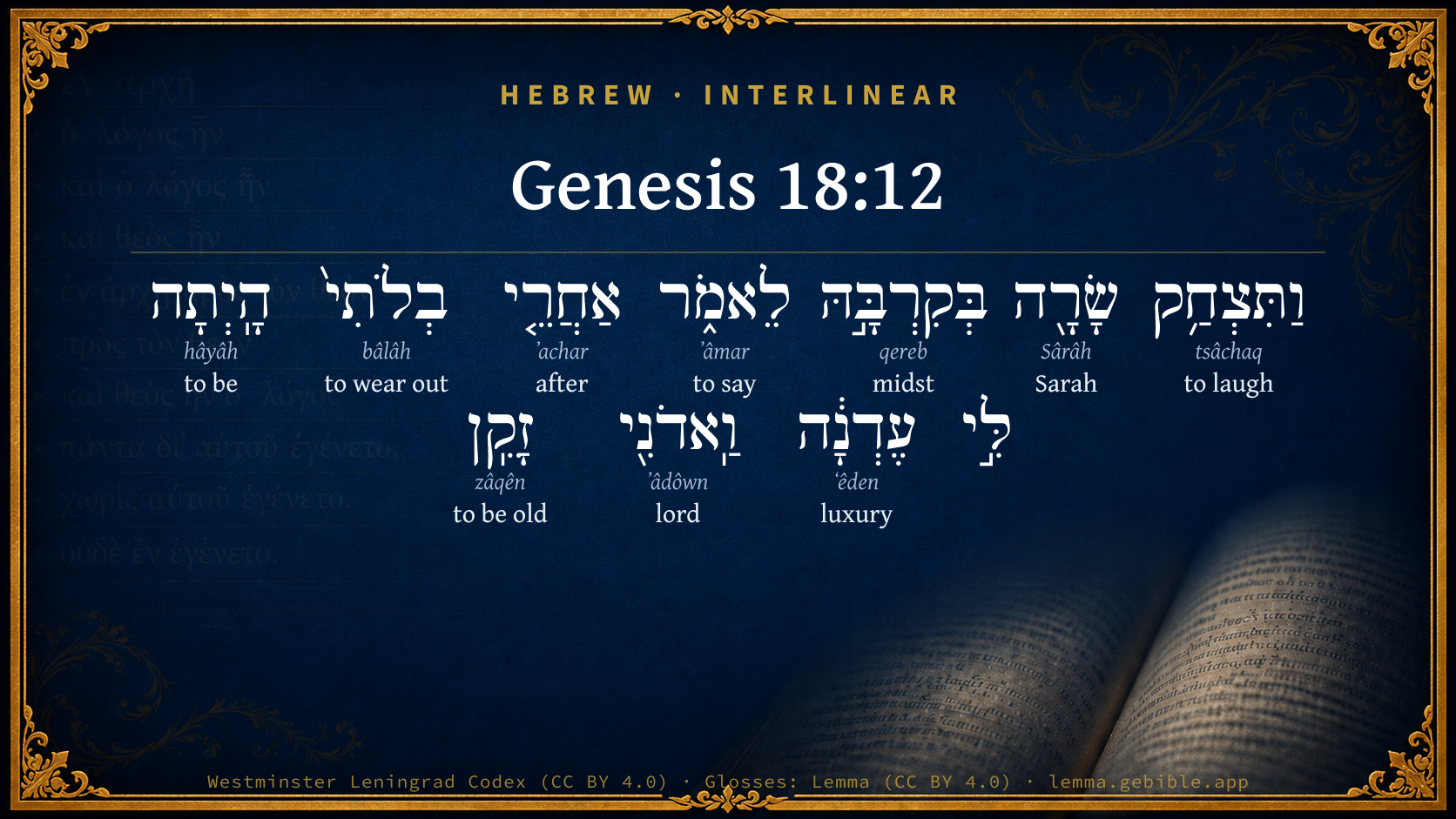
Hebrew (Westminster Leningrad Codex) Genesis 18:12 appears in the Hebrew Old Testament. The text above is from the Westminster Leningrad Codex. Each word links to its Strong’s number, a concise gloss, and parsing drawn from the Open Scriptures Hebrew Bible morphology. Click any word for its full Brown-Driver-Briggs (BDB) entry.
Download image
Cite this verse

Genesis 18:12 (World English Bible). Public Domain. Lemma interlinear Bible study tool, https://lemma.gebible.app/v/genesis/18/12.

Show BibTeX & RIS
BibTeX
RIS
English Translation
Sarah laughed within herself, saying, "After I have grown old will I have pleasure, my lord being old also?"
World English Bible · Public Domain
Highlights
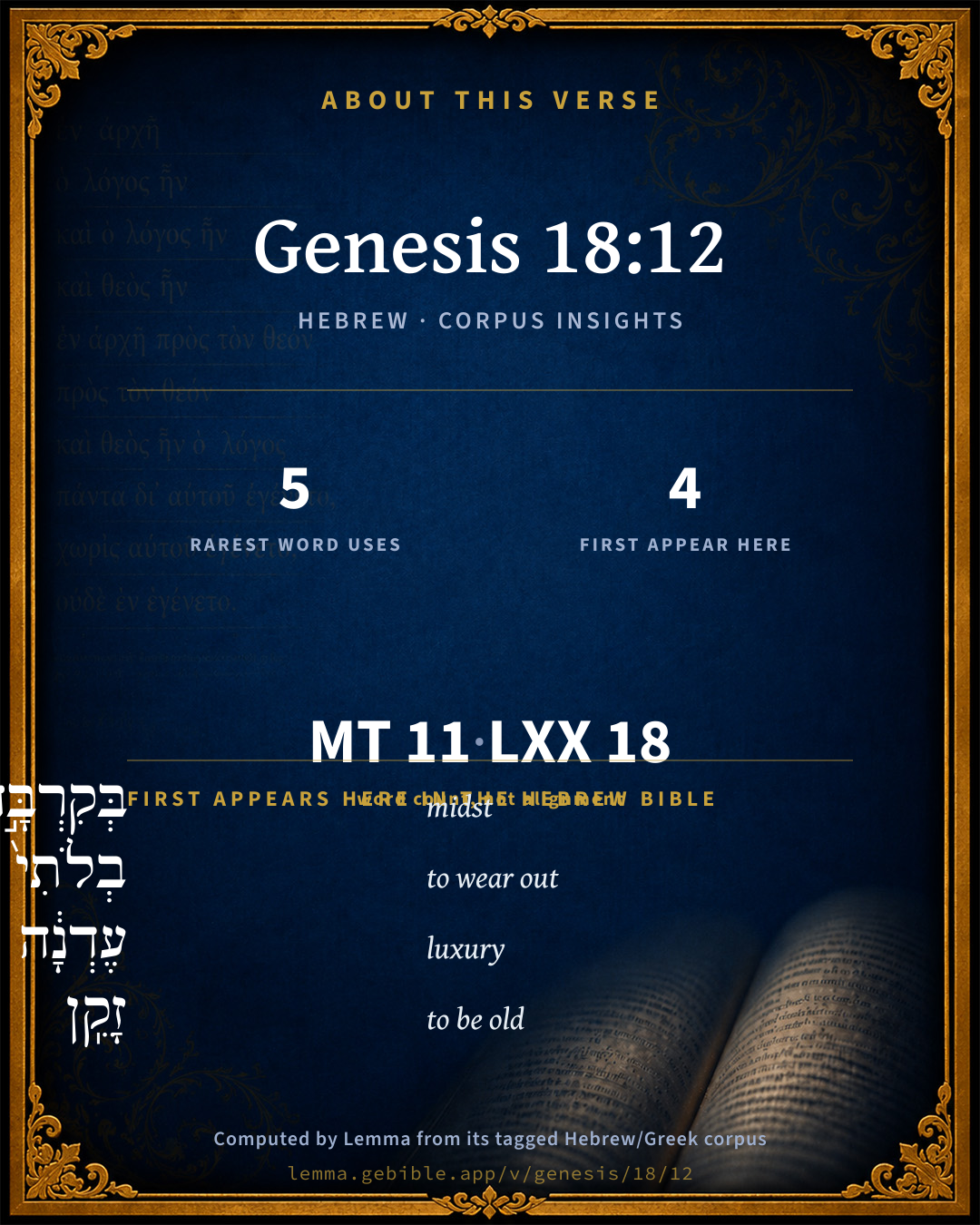
  • 4 first appearances in the Hebrew Bible
Full analysis ↓
Download a study sheet

One document with this verse’s original text, its word-by-word gloss line, the meaning frame, cross-references with their text, attributed commentary, and full source and license credits — printable, and it pastes into notes with its structure intact.

This verse Autodidact and up

Study sheet (.html) Plain text (.txt)

A passage Seminary Student

Up to 50 verses in one chapter. A passage sheet keeps up to 6 commentary sources and 12 cross-references per verse, in the order this page ranks them, and says so on the sheet whenever that leaves anything out. Ask for a single verse and you get the Autodidact verse sheet above.

Everything on this page stays free to read, with no account — the sheet is a download of what is already on screen, not access to it.

Want to remove ads? Support Godless Engineer
Compare translations 3

The same verse in 3 English versions, stacked beneath the original-language interlinear above. Click any original word for its lexicon entry.

Each is an independent rendering of the whole verse — the interlinear is not word-aligned to these translations.

Highlighted words mark where these versions differ — a whole-verse word diff, not a word-by-word alignment.

  • World English Bible Public Domain
    Sarah laughed within herself, saying, "After I have grown old will I have pleasure, my lord being old also?"
  • King James Version Public Domain
    Therefore Sarah laughed within herself, saying, After I am waxed old shall I have pleasure, my lord being old also?
  • unfoldingWord Literal Text CC BY-SA 4.0
    So Sarah laughed within herself and said, “After I am worn out, will I have pleasure? And my lord old!”

unfoldingWord Literal Text — © unfoldingWord, licensed CC BY-SA 4.0. Word-aligned USFM3 via Door43 (git.door43.org/unfoldingWord/en_ult).

Versions to compare (up to 4)

3 of 4 selected

Show all 18 translations

Every available English version of this verse, each an independent rendering of the whole verse.

  • World English Bible Public Domain
    Sarah laughed within herself, saying, "After I have grown old will I have pleasure, my lord being old also?"
  • Berean Standard Bible Public Domain
    So she laughed to herself, saying, “After I am worn out and my master is old, will I now have this pleasure?”
  • Majority Standard Bible Public Domain
    So she laughed to herself, saying, “After I am worn out and my master is old, will I now have this pleasure?”
  • King James Version Public Domain
    Therefore Sarah laughed within herself, saying, After I am waxed old shall I have pleasure, my lord being old also?
  • American Standard Version (1901) Public Domain
    And Sarah laughed within herself, saying, After I am waxed old shall I have pleasure, my lord being old also?
  • Revised Version (1885) Public Domain
    And Sarah laughed within herself, saying, After I am waxed old shall I have pleasure, my lord being old also?
  • Geneva Bible (1599) Public Domain
    Therefore Sarah laughed within her selfe, saying, After I am waxed olde, and my lord also, shall I haue lust?
  • Douay-Rheims (1899) Public Domain
    Now they were both old, and far advanced in years, and it had ceased to be with Sara after the manner of women.
  • Young's Literal Translation Public Domain
    and Abraham and Sarah `are' aged, entering into days -- the way of women hath ceased to be to Sarah;
  • Literal Standard Version CC BY-SA 4.0
    and Sarah laughs in her heart, saying, “After I have waxed old have I had pleasure? My lord [is] also old!”
  • Unlocked Literal Bible CC BY-SA 4.0
    So Sarah laughed to herself, saying to herself, “After I am worn-out and my master is old, will I now have this pleasure?”
  • unfoldingWord Literal Text CC BY-SA 4.0
    So Sarah laughed within herself and said, “After I am worn out, will I have pleasure? And my lord old!”
  • Darby Bible Public Domain
    And Sarah laughed within herself, saying, After I am become old, shall I have pleasure, and my lord old?
  • World Messianic Bible Public Domain
    Sarah laughed within herself, saying, “After I have grown old will I have pleasure, my lord being old also?”
  • Webster's Bible Public Domain
    Therefore Sarah laughed within herself, saying, After I am become old shall I have pleasure, my lord being old also?
  • Free Bible Version CC BY-SA 4.0
    Sarah was laughing inside, saying to herself, “Now that I'm old and worn out, how would I experience pleasure? My husband is old too!”
  • Bible in Basic English Public Domain
    And Sarah, laughing to herself, said, Now that I am used up am I still to have pleasure, my husband himself being old?
  • JPS Tanakh (1917) Public Domain
    And Sarah laughed within herself, saying: 'After I am waxed old shall I have pleasure, my lord being old also?'

Literal Standard Version (2020), Covenant Press — licensed CC BY-SA 4.0. Text via the HelloAO Bible API (eBible.org). Unlocked Literal Bible (unfoldingWord) — licensed CC BY-SA 4.0. Text via the HelloAO Bible API (eBible.org). unfoldingWord Literal Text — © unfoldingWord, licensed CC BY-SA 4.0. Word-aligned USFM3 via Door43 (git.door43.org/unfoldingWord/en_ult). Free Bible Version, Dr. Jonathan Gallagher — licensed CC BY-SA 4.0. Text via the HelloAO Bible API (eBible.org).

Word by word

More ways to search: Search by grammar → Find every occurrence → Compare this word →

Practice this passage: Drill this verse → Learn its vocabulary →

עֶדְנָ֔ה
ʻêden
H5730
“luxury”
Noun, Common, Feminine, Singular, Absolute
Part of Speech
Noun
Type
Common
Gender
Feminine
Number
Singular
State
Absolute
Full BDB Definition

Origin: from H5727

TWOT: 1567a

luxury, dainty, delight, finery - delight
  1. וַתִּצְחַ֥ק tsâchaq H6711 “and · to laugh” Conjunction + Verb, Qal, Sequential Imperfect, 3rd Person, Feminine, Singular
  2. שָׂרָ֖ה Sârâh H8283 “Sarah” Noun, Proper
  3. בְּקִרְבָּ֣הּ qereb H7130 “in/at · midst · her” Preposition + Noun, Common, Masculine, Singular, Construct + Suffix, Personal, 3rd Person, Feminine, Singular
  4. לֵאמֹ֑ר ʼâmar H559 “to say” Preposition + Verb, Qal, Infinitive Construct
  5. אַחֲרֵ֤י ʼachar H310 “after” Preposition
  6. בְלֹתִי֙ bâlâh H1086 “to wear out · me” Verb, Qal, Infinitive Construct + Suffix, Personal, 1st Person, Common, Singular
  7. הָֽיְתָה hâyâh H1961 “to be” Verb, Qal, Perfect, 3rd Person, Feminine, Singular
  8. וַֽאדֹנִ֖י ʼâdôwn H113 “and · lord · my” Conjunction + Noun, Common, Masculine, Singular, Construct + Suffix, Personal, 1st Person, Common, Singular
  9. זָקֵֽן zâqên H2204 “to be old” Verb, Qal, Perfect, 3rd Person, Masculine, Singular

About this verse

These counts appear in no published source. They are computed here, from the morphology-tagged text and Lemma’s own curated glosses. What Lemma adds →

11
words
10
distinct lemmas
Pentateuch
section

Notable vocabulary

The rarest word here is עֶדְנָ֔ה luxury H5730 — appearing just 5 times in the whole Hebrew Bible.

First appearance in Scripture

These words make their first canonical appearance in the Hebrew Bible here:

  • בְּקִרְבָּ֣הּ midst H7130
  • בְלֹתִי֙ to wear out H1086
  • עֶדְנָ֔ה luxury H5730
  • זָקֵֽן to be old H2204

Shared distinctive vocabulary

עֶדְנָ֔ה luxury H5730 occurs in 5 verses of the Hebrew Bible. Also found in:

Grammatical profile

  • 5 verbs
  • 4 nouns
  • 2 prepositions

Verb forms

  • וַתִּצְחַ֥ק Qal · Sequential Imperfect
  • לֵאמֹ֑ר Qal · Infinitive Construct
  • בְלֹתִי֙ Qal · Infinitive Construct
  • הָֽיְתָה Qal · Perfect
  • זָקֵֽן Qal · Perfect

Hebrew & Septuagint length

In English translation the verse runs 19 words from the Hebrew and 23 from the Septuagint (LXX English) — closely comparable.

A rough comparison of the two English renderings, which tokenize alike — not a word-level alignment.

Word counts can differ between the Hebrew and the Greek without any difference in meaning — e.g. the Hebrew direct-object marker אֵת has no separate Greek word, and Greek often adds the article ὁ.

In the original languages it is 11 Hebrew tokens and 18 Greek tokens — but the two are counted differently (Hebrew bundles its prefixes and suffixes into one token; the Greek is in lemma form), so that isn’t a like-for-like length.

Cross-references

9

Topical passages linked to Genesis 18:12 in the Treasury of Scripture Knowledge — connected by theme and wording, ordered by reader-vote popularity; previews shown in the World English Bible.

  • Genesis 17:17 Then Abraham fell on his face, and laughed, and said in his heart, "Will a child be born to him who is one hundred years old? Will Sarah, who is ninety years old, give birth?"
  • 1 Peter 3:6 as Sarah obeyed Abraham, calling him lord, whose children you now are, if you do well, and are not put in fear by any terror.
  • Luke 1:18–20 Zacharias said to the angel, "How can I be sure of this? For I am an old man, and my wife is well advanced in years."
  • Genesis 18:13 Yahweh said to Abraham, "Why did Sarah laugh, saying, 'Will I really bear a child, yet I am old?'
  • Genesis 21:6–7 Sarah said, "God has made me laugh. Everyone who hears will laugh with me."
  • Luke 1:34–35 Mary said to the angel, "How can this be, seeing I am a virgin?"
  • Psalms 126:2 Then our mouth was filled with laughter, And our tongue with singing. Then they said among the nations, "Yahweh has done great things for them."
  • Ephesians 5:33 Nevertheless each of you must also love his own wife even as himself; and let the wife see that she respects her husband.
  • Hebrews 11:11–12 By faith, even Sarah herself received power to conceive, and she bore a child when she was past age, since she counted him faithful who had promised.

Cross-references courtesy of OpenBible.info (CC BY 4.0).

Hebrew and Greek witnesses Masoretic Hebrew ↔ Greek Septuagint

The same verse in the two great witnesses to the Old Testament, shown verse-for-verse.

These are two independent witnesses, not word-aligned to each other, and the Septuagint is shown in lemma (dictionary) form.

Hebrew Genesis 18:12 Masoretic · Westminster Leningrad Codex

וַתִּצְחַ֥ק שָׂרָ֖ה בְּקִרְבָּ֣הּ לֵאמֹ֑ר אַחֲרֵ֤י בְלֹתִי֙ הָֽיְתָה לִּ֣י עֶדְנָ֔ה וַֽאדֹנִ֖י זָקֵֽן

Sarah laughed within herself, saying, "After I have grown old will I have pleasure, my lord being old also?"

World English Bible · Public Domain

Greek LXX Genesis 18:12 Septuagint · lemma form

γελάω δέ σαρρα ἐν ἑαυτοῦ λέγω οὔπω μέν ἐγώ γίγνομαι ἕως ὁ νῦν ὁ δέ κύριος ἐγώ πρεσβύτερος

And Sarrha laughed in herself, saying, The thing has not as yet happened to me, even until now, and my lord is old.

LXX2012 (modern English Septuagint) · Public Domain

Hebrew: Westminster Leningrad Codex (CC BY 4.0). Greek: Septuagint (public domain); English from LXX2012 (modern English Septuagint) (Public Domain). How the Septuagint differs from the Hebrew →

Targum (Aramaic paraphrase)

2

The Targum is the ancient Jewish Aramaic paraphrase of the Hebrew Scriptures — an interpretive translation, not the Hebrew text itself. Onkelos (literal) and Pseudo-Jonathan (expansive) render the Torah, and Jonathan the Prophets. Coverage is partial: where no permissively-licensed English translation exists for a verse, only the Aramaic is shown. This is verse-level text, not a word-by-word alignment to the Hebrew.

  1. Targum Onkelos Torah (Genesis–Deuteronomy)
    וְחַיְכַת שָׂרָה בִּמְעָהַהּ לְמֵימָר בָּתַר דְּסֵיבִית הֲוַת לִי עוּלֵימוּ וְרִבּוֹנִי סִיב

    (no public-domain English translation for this verse)

    Targum Onkelos — Aramaic: “Onkelos Genesis” (public domain); “Onkelos Exodus” (public domain); “Onkelos Leviticus” (public domain); “Onkelos Numbers” (public domain); “Onkelos Deuteronomy” (public domain). English: “Sefaria Community Translation” (CC0 1.0 (public-domain dedication)); “J.W. Etheridge. The Targums of Onkelos and Jonathan Ben Uzziel on the Pentateuch. London: Longmans, Green, 1862” (public domain). Text via Sefaria.

  2. Targum Pseudo-Jonathan Torah (Genesis–Deuteronomy)
    וּתְמָהַת שָרָה בְּלִבָּה לְמֵימַר בָּתַר דִי סֵיבִית הֲוֵי לִי עִדוּיֵין וְרִבּוֹנִי אַבְרָהָם סִיב

    And Sarah wondered in her heart, saying After that I am old shall I have conceptions, and my lord Abraham is old?

    Targum Pseudo-Jonathan — Aramaic: “Targum Jonathan on Genesis” (public domain); “Targum Jonathan on Exodus” (public domain); “Targum Jonathan on Leviticus” (public domain); “Targum Jonathan on Numbers” (public domain); “Targum Jonathan on Deuteronomy” (public domain). English: “The Targum of Jonathan ben Uzziel, trans. J. W. Etheridge, London, 1862” (public domain). Text via Sefaria.

Commentary

Notes on Genesis 18:12 from classic Christian and Jewish commentators (each source and its license shown beneath its notes). The classic Christian expositions comment on the surrounding passage and are grouped to its opening verse, so a note may address several verses; the Jewish commentaries on the Tanakh (Rashi and others) are per-verse, so they appear only where the commentator wrote on this verse.

Lemma curates 59 commentaries, every one of them public domain or Creative Commons licensed, each selected and text-cleaned for this edition rather than reprinted as found. About our sources →

Trapp's Complete Commentary

John Trapp

Gen 18:12 Therefore Sarah laughed within herself, saying, After I am waxed old shall I have pleasure, my lord being old also?

Ver. 12. Sarah laughed.] God’s promises seem absurd and ridiculous, many of them, to human reason, which therefore must be silenced, and shut out, as Hagar was; for it will argue carnally, as that unbelieving lord {2Ki 7:2} storms at God’s offers, as Naaman at the message {2Ki 5:11} looks upon God’s Jordan with Syrian eyes, as he, and after all, cries out with Nicodemus, "How can these things be?" {Joh 3:4} measuring God by its own model; and casting him into its own mould.

After I am waxed old, shall I lust?] Old and cold, is our English proverb; and the Greek word for an old body signifies one in whom natural heat is extinct. {a} It is a most undecent thing to see the pleasure of youth prevailing in times of age, among old decrepit goats. Were it not monstrous to behold green apples on a tree in winter?

My lord being old also?] This was the only good word in the whole sentence: God takes notice of it, and by St Peter records it to her eternal commendation; {1Pe 3:6} yea, he was so well pleased with her subjection to her husband, whom she here in her heart calleth Lord, that he is content to forgive her great sin of unbelief.

{a} Pρεσβυς, α πυρ et σβεω

John Trapp, A Commentary or Exposition upon All the Books of the Old and New Testament (1647–1656) — public domain. Text from a community e-Sword module.

Joseph Benson's Commentary

Gen 18:12. Sarah laughed within herself — It was not a laughter of faith, like Abraham’s, (Gen 17:17,) but a laughter of doubting and distrust. The great objection which Sarah could not get over was her age. I am waxed old — And past child-bearing in a course of nature, especially having been hitherto barren, and, which magnifies the difficulty, My lord is old also. Observe here, that Sarah calls Abraham her lord, and the Holy Ghost takes notice of it to her honour, and recommends it to the imitation of all Christian wives, 1Pe 3:6, Sarah obeyed Abraham, calling him lord, in token of respect and subjection.

Joseph Benson's Commentary on the Old and New Testaments (1811–1818) — public domain. Text from a community e-Sword module.

Geneva Bible (1599)

Geneva Bible translators

For she rather had respect to the order of nature, than believed the promise of God.

Geneva Bible (1599) marginal notes — public domain. Text via Bolls.life.

Jamieson, Fausset & Brown

Robert Jamieson, A. R. Fausset & David Brown

Therefore Sarah laughed within herself--Long delay seems to have weakened faith. Sarah treated the announcement as incredible, and when taxed with the silent sneer, she added falsehood to distrust. It was an aggravated offense (Act 5:4), and nothing but grace saved her (Rom 9:18).

Jamieson, Fausset & Brown — Commentary Critical and Explanatory on the Whole Bible (1871) — public domain (CC PDM 1.0). Text via the HelloAO Bible API.

Adam Clarke's Commentary

Verse 12. Sarah laughed] Partly through pleasure at the bare idea of the possibility of the thing, and partly from a conviction that it was extremely improbable. She appears to have been in the same spirit, and to have had the same feelings of those who, unexpectedly hearing of something of great consequence to themselves, smile and say, "The news is too good to be true;", see Ge 21:6. There is a case very similar to this mentioned Ps 126:1-2. On Abraham's laughing, See Clarke on Ge 17:17.

Adam Clarke's Commentary on the Bible (1810–1826) — public domain. Text from a community e-Sword/MySword module.

John Calvin's Commentaries

12. Therefore Sarah laughed within herself Abraham had laughed before, as appears in the preceding chapter Genesis 17:1: but the laughter of both was, by no means, similar. For Sarah is not transported with admiration and joy, on receiving the promise of God; but foolishly sets her own age and that of her husband in opposition to the word of God; that she may withhold confidence from God, when he speaks. Yet she does not, avowedly, charge God with falsehood or vanity; but because, having her mind fixed on the contemplation of the thing proposed, she only weighs what might be accomplished by natural means, without raising her thoughts to the consideration of the power of God, and thus rashly casts discredit on God who speaks to her. Thus, as often as we measure the promises and the works of God, by our own reason, and by the laws of nature, we act reproachfully towards him, though we may intend nothing of the sort. For we do not pay him his due honor, except we regard every obstacle which presents itself in heaven and on earth, as placed under subjection to his word. But although the incredulity of Sarah is not to be excused; she, nevertheless, does not directly reject the favor of God; but is only so kept back by shame and modesty, that she does not altogether believe what she hears. Even her very words declare the greatest modesty; ‘After we are grown old shall we give ourselves up to lust?’ Wherefore, let us observe, that nothing was less in Sarah’s mind, than to make God a liar. But herein consisted in this alone, that, having fixed her thoughts too much on the accustomed order of nature, she did not give glory to God, by expecting from him a miracle which she was unable to conceive in her mind. We must here notice the admonition which the Apostle gathers from this passage, because Sarah here calls Abraham her lord. (1 Peter 3:6.) For he exhorts women, after her example, to be obedient and well-behaved towards their own husbands. Many women, indeed, without difficulty, give their husbands this title, when yet they do not scruple to bring them under rule, by their imperious pride: but the Apostle takes it for granted that Sarah testifies, from her heart, what she feels, respecting her husband: nor is it doubtful that she gave proof, by actual services, of the modesty which she had professed in words.

John Calvin's Commentaries (1540-1563) — public domain. Text from the Calvin Translation Society English edition (1840s-50s) via the Christian Classics Ethereal Library (ccel.org). Calvin's coverage is partial (roughly two-thirds of the Bible); uncommented books and verses are honest gaps, never fabricated. The 19th-century editor's footnotes and remarks are omitted so the notes are faithfully Calvin's own voice.

Ellicott's Commentary for English Readers

(12) Sarah laughed.—See Note on Gen_17:17. The laughter of both husband and wife brings into prominence the inconceivable character of the fact. Sarah’s conduct has been very unjustly condemned. Though Abraham may have begun to guess that his visitors were more than men, she probably had no such suspicions. Sitting inside the tent, and catching their words only occasionally, listening, perhaps, now only because she heard her own name mentioned, when she hears them talk of her having a child she naturally laughs. thinking possibly that they did not know how old she was.

After I am waxed old.—The Hebrew word is stronger and more lively. It means “to be worn out like an old garment.”

A Bible Commentary for English Readers, edited by Charles John Ellicott (1878–1897) — public domain. Text from a community e-Sword module.

The Cambridge Bible for Schools and Colleges

gen. ed. J. J. S. Perowne

12. Sarah laughed within herself] This is the laughter, according to J, which furnished a reason for the name “Isaac”; and on that account it is here emphasized. See, for the reason in P, Gen_17:17.

waxed old] The word in the original is forcible, and is used elsewhere for worn-out raiment, e.g. “shall wax old like a garment,” Psa_102:26.

The Cambridge Bible for Schools and Colleges (gen. ed. J. J. S. Perowne; Cambridge University Press, 1878–1918) — public domain. Text from a community e-Sword module.

John Gill's Exposition

Therefore Sarah laughed within herself,.... Not for joy of a son, and as pleased with it, believing so it would be; but as disbelieving it, and perhaps deriding it, and confuting it with a laugh, which, though it did not appear in her countenance, was secretly in her heart:

saying, not with her mouth, but in her mind:

after I am waxed old, being almost ninety years of age:

shall I have pleasure? in conception, or rather in having a son, and in suckling and nursing him, and bringing him up; for in bearing and bringing forth is sorrow:

and my Lord being old also; which increased the difficulty and her unbelief: the Apostle Peter seems to have respect to this in Pe1 3:6.

John Gill's Exposition of the Whole Bible (1746–1763) — public domain (CC PDM 1.0). Text via the HelloAO Bible API.

Haydock's Catholic Bible Commentary

Laughed, as if the promise were incredible. --- My lord, or husband, which title of respect, 1 Peter iii. 6, commends. (Du Hamel)

George Leo Haydock (1774–1849), Haydock's Catholic Family Bible and Commentary, 1859 edition — public domain. Excludes Psalms (Douay-Rheims chapter numbering differs from Protestant) and Deuterocanonical books (Catholic canon only).

Matthew Poole's English Annotations

Sarah laughed within herself; not from joy and admiration, but from distrust and contempt, as if it were incredible. Heb. In her heart, i.e. she secretly derided it, though none but herself, as she thought, knew it.

Shall I have pleasure? Not so much in the conception, as in the education and fruition of a child.

Matthew Poole's English Annotations on the Holy Bible (1683–1685) — public domain. Text from a community e-Sword/MySword module.

Whedon's Commentary on the Bible

Daniel D. Whedon

12. Sarah laughed — The context here shows that Sarah’s laugh was that of incredulity, as the context of Gen_17:17, shows that Abraham’s laughing was that of joyful wonder. Sarah laughed within herself, not aloud, nor with prostration, as yielding confidently to the joy of the promise, but with secret incredulity. My lord — See 1Pe_3:5-6.

Daniel D. Whedon (gen. ed.), Commentary on the Old and New Testaments (1874–1909) — public domain. Text from a community e-Sword module.

The Pulpit Commentary

Therefore (literally, and) Sarah laughed within herself Abraham had laughed in joyful amazement, (Gen_18:17) at the first mention of Sarah s son; Sarah laughs, if not in unbelief (Calvin, Keil, "Speaker"s Commentary," Wordsworth), at least with a mingled feeling of doubt and delight (Lange, Murphy) at the announcement of her approaching maternitysaying, After I am waxed old shall I have pleasure, my lord being old also? literally, and my lord, i.e. my husband, is old. The reverential submission to Abraham which Sarah here displays is in the New Testament commended as a pattern to Christian. (1Pe_3:6)

"Sarah laughed within herself.

1. The incongruity between a Divine promise and the sphere of its fulfillment is temptation to unbelief.

2. A disposition to measure the reality and certainty of the Divine by a human or earthly standard is sure to lead us to irreverence and sinful doubt.

3. There may be an inward and concealed working, known to God though not outwardly expressed. Which is still both an insult to him a d an injury to us.

4. The root of unbelief is in the ground of the soul. Sarah laughed because she was not prepared for the gracious promise. She was afraid of her own thoughts because they were not such as became her, and did dishonor to God"s sufficiency and love. "She denied, saying, I laughed not." A more receptive and spiritual mind would have both risen above the incongruity and been incapable of the dissimulation. R.

The Pulpit Commentary (1880–1919), ed. H.D.M. Spence-Jones & Joseph S. Exell — public domain. Text from a community e-Sword module.

John Wesley's Explanatory Notes

Sarah laughed within herself - It was not a laughter of faith, like Abraham's, chap. xvii, 17, but a laughter of doubting and distrust. The great objection which Sarah could not get over was her age. I am waxed old, and past child-bearing in a course of nature, especially having been hitherto barren, and which magnifies the difficulty, My Lord is old also. Observe here, That Sarah calls Abraham her Lord, and the Holy Ghost takes notice of it to her honour, and recommends it to the imitation of all Christian wives, 1Pe iii, 6. Sarah obeyed Abraham calling him Lord, in token of respect and subjection.

John Wesley, Explanatory Notes Upon the Whole Bible (1754–1765) — public domain. Text via the GEBible commentary corpus.

Rashi

Rabbi Shlomo Yitzchaki (Rashi)

בקרבה [SARAH LAUGHED] WITHIN HERSELF (or, REGARDING HER INSIDE) — She reflected on her physical condition, saying, “Is it possible that this womb shall bear a child, that these dried-up breasts shall give forth milk” (Midrash Tanchuma, Shoftim 18).

עדנה means glistening flesh (skin), and so it is used in the Mishna (Menachot 86a): it makes the hair fall out and the skin smooth (מעדן).

Rashi on the Tanakh — English translations: “The Judaica Press complete Tanach with Rashi, translated by A. J. Rosenberg” (CC BY 4.0); “Pentateuch with Rashi's commentary by M. Rosenbaum and A.M. Silbermann, 1929-1934” (public domain); “The Metsudah Tanach series, Lakewood, N.J” (CC BY 4.0); and “The Book of Joshua, Metsudah Publications, 1997” (CC BY 4.0). Text via Sefaria.

Radak

Rabbi David Kimhi (Radak)

ותצחק שרה בקרבה, Sarah laughed derisively internally, not audibly; she did not believe that the man who had made the prediction was an angel, though she assumed that he was a prophet.

לאמור, she contemplated saying out loud what she had only been thinking so far. Even though, she did not laugh in the angel’s face, but contained herself due to her good manners, asking instead in wonderment:

אחרי בלותי היתה לי עדנה, how is it possible that I, who have stopped ovulating should become sufficiently rejuvenated? The word עדנה refers to youthful flesh and skin. It describes a certain elasticity of the skin. The angel was fully aware that she had laughed; this is why he said to Avraham: why did Sarah laugh?

Radak on the Tanakh — English translations: “Sefaria Community Translation” (CC0 1.0 (public-domain dedication)); “Eliyahu Munk, HaChut Hameshulash” (CC BY 4.0); “Rabbi Mike Feuer, Jerusalem Anthology” (CC BY 4.0); and “R. David Kimhi on the first book of Psalms, Translated by R.G. Finch, London, 1919” (public domain). Text via Sefaria.

Lesson kit

Teaching starters — assembled from the data on this page, not authored interpretation. Every prompt links to the verse data it draws on. Edit before teaching.

Genesis, in the Pentateuch, opens this verse with 11 words (10 distinct Hebrew lemmas). Its most distinctive word is ʻêden (“luxury”). A historical commentator’s framing appears above. Read the whole chapter for the surrounding context.

Discussion questions

  1. What does “luxury” (ʻêden) contribute to the verse as a whole?
  2. 4 words here appear for the first time in Scripture. What is being introduced at this debut?
  3. 2 Samuel 1:24 shares the word «luxury» with this verse. How do the two illuminate each other?
  4. These translations render this verse differently. What is at stake in choosing one wording over another?
  5. The verb «וַתִּצְחַ֥ק» is Qal Sequential Imperfect. How does its form color the action?
  6. Reading how Trapp's Complete Commentary and Joseph Benson's Commentary read this verse, where do the two commentators agree and where do they part?

Things to notice

Reading settings

Reading text

Shown beneath each verse's original-language words.

Old Testament
Old Testament edition

Read the OT as the Masoretic Hebrew (MT) or the Greek Septuagint (LXX).

English shown for the Greek Septuagint (in the Hebrew ↔ Greek comparison).

Comparing translations? Open the Compare panel on any verse page to stack up to four side by side.