
Zephaniah 3:12

Hebrew (Westminster Leningrad Codex) Zephaniah 3:12 appears in the Hebrew Old Testament. The text above is from the Westminster Leningrad Codex. Each word links to its Strong’s number, a concise gloss, and parsing drawn from the Open Scriptures Hebrew Bible morphology. Click any word for its full Brown-Driver-Briggs (BDB) entry.
Download image
Cite this verse

Zephaniah 3:12 (World English Bible). Public Domain. Lemma interlinear Bible study tool, https://lemma.gebible.app/v/zephaniah/3/12.

Show BibTeX & RIS
BibTeX
RIS
English Translation
But I will leave in the midst of you an afflicted and poor people, and they will take refuge in the name of Yahweh.
World English Bible · Public Domain
Download a study sheet

One document with this verse’s original text, its word-by-word gloss line, the meaning frame, cross-references with their text, attributed commentary, and full source and license credits — printable, and it pastes into notes with its structure intact.

This verse Autodidact and up

Study sheet (.html) Plain text (.txt)

A passage Seminary Student

Up to 50 verses in one chapter. A passage sheet keeps up to 6 commentary sources and 12 cross-references per verse, in the order this page ranks them, and says so on the sheet whenever that leaves anything out. Ask for a single verse and you get the Autodidact verse sheet above.

Everything on this page stays free to read, with no account — the sheet is a download of what is already on screen, not access to it.

Want to remove ads? Support Godless Engineer
Compare translations 3

The same verse in 3 English versions, stacked beneath the original-language interlinear above. Click any original word for its lexicon entry.

Each is an independent rendering of the whole verse — the interlinear is not word-aligned to these translations.

Highlighted words mark where these versions differ — a whole-verse word diff, not a word-by-word alignment.

  • World English Bible Public Domain
    But I will leave in the midst of you an afflicted and poor people, and they will take refuge in the name of Yahweh.
  • King James Version Public Domain
    I will also leave in the midst of thee an afflicted and poor people, and they shall trust in the name of the LORD.
  • unfoldingWord Literal Text CC BY-SA 4.0
    And I will leave in your midst a humble and lowly people, and they will trust in the name of Yahweh.

unfoldingWord Literal Text — © unfoldingWord, licensed CC BY-SA 4.0. Word-aligned USFM3 via Door43 (git.door43.org/unfoldingWord/en_ult).

Versions to compare (up to 4)

3 of 4 selected

Show all 18 translations

Every available English version of this verse, each an independent rendering of the whole verse.

  • World English Bible Public Domain
    But I will leave in the midst of you an afflicted and poor people, and they will take refuge in the name of Yahweh.
  • Berean Standard Bible Public Domain
    But I will leave within you a meek and humble people, and they will trust in the name of the LORD.
  • Majority Standard Bible Public Domain
    But I will leave within you a meek and humble people, and they will trust in the name of the LORD.
  • King James Version Public Domain
    I will also leave in the midst of thee an afflicted and poor people, and they shall trust in the name of the LORD.
  • American Standard Version (1901) Public Domain
    But I will leave in the midst of thee an afflicted and poor people, and they shall take refuge in the name of Jehovah.
  • Revised Version (1885) Public Domain
    But I will leave in the midst of thee an afflicted and poor people, and they shall trust in the name of the LORD.
  • Geneva Bible (1599) Public Domain
    Then will I leaue in the middes of thee an humble and poore people: and they shall trust in the Name of the Lord.
  • Douay-Rheims (1899) Public Domain
    And I will leave in the midst of thee a poor and needy people: and they shall hope in the name of the Lord.
  • Young's Literal Translation Public Domain
    And I have left in thy midst a people humble and poor, And they have trusted in the name of Jehovah.
  • Literal Standard Version CC BY-SA 4.0
    And I have left in your midst a people humble and poor, || And they have trusted in the Name of YHWH.
  • Unlocked Literal Bible CC BY-SA 4.0
    But I will leave among you a lowly and poor people, and they will find refuge in the name of Yahweh.
  • unfoldingWord Literal Text CC BY-SA 4.0
    And I will leave in your midst a humble and lowly people, and they will trust in the name of Yahweh.
  • Darby Bible Public Domain
    And I will leave in the midst of thee an afflicted and poor people, and they shall trust in the name of Jehovah.
  • World Messianic Bible Public Domain
    But I will leave among you an afflicted and poor people, and they will take refuge in the LORD’s name.
  • Webster's Bible Public Domain
    I will also leave in the midst of thee an afflicted and poor people, and they shall trust in the name of the LORD.
  • Free Bible Version CC BY-SA 4.0
    I will leave among you those who are meek and humble, those who trust in the name of the Lord.
  • Bible in Basic English Public Domain
    But I will still have among you a quiet and poor people, and they will put their faith in the name of the Lord.
  • JPS Tanakh (1917) Public Domain
    And I will leave in the midst of thee an afflicted and poor people, and they shall take refuge in the name of the LORD.

Literal Standard Version (2020), Covenant Press — licensed CC BY-SA 4.0. Text via the HelloAO Bible API (eBible.org). Unlocked Literal Bible (unfoldingWord) — licensed CC BY-SA 4.0. Text via the HelloAO Bible API (eBible.org). unfoldingWord Literal Text — © unfoldingWord, licensed CC BY-SA 4.0. Word-aligned USFM3 via Door43 (git.door43.org/unfoldingWord/en_ult). Free Bible Version, Dr. Jonathan Gallagher — licensed CC BY-SA 4.0. Text via the HelloAO Bible API (eBible.org).

Word by word

More ways to search: Search by grammar → Find every occurrence → Compare this word →

Practice this passage: Drill this verse → Learn its vocabulary →

וְחָס֖וּ
châçâh
H2620
“and · to seek refuge”
Conjunction + Verb, Qal, Sequential Perfect, 3rd Person, Common, Plural
Part of Speech
Conjunction + Verb
Stem
Qal
Form
Sequential Perfect
Person
3rd Person
Gender
Common
Number
Plural
Full BDB Definition

Origin: a primitive root

TWOT: 700

(Qal) to seek refuge, flee for protection - to put trust in (God), confide or hope in (God) (figuratively)
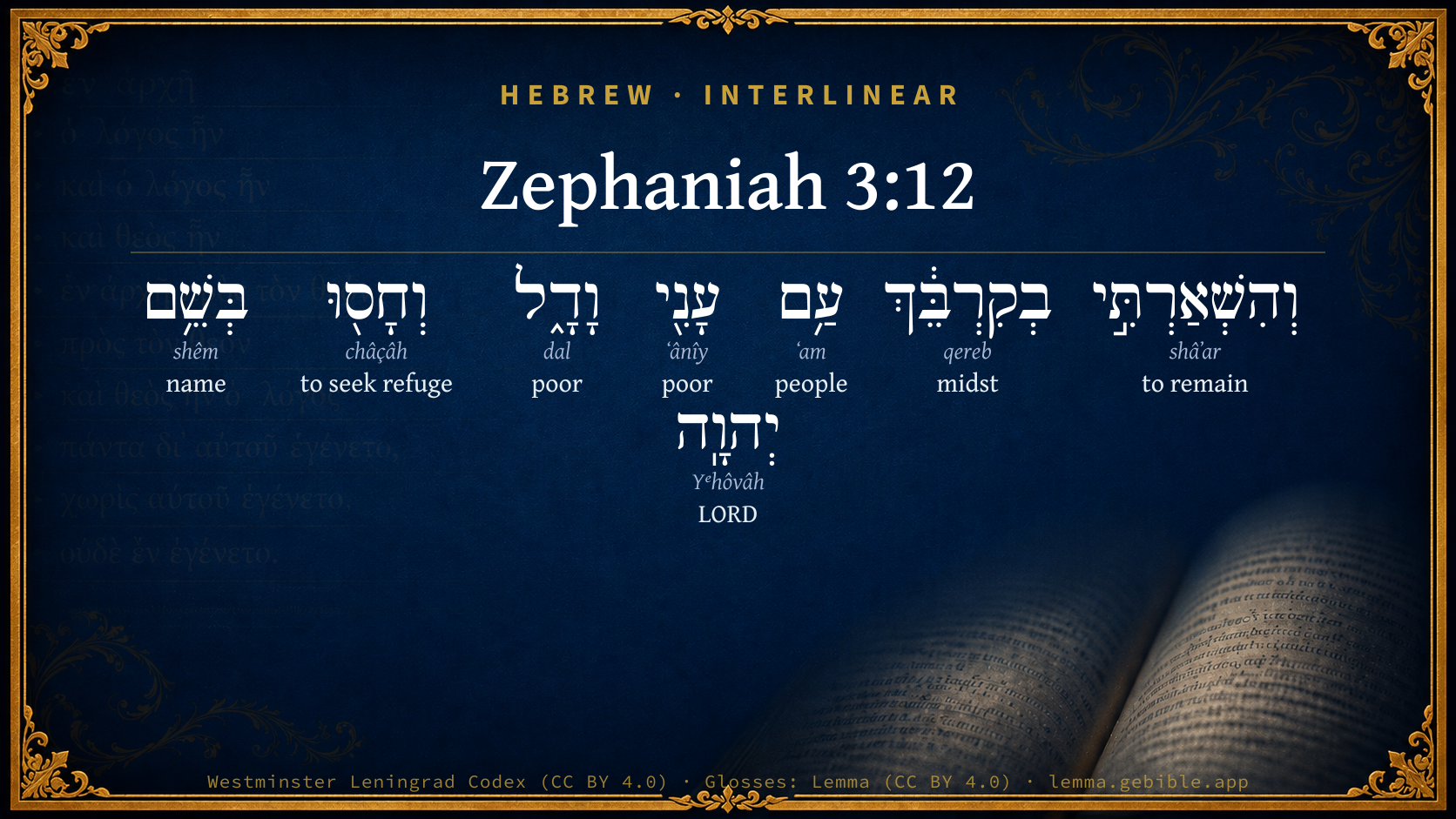
  1. וְהִשְׁאַרְתִּ֣י shâʼar H7604 “and · to remain” Conjunction + Verb, Hiphil, Sequential Perfect, 1st Person, Common, Singular
  2. בְקִרְבֵּ֔ךְ qereb H7130 “in/at · midst · your” Preposition + Noun, Common, Masculine, Singular, Construct + Suffix, Personal, 2nd Person, Feminine, Singular
  3. עַ֥ם ʻam H5971 “people” Noun, Common, Masculine, Singular, Absolute
  4. עָנִ֖י ʻânîy H6041 “poor” Adjective, Adjective, Masculine, Singular, Absolute
  5. וָדָ֑ל dal H1800 “and · poor” Conjunction + Adjective, Adjective, Masculine, Singular, Absolute
  6. בְּשֵׁ֥ם shêm H8034 “in/at · name of” Preposition + Noun, Common, Masculine, Singular, Construct
  7. יְהוָֽה Yᵉhôvâh H3068 “LORD” Noun, Proper

About this verse

These counts appear in no published source. They are computed here, from the morphology-tagged text and Lemma’s own curated glosses. What Lemma adds →

8
words
8
distinct lemmas
Prophets
section

Shared distinctive vocabulary

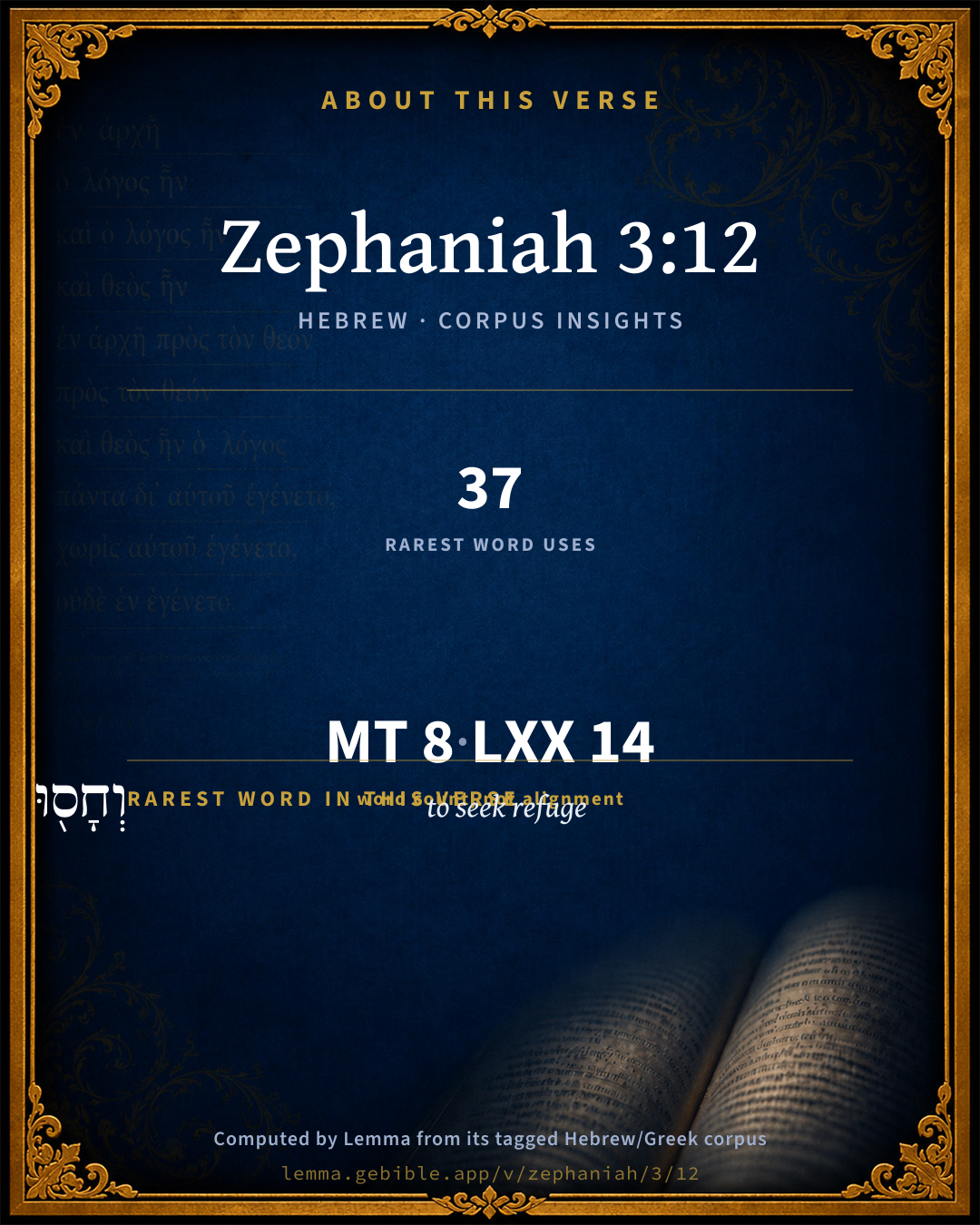
וְחָס֖וּ to seek refuge H2620 occurs in 36 verses of the Hebrew Bible. Also found in:

Grammatical profile

  • 2 verbs
  • 4 nouns
  • 2 adjectives

Verb forms

  • וְהִשְׁאַרְתִּ֣י Hiphil · Sequential Perfect
  • וְחָס֖וּ Qal · Sequential Perfect

Hebrew & Septuagint length

In English translation the verse runs 24 words from the Hebrew and 11 from the Septuagint (LXX English) — the Septuagint runs noticeably shorter here. See the side-by-side →

A rough comparison of the two English renderings, which tokenize alike — not a word-level alignment.

Word counts can differ between the Hebrew and the Greek without any difference in meaning — e.g. the Hebrew direct-object marker אֵת has no separate Greek word, and Greek often adds the article ὁ.

In the original languages it is 8 Hebrew tokens and 14 Greek tokens — but the two are counted differently (Hebrew bundles its prefixes and suffixes into one token; the Greek is in lemma form), so that isn’t a like-for-like length.

Cross-references

15

Topical passages linked to Zephaniah 3:12 in the Treasury of Scripture Knowledge — connected by theme and wording, ordered by reader-vote popularity; previews shown in the World English Bible.

  • Isaiah 14:32 What then shall one answer the messengers of the nation? That Yahweh has founded Zion, and in her shall the afflicted of his people take refuge.
  • Nahum 1:7 Yahweh is good, a stronghold in the day of trouble; and he knows those who take refuge in him.
  • Isaiah 61:1–3 The Spirit of the Lord Yahweh is on me; because Yahweh has anointed me to preach good news to the humble; he has sent me to bind up the broken-hearted, to proclaim liberty to the captives, and the opening [of the prison] to those who are bound;
  • Zechariah 13:8–9 It shall happen that in all the land," says Yahweh, Two parts in it will be cut off and die; But the third will be left in it.
  • Isaiah 50:10 Who is among you who fears Yahweh, who obeys the voice of his servant? He who walks in darkness, and has no light, let him trust in the name of Yahweh, and rely on his God.
  • Matthew 5:3 "Blessed are the poor in spirit, For theirs is the Kingdom of Heaven.
  • James 2:5 Listen, my beloved brothers. Didn't God choose those who are poor in this world to be rich in faith, and heirs of the Kingdom which he promised to those who love him?
  • Psalms 37:40 Yahweh helps them, and rescues them. He rescues them from the wicked, and saves them, Because they have taken refuge in him.
  • Zechariah 11:11 It was broken in that day; and thus the poor of the flock that listened to me knew that it was the word of Yahweh.
  • Matthew 11:5 the blind receive their sight, the lame walk, the lepers are cleansed, the deaf hear, the dead are raised up, and the poor have good news preached to them.
  • Matthew 12:21 In his name, the Gentiles will hope."
  • Romans 15:12 Again, Isaiah says, "There will be the root of Jesse, He who arises to rule over the Gentiles; On him will the Gentiles hope."
  • 1 Corinthians 1:27–28 but God chose the foolish things of the world that he might put to shame those who are wise. God chose the weak things of the world, that he might put to shame the things that are strong;
  • Ephesians 1:12–13 to the end that we should be to the praise of his glory, we who had before hoped in Christ:
  • 1 Peter 1:21 who through him are believers in God, who raised him from the dead, and gave him glory; so that your faith and hope might be in God.

Cross-references courtesy of OpenBible.info (CC BY 4.0).

Hebrew and Greek witnesses Masoretic Hebrew ↔ Greek Septuagint

The same verse in the two great witnesses to the Old Testament, shown verse-for-verse.

Here the Septuagint runs noticeably shorter than the Hebrew — LXX2012 (modern English Septuagint) 11 words vs World English Bible 24. A rough length comparison of the two English translations, not a word-level alignment — read both below.

These are two independent witnesses, not word-aligned to each other, and the Septuagint is shown in lemma (dictionary) form.

Hebrew Zephaniah 3:12 Masoretic · Westminster Leningrad Codex

וְהִשְׁאַרְתִּ֣י בְקִרְבֵּ֔ךְ עַ֥ם עָנִ֖י וָדָ֑ל וְחָס֖וּ בְּשֵׁ֥ם יְהוָֽה

But I will leave in the midst of you an afflicted and poor people, and they will take refuge in the name of Yahweh.

World English Bible · Public Domain

Greek LXX Zephaniah 3:12 Septuagint · lemma form

καί ὑπολείπω ἐν σύ λαός πραΰς καί ταπεινός καί εὐλαβέομαι ἀπό ὁ ὄνομα κύριος

And I will leave in you a meek and lowly people;

LXX2012 (modern English Septuagint) · Public Domain

Hebrew: Westminster Leningrad Codex (CC BY 4.0). Greek: Septuagint (public domain); English from LXX2012 (modern English Septuagint) (Public Domain). How the Septuagint differs from the Hebrew →

Targum (Aramaic paraphrase)

1

The Targum is the ancient Jewish Aramaic paraphrase of the Hebrew Scriptures — an interpretive translation, not the Hebrew text itself. Onkelos (literal) and Pseudo-Jonathan (expansive) render the Torah, and Jonathan the Prophets. Coverage is partial: where no permissively-licensed English translation exists for a verse, only the Aramaic is shown. This is verse-level text, not a word-by-word alignment to the Hebrew.

  1. Targum Jonathan Prophets (Joshua–Malachi)
    וְאַשְׁאַר בְּגַוֵיךְ עַם עִנְוְתָן וּמְקַבֵּל עוּלְבָן וְיִתְרַחֲצוּן בִּשְׁמָא דַיָי:

    (no public-domain English translation for this verse)

    Targum Jonathan — Aramaic: “Mikraot Gedolot” (public domain). English: “Sefaria Community Translation” (CC0 1.0 (public-domain dedication)); “London "Chaldee Paraphrase," 1871” (public domain). Text via Sefaria.

Commentary

Notes on Zephaniah 3:12 from classic Christian and Jewish commentators (each source and its license shown beneath its notes). The classic Christian expositions comment on the surrounding passage and are grouped to its opening verse, so a note may address several verses; the Jewish commentaries on the Tanakh (Rashi and others) are per-verse, so they appear only where the commentator wrote on this verse.

Lemma curates 59 commentaries, every one of them public domain or Creative Commons licensed, each selected and text-cleaned for this edition rather than reprinted as found. About our sources →

Trapp's Complete Commentary

John Trapp

Zep 3:12 I will also leave in the midst of thee an afflicted and poor people, and they shall trust in the name of the LORD.

Ver. 12. I will also leave in the midst of thee an afflicted and poor people] Poor and therein afflicted, therefore despised. Poverty is an affliction, and makes a man trodden upon, Nil habet infelix paupertas durius in se, Quam quod ridicules homines facit, Men will be sure to go over the hedge where it is lowest. Hence St Paul joins them together, I have learned to want and to be abased. They that want must look to be abased. This thy son, saith he, Luk 15:30, not this my brother; he would not once own him, because in poverty. But though men will not, yet God will, Jas 2:5 Rev 2:9. I know thy poverty, but that is nothing, thou art rich: poor in spirit, rich to Godward, glorying in nothing but this, that thou understandest and knowest me and my will, thyself and thy duty, Jer 9:23, and art therefore a rich cargazon, a full magazine, such as the world is not worthy of.

And they shall trust in the name of the Lord] As having nothing else to trust to. So St Paul’s widow indeed, being desolate and left alone, trusteth in God, who while she had a husband trusted too much in him, 1Ti 5:5. A noble woman of Savoy, mother to John Galear, Duke of Milan, after her husband’s decease, caused a coin to be made, upon the one side whereof she drew these words, Sola facta solum Deum sequor, Being left alone, I trust in God alone.

John Trapp, A Commentary or Exposition upon All the Books of the Old and New Testament (1647–1656) — public domain. Text from a community e-Sword module.

The Biblical Illustrator

Joseph S. Exell

Zep_3:12

I will leave in the midst of thee an afflicted and poor people, and they shall trust in the name of the Lord.

The rich poverty

I. Gods dealings with His poor Church when He comes to visit the world. I will leave in the midst of thee. God will have some in the worst time. This is an article of our faith. We believe in the holy Catholic Church. The world should not stand were it not for a company in the world that are His. Though Gods people be but a few, yet hath He a special care of them. Sometimes, indeed, it seems otherwise. Gods children are taken away in common judgments. But He deals with HIS children as becometh His infinite wisdom, and so that they shall find most comfort in the hardest times.

II. The state and condition of these people. An afflicted and poor people. This is for the most part the state of Gods children and Church in the world. We must not say it is a general rule. Reasons are--

1. It is fit that the body should be conformable to the head.

2. By reason of the remainder of our corruptions it is needful.

God sanctifies outward affliction and poverty, to help inward poverty of spirit. It takes away the fuel that feeds pride. And it has a power to bring us to God. Inward and spiritual poverty is not mere want of grace. There is a poverty of spirit before we are in a state of grace, and after. Where this con Diction and poverty is, a man sees an emptiness and vanity in all things in the world whatsoever, but in Christ. There is a desire for the grace and favour of God above all things. A wondrous earnestness after pardon and mercy, and after grace It is always joined with a wondrous abasing of self. There is a continual frame and disposition of soul which Is a poverty of spirit that accompanies Gods children all the days of their life. In justification and in sanctification there must be poverty of spirit.

III. The carriage of these poor and afflicted people. Naturally every man will have a trust in himself, or out of himself. God is the trust of the poor man. What he wants in himself he has in God. Learn, then, to know God: in His special attributes, and in His promises. (R. Sibbes.)

The condition and character of the people of God

I. The condition of Gods people in this world. An afflicted and poor people. A remnant. Though trouble, vanity, and vexation of spirit attend upon believers as the children of this world, yet there are trials, difficulties, and woes of a far more grievous nature, peculiar to them as the people of God. Sin is the greatest of the great troubles of the righteous. Then there is what Scripture calls, the hiding of Gods countenance. They are poor in the sense of being poor in spirit. And the true Church of Christ has ever been a protesting, minority.

II. Their hope and character. Their hope is a good hope. The name of the Lord is a strong tower; the righteous runneth into it and is safe. As to their character, God calls them to holiness, to purity, to love, to peace. The most devoted Christian cannot hope to be entirely free from sin until mortality, is swallowed up of life. But the believer does not love sin, or anew it to reign over him.

III. Their privileges.

1. Their wants shall he supplied.

2. They shall be free from terror and danger. (C. Arthur Maginn, M. A.)

Gods people afflicted and poor

The Book of Providence is confessedly a difficult book. Perhaps there are few more mysterious things in it than the deep trials of the family of God.

I. The Lord has a people. They are the Lords witnesses. Yet they are but a remnant. A remnant according to the election of grace.

II. The circumstances of his people. Afflicted and poor. There is not an evil in life from which they are exempt. They have afflictions common to men, and afflictions peculiar to themselves. Oftentimes they are heavy afflictions. Many of Gods people are literally poor, and certainly they are poor in the sense of being humble.

III. WHAT ARE THE BLESSINGS OF THESE CIRCUMSTANCES? Affliction is the means of bringing them to think. And it is the means of drawing out the sympathies of the saints of God. (J. Harington Evans, M. A.)

The Biblical Illustrator, edited by Joseph S. Exell (c. 1880s–1900s) — public domain. Text from a community e-Sword module.

Joseph Benson's Commentary

Zep 3:12-13. I will also leave in the midst of thee — Of Judea and Jerusalem; an afflicted and poor people — Hebrew, עם עני ודל, a people humble, or meek, and poor. When the Chaldeans carried away the Jews into captivity, they left of the poor of the land for vine-dressers and husbandmen; and such as returned from the Babylonish captivity were generally both poor and lowly, and dead to all confidence in external privileges. These were a type and figure of God’s spiritual remnant, who, at the coming of the Messiah, should believe on him, and embrace his gospel; who were both poor in spirit, and generally poor as to this world, and were meek and lowly in heart, and very different in their dispositions from the proud, self-righteous Pharisees, who rejected Christ on account of his appearing among them in a state of poverty, reproach, and humiliation. And they shall trust in the name of the Lord — Not in their descent from Abraham, their rite of circumcision, their city or temple, or any of their civil or religious advantages, but only in the Lord, in his mercy, power, and faithfulness. The remnant of Israel — Preserved in the captivity and dispersion, purified in the furnace of affliction, and now restored to their own land; shall not do iniquity — Shall not commit the sins they formerly committed, nor provoke God with their idolatries and other abominations as before; they shall be reformed and righteous. Nor speak lies — Nor shall they deceive each other, as they had been wont to do: they shall be honest and upright, men of veracity and fidelity. Neither shall a deceitful tongue be found in their mouth — Their spirit being without guile, their speech shall be without deceit. For they shall feed — Or, They shall also feed, and lie down — That is, they shall abound in necessary things, and live securely; a blessing which shall be added as a crown of their piety and truth. And none shall make them afraid — So as to induce them to commit iniquity, or speak lies: or, they shall be in no fear of any of the neighbouring nations, but shall have perfect peace on all sides. But this promise undoubtedly was to receive its full accomplishment only in the holy and happy state of the Christian Church, fed and protected by the good Shepherd, and safe under his watchful care; especially in the latter days, and during his millennial reign. Compare the places referred to in the margin.

Joseph Benson's Commentary on the Old and New Testaments (1811–1818) — public domain. Text from a community e-Sword module.

Tyndale Open Study Notes

Tyndale Open Resources

3:12 Jesus the Messiah perfectly expresses the ethical qualities predicted for the godly remnant of Israel (Isa 42:1-4; 53:3, 7-9; Zech 9:9; see Matt 11:28-30; 12:15-21; Phil 2:1-8; 1 Pet 2:23).

Tyndale Open Study Notes — © Tyndale Open Resources, licensed CC BY-SA 4.0. Text via the HelloAO Bible API.

Jamieson, Fausset & Brown

Robert Jamieson, A. R. Fausset & David Brown

afflicted . . . they shall trust in . . . Lord--the blessed effect of sanctified affliction on the Jewish remnant. Entire trust in the Lord cannot be, except where all cause for boasting is taken away (Isa 14:32; Zac 11:11).

Jamieson, Fausset & Brown — Commentary Critical and Explanatory on the Whole Bible (1871) — public domain (CC PDM 1.0). Text via the HelloAO Bible API.

Adam Clarke's Commentary

Verse 12. An afflicted and poor people] In such a state will the Jews be found when they shall hear the universal call, and believe in Christ Jesus. Indeed, this is the general state of the Jews in the present day; except a few that are called Jews, who are very rich; and who believe just as much in the God of Jacob, as they do in Jesus Christ.

Adam Clarke's Commentary on the Bible (1810–1826) — public domain. Text from a community e-Sword/MySword module.

John Calvin's Commentaries

Here the Prophet pursues the same subject—that God would provide for the safety of his Church, by cutting off the majority of the people, and by reserving a few; for his purpose was to gather for himself a pure and holy Church, as the city had previously been full of all uncleanness. It ought, then, to have been a compensation to ease their grief, when the godly saw that God would be propitious to them, though he had treated them with great severity. And we must bear in mind what I have before stated—that the Church could not have been preserved without correcting and subduing that arrogance, which arose from a false profession as to God. Zephaniah takes it now as granted, that pride could not be torn away from their hearts, except they were wholly cast down, and thus made contrite. He then teaches us, that as long as they remained whole, they were ever proud, and that hence it was necessary to apply a violent remedy, that they might learn meekness and humility; which he intimates when he says, that the residue of the people would be humble and afflicted; for if they had become willingly teachable, there would have been no need of so severe a correction. In short, though the faithful lament that God should thus almost annihilate his Church, yet in order that they might not murmur, he shows that this was a necessary remedy. How so? because they would have always conducted themselves arrogantly against God, had they not been afflicted. It was, therefore, needful for them to be in a manner broken, because they could not be bent. I will, then, he says, make the residue an afflicted and a poor people

The word, עני, oni, means humble; but as he adds the word דל, dal, he no doubt shows that the Jews could not be corrected without being stripped of all the materials of their glorying. They were, indeed, extremely wedded to their boastings; yea, they were become hardened in their contempt of God. He therefore says, that this fruit would at last follow, that they would trust in the Lord, that is, when he had laid them prostrate.

This verse contains a most useful instruction: for first we are taught that the Church is subdued by the cross, that she may know her pride, which is so innate and so fixed in the hearts of men, that it cannot be removed, except the Lord, so to speak, roots it out by force. There is then no wonder that the faithful are so much humbled be the Lord, and that the lot of the Church is so contemptible; for if they had more vigor, they would soon, as is often the case, break out into an insolent spirit. That the Lord, then, may keep his elect under restraint, he subdues and tames them by poverty. In short, he exercises them under the cross. This is one thing.

We must also notice the latter clause, when he says, They shall trust in the Lord, that is, those who have been reduced to poverty and want. We hence see for what purpose God deprives us of all earthly trust, and takes away from us every ground of glorying; it is, that we may rely only on his favor. This dependence ought not, indeed, to be extorted from us, for what can be more desirable than to trust in God? But while men arrogate to themselves more than what is right, and thus put themselves in the place of God, they cannot really and sincerely trust in him. They indeed imagine that they trust in God, when they ascribe to him a part of their salvation; but except this be done wholly, no trust can be placed in God. It is hence necessary that they who ascribe to themselves even the smallest thing, should be reduced to nothing: and this is what the Prophet means. Let us further know, that men do not profit under God’s scourges, except they wholly deny themselves, and forget their own power, which they falsely imagine, and recomb on him alone.

But the Prophet speaks of the elect alone; for we see that many are severely afflicted, and are not softened, nor do they put off their former hardihood. But the Lord so chastises his people, that by the spirit of meekness he corrects in them all pride and haughtiness. But by saying, They shall trust in the name of Jehovah, he sets this trust in contrast with the pride which he had previously condemned. They indeed wished to appear to trust in the name of God, when they boasted of Mount Sion, and haughtily brought forward the adoption by which they had been separated from heathen nations; but it was a false boasting, which had no trust in it. To trust, then, in the name of Jehovah is nothing else than sincerely to embrace the favor which he offers in his word, and not to make vain pretenses, but to call on him with a pure heart and with a deep feeling of penitence.

For the same purpose he adds, The residue of Israel shall no more work iniquity nor speak falsehood; nor shall there be found a deceitful tongue in their mouth. The Prophet continues the same subject—that the Church is not to be less esteemed when it consists only of a few men; for in the vast number there was great filth, which not only polluted the earth by its ill savor, but infected heaven itself. Since then Jerusalem was full of iniquities, as long as the people remained entire, the Prophet adduces this comfort, that there was no reason for sorrow, if from a vast number as the sand of the sea, and from a great multitude like the stars, God would only collect a small band; for by this means the Church would be cleansed. And it was of great importance that the filth should be cleansed from God’s sanctuary; for what could have been more disgraceful than that the holy place should be made the lodging of swine, and that the place which God designed to be consecrated to himself, should be profaned? As then Jerusalem was the sanctuary of God, ought not true religion to have flourished there? But when it became polluted with every kind of filth, the Prophet shows that it ought not to have seemed grievous that the Lord should take away that vast multitude which falsely boasted that they professed his name. They shall not then work iniquity

Under one kind of expression he includes the whole of a righteous life, when he says, They shall not speak falsely, nor will there be found a deceitful tongue. It is indeed sufficient for the practice of piety or integrity of life to keep the tongue free from frauds and falsehood; but as it cannot be that any one will abstain from all frauds and falsehood, except he purely and from the heart fears God, the Prophet, by including the whole under one thing, expresses under the word tongue what embraces complete holiness of life.

It may be now asked, whether this has ever been fulfilled. It is indeed certain, that though few returned to their own country, there were yet many hypocrites among that small number; for as soon as the people reached their own land, every one, as we find, was so bent on his own advantages, that they polluted themselves with heathen connections, that they neglected the building of the temple, and deprived the priests of their tenths, that they became cold in the worship of God. With these things they were charged by Haggai, Zechariah, and Malachi. Since these things were so, what means this promise, that there would be no iniquity when God had cleansed his Church? The Prophet speaks comparatively; for the Lord would so cleanse away the spots from his people that their holiness would then appear more pure. Though then many hypocrites were still mixed with the good and real children of God, it was yet true that iniquity was not so prevalent, that frauds and falsehood were not so rampant among the people as they were before.

He afterwards adds, For they shall feed and lie down, and there will be none to terrify them. He mentions another benefit from God—that he will protect his people from all wrongs when they had repented. We must ever bear in mind what I have stated—that the Prophet intended here to heal the sorrow of the godly, which might have otherwise wholly dejected their minds. That he might then in some measure alleviate the grief of God’s children, he brings forward this argument—“Though few shall remain, it is yet well that the Lord will cleanse away the filth of the holy city, that it may be justly deemed to be God’s habitation, which was before the den of thieves. It is not then a loss to you, that few will dwell in the holy land, for God will be a faithful guardian of your safety. What need then is there of a large multitude, except to render you safe from enemies and from wild beasts? What does it signify, if God receives you under his protection, under the condition that ye shall be secure, though not able to resist your enemies? Though one cannot defend another, yet if God be your protector, and ye be made to live in peace under the defense which he promises, there is no reason why ye should say, that you have suffered a great loss, when your great number was made small. It is then enough for you to live under God’s guardianship; for though the whole world were united against you, and ye had no strength nor defense yourselves, yet the Lord can preserve you; there will be no one to terrify you

And this argument is taken from the law; for it is mentioned among other blessings, that God would render safe the life of his people; which is an invaluable blessing, and without which the life of men, we know, must be miserable; for nothing is more distressing than constant fear, and nothing is more conducive to happiness than a quiet life: and hence to live in quietness and free from all fear, is what the Lord promises as a chief blessing to his people.

John Calvin's Commentaries (1540-1563) — public domain. Text from the Calvin Translation Society English edition (1840s-50s) via the Christian Classics Ethereal Library (ccel.org). Calvin's coverage is partial (roughly two-thirds of the Bible); uncommented books and verses are honest gaps, never fabricated. The 19th-century editor's footnotes and remarks are omitted so the notes are faithfully Calvin's own voice.

Ellicott's Commentary for English Readers

(12) Afflicted.—ânî, a condition which is likely to make them also “meek,” ânâv, instead of “haughty.”

A Bible Commentary for English Readers, edited by Charles John Ellicott (1878–1897) — public domain. Text from a community e-Sword module.

The Cambridge Bible for Schools and Colleges

gen. ed. J. J. S. Perowne

12. I will also leave] As R.V., But I will leave.

an afflicted and poor people] Comp. Isa_14:32, “The Lord hath founded Zion, and in her shall the afflicted of his people take refuge.” The rendering “afflicted,” in its modern sense, is too strong; compare the last words of Zep_3:13. The term is used of the Messiah, Zec_9:9, “lowly and riding upon an ass”; comp. Isa_66:2, “him that is poor and of a contrite spirit, and trembleth at my word,” where the term seems used in a moral or religious sense. “Afflicted” does not mean “in distress,” but is the opposite of powerful (Hab_3:14), or haughty (Zep_3:11).

trust in the name of the Lord] This expresses the characteristic of the lowly and poor people left in Zion. Trust in the Lord is the essential mark of true religion. Comp. the passages cited on Zep_3:2.

The Cambridge Bible for Schools and Colleges (gen. ed. J. J. S. Perowne; Cambridge University Press, 1878–1918) — public domain. Text from a community e-Sword module.

John Gill's Exposition

I will also leave in the midst of thee an afflicted and poor people Of a character just the reverse of the proud and haughty, that should be removed from Jerusalem and Judea by death or captivity; these are they that should be preserved from the general calamity, as the Christians were, and were left in the church of God: these were an "afflicted" people, as the Lord's people in all ages are afflicted with a body of sin; with the temptations of Satan; with the hidings of God's face; with bodily infirmities, and with the reproaches and persecutions of men; the first Christians, both among Jews and Gentiles, justly bore this character, especially with respect to the last article: and they were also "poor", for the most part the poor of this world, being stripped of their worldly enjoyments for the sake of Christ; but especially poor in spirit, broken hearted, contrite, lowly ones; that had a mean opinion of themselves, modest, meek, and humble; sensible of their spiritual poverty, and seeking after the true riches of grace and glory. The Targum renders it, ``a meek people, and receiving injuries;'' quietly and patiently: and they shall trust in the name of the Lord; not in men, but in the Lord; not in descent from men, from the patriarchs, as the Jews were wont to do; not in Moses, as they, in his law, and obedience to it; not in any creature or creature enjoyment; not in wealth and riches: nor in their own hearts, or in their own righteousness; but in the name of the Lord Jesus Christ; in his person for acceptance with God; in his righteousness for justification; in his blood for pardon and cleansing; in his sacrifice for atonement; in his fulness for supplies of grace; in his power and strength for protection and preservation; and in his obedience, sufferings, and death, for salvation and eternal life. This trust signifies, according to the sense of the word F14, a betaking of themselves to Christ as a refuge; a hiding themselves under the shadow of his wings; under his person, blood, and righteousness, where they are covered and sheltered from the avenging justice of God; from the curses of the law, and wrath to come: it is a committing themselves into the hands of Christ; a leaning and staying upon him, expecting grace and glory from him; trusting him with all they have, and for all they want in time and eternity: and this the chosen, redeemed, and called ones, "shall do"; for, through the efficacious grace of God, faith is given to them, and wrought in them; and this is drawn forth into act and exercise by the same grace, and is continued in them, and shall never fail, through the powerful intercession of Christ for them; they shall believe, and go on believing, to the saving of their souls. FOOTNOTES: F14 (wox) "se recipient", Junius & Tremellius, Drusius, Burkius; "confugient", Cocceius.

John Gill's Exposition of the Whole Bible (1746–1763) — public domain (CC PDM 1.0). Text via the HelloAO Bible API.

Albert Barnes' Notes on the Bible

I will also leave - (Over, as a remnant, it is still the same heavy prophecy, that a remnant only ‘shall be saved’) “an afflicted and poor people.” priests, (except that ‘great company who were obedient to the faith’) Act 6:7, scribes, lawyers, Pharisees, Sadducees were taken away; and there remained “the people of the land” , the “unlearned and ignorant” Act 4:13, “the weak things of the world and the things despised” 1Co 1:27-28 who bore the very title of their Master, “the poor and needy; poor in Spirit” Psa 41:1; poor also in outward things, since “they who had lands, sold them and they had all things common” Act 2:44-45; Act 4:32, Act 4:35. They were afflicted above measure outwardly in the (Act 8:1; Act 9:2, Act 9:13-14; Act 12:1-2; Act 13:50; Act 14:5, Act 14:22; 22; etc. Rom 8:17, Rom 8:35-36; Rom 12:14; 1Co 9:19; 2Co 1:8-9; 2Co 12:10; 2Th 1:4; 2Ti 3:11-12; Heb 10:32-34; Jam 2:6-7; 1Pe 1:6-7; 1Pe 4:13; Rev 1:9; Rev 6:9 etc.) persecutions, “reproaches, spoiling of” their “goods,” stripes, deaths, which they endured for Christ’s sake.

They knew too their own poverty, Rup: “knowing themselves to be sinners, and that they were justified only by faith in Jesus Christ.” When the rest were cast out “of the midst of her,” these should be left “in the midst of her” (the words stand in contrast with one another) in the bosom of the Church. “And they shall trust in the name of the Lord.” “As they looked to be justified only in the Name of Christ,” and (Dionysius) “trusted in the grace and power of God alone, not in any power or wisdom or eloquence or riches of this world, they converted the world to a faith above nature.” Cyril: “Conformed in this too to Christ. Who for our sakes became poor and almost neglected both His divine glory and the supereminence of His nature, to subject Himself to the condition of a servant. So then those instructed in His laws after His example, think humbly of themselves, They became most exceedingly loved of God, and chiefly the divine disciples, who were set as lights of the world.”

Albert Barnes' Notes on the Bible (1834–1885) — public domain. Text from a community e-Sword/MySword module.

Haydock's Catholic Bible Commentary

Poor in spirit. (Haydock) --- Hebrew, "meek and extenuated," who trust not in themselves. This is the character of true Christians. The few Jews who remained in the country, or who returned from Babylon, might well represent them, being poor and dependent. The disciples of Christ contemned riches, and were resolute only where virtue was at stake. (Calmet) --- They were instructed by poor fishermen taught by God. (Menochius)

George Leo Haydock (1774–1849), Haydock's Catholic Family Bible and Commentary, 1859 edition — public domain. Excludes Psalms (Douay-Rheims chapter numbering differs from Protestant) and Deuterocanonical books (Catholic canon only).

Matthew Poole's English Annotations

I will also leave: the Chaldeans had spared none if the Lord had not preserved a remnant; it is he, rather than they, which did leave a remnant.

In the midst of thee; to return and dwell in Judea and Jerusalem.

An afflicted people; or a people of a broken spirit, a meek, humble, spirited people, instead of that proud heart which was once among them. Poor; not so much in outward respects as poor in spirit, such a people as the Lord can delight in.

They shall trust in the name of the Lord; not in city or temple, but in the Lord, and in his mercy, faithfulness, and power.

Matthew Poole's English Annotations on the Holy Bible (1683–1685) — public domain. Text from a community e-Sword/MySword module.

The Pulpit Commentary

A further characteristic of Messiah"s kingdom is here unfolded. No worldly pomp or splendour shall be found in it; its members are not proud, conceited, self-reliant. I will also leave in the midst of thee. I will leave over, as a remnant saved in the judgment. (comp. Rom_9:27 Mic_2:12, and the note there) An afflicted and poor people. The two epithets and elsewhere joined together (Job_34:28 Isa_26:6) to express the feeling of patience under affliction and inability to help one"s self by one"s own efforts. The spirit signified is just the contrary of the haughty, complacent, self-satisfied temper previously mentioned. (1Co_1:26 Jam_2:5) They shall trust in the Name of the Lord. All self-confidence shall be abolished, and the religion of the remnant shall be characterized by quiet trust in God.

The Pulpit Commentary (1880–1919), ed. H.D.M. Spence-Jones & Joseph S. Exell — public domain. Text from a community e-Sword module.

John Wesley's Explanatory Notes

Of thee - In Judea and Jerusalem.

John Wesley, Explanatory Notes Upon the Whole Bible (1754–1765) — public domain. Text via the GEBible commentary corpus.

Scofield Reference Notes

C. I. Scofield

trust

(See Scofield "Psa 2:12").

The Scofield Reference Bible (1917 edition), notes by C. I. Scofield — public domain. Text from a community e-Sword module.

unfoldingWord translationNotes

Door43 World Missions Community

General Information:

In verses Zep 3:11-13, Yahweh encourages the remnant of Israel who survive the judgment.

I will leave among you a lowly and poor people ... The remnant of Israel

The first phrase describes the "remnant" in the second phrase.

they will find refuge in the name of Yahweh

Yahweh's protection of this remnant is spoke of as if he was a refuge or a fortress. Here "name of Yahweh" refers to his person. AT: "they will come to Yahweh and he will help them" (See: Metaphor and Metonymy)

commit injustice

"do unjust things"

no deceitful tongue will be found in their mouth

Here "tongue ... in their mouth" represents the things that the tongue enables the mouth to speak. They can be stated in active form. AT: "none of them will speak deceitful things" or "they will not say deceitful things" (See: Active or Passive and Metonymy)

they will graze and lie down

Yahweh speaks of his provision for the people of Israel as if they are a flock of sheep that grazes and rests in safety. (See: Metaphor)

translationWords

lowly

refuge

remnant

Israel

deceive

tongue

unfoldingWord translationNotes — © Distant Shores Media and the Door43 World Missions Community, licensed CC BY-SA 4.0. Source: git.door43.org/Door43/en_tn.

Rashi

Rabbi Shlomo Yitzchaki (Rashi)

a humble and poor people A humble people that submits to humiliation.

Rashi on the Tanakh — English translations: “The Judaica Press complete Tanach with Rashi, translated by A. J. Rosenberg” (CC BY 4.0); “Pentateuch with Rashi's commentary by M. Rosenbaum and A.M. Silbermann, 1929-1934” (public domain); “The Metsudah Tanach series, Lakewood, N.J” (CC BY 4.0); and “The Book of Joshua, Metsudah Publications, 1997” (CC BY 4.0). Text via Sefaria.

Lesson kit

Teaching starters — assembled from the data on this page, not authored interpretation. Every prompt links to the verse data it draws on. Edit before teaching.

Zephaniah, in the Prophets, opens this verse with 8 words (8 distinct Hebrew lemmas). Its most distinctive word is châçâh (“to seek refuge”). The Greek Septuagint runs shorter here. A historical commentator’s framing appears above. Read the whole chapter for the surrounding context.

Discussion questions

  1. What does “to seek refuge” (châçâh) contribute to the verse as a whole?
  2. Deuteronomy 32:37 shares the word «to seek refuge» with this verse. How do the two illuminate each other?
  3. Compared with the Hebrew, the Septuagint runs shorter here. What questions does that raise?
  4. The translations on this page render this verse differently — a whole-verse word diff, not a word-by-word alignment. What might account for the different wordings?
  5. The verb «וְהִשְׁאַרְתִּ֣י» is Hiphil Sequential Perfect. How does its form color the action?
  6. Reading how Trapp's Complete Commentary and The Biblical Illustrator read this verse, where do the two commentators agree and where do they part?

Things to notice

Reading settings

Reading text

Shown beneath each verse's original-language words.

Old Testament
Old Testament edition

Read the OT as the Masoretic Hebrew (MT) or the Greek Septuagint (LXX).

English shown for the Greek Septuagint (in the Hebrew ↔ Greek comparison).

Comparing translations? Open the Compare panel on any verse page to stack up to four side by side.