Isaiah 24:13

Hebrew (Westminster Leningrad Codex) Isaiah 24:13 appears in the Hebrew Old Testament. The text above is from the Westminster Leningrad Codex. Each word links to its Strong’s number, a concise gloss, and parsing drawn from the Open Scriptures Hebrew Bible morphology. Click any word for its full Brown-Driver-Briggs (BDB) entry.
Download image
Cite this verse

Isaiah 24:13 (World English Bible). Public Domain. Lemma interlinear Bible study tool, https://lemma.gebible.app/v/isaiah/24/13.

Show BibTeX & RIS
BibTeX
RIS
English Translation
For thus shall it be in the midst of the earth among the peoples, as the shaking of an olive tree, as the gleanings when the vintage is done.
World English Bible · Public Domain
Download a study sheet

One document with this verse’s original text, its word-by-word gloss line, the meaning frame, cross-references with their text, attributed commentary, and full source and license credits — printable, and it pastes into notes with its structure intact.

This verse Autodidact and up

Study sheet (.html) Plain text (.txt)

A passage Seminary Student

Up to 50 verses in one chapter. A passage sheet keeps up to 6 commentary sources and 12 cross-references per verse, in the order this page ranks them, and says so on the sheet whenever that leaves anything out. Ask for a single verse and you get the Autodidact verse sheet above.

Everything on this page stays free to read, with no account — the sheet is a download of what is already on screen, not access to it.

Want to remove ads? Support Godless Engineer
Compare translations 3

The same verse in 3 English versions, stacked beneath the original-language interlinear above. Click any original word for its lexicon entry.

Each is an independent rendering of the whole verse — the interlinear is not word-aligned to these translations.

Highlighted words mark where these versions differ — a whole-verse word diff, not a word-by-word alignment.

  • World English Bible Public Domain
    For thus shall it be in the midst of the earth among the peoples, as the shaking of an olive tree, as the gleanings when the vintage is done.
  • King James Version Public Domain
    When thus it shall be in the midst of the land among the people, there shall be as the shaking of an olive tree, and as the gleaning grapes when the vintage is done.
  • unfoldingWord Literal Text CC BY-SA 4.0
    For thus it will be in the midst of the earth, in the middle of the peoples: like the shaking of an olive tree, like gleanings when the vintage has ended.

unfoldingWord Literal Text — © unfoldingWord, licensed CC BY-SA 4.0. Word-aligned USFM3 via Door43 (git.door43.org/unfoldingWord/en_ult).

Versions to compare (up to 4)

3 of 4 selected

Show all 18 translations

Every available English version of this verse, each an independent rendering of the whole verse.

  • World English Bible Public Domain
    For thus shall it be in the midst of the earth among the peoples, as the shaking of an olive tree, as the gleanings when the vintage is done.
  • Berean Standard Bible Public Domain
    So will it be on the earth and among the nations, like a harvested olive tree, like a gleaning after a grape harvest.
  • Majority Standard Bible Public Domain
    So will it be on the earth and among the nations, like a harvested olive tree, like a gleaning after a grape harvest.
  • King James Version Public Domain
    When thus it shall be in the midst of the land among the people, there shall be as the shaking of an olive tree, and as the gleaning grapes when the vintage is done.
  • American Standard Version (1901) Public Domain
    For thus shall it be in the midst of the earth among the peoples, as the shaking of an olive-tree, as the gleanings when the vintage is done.
  • Revised Version (1885) Public Domain
    For thus shall it be in the midst of the earth among the peoples, as the shaking of an olive tree, as the grape gleanings when the vintage is done.
  • Geneva Bible (1599) Public Domain
    Surely thus shall it bee in the middes of the earth, among the people, as the shaking of an oliue tree, and as the grapes when the vintage is ended.
  • Douay-Rheims (1899) Public Domain
    For it shall be thus in the midst of the earth, in the midst of the people, as if a few olives, that remain, should be shaken out of the olive tree: or grapes, when the vintage is ended.
  • Young's Literal Translation Public Domain
    When thus it is in the heart of the land, In the midst of the peoples, As the compassing of the olive, As gleanings when harvest hath been finished,
  • Literal Standard Version CC BY-SA 4.0
    When thus it is in the heart of the land, || In the midst of the peoples, || As the surrounding of the olive, || As gleanings when harvest has been finished,
  • Unlocked Literal Bible CC BY-SA 4.0
    For this is how it will be on the whole earth among the nations, as when an olive tree is beaten, as the gleanings when the grape harvest is done.
  • unfoldingWord Literal Text CC BY-SA 4.0
    For thus it will be in the midst of the earth, in the middle of the peoples: like the shaking of an olive tree, like gleanings when the vintage has ended.
  • Darby Bible Public Domain
    For so will it be in the midst of the land among the peoples, as the shaking of an olive-tree, as the grape-gleanings when the vintage is done.
  • World Messianic Bible Public Domain
    For it will be so within the earth among the peoples, as the shaking of an olive tree, as the gleanings when the vintage is done.
  • Webster's Bible Public Domain
    When thus it shall be in the midst of the land among the people, there shall be as the shaking of an olive-tree, and as the gleaning grapes when the vintage is done.
  • Free Bible Version CC BY-SA 4.0
    This is the way it's going to be all throughout the earth among the nations—only a few olives are left after the tree is shaken, only a few grapes are left to be gleaned after the harvest.
  • Bible in Basic English Public Domain
    For it will be in the heart of the earth among the peoples, like the shaking of an olive-tree, as the last of the grapes after the getting-in is done.
  • JPS Tanakh (1917) Public Domain
    For thus shall it be in the midst of the earth, among the peoples, as at the beating of an olive-tree, as at the gleanings when the vintage is done.

Literal Standard Version (2020), Covenant Press — licensed CC BY-SA 4.0. Text via the HelloAO Bible API (eBible.org). Unlocked Literal Bible (unfoldingWord) — licensed CC BY-SA 4.0. Text via the HelloAO Bible API (eBible.org). unfoldingWord Literal Text — © unfoldingWord, licensed CC BY-SA 4.0. Word-aligned USFM3 via Door43 (git.door43.org/unfoldingWord/en_ult). Free Bible Version, Dr. Jonathan Gallagher — licensed CC BY-SA 4.0. Text via the HelloAO Bible API (eBible.org).

Word by word

More ways to search: Search by grammar → Find every occurrence → Compare this word →

Practice this passage: Drill this verse → Learn its vocabulary →

כְּנֹ֣קֶף
nôqeph
H5363
“like/as · striking off of”
Preposition + Noun, Common, Masculine, Singular, Construct
Part of Speech
Preposition + Noun
Type
Common
Gender
Masculine
Number
Singular
State
Construct
Full BDB Definition

Origin: from H5362

TWOT: 1415a

striking off
  1. כִּ֣י kîy H3588 “that” Conjunction
  2. כֹ֥ה kôh H3541 “thus” Adverb
  3. יִהְיֶ֛ה hâyâh H1961 “to be” Verb, Qal, Imperfect, 3rd Person, Masculine, Singular
  4. בְּקֶ֥רֶב qereb H7130 “in/at · midst of” Preposition + Noun, Common, Masculine, Singular, Construct
  5. הָאָ֖רֶץ ʼerets H776 “the · land” Particle, Definite Article + Noun, Common, Both, Singular, Absolute
  6. בְּת֣וֹךְ tâvek H8432 “in/at · midst of” Preposition + Noun, Common, Masculine, Singular, Construct
  7. הָֽעַמִּ֑ים ʻam H5971 “the · peoples” Particle, Definite Article + Noun, Common, Masculine, Plural, Absolute
  8. זַ֔יִת zayith H2132 “olive” Noun, Common, Masculine, Singular, Absolute
  9. כְּעוֹלֵלֹ֖ת ʻôlêlâh H5955 “like/as · gleanings” Preposition + Noun, Common, Feminine, Plural, Absolute
  10. אִם ʼim H518 “if” Conjunction
  11. כָּלָ֥ה kâlâh H3615 “to finish” Verb, Qal, Perfect, 3rd Person, Masculine, Singular
  12. בָצִֽיר bâtsîyr H1210 “vintage” Noun, Common, Masculine, Singular, Absolute

About this verse

These counts appear in no published source. They are computed here, from the morphology-tagged text and Lemma’s own curated glosses. What Lemma adds →

13
words
13
distinct lemmas
Prophets
section

Notable vocabulary

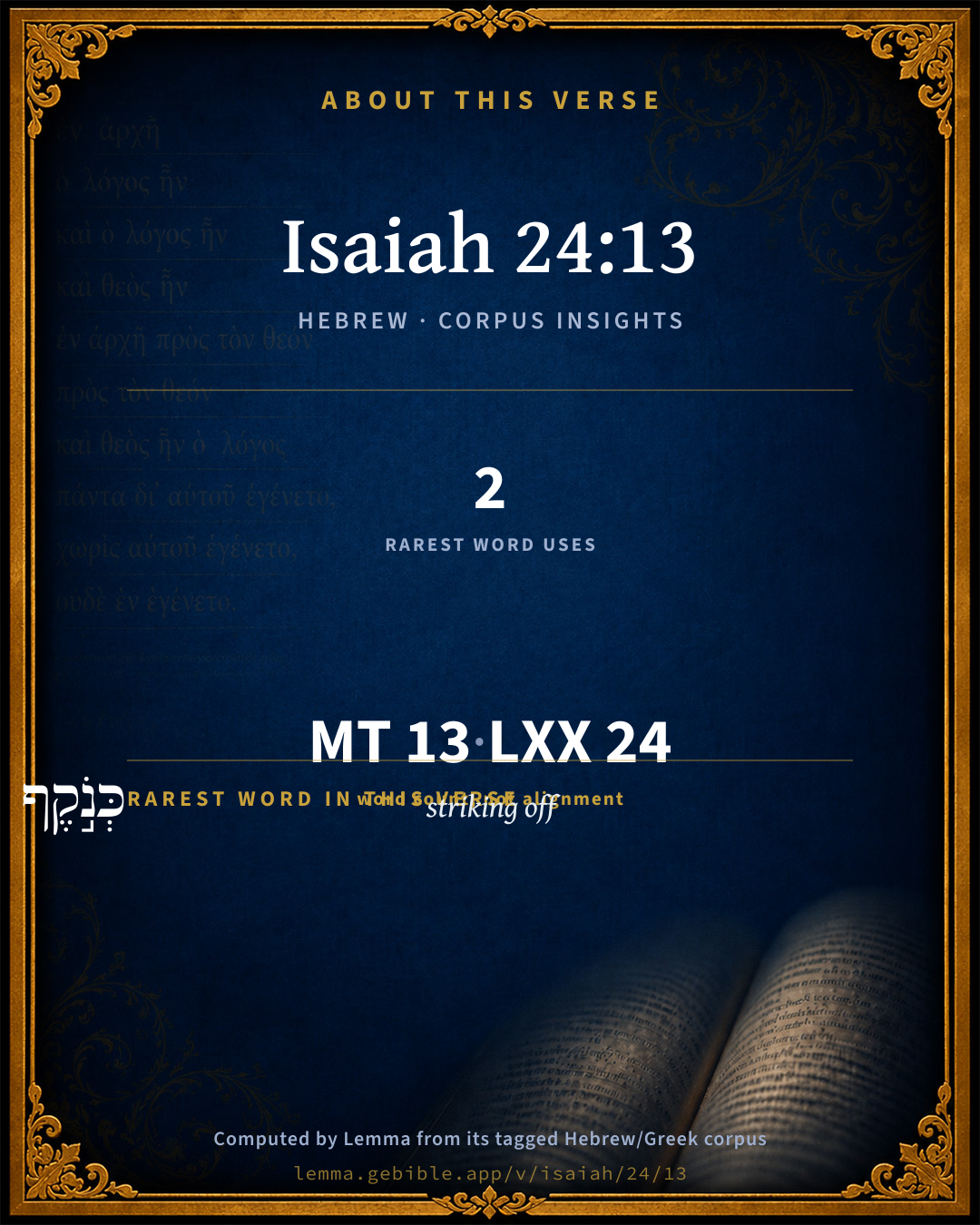
The rarest word here is כְּנֹ֣קֶף striking off H5363 — appearing just 2 times in the whole Hebrew Bible.

Shared distinctive vocabulary

כְּנֹ֣קֶף striking off H5363 occurs in 2 verses of the Hebrew Bible. Also found in:

Grammatical profile

  • 2 verbs
  • 8 nouns
  • 2 conjunctions
  • 1 adverb

Verb forms

  • יִהְיֶ֛ה Qal · Imperfect
  • כָּלָ֥ה Qal · Perfect

Hebrew & Septuagint length

In English translation the verse runs 29 words from the Hebrew and 32 from the Septuagint (LXX English) — closely comparable.

A rough comparison of the two English renderings, which tokenize alike — not a word-level alignment.

Word counts can differ between the Hebrew and the Greek without any difference in meaning — e.g. the Hebrew direct-object marker אֵת has no separate Greek word, and Greek often adds the article ὁ.

In the original languages it is 13 Hebrew tokens and 24 Greek tokens — but the two are counted differently (Hebrew bundles its prefixes and suffixes into one token; the Greek is in lemma form), so that isn’t a like-for-like length.

Cross-references

15

Topical passages linked to Isaiah 24:13 in the Treasury of Scripture Knowledge — connected by theme and wording, ordered by reader-vote popularity; previews shown in the World English Bible.

  • Isaiah 1:9 Unless Yahweh of hosts had left to us a very small remnant, We would have been as Sodom; We would have been like Gomorrah.
  • Isaiah 6:13 If there are yet a tenth in it, It also shall in turn be eaten up: As a terebinth, and as an oak, whose stock remains, when they are felled; So the holy seed is its stock."
  • Isaiah 10:20–22 It shall come to pass in that day, that the remnant of Israel, and those who are escaped of the house of Jacob, shall no more again lean on him who struck them, but shall lean on Yahweh, the Holy One of Israel, in truth.
  • Isaiah 17:5–6 It shall be as when the harvester gathers the standing grain, and his arm reaps the ears; yes, it shall be as when one gleans ears in the valley of Rephaim.
  • Jeremiah 44:28 Those who escape the sword shall return out of the land of Egypt into the land of Judah, few in number; and all the remnant of Judah, who have gone into the land of Egypt to sojourn there, shall know whose word shall stand, mine, or theirs.
  • Ezekiel 6:8–11 Yet will I leave a remnant, in that you shall have some that escape the sword among the nations, when you shall be scattered through the countries.
  • Ezekiel 7:16 But those of those who escape shall escape, and shall be on the mountains like doves of the valleys, all of them moaning, every one in his iniquity.
  • Ezekiel 9:4–6 Yahweh said to him, Go through the midst of the city, through the midst of Jerusalem, and set a mark on the foreheads of the men that sigh and that cry over all the abominations that are done in the midst of it.
  • Ezekiel 11:16–20 Therefore say, Thus says the Lord Yahweh: Whereas I have removed them far off among the nations, and whereas I have scattered them among the countries, yet will I be to them a sanctuary for a little while in the countries where they are come.
  • Ezekiel 14:22–23 Yet, behold, therein shall be left a remnant that shall be carried forth, both sons and daughters: behold, they shall come forth to you, and you shall see their way and their doings; and you shall be comforted concerning the evil that I have brought on Jerusalem, even concerning all that I have brought on it.
  • Micah 2:12 I will surely assemble, Jacob, all of you; I will surely gather the remnant of Israel; I will put them together as the sheep of Bozrah, As a flock in the midst of their pasture; They will swarm with people.
  • Matthew 24:22 Unless those days had been shortened, no flesh would have been saved. But for the sake of the chosen ones, those days will be shortened.
  • Romans 11:2–6 God didn't reject his people, which he foreknew. Or don't you know what the Scripture says about Elijah? How he pleads with God against Israel:
  • Revelation 3:4 Nevertheless you have a few names in Sardis that did not defile their garments. They will walk with me in white, for they are worthy.
  • Revelation 11:2–3 Leave out the court which is outside of the temple, and don't measure it, for it has been given to the gentiles. They will tread the holy city under foot for forty-two months.

Cross-references courtesy of OpenBible.info (CC BY 4.0).

Hebrew and Greek witnesses Masoretic Hebrew ↔ Greek Septuagint

The same verse in the two great witnesses to the Old Testament, shown verse-for-verse.

These are two independent witnesses, not word-aligned to each other, and the Septuagint is shown in lemma (dictionary) form.

Hebrew Isaiah 24:13 Masoretic · Westminster Leningrad Codex

כִּ֣י כֹ֥ה יִהְיֶ֛ה בְּקֶ֥רֶב הָאָ֖רֶץ בְּת֣וֹךְ הָֽעַמִּ֑ים כְּנֹ֣קֶף זַ֔יִת כְּעוֹלֵלֹ֖ת אִם כָּלָ֥ה בָצִֽיר

For thus shall it be in the midst of the earth among the peoples, as the shaking of an olive tree, as the gleanings when the vintage is done.

World English Bible · Public Domain

Greek LXX Isaiah 24:13 Septuagint · lemma form

οὗτος πᾶς εἰμί ἐν ὁ γῆ ἐν μέσος ὁ ἔθνος ὅς τρόπος ἐάν τις καλαμάομαι ἐλαία οὕτως καλαμάομαι αὐτός καί ἐάν παύω ὁ τρύγητος

All this shall be in the land in the midst of the nations, as if one should strip an olive tree, so shall they strip them; but when the vintage is done,

LXX2012 (modern English Septuagint) · Public Domain

Hebrew: Westminster Leningrad Codex (CC BY 4.0). Greek: Septuagint (public domain); English from LXX2012 (modern English Septuagint) (Public Domain). How the Septuagint differs from the Hebrew →

Targum (Aramaic paraphrase)

1

The Targum is the ancient Jewish Aramaic paraphrase of the Hebrew Scriptures — an interpretive translation, not the Hebrew text itself. Onkelos (literal) and Pseudo-Jonathan (expansive) render the Torah, and Jonathan the Prophets. Coverage is partial: where no permissively-licensed English translation exists for a verse, only the Aramaic is shown. This is verse-level text, not a word-by-word alignment to the Hebrew.

  1. Targum Jonathan Prophets (Joshua–Malachi)
    אֲרֵי כְדֵין יִשְׁתְּאֲרוּן יְחִידָאִין צַדִיקַיָא בְגוֹ אַרְעָא בֵּינֵי מַלְכְּוָתָא כְּבִיעוּר זֵיתָא כְּעוֹלְלָן בָּתַר קָטַף:

    When thus the righteous shall be left alone in the midst of the earth, among the kingdoms, as the shaking of olives, as the gleaning of grapes after the vintage.

    Targum Jonathan — Aramaic: “Mikraot Gedolot” (public domain). English: “Sefaria Community Translation” (CC0 1.0 (public-domain dedication)); “London "Chaldee Paraphrase," 1871” (public domain). Text via Sefaria.

Commentary

Notes on Isaiah 24:13 from classic Christian and Jewish commentators (each source and its license shown beneath its notes). The classic Christian expositions comment on the surrounding passage and are grouped to its opening verse, so a note may address several verses; the Jewish commentaries on the Tanakh (Rashi and others) are per-verse, so they appear only where the commentator wrote on this verse.

Lemma curates 59 commentaries, every one of them public domain or Creative Commons licensed, each selected and text-cleaned for this edition rather than reprinted as found. About our sources →

Matthew Henry's Commentary

Here is mercy remembered in the midst of wrath. In Judah and Jerusalem, and the neighbouring countries, when they are overrun by the enemy, Sennacherib or Nebuchadnezzar, there shall be a remnant preserved from the general ruin, and it shall be a devout and pious remnant. And this method God usually observes when his judgments are abroad; he does not make a full end, Isa 6:13. Or we may take it thus: Though the greatest part of mankind have all their comfort ruined by the emptying of the earth, and the making of that desolate, yet there are some few who understand their interests better, who have laid up their treasure in heaven and not in things below, and therefore can keep up their comfort and joy in God even when the earth mourns and fades away. Observe,

I. The small number of this remnant, Isa 24:13. When all goes to ruin there shall be as the shaking of an olive-tree, and the gleaning grapes, here and there one who shall escape the common calamity (as Noah and his family when the old world was drowned), that shall be able to sit down upon a heap of the ruins of all their creature comforts, and even then rejoice in the Lord (Hab 3:16-18), who, when all faces gather blackness, can lift up their heads with joy, Luk 21:26, Luk 21:28. These few are dispersed, and at a distance from each other, like the gleanings of the olive-tree; and they are concealed, hid under the leaves. The Lord only knows those that are his; the world does not.

II. The great devotion of this remnant, which is the greater for their having so narrowly escaped this great destruction (Isa 24:14): They shall lift up their voice; they shall sing. 1. They shall sing for joy in their deliverance. When the mirth of carnal worldlings ceases the joy of the saints is as lively as ever; when the merry-hearted do sigh because the vine languishes the upright-hearted do sing because the covenant of grace, the fountain of their comforts and the foundation of their hopes, never fails. Those that rejoice in the Lord can rejoice in tribulation, and by faith may be in triumphs when all about them are in tears. 2. They shall sing to the glory and praise of God, shall sing not only for the mercy but for the majesty of the Lord. Their songs are awful and serious, and in their spiritual joys they have a reverend regard to the greatness of God, and keep at a humble distance when they attend him with their praises. The majesty of the Lord, which is matter of terror to wicked people, furnishes the saints with songs of praise. They shall sing for the magnificence, or transcendent excellency, of the Lord, shown both in his judgments and in his mercies; for we must sing, and sing unto him, of both, Psa 101:1. Those who have made, or are making, their escape from the land (that being emptied and made desolate) to the sea and the isles of the sea, shall thence cry aloud; their dispersion shall help to spread the knowledge of God, and they shall make even remote shores to ring with his praises. It is much for the honour of God if those who fear him rejoice in him, and praise him, even in the most melancholy times.

III. Their holy zeal to excite others to the same devotion (Isa 24:15); they encourage their fellow-sufferers to do likewise. 1. Those who are in the fires, in the furnace of affliction, those fires by which the inhabitants of the earth are burned, Isa 24:6. Or in the valleys, the low, dark, dirty places. 2. Those who are in the isles of the sea, whither they are banished, or are forced to flee for shelter, and hide themselves remote from all their friends. They went through fire and water (Psa 66:12); yet in both let them glorify the Lord, and glory him as the Lord God of Israel. Those who through grace can glory in tribulation ought to glorify God in tribulation, and give him thanks for their comforts, which abound as their afflictions do abound. We must in every fire, even the hottest, in every isle, even the remotest, keep up our good thoughts of God. When, though he slay us, yet we trust in him - when, though for his sake we are killed all the day long, yet none of these things move us - then we glorify the Lord in the fires. Thus the three children, and the martyrs that sang at the stake.

Matthew Henry's Commentary on the Whole Bible (1708–1710) — public domain (CC PDM 1.0). Text via the HelloAO Bible API.

Trapp's Complete Commentary

John Trapp

Isa 24:13 When thus it shall be in the midst of the land among the people, [there shall be] as the shaking of an olive tree, [and] as the gleaning grapes when the vintage is done.

Ver. 13. When thus it shall be in the midst of the land.] Or, For so it shall be in the land among the people, as in the beating of an olive tree, &c. En misericordiae specimen, still there is a remnant reserved for royal use; quando omnia passim pessum eunt. God never so punisheth but he leaveth some matter for his mercy to work upon. A church on earth he will ever have.

John Trapp, A Commentary or Exposition upon All the Books of the Old and New Testament (1647–1656) — public domain. Text from a community e-Sword module.

Joseph Benson's Commentary

Isa 24:13-14. When thus it shall be in the midst of the land, &c. — When this judgment shall be executed, there shall he left a remnant; as there are some few olives or grapes left after the vintage is over. They shall lift up their voice, &c. — The remnant shall sing for the glorious power and goodness of God manifested in their deliverance. They shall cry aloud —

In a way of exultation and thanksgiving to God; from the sea — From the isles of the sea, as it is expressed in Isa 24:15, that is, from the isles of the Western or Mediterranean sea, whither many of the Jews were scattered, and where they sojourned. “The great distresses brought upon Israel and Judah drove the people away, and dispersed them all over the neighbouring countries; they fled to Egypt, to Asia Minor, to the islands and coasts of Greece. They were to be found in great numbers in most of the principal cities of these countries. Alexandria was, in a great measure, peopled by them. They had synagogues for their worship in many places; and were greatly instrumental in propagating the knowledge of the true God among these heathen nations, and preparing them for the reception of Christianity. This is what the prophet seems to mean by the celebration of the name of JEHOVAH in the distant coasts, and in the uttermost parts of the land.” — Bishop Lowth.

Joseph Benson's Commentary on the Old and New Testaments (1811–1818) — public domain. Text from a community e-Sword module.

Lange's Commentary on the Holy Scriptures

2. THE DESTRUCTION OF THE GLOBE

Isa_24:13-23

13     6When thus it shall be in the midst of the land among the people,

There shall be as the shaking of an olive tree,

And as the gleaning grapes when the vintage is done.

14     They shall lift up their voice,

They shall sing for the majesty of the Lord,

They shall cry aloud from the sea.

15     Wherefore glorify ye the Lord in the [7]8fires,

Even the name of the Lord God of Israel in the isles of the sea.

16     From the 9uttermost part of the earth have we heard songs,

Even glory to the righteous.

But I said,

10My leanness, my leanness, woe unto me!

The treacherous dealers have dealt treacherously;

Yea, the treacherous dealers have dealt very treacherously.

17     Fear, and the pit, and the snare are upon thee,

O inhabitant of the earth.

18     And it shall come to pass,

That he who fleeth from the noise of the fear

Shall fall into the pit;

And he that cometh up out of the midst of the pit

Shall be taken in the snare:

For the windows from on high are open,

And the foundations of the earth do shake.

19     The earth is utterly broken down;

The earth is clean dissolved,

The earth is moved exceedingly.

20     The earth shall reel to and fro like a drunkard,

And shall 11be removed like a cottage;

And the transgression thereof shall be heavy upon it;

And it shall fall,

And not rise again.

21     And it shall come to pass in that day,

That the Lord shall 12punish the host of the high ones that are on high,

And the kings of the earth upon the earth.

22     And they shall be gathered together, 13as prisoners are gathered in 14the pit,

And shall be shut up in the prison,

And after many days shall they be 15visited.

23     Then the moon shall be confounded,

And the sun ashamed,

When the Lord of hosts shall reign in mount Zion, and in Jerusalem,

And 16before his ancients gloriously.

TEXTUAL AND GRAMMATICAL

Isa_24:13. The impersonal expression כה יהיה is to be understood as וְהָיָה Isa_17:5.

Isa_24:19. רֹעָה is a substantive as בֶּגֶד in Isa_24:16 and אֲסֵפָה in Isa_24:22; three examples in this chapter of the infin. abs. being represented by a substantive formed from the same stem. Isa_24:22. Many would connect אַסִּיר with אֲסֵפָה; but אַסִּיר is really in apposition to the subject involved in אֻסִּפוּ. The singular אַסִּיר need not cause surprise; comp. Isa_20:4. The case before us comes under the category of the ideal number treated of, Naegelsbach Gr., § 61, 1 sq. עַל stands in the signification of אֵל. Comp. on Isa_10:3.

EXEGETICAL AND CRITICAL

1. The Prophet depicts here the second stage of the world’s destruction. This consists substantially in the shattering of the globe of the earth itself. The transition is formed by the thought, Isa_24:13, that only few men, a gleaning, as it were, will survive the first catastrophe. But these saved ones are the pious, the elect of God. These flee to the promised land, to Jerusalem. From the sea, i.e., from the west, the prophet hears the song of praise (Isa_24:14). He answers by calling on east and west to praise the name of the Lord (Isa_24:15). This summons is obeyed. We perceive from this, that the elect of God are hidden in a safe place (Isa_24:16 a). But that is just the occasion for the signal to be given for the occurrence of the last and most frightful catastrophe. The Prophet announces it with an exclamation of anxiety and terror. At the same time he declares why it must be so; the sin of men provokes the judgment of God (Isa_24:16 b). He characterizes beforehand the catastrophe as one which shall take place in different successive acts, each more severe than the preceding, so that he who has escaped the first blow will certainly fall under the second or the third (Isa_24:17-18 a). For, as at the deluge, the windows of heaven will be opened, and the foundations of the earth will be broken up (Isa_24:18 b). The globe of the earth will then rend, burst, break (Isa_24:19), reel like a drunken man. The earth cannot bear the load of sin. It must, therefore, fall to rise again no more (Isa_24:20). But the judgment of God is not confined to the earth: The angelic powers that are hostile to God will, as well as the representatives of the worldly power on earth, be cast into the abyss, and there shut up for a time; but after a certain term has expired, they will again be liberated (Isa_24:21-22). Sun and moon, too, will lose their brightness, so that only in one place of the world can safety be found, namely, in Zion. For, although the rest of the earth be shattered, Zion, the holy mount, remains uninjured. For there Jehovah rules as king, and through the heads of His people there gathered round Him will He communicate His glory to His people also (Isa_24:23).

2. When thus it shall be—treacherously.

Isa_24:13-16. In the olive and grape harvest the great mass of the fruit is shaken or plucked off and cast into the press. Only few berries remain on the olive tree or vine. The few remaining olives are struck off with a stick. The few grapes remaining on the vine are afterwards cut off. When, then, at the close of the catastrophe depicted in Isa_24:1-13, only few persons survive, that is a proof of the extent of the catastrophe, and a measure whereby to estimate it. This by the way of explaining the כִי. [Translate, “For thus it shall be;” not as in the E. V. “When thus it shall be,” etc.]. But few escape destruction. These are the elect. To these few, who are by implication supposed in Isa_24:13 b, הֵמָּה, Isa_24:14, refers. They exult at their deliverance, which they owe to the majesty of Jehovah, רנן is found as here connected with צָהַל12:6; Isa_54:1. רנן occurs frequently in the first and second part of Isaiah. גָאוֹן is an expression very common in Isaiah. But why does the Prophet hear from the sea, i.e., from the west the exulting shout of them that have escaped? We cannot, with Drechsler and some older interpreters, take מִיָּם in the comparative sense (they shall cry aloud more than the sea); for צהל, an onomatopoetic word, denotes a clear sound (like the neighing of a horse) which cannot be compared with the thunder of the sea. Does there lie in the expression מים something like a foreboding of the fact that the Church of the Lord would spread especially in the lands of the west, and that, therefore, the great mass of the redeemed would come from that quarter? From the moment when the Prophet announced the comforting word (Isa_24:13-14), all the godly dwelling in the east and west are to praise the name of the Lord who has given to them, in place of the terrible day of judgment, the promise of deliverance. There can be no doubt that the word אֻרִים is connected with אוּר ,אוֹר (ignis, flamma, a word peculiar to Isaiah; for beside Isa_31:9; Isa_44:16; Isa_47:14; Isa_50:11, it is found only Eze_5:2, and there probably as a reminiscence from Isaiah) and with אוּרִים (on the breastplate of the high-priest). As the light rises daily in the east of the earth, as in opposition to it the north is conceived as צָפוֹן (plaga abscondita, caliginosa), as the Greeks too designate the eastern region of the heavens by πρὸς ἠῶ τ’ ἠέλιόν τε (Il. xii. 239 et saepe), we are justified in understanding by אֻרִים the countries of light, or the sun, i.e. the east. The meaning “eastern countries” answers well to the “islands of the sea” in the parallel clause. There is no need for altering the text. In Isa_24:14 those who are saved are described as coming with jubilation, and in Isa_24:15 all who desire deliverance are summoned to shout for joy. This explains how the Prophet, Isa_24:16, actually hears songs of praise (comp. Isa_12:2; Isa_51:3; Isa_25:5) from the end of the earth (כָּנָףala, ora, extremity; כנף הארץ only here, yet comp. Isa_11:12). The theme of the songs is צְבִי לַצַּדִּיק. If it were said כָּבוֹד ל׳, I would unhestitatingly refer צדיק to God. But, as Delitzsch well remarks, Jahve bestows צְבִי4:2; Isa_28:5; but to him כּבוֹד is given. The thought is like that in Rom_2:6 sqq. Every one is rewarded according to his works. Therefore praise (צְבִיornatus, decus, splendor4:2; Isa_13:19; Isa_23:9; Isa_28:1; Isa_28:4-5) is to the righteous, but tribulation and anguish upon every soul of man that doeth evil. The fundamental idea of the divine judgment is thus expressed. The Prophet has seen the one side “glory to the righteous” fulfilled. These, the righteous, have arrived at their hiding place. They are gathered on the holy mountain, and find there protection (Isa_4:5 sq.). But thereby the sign is given that now the judgment can begin, and has to begin on the ungodly. This prospect agitates the Prophet exceedingly. He sees himself in that fatal moment fear and quake, and hears himself breaking out into the words רזי לי וגו׳. This he introduces with ואמר.רָזי. is ἅπ. λεγ. But the signification is clear. The verb רָזָה denotes attenuare, maciare (Isa_17:4). The Prophet feels his powers wasting away as the effect of the extraordinary terror (comp. Dan_7:28; Dan_8:27; Dan_10:16 sqq.). He next declares that the צדיק has his counterpart on earth in the בֹכֵּד. As the former has glory for his portion from a just God, so the latter receives “fear and the pit and the snare.” It will have been seen that I do not take בגד in the sense of “robber,” but retain its proper signification of perfidy, faithlessness, falling away (Isa_21:2; Isa_33:1; Isa_48:8). The Prophet by the accumulation and repetition of verbal and substantive forms of בָּנד indicates that this perfidy and faithlessness were exercised in the highest degree, and in all forms.

3. Fear and the pit——rise again.

Isa_24:17-20. By three assonant words which sound in accord not only with one another, but also with the immediately preceding symphony, the Prophet characterizes, first in general terms, the terrible catastrophe, the second act of the judgment of the world. By the threefold series of punishments the impossibility of escaping judgment is effectively set before the eyes. And then, in particular, the all-embracing character of the judgment which lets nothing escape, is exhibited by showing how the earth is affected above, below, and in the midst, and shaken till it is broken down. First, the windows (ארבותcancelli, fenestrae, Gen_7:11; Gen_8:2 comp. Isa_60:8) from on high,i.e., from heaven, are opened, not to let rain fall in order to produce a deluge; for the earth shall not be destroyed again by water (Gen_9:11). But the Lord has yet other weapons. Wind, fire, thunder and lightning, drought, pestilence, etc., are also God’s instruments of punishment, and they also in a certain sense come from on high (comp. Psa_78:49). The foundations of the earth (Isa_58:12, comp. Isa_40:21) are the foundations on which the earth rests. These shall be shaken (Isa_13:13; Isa_14:16). Then the globe of the earth, assailed from above, and from beneath deprived of its supports, must feel in itself the powerful hand of Almighty God. Four times in succession is the word “the earth” or “earth” used with emphasis. Terrible, not merely local, but universal earthquakes shake the earth. It receives rents, becomes full of breaks, totters (Isa_40:20; Isa_41:7; Isa_54:10), reels (Isa_6:4; Isa_7:2; Isa_19:1; Isa_29:9; Isa_37:22) as the drunkard (generic article) and oscillates to and fro as the hammock shaken by the wind (Isa_1:8). Who could deem it possible that there is a burden which the earth that sustains everything, cannot bear, by which it is crushed as a house too heavily burdened? This burden is sin (Isa_1:4; Psa_38:5). This is the destruction of men and of things. Where God’s creation is tainted with it, it must come to naught. As man, the lord of creation, fell by sin, so must the earth also, the theatre of human history, fall by sin never again to rise in its previous form. The words It shall fall and not rise again, are a clear proof that the total destruction of the globe of the earth in its present form is the subject treated of. In its present form! For the earth shall rise again in a higher, holy form beyond the range of sin and its consequence, death. For there is a new heaven and a new earth, wherein dwelleth righteousness (Isa_65:17; Isa_66:22; 2Pe_3:13; Rev_21:1).

4. And it shall come—gloriously.

Isa_24:21-23. The Prophet now lifts up his eye to the super-terrestrial sphere. As the lot of the earth is affected by the influence of that sphere, so the swoop of the judgment that falls upon the earth must reach even to it. That צבא המרום are not earthly powers (Luther“hohe Ritterschaft,”Targum, Calvin, Haveernick and others), may be inferred even from the expression צבא; for the high ones of the earth do not form a צָבָא. Moreover צבא חמרום is evidently identical with “the host of heaven,” Isa_34:4, and by the addition בַּמָּרום this צבא המרוֹם is more than sufficiently distinguished from every conceivable צבא המרום upon the earth. That the host of the height are only the stars, as Hofmann (Schriftbeweis II. 2, p. 522) would have it, seems to be rendered by the context incredible. For how could the irrational glories of heaven be put in conjunction with the rational glories of the earth? The former correspond not to our kings, but to our earth itself. How, too, can we conceive a judgment executed on a world, without its affecting at the same time those intelligent beings that stand in any connection with that world? It seems to me to be likewise one-sided to refer צבא המרום merely to the angels, who are said to be heads and guardians of the separate kingdoms (Dan_10:13; Dan_10:20; Rosenmueller, Hitzig, Delitzsch, and others), or to the heathen gods conceived of as angels (Knobel). The judgment of God falls certainly on every thing that can be called צבא המרום, so far as it has at all merited the judgment. The expression is found only here; but the nearly related expression, “the host of heaven,” is frequently used to designate, sometimes, the host of the stars (Isa_40:26; Isa_45:12; Jer_8:2; Jer_33:22; Dan_8:10), sometimes, the angelic world (1Ki_22:19; Psa_103:21; Neh_9:6, and the expression צְבָאוֹת), sometimes, perhaps, both together (Deu_4:19; Deu_17:3; 2Ki_17:16; 2Ki_21:3; 2Ki_21:5; Isa_34:4; Zep_1:5). The host of the height and the kings of the earth are both the subject of אספו, Isa_24:22. As now we have shown that the host of the height can designate the world of angels, and as the Scripture clearly testifies that the angels are bound as a punishment for their apostasy (2Pe_2:4; Judges 6; Rev_20:1-3), can not the Prophet’s eye have perceived this feature of the picture of what will take place at the end of the world? The invisible, extramundane heads of the worldly power, as well as their earthly, visible organs, will, according to the statement of the Prophet, be collected as prisoners in the pit, and shut up in it. The pit is here used for Sheol as oftentimes (Isa_14:15; Isa_14:19; Isa_38:18). But not merely the binding of those angelic and worldly powers, their being set loose for a time is also announced by the Prophet. Only by a brief, obscure word, probably not seen through by himself, does the Prophet intimate this. Even we should not understand this word if the revelation of the New Testament, which is nearer the time of the fulfilment, did not throw light on this dark point. It declares expressly that after a thousand years Satan should be loosed out of his prison (Rev_20:7). Isaiah uses here an indefinite announcement of time—after many days—and an indefinite verb. פקד stands here as Isa_23:17 of a visiting which consists in looking again after some one who has remained for a time neglected (Jer_27:22). This ἐπισκέπτειν can be a gracious visitation, but it can also be a new stage in the visitation of judgment. That we have to take the word here in the latter sense is seen from the place quoted from the Revelation of John. The setting loose of Satan is only the prelude to his total destruction, Rev_20:10. Then follows the last, highest and grandest revelation of God. The earth now becomes what it ought originally to have been, but which it was hindered from being by sin, viz., the common dwelling-place of God and of men. The heavenly Jerusalem, the tabernacle in which God dwells with men (Rev_21:3) descends upon the renovated earth. This is the Jerusalem in which according to Isa_24:23, Jehovah Zebaoth reigns as King. This city needs no sun and no moon any more—for the Lord Himself is its light (Rev_21:23; Rev_22:5). Before this light the earthly sun (חַמָּה, Isa_30:26) and the earthly moon (ibid.) grow pale (comp. Isa_1:29); they which were created to rule the day and to rule the night, resign their dominion to Him who alone and everywhere from this time on will from mount Zion rule the earth. Here too is the place where the redeemed of the Lord (Isa_24:13-16) find everlasting rest and protection (Isa_4:5 sq.). The Prophet has already (Isa_1:22 sqq.) shown the importance of rulers for the moral condition of the people. The whole history of the people is a proof of their importance. In the new Jerusalem the new Israel will have new elders also, who will not be the promoters of wickedness and misery any more, but of all that is good and glorious (Isa_3:14). The elders of the Apocalypse, who perhaps bear their name from this place before us, are, therefore, in my opinion, not angels, as Hofmann will have them to be, but representatives of the people of God. For why should there not be order and organization even in the kingdom of glory?

DOCTRINAL AND ETHICAL

1. Isa_24:2. “When general judgments take place, no distinction is observed between man and wife, master and servant, mistress and maid, learned and unlearned, noble and plebeian, clergy and laity; therefore let no one rely on any external prerogative or superiority, but let every one without distinction repent and forsake sin.”—Cramer. Though this is right, yet we must, on the other hand, remember that the Lord declares in reference to the same great event, “Then shall two be in the field; the one shall be taken, and the other left. Two women shall be grinding at the mill; the one shall be taken, and the other left” (Mat_24:10 sq.). There is no contradiction in these two statements. Both are true: outward relations will make no difference; there shall be no respect of persons. But the state of the heart will make a difference. According to the inward character there will, in the case of those whose external position in the world is perfectly alike, be some who enter life, others whose doom is death.

2. Isa_24:5 sq. “The earth is burdened with sins, and is therefore deprived of every blessing. The earth must suffer for our guilt, when we have as it were spoilt it, and it must be subject to vanity for our sakes (Rom_8:20). What wonder is it that it should show itself ungrateful toward us?”—Cramer.

[3. Isa_24:13 sq. “Observe the small number of this remnant; here and there one who shall escape the common calamity (as Noah and his family, when the old world was drowned), who when all faces gather blackness, can lift up their head with joy. Luk_21:26-28.” Henry.—D. M.].

4. Isa_24:17-20. Our earth is a volcanic body. Mighty volcanic forces were active at its formation. That these are still in commotion in the interior of the earth is proved by the many active volcanoes scattered over the whole earth, and by the perpetual volcanic convulsions which we call earthquakes. These have hitherto been confined to particular localities. But who can guarantee that a concentration and simultaneous eruption of those volcanic forces, that is, a universal earthquake, shall not hereafter occur? The Lord makes express mention of earthquakes among the signs which shall precede His second coming (Mat_24:7; Mar_13:8; Luk_21:11). And in 2Pe_3:5 sqq. the future destruction of the earth by fire is set over against the destruction of the old world by water. Isaiah in our place announces a catastrophe whose characteristic features will be that, 1) there will be no escape from it; 2) destructive forces will assail from above and below; 3) the earth will be rent asunder; 4) it will reel and totter; 5) it will suffer so heavy a fall that it will not rise again (Isa_24:20 b). Is there not here a prophecy of the destruction of the earth by volcanic forces? And how suddenly can they break loose! The ministers of the word have every reason to compare this extreme exposedness of our earth to fire, and the possibility of its unexpectedly sudden collapse with the above-cited warnings of the word of God, and to attach thereto the admonition which is added in 2Pe_3:11.

5. Isa_24:21. The earth is a part of our planetary system. It is not what it appears to the optical perception to be, a central body around which worlds of a different nature revolve, but it, together with many similar bodies, revolves round a common centre. The earth according to that view of the account of the creation in Genesis 1, which appears to me the true one, has arisen with all the bodies of our Solar system out of one primary matter, originally united, common to them all. If our Solar System is a well-ordered, complete organism, it must rest on the basis of a not merely formal, but also material unity; i.e., the separate bodies must move, not only according to a principle of order which governs all, but they must also as to their substance be essentially like. And as they arose simultaneously, so must they perish simultaneously. It is inconceivable that our earth alone should disappear from the organism of the Solar System, or pass over to a higher material condition. Its absence, or ceasing to exist in its previous form and substance, would necessarily draw after it the ruin of the whole system. Hence the Scripture speaks every where of a passing away and renovation of the heaven and the earth (Psa_102:26; Isa_51:6; Isa_65:17; Isa_66:22; Mat_5:18; Mat_24:29; Mat_24:35; 2Pe_3:7; 2Pe_3:10; 2Pe_3:13; Heb_12:26; Rev_20:11; Rev_21:1). The heaven that shall pass away with a great noise, whose powers shall be shaken, whose stars shall fall, is the planetary heaven. The same lot will happen to the companions of our earth, to the other planets, and to the centre, the sun, and to all other co-ordinate and subordinate stellar bodies, which will befall the earth itself. This is the substance of the view which serves as a basis for our place. But personal beings are not thereby by any means excluded from the צבא מרום. The parallel expression מלכי האדמה, and the use in other places of the related expression צבא השׁמים lead us rather to suppose personal beings to be included. But I believe that a distinction must be made here. As the heavenly bodies which will pass away simultaneously with the earth, can only be those which arose together with it, and which stand in organic connection with it, so also the angelic powers, which are judged simultaneously with us men, can be only those which stand in connection with the heavenly bodies of our Solar System, i.e., with the earthly material world. There are heavenly bodies of glorious pneumatic substance. If personal beings stand in connection with them, they must also be pure, glorious, resplendent beings. These will not be judged. They are the holy angels, who come with the Lord (Mat_25:31). But it is quite conceivable that all the bodies of our Solar System are till the judgment like our earth suffered to be the theatre of the spirits of darkness.

6. Isa_24:21-23, It seems to me that the Prophet has here sketched the chief matters pertaining to eschatology. For the passing away of heaven and earth, the binding of Satan (Rev_20:1-3), the loosing of Satan again (Rev_20:7), and finally the reign of God alone, which will make sun and moon unnecessary (Rev_21:23)—are not these the boundary-stones of the chief epochs of the history of the end of the world?

7. Isa_25:6. [“The Lord of hosts makes this feast. The provision is very rich, and every thing is of the best. It is a feast, which supposes abundance and variety; it is a continual feast to believers: it is their fault if it be not. It is a feast of fat things and full of marrow; so relishing, so nourishing are the comforts of the Gospel to all those that feast upon them and digest them. The returning prodigal was entertained with the fatted calf; and David has that pleasure in communion with God, with which his soul is satisfied as with marrow and fatness. It is a feast of wines on the lees; the strongest-bodied wines, that have been long kept upon the lees, and then are well refined from them, so that they are clear and fine. There is that in the Gospel which, like fine wine, soberly used, makes glad the heart, and raises the spirits, and is fit for those that are of a heavy heart, being under convictions of sin, and mourning for it, that they may drink and forget their misery (for that is the proper use of wine; it is a cordial for those that need it, Pro_31:6-7) may be of good cheer, knowing that their sins are forgiven, and may be vigorous in their spiritual work and warfare, as a strong man refreshed with wine.” Henry.—D. M.]

8. Isa_25:9. “In the Old Testament the vail and covering were before men’s eyes, partly because they waited for the light that was to appear, partly because they sat in darkness and in the shadow of death (Luk_1:79). The fulfilment of this prediction has in Christ already begun, and will at last be perfectly fulfilled in the Church triumphant where all ignorance and sorrow shall be dispelled (1Co_13:12).” Cramer.

9. Isa_25:8. “God here represents Himself as a mother, who presses to her bosom her sorrowful son, comforts him and wipes away his tears (Isa_66:13). The righteous are to believe and appropriate this promise, that every one may learn to speak with Paul in the time of trial: the sufferings of this present time are not worthy to be compared with the glory which shall be revealed in us, Rom_8:18.” Cramer.

10. Isa_25:10. “This is now the hope and consolation of the church that the hand of the Lord rests on this mountain, that is, that He will be gracious, and let His power, help and grace be there seen and felt. But the unbelieving Moabites, i.e., the Jews, with all others who will not receive the gospel, shall be threshed to pieces as straw in the mire; these the Lord’s hand will not rescue, as it helps those who wait on Him, but it shall press them down so that they will never rise, according to the saying, Mar_16:16.” Veit Dietrich.

11. Isaiah 25 Three thoughts contained in this chapter we should hold fast: 1) When we see the world triumph over every thing which belongs to the Lord and His kingdom, when our hearts are anxious about the preservation in the world of the Church of Christ, which is sore oppressed, let this word of the Prophet comfort our hearts. The world-city which contains all that is of the world, sinks into the dust, and the church of Christ goes from her chains and bands into the state of freedom and glory. We have often seen that it is the Lord’s way to let every thing come to maturity. When it is once ripe, He comes suddenly with His sentence. Let us comfort ourselves therewith, for thus will it happen with the world and its dominion over the faithful followers of Christ. When it is ripe, suddenly it will come to an end. 2) No one who has a heart for the welfare of the nations can see without the deepest pain how all hearts are now seduced and befooled, and all eyes closed and covered. The simplest truths are no longer acknowledged, but the more perverse, brutal and mean views and doctrines are, the more greedily are they laid hold of. We cannot avert this. But our comfort is that even this seduction of the nations will reach its climax. Then men will come to themselves. The vail and covering will fall off, and the Gospel will shine with new light before the nations. Therewith let us comfort ourselves. 3) Till this happens, the church is sorrowful. But she shall be full of joy. The promise is given to her that she shall be fully satisfied with the good things of the house of the Lord. A life is promised to her which neither death nor any pain can affect, as she has rest from all enemies. The word of the Lord shall be fulfilled in her: Blessed are the meek, for they shall inherit the earth. The Church that has such a promise may wait in patient quietness for its accomplishment, and praise the Lord in affliction, till it pleases Him to glorify her before all nations.” Weber, The Prophet Isaiah. 1875.

12. Isa_26:1. “The Christian church is a city of God. God has built it, and He is the right Master-builder. It is strong: 1) on account of the Builder; 2) on account of the foundation and corner-stone, which is Christ; 3) on account of the bond wherewith the living stones are bound together, which is the unity of the faith.” Cramer. [The security and happiness of true believers, both on earth and in heaven, is represented in Scripture under the image of their dwelling in a city in which they can bid defiance to all their enemies. We dwell in such a city even now, Psa_46:4-5. We look for such a city, Heb_11:10; Heb_11:16; Revelation 21—D. M.]

13. Isa_26:2. [These words may be taken as a description of the people whom God owns, who are fit to be accounted members of the church of the living God on earth, and who will not be excluded from the celestial city. Instead of complaining that only the righteous and the faithful will be admitted into the heavenly city, it should rather give us joy to think that there will be no sin there, that none but the just and true will there be found. This has been a delightful subject of reflection to God’s saints. The last words written by Henry Martyn were: “Oh! when shall time give place to eternity? When shall appear that new heaven and new earth wherein dwelleth righteousness? There, there shall in no wise enter in any thing that defileth; none of that wickedness which has made men worse than wild beasts—none of their corruptions which add to the miseries of mortality shall be seen or heard of any more.”—D. M.]

14. Isa_26:4. “The fourth privilege of the church is trust in God the Rock of Ages, i.e., in Christ, who not only here, but also Matthew 16; 1 Corinthians 10; 1 Peter 2, is called a rock in a peculiar manner, because no other foundation of salvation and of the church can be laid except this rock, which is here called the rock of ages on account of the eternity of His being, merit and office. Hence a refutation can be drawn of the papistical fable which makes Peter and his successors, the Roman Pontiffs, to be the rock on which the church is built.” Foerster. [“Whatever we trust to the world for, it will be but for a moment. All we expect from it is confined within the limits of time; but what we trust in God for will last as long as we shall last. For in the Lord Jehovah, Jah, Jehovah, in Him who was, and is, and is to come, there is a rock of ages, a firm and lasting foundation for faith and hope to build upon; and the house built on that rock will stand in a storm.” Henry.”—D. M.]

15. Isa_26:5. “It is very common with the prophets, when they prophesy of the kingdom of Christ to make reference to the proud and to the needy, and to represent the latter as exalted and the former as brought low. This truth is directed properly against the self-righteous. For Christ and His righteousness will not endure spiritual pride and presumption; but the souls that are poor, that hunger and thirst for grace, that know their need, these Christ graciously receives.” Cramer.

16. Isa_26:6. “It vexes the proud all the more that they will be overcome by those who are poor and of no consequence. For example, Goliath was annoyed that a boy should come against him with a staff (1 Sam. 13:43) Cramer.

17. Isa_26:8-10. That the justice of God must absolutely manifest itself that the majesty of the Lord may be seen, and that the wicked may learn righteousness, must even from a new Testament view-point be admitted. But the New Testament disputes the existence of any one who is righteous when confronted by the law, and who is not deserving of punishment. [But that there is none righteous, no not one, is taught most emphatically in the Old Testament also.—D. M.]. But it (the New Testament) while it shuts up all, Jews and Gentiles, without exception, under sin (Gal_3:22; Rom_3:9; Rom_11:32), sets forth a scheme of mediation, which, while it renders full satisfaction to justice, at the same time offers to all the possibility of deliverance. This mediation is through the Cross of Christ. It is only when this mediation has not been accepted that punitive justice has free course. It should not surprise us that even the Evangelist of the Old Covenant, who wrote chap. 53, did not possess perfect knowledge of this mediation. Let us remember John the Baptist (Mat_3:7; Mat_11:11) and the disciples of the Lord (Luk_9:54). [Let us not forget that Isaiah was a true Prophet, and spoke as he was moved by the Spirit of God. The Apostle Paul did not find fault with the most terrible denunciations of judgment contained in the Old Testament, or affect a superiority over the men who uttered them. On the contrary, he quotes them as words which could not be suffered to fall, but which must be fulfilled in all their dreadful import. See e.g. Rom_11:9-10.—D. M.].

18. Isa_26:12. “It is a characteristic of true, sincere Christians, that they give God the glory and not themselves, and freely confess that they have nothing of themselves, but everything from God (1Co_4:7; Php_2:13; Heb_12:2).” Cramer.

19. Isa_26:16. The old theologians have many comforting and edifying thoughts connected with this place: “A magnet has the power to raise and attract to itself iron. Our heart is heavy as iron. But the hand of God is as a magnet. When that hand visits us with affliction, it lifts us up, and draws us to itself.” “Distress teaches us to pray, and prayer again dispels all distress. One wedge displaces the other.” “Ex gravibus curis impellimur ad pia vota.” “Ex monte myrrhae procedimus ad collem thuris (Cant. 9:6). In amaritudine crucis exsurgit odor devotae precationis (Psa_86:6 sq.).” “Ubi nulla crux et tentatio, ibi nulla vera oratio. Oratio sine mails est tanquam avis sine alis. Optimus orandi magister necessitas. Τὰ παθήματα μαθήματα. Quae nocent, docent. Ubi tentatio, ibi oratio. Mala, quae hic nos premunt, ad Deum ire compellunt. Qui nescit orare, ingrediatur mare.” “When the string is most tightly drawn, it sounds best. Cross and temptation are the right prayer-bell. They are the press by which God crushes out the juice of prayer.” Cramer and Foerster.

20. Isa_26:20. As God, when the deluge was about to burst, bade Noah go into his ark as into his chamber, and Himself shut the door on him (Gen_7:6); so does the Lord still act when a storm is approaching; He brings His own into a chamber where they can be safe, either for their temporal preservation and protection against every might (Psa_91:1), or, on the other hand, to give them repose by a peaceful and happy death.” “His anger endureth but a moment; in his favor is life (Psa_30:6).” Cramer.

21. Isa_27:1. [“Great and mighty princes [nations] if they oppose the people of God, are in God’s account, as dragons and serpents, and plagues of mankind; and the Lord will punish them in due time. They are too big for men to deal with, and call to an account; and therefore the great God will take the doing of it into His own hands.” Henry.—D. M.].

22. Isa_27:2-5. “It seems to the world that God has no concern for His church and Christians, else, we imagine, they would be better off. But certain it is, that it is not the angels but God Himself that will be watcher over this vineyard, and will send it gracious rain.” Veit Dietrich. [“The church is a vineyard of red wine, yielding the best and choicest grapes, intimating the reformation of the church, that it now brings forth good fruit unto God, whereas before it brought forth fruit to itself, or brought forth wild grapes, Isa_5:4.” “God takes care (1) of the safety of this vineyard; I the Lord do keep it. He speaks this, as glorying in it, that He is, and has undertaken to be, the keeper of Israel; those that bring forth fruit to God are, and shall be always, under His protection. (2) God takes care of the fruitfulness of this vineyard: I will water it every moment; and yet it shall not be over watered. We need the constant and continual waterings of the divine grace; for if that be at any time withdrawn, we wither and come to nothing.” Henry. D. M.].

23. Isa_27:4. “Est aurea promissio, qua praecedentem confirmat. Indignatio non est mihi, fury is not in me. Quomodo enim is nobis irasci potest, qui pro nobis est mortuus? Quanquam igitur appareat, eum irasci, non tamen est verum, quod irascatur. Sic Paulo immittitur angelus Satanae, sed non est ira, nam ipse Christus dicit: sufficit tibi gratia mea. Sic pater filium delinquentem castigat, sed non est ira, quanquam appareat ira esse. Custodia igitur vineae aliquando cogit Deum immittere speciem irae, ne pereat luxurie, sed non est ira. Est insignis textus, which we should inscribe on all tribulations: Non est indignatio mihi, non possum irasci. Quod autem videtur irasci est custodia vineae, ne pereas et fias securus. Luther. “In order to understand fully the doctrine of the wrath of God we must have a clear perception of the antithesis: the long-suffering of God, and the wrath of God, wrath and mercy.” Lange.

24. Isa_27:7-9. “Christ judges His church, i.e., He punishes and afflicts it, but He does this in measure. The sorrow and cross is meted out, and is not, as it appears to us, without measure and infinite. It is so measured that redemption must certainly follow. But why does God let His Christians so suffer? Why does He not lay the cross on the wicked? God answers this question and speaks: the sin of Jacob will thereby cease. That is: God restrains sin by the cross, and subdues the old Adam.” Veit Dietrich.

25. Isa_27:13. [“The application of this verse to a future restoration of the Jews can neither be established nor disproved. In itself considered, it appears to contain nothing which may not be naturally applied to events long past.” J. A. Alexander.—“This prediction was completely and entirely fulfilled by the return of the Jews to their own country under the decree of Cyrus.” Barnes.—D. M.].

HOMILETICAL AND PRACTICAL

1. On Isa_24:4-6. Fast-day sermon. Warning against dechristianization of the life of the people. 1) Wherein such dechristianization consists: a, transgression of the commandments that are in force; b, alteration of the commandments which are essential articles of the everlasting covenant, as e.g. removing of all state institutions from the basis of religion. 2) Its consequences: a, Desecration of the land (subjectively, by the spread of a profane, godless sentiment; objectively, by the secularization of relations hitherto held sacred); b, the curse consumes the land, Isa_24:4.

2. On Isa_25:1-5. The Lord, the refuge of the needy. 1) He has the power to help. This we perceive a, from His nature (Lord, God, Wonderful); b, from His deeds (Isa_25:1 b, Isa_25:2). 2) He gives His strength even to the feeble, (Isa_25:4). 3) These are thereby victorious, (Isa_25:5).

3. On Isa_25:6-9. Easter Sermon, by T. Schaeffer (Manch. Gab. u. ein Geist III. p. 269):—“The glorious Easter-blessing of the Risen One: 1) Wherein it consists? 2) who receive it? 3) what are its effects? Christmas Sermon, by Romberg [ibid. 1869, p. 78): Our text represents to us Christmas joy under the image of a festive board. Let us consider, 1) the host; 2) the guests; 3) the gifts.”

4. On Isa_26:1-4. Concerning the church. 1) She is a strong city in which salvation is to be found. 2) The condition of having a portion in her is faith. 3) The blessing which she is instrumental in procuring is peace.

5. Isa_26:19-21. The comfort of the Christian for the present and future. 1) For the present the Christian is to betake himself to his quiet chamber, where he is alone with his Lord and by Him made cheerful and secure. 2) For the future he has the certain hope, a, that the Lord will judge the wicked, b, raise the believer to everlasting life.

6. Isa_27:2-9. How the Lord deals with His vineyard, the church. 1) Fury is not in Him towards it; 2) He protects and purifies it; 3) He gives it strength, peace and growth; 4) He chastens it in measure; 5) He makes the chastisement itself serve to purge it from sins.

Footnotes:

[6]For thus it shall be.

[7]Or, valleys.

[8]the lands of light, the east.

[9]Heb. wing.

[10]Heb. leanness to me, or, my secret to me.

[11]shake like a hammock.

[12]Heb. visit upon.

[13]Heb. with the gathering of prisoners.

[14]Or, dungeon.

[15]Or, found wanting.

[16]Or, There shall be glory before his ancients.

Lange's Commentary on the Holy Scriptures (Critical, Doctrinal, and Homiletical), ed. John Peter Lange, English translation edited by Philip Schaff (1864–1880) — public domain. Text from a community e-Sword module.

Tyndale Open Study Notes

Tyndale Open Resources

24:13 stray olives left on the tree: The remnant will include godly people both from Israel (see 17:6) and from other nations. • The theme of the remnant is common in Isaiah (see “The Remnant” Theme Note; see also 10:22; 14:30; 16:14; 24:6; 37:32).

Tyndale Open Study Notes — © Tyndale Open Resources, licensed CC BY-SA 4.0. Text via the HelloAO Bible API.

Geneva Bible (1599)

Geneva Bible translators

He comforteth the faithful, declaring that in this great desolation the Lord will assemble his Church which shall praise his Name, as Isa. 10:22.

Geneva Bible (1599) marginal notes — public domain. Text via Bolls.life.

Jamieson, Fausset & Brown

Robert Jamieson, A. R. Fausset & David Brown

the land--Judea. Put the comma after "land," not after "people." "There shall be among the people (a remnant left), as the shaking (the after-picking) of an olive tree"; as in gathering olives, a few remain on the highest boughs (Isa 17:5-6).

Jamieson, Fausset & Brown — Commentary Critical and Explanatory on the Whole Bible (1871) — public domain (CC PDM 1.0). Text via the HelloAO Bible API.

Ellicott's Commentary for English Readers

(13) There shall be as the shaking of an olive tree . . .—The prophet’s characteristic thought of the “remnant” that should escape is presented under familiar imagery, that of the few olives on the olive tree, and the gleaning of the grapes when the vintage is over. (Comp. Isa_17:5-6; Jdg_8:2.)

A Bible Commentary for English Readers, edited by Charles John Ellicott (1878–1897) — public domain. Text from a community e-Sword module.

The Cambridge Bible for Schools and Colleges

gen. ed. J. J. S. Perowne

13. The whole human race must perish, with the exception of an insignificant remnant. Render: For so shall it be in the midst of the earth among the peoples as at the beating of an olive-tree, as the after-gleaning when the vintage is over. The images are borrowed from ch. Isa_17:6, and are used in the same sense.

The Cambridge Bible for Schools and Colleges (gen. ed. J. J. S. Perowne; Cambridge University Press, 1878–1918) — public domain. Text from a community e-Sword module.

John Gill's Exposition

When thus it shall be in the midst of the land among the people,.... When the above judgments shall be executed, the city of Rome shall be destroyed, and the vials of God's wrath are poured but on all the antichristian states, on all the followers of the beast, throughout the whole Romish jurisdiction:

there shall be as the shaking of an olive tree, and as the gleaning of grapes, when the vintage is done; as when an olive tree is shaken, or beaten with a staff, which was the usual way of gathering olives, and which the word (t) here signifies, there are some few left upon the uppermost or outermost branches, which cannot be reached; and as, after the vintage is got in, there are some grapes to be gleaned and gathered from the vines; see Isa 17:6 so it is here insinuated that there should be some, though but a few, a remnant, according to the election of grace, that should escape the above calamities, and be preserved as a seed for the church of God; and so it will be, that just before the destruction of mystical Babylon, the Lord's people will be called out of her, that they partake not of her sins, and of her plagues, Rev 18:4. The Targum is,

"for now shall be left alone the righteous in the midst of the earth, among the kingdoms, as the shaking of olives, as the gleaning of grapes after the vintage;''

and to olives and grapes are these gracious persons fitly compared, for the goodness, loveliness, and fruitfulness of them, through the grace of God.

(t) "similes olivis destrictae oleae", Junius & Tremellius; "tanquam strictura oleae", Cocceius.

John Gill's Exposition of the Whole Bible (1746–1763) — public domain (CC PDM 1.0). Text via the HelloAO Bible API.

Albert Barnes' Notes on the Bible

In the midst of the land - That is, in the midst of the land of Canaan.

There shall be as the shaking of an olive-tree - A few shall be left, as in gathering olives a few will remain on the highest and outermost boughs (see the notes at Isa 17:5-6).

Albert Barnes' Notes on the Bible (1834–1885) — public domain. Text from a community e-Sword/MySword module.

Matthew Poole's English Annotations

When thus it shall be, when this judgment shall be executed,

in the midst of the land; in the land. But withal this phrase may intimate that the judgment should not be slight and superficial, and in the skirts of the land; but that it should reach their very heart, their most inward and best defended parts.

There shall be as the shaking of an olive tree, & c.; there shall be left a remnant, and that but a very small remnant; as there are some few, and but a few, olives or grapes left after the vintage is over; which, by comparing this with the following verse, seems to be added by way of mitigation, to signify that God would in judgment remember mercy.

Matthew Poole's English Annotations on the Holy Bible (1683–1685) — public domain. Text from a community e-Sword/MySword module.

Whedon's Commentary on the Bible

Daniel D. Whedon

13. The people — But little is said, up to this, about “the people.” The picture of so utter a desolation is now touched up with here and there a straggler out of all the once vast population. For the comparison see Isa_17:5-6, and note.

Daniel D. Whedon (gen. ed.), Commentary on the Old and New Testaments (1874–1909) — public domain. Text from a community e-Sword module.

The Pulpit Commentary

When thus it shall be; rather, for so shall it be. In the time described the condition of the earth shall be like to that of an olive-ground when the beating is done, or of a vineyard when (he grapes are gathered. That is, a small and scattered remnant of inhabitants shall alone be left, like the few grapes and olives that were the portion of the gleaners. (cf. Isa_17:6) There shall be. These words are not needed, and should be erased. The nexus is, "so it shall be as the shaking rather, "beating of an olive tree.

Vers. 13-16. The voice of the chastened.

We learn

I THAT GOD TEMPERS JUDGMENT WITH MERCY. (Ver. 13.) There will be some fruit spared, though the olive tree be terribly shaken, though the grapes have been gathered. All will not be taken from the holy land; a remnant shall be left. Though God strip a man or a nation of his (its) resources, yet will he leave him (it) a remainder, something to console him, something with which he may start anew. A starry night succeeds a stormy day; a calm and quiet age closes a life of struggle and of sorrow; "the old familiar faces" have disappeared, but a few faithful souls still linger who can go back with us in thought and sympathy to early days.

II THAT FROM THE LIPS OF THE CHASTENED THERE OFTEN COME SWEET AND EVEN TRIUMPHANT STRAINS. (Ver. 14.) Those who have been visited in Divine wrath, and have seen their compatriots carried away into captivity, shall not give way to despondency; they shall learn to honor and to rejoice in the majesty of Jehovah; they "shall lift up the voice," "shall sing," "shall shout" (exult). Something (it does not appear what) in the Divine character will appear to them so majestic, so glorious, so beneficent, that their sweetest and strongest accents will be called forth. To those who stand outside it often seems wonderful and incomprehensible that those who are inside a great affliction should find such occasion for thanksgiving. But it is certainly true that the sick in their sickness, the poor in their poverty, the bereaved in their loneliness, often find more reason for thankful song than do the strong in their strength and the wealthy in their riches. And the song they sing is not one in which submission struggles with complaint, but rather, as here, the happy outpouring of perfect acquiescence in the Divine will, the voice of sacred joy.

III THAT GOD WILL BE GLORIFIED BY THOSE FURTHEST OFF AS BY THOSE NEAR TO HIS SANCTUARY. (Ver. 15.) "Glorify ye the Lord" in the east ("in the fires"); in the west ("the isles of the sea ");" from the uttermost part of the earth," etc. (ver. 16). Under the chastening hand of the Lord Israel went into exile; in exile the truth of God was made known as it otherwise would not have been. In other ways the judgments of God led, and still lead, to the circulation of his truth and to the magnifying of his Name. A cleansed and purified Church will be a missionary Church, through whose instrumentality the grace of the Lord Jesus Christ will be known and sung on every hand.

IV THAT THE RECOGNITION OF THE DIVINE RIGHTEOUSNESS IS THE FOUNDATION OF ALL RELIGIOUS SERVICE. "Glory to the Righteous One" (ver. 16). Ill indeed would it be for the land in which the piety of the people lost its hold on the righteousness of God. In the absence of righteousness from his character, there would be nothing worth calling goodness or mercy on his part and nothing worth calling reverence or devotion on ours. All religion worthy of the name rests on the righteousness of God. The wave of sentiment that would weaken our sense of it is one that washes against our deepest and highest interests, and should be steadfastly opposed. Above and beneath all other things God is the Righteous One, at the remembrance of whose holiness we do well to give thanks, (Psa_30:4) in whose purity and perfection we do well to glory. C.

The mission of remnants.

Explaining the figure used in this verse, Thomson says, "Early in autumn the olive berries begin to drop of themselves, or are shaken off by the wind. They are allowed to remain under the trees for some time, guarded by the watchman of the town a very familiar Bible character. Then a proclamation is made by the governor that all who have trees go out and pick what has fallen. Previous to this, not even the owners are allowed to gather olives in the groves. This proclamation is repeated once or twice, according to the season. In November comes the general and final summons, which sends forth all Hasbeiya. No olives are now safe unless the owner looks after them, for the watchmen are removed, and the orchards are alive with men, women, and children. Everywhere the people are in the trees, "shaking" them with all their might, to bring down the fruit. The effort is to make a clear sweep of all the crop; but, in spite of shaking and beating, there is always a gleaning left. These are gathered by the very poor, who have no trees of their own; and by industry they collect enough to keep a lamp in their habitation during the dismal nights of winter, and to cook their mess of pottage and bitter herbs." Reference may be to the few poor who were left in the land of Judah to till the fields, when the great mass of the people were carried away captive. God has always kept a remnant. Noah and his family in the time of the Flood. Seven thousand in the time of Ahab, an election of grace. And remnants have always their witness to make and their work to do.

I REMNANTS WITNESS OF GOD"S JUDGMENTS. They compel us to ask Why are they thus but remnants? and so the Divine dealings are recalled to mind. There was punishment because there was sin; there was overwhelming punishment because the cup of iniquity had become full. The nation is destroyed as a nation because the world must be taught, over and over again, that "righteousness exalteth a nation, but sin is a rebuke to any people.

II REMNANTS WITNESS TO GOD"S MERCY IN JUDGMENT. They say God"s judgments are never absolutely destructive. God cuts down the tree, but leaves the stock in the ground. God removes the nation, but leaves a few to keep up possession and rights. Self-vindication is only a part of God"s meaning in his judgments. Correction is his chief purpose, and his mercifulness calls for repentance.

III REMNANTS WITNESS TO GOD"S RESTORING MERCY THROUGH JUDGMENT. For they only keep possession till better days, though their possession declares that the better days will come. The "election of grace" has this to say: "All Israel shall be saved." These points may be applied to the few that are kept faithful in times of worldliness and spiritual decay in connection with Christ"s Church. R.T.

The Pulpit Commentary (1880–1919), ed. H.D.M. Spence-Jones & Joseph S. Exell — public domain. Text from a community e-Sword module.

John Wesley's Explanatory Notes

When - When this judgment shall be executed, there shall be left a remnant; as there are some few olives or grapes left after the vintage is over. 14. They - The remnant shall sing for the glorious power and goodness of God, manifested in their deliverance. The sea - From the isles of the sea; from those parts beyond the sea into which, they were carried captive.

John Wesley, Explanatory Notes Upon the Whole Bible (1754–1765) — public domain. Text via the GEBible commentary corpus.

J. A. Alexander on Isaiah

Joseph Addison Alexander

“For so shall it be in the midst of the earth among the nations, like the beating of an olive-tree, like gleanings when the gathering is done.” The Prophet is stating more distinctly the extent of the desolation which he had before described. In the midst of the nations is explained as actual dispersion among foreign nations.

Joseph Addison Alexander, The Prophecies of Isaiah (1846–1847; New York: Scribner, 1870–1878) — public domain. Text from a community e-Sword module.

Kretzmann's Popular Commentary

Paul E. Kretzmann

The Destruction of the Mass of the Earth

v. 13. When thus it shall be in the midst of the land among the people, as described in the first part of the chapter, there shall be as the shaking of an olive-tree, when the few olives remaining at the close of the harvest are struck down with a stick, and as the gleaning grapes when the vintage is done, for only a small remnant, the true children of God, would be left.

v. 14. They shall lift up their voice, namely, those who are delivered in the general destruction, they shall sing for the majesty of the Lord, by whose glorious power they have been preserved, they shall cry aloud from the sea, from the Mediterranean, as the western body of water, the cry of the believers thus going forth toward the East and toward the West.

v. 15. Wherefore glorify ye the Lord, so the song of the redeemed reads, in the fires, in the Countries of light, in the Eastern countries, even the name of the Lord God of Israel in the Isles of the sea, in the Western countries. The meaning is: "Where-ever ye be scattered, whether in the far East or in the remote West, glorify the Lord. " This urgent invitation is not issued in vain.

v. 16. From the uttermost part of the earth have we heard songs, all the believers joining in the praise of Jehovah, even glory to the Righteous, literally, "Praise to the Just!" But I said, the prophet cried out in remembering the afflictions of the final Judgment, My leanness, my leanness, woe unto me! for he felt his powers wasting away as the result of the extraordinary terror taking hold upon him. The treacherous dealers have dealt treacherously; yea, the treacherous dealers have dealt very treacherously. He saw perfidy and faithlessness exercised on every hand, and in the highest degree.

v. 17. Fear and the pit and the snare are upon thee, O inhabitant of the earth. The Hebrew text here has an alliteration by means of which the very sound of the words conveys the dreadfulness of the judgment.

v. 18. And it shall come to pass that he who fleeth from the noise of the fear, the shouting which produces terror, shall fall into the pit, forgetting all caution under the influence of a blind fear, and he that cometh up out of the midst of the pit, scrambling out of its confining depth, shall be taken in the snare, all chances for escape thus being cut off; for the windows from on high are open, through which the Lord’s instruments of punishment are sent down to the earth, and the foundations of the earth do shake, its very supports tottering and preparing to fall.

v. 19. The earth is utterly broken down, deep gashes appear on its surface, the earth is clean dissolved, burst open, the earth is moved exceedingly, shaken to pieces. The picture shows the earth with deep clefts, which quickly widen down to its innermost recesses, until finally the whole fabric collapses.

v. 20. The earth shall reel to and fro like a drunkard and shall be removed like a cottage, it swings back and forth like a hammock; and the transgression thereof, which has caused this punishment to come upon the earth, shall be heavy upon it, pressing her down to the ground; and it shall fall and not rise again, the total destruction of the earth in its present form being pictured.

v. 21. And it shall come to pass in that day, at the time of the final Judgment, that the Lord shall punish the host of the high ones that are on high and the kings of the earth upon the earth, the angels being regarded as presiding over the kingdoms of the world and being held responsible for the manner in which matters are taken care of on earth. Cf 1Co 6:3.

v. 22. And they shall be gathered together as prisoners are gathered in the pit, and shall be shut up in the prison, 2Pe 2:4; Jud 1:6; Rev 20:1-3; and after many days shall they be visited, for the final punishment which would then be carried out upon them.

v. 23. Then the moon shall be confounded, covering her face in shame, and the sun ashamed, shrinking back in disgrace, when the Lord of hosts shall reign in Mount Zion and in Jerusalem, in the final great victory over all His enemies, and before His ancients gloriously, the leaders of the believers, together with the entire Church of the saints, partaking of His eternal glory in heaven, Rev 21:23; Rev 22:5.

Paul E. Kretzmann, Popular Commentary of the Bible (1921–1924) — public domain. Text from a community e-Sword module.

Rashi

Rabbi Shlomo Yitzchaki (Rashi)

For so shall Israel remain in the midst of the peoples, one in a city and two in a family.

like the cutting of the olive tree that leaves over berries at the tip of the uppermost bough.

Rashi on the Tanakh — English translations: “The Judaica Press complete Tanach with Rashi, translated by A. J. Rosenberg” (CC BY 4.0); “Pentateuch with Rashi's commentary by M. Rosenbaum and A.M. Silbermann, 1929-1934” (public domain); “The Metsudah Tanach series, Lakewood, N.J” (CC BY 4.0); and “The Book of Joshua, Metsudah Publications, 1997” (CC BY 4.0). Text via Sefaria.

Ibn Ezra

Rabbi Abraham ibn Ezra

בנקף As the shaking. נקף is similar in meaning to ונקף and he shall cut down (10:34).

As the gleaning grapes, that is, only a few; for when the vintage is over, the gleaning grapes are left.

Ibn Ezra on the Tanakh — English translations: “Sefaria Community Translation” (CC0 1.0 (public-domain dedication)); “Yalkut, Sifsei Chachomim Chumash, Metsudah Publications, 2009” (CC BY 4.0); and “Commentary of Ibn Ezra on Isaiah - trans. by M. Friedlander, 1873” (public domain). Text via Sefaria.

Lesson kit

Teaching starters — assembled from the data on this page, not authored interpretation. Every prompt links to the verse data it draws on. Edit before teaching.

Isaiah, in the Prophets, opens this verse with 13 words (13 distinct Hebrew lemmas). Its most distinctive word is nôqeph (“striking off”). A historical commentator’s framing appears above. Read the whole chapter for the surrounding context.

Discussion questions

  1. The word nôqeph carries the sense “striking off.” How does it shape the verse?
  2. How does Isaiah 17:6, which shares the word «striking off», read alongside this verse?
  3. These translations render this verse differently; the difference is in the English rendering, not the original. What questions does that raise?
  4. «יִהְיֶ֛ה» is a Qal Imperfect verb. How does that grammatical form shape the action described?
  5. Compare how Matthew Henry's Commentary and Trapp's Complete Commentary read this verse. Where do they agree or differ?

Things to notice

Reading settings

Reading text

Shown beneath each verse's original-language words.

Old Testament
Old Testament edition

Read the OT as the Masoretic Hebrew (MT) or the Greek Septuagint (LXX).

English shown for the Greek Septuagint (in the Hebrew ↔ Greek comparison).

Comparing translations? Open the Compare panel on any verse page to stack up to four side by side.