Psalms 101:7

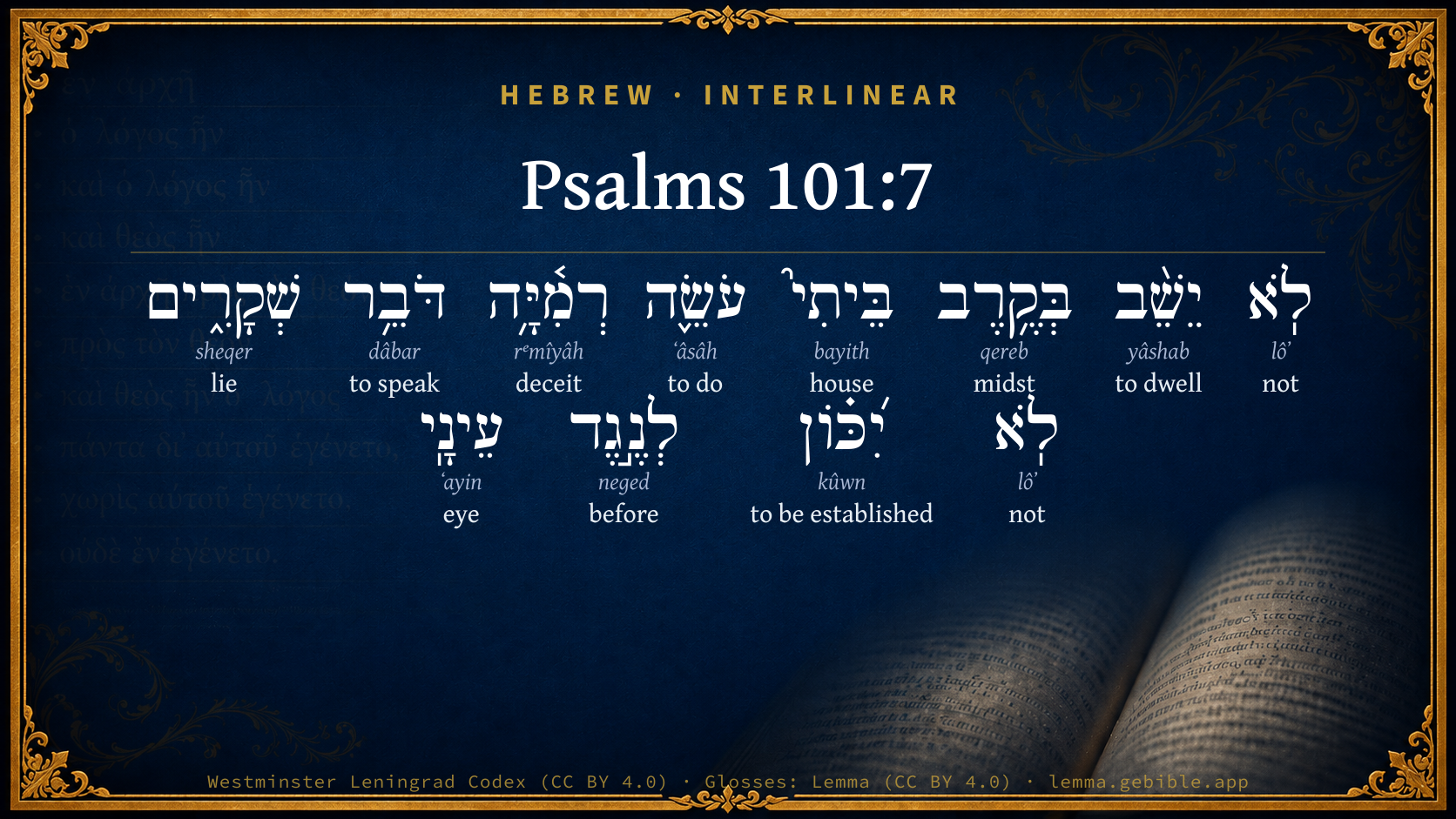
Hebrew (Westminster Leningrad Codex) Psalms 101:7 appears in the Hebrew Old Testament. The text above is from the Westminster Leningrad Codex. Each word links to its Strong’s number, a concise gloss, and parsing drawn from the Open Scriptures Hebrew Bible morphology. Click any word for its full Brown-Driver-Briggs (BDB) entry.
Download image
Cite this verse

Psalms 101:7 (World English Bible). Public Domain. Lemma interlinear Bible study tool, https://lemma.gebible.app/v/psalms/101/7.

Show BibTeX & RIS
BibTeX
RIS
English Translation
He who practices deceit won't dwell within my house. He who speaks falsehood won't be established before my eyes.
World English Bible · Public Domain
Download a study sheet

One document with this verse’s original text, its word-by-word gloss line, the meaning frame, cross-references with their text, attributed commentary, and full source and license credits — printable, and it pastes into notes with its structure intact.

This verse Autodidact and up

Study sheet (.html) Plain text (.txt)

A passage Seminary Student

Up to 50 verses in one chapter. A passage sheet keeps up to 6 commentary sources and 12 cross-references per verse, in the order this page ranks them, and says so on the sheet whenever that leaves anything out. Ask for a single verse and you get the Autodidact verse sheet above.

Everything on this page stays free to read, with no account — the sheet is a download of what is already on screen, not access to it.

Want to remove ads? Support Godless Engineer
Compare translations 3

The same verse in 3 English versions, stacked beneath the original-language interlinear above. Click any original word for its lexicon entry.

Each is an independent rendering of the whole verse — the interlinear is not word-aligned to these translations.

Highlighted words mark where these versions differ — a whole-verse word diff, not a word-by-word alignment.

  • World English Bible Public Domain
    He who practices deceit won't dwell within my house. He who speaks falsehood won't be established before my eyes.
  • King James Version Public Domain
    He that worketh deceit shall not dwell within my house: he that telleth lies shall not tarry in my sight.
  • unfoldingWord Literal Text CC BY-SA 4.0
    A doer of deceit will not remain within my house; a speaker of lies will not be established before my eyes.

unfoldingWord Literal Text — © unfoldingWord, licensed CC BY-SA 4.0. Word-aligned USFM3 via Door43 (git.door43.org/unfoldingWord/en_ult).

Versions to compare (up to 4)

3 of 4 selected

Show all 18 translations

Every available English version of this verse, each an independent rendering of the whole verse.

  • World English Bible Public Domain
    He who practices deceit won't dwell within my house. He who speaks falsehood won't be established before my eyes.
  • Berean Standard Bible Public Domain
    No one who practices deceit shall dwell in my house; no one who tells lies shall stand in my presence.
  • Majority Standard Bible Public Domain
    No one who practices deceit shall dwell in my house; no one who tells lies shall stand in my presence.
  • King James Version Public Domain
    He that worketh deceit shall not dwell within my house: he that telleth lies shall not tarry in my sight.
  • American Standard Version (1901) Public Domain
    He that worketh deceit shall not dwell within my house: He that speaketh falsehood shall not be established before mine eyes.
  • Revised Version (1885) Public Domain
    He that worketh deceit shall not dwell within my house: he that speaketh falsehood shall not be established before mine eyes.
  • Geneva Bible (1599) Public Domain
    There shall no deceitful person dwell within mine house: he that telleth lyes, shall not remaine in my sight.
  • Douay-Rheims (1899) Public Domain
    He that worketh pride shall not dwell in the midst of my house: he that speaketh unjust things did not prosper before my eyes.
  • Young's Literal Translation Public Domain
    He dwelleth not in my house who is working deceit, Whoso is speaking lies Is not established before mine eyes.
  • Literal Standard Version CC BY-SA 4.0
    He who is working deceit does not dwell in my house, || Whoever is speaking lies is not established before my eyes.
  • Unlocked Literal Bible CC BY-SA 4.0
    Deceitful people will not remain within my house; liars will not be welcome before my eyes.
  • unfoldingWord Literal Text CC BY-SA 4.0
    A doer of deceit will not remain within my house; a speaker of lies will not be established before my eyes.
  • Darby Bible Public Domain
    He that practiseth deceit shall not dwell within my house; he that speaketh falsehoods shall not subsist in my sight.
  • World Messianic Bible Public Domain
    He who practices deceit won’t dwell within my house. He who speaks falsehood won’t be established before my eyes.
  • Webster's Bible Public Domain
    He that worketh deceit shall not dwell within my house: he that telleth lies shall not tarry in my sight.
  • Free Bible Version CC BY-SA 4.0
    No one who is dishonest will live in my house; no liars will be allowed in my presence.
  • Bible in Basic English Public Domain
    The worker of deceit will not come into my house; the false man will have no place before my eyes.
  • JPS Tanakh (1917) Public Domain
    He that worketh deceit shall not dwell within my house; he that speaketh falsehood shall not be established before mine eyes.

Literal Standard Version (2020), Covenant Press — licensed CC BY-SA 4.0. Text via the HelloAO Bible API (eBible.org). Unlocked Literal Bible (unfoldingWord) — licensed CC BY-SA 4.0. Text via the HelloAO Bible API (eBible.org). unfoldingWord Literal Text — © unfoldingWord, licensed CC BY-SA 4.0. Word-aligned USFM3 via Door43 (git.door43.org/unfoldingWord/en_ult). Free Bible Version, Dr. Jonathan Gallagher — licensed CC BY-SA 4.0. Text via the HelloAO Bible API (eBible.org).

Word by word

More ways to search: Search by grammar → Find every occurrence → Compare this word →

Practice this passage: Drill this verse → Learn its vocabulary →

רְמִ֫יָּ֥ה
rᵉmîyâh
H7423
“deceit”
Noun, Common, Feminine, Singular, Absolute
Part of Speech
Noun
Type
Common
Gender
Feminine
Number
Singular
State
Absolute
Full BDB Definition

Origin: from H7411

TWOT: 2169a

laxness, slackness, slackening, deceit, treachery
  1. לֹֽא lôʼ H3808 “not” Particle, Negative
  2. יֵשֵׁ֨ב yâshab H3427 “to dwell” Verb, Qal, Imperfect, 3rd Person, Masculine, Singular
  3. בְּקֶ֥רֶב qereb H7130 “in/at · midst of” Preposition + Noun, Common, Masculine, Singular, Construct
  4. בֵּיתִי֮ bayith H1004 “house · my” Noun, Common, Masculine, Singular, Construct + Suffix, Personal, 1st Person, Common, Singular
  5. עֹשֵׂ֪ה ʻâsâh H6213 “doing” Verb, Qal, Participle Active, Masculine, Singular, Construct
  6. דֹּבֵ֥ר dâbar H1696 “speaking” Verb, Qal, Participle Active, Masculine, Singular, Absolute
  7. שְׁקָרִ֑ים sheqer H8267 “lies” Noun, Common, Masculine, Plural, Absolute
  8. לֹֽא lôʼ H3808 “not” Particle, Negative
  9. יִ֝כּ֗וֹן kûwn H3559 “to be established” Verb, Niphal, Imperfect, 3rd Person, Masculine, Singular
  10. לְנֶ֣גֶד neged H5048 “to/for · before” Preposition + Preposition
  11. עֵינָֽי ʻayin H5869 “eyes · my” Noun, Common, Both, Dual, Construct + Suffix, Personal, 1st Person, Common, Singular

About this verse

These counts appear in no published source. They are computed here, from the morphology-tagged text and Lemma’s own curated glosses. What Lemma adds →

12
words
11
distinct lemmas
Wisdom
section

Notable vocabulary

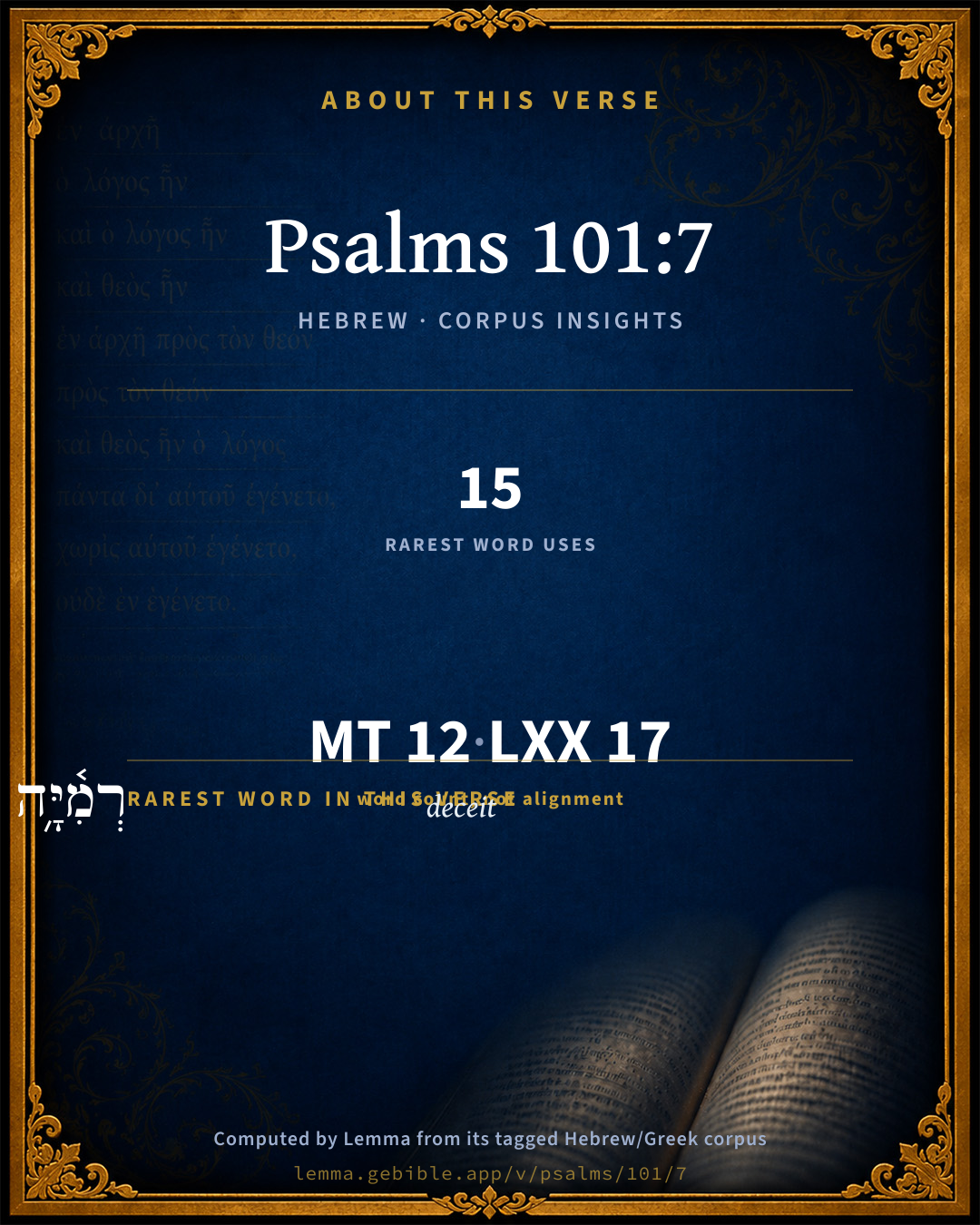
The rarest word here is רְמִ֫יָּ֥ה deceit H7423 — appearing just 15 times in the whole Hebrew Bible.

Shared distinctive vocabulary

רְמִ֫יָּ֥ה deceit H7423 occurs in 15 verses of the Hebrew Bible. Also found in:

Grammatical profile

  • 4 verbs
  • 5 nouns
  • 1 preposition
  • 2 particles

Verb forms

  • יֵשֵׁ֨ב Qal · Imperfect
  • עֹשֵׂ֪ה Qal · Participle Active
  • דֹּבֵ֥ר Qal · Participle Active
  • יִ֝כּ֗וֹן Niphal · Imperfect

Repetition

A word recurs within this verse — often emphatic in Hebrew:

Hebrew & Septuagint length

In English translation the verse runs 19 words from the Hebrew and 19 from the Septuagint (LXX English) — the same length.

A rough comparison of the two English renderings, which tokenize alike — not a word-level alignment.

Word counts can differ between the Hebrew and the Greek without any difference in meaning — e.g. the Hebrew direct-object marker אֵת has no separate Greek word, and Greek often adds the article ὁ.

In the original languages it is 12 Hebrew tokens and 17 Greek tokens — but the two are counted differently (Hebrew bundles its prefixes and suffixes into one token; the Greek is in lemma form), so that isn’t a like-for-like length.

Cross-references

7

Topical passages linked to Psalms 101:7 in the Treasury of Scripture Knowledge — connected by theme and wording, ordered by reader-vote popularity; previews shown in the World English Bible.

  • Acts 5:1–10 But a certain man named Ananias, with Sapphira, his wife, sold a possession,
  • 2 Samuel 4:10–12 when one told me, saying, Behold, Saul is dead, thinking to have brought good news, I took hold of him, and killed him in Ziklag, which was the reward I gave him for his news.
  • Proverbs 29:12 If a ruler listens to lies, All of his officials are wicked.
  • Psalms 52:2 Your tongue plots destruction, Like a sharp razor, working deceitfully.
  • Acts 1:16–20 "Brothers, it was necessary that this Scripture should be fulfilled, which the Holy Spirit spoke before by the mouth of David concerning Judas, who was guide to those who took Jesus.
  • 2 Kings 5:26–27 He said to him, Didn't my heart go with you, when the man turned from his chariot to meet you? Is it a time to receive money, and to receive garments, and olive groves and vineyards, and sheep and oxen, and men-servants and maid-servants?
  • Acts 1:25 to take part in this ministry and apostleship from which Judas fell away, that he might go to his own place."

Cross-references courtesy of OpenBible.info (CC BY 4.0).

Hebrew and Greek witnesses Masoretic Hebrew ↔ Greek Septuagint

The same verse in the two great witnesses to the Old Testament, shown verse-for-verse.

You’re reading Greek Psalm 100 (Hebrew Psalm 101). The Septuagint counts the superscription, so verse numbers can differ from the Hebrew — chapter-level alignment, not verse-by-verse. Numbering follows Rahlfs.

These are two independent witnesses, not word-aligned to each other, and the Septuagint is shown in lemma (dictionary) form.

Hebrew Psalms 101:7 Masoretic · Westminster Leningrad Codex

לֹֽא יֵשֵׁ֨ב בְּקֶ֥רֶב בֵּיתִי֮ עֹשֵׂ֪ה רְמִ֫יָּ֥ה דֹּבֵ֥ר שְׁקָרִ֑ים לֹֽא יִ֝כּ֗וֹן לְנֶ֣גֶד עֵינָֽי

He who practices deceit won't dwell within my house. He who speaks falsehood won't be established before my eyes.

World English Bible · Public Domain

Greek LXX Greek Psalm 100:7 Septuagint · lemma form

οὐ καταοἰκέω ἐν μέσος ὁ οἰκία ἐγώ ποιέω ὑπερηφανία λαλέω ἄδικος οὐ καταεὐθύνω ἐναντίον ὁ ὀφθαλμός ἐγώ

The proud doer lived not in the midst of my house; the unjust speaker prospered not in my sight.

LXX2012 (modern English Septuagint) · Public Domain

Hebrew: Westminster Leningrad Codex (CC BY 4.0). Greek: Septuagint (public domain); English from LXX2012 (modern English Septuagint) (Public Domain). How the Septuagint differs from the Hebrew →

Commentary

Notes on Psalms 101:7 from classic Christian and Jewish commentators (each source and its license shown beneath its notes). The classic Christian expositions comment on the surrounding passage and are grouped to its opening verse, so a note may address several verses; the Jewish commentaries on the Tanakh (Rashi and others) are per-verse, so they appear only where the commentator wrote on this verse.

Lemma curates 59 commentaries, every one of them public domain or Creative Commons licensed, each selected and text-cleaned for this edition rather than reprinted as found. About our sources →

Trapp's Complete Commentary

John Trapp

Psa 101:7 He that worketh deceit shall not dwell within my house: he that telleth lies shall not tarry in my sight.

Ver. 7. He that worketh deceit shall not dwell in my house] If I may know him to be such a one, I shall soon cashier him, and serve him as Philip of Macedon afterwards did two of his evil servants; the one whereof he compelled to run out of his country, and the other to drive him. David was not guarded and surrounded, as many princes are today, Magno agmine Aionum, Negonum, Ganeonum, Palponum, Gnathonum, Balatronum.

He that telleth lies shall not tarry in my sight] Liars are frequent in courts, as in Saul’s, and do much mischief. The good Emperor Aurelius was much abused by them. Lewis XI of France complained that he had plenty of all things but of only one; and being asked of what? Of truth, quoth he. Augustus took on exceedingly when Varus was slain in battle, and gave this for a reason, Quod non esset a quo verum audiret, because he had not now a friend from whom he could hear the truth of things.

John Trapp, A Commentary or Exposition upon All the Books of the Old and New Testament (1647–1656) — public domain. Text from a community e-Sword module.

The Biblical Illustrator

Joseph S. Exell

Psa_101:7

He that worketh deceit shall not dwell within my house.

Wise choice of companions

A man is known by the company he keeps; yes, and by his company you may know what he is coming to be. We unconsciously fall into the habits of thought and feeling of those with whom we are associated. Our ideas are moulded by our ideals; our conduct by our examples. To choose refining, purifying society is the grandest step up and on, to keep the company of the vicious and the vile is as sure a step toward ruin. The Church is mainly given us to meet this demand of our social nature. (A. T. Pierson, D.D.)

.

Psa_102:1-28

The Biblical Illustrator, edited by Joseph S. Exell (c. 1880s–1900s) — public domain. Text from a community e-Sword module.

Joseph Benson's Commentary

Psa 101:7. He that worketh deceit — That uses any frauds or subtle artifice to deceive, abuse, or wrong any of my people; shall not dwell within my house — Though he may insinuate himself into my family, yet, as soon as he is discovered, he shall be turned out of it. He that telleth lies — Either to defend and excuse the guilty, or to betray the innocent; shall not tarry in my sight — I will certainly and immediately banish him from my presence.

Joseph Benson's Commentary on the Old and New Testaments (1811–1818) — public domain. Text from a community e-Sword module.

J. A. Alexander on Psalms

Joseph Addison Alexander

7. (Psa 101:7) Not in the inside of my house shat dwell (one) practising fraud, telling lies; not settled shall he be before my eyes. Here again the form of expression corresponds to that in the first part of the psalm. Compare in the midst of my house with Psa 101:2, and before my eyes with Psa 101:3. Shall not dwell, or still more strongly, shall not (even) sit, which is the primary meaning of the Hebrew verb. The corresponding verb in the last clause means to be established, permanently settled, as opposed to a mere temporary, transient presence. As if he had said, though they should even gain admission to my house, they shall not take up their abode there.

Joseph Addison Alexander, The Psalms Translated and Explained (1850) — public domain. Text from a community e-Sword module.

Tyndale Open Study Notes

Tyndale Open Resources

101:7-8 The psalmist commits himself to ridding his house and the city of the Lord—representing the entire kingdom—of all evil.

Tyndale Open Study Notes — © Tyndale Open Resources, licensed CC BY-SA 4.0. Text via the HelloAO Bible API.

Adam Clarke's Commentary

Verse 7. He that worketh deceit - that telleth lies] I will expel from my court all sycophants and flatterers. Tiberius encouraged flatterers; Titus burned some, banished several others, and sold many for slaves.

Adam Clarke's Commentary on the Bible (1810–1826) — public domain. Text from a community e-Sword/MySword module.

John Calvin's Commentaries

7 He who worketh deceit shall not dwell in the midst of my house This verse may be explained of all magistrates to whose charge the exercise of public judgments is committed, as well as of household servants. But as David has just now spoken in general of all officers, he seems now to speak properly of those who are near the person of the king. When the chief counsellors of kings and other intimate acquaintances who have gained possession of their ears, are deceitful and crafty, this becomes the source of all corruptions; for by their example they encourage others in evil, lifting up as it were the banner of licentiousness. And it is impossible that he who does not maintain good order in his own house, can be a fit person for holding the government of a whole realm. The authority which cannot preserve its influence under the domestic roof is of little worth in state affairs.

John Calvin's Commentaries (1540-1563) — public domain. Text from the Calvin Translation Society English edition (1840s-50s) via the Christian Classics Ethereal Library (ccel.org). Calvin's coverage is partial (roughly two-thirds of the Bible); uncommented books and verses are honest gaps, never fabricated. The 19th-century editor's footnotes and remarks are omitted so the notes are faithfully Calvin's own voice.

Ellicott's Commentary for English Readers

(7) Tarry in my sight—i.e., stand as a courtier in the royal presence. Comp. Homer:

“Hateful to me as gates of hell is he

Who hides one thing within his mind and speaks another.”

A Bible Commentary for English Readers, edited by Charles John Ellicott (1878–1897) — public domain. Text from a community e-Sword module.

The Cambridge Bible for Schools and Colleges

gen. ed. J. J. S. Perowne

7. he that telleth lies &c.] He that speaketh falsehood shall not be established in my presence.

The Cambridge Bible for Schools and Colleges (gen. ed. J. J. S. Perowne; Cambridge University Press, 1878–1918) — public domain. Text from a community e-Sword module.

John Gill's Exposition

He that worketh deceit shall not dwell within my house,.... Flatterers, sycophants, tricking and fraudulent persons, who seek to supplant others, and get into their places; these should lose the favour they had, when detected. So hypocritical persons, that have only a form of godliness, a mask of religion, and false teachers that lie in wait to deceive; and antichrist, whose coming was with all deceivableness of unrighteousness; who has seduced men by his miracles, doctrines, and sorceries; these shall have no place, neither in Christ's house below nor above. The Targum is,

"he that works deceit shall not dwell in the midst of the house of my sanctuary:''

he that telleth lies shall not tarry in my sight; or, "he shall not be established" before mine eyes (r); he shall not continue in his post and place, in his office and station; he shall soon be dismissed from it; lying is very abominable to God, very prejudicial to men, and hated by Christ, who is truth itself. All sorts of lies, and liars are so, religious and doctrinal ones; such who speak lies in hypocrisy, as the emissaries of Rome; all that make an abomination, or a lie, will have no place with Christ in the New Jerusalem, Rev 21:27.

(r) "nequaquam firmabitur", Pagninus, Montanus; "non stabilietur", Vatablus, Junius & Tremellius, Piscator, Cocceius, Gejerus, Michaelis.

John Gill's Exposition of the Whole Bible (1746–1763) — public domain (CC PDM 1.0). Text via the HelloAO Bible API.

Albert Barnes' Notes on the Bible

He that worketh deceit - The man who is dishonest - who is full of tricks, false pretences, and devices - who cannot be confided in as straight-forward and sincere - one whose word cannot be relied on - one whose course is subterranean or serpentine.

Shall not dwell within my house - Shall neither be employed in my service, nor be admitted as a guest and companion. I will not, in any way, patronise or countenance such a person.

He that telleth lies - In any way: by stating what is false; by promising what is not performed; by deceiving me in his professions. I will seek only those who love and speak the truth.

Shall not tarry in my sight - Margin, “shall not be established.” The idea is that of being confirmed or established. The sense here seems to be, that though such a person should gain admittance to his house on any pretence or profession, he should not obtain a permanent residence there. As soon as his real character was known, he would be dismissed or discharged. The psalmist says that he would do nothing to show him countenance; he would not give occasion to have it represented that he favored liars or dishonest persons, or that such persons might find employment with him. As a universal rule, no man should have such plans to accomplish in his family, or in his business-transactions, that he cannot employ, in accomplishing those things, persons who are perfectly honest; or, in other words, no man should engage in any undertaking, or pursue any kind of business, that would require people of loose principles - the cunning, the crafty, the deceitful, the dishonest - to carry it out. Yet there are many such employments in the world; and there are men suited for such employments, and who are willing to engage in such work. It may be a good test for a man in regard to the business in which he is engaged, to ask himself what kind of agents, clerks, or servants, it will be necessary for him to employ in carrying it out. If the business is such as to make it necessary to employ unprincipled people - people who have easy consciences - people who will violate the sabbath - men who have more skill than honesty - more cunning than principle - that very fact should determine him at once in regard to the propriety of the business.

Albert Barnes' Notes on the Bible (1834–1885) — public domain. Text from a community e-Sword/MySword module.

Matthew Poole's English Annotations

He that worketh deceit; he who shall use any frauds, or cheats, or subtle artifices to abuse or wrong any of my people; which David’s courtiers were more likely to endeavour, because he would not permit any open violence.

He that telleth lies; he that shall abuse me with lies, as courtiers usually do their princes, either to defend and excuse the guilty, or to betray the innocent.

Shall not tarry in my sight; I will certainly and immediately banish him from my presence.

Matthew Poole's English Annotations on the Holy Bible (1683–1685) — public domain. Text from a community e-Sword/MySword module.

The Treasury of David

Charles H. Spurgeon

Ver. 7. He that worketh deceit shall not dwell within my house. He had power to choose his courtiers, and he meant to exercise it. Deceit among most orientals is reckoned to be a virtue, and is only censured when it is not sufficiently cunning, and therefore comes to be found out; it was therefore all the more remarkable that David should have so determinedly set his face against it. He could not tell what a deceitful man might be doing, what plots he might be contriving, what mischief he might be brewing, and therefore he resolved that he would at any rate keep him out of his house, that his palace might not become a den of villainy. Cheats in the market are bad enough, but deceivers at our own table we cannot bear.

He that telleth lies shall not tarry in my sight. He would not have a liar within sight or hearing; lie loathed the mention of him. Grace makes men truthful, and creates in them an utter horror of everything approaching to falsehood. If David would not have a liar in his sight, much less will the Lord; neither he that loves nor he who makes a lie shall be admitted into heaven. Liars are obnoxious enough on earth; the saints shall not be worried with them in another world.

Psalms 101:8*

Charles H. Spurgeon's The Treasury of David (1869–1885) — public domain. Psalms only. Text from a community e-Sword/MySword module.

Whedon's Commentary on the Bible

Daniel D. Whedon

7. He that worketh deceit—David reiterates his purpose to cut off flattery and falsehood. His horror and execration of these are expressed in Psa_52:1-7

Daniel D. Whedon (gen. ed.), Commentary on the Old and New Testaments (1874–1909) — public domain. Text from a community e-Sword module.

The Pulpit Commentary

He that worketh deceit shall not dwell within my house. It is the duty of a king to see, not only that his own ways are blameless, but that his entire household is well ordered, and consists of righteous persons. (comp. Job_1:5) "Deceit" here means "wickedness" generally. He that telleth lies shall not tarry in my sight; literally, shall not be established; i.e. shall not keep his position in my court, but be banished from it. "Lying" is one of the sins which the psalmists denounce most frequently. (see Psa_31:18 Psa_40:4 Psa_52:3 Psa_58:3 Psa_59:12 Psa_62:4 Psa_63:11 119:163, etc.)

The sin of the untruthful.

"He that telleth lies shall not tarry in my sight." There is no sin that is more difficult to deal with, when once it has become established. Many children are untruthful because they have vivid imaginations, and though their words match what they see, what they see does not strictly accord with the actual facts. These cases require the most careful and judicious treatment at the hands of parents and teachers, if the child habit is not to develop into a confirmed untruthfulness. But there are some children who seem to be born liars their word can never be trusted. Only the sternest discipline can correct an evil which, if left unchecked, must inevitably ruin the life. And some children are made untruthful by fear; and by their statements always being treated suspiciously; and by their being constantly set upon inventing excuses.

I THE UNTRUTHFUL MAN SINS AGAINST HIMSELF. He confuses his own sense of right and wrong; destroys his moral sense, until he discovers that he cannot trust himself. "To thine own self be true, And it must follow, as the night the day, Thou canst not then be false to any man.

II THE UNTRUTHFUL MAN SINS AGAINST HIS FELLOW MAN. For only truth can guide us aright. If those whom we trust and obey are not true, our way cannot be safe. Illustrate by the man who goes an unknown road, and receives untruthful directions. See in business affairs what mischiefs untruthfulness can make. Every man has an absolute right to demand from his fellow man a precise accordance between statement and fact. Show that secrecy, withholding, may be as effectually untruthful as any statement. We are bound to be true in every form in which we express ourselves to our fellows. Point out what self-restraints are required, if we are to be absolutely true in tones, and looks, and silences, and speech.

III THE UNTRUTHFUL MAN SINS AGAINST GOD. Who "requireth truth in the inward parts." This introduces familiar considerations, on which no special suggestions arc needed. R.T.

The Pulpit Commentary (1880–1919), ed. H.D.M. Spence-Jones & Joseph S. Exell — public domain. Text from a community e-Sword module.

unfoldingWord translationNotes

Door43 World Missions Community

Deceitful people will not ... liars will not

These two phrases have the same idea and are used together to emphasize how David will not tolerate deceitful people. (See: Parallelism)

liars will not be welcome

This can be stated in active form. AT: "I will not welcome liars" (See: Active or Passive)

before my eyes

Here "my eyes" refers to David himself. AT: "before me" or "in my presence" (See: Synecdoche)

Morning by morning

"Every day"

the wicked

This refers to wicked people. AT: "the wicked people" (See: Nominal Adjectives)

from the city of Yahweh

David is referring to the city that he is in as "the city of Yahweh." This can be made clear. AT: "from this city, which is Yahweh's city" (See: Assumed Knowledge and Implicit Information)

translationWords

deceive

house

evil

evildoer

unfoldingWord translationNotes — © Distant Shores Media and the Door43 World Missions Community, licensed CC BY-SA 4.0. Source: git.door43.org/Door43/en_tn.

Lesson kit

Teaching starters — assembled from the data on this page, not authored interpretation. Every prompt links to the verse data it draws on. Edit before teaching.

Psalms, in the Wisdom, opens this verse with 12 words (11 distinct Hebrew lemmas). Its most distinctive word is rᵉmîyâh (“deceit”). A historical commentator’s framing appears above. Read the whole chapter for the surrounding context.

Discussion questions

  1. What does “deceit” (rᵉmîyâh) contribute to the verse as a whole?
  2. How does Job 13:7, which shares the word «deceit», read alongside this verse?
  3. What does the repetition of “not” (2× in this one verse) do in this verse?
  4. These translations render this verse differently; the difference is in the English rendering, not the original. What questions does that raise?
  5. «יֵשֵׁ֨ב» is a Qal Imperfect verb. How does that grammatical form shape the action described?
  6. Compare how Trapp's Complete Commentary and The Biblical Illustrator read this verse. Where do they agree or differ?

Things to notice

Reading settings

Reading text

Shown beneath each verse's original-language words.

Old Testament
Old Testament edition

Read the OT as the Masoretic Hebrew (MT) or the Greek Septuagint (LXX).

English shown for the Greek Septuagint (in the Hebrew ↔ Greek comparison).

Comparing translations? Open the Compare panel on any verse page to stack up to four side by side.