
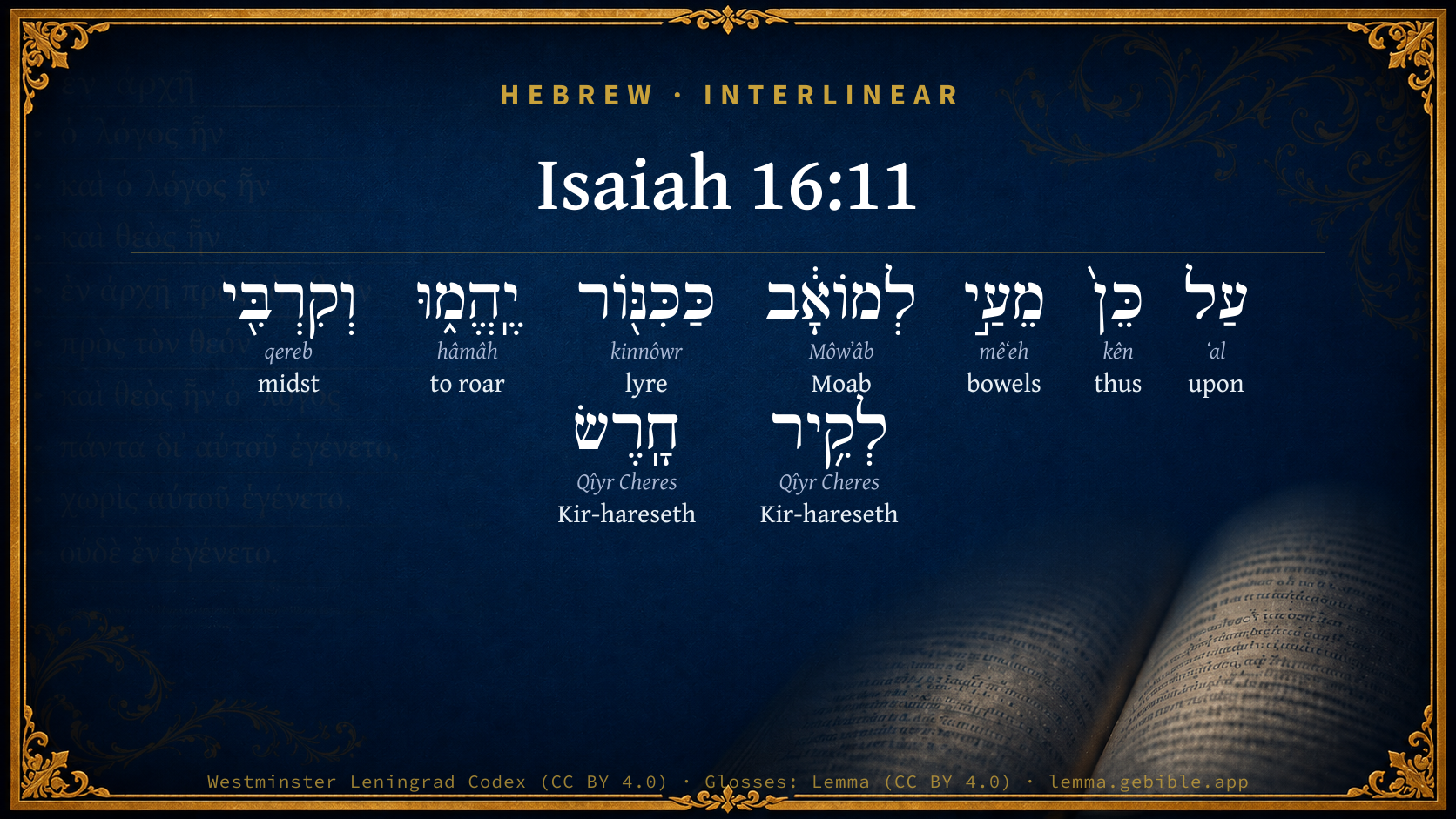
Isaiah 16:11

Hebrew (Westminster Leningrad Codex) Isaiah 16:11 appears in the Hebrew Old Testament. The text above is from the Westminster Leningrad Codex. Each word links to its Strong’s number, a concise gloss, and parsing drawn from the Open Scriptures Hebrew Bible morphology. Click any word for its full Brown-Driver-Briggs (BDB) entry.
Download image
Cite this verse

Isaiah 16:11 (World English Bible). Public Domain. Lemma interlinear Bible study tool, https://lemma.gebible.app/v/isaiah/16/11.

Show BibTeX & RIS
BibTeX
RIS
English Translation
Why my heart sounds like a harp for Moab, and my inward parts for Kir Heres.
World English Bible · Public Domain
Download a study sheet

One document with this verse’s original text, its word-by-word gloss line, the meaning frame, cross-references with their text, attributed commentary, and full source and license credits — printable, and it pastes into notes with its structure intact.

This verse Autodidact and up

Study sheet (.html) Plain text (.txt)

A passage Seminary Student

Up to 50 verses in one chapter. A passage sheet keeps up to 6 commentary sources and 12 cross-references per verse, in the order this page ranks them, and says so on the sheet whenever that leaves anything out. Ask for a single verse and you get the Autodidact verse sheet above.

Everything on this page stays free to read, with no account — the sheet is a download of what is already on screen, not access to it.

Want to remove ads? Support Godless Engineer
Compare translations 3

The same verse in 3 English versions, stacked beneath the original-language interlinear above. Click any original word for its lexicon entry.

Each is an independent rendering of the whole verse — the interlinear is not word-aligned to these translations.

Highlighted words mark where these versions differ — a whole-verse word diff, not a word-by-word alignment.

  • World English Bible Public Domain
    Why my heart sounds like a harp for Moab, and my inward parts for Kir Heres.
  • King James Version Public Domain
    Wherefore my bowels shall sound like an harp for Moab, and mine inward parts for Kirharesh.
  • unfoldingWord Literal Text CC BY-SA 4.0
    Therefore my insides moan like a harp for Moab, and my inward part, for Kir Heres.

unfoldingWord Literal Text — © unfoldingWord, licensed CC BY-SA 4.0. Word-aligned USFM3 via Door43 (git.door43.org/unfoldingWord/en_ult).

Versions to compare (up to 4)

3 of 4 selected

Show all 18 translations

Every available English version of this verse, each an independent rendering of the whole verse.

  • World English Bible Public Domain
    Why my heart sounds like a harp for Moab, and my inward parts for Kir Heres.
  • Berean Standard Bible Public Domain
    Therefore my heart laments for Moab like a harp, my inmost being for Kir-heres.
  • Majority Standard Bible Public Domain
    Therefore my heart laments for Moab like a harp, my inmost being for Kir-heres.
  • King James Version Public Domain
    Wherefore my bowels shall sound like an harp for Moab, and mine inward parts for Kirharesh.
  • American Standard Version (1901) Public Domain
    Wherefore my heart soundeth like a harp for Moab, and mine inward parts for Kir-heres.
  • Revised Version (1885) Public Domain
    Wherefore my bowels sound like an harp for Moab, and mine inward parts for Kir-heres.
  • Geneva Bible (1599) Public Domain
    Wherefore, my bowels shall sounde like an harpe for Moab, and mine inwarde partes for Ker-haresh.
  • Douay-Rheims (1899) Public Domain
    Wherefore my bowels shall sound like a harp for Moab, and my inward parts for the brick wall.
  • Young's Literal Translation Public Domain
    Therefore my bowels for Moab as a harp do sound, And mine inward parts for Kir-Haresh.
  • Literal Standard Version CC BY-SA 4.0
    Therefore my bowels sound as a harp for Moab, || And my inward parts for Kir-Haresh.
  • Unlocked Literal Bible CC BY-SA 4.0
    So my heart sighs like a harp for Moab, and my inward being for Kir Hareseth.
  • unfoldingWord Literal Text CC BY-SA 4.0
    Therefore my insides moan like a harp for Moab, and my inward part, for Kir Heres.
  • Darby Bible Public Domain
    Therefore my bowels sound like a harp for Moab, and mine inward parts for Kirheres.
  • World Messianic Bible Public Domain
    Therefore my heart sounds like a harp for Moab, and my inward parts for Kir Heres.
  • Webster's Bible Public Domain
    Wherefore my bowels shall sound like a harp for Moab, and my inward parts for Kir-haresh.
  • Free Bible Version CC BY-SA 4.0
    Heartbroken I cry for Moab like sad music on a harp; deep inside I weep for Kir-hareseth.
  • Bible in Basic English Public Domain
    For this cause the cords of my heart are sounding for Moab, and I am full of sorrow for Kir-heres.
  • JPS Tanakh (1917) Public Domain
    Wherefore my heart moaneth like a harp for Moab, and mine inward parts for Kir-heres.

Literal Standard Version (2020), Covenant Press — licensed CC BY-SA 4.0. Text via the HelloAO Bible API (eBible.org). Unlocked Literal Bible (unfoldingWord) — licensed CC BY-SA 4.0. Text via the HelloAO Bible API (eBible.org). unfoldingWord Literal Text — © unfoldingWord, licensed CC BY-SA 4.0. Word-aligned USFM3 via Door43 (git.door43.org/unfoldingWord/en_ult). Free Bible Version, Dr. Jonathan Gallagher — licensed CC BY-SA 4.0. Text via the HelloAO Bible API (eBible.org).

Word by word

More ways to search: Search by grammar → Find every occurrence → Compare this word →

Practice this passage: Drill this verse → Learn its vocabulary →

About this verse

These counts appear in no published source. They are computed here, from the morphology-tagged text and Lemma’s own curated glosses. What Lemma adds →

9
words
8
distinct lemmas
Prophets
section

Notable vocabulary

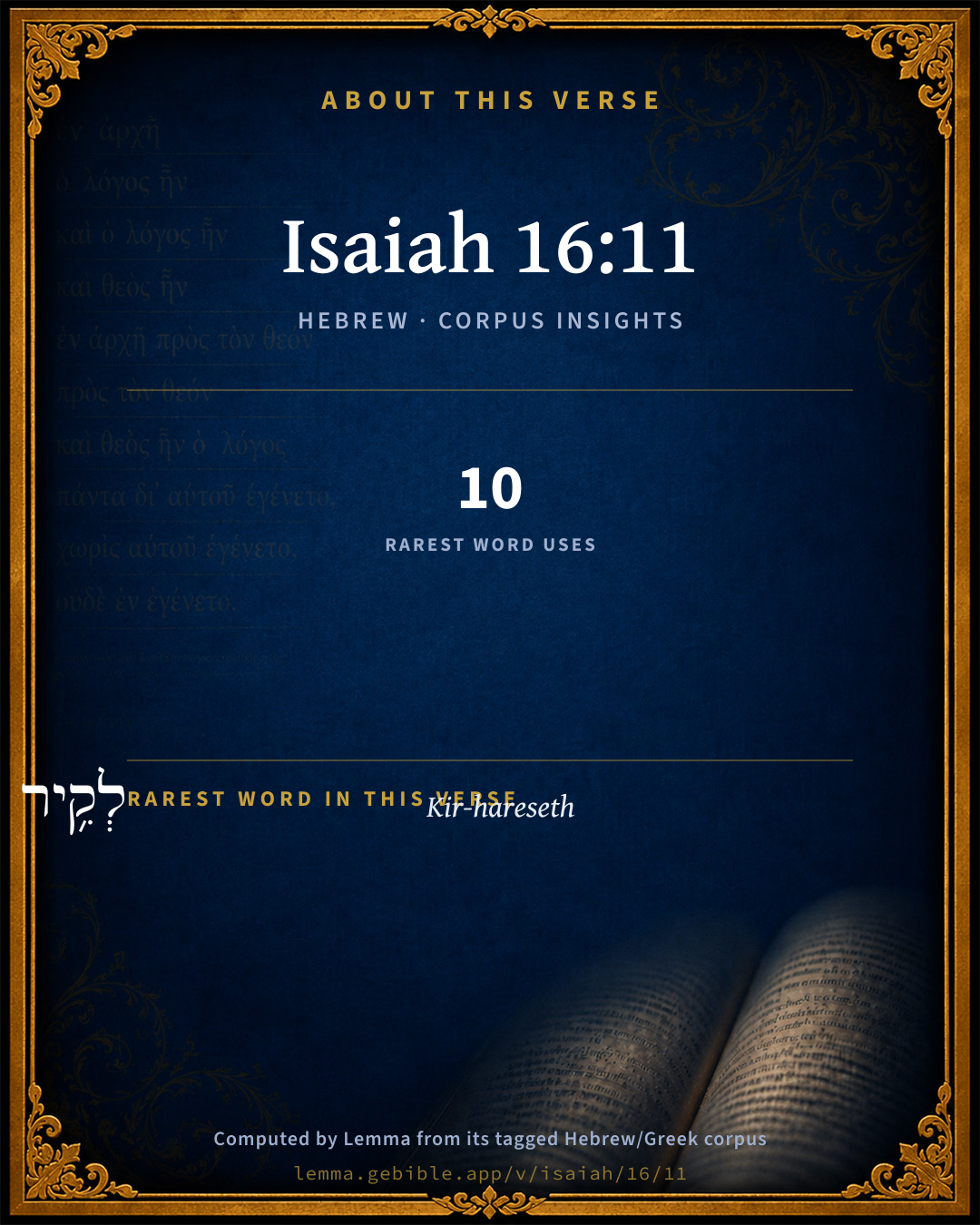
The rarest word here is לְקִ֥יר Kir-hareseth H7025 — appearing just 10 times in the whole Hebrew Bible.

Shared distinctive vocabulary

לְקִ֥יר Kir-hareseth H7025 occurs in 5 verses of the Hebrew Bible. Also found in:

Grammatical profile

  • 1 verb
  • 6 nouns
  • 1 preposition
  • 1 particle

Verb forms

  • יֶֽהֱמ֑וּ Qal · Imperfect

Repetition

A word recurs within this verse — often emphatic in Hebrew:

  • לְקִ֥יר Kir-hareseth H7025 ×2

Hebrew & Septuagint length

In English translation the verse runs 16 words from the Hebrew and 20 from the Septuagint (LXX English) — closely comparable.

A rough comparison of the two English renderings, which tokenize alike — not a word-level alignment.

Word counts can differ between the Hebrew and the Greek without any difference in meaning — e.g. the Hebrew direct-object marker אֵת has no separate Greek word, and Greek often adds the article ὁ.

Cross-references

7

Topical passages linked to Isaiah 16:11 in the Treasury of Scripture Knowledge — connected by theme and wording, ordered by reader-vote popularity; previews shown in the World English Bible.

  • Isaiah 15:5 My heart cries out for Moab; her nobles [flee] to Zoar, to Eglath Shelishiyah: for by the ascent of Luhith with weeping they go up; for in the way of Horonaim they raise up a cry of destruction.
  • Isaiah 63:15 Look down from heaven, and see from the habitation of your holiness and of your glory: where are your zeal and your mighty acts? the yearning of your heart and your compassion is restrained toward me.
  • Jeremiah 48:36 Therefore my heart sounds for Moab like pipes, and my heart sounds like pipes for the men of Kir Heres: therefore the abundance that he has gotten is perished.
  • Hosea 11:8 "How can I give you up, Ephraim? How can I hand you over, Israel? How can I make you like Admah? How can I make you like Zeboiim? My heart is turned within me, My compassion is aroused.
  • Philippians 2:1 If there is therefore any exhortation in Christ, if any consolation of love, if any fellowship of the Spirit, if any tender mercies and compassion,
  • Jeremiah 31:20 Is Ephraim my dear son? is he a darling child? for as often as I speak against him, I do earnestly remember him still: therefore my heart yearns for him; I will surely have mercy on him, says Yahweh.
  • Jeremiah 4:19 My anguish, my anguish! I am pained at my very heart; my heart is disquieted in me; I can't hold my peace; because you have heard, O my soul, the sound of the trumpet, the alarm of war.

Cross-references courtesy of OpenBible.info (CC BY 4.0).

Hebrew and Greek witnesses Masoretic Hebrew ↔ Greek Septuagint

The same verse in the two great witnesses to the Old Testament, shown verse-for-verse.

These are two independent witnesses, not word-aligned to each other, and the Septuagint is shown in lemma (dictionary) form.

Hebrew Isaiah 16:11 Masoretic · Westminster Leningrad Codex

עַל כֵּן֙ מֵעַ֣י לְמוֹאָ֔ב כַּכִּנּ֖וֹר יֶֽהֱמ֑וּ וְקִרְבִּ֖י לְקִ֥יר חָֽרֶשׂ

Why my heart sounds like a harp for Moab, and my inward parts for Kir Heres.

World English Bible · Public Domain

Greek LXX Isaiah 16:11 Septuagint · lemma form

διά οὗτος ὁ κοιλία ἐγώ ἐπί μωαβ ὡς κιθάρα ἠχέω καί ὁ ἐντός ἐγώ ὡσεί τεῖχος ὅς ἐνκαινίζω

Therefore my belly shall sound as a harp for Moab, and you have repaired my inward parts as a wall.

LXX2012 (modern English Septuagint) · Public Domain

Hebrew: Westminster Leningrad Codex (CC BY 4.0). Greek: Septuagint (public domain); English from LXX2012 (modern English Septuagint) (Public Domain). How the Septuagint differs from the Hebrew →

Targum (Aramaic paraphrase)

1

The Targum is the ancient Jewish Aramaic paraphrase of the Hebrew Scriptures — an interpretive translation, not the Hebrew text itself. Onkelos (literal) and Pseudo-Jonathan (expansive) render the Torah, and Jonathan the Prophets. Coverage is partial: where no permissively-licensed English translation exists for a verse, only the Aramaic is shown. This is verse-level text, not a word-by-word alignment to the Hebrew.

  1. Targum Jonathan Prophets (Joshua–Malachi)
    עַל כֵּן מְעֵיהוֹן דְמוֹאֲבָאֵי כְּכִּנָרַיָא הָמָן וְלִבְּהוֹן עַל אֱנַשׁ כְּרַךְ תוּקְפֵיהוֹן דָוָן:

    Wherefore the bowels of the Moabites shall sound as a harp, and their heart shall mourn over the men of the city of their strength.

    Targum Jonathan — Aramaic: “Mikraot Gedolot” (public domain). English: “Sefaria Community Translation” (CC0 1.0 (public-domain dedication)); “London "Chaldee Paraphrase," 1871” (public domain). Text via Sefaria.

Commentary

Notes on Isaiah 16:11 from classic Christian and Jewish commentators (each source and its license shown beneath its notes). The classic Christian expositions comment on the surrounding passage and are grouped to its opening verse, so a note may address several verses; the Jewish commentaries on the Tanakh (Rashi and others) are per-verse, so they appear only where the commentator wrote on this verse.

Lemma curates 59 commentaries, every one of them public domain or Creative Commons licensed, each selected and text-cleaned for this edition rather than reprinted as found. About our sources →

Trapp's Complete Commentary

John Trapp

Isa 16:11 Wherefore my bowels shall sound like an harp for Moab, and mine inward parts for Kirharesh.

Ver. 11. Wherefore my bowels shall sound {a} like an harp for Moab.] The "elect of God, holy and beloved, have bowels of mercy, tenderness, and kindness" toward their very enemies also, {Col 3:12} whom they do oft pity more than they pity themselves, as Habakkuk did the Chaldeans’ calamity, {Isa 3:16} and as Daniel did Nebuchadnezzar’s downfall. {Dan 4:19} Sicut cithara plectro tacta dat sonitum in funere funereum, As they have mournful music at funerals; {Jer 9:17; Jer 9:20 Mat 9:23} or as the strings of a shawm sound heavily, so do my heart strings for miserable Moab. In a harp, if one string be touched, all the rest sound; so it should be with us in regard of fellow feeling. We should feel others’ hard cords through our soft beds.

{a} Ego ex intimis visceribus meis conturbatus. - Jun.

John Trapp, A Commentary or Exposition upon All the Books of the Old and New Testament (1647–1656) — public domain. Text from a community e-Sword module.

Joseph Benson's Commentary

Isa 16:11-12. Wherefore my bowels shall sound as a harp — Through compassion. In excessive grief, the bowels are sometimes rolled together, so as to make an audible noise. Hereby he signifies the greatness of their approaching calamity, which, being so grievous to him, must needs be intolerable to them. And when it is seen that Moab is weary, &c. — When it shall appear to them and others, that all their other devotions are vain and ineffectual; he shall come to his sanctuary to pray — To the temple of his great god Chemosh; but he shall not prevail — His god can neither hear nor help him. In other words, the Moabites, “as their last efforts, shall go to their altars, there to perform their sacred rites to appease the anger of their deity: but, wearied herewith, they shall enter into some more sacred and celebrated sanctuary of their god, to pour forth their earnest supplications and prayers, but shall obtain nothing; thus proving the vanity of their superstition, and the imbecility of those false deities on whom they trusted.”

Joseph Benson's Commentary on the Old and New Testaments (1811–1818) — public domain. Text from a community e-Sword module.

Geneva Bible (1599)

Geneva Bible translators

For very sorrow and compassion.

Geneva Bible (1599) marginal notes — public domain. Text via Bolls.life.

Jamieson, Fausset & Brown

Robert Jamieson, A. R. Fausset & David Brown

bowels--in Scripture the seat of yearning compassion. It means the inward seat of emotion, the heart, &c. (Isa 63:15; compare Isa 15:5; Jer 48:36).

sound . . . harp--as its strings vibrate when beaten with the plectrum or hand.

Jamieson, Fausset & Brown — Commentary Critical and Explanatory on the Whole Bible (1871) — public domain (CC PDM 1.0). Text via the HelloAO Bible API.

Ellicott's Commentary for English Readers

(11) My bowels shall sound like an harp . . .—The context leaves it uncertain whether the speaker is the prophet as in Isa_16:9, or Jehovah as in Isa_16:10. The former seems, perhaps, the most natural. On the other hand, the very phrase is used of the compassion of Jehovah in Isa_63:15. The “bowels,” as in modern language the “heart,” were looked on as the seat of the emotions, and as such they vibrate, like the chords of the harp or lyre (kinnûr) used at funerals, with the thrills of pity.

A Bible Commentary for English Readers, edited by Charles John Ellicott (1878–1897) — public domain. Text from a community e-Sword module.

The Cambridge Bible for Schools and Colleges

gen. ed. J. J. S. Perowne

11. (Jer_48:36) my bowels shall sound like a harp] omit “shall” with R.V. The poet’s emotion flows forth spontaneously in the strains of the elegy. The bowels are the seat of the more intense emotions (Job_30:27), especially of compassion (Jer_4:19; Jer_31:20; Son_5:4). Kir-haresh] Kir-heres. See on Isa_16:7.

The Cambridge Bible for Schools and Colleges (gen. ed. J. J. S. Perowne; Cambridge University Press, 1878–1918) — public domain. Text from a community e-Sword module.

John Gill's Exposition

Wherefore my bowels shall sound like a harp for Moab,.... Making a noise as the harp does, and a mournful one as that, when used at funerals; which it makes when it is stricken or played on with the hand, as these were, through the afflictive and punitive hand of God; and which, when stricken, causes a quavering of the strings, to which the inward trembling of the bowels is compared, and is very expressive of the prophet's sympathy, or those he personates; for, when one string of the harp is touched, the rest sound. For these words, as Kimchi says, are spoken in the language of the Moabites; those that survived lamenting the desolate state of their country, which must be very great and affecting; and to show that it was so is the design of the prophet's expressing himself after this manner; for if it was painful to him, it must be much more so to them; so the Targum,

"wherefore the bowels of the Moabites shall sound as a harp;''

of the sounding of the bowels, see Isa 63:15,

and mine inward parts for Kirharesh: the same with Kirhareseth, Isa 16:7 which being a principal city, the destruction of it was greatly laid to heart. The Targum is,

"and their heart shall grieve for the men of the city of their strength;''

it being a strong city, in which they placed their confidence; but being destroyed, and the inhabitants of it, it was very affecting, to which agrees Jer 48:31.

John Gill's Exposition of the Whole Bible (1746–1763) — public domain (CC PDM 1.0). Text via the HelloAO Bible API.

Albert Barnes' Notes on the Bible

Wherefore my bowels - This is also an expression of the deep grief of the prophet in view of the calamities which were coming upon Moab. The “bowels” in the Scriptures are everywhere represented as the seat of compassion, pity, commiseration, and tender mercy Gen 43:30 : ‘His bowels did yearn upon his brother’ - he deeply felt for him, he greatly pitied him 1Ki 3:26; Psa 25:6; Pro 12:10; Son 5:4; Isa 63:15; Jer 4:19; Jer 31:20; Phi 1:8; Phi 2:1. In classic writers, the word ‘bowels’ denotes the “upper” viscera of victims - the heart, the lungs, the liver, which were eaten during or after the sacrifice (Robinson, “Lex.,” on the word σπλάγχνον splangchnon). In the Scriptures, it denotes the “inward parts” - evidently also the upper viscera, regarded as the seat of the emotions and passions. The word as we use it - denoting the lower “viscera” - by no means expresses the sense of the word in the Scriptures, and it is this change in the signification which renders the use of the very language of the Bible unpleasant or inappropriate. We express the idea by the use of the word “heart” - the seat of the affections.

Shall sound like an harp - The “bowels” are represented in the Scriptures as affected in various modes in the exercise of pity or compassion. Thus, in Lam 1:20, Jeremiah says, ‘My bowels are troubled’ (see Lam 2:1; Jer 31:20). Job Job 30:27, says, ‘My bowels boiled, and rested not;’ there was great agitation; deep feeling. Thus, Jer 4:19 :

My bowels! My bowels! I am pained at my very heart.

My heart “maketh a noise” in me.

So Isa 63:15 : ‘Where is the sounding of thy bowels and mercies?’ The word ‘sound’ here means to make a tumultuous noise; and the whole expression here denotes that his heart was affected with the calamities of Moab as the strings of the harp vibrate when beaten with the plectrum or the band. His heart was deeply pained and affected by the calamities of Moab, and responded to those calamities, as the strings of the harp did to the blow of the plectrum.

Mine inward parts - The expressions used here are somewhat analogous to ours of the “beating of the heart,” to denote deep emotion. Forster says of the savages of the South Sea that they call compassion “a barking of the bowels.”

For Kirharesh - (See the note at Isa 16:7.)

Albert Barnes' Notes on the Bible (1834–1885) — public domain. Text from a community e-Sword/MySword module.

Haydock's Catholic Bible Commentary

Wall. Kir-hareseth, ver. 7. I am grieved at your misfortunes. (Calmet)

George Leo Haydock (1774–1849), Haydock's Catholic Family Bible and Commentary, 1859 edition — public domain. Excludes Psalms (Douay-Rheims chapter numbering differs from Protestant) and Deuterocanonical books (Catholic canon only).

Matthew Poole's English Annotations

Shall sound, through compassion to them; of which See Poole "Isa 15:5". In excessive griefs the bowels are sometimes rolled and tumbled together, so as to make an audible noise. Hereby he signifies the greatness of their approaching calamity, which being so grievous to him, must needs be intolerable to them.

Matthew Poole's English Annotations on the Holy Bible (1683–1685) — public domain. Text from a community e-Sword/MySword module.

Whedon's Commentary on the Bible

Daniel D. Whedon

11. Wherefore my bowels — An expression of deepest grief. The viscera above the diaphragm, including heart, lungs, liver, are here called “bowels.”

Shall sound like a harp — Grief was capable, it was thought, of causing the heart to beat and the nerves to tremble; and such sensations were fancied to resemble low harp sounds.

Daniel D. Whedon (gen. ed.), Commentary on the Old and New Testaments (1874–1909) — public domain. Text from a community e-Sword module.

The Pulpit Commentary

My bowels shall sound like a harp for Moab; i.e. they shall vibrate with thrills of grief (Kay).

The Pulpit Commentary (1880–1919), ed. H.D.M. Spence-Jones & Joseph S. Exell — public domain. Text from a community e-Sword module.

John Wesley's Explanatory Notes

My bowels - Thro' compassion. In excessive grief, the bowels are sometimes rolled together, so as to make an audible noise.

John Wesley, Explanatory Notes Upon the Whole Bible (1754–1765) — public domain. Text via the GEBible commentary corpus.

J. A. Alexander on Isaiah

Joseph Addison Alexander

“Therefore my bowels for Moab like the harp shall sound, and my inwards for Kirhares.” The viscera are evidently mentioned as the seat of the affections. Modern usage would require heart and bosom. The distinction which philologists have made between the ancient usage of bowels to denote the upper viscera and its modern restriction to the lower viscera, sufficiently accounts for the different associations excited by the same or equivalent expressions, then and now. The comparison is either with the sad notes of a harp, or with the striking of its strings, which may be used to represent the beating of the heart or the commotion of the nerves. Sound is not an adequate translation of the Hebrew word which conveys the idea of tumultuous agitation.

Joseph Addison Alexander, The Prophecies of Isaiah (1846–1847; New York: Scribner, 1870–1878) — public domain. Text from a community e-Sword module.

unfoldingWord translationNotes

Door43 World Missions Community

General Information:

This continues the prophecy about the people of Moab. God describes events that will happen in the future as if it is happening in the present. (See: Isaiah 15:1-2)

So my heart sighs like a harp for Moab

The phrase "my heart" represents Yahweh and his sad feelings. He compares his sigh to the sound of a sad song played on a harp. AT: "So I sigh like a sad song on a harp" (See: Synecdoche and Simile)

Moab ... himself ... his

All of these words refer to the people of Moab. (See: Metonymy)

my inward being for Kir Hareseth

The phrase "my inward being" represents Yahweh. The word "sighs" is understood from the previous phrase. See how you translated Kir Hareseth in Isaiah 16:7. AT: "my inward being sighs for Kir Hareseth" or "I am very sad for the people of Kir Hareseth" (See: Ellipsis)

his prayers will accomplish nothing

"his prayers will not be answered"

translationWords

heart

harp

Moab

high place

temple

pray

unfoldingWord translationNotes — © Distant Shores Media and the Door43 World Missions Community, licensed CC BY-SA 4.0. Source: git.door43.org/Door43/en_tn.

Rashi

Rabbi Shlomo Yitzchaki (Rashi)

shall moan in lamentation.

Rashi on the Tanakh — English translations: “The Judaica Press complete Tanach with Rashi, translated by A. J. Rosenberg” (CC BY 4.0); “Pentateuch with Rashi's commentary by M. Rosenbaum and A.M. Silbermann, 1929-1934” (public domain); “The Metsudah Tanach series, Lakewood, N.J” (CC BY 4.0); and “The Book of Joshua, Metsudah Publications, 1997” (CC BY 4.0). Text via Sefaria.

Ibn Ezra

Rabbi Abraham ibn Ezra

Wherefore my heart, etc. These are not the words of the prophet, but of the Moabites, whom the prophet represents as speaking.

Ibn Ezra on the Tanakh — English translations: “Sefaria Community Translation” (CC0 1.0 (public-domain dedication)); “Yalkut, Sifsei Chachomim Chumash, Metsudah Publications, 2009” (CC BY 4.0); and “Commentary of Ibn Ezra on Isaiah - trans. by M. Friedlander, 1873” (public domain). Text via Sefaria.

Lesson kit

Teaching starters — assembled from the data on this page, not authored interpretation. Every prompt links to the verse data it draws on. Edit before teaching.

Isaiah, in the Prophets, opens this verse with 9 words (8 distinct Hebrew lemmas). Its most distinctive word is Qîyr Cheres (“Kir-hareseth”). A historical commentator’s framing appears above. Read the whole chapter for the surrounding context.

Discussion questions

  1. What does “Kir-hareseth” (Qîyr Cheres) contribute to the verse as a whole?
  2. 2 Kings 3:25 shares the word «Kir-hareseth» with this verse. How do the two illuminate each other?
  3. “Kir-hareseth” occurs 2× in this one verse. What is the effect of the repetition?
  4. These translations render this verse differently. What is at stake in choosing one wording over another?
  5. The verb «יֶֽהֱמ֑וּ» is Qal Imperfect. How does its form color the action?
  6. Reading how Trapp's Complete Commentary and Joseph Benson's Commentary read this verse, where do the two commentators agree and where do they part?

Things to notice

  • These translations choose different wording for 16 words in this verse.
  • “Kir-hareseth” occurs 2× in this single verse.
  • 8 distinct Hebrew lemmas span 9 words in this verse.

Reading settings

Reading text

Shown beneath each verse's original-language words.

Old Testament
Old Testament edition

Read the OT as the Masoretic Hebrew (MT) or the Greek Septuagint (LXX).

English shown for the Greek Septuagint (in the Hebrew ↔ Greek comparison).

Comparing translations? Open the Compare panel on any verse page to stack up to four side by side.