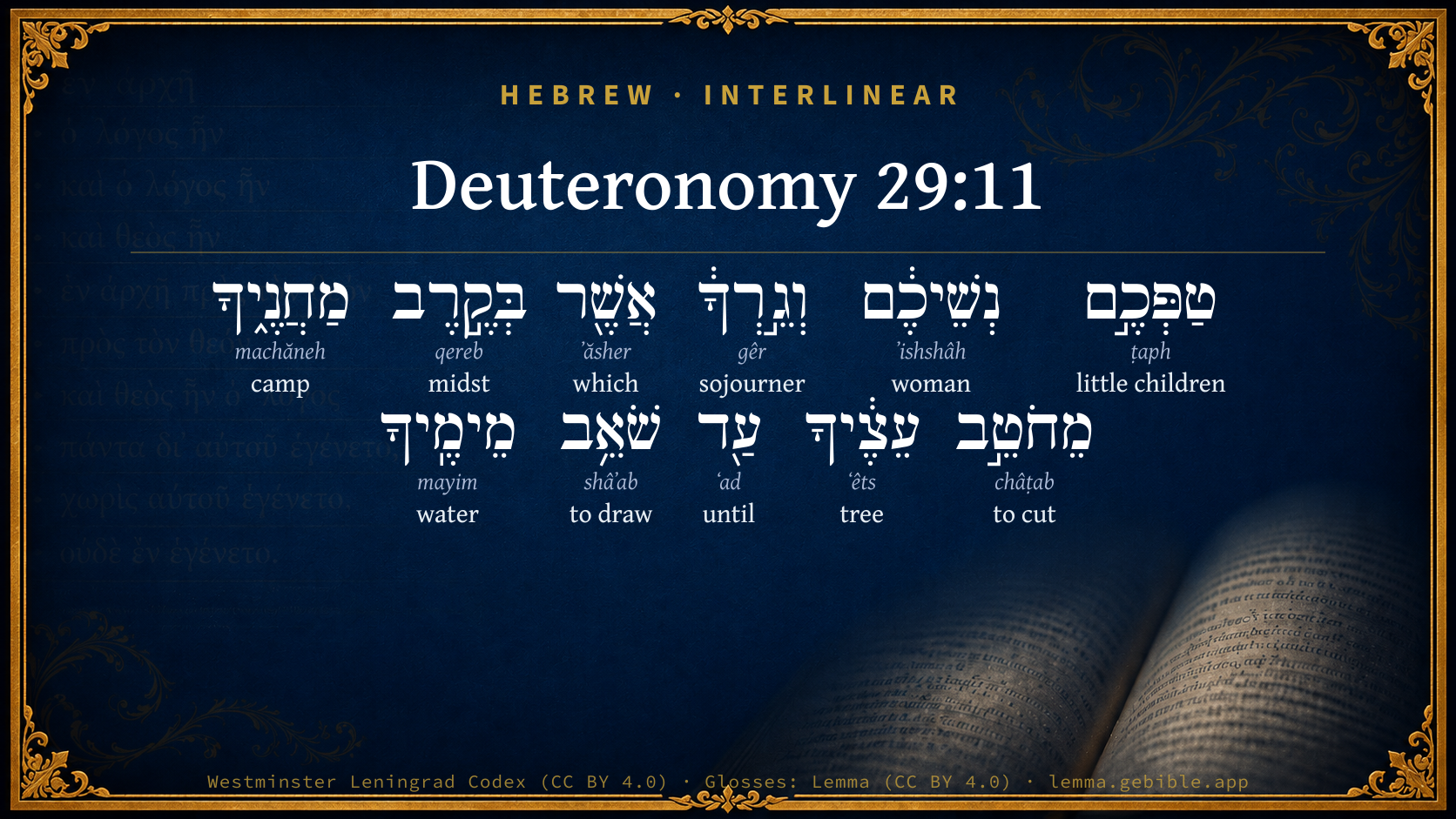
Deuteronomy 29:11

Hebrew (Westminster Leningrad Codex) Deuteronomy 29:11 appears in the Hebrew Old Testament. The text above is from the Westminster Leningrad Codex. Each word links to its Strong’s number, a concise gloss, and parsing drawn from the Open Scriptures Hebrew Bible morphology. Click any word for its full Brown-Driver-Briggs (BDB) entry.
Download image
Cite this verse

Deuteronomy 29:11 (World English Bible). Public Domain. Lemma interlinear Bible study tool, https://lemma.gebible.app/v/deuteronomy/29/11.

Show BibTeX & RIS
BibTeX
RIS
English Translation
your little ones, your wives, and your foreigner who is in the midst of your camps, from the one who cuts your wood to the one who draws your water;
World English Bible · Public Domain
Download a study sheet

One document with this verse’s original text, its word-by-word gloss line, the meaning frame, cross-references with their text, attributed commentary, and full source and license credits — printable, and it pastes into notes with its structure intact.

This verse Autodidact and up

Study sheet (.html) Plain text (.txt)

A passage Seminary Student

Up to 50 verses in one chapter. A passage sheet keeps up to 6 commentary sources and 12 cross-references per verse, in the order this page ranks them, and says so on the sheet whenever that leaves anything out. Ask for a single verse and you get the Autodidact verse sheet above.

Everything on this page stays free to read, with no account — the sheet is a download of what is already on screen, not access to it.

Want to remove ads? Support Godless Engineer
Compare translations 3

The same verse in 3 English versions, stacked beneath the original-language interlinear above. Click any original word for its lexicon entry.

Each is an independent rendering of the whole verse — the interlinear is not word-aligned to these translations.

Highlighted words mark where these versions differ — a whole-verse word diff, not a word-by-word alignment.

  • World English Bible Public Domain
    your little ones, your wives, and your foreigner who is in the midst of your camps, from the one who cuts your wood to the one who draws your water;
  • King James Version Public Domain
    Your little ones, your wives, and thy stranger that is in thy camp, from the hewer of thy wood unto the drawer of thy water:
  • unfoldingWord Literal Text CC BY-SA 4.0
    your children, your wives, and the foreigner who among you in your camp, from him who cuts your wood to him who draws your water),

unfoldingWord Literal Text — © unfoldingWord, licensed CC BY-SA 4.0. Word-aligned USFM3 via Door43 (git.door43.org/unfoldingWord/en_ult).

Versions to compare (up to 4)

3 of 4 selected

Show all 18 translations

Every available English version of this verse, each an independent rendering of the whole verse.

  • World English Bible Public Domain
    your little ones, your wives, and your foreigner who is in the midst of your camps, from the one who cuts your wood to the one who draws your water;
  • Berean Standard Bible Public Domain
    your children and wives, and the foreigners in your camps who cut your wood and draw your water—
  • Majority Standard Bible Public Domain
    your children and wives, and the foreigners in your camps who cut your wood and draw your water—
  • King James Version Public Domain
    Your little ones, your wives, and thy stranger that is in thy camp, from the hewer of thy wood unto the drawer of thy water:
  • American Standard Version (1901) Public Domain
    your little ones, your wives, and thy sojourner that is in the midst of thy camps, from the hewer of thy wood unto the drawer of thy water;
  • Revised Version (1885) Public Domain
    your little ones, your wives, and thy stranger that is in the midst of thy camps, from the hewer of thy wood unto the drawer of thy water:
  • Geneva Bible (1599) Public Domain
    Your children, your wiues, and thy stranger that is in thy campe from the hewer of thy wood, vnto the drawer of thy water,
  • Douay-Rheims (1899) Public Domain
    , 11Your children and your wives, and the stranger that abideth with thee in the camp, besides the hewers of wood, and them that bring water:
  • Young's Literal Translation Public Domain
    your infants, your wives, and thy sojourner who `is' in the midst of thy camps, from the hewer of thy wood unto the drawer of thy water --
  • Literal Standard Version CC BY-SA 4.0
    your infants, your wives, and your sojourner who [is] in the midst of your camps, from the hewer of your wood to the drawer of your water,
  • Unlocked Literal Bible CC BY-SA 4.0
    your little ones, your wives, and the foreigner who is among you in your camp, from him who cuts your wood to him who draws your water.
  • unfoldingWord Literal Text CC BY-SA 4.0
    your children, your wives, and the foreigner who among you in your camp, from him who cuts your wood to him who draws your water),
  • Darby Bible Public Domain
    your little ones, your wives, and thy stranger that is in thy camp, as well the hewer of thy wood as the drawer of thy water;
  • World Messianic Bible Public Domain
    your little ones, your wives, and the foreigners who are in the middle of your camps, from the one who cuts your wood to the one who draws your water,
  • Webster's Bible Public Domain
    Your little ones, your wives, and thy stranger that is in thy camp, from the hewer of thy wood to the drawer of thy water:
  • Free Bible Version CC BY-SA 4.0
    your children and wives, and the foreigners in your camps who cut your firewood and carry your water.
  • Bible in Basic English Public Domain
    And your little ones, your wives, and the men of other lands who are with you in your tents, down to the wood-cutter and the servant who gets water for you:
  • JPS Tanakh (1917) Public Domain
    (29-10) your little ones, your wives, and thy stranger that is in the midst of thy camp, from the hewer of thy wood unto the drawer of thy water;

Literal Standard Version (2020), Covenant Press — licensed CC BY-SA 4.0. Text via the HelloAO Bible API (eBible.org). Unlocked Literal Bible (unfoldingWord) — licensed CC BY-SA 4.0. Text via the HelloAO Bible API (eBible.org). unfoldingWord Literal Text — © unfoldingWord, licensed CC BY-SA 4.0. Word-aligned USFM3 via Door43 (git.door43.org/unfoldingWord/en_ult). Free Bible Version, Dr. Jonathan Gallagher — licensed CC BY-SA 4.0. Text via the HelloAO Bible API (eBible.org).

Word by word

More ways to search: Search by grammar → Find every occurrence → Compare this word →

Practice this passage: Drill this verse → Learn its vocabulary →

מֵחֹטֵ֣ב
châṭab
H2404
“from · cutting”
Preposition + Verb, Qal, Participle Active, Masculine, Singular, Construct
Part of Speech
Preposition + Verb
Stem
Qal
Form
Participle Active
Gender
Masculine
Number
Singular
State
Construct
Full BDB Definition

Origin: a primitive root

TWOT: 639

to cut, gather - (Qal) to cut, gather (wood) - (Pual) to cut, carve
  1. טַפְּכֶ֣ם ṭaph H2945 “little children · your” Noun, Common, Masculine, Singular, Construct + Suffix, Personal, 2nd Person, Masculine, Plural
  2. נְשֵׁיכֶ֔ם ʼishshâh H802 “women · your” Noun, Common, Feminine, Plural, Construct + Suffix, Personal, 2nd Person, Masculine, Plural
  3. וְגֵ֣רְךָ֔ gêr H1616 “and · sojourner · your” Conjunction + Noun, Common, Masculine, Singular, Construct + Suffix, Personal, 2nd Person, Masculine, Singular
  4. אֲשֶׁ֖ר ʼăsher H834 “which” Particle, Relative
  5. בְּקֶ֣רֶב qereb H7130 “in/at · midst of” Preposition + Noun, Common, Masculine, Singular, Construct
  6. מַחֲנֶ֑יךָ machăneh H4264 “camps · your” Noun, Common, Both, Plural, Construct + Suffix, Personal, 2nd Person, Masculine, Singular
  7. עֵצֶ֔יךָ ʻêts H6086 “trees · your” Noun, Common, Masculine, Plural, Construct + Suffix, Personal, 2nd Person, Masculine, Singular
  8. עַ֖ד ʻad H5704 “until” Preposition
  9. שֹׁאֵ֥ב shâʼab H7579 “drawing” Verb, Qal, Participle Active, Masculine, Singular, Construct
  10. מֵימֶֽיךָ mayim H4325 “water(s) · your” Noun, Common, Masculine, Plural, Construct + Suffix, Personal, 2nd Person, Masculine, Singular

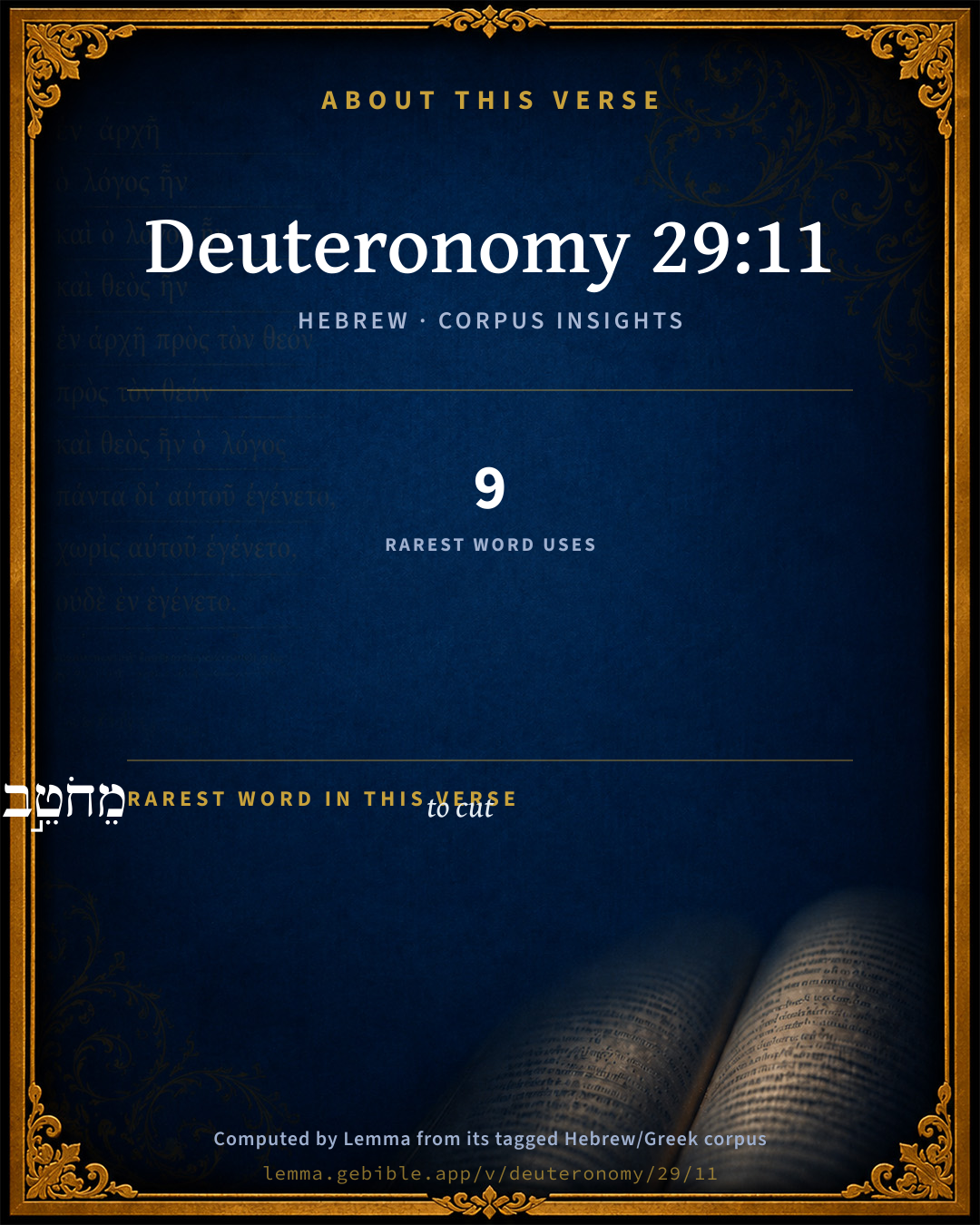
About this verse

These counts appear in no published source. They are computed here, from the morphology-tagged text and Lemma’s own curated glosses. What Lemma adds →

11
words
11
distinct lemmas
Pentateuch
section

Notable vocabulary

The rarest word here is מֵחֹטֵ֣ב to cut H2404 — appearing just 9 times in the whole Hebrew Bible.

Shared distinctive vocabulary

מֵחֹטֵ֣ב to cut H2404 occurs in 9 verses of the Hebrew Bible. Also found in:

Grammatical profile

  • 2 verbs
  • 7 nouns
  • 1 preposition
  • 1 particle

Verb forms

  • מֵחֹטֵ֣ב Qal · Participle Active
  • שֹׁאֵ֥ב Qal · Participle Active

Hebrew & Septuagint length

In English translation the verse runs 30 words from the Hebrew and 27 from the Septuagint (LXX English) — closely comparable.

A rough comparison of the two English renderings, which tokenize alike — not a word-level alignment.

Word counts can differ between the Hebrew and the Greek without any difference in meaning — e.g. the Hebrew direct-object marker אֵת has no separate Greek word, and Greek often adds the article ὁ.

Cross-references

7

Topical passages linked to Deuteronomy 29:11 in the Treasury of Scripture Knowledge — connected by theme and wording, ordered by reader-vote popularity; previews shown in the World English Bible.

  • Exodus 12:38 A mixed multitude went up also with them, with flocks, herds, and even very much cattle.
  • Exodus 12:48–49 When a stranger shall live as a foreigner with you, and will keep the Passover to Yahweh, let all his males be circumcised, and then let him come near and keep it; and he shall be as one who is born in the land: but no uncircumcised person shall eat of it.
  • Numbers 11:4 The mixed multitude that was among them lusted exceedingly: and the children of Israel also wept again, and said, Who shall give us flesh to eat?
  • Deuteronomy 5:14 but the seventh day is a Sabbath to Yahweh your God: [in it] you shall not do any work, you, nor your son, nor your daughter, nor your man-servant, nor your maid-servant, nor your ox, nor your donkey, nor any of your cattle, nor your stranger who is within your gates; that your man-servant and your maid-servant may rest as well as you.
  • Joshua 9:21–27 The princes said to them, Let them live: so they became wood cutters and drawers of water to all the congregation, as the princes had spoken to them.
  • Galatians 3:28 There is neither Jew nor Greek, there is neither slave nor free man, there is neither male nor female; for you are all one in Christ Jesus.
  • Colossians 3:11 where there can't be Greek and Jew, circumcision and uncircumcision, barbarian, Scythian, bondservant, freeman; but Christ is all, and in all.

Cross-references courtesy of OpenBible.info (CC BY 4.0).

Hebrew and Greek witnesses Masoretic Hebrew ↔ Greek Septuagint

The same verse in the two great witnesses to the Old Testament, shown verse-for-verse.

These are two independent witnesses, not word-aligned to each other, and the Septuagint is shown in lemma (dictionary) form.

Hebrew Deuteronomy 29:11 Masoretic · Westminster Leningrad Codex

טַפְּכֶ֣ם נְשֵׁיכֶ֔ם וְגֵ֣רְךָ֔ אֲשֶׁ֖ר בְּקֶ֣רֶב מַחֲנֶ֑יךָ מֵחֹטֵ֣ב עֵצֶ֔יךָ עַ֖ד שֹׁאֵ֥ב מֵימֶֽיךָ

your little ones, your wives, and your foreigner who is in the midst of your camps, from the one who cuts your wood to the one who draws your water;

World English Bible · Public Domain

Greek LXX Deuteronomy 29:11 Septuagint · lemma form

παραἔρχομαι ἐν ὁ διαθήκη κύριος ὁ θεός σύ καί ἐν ὁ ἀρά αὐτός ὅσος κύριος ὁ θεός σύ διατίθημι πρός σύ σήμερον

your wives, and your children, and the stranger who is in the midst of your camp, from your hewer of wood even to your drawer of water,

LXX2012 (modern English Septuagint) · Public Domain

On this verse, Haydock's Catholic Bible Commentary discusses the Septuagint’s reading. Read the note in Commentary ↓

Hebrew: Westminster Leningrad Codex (CC BY 4.0). Greek: Septuagint (public domain); English from LXX2012 (modern English Septuagint) (Public Domain). How the Septuagint differs from the Hebrew →

Targum (Aramaic paraphrase)

2

The Targum is the ancient Jewish Aramaic paraphrase of the Hebrew Scriptures — an interpretive translation, not the Hebrew text itself. Onkelos (literal) and Pseudo-Jonathan (expansive) render the Torah, and Jonathan the Prophets. Coverage is partial: where no permissively-licensed English translation exists for a verse, only the Aramaic is shown. This is verse-level text, not a word-by-word alignment to the Hebrew.

  1. Targum Onkelos Torah (Genesis–Deuteronomy)
    לְאָעָלוּתָךְ בִּקְיָמָא דַיְיָ אֱלָהָךְ וּבְמוֹמָתֵהּ דִי יְיָ אֱלָהָךְ גְזַר עִמָךְ יוֹמָא דֵין

    To enter into the covenant of Hashem, your God, and into his oath that Hashem, your God, decrees with you this day.

    Targum Onkelos — Aramaic: “Onkelos Genesis” (public domain); “Onkelos Exodus” (public domain); “Onkelos Leviticus” (public domain); “Onkelos Numbers” (public domain); “Onkelos Deuteronomy” (public domain). English: “Sefaria Community Translation” (CC0 1.0 (public-domain dedication)); “J.W. Etheridge. The Targums of Onkelos and Jonathan Ben Uzziel on the Pentateuch. London: Longmans, Green, 1862” (public domain). Text via Sefaria.

  2. Targum Pseudo-Jonathan Torah (Genesis–Deuteronomy)
    לְאַעֲלוּתְכוֹן בִּקְיָימָא דַיְיָ אֱלָהָכוֹן וּלְאַזְהְרוֹתְכוֹן בְּמוֹמָתֵיהּ דַיְיָ אֱלָהָכוֹן גְזַר עִמְכוֹן יוֹמָנָא

    that you may enter into the covenant of the Lord your God, and may have in remembrance the oath which the Lord your God doth ratify with you this day:

    Targum Pseudo-Jonathan — Aramaic: “Targum Jonathan on Genesis” (public domain); “Targum Jonathan on Exodus” (public domain); “Targum Jonathan on Leviticus” (public domain); “Targum Jonathan on Numbers” (public domain); “Targum Jonathan on Deuteronomy” (public domain). English: “The Targum of Jonathan ben Uzziel, trans. J. W. Etheridge, London, 1862” (public domain). Text via Sefaria.

Commentary

Notes on Deuteronomy 29:11 from classic Christian and Jewish commentators (each source and its license shown beneath its notes). The classic Christian expositions comment on the surrounding passage and are grouped to its opening verse, so a note may address several verses; the Jewish commentaries on the Tanakh (Rashi and others) are per-verse, so they appear only where the commentator wrote on this verse.

Lemma curates 59 commentaries, every one of them public domain or Creative Commons licensed, each selected and text-cleaned for this edition rather than reprinted as found. About our sources →

Trapp's Complete Commentary

John Trapp

Deu 29:11 Your little ones, your wives, and thy stranger that [is] in thy camp, from the hewer of thy wood unto the drawer of thy water:

Ver. 11. From the hewer of thy wood.] The meanest amongst you, such as afterwards were the Gibeonites, who also by faith became covenanters, and are called Nethinims in Ezra and Nehemiah. They were made drawers of water to the temple, as a kind of punishment: God made it a mercy; for the nearer they were to the Church, the nearer they came to God.

John Trapp, A Commentary or Exposition upon All the Books of the Old and New Testament (1647–1656) — public domain. Text from a community e-Sword module.

Tyndale Open Study Notes

Tyndale Open Resources

29:11 foreigners (literally sojourners): See study note on 10:18. • The saying chop your wood and carry your water was a cliché for any servile work (see Josh 9:22-27).

Tyndale Open Study Notes — © Tyndale Open Resources, licensed CC BY-SA 4.0. Text via the HelloAO Bible API.

Ellicott's Commentary for English Readers

(11) Your little ones.—Compare St. Peter’s words on the day of Pentecost: “The promise is unto you and to your children” (Act_2:39). The covenant with Abraham was that the Almighty would be a God to him and to his seed (Gen_17:7), including the child of eight days old (Deu_29:12), and the slave (Deu_29:13), who were to receive the sign of His covenant in their flesh for an everlasting covenant.

From the hewer of thy wood unto the drawer of thy water.—From this Rashi infers that “there were Canaanites who became proselytes in the time of Moses, in the same way as the Gibeonites in the days of Joshua.” It may have been so. And we know that there were many female captives of the Midianites who became slaves. (See Numbers 31)

A Bible Commentary for English Readers, edited by Charles John Ellicott (1878–1897) — public domain. Text from a community e-Sword module.

John Gill's Exposition

Your little ones, your wives,.... Who are scarce ever mentioned in any special law or solemn transaction:

and thy stranger that is in thy camp; not only the proselyte of righteousness, who embraced the Jewish religion entirely, but the proselyte of the gate, who was admitted to dwell among them, having renounced idolatry. These standing with the Israelites, when this covenant was made, has respect to the Gentiles, who as well as the Jews have an interest in the covenant of grace made with Christ; in whom there is, neither Jew nor Gentile, any difference between them:

from the hewer of thy wood to the drawer of thy water; that hewed wood for firing and other uses, and drew water for the camp; who were generally mean persons, and perhaps some that came out of Egypt with them are here intended; however, mean and abject persons are meant, and signifies that none should be excluded from a concern in this solemn affair on account of their meanness.

John Gill's Exposition of the Whole Bible (1746–1763) — public domain (CC PDM 1.0). Text via the HelloAO Bible API.

Albert Barnes' Notes on the Bible

The covenant was national, and therefore embraced all the elements which make up the nation. The “little ones” would of course be represented by their parents or guardians; the absent Deu 29:15 by those present; nor were the servants and proselytes to be excluded (compare Act 2:39). The text is fairly alleged in justification of the Church’s practice of admitting little ones into covenant with God by Baptism, and accepting promises made on their behalf by sponsors.

Albert Barnes' Notes on the Bible (1834–1885) — public domain. Text from a community e-Sword/MySword module.

Haydock's Catholic Bible Commentary

Besides, (exceptis,) which may signify all were present; or rather that the strangers of Egypt, &c., who were employed in servile offices, were alone excluded, as having no part in the covenant made with the Israelites. (Calmet) --- St. Jerome seems to have rendered min, præter, in the latter sense; but the Chaldean, Septuagint, &c., take it in the former, as if none at all were absent, from the highest to the lowest. (Menochius)

George Leo Haydock (1774–1849), Haydock's Catholic Family Bible and Commentary, 1859 edition — public domain. Excludes Psalms (Douay-Rheims chapter numbering differs from Protestant) and Deuterocanonical books (Catholic canon only).

Matthew Poole's English Annotations

Thy stranger; such strangers as had embraced their religion.

From the hewer of thy wood unto the drawer of thy water; all sorts of persons, yea, even the meanest of them, such as these were, Jos 9:27, all sorts and ranks of servants.

Matthew Poole's English Annotations on the Holy Bible (1683–1685) — public domain. Text from a community e-Sword/MySword module.

Whedon's Commentary on the Bible

Daniel D. Whedon

11. Little ones,… wives — As the covenant was with the nation in its organic unity it included all the members — the men, the women, the children, the Egyptians who left Egypt with them, (see Exo_12:38,) and the Midianites who united with Israel. See Num_10:29-31.

Thy stranger — The proselyte. Comp. Exo_12:38-48.

The hewer of thy wood — Comp. Jos_9:21.

Daniel D. Whedon (gen. ed.), Commentary on the Old and New Testaments (1874–1909) — public domain. Text from a community e-Sword module.

The Pulpit Commentary

Vers. 11-14. The covenant was a national engagement, and as such included not only the adults anti existing generation, but the little ones, the strangers resident in Israel, the lowest menial servants, that is, all the elements of which the nation was composed, as well as their posterity in coming, generations. That thou shouldest enter into covenant. The expression in the Hebrew is a strong one, indicating not a mere formal engagement, but a going thoroughly into the covenant; the phrase is used of the sword going through the land, (Lev_26:6) and of one going into the pit. (Job_33:28) Into his oath. Covenants were confirmed by (Gen_26:28; Heb_6:17) hence in Scripture the covenant of God is sometimes called his oath. (ver. 14; Heb_7:28) On ver. 13, cf. Deu_28:9 Deu_27:9; Exo_19:5, Exo_19:6)

The Pulpit Commentary (1880–1919), ed. H.D.M. Spence-Jones & Joseph S. Exell — public domain. Text from a community e-Sword module.

John Wesley's Explanatory Notes

Thy stranger - Such strangers as had embraced their religion: all sorts of persons, yea, even the meanest of them.

John Wesley, Explanatory Notes Upon the Whole Bible (1754–1765) — public domain. Text via the GEBible commentary corpus.

Rashi

Rabbi Shlomo Yitzchaki (Rashi)

לעברך means THAT THOU SHOULDEST PASS [INTO THE COVENANT]. It would not, however, be correct to explain it as meaning “to make thee pass” (when the suffix would be objective), but it must be explained like (Deuteronomy 4:14) לעשתכם אתם, “that ye may do them”.

לעברך בברית THAT THOU SHOULDEST PASS INTO THE COVENANT — The way of “passing” was as follows: those who made a covenant used to make a partition (i.e. used to place objects in a straight line) on one side and a partition on the other and passed between them, as it is said, (Jeremiah 34:18—20) “[And I will give the men which have not performed the words of the covenant which they made before Me] when they cut the calf in two, and passed between the parts thereof … [into the hands of their enemies]”.

Rashi on the Tanakh — English translations: “The Judaica Press complete Tanach with Rashi, translated by A. J. Rosenberg” (CC BY 4.0); “Pentateuch with Rashi's commentary by M. Rosenbaum and A.M. Silbermann, 1929-1934” (public domain); “The Metsudah Tanach series, Lakewood, N.J” (CC BY 4.0); and “The Book of Joshua, Metsudah Publications, 1997” (CC BY 4.0). Text via Sefaria.

Lesson kit

Teaching starters — assembled from the data on this page, not authored interpretation. Every prompt links to the verse data it draws on. Edit before teaching.

Deuteronomy, in the Pentateuch, opens this verse with 11 words (11 distinct Hebrew lemmas). Its most distinctive word is châṭab (“to cut”). A historical commentator’s framing appears above. Read the whole chapter for the surrounding context.

Discussion questions

  1. How does “to cut” (châṭab) shape what this verse is saying?
  2. Deuteronomy 19:5 shares the word «to cut» with this verse. How do the two illuminate each other?
  3. These translations render this verse differently. What is at stake in choosing one wording over another?
  4. The verb «מֵחֹטֵ֣ב» is Qal Participle Active. How does its form color the action?
  5. Reading how Trapp's Complete Commentary and Tyndale Open Study Notes read this verse, where do the two commentators agree and where do they part?

Things to notice

Reading settings

Reading text

Shown beneath each verse's original-language words.

Old Testament
Old Testament edition

Read the OT as the Masoretic Hebrew (MT) or the Greek Septuagint (LXX).

English shown for the Greek Septuagint (in the Hebrew ↔ Greek comparison).

Comparing translations? Open the Compare panel on any verse page to stack up to four side by side.