
Joshua 6:25

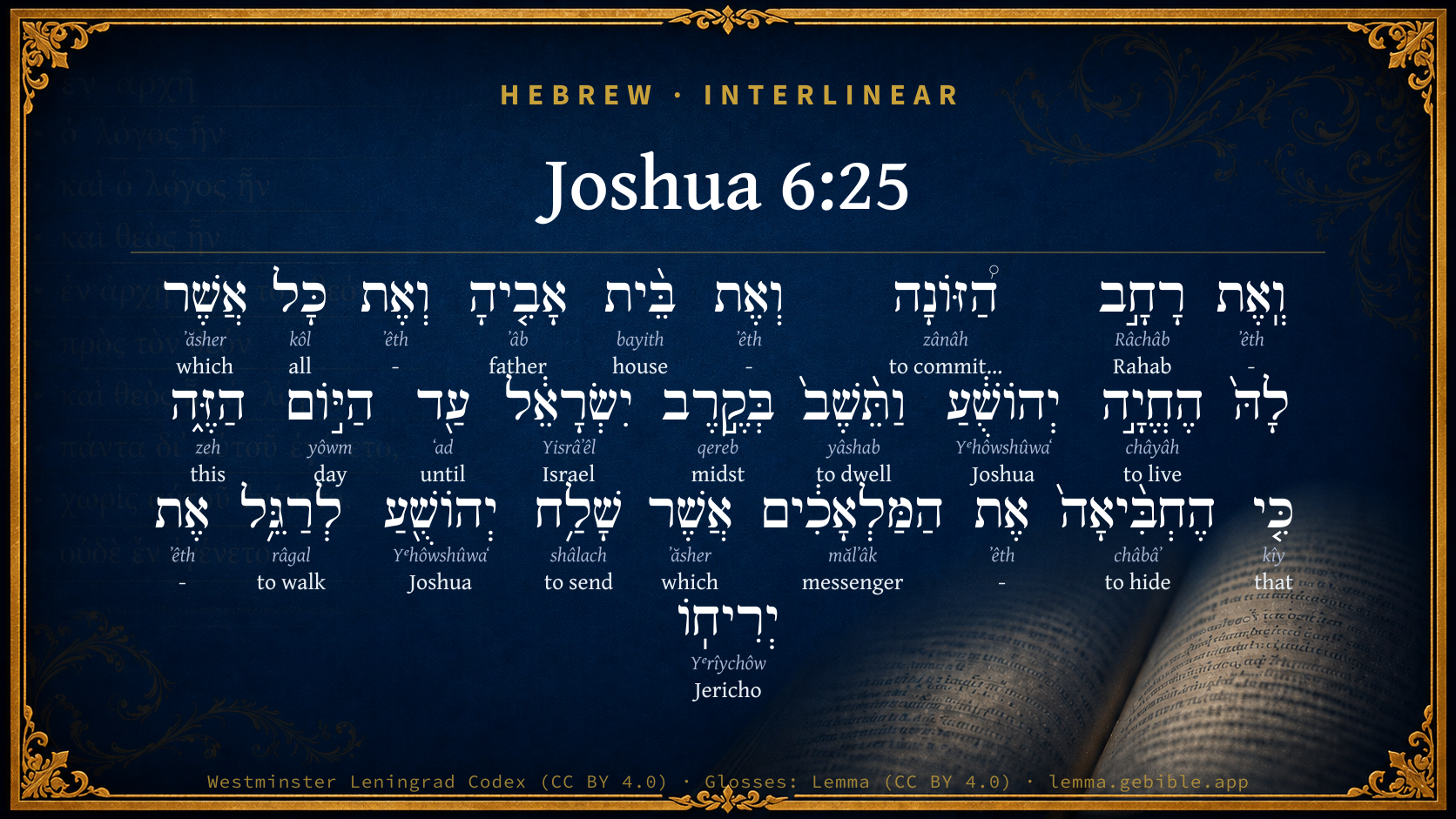
Hebrew (Westminster Leningrad Codex) Joshua 6:25 appears in the Hebrew Old Testament. The text above is from the Westminster Leningrad Codex. Each word links to its Strong’s number, a concise gloss, and parsing drawn from the Open Scriptures Hebrew Bible morphology. Click any word for its full Brown-Driver-Briggs (BDB) entry.
Download image
Cite this verse

Joshua 6:25 (World English Bible). Public Domain. Lemma interlinear Bible study tool, https://lemma.gebible.app/v/joshua/6/25.

Show BibTeX & RIS
BibTeX
RIS
English Translation
But Rahab the prostitute, and her father's household, and all that she had, did Joshua save alive; and she lived in the midst of Israel to this day, because she hid the messengers, whom Joshua sent to spy out Jericho.
World English Bible · Public Domain
Download a study sheet

One document with this verse’s original text, its word-by-word gloss line, the meaning frame, cross-references with their text, attributed commentary, and full source and license credits — printable, and it pastes into notes with its structure intact.

This verse Autodidact and up

Study sheet (.html) Plain text (.txt)

A passage Seminary Student

Up to 50 verses in one chapter. A passage sheet keeps up to 6 commentary sources and 12 cross-references per verse, in the order this page ranks them, and says so on the sheet whenever that leaves anything out. Ask for a single verse and you get the Autodidact verse sheet above.

Everything on this page stays free to read, with no account — the sheet is a download of what is already on screen, not access to it.

Want to remove ads? Support Godless Engineer
Compare translations 3

The same verse in 3 English versions, stacked beneath the original-language interlinear above. Click any original word for its lexicon entry.

Each is an independent rendering of the whole verse — the interlinear is not word-aligned to these translations.

Highlighted words mark where these versions differ — a whole-verse word diff, not a word-by-word alignment.

  • World English Bible Public Domain
    But Rahab the prostitute, and her father's household, and all that she had, did Joshua save alive; and she lived in the midst of Israel to this day, because she hid the messengers, whom Joshua sent to spy out Jericho.
  • King James Version Public Domain
    And Joshua saved Rahab the harlot alive, and her father's household, and all that she had; and she dwelleth in Israel even unto this day; because she hid the messengers, which Joshua sent to spy out Jericho.
  • unfoldingWord Literal Text CC BY-SA 4.0
    And Joshua kept alive Rahab the prostitute and the house of her father and all who to her. And she has dwelt in the midst of Israel to this day, because she hid the messengers whom Joshua had sent to spy on Jericho.

unfoldingWord Literal Text — © unfoldingWord, licensed CC BY-SA 4.0. Word-aligned USFM3 via Door43 (git.door43.org/unfoldingWord/en_ult).

Versions to compare (up to 4)

3 of 4 selected

Show all 18 translations

Every available English version of this verse, each an independent rendering of the whole verse.

  • World English Bible Public Domain
    But Rahab the prostitute, and her father's household, and all that she had, did Joshua save alive; and she lived in the midst of Israel to this day, because she hid the messengers, whom Joshua sent to spy out Jericho.
  • Berean Standard Bible Public Domain
    And Joshua spared Rahab the prostitute, with her father’s household and all who belonged to her, because she hid the men Joshua had sent to spy out Jericho. So she has lived among the Israelites to this day.
  • Majority Standard Bible Public Domain
    And Joshua spared Rahab the prostitute, with her father’s household and all who belonged to her, because she hid the men Joshua had sent to spy out Jericho. So she has lived among the Israelites to this day.
  • King James Version Public Domain
    And Joshua saved Rahab the harlot alive, and her father's household, and all that she had; and she dwelleth in Israel even unto this day; because she hid the messengers, which Joshua sent to spy out Jericho.
  • American Standard Version (1901) Public Domain
    But Rahab the harlot, and her father's household, and all that she had, did Joshua save alive; and she dwelt in the midst of Israel unto this day, because she hid the messengers, whom Joshua sent to spy out Jericho.
  • Revised Version (1885) Public Domain
    But Rahab the harlot, and her father’s household, and all that she had, did Joshua save alive; and she dwelt in the midst of Israel, unto this day; because she hid the messengers, which Joshua sent to spy out Jericho.
  • Geneva Bible (1599) Public Domain
    So Ioshua saued Rahab the harlot, and her fathers houshold, and all that shee had; and shee dwelt in Israel euen vnto this day, because shee had hid the messengers, which Ioshua sent to spie out Iericho.
  • Douay-Rheims (1899) Public Domain
    But Josue saved Rahab the harlot and her father's house, and all she had, and they dwelt in the midst of Israel until this present day: because she hid the messengers whom he had sent to spy out Jericho. At that time, Josue made an imprecation, saying:
  • Young's Literal Translation Public Domain
    and Rahab the harlot, and the house of her father, and all whom she hath, hath Joshua kept alive; and she dwelleth in the midst of Israel unto this day, for she hid the messengers whom Joshua sent to spy out Jericho.
  • Literal Standard Version CC BY-SA 4.0
    and Rahab the harlot, and the house of her father, and all whom she has, Joshua has kept alive; and she dwells in the midst of Israel to this day, for she hid the messengers whom Joshua sent to spy out Jericho.
  • Unlocked Literal Bible CC BY-SA 4.0
    But Joshua allowed Rahab the prostitute, her father's household, and all that were with her to live. She lives in Israel to this day because she hid the men whom Joshua sent to spy on Jericho.
  • unfoldingWord Literal Text CC BY-SA 4.0
    And Joshua kept alive Rahab the prostitute and the house of her father and all who to her. And she has dwelt in the midst of Israel to this day, because she hid the messengers whom Joshua had sent to spy on Jericho.
  • Darby Bible Public Domain
    And Joshua saved alive Rahab the harlot, and her father's household, and all that she had, and she dwelt in the midst of Israel to this day; because she hid the messengers whom Joshua had sent to spy out Jericho.
  • World Messianic Bible Public Domain
    But Rahab the prostitute, her father’s household, and all that she had, Joshua saved alive. She lives in the middle of Israel to this day, because she hid the messengers whom Joshua sent to spy out Jericho.
  • Webster's Bible Public Domain
    And Joshua saved Rahab the harlot alive, and her father's household, and all that she had; and she dwelleth in Israel even to this day; because she hid the messengers which Joshua sent to spy out Jericho.
  • Free Bible Version CC BY-SA 4.0
    Joshua spared Rahab the prostitute and her family because she hid the men Joshua had sent to spy out Jericho. And she lives among the Israelites to this day.
  • Bible in Basic English Public Domain
    But Joshua kept Rahab, the loose woman, and her father's family and all she had, from death, and so she got a living-place among the children of Israel to this day; because she kept safe the men whom Joshua had sent to make a search through the land.
  • JPS Tanakh (1917) Public Domain
    But Rahab the harlot, and her father's household, and all that she had, did Joshua save alive; and she dwelt in the midst of Israel, unto this day; because she hid the messengers, whom Joshua sent to spy out Jericho.

Literal Standard Version (2020), Covenant Press — licensed CC BY-SA 4.0. Text via the HelloAO Bible API (eBible.org). Unlocked Literal Bible (unfoldingWord) — licensed CC BY-SA 4.0. Text via the HelloAO Bible API (eBible.org). unfoldingWord Literal Text — © unfoldingWord, licensed CC BY-SA 4.0. Word-aligned USFM3 via Door43 (git.door43.org/unfoldingWord/en_ult). Free Bible Version, Dr. Jonathan Gallagher — licensed CC BY-SA 4.0. Text via the HelloAO Bible API (eBible.org).

Word by word

More ways to search: Search by grammar → Find every occurrence → Compare this word →

Practice this passage: Drill this verse → Learn its vocabulary →

רָחָ֣ב
Râchâb
H7343
“Rahab”
Noun, Proper
Part of Speech
Noun
Type
Proper
Full BDB Definition

Origin: the same as H7342

TWOT: None

Rahab = "wide" - a harlot of Jericho who aided the spies to escape; saved from the destruction of Jericho; married Salmon, an ancestor of David and of Christ; commended for her faith in the book of James
  1. וְֽאֶת ʼêth H853 “and · -” Conjunction + Particle, Direct Object
  2. הַ֠זּוֹנָה zânâh H2181 “the · committing fornication” Particle, Definite Article + Verb, Qal, Participle Active, Feminine, Singular, Absolute
  3. וְאֶת ʼêth H853 “and · -” Conjunction + Particle, Direct Object
  4. בֵּ֨ית bayith H1004 “house of” Noun, Common, Masculine, Singular, Construct
  5. אָבִ֤יהָ ʼâb H1 “father · her” Noun, Common, Masculine, Singular, Construct + Suffix, Personal, 3rd Person, Feminine, Singular
  6. וְאֶת ʼêth H853 “and · -” Conjunction + Particle, Direct Object
  7. כָּל kôl H3605 “all of” Noun, Common, Masculine, Singular, Construct
  8. אֲשֶׁר ʼăsher H834 “which” Particle, Relative
  9. הֶחֱיָ֣ה châyâh H2421 “to live” Verb, Hiphil, Perfect, 3rd Person, Masculine, Singular
  10. יְהוֹשֻׁ֔עַ Yᵉhôwshûwaʻ H3091 “Joshua” Noun, Proper
  11. וַתֵּ֨שֶׁב֙ yâshab H3427 “and · to dwell” Conjunction + Verb, Qal, Sequential Imperfect, 3rd Person, Feminine, Singular
  12. בְּקֶ֣רֶב qereb H7130 “in/at · midst of” Preposition + Noun, Common, Masculine, Singular, Construct
  13. יִשְׂרָאֵ֔ל Yisrâʼêl H3478 “Israel” Noun, Proper
  14. עַ֖ד ʻad H5704 “until” Preposition
  15. הַיּ֣וֹם yôwm H3117 “the · day” Particle, Definite Article + Noun, Common, Masculine, Singular, Absolute
  16. הַזֶּ֑ה zeh H2088 “the · this” Particle, Definite Article + Pronoun, Demonstrative, Masculine, Singular
  17. כִּ֤י kîy H3588 “that” Conjunction
  18. הֶחְבִּ֨יאָה֙ châbâʼ H2244 “to hide” Verb, Hiphil, Perfect, 3rd Person, Feminine, Singular
  19. אֶת ʼêth H853 “-” Particle, Direct Object
  20. הַמַּלְאָכִ֔ים mălʼâk H4397 “the · messengers” Particle, Definite Article + Noun, Common, Masculine, Plural, Absolute
  21. אֲשֶׁר ʼăsher H834 “which” Particle, Relative
  22. שָׁלַ֥ח shâlach H7971 “to send” Verb, Qal, Perfect, 3rd Person, Masculine, Singular
  23. יְהוֹשֻׁ֖עַ Yᵉhôwshûwaʻ H3091 “Joshua” Noun, Proper
  24. לְרַגֵּ֥ל râgal H7270 “to walk” Preposition + Verb, Piel, Infinitive Construct
  25. אֶת ʼêth H853 “-” Particle, Direct Object
  26. יְרִיחֽוֹ Yᵉrîychôw H3405 “Jericho” Noun, Proper

About this verse

These counts appear in no published source. They are computed here, from the morphology-tagged text and Lemma’s own curated glosses. What Lemma adds →

28
words
21
distinct lemmas
Historical
section

Notable vocabulary

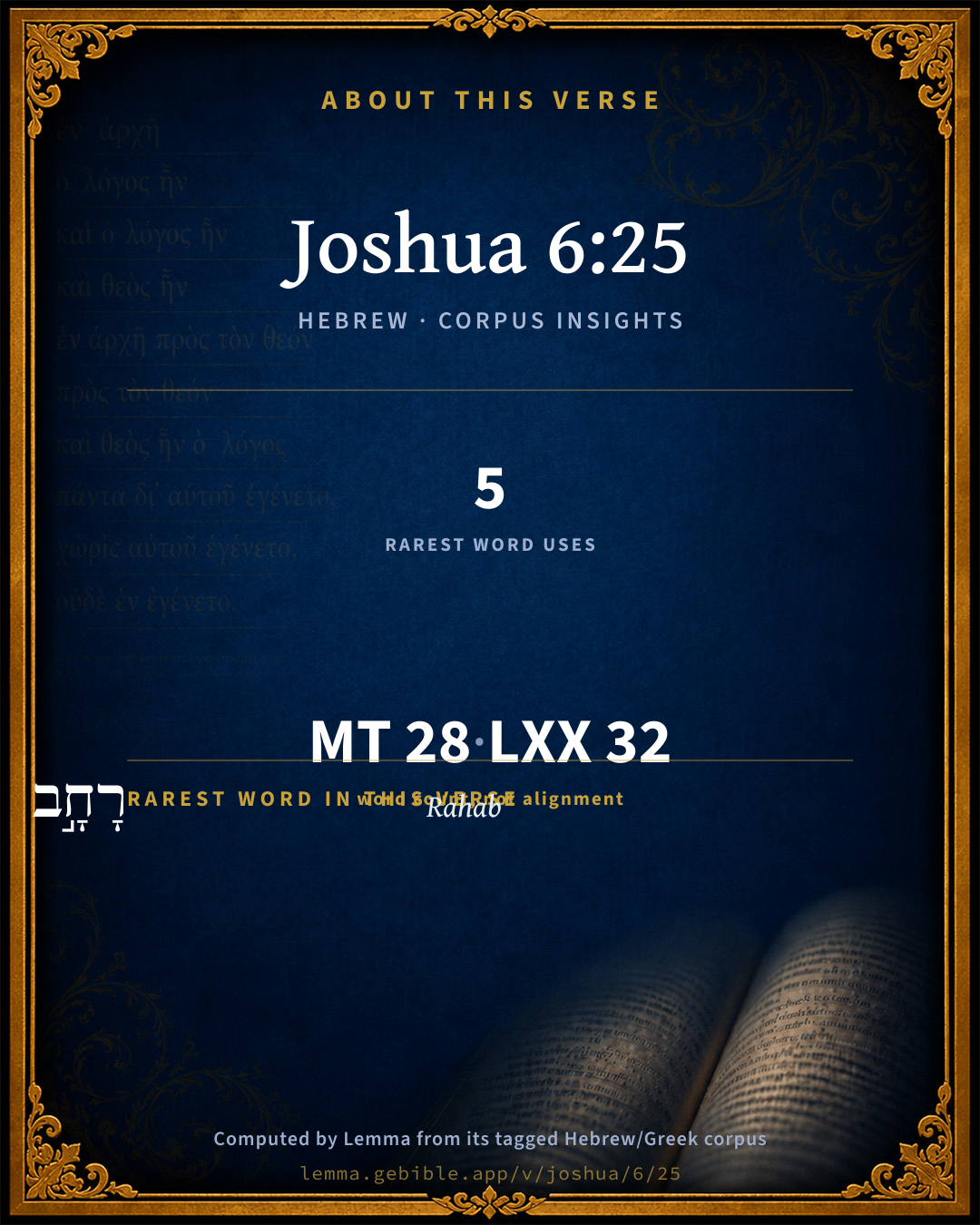
The rarest word here is רָחָ֣ב Rahab H7343 — appearing just 5 times in the whole Hebrew Bible.

Shared distinctive vocabulary

רָחָ֣ב Rahab H7343 occurs in 5 verses of the Hebrew Bible. Also found in:

Grammatical profile

  • 6 verbs
  • 11 nouns
  • 1 pronoun
  • 2 prepositions
  • 1 conjunction
  • 7 particles

Verb forms

  • הַ֠זּוֹנָה Qal · Participle Active
  • הֶחֱיָ֣ה Hiphil · Perfect
  • וַתֵּ֨שֶׁב֙ Qal · Sequential Imperfect
  • הֶחְבִּ֨יאָה֙ Hiphil · Perfect
  • שָׁלַ֥ח Qal · Perfect
  • לְרַגֵּ֥ל Piel · Infinitive Construct

Repetition

Words recur within this verse — often emphatic in Hebrew:

  • יְהוֹשֻׁ֔עַ Joshua H3091 ×2
  • אֲשֶׁר which H834 ×2

Hebrew & Septuagint length

In English translation the verse runs 40 words from the Hebrew and 36 from the Septuagint (LXX English) — closely comparable.

A rough comparison of the two English renderings, which tokenize alike — not a word-level alignment.

Word counts can differ between the Hebrew and the Greek without any difference in meaning — e.g. the Hebrew direct-object marker אֵת has no separate Greek word, and Greek often adds the article ὁ.

In the original languages it is 28 Hebrew tokens and 32 Greek tokens — but the two are counted differently (Hebrew bundles its prefixes and suffixes into one token; the Greek is in lemma form), so that isn’t a like-for-like length.

Cross-references

8

Topical passages linked to Joshua 6:25 in the Treasury of Scripture Knowledge — connected by theme and wording, ordered by reader-vote popularity; previews shown in the World English Bible.

  • Hebrews 11:31 By faith, Rahab the prostitute, didn't perish with those who were disobedient, having received the spies in peace.
  • Joshua 2:6 But she had brought them up to the roof, and hid them with the stalks of flax, which she had laid in order on the roof.
  • Judges 1:24–25 The watchers saw a man come forth out of the city, and they said to him, Show us, we pray you, the entrance into the city, and we will deal kindly with you.
  • Matthew 1:5 Salmon became the father of Boaz by Rahab. Boaz became the father of Obed by Ruth. Obed became the father of Jesse.
  • James 2:25 In like manner wasn't Rahab the prostitute also justified by works, in that she received the messengers, and sent them out another way?
  • Acts 2:21 It will be, that whoever will call on the name of the Lord will be saved.'
  • Joshua 4:9 Joshua set up twelve stones in the midst of the Jordan, in the place where the feet of the priests who bore the ark of the covenant stood: and they are there to this day.
  • Joshua 11:19–20 There was not a city that made peace with the children of Israel, save the Hivites the inhabitants of Gibeon: they took all in battle.

Cross-references courtesy of OpenBible.info (CC BY 4.0).

Hebrew and Greek witnesses Masoretic Hebrew ↔ Greek Septuagint

The same verse in the two great witnesses to the Old Testament, shown verse-for-verse.

These are two independent witnesses, not word-aligned to each other, and the Septuagint is shown in lemma (dictionary) form.

Hebrew Joshua 6:25 Masoretic · Westminster Leningrad Codex

וְֽאֶת רָחָ֣ב הַ֠זּוֹנָה וְאֶת בֵּ֨ית אָבִ֤יהָ וְאֶת כָּל אֲשֶׁר לָהּ֙ הֶחֱיָ֣ה יְהוֹשֻׁ֔עַ וַתֵּ֨שֶׁב֙ בְּקֶ֣רֶב יִשְׂרָאֵ֔ל עַ֖ד הַיּ֣וֹם הַזֶּ֑ה כִּ֤י הֶחְבִּ֨יאָה֙ אֶת הַמַּלְאָכִ֔ים אֲשֶׁר שָׁלַ֥ח יְהוֹשֻׁ֖עַ לְרַגֵּ֥ל אֶת יְרִיחֽוֹ

But Rahab the prostitute, and her father's household, and all that she had, did Joshua save alive; and she lived in the midst of Israel to this day, because she hid the messengers, whom Joshua sent to spy out Jericho.

World English Bible · Public Domain

Greek LXX Joshua 6:25 Septuagint · lemma form

καί ρααβ ὁ πόρνη καί πᾶς ὁ οἶκος ὁ πατρικός αὐτός ζωγρέω ἰησοῦς καί καταοἰκέω ἐν ὁ ἰσραήλ ἕως ὁ σήμερον ἡμέρα διότι κρύπτω ὁ κατασκοπεύω ὅς ἀποστέλλω ἰησοῦς κατασκοπεύω ὁ ιεριχω

And Joshua saved alive Raab the harlot, and all the house of her father, and caused her to dwell in Israel until this day, because she hid the spies which Joshua sent to spy out Jericho.

LXX2012 (modern English Septuagint) · Public Domain

On this verse, Ellicott's Commentary for English Readers discusses the Septuagint’s reading. Read the note in Commentary ↓

Hebrew: Westminster Leningrad Codex (CC BY 4.0). Greek: Septuagint (public domain); English from LXX2012 (modern English Septuagint) (Public Domain). How the Septuagint differs from the Hebrew →

Targum (Aramaic paraphrase)

1

The Targum is the ancient Jewish Aramaic paraphrase of the Hebrew Scriptures — an interpretive translation, not the Hebrew text itself. Onkelos (literal) and Pseudo-Jonathan (expansive) render the Torah, and Jonathan the Prophets. Coverage is partial: where no permissively-licensed English translation exists for a verse, only the Aramaic is shown. This is verse-level text, not a word-by-word alignment to the Hebrew.

  1. Targum Jonathan Prophets (Joshua–Malachi)
    וְיַת רָחָב פּוּנְדְקִיתָא וְיַת בֵּית אֲבוּהָא וְיַת כָּל דִי לָהּ קַיֵם יְהוֹשֻׁעַ וִיתִיבַת בְּגוֹ יִשְׂרָאֵל עַד יוֹמָא הָדֵין אֲרֵי אִטְמַרַת יַת אִזְגַדַיָא דִשְׁלַח יְהוֹשֻׁעַ לַאֲלָלָא יַת אַרְעָא:

    (no public-domain English translation for this verse)

    Targum Jonathan — Aramaic: “Mikraot Gedolot” (public domain). English: “Sefaria Community Translation” (CC0 1.0 (public-domain dedication)); “London "Chaldee Paraphrase," 1871” (public domain). Text via Sefaria.

Commentary

Notes on Joshua 6:25 from classic Christian and Jewish commentators (each source and its license shown beneath its notes). The classic Christian expositions comment on the surrounding passage and are grouped to its opening verse, so a note may address several verses; the Jewish commentaries on the Tanakh (Rashi and others) are per-verse, so they appear only where the commentator wrote on this verse.

Lemma curates 59 commentaries, every one of them public domain or Creative Commons licensed, each selected and text-cleaned for this edition rather than reprinted as found. About our sources →

Trapp's Complete Commentary

John Trapp

Jos 6:25 And Joshua saved Rahab the harlot alive, and her father’s household, and all that she had; and she dwelleth in Israel [even] unto this day; because she hid the messengers, which Joshua sent to spy out Jericho.

Ver. 25. Even unto this day.] When this story was written, she was a great lady in Israel, being married to Salmon.

John Trapp, A Commentary or Exposition upon All the Books of the Old and New Testament (1647–1656) — public domain. Text from a community e-Sword module.

MacLaren's Expositions of Holy Scripture

Alexander MacLaren

Joshua

RAHAB

Jos 6:25.

This story comes in like an oasis in these terrible narratives of Canaanite extermination. There is much about it that is beautiful and striking, but the main thing is that it teaches the universality of God’s mercy, and the great truth that trust in Him unites to Him and brings deliverance, how black soever may have been the previous life.

I need not tell over again the story, told with such inimitable picturesqueness here: how the two spies, swimming the Jordan in flood, set out on their dangerous mission and found themselves in the house of Rahab, a harlot; how the king sent to capture them, how she hid them among the flax-stalks bleaching on the flat roof, confessed faith in Israel’s God and lied steadfastly to save them, how they escaped to the Quarantania hills, how she ‘perished not’ in the capture, entered into the community of Israel, was married, and took her place-hers!-in the line of David’s and Christ’s ancestresses.

The point of interest is her being, notwithstanding her previous position and history, one of the few instances in which heathen were brought into Israel. The Epistle to the Hebrews and James both refer to her. We now consider her story as embodying for us some important truths about faith in its nature, its origin, its power.

I. Faith in its constant essence and its varying objects.

Her creed was very short and simple. She abjured idols, and believed that Jehovah was the one God. She knew nothing of even the Mosaic revelation, nothing of its moral law or of its sacrifices. And yet the Epistle to the Hebrews has no scruple in ascribing faith to her. The object of that Epistle is to show that Christianity is Judaism perfected. It labours to establish that objectively there has been advance, not contradiction, and that subjectively there is absolute identity. It has always been faith that has bound men to God. That faith may co-exist with very different degrees of illumination. Not the creed, but the trust, is the all-important matter. This applies to all pre-Christian times and to all heathen lands. Our faith has a fuller gospel to lay hold of. Do not neglect it.

Beware lest people with less light and more love get in before you, ‘who shall come from the east and the west.’

II. Faith in its origin in fear.

There are many roads to faith, and it matters little which we take, so long as we get to the goal. This is one, and some people seem to think that it is a very low and unworthy one, and one which we should never urge upon men. But there are a side of the divine nature and a mode of the divine government which properly evoke fear.

God’s moral government, His justice and retribution, are facts.

Fear is an inevitable and natural consequence of feeling that His justice is antagonistic to us. The work of conscience is precisely to create such fear. Not to feel it is to fall below manhood or to be hardened by sin.

That fear is meant to lead us to God and love. Rahab fled to God. Peter ‘girt his fisher’s coat to him,’ and lost his fear in the sunshine of Christ’s face, as a rainbow trembles out of a thunder-cloud when touched by sunbeams.

We have all grounds enough to fear.

Urge these as a reason for trust.

III. Faith in its relation to the previous life.

It is a strange instance of blindness that attempts have been made to soften down the Bible’s plain speaking about Rahab’s character.

In her story we have an anticipation of New Testament teaching.

The ‘woman that was a sinner.’

Mary Magdalene.

‘Then drew near all the publicans and sinners for to hear Him.’

She shows us that there is no hopeless guilt. None is so in regard to the effects of sin on a soul. There is no heart so indurated as that its capacity for being stirred by the divine message is killed.

There is none hopeless in regard to God.

His love embraces all, however bad. The bond which unites to Him is not blamelessness of life but simple trust.

The grossest vice is not so thorough a barrier as self-satisfied self-righteousness.

A thin slice of crystal will bar the entrance of air more effectually than many folds of stuff.

IV. Faith in its practical effects.

Rahab’s story shows how living faith, like a living stream, will cut a channel for itself, and must needs flow out into the life.

Hence James is right in using her as an example of how ‘we are justified by works and not by faith only,’ and the author of the Epistle to the Hebrews is equally right in enrolling her in his great muster-roll of heroes and heroines of faith, and asserting that ‘by faith’ she ‘perished not among them who believed not.’ The one writer fastens on a later stage in her experience than does the other. James points to the rich fruit, the Epistle to the Hebrews goes deeper and lays bare the root from which the life rose to the clusters.

The faith that saves is not a barren intellectual process, nor an idle trust in Christ’s salvation, but a practical power. If genuine it will mould and impel the life.

So Rahab’s faith led her, as ours, if real, will lead us, to break with old habits and associations contrary to itself. She ceased to be ‘Rahab the harlot,’ she forsook ‘her own people and her father’s house.’ But her conquest of her old self was gradual. A lie was a strange kind of first-fruits of faith. Its true fruit takes time to flower and swell and come to ripeness and sweetness.

So we should not expect old heads on young shoulders, nor wonder if people, lifted from the dunghills of the world, have some stench and rags of their old vices hanging about them still. That thought should moderate our expectations of the characters of converts from heathenism, or from the degraded classes at home. And it should be present to ourselves, when we find in ourselves sad recurrences of faults and sins that we know should have been cast out, and that we hoped had been so.

This thought enhances our wondering gratitude for the divine long-suffering which bears with our slow progress. Our great Teacher never loses patience with His dull scholars.

V. Faith as the means of deliverance and safety.

From external evils it delivers us or not, as God may will. James was no less dear, and no less faithful, than John, though he was early ‘slain with the sword,’ and his brother died in extreme old age in Ephesus. Paul looked forward to being ‘delivered from every evil work,’ though he knew that the time of his being ‘offered’ was at hand, because the deliverance that he looked for was his being ‘saved into His heavenly kingdom.’

That true deliverance is infallibly ours, if by faith we have made the Deliverer ours.

There is a more terrible fall of a worse city than Jericho, in that day when ‘the city of the terrible ones shall be laid low,’ and our Joshua brings it ‘to the ground, even to the dust.’ ‘In that same day shall this song be sung in the land of Judah: we have a strong city, salvation will God appoint for walls and bulwarks,’ and into that eternal home He will certainly lead all who are joined to Him, and separated from their foul old selves, and from ‘the city of destruction,’ by faith in Him.

Alexander MacLaren, Expositions of Holy Scripture (1904–1910) — public domain. Text from a community e-Sword module.

Tyndale Open Study Notes

Tyndale Open Resources

6:25 The statement that Rahab lives among the Israelites to this day affirms the breadth and depth of God’s grace. Rahab was not only accepted into Israel; she ultimately was an ancestor of the Messiah (see Matt 1:5).

Tyndale Open Study Notes — © Tyndale Open Resources, licensed CC BY-SA 4.0. Text via the HelloAO Bible API.

Geneva Bible (1599)

Geneva Bible translators

For she was married to Salmon prince of the tribe of Judah, Matt. 1:5.

Geneva Bible (1599) marginal notes — public domain. Text via Bolls.life.

Jamieson, Fausset & Brown

Robert Jamieson, A. R. Fausset & David Brown

she--Rahab

dwelleth in Israel unto this day--a proof that this book was written not long after the events related.

Jamieson, Fausset & Brown — Commentary Critical and Explanatory on the Whole Bible (1871) — public domain (CC PDM 1.0). Text via the HelloAO Bible API.

Adam Clarke's Commentary

Verse 25. And she dwelleth in Israel even unto this day] This is one proof that the book was written in the time to which it is commonly referred; and certainly might have been done by the hand of Joshua himself, though doubtless many marginal notes may have since crept into the text, which, to superficial observers, give it the appearance of having been written after the days of Joshua. See the preface to this book.

Adam Clarke's Commentary on the Bible (1810–1826) — public domain. Text from a community e-Sword/MySword module.

Ellicott's Commentary for English Readers

(25) And Joshua saved Rahab the harlot alive.—“By faith the harlot Rahab perished not with them that believed not” (Heb_11:31). And so Jesus said to her who had ministered to Him in the house of Simon the Pharisee, “Thy sins are forgiven;” and again, “Thy faith hath saved thee: go in peace” Luk_7:48; Luk_7:50). “Likewise also was not Rahab the harlot justified by works?” (Jas_2:25).

And she dwelleth in Israel even unto this day.—“Salmon begat Booz of Rachab” seems certainly to refer to her (Mat_1:5), though why she is called Rachab in that place is not obvious. Rachab is not the usual form of the word, either in the LXX. or in the other passages of the Greek text where she is named. It is not simply a variation in the English spelling, but a difference in the original Greek.

A Bible Commentary for English Readers, edited by Charles John Ellicott (1878–1897) — public domain. Text from a community e-Sword module.

The Cambridge Bible for Schools and Colleges

gen. ed. J. J. S. Perowne

25. she dwelleth in Israel] These words do not necessarily imply that she was alive at the time the Book of Joshua was written, but that the family of strangers, of which she was reckoned the head, continued to dwell among the children of Israel. She married Salmon, of the tribe of Judah, and became the ancestress of Boaz, the husband of Ruth. See Mat_1:5. Her reception into the Jewish Church, and her mention in the genealogy of Christ, were a pledge and earnest of the reception of the Gentile world, and of the grafting of the wild olive into the good olive-tree (Rom_11:24).

The Cambridge Bible for Schools and Colleges (gen. ed. J. J. S. Perowne; Cambridge University Press, 1878–1918) — public domain. Text from a community e-Sword module.

John Gill's Exposition

And Joshua saved Rahab the harlot alive,.... From perishing by the sword, as the rest of the inhabitants did. Kimchi says, some interpret it of his giving her food, and an inheritance by which she might live; and Josephus (f) intimates the same: he says, he gave her fields, and had her in great honour and esteem; and it is the notion of some Jewish writers, that he took her to wife, and that this is meant by saving her alive; which sense Kimchi disapproves of, as being foreign; besides, it was not Joshua, but Salmon, a prince in Israel, that married her, Mat 1:5,

and her father's household, and all she had; that is, he saved alive all her relations, and it may be her cattle, if she had any; and those of her kindred also, as their sheep, oxen, and asses, when those of others were killed, Jos 6:21. Some also understand this of intermarriages of principal persons in Israel with some of her father's fairly; but it only signifies that their lives were spared, when the whole city was destroyed with the edge of the sword:

and she dwelleth in Israel even unto this day; which may be meant either personally of Rahab, who was living and dwelt in the land of Canaan, when this history was written; and serves to strengthen the opinion that Joshua was the writer of it, and to explain the meaning of the phrase "unto this day", elsewhere used in this book; and to remove any objection from it against his being the author of it; or else of her dwelling there in her posterity, and so she might dwell in it unto the times of the Messiah, who sprang from her, Mat 1:5,

because she hid the messengers which Joshua, sent to spy out Jericho; this was the reason of her and her father's family being saved alive; See Gill on Jos 6:17.

(f) Antiqu. l. 5. c. 1. sect. 7.

John Gill's Exposition of the Whole Bible (1746–1763) — public domain (CC PDM 1.0). Text via the HelloAO Bible API.

Albert Barnes' Notes on the Bible

Even unto this day - These words are rightly noted as implying that the narrative was written not long after the occurrences which it records.

Albert Barnes' Notes on the Bible (1834–1885) — public domain. Text from a community e-Sword/MySword module.

Haydock's Catholic Bible Commentary

Day. Rahab prefigured the wild olive tree, which St. Paul says was engrafted on the good olive tree, (Romans xi. 24,) and which will remain till the end of the world. (Theodoret, q. 8.) She married Salmon, of the tribe of Juda, and became the ancestor of David and of the Messias. (Calmet)

George Leo Haydock (1774–1849), Haydock's Catholic Family Bible and Commentary, 1859 edition — public domain. Excludes Psalms (Douay-Rheims chapter numbering differs from Protestant) and Deuterocanonical books (Catholic canon only).

Matthew Poole's English Annotations

For that general command of rooting out the Canaanites seems to have had some exception, in case any of them had sincerely and seasonably cast off their idolatry and wickedness, and submitted themselves to the Israelites, as we shall see hereafter.

Matthew Poole's English Annotations on the Holy Bible (1683–1685) — public domain. Text from a community e-Sword/MySword module.

Whedon's Commentary on the Bible

Daniel D. Whedon

25. She dwelleth in Israel even unto this day — This account must have been written during the lifetime of Rahab, when many were living who could have disputed the miracles if they had not occurred. Those who assert that this book was written several centuries later are driven to such an arbitrary interpretation as that her descendants continued to dwell in Israel unto this day.

[Rahab was the first Canaanite convert to the Hebrew faith, and is, accordingly, highly honoured in Hebrew history and Jewish tradition. She was married to Salmon, whom a romantic imagination has very plausibly identified with one of the two spies whose lives she saved at Jericho. She became an honoured mother in Israel, from whom sprang David and his Messianic son. Mat_1:5. The prominence given by Matthew to the adoption of Gentile women, like Rahab and Ruth, into the Messiah’s genealogy, is a prophetic indication of the Gospel catholicity, in which Jew and Gentile, bond and free, are seen to be one in Christ.]

Daniel D. Whedon (gen. ed.), Commentary on the Old and New Testaments (1874–1909) — public domain. Text from a community e-Sword module.

The Pulpit Commentary

Unto this day. This may either be interpreted of herself, or, according to s common Hebrew idiom, of her family. (cf. Jos_17:14-18 Jos_24:17) For a fuller discussion of the bearing of this passage on the date of the Book of Joshua, see Introduction. There is no mention of Rahab"s marriage in the Old Testament. Lightfoot ("Hebrew and Talmudicai Exercitations?" Mat_1:5) mentions a tradition that she married Joshua! Dr. W. H. Mill, in his treatise on the genealogies of our Lord, defends the tradition St. Matthew has followed by showing that Salmon"s age at the time gives immense probability to the statement. Some (see the Bishop of Bath and Wells" article in Smith"s "Dictionary of the Bible") suppose that Salmon was one of the spies.

The Pulpit Commentary (1880–1919), ed. H.D.M. Spence-Jones & Joseph S. Exell — public domain. Text from a community e-Sword module.

John Wesley's Explanatory Notes

The harlot olive - For that general command of rooting out the Canaanites seems to have had some exception, in case any of them had sincerely and seasonably cast off their wickedness, and submitted to the Israelites.

John Wesley, Explanatory Notes Upon the Whole Bible (1754–1765) — public domain. Text via the GEBible commentary corpus.

unfoldingWord translationNotes

Door43 World Missions Community

She lives in Israel

The word "She" refers to Rahab and represents her descendants. AT: "Her descendants live in Israel" (See: Metonymy)

to this day

"now" or "even today." Rahab's descendants are still living in Israel as the original writer writes this story.

translationWords

Joshua

Rahab

prostitute

ancestor

household

Israel

Jericho

unfoldingWord translationNotes — © Distant Shores Media and the Door43 World Missions Community, licensed CC BY-SA 4.0. Source: git.door43.org/Door43/en_tn.

Radak

Rabbi David Kimhi (Radak)

Joshua left alive (hecheyah): As he commanded to keep the oath that the messengers swore to her, as he said (Josh. 6:17), "Only Rachav the harlot, etc." But one can also explain hecheyah [to mean] that he gave them nourishment (micheyah), money or an inheritance from which they could live. And this is [the meaning of] what it states, "and she dwelt among the Israelites." And this is the correct explanation. And there is a homily (drash) that Yehoshua took Rachav as a wife. And this is [the meaning of] hecheyah, as once they saw that Yehoshua took Rachav as a wife, some of the Jewish notables clung to the house of her father (and gave them assistance). And even though it is written about the seven peoples [of Canaan] (Deut. 7:4), "you shall not intermarry with them," they said that Rachav and the house of her father were foreigners and were not from the seven nations. And there is someone who says that went the spies that Yehoshua had sent entered Jericho, she converted - and the Israelites had not yet entered the Land [of Israel]. And all of this [last suggestion] is according to the [position] that holds that when it is written, "you shall not intermarry with them," it is [only] written about when they are in their state of being of the nations (as opposed to having converted).

Radak on the Tanakh — English translations: “Sefaria Community Translation” (CC0 1.0 (public-domain dedication)); “Eliyahu Munk, HaChut Hameshulash” (CC BY 4.0); “Rabbi Mike Feuer, Jerusalem Anthology” (CC BY 4.0); and “R. David Kimhi on the first book of Psalms, Translated by R.G. Finch, London, 1919” (public domain). Text via Sefaria.

Lesson kit

Teaching starters — assembled from the data on this page, not authored interpretation. Every prompt links to the verse data it draws on. Edit before teaching.

Joshua, in the Historical, opens this verse with 28 words (21 distinct Hebrew lemmas). Its most distinctive word is Râchâb (“Rahab”). A historical commentator’s framing appears above. Read the whole chapter for the surrounding context.

Discussion questions

  1. What does “Rahab” (Râchâb) contribute to the verse as a whole?
  2. How does Joshua 2:1, which shares the word «Rahab», read alongside this verse?
  3. What does the repetition of “Joshua” (2× in this one verse) do in this verse?
  4. These translations render this verse differently; the difference is in the English rendering, not the original. What questions does that raise?
  5. «הַ֠זּוֹנָה» is a Qal Participle Active verb. How does that grammatical form shape the action described?
  6. Compare how Trapp's Complete Commentary and MacLaren's Expositions of Holy Scripture read this verse. Where do they agree or differ?

Things to notice

Reading settings

Reading text

Shown beneath each verse's original-language words.

Old Testament
Old Testament edition

Read the OT as the Masoretic Hebrew (MT) or the Greek Septuagint (LXX).

English shown for the Greek Septuagint (in the Hebrew ↔ Greek comparison).

Comparing translations? Open the Compare panel on any verse page to stack up to four side by side.