Deuteronomy 17:7

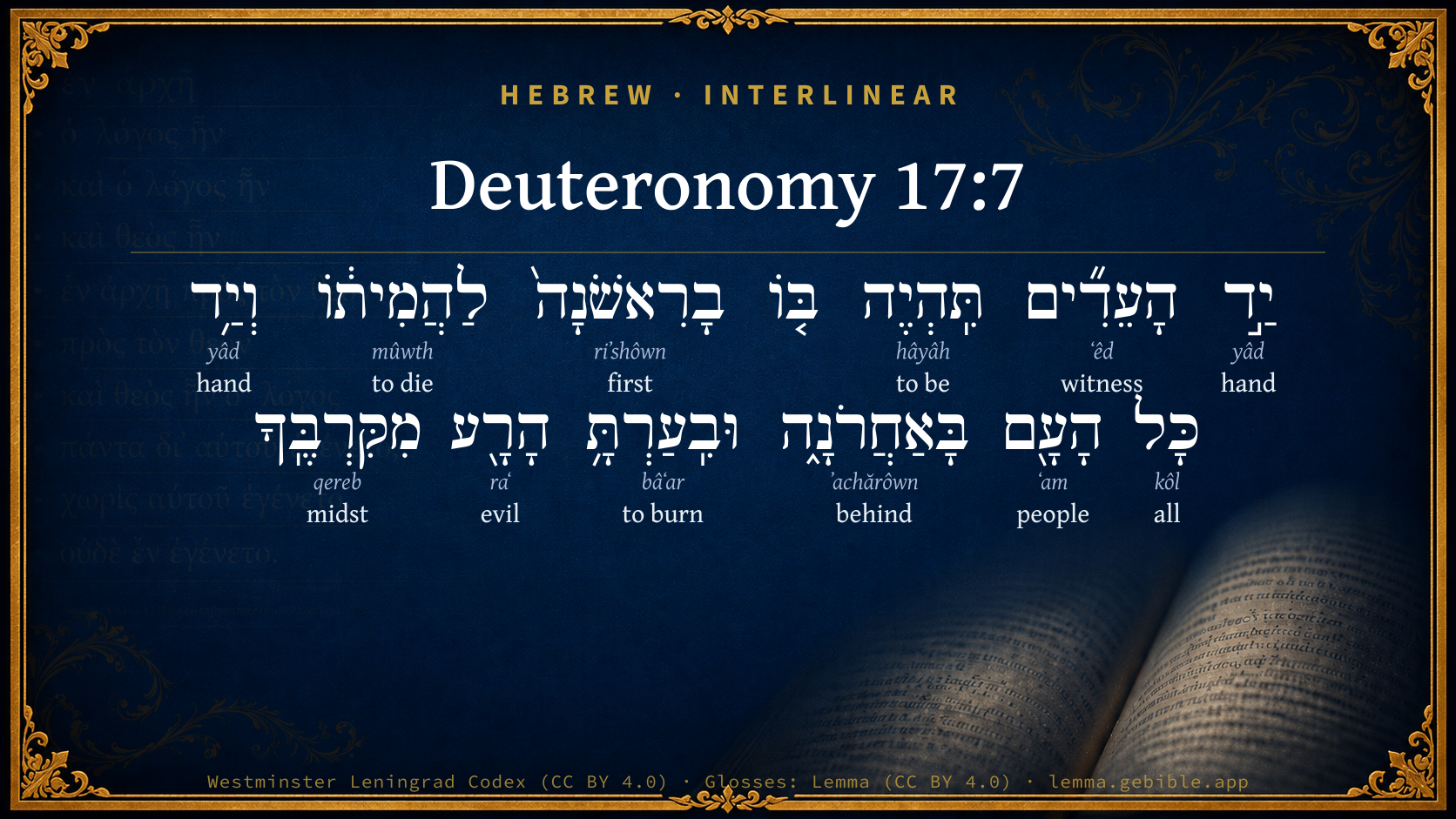
Hebrew (Westminster Leningrad Codex) Deuteronomy 17:7 appears in the Hebrew Old Testament. The text above is from the Westminster Leningrad Codex. Each word links to its Strong’s number, a concise gloss, and parsing drawn from the Open Scriptures Hebrew Bible morphology. Click any word for its full Brown-Driver-Briggs (BDB) entry.
Download image
Cite this verse

Deuteronomy 17:7 (World English Bible). Public Domain. Lemma interlinear Bible study tool, https://lemma.gebible.app/v/deuteronomy/17/7.

Show BibTeX & RIS
BibTeX
RIS
English Translation
The hand of the witnesses shall be first on him to put him to death, and afterward the hand of all the people. So you shall put away the evil from the midst of you.
World English Bible · Public Domain
Download a study sheet

One document with this verse’s original text, its word-by-word gloss line, the meaning frame, cross-references with their text, attributed commentary, and full source and license credits — printable, and it pastes into notes with its structure intact.

This verse Autodidact and up

Study sheet (.html) Plain text (.txt)

A passage Seminary Student

Up to 50 verses in one chapter. A passage sheet keeps up to 6 commentary sources and 12 cross-references per verse, in the order this page ranks them, and says so on the sheet whenever that leaves anything out. Ask for a single verse and you get the Autodidact verse sheet above.

Everything on this page stays free to read, with no account — the sheet is a download of what is already on screen, not access to it.

Want to remove ads? Support Godless Engineer
Compare translations 3

The same verse in 3 English versions, stacked beneath the original-language interlinear above. Click any original word for its lexicon entry.

Each is an independent rendering of the whole verse — the interlinear is not word-aligned to these translations.

Highlighted words mark where these versions differ — a whole-verse word diff, not a word-by-word alignment.

  • World English Bible Public Domain
    The hand of the witnesses shall be first on him to put him to death, and afterward the hand of all the people. So you shall put away the evil from the midst of you.
  • King James Version Public Domain
    The hands of the witnesses shall be first upon him to put him to death, and afterward the hands of all the people. So thou shalt put the evil away from among you.
  • unfoldingWord Literal Text CC BY-SA 4.0
    The hand of the witnesses shall be the first on him to put him to death, and afterward the hand of all the people, and you shall remove the evil from among you.

unfoldingWord Literal Text — © unfoldingWord, licensed CC BY-SA 4.0. Word-aligned USFM3 via Door43 (git.door43.org/unfoldingWord/en_ult).

Versions to compare (up to 4)

3 of 4 selected

Show all 18 translations

Every available English version of this verse, each an independent rendering of the whole verse.

  • World English Bible Public Domain
    The hand of the witnesses shall be first on him to put him to death, and afterward the hand of all the people. So you shall put away the evil from the midst of you.
  • Berean Standard Bible Public Domain
    The hands of the witnesses shall be the first in putting him to death, and after that, the hands of all the people. So you must purge the evil from among you.
  • Majority Standard Bible Public Domain
    The hands of the witnesses shall be the first in putting him to death, and after that, the hands of all the people. So you must purge the evil from among you.
  • King James Version Public Domain
    The hands of the witnesses shall be first upon him to put him to death, and afterward the hands of all the people. So thou shalt put the evil away from among you.
  • American Standard Version (1901) Public Domain
    The hand of the witnesses shall be first upon him to put him to death, and afterward the hand of all the people. So thou shalt put away the evil from the midst of thee.
  • Revised Version (1885) Public Domain
    The hand of the witnesses shall be first upon him to put him to death, and afterward the hand of all the people. So thou shalt put away the evil from the midst of thee.
  • Geneva Bible (1599) Public Domain
    The handes of the witnesses shall be first vpon him, to kill him: and afterward the hands of all the people: so thou shalt take the wicked away from among you.
  • Douay-Rheims (1899) Public Domain
    The hands of the witnesses shall be first upon him to kill him, and afterwards the hands of the rest of the people: that thou mayst take away the evil out of the midst of thee.
  • Young's Literal Translation Public Domain
    the hand of the witnesses is on him, in the first place, to put him to death, and the hand of all the people last; and thou hast put away the evil thing out of thy midst.
  • Literal Standard Version CC BY-SA 4.0
    the hand of the witnesses is on him in the first place to put him to death, and the hand of all the people last; and you have put away evil out of your midst.
  • Unlocked Literal Bible CC BY-SA 4.0
    The hand of the witnesses must be the first to put him to death, and afterward the hand of all the people; and you will remove the evil from among you.
  • unfoldingWord Literal Text CC BY-SA 4.0
    The hand of the witnesses shall be the first on him to put him to death, and afterward the hand of all the people, and you shall remove the evil from among you.
  • Darby Bible Public Domain
    The hands of the witnesses shall be first upon him to put him to death, and afterwards the hands of all the people; and thou shalt put evil away from thy midst.
  • World Messianic Bible Public Domain
    The hands of the witnesses shall be first on him to put him to death, and afterward the hands of all the people. So you shall remove the evil from among you.
  • Webster's Bible Public Domain
    The hands of the witnesses shall be first upon him to put him to death, and afterward the hands of all the people. So thou shalt remove the evil from among you.
  • Free Bible Version CC BY-SA 4.0
    The witnesses must act first in executing the person, and then the rest of those who are present. You must eliminate the evil from among you.
  • Bible in Basic English Public Domain
    The hands of the witnesses will be the first to put him to death, and after them the hands of all the people. So you are to put away the evil from among you.
  • JPS Tanakh (1917) Public Domain
    The hand of the witnesses shall be first upon him to put him to death, and afterward the hand of all the people. So thou shalt put away the evil from the midst of thee.

Literal Standard Version (2020), Covenant Press — licensed CC BY-SA 4.0. Text via the HelloAO Bible API (eBible.org). Unlocked Literal Bible (unfoldingWord) — licensed CC BY-SA 4.0. Text via the HelloAO Bible API (eBible.org). unfoldingWord Literal Text — © unfoldingWord, licensed CC BY-SA 4.0. Word-aligned USFM3 via Door43 (git.door43.org/unfoldingWord/en_ult). Free Bible Version, Dr. Jonathan Gallagher — licensed CC BY-SA 4.0. Text via the HelloAO Bible API (eBible.org).

Word by word

More ways to search: Search by grammar → Find every occurrence → Compare this word →

Practice this passage: Drill this verse → Learn its vocabulary →

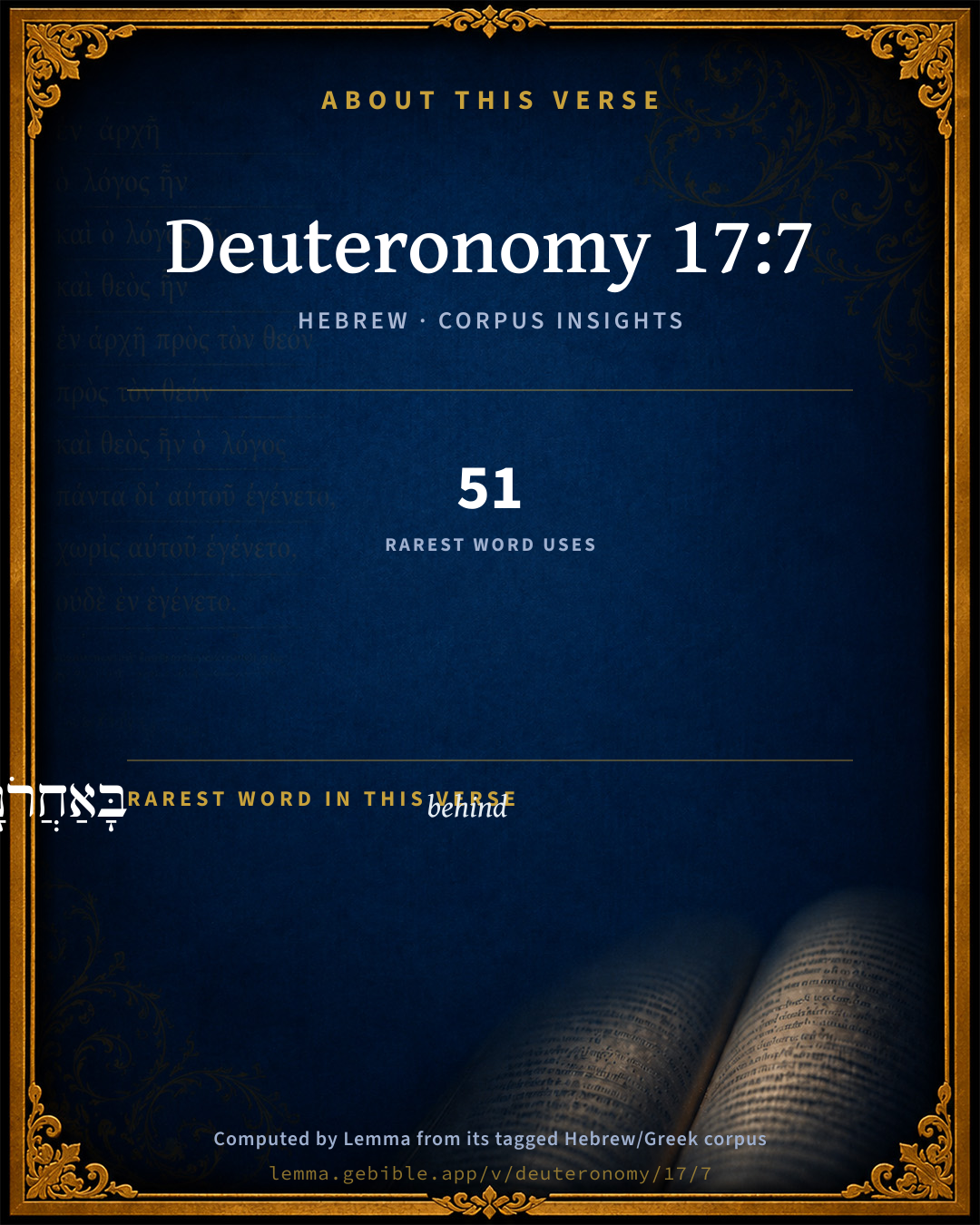
בָּאַחֲרֹנָ֑ה
ʼachărôwn
H314
“in/at the · behind”
Preposition, Determined + Adjective, Adjective, Feminine, Singular, Absolute
Part of Speech
Preposition + Adjective
Type
Adjective
Gender
Feminine
Number
Singular
State
Absolute
Full BDB Definition

Origin: from H309

TWOT: 68e

behind, following, subsequent, western - behind, hindermost, western (of location) - later, subsequent, latter, last (of time)
  1. יַ֣ד yâd H3027 “hand of” Noun, Common, Both, Singular, Construct
  2. הָעֵדִ֞ים ʻêd H5707 “the · witnesses” Particle, Definite Article + Noun, Common, Masculine, Plural, Absolute
  3. תִּֽהְיֶה hâyâh H1961 “to be” Verb, Qal, Imperfect, 3rd Person, Feminine, Singular
  4. בָרִאשֹׁנָה֙ riʼshôwn H7223 “in/at the · first” Preposition, Determined + Adjective, Adjective, Feminine, Singular, Absolute
  5. לַהֲמִית֔וֹ mûwth H4191 “to die · him” Preposition + Verb, Hiphil, Infinitive Construct + Suffix, Personal, 3rd Person, Masculine, Singular
  6. וְיַ֥ד yâd H3027 “and · hand of” Conjunction + Noun, Common, Both, Singular, Construct
  7. כָּל kôl H3605 “all of” Noun, Common, Masculine, Singular, Construct
  8. הָעָ֖ם ʻam H5971 “the · people” Particle, Definite Article + Noun, Common, Masculine, Singular, Absolute
  9. וּבִֽעַרְתָּ֥ bâʻar H1197 “and · to burn” Conjunction + Verb, Piel, Sequential Perfect, 2nd Person, Masculine, Singular
  10. הָרָ֖ע raʻ H7451 “the · evil” Particle, Definite Article + Adjective, Adjective, Masculine, Singular, Absolute
  11. מִקִּרְבֶּֽךָ qereb H7130 “from · midst · your” Preposition + Noun, Common, Masculine, Singular, Construct + Suffix, Personal, 2nd Person, Masculine, Singular

About this verse

These counts appear in no published source. They are computed here, from the morphology-tagged text and Lemma’s own curated glosses. What Lemma adds →

13
words
11
distinct lemmas
Pentateuch
section

Shared distinctive vocabulary

בָּאַחֲרֹנָ֑ה behind H314 occurs in 48 verses of the Hebrew Bible. Also found in:

Grammatical profile

  • 3 verbs
  • 6 nouns
  • 3 adjectives
  • 1 preposition

Verb forms

  • תִּֽהְיֶה Qal · Imperfect
  • לַהֲמִית֔וֹ Hiphil · Infinitive Construct
  • וּבִֽעַרְתָּ֥ Piel · Sequential Perfect

Repetition

A word recurs within this verse — often emphatic in Hebrew:

  • יַ֣ד hand H3027 ×2

Hebrew & Septuagint length

In English translation the verse runs 35 words from the Hebrew and 37 from the Septuagint (LXX English) — closely comparable.

A rough comparison of the two English renderings, which tokenize alike — not a word-level alignment.

Word counts can differ between the Hebrew and the Greek without any difference in meaning — e.g. the Hebrew direct-object marker אֵת has no separate Greek word, and Greek often adds the article ὁ.

Cross-references

8

Topical passages linked to Deuteronomy 17:7 in the Treasury of Scripture Knowledge — connected by theme and wording, ordered by reader-vote popularity; previews shown in the World English Bible.

  • Deuteronomy 13:9 but you shall surely kill him; your hand shall be first on him to put him to death, and afterwards the hand of all the people.
  • 1 Corinthians 5:13 But those who are outside, God judges. "Put away the wicked man from among yourselves."
  • Deuteronomy 13:5 That prophet, or that dreamer of dreams, shall be put to death, because he has spoken rebellion against Yahweh your God, who brought you out of the land of Egypt, and redeemed you out of the house of bondage, to draw you aside out of the way which Yahweh your God commanded you to walk in. So shall you put away the evil from the midst of you.
  • Deuteronomy 17:12 The man who does presumptuously, in not listening to the priest who stands to minister there before Yahweh your God, or to the judge, even that man shall die: and you shall put away the evil from Israel.
  • Deuteronomy 19:19 then shall you do to him, as he had thought to do to his brother: so shall you put away the evil from the midst of you.
  • Deuteronomy 24:7 If a man be found stealing any of his brothers of the children of Israel, and he deal with him as a slave, or sell him; then that thief shall die: so shall you put away the evil from the midst of you.
  • Judges 20:13 Now therefore deliver up the men, the base fellows, who are in Gibeah, that we may put them to death, and put away evil from Israel. But Benjamin would not listen to the voice of their brothers the children of Israel.
  • Acts 7:58–59 They threw him out of the city, and stoned him. The witnesses placed their garments at the feet of a young man named Saul.

Cross-references courtesy of OpenBible.info (CC BY 4.0).

Hebrew and Greek witnesses Masoretic Hebrew ↔ Greek Septuagint

The same verse in the two great witnesses to the Old Testament, shown verse-for-verse.

These are two independent witnesses, not word-aligned to each other, and the Septuagint is shown in lemma (dictionary) form.

Hebrew Deuteronomy 17:7 Masoretic · Westminster Leningrad Codex

יַ֣ד הָעֵדִ֞ים תִּֽהְיֶה בּ֤וֹ בָרִאשֹׁנָה֙ לַהֲמִית֔וֹ וְיַ֥ד כָּל הָעָ֖ם בָּאַחֲרֹנָ֑ה וּבִֽעַרְתָּ֥ הָרָ֖ע מִקִּרְבֶּֽךָ

The hand of the witnesses shall be first on him to put him to death, and afterward the hand of all the people. So you shall put away the evil from the midst of you.

World English Bible · Public Domain

Greek LXX Deuteronomy 17:7 Septuagint · lemma form

καί ὁ χείρ ὁ μάρτυς εἰμί ἐπί αὐτός ἐν πρῶτος θανατόω αὐτός καί ὁ χείρ πᾶς ὁ λαός ἐπί ἔσχατο καί ἐκαἴρω ὁ πονηρός ἐκ σύ αὐτός

And the hand of the witnesses shall be upon him among the first to put him to death, and the hand of the people at the last; so shall you remove the evil one from among yourselves.

LXX2012 (modern English Septuagint) · Public Domain

Hebrew: Westminster Leningrad Codex (CC BY 4.0). Greek: Septuagint (public domain); English from LXX2012 (modern English Septuagint) (Public Domain). How the Septuagint differs from the Hebrew →

Targum (Aramaic paraphrase)

2

The Targum is the ancient Jewish Aramaic paraphrase of the Hebrew Scriptures — an interpretive translation, not the Hebrew text itself. Onkelos (literal) and Pseudo-Jonathan (expansive) render the Torah, and Jonathan the Prophets. Coverage is partial: where no permissively-licensed English translation exists for a verse, only the Aramaic is shown. This is verse-level text, not a word-by-word alignment to the Hebrew.

  1. Targum Onkelos Torah (Genesis–Deuteronomy)
    יְדָא דְסַהֲדַיָא תְּהֵי בֵהּ בְּקַדְמֵיתָא לְמִקְטְלֵהּ וִידָא דְכָל עַמָא בְּבַתְרֵיתָא וּתְפַלֵי עָבֵד דְבִישׁ מִבֵּינָךְ

    (no public-domain English translation for this verse)

    Targum Onkelos — Aramaic: “Onkelos Genesis” (public domain); “Onkelos Exodus” (public domain); “Onkelos Leviticus” (public domain); “Onkelos Numbers” (public domain); “Onkelos Deuteronomy” (public domain). English: “Sefaria Community Translation” (CC0 1.0 (public-domain dedication)); “J.W. Etheridge. The Targums of Onkelos and Jonathan Ben Uzziel on the Pentateuch. London: Longmans, Green, 1862” (public domain). Text via Sefaria.

  2. Targum Pseudo-Jonathan Torah (Genesis–Deuteronomy)
    יְדָא דְסַהֲדַיָא תְהֵי בֵיהּ בְּשֵׁירוּיָא לְמִקְטְלֵיהּ וִידָא דְכָל עַמָּא בְּבַתְרֵיתָא וּתְפַלּוּן עֲבִיד דְּבִישׁ מִבֵּינֵיכוֹן

    The hands of the witnesses shall be first upon him to kill him, and afterward the hands of all (any of) the people; and so shall you bring down the evil doer among you.

    Targum Pseudo-Jonathan — Aramaic: “Targum Jonathan on Genesis” (public domain); “Targum Jonathan on Exodus” (public domain); “Targum Jonathan on Leviticus” (public domain); “Targum Jonathan on Numbers” (public domain); “Targum Jonathan on Deuteronomy” (public domain). English: “The Targum of Jonathan ben Uzziel, trans. J. W. Etheridge, London, 1862” (public domain). Text via Sefaria.

Commentary

Notes on Deuteronomy 17:7 from classic Christian and Jewish commentators (each source and its license shown beneath its notes). The classic Christian expositions comment on the surrounding passage and are grouped to its opening verse, so a note may address several verses; the Jewish commentaries on the Tanakh (Rashi and others) are per-verse, so they appear only where the commentator wrote on this verse.

Lemma curates 59 commentaries, every one of them public domain or Creative Commons licensed, each selected and text-cleaned for this edition rather than reprinted as found. About our sources →

Trapp's Complete Commentary

John Trapp

Deu 17:7 The hands of the witnesses shall be first upon him to put him to death, and afterward the hands of all the people. So thou shalt put the evil away from among you.

Ver. 9. And unto the judge,] i.e., The council of judges, the Synedrion, {2Ch 19:8} consisting partly of priests and partly of civil magistrates. Amongst the Turks at this day their judges are ever ecclesiastical persons; whereby both orders joined, give reputation one to another and maintenance; for these places of judicature are the only preferment of the priesthood. {a}

{a} Blunt’s Voyage, p. 89.

John Trapp, A Commentary or Exposition upon All the Books of the Old and New Testament (1647–1656) — public domain. Text from a community e-Sword module.

Joseph Benson's Commentary

Deu 17:7. First upon him — God thus ordered it, for the caution of witnesses, that, if they had, through malice or wrath, accused him falsely, they might now be afraid to imbrue their hands in innocent blood; and for the security and satisfaction of the people in the execution of this punishment.

Joseph Benson's Commentary on the Old and New Testaments (1811–1818) — public domain. Text from a community e-Sword module.

Tyndale Open Study Notes

Tyndale Open Resources

17:7 The instruction for witnesses to throw the first stones guarded against unfounded allegations. False testimony carried serious consequences. Requiring a witness to take the leading role in an execution helped guarantee the reliability of his testimony; he would personally bear the guilt if he took the life of an innocent person (see John 8:1-11). • The people would purge the evil from among you by executing those whose sin brought the stain of guilt upon the community of Israel (see “Purge the Evil” Theme Note; cp. 1 Cor 5:12-13 and study note).

Tyndale Open Study Notes — © Tyndale Open Resources, licensed CC BY-SA 4.0. Text via the HelloAO Bible API.

Geneva Bible (1599)

Geneva Bible translators

Whereby they declared that they testifieth the truth.

To signify a common consent to maintain God’s honor and true religion.

Geneva Bible (1599) marginal notes — public domain. Text via Bolls.life.

The Cambridge Bible for Schools and Colleges

gen. ed. J. J. S. Perowne

7. The hand of the witnesses shall be first, etc.] Cp. Deu_13:9 (10): so they would feel more seriously the responsibility of their testimony!

so thou shalt put away the evil) burn out. See on Deu_13:5 (6).

The Cambridge Bible for Schools and Colleges (gen. ed. J. J. S. Perowne; Cambridge University Press, 1878–1918) — public domain. Text from a community e-Sword module.

John Gill's Exposition

The hands of the witnesses shall be first upon him to put him to death,.... Of everyone of them, as Aben Ezra; they were to cast the first stone at him, which would be a further trial and confirmation of their testimony; for if they readily and without reluctance first began the stoning of the idolater, it would not only show their zeal for the honour of the divine Being, but an unconsciousness of guilt in their testimony, and be an encouragement to others to proceed with safety:

and afterwards the hands of all the people; should be employed in taking up stones, and casting at him until he was dead:

so thou shall put the evil away from among you; both the evil man and the evil committed by him, which by this means would be prevented from spreading, seeing by his death others would be deterred from following his example; as well as the evil of punishment, which otherwise would have come upon the nation, had they connived at so gross an iniquity.

John Gill's Exposition of the Whole Bible (1746–1763) — public domain (CC PDM 1.0). Text via the HelloAO Bible API.

Haydock's Catholic Bible Commentary

Kill him. Thus testifying that they approve the sentence, and are willing that his blood should be required at their hands, if they had accused him falsely. The criminal was hurled down a precipice by one of the witnesses, and, if he survived, he was stoned by the other, and by the whole people. Maimonides asserts, that the execution took place on some great festival, for the terror and instruction of the multitude; but others call this in question. (Fagius) (Calmet)

George Leo Haydock (1774–1849), Haydock's Catholic Family Bible and Commentary, 1859 edition — public domain. Excludes Psalms (Douay-Rheims chapter numbering differs from Protestant) and Deuterocanonical books (Catholic canon only).

Matthew Poole's English Annotations

Shall be first upon him; either laid upon his head to design the person, or stretched out to throw the first stone at him. God thus ordered it, partly for the caution of witnesses, that if they had through malice or wrath accused him falsely, they might now be afraid to imbrue their hands in innocent blood; partly for the security and satisfaction of the people in the execution of this punishment.

The hand of all the people, who, being all highly and particularly obliged to God, are bound to express their zeal for his honour and service, and their detestation of all persons and things so highly dishonourable and abominable to him.

Matthew Poole's English Annotations on the Holy Bible (1683–1685) — public domain. Text from a community e-Sword/MySword module.

John Wesley's Explanatory Notes

First upon him - God thus ordered it, for the caution of witnesses, that, if they had thro' malice or wrath accused him falsely, they might now be afraid to imbrue their hands in innocent blood; and for the security and satisfaction of the people in the execution of this punishment.

John Wesley, Explanatory Notes Upon the Whole Bible (1754–1765) — public domain. Text via the GEBible commentary corpus.

Lesson kit

Teaching starters — assembled from the data on this page, not authored interpretation. Every prompt links to the verse data it draws on. Edit before teaching.

Deuteronomy, in the Pentateuch, opens this verse with 13 words (11 distinct Hebrew lemmas). Its most distinctive word is ʼachărôwn (“behind”). A historical commentator’s framing appears above. Read the whole chapter for the surrounding context.

Discussion questions

  1. What does “behind” (ʼachărôwn) contribute to the verse as a whole?
  2. Genesis 33:2 shares the word «behind» with this verse. How do the two illuminate each other?
  3. “hand” occurs 2× in this one verse. What is the effect of the repetition?
  4. The translations on this page render this verse differently — a whole-verse word diff, not a word-by-word alignment. What might account for the different wordings?
  5. The verb «תִּֽהְיֶה» is Qal Imperfect. How does its form color the action?
  6. Reading how Trapp's Complete Commentary and Joseph Benson's Commentary read this verse, where do the two commentators agree and where do they part?

Things to notice

Reading settings

Reading text

Shown beneath each verse's original-language words.

Old Testament
Old Testament edition

Read the OT as the Masoretic Hebrew (MT) or the Greek Septuagint (LXX).

English shown for the Greek Septuagint (in the Hebrew ↔ Greek comparison).

Comparing translations? Open the Compare panel on any verse page to stack up to four side by side.