
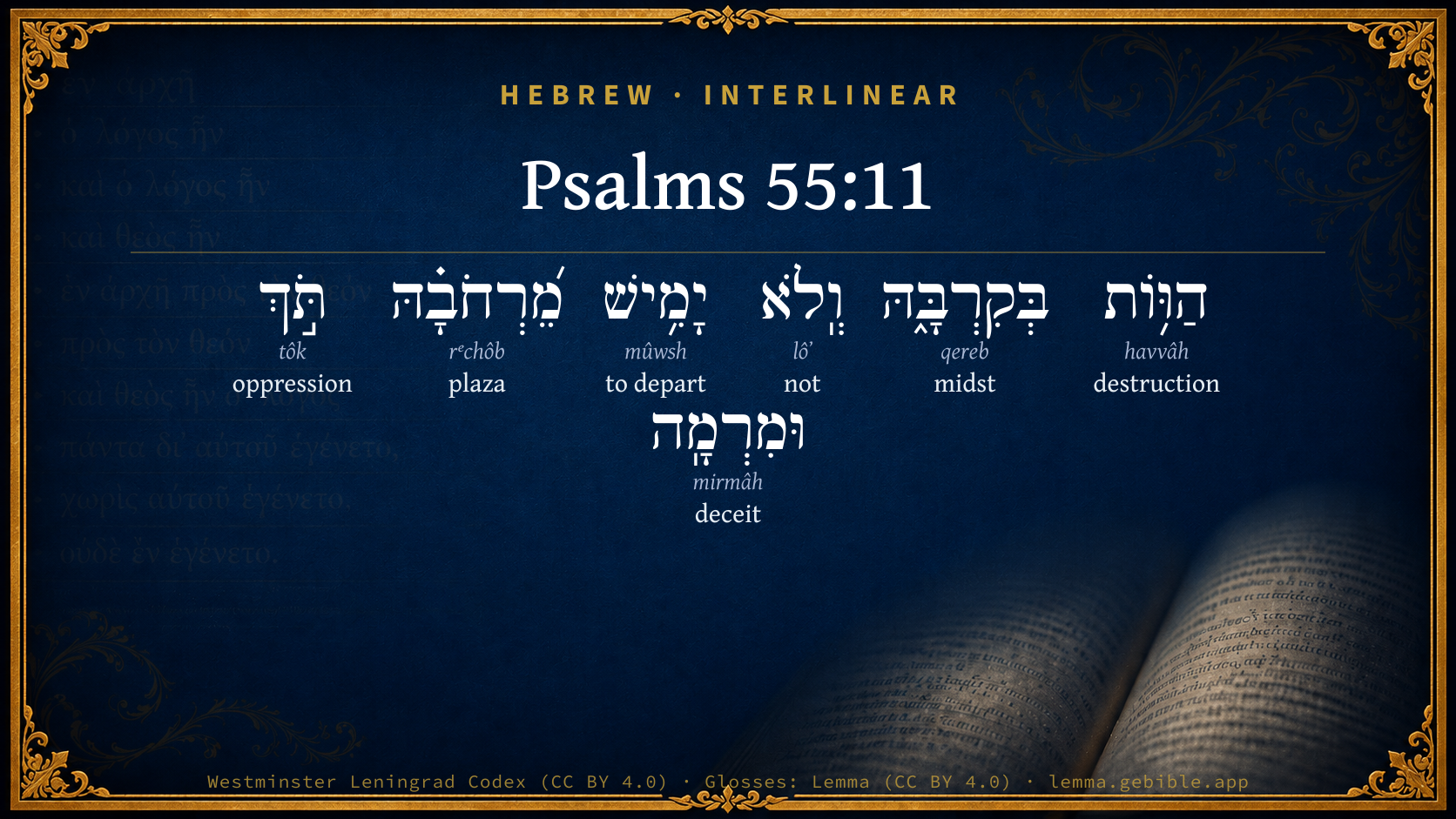
Psalms 55:11

Hebrew (Westminster Leningrad Codex) Psalms 55:11 appears in the Hebrew Old Testament. The text above is from the Westminster Leningrad Codex. Each word links to its Strong’s number, a concise gloss, and parsing drawn from the Open Scriptures Hebrew Bible morphology. Click any word for its full Brown-Driver-Briggs (BDB) entry.
Download image
Cite this verse

Psalms 55:11 (World English Bible). Public Domain. Lemma interlinear Bible study tool, https://lemma.gebible.app/v/psalms/55/11.

Show BibTeX & RIS
BibTeX
RIS
English Translation
Destructive forces are within her. Threats and lies don't depart from her streets.
World English Bible · Public Domain
Download a study sheet

One document with this verse’s original text, its word-by-word gloss line, the meaning frame, cross-references with their text, attributed commentary, and full source and license credits — printable, and it pastes into notes with its structure intact.

This verse Autodidact and up

Study sheet (.html) Plain text (.txt)

A passage Seminary Student

Up to 50 verses in one chapter. A passage sheet keeps up to 6 commentary sources and 12 cross-references per verse, in the order this page ranks them, and says so on the sheet whenever that leaves anything out. Ask for a single verse and you get the Autodidact verse sheet above.

Everything on this page stays free to read, with no account — the sheet is a download of what is already on screen, not access to it.

Want to remove ads? Support Godless Engineer
Compare translations 3

The same verse in 3 English versions, stacked beneath the original-language interlinear above. Click any original word for its lexicon entry.

Each is an independent rendering of the whole verse — the interlinear is not word-aligned to these translations.

Highlighted words mark where these versions differ — a whole-verse word diff, not a word-by-word alignment.

  • World English Bible Public Domain
    Destructive forces are within her. Threats and lies don't depart from her streets.
  • King James Version Public Domain
    Wickedness is in the midst thereof: deceit and guile depart not from her streets.
  • unfoldingWord Literal Text CC BY-SA 4.0
    Calamity in the midst of it, and oppression and deceit do not depart from its open square.

unfoldingWord Literal Text — © unfoldingWord, licensed CC BY-SA 4.0. Word-aligned USFM3 via Door43 (git.door43.org/unfoldingWord/en_ult).

Versions to compare (up to 4)

3 of 4 selected

Show all 18 translations

Every available English version of this verse, each an independent rendering of the whole verse.

  • World English Bible Public Domain
    Destructive forces are within her. Threats and lies don't depart from her streets.
  • Berean Standard Bible Public Domain
    Destruction is within; oppression and deceit never leave the streets.
  • Majority Standard Bible Public Domain
    Destruction is within; oppression and deceit never leave the streets.
  • King James Version Public Domain
    Wickedness is in the midst thereof: deceit and guile depart not from her streets.
  • American Standard Version (1901) Public Domain
    Wickedness is in the midst thereof: Oppression and guile depart not from its streets.
  • Revised Version (1885) Public Domain
    Wickedness is in the midst thereof: oppression and guile depart not from her streets.
  • Geneva Bible (1599) Public Domain
    Wickednes is in the middes thereof: deceit and guile depart not from her streetes.
  • Douay-Rheims (1899) Public Domain
    I waited for him that hath saved me from pusillanimity of spirit, and a storm.
  • Young's Literal Translation Public Domain
    Mischiefs `are' in its midst. Fraud and deceit depart not from its street.
  • Literal Standard Version CC BY-SA 4.0
    Mischiefs [are] in its midst. Fraud and deceit do not depart from its street.
  • Unlocked Literal Bible CC BY-SA 4.0
    Wickedness is in the middle of it; oppression and deceit do not leave its streets.
  • unfoldingWord Literal Text CC BY-SA 4.0
    Calamity in the midst of it, and oppression and deceit do not depart from its open square.
  • Darby Bible Public Domain
    Perversities are in the midst thereof; and oppression and deceit depart not from its streets.
  • World Messianic Bible Public Domain
    Destructive forces are within her. Threats and lies don’t depart from her streets.
  • Webster's Bible Public Domain
    \\55:10\\Day and night they go about it upon its walls: mischief also and sorrow are in the midst of it.
  • Free Bible Version CC BY-SA 4.0
    The ones causing destruction are inside the city; frauds and cheats are always on the streets.
  • Bible in Basic English Public Domain
    Evil is there; cruel rule and deceit are ever in the streets.
  • JPS Tanakh (1917) Public Domain
    (55-12) Wickedness is in the midst thereof; oppression and guile depart not from her broad place.

Literal Standard Version (2020), Covenant Press — licensed CC BY-SA 4.0. Text via the HelloAO Bible API (eBible.org). Unlocked Literal Bible (unfoldingWord) — licensed CC BY-SA 4.0. Text via the HelloAO Bible API (eBible.org). unfoldingWord Literal Text — © unfoldingWord, licensed CC BY-SA 4.0. Word-aligned USFM3 via Door43 (git.door43.org/unfoldingWord/en_ult). Free Bible Version, Dr. Jonathan Gallagher — licensed CC BY-SA 4.0. Text via the HelloAO Bible API (eBible.org).

Word by word

More ways to search: Search by grammar → Find every occurrence → Compare this word →

Practice this passage: Drill this verse → Learn its vocabulary →

About this verse

These counts appear in no published source. They are computed here, from the morphology-tagged text and Lemma’s own curated glosses. What Lemma adds →

7
words
7
distinct lemmas
Wisdom
section

Notable vocabulary

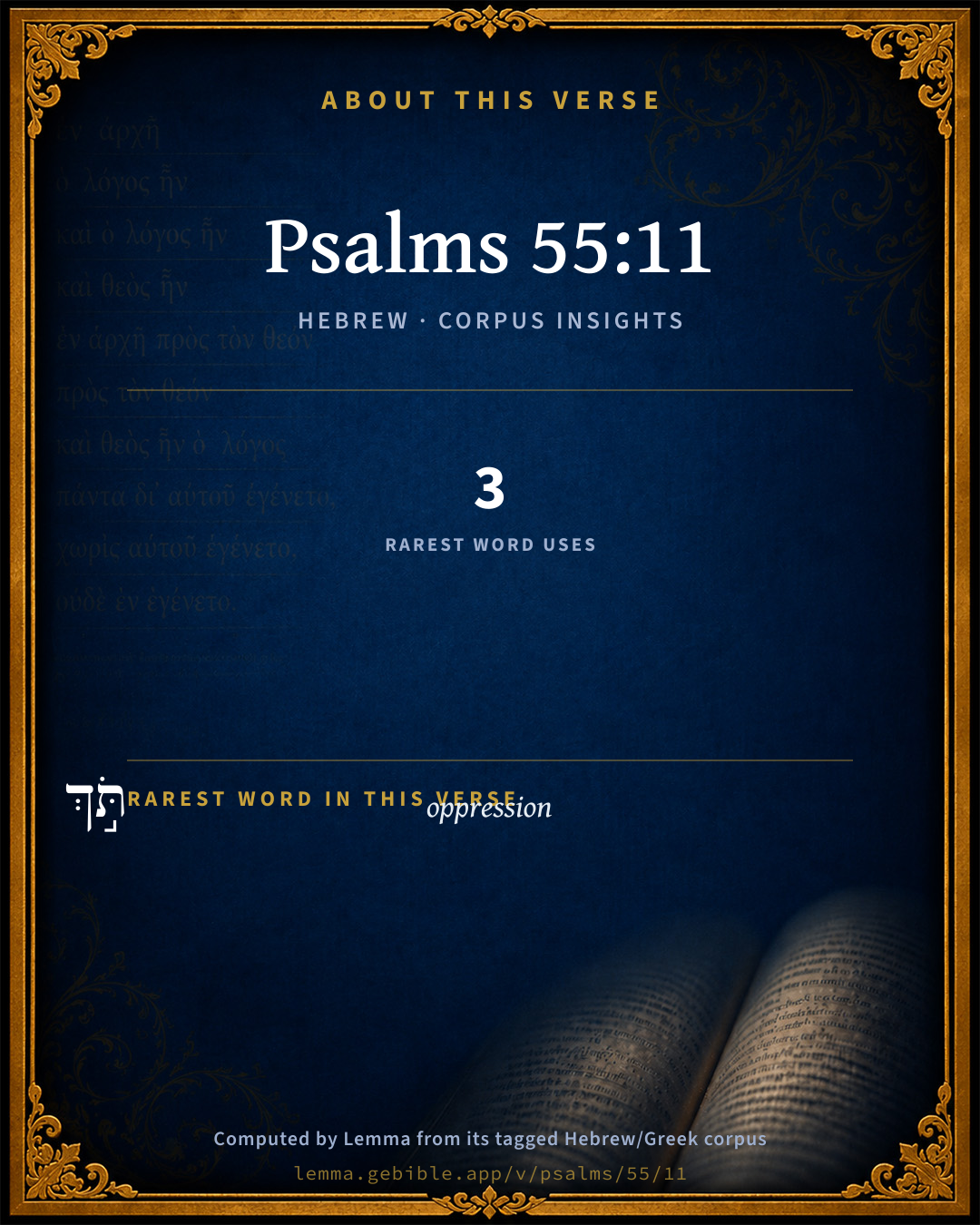
The rarest word here is תֹּ֣ךְ oppression H8496 — appearing just 3 times in the whole Hebrew Bible.

Shared distinctive vocabulary

תֹּ֣ךְ oppression H8496 occurs in 3 verses of the Hebrew Bible. Also found in:

Grammatical profile

  • 1 verb
  • 5 nouns
  • 1 particle

Verb forms

  • יָמִ֥ישׁ Qal · Imperfect

Hebrew & Septuagint length

In English translation the verse runs 13 words from the Hebrew and 10 from the Septuagint (LXX English) — closely comparable.

A rough comparison of the two English renderings, which tokenize alike — not a word-level alignment.

Word counts can differ between the Hebrew and the Greek without any difference in meaning — e.g. the Hebrew direct-object marker אֵת has no separate Greek word, and Greek often adds the article ὁ.

Cross-references

9

Topical passages linked to Psalms 55:11 in the Treasury of Scripture Knowledge — connected by theme and wording, ordered by reader-vote popularity; previews shown in the World English Bible.

  • Psalms 5:9 For there is no faithfulness in their mouth. Their heart is destruction. Their throat is an open tomb. They flatter with their tongue.
  • Isaiah 59:7 Their feet run to evil, and they make haste to shed innocent blood: their thoughts are thoughts of iniquity; desolation and destruction are in their paths.
  • Psalms 10:7 His mouth is full of cursing, deceit, and oppression. Under his tongue is mischief and iniquity.
  • Jeremiah 5:26–27 For among my people are found wicked men: they watch, as fowlers lie in wait; they set a trap, they catch men.
  • Acts 7:51–52 "You stiff-necked and uncircumcised in heart and ears, you always resist the Holy Spirit! As your fathers did, so you do.
  • Psalms 109:2–3 For they have opened the mouth of the wicked and the mouth of deceit against me. They have spoken to me with a lying tongue.
  • Jeremiah 9:3–5 They bend their tongue, [as it were] their bow, for falsehood; and they are grown strong in the land, but not for truth: for they proceed from evil to evil, and they don't know me, says Yahweh.
  • Ezekiel 22:1–12 Moreover the word of Yahweh came to me, saying,
  • Matthew 26:4 They took counsel together that they might take Jesus by deceit, and kill him.

Cross-references courtesy of OpenBible.info (CC BY 4.0).

Hebrew and Greek witnesses Masoretic Hebrew ↔ Greek Septuagint

The same verse in the two great witnesses to the Old Testament, shown verse-for-verse.

You’re reading Greek Psalm 54 (Hebrew Psalm 55). The Septuagint counts the superscription, so verse numbers can differ from the Hebrew — chapter-level alignment, not verse-by-verse. Numbering follows Rahlfs.

These are two independent witnesses, not word-aligned to each other, and the Septuagint is shown in lemma (dictionary) form.

Hebrew Psalms 55:11 Masoretic · Westminster Leningrad Codex

הַוּ֥וֹת בְּקִרְבָּ֑הּ וְֽלֹא יָמִ֥ישׁ מֵ֝רְחֹבָ֗הּ תֹּ֣ךְ וּמִרְמָֽה

Destructive forces are within her. Threats and lies don't depart from her streets.

World English Bible · Public Domain

Greek LXX Greek Psalm 54:11 Septuagint · lemma form

ἡμέρα καί νύξ κυκλόω αὐτός ἐπί ὁ τεῖχος αὐτός ἀνομία καί κόπος ἐν μέσος αὐτός καί ἀδικία

and usury and craft have not failed from its streets.

LXX2012 (modern English Septuagint) · Public Domain

Hebrew: Westminster Leningrad Codex (CC BY 4.0). Greek: Septuagint (public domain); English from LXX2012 (modern English Septuagint) (Public Domain). How the Septuagint differs from the Hebrew →

Commentary

Notes on Psalms 55:11 from classic Christian and Jewish commentators (each source and its license shown beneath its notes). The classic Christian expositions comment on the surrounding passage and are grouped to its opening verse, so a note may address several verses; the Jewish commentaries on the Tanakh (Rashi and others) are per-verse, so they appear only where the commentator wrote on this verse.

Lemma curates 59 commentaries, every one of them public domain or Creative Commons licensed, each selected and text-cleaned for this edition rather than reprinted as found. About our sources →

Trapp's Complete Commentary

John Trapp

Psa 55:11 Wickedness [is] in the midst thereof: deceit and guile depart not from her streets.

Ver. 11. Wickedness is in the midst thereof] As if it were no longer, as once, Theopolis, but Poneropolls, for all kind of naughtiness there.

Deceit and guile depart not from her streets] The Vulgate hath it, Usura et dolus, Usury and guile; and Theodoret’s note here is, Notandum est, non mode Novi Testamenti perfectionem, sed Legis statum faenus damnare, that usury is condemned in both Old and New Testament.

John Trapp, A Commentary or Exposition upon All the Books of the Old and New Testament (1647–1656) — public domain. Text from a community e-Sword module.

J. A. Alexander on Psalms

Joseph Addison Alexander

12. (Psa 55:11). Mischiefs (are) in the midst of her, and from her street will not depart oppression and deceit. The first word in Hebrew necessarily suggests the two ideas of calamities and crimes, i.e. calamities occasioned by the crimes of others. See above, on Psa 5:9; Psa 38:12; Psa 52:2; Psa 52:7. The word translated street denotes a wide place, and is specially applied to the square or open space surrounding the gates of oriental cities, and used both for markets and for courts of justice. See Neh 8:1; Neh 8:3; Neh 8:16. The word therefore very nearly corresponds to the Greek agora and the Latin forum, and may be here used to suggest the idea both of legal and commercial malfeasance. Neither their markets nor their courts are ever free from these two forms of gross injustice, namely, fraud and violence.

Joseph Addison Alexander, The Psalms Translated and Explained (1850) — public domain. Text from a community e-Sword module.

Jamieson, Fausset & Brown

Robert Jamieson, A. R. Fausset & David Brown

Wickedness--literally, "Mischief," evils resulting from others (Psa 5:9; Psa 52:2, Psa 52:7).

streets--or literally, "wide places," markets, courts of justice, and any public place.

Jamieson, Fausset & Brown — Commentary Critical and Explanatory on the Whole Bible (1871) — public domain (CC PDM 1.0). Text via the HelloAO Bible API.

Ellicott's Commentary for English Readers

(11) Deceit.—Rather, oppression, or violence.

Streets.—Rather, squares, the open space at the

gate of an Oriental city where public business was conducted. It is a miserable picture of mis-government; in the very seat of justice is nothing but oppression and guile.

A Bible Commentary for English Readers, edited by Charles John Ellicott (1878–1897) — public domain. Text from a community e-Sword module.

The Cambridge Bible for Schools and Colleges

gen. ed. J. J. S. Perowne

11. Wickedness] The same word as in Psa_52:2; very wickedness or destruction. deceit] R.V. oppression, or, marg., fraud.

her streets] Lit., broad place: the open space inside the gates, where justice was administered and business transacted. Everywhere throughout the city, in the most public places of concourse, every form of evil and injustice is rampant, without check or intermission. The whole city lies at their mercy. Cp. the catalogue of vices in Psa_10:7 : “His mouth is full of cursing and deceit and oppression; under his tongue is mischief and iniquity.”

The Cambridge Bible for Schools and Colleges (gen. ed. J. J. S. Perowne; Cambridge University Press, 1878–1918) — public domain. Text from a community e-Sword module.

John Gill's Exposition

For it was not an enemy that reproached me,.... An open and avowed one; a Moabite or a Philistine; such an one as Goliath, who cursed him by his gods; but one of his own country, city, court, and family, who pretended to be a friend; his son Absalom, according to Arama: so it was not one of the Scribes and Pharisees, the sworn enemies of Christ, who rejected him as the Messiah, and would not have him to reign over them, that reproached him, but one of his own apostles;

then I could have borne it; reproach from an enemy is to be expected, and may be patiently endured; and, when it is for righteousness' sake, should be accounted an happiness, and rejoiced at; but the reproaches of one that has been thought to be a friend are very cutting, wounding, heartbreaking, and intolerable, Psa 69:7; the calumnies and reproaches of the Scribes and Pharisees were borne by Christ with great patience, and were answered with great calmness and mildness, Mat 11:19. Or, "I would have lifted up" (t); that is, my hand, and defended myself; I should have been upon my guard, ready to receive the blow, or to have put it off, or repelled it;

neither was it he that hated me: openly, but secretly in his heart;

that did magnify himself against me; made himself a great man, and set himself at the head of the conspiracy and opposition against him, and spoke great swelling words, in way of raillery and reproach;

then I would have hid myself from him; as David did from Saul, when he became his enemy, Sa1 20:24; and as Christ from the Jews, Joh 8:59; but as for Judas, he knew the place he resorted to; and therefore easily found him, Joh 18:2; the sense may be, that he would have shunned his company, refused conversation with him; much less would he have admitted him to his privy councils, by which means he knew all his affairs, and there was no hiding and concealing things from him.

(t)

John Gill's Exposition of the Whole Bible (1746–1763) — public domain (CC PDM 1.0). Text via the HelloAO Bible API.

Albert Barnes' Notes on the Bible

Wickedness is in the midst thereof - That is, the wickedness connected with rebellion and revolt.

Deceit and guile depart not from her streets - They are everywhere. They are found in every street and alley. They pervade all classes of the people. The word rendered “deceit” means rather “oppression.” This was connected with “guile,” or with “deceit.” That is, wrong would be everywhere committed, and the perpetration of those wrongs would be connected with false representations, and false pretences - a state of things that might be expected in the unnatural rebellion under Absalom.

Albert Barnes' Notes on the Bible (1834–1885) — public domain. Text from a community e-Sword/MySword module.

Matthew Poole's English Annotations

The places of buying and selling, and of public and common conversation. So their sins were both universal and impudent.

Matthew Poole's English Annotations on the Holy Bible (1683–1685) — public domain. Text from a community e-Sword/MySword module.

The Treasury of David

Charles H. Spurgeon

Ver. 11. Wickedness is in the midst thereof. The very heart of the city was base. In her places of authority crime went hand in hand with calamity. All the wilder and more wicked elements were uppermost; the canaille were commanders; the scum floated uppermost; justice was at a discount; the population was utterly demoralized; prosperity had vanished and order with it.

Deceit and guile depart not from her streets. In all the places of concourse crafty tongues were busy persuading the people with cozening phrases. Crafty demagogues led the people by the nose. Their good king was defamed in all ways, and when they saw him go away, they fell to reviling the governors of their own choosing. The forum was the fortress of fraud, the congress was the convention of cunning. Alas, poor Jerusalem, to be thus the victim of sin and shame! Virtue reviled and vice regnant! Her solemn assemblies broken up, her priests fled, her king banished, and troops of reckless villains parading her streets, sunning themselves on her walls, and vomiting their blasphemies in her sacred shrines. Here was cause enough for the sorrow which so plaintively utters itself in these verses.

None.

None.

Psalms 55:12*

Charles H. Spurgeon's The Treasury of David (1869–1885) — public domain. Psalms only. Text from a community e-Sword/MySword module.

Whedon's Commentary on the Bible

Daniel D. Whedon

11. Wickedness… deceit and guile—Rampant lust, perfidy, and craft everywhere prevailed.

Depart not from her streets—It is better to understand רחב, (rehhob,) here translated street, to signify market place, open space, public square, or broad way before the gates, where courts were held, as in 2Ch_32:6; Ezr_10:9; Neh_8:1; Neh_8:3; Neh_8:16. In Jer_5:1, it is translated broad places; in our English Bible, and in Neh_2:4, broad ways. In these open courts of the city, where justice was usually dispensed, wickedness, extortion, and deceit, prevailed. Compare Psa_9:14

Daniel D. Whedon (gen. ed.), Commentary on the Old and New Testaments (1874–1909) — public domain. Text from a community e-Sword module.

The Pulpit Commentary

Wickedness is in the midst thereof; deceit and guile depart not from her streets; literally, out of her street (rehob) open square, where justice ought to have been administered "(Kay), "adjoining the vaulted passage of the city gate" (Cheyne); comp. Job_29:7.

The Pulpit Commentary (1880–1919), ed. H.D.M. Spence-Jones & Joseph S. Exell — public domain. Text from a community e-Sword module.

John Wesley's Explanatory Notes

Streets - The places of buying and selling, and of public commerce.

John Wesley, Explanatory Notes Upon the Whole Bible (1754–1765) — public domain. Text via the GEBible commentary corpus.

Rashi

Rabbi Shlomo Yitzchaki (Rashi)

they surround it i.e., the violence and the strife.

Rashi on the Tanakh — English translations: “The Judaica Press complete Tanach with Rashi, translated by A. J. Rosenberg” (CC BY 4.0); “Pentateuch with Rashi's commentary by M. Rosenbaum and A.M. Silbermann, 1929-1934” (public domain); “The Metsudah Tanach series, Lakewood, N.J” (CC BY 4.0); and “The Book of Joshua, Metsudah Publications, 1997” (CC BY 4.0). Text via Sefaria.

Lesson kit

Teaching starters — assembled from the data on this page, not authored interpretation. Every prompt links to the verse data it draws on. Edit before teaching.

Psalms, in the Wisdom, opens this verse with 7 words (7 distinct Hebrew lemmas). Its most distinctive word is tôk (“oppression”). A historical commentator’s framing appears above. Read the whole chapter for the surrounding context.

Discussion questions

  1. What does “oppression” (tôk) contribute to the verse as a whole?
  2. Psalms 10:7 shares the word «oppression» with this verse. How do the two illuminate each other?
  3. The translations on this page render this verse differently — a whole-verse word diff, not a word-by-word alignment. What might account for the different wordings?
  4. The verb «יָמִ֥ישׁ» is Qal Imperfect. How does its form color the action?
  5. Reading how Trapp's Complete Commentary and J. A. Alexander on Psalms read this verse, where do the two commentators agree and where do they part?

Things to notice

Reading settings

Reading text

Shown beneath each verse's original-language words.

Old Testament
Old Testament edition

Read the OT as the Masoretic Hebrew (MT) or the Greek Septuagint (LXX).

English shown for the Greek Septuagint (in the Hebrew ↔ Greek comparison).

Comparing translations? Open the Compare panel on any verse page to stack up to four side by side.