
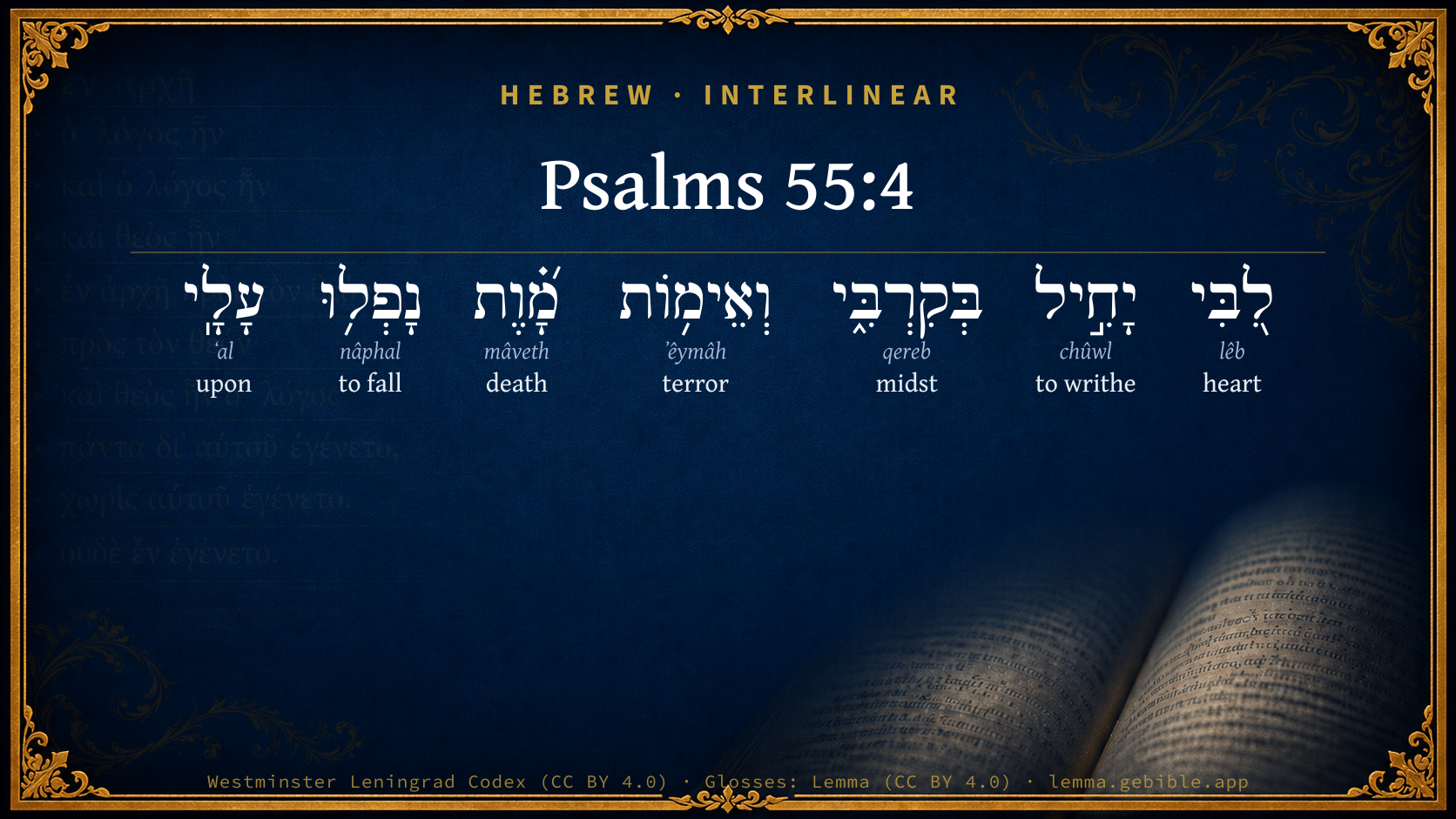
Psalms 55:4

Hebrew (Westminster Leningrad Codex) Psalms 55:4 appears in the Hebrew Old Testament. The text above is from the Westminster Leningrad Codex. Each word links to its Strong’s number, a concise gloss, and parsing drawn from the Open Scriptures Hebrew Bible morphology. Click any word for its full Brown-Driver-Briggs (BDB) entry.
Download image
Cite this verse

Psalms 55:4 (World English Bible). Public Domain. Lemma interlinear Bible study tool, https://lemma.gebible.app/v/psalms/55/4.

Show BibTeX & RIS
BibTeX
RIS
English Translation
My heart is severely pained within me. The terrors of death have fallen on me.
World English Bible · Public Domain
Download a study sheet

One document with this verse’s original text, its word-by-word gloss line, the meaning frame, cross-references with their text, attributed commentary, and full source and license credits — printable, and it pastes into notes with its structure intact.

This verse Autodidact and up

Study sheet (.html) Plain text (.txt)

A passage Seminary Student

Up to 50 verses in one chapter. A passage sheet keeps up to 6 commentary sources and 12 cross-references per verse, in the order this page ranks them, and says so on the sheet whenever that leaves anything out. Ask for a single verse and you get the Autodidact verse sheet above.

Everything on this page stays free to read, with no account — the sheet is a download of what is already on screen, not access to it.

Want to remove ads? Support Godless Engineer
Compare translations 3

The same verse in 3 English versions, stacked beneath the original-language interlinear above. Click any original word for its lexicon entry.

Each is an independent rendering of the whole verse — the interlinear is not word-aligned to these translations.

Highlighted words mark where these versions differ — a whole-verse word diff, not a word-by-word alignment.

  • World English Bible Public Domain
    My heart is severely pained within me. The terrors of death have fallen on me.
  • King James Version Public Domain
    My heart is sore pained within me: and the terrors of death are fallen upon me.
  • unfoldingWord Literal Text CC BY-SA 4.0
    My heart writhes in the midst of me, and the terrors of death have fallen onto me.

unfoldingWord Literal Text — © unfoldingWord, licensed CC BY-SA 4.0. Word-aligned USFM3 via Door43 (git.door43.org/unfoldingWord/en_ult).

Versions to compare (up to 4)

3 of 4 selected

Show all 17 translations

Every available English version of this verse, each an independent rendering of the whole verse.

  • World English Bible Public Domain
    My heart is severely pained within me. The terrors of death have fallen on me.
  • Berean Standard Bible Public Domain
    My heart murmurs within me, and the terrors of death assail me.
  • Majority Standard Bible Public Domain
    My heart pounds within me, and the terrors of death assail me.
  • King James Version Public Domain
    My heart is sore pained within me: and the terrors of death are fallen upon me.
  • American Standard Version (1901) Public Domain
    My heart is sore pained within me: And the terrors of death are fallen upon me.
  • Revised Version (1885) Public Domain
    My heart is sore pained within me: and the terrors of death are fallen upon me.
  • Geneva Bible (1599) Public Domain
    Mine heart trembleth within mee, and the terrours of death are fallen vpon me.
  • Young's Literal Translation Public Domain
    My heart is pained within me, And terrors of death have fallen on me.
  • Literal Standard Version CC BY-SA 4.0
    My heart is pained within me, || And terrors of death have fallen on me.
  • Unlocked Literal Bible CC BY-SA 4.0
    My heart trembles within me, and the terrors of death have fallen on me.
  • unfoldingWord Literal Text CC BY-SA 4.0
    My heart writhes in the midst of me, and the terrors of death have fallen onto me.
  • Darby Bible Public Domain
    My heart is writhing within me, and the terrors of death are fallen upon me.
  • World Messianic Bible Public Domain
    My heart is severely pained within me. The terrors of death have fallen on me.
  • Webster's Bible Public Domain
    \\55:3\\Because of the voice of the enemy, because of the oppression of the wicked: for they cast iniquity upon me, and in wrath they hate me.
  • Free Bible Version CC BY-SA 4.0
    My heart thumps in agony! Terrified, I feel I'm about to die!
  • Bible in Basic English Public Domain
    My heart is deeply wounded, and the fear of death has come on me.
  • JPS Tanakh (1917) Public Domain
    (55-5) My heart doth writhe within me; and the terrors of death are fallen upon me.

Literal Standard Version (2020), Covenant Press — licensed CC BY-SA 4.0. Text via the HelloAO Bible API (eBible.org). Unlocked Literal Bible (unfoldingWord) — licensed CC BY-SA 4.0. Text via the HelloAO Bible API (eBible.org). unfoldingWord Literal Text — © unfoldingWord, licensed CC BY-SA 4.0. Word-aligned USFM3 via Door43 (git.door43.org/unfoldingWord/en_ult). Free Bible Version, Dr. Jonathan Gallagher — licensed CC BY-SA 4.0. Text via the HelloAO Bible API (eBible.org).

Word by word

More ways to search: Search by grammar → Find every occurrence → Compare this word →

Practice this passage: Drill this verse → Learn its vocabulary →

About this verse

These counts appear in no published source. They are computed here, from the morphology-tagged text and Lemma’s own curated glosses. What Lemma adds →

7
words
7
distinct lemmas
Wisdom
section

Notable vocabulary

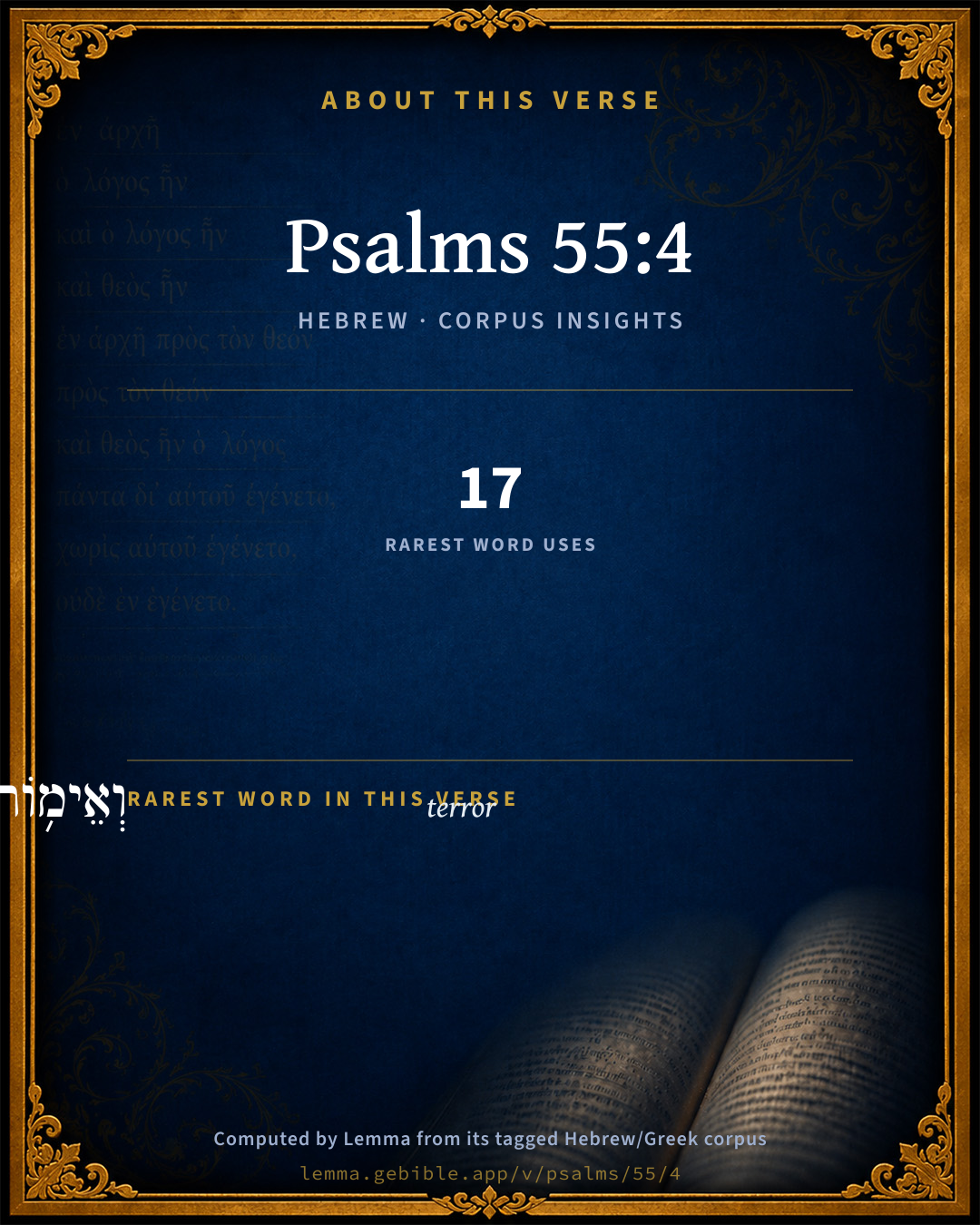
The rarest word here is וְאֵימ֥וֹת terror H367 — appearing just 17 times in the whole Hebrew Bible.

Shared distinctive vocabulary

וְאֵימ֥וֹת terror H367 occurs in 17 verses of the Hebrew Bible. Also found in:

Grammatical profile

  • 2 verbs
  • 4 nouns
  • 1 preposition

Verb forms

  • יָחִ֣יל Qal · Imperfect
  • נָפְל֥וּ Qal · Perfect

Hebrew & Septuagint length

In English translation the verse runs 15 words from the Hebrew and 14 from the Septuagint (LXX English) — closely comparable.

A rough comparison of the two English renderings, which tokenize alike — not a word-level alignment.

Word counts can differ between the Hebrew and the Greek without any difference in meaning — e.g. the Hebrew direct-object marker אֵת has no separate Greek word, and Greek often adds the article ὁ.

Cross-references

12

Topical passages linked to Psalms 55:4 in the Treasury of Scripture Knowledge — connected by theme and wording, ordered by reader-vote popularity; previews shown in the World English Bible.

  • Psalms 116:3 The cords of death surrounded me, The pains of Sheol got a hold of me. I found trouble and sorrow.
  • Mark 14:33–34 He took with him Peter, James, and John, and began to be greatly troubled and distressed.
  • 2 Corinthians 1:8–10 For we don't desire to have you uninformed, brothers, concerning our affliction which happened to us in Asia, that we were weighed down exceedingly, beyond our power, so much that we despaired even of life.
  • Psalms 18:4–5 The cords of death surrounded me. The floods of ungodliness made me afraid.
  • Hebrews 5:7 He, in the days of his flesh, having offered up prayers and petitions with strong crying and tears to him who was able to save him from death, and having been heard for his godly fear,
  • Psalms 6:3 My soul is also in great anguish. But you, Yahweh--how long?
  • Psalms 69:20 Reproach has broken my heart, and I am full of heaviness. I looked for some to take pity, but there was none; For comforters, but I found none.
  • Psalms 88:3 For my soul is full of troubles. My life draws near to Sheol.
  • Psalms 102:3–5 For my days consume away like smoke. My bones are burned as a firebrand.
  • Isaiah 38:10–13 I said, In the noontide of my days I shall go into the gates of Sheol: I am deprived of the residue of my years.
  • Matthew 26:37–38 He took with him Peter and the two sons of Zebedee, and began to be sorrowful and severely troubled.
  • John 12:27 "Now my soul is troubled. What shall I say? 'Father, save me from this time?' But for this cause I came to this time.

Cross-references courtesy of OpenBible.info (CC BY 4.0).

Hebrew and Greek witnesses Masoretic Hebrew ↔ Greek Septuagint

The same verse in the two great witnesses to the Old Testament, shown verse-for-verse.

You’re reading Greek Psalm 54 (Hebrew Psalm 55). The Septuagint counts the superscription, so verse numbers can differ from the Hebrew — chapter-level alignment, not verse-by-verse. Numbering follows Rahlfs.

These are two independent witnesses, not word-aligned to each other, and the Septuagint is shown in lemma (dictionary) form.

Hebrew Psalms 55:4 Masoretic · Westminster Leningrad Codex

לִ֭בִּי יָחִ֣יל בְּקִרְבִּ֑י וְאֵימ֥וֹת מָ֝֗וֶת נָפְל֥וּ עָלָֽי

My heart is severely pained within me. The terrors of death have fallen on me.

World English Bible · Public Domain

Greek LXX Greek Psalm 54:4 Septuagint · lemma form

ἀπό φωνή ἐχθρός καί ἀπό θλῖψις ἁμαρτωλός ὅτι ἐκκλίνω ἐπί ἐγώ ἀνομία καί ἐν ὀργή ἐνκοτέω ἐγώ

My heart was troubled within me; and the fear of death fell upon me.

LXX2012 (modern English Septuagint) · Public Domain

On this verse, Albert Barnes' Notes on the Bible discusses the Septuagint’s reading. Read the note in Commentary ↓

Hebrew: Westminster Leningrad Codex (CC BY 4.0). Greek: Septuagint (public domain); English from LXX2012 (modern English Septuagint) (Public Domain). How the Septuagint differs from the Hebrew →

Commentary

Notes on Psalms 55:4 from classic Christian and Jewish commentators (each source and its license shown beneath its notes). The classic Christian expositions comment on the surrounding passage and are grouped to its opening verse, so a note may address several verses; the Jewish commentaries on the Tanakh (Rashi and others) are per-verse, so they appear only where the commentator wrote on this verse.

Lemma curates 59 commentaries, every one of them public domain or Creative Commons licensed, each selected and text-cleaned for this edition rather than reprinted as found. About our sources →

Trapp's Complete Commentary

John Trapp

Psa 55:4 My heart is sore pained within me: and the terrors of death are fallen upon me.

Ver. 4. My heart is sore pained within me] No otherwise than a woman is pained in travail; cordicitus doleo. I am pained deep in my heart.

And the terrors of death are fallen upon me] Caused, doubtless, by the deep sense and conscience of his late grievous sins.

John Trapp, A Commentary or Exposition upon All the Books of the Old and New Testament (1647–1656) — public domain. Text from a community e-Sword module.

The Biblical Illustrator

Joseph S. Exell

Psa_55:4

The terrors of death are fallen upon me.

On the fear of death

I. The nature of the fear of death. It appears to arise from an instinct of nature, which is increased and strengthened by observation, reflection, and conscience. A feeling which springs from such sources, however unpleasant or painful it may be, cannot have been implanted in vain in the human breast, and should be treated with seriousness and respect.

II. The uses of the fear of death. When God first made known the doctrines and duties of religion, He urged and supported them by the fear of death (Gen_2:15). In every successive dispensation of religion, its belief and practice have been enforced by the same principle (Deu_30:19; Eze_18:31; Rom_8:13, etc.). Often has the fear of death led to religious inquiry, to repentance, to conversion, to faith unfeigned, to peace, to hope, to Christ and to God. Often has it awakened men out of spiritual sleep, to trim their lamps, to gird their loins, to be sober, and to hope to the end for the grace which is to be brought at the revelation of Jesus Christ.

III. The abuses of the fear of death. It was intended, as we have seen, to stimulate and restrain men, as circumstances may require; but it never was intended to enslave them. The Scriptures, however, speak of some, who, through fear of death, were all their lifetime subject to bondage. Such characters exist, and are examples of the corruption and abuse of this principle. Urged by this principle, some have doubted, and others have denied, the facts of religion; they have corrupted its doctrines, neglected its duties, misapplied its promises, and made of no effect its threatenings.

IV. The means of removing the fear of death. That the fear of death is not at all times necessary for the purposes which have just been stated is evident from the doctrines of religion (Joh_10:14; Heb_8:6; Heb_2:14-15; Rom_8:2; Luk_10:17; 1Jn_4:18). St. Paul affirms, that the sting of death is sin; that is, it is sin which gives death all its horrors; Death is the wages or punishment of sin. Whatsoever, then, can remove the sense of guilt from the conscience, and the dread of punishment from the mind, will necessarily remove the fear of death; and if it can farther be made evident that death itself is beneficial, and that it is in reality the commencement of everything that is desirable, then its fear will not only be removed, but will be completely destroyed. All this may be effected by the knowledge and belief of the Gospel (2Ti_1:10; Mat_18:11; Mat_20:28; 1Co_3:18; 2Co_5:19; Heb_9:14; Joh_3:16; 2Co_5:8; 1Co_14:54; 1Co_14:57).

V. Improvement.

1. Remember that God, in His moral government of the world, can bring good out of evil.

2. Consider the caution which should be employed in removing the fear of death. The fear of death is employed as a means to support life, order, and religion; and, therefore, were it prematurely taken away, it might remove the barriers opposed to rashness, profligacy, and death itself.

3. Beware of the slavish fear of death.

4. Use diligently the means of rising superior to the fear of death. Study, then, the Gospel; yield to the conviction of its truth; live under its influence; cultivate its grace; and you will be enabled to say (Rom_8:38-39). (T. S. Jones, D. D.)

The fear of death

Who is it that doth not fear death? We begin it from our earliest years. From his very infancy the child begins to understand that there are other things besides more bodily pain--a strange, inexplicable feeling comes upon him, which, sooner or later, becomes the explicit fear of death. Whatever may be our position in life, whether we are religious persons, striving, as well as we can, to prepare ourselves for that awful moment, whether we are giddy end worldly, it is impossible to shake off that awful fooling when we think of the moment when the soul passes into the unseen. No man has ever returned from that unseen world, and therefore it is that we are filled with inexplicable dread which makes us shrink from it with a horror we cannot describe. It is true there are certain exceptions to the rule, but they are exceptions more in appearance than in reality, and they do not go any way to prove that the fear of death has not fallen upon all mankind. For instance, there is a peculiar dulness and deadness of feeling which comes upon many persons at the end of a very long illness. It is the same also with persons who live to a considerable old age. It occurs at different times with different persons--sometimes at sixty, seventy, or later. A certain deadness of feeling creeps over all the affections. As the body weakens so does the intelligence lose its power, and so do the feelings lose their exquisite sensibility. Then, again, there are those to whom life is one long, terrible misery. It drives, as we know, some few persons to suicide, for it drives them, as it were, mad. They cannot control themselves. Then there are violent excitements which make persons for the moment utterly disregard death, such as the excitement which many, indeed nearly all, feel on the field of battle. They are afraid in one sense; it is their courage which conquers their distress, and they live and they die like men. It is the same in any other great excitement. Take, for instance, the efforts which may be made for the rescuing of persons from great suffering, or from some horrible death. Imagine the feelings of the men who rush into the flames to save their fellow-creatures. Death is forgotten for the moment; they do not think of it; their earnestness, their passionate desire to save their follow-creatures from this same hideous death overpowers the dread which is in their own hearts. It is the same at sea. We continually read accounts of persons saving others in the midst of a shipwreck. Here, again, it is courage that conquers fear. They do not fear death for themselves, but they fear it for those whom they are going to save, and thus they give themselves to death without a single beat in their lowly hearts. When we consider what is the state of those persons who die quietly in their beds from some sort of sickness, who themselves are fully possessed with a belief in the truth of religion, who have long confided in Gods providence, and entertain not the slightest doubt in their own minds that they are going to pass from a world of sin and misery to a life of holiness and blessedness--how is it with them? We find that even with them, notwithstanding all their faith, that death is nothing to be afraid of, still their courage wants keeping up to the point by incessant prayers and texts from the Bible, and all kinds of encouraging influences which may stimulate and help them. This shows that whatever may be our state, whatever our confidence in God, and our trust in the promises, still there is this dread of passing into the dark beyond. And it is not really difficult to understand the practical gain which comes to us all from the presence in our mind of this indescribable fear. First of all, where would the world be if we had not this terror? How many of us would bear to live through the troubles which encompass nearly all the creatures in this world? But, far more than this, the existence of this dread is absolutely necessary to implant in us that conviction of the vast importance of the moment of death, which we find it so difficult to realize. How shall it be to us, not only easy, but natural, to turn with our whole hearts to God at the last moment, when we seem, perhaps, insensible to those who are watching and weeping around us--how shall we, in those last moments, turn our thoughts to God and say, My Lord, Thou art my God? Surely it must be by cultivating that continual sense of His presence, and of His goodness, and of His power, which alone can conquer death and make us die in perfect peace. The remedy against death is God; He caused us to live; He implanted in our hearts this mysterious terror; but why did He? He did it that we might learn the more to trust Him as being ever present with us, as being around us, enshrining us, taking us, as it were, in His arms, in the arms of a loving Father. (J. M. Capes.)

The Biblical Illustrator, edited by Joseph S. Exell (c. 1880s–1900s) — public domain. Text from a community e-Sword module.

Joseph Benson's Commentary

Psa 55:4. My heart is sore pained within me — Hebrew, יחיל, jachil, trembles, or suffers pains like those of a travailing woman, as the word properly signifies. My heart, which hath generally supported me in my distresses, is now ready to sink within me; therefore, Lord, pity and help me. The terrors of death are fallen upon me — Either deadly terrors, such as seize upon men in the agonies of death, or fear of death; which is the more grievous to me, because my death would reflect dishonour upon thee, and bring many miseries upon the people.

Joseph Benson's Commentary on the Old and New Testaments (1811–1818) — public domain. Text from a community e-Sword module.

J. A. Alexander on Psalms

Joseph Addison Alexander

5. (Psa 55:4). My heart writhes in the midst of me, and terrors of death have fallen upon me. The future form of the first verb implies an apprehension that the pain will continue and be permanent. In the midst of me, inside of me, within me. He is not merely involved in outward troubles, but pained at heart. Terrors of death might be strictly understood as meaning fear or dread of death; but it agrees better with the strong figurative language of the first clause, to take it in the sense of deadly, mortal terrors. An analogous expression is death-shade or shadow of death. See above, on Psa 23:4; Psa 44:19. The figure of falling necessarily suggests the idea of infliction by a superior power.

Joseph Addison Alexander, The Psalms Translated and Explained (1850) — public domain. Text from a community e-Sword module.

Tyndale Open Study Notes

Tyndale Open Resources

55:4-8 In the experience of deep anguish, the psalmist confesses that his adversity has become unbearable and he seeks an escape.

Tyndale Open Study Notes — © Tyndale Open Resources, licensed CC BY-SA 4.0. Text via the HelloAO Bible API.

Jamieson, Fausset & Brown

Robert Jamieson, A. R. Fausset & David Brown

express great alarm.

Jamieson, Fausset & Brown — Commentary Critical and Explanatory on the Whole Bible (1871) — public domain (CC PDM 1.0). Text via the HelloAO Bible API.

Adam Clarke's Commentary

Verse 4. The terrors of death are fallen upon me.] I am in hourly expectation of being massacred.

Adam Clarke's Commentary on the Bible (1810–1826) — public domain. Text from a community e-Sword/MySword module.

John Calvin's Commentaries

4. My heart trembles within me Here we have additional evidence of the extremity of David’s sufferings. He that uses these words was no soft or effeminate person, but one who had given indubitable proofs of constancy. Nor is it merely of the atrocious injuries inflicted upon him by his enemies that he complains. He exclaims that he is overwhelmed with terrors, and thus acknowledges that his heart was not insensible to his afflictions. We may learn from the passage, therefore, not only that the sufferings which David endured at this time were heavy, but that the fortitude of the greatest servants of God fails them in the hour of severe trial. We are all good soldiers so long as things go well with us, but when brought to close combat, our weakness is soon apparent. Satan avails himself of the advantage, suggests that God has withdrawn the supports of his Spirit, and instigates us to despair. Of this we have an example in David, who is here represented as struggling with inward fears, as well as a complication of outward calamities, and sustaining a sore conflict of spirit in his application to the throne of God. The expression, terrors of death, shows that he was on the very eve of sinking unless Divine grace interposed.

John Calvin's Commentaries (1540-1563) — public domain. Text from the Calvin Translation Society English edition (1840s-50s) via the Christian Classics Ethereal Library (ccel.org). Calvin's coverage is partial (roughly two-thirds of the Bible); uncommented books and verses are honest gaps, never fabricated. The 19th-century editor's footnotes and remarks are omitted so the notes are faithfully Calvin's own voice.

Ellicott's Commentary for English Readers

(4) Is sore pained.—Better, writhes with pain.

Terrors of death—i.e., terrors caused by death, a horror of death.

A Bible Commentary for English Readers, edited by Charles John Ellicott (1878–1897) — public domain. Text from a community e-Sword module.

The Cambridge Bible for Schools and Colleges

gen. ed. J. J. S. Perowne

4. terrors of death] Such terrors as the presence of Death, “the king of terrors,” inspires.

The Cambridge Bible for Schools and Colleges (gen. ed. J. J. S. Perowne; Cambridge University Press, 1878–1918) — public domain. Text from a community e-Sword module.

John Gill's Exposition

My heart is sore pained within me,.... At the civil war in his kingdom; at the battle likely to ensue between his forces and Absalom's, and at the issue of it; see Jer 4:19; this was true of Christ in the garden, when his soul was exceeding sorrowful unto death, and he was in pain, as a woman in travail, as the word (q) here used signifies; and on the cross, when his heart, like wax, melted in the midst of his bowels;

and the terrors of death are fallen upon me; see Sa2 15:14; thus it was with the human nature of Christ, when he desired, if possible, the cup might pass from him.

(q) "operuit me", Pagninus, Montanus, Gejerus, Michaelis; "operit", Cocceius; "obtegit", Junius & Tremellius; "obtexit", Piscator; so Ainsworth.

John Gill's Exposition of the Whole Bible (1746–1763) — public domain (CC PDM 1.0). Text via the HelloAO Bible API.

Albert Barnes' Notes on the Bible

My heart is sore pained within me - Heavy and sad; that is, I am deeply afflicted. The word rendered is “sore pained,” means properly to turn round; to twist; to dance in a circle; to be whirled round; and then to twist or writhe with pain, especially applied to a woman in travail, Isa 13:8; Isa 23:4; Isa 26:18. Here the idea is, that he was in deep distress and anguish. It is easy to see that this would be so, if the psalm refers to the revolt of Absalom. The ingratitude and rebellion of a son - the fact of being driven away from his throne - the number of his enemies - the unexpected news that Ahithophel was among them - and the entire uncertainty as to the result, justified the use of this strong language.

And the terrors of death are fallen upon me - The Septuagint, the Vulgate, and Luther, render this “the fear of death,” as if he were afraid for his life, or afraid that the result of all this would be his death. A more natural construction, however, is to suppose that the reference is to the ordinary pains of death, and that he means to say that the pangs which he endured were like the pangs of death. The words “are fallen” suggest the idea that this had come suddenly upon him, like a “horror of great darkness” (compare Gen 15:12), or as if the gloomy shadow of death had suddenly crossed his path. Compare the notes at Psa 23:4. The calamities had come suddenly upon him; the conspiracy had been suddenly developed; and he had been suddenly driven away.

Albert Barnes' Notes on the Bible (1834–1885) — public domain. Text from a community e-Sword/MySword module.

Matthew Poole's English Annotations

My heart is sore pained within me; with pains like those of a travailing woman, as the word signifies. My heart, which hath commonly supported me in my distresses, is now ready to sink within me; therefore, Lord, pity and help me.

The terrors of death; either deadly terrors, such as seize upon men in the agonies of death; or fear of death; which is the more grievous to me, because my death will reflect dishonour upon thee, and bring many miseries upon the people.

Matthew Poole's English Annotations on the Holy Bible (1683–1685) — public domain. Text from a community e-Sword/MySword module.

The Treasury of David

Charles H. Spurgeon

Ver. 4. My heart is sore pained within me. His spirit writhed in agony, like a poor worm; he was mentally as much in pain as a woman in travail physically. His inmost soul was touched; and a wounded spirit who can bear? If this were written when David was attacked by his own favourite son, and ignominiously driven from his capital, he had reason enough for using these expressions.

And the terrors of death are fallen upon me. Mortal fears seized him, he felt like one suddenly surrounded with the glooms of the shadow of death, upon whom the eternal night suddenly descends. Within and without he was afflicted, and his chief terror seemed to come from above, for he uses the expression, "Fallen upon me." He gave himself up for lost. He felt that he was as good as dead. The inmost centre of his nature was moved with dismay. Think of our Lord in the garden, with his "soul exceeding sorrowful even unto death, " and you have a parallel to the griefs of the psalmist. Perchance, dear reader, if as yet thou hast not trodden this gloomy way, thou wilt do soon; then be sure to mark the footprints of thy Lord in this miry part of the road.

Ver. 4. Is sore pained, or, trembled with pain, The word usually meaneth such pains as a woman feels in her travail. Henry Ainsworth.

Ver. 4. The terrors of death are fallen upon me. My heart, said the afflicted psalmist, is sore pained within me: and though I am repeatedly assured of my interest in the divine love and favour, yet now the terrors of death are fallen upon me. The case of David is so far from being peculiar to himself, that it portrays, in the most striking colours, a state of mind to which many of the most exemplary Christians are frequently, if not constantly subject. Many, whose hopes are placed on the right foundation, even Christ Jesus, and whose conduct is uniform and consistent, are ye harassed almost continually by the tormenting fears of death... It will be an interesting and useful enquiry to examine into the real causes of a fear, which cultivates melancholy and despondency on the one hand and destroys our happiness on the other. To effect this design I shall consider,

I. The various causes of the fear of death.

II. The arguments calculated to remove it. There are few,

indeed, so hardened in the slavery of vice, or so

utterly regardless of every admonition, as to consider

the awful period of dissolution without some emotions

of terror and dismay. There is something so

peculiarly awful in the idea of a change hitherto

unknown, and of a state hitherto untried, that the

most hardy veterans have owned its tremendous aspects.

One of the first causes of the fear of death is conscious guilt. The most hardened are conscious of many things which they may not readily confess; and the most self righteous is conscious of many crimes which he artfully studies to conceal. Whilst the Christian is looking only to his own habits and temper, he may and will be always wretched; but if he looks to the great Surety, Christ Jesus, his gloomy prospect will soon be turned to joy. An attachment to this world is also a (second) cause of the fear of death. A principal of self preservation is also a (third) cause of the fear of death. That our bodies, which are pampered by pride and nourished by indulgence, should be consigned to the silent grave, and become even the food of worms, is a humbling reflection to the boasted dignity of man. Besides, nature revolts at the idea of its own dissolution; hence a desire of preserving life, evidently implanted in us. The devil is also (fourthly) often permitted to terrify the consciences of men, and thereby increase at least the fear of death. Unbelief is also a (fifth) cause of the fear of death. Were our faith more frequently in exercise, we should be enabled to look beyond the dreary mansions of the grave with a hope full of immortality. Our fears of death may be often caused by looking for that perfection in ourselves, which we shall never easily discover.

Consider the arguments calculated to remove the fear of death. It may be necessary to premise that the consolations of religion belong only to real Christians; for the wicked have just reason to dread the approach of death. But to such as are humbled under a sense of their own unworthiness, and who have fled to Christ for pardon and salvation, they have no cause to apprehend either the pain or the consequences of death; because first, the sting of death is taken away. Secondly, because death is no longer an enemy but a friend. Instead of threatening us with misery, it invites us to happiness. Thirdly, the safety of our state is founded on the oath, the purpose, and the promises of God. A fourth argument calculated to remove the fear of death, is the consideration of the benefits resulting from it. The benefits which believers receive from Christ at the resurrection also, is a fifth argument calculated to remove the fear of death. Condensed from a Sermon by John Grove, M.A., F.A.S., 1802.

Ver. 4-5, In the version of the Psalter used in the Prayer book, this verse stands with a more homely and expressive simplicity, "My heart is disquieted within me, and the fear of death is fallen upon me. Fearfulness and trembling are come upon me, and an horrible dread hath overwhelmed me." The fear of death is upon all flesh. It is no sign of manhood to be without it. To overcome it in the way of duty is courage; to meet death with patience is faith; but not to fear it is either a gift of special grace, or a dangerous insensibility. No doubt great saints have been able to say, "I have a desire to depart." And many have rushed to martyrdom as to the love and bosom of their Lord; but for the rest, the multitude of his flock, who are neither wilful sinners nor to be numbered among the saints, the thought of death is a thought of fear. We see that, on the first feeling of their having so much as set foot in the path leading to the grave, even good men feel "the terror of death, ""a horrible dread, "which makes every pulse to beat with a hurried and vehement speed. Their whole nature, both in body and in soul, trembles to its very centre; and their heart is "disquieted, ""sore pained, "within them. Let us see what are the causes or reasons of this "fear of death." The first must needs be a consciousness of personal sinfulness. A sense of unfitness to meet God, our unreadiness to die, a multitude of personal faults, evil tempers, thoughts, and inclinations; the recollection of innumerable sins, of great omissions and lukewarmness in all religious duties, the little love or gratitude we have to God, and the great imperfections of our repentance; all these make us tremble at the thought of going to give up our account. We feel as if it were impossible we could be saved. Shame, fear, and a "horrible dread" fall upon us. Henry Edward Manning, M.A., 1850.

Ver. 4. The terrors of death. See Sermon by Grove in the Notes.

Psalms 55:5*

Charles H. Spurgeon's The Treasury of David (1869–1885) — public domain. Psalms only. Text from a community e-Sword/MySword module.

Whedon's Commentary on the Bible

Daniel D. Whedon

4. Sore pained—Literally, writhes.

Terrors of death—Terrors which precede or accompany death.

Daniel D. Whedon (gen. ed.), Commentary on the Old and New Testaments (1874–1909) — public domain. Text from a community e-Sword module.

The Pulpit Commentary

My heart is sore pained within me. The attacks of his enemies (ver. 3) deeply grieve and pain the heart of the psalmist. It is not as if they were foreigners, whose hostility was to be expected. They are his own countrymen; one of them is his own familiar friend (ver. 12). Yet they threaten his life. And the terrors of death are fallen upon ms. When a king is the object of a conspiracy, he well knows, especially in the East, that nothing but his death will satisfy the conspirators. So on David, long before he made up his mind to quit Jerusalem, (2Sa_15:14) the "terrors of death" must have fallen.

The Pulpit Commentary (1880–1919), ed. H.D.M. Spence-Jones & Joseph S. Exell — public domain. Text from a community e-Sword module.

John Wesley's Explanatory Notes

The terrors - Deadly terrors; such as seize upon men in the agonies of death.

John Wesley, Explanatory Notes Upon the Whole Bible (1754–1765) — public domain. Text via the GEBible commentary corpus.

unfoldingWord translationNotes

Door43 World Missions Community

My heart trembles within me

Here, "heart trembles" refers to his emotional pain and suffering. This suffering is because of fear. AT: "I am suffering because I am so afraid" (See: Metonymy)

the terrors of death have fallen on me

Becoming very afraid, or terrified, is spoken of as if terror is a thing that falls on a person. AT: "I am very much afraid that I will die" or "I am terrified that I will die" (See: Metaphor)

Fearfulness and trembling have come on me

Becoming fearful and trembling is spoken of as if fearfulness and trembling are things that come on a person. AT: "I have become very fearful and I tremble" (See: Metaphor)

horror has overwhelmed me

Feeling horror is spoken of as if horror were a thing that can cover people. AT: "I feel terrible horror" or "I am extremely afraid" (See: Metaphor)

translationWords

heart

terror

die

fear

tremble

horror

unfoldingWord translationNotes — © Distant Shores Media and the Door43 World Missions Community, licensed CC BY-SA 4.0. Source: git.door43.org/Door43/en_tn.

Rashi

Rabbi Shlomo Yitzchaki (Rashi)

the distress Heb. עקת, an expression of distress.

for they accuse me of iniquity Doeg and Ahithophel accuse me of iniquities that overweigh [the scale] to demonstrate that I am liable to death, and they sanction [the shedding of] my blood.

Rashi on the Tanakh — English translations: “The Judaica Press complete Tanach with Rashi, translated by A. J. Rosenberg” (CC BY 4.0); “Pentateuch with Rashi's commentary by M. Rosenbaum and A.M. Silbermann, 1929-1934” (public domain); “The Metsudah Tanach series, Lakewood, N.J” (CC BY 4.0); and “The Book of Joshua, Metsudah Publications, 1997” (CC BY 4.0). Text via Sefaria.

Lesson kit

Teaching starters — assembled from the data on this page, not authored interpretation. Every prompt links to the verse data it draws on. Edit before teaching.

Psalms, in the Wisdom, opens this verse with 7 words (7 distinct Hebrew lemmas). Its most distinctive word is ʼêymâh (“terror”). A historical commentator’s framing appears above. Read the whole chapter for the surrounding context.

Discussion questions

  1. The word ʼêymâh carries the sense “terror.” How does it shape the verse?
  2. Genesis 15:12 shares the word «terror» with this verse. How do the two illuminate each other?
  3. The translations on this page render this verse differently — a whole-verse word diff, not a word-by-word alignment. What might account for the different wordings?
  4. The verb «יָחִ֣יל» is Qal Imperfect. How does its form color the action?
  5. Reading how Trapp's Complete Commentary and The Biblical Illustrator read this verse, where do the two commentators agree and where do they part?

Things to notice

Reading settings

Reading text

Shown beneath each verse's original-language words.

Old Testament
Old Testament edition

Read the OT as the Masoretic Hebrew (MT) or the Greek Septuagint (LXX).

English shown for the Greek Septuagint (in the Hebrew ↔ Greek comparison).

Comparing translations? Open the Compare panel on any verse page to stack up to four side by side.