
Proverbs 14:33

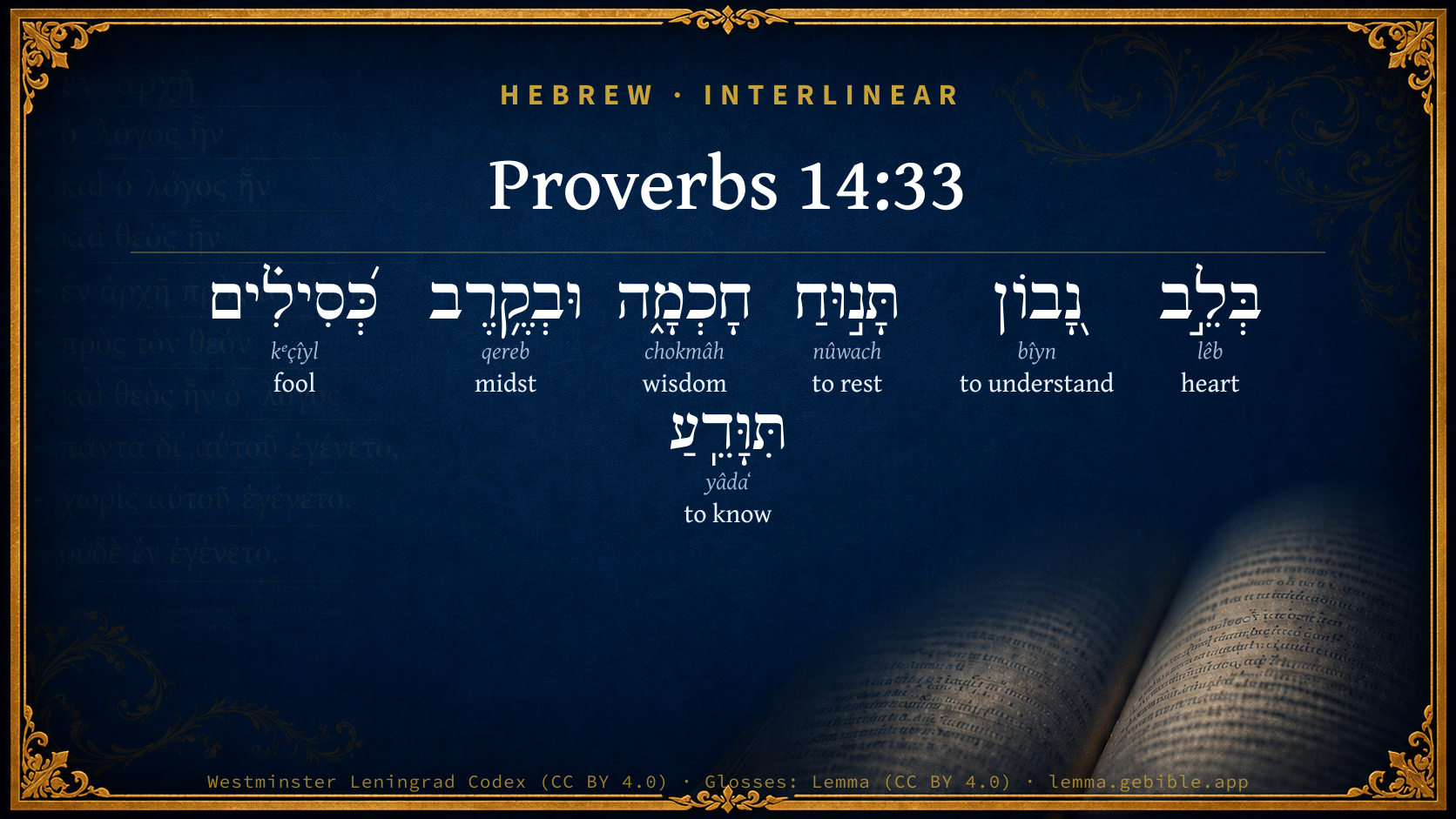
Hebrew (Westminster Leningrad Codex) Proverbs 14:33 appears in the Hebrew Old Testament. The text above is from the Westminster Leningrad Codex. Each word links to its Strong’s number, a concise gloss, and parsing drawn from the Open Scriptures Hebrew Bible morphology. Click any word for its full Brown-Driver-Briggs (BDB) entry.
Download image
Cite this verse

Proverbs 14:33 (World English Bible). Public Domain. Lemma interlinear Bible study tool, https://lemma.gebible.app/v/proverbs/14/33.

Show BibTeX & RIS
BibTeX
RIS
English Translation
Wisdom rests in the heart of one who has understanding, And is even made known in the inward part of fools.
World English Bible · Public Domain
Download a study sheet

One document with this verse’s original text, its word-by-word gloss line, the meaning frame, cross-references with their text, attributed commentary, and full source and license credits — printable, and it pastes into notes with its structure intact.

This verse Autodidact and up

Study sheet (.html) Plain text (.txt)

A passage Seminary Student

Up to 50 verses in one chapter. A passage sheet keeps up to 6 commentary sources and 12 cross-references per verse, in the order this page ranks them, and says so on the sheet whenever that leaves anything out. Ask for a single verse and you get the Autodidact verse sheet above.

Everything on this page stays free to read, with no account — the sheet is a download of what is already on screen, not access to it.

Want to remove ads? Support Godless Engineer
Compare translations 3

The same verse in 3 English versions, stacked beneath the original-language interlinear above. Click any original word for its lexicon entry.

Each is an independent rendering of the whole verse — the interlinear is not word-aligned to these translations.

Highlighted words mark where these versions differ — a whole-verse word diff, not a word-by-word alignment.

  • World English Bible Public Domain
    Wisdom rests in the heart of one who has understanding, And is even made known in the inward part of fools.
  • King James Version Public Domain
    Wisdom resteth in the heart of him that hath understanding: but that which is in the midst of fools is made known.
  • unfoldingWord Literal Text CC BY-SA 4.0
    In the heart of the understanding one rests wisdom, and in the midst of the stupid she will be known.

unfoldingWord Literal Text — © unfoldingWord, licensed CC BY-SA 4.0. Word-aligned USFM3 via Door43 (git.door43.org/unfoldingWord/en_ult).

Versions to compare (up to 4)

3 of 4 selected

Show all 18 translations

Every available English version of this verse, each an independent rendering of the whole verse.

  • World English Bible Public Domain
    Wisdom rests in the heart of one who has understanding, And is even made known in the inward part of fools.
  • Berean Standard Bible Public Domain
    Wisdom rests in the heart of the discerning; even among fools she is known.
  • Majority Standard Bible Public Domain
    Wisdom rests in the heart of the discerning; even among fools she is known.
  • King James Version Public Domain
    Wisdom resteth in the heart of him that hath understanding: but that which is in the midst of fools is made known.
  • American Standard Version (1901) Public Domain
    Wisdom resteth in the heart of him that hath understanding; But `that which is' in the inward part of fools is made known.
  • Revised Version (1885) Public Domain
    Wisdom resteth in the heart of him that hath understanding: but that which is in the inward part of fools is made known.
  • Geneva Bible (1599) Public Domain
    Wisedome resteth in the heart of him that hath vnderstanding, and is knowen in the mids of fooles.
  • Douay-Rheims (1899) Public Domain
    In the heart of the prudent resteth wisdom, and it shall instruct all the ignorant.
  • Young's Literal Translation Public Domain
    In the heart of the intelligent wisdom doth rest. And in the midst of fools it is known.
  • Literal Standard Version CC BY-SA 4.0
    Wisdom rests in the heart of the intelligent. And it is known in the midst of fools.
  • Unlocked Literal Bible CC BY-SA 4.0
    Wisdom rests in the heart of the discerning, but even among fools she lets herself be known.
  • unfoldingWord Literal Text CC BY-SA 4.0
    In the heart of the understanding one rests wisdom, and in the midst of the stupid she will be known.
  • Darby Bible Public Domain
    Wisdom resteth in the heart of the intelligent [man]; but that which is in the foolish maketh itself known.
  • World Messianic Bible Public Domain
    Wisdom rests in the heart of one who has understanding, and is even made known in the inward part of fools.
  • Webster's Bible Public Domain
    Wisdom resteth in the heart of him that hath understanding: but that which is in the midst of fools is made known.
  • Free Bible Version CC BY-SA 4.0
    Wisdom is at home in a mind that understands, but it's not found among stupid people.
  • Bible in Basic English Public Domain
    Wisdom has her resting-place in the mind of the wise, but she is not seen among the foolish.
  • JPS Tanakh (1917) Public Domain
    In the heart of him that hath discernment wisdom resteth; but in the inward part of fools it maketh itself known.

Literal Standard Version (2020), Covenant Press — licensed CC BY-SA 4.0. Text via the HelloAO Bible API (eBible.org). Unlocked Literal Bible (unfoldingWord) — licensed CC BY-SA 4.0. Text via the HelloAO Bible API (eBible.org). unfoldingWord Literal Text — © unfoldingWord, licensed CC BY-SA 4.0. Word-aligned USFM3 via Door43 (git.door43.org/unfoldingWord/en_ult). Free Bible Version, Dr. Jonathan Gallagher — licensed CC BY-SA 4.0. Text via the HelloAO Bible API (eBible.org).

Word by word

More ways to search: Search by grammar → Find every occurrence → Compare this word →

Practice this passage: Drill this verse → Learn its vocabulary →

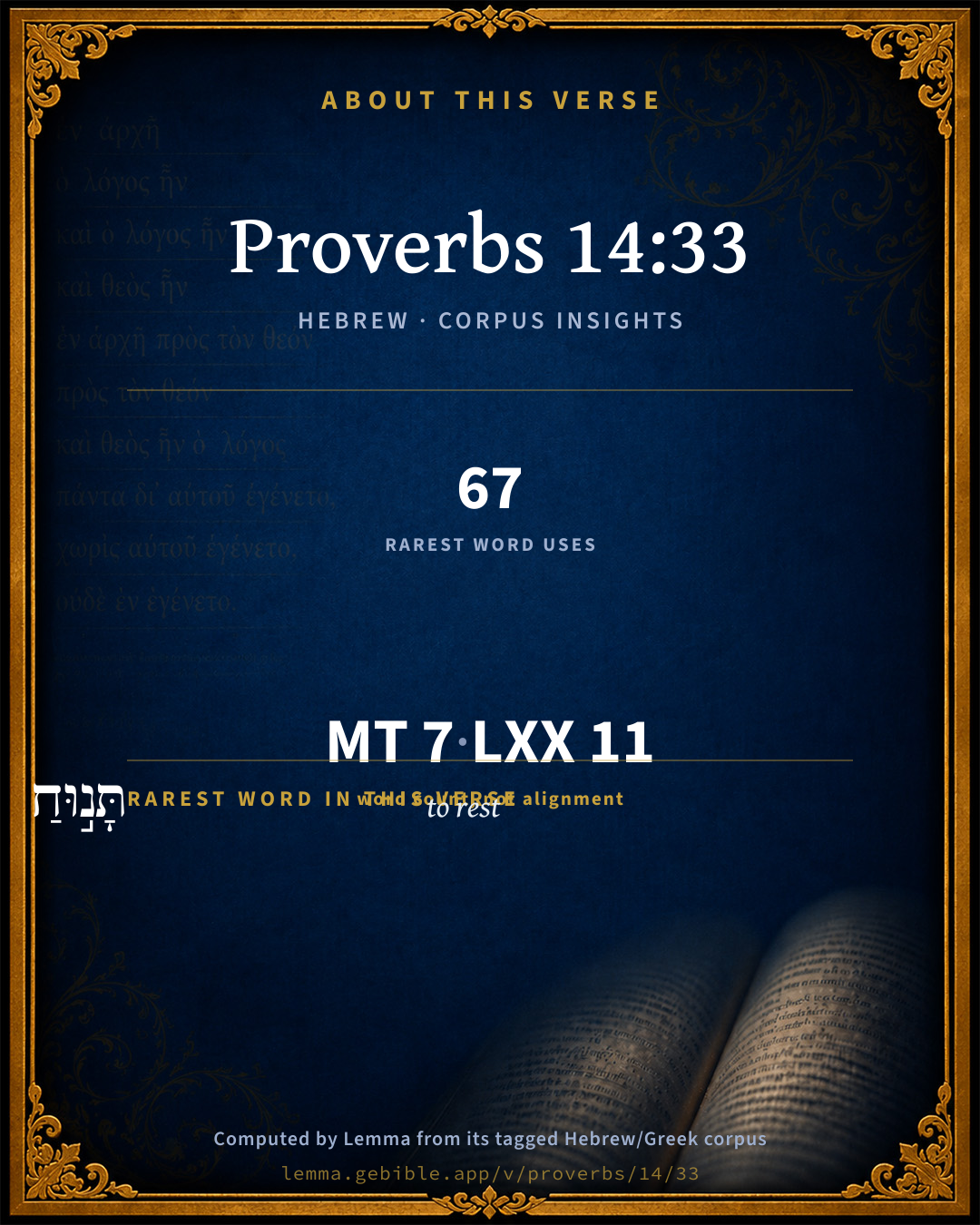
תָּנ֣וּחַ
nûwach
H5117
“to rest”
Verb, Qal, Imperfect, 3rd Person, Feminine, Singular
Part of Speech
Verb
Stem
Qal
Form
Imperfect
Person
3rd Person
Gender
Feminine
Number
Singular
Full BDB Definition

Origin: a primitive root

TWOT: 1323

to rest - (Qal) - to rest, settle down and remain - to repose, have rest, be quiet - (Hiphil) - to cause to rest, give rest to, make quiet - to cause to rest, cause to alight, set down - to lay or set down, deposit, let lie, place - to let remain, leave - to leave, depart from - to abandon - to permit - (Hophal) - to obtain rest, be granted rest - to be left, be placed - open space (substantive)
  1. בְּלֵ֣ב lêb H3820 “in/at · heart” Preposition + Noun, Common, Masculine, Singular, Absolute
  2. נָ֭בוֹן bîyn H995 “understanding” Verb, Niphal, Participle Active, Masculine, Singular, Absolute
  3. חָכְמָ֑ה chokmâh H2451 “wisdom” Noun, Common, Feminine, Singular, Absolute
  4. וּבְקֶ֥רֶב qereb H7130 “and · in/at · midst of” Conjunction + Preposition + Noun, Common, Masculine, Singular, Construct
  5. כְּ֝סִילִ֗ים kᵉçîyl H3684 “fool” Adjective, Adjective, Masculine, Plural, Absolute
  6. תִּוָּדֵֽעַ yâdaʻ H3045 “to know” Verb, Niphal, Imperfect, 3rd Person, Feminine, Singular

About this verse

These counts appear in no published source. They are computed here, from the morphology-tagged text and Lemma’s own curated glosses. What Lemma adds →

7
words
7
distinct lemmas
Wisdom
section

Grammatical profile

  • 3 verbs
  • 3 nouns
  • 1 adjective

Verb forms

  • נָ֭בוֹן Niphal · Participle Active
  • תָּנ֣וּחַ Qal · Imperfect
  • תִּוָּדֵֽעַ Niphal · Imperfect

Hebrew & Septuagint length

In English translation the verse runs 21 words from the Hebrew and 20 from the Septuagint (LXX English) — closely comparable.

A rough comparison of the two English renderings, which tokenize alike — not a word-level alignment.

Word counts can differ between the Hebrew and the Greek without any difference in meaning — e.g. the Hebrew direct-object marker אֵת has no separate Greek word, and Greek often adds the article ὁ.

In the original languages it is 7 Hebrew tokens and 11 Greek tokens — but the two are counted differently (Hebrew bundles its prefixes and suffixes into one token; the Greek is in lemma form), so that isn’t a like-for-like length.

Cross-references

7

Topical passages linked to Proverbs 14:33 in the Treasury of Scripture Knowledge — connected by theme and wording, ordered by reader-vote popularity; previews shown in the World English Bible.

  • Proverbs 12:16 A fool shows his annoyance the same day, But one who overlooks an insult is prudent.
  • Proverbs 12:23 A prudent man keeps his knowledge, But the hearts of fools proclaim foolishness.
  • Proverbs 15:28 The heart of the righteous weighs answers, But the mouth of the wicked gushes out evil.
  • Proverbs 13:16 Every prudent man acts from knowledge, But a fool exposes folly.
  • Proverbs 29:11 A fool vents all of his anger, But a wise man brings himself under control.
  • Ecclesiastes 10:3 Yes also, when the fool walks by the way, his understanding fails him, and he says to everyone that he is a fool.
  • Proverbs 15:2 The tongue of the wise commends knowledge, But the mouth of fools gush out folly.

Cross-references courtesy of OpenBible.info (CC BY 4.0).

Hebrew and Greek witnesses Masoretic Hebrew ↔ Greek Septuagint

The same verse in the two great witnesses to the Old Testament, shown verse-for-verse.

These are two independent witnesses, not word-aligned to each other, and the Septuagint is shown in lemma (dictionary) form.

Hebrew Proverbs 14:33 Masoretic · Westminster Leningrad Codex

בְּלֵ֣ב נָ֭בוֹן תָּנ֣וּחַ חָכְמָ֑ה וּבְקֶ֥רֶב כְּ֝סִילִ֗ים תִּוָּדֵֽעַ

Wisdom rests in the heart of one who has understanding, And is even made known in the inward part of fools.

World English Bible · Public Domain

Greek LXX Proverbs 14:33 Septuagint · lemma form

ἐν καρδία ἀγαθός ἀνήρ σοφία ἐν δέ καρδία ἄφρων οὐ διαγιγνώσκω

There is wisdom in the good heart of a man: but in the heart of fools it is not discerned.

LXX2012 (modern English Septuagint) · Public Domain

On this verse, Albert Barnes' Notes on the Bible discusses the Septuagint’s reading. Read the note in Commentary ↓

Hebrew: Westminster Leningrad Codex (CC BY 4.0). Greek: Septuagint (public domain); English from LXX2012 (modern English Septuagint) (Public Domain). How the Septuagint differs from the Hebrew →

Commentary

Notes on Proverbs 14:33 from classic Christian and Jewish commentators (each source and its license shown beneath its notes). The classic Christian expositions comment on the surrounding passage and are grouped to its opening verse, so a note may address several verses; the Jewish commentaries on the Tanakh (Rashi and others) are per-verse, so they appear only where the commentator wrote on this verse.

Lemma curates 59 commentaries, every one of them public domain or Creative Commons licensed, each selected and text-cleaned for this edition rather than reprinted as found. About our sources →

Trapp's Complete Commentary

John Trapp

Pro 14:33 Wisdom resteth in the heart of him that hath understanding: but [that which is] in the midst of fools is made known.

Ver. 33. Wisdom resteth in the heart of him, &c.] He sets not his good parts and practices a-sunning, as vain glorious fools used to do, that they may be praised and applauded. As Jerome calls Crates the philosopher, we may call the whole nation of them so, Gloriae animal, popularis aurae vile mancipium, {a} a base hunter after praise of men. The truly wise concealeth himself till he seeth a fit time, and may be compared to the red rose, which though outwardly not so fragrant, is inwardly far more cordial than the damask, being more thrifty of its sweetness, and reserving it in itself. Or to the violet, which grows low, hangs the head downward, and hides itself with its own leaves; whereas the marigold, of nothing so good a smell, opens and shuts with the sun; which, when it is set, it hangs down the head, as forlorn and desperate. So that which is in the midst of fools is made known. Jehonadab must needs see what zeal Jehu hath for the Lord of hosts; his piety is shored up by popularity, &c.

{a} Epist. ad Julian. consolator.

John Trapp, A Commentary or Exposition upon All the Books of the Old and New Testament (1647–1656) — public domain. Text from a community e-Sword module.

Joseph Benson's Commentary

Pro 14:33. Wisdom resteth in the heart, &c. — Is laid up and hid there, and not vainly or rashly uttered by him, but only brought forth upon necessary or fit occasions; but that which is in the midst — That is, in the heart; of fools, is made known — That folly which is there instead of wisdom, or that small degree of wisdom which they have, they will publish in all times and companies, without any consideration or discretion.

Joseph Benson's Commentary on the Old and New Testaments (1811–1818) — public domain. Text from a community e-Sword module.

The Preacher's Complete Homiletical Commentary

Joseph S. Exell (gen. ed.)

MAIN HOMILETICS OF Pro_14:33

THE HIDDEN MADE MANIFEST

I. The God-ordained place for moral wisdom—“the heart.” The divinely ordained place for the sap of the vine is its root.

1. It has its centre and spring there, that thence it may diffuse itself into every branch and leaf, and give life and health to the whole tree. So the divinely-ordained place for moral wisdom is the heart—the affections of a man. If it has its seat there it will certainly influence all his thoughts, and words, and deeds.

2. It is not only the most influential part of a man, but it is the most secure. There, if anywhere, it is out of the reach of harm. If it is only in the head—in the intellectual part of a man—temptation may rob him of it—false reasoning or adversity may shake it from its seat, but if it has hold of the heart, it will hold its own against every foe.

3. It is the only place from which it can reach and bless other human hearts. The sap of the tree must issue direct from its root if there is to be fruit that will sustain and give satisfaction to the eater. So a life will bring forth no fruit to feed others unless its religion is a religion of the heart. There is no way to the heart except from the heart, those who have only an intellectual hold upon moral wisdom cannot feed hungry souls.

4. It is the only place whence can issue glory to God. The whole man, spirit and soul and body, must be under the guidance of moral wisdom if he is to render acceptable service to God. Nothing less will satisfy Him who “searches the heart of the children of men” (Jer_17:10). If the heart is right, the external service will not be wanting. (See Homiletics and Comments on chap. Pro_4:23).

II. Where this wisdom of the heart is lacking, the life will betray it. In all natural life there is a law by which its hidden secrets are manifested in outward signs. The health of the root is seen in the health of the tree, the disease of the internal bodily organs manifests itself in the outward appearance. So it is with moral health and disease. However men may try to appear what they are not, the natural tendency of human nature often proves too strong for the artificial restraint that is put upon it, and sooner or later men reveal what they really are. “That which is in the midst of moral fools is made known,” although time is needed for the folly fully to develop itself.

OUTLINES AND SUGGESTIVE COMMENTS

“Resteth” implies the tranquil and modest spirit of the wise, and the permanence of their keeping of wisdom; and especially that it is the fruit of the spirit from above descending and abiding on them (Num_11:25-26; Isa_11:2; 2Ki_2:15). Contrast Ecc_7:9. The wise does not draw forth his wisdom from its resting place within his heart at random, but in proper place and time, as the occasion may require. But fools cannot long disguise their folly (see chap. Pro_10:14; Pro_12:23; Pro_13:16). The Hebrew adage says, “A vessel full of coins will make no noise; but if there be only one coin in it, it will make a rattle.” The more learned one is, the more modest he will be; the more unlearned, the more presumptuous and ostentatious.—Fausset.

In the heart of the understanding wisdom remains silent and still, for the understanding feels himself personally happy in its possession, endeavours all the more to deepen it, and lets it operate within.—Deliztsch.

There she keepeth residence and there she ruleth, and thither she bringeth her treasures and her comforts, and every good thing that is to be wished for. And therefore she calleth for it, as most meet for her to possess; and safest for every wise man to yield unto her. “My son, give me thine heart.”

The Preacher's Complete Homiletical Commentary (gen. ed. Joseph S. Exell; Funk & Wagnalls, c. 1892) — public domain (pre-1929). A full-Bible homiletical/sermon-outline anthology covering 65 of 66 books (2 John is absent from the source module). Text from a community e-Sword module.

Geneva Bible (1599)

Geneva Bible translators

Forasmuch as they are convicted thereby and put to silence.

Geneva Bible (1599) marginal notes — public domain. Text via Bolls.life.

Matthew Henry's Commentary

Observe, 1. Modesty is the badge of wisdom. He that is truly wise hides his treasure, so as not to boast of it (Mat 13:44), though he does not hide his talent, so as not to trade with it. His wisdom rests in his heart; he digests what he knows, and has it ready to him, but does not unseasonably talk of it and make a noise with it. The heart is the seat of the affections, and there wisdom must rest in the practical love of it, and not swim in the head. 2. Openness and ostentation are a mark of folly. If fools have a little smattering of knowledge, they take all occasions, though very foreign, to produce it, and bring it in by head and shoulders. Or the folly that is in the midst of fools is made known by their forwardness to talk. Many a foolish man takes more pains to show his folly than a wise man thinks it worth his while to take to show his wisdom.

Matthew Henry's Commentary on the Whole Bible (1708–1710) — public domain (CC PDM 1.0). Text via the HelloAO Bible API.

Jamieson, Fausset & Brown

Robert Jamieson, A. R. Fausset & David Brown

resteth--preserved in quietness for use, while fools blazon their folly (Pro 12:23; Pro 13:16).

Jamieson, Fausset & Brown — Commentary Critical and Explanatory on the Whole Bible (1871) — public domain (CC PDM 1.0). Text via the HelloAO Bible API.

Ellicott's Commentary for English Readers

(33) But that which is in the midst of fools is made known.—“Wisdom” is the subject of this as of the former half of the verse. “Wisdom rests in the heart of him that hath understanding;” he does not care to drag it out and exhibit it, but the fool cannot keep to himself anything which he thinks he knows.

A Bible Commentary for English Readers, edited by Charles John Ellicott (1878–1897) — public domain. Text from a community e-Sword module.

The Cambridge Bible for Schools and Colleges

gen. ed. J. J. S. Perowne

33. the midst] Rather (answering to the heart in the 1st clause) the inward part, R.V. Adopting this, we may render, either with A.V. and R.V. text, “that which is in the inward part” (i.e. their folly, comp. Pro_12:23); or “but in the inward part of fools it (wisdom, any modicum of it which they have or think they have), so far from resting and biding its time, is blurted out.”

The Cambridge Bible for Schools and Colleges (gen. ed. J. J. S. Perowne; Cambridge University Press, 1878–1918) — public domain. Text from a community e-Sword module.

John Gill's Exposition

Wisdom resteth in the heart of him that hath understanding,.... It is in his heart, as the treasury where it is laid up, and where it is kept in safety; here it lies hid and undiscerned, unmolested and undisturbed; no noise is made about it, or any ostentation of it; it dwells quietly and constantly there;

but that which is in the midst of fools is made known; the least share of knowledge which such persons have, or think they have, does not lie long in the midst of them; they take every opportunity of showing it to others, or of letting others know what they have attained to; and thereby, instead of getting the character of wise and prudent men, obtain that of fools; for, though a prudent man is communicative of his knowledge to others, it is at proper times, and in proper places, and to proper persons, which fools do not observe; but, without any manner of judgment or discretion, or regard to persons, places, and seasons, vainly thrust out their knowledge, and so proclaim their folly. The Syriac version is,

"in the heart of fools it shall not be known;''

it has no place there.

John Gill's Exposition of the Whole Bible (1746–1763) — public domain (CC PDM 1.0). Text via the HelloAO Bible API.

Albert Barnes' Notes on the Bible

Omit “that which is.” “Wisdom” is the subject of both clauses. She is “made nown,” i. e., by the very force of contrast, in the midst of fools; or she is reserved and reticent in the one, noisy and boastful in the other. The Septuagint and some other versions get over the difficulty, by reading “Wisdom is not made known.”

Albert Barnes' Notes on the Bible (1834–1885) — public domain. Text from a community e-Sword/MySword module.

Haydock's Catholic Bible Commentary

And. Protestants, "but that which is in the midst of fools is made known." (Haydock) --- A vessel full of gold makes no noise, while that which contains only a few pieces sounds much. (Munster.) (Cornelius a Lapide) --- Thus the fool makes a parade of all that he knows. (Calmet) --- Septuagint, "but in the heart of fools, it is not known." (Haydock) --- Aquila and Theodotion have the negation, (Calmet) as well as the Syriac and Arabic. See chap. v. 16. (Kennicott)

George Leo Haydock (1774–1849), Haydock's Catholic Family Bible and Commentary, 1859 edition — public domain. Excludes Psalms (Douay-Rheims chapter numbering differs from Protestant) and Deuterocanonical books (Catholic canon only).

Matthew Poole's English Annotations

Resteth; is laid up and hid there, and not vainly nor rashly uttered by him, but only upon necessary or fit occasions.

In the midst, i.e. in the heart, which is expressed by this very word, Psa 64:6, and elsewhere. That folly which is there instead of wisdom; or, that small degree of wisdom or knowledge which they have.

Is made known; they will publish it in all times and companies, without any consideration or discretion.

Matthew Poole's English Annotations on the Holy Bible (1683–1685) — public domain. Text from a community e-Sword/MySword module.

Whedon's Commentary on the Bible

Daniel D. Whedon

33. Wisdom resteth in the heart of him that hath understanding — Reposeth there, not obtruding itself, or being solicitous of notice.

That which is in the midst of fools (in the heart of such) is made known — Is soon exhibited, both by tongue and act. Comp. Pro_10:14; Pro_12:16; Pro_12:23; Pro_13:16; Pro_15:2; Pro_29:11.

Daniel D. Whedon (gen. ed.), Commentary on the Old and New Testaments (1874–1909) — public domain. Text from a community e-Sword module.

The Pulpit Commentary

Wisdom resteth in the heart of him that hath understanding. The wise man is not always blurting out and making a display of his wisdom; he lets it lie still and hidden till there is occasion to use it with effect. (Pro_10:14 Pro_12:23) But that which is in the midst of fools is made known; literally and better, but in the midst of fools it, wisdom, maketh itself known. That is, in contrast to the folly of fools, wisdom is seen to great advantage; or, it may be, the conceited display of the fool"s so called wisdom is contrasted with the modesty and reticence of the really intelligent man. "A fool"s heart is ever dancing on his lips," says a proverb. So Ecc 21:26, "The heart of fools is in their mouth; but the mouth of the wise is in their heart." Theognia, 1163 Ofyalmoi kai gkwssa kai ouata kai noov andrwn En messw sthyewn en aunetoiv fuetai . "The eyes, and tongue, and ears, and mind alike Are centred in the bosom of the wise.

Vulgate, "In the heart of the prudent resteth wisdom, and it will teach all the unlearned." Wisdom sits enshrined in the intelligent man"s mind, and thence disseminates instruction and light around to all who need it. The Septuagint, with which agree the Syriac, Aquila, and Theodotion, inserts a negative in the second clause, thus: "In the good heart of a man shall rest wisdom, but in the heart of fools it is not discerned". (RAPC Wis 1:4)

See homily on Pr 29.

The Pulpit Commentary (1880–1919), ed. H.D.M. Spence-Jones & Joseph S. Exell — public domain. Text from a community e-Sword module.

John Wesley's Explanatory Notes

Resteth - Is laid up and hid there. In the midst - In the heart. Made known - They will publish in all times and companies.

John Wesley, Explanatory Notes Upon the Whole Bible (1754–1765) — public domain. Text via the GEBible commentary corpus.

Keil & Delitzsch

C. F. Keil & F. Delitzsch

33 Wisdom rests in the heart of the man of understanding;

But the heart of fools it maketh itself known.

Most interpreters know not what to make of the second line here. The lxx (and after it the Syr.), and as it appears, also Aquila and Theodotion, insert οὐ; the Targ. improves the Peshito, for it inserts אוּלת (so that Pro 12:23; Pro 13:16, and Pro 15:2 are related). And Abulwald explains: in the heart of fools it is lost; Euchel: it reels about; but these are imaginary interpretations resting on a misunderstanding of the passages, in which ידע means to come to feel, and הודיע to give to feel (to punish, correct). Kimchi rightly adheres to the one ascertained meaning of the words, according to which the Venet. μέσον δὲ ἀφρόνων γνωσθήσεται. So also the translation of Jerome: et indoctos quosque (quoque) erudiet, is formed, for he understands the "and is manifest among fools" (Luther) not merely, as C. B. Michaelis, after the saying: opposita juxta se posita magis elucescunt, but of a becoming manifest, which is salutary to these. Certainly בּקרב can mean among = in the circle, of Pro 15:31; but if, as here and e.g., Jer 31:31, בקרב is interchanged with בלב, and if חכמה בקרב is the subject spoken of, as Kg1 3:28, then בקרב does not mean among (in the midst of), but in the heart of the fool. According to this, the Talmud rightly, by comparison with the current proverb (Meza 85b): אסתירא בלגינא קישׁ קישׁ קריא, a stater in a flaggon cries Kish, Kish, i.e., makes much clatter. In the heart of the understanding wisdom rests, i.e., remains silent and still, for the understanding feels himself personally happy in its possession, endeavours always the more to deepen it, and lets it operate within; on the contrary, wisdom in the heart of fools makes itself manifest: they are not able to keep to themselves the wisdom which they imagine they possess, or the portion of wisdom which is in reality theirs; but they think, as it is said in Persius: Scire tuum nihil est nisi scire hoc te sciat alter. They discredit and waste their little portion of wisdom (instead of thinking on its increase) by obtrusive ostentatious babbling.

Keil & Delitzsch — Biblical Commentary on the Old Testament (1861–1891) — public domain (CC PDM 1.0). Text via the HelloAO Bible API. (Old Testament only.)

Bridges on Proverbs

Charles Bridges

Often does the wise man shew the blessing of wisdom on the lips. (Pro 10:11, Pro 10:20-21 ; Pro 15:2, Pro 15:7 .) Here we trace it to its home. It flows from the head, and rests in the heart. Thus did it rest without measure in the humanity of Jesus (Joh 3:34 ); and most glorious was its manifestation.†1 When it rests in our hearts, incalculable is its value, as a fixed principle. It preserves us from the tossing of "divers and strange doctrines," and gives us "the good thing of a heart established with grace." (Heb 13:9 .) We see now the vital difference between speculation and experience; between the convictions of the judgment and the movement of the will.

It differs widely from mere worldly disputation. This — as Bishop Taylor observes — ’covers no vices, but kindles a great many. Though men esteem it learning, it is the most useless learning in the world.’†2 True wisdom, while it fixes its rest, sets up its throne, in the heart. All is therefore Christian order and holiness.

But there is another fountain always bubbling up.†3 The fool’s multitude of words,†4 selfish indulgence,†5 uncontrolled passions,†6 make manifest what is in the midst of him.†7 Let him stand out as a warning beacon against display, self-conceit, self-ignorance. Never let our prayers cease, until He who is the Wisdom of God (1Co 1:24 ) "takes his rest in our hearts." Have we received the precious gift? Then let us seek the increase by a close union with him, and an entire dependence upon him. (1Co 1:30 .)

Footnotes:

†1 Luk 2:47, Luk 2:52 ; Luk 4:22 . Mat 22:46 . Joh 7:46 .

†2 Via Intelligentiæ — Preached before the University of Dublin.

†3 Pro 15:2, Pro 15:28 ; Pro 29:11 .

†4 Ecc 5:3; Ecc 10:14 .

†5 1Sa 25:10 .

†6 1Sa 20:30-34 . 1Ki 19:1-2 . Compare Pro 14:16 ; Pro 12:16 .

†7 Pro 10:9; Pro 12:23 ; Pro 13:16 ; Pro 18:2 . Ecc 10:3 .

Charles Bridges, An Exposition of the Book of Proverbs (1846) — public domain. Text from a community e-Sword module.

Kretzmann's Popular Commentary

Paul E. Kretzmann

v. 33. Wisdom resteth in the heart of him that hath understanding, it is quietly safe there, and the wise person carefully guards and increases it; but that which is in the midst of fools is made known, they are always eager and loud in giving their opinion, since they believe themselves to be wise, but they thereby reveal their lack of true understanding, they make known the emptiness of their minds.

Paul E. Kretzmann, Popular Commentary of the Bible (1921–1924) — public domain. Text from a community e-Sword module.

Rashi

Rabbi Shlomo Yitzchaki (Rashi)

Wisdom rests in the heart of an understanding man Heb. תנוח, it dwells and rests tranquilly; an expression of rest and tranquility.

but in the midst of the fools it is known The little wisdom that is in his heart calls out. This parallels the Talmudic maxim (Baba Mezia 85b): “A coin in a bottle makes a sound of kish kish.”

Rashi on the Tanakh — English translations: “The Judaica Press complete Tanach with Rashi, translated by A. J. Rosenberg” (CC BY 4.0); “Pentateuch with Rashi's commentary by M. Rosenbaum and A.M. Silbermann, 1929-1934” (public domain); “The Metsudah Tanach series, Lakewood, N.J” (CC BY 4.0); and “The Book of Joshua, Metsudah Publications, 1997” (CC BY 4.0). Text via Sefaria.

Lesson kit

Teaching starters — assembled from the data on this page, not authored interpretation. Every prompt links to the verse data it draws on. Edit before teaching.

Proverbs, in the Wisdom, opens this verse with 7 words (7 distinct Hebrew lemmas). Its most distinctive word is nûwach (“to rest”). A historical commentator’s framing appears above. Read the whole chapter for the surrounding context.

Discussion questions

  1. How does “to rest” (nûwach) shape what this verse is saying?
  2. Proverbs 12:16 shares this passage’s theme. How do the two illuminate each other?
  3. These translations render this verse differently; the difference is in the English rendering, not the original. What questions does that raise?
  4. The verb «נָ֭בוֹן» is Niphal Participle Active. How does its form color the action?
  5. Reading how Trapp's Complete Commentary and Joseph Benson's Commentary read this verse, where do the two commentators agree and where do they part?

Things to notice

Reading settings

Reading text

Shown beneath each verse's original-language words.

Old Testament
Old Testament edition

Read the OT as the Masoretic Hebrew (MT) or the Greek Septuagint (LXX).

English shown for the Greek Septuagint (in the Hebrew ↔ Greek comparison).

Comparing translations? Open the Compare panel on any verse page to stack up to four side by side.