
Psalms 46:5

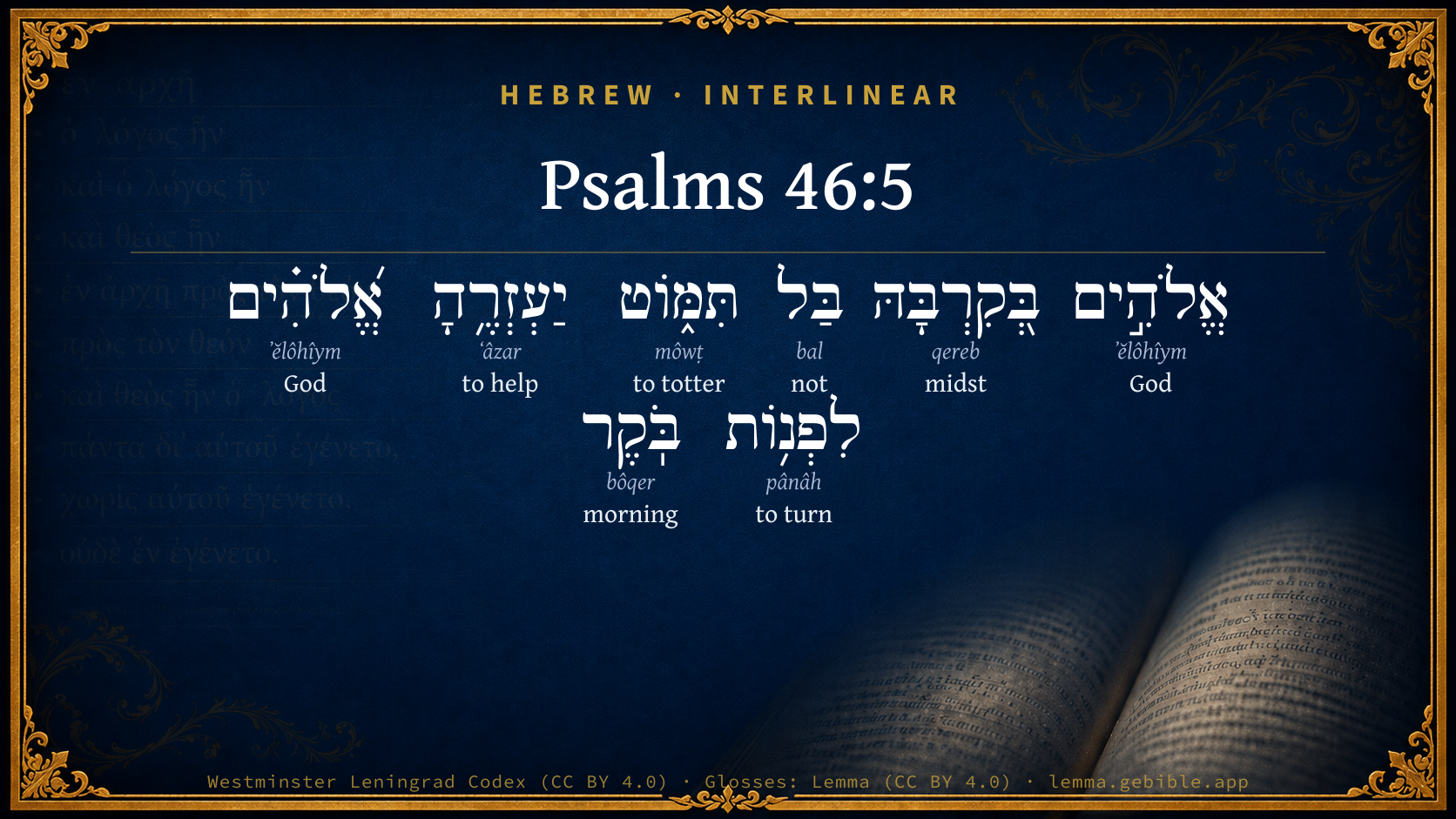
Hebrew (Westminster Leningrad Codex) Psalms 46:5 appears in the Hebrew Old Testament. The text above is from the Westminster Leningrad Codex. Each word links to its Strong’s number, a concise gloss, and parsing drawn from the Open Scriptures Hebrew Bible morphology. Click any word for its full Brown-Driver-Briggs (BDB) entry.
Download image
Cite this verse

Psalms 46:5 (World English Bible). Public Domain. Lemma interlinear Bible study tool, https://lemma.gebible.app/v/psalms/46/5.

Show BibTeX & RIS
BibTeX
RIS
English Translation
God is in her midst. She shall not be moved. God will help her at dawn.
World English Bible · Public Domain
Download a study sheet

One document with this verse’s original text, its word-by-word gloss line, the meaning frame, cross-references with their text, attributed commentary, and full source and license credits — printable, and it pastes into notes with its structure intact.

This verse Autodidact and up

Study sheet (.html) Plain text (.txt)

A passage Seminary Student

Up to 50 verses in one chapter. A passage sheet keeps up to 6 commentary sources and 12 cross-references per verse, in the order this page ranks them, and says so on the sheet whenever that leaves anything out. Ask for a single verse and you get the Autodidact verse sheet above.

Everything on this page stays free to read, with no account — the sheet is a download of what is already on screen, not access to it.

Want to remove ads? Support Godless Engineer
Compare translations 3

The same verse in 3 English versions, stacked beneath the original-language interlinear above. Click any original word for its lexicon entry.

Each is an independent rendering of the whole verse — the interlinear is not word-aligned to these translations.

Highlighted words mark where these versions differ — a whole-verse word diff, not a word-by-word alignment.

  • World English Bible Public Domain
    God is in her midst. She shall not be moved. God will help her at dawn.
  • King James Version Public Domain
    God is in the midst of her; she shall not be moved: God shall help her, and that right early.
  • unfoldingWord Literal Text CC BY-SA 4.0
    God in the midst of her, she will not be shaken. God will help her at the turning of the morning.

unfoldingWord Literal Text — © unfoldingWord, licensed CC BY-SA 4.0. Word-aligned USFM3 via Door43 (git.door43.org/unfoldingWord/en_ult).

Versions to compare (up to 4)

3 of 4 selected

Show all 18 translations

Every available English version of this verse, each an independent rendering of the whole verse.

  • World English Bible Public Domain
    God is in her midst. She shall not be moved. God will help her at dawn.
  • Berean Standard Bible Public Domain
    God is within her; she will not be moved. God will help her when morning dawns.
  • Majority Standard Bible Public Domain
    God is within her; she will not be moved. God will help her when morning dawns.
  • King James Version Public Domain
    God is in the midst of her; she shall not be moved: God shall help her, and that right early.
  • American Standard Version (1901) Public Domain
    God is in the midst of her; she shall not be moved: God will help her, and that right early.
  • Revised Version (1885) Public Domain
    God is in the midst of her; she shall not be moved: God shall help her, and that right early.
  • Geneva Bible (1599) Public Domain
    God is in the middes of it: therefore shall it not be moued: God shall helpe it very earely.
  • Douay-Rheims (1899) Public Domain
    The stream of the river maketh the city of God joyful: the most High hath sanctified his own tabernacle.
  • Young's Literal Translation Public Domain
    God `is' in her midst -- she is not moved, God doth help her at the turn of the morn!
  • Literal Standard Version CC BY-SA 4.0
    God [is] in her midst—she is not moved, God helps her at the turn of the morning!
  • Unlocked Literal Bible CC BY-SA 4.0
    God is in the middle of her; she will not be moved; God will help her, and he will do so at the dawn of morning.
  • unfoldingWord Literal Text CC BY-SA 4.0
    God in the midst of her, she will not be shaken. God will help her at the turning of the morning.
  • Darby Bible Public Domain
    God is in the midst of her; she shall not be moved: God shall help her at the dawn of the morning.
  • World Messianic Bible Public Domain
    God is within her. She shall not be moved. God will help her at dawn.
  • Webster's Bible Public Domain
    \\46:4\\There is a river, the streams of which shall make glad the city of God, the holy place of the tabernacles of the Most High.
  • Free Bible Version CC BY-SA 4.0
    God is in the midst of the city; it will never fall. God protects it as soon as it is light.
  • Bible in Basic English Public Domain
    God has taken his place in her; she will not be moved: he will come to her help at the dawn of morning.
  • JPS Tanakh (1917) Public Domain
    (46-6) God is in the midst of her, she shall not be moved; God shall help her, at the approach of morning.

Literal Standard Version (2020), Covenant Press — licensed CC BY-SA 4.0. Text via the HelloAO Bible API (eBible.org). Unlocked Literal Bible (unfoldingWord) — licensed CC BY-SA 4.0. Text via the HelloAO Bible API (eBible.org). unfoldingWord Literal Text — © unfoldingWord, licensed CC BY-SA 4.0. Word-aligned USFM3 via Door43 (git.door43.org/unfoldingWord/en_ult). Free Bible Version, Dr. Jonathan Gallagher — licensed CC BY-SA 4.0. Text via the HelloAO Bible API (eBible.org).

Word by word

More ways to search: Search by grammar → Find every occurrence → Compare this word →

Practice this passage: Drill this verse → Learn its vocabulary →

תִּמּ֑וֹט
môwṭ
H4131
“to totter”
Verb, Niphal, Imperfect, 3rd Person, Feminine, Singular
Part of Speech
Verb
Stem
Niphal
Form
Imperfect
Person
3rd Person
Gender
Feminine
Number
Singular
Full BDB Definition

Origin: a primitive root

TWOT: 1158

to totter, shake, slip - (Qal) to totter, shake, slip - (Niphal) to be shaken, be moved, be overthrown - (Hiphil) to dislodge, let fall, drop - (Hithpael) to be greatly shaken
  1. אֱלֹהִ֣ים ʼĕlôhîym H430 “God(s)” Noun, Common, Masculine, Plural, Absolute
  2. בְּ֭קִרְבָּהּ qereb H7130 “in/at · midst · her” Preposition + Noun, Common, Masculine, Singular, Construct + Suffix, Personal, 3rd Person, Feminine, Singular
  3. בַּל bal H1077 “not” Particle, Negative
  4. יַעְזְרֶ֥הָ ʻâzar H5826 “to help · her” Verb, Qal, Imperfect, 3rd Person, Masculine, Singular + Suffix, Personal, 3rd Person, Feminine, Singular
  5. אֱ֝לֹהִ֗ים ʼĕlôhîym H430 “God(s)” Noun, Common, Masculine, Plural, Absolute
  6. לִפְנ֥וֹת pânâh H6437 “to turn” Preposition + Verb, Qal, Infinitive Construct
  7. בֹּֽקֶר bôqer H1242 “morning” Noun, Common, Masculine, Singular, Absolute

About this verse

These counts appear in no published source. They are computed here, from the morphology-tagged text and Lemma’s own curated glosses. What Lemma adds →

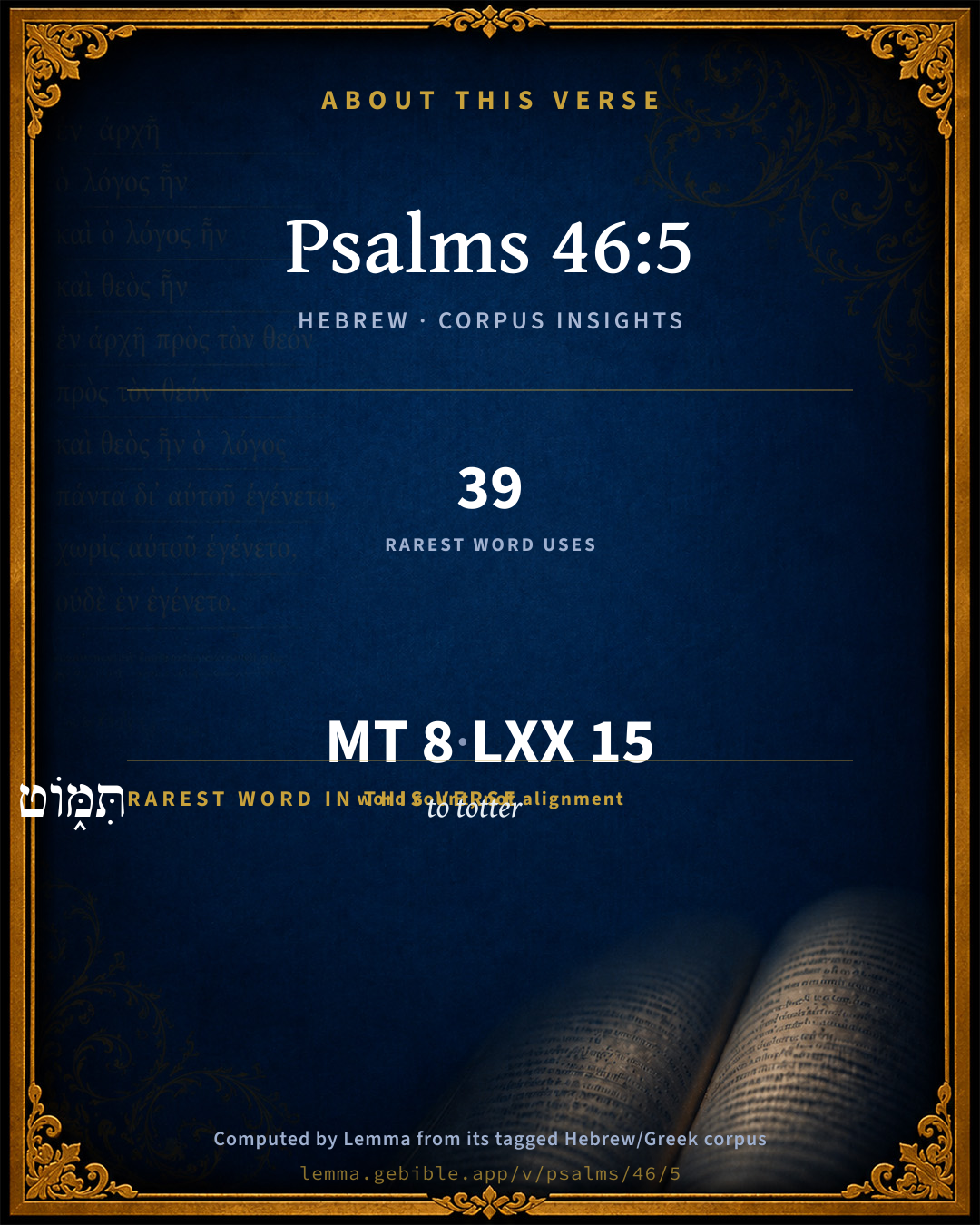
8
words
7
distinct lemmas
Wisdom
section

Shared distinctive vocabulary

תִּמּ֑וֹט to totter H4131 occurs in 36 verses of the Hebrew Bible. Also found in:

Grammatical profile

  • 3 verbs
  • 4 nouns
  • 1 particle

Verb forms

  • תִּמּ֑וֹט Niphal · Imperfect
  • יַעְזְרֶ֥הָ Qal · Imperfect
  • לִפְנ֥וֹת Qal · Infinitive Construct

Repetition

A word recurs within this verse — often emphatic in Hebrew:

  • אֱלֹהִ֣ים God H430 ×2

Hebrew & Septuagint length

In English translation the verse runs 16 words from the Hebrew and 19 from the Septuagint (LXX English) — closely comparable.

A rough comparison of the two English renderings, which tokenize alike — not a word-level alignment.

Word counts can differ between the Hebrew and the Greek without any difference in meaning — e.g. the Hebrew direct-object marker אֵת has no separate Greek word, and Greek often adds the article ὁ.

In the original languages it is 8 Hebrew tokens and 15 Greek tokens — but the two are counted differently (Hebrew bundles its prefixes and suffixes into one token; the Greek is in lemma form), so that isn’t a like-for-like length.

Cross-references

23

Topical passages linked to Psalms 46:5 in the Treasury of Scripture Knowledge — connected by theme and wording, ordered by reader-vote popularity; previews shown in the World English Bible.

  • Zechariah 2:5 For I,' says Yahweh, 'will be to her a wall of fire around it, and I will be the glory in the midst of her.
  • Joel 2:27 You will know that I am in the midst of Israel, And that I am Yahweh, your God, and there is no one else; And my people will never again be disappointed.
  • Zephaniah 3:15 Yahweh has taken away your judgments. He has thrown out your enemy. The King of Israel, Yahweh, is in the midst of you. You will not be afraid of evil any more.
  • Zechariah 2:10–11 Sing and rejoice, daughter of Zion; for, behold, I come, and I will dwell in the midst of you,' says Yahweh.
  • Ezekiel 43:7 He said to me, Son of man, [this is] the place of my throne, and the place of the soles of my feet, where I will dwell in the midst of the children of Israel forever. The house of Israel shall no more defile my holy name, neither they, nor their kings, by their prostitution, and by the dead bodies of their kings [in] their high places;
  • Psalms 62:2 He alone is my rock and my salvation, my fortress-- I will never be greatly shaken.
  • Isaiah 12:6 Cry aloud and shout, you inhabitant of Zion; for great in the midst of you is the Holy One of Israel!"
  • Psalms 112:6 For he will never be shaken. The righteous will be remembered forever.
  • Matthew 18:20 For where two or three are gathered together in my name, there I am in the midst of them."
  • Psalms 30:5 For his anger is but for a moment; His favor is for a lifetime. Weeping may stay for the night, But joy comes in the morning.
  • Deuteronomy 23:14 for Yahweh your God walks in the midst of your camp, to deliver you, and to give up your enemies before you; therefore shall your camp be holy, that he may not see an unclean thing in you, and turn away from you.
  • Psalms 62:6 He alone is my rock and my salvation, my fortress. I will not be shaken.
  • Zechariah 8:3 Thus says Yahweh: "I have returned to Zion, and will dwell in the midst of Jerusalem. Jerusalem shall be called 'The City of Truth;' and the mountain of Yahweh of Hosts, 'The Holy Mountain.'"
  • Ezekiel 43:9 Now let them put away their prostitution, and the dead bodies of their kings, far from me; and I will dwell in the midst of them forever.
  • Psalms 37:40 Yahweh helps them, and rescues them. He rescues them from the wicked, and saves them, Because they have taken refuge in him.
  • Hosea 11:9 I will not execute the fierceness of my anger. I will not return to destroy Ephraim: For I am God, and not man; the Holy One in the midst of you; And I will not come in wrath.
  • Luke 18:8 I tell you that he will avenge them quickly. Nevertheless, when the Son of Man comes, will he find faith on the earth?"
  • Psalms 125:1 Those who trust in Yahweh are as Mount Zion, Which can't be moved, but remains forever.
  • Psalms 143:8 Cause me to hear your loving kindness in the morning, For I trust in you. Cause me to know the way in which I should walk, For I lift up my soul to you.
  • Psalms 68:18 You have ascended on high. You have led away captives. You have received gifts among men, Yes, among the rebellious also, that Yah God might dwell there.
  • Revelation 2:1 To the angel of the assembly in Ephesus write: "He who holds the seven stars in his right hand, he who walks among the seven golden lampstands says these things:
  • Exodus 14:24 It happened in the morning watch, that Yahweh looked out on the host of the Egyptians through the pillar of fire and of cloud, and confused the Egyptian army.
  • Exodus 14:27 Moses stretched out his hand over the sea, and the sea returned to its strength when the morning appeared; and the Egyptians fled against it. Yahweh overthrew the Egyptians in the midst of the sea.

Cross-references courtesy of OpenBible.info (CC BY 4.0).

Hebrew and Greek witnesses Masoretic Hebrew ↔ Greek Septuagint

The same verse in the two great witnesses to the Old Testament, shown verse-for-verse.

You’re reading Greek Psalm 45 (Hebrew Psalm 46). The Septuagint counts the superscription, so verse numbers can differ from the Hebrew — chapter-level alignment, not verse-by-verse. Numbering follows Rahlfs.

These are two independent witnesses, not word-aligned to each other, and the Septuagint is shown in lemma (dictionary) form.

Hebrew Psalms 46:5 Masoretic · Westminster Leningrad Codex

אֱלֹהִ֣ים בְּ֭קִרְבָּהּ בַּל תִּמּ֑וֹט יַעְזְרֶ֥הָ אֱ֝לֹהִ֗ים לִפְנ֥וֹת בֹּֽקֶר

God is in her midst. She shall not be moved. God will help her at dawn.

World English Bible · Public Domain

Greek LXX Greek Psalm 45:5 Septuagint · lemma form

ὁ ποταμός ὁ ὅρμημα εὐφραίνω ὁ πόλις ὁ θεός ἁγιάζω ὁ σκήνωμα αὐτός ὁ ὕψιστος

God is in the midst of her; she shall not be moved: God shall help her with his countenance.

LXX2012 (modern English Septuagint) · Public Domain

Hebrew: Westminster Leningrad Codex (CC BY 4.0). Greek: Septuagint (public domain); English from LXX2012 (modern English Septuagint) (Public Domain). How the Septuagint differs from the Hebrew →

Commentary

Notes on Psalms 46:5 from classic Christian and Jewish commentators (each source and its license shown beneath its notes). The classic Christian expositions comment on the surrounding passage and are grouped to its opening verse, so a note may address several verses; the Jewish commentaries on the Tanakh (Rashi and others) are per-verse, so they appear only where the commentator wrote on this verse.

Lemma curates 59 commentaries, every one of them public domain or Creative Commons licensed, each selected and text-cleaned for this edition rather than reprinted as found. About our sources →

Trapp's Complete Commentary

John Trapp

Psa 46:5 God [is] in the midst of her; she shall not be moved: God shall help her, [and that] right early.

Ver. 5. God is in the midst of her] Hence the Church is called Jehovah Shammah, the Lord is there, Eze 48:35, there he hath set him up a mercy seat, a throne of grace, and paved his people a new and living way thereunto with the blood of his Son, so that they may come boldly, obtain mercy, and find grace to help in time of need, Heb 4:14.

She shall not be moved] Or, not greatly moved, Psa 62:2, in those great commotions abroad the world, Psa 46:2-3. This bush may burn, but shall not be consumed; and that by the blessing of him that dwelt in the bush, Deu 33:16 Built she is upon a rock, Mat 16:18, and so is every particular believer, Mat 7:25. And if at any time they be in distress,

God shall help her, and that right early] Heb. when the morning appeareth; that is, in the nick of time, when help shall be most seasonable and best welcome, Exo 14:23, Begneth haveshugnah (Kimchi). Mourning lasteth but till morning, Psa 30:5; the Church is invincible, ακινητος και ανικητος).

John Trapp, A Commentary or Exposition upon All the Books of the Old and New Testament (1647–1656) — public domain. Text from a community e-Sword module.

J. A. Alexander on Psalms

Joseph Addison Alexander

6. (Psa 46:5). God (is) in the midst of her, she shall not be moved; God will help her at the turning of the morning. This last idiomatic phrase seems to mean, at the point when the day turns to come back, after reaching its greatest distance. See Exo 14:27, Jdg 19:26, and compare Deu 23:12 (11). The idea is that of a critical transition from grief to joy. See Psa 30:6 (5), Psa 49:15 (14), Psa 90:14, Psa 110:1-7. The terms of this verse beome still more significant and striking, if we suppose a specific reference to the night in which Sennacherib's host was smitten, and the sight which was disclosed at break of day. See Isa 37:36, and compare Isa 17:14.

Joseph Addison Alexander, The Psalms Translated and Explained (1850) — public domain. Text from a community e-Sword module.

Tyndale Open Study Notes

Tyndale Open Resources

46:5 From the very break of day: In the ancient Near East, enemies attacked cities during the day; even during the most dangerous times, the Lord will protect the place where his name dwells.

Tyndale Open Study Notes — © Tyndale Open Resources, licensed CC BY-SA 4.0. Text via the HelloAO Bible API.

Geneva Bible (1599)

Geneva Bible translators

Always when need requireth.

Geneva Bible (1599) marginal notes — public domain. Text via Bolls.life.

Jamieson, Fausset & Brown

Robert Jamieson, A. R. Fausset & David Brown

right early--literally, "at the turn of morning," or change from night to day, a critical time (Psa 30:5; compare Isa 37:36).

Jamieson, Fausset & Brown — Commentary Critical and Explanatory on the Whole Bible (1871) — public domain (CC PDM 1.0). Text via the HelloAO Bible API.

Adam Clarke's Commentary

Verse 5. God is in the midst of her] God will not abandon them that trust in him; he will maintain his own cause; and, if his Church should at any time be attacked, he will help her, and that right early - with the utmost speed. As soon as the onset is made, God is there to resist. As by the day-break the shadows and darkness are dissipated; so by the bright rising of Jehovah, the darkness of adversity shall be scattered.

Adam Clarke's Commentary on the Bible (1810–1826) — public domain. Text from a community e-Sword/MySword module.

John Calvin's Commentaries

5. God is in the midst of her; she shall not be moved. The Psalmist now shows that the great security of the Church consists in this, that God dwells in the midst of her; for the verb which we translate, shall be moved, is of the feminine gender, nor can it be referred to God, as if it were designed to teach that God is immovable. The sentence must be explained in this way, The holy city shall not be moved or shaken, because God dwells there, and is always ready to help her. The expression, the dawn of the morning denotes daily, as soon as the sun rises upon the earth. The sum of the whole is, If we desire to be protected by the hand of God, we must be concerned above all things that he may dwell amongst us; for all hope of safety depends upon his presence alone. And he dwells amongst us for no other purpose than to preserve us uninjured. Moreover, although God does not always hasten immediately to our aid, according to the importunity of our desires, yet he will always come to us seasonably, so as to make apparent the truth of what is elsewhere said,

“Behold, he that keepeth Israel shall neither slumber nor sleep,” (Psalm 121:4.)

John Calvin's Commentaries (1540-1563) — public domain. Text from the Calvin Translation Society English edition (1840s-50s) via the Christian Classics Ethereal Library (ccel.org). Calvin's coverage is partial (roughly two-thirds of the Bible); uncommented books and verses are honest gaps, never fabricated. The 19th-century editor's footnotes and remarks are omitted so the notes are faithfully Calvin's own voice.

Ellicott's Commentary for English Readers

(5) Right early.—Literally, at the turning of the morning. Evidently metaphorical of the dawn of a brighter day.

A Bible Commentary for English Readers, edited by Charles John Ellicott (1878–1897) — public domain. Text from a community e-Sword module.

The Cambridge Bible for Schools and Colleges

gen. ed. J. J. S. Perowne

5. God is in the midst of her] Cp. Isa_12:6; and Mic_3:11, where we learn how this watchword was abused by those who saw in the Presence of God a pledge of protection but no call to holiness.

she shall not be moved] More stable than the solid mountains (Psa_46:2): more secure than the kingdoms of the earth (Psa_46:6).

and that right early] Better, when the morn appeareth, when the dawn of deliverance succeeds the night of distress (Psa_46:3; Psa_30:5): but not without a special reference to the morning when they rose to find Sennacherib’s army destroyed (Isa_37:36), and a reminiscence of the Exodus, where the same phrase is used (Exo_14:27).

The Cambridge Bible for Schools and Colleges (gen. ed. J. J. S. Perowne; Cambridge University Press, 1878–1918) — public domain. Text from a community e-Sword module.

John Gill's Exposition

God is in the midst of her,.... The church and people of God; not merely by his essence, power, and providence, as he is in the midst of the world; but by his gracious presence, and which always continues, though not always perceived; and is a sufficient antidote against all fear of men and devils;

she shall not be moved; though the earth may; and when it is, Psa 46:2, neither from the heart of God, on which his people are set as a seal; nor from the hands of Christ, from whence they can never be plucked; nor from the covenant of grace, which is immovable; nor off of the rock Christ, on which they are built; nor from the state of grace, of justification, adoption, and sanctification, in which they stand; nor out of the world, by all the cunning and power of antichrist;

God shall help her, and that right early: or "when the morning looks out" (x). When it is night with the church, it is the hour and power of darkness with the enemies of it; and this is the time of the reign of antichrist, whose kingdom is a kingdom of darkness: but the "morning cometh, and also the night"; the former being about to break forth, and the latter to be at an end; yea, at eventide it shall be light: and the Lord will be a suitable, seasonable, and timely help to his people; for though weeping endures the night, joy comes in the morning.

(x) "respiciente mane", Pagninus; "ad prospectum aurorae", Musculus; "at the looking forth of the morning", Ainsworth; that is, "speedily and quickly", as Suidas interprets it in voce

John Gill's Exposition of the Whole Bible (1746–1763) — public domain (CC PDM 1.0). Text via the HelloAO Bible API.

Albert Barnes' Notes on the Bible

God is in the midst of her - God is in the midst of the “city” referred to above - the “city of God.” That is,

(a) he dwelt there by the visible symbol of his presence, the Shekinah;

(b) he was there “actually” as a help and a protector.

It was his chosen abode, and as long as such a Being dwelt in the city, they had nothing to fear.

God shall help her - That is, in her danger, he will interpose to save her. This is language such as would be used in reference to a place that was besieged, and would well apply to the state of things when Jerusalem was besieged by the armies of Assyria under Sennacherib. The language expresses the confidence of the people in the time of the impending danger.

And that right early - Margin, “when the morning appeareth.” Literally, “in the faces of the morning,” as the word is commonly used; or, more literally, in the “turning” of the morning - for the verb from which the word is derived means properly “to turn,” and then “to turn to or from any one.” The noun is applied to the face or countenance, because the person is “turned” to us when we see his countenance. The poetic idea here seems to refer to the day as having turned away “from” us at night, and then as turning about “toward” us in the morning, after having gone, as it were, to the greatest distance from us. “Possibly” there may be an allusion here to what occurred in the camp of the Assyrians, when the discovery that the angel of the Lord had smitten them was made early in the morning, or when men arose in the morning: “The angel of the Lord went forth, and smote in the camp of the Assyrians an hundred and fourscore and five thousand: and when they arose in the morning” (that is, when men arose in the morning), “behold, they were all dead corpses,” Isa 37:36.

Albert Barnes' Notes on the Bible (1834–1885) — public domain. Text from a community e-Sword/MySword module.

Matthew Poole's English Annotations

Heb. as soon as the morning appeareth, i.e. speedily, after a short night of affliction; compare Psa 30:5; and seasonably, when the danger is greatest, and the enemies prepare to make the assault; which is commonly done in the morning.

Matthew Poole's English Annotations on the Holy Bible (1683–1685) — public domain. Text from a community e-Sword/MySword module.

The Treasury of David

Charles H. Spurgeon

Ver. 5. God is in the midst of her. His help is therefore sure and near. Is she besieged, then he is himself besieged within her, and we may be certain that he will break forth upon his adversaries. How near is the Lord to the distresses of his saints, since he sojourns in their midst! Let us take heed that we do not grieve him; let us have such respect to him as Moses had when he felt the sand of Horeb's desert to be holy, and put off his shoes from off his feet when the Lord spake from the burning bush. She shall not be moved. How can she be moved unless her enemies move her Lord also? His presence renders all hope of capturing and demolishing the city utterly ridiculous. The Lord is in the vessel, and she cannot, therefore, be wrecked. God shall help her. Within her he will furnish rich supplies, and outside her walls he will lay her foes in heaps like the armies of Sennacherib, when the angel went forth and smote them. And that right early. As soon as the first ray of light proclaims the coming day, at the turning of the morning God's right arm shall be outstretched for his people. The Lord is up betimes. We are slow to meet him, but he is never tardy in helping us. Impatience complains of divine delays, but in very deed the Lord is not slack concerning his promise. Man's haste is often folly, but God's apparent delays are ever wise; and when rightly viewed, are no delays at all. Today the bands of evil may environ the church of God, and threaten her with destruction; but ere long they shall pass away like the foam on the waters, and the noise of their tumult shall be silent in the grave. The darkest hour of the night is just before the turning of the morning; and then, even then, shall the Lord appear as the great ally of his church.

Ver. 5. God is in the midst of her. It is the real presence of Christ, and the supernatural power of his Spirit, which makes the church mighty to the conquest of souls. The church spreads because her God is in the midst of her. When at any time she has forgotten her dependence on the invisible intercession of her Head, and the gracious energy of his Spirit, she has found herself shorn of the locks of her great strength, and has become the laughing stock of the Philistines. William Binnie, D.D.

Ver. 5. God is in the midst of her, etc. The enemies of the church may toss her as waves, but they shall not split her as rocks. She may be dipped in water as a feather, but shall not sink therein as lead. He that is a well of water within her to keep her from fainting, will also prove a wall of fire about her to preserve her from falling. Tried she may be, but destroyed she cannot be. Her foundation is the Rock of Ages, and her defence the everlasting Arms. It is only such fabrics as are bottomed upon the sand, that are overthrown by the wind. The adversaries of God's people will push at them as far as their horns will go, but when they have scoured them by persecution, as tarnished vessels, then God will throw such wisps into the fire. William Secker.

Ver. 5. When the Papists were in their ruff, and Melancthon began sometimes to fear lest the infant Reformation should be stifled in the birth, Luther was wont to comfort him with these words: "Si nos ruemus, ruet Christus und, scilicet ille regnator mundi, esto ruat, malo ego cum Christo rures, quam cum Caesare stare; "that is, If we perish, Christ must fall too (he is in the midst of us), and if it must be so, be it so; I had rather perish with Christ, that great Ruler of the world, than prosper with Caesar. John Collings.

Ver. 5. And that right early. Therefore, notice that all the great deliverances wrought in Holy Scripture, were wrought so early, as to have been brought to pass in the middle of the night. So Gideon, with his pitchers and lamps against the Midianites; so Saul, when he went forth against Nahash, the Ammonite; so Joshua, when he went up to succour Gibeon; so Samson, when he carried off in triumph the gates of Gaza; so also the associate kings, under the guidance of Elisha, in their expedition against the Moabites, when they, according to God's command, filled the wilderness with ditches, and then beheld their enemies drawn to their destruction, by the reflection of the rising sun upon the water. Michael Ayguan.

Ver. 5. Right early. Rather, with the margin, when the morning appeareth. The restoration of the Jews will be one of the first things at the season of the second advent. It will be accomplished in the very dawning of that day, "when the Sun of Righteousness will rise with healing on his wings." Samuel Horsley.

Charles H. Spurgeon's The Treasury of David (1869–1885) — public domain. Psalms only. Text from a community e-Sword/MySword module.

Whedon's Commentary on the Bible

Daniel D. Whedon

5. God is in the midst of her—Not the natural strength of the city, nor its improved fortifications, commissary supplies, extensive water works, military discipline, and arsenal stores, on which Hezekiah had bestowed such timely attention—not these were the strength of the city, but God, who was in the midst of her.

Right early—Literally, at the uncovering of dawn; the earliest day streak, before the dawn proper; that is, immediately, in the opportune moment.

Daniel D. Whedon (gen. ed.), Commentary on the Old and New Testaments (1874–1909) — public domain. Text from a community e-Sword module.

The Pulpit Commentary

God is in the midst of her; she shall not be moved. While the world is being turned upside down (vers. 2, 3, 6), the Church is unmoved since "God is in the midst of her." God shall help her, and that right early; literally, at the turning of the morning, or, in other words, "at the break of day". (comp. Psa_30:6 Psa_49:14 Isa_17:14) The deliverance of Israel from Sennacherib came, it is to be remembered, when it was discovered "early in the morning" that in the camp of the Assyrians were 185, 000 "dead corpses". (2Ki_19:35)

The Pulpit Commentary (1880–1919), ed. H.D.M. Spence-Jones & Joseph S. Exell — public domain. Text from a community e-Sword module.

Rashi

Rabbi Shlomo Yitzchaki (Rashi)

But as for the river its rivulets Heb. פלגיו, ses ruisseaux in French, its rivulets.

the river of Paradise.

Rashi on the Tanakh — English translations: “The Judaica Press complete Tanach with Rashi, translated by A. J. Rosenberg” (CC BY 4.0); “Pentateuch with Rashi's commentary by M. Rosenbaum and A.M. Silbermann, 1929-1934” (public domain); “The Metsudah Tanach series, Lakewood, N.J” (CC BY 4.0); and “The Book of Joshua, Metsudah Publications, 1997” (CC BY 4.0). Text via Sefaria.

Lesson kit

Teaching starters — assembled from the data on this page, not authored interpretation. Every prompt links to the verse data it draws on. Edit before teaching.

Psalms, in the Wisdom, opens this verse with 8 words (7 distinct Hebrew lemmas). Its most distinctive word is môwṭ (“to totter”). A historical commentator’s framing appears above. Read the whole chapter for the surrounding context.

Discussion questions

  1. How does “to totter” (môwṭ) shape what this verse is saying?
  2. How does Leviticus 25:35, which shares the word «to totter», read alongside this verse?
  3. What does the repetition of “God” (2× in this one verse) do in this verse?
  4. These translations render this verse differently. What is at stake in choosing one wording over another?
  5. «תִּמּ֑וֹט» is a Niphal Imperfect verb. How does that grammatical form shape the action described?
  6. Compare how Trapp's Complete Commentary and J. A. Alexander on Psalms read this verse. Where do they agree or differ?

Things to notice

Reading settings

Reading text

Shown beneath each verse's original-language words.

Old Testament
Old Testament edition

Read the OT as the Masoretic Hebrew (MT) or the Greek Septuagint (LXX).

English shown for the Greek Septuagint (in the Hebrew ↔ Greek comparison).

Comparing translations? Open the Compare panel on any verse page to stack up to four side by side.