
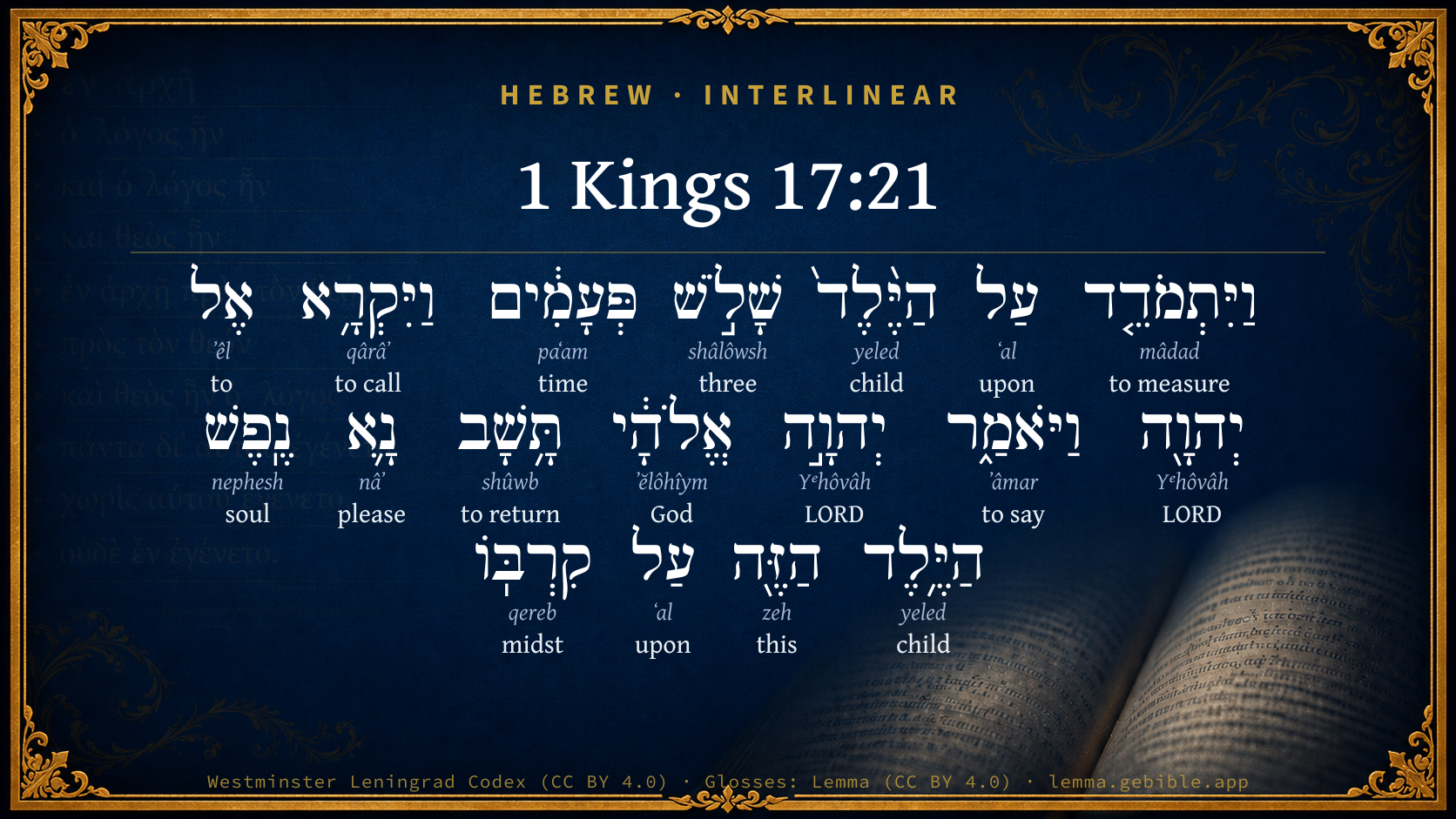
1 Kings 17:21

Hebrew (Westminster Leningrad Codex) 1 Kings 17:21 appears in the Hebrew Old Testament. The text above is from the Westminster Leningrad Codex. Each word links to its Strong’s number, a concise gloss, and parsing drawn from the Open Scriptures Hebrew Bible morphology. Click any word for its full Brown-Driver-Briggs (BDB) entry.
Download image
Cite this verse

1 Kings 17:21 (World English Bible). Public Domain. Lemma interlinear Bible study tool, https://lemma.gebible.app/v/1-kings/17/21.

Show BibTeX & RIS
BibTeX
RIS
English Translation
He stretched himself on the child three times, and cried to Yahweh, and said, Yahweh my God, please let this child's soul come into him again.
World English Bible · Public Domain
Download a study sheet

One document with this verse’s original text, its word-by-word gloss line, the meaning frame, cross-references with their text, attributed commentary, and full source and license credits — printable, and it pastes into notes with its structure intact.

This verse Autodidact and up

Study sheet (.html) Plain text (.txt)

A passage Seminary Student

Up to 50 verses in one chapter. A passage sheet keeps up to 6 commentary sources and 12 cross-references per verse, in the order this page ranks them, and says so on the sheet whenever that leaves anything out. Ask for a single verse and you get the Autodidact verse sheet above.

Everything on this page stays free to read, with no account — the sheet is a download of what is already on screen, not access to it.

Want to remove ads? Support Godless Engineer
Compare translations 3

The same verse in 3 English versions, stacked beneath the original-language interlinear above. Click any original word for its lexicon entry.

Each is an independent rendering of the whole verse — the interlinear is not word-aligned to these translations.

Highlighted words mark where these versions differ — a whole-verse word diff, not a word-by-word alignment.

  • World English Bible Public Domain
    He stretched himself on the child three times, and cried to Yahweh, and said, Yahweh my God, please let this child's soul come into him again.
  • King James Version Public Domain
    And he stretched himself upon the child three times, and cried unto the LORD, and said, O LORD my God, I pray thee, let this child's soul come into him again.
  • unfoldingWord Literal Text CC BY-SA 4.0
    And he stretched himself out over the child three times. And he called out to Yahweh and said, “Yahweh my God, please let the life of this child return into his midst.”

unfoldingWord Literal Text — © unfoldingWord, licensed CC BY-SA 4.0. Word-aligned USFM3 via Door43 (git.door43.org/unfoldingWord/en_ult).

Versions to compare (up to 4)

3 of 4 selected

Show all 18 translations

Every available English version of this verse, each an independent rendering of the whole verse.

  • World English Bible Public Domain
    He stretched himself on the child three times, and cried to Yahweh, and said, Yahweh my God, please let this child's soul come into him again.
  • Berean Standard Bible Public Domain
    Then he stretched himself out over the child three times and cried out to the LORD, “O LORD my God, please let this boy’s life return to him!”
  • Majority Standard Bible Public Domain
    Then he stretched himself out over the child three times and cried out to the LORD, “O LORD my God, please let this boy’s life return to him!”
  • King James Version Public Domain
    And he stretched himself upon the child three times, and cried unto the LORD, and said, O LORD my God, I pray thee, let this child's soul come into him again.
  • American Standard Version (1901) Public Domain
    And he stretched himself upon the child three times, and cried unto Jehovah, and said, O Jehovah my God, I pray thee, let this child's soul come into him again.
  • Revised Version (1885) Public Domain
    And he stretched himself upon the child three times, and cried unto the LORD, and said, O LORD my God, I pray thee, let this child’s soul come into him again.
  • Geneva Bible (1599) Public Domain
    And he stretched himselfe vpon the childe three times, and called vnto the Lord, and saide, O Lord my God, I pray thee, let this childes soule come into him againe.
  • Douay-Rheims (1899) Public Domain
    And he stretched, and measured himself upon the child three times, and cried to the Lord, and said: 0 Lord my God, let the soul of this child, I beseech thee, return into his body.
  • Young's Literal Translation Public Domain
    And he stretcheth himself out on the lad three times, and calleth unto Jehovah, and saith, `O Jehovah my God, let turn back, I pray Thee, the soul of this lad into his midst;'
  • Literal Standard Version CC BY-SA 4.0
    And he stretches himself out on the boy three times, and calls to YHWH and says, “O YHWH my God, please let the soul of this boy return into his midst”;
  • Unlocked Literal Bible CC BY-SA 4.0
    Then Elijah stretched himself on the child three times; he cried out to Yahweh and said, “Yahweh my God, I beg you, please let this child's life return to him.”
  • unfoldingWord Literal Text CC BY-SA 4.0
    And he stretched himself out over the child three times. And he called out to Yahweh and said, “Yahweh my God, please let the life of this child return into his midst.”
  • Darby Bible Public Domain
    And he stretched himself upon the child three times, and cried to Jehovah and said, Jehovah, my God, I pray thee, let this child's soul come into him again!
  • World Messianic Bible Public Domain
    He stretched himself on the child three times, and cried to the LORD and said, “LORD my God, please let this child’s soul come into him again.”
  • Webster's Bible Public Domain
    And he stretched himself upon the child three times, and cried to the LORD, and said, O LORD my God, I pray thee, let this child's soul come into him again.
  • Free Bible Version CC BY-SA 4.0
    He stretched himself out on the boy three times, and cried out to the Lord, “Lord my God, please let this boy's life return to him!”
  • Bible in Basic English Public Domain
    And stretching herself out on the child three times, he made his prayer to the Lord, saying, O Lord my God, be pleased to let this child's life come back to him again.
  • JPS Tanakh (1917) Public Domain
    And he stretched himself upon the child three times, and cried unto the LORD, and said: 'O LORD my God, I pray thee, let this child's soul come back into him.'

Literal Standard Version (2020), Covenant Press — licensed CC BY-SA 4.0. Text via the HelloAO Bible API (eBible.org). Unlocked Literal Bible (unfoldingWord) — licensed CC BY-SA 4.0. Text via the HelloAO Bible API (eBible.org). unfoldingWord Literal Text — © unfoldingWord, licensed CC BY-SA 4.0. Word-aligned USFM3 via Door43 (git.door43.org/unfoldingWord/en_ult). Free Bible Version, Dr. Jonathan Gallagher — licensed CC BY-SA 4.0. Text via the HelloAO Bible API (eBible.org).

Word by word

More ways to search: Search by grammar → Find every occurrence → Compare this word →

Practice this passage: Drill this verse → Learn its vocabulary →

וַיִּתְמֹדֵ֤ד
mâdad
H4058
“and · to measure”
Conjunction + Verb, Hithpolel, Sequential Imperfect, 3rd Person, Masculine, Singular
Part of Speech
Conjunction + Verb
Stem
Hithpolel
Form
Sequential Imperfect
Person
3rd Person
Gender
Masculine
Number
Singular
Full BDB Definition

Origin: a primitive root

TWOT: 1146

to measure, stretch - (Qal) to measure - (Niphal) to be measured - (Piel) - to extend, continue - to measure, measure off - (Po) measured - (Hithpolel) to extend oneself, stretch oneself
  1. עַל ʻal H5921 “upon” Preposition
  2. הַיֶּ֨לֶד֙ yeled H3206 “the · child” Particle, Definite Article + Noun, Common, Masculine, Singular, Absolute
  3. שָׁלֹ֣שׁ shâlôwsh H7969 “three” Adjective, Cardinal number, Feminine, Singular, Absolute
  4. פְּעָמִ֔ים paʻam H6471 “times” Noun, Common, Feminine, Plural, Absolute
  5. וַיִּקְרָ֥א qârâʼ H7121 “and · to call” Conjunction + Verb, Qal, Sequential Imperfect, 3rd Person, Masculine, Singular
  6. אֶל ʼêl H413 “to” Preposition
  7. יְהוָ֖ה Yᵉhôvâh H3068 “LORD” Noun, Proper
  8. וַיֹּאמַ֑ר ʼâmar H559 “and · to say” Conjunction + Verb, Qal, Sequential Imperfect, 3rd Person, Masculine, Singular
  9. יְהוָ֣ה Yᵉhôvâh H3068 “LORD” Noun, Proper
  10. אֱלֹהָ֔י ʼĕlôhîym H430 “God(s) · my” Noun, Common, Masculine, Plural, Construct + Suffix, Personal, 1st Person, Common, Singular
  11. תָּ֥שָׁב shûwb H7725 “to return” Verb, Qal, Jussive, 3rd Person, Feminine, Singular
  12. נָ֛א nâʼ H4994 “please” Particle, Exhortation
  13. נֶֽפֶשׁ nephesh H5315 “soul of” Noun, Common, Both, Singular, Construct
  14. הַיֶּ֥לֶד yeled H3206 “the · child” Particle, Definite Article + Noun, Common, Masculine, Singular, Absolute
  15. הַזֶּ֖ה zeh H2088 “the · this” Particle, Definite Article + Pronoun, Demonstrative, Masculine, Singular
  16. עַל ʻal H5921 “upon” Preposition
  17. קִרְבּֽוֹ qereb H7130 “midst · his” Noun, Common, Masculine, Singular, Construct + Suffix, Personal, 3rd Person, Masculine, Singular

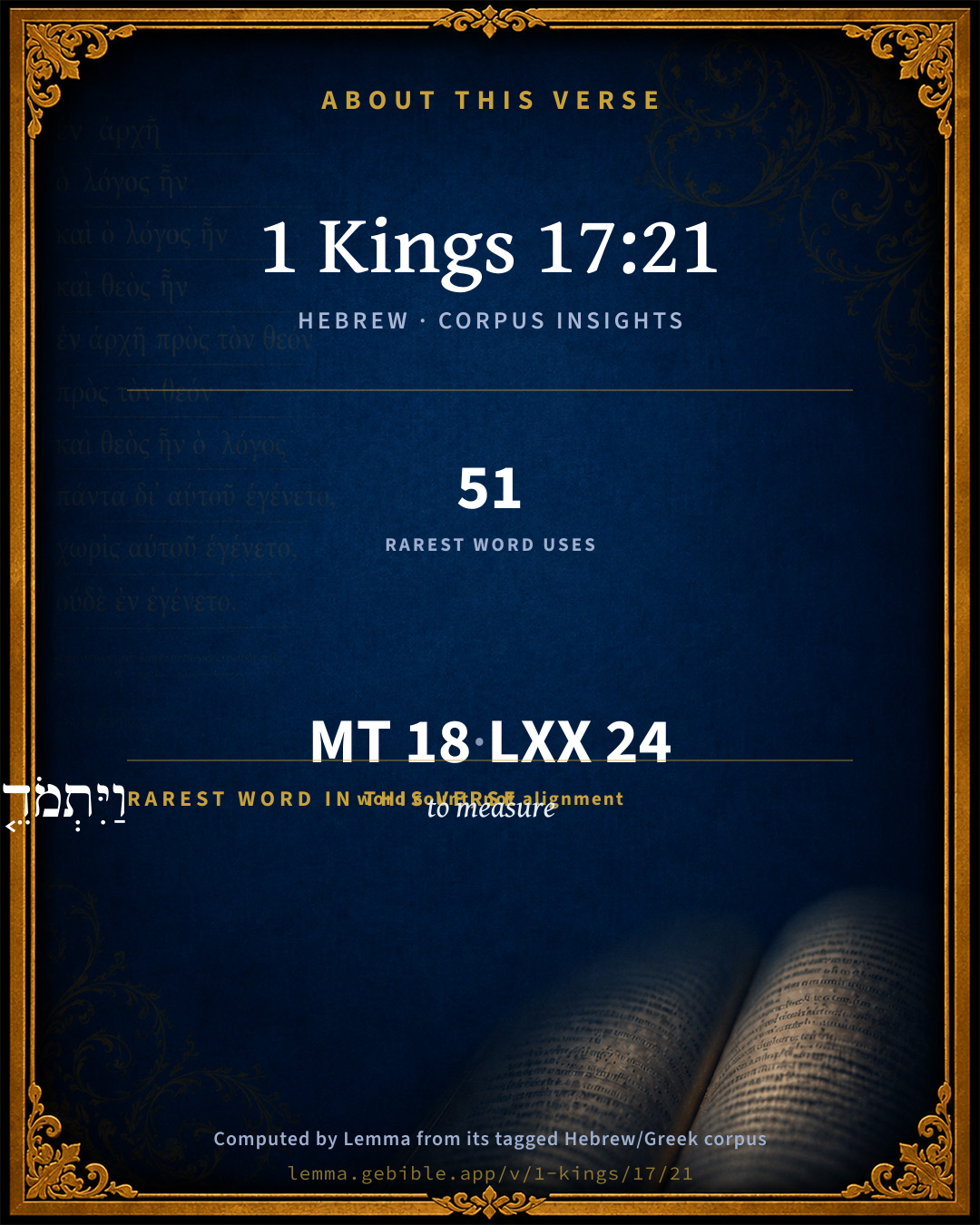
About this verse

These counts appear in no published source. They are computed here, from the morphology-tagged text and Lemma’s own curated glosses. What Lemma adds →

18
words
15
distinct lemmas
Historical
section

Shared distinctive vocabulary

וַיִּתְמֹדֵ֤ד to measure H4058 occurs in 49 verses of the Hebrew Bible. Also found in:

Grammatical profile

  • 4 verbs
  • 8 nouns
  • 1 adjective
  • 1 pronoun
  • 3 prepositions
  • 1 particle

Verb forms

  • וַיִּתְמֹדֵ֤ד Hithpolel · Sequential Imperfect
  • וַיִּקְרָ֥א Qal · Sequential Imperfect
  • וַיֹּאמַ֑ר Qal · Sequential Imperfect
  • תָּ֥שָׁב Qal · Jussive

Repetition

Words recur within this verse — often emphatic in Hebrew:

  • עַל upon H5921 ×2
  • הַיֶּ֨לֶד֙ child H3206 ×2
  • יְהוָ֖ה LORD H3068 ×2

Hebrew & Septuagint length

In English translation the verse runs 26 words from the Hebrew and 30 from the Septuagint (LXX English) — closely comparable.

A rough comparison of the two English renderings, which tokenize alike — not a word-level alignment.

Word counts can differ between the Hebrew and the Greek without any difference in meaning — e.g. the Hebrew direct-object marker אֵת has no separate Greek word, and Greek often adds the article ὁ.

In the original languages it is 18 Hebrew tokens and 24 Greek tokens — but the two are counted differently (Hebrew bundles its prefixes and suffixes into one token; the Greek is in lemma form), so that isn’t a like-for-like length.

Cross-references

5

Topical passages linked to 1 Kings 17:21 in the Treasury of Scripture Knowledge — connected by theme and wording, ordered by reader-vote popularity; previews shown in the World English Bible.

  • Acts 20:10 Paul went down, and fell upon him, and embracing him said, "Don't be troubled, for his life is in him."
  • 2 Kings 4:33–35 He went in therefore, and shut the door on them both, and prayed to Yahweh.
  • Acts 9:40 Peter put them all out, and kneeled down and prayed. Turning to the body, he said, "Tabitha, get up!" She opened her eyes, and when she saw Peter, she sat up.
  • Hebrews 11:19 accounting that God is able to raise up even from the dead. Figuratively speaking, he also did receive him back from the dead.
  • Acts 10:10 He became hungry and desired to eat, but while they were preparing, he fell into a trance.

Cross-references courtesy of OpenBible.info (CC BY 4.0).

Hebrew and Greek witnesses Masoretic Hebrew ↔ Greek Septuagint

The same verse in the two great witnesses to the Old Testament, shown verse-for-verse.

These are two independent witnesses, not word-aligned to each other, and the Septuagint is shown in lemma (dictionary) form.

Hebrew 1 Kings 17:21 Masoretic · Westminster Leningrad Codex

וַיִּתְמֹדֵ֤ד עַל הַיֶּ֨לֶד֙ שָׁלֹ֣שׁ פְּעָמִ֔ים וַיִּקְרָ֥א אֶל יְהוָ֖ה וַיֹּאמַ֑ר יְהוָ֣ה אֱלֹהָ֔י תָּ֥שָׁב נָ֛א נֶֽפֶשׁ הַיֶּ֥לֶד הַזֶּ֖ה עַל קִרְבּֽוֹ

He stretched himself on the child three times, and cried to Yahweh, and said, Yahweh my God, please let this child's soul come into him again.

World English Bible · Public Domain

Greek LXX 1 Kings 17:21 Septuagint · lemma form

καί ἐνφυσάω ὁ παιδάριον τρίς καί ἐπικαλέω ὁ κύριος καί εἶπον κύριος ὁ θεός ἐγώ ἐπιστρέφω δή ὁ ψυχή ὁ παιδάριον οὗτος εἰς αὐτός

And he breathed on the child thrice, and called on the Lord, and said, O Lord my God, let, I pray you, the soul of this child return to him.

LXX2012 (modern English Septuagint) · Public Domain

On this verse, The Cambridge Bible for Schools and Colleges discusses the Septuagint’s reading. Read the note in Commentary ↓

Hebrew: Westminster Leningrad Codex (CC BY 4.0). Greek: Septuagint (public domain); English from LXX2012 (modern English Septuagint) (Public Domain). How the Septuagint differs from the Hebrew →

Targum (Aramaic paraphrase)

1

The Targum is the ancient Jewish Aramaic paraphrase of the Hebrew Scriptures — an interpretive translation, not the Hebrew text itself. Onkelos (literal) and Pseudo-Jonathan (expansive) render the Torah, and Jonathan the Prophets. Coverage is partial: where no permissively-licensed English translation exists for a verse, only the Aramaic is shown. This is verse-level text, not a word-by-word alignment to the Hebrew.

  1. Targum Jonathan Prophets (Joshua–Malachi)
    וְאִתְמְקַק עַל רַבְיָא תְּלַת זִמְנִין וְצַלֵי קֳדָם יְיָ וַאֲמַר יְיָ אֱלָהִי תְּתוּב כְּעַן נַפְשָׁא דְרַבְיָא הָדֵין לִמְעוֹהִי:

    (no public-domain English translation for this verse)

    Targum Jonathan — Aramaic: “Mikraot Gedolot” (public domain). English: “Sefaria Community Translation” (CC0 1.0 (public-domain dedication)); “London "Chaldee Paraphrase," 1871” (public domain). Text via Sefaria.

Commentary

Notes on 1 Kings 17:21 from classic Christian and Jewish commentators (each source and its license shown beneath its notes). The classic Christian expositions comment on the surrounding passage and are grouped to its opening verse, so a note may address several verses; the Jewish commentaries on the Tanakh (Rashi and others) are per-verse, so they appear only where the commentator wrote on this verse.

Lemma curates 59 commentaries, every one of them public domain or Creative Commons licensed, each selected and text-cleaned for this edition rather than reprinted as found. About our sources →

Trapp's Complete Commentary

John Trapp

1Ki 17:21 And he stretched himself upon the child three times, and cried unto the LORD, and said, O LORD my God, I pray thee, let this child’s soul come into him again.

Ver. 21. And he stretched himself.] As well to express the fervency of his prayer, as the desire he had to make him even partaker of his own life. See a like posture, 2Ki 4:34.

Three times] Alternis incubates et orans. Pray on still. He prayed thrice, saith one, to intimate his praying to the blessed Trinity. He prayed at first, saith another, but nothing came: he prayed therefore again more fervently, and yet a third time with greatest ardency, and had his request.

John Trapp, A Commentary or Exposition upon All the Books of the Old and New Testament (1647–1656) — public domain. Text from a community e-Sword module.

Joseph Benson's Commentary

1Ki 17:21. He stretched himself upon the child three times — Not as if he thought this could contribute any warmth or life to the child; but partly to express, and withal to increase, his grief for the child’s death, and his desire of its reviving; that thereby his prayers might be more fervent, and consequently more prevalent with God: and partly to give a sign of what God would do by his power, and what he doth by his grace in the raising of souls dead in sin to a spiritual life: the Holy Ghost comes upon them, and the power of the Highest overshadows them, and puts life into them. Let this child’s soul come into him again — By this way of speaking, Elijah expressed his certainty that the child’s soul had left his body, and that he was properly dead. And he asks, not that he might be recovered from a fainting fit, swoon, or trance; but reanimated by the departed soul, and raised from the dead. This certainly was a great and most extraordinary request, and such as there is every reason to think had never been asked of God before by any human creature. Certainly he had no precedent to plead for requesting such a thing, much less did he know of an instance of any mortal’s resurrection having taken place in answer to any one’s prayers or otherwise. Nevertheless, he was encouraged and induced to make this request, partly by his zeal for God’s honour, which he judged was concerned in it, and would be eclipsed, if the child of this widow remained in death; partly by the experience which he had of his prevailing power with God in prayer; and partly by a divine influence, moving him to desire the child’s restoration to life.

Joseph Benson's Commentary on the Old and New Testaments (1811–1818) — public domain. Text from a community e-Sword module.

Tyndale Open Study Notes

Tyndale Open Resources

17:21 While it is unclear what life-giving power Elijah was trying to convey by his physical contact with the deceased boy, it is clear that his confidence was in the Lord. Elisha later performed a similar physical ritual when the Lord restored the dead son of the woman from Shunem (2 Kgs 4:32-37).

Tyndale Open Study Notes — © Tyndale Open Resources, licensed CC BY-SA 4.0. Text via the HelloAO Bible API.

Adam Clarke's Commentary

Verse 21. Stretched himself upon the child three times] It is supposed that he did this in order to communicate some natural warmth to the body of the child, in order to dispose it to receive the departed spirit. Elisha, his disciple, did the same in order to restore the dead child of the Shunammite, 2Kg 4:34. And St. Paul appears to have stretched himself on Eutychus in order to restore him to life, Ac 20:10.

Let this child's soul come into him again] Surely this means no more than the breath. Though the word נפש nephesh may sometimes signify the life, yet does not this imply that the spirit must take possession of the body in order to produce and maintain the flame of animal life? The expressions here are singular: Let his soul, נפש nephesh, come into him, על קרבו al kirbo, into the midst of him.

Adam Clarke's Commentary on the Bible (1810–1826) — public domain. Text from a community e-Sword/MySword module.

Ellicott's Commentary for English Readers

(21) He stretched himself upon the child.—To suppose that this implies merely the use of some natural means of reviving the dead, is simply to explain the whole description away. The idea in this passage (as in 2Ki_4:34; 2Ki_13:21, and, perhaps, Act_20:10) clearly is of a certain healing “virtue,” attaching in measure to the person of the prophets, as without measure it belonged to our Lord Himself (Luk_8:45-46). But it is to be noted that in the case of the prophet, the power to heal or raise up is made distinctly conditional on prayer, “the Lord heard the voice of Elijah.”

A Bible Commentary for English Readers, edited by Charles John Ellicott (1878–1897) — public domain. Text from a community e-Sword module.

The Cambridge Bible for Schools and Colleges

gen. ed. J. J. S. Perowne

21. And he stretched himself] As though he would give of his own vitality to restore the life of the boy. The LXX. reads ἐνεφύσησε τῷ παιδαρίῳ = ‘he breathed upon the child.’ This is an exposition of the later words which speak of the child’s soul returning to him.

The Cambridge Bible for Schools and Colleges (gen. ed. J. J. S. Perowne; Cambridge University Press, 1878–1918) — public domain. Text from a community e-Sword module.

John Gill's Exposition

And the Lord heard the voice of Elijah,.... In prayer, and answered it:

and the soul of the child came into him again, and he revived; this is the first instance of anyone being raised from the dead; this Satan has imitated; hence the many fabulous stories with the Heathens of persons being raised to life after death (k).

(k) Vid. Huet. Alnetan. Quaest. l. 2. c. 12. sect. 30.

John Gill's Exposition of the Whole Bible (1746–1763) — public domain (CC PDM 1.0). Text via the HelloAO Bible API.

Albert Barnes' Notes on the Bible

He stretched himself upon the child three times - This action of Elijah is different from that of Elisha (marginal reference), and does not imply the use of any natural means for the restoration of suspended animation. It is nearly parallel to the “touch,” through which our Lord performed similar miracles Mat 9:25; Luk 7:14.

Albert Barnes' Notes on the Bible (1834–1885) — public domain. Text from a community e-Sword/MySword module.

Haydock's Catholic Bible Commentary

Times, in honour of the blessed Trinity. (Menochius) --- He puts himself in this posture, as if the co-operate with God in warming the child; as Eliseus did, (4 Kings iv. 34,) as well as St. Paul, (Acts xx. 10,) and St. Benedict. (St. Gregory, Dial. ii. 32.) This posture represented the condescension of Jesus Christ in assuming our nature, to give us life; and the Old Testament affords few more striking figures of this union. (Calmet) (St. Augustine, ser. 201. de Temp.; St. Bernard xvi. in Cant.) (Tirinus)

George Leo Haydock (1774–1849), Haydock's Catholic Family Bible and Commentary, 1859 edition — public domain. Excludes Psalms (Douay-Rheims chapter numbering differs from Protestant) and Deuterocanonical books (Catholic canon only).

Matthew Poole's English Annotations

He stretched himself upon the child; not as if he thought this could contribute any warmth or life to the child; but partly to express, and withal to increase, his grief for the child’s death, and his desire of its reviving; that thereby his prayers might be more fervent, and consequently more prevalent with God; and partly that it might appear that this miracle, though wrought by God alone, yet was done for the sake of Elijah, and in answer to his prayers. Compare 2Ki 4:34; Joh 9:6; Act 20:10.

And cried unto the Lord: first he stretched himself, then he prayed, and that for three times successively.

Let this child’s soul come into him again; by which it is evident that the soul was gone out of his body, and therefore doth subsist without it after death. Compare Gen 35:18. This was a great request; but Elijah was encouraged to make it; partly, by his zeal for God’s honour, which he thought was concerned in it, and would be eclipsed by it; partly, by the experience which he had of his prevailing power with God in prayer; and partly, by a Divine impulse moving him to desire it.

Matthew Poole's English Annotations on the Holy Bible (1683–1685) — public domain. Text from a community e-Sword/MySword module.

Whedon's Commentary on the Bible

Daniel D. Whedon

21. He stretched himself upon the child three times — This procedure should be compared with Elisha’s in raising the son of the Shunammite woman, (2Ki_4:34, note,) and Paul’s in restoring Eutychus, (Act_20:10.) Elijah had no power, like Christ, to raise the dead by a single word of command; (Luk_7:14; Luk_8:54; Joh_11:43;) but confident that God would, through his agency, bring the child’s soul back again, he resorts to every rational means, and prays with greatest fervency for the desired result. Three was a sacred number; and the prophet’s thrice stretching himself upon the child was in keeping with the threefold form of daily prayer among the pious Israelites, (Psa_55:17, Dan_6:10,) and the threefold benediction of the high priest. Num_6:23.

Daniel D. Whedon (gen. ed.), Commentary on the Old and New Testaments (1874–1909) — public domain. Text from a community e-Sword module.

The Pulpit Commentary

And he stretched himself marg. measured himself, but Gesenius holds that stretch out is the primary meaning of the root upon the child cf. 2Ki_4:34. The commentators are again at variance as to whether these words imply the use of natural means or not. Those who hold that the child was dead naturally adopt the negative, and some (Keil, Rawlinson, al.) compare with it the action of our Lord in the case of the blind, deaf and dumb (Mat_9:35; Luk_7:14; Joh_9:6, Joh_9:7) But surely the circumstances and the purpose alike, in these latter eases, were entirely different. The object of the touch, of anointing the eyes, etc., in these cases of healing, appears to have been to awaken a sufficient faith without which "He could do no miracle" (Mat_13:58) in men whose infirmities of blindness, deafness, etc., prevented their attaining faith through the ordinary channels of seeing and hearing the merciful and gracious Son of man. But here the child, if not dead, was senseless. We are driven, therefore, to the belief that the prophet "used rational means for warming and revivifying" the child, "not with the hope that of themselves they would prove effectual, but in the sure confidence that God, in answer to his weeping supplication, would impart supernatural force to the natural human agencies," Bahr three times Not only in his prayer but also in this triple repetition do we recognize Elijah"s profound conviction that only by the Almighty power of God could the child be restored, and that whatever means were used, God alone could make them effectual. For three is the number and signature of the Godheads" die eigentlieh gottliche Zahl, die Signatur des gottlichen Wesens" (Bahr, Symb. 1:143). Hence it is, inter alia, that "the calling upon the name of Jehovah in the old covenant he might have added, "and in the new;" cf. Mar_14:39, 41; 2Co_12:8 a threefold act:" Psa_55:17; Dan_6:10, Dan_6:13; Num_6:24-26; Isa_6:3 (Bahr) The correspondence 2Co_12:8 is very striking and cried unto the Lord, and said, O Lord my God, I pray Thee Heb. now let this child"s soul come into him Heb. upon his inside l is here, as elsewhere, used for lae again. Though vpn here translated "soul," constantly means "life," yet it by no means settles the question whether the child was really living or dead. For,

(1) the, primary meaning of the word is breath (Gesen., Thesaurus, s.v. ), and

(2) the words might with perfect propriety, even if we interpret "life" or "soul," be used of one who lay in a lifeless and inanimate condition. Massillon"s graphic language (vol. 1. p. 91, ed. 1858), showing the contrast between Elijah"s procedure and that of our blessed Lord (Luk_7:14 Luk_8:54; Joh_11:43) is worth citing here: "Elie ressuscite des morts, il est vrai; mais il est oblige de se coucher plusieurs fois sur le corps de l"enfant qu"il ressuscite; il souffle, il se retrecit, it s"agite; on voit bien qu"il invoque une puissance etrangere; qu"il rappelle de l"empire de ta mort une ame qui n"est pas soumise a savoix, et qu"il n"est pas lui-meme le maitre de la mort et de la vie: Jesus-Christ ressuscite les morts comme il fait les actions les plus communes; il parle en maitre a ceux qui dorment d"un sommeil eternel, et l"on sent bien qu"il est le Dieu des morts comme des vivants, jamais plus tranquille que lorsqu"il opere les plus grandes choses.

Prayer for the Dead.

The portrait of the widow of Zarephath is remarkably natural. Her calmness in speaking of the trouble that was only threatened (ver. 12), is contrasted with her agony when trouble actually comes (ver. 18). She believed in Jehovah though in a heathen kingdom; yet there was a blending of superstition with her faith. She supposed that God might have overlooked her sin, had it not been that He was present with His prophet in her home; and she confounded discipline with retribution. The latter was the mistake of the barbarians at Melita. (Compare Act_28:4) See also our Lord"s teaching, Luk_13:4. The death of this child is to be explained on the principle which asserted itself in the blindness of the man whom Jesus cured, (Joh_9:3) or in the illness of Lazarus, concerning which our Lord said, "This sickness is not unto death, but for glory of (Joh_11:4) Rembrandt has depicted the scene brought before us in this chapter. In a roughly built upper room the dead child lies upon the bed; one hand rests upon his breast, while the other has fallen heavily at his side, giving a wonderful idea of the weight of death. Elijah stands on the further side of the bed with his rugged, earnest face upturned towards heaven and his hands clasped in an agony of supplication as he says, "O Lord my God, I pray thee let this child"s soul come into him again!" This event was not intended to be wondered at as a prodigy, nor was it merely to benefit the widow, but for all time has spiritual significance. With this belief we see in it

I AN EMBLEM OF SPIRITUAL DEATH. The child had died suddenly, Or Elijah would have been told of his illness. His death was real, and was more than the insensibility of Eutychus. (Act_20:10) We say that a thing, susceptible of life, is dead when it cannot receive what is essential to its growth and well being; e.g., a tree is dead when it is no longer able to absorb the nutriment without which it must fade, and ultimately fall. An animal is dead which can no longer breath air or assimilate food. The mind is dead as is that of an idiot when it receives no true mental impressions. The soul is dead which is insensible to spiritual influence. As it is possible to have physical without mental life, so it is possible to have mental without spiritual life. "Spiritual death" is not a mere figure of speech. It may be illustrated by the condition of this child. The food provided for him was useless now, the tenderest words of his mother were unheeded, and the voice that so lately was musical with laughter was silent.

Similarly the spiritually dead are indifferent to God"s provision, unconscious of their own possibilities, irresponsive to the Father"s voice. "Except a man be born again he cannot enter the kingdom of God." "He that hath not the Son hath not life." "Dead in trespasses and sins." "Come from the four winds, O breath, and breathe upon these slain that they may live.

II AN EXAMPLE OF INTERCESSORY PRAYER. A man of Elijah"s strong nature would have strong affections, and we can imagine how intensely he had come to love this child. On hearing of his death he could only say to the distracted mother, "Give me thy son," and then carried him up to his own room, and cried to God in an agony of prayer.

1. It was offered in solitude. Not even the mother was there. Such intense crises in life must be met alone. Jesus Christ was wont to "depart into a solitary place" to pray. Understanding our needs He said, "When thou prayest, enter into thy closet, and shut to the door, and pray to thy Father which seeth in secret." "Jacob was left alone" when he wrestled with the angel. Compare Elijah"s miracle with that of the Lord, who, when He went into the room where Jairus" daughter lay dead, "suffered no man to go in," beyond those who were one with Him in sympathy and prayer.

2. It was peculiarly definite. There was one want in his heart, one cry on his lips. Our prayers too often are meditations on the Divine attributes, or general confessions, and thanksgivings. If our King asked "What is thy petition?" we should sometimes be at a logs for an answer. Pray for one grace, for one unbelieving friend, etc.

3. It was intensely earnest. Elijah could not be denied. His was not a speech, but a cry. He looked for the awakening, and flung himself on the dead in an agony of earnestness as if he would infuse his own warmth and life. The touch was similar to that of Peter, when he took the cripple by the (Act_3:7) not the cause of blessing, but the medium of blessing. The Divine power works through the human agency.

III AN EARNEST OF TRUE RESURRECTION. Elijah could not give life, but he could ask God for it. Nor can we arouse to new life by preaching, though God can do so through preaching. Our words are only the media through which the Holy Spirit works. The Atlantic cable is useless except as the message is flashed forth by mysterious unseen power. This distinguishes the miracles of our Lord Jesus from those of His servants. (Compare Luk_7:14 with Act_3:12-16) There is a resurrection wherein saints shall be raised by the power of God to a life of immortality, the promise and pledge of which we have in the resurrection of Christ, who is the "firstfruits of them that sleep." There is also a spiritual resurrection, to which Paul refers when he appeals to Christians as those "risen with Christ; and of this, as well as of that, is there an illustration in our text. Raised to newness of life we, like the child Elijah prayed for, have to live for awhile in the old sphere. The prophet gave the child to his mother. Jesus restored Lazarus to his sisters, the young man at Nain to his mother, and the ruler"s daughter to her parents; and so to us, who have "passed from death unto life," He says, "Return to thine own house, and show how great things God hath done for thee." This miracle constrained the widow to accept as God"s truth the declaration of His servant (ver. 24). How much more reason have we, who believe in the supernatural works of His Son, to say, "We know that thou art a teacher come from God; for no man can do these miracles that thou doest, except God be with him! A.R.

The Pulpit Commentary (1880–1919), ed. H.D.M. Spence-Jones & Joseph S. Exell — public domain. Text from a community e-Sword module.

John Wesley's Explanatory Notes

Come into him - By which it is evident, that the soul was gone out of his body, this was a great request; but Elijah was encouraged to make it; by his zeal for God's honour, and by the experience which he had of his prevailing power with God in prayer.

John Wesley, Explanatory Notes Upon the Whole Bible (1754–1765) — public domain. Text via the GEBible commentary corpus.

Rashi

Rabbi Shlomo Yitzchaki (Rashi)

He spread himself out. [ויתמודד is] an expression of מדה, [i.e.,] he spread himself upon him.

Rashi on the Tanakh — English translations: “The Judaica Press complete Tanach with Rashi, translated by A. J. Rosenberg” (CC BY 4.0); “Pentateuch with Rashi's commentary by M. Rosenbaum and A.M. Silbermann, 1929-1934” (public domain); “The Metsudah Tanach series, Lakewood, N.J” (CC BY 4.0); and “The Book of Joshua, Metsudah Publications, 1997” (CC BY 4.0). Text via Sefaria.

Lesson kit

Teaching starters — assembled from the data on this page, not authored interpretation. Every prompt links to the verse data it draws on. Edit before teaching.

1 Kings, in the Historical, opens this verse with 18 words (15 distinct Hebrew lemmas). Its most distinctive word is mâdad (“to measure”). A historical commentator’s framing appears above. Read the whole chapter for the surrounding context.

Discussion questions

  1. How does “to measure” (mâdad) shape what this verse is saying?
  2. Exodus 16:18 shares the word «to measure» with this verse. How do the two illuminate each other?
  3. “upon” occurs 2× in this one verse. What is the effect of the repetition?
  4. These translations render this verse differently; the difference is in the English rendering, not the original. What questions does that raise?
  5. The verb «וַיִּתְמֹדֵ֤ד» is Hithpolel Sequential Imperfect. How does its form color the action?
  6. Reading how Trapp's Complete Commentary and Joseph Benson's Commentary read this verse, where do the two commentators agree and where do they part?

Things to notice

Reading settings

Reading text

Shown beneath each verse's original-language words.

Old Testament
Old Testament edition

Read the OT as the Masoretic Hebrew (MT) or the Greek Septuagint (LXX).

English shown for the Greek Septuagint (in the Hebrew ↔ Greek comparison).

Comparing translations? Open the Compare panel on any verse page to stack up to four side by side.