
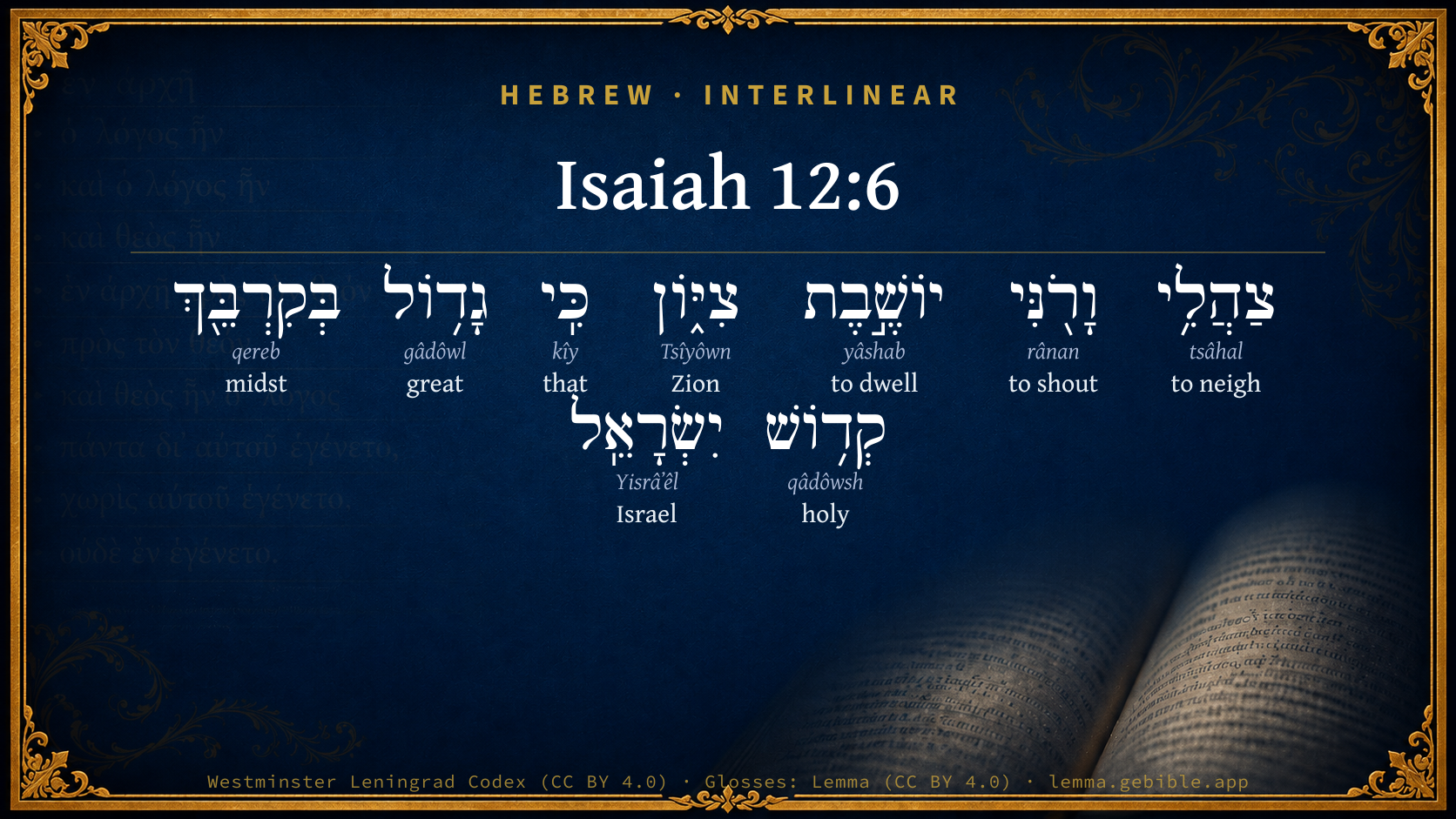
Isaiah 12:6

Hebrew (Westminster Leningrad Codex) Isaiah 12:6 appears in the Hebrew Old Testament. The text above is from the Westminster Leningrad Codex. Each word links to its Strong’s number, a concise gloss, and parsing drawn from the Open Scriptures Hebrew Bible morphology. Click any word for its full Brown-Driver-Briggs (BDB) entry.
Download image
Cite this verse

Isaiah 12:6 (World English Bible). Public Domain. Lemma interlinear Bible study tool, https://lemma.gebible.app/v/isaiah/12/6.

Show BibTeX & RIS
BibTeX
RIS
English Translation
Cry aloud and shout, you inhabitant of Zion; for great in the midst of you is the Holy One of Israel!"
World English Bible · Public Domain
Download a study sheet

One document with this verse’s original text, its word-by-word gloss line, the meaning frame, cross-references with their text, attributed commentary, and full source and license credits — printable, and it pastes into notes with its structure intact.

This verse Autodidact and up

Study sheet (.html) Plain text (.txt)

A passage Seminary Student

Up to 50 verses in one chapter. A passage sheet keeps up to 6 commentary sources and 12 cross-references per verse, in the order this page ranks them, and says so on the sheet whenever that leaves anything out. Ask for a single verse and you get the Autodidact verse sheet above.

Everything on this page stays free to read, with no account — the sheet is a download of what is already on screen, not access to it.

Want to remove ads? Support Godless Engineer
Compare translations 3

The same verse in 3 English versions, stacked beneath the original-language interlinear above. Click any original word for its lexicon entry.

Each is an independent rendering of the whole verse — the interlinear is not word-aligned to these translations.

Highlighted words mark where these versions differ — a whole-verse word diff, not a word-by-word alignment.

  • World English Bible Public Domain
    Cry aloud and shout, you inhabitant of Zion; for great in the midst of you is the Holy One of Israel!"
  • King James Version Public Domain
    Cry out and shout, thou inhabitant of Zion: for great is the Holy One of Israel in the midst of thee.
  • unfoldingWord Literal Text CC BY-SA 4.0
    Cry aloud and shout joyfully, dweller of Zion, for the Holy of Israel great in your midst.”

unfoldingWord Literal Text — © unfoldingWord, licensed CC BY-SA 4.0. Word-aligned USFM3 via Door43 (git.door43.org/unfoldingWord/en_ult).

Versions to compare (up to 4)

3 of 4 selected

Show all 18 translations

Every available English version of this verse, each an independent rendering of the whole verse.

  • World English Bible Public Domain
    Cry aloud and shout, you inhabitant of Zion; for great in the midst of you is the Holy One of Israel!"
  • Berean Standard Bible Public Domain
    Cry out and sing, O citizen of Zion, for great among you is the Holy One of Israel.”
  • Majority Standard Bible Public Domain
    Cry out and sing, O citizen of Zion, for great among you is the Holy One of Israel.”
  • King James Version Public Domain
    Cry out and shout, thou inhabitant of Zion: for great is the Holy One of Israel in the midst of thee.
  • American Standard Version (1901) Public Domain
    Cry aloud and shout, thou inhabitant of Zion; for great in the midst of thee is the Holy One of Israel.
  • Revised Version (1885) Public Domain
    Cry aloud and shout, thou inhabitant of Zion: for great is the Holy One of Israel in the midst of thee.
  • Geneva Bible (1599) Public Domain
    Cry out, and shoute, O inhabitant of Zion: for great is ye holy one of Israel in the middes of thee.
  • Douay-Rheims (1899) Public Domain
    Rejoice, and praise, O thou habitation of Sion: for great is he that is in the midst of thee, the Holy One of Israel.
  • Young's Literal Translation Public Domain
    Cry aloud, and sing, O inhabitant of Zion, For great in thy midst `is' the Holy One of Israel!'
  • Literal Standard Version CC BY-SA 4.0
    Cry aloud, and sing, O inhabitant of Zion, || For the Holy One of Israel [is] great in your midst!”
  • Unlocked Literal Bible CC BY-SA 4.0
    Cry aloud and shout for joy, you inhabitants of Zion, for great in your midst is the Holy One of Israel.”
  • unfoldingWord Literal Text CC BY-SA 4.0
    Cry aloud and shout joyfully, dweller of Zion, for the Holy of Israel great in your midst.”
  • Darby Bible Public Domain
    Cry out and shout, thou inhabitress of Zion; for great is the Holy One of Israel in the midst of thee.
  • World Messianic Bible Public Domain
    Cry aloud and shout, you inhabitant of Zion, for the Holy One of Israel is great among you!”
  • Webster's Bible Public Domain
    Cry aloud and shout, thou inhabitant of Zion: for great is the Holy One of Israel in the midst of thee.
  • Free Bible Version CC BY-SA 4.0
    Shout loudly and sing for joy, you people of Zion, for the Holy One of Israel is great, and is among you.”
  • Bible in Basic English Public Domain
    Let your voice be sounding in a cry of joy, O daughter of Zion, for great is the Holy One of Israel among you.
  • JPS Tanakh (1917) Public Domain
    Cry aloud and shout, thou inhabitant of Zion, for great is the Holy One of Israel in the midst of thee.'

Literal Standard Version (2020), Covenant Press — licensed CC BY-SA 4.0. Text via the HelloAO Bible API (eBible.org). Unlocked Literal Bible (unfoldingWord) — licensed CC BY-SA 4.0. Text via the HelloAO Bible API (eBible.org). unfoldingWord Literal Text — © unfoldingWord, licensed CC BY-SA 4.0. Word-aligned USFM3 via Door43 (git.door43.org/unfoldingWord/en_ult). Free Bible Version, Dr. Jonathan Gallagher — licensed CC BY-SA 4.0. Text via the HelloAO Bible API (eBible.org).

Word by word

More ways to search: Search by grammar → Find every occurrence → Compare this word →

Practice this passage: Drill this verse → Learn its vocabulary →

About this verse

These counts appear in no published source. They are computed here, from the morphology-tagged text and Lemma’s own curated glosses. What Lemma adds →

9
words
9
distinct lemmas
Prophets
section

Notable vocabulary

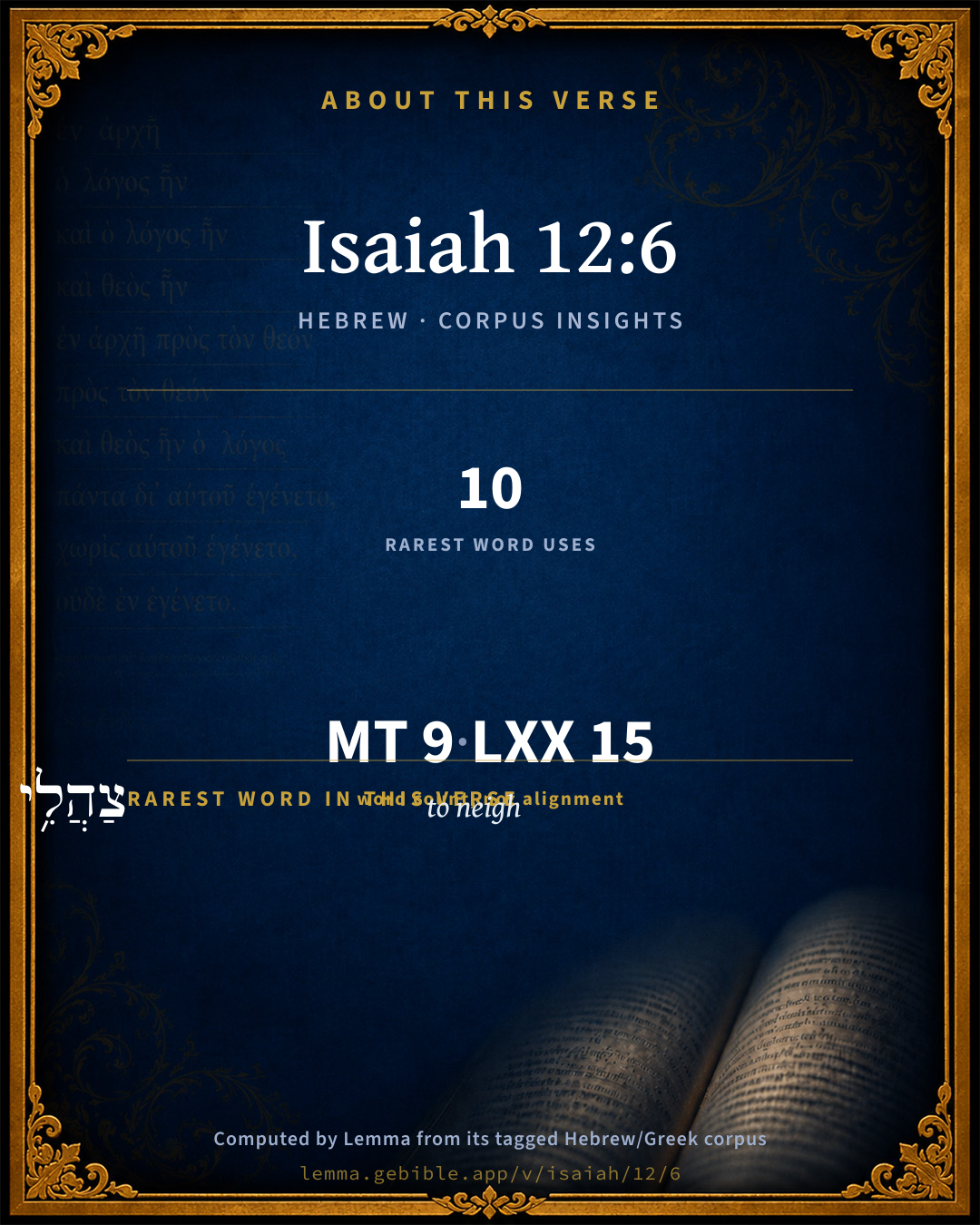
The rarest word here is צַהֲלִ֥י to neigh H6670 — appearing just 10 times in the whole Hebrew Bible.

Shared distinctive vocabulary

צַהֲלִ֥י to neigh H6670 occurs in 9 verses of the Hebrew Bible. Also found in:

Grammatical profile

  • 3 verbs
  • 3 nouns
  • 2 adjectives
  • 1 conjunction

Verb forms

  • צַהֲלִ֥י Qal · Imperative
  • וָרֹ֖נִּי Qal · Imperative
  • יוֹשֶׁ֣בֶת Qal · Participle Active

Hebrew & Septuagint length

In English translation the verse runs 21 words from the Hebrew and 21 from the Septuagint (LXX English) — the same length.

A rough comparison of the two English renderings, which tokenize alike — not a word-level alignment.

Word counts can differ between the Hebrew and the Greek without any difference in meaning — e.g. the Hebrew direct-object marker אֵת has no separate Greek word, and Greek often adds the article ὁ.

In the original languages it is 9 Hebrew tokens and 15 Greek tokens — but the two are counted differently (Hebrew bundles its prefixes and suffixes into one token; the Greek is in lemma form), so that isn’t a like-for-like length.

Cross-references

24

Topical passages linked to Isaiah 12:6 in the Treasury of Scripture Knowledge — connected by theme and wording, ordered by reader-vote popularity; previews shown in the World English Bible.

  • Zechariah 2:10–11 Sing and rejoice, daughter of Zion; for, behold, I come, and I will dwell in the midst of you,' says Yahweh.
  • Zechariah 2:5 For I,' says Yahweh, 'will be to her a wall of fire around it, and I will be the glory in the midst of her.
  • Psalms 9:11 Sing praises to Yahweh, who dwells in Zion, And declare among the people what he has done.
  • Zephaniah 3:14–17 Sing, daughter of Zion! Shout, Israel! Be glad and rejoice with all your heart, daughter of Jerusalem.
  • Isaiah 41:14 Don't be afraid, you worm Jacob, and you men of Israel; I will help you, says Yahweh, and your Redeemer is the Holy One of Israel.
  • Psalms 71:22 I will also praise you with the harp for your faithfulness, my God. I sing praises to you with the lyre, Holy One of Israel.
  • Isaiah 40:9 You who tell good news to Zion, go up on a high mountain; you who tell good news to Jerusalem, lift up your voice with strength; lift it up, don't be afraid; say to the cities of Judah, Behold, your God!
  • Isaiah 41:16 You shall winnow them, and the wind shall carry them away, and the whirlwind shall scatter them; and you shall rejoice in Yahweh, you shall glory in the Holy One of Israel.
  • Isaiah 54:1 Sing, barren, you who didn't bear; break forth into singing, and cry aloud, you who did not travail with child: for more are the children of the desolate than the children of the married wife, says Yahweh.
  • Ezekiel 48:35 It shall be eighteen thousand [reeds] round about: and the name of the city from that day shall be, Yahweh is there.
  • Luke 19:37–40 As he was now getting near, at the descent of the Mount of Olives, the whole multitude of the disciples began to rejoice and praise God with a loud voice for all the mighty works which they had seen,
  • Psalms 68:16 Why do you look in envy, you rugged mountains, At the mountain where God chooses to reign? Yes, Yahweh will dwell there forever.
  • Psalms 89:18 For our shield belongs to Yahweh; Our king to the Holy One of Israel.
  • Psalms 132:14 "This is my resting place forever. Here I will live, for I have desired it.
  • Isaiah 8:18 Behold, I and the children whom Yahweh has given me are for signs and for wonders in Israel from Yahweh of Hosts, who dwells in Mount Zion.
  • Isaiah 10:24 Therefore thus says the Lord, Yahweh of Hosts, my people who dwell in Zion, don't be afraid of the Assyrian, though he strike you with the rod, and lift up his staff against you, after the manner of Egypt.
  • Isaiah 24:23 Then the moon shall be confounded, and the sun ashamed; for Yahweh of Hosts will reign on Mount Zion, and in Jerusalem; and before his elders shall be glory.
  • Isaiah 30:19 For the people shall dwell in Zion at Jerusalem; you shall weep no more; he will surely be gracious to you at the voice of your cry; when he shall hear, he will answer you.
  • Isaiah 33:24 The inhabitant shall not say, I am sick: the people who dwell therein shall be forgiven their iniquity.
  • Isaiah 49:26 I will feed those who oppress you with their own flesh; and they shall be drunken with their own blood, as with sweet wine: and all flesh shall know that I, Yahweh, am your Savior, and your Redeemer, the Mighty One of Jacob.
  • Isaiah 52:7–10 How beautiful on the mountains are the feet of him who brings good news, who publishes peace, who brings good news of good, who publishes salvation, who says to Zion, Your God reigns!
  • Ezekiel 43:7 He said to me, Son of man, [this is] the place of my throne, and the place of the soles of my feet, where I will dwell in the midst of the children of Israel forever. The house of Israel shall no more defile my holy name, neither they, nor their kings, by their prostitution, and by the dead bodies of their kings [in] their high places;
  • Zephaniah 2:5 Woe to the inhabitants of the sea coast, the nation of the Cherethites! The word of Yahweh is against you, Canaan, the land of the Philistines. I will destroy you, that there will be no inhabitant.
  • Zechariah 8:3–8 Thus says Yahweh: "I have returned to Zion, and will dwell in the midst of Jerusalem. Jerusalem shall be called 'The City of Truth;' and the mountain of Yahweh of Hosts, 'The Holy Mountain.'"

Cross-references courtesy of OpenBible.info (CC BY 4.0).

Hebrew and Greek witnesses Masoretic Hebrew ↔ Greek Septuagint

The same verse in the two great witnesses to the Old Testament, shown verse-for-verse.

These are two independent witnesses, not word-aligned to each other, and the Septuagint is shown in lemma (dictionary) form.

Hebrew Isaiah 12:6 Masoretic · Westminster Leningrad Codex

צַהֲלִ֥י וָרֹ֖נִּי יוֹשֶׁ֣בֶת צִיּ֑וֹן כִּֽי גָד֥וֹל בְּקִרְבֵּ֖ךְ קְד֥וֹשׁ יִשְׂרָאֵֽל

Cry aloud and shout, you inhabitant of Zion; for great in the midst of you is the Holy One of Israel!"

World English Bible · Public Domain

Greek LXX Isaiah 12:6 Septuagint · lemma form

ἀγαλλιάομαι καί εὐφραίνω ὁ καταοἰκέω σιων ὅτι ὑψόω ὁ ἅγιος ὁ ἰσραήλ ἐν μέσος αὐτός

Exalt and rejoice, you⌃ that dwell in Sion: for the Holy One of Israel is exalted in the midst of her.

LXX2012 (modern English Septuagint) · Public Domain

Hebrew: Westminster Leningrad Codex (CC BY 4.0). Greek: Septuagint (public domain); English from LXX2012 (modern English Septuagint) (Public Domain). How the Septuagint differs from the Hebrew →

Targum (Aramaic paraphrase)

1

The Targum is the ancient Jewish Aramaic paraphrase of the Hebrew Scriptures — an interpretive translation, not the Hebrew text itself. Onkelos (literal) and Pseudo-Jonathan (expansive) render the Torah, and Jonathan the Prophets. Coverage is partial: where no permissively-licensed English translation exists for a verse, only the Aramaic is shown. This is verse-level text, not a word-by-word alignment to the Hebrew.

  1. Targum Jonathan Prophets (Joshua–Malachi)
    בּוּעִי וְשַׁבְּחִי כְּנִשְׁתָּא דְצִיוֹן אֲרֵי רַבָּא אֲמַר לְאַשְׁרָאָה שְׁכִינְתֵּיהּ בְּגַוָךְ קַדִישָׁא דְיִשְׂרָאֵל:

    Cry out and shout, O congregation of Zion, because He is great that promised to cause His Shekinah to dwell in the midst of thee, the Holy One of Israel.

    Targum Jonathan — Aramaic: “Mikraot Gedolot” (public domain). English: “Sefaria Community Translation” (CC0 1.0 (public-domain dedication)); “London "Chaldee Paraphrase," 1871” (public domain). Text via Sefaria.

Commentary

Notes on Isaiah 12:6 from classic Christian and Jewish commentators (each source and its license shown beneath its notes). The classic Christian expositions comment on the surrounding passage and are grouped to its opening verse, so a note may address several verses; the Jewish commentaries on the Tanakh (Rashi and others) are per-verse, so they appear only where the commentator wrote on this verse.

Lemma curates 59 commentaries, every one of them public domain or Creative Commons licensed, each selected and text-cleaned for this edition rather than reprinted as found. About our sources →

Trapp's Complete Commentary

John Trapp

Isa 12:6 Cry out and shout, thou inhabitant of Zion: for great [is] the Holy One of Israel in the midst of thee.

Ver. 6. Cry out.] Heb., Hinni, neigh as horses do that are full fed, or fitted for fight. Iubila quantum potes, valide et totis viribus clama, claram et laectam vocem ede.

For great is the Holy One of Israel in the midst of thee.] Or, For the Holy One of Israel, who is great, is in the midst of thee. How shouldst thou then do otherwise than well?

John Trapp, A Commentary or Exposition upon All the Books of the Old and New Testament (1647–1656) — public domain. Text from a community e-Sword module.

Albert Barnes' Notes on the Bible

Cry out - (צהלי tsahalı̂y). This word is usually applied to the neighing of a horse Jer 5:8; Jer 8:16. It is also used to express joy, pleasure, exultation, by a clear and loud sound of the voice Isa 10:30; Isa 12:6; Isa 14:14; Isa 54:1; Jer 31:7; Jer 50:11. It is here synonymous with the numerous passages in the Psalms, and elsewhere, where the people of God are called on to exult, to shout, to make a noise as expressive of their joy Psa 47:1; Psa 148:1-14; Psa 149:1-9; Isa 42:11; Isa 44:23; Jer 31:7; Zep 3:14; Zec 9:9.

And shout - (ורני vāronı̂y). This word properly means to cry aloud Pro 1:20; Pro 8:3; to cry for help Lam 2:19; to raise a shout of joy, to rejoice, or exult Lev 9:24; Job 38:7; to praise, or celebrate with joy Psa 33:1; Psa 51:15; Psa 59:17; Psa 89:13. Here it denotes the joy in view of God’s mercies, which leads to songs of exalted praise.

Thou inhabitant of Zion - Thou that dwellest in Zion; that is, thou who art numbered with the people of God (note, Isa 1:8). The margin here is in accordance with the Hebrew - ‘Inhabitress of Zion;’ and the word used here is applicable to the people, rather than to an individual.

For great is the Holy One of Israel - That is, God has shown himself great and worthy of praise, by the wonderful deliverance which he has worked for his people. Thus closes this beautiful hymn. It is worthy of the theme - worth to be sung by all. O, may all the redeemed join in this song of deliverance; and may the time soon come, when the beautiful vision of the poet shall be realized, in the triumphant song of redemption echoing around the world:

‘One song employs all nations; and all cry,

“Worthy the Lamb, for he was slain for us!”

The dwellers in the vales and on the rocks

Shout to each other, and the mountain-tops

From distant mountains catch the flying joy;

Till, nation after nation taught the strain,

Earth rolls the rapturous hosanna round.’

“The Task” Book vi.

Albert Barnes' Notes on the Bible (1834–1885) — public domain. Text from a community e-Sword/MySword module.

The Biblical Illustrator

Joseph S. Exell

Isa_12:6

Cry out and shout, thou inhabitant of Zion

Rapturous enthusiasm should characterise religion

Here is a call for enthusiasm, rapture, and what would generally be denominated madness.

Still, the words are here, and they are perfectly clear as to their meaning and purpose, and a reason is given for the cry and for the shout; that reason is--for great is the Holy One of Israel in the midst of thee. Men have been infuriated by earthly deliverances, and rightly so, and brought into paroxysms of thankfulness and joy why not so in their religious natures? It is recorded by Plutarch that when the Romans delivered a certain people from the tyranny of the Macedonians and the Spartans, the cry of the delivered men was so great that it dissipated the very air, and birds flying across that plane of the hemisphere fell down amazed. Have we ever rent the air with our cries and shouts of delight and thankfulness? Our Christianity may have been formal, and our atheism may have been the atheism of respectability. Respectability can never be earnest. It is limited by a smaller word. If Sydney Smith said the Church is dying of dignity, we may apply the rebuke to ourselves, and ask if we are not falling into torpor through the opiate of respectability. Are we called to silence? Who can describe the feeling of those who were imprisoned during the Indian Mutiny? Is there not a page in the history of that rebellion which makes every human heart thrill with excitement? We remember how the Europeans were shut up, being beleaguered and invested, and within a hand breadth of extinction; and we remember hearing of the deliverers approach, and of those who were suffering catching the strains of music; they heard the pibroch and the slogan, and their hearts came again, and every soldier was a hero, and every woman a saint, and as the deliverers came on could you have said to those who had been shut up in terror and darkness, Now restrain yourselves; avoid everything sensational, and maintain a decorous and proper attitude in all things--what answer would they have returned to your inane and unseasonable address? We must pass through a certain class of circumstances before we can understand the feelings of those who express gratitude for deliverance. The singing of the Church should be loud, joyous, and sweet; all instruments should accompany it now the clash of bells, now the blare of trumpets, now the lilt of lutes, and now the throb of drums; strong men, gentle women, merry children should unite their voices in one glad burst of religious joy. Thank God for music. That will unite the Church when theology will divide it. There is no disputable argument in music. The vanity of opinion is not touched by music. The demon of heresy is left without a chance in music. Pedantic criticism is ignored. The heart has it all its own way. All is harmony. All is praise. All is love. If ever preaching be displaced or superseded, may it be by music! (J. Parker, D. D.)

Thou inhabitant of Zion

The Hebrew is feminine: the appeal is to a womans heart--Cry out and shout, thou daughter of Zion! Without the womanly element the Church is without charm, and without the Divinest passion. The woman must lead us, in song, in music, in praise, and by the contagion of her enthusiasm must warm others into responsive and cooperative zeal. (J. Parker, D. D.)

Gods precede with His people

Among the ancient people of God, Jehovah vouchsafed His immediate and manifest presence, both in the continuance of His visible glory between the cherubim, and, upon extraordinary occasions, in an extraordinary manner. Such miraculous indications of the Divine presence are not to be expected in these latter days. Now that God has blessed us with a revelation, so clear, so completely suited to our necessities, and in all its doctrines and precepts so manifestly Divine, that our own consciences cannot but acknowledge it as the truth, He has withdrawn those miraculous tokens of His favour by which He upheld the confidence of His ancient people, requiring us to walk by faith and not by sight. The glory of the spiritual Zion does not consist in outward manifestations of the Godhead, but in the real though invisible presence of the King of Zion, according to His gracious promise, Lo, I am with you alway. He is present by His Spirit in the hearts of all His faithful followers. What is implied in this promise of the Holy One of Israel in the midst of Zion?

1. That God is ever with His people to strengthen and sustain them.

2. God, through Christ, is ever present with His people, to succour and defend them.

3. Jehovah is ever present with His people to lead and direct them.

4. God is ever with His people to comfort them.

5. Jehovah is ever present with His people to command a blessing upon the appointed means of His grace. Without this, the Scriptures are a dead letter. (W. Ramsay.)

The Church of the living God

Civilised countries have many institutions of a voluntary kind for useful purposes. There is, however, an institution in the world, where men are laid under direct obligation to Him who has established the institution, namely, the Church of God, in relation to which the earnest appeal in the text is made.

I. THIS CHURCH PRESENTS TO US THE WAY, UNDER GODS HAND, TO TRUE PERSONAL GOODNESS. Men devise many recipes to correct evils and excite to virtue. But Zion accomplishes all these results by one simple method. To be in the Church of God is to be in the way of all goodness. Well may the inhabitants of Zion rejoice, for all spiritual blessings of Gods kingdom are given to it.

II. Another logical conclusion follows, namely, that ALL OF US OUGHT TO BE IN THAT ZION. We are to be in it, not because the Church itself demands it; not because the minister calls for it; not because the influences around us have inculcated it. We are to belong to the Church because God, who founded the Church and created us, has laid this obligation upon us. And we are not to be simply visitors to His Church, or occasional attendants, and especially not to be patrons. We are to be inhabitants, dwelling in it; being in it with our whole souls, and complying with the obligations that are incumbent upon its inhabitants, if we would be pure men. And this is no unreasonable command.

1. The way in which the word came is both significant and instructive.

2. Another consideration is that, Great is the Holy One of Israel in the midst of her. That is the culminating and crowning glory of Gods Zion.

Practical reflections--

1. We must see that this Zion is a home of great dignity. It is more than a home, it is Gods kingdom.

2. If this be Gods Zion, then what have we to do to be in His Zion and to feel the pleasures incumbent upon members of His Zion? We are to obey Him. It is His presence, His power, His relation to us, that give sanctity to Gods house and service.

3. Let me speak a word to any who are without God and without hope of eternal life. This King summons you from rebellion; He summons you to peace and goodwill to Him. (J. Hall, D. D.)

The character, privilege, and duty of the people of God

I. THE CHARACTER here given of the people of God, couched in Old Testament language, in that they are called inhabitants of Zion. To understand the meaning of the words, inhabitant of Zion, as describing the people of God in every age, we should first remember that Zion was literally a hill in the land of Judea. There was a hill in the southern part of the promised land, on which, or on part of which, the city of Jerusalem was built, and this hill had two peaks, the one called Zion proper, and the other called Mount Moriah, and while Jerusalem stood on one of these peaks, or Zion proper, the temple was built by appointment on the other of these peaks, or Mount Moriah, but the whole together was called the hill of Zion, of Mount Zion, and accordingly in the 2 nd Psalm we read, Yet have I set My King upon My holy hill of Zion, and again, Beautiful for situation, the joy of the whole earth; is Mount Zion, plainly showing that this was a hill in the land of Judea. But, as I have said, on one peak or top of this hill the temple of Solomon was placed, and hence the word Zion came by a common figure of speech to be transferred from the mountain to the temple, the most prominent feature on the mountain, and in this sense I think we have it in the 87 th Psalm, The Lord loveth the gates of Zion more than all the dwellings of Jacob. Understanding, then, by the word Zion the temple, an inhabitant of Zion now calls up the idea of a person who lives in and about the temple; and, indeed, the will of God was, that all His ancient people should live as much as may be in and about the temple. But we must remember that the temple was intended to be a type of the human nature of our Lord, or of God in our nature (Joh_2:19-21). An inhabitant of Zion is one who is much versant with Christ.

II. THE PRIVILEGE connected with this character. Great is the Holy One of Israel in the midst of thee. The Holy One of Israel, or the God that went out and in among the people of Israel, the God that brought them out of the land of Egypt, and through a variety of vicissitudes landed them at last in the Canaan of promise, was no other than the Lord Jesus Christ 1Co_10:9). But it is particularly the privilege of all the inhabitants of Zion, that they have the protection of Him at all times who is the Almighty, and who is, therefore, able to prevail against all opposition. Great is the Holy One of Israel in the midst of thee. These last words convey the idea of a garrison, which, being in the very centre of a place fortified, contains armed men ready to run out from this central point, whenever they are called or required. So Christ, the Holy One, is in the midst of the Church, in the midst of the believer individually, because quite prepared to run out to any point where His people are weak and unprotected. If any of Gods people be poor in this world, they need not have recourse to unlawful methods to secure for them and their families bread to eat, and raiment to put on, for their Heavenly Father knows they need these things, and He will give them to them, in the use of the lawful means put in their power. It intimates God reconciled in Christ to provide for their souls. He will provide for them the means of grace. But once more, it makes part of the privilege of Gods people, that they are to see the greatness of the glory of God ultimately. Now God says that the very greatness of His glory shines out in the work of redemption--that there is more of that great invisible God brought out to intelligent creatures, by the work of redemption, than by any work which God created.

III. THE DUTY that God expects of His people, in consequence of their understanding this. Cry out and shout. And here we are taught--

1. That courage is our duty--boldness. Cry out and shout. Why? Because there is no condemnation to them who are in Christ Jesus.

2. Cheerfulness.

3. Holding forth the Word of life.

Concluding remarks--

1. How very far below their privilege do some professing Christians live!

2. Privilege always goes before duty.

3. The words are spoken to individuals. (J. Muir, D. D.)

Loyal joy

Speaking of the early days of Queen Marys reign, Mr. Froude says: When the lords with the mayor and heralds went to the Cross at Cheapside to proclaim Mary as Queen, there was no reason to complain of a silent audience. Pembroke stood out to read, and could but utter one sentence before his voice was lost in the shout of joy which thundered into the air. God save the Queen, rang out from ten thousands of throats. God save the Queen, cried Pembroke himself when he had done, and flung up his jewelled cap and tossed his purse among the crowd. The glad news spread like lightning through London, and the pent up hearts of the citizens poured themselves out in a torrent of exultation. Above the human cries, the long silent church bells clashed again into life: first began St. Pauls, where happy chance had saved them from destruction; then, one by one, every peal which had been spared caught up the sound; and through the summer evening and night, and all the next day, the metal tongues from tower and steeple gave voice to Englands gladness.

The Biblical Illustrator, edited by Joseph S. Exell (c. 1880s–1900s) — public domain. Text from a community e-Sword module.

The Preacher's Complete Homiletical Commentary

Joseph S. Exell (gen. ed.)

THE DUTY OF GLADNESS

Isa_12:6. Cry out and shout, &c.

Two things are here observable:—

1. The person addressed, “thou inhabitant of Zion” [1012] i.e., one who is no longer a stranger and foreigner, but a fellow-citizen with the saints (Eph_2:12; Eph_2:19).

2. The admonition given, “Cry out and shout.” Consider—

[1012] Zion was the name of a high mound situated upon a bed of rock enclosed within the walls of Jerusalem, and making the finest and strongest part thereof. Here was first the Tabernacle, and then the Temple, and concerning it great things are declared (Psa_132:13-18). If we look through the literal description to the spiritual glory discernible, we shall soon see that it was typical of a higher state, and a shadow of good things to come. I need hardly remind you that, by a figure of speech, Zion is used in the New Testament as significant of the Church of the living God (Heb_12:22).—Jay.

Such are the encouragements that consoled the ancient city of God in the day of her trouble. Harassed, her garrisons stormed, her armies scattered, her very sanctuary threatened with violation. she was bade remember her Eternal King, and take comfort in the thought of that watchful Guardian who sooner or later would assuredly avenge her wrongs. Often was she taught the same lesson; and often, in despite of her own froward and unbelieving heart, was the prediction realised. The Lord still “loved the gates of Zion;” the streams of His holy “river still made glad the city of God;” and He was “known in her palace for a refuge.” But a gloomier hour at length arrived; even Divine patience has its limits; and the last dread crime of Zion could only be expiated in her ruin. Blood had flowed beneath her hands, every drop of which was worth a universe, and she had invoked its curse upon her own head and the head of her children. And now, behold, in the fearful words of her own prophets, “the lion is come up from his thicket, and the destroyer of the Gentiles is on his way,”—Jerusalem is ruined and Judah is fallen, because their tongues and their doings are against the Lord to provoke the eyes of His glory. “But what?—is this the city of which such glorious things are spoken—that the Highest Himself should establish her, that she should not be moved?” Where are His mighty promises of perpetuity? Where is that foundation which no power should ever shake—that Zion, in which the poor of His people were to trust?

Brethren, look around you, and you behold the evidences of its existence, and of the eternal faithfulness of Him who is pledged to its immortality. A greater than Zion inherits her name; a greater than Zion bore it in the far-reaching scope of the prophetic vision. That “city of the great King” was but a perishable emblem of a “city whose builder and maker is God.” It is true she was honoured by His symbolic presence and sanctified by His sacred worship; it is true that for ages she alone, in a world of darkness, held the precious lamp of His truth; but what are these characters of honour to hers, whose every living stone is quickened by His indwelling energy, whose worship is no more in type and shadow, but in spirit and in substance; whose preaching and teaching, no longer shrouded in obscurity and limited to a corner of the earth, spreads over all lands, embraces the whole family of mankind, and makes even the course of that sun whose “going forth is from the end of the heaven and his circuit unto the ends of it, and from whose light nothing is hid,” a faint image of the power with which she diffuses through all nations “the light of the knowledge of the glory of God in the face of Jesus Christ”? (See also 2Co_3:10-11.)—Archer Butler.

I. THE TRUTH ON WHICH THE ADMONITION IS FOUNDED. “Great is the Holy One of Israel in the midst of thee.” This includes—

1. His character, “the Holy One of Israel.” The holiness of God has shone forth in all that He has done in heaven and on earth (Psa_145:17); in heaven it is the theme of the songs of the most exalted intelligences (Isa_6:3); on earth it inspires bad men with dread and dislike (Isa_30:11), and good men with thankfulness and hope (Psa_30:4; Heb_12:10; H. E. I, 2275, 2843).

2. His greatness. “Great”—in duration, wisdom, power, dominion, and resources. All these render Him terrible as an enemy, desirable as a friend [1015]

3. His residence. “In the midst of thee.” But is not God everywhere? Yes, but not everywhere in the same character; not in heaven as in earth, &c. Wherever His presence is spoken of in a way of promise or privilege, it is to be distinguished from His attribute of omnipresence, for it has then in it something peculiarly beneficial and saving (Deu_4:7; Psa_34:18). God’s presence in the midst of His people is the guarantee of their safety and the source of their joy. Let them adore the condescension He shows in dwelling in their midst.

[1015] How well may the Church on Zion rejoice to have such a God dwelling in the midst of it! He is great as the Giver of promises, and great in fulfilling them; great in grace, and great in judgment; great in all His saving acts, which spread from Israel to all mankind.—Delitzsch.

II. THE STIRRING EXHORTATION.

1. Religion is animated. “Cry out and shout,” &c. What is here required cannot be merely the exclamation, separate from suitable dispositions and sentiments, as is the case with some. Noise is in itself worth nothing. On the other hand, where there are these feelings, it is permissible, yea, praiseworthy, to give free and exultant expression to them (Rev_5:12). Some disparage such expressions as enthusiasm, but there is nothing that should call forth enthusiasm like the Gospel. Religion calls for not only feeling and sentiment, but for the highest degree of feeling and sentiment [1018]

2. Religion, rational as well as animated. Why is the inhabitant of Zion to cry aloud and shout? “For great is the Holy One of Israel in the midst of thee.” This more than justified him, for from hence the Church can infer safety, assistance, consolation, honour. Thus God is with His people, and this is grace: soon they shall be with Him, and that is glory.—William Jay: Sunday Evening Sermons and Thursday Evening Lectures, pp. 297–305.

[1018] Take the Gospel. What is it? Not a decision of Parliament, or the termination of a debate which may have no effect on our welfare. It brings us glad tidings of great joy. It is infinitely important, it is eternally interesting to us. It is our life. It is all our salvation, and it should be all our desire. Therefore we should receive it as a faithful saying, and worthy of all acceptation. We should receive it as a dying man would a remedy, or as a condemned criminal would hail a reprieve. We should receive it with feelings superior to those with which we receive anything else. It is a subject which rises infinitely above all others in interest and importance, and demands all the energies of the soul, and renders Dr. Young’s words the words of truth and soberness:—

“On such a theme ’twere impious to be calm:

Passion is reason; transport, temper here.”

—Jay.

The Preacher's Complete Homiletical Commentary (gen. ed. Joseph S. Exell; Funk & Wagnalls, c. 1892) — public domain (pre-1929). A full-Bible homiletical/sermon-outline anthology covering 65 of 66 books (2 John is absent from the source module). Text from a community e-Sword module.

Tyndale Open Study Notes

Tyndale Open Resources

12:6 See Pss 48:1; 96:4; 99:2.

Tyndale Open Study Notes — © Tyndale Open Resources, licensed CC BY-SA 4.0. Text via the HelloAO Bible API.

Geneva Bible (1599)

Geneva Bible translators

Ye that are of the Church.

Geneva Bible (1599) marginal notes — public domain. Text via Bolls.life.

Jamieson, Fausset & Brown

Robert Jamieson, A. R. Fausset & David Brown

inhabitant of Zion--Hebrew, "inhabitress"; so "daughter of Zion," that is, Zion and its people.

in the midst of thee--of Jerusalem literally (Jer 3:17; Eze 48:35; Zep 3:15, Zep 3:17; Zac 2:10).

The predictions as to foreign nations are for the sake of the covenant people, to preserve them from despair, or reliance on human confederacies, and to strengthen their faith in God: also in order to extirpate narrow-minded nationality: God is Jehovah to Israel, not for Israel's sake alone, but that He may be thereby Elohim to the nations. These prophecies are in their right chronological place, in the beginning of Hezekiah's reign; then the nations of Western Asia, on the Tigris and Euphrates, first assumed a most menacing aspect.

Next: Isaiah Chapter 13

Jamieson, Fausset & Brown — Commentary Critical and Explanatory on the Whole Bible (1871) — public domain (CC PDM 1.0). Text via the HelloAO Bible API.

Adam Clarke's Commentary

Verse 6. Thou inhabitant of Zion] Not only the Jewish people, to whom his word of salvation was to be sent first; but also all members of the Church of Christ: as in them, and in his Church, the Holy One of Israel dwells. St. Paul, speaking of the mystery which had been proclaimed among the Gentiles, sums it up in these words: "which is CHRIST IN YOU, the hope of glory; whom we preach, warning every man, and teaching every man in all wisdom, that we may present every man perfect in Christ Jesus;" Col 1:27-28. Well, therefore, may the inhabitant of Zion cry oat and shout, and proclaim the greatness of her Redeemer.

Adam Clarke's Commentary on the Bible (1810–1826) — public domain. Text from a community e-Sword/MySword module.

Ellicott's Commentary for English Readers

(6) Thou inhabitant of Zion.—The Hebrew is feminine. The inhabitant is the daughter of Zion, the restored Church, that has Zion for her dwelling-place.

Great is the Holy One of Israel . . .—The hymn ends with the Divine Name which is characteristic of Isaiah. The presence of the Holy One was to be a joy and blessing to the remnant who were worthy of their calling. With this hymn the whole of what has been called the Immanuel volume of Isaiah’s prophecies comes to its close.

A Bible Commentary for English Readers, edited by Charles John Ellicott (1878–1897) — public domain. Text from a community e-Sword module.

The Cambridge Bible for Schools and Colleges

gen. ed. J. J. S. Perowne

6. Cry out] the same word as in ch. Isa_10:30, but in a very different sense. Cf. ch. Isa_24:14, Isa_54:1.

inhabitant of Zion] Lit. “inhabitress,” Jerusalem being personified as a woman, Mic_1:11-15; Jer_46:19, &c.

The Cambridge Bible for Schools and Colleges (gen. ed. J. J. S. Perowne; Cambridge University Press, 1878–1918) — public domain. Text from a community e-Sword module.

John Gill's Exposition

Cry out, and shout,.... By singing aloud, with the high praises of God in the mouth:

thou inhabitant of Zion: born and brought up there, free of Zion, that is settled and dwells there, and so happy; since there plenty of provisions is had, health is enjoyed, and the inhabitants in the utmost safety and protection, having the greatest privileges and immunities; and therefore have reason to sing and shout for joy, and especially for what follows:

for great is the Holy One of Israel in the midst of thee; by "the Holy One of Israel" is meant Christ, the Redeemer and Husband of this church; see Isa 48:17 because, as God, he is the God of Israel, the spiritual Israel, and as such is holy, even glorious in holiness; and, as man, sprung from Israel, literal Israel, and as such is holy in his nature, acts, and offices; and is the sanctifier of the whole Israel of God, from whom they receive all their holiness: he is "in the midst" of his church, in the midst of Zion, and the inhabitants of it, to whom he has promised his presence, and grants it, and which causes such joy and gladness, as nothing else can give; and here he is "great", and shows himself to be so, the great God, and our Saviour; a Saviour, and a great one; a great King over the holy hill of Zion; and a great High Priest over the house of God; wherefore greatness should be ascribed unto him, and praise be given him.

Next: Isaiah Chapter 13

John Gill's Exposition of the Whole Bible (1746–1763) — public domain (CC PDM 1.0). Text via the HelloAO Bible API.

Haydock's Catholic Bible Commentary

Of thee. He alludes to the name Emmanuel. Christ preached, and his own would not receive him, John i. 11., and 26. (Calmet) --- He continues with us, concealed under the sacramental species [of the Eucharist]. (Menochius)

George Leo Haydock (1774–1849), Haydock's Catholic Family Bible and Commentary, 1859 edition — public domain. Excludes Psalms (Douay-Rheims chapter numbering differs from Protestant) and Deuterocanonical books (Catholic canon only).

Whedon's Commentary on the Bible

Daniel D. Whedon

6. In the midst of thee — To have God’s dwelling in the midst of his people, making and fulfiling his promises without diminution or failure, for evermore, is the prophet’s grandest thought in this closing of his book, very appropriately called the Book of Immanuel.

Daniel D. Whedon (gen. ed.), Commentary on the Old and New Testaments (1874–1909) — public domain. Text from a community e-Sword module.

The Pulpit Commentary

Cry out and shout, thou inhabitant of Zion; i.e. raise a "cry" that may be heard far and wide a cry that shall be a "shout" of rejoicing. The wool translated "inhabitant" is feminine, and designates the entire community or Church that dwells on the holy hill. For great is the Holy One of Israel in the midst of thee. The crowning glory of the Church is the presence of her Lord in the midst of her a presence continuous ("I am with you always"), efficacious, (Joh_15:4-6) yet invisible. (1Pe_1:8) The Church is ever to proclaim this presence and rejoice in it.

The Pulpit Commentary (1880–1919), ed. H.D.M. Spence-Jones & Joseph S. Exell — public domain. Text from a community e-Sword module.

J. A. Alexander on Isaiah

Joseph Addison Alexander

“Cry out and shout (or sing), oh inhabitant of Zion (the people or the church personified as a woman), for great in the midst of thee (residing in thee by a special manifestation of his presence) is the Holy One of Israel” (that Holy Being who has bound himself to Israel, in a peculiar and extraordinary manner, as their covenant God).

Joseph Addison Alexander, The Prophecies of Isaiah (1846–1847; New York: Scribner, 1870–1878) — public domain. Text from a community e-Sword module.

Ibn Ezra

Rabbi Abraham ibn Ezra

Cry out, etc. It is right, that thou, O Zion, shouldst lift up thy voice, for God is in thy midst.

Ibn Ezra on the Tanakh — English translations: “Sefaria Community Translation” (CC0 1.0 (public-domain dedication)); “Yalkut, Sifsei Chachomim Chumash, Metsudah Publications, 2009” (CC BY 4.0); and “Commentary of Ibn Ezra on Isaiah - trans. by M. Friedlander, 1873” (public domain). Text via Sefaria.

Lesson kit

Teaching starters — assembled from the data on this page, not authored interpretation. Every prompt links to the verse data it draws on. Edit before teaching.

Isaiah, in the Prophets, opens this verse with 9 words (9 distinct Hebrew lemmas). Its most distinctive word is tsâhal (“to neigh”). A historical commentator’s framing appears above. Read the whole chapter for the surrounding context.

Discussion questions

  1. How does “to neigh” (tsâhal) shape what this verse is saying?
  2. Esther 8:15 shares the word «to neigh» with this verse. How do the two illuminate each other?
  3. The translations on this page render this verse differently — a whole-verse word diff, not a word-by-word alignment. What might account for the different wordings?
  4. The verb «צַהֲלִ֥י» is Qal Imperative. How does its form color the action?
  5. Reading how Trapp's Complete Commentary and Albert Barnes' Notes on the Bible read this verse, where do the two commentators agree and where do they part?

Things to notice

Reading settings

Reading text

Shown beneath each verse's original-language words.

Old Testament
Old Testament edition

Read the OT as the Masoretic Hebrew (MT) or the Greek Septuagint (LXX).

English shown for the Greek Septuagint (in the Hebrew ↔ Greek comparison).

Comparing translations? Open the Compare panel on any verse page to stack up to four side by side.