
Deuteronomy 24:7

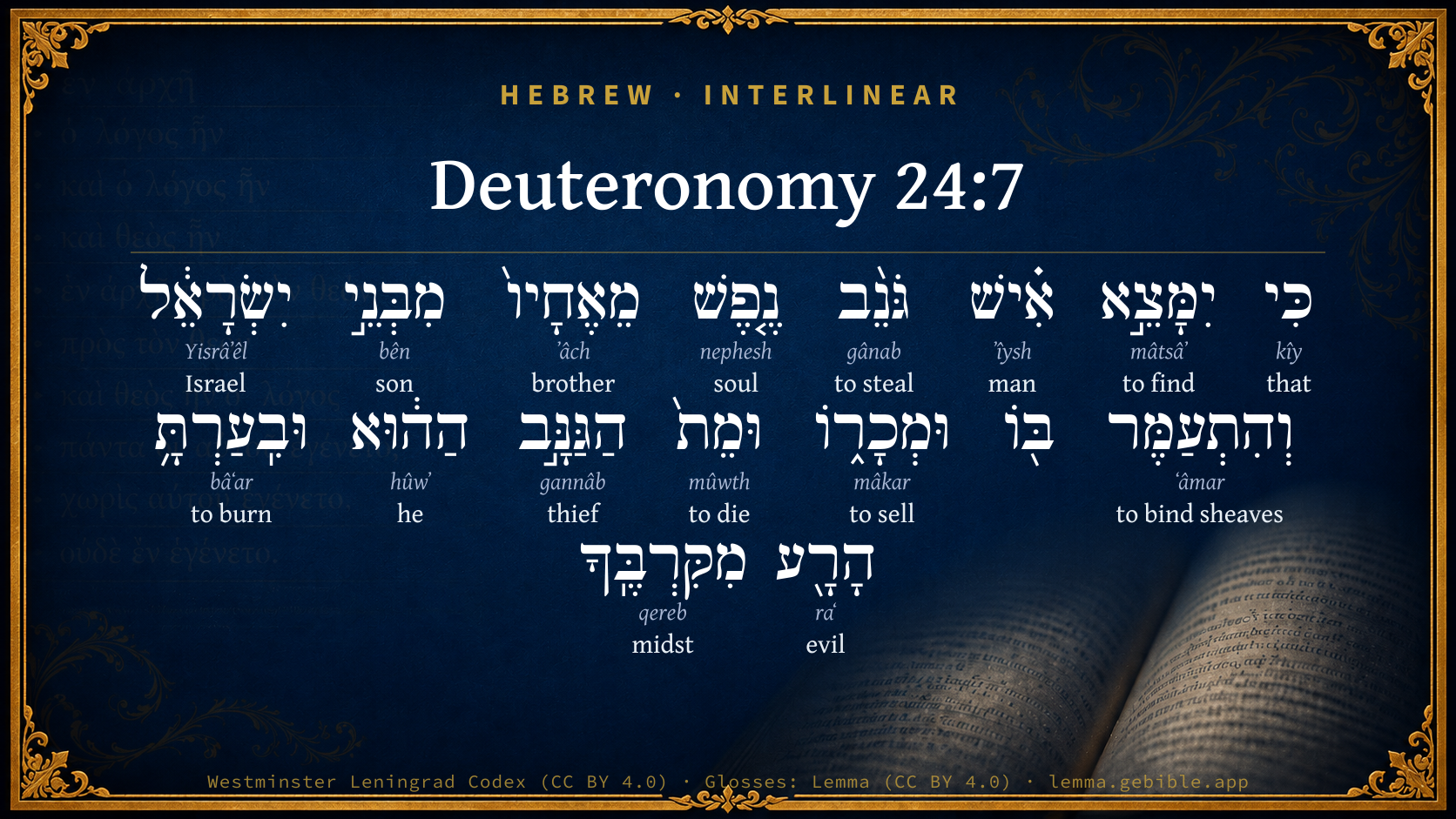
Hebrew (Westminster Leningrad Codex) Deuteronomy 24:7 appears in the Hebrew Old Testament. The text above is from the Westminster Leningrad Codex. Each word links to its Strong’s number, a concise gloss, and parsing drawn from the Open Scriptures Hebrew Bible morphology. Click any word for its full Brown-Driver-Briggs (BDB) entry.
Download image
Cite this verse

Deuteronomy 24:7 (World English Bible). Public Domain. Lemma interlinear Bible study tool, https://lemma.gebible.app/v/deuteronomy/24/7.

Show BibTeX & RIS
BibTeX
RIS
English Translation
If a man be found stealing any of his brothers of the children of Israel, and he deal with him as a slave, or sell him; then that thief shall die: so shall you put away the evil from the midst of you.
World English Bible · Public Domain
Download a study sheet

One document with this verse’s original text, its word-by-word gloss line, the meaning frame, cross-references with their text, attributed commentary, and full source and license credits — printable, and it pastes into notes with its structure intact.

This verse Autodidact and up

Study sheet (.html) Plain text (.txt)

A passage Seminary Student

Up to 50 verses in one chapter. A passage sheet keeps up to 6 commentary sources and 12 cross-references per verse, in the order this page ranks them, and says so on the sheet whenever that leaves anything out. Ask for a single verse and you get the Autodidact verse sheet above.

Everything on this page stays free to read, with no account — the sheet is a download of what is already on screen, not access to it.

Want to remove ads? Support Godless Engineer
Compare translations 3

The same verse in 3 English versions, stacked beneath the original-language interlinear above. Click any original word for its lexicon entry.

Each is an independent rendering of the whole verse — the interlinear is not word-aligned to these translations.

Highlighted words mark where these versions differ — a whole-verse word diff, not a word-by-word alignment.

  • World English Bible Public Domain
    If a man be found stealing any of his brothers of the children of Israel, and he deal with him as a slave, or sell him; then that thief shall die: so shall you put away the evil from the midst of you.
  • King James Version Public Domain
    If a man be found stealing any of his brethren of the children of Israel, and maketh merchandise of him, or selleth him; then that thief shall die; and thou shalt put evil away from among you.
  • unfoldingWord Literal Text CC BY-SA 4.0
    If a man is found stealing a life from his brothers from the sons of Israel, and treats him as a slave or sells him, then that thief shall die; and you shall remove the evil from among you.

unfoldingWord Literal Text — © unfoldingWord, licensed CC BY-SA 4.0. Word-aligned USFM3 via Door43 (git.door43.org/unfoldingWord/en_ult).

Versions to compare (up to 4)

3 of 4 selected

Show all 18 translations

Every available English version of this verse, each an independent rendering of the whole verse.

  • World English Bible Public Domain
    If a man be found stealing any of his brothers of the children of Israel, and he deal with him as a slave, or sell him; then that thief shall die: so shall you put away the evil from the midst of you.
  • Berean Standard Bible Public Domain
    If a man is caught kidnapping one of his Israelite brothers, whether he treats him as a slave or sells him, the kidnapper must die. So you must purge the evil from among you.
  • Majority Standard Bible Public Domain
    If a man is caught kidnapping one of his Israelite brothers, whether he treats him as a slave or sells him, the kidnapper must die. So you must purge the evil from among you.
  • King James Version Public Domain
    If a man be found stealing any of his brethren of the children of Israel, and maketh merchandise of him, or selleth him; then that thief shall die; and thou shalt put evil away from among you.
  • American Standard Version (1901) Public Domain
    If a man be found stealing any of his brethren of the children of Israel, and he deal with him as a slave, or sell him; then that thief shall die: so shalt thou put away the evil from the midst of thee.
  • Revised Version (1885) Public Domain
    If a man be found stealing any of his brethren of the children of Israel, and he deal with him as a slave, or sell him; then that thief shall die: so shalt thou put away the evil from the midst of thee.
  • Geneva Bible (1599) Public Domain
    If any man be found stealing any of his brethren of the children of Israel, and maketh marchandise of him, or selleth him, that thiefe shall die: so shalt thou put euil away from among you.
  • Douay-Rheims (1899) Public Domain
    If ally man be found soliciting his brother of the children of Israel, and selling him shall take a price, he shall be put to death, and thou shalt take away the evil from the midst of thee.
  • Young's Literal Translation Public Domain
    `When a man is found stealing a person, of his brethren, of the sons of Israel, and hath tyrannized over him, and sold him, then hath that thief died, and thou hast put away the evil thing out of thy midst.
  • Literal Standard Version CC BY-SA 4.0
    When a man is found stealing a person from his brothers, from the sons of Israel, and has tyrannized over him and sold him, then that thief has died, and you have put away evil out of your midst.
  • Unlocked Literal Bible CC BY-SA 4.0
    If a man is found kidnapping any of his brothers from among the people of Israel, and treats him as a slave and sells him, that thief must die; and you will remove the evil from among you.
  • unfoldingWord Literal Text CC BY-SA 4.0
    If a man is found stealing a life from his brothers from the sons of Israel, and treats him as a slave or sells him, then that thief shall die; and you shall remove the evil from among you.
  • Darby Bible Public Domain
    If a man be found who hath stolen one of his brethren of the children of Israel, and who hath treated him as a slave and sold him, that thief shall die; and thou shalt put evil away from thy midst.
  • World Messianic Bible Public Domain
    If a man is found stealing any of his brothers of the children of Israel, and he deals with him as a slave, or sells him, then that thief shall die. So you shall remove the evil from among you.
  • Webster's Bible Public Domain
    If a man shall be found stealing any of his brethren of the children of Israel, and shall make merchandise of him, or sell him; then that thief shall die; and thou shalt remove evil from among you.
  • Free Bible Version CC BY-SA 4.0
    Anyone caught kidnapping a fellow Israelite must be executed, whether the kidnapper makes him a slave or sells him. You must eliminate the evil from among you.
  • Bible in Basic English Public Domain
    If a man takes by force one of his countrymen, the children of Israel, using him as his property or getting a price for him, that thief is to be put to death: so you are to put away evil from among you.
  • JPS Tanakh (1917) Public Domain
    If a man be found stealing any of his brethren of the children of Israel, and he deal with him as a slave, and sell him; then that thief shall die; so shalt thou put away the evil from the midst of thee.

Literal Standard Version (2020), Covenant Press — licensed CC BY-SA 4.0. Text via the HelloAO Bible API (eBible.org). Unlocked Literal Bible (unfoldingWord) — licensed CC BY-SA 4.0. Text via the HelloAO Bible API (eBible.org). unfoldingWord Literal Text — © unfoldingWord, licensed CC BY-SA 4.0. Word-aligned USFM3 via Door43 (git.door43.org/unfoldingWord/en_ult). Free Bible Version, Dr. Jonathan Gallagher — licensed CC BY-SA 4.0. Text via the HelloAO Bible API (eBible.org).

Word by word

More ways to search: Search by grammar → Find every occurrence → Compare this word →

Practice this passage: Drill this verse → Learn its vocabulary →

וְהִתְעַמֶּר
ʻâmar
H6014
“and · to bind sheaves”
Conjunction + Verb, Hithpael, Sequential Perfect, 3rd Person, Masculine, Singular
Part of Speech
Conjunction + Verb
Stem
Hithpael
Form
Sequential Perfect
Person
3rd Person
Gender
Masculine
Number
Singular
Full BDB Definition

Origin: a primitive root

TWOT: 1645 , 1646

to bind sheaves - (Piel) to gather - to manipulate, deal tyrannically with - (Hithpael) to treat as a slave
  1. כִּי kîy H3588 “that” Conjunction
  2. יִמָּצֵ֣א mâtsâʼ H4672 “to find” Verb, Niphal, Imperfect, 3rd Person, Masculine, Singular
  3. אִ֗ישׁ ʼîysh H376 “man” Noun, Common, Masculine, Singular, Absolute
  4. גֹּנֵ֨ב gânab H1589 “stealing” Verb, Qal, Participle Active, Masculine, Singular, Absolute
  5. נֶ֤פֶשׁ nephesh H5315 “soul” Noun, Common, Both, Singular, Absolute
  6. מֵאֶחָיו֙ ʼâch H251 “from · brothers · his” Preposition + Noun, Common, Masculine, Plural, Construct + Suffix, Personal, 3rd Person, Masculine, Singular
  7. מִבְּנֵ֣י bên H1121 “from · sons of” Preposition + Noun, Common, Masculine, Plural, Construct
  8. יִשְׂרָאֵ֔ל Yisrâʼêl H3478 “Israel” Noun, Proper
  9. וּמְכָר֑וֹ mâkar H4376 “and · to sell · him” Conjunction + Verb, Qal, Sequential Perfect, 3rd Person, Masculine, Singular + Suffix, Personal, 3rd Person, Masculine, Singular
  10. וּמֵת֙ mûwth H4191 “and · to die” Conjunction + Verb, Qal, Sequential Perfect, 3rd Person, Masculine, Singular
  11. הַגַּנָּ֣ב gannâb H1590 “the · thief” Particle, Definite Article + Noun, Common, Masculine, Singular, Absolute
  12. הַה֔וּא hûwʼ H1931 “the · he” Particle, Definite Article + Pronoun, Personal, 3rd Person, Masculine, Singular
  13. וּבִֽעַרְתָּ֥ bâʻar H1197 “and · to burn” Conjunction + Verb, Piel, Sequential Perfect, 2nd Person, Masculine, Singular
  14. הָרָ֖ע raʻ H7451 “the · evil” Particle, Definite Article + Adjective, Adjective, Masculine, Singular, Absolute
  15. מִקִּרְבֶּֽךָ qereb H7130 “from · midst · your” Preposition + Noun, Common, Masculine, Singular, Construct + Suffix, Personal, 2nd Person, Masculine, Singular

About this verse

These counts appear in no published source. They are computed here, from the morphology-tagged text and Lemma’s own curated glosses. What Lemma adds →

17
words
16
distinct lemmas
Pentateuch
section

Notable vocabulary

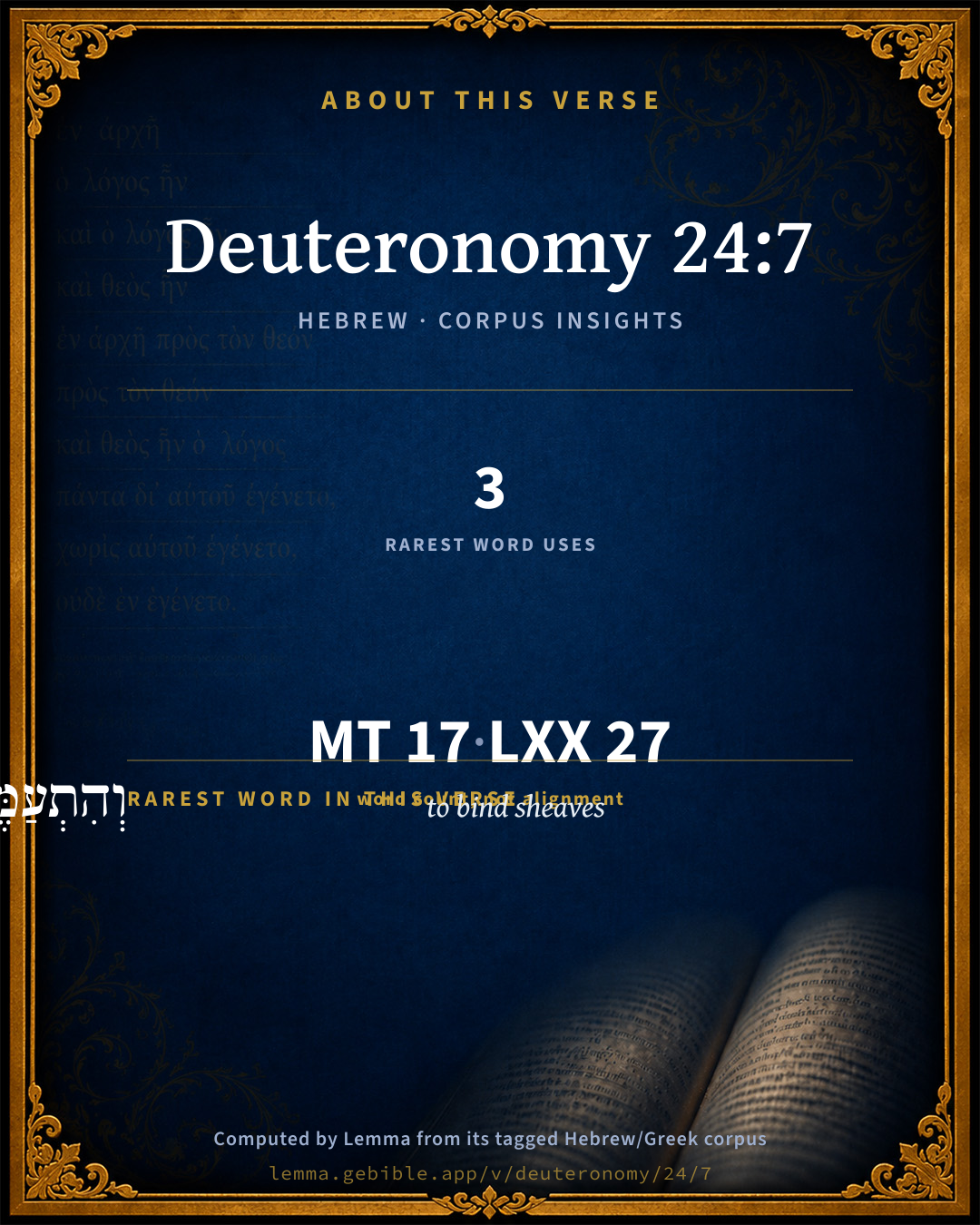
The rarest word here is וְהִתְעַמֶּר to bind sheaves H6014 — appearing just 3 times in the whole Hebrew Bible.

Shared distinctive vocabulary

וְהִתְעַמֶּר to bind sheaves H6014 occurs in 3 verses of the Hebrew Bible. Also found in:

Grammatical profile

  • 6 verbs
  • 7 nouns
  • 1 adjective
  • 1 pronoun
  • 1 preposition
  • 1 conjunction

Verb forms

  • יִמָּצֵ֣א Niphal · Imperfect
  • גֹּנֵ֨ב Qal · Participle Active
  • וְהִתְעַמֶּר Hithpael · Sequential Perfect
  • וּמְכָר֑וֹ Qal · Sequential Perfect
  • וּמֵת֙ Qal · Sequential Perfect
  • וּבִֽעַרְתָּ֥ Piel · Sequential Perfect

Hebrew & Septuagint length

In English translation the verse runs 43 words from the Hebrew and 44 from the Septuagint (LXX English) — closely comparable.

A rough comparison of the two English renderings, which tokenize alike — not a word-level alignment.

Word counts can differ between the Hebrew and the Greek without any difference in meaning — e.g. the Hebrew direct-object marker אֵת has no separate Greek word, and Greek often adds the article ὁ.

In the original languages it is 17 Hebrew tokens and 27 Greek tokens — but the two are counted differently (Hebrew bundles its prefixes and suffixes into one token; the Greek is in lemma form), so that isn’t a like-for-like length.

Cross-references

6

Topical passages linked to Deuteronomy 24:7 in the Treasury of Scripture Knowledge — connected by theme and wording, ordered by reader-vote popularity; previews shown in the World English Bible.

  • Exodus 21:16 "Anyone who kidnaps someone and sells him, or if he is found in his hand, he shall surely be put to death.
  • Exodus 22:1–4 "If a man steals an ox or a sheep, and kills it, or sells it; he shall pay five oxen for an ox, and four sheep for a sheep.
  • 1 Timothy 1:10 for the sexually immoral, for homosexuals, for slave-traders, for liars, for perjurers, and for any other thing contrary to the sound doctrine;
  • Revelation 18:13 and cinnamon, incense, perfume, frankincense, wine, olive oil, fine flour, wheat, sheep, horses, chariots, bodies, and people's souls.
  • Deuteronomy 19:19 then shall you do to him, as he had thought to do to his brother: so shall you put away the evil from the midst of you.
  • Ezekiel 27:13 Javan, Tubal, and Meshech, they were your traffickers; they traded the persons of men and vessels of brass for your merchandise.

Cross-references courtesy of OpenBible.info (CC BY 4.0).

Hebrew and Greek witnesses Masoretic Hebrew ↔ Greek Septuagint

The same verse in the two great witnesses to the Old Testament, shown verse-for-verse.

These are two independent witnesses, not word-aligned to each other, and the Septuagint is shown in lemma (dictionary) form.

Hebrew Deuteronomy 24:7 Masoretic · Westminster Leningrad Codex

כִּי יִמָּצֵ֣א אִ֗ישׁ גֹּנֵ֨ב נֶ֤פֶשׁ מֵאֶחָיו֙ מִבְּנֵ֣י יִשְׂרָאֵ֔ל וְהִתְעַמֶּר בּ֖וֹ וּמְכָר֑וֹ וּמֵת֙ הַגַּנָּ֣ב הַה֔וּא וּבִֽעַרְתָּ֥ הָרָ֖ע מִקִּרְבֶּֽךָ

If a man be found stealing any of his brothers of the children of Israel, and he deal with him as a slave, or sell him; then that thief shall die: so shall you put away the evil from the midst of you.

World English Bible · Public Domain

Greek LXX Deuteronomy 24:7 Septuagint · lemma form

ἐάν δέ ἁλίσκω ἄνθρωπος κλέπτω ψυχή ὁ ἀδελφός αὐτός ὁ υἱός ἰσραήλ καί καταδυναστεύω αὐτός ἀποδίδωμι ἀποθνήσκω ὁ κλέπτης ἐκεῖνος καί ἐκαἴρω ὁ πονηρός ἐκ σύ αὐτός

And if any one should have recently taken a wife, he shall not go out to war, neither shall any thing be laid upon him; he shall be free in his house; for one year he shall cheer his wife whom he has taken.

LXX2012 (modern English Septuagint) · Public Domain

Hebrew: Westminster Leningrad Codex (CC BY 4.0). Greek: Septuagint (public domain); English from LXX2012 (modern English Septuagint) (Public Domain). How the Septuagint differs from the Hebrew →

Targum (Aramaic paraphrase)

2

The Targum is the ancient Jewish Aramaic paraphrase of the Hebrew Scriptures — an interpretive translation, not the Hebrew text itself. Onkelos (literal) and Pseudo-Jonathan (expansive) render the Torah, and Jonathan the Prophets. Coverage is partial: where no permissively-licensed English translation exists for a verse, only the Aramaic is shown. This is verse-level text, not a word-by-word alignment to the Hebrew.

  1. Targum Onkelos Torah (Genesis–Deuteronomy)
    אֲרֵי יִשְׁתְּכַח גְבַר גָנֵב נַפְשָׁא מֵאֲחוֹהִי מִבְּנֵי יִשְׂרָאֵל וְיִתָּגַר בֵּהּ וִיזַבְּנִנֵהּ וְיִתְקְטֵל גַנָבָא הַהוּא וּתְפַלֵי עָבֵד דְבִישׁ מִבֵּינָךְ

    (no public-domain English translation for this verse)

    Targum Onkelos — Aramaic: “Onkelos Genesis” (public domain); “Onkelos Exodus” (public domain); “Onkelos Leviticus” (public domain); “Onkelos Numbers” (public domain); “Onkelos Deuteronomy” (public domain). English: “Sefaria Community Translation” (CC0 1.0 (public-domain dedication)); “J.W. Etheridge. The Targums of Onkelos and Jonathan Ben Uzziel on the Pentateuch. London: Longmans, Green, 1862” (public domain). Text via Sefaria.

  2. Targum Pseudo-Jonathan Torah (Genesis–Deuteronomy)
    אֲרוּם יִשְׁתַּכַּח בַּר נַשׁ גְּנִיב נְפָשׁ מֵאָחוֹי מִבְּנֵי יִשְרָאֵל וְיַעֲבֵיד בֵּיהּ פְּרַקְמַטְיָא וְיִזְבְּנִינֵיהּ וְיִתְקְטֵיל גַּבְרָא הַהוּא בְּשִׁינוּקָא דְסוֹדְרָא וּתְפַלֵּי עֲבִיד דְּבִישׁ מִבֵּינָךְ

    When a man is found stealing a person of his brethren of the sons of Israel, making merchandise of him, and selling him, that man shall die by strangulation with the napkin; and you shall put away the evil doer from among thee.

    Targum Pseudo-Jonathan — Aramaic: “Targum Jonathan on Genesis” (public domain); “Targum Jonathan on Exodus” (public domain); “Targum Jonathan on Leviticus” (public domain); “Targum Jonathan on Numbers” (public domain); “Targum Jonathan on Deuteronomy” (public domain). English: “The Targum of Jonathan ben Uzziel, trans. J. W. Etheridge, London, 1862” (public domain). Text via Sefaria.

Commentary

Notes on Deuteronomy 24:7 from classic Christian and Jewish commentators (each source and its license shown beneath its notes). The classic Christian expositions comment on the surrounding passage and are grouped to its opening verse, so a note may address several verses; the Jewish commentaries on the Tanakh (Rashi and others) are per-verse, so they appear only where the commentator wrote on this verse.

Lemma curates 59 commentaries, every one of them public domain or Creative Commons licensed, each selected and text-cleaned for this edition rather than reprinted as found. About our sources →

Trapp's Complete Commentary

John Trapp

Deu 24:7 If a man be found stealing any of his brethren of the children of Israel, and maketh merchandise of him, or selleth him; then that thief shall die; and thou shalt put evil away from among you.

Ver. 7. And maketh merchandise of him.] What then shall be done to those seducers, that "creeping," or shooting themselves into houses, "lead captive silly women," {2Ti 3:6} and simple men, {Rom 16:18} take them prisoners, and then make price of them? {2Pe 2:3} Of which sort of soul merchants, there are now-a-days found not a few. See Rev 18:13.

John Trapp, A Commentary or Exposition upon All the Books of the Old and New Testament (1647–1656) — public domain. Text from a community e-Sword module.

Joseph Benson's Commentary

Deu 24:7. That thief shall die — Thus the crime of man-stealing was to be punished with death, though stealing of beasts, or other things, was not.

Joseph Benson's Commentary on the Old and New Testaments (1811–1818) — public domain. Text from a community e-Sword module.

Jamieson, Fausset & Brown

Robert Jamieson, A. R. Fausset & David Brown

If a man be found stealing any of his brethren--(See Exo 21:16).

Jamieson, Fausset & Brown — Commentary Critical and Explanatory on the Whole Bible (1871) — public domain (CC PDM 1.0). Text via the HelloAO Bible API.

Ellicott's Commentary for English Readers

(7) If a man be found stealing (a soul) any of his brethren . . .—See Exo_21:16.

(8,9) Take heed in the plague of leprosy. . . . Remember what the Lord thy God did to Miriam.—The point here seems to be that though Miriam was one of the three leaders of Israel (“I sent before thee Moses, Aaron, and Miriam”—Mic_6:4), yet she was shut out of the camp seven days (Num_12:14) when suddenly smitten with leprosy. There might be a tendency to relax the law in the case of great or wealthy persons. But this would be felt keenly by poorer lepers, who could obtain no exemption. Moses, whose own sister had suffered from the leprosy, and had been treated according to the strict letter of the law, would never consent to any relaxation of it.

The priests the Levites.—The law of leprosy was one of the laws which the “priests” in particular were ordered to administer. “Aaron looked on Miriam, and, behold, she was leprous” It seems impossible to maintain that the Levites in general are meant here. The writer evidently had personal knowledge of the case of Miriam. Had he or his first readers lived in later times, he would have explained his meaning more fully.

A Bible Commentary for English Readers, edited by Charles John Ellicott (1878–1897) — public domain. Text from a community e-Sword module.

The Cambridge Bible for Schools and Colleges

gen. ed. J. J. S. Perowne

7. Against Manstealing. If a man be found (see Deu_21:1, Deu_22:22) stealing a brother (see on Deu_15:2) Israelite, and playing the owner (see Deu_21:14) he shall die: so shalt thou put away the evil, etc. (Deu_13:5 (6)). The parallel in E, Exo_21:16, has stealing a man; for D’s substitution of Israelite see on Deu_15:2, Deu_22:1-4. Ḫammurabi (§ 14) decrees death to the kidnapper.

The Cambridge Bible for Schools and Colleges (gen. ed. J. J. S. Perowne; Cambridge University Press, 1878–1918) — public domain. Text from a community e-Sword module.

John Gill's Exposition

If a man be found stealing any of his brethren of the children of Israel,.... Whether grown up or little, male or female, an Israelite or a proselyte, or a freed servant; all, as Maimonides (f) says, are included in this general word "brethren"; though Aben Ezra observes, that it is added, "of the children of Israel", for explanation, since an Edomite is called a "brother". Now, a man must be "found" committing this fact; that is, it must plainly appear, there must be full proof of it by witnesses, as Jarchi explains this word:

and maketh merchandise of him; or rather uses him as a servant, and employs him in any service to the least profit and advantage by him, even to the value of a farthing; yea, if he does but lean upon him, and he supports him, though he is an old man that is stolen; this is serving a man's self by him, as Maimonides (g), which is what is forbidden as distinct from selling him, as follows:

or selleth him: to others; and both these, according to the above writer (h), using him for service, and selling him, are necessary to make him guilty of death; not the one without the other; but reading them disjunctively, as we do, gives the better sense of the words:

then that thief shall die; by strangling with a napkin, as the Targum of Jonathan; and so Maimonides (i) says, his death is by strangling:

and thou shall put evil away from among you; both him that does evil, as the Targum of Jonathan, and the guilt of it by inflicting due punishment for it; and so deter from such practices, and prevent evil coming upon the body of the people, should such a sin be connived at; see Exo 21:16.

(f) Hichot Genibah, c. 9. sect. 6. (g) Ib. sect. 2. (h) Ib. sect. 3. (i) Hilchot Genibah, c. 9. sect. 1. So R. Sol. Urbin. Ohel Moed, fol. 67. 1. interprets it of service.

John Gill's Exposition of the Whole Bible (1746–1763) — public domain (CC PDM 1.0). Text via the HelloAO Bible API.

Albert Barnes' Notes on the Bible

Compare Deu 21:14; and Exo 21:16.

Albert Barnes' Notes on the Bible (1834–1885) — public domain. Text from a community e-Sword/MySword module.

Haydock's Catholic Bible Commentary

Soliciting. Hebrew, "stealing a soul;" (Menochius) or decoying one to a distance from home, where he may have an opportunity of selling him for a slave. (Haydock) (Exodus xxi. 16.)

George Leo Haydock (1774–1849), Haydock's Catholic Family Bible and Commentary, 1859 edition — public domain. Excludes Psalms (Douay-Rheims chapter numbering differs from Protestant) and Deuterocanonical books (Catholic canon only).

Matthew Poole's English Annotations

See Poole "Exo 21:16".

Matthew Poole's English Annotations on the Holy Bible (1683–1685) — public domain. Text from a community e-Sword/MySword module.

Whedon's Commentary on the Bible

Daniel D. Whedon

7. Stealing any of his brethren — A repetition of the law against man-stealing. Comp. Exo_21:16.

Maketh merchandise of him — The same verb is here used that is employed in Deu_21:14. It means to lay hands upon one, to use violence, to treat one as a slave.

Daniel D. Whedon (gen. ed.), Commentary on the Old and New Testaments (1874–1909) — public domain. Text from a community e-Sword module.

The Pulpit Commentary

Against man-stealing: repetition, with expansion, of the law in Exo_21:16.

Man-stealing a capital crime.

We have already noticed the merciful fugitive law which forbade any one to restore a runaway to his master. That was the cure of existing evil. Here we have the prevention, which is better still. For man-stealing and man-selling are the origin of slavery, and the Lord attaches to this the penalty of death. As Cheerer said of it, "God be praised for this law! It strikes through and through the vitals of this sin.

I LIBERTY MUST BE MAINTAINED UNDER THE PENAL SANCTION OF DEATH TO HIM WHO INVADES IT. The ruffian who would steal and sell a brother deserves to die. His treason against the liberty of his fellow is an unpardonable sin against society, and he should get no quarter. No wonder men have fought and died for liberty when God surrounds it with such tremendous sanctions.

II HOW MUCH GREATER THE CRIME OF BRINGING MEN INTO SPIRITUAL BONDAGE. And this is done daily. What is the meaning of the power exercised by superstitious priesthoods over their devotees? Is it not "spiritual despotism?" And should not the crime of man-stealing awake a suspicion in such hearts that their procedure is the exact analogue in the spiritual sphere? It should be combated and resisted unto the death, as destroying that heritage of liberty with which the Lord has endowed all men. R.M.E.

Slave-traffic a capital offence.

Slavery, in modified form, has always prevailed in Eastern lands; and, with prudent limitations, was tolerated among the Hebrews. To promulgate laws for men, which transcended their moral sense, would defeat the ends of law. God has continually to lead men from lower levels to higher. A man may voluntarily sell his liberty for a time. But to deprive a man of liberty by violence is a scarlet sin; and man-stealing is rightly branded with the deepest indignation of God.

I LIBERTY IS ESSENTIAL TO MAN"S FULLEST LIFE. Any form of bondage is a curtailment of life, a mutilation of the man. His outward condition may be bettered. He may have more food and warmer clothing and a healthier home, but the real man is injured. He is not fully susceptible of self-development. The springs of life are poisoned. He learns to despise himself, and to despise oneself is a step on the slippery road to ruin. Yet liberty is a human right not well understood. It must be distinguished from license. True liberty has its limits and its checks. A man is at liberty to part with his liberty for a time. Every man who toils for his bread is compelled to do this. Yet even this temporary cessation of his liberty must be voluntary.

II TO DEPRIVE A MAN FORCIBLY OF HIS LIBERTY IS TO DEPRIVE HIM OF HIS LIFE. The life of the body is not the whole of a man"s life. The intellect, affections, choice, will, have a life more precious than the life of the body. To steal a man or to kidnap a child is to interfere, wantonly and injuriously, with the proper life of the person. The outward conditions of training and probation are not such as God ordained. The man"s eternal prospects, as well as his earthly possibilities, are blighted. And all this moral damage is done for paltry gain. The man who can lend himself to such a business as slave-mongering is lost to all goodness, lost to shame. He is a disgrace to the human species a tool of Satan.

III FOR SUCH A CRIME THE GOD-APPOINTED PENALTY IS DEATH. No heavier penalty is imposed by the civil magistrate, because no heavier penalty is possible. Such a monster must be removed from the scenes of human society, because his presence is pestilential, demoralizing, deadly. Where human judgment ends, God"s judgment begins. Such a one is hurried before the higher court of heaven, is arraigned before the great white throne of the Eternal, and fullest justice will here be meted out. My soul, be thou free from such taint as this! D.

The Pulpit Commentary (1880–1919), ed. H.D.M. Spence-Jones & Joseph S. Exell — public domain. Text from a community e-Sword module.

unfoldingWord translationNotes

Door43 World Missions Community

General Information:

Moses speaks to the Israelites as if they were one man, so the words "you" and "your" here are singular. (See: Forms of You)

If a man is found kidnapping

This is an idiom for "If a man kidnaps." It can be stated in active form. AT: "If you find a man kidnapping" (See: Idiom and Active or Passive)

kidnapping

using physical force to take an innocent person away from his home and imprison him

any of his brothers from among the people of Israel

"any of his fellow Israelites"

that thief must die

"then other Israelites should kill that thief as a punishment for what he did"

you will remove the evil from among you

The adjective "evil" can be translated as a noun phrase. AT: "you must remove from among the Israelites the person who does this evil thing" or "you must execute this evil person" (See: Nominal Adjectives)

translationWords

brother

Israel

servant

thief

die

evil

unfoldingWord translationNotes — © Distant Shores Media and the Door43 World Missions Community, licensed CC BY-SA 4.0. Source: git.door43.org/Door43/en_tn.

Rashi

Rabbi Shlomo Yitzchaki (Rashi)

כי ימצא IF [A MAN] BE FOUND [STEALING …] — Found when doing so by witnesses and after legal warning. This, too, is the meaning in all cases where a form of the verb מצא is used in the Torah, under similar circumstances (Mekhilta; Sifrei Devarim 273:1).

והתעמר בו AND TREATS HIM AS A SLAVE — he is not liable to the death penalty until he uses him as a slave (cf. Sifrei Devarim 273:5; Sanhedrin 85b).

Rashi on the Tanakh — English translations: “The Judaica Press complete Tanach with Rashi, translated by A. J. Rosenberg” (CC BY 4.0); “Pentateuch with Rashi's commentary by M. Rosenbaum and A.M. Silbermann, 1929-1934” (public domain); “The Metsudah Tanach series, Lakewood, N.J” (CC BY 4.0); and “The Book of Joshua, Metsudah Publications, 1997” (CC BY 4.0). Text via Sefaria.

Lesson kit

Teaching starters — assembled from the data on this page, not authored interpretation. Every prompt links to the verse data it draws on. Edit before teaching.

Deuteronomy, in the Pentateuch, opens this verse with 17 words (16 distinct Hebrew lemmas). Its most distinctive word is ʻâmar (“to bind sheaves”). A historical commentator’s framing appears above. Read the whole chapter for the surrounding context.

Discussion questions

  1. The word ʻâmar carries the sense “to bind sheaves.” How does it shape the verse?
  2. Deuteronomy 21:14 shares the word «to bind sheaves» with this verse. How do the two illuminate each other?
  3. The translations on this page render this verse differently — a whole-verse word diff, not a word-by-word alignment. What might account for the different wordings?
  4. The verb «יִמָּצֵ֣א» is Niphal Imperfect. How does its form color the action?
  5. Reading how Trapp's Complete Commentary and Joseph Benson's Commentary read this verse, where do the two commentators agree and where do they part?

Things to notice

Reading settings

Reading text

Shown beneath each verse's original-language words.

Old Testament
Old Testament edition

Read the OT as the Masoretic Hebrew (MT) or the Greek Septuagint (LXX).

English shown for the Greek Septuagint (in the Hebrew ↔ Greek comparison).

Comparing translations? Open the Compare panel on any verse page to stack up to four side by side.