
Joshua 24:17

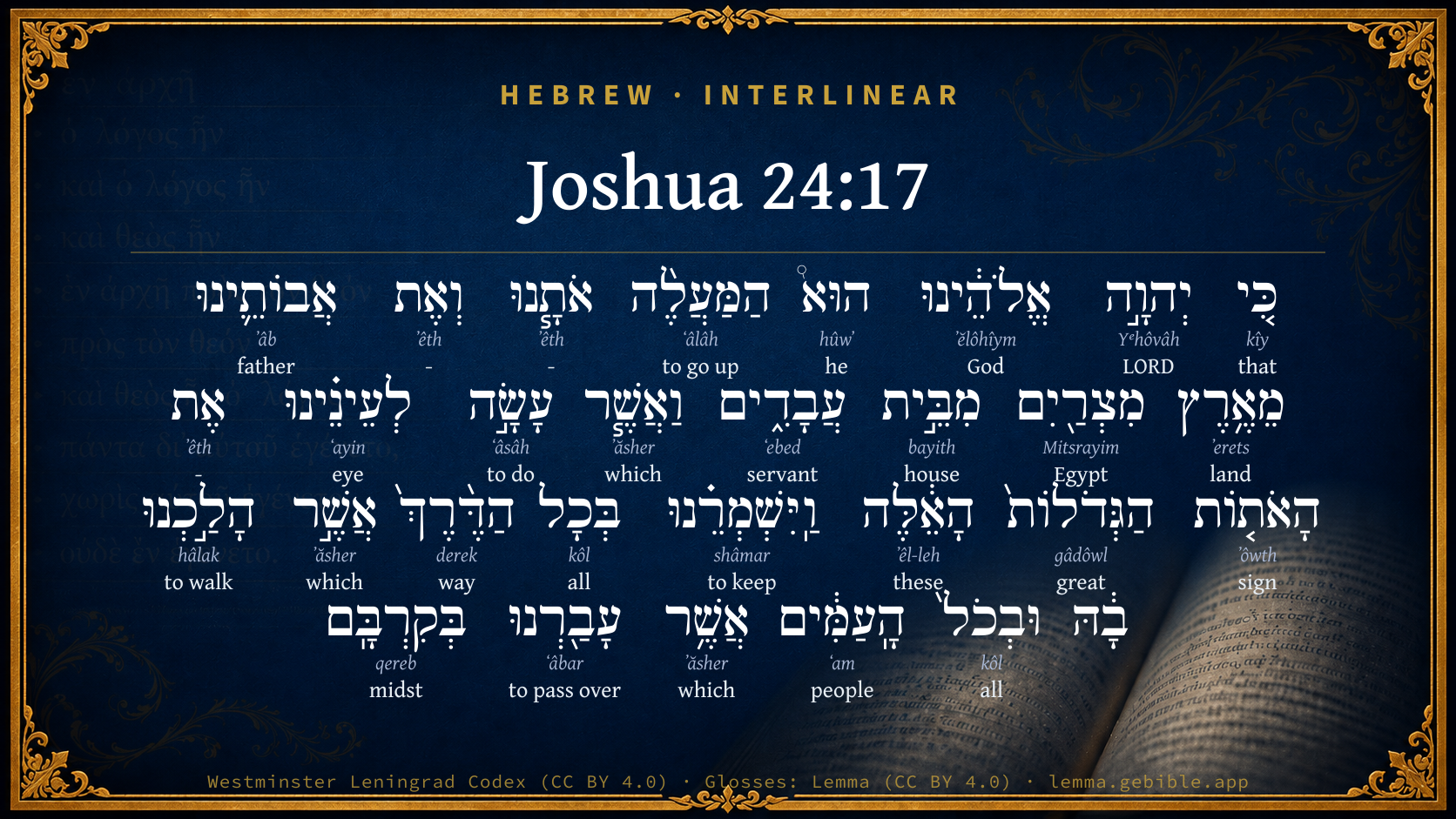
Hebrew (Westminster Leningrad Codex) Joshua 24:17 appears in the Hebrew Old Testament. The text above is from the Westminster Leningrad Codex. Each word links to its Strong’s number, a concise gloss, and parsing drawn from the Open Scriptures Hebrew Bible morphology. Click any word for its full Brown-Driver-Briggs (BDB) entry.
Download image
Cite this verse

Joshua 24:17 (World English Bible). Public Domain. Lemma interlinear Bible study tool, https://lemma.gebible.app/v/joshua/24/17.

Show BibTeX & RIS
BibTeX
RIS
English Translation
for Yahweh our God, he it is who brought us and our fathers up out of the land of Egypt, from the house of bondage, and who did those great signs in our sight, and preserved us in all the way in which we went, and among all the peoples through the midst of whom we passed;
World English Bible · Public Domain
Download a study sheet

One document with this verse’s original text, its word-by-word gloss line, the meaning frame, cross-references with their text, attributed commentary, and full source and license credits — printable, and it pastes into notes with its structure intact.

This verse Autodidact and up

Study sheet (.html) Plain text (.txt)

A passage Seminary Student

Up to 50 verses in one chapter. A passage sheet keeps up to 6 commentary sources and 12 cross-references per verse, in the order this page ranks them, and says so on the sheet whenever that leaves anything out. Ask for a single verse and you get the Autodidact verse sheet above.

Everything on this page stays free to read, with no account — the sheet is a download of what is already on screen, not access to it.

Want to remove ads? Support Godless Engineer
Compare translations 3

The same verse in 3 English versions, stacked beneath the original-language interlinear above. Click any original word for its lexicon entry.

Each is an independent rendering of the whole verse — the interlinear is not word-aligned to these translations.

Highlighted words mark where these versions differ — a whole-verse word diff, not a word-by-word alignment.

  • World English Bible Public Domain
    for Yahweh our God, he it is who brought us and our fathers up out of the land of Egypt, from the house of bondage, and who did those great signs in our sight, and preserved us in all the way in which we went, and among all the peoples through the midst of whom we passed;
  • King James Version Public Domain
    For the LORD our God, he it is that brought us up and our fathers out of the land of Egypt, from the house of bondage, and which did those great signs in our sight, and preserved us in all the way wherein we went, and among all the people through whom we passed:
  • unfoldingWord Literal Text CC BY-SA 4.0
    For Yahweh, he our God, the one having brought us and our fathers up from the land of Egypt, from the house of slaves, and who did these great signs before our eyes. And he kept us in all of the way in which we went and among all the peoples in whose midst we passed.

unfoldingWord Literal Text — © unfoldingWord, licensed CC BY-SA 4.0. Word-aligned USFM3 via Door43 (git.door43.org/unfoldingWord/en_ult).

Versions to compare (up to 4)

3 of 4 selected

Show all 18 translations

Every available English version of this verse, each an independent rendering of the whole verse.

  • World English Bible Public Domain
    for Yahweh our God, he it is who brought us and our fathers up out of the land of Egypt, from the house of bondage, and who did those great signs in our sight, and preserved us in all the way in which we went, and among all the peoples through the midst of whom we passed;
  • Berean Standard Bible Public Domain
    For the LORD our God brought us and our fathers out of the land of Egypt, out of the house of slavery, and performed these great signs before our eyes. He also protected us throughout our journey and among all the nations through which we traveled.
  • Majority Standard Bible Public Domain
    For the LORD our God brought us and our fathers out of the land of Egypt, out of the house of slavery, and performed these great signs before our eyes. He also protected us throughout our journey and among all the nations through which we traveled.
  • King James Version Public Domain
    For the LORD our God, he it is that brought us up and our fathers out of the land of Egypt, from the house of bondage, and which did those great signs in our sight, and preserved us in all the way wherein we went, and among all the people through whom we passed:
  • American Standard Version (1901) Public Domain
    for Jehovah our God, he it is that brought us and our fathers up out of the land of Egypt, from the house of bondage, and that did those great signs in our sight, and preserved us in all the way wherein we went, and among all the peoples through the midst of whom we passed;
  • Revised Version (1885) Public Domain
    for the LORD our God, he it is that brought us and our fathers up out of the land of Egypt, from the house of bondage, and that did those great signs in our sight, and preserved us in all the way wherein we went, and among all the peoples through the midst of whom we passed:
  • Geneva Bible (1599) Public Domain
    For the Lord our God, he brought vs and our fathers out of the lande of Egypt, from the house of bondage, and he did those great miracles in our sight, and preserued vs in all the way that we went, and among all the people through whome we came.
  • Douay-Rheims (1899) Public Domain
    The Lord our God he brought us and our fathers out of the land of Egypt, out of the house of bondage: and did very great signs in our sight, and preserved us in all the way by which we journeyed, and among all the people through whom we passed.
  • Young's Literal Translation Public Domain
    for Jehovah our God `is' He who is bringing us and our fathers up out of the land of Egypt, out of a house of servants, and who hath done before our eyes these great signs, and doth keep us in all the way in which we have gone, and among all the peoples through whose midst we passed;
  • Literal Standard Version CC BY-SA 4.0
    for our God YHWH [is] He who is bringing us and our fathers up out of the land of Egypt, out of a house of servants, and who has done these great signs before our eyes, and keeps us in all the way in which we have gone, and among all the peoples through whose midst we passed;
  • Unlocked Literal Bible CC BY-SA 4.0
    for it is Yahweh our God who brought us and our ancestors up from the land of Egypt, out of the house of slavery, and who did those great signs in our sight, and who preserved us in all the way that we went, and among all the nations through whom we passed.
  • unfoldingWord Literal Text CC BY-SA 4.0
    For Yahweh, he our God, the one having brought us and our fathers up from the land of Egypt, from the house of slaves, and who did these great signs before our eyes. And he kept us in all of the way in which we went and among all the peoples in whose midst we passed.
  • Darby Bible Public Domain
    for Jehovah our God, he it is that brought us up and our fathers out of the land of Egypt, from the house of bondage, and who did those great signs before our eyes, and preserved us in all the way wherein we went, and among all the peoples through whom we passed!
  • World Messianic Bible Public Domain
    for it is the LORD our God who brought us and our fathers up out of the land of Egypt, from the house of bondage, and who did those great signs in our sight, and preserved us in all the way in which we went, and among all the peoples through the middle of whom we passed.
  • Webster's Bible Public Domain
    For the LORD our God, he it is that brought us, and our fathers, out of the land of Egypt, from the house of bondage, and who did those great signs in our sight, and preserved us in all the way in which we went, and among all the people through whom we passed:
  • Free Bible Version CC BY-SA 4.0
    For the Lord our God brought us and our forefathers out of slavery in Egypt. He was the one who did great miracles before our very eyes. He looked after us on the way as we traveled through the lands of many nations.
  • Bible in Basic English Public Domain
    For it is the Lord our God who has taken us and our fathers out of the land of Egypt, out of the prison-house, and who did all those great signs before our eyes, and kept us safe on all our journeys, and among all the peoples through whom we went:
  • JPS Tanakh (1917) Public Domain
    for the LORD our God, He it is that brought us and our fathers up out of the land of Egypt, from the house of bondage, and that did those great signs in our sight, and preserved us in all the way wherein we went, and among all the peoples through the midst of whom we passed;

Literal Standard Version (2020), Covenant Press — licensed CC BY-SA 4.0. Text via the HelloAO Bible API (eBible.org). Unlocked Literal Bible (unfoldingWord) — licensed CC BY-SA 4.0. Text via the HelloAO Bible API (eBible.org). unfoldingWord Literal Text — © unfoldingWord, licensed CC BY-SA 4.0. Word-aligned USFM3 via Door43 (git.door43.org/unfoldingWord/en_ult). Free Bible Version, Dr. Jonathan Gallagher — licensed CC BY-SA 4.0. Text via the HelloAO Bible API (eBible.org).

Word by word

More ways to search: Search by grammar → Find every occurrence → Compare this word →

Practice this passage: Drill this verse → Learn its vocabulary →

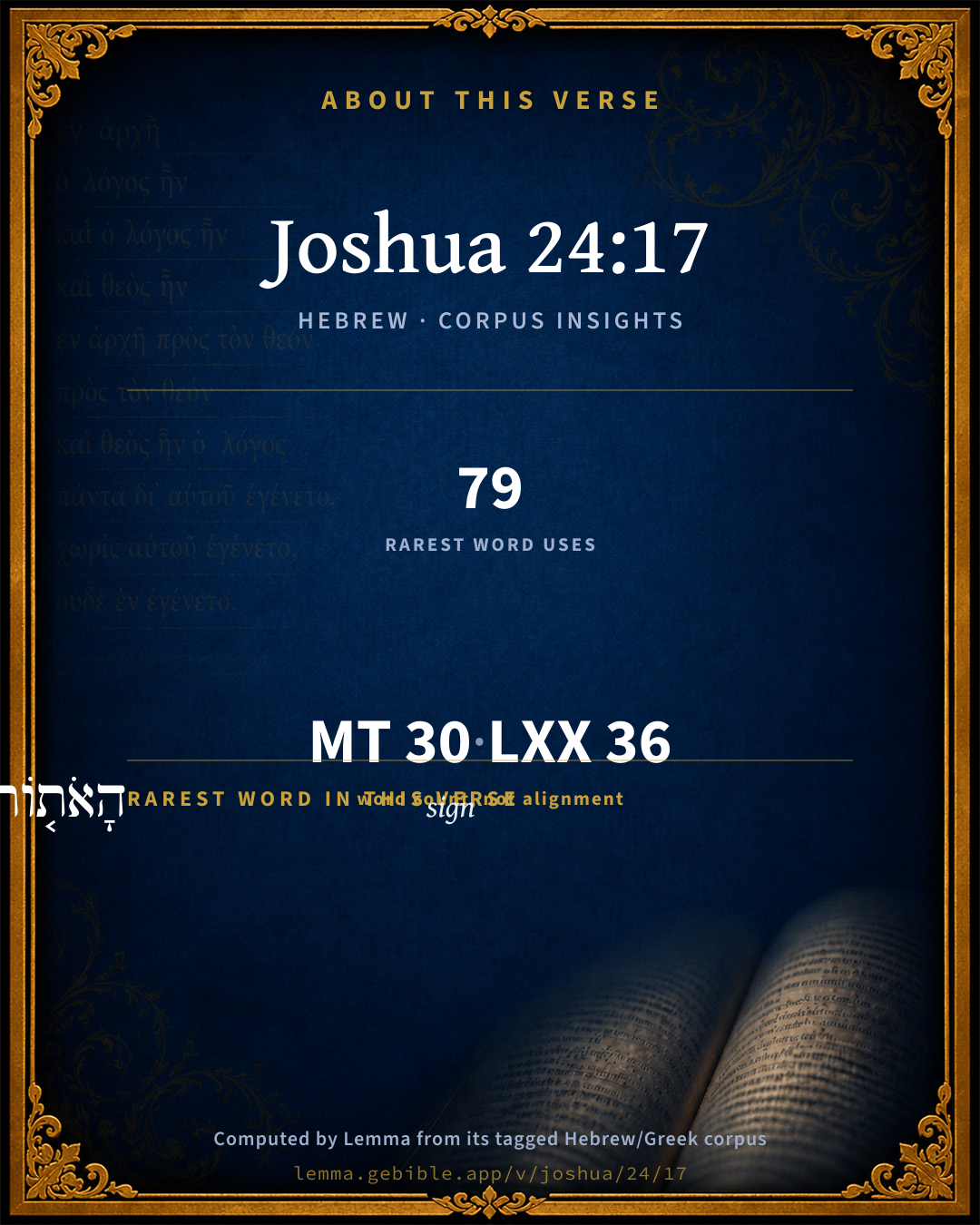
הָאֹת֤וֹת
ʼôwth
H226
“the · signs”
Particle, Definite Article + Noun, Common, Both, Plural, Absolute
Part of Speech
Particle + Noun
Type
Common
Gender
Both
Number
Plural
State
Absolute
Full BDB Definition

Origin: probably from H225 (in the sense of appearing)

TWOT: 41a

sign, signal - a distinguishing mark - banner - remembrance - miraculous sign - omen - warning - token, ensign, standard, miracle, proof
  1. כִּ֚י kîy H3588 “that” Conjunction
  2. יְהוָ֣ה Yᵉhôvâh H3068 “LORD” Noun, Proper
  3. אֱלֹהֵ֔ינוּ ʼĕlôhîym H430 “God(s) · our” Noun, Common, Masculine, Plural, Construct + Suffix, Personal, 1st Person, Common, Plural
  4. הוּא֩ hûwʼ H1931 “he” Pronoun, Personal, 3rd Person, Masculine, Singular
  5. הַמַּעֲלֶ֨ה ʻâlâh H5927 “the · going up” Particle, Definite Article + Verb, Hiphil, Participle Active, Masculine, Singular, Absolute
  6. אֹתָ֧נוּ ʼêth H853 “- · us” Particle, Direct Object + Suffix, Personal, 1st Person, Common, Plural
  7. וְאֶת ʼêth H853 “and · -” Conjunction + Particle, Direct Object
  8. אֲבוֹתֵ֛ינוּ ʼâb H1 “fathers · our” Noun, Common, Masculine, Plural, Construct + Suffix, Personal, 1st Person, Common, Plural
  9. מֵאֶ֥רֶץ ʼerets H776 “from · land of” Preposition + Noun, Common, Both, Singular, Construct
  10. מִצְרַ֖יִם Mitsrayim H4714 “Egypt” Noun, Proper
  11. מִבֵּ֣ית bayith H1004 “from · house of” Preposition + Noun, Common, Masculine, Singular, Construct
  12. עֲבָדִ֑ים ʻebed H5650 “servants” Noun, Common, Masculine, Plural, Absolute
  13. וַאֲשֶׁ֧ר ʼăsher H834 “and · which” Conjunction + Particle, Relative
  14. עָשָׂ֣ה ʻâsâh H6213 “to do” Verb, Qal, Perfect, 3rd Person, Masculine, Singular
  15. לְעֵינֵ֗ינוּ ʻayin H5869 “to/for · eyes · our” Preposition + Noun, Common, Both, Dual, Construct + Suffix, Personal, 1st Person, Common, Plural
  16. אֶת ʼêth H853 “-” Particle, Direct Object
  17. הַגְּדֹלוֹת֙ gâdôwl H1419 “the · great” Particle, Definite Article + Adjective, Adjective, Feminine, Plural, Absolute
  18. הָאֵ֔לֶּה ʼêl-leh H428 “the · these” Particle, Definite Article + Pronoun, Demonstrative, Common, Plural
  19. וַֽיִּשְׁמְרֵ֗נוּ shâmar H8104 “and · to keep · us” Conjunction + Verb, Qal, Sequential Imperfect, 3rd Person, Masculine, Singular + Suffix, Personal, 1st Person, Common, Plural
  20. בְּכָל kôl H3605 “in/at · all of” Preposition + Noun, Common, Masculine, Singular, Construct
  21. הַדֶּ֨רֶךְ֙ derek H1870 “the · way” Particle, Definite Article + Noun, Common, Both, Singular, Absolute
  22. אֲשֶׁ֣ר ʼăsher H834 “which” Particle, Relative
  23. הָלַ֣כְנוּ hâlak H1980 “to walk” Verb, Qal, Perfect, 1st Person, Common, Plural
  24. וּבְכֹל֙ kôl H3605 “and · in/at · all of” Conjunction + Preposition + Noun, Common, Masculine, Singular, Construct
  25. הָֽעַמִּ֔ים ʻam H5971 “the · peoples” Particle, Definite Article + Noun, Common, Masculine, Plural, Absolute
  26. אֲשֶׁ֥ר ʼăsher H834 “which” Particle, Relative
  27. עָבַ֖רְנוּ ʻâbar H5674 “to pass over” Verb, Qal, Perfect, 1st Person, Common, Plural
  28. בְּקִרְבָּֽם qereb H7130 “in/at · midst · their” Preposition + Noun, Common, Masculine, Singular, Construct + Suffix, Personal, 3rd Person, Masculine, Plural

About this verse

These counts appear in no published source. They are computed here, from the morphology-tagged text and Lemma’s own curated glosses. What Lemma adds →

30
words
24
distinct lemmas
Historical
section

Grammatical profile

  • 5 verbs
  • 14 nouns
  • 1 adjective
  • 2 pronouns
  • 1 preposition
  • 1 conjunction
  • 6 particles

Verb forms

  • הַמַּעֲלֶ֨ה Hiphil · Participle Active
  • עָשָׂ֣ה Qal · Perfect
  • וַֽיִּשְׁמְרֵ֗נוּ Qal · Sequential Imperfect
  • הָלַ֣כְנוּ Qal · Perfect
  • עָבַ֖רְנוּ Qal · Perfect

Repetition

Words recur within this verse — often emphatic in Hebrew:

  • בְּכָל all H3605 ×2
  • וַאֲשֶׁ֧ר which H834 ×3

Hebrew & Septuagint length

In English translation the verse runs 57 words from the Hebrew and 35 from the Septuagint (LXX English) — the Septuagint runs noticeably shorter here. See the side-by-side →

A rough comparison of the two English renderings, which tokenize alike — not a word-level alignment.

Word counts can differ between the Hebrew and the Greek without any difference in meaning — e.g. the Hebrew direct-object marker אֵת has no separate Greek word, and Greek often adds the article ὁ.

In the original languages it is 30 Hebrew tokens and 36 Greek tokens — but the two are counted differently (Hebrew bundles its prefixes and suffixes into one token; the Greek is in lemma form), so that isn’t a like-for-like length.

Cross-references

6

Topical passages linked to Joshua 24:17 in the Treasury of Scripture Knowledge — connected by theme and wording, ordered by reader-vote popularity; previews shown in the World English Bible.

  • Exodus 19:4 'You have seen what I did to the Egyptians, and how I bore you on eagles' wings, and brought you to myself.
  • Isaiah 63:7–14 I will make mention of the loving kindnesses of Yahweh, [and] the praises of Yahweh, according to all that Yahweh has bestowed on us, and the great goodness toward the house of Israel, which he has bestowed on them according to his mercies, and according to the multitude of his loving kindnesses.
  • Deuteronomy 32:11–12 As an eagle that stirs up her nest, That flutters over her young, He spread abroad his wings, he took them, He bore them on his feathers.
  • Joshua 24:5–14 I sent Moses and Aaron, and I plagued Egypt, according to that which I did in the midst of it: and afterward I brought you out.
  • Isaiah 46:4 and even to old age I am he, and even to gray hairs will I carry you. I have made, and I will bear; yes, I will carry, and will deliver.
  • Amos 2:9–10 Yet I destroyed the Amorite before them, Whose height was like the height of the cedars, And he was strong as the oaks; Yet I destroyed his fruit from above, and his roots from beneath.

Cross-references courtesy of OpenBible.info (CC BY 4.0).

Hebrew and Greek witnesses Masoretic Hebrew ↔ Greek Septuagint

The same verse in the two great witnesses to the Old Testament, shown verse-for-verse.

Here the Septuagint runs noticeably shorter than the Hebrew — LXX2012 (modern English Septuagint) 35 words vs World English Bible 57. A rough length comparison of the two English translations, not a word-level alignment — read both below.

These are two independent witnesses, not word-aligned to each other, and the Septuagint is shown in lemma (dictionary) form.

Hebrew Joshua 24:17 Masoretic · Westminster Leningrad Codex

כִּ֚י יְהוָ֣ה אֱלֹהֵ֔ינוּ הוּא֩ הַמַּעֲלֶ֨ה אֹתָ֧נוּ וְאֶת אֲבוֹתֵ֛ינוּ מֵאֶ֥רֶץ מִצְרַ֖יִם מִבֵּ֣ית עֲבָדִ֑ים וַאֲשֶׁ֧ר עָשָׂ֣ה לְעֵינֵ֗ינוּ אֶת הָאֹת֤וֹת הַגְּדֹלוֹת֙ הָאֵ֔לֶּה וַֽיִּשְׁמְרֵ֗נוּ בְּכָל הַדֶּ֨רֶךְ֙ אֲשֶׁ֣ר הָלַ֣כְנוּ בָ֔הּ וּבְכֹל֙ הָֽעַמִּ֔ים אֲשֶׁ֥ר עָבַ֖רְנוּ בְּקִרְבָּֽם

for Yahweh our God, he it is who brought us and our fathers up out of the land of Egypt, from the house of bondage, and who did those great signs in our sight, and preserved us in all the way in which we went, and among all the peoples through the midst of whom we passed;

World English Bible · Public Domain

Greek LXX Joshua 24:17 Septuagint · lemma form

κύριος ὁ θεός ἐγώ αὐτός θεός εἰμί αὐτός ἀναἄγω ἐγώ καί ὁ πατήρ ἐγώ ἐκ αἴγυπτος καί διαφυλάσσω ἐγώ ἐν πᾶς ὁ ὁδός ὅς πορεύομαι ἐν αὐτός καί ἐν πᾶς ὁ ἔθνος ὅς παραἔρχομαι διά αὐτός

The Lord our God, he is God; he brought up us and our fathers from Egypt, and kept us in all the way wherein we walked, and among all the nations through whom we passed.

LXX2012 (modern English Septuagint) · Public Domain

Hebrew: Westminster Leningrad Codex (CC BY 4.0). Greek: Septuagint (public domain); English from LXX2012 (modern English Septuagint) (Public Domain). How the Septuagint differs from the Hebrew →

Targum (Aramaic paraphrase)

1

The Targum is the ancient Jewish Aramaic paraphrase of the Hebrew Scriptures — an interpretive translation, not the Hebrew text itself. Onkelos (literal) and Pseudo-Jonathan (expansive) render the Torah, and Jonathan the Prophets. Coverage is partial: where no permissively-licensed English translation exists for a verse, only the Aramaic is shown. This is verse-level text, not a word-by-word alignment to the Hebrew.

  1. Targum Jonathan Prophets (Joshua–Malachi)
    אֲרֵי יְיָ אֱלָהָנָא הוּא דְאַסֵיק יָתָנָא וְיַת אַבְהָתָנָא מֵאַרְעָא דְמִצְרַיִם מִבֵּית עַבְדוּתָא וְדִי עֲבַד לְעֵינָנָא יַת אָתַיָא וְיַת רַבְרְבָתָא הָאִלֵין וּנְטָרָנָא בְּכָל אוֹרְחָא דִי הֲלִיכְנָא בָּהּ וּבְכָל עַמְמַיָא דִי עָבַרְנָא בֵּינֵיהוֹן:

    (no public-domain English translation for this verse)

    Targum Jonathan — Aramaic: “Mikraot Gedolot” (public domain). English: “Sefaria Community Translation” (CC0 1.0 (public-domain dedication)); “London "Chaldee Paraphrase," 1871” (public domain). Text via Sefaria.

Commentary

Notes on Joshua 24:17 from classic Christian and Jewish commentators (each source and its license shown beneath its notes). The classic Christian expositions comment on the surrounding passage and are grouped to its opening verse, so a note may address several verses; the Jewish commentaries on the Tanakh (Rashi and others) are per-verse, so they appear only where the commentator wrote on this verse.

Lemma curates 59 commentaries, every one of them public domain or Creative Commons licensed, each selected and text-cleaned for this edition rather than reprinted as found. About our sources →

Trapp's Complete Commentary

John Trapp

Jos 24:17 For the LORD our God, he [it is] that brought us up and our fathers out of the land of Egypt, from the house of bondage, and which did those great signs in our sight, and preserved us in all the way wherein we went, and among all the people through whom we passed:

Ver. 17. He it is that brought us up.] Beneficium postulat officium; Mercy requireth duty: deliverance commandeth obedience. But many miscreants, as if God had hired them to be wicked, abuse all his benefits to his dishonour.

John Trapp, A Commentary or Exposition upon All the Books of the Old and New Testament (1647–1656) — public domain. Text from a community e-Sword module.

The Cambridge Bible for Schools and Colleges

gen. ed. J. J. S. Perowne

17. for the Lord our God, he it is] The people ground their promises of fidelity for the future on the dealings of God with them in the past, (i) their deliverance from Egypt; (ii) the great signs wrought in that land; (iii) their preservation in the wilderness; (iv) the expulsion of the Amorites.

The Cambridge Bible for Schools and Colleges (gen. ed. J. J. S. Perowne; Cambridge University Press, 1878–1918) — public domain. Text from a community e-Sword module.

John Gill's Exposition

For the Lord our God, he it is that brought us up and our fathers, out of the land of Egypt,.... When Pharaoh, the king of it, refused to let them go, yet he wrought such wonders in it and inflicted such plagues on it, as obliged Pharaoh and his people to dismiss them:

from the house of bondage: where they were held in the greatest thraldom and slavery, and their lives made bitter and miserable:

and which did those great signs in our sight; meaning the wonders and marvellous things wrought before Pharaoh and his people, and in the sight of Israel, Psa 78:11; though Abarbinel is of opinion it refers to what had been done in their sight of late in the land of Canaan, as the dividing of the waters of Jordan, the fall of the walls of Jericho, the standing still of the sun in Gibeon; but this seems not so well to agree with what follows:

and preserved us in all the way wherein we went: in the wilderness from serpents and scorpions, and beasts of prey, and from all dangers from every quarter:

and among all the people through whom we passed; through whose borders they passed, as the Edomites, Moabites, and Amorites; though the above writer seems to understand it of preservation from the dangers of their enemies in the land of Canaan.

John Gill's Exposition of the Whole Bible (1746–1763) — public domain (CC PDM 1.0). Text via the HelloAO Bible API.

The Pulpit Commentary

For the Lord our God. Rather, for Jehovah our God (see note on ver. 2). The Israelites, we may observe, were no sceptics, nor ever became such. Their sin was not open rebellion, but the attempt to engraft upon God"s service conduct incompatible with it, which led in practice to the same result a final antagonism to God. But they believed in Jehovah; they had no doubt of the miracles He had worked, nor of the fact that His protecting hand had delivered them from all their perils, and had achieved for them all their victories. Nor do we find, amid all their sins, that they ever committed themselves to a formal denial of His existence and authority. To this, in the worst times, the prophets appeal, and though Israelitish obstinacy contested their conclusions, it never disputed their premises. Did those great signs. Here the people, in their answer, imply the circumstances which Joshua had omitted. This remark presupposes the miraculous passage of the Red Sea and the Jordan, and the other great miracles recorded in the books of Moses and Joshua. And among all the people through whom we passed. The Hebrew is stronger, "through the midst of whom." As the destruction of the Amorites is mentioned afterwards, this must refer to the safe passage of the Israelites, not only among the wandering bands of Ishmaelites in the wilderness, but along the borders of king Arad the Canaanite, of Edom, and of Moab. (Num_20:25) This close, yet incidental, agreement on the part of the writers of two separate books serves to establish the trustworthiness of the writers.

The Pulpit Commentary (1880–1919), ed. H.D.M. Spence-Jones & Joseph S. Exell — public domain. Text from a community e-Sword module.

Lesson kit

Teaching starters — assembled from the data on this page, not authored interpretation. Every prompt links to the verse data it draws on. Edit before teaching.

Joshua, in the Historical, opens this verse with 30 words (24 distinct Hebrew lemmas). Its most distinctive word is ʼôwth (“sign”). The Greek Septuagint runs shorter here. A historical commentator’s framing appears above. Read the whole chapter for the surrounding context.

Discussion questions

  1. What does “sign” (ʼôwth) contribute to the verse as a whole?
  2. Exodus 19:4 shares this passage’s theme. How do the two illuminate each other?
  3. “all” occurs 2× in this one verse. What is the effect of the repetition?
  4. Compared with the Hebrew, the Septuagint runs shorter here. What questions does that raise?
  5. The translations on this page render this verse differently — a whole-verse word diff, not a word-by-word alignment. What might account for the different wordings?
  6. The verb «הַמַּעֲלֶ֨ה» is Hiphil Participle Active. How does its form color the action?
  7. Reading how Trapp's Complete Commentary and The Cambridge Bible for Schools and Colleges read this verse, where do the two commentators agree and where do they part?

Things to notice

Reading settings

Reading text

Shown beneath each verse's original-language words.

Old Testament
Old Testament edition

Read the OT as the Masoretic Hebrew (MT) or the Greek Septuagint (LXX).

English shown for the Greek Septuagint (in the Hebrew ↔ Greek comparison).

Comparing translations? Open the Compare panel on any verse page to stack up to four side by side.