Joshua 3:5

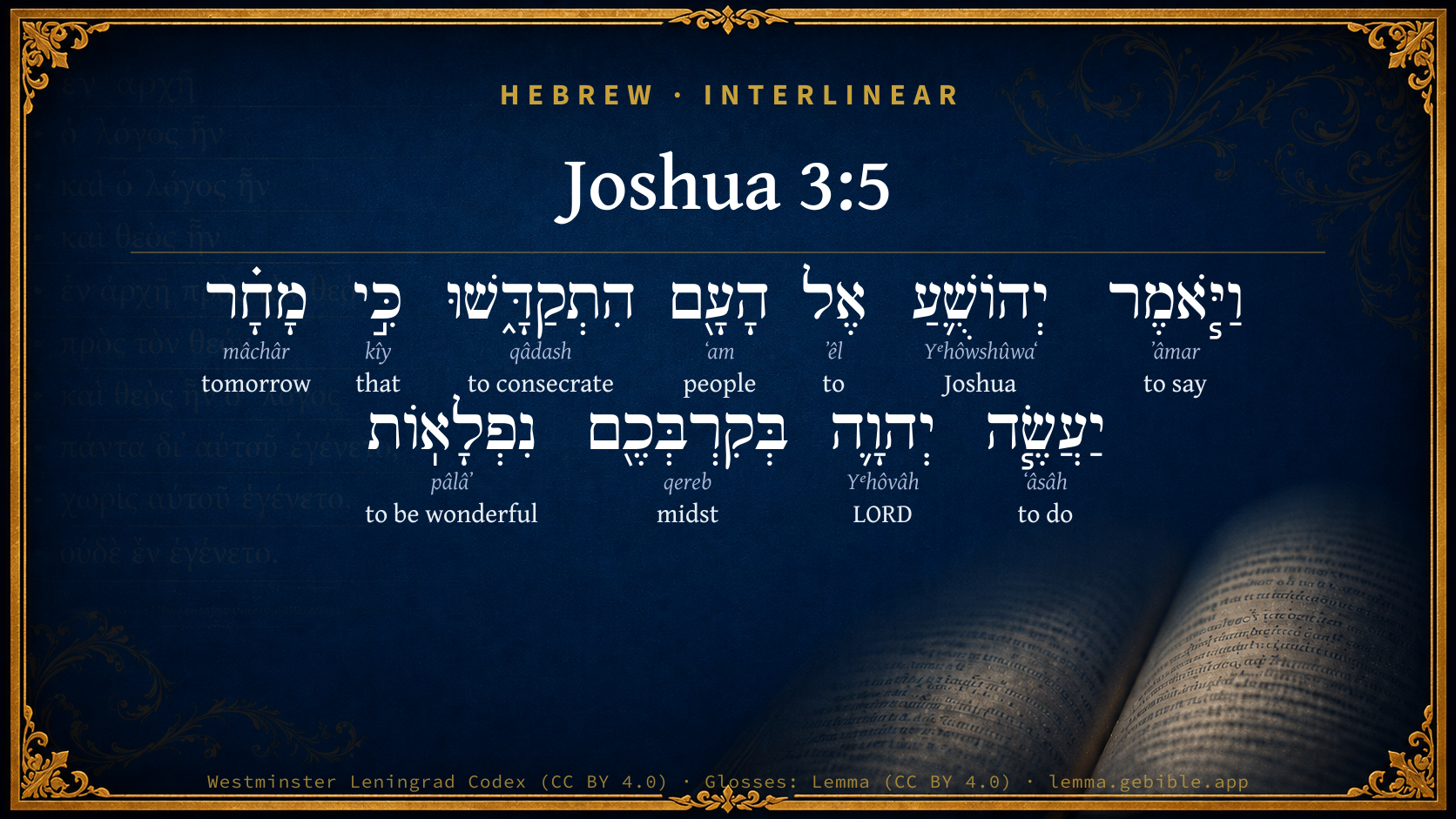
Hebrew (Westminster Leningrad Codex) Joshua 3:5 appears in the Hebrew Old Testament. The text above is from the Westminster Leningrad Codex. Each word links to its Strong’s number, a concise gloss, and parsing drawn from the Open Scriptures Hebrew Bible morphology. Click any word for its full Brown-Driver-Briggs (BDB) entry.
Download image
Cite this verse

Joshua 3:5 (World English Bible). Public Domain. Lemma interlinear Bible study tool, https://lemma.gebible.app/v/joshua/3/5.

Show BibTeX & RIS
BibTeX
RIS
English Translation
Joshua said to the people, Sanctify yourselves; for tomorrow Yahweh will do wonders among you.
World English Bible · Public Domain
Download a study sheet

One document with this verse’s original text, its word-by-word gloss line, the meaning frame, cross-references with their text, attributed commentary, and full source and license credits — printable, and it pastes into notes with its structure intact.

This verse Autodidact and up

Study sheet (.html) Plain text (.txt)

A passage Seminary Student

Up to 50 verses in one chapter. A passage sheet keeps up to 6 commentary sources and 12 cross-references per verse, in the order this page ranks them, and says so on the sheet whenever that leaves anything out. Ask for a single verse and you get the Autodidact verse sheet above.

Everything on this page stays free to read, with no account — the sheet is a download of what is already on screen, not access to it.

Want to remove ads? Support Godless Engineer
Compare translations 3

The same verse in 3 English versions, stacked beneath the original-language interlinear above. Click any original word for its lexicon entry.

Each is an independent rendering of the whole verse — the interlinear is not word-aligned to these translations.

Highlighted words mark where these versions differ — a whole-verse word diff, not a word-by-word alignment.

  • World English Bible Public Domain
    Joshua said to the people, Sanctify yourselves; for tomorrow Yahweh will do wonders among you.
  • King James Version Public Domain
    And Joshua said unto the people, Sanctify yourselves: for to morrow the LORD will do wonders among you.
  • unfoldingWord Literal Text CC BY-SA 4.0
    And Joshua said to the people, “Consecrate yourselves, for tomorrow Yahweh will do wonders in your midst.”

unfoldingWord Literal Text — © unfoldingWord, licensed CC BY-SA 4.0. Word-aligned USFM3 via Door43 (git.door43.org/unfoldingWord/en_ult).

Versions to compare (up to 4)

3 of 4 selected

Show all 18 translations

Every available English version of this verse, each an independent rendering of the whole verse.

  • World English Bible Public Domain
    Joshua said to the people, Sanctify yourselves; for tomorrow Yahweh will do wonders among you.
  • Berean Standard Bible Public Domain
    Then Joshua told the people, “Consecrate yourselves, for tomorrow the LORD will do wonders among you.”
  • Majority Standard Bible Public Domain
    Then Joshua told the people, “Consecrate yourselves, for tomorrow the LORD will do wonders among you.”
  • King James Version Public Domain
    And Joshua said unto the people, Sanctify yourselves: for to morrow the LORD will do wonders among you.
  • American Standard Version (1901) Public Domain
    And Joshua said unto the people, Sanctify yourselves; for tomorrow Jehovah will do wonders among you.
  • Revised Version (1885) Public Domain
    And Joshua said unto the people, Sanctify yourselves: for tomorrow the LORD will do wonders among you.
  • Geneva Bible (1599) Public Domain
    (Nowe Ioshua had saide vnto the people, Sanctifie your selues: for to morowe the Lord will doe wonders among you)
  • Douay-Rheims (1899) Public Domain
    And Josue said to the people: Be ye sanctified: for to morrow the Lord will do wonders among you.
  • Young's Literal Translation Public Domain
    And Joshua saith unto the people, `Sanctify yourselves, for to-morrow doth Jehovah do in your midst wonders.'
  • Literal Standard Version CC BY-SA 4.0
    And Joshua says to the people, “Sanctify yourselves, for tomorrow YHWH does wonders in your midst.”
  • Unlocked Literal Bible CC BY-SA 4.0
    Joshua said to the people, “Consecrate yourselves tomorrow, for Yahweh will do wonders among you.”
  • unfoldingWord Literal Text CC BY-SA 4.0
    And Joshua said to the people, “Consecrate yourselves, for tomorrow Yahweh will do wonders in your midst.”
  • Darby Bible Public Domain
    And Joshua said to the people, Hallow yourselves; for to-morrow Jehovah will do wonders in your midst.
  • World Messianic Bible Public Domain
    Joshua said to the people, “Sanctify yourselves; for tomorrow the LORD will do wonders among you.”
  • Webster's Bible Public Domain
    And Joshua said to the people, Sanctify yourselves: for to-morrow the LORD will do wonders among you.
  • Free Bible Version CC BY-SA 4.0
    Then Joshua said to the people, “Make sure you are pure, because tomorrow the Lord is going to do amazing things among you.”
  • Bible in Basic English Public Domain
    And Joshua said to the people, Make yourselves holy, for tomorrow the Lord will do works of wonder among you.
  • JPS Tanakh (1917) Public Domain
    And Joshua said unto the people: 'Sanctify yourselves; for to-morrow the LORD will do wonders among you.'

Literal Standard Version (2020), Covenant Press — licensed CC BY-SA 4.0. Text via the HelloAO Bible API (eBible.org). Unlocked Literal Bible (unfoldingWord) — licensed CC BY-SA 4.0. Text via the HelloAO Bible API (eBible.org). unfoldingWord Literal Text — © unfoldingWord, licensed CC BY-SA 4.0. Word-aligned USFM3 via Door43 (git.door43.org/unfoldingWord/en_ult). Free Bible Version, Dr. Jonathan Gallagher — licensed CC BY-SA 4.0. Text via the HelloAO Bible API (eBible.org).

Word by word

More ways to search: Search by grammar → Find every occurrence → Compare this word →

Practice this passage: Drill this verse → Learn its vocabulary →

מָחָ֗ר
mâchâr
H4279
“tomorrow”
Noun, Common, Masculine, Singular, Absolute
Part of Speech
Noun
Type
Common
Gender
Masculine
Number
Singular
State
Absolute
Full BDB Definition

Origin: probably from H309

TWOT: 1185a

tomorrow, in time to come, in the future - tomorrow (as the day following the present day) - in future time
  1. וַיֹּ֧אמֶר ʼâmar H559 “and · to say” Conjunction + Verb, Qal, Sequential Imperfect, 3rd Person, Masculine, Singular
  2. יְהוֹשֻׁ֛עַ Yᵉhôwshûwaʻ H3091 “Joshua” Noun, Proper
  3. אֶל ʼêl H413 “to” Preposition
  4. הָעָ֖ם ʻam H5971 “the · people” Particle, Definite Article + Noun, Common, Masculine, Singular, Absolute
  5. הִתְקַדָּ֑שׁוּ qâdash H6942 “consecrate” Verb, Hithpael, Imperative, 2nd Person, Masculine, Plural
  6. כִּ֣י kîy H3588 “that” Conjunction
  7. יַעֲשֶׂ֧ה ʻâsâh H6213 “to do” Verb, Qal, Imperfect, 3rd Person, Masculine, Singular
  8. יְהוָ֛ה Yᵉhôvâh H3068 “LORD” Noun, Proper
  9. בְּקִרְבְּכֶ֖ם qereb H7130 “in/at · midst · your” Preposition + Noun, Common, Masculine, Singular, Construct + Suffix, Personal, 2nd Person, Masculine, Plural
  10. נִפְלָאֽוֹת pâlâʼ H6381 “being wonderful” Verb, Niphal, Participle Active, Feminine, Plural, Absolute

About this verse

These counts appear in no published source. They are computed here, from the morphology-tagged text and Lemma’s own curated glosses. What Lemma adds →

11
words
11
distinct lemmas
Historical
section

Shared distinctive vocabulary

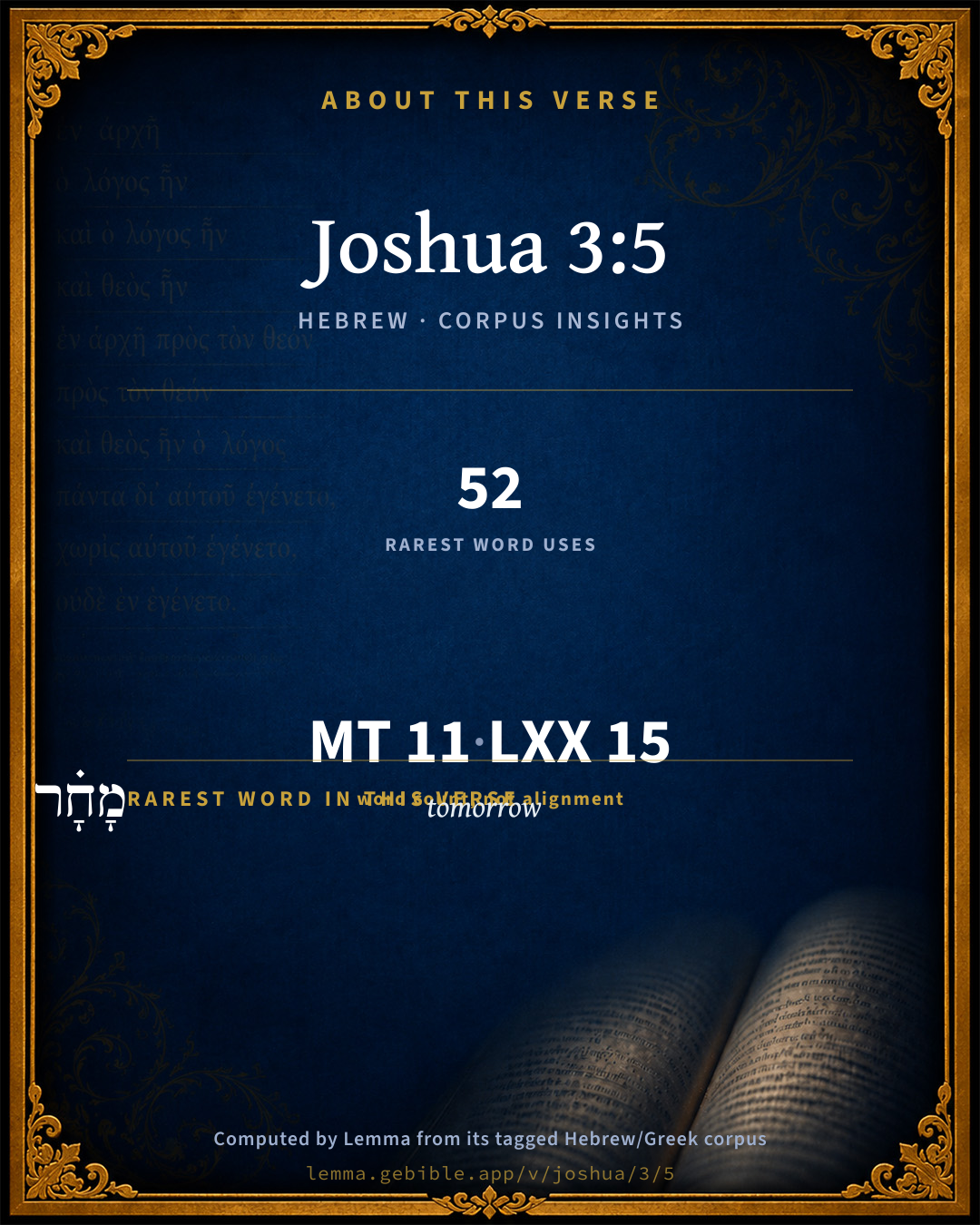
מָחָ֗ר tomorrow H4279 occurs in 52 verses of the Hebrew Bible. Also found in:

Grammatical profile

  • 4 verbs
  • 5 nouns
  • 1 preposition
  • 1 conjunction

Verb forms

  • וַיֹּ֧אמֶר Qal · Sequential Imperfect
  • הִתְקַדָּ֑שׁוּ Hithpael · Imperative
  • יַעֲשֶׂ֧ה Qal · Imperfect
  • נִפְלָאֽוֹת Niphal · Participle Active

Hebrew & Septuagint length

In English translation the verse runs 15 words from the Hebrew and 19 from the Septuagint (LXX English) — closely comparable.

A rough comparison of the two English renderings, which tokenize alike — not a word-level alignment.

Word counts can differ between the Hebrew and the Greek without any difference in meaning — e.g. the Hebrew direct-object marker אֵת has no separate Greek word, and Greek often adds the article ὁ.

In the original languages it is 11 Hebrew tokens and 15 Greek tokens — but the two are counted differently (Hebrew bundles its prefixes and suffixes into one token; the Greek is in lemma form), so that isn’t a like-for-like length.

Cross-references

12

Topical passages linked to Joshua 3:5 in the Treasury of Scripture Knowledge — connected by theme and wording, ordered by reader-vote popularity; previews shown in the World English Bible.

  • Leviticus 20:7 "'Sanctify yourselves therefore, and be holy; for I am Yahweh your God.
  • Joshua 7:13 Up, sanctify the people, and say, Sanctify yourselves against tomorrow: for thus says Yahweh, the God of Israel, There is a devoted thing in the midst of you, Israel; you can not stand before your enemies, until you take away the devoted thing from among you.
  • 1 Samuel 16:5 He said, Peaceably; I am come to sacrifice to Yahweh: sanctify yourselves, and come with me to the sacrifice. He sanctified Jesse and his sons, and called them to the sacrifice.
  • Joel 2:16 Gather the people. Sanctify the assembly. Assemble the elders. Gather the children, and those who suck the breasts. Let the bridegroom go forth from his room, And the bride out of her chamber.
  • John 17:19 For their sakes I sanctify myself, that they themselves also may be sanctified in truth.
  • Exodus 19:10–15 Yahweh said to Moses, "Go to the people, and sanctify them today and tomorrow, and let them wash their garments,
  • Leviticus 10:3 Then Moses said to Aaron, "This is what Yahweh spoke of, saying, "'I will show myself holy to those who come near me, And before all the people I will be glorified.'" Aaron held his peace.
  • Psalms 86:10 For you are great, and do wondrous things. You are God alone.
  • Job 1:5 It was so, when the days of their feasting had run their course, that Job sent and sanctified them, and rose up early in the morning, and offered burnt offerings according to the number of them all. For Job said, "It may be that my sons have sinned, and renounced God in their hearts." Thus did Job continually.
  • Joshua 3:13 It shall come to pass, when the soles of the feet of the priests who bear the ark of Yahweh, the Lord of all the earth, shall rest in the waters of the Jordan, that the waters of the Jordan shall be cut off, even the waters that come down from above; and they shall stand in one heap.
  • Joshua 3:15 and when those who bore the ark were come to the Jordan, and the feet of the priests who bore the ark were dipped in the brink of the water (for the Jordan overflows all its banks all the time of harvest),
  • Psalms 114:1–7 When Israel went forth out of Egypt, The house of Jacob from a people of foreign language;

Cross-references courtesy of OpenBible.info (CC BY 4.0).

Hebrew and Greek witnesses Masoretic Hebrew ↔ Greek Septuagint

The same verse in the two great witnesses to the Old Testament, shown verse-for-verse.

These are two independent witnesses, not word-aligned to each other, and the Septuagint is shown in lemma (dictionary) form.

Hebrew Joshua 3:5 Masoretic · Westminster Leningrad Codex

וַיֹּ֧אמֶר יְהוֹשֻׁ֛עַ אֶל הָעָ֖ם הִתְקַדָּ֑שׁוּ כִּ֣י מָחָ֗ר יַעֲשֶׂ֧ה יְהוָ֛ה בְּקִרְבְּכֶ֖ם נִפְלָאֽוֹת

Joshua said to the people, Sanctify yourselves; for tomorrow Yahweh will do wonders among you.

World English Bible · Public Domain

Greek LXX Joshua 3:5 Septuagint · lemma form

καί εἶπον ἰησοῦς ὁ λαός ἁγνίζω εἰς αὔριον ὅτι αὔριον ποιέω ἐν σύ κύριος θαυμαστός

And Joshua said to the people, Sanctify yourselves against to-morrow, for to-morrow the Lord will do wonders among you.

LXX2012 (modern English Septuagint) · Public Domain

Hebrew: Westminster Leningrad Codex (CC BY 4.0). Greek: Septuagint (public domain); English from LXX2012 (modern English Septuagint) (Public Domain). How the Septuagint differs from the Hebrew →

Targum (Aramaic paraphrase)

1

The Targum is the ancient Jewish Aramaic paraphrase of the Hebrew Scriptures — an interpretive translation, not the Hebrew text itself. Onkelos (literal) and Pseudo-Jonathan (expansive) render the Torah, and Jonathan the Prophets. Coverage is partial: where no permissively-licensed English translation exists for a verse, only the Aramaic is shown. This is verse-level text, not a word-by-word alignment to the Hebrew.

  1. Targum Jonathan Prophets (Joshua–Malachi)
    וַאֲמַר יְהוֹשֻׁעַ לְעַמָא אִזְדַמְנוּ אֲרֵי מָחָר יְעַבֵּד יְיָ בֵּינֵיכוֹן פְּרִישָׁן:

    (no public-domain English translation for this verse)

    Targum Jonathan — Aramaic: “Mikraot Gedolot” (public domain). English: “Sefaria Community Translation” (CC0 1.0 (public-domain dedication)); “London "Chaldee Paraphrase," 1871” (public domain). Text via Sefaria.

Commentary

Notes on Joshua 3:5 from classic Christian and Jewish commentators (each source and its license shown beneath its notes). The classic Christian expositions comment on the surrounding passage and are grouped to its opening verse, so a note may address several verses; the Jewish commentaries on the Tanakh (Rashi and others) are per-verse, so they appear only where the commentator wrote on this verse.

Lemma curates 59 commentaries, every one of them public domain or Creative Commons licensed, each selected and text-cleaned for this edition rather than reprinted as found. About our sources →

Trapp's Complete Commentary

John Trapp

Jos 3:5 And Joshua said unto the people, Sanctify yourselves: for to morrow the LORD will do wonders among you.

Ver. 5. Sanctify yourselves.] By ceremonial and spiritual purifications, doing your utmost to bring your hearts to a holy temper, that ye may make the best of the ensuing miracle.

John Trapp, A Commentary or Exposition upon All the Books of the Old and New Testament (1647–1656) — public domain. Text from a community e-Sword module.

Joseph Benson's Commentary

Jos 3:5. And Joshua said — He himself also, as well as the officers, by his direction, spake to the people the day before their passage; and as the matter was very important, he probably went himself from tribe to tribe, to give the orders here mentioned. Sanctify yourselves — Not only wash your clothes, and shun all kinds of bodily impurities, (see Gen 35:2; Exo 19:10; Num 9:10,) but purify your minds and hearts, by repentance, and faith, and new obedience, without which the external purifications of your bodies and garments will be of little avail. In other words, prepare yourselves by seriousness, recollection, and prayer, that you may behold with proper regard, reverence, and gratitude, and may fix in your hearts, the wonderful display which is about to be made of the divine power in your behalf, and that you may be meet to receive so great a favour as is now about to be conferred upon you.

Joseph Benson's Commentary on the Old and New Testaments (1811–1818) — public domain. Text from a community e-Sword module.

MacLaren's Expositions of Holy Scripture

Alexander MacLaren

Joshua

‘THE WATERS SAW THEE; THEY WERE AFRAID’

Jos 3:5 - Jos 3:17.

The arrangement of the narrative of the passage of Jordan, which occupies Jos 3:1-17 and Jos 4:1-24, is remarkable, and has led to suggestions of interpolation and blending of two accounts, which are quite unnecessary. It is divided into four sections,-the preparations {Jos 3:1 - Jos 3:6}, the passage {Jos 3:7 - Jos 3:17}, the lifting of the memorial stones from the river’s bed and the fixing of one set of them in it {Jos 4:1 - Jos 4:14}, the return of the waters, and the erection of the second set of memorial stones at Gilgal {Jos 4:15 - Jos 4:24}.

Each section closes with a summary of the whole transaction, after the common manner of Old Testament history, which gives to a hasty reader the impression of confusion and repetition; but a little attention shows a very symmetrical arrangement, negativing the possibility of interpolation. The last three sections are all built on the same lines. In each there is a triple division,-God’s command to Joshua, Joshua’s communication of it to the people, and the actual fact, fulfilling these. So each stage passes thrice before the view, and the impressiveness of the history is heightened by our seeing it first in the mirror of the divine Word, and then in the orders of the commander, before we see it as a thing actually happening.

Jos 3:5 - Jos 3:6 of the chapter belong to the section which deals with the preparation. General instructions had been already issued that the host was to follow the ark, leaving two thousand cubits between them and it; but nothing had been said as to how Jordan was to be crossed. No doubt many a question and doubt had been muttered by the watch-fires, as the people looked at the muddy, turbid stream, swirling in flood. The spies probably managed to swim it, but that was a feat worthy to be named in the epitaph of heroes {1Ch 12:15}, and impossible for the crowd of all ages and both sexes which followed Joshua. There was the rushing stream, swollen as it always is in harvest. How were they to get over? And if the people of Jericho, right over against them, chose to fall upon them as they were struggling across, what could hinder utter defeat? No doubt, all that was canvassed, in all sorts of tones; but no inkling of the miracle seems to have been given.

God often opens His hand by one finger at a time, and leaves us face to face with some plain but difficult duty, without letting us see the helps to its performance, till we need to use them. If we go right on the road which He has traced out, it will never lead us into a blind alley. The mountains will part before us as we come near what looked their impassable wall; and some narrow gorge or other, wide enough to run a track through, but not wide enough to be noticed before we are close on it, will be sure to open. The attitude of expectation of God’s help, while its nature is unrevealed, is kept up in Joshua’s last instruction. The people are bidden to ‘sanctify themselves, because to-morrow the Lord will do wonders’ among them. That sanctifying was not external, but included the hallowing of spirit by docile waiting for His intervention, and by obedience while the manner of it was hidden. The secret of to-morrow is partly made known, and the faith of the people is nourished by the mystery remaining, as well as by the light given. The best security for to-morrow’s wonders is to-day’s sanctifying.

The command to the priests discloses to them a little more, in bidding them pass over before the people, but the additional disclosure would only be an additional trial of faith; for the silence as to how so impossible a command was to be made possible is absolute. The swollen river had obliterated all fords; and how were priests, staggering under the weight of the ark on their shoulders, to ‘pass over’? The question is not answered till the ark is on their shoulders. To-day often sees to-morrow’s duty without seeing how it is to be done. But the bearers of the ark need never fear but that the God to whom it belongs will take care of it and of them. The last sentence of Jos 3:6 is the anticipatory summary which closes each section.

In Jos 3:7 - Jos 3:17 we have the narrative of the actual crossing, in its three divisions of God’s command {Jos 3:7 - Jos 3:8}, Joshua’s repetition of it {Jos 3:9 - Jos 3:13}, and the historical fact {Jos 3:14 - Jos 3:17}. The final instructions were only given on the morning of the day of crossing. The report of God’s commands given in Jos 3:7 - Jos 3:8 is condensed, as is evident from the fuller statement of them in Joshua’s address to the people, which immediately follows. In it Joshua is fully aware of the manner of the miracle and of the details of the crossing, but we have no record of his having received them. The summary of that eventful morning’s instructions to him emphasises first the bearing of the miracle on his reputation. The passage of the Red Sea had authenticated the mission of Moses to the past generation, who, in consequence of it, ‘believed God and His servant Moses.’ The new generation are to have a parallel authentication of Joshua’s commission. It is noteworthy that this is not the purpose of the miracle which the leader announces to the people in Jos 3:10. It was a message from God to himself, a kind of gracious whisper meant for his own encouragement. What a thought to fill a man’s heart with humble devotion, that God would work such a wonder in order to demonstrate that He was with him! And what a glimpse of more to follow lay in that promise, ‘This day will I begin to magnify thee I.’

The command to the priests in Jos 3:8 is also obviously condensed; for Joshua’s version of it, which follows, is much more detailed, and contains particular instructions, which must have been derived from the divine word to him on that morning.

We may pass on, then, to the second division of the narrative; namely, Joshua’s communication of God’s commands to the people. Observe the form which the purpose of the miracle assumes there. It is the confirmation of the divine Presence, not with the leader, but with the people and their consequent victory. Joshua grasped the inmost meaning of God’s Word to himself, and showed noble self-suppression, when he thus turned the direction of the miracle. The true servant of God knows that God is with him, not for his personal glorification, but for the welfare of God’s people, and cares little for the estimation in which men hold him, if they will only believe that the conquering God is with them. We too often make great leaders and teachers in the church opaque barriers to hide God from us, instead of transparent windows through which He shines upon His people. We are a great deal more ready to say, ‘God is with him,’ than to add, ‘and therefore God is with us, in our Joshuas, and without them.’

Observe the grand emphasis of that name, ‘the living God,’ tacitly contrasted with the dead idols of the enemies, and sealing the assurance of His swift and all-conquering might. Observe, too, the triumphant contempt in the enumeration of the many tribes of the foe with their barbarous names. Five of them had been enough, when named by the spies’ trembling lips, to terrify the congregation, but here the list of the whole seven but strengthens confidence. Faith delights to look steadily at its enemies, knowing that the one Helper is more than they all. This catalogue breathes the same spirit as Paul’s rapturous list of the foes impotent to separate from the love of God. Mark, too, the long-drawn-out designation of the ark, with its accumulation of nouns, which grammatical purists have found difficult,-’the ark of the covenant of the Lord of all the earth’; where it leads they need not fear to follow. It was the pledge of His presence, it contained the Ten Words on which His covenant was concluded. That covenant enlisted on their side Him who was Lord of the swollen river as of all the fierce clans beyond; and with His ark in front, their victory was sure. If ever the contemplation of His power and covenant relation was in place, it was on that morning, as Israel stood ranked for the march that was to lead them through Jordan, and to plant their feet on the soil of Canaan. Nor must we omit the peculiar appropriateness of this solemn designation, on the occasion of the ark’s first becoming the leader of the march. Hitherto it had been carried in the centre; now it was moved to the van, and took the place of the pillar, which blazed no more. But the guidance was no less divine. The simple coffer which Bezaleel had made was as august and reliable a symbol of God’s presence as the pillar; and the tables of the law, shut in it, were henceforth to be the best directors of the nation.

Then follows the command to elect twelve representatives of the tribes, for a purpose not yet explained; and then, at the last moment, the manner of crossing is disclosed, to the silencing of wise doubters and the confirmation of ignorant faith. The brief anticipatory announcement of the miracle puts stress on the arrest of the waters at the instant when the priests’ feet touched them, and tells what is to befall the arrested torrent above the point where the ark stood, saying nothing about the lower stretch of the river, and just hinting by one word ‘heap’ the parallel between this miracle and that of the passing of the Red Sea: ‘The floods stood upright as an heap’ {Exo 15:8}.

Jos 3:14 - Jos 3:17 narrate the actual crossing. One long sentence, like the roll of an Atlantic wave, or a long-drawn shout of triumph, masses together the stages of the march; the breaking up of the encampment; the solemn advance of the ark, watched by the motionless crowd; its approach to the foaming stream, running bank-full, as is its wont in the early harvest months; the decisive moment when the naked feet of the priests were dipped in the water. What a hush of almost painful expectation would fall on the gazers! Then, with a rush of triumph, the long sentence pours on, like a river escaping from some rocky gorge, and tells the details of the transcendent fact. Looking up stream, the water ‘stood’; and, as the flow above went on, it was dammed up, and, as would appear, swept back to a point not now known, but apparently some miles up. Looking down the course, the water flowed naturally to the Dead Sea; and, in effect, the whole bed southwards was quickly left bare, giving room for the advance of the people with wide-extended front, while the priests, with the ark on their shoulders, stood silent in the midst of the bed, between the heaped waters and the hasting host. Jos 3:17 gives the usual summary sentence, which partly anticipates what is still to follow, but here comes in with special force, as gathering up the whole wonderful scene, and recounting once more, and not without a ring of astonished triumph, how the priests stood firm on dry ground in that strange place, ‘until all the nation were passed clean over Jordan.’

From Jos 3:7 and Jos 3:10 we learn the purpose of this miracle as being twofold. It was intended to stamp the seal of God’s approbation on Joshua, and to hearten the people by the assurance of God’s fighting for them. The leader was thereby put on the level of Moses, the people, on that of the generation before whom the Red Sea had been divided. The parallel with that event is obvious and significant. The miracle which led Israel into the wilderness is repeated as they pass from it. The first stage of their deliverance and the second are begun with analogous displays of divine power. The same arm which cleft the sea is stretched out, after all sins, for the new generation, and ‘is not shortened that it cannot save.’ God does not disdain to duplicate His wonders, even for very unworthy servants. The unchanging, long-suffering patience, and the unwearied strength to which all generations in succession can turn with confidence, are wonderfully set forth by these two miracles. And though we have passed into the higher stage, where miracles have ceased, the principle which dictated the parallelism still holds good, and we too can look back to all these ancient wonders, and be sure that they are done over and over again according to our needs. ‘As we have heard, so have we seen,’ might have been Israel’s song that day, as it may be ours every day.

The beautiful application made of the parted waters of Jordan in Christian literature, which sees in them the prophecy of conquered death, is perhaps scarcely in accordance with truth, for the divided Jordan was the introduction, not to peace, but to warfare. But it is too deeply impressed on the heart to be lightly put aside, and we may well allow faith and hope to discern in the stream, whose swollen waters shrink backwards as soon as the ark is borne into their turbid and swift current, an emblem of that dark flood that rolled between the host of God and their home, and was dried up as soon as the pierced foot of the Christ touched its cold waters.

‘What ailest thee, thou sea, that thou fleest; thou Jordan, that thou turnest back?’ Christ has gone up before us. He has shaken His hand over the river, and caused men to go over dry shod.

Alexander MacLaren, Expositions of Holy Scripture (1904–1910) — public domain. Text from a community e-Sword module.

Tyndale Open Study Notes

Tyndale Open Resources

3:5 Purify yourselves: They had to separate themselves from anything unclean that would bar an Israelite from coming into God’s presence (cp. Exod 19:9-20; Lev 11:44).

Tyndale Open Study Notes — © Tyndale Open Resources, licensed CC BY-SA 4.0. Text via the HelloAO Bible API.

Jamieson, Fausset & Brown

Robert Jamieson, A. R. Fausset & David Brown

Joshua said unto the people--rather "had said," for as he speaks of "to-morrow," the address must have been made previous to the day of crossing, and the sanctification was in all probability the same as Moses had commanded before the giving of the law, consisting of an outward cleansing (Exo 19:10-15) preparatory to that serious and devout state of mind with which so great a manifestation should be witnessed.

Jamieson, Fausset & Brown — Commentary Critical and Explanatory on the Whole Bible (1871) — public domain (CC PDM 1.0). Text via the HelloAO Bible API.

Adam Clarke's Commentary

Verse 5. Sanctify yourselves] What was implied in this command we are not informed; but it is likely that it was the same as that given by Moses, Ex 19:10-14. They were to wash themselves and their garments, and abstain from every thing that might indispose their minds from a profitable attention to the miracle about to be wrought in their behalf.

Adam Clarke's Commentary on the Bible (1810–1826) — public domain. Text from a community e-Sword/MySword module.

John Calvin's Commentaries

5. And Joshua said, etc Some unwonted manifestation of divine power in bringing assistance behooved to be held forth, lest the backwardness arising from hesitancy might produce delay; and yet, in order that the Israelites might depend on the mere counsel of God, Joshua does not yet plainly point out the special nature of the miracle, unless, indeed, we choose to read what follows shortly after, as forming part of one context. Herein lies the true test of faith, to lean so on the counsel of God, as not to keep inquiring too anxiously concerning the mode of action or the event. As the word קדש means sometimes to prepare, and sometimes to sanctify, and either meaning is not inappropriate, I thought it best to leave a free choice. For faith prepares us to perceive the operation of God; and in those times, when God manifested himself to men more nearly, they consecrated themselves by a solemn rite; thus we see how Moses, on the promulgation of the Law, sanctified the people as God had commanded. The view taken by some expositors, that the people were thus commanded to purge themselves from defilement’s, merely in order that nothing might impede the passage of the Jordan, seems to be too confined.

John Calvin's Commentaries (1540-1563) — public domain. Text from the Calvin Translation Society English edition (1840s-50s) via the Christian Classics Ethereal Library (ccel.org). Calvin's coverage is partial (roughly two-thirds of the Bible); uncommented books and verses are honest gaps, never fabricated. The 19th-century editor's footnotes and remarks are omitted so the notes are faithfully Calvin's own voice.

The Cambridge Bible for Schools and Colleges

gen. ed. J. J. S. Perowne

5. Sanctify yourselves] Compare the instructions of Moses before the giving of the Law (Exo_19:10-15). This would consist partly in ceremonial purification, partly in turning to the Lord in a spirit of expectant faith in “the wonders” which “the Lord would do” amongst them. Wyclif renders the verse: “Be ye hallowid; forsothe to morrowe the Lord shall do among yow marveyls.”

to morrow] the tenth of Nisan (Jos_4:19), the anniversary of the day on which forty years before the Israelites had “taken to them” (Exo_12:3) “every man a lamb” as a Paschal victim.

The Cambridge Bible for Schools and Colleges (gen. ed. J. J. S. Perowne; Cambridge University Press, 1878–1918) — public domain. Text from a community e-Sword module.

John Gill's Exposition

And Joshua said unto the people,.... On the third day; and the thirtieth day of the mourning for Moses, Jarchi says, was the first of the three days, and that being the seventh day of the month, this must be the ninth, as it is most clear the morrow was the tenth:

sanctify yourselves; in a ceremonial sense, by washing their bodies and their clothes, and abstaining from their wives; and in a moral sense, by acts of religion and devotion, by prayer and meditation, and the exercise of repentance and, good works: it may denote that sanctification is necessary to our passage over Jordan, or through death to the heavenly Canaan, for without holiness no man shall see the Lord:

for tomorrow the Lord will do wonders among you: in their sight and presence, and for them, by dividing the waters of Jordan, that they might pass through it as on dry land; this, as Kimchi says, was the tenth of Nisan, as is plain from Jos 4:19.

John Gill's Exposition of the Whole Bible (1746–1763) — public domain (CC PDM 1.0). Text via the HelloAO Bible API.

Haydock's Catholic Bible Commentary

Sanctified, as Moses had required at Mount Sinai, (Exodus xix. 10, 15,) ordering the people to wash their garments, and to abstain from their wives, that by this exterior purity, they might be reminded not to neglect that of the soul, without which they would derive but small benefit or instruction from the greatest miracles.

George Leo Haydock (1774–1849), Haydock's Catholic Family Bible and Commentary, 1859 edition — public domain. Excludes Psalms (Douay-Rheims chapter numbering differs from Protestant) and Deuterocanonical books (Catholic canon only).

Matthew Poole's English Annotations

Joshua said, or rather had said, to wit, the day before their passage; for it follows,

to-morrow. Sanctify yourselves, both in soul and body, that you may be meet to receive such a favour, and with more attention and reverence observe and ponder this great work, and fix it in your hearts and memories. See Poole "Exo 19:10"; See Poole "Lev 20:7".

Matthew Poole's English Annotations on the Holy Bible (1683–1685) — public domain. Text from a community e-Sword/MySword module.

Whedon's Commentary on the Bible

Daniel D. Whedon

5. Sanctify yourselves — By sacred ablutions and observances, and by a change of raiment where the washing of the raiment was impracticable. Compare the marginal references.

The Lord will do wonders among you — He will open a passage through the Jordan as he did through the Red Sea, and lead his people through dry-shod. The miracle of the Red Sea was a wonder whose name had been noised abroad for forty years, (Jos_2:10,) and this at the Jordan was to be like it.

Daniel D. Whedon (gen. ed.), Commentary on the Old and New Testaments (1874–1909) — public domain. Text from a community e-Sword module.

The Pulpit Commentary

Sanctify yourselves. The Hithpahel, which is used here, is frequently used of ceremonial purification, as in Exo_19:22 1Ch_15:12, 14 2Ch_5:11; and especially 2Sa_11:4. It is also connected with purification, but ironically, in Isa_66:17. Tomorrow. These words were uttered while all was in preparation. We learn from ver. 7, though it is not expressly stated, that the actual crossing took place the next day. We ought, probably, to place this verse in a parenthesis, and to translate "Joshua had said," because the sanctification (see Exo_19:10, Exo_19:14) involved some definite period. Knobel, however, assumes, as usual, that there is at least a faulty arrangement here. Wonders, or rather, miracles, from alp to separate, distinguish. They were, therefore, acts distinguished from the ordinary course of God"s providence. We may observe that, while among the Canaanites all was terror and confusion, m the camp of Joshua all was confidence and faith. "Either success or discomfiture begins ever at the heart. A man"s inward disposition doth more than presage the event. If Satan see us once faint, he gives himself the day. There is no way to safety, but that our hearts be the last that shall yield" (Bp. Hall).

HOMILIES BY S.R. ALDRIDGE Ver. 5. Preparation for beholding displays of Divine power.

With what longing eyes must the Israelites have looked upon the river which they were soon to cross. Hope had been deferred for years. The promised land, fertile and beautiful, seemed to disappear from their sight, as did the fruit and water from the eager hands and parched lips of Tantalus. Could it, then, be really true that on the morrow the boundary line would separate them from their inheritance no more? By the Jordan the Israelites were encamped, and the command of the text sounded in their ears, "Sanctify yourselves." This was to be THE PEOPLE"S PREPARATION FOR GOD"S WORE AMONGST THEM. Probably the injunction respected rather the hearts than the dress and bodies of the people. It invoked a seriousness of deportment befitting the solemn ceremony of the coming day, an examination of themselves, a recalling of the facts of their past history, a mourning over their numerous transgressions, and a resolve henceforth to serve the Lord. We believe that in endeavouring to ascertain the reasons which dictated the advice of the text, we shall be meditating on truths profitable to our own souls.

I SANCTIFICATION WOULD FIT THEM TO BEHOLD THE MANIFESTED PRESENCE OF GOD. Emblem, ritual, and precept were unceasingly employed to remind the Israelites of the holiness of God. They were to observe the sanitary regulations, because "the Lord thy God walketh in the midst of the comp." Before their offerings could be accepted they must purify themselves with ablutions. And, above all, they were excluded from the tabernacle where God"s dwelling was, and into the Holiest only the high priest could enter once a year. Now every prodigy was the special coming of Jehovah into the midst of Israel. Whilst really present in the unceasing operations of nature, nevertheless it was on the occasion of the miraculous that God seemed to put aside the veil and to draw nigh in person. Hence the need that the Israelites should be sanctified. Holiness consumes impurity as light destroys darkness. The people must prepare themselves to stand in the glory of God"s presence. So was it required at the appearance of the Almighty on Sinai, and before the wondrous shower of quails, and so afterwards for the battle of Ai; otherwise would "the Lord break forth upon them." Whilst we are not under the terrors of the law, yet reverence beseemeth us in our approach to the "Father of our spirits." We would not rush heedlessly to communion with Him, nor fall into levity while upon our knees. With us, too, there are times when we must sanctify ourselves for the special manifestation of the Divine. Sin amongst Christians is a chief obstacle to the accomplishment of signs and wonders in the name of Jesus.

II SANCTIFICATION WOULD PREPARE THEM TO APPRECIATE THE GREATNESS OF THE MIRACLE. As was the case with the "mighty works" of our Lord, these wonders of the Old Testament were not wrought simply to assist men in their straits and feebleness, but to exert an ethical influence upon them, teaching the power and love of God. Now that the Israelites were about to enter upon their inheritance, the time was fitting one for signal marks of Divine favour and might. But in order that the miracle have due weight, previous reflection and expectation were essential. The Israelites were as children whose curiosity must be aroused and excitement intensified by stimulating annunciations. Then, when the notable day dawned, attention would be drawn to every detail, every occurrence, and the more vivid and lasting would he the impressions produced. A miracle silently and suddenly performed would fail of the results intended. Preparation befits our solemn engagements, qualifying us the more quickly to hear the "still small voice," and to note the "way of God" amongst men. It is well for the passions to be quieted, and the common duties dismissed from the mind, as we near the sacred operations of God. Of what abiding influence would the services of the Lord"s day he capable, if it were possible to spend the previous evening in preparing the mind to say, "Speak, Lord, for thy servant heareth"! Fully to reap benefit from witnessing a "sign," or from perusing an account thereof, demands of us the same sanctification of heart.

III SANCTIFICATION WOULD AFFORD EVIDENCE OF FAITH IN THEIR LEADER AND IN GOD. What folly to trouble about purification unless they believed that the promise would be fulfilled. The miracle was to be eminently a proof of the love of God. His honour demanded that the people should show themselves to be in some degree worthy of His favour. Jesus inquired of the applicants for relief whether they had faith in His ability to heal them; and we read of places where "he did not many mighty works because of their unbelief." Unbelief is the great hindrance to the progress of religion, both in the individual and in the world. We block the only avenue by which heavenly blessings can come to us; we shut the gates, and wonder why our city is not thronged with angelic visitants. Faith in preparation would lead to augmented faith in the time of action.

Soon was coming the hour of trial. How would the people venture between the dangerous heaps of water? Here would be reaped the advantage of previous thought. Faith grows by exercise. The conquest of one difficulty opens the way for subsequent victories. If the Church of Christ is paralysed by secret disbelief of the efficacy of God"s Word and Spirit to convert men, how can she expect great awakenings? "According to our faith" is it unto us. And if there is not sufficient faith to lead to the making of the necessary arrangements, where shall be the faith to enable us to rejoice in the evident tokens of God"s presence? Let us "lift up holy hands without wrath and doubting. A.

God"s wonders.

"Sanctify yourselves, for tomorrow the Lord will do wonders among you. These words admirably express the conditions of all blessing for the people of God. Those conditions are at once Divine and human. The Divine is the essential; the human can only be realised through it.

I GOD WILL DO WONDERS. This is a true description of all God"s works of deliverance, and primarily of His great miracle of pardon. For, of all the marvellous things which He does, the most amazing is that He should have pity upon us, and should come back to us after we have forsaken Him. Grace is the crowning miracle. Never discouraged, it is perpetually triumphing over all obstacles, breaking down all that opposes its designs, bidding the mountain to become a plain, and magnifying itself in our infirmities. There are periods in the history of the race, and in that of individuals, when this miracle of constant recurrence is made yet more emphatic, as though to hasten on the purpose of eternal love. So was it at the time of the conflict between Israel and the Canaanitish nations. So was it at the birth of Christianity. So is it at the time of the beginning of the new life in the individual soul. The free and sovereign grace which does wonders is thus the necessary, antecedent Divine condition.

II THE HUMAN CONDITION IS CLEARLY EXPRESSED IN THESE WORDS OF JOSHUA. "Sanctify yourselves. We repeat, this condition cannot be fulfilled unless Divine grace have renewed our heart, and given us strength to sanctify ourselves. But our duty is none the less positive, imperative, sacred. God does not treat us as passive, inert beings, but as free agents made in His likeness. It behoves us, then, to respond to His grace. Hence the necessity to sanctify ourselves, in order that we may be partakers in the wonders He will work. This is all the more necessary since God will not work these wonders without us, but, by us and with us, calling us to be fellow workers with Him. Israel must prepare itself for victory by sanctifying itself. To sanctify ourselves is to put away all that is alien to the Divine life; to consecrate ourselves unreservedly to God; to give ourselves to Him; to bring Wire our heart that He may fill it. It is to yield ourselves to Him as wiring instruments in His hand; so that we are never better workers with Him than when we allow Him to work in us. To let Him work, this is our best way of serving. Do we desire that He should again "do wonders" in our age, in these days of final conflict between the gospel and antichrist? Let us, then, sanctify ourselves, like the children of Israel on the eve of battle with the Canaanites, and so will be fulfilled the twofold condition of all spiritual blessing so well set forth by St. Paul in the words: "Work out your own salvation with fear and trembling, for it is God which worketh in you to will and to do of his good pleasure". (Php_2:12, 13) E. DE P.

The Pulpit Commentary (1880–1919), ed. H.D.M. Spence-Jones & Joseph S. Exell — public domain. Text from a community e-Sword module.

John Wesley's Explanatory Notes

And Joshua said - Or rather, had said, the day before their passage; for it follows, tomorrow. Sanctify yourselves - Both in soul and body, that you may be meet to receive such a favour, and with more reverence observe this great work, and fix it in your hearts.

John Wesley, Explanatory Notes Upon the Whole Bible (1754–1765) — public domain. Text via the GEBible commentary corpus.

unfoldingWord translationNotes

Door43 World Missions Community

Consecrate yourselves

This refers to a special preparation of being religiously clean before Yahweh.

Yahweh will do wonders

Yahweh will be doing miracles for all to see and experience.

Take up the ark

This is referring to the levites picking up the ark for the purpose of carrying it from one location to another.

translationWords

people group

consecrate

Yahweh

miracle

priest

ark of the covenant

unfoldingWord translationNotes — © Distant Shores Media and the Door43 World Missions Community, licensed CC BY-SA 4.0. Source: git.door43.org/Door43/en_tn.

Rashi

Rabbi Shlomo Yitzchaki (Rashi)

And Yehoshua said. This was on the third day, and the thirtieth day of mourning [for Moshe] was on the first of the three days.

הִתְקַדָשׁוּ usually means sanctify yourselves, but here it means prepare yourselves.

For tomorrow when you cross the Jordan.

Wonders. This translation follows that of Targum Yonasan.

Rashi on the Tanakh — English translations: “The Judaica Press complete Tanach with Rashi, translated by A. J. Rosenberg” (CC BY 4.0); “Pentateuch with Rashi's commentary by M. Rosenbaum and A.M. Silbermann, 1929-1934” (public domain); “The Metsudah Tanach series, Lakewood, N.J” (CC BY 4.0); and “The Book of Joshua, Metsudah Publications, 1997” (CC BY 4.0). Text via Sefaria.

Lesson kit

Teaching starters — assembled from the data on this page, not authored interpretation. Every prompt links to the verse data it draws on. Edit before teaching.

Joshua, in the Historical, opens this verse with 11 words (11 distinct Hebrew lemmas). Its most distinctive word is mâchâr (“tomorrow”). A historical commentator’s framing appears above. Read the whole chapter for the surrounding context.

Discussion questions

  1. What does “tomorrow” (mâchâr) contribute to the verse as a whole?
  2. Genesis 30:33 shares the word «tomorrow» with this verse. How do the two illuminate each other?
  3. These translations render this verse differently; the difference is in the English rendering, not the original. What questions does that raise?
  4. The verb «וַיֹּ֧אמֶר» is Qal Sequential Imperfect. How does its form color the action?
  5. Reading how Trapp's Complete Commentary and Joseph Benson's Commentary read this verse, where do the two commentators agree and where do they part?

Things to notice

Reading settings

Reading text

Shown beneath each verse's original-language words.

Old Testament
Old Testament edition

Read the OT as the Masoretic Hebrew (MT) or the Greek Septuagint (LXX).

English shown for the Greek Septuagint (in the Hebrew ↔ Greek comparison).

Comparing translations? Open the Compare panel on any verse page to stack up to four side by side.