
Isaiah 29:23

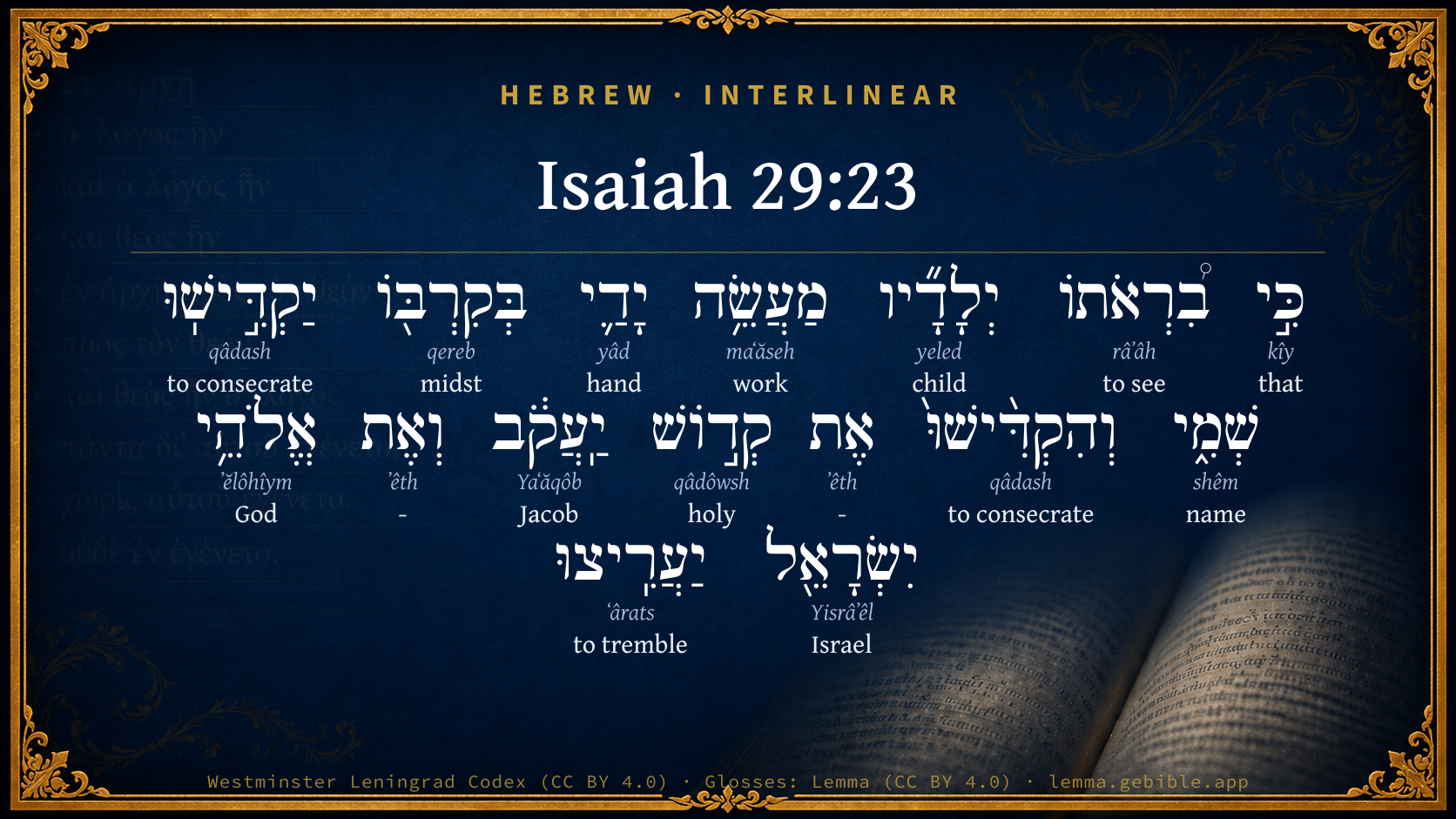
Hebrew (Westminster Leningrad Codex) Isaiah 29:23 appears in the Hebrew Old Testament. The text above is from the Westminster Leningrad Codex. Each word links to its Strong’s number, a concise gloss, and parsing drawn from the Open Scriptures Hebrew Bible morphology. Click any word for its full Brown-Driver-Briggs (BDB) entry.
Download image
Cite this verse

Isaiah 29:23 (World English Bible). Public Domain. Lemma interlinear Bible study tool, https://lemma.gebible.app/v/isaiah/29/23.

Show BibTeX & RIS
BibTeX
RIS
English Translation
But when he sees his children, the work of my hands, in the midst of him, they shall sanctify my name; yes, they shall sanctify the Holy One of Jacob, and shall stand in awe of the God of Israel.
World English Bible · Public Domain
Download a study sheet

One document with this verse’s original text, its word-by-word gloss line, the meaning frame, cross-references with their text, attributed commentary, and full source and license credits — printable, and it pastes into notes with its structure intact.

This verse Autodidact and up

Study sheet (.html) Plain text (.txt)

A passage Seminary Student

Up to 50 verses in one chapter. A passage sheet keeps up to 6 commentary sources and 12 cross-references per verse, in the order this page ranks them, and says so on the sheet whenever that leaves anything out. Ask for a single verse and you get the Autodidact verse sheet above.

Everything on this page stays free to read, with no account — the sheet is a download of what is already on screen, not access to it.

Want to remove ads? Support Godless Engineer
Compare translations 3

The same verse in 3 English versions, stacked beneath the original-language interlinear above. Click any original word for its lexicon entry.

Each is an independent rendering of the whole verse — the interlinear is not word-aligned to these translations.

Highlighted words mark where these versions differ — a whole-verse word diff, not a word-by-word alignment.

  • World English Bible Public Domain
    But when he sees his children, the work of my hands, in the midst of him, they shall sanctify my name; yes, they shall sanctify the Holy One of Jacob, and shall stand in awe of the God of Israel.
  • King James Version Public Domain
    But when he seeth his children, the work of mine hands, in the midst of him, they shall sanctify my name, and sanctify the Holy One of Jacob, and shall fear the God of Israel.
  • unfoldingWord Literal Text CC BY-SA 4.0
    For when he sees his children, the work of my hands, in his midst, they will sanctify my name, and they will sanctify the Holy of Jacob, and they will fear the God of Israel.

unfoldingWord Literal Text — © unfoldingWord, licensed CC BY-SA 4.0. Word-aligned USFM3 via Door43 (git.door43.org/unfoldingWord/en_ult).

Versions to compare (up to 4)

3 of 4 selected

Show all 18 translations

Every available English version of this verse, each an independent rendering of the whole verse.

  • World English Bible Public Domain
    But when he sees his children, the work of my hands, in the midst of him, they shall sanctify my name; yes, they shall sanctify the Holy One of Jacob, and shall stand in awe of the God of Israel.
  • Berean Standard Bible Public Domain
    For when he sees his children around him, the work of My hands, they will honor My name, they will sanctify the Holy One of Jacob, and they will stand in awe of the God of Israel.
  • Majority Standard Bible Public Domain
    For when he sees his children around him, the work of My hands, they will honor My name, they will sanctify the Holy One of Jacob, and they will stand in awe of the God of Israel.
  • King James Version Public Domain
    But when he seeth his children, the work of mine hands, in the midst of him, they shall sanctify my name, and sanctify the Holy One of Jacob, and shall fear the God of Israel.
  • American Standard Version (1901) Public Domain
    But when he seeth his children, the work of my hands, in the midst of him, they shall sanctify my name; yea, they shall sanctify the Holy One of Jacob, and shall stand in awe of the God of Israel.
  • Revised Version (1885) Public Domain
    But when he seeth his children, the work of mine hands, in the midst of him, they shall sanctify my name; yea, they shall sanctify the Holy One of Jacob, and shall stand in awe of the God of Israel.
  • Geneva Bible (1599) Public Domain
    But when he seeth his children, the worke of mine hands, in the mids of him, they shall sanctifie my Name, and sanctifie the holy one of Iaakob, and shall feare the God of Israel.
  • Douay-Rheims (1899) Public Domain
    But when he shall see his children, the work of my hands in the midst of him sanctifying my name, and they shall sanctify the Holy One of Jacob, and shall glorify the God of Israel:
  • Young's Literal Translation Public Domain
    For in his seeing his children, The work of My hand, in his midst, They sanctify My name, And have sanctified the Holy One of Jacob, And the God of Israel they declare fearful.
  • Literal Standard Version CC BY-SA 4.0
    For in his seeing his children, || The work of My hand, in his midst, || They sanctify My Name, || And have sanctified the Holy One of Jacob, || And they declare the God of Israel fearful.
  • Unlocked Literal Bible CC BY-SA 4.0
    But when he sees his children, the work of my hands, they will make my name holy. They will make holy the name of the Holy One of Jacob and they will stand in awe of the God of Israel.
  • unfoldingWord Literal Text CC BY-SA 4.0
    For when he sees his children, the work of my hands, in his midst, they will sanctify my name, and they will sanctify the Holy of Jacob, and they will fear the God of Israel.
  • Darby Bible Public Domain
    for when he seeth his children, the work of my hands, in the midst of him, they shall hallow my name, and hallow the Holy One of Jacob, and shall fear the God of Israel.
  • World Messianic Bible Public Domain
    But when he sees his children, the work of my hands, in the middle of him, they will sanctify my name. Yes, they will sanctify the Holy One of Jacob, and will stand in awe of the God of Israel.
  • Webster's Bible Public Domain
    But when he seeth his children, the work of my hands, in the midst of him, they shall sanctify my name, and sanctify the Holy One of Jacob, and shall fear the God of Israel.
  • Free Bible Version CC BY-SA 4.0
    When you see all your children and everything I've done for you, then you will regard my character as holy, and you will respect the Holy One of Jacob. You will have reverence for the God of Israel.
  • Bible in Basic English Public Domain
    But when they, the children of Jacob, see the work of my hands among them, they will give honour to my name; yes, they will give honour to the Holy One of Jacob, and go in fear of the God of Israel.
  • JPS Tanakh (1917) Public Domain
    When he seeth his children, the work of My hands, in the midst of him, that they sanctify My name; yea, they shall sanctify the Holy One of Jacob, and shall stand in awe of the God of Israel.

Literal Standard Version (2020), Covenant Press — licensed CC BY-SA 4.0. Text via the HelloAO Bible API (eBible.org). Unlocked Literal Bible (unfoldingWord) — licensed CC BY-SA 4.0. Text via the HelloAO Bible API (eBible.org). unfoldingWord Literal Text — © unfoldingWord, licensed CC BY-SA 4.0. Word-aligned USFM3 via Door43 (git.door43.org/unfoldingWord/en_ult). Free Bible Version, Dr. Jonathan Gallagher — licensed CC BY-SA 4.0. Text via the HelloAO Bible API (eBible.org).

Word by word

More ways to search: Search by grammar → Find every occurrence → Compare this word →

Practice this passage: Drill this verse → Learn its vocabulary →

יַעֲרִֽיצוּ
ʻârats
H6206
“to tremble”
Verb, Hiphil, Imperfect, 3rd Person, Masculine, Plural
Part of Speech
Verb
Stem
Hiphil
Form
Imperfect
Person
3rd Person
Gender
Masculine
Number
Plural
Full BDB Definition

Origin: a primitive root

TWOT: 1702

to tremble, dread, fear, oppress, prevail, break, be terrified, cause to tremble - (Qal) - to cause to tremble, terrify - to tremble, feel dread - (Niphal) to be awesome, be terrible - (Hiphil) - to regard or treat with awe, regard or treat as awful - to inspire with awe, terrify
  1. כִּ֣י kîy H3588 “that” Conjunction
  2. בִ֠רְאֹתוֹ râʼâh H7200 “in/at · to see · him” Preposition + Verb, Qal, Infinitive Construct + Suffix, Personal, 3rd Person, Masculine, Singular
  3. יְלָדָ֞יו yeled H3206 “children · his” Noun, Common, Masculine, Plural, Construct + Suffix, Personal, 3rd Person, Masculine, Singular
  4. מַעֲשֵׂ֥ה maʻăseh H4639 “work of” Noun, Common, Masculine, Singular, Construct
  5. יָדַ֛י yâd H3027 “hands · my” Noun, Common, Both, Dual, Construct + Suffix, Personal, 1st Person, Common, Singular
  6. בְּקִרְבּ֖וֹ qereb H7130 “in/at · midst · his” Preposition + Noun, Common, Masculine, Singular, Construct + Suffix, Personal, 3rd Person, Masculine, Singular
  7. יַקְדִּ֣ישֽׁוּ qâdash H6942 “to consecrate” Verb, Hiphil, Imperfect, 3rd Person, Masculine, Plural
  8. שְׁמִ֑י shêm H8034 “name · my” Noun, Common, Masculine, Singular, Construct + Suffix, Personal, 1st Person, Common, Singular
  9. וְהִקְדִּ֨ישׁוּ֙ qâdash H6942 “and · to consecrate” Conjunction + Verb, Hiphil, Sequential Perfect, 3rd Person, Common, Plural
  10. אֶת ʼêth H853 “-” Particle, Direct Object
  11. קְד֣וֹשׁ qâdôwsh H6918 “holy of” Adjective, Adjective, Masculine, Singular, Construct
  12. יַֽעֲקֹ֔ב Yaʻăqôb H3290 “Jacob” Noun, Proper
  13. וְאֶת ʼêth H853 “and · -” Conjunction + Particle, Direct Object
  14. אֱלֹהֵ֥י ʼĕlôhîym H430 “God(s) of” Noun, Common, Masculine, Plural, Construct
  15. יִשְׂרָאֵ֖ל Yisrâʼêl H3478 “Israel” Noun, Proper

About this verse

These counts appear in no published source. They are computed here, from the morphology-tagged text and Lemma’s own curated glosses. What Lemma adds →

16
words
14
distinct lemmas
Prophets
section

Notable vocabulary

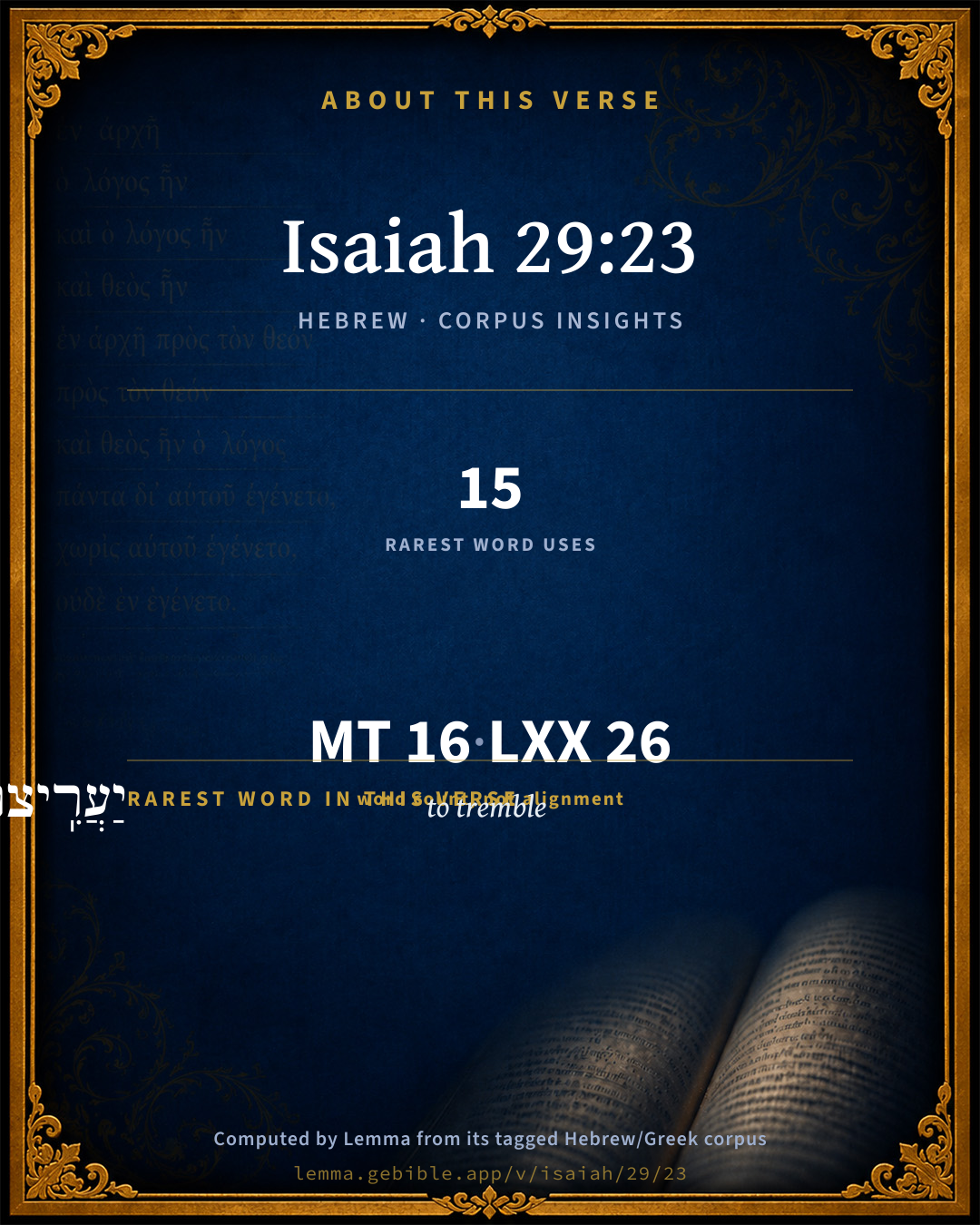
The rarest word here is יַעֲרִֽיצוּ to tremble H6206 — appearing just 15 times in the whole Hebrew Bible.

Shared distinctive vocabulary

יַעֲרִֽיצוּ to tremble H6206 occurs in 15 verses of the Hebrew Bible. Also found in:

Grammatical profile

  • 4 verbs
  • 8 nouns
  • 1 adjective
  • 1 conjunction
  • 2 particles

Verb forms

  • בִ֠רְאֹתוֹ Qal · Infinitive Construct
  • יַקְדִּ֣ישֽׁוּ Hiphil · Imperfect
  • וְהִקְדִּ֨ישׁוּ֙ Hiphil · Sequential Perfect
  • יַעֲרִֽיצוּ Hiphil · Imperfect

Repetition

A word recurs within this verse — often emphatic in Hebrew:

  • יַקְדִּ֣ישֽׁוּ to consecrate H6942 ×2

Hebrew & Septuagint length

In English translation the verse runs 40 words from the Hebrew and 32 from the Septuagint (LXX English) — closely comparable.

A rough comparison of the two English renderings, which tokenize alike — not a word-level alignment.

Word counts can differ between the Hebrew and the Greek without any difference in meaning — e.g. the Hebrew direct-object marker אֵת has no separate Greek word, and Greek often adds the article ὁ.

In the original languages it is 16 Hebrew tokens and 26 Greek tokens — but the two are counted differently (Hebrew bundles its prefixes and suffixes into one token; the Greek is in lemma form), so that isn’t a like-for-like length.

Cross-references

14

Topical passages linked to Isaiah 29:23 in the Treasury of Scripture Knowledge — connected by theme and wording, ordered by reader-vote popularity; previews shown in the World English Bible.

  • Isaiah 19:25 because Yahweh of Hosts has blessed them, saying, Blessed be Egypt my people, and Assyria the work of my hands, and Israel my inheritance.
  • Ephesians 2:10 For we are his workmanship, created in Christ Jesus for good works, which God prepared before that we would walk in them.
  • Isaiah 8:13 Yahweh of hosts, him shall you sanctify; and let him be your fear, and let him be your dread.
  • Isaiah 45:11 Thus says Yahweh, the Holy One of Israel, and his Maker: Ask me of the things that are to come; concerning my sons, and concerning the work of my hands, command you me.
  • Isaiah 5:16 But Yahweh of Hosts is exalted in justice, And God the Holy One is sanctified in righteousness.
  • Isaiah 49:20–26 The children of your bereavement shall yet say in your ears, The place is too small for me; give place to me that I may dwell.
  • Isaiah 60:21 Your people also shall be all righteous; they shall inherit the land forever, the branch of my planting, the work of my hands, that I may be glorified.
  • Leviticus 10:3 Then Moses said to Aaron, "This is what Yahweh spoke of, saying, "'I will show myself holy to those who come near me, And before all the people I will be glorified.'" Aaron held his peace.
  • Isaiah 43:21 the people which I formed for myself, that they might set forth my praise.
  • Hosea 3:5 Afterward the children of Israel shall return, and seek Yahweh their God, and David their king, and shall come with trembling to Yahweh and to his blessings in the last days.
  • Matthew 6:9 Pray like this: 'Our Father in heaven, may your name be kept holy.
  • Revelation 11:15–17 The seventh angel sounded, and great voices in heaven followed, saying, "The kingdom of the world has become the Kingdom of our Lord, and of his Christ. He will reign forever and ever!"
  • Revelation 15:4 Who wouldn't fear you, Lord, And glorify your name? For you only are holy. For all the nations will come and worship before you. For your righteous acts have been revealed."
  • Revelation 19:5 A voice came forth from the throne, saying, "Give praise to our God, all you his servants, you who fear him, the small and the great!"

Cross-references courtesy of OpenBible.info (CC BY 4.0).

Hebrew and Greek witnesses Masoretic Hebrew ↔ Greek Septuagint

The same verse in the two great witnesses to the Old Testament, shown verse-for-verse.

These are two independent witnesses, not word-aligned to each other, and the Septuagint is shown in lemma (dictionary) form.

Hebrew Isaiah 29:23 Masoretic · Westminster Leningrad Codex

כִּ֣י בִ֠רְאֹתוֹ יְלָדָ֞יו מַעֲשֵׂ֥ה יָדַ֛י בְּקִרְבּ֖וֹ יַקְדִּ֣ישֽׁוּ שְׁמִ֑י וְהִקְדִּ֨ישׁוּ֙ אֶת קְד֣וֹשׁ יַֽעֲקֹ֔ב וְאֶת אֱלֹהֵ֥י יִשְׂרָאֵ֖ל יַעֲרִֽיצוּ

But when he sees his children, the work of my hands, in the midst of him, they shall sanctify my name; yes, they shall sanctify the Holy One of Jacob, and shall stand in awe of the God of Israel.

World English Bible · Public Domain

Greek LXX Isaiah 29:23 Septuagint · lemma form

ἀλλά ὅταν ὁράω ὁ τέκνον αὐτός ὁ ἔργον ἐγώ διά ἐγώ ἁγιάζω ὁ ὄνομα ἐγώ καί ἁγιάζω ὁ ἅγιος ἰακώβ καί ὁ θεός ὁ ἰσραήλ φοβέω

But when their children shall have seen my works, they shall sanctify my name for my sake, and they sanctify the Holy One of Jacob, and shall fear the God of Israel.

LXX2012 (modern English Septuagint) · Public Domain

On this verse, Adam Clarke's Commentary discusses the Septuagint’s reading. Read the note in Commentary ↓

Hebrew: Westminster Leningrad Codex (CC BY 4.0). Greek: Septuagint (public domain); English from LXX2012 (modern English Septuagint) (Public Domain). How the Septuagint differs from the Hebrew →

Targum (Aramaic paraphrase)

1

The Targum is the ancient Jewish Aramaic paraphrase of the Hebrew Scriptures — an interpretive translation, not the Hebrew text itself. Onkelos (literal) and Pseudo-Jonathan (expansive) render the Torah, and Jonathan the Prophets. Coverage is partial: where no permissively-licensed English translation exists for a verse, only the Aramaic is shown. This is verse-level text, not a word-by-word alignment to the Hebrew.

  1. Targum Jonathan Prophets (Joshua–Malachi)
    אֲרֵי בְּמַחֲזוֹהִי גְבוּרָן דְאַעְבֵיד לִבְנוֹהִי טַבְוָת אַבְרָהָם לְזַרְעֵיהּ בַּתְרוֹהִי עַל אַרְעֲהוֹן בֵּינֵיהוֹן יְקַדְשׁוּן שְׁמִי וְיֵימְרוּן קַדִישׁ עַל קַדִישָׁא דְיַעֲקֹב וְעַל אֱלָהָא דְיִשְׂרָאֵל יֵימְרוּן תַּקִיף:

    But when they of the house of Jacob shall see the mighty deeds which I shall do for their children, the kindness which I have promised Abraham, and his posterity after him in their own land, they shall sanctify my name among them; they shall say, Holy is the holy One of Jacob; and concerning the God of Israel they shall say, He is mighty.

    Targum Jonathan — Aramaic: “Mikraot Gedolot” (public domain). English: “Sefaria Community Translation” (CC0 1.0 (public-domain dedication)); “London "Chaldee Paraphrase," 1871” (public domain). Text via Sefaria.

Commentary

Notes on Isaiah 29:23 from classic Christian and Jewish commentators (each source and its license shown beneath its notes). The classic Christian expositions comment on the surrounding passage and are grouped to its opening verse, so a note may address several verses; the Jewish commentaries on the Tanakh (Rashi and others) are per-verse, so they appear only where the commentator wrote on this verse.

Lemma curates 59 commentaries, every one of them public domain or Creative Commons licensed, each selected and text-cleaned for this edition rather than reprinted as found. About our sources →

Trapp's Complete Commentary

John Trapp

Isa 29:23 But when he seeth his children, the work of mine hands, in the midst of him, they shall sanctify my name, and sanctify the Holy One of Jacob, and shall fear the God of Israel.

Ver. 23. The work of mine hands.] "Created in Christ Jesus unto good works"; {Eph 2:10} and now sanctifying God’s name in their hearts and lives, and walking in the fear of the Lord, and in the comforts of the Holy Ghost. Thus, as it were, ex professo, doth the prophet Isaiah here handle the doctrine of regeneration, which, and other like places, while Nicodemus had not noted, he was worthily reproved. {Joh 3:9-10}

John Trapp, A Commentary or Exposition upon All the Books of the Old and New Testament (1647–1656) — public domain. Text from a community e-Sword module.

Jamieson, Fausset & Brown

Robert Jamieson, A. R. Fausset & David Brown

But--rather, "For."

he--Jacob.

work of mine hands--spiritually, as well as physically (Isa 19:25; Isa 60:21; Eph 2:10). By Jehovah's agency Israel shall be cleansed of its corruptions, and shall consist wholly of pious men (Isa 54:13-14; Isa 2:1; Isa 60:21).

midst of him--that is, his land. Or else "His children" are the Gentiles adopted among the Israelites, his lineal descendants (Rom 9:26; Eph 3:6) [HORSLEY].

Jamieson, Fausset & Brown — Commentary Critical and Explanatory on the Whole Bible (1871) — public domain (CC PDM 1.0). Text via the HelloAO Bible API.

Adam Clarke's Commentary

Verse 23. But when he seeth his children, the work of mine hands - "For when his children shall see the work of my hands"] For בראותו birotho I read בראות biroth, with the Septuagint and Syriac.

Adam Clarke's Commentary on the Bible (1810–1826) — public domain. Text from a community e-Sword/MySword module.

Ellicott's Commentary for English Readers

(23) The work of mine hands.—Possibly the direct object of the verb “seeth,” the word “his children” being an interpretative insertion, to explain the change from the singular to the plural. The joy of the patriarch as he watched his people centred in the fact that they repented, and once more worshipped God as the Holy and the Dread, entering at last into that true fear of the Lord which is the beginning of wisdom (Pro_1:7; Job_28:28).

A Bible Commentary for English Readers, edited by Charles John Ellicott (1878–1897) — public domain. Text from a community e-Sword module.

The Cambridge Bible for Schools and Colleges

gen. ed. J. J. S. Perowne

23. when he seeth his children, the work …] R.V. marg. “when his children see the work” [lit. “when he (his children) shall see the work, &c.”] Neither rendering is satisfactory, and “his children” should be omitted as a marginal gloss.

sanctify … fear] The same words are used in ch. Isa_8:13.

The Cambridge Bible for Schools and Colleges (gen. ed. J. J. S. Perowne; Cambridge University Press, 1878–1918) — public domain. Text from a community e-Sword module.

John Gill's Exposition

But when he seeth his children, the work of my hands, in the midst of him,.... That is, it will be a pleasure to the church of God, signified by Jacob, when they shall observe a great number of Jacob's posterity, or of the Jews, born again, become the "children" of the church, born in her, and nursed up at her side, dandled on her knees, and sucking at the breasts of her consolation; and so in the midst of her, members of her, and in communion with her, having been begotten again, by means of her ministers, through the Gospel, by the Spirit and grace of God; and so "the work of his hands", his new creatures, formed for and by himself; his workmanship, created in Jesus Christ, curiously wrought by his hands, as well as engraven on them:

they shall sanctify my name; meaning either the spiritual seed of Jacob, those regenerated ones, the nation that shall be born at once; these shall sanctify the name of the Lord, not by making, but by declaring him to be holy; by believing in his name; by seeking to him for righteousness and holiness; by embracing his doctrines, and submitting to his ordinances; which will add to the pleasure of the church of Christ. So the Vulgate Latin version renders it, "but when he seeth his children---sanctifying my name"; or else Jacob, that is, the church of Christ, is here meant, who, upon seeing such a large number of Jewish converts, shall sanctify the name of the Lord, or give him praise and glory on account of it; which is repeated with some addition,

and sanctify the Holy One of Jacob, and shall fear the God of Israel; reverence his name and his sanctuary, his word and his ordinances, worship him inwardly and outwardly, fear the Lord and his goodness, both the church and these new converts, Hos 3:5.

John Gill's Exposition of the Whole Bible (1746–1763) — public domain (CC PDM 1.0). Text via the HelloAO Bible API.

Albert Barnes' Notes on the Bible

But when he seeth his children - The sense is, ‘he shall not be ashamed of his sons, for he shall see them henceforward walking in the ways of piety and virtue.’

The work of my hands - That is, this change Isa 29:17-19 by which the nation will be reformed, will be produced by the agency of God himself. The sentiment is in accordance with the doctrines of the Scriptures everywhere, that people are recovered from sin by the agency of God alone (compare Isa 60:21; Eph 2:10).

In the midst of him - In the midst of his people. The name Jacob is often employed to denote all his posterity, or the whole nation of the Jews.

Albert Barnes' Notes on the Bible (1834–1885) — public domain. Text from a community e-Sword/MySword module.

Haydock's Catholic Bible Commentary

Israel. They shall serve God with fidelity and gratitude, chap. xxx. 22. (Calmet)

George Leo Haydock (1774–1849), Haydock's Catholic Family Bible and Commentary, 1859 edition — public domain. Excludes Psalms (Douay-Rheims chapter numbering differs from Protestant) and Deuterocanonical books (Catholic canon only).

Matthew Poole's English Annotations

When he seeth his children; when the believing seed of Jacob shall see those children, whom they have begotten to God by the preaching of the gospel, even the Gentiles, converted by their ministry.

The work of mine hands; the children, not of the flesh, but of the promise, Rom 9:8, whom I, by my almighty power and grace, have created or regenerated, of stones raising up children to Abraham. In the midst of him; which Gentiles shall be incorporated with the Jews into one and the same body and church.

They shall sanctify my name; they shall not despise and hate the Gentiles, and envy them the grace of God, and an interest in their Messiah, but shall praise and glorify God with them and for them, as the believing Jews did, Act 11:18.

Matthew Poole's English Annotations on the Holy Bible (1683–1685) — public domain. Text from a community e-Sword/MySword module.

The Pulpit Commentary

The work of mine hands; i.e. regenerated and "created anew unto good works" (Eph_2:10) God"s work, and no longer denying themselves to be such (ver. 16). They shall sanctify my Name, and sanctify, etc.; rather, they shall sanctify my Name, they shall even sanctify the Holy One of Jacob, and fear the God of Israel. The last two clauses are exegetical of the first (Kay).

The sanctifying power of sanctified people.

"They God"s redeemed and sanctified ones sanctify my Name, and sanctify the Holy One of Jacob." This thought, in its New Testament form, may be found in the words of the great High Priestly prayer, "And for their sakes I sanctify myself, that they also might be sanctified through the truth." Christ, the Model of the sanctified ones, honors God, and redeems and purifies man. Two things need consideration.

I GOD"S SANCTIFIED ONES. "Sanctify" is a familiar term to godly people. It is a word bearing several distinct meanings, or, it would be more exact to say, several distinct parts of meaning. Sometimes one of these parts is set in prominence, and sometimes another part; and it is always worth while to use religious terms with care, precisely apprehending the senses in which they are employed. "Sanctify" may mean "make actually pure and holy." This is indeed the more common and usual meaning of the term, which comes at once to our minds. We think that for us to be sanctified must be for us to be made "perfectly holy." The word seems to express our "meetness for the inheritance of the saints in the light." When we are wholly sanctified we shall be ready for presenting faultless before the presence of God. Some of us think that such "holiness" may be attained in this life; while others of us feel that the testing death-time must come ere the sanctification can be complete, and the full bloom can rest on the sacred fruitage of our life. But by putting this side of meaning into undue prominence, we lose sight of other ideas which lie in the word ideas of even more practical importance to us. The Jews had thoughts about this word "sanctify" which brought it more helpfully within the sphere of their actual life and labor. To them to sanctify a thing was to take it away to separate it from common uses, and devote it wholly, consecrate it, to Divine and holy uses. A person or a thing was sanctified when it was given over wholly to God and God"s service. A lamb separated from the flock for sacrifice was said to be sanctified. Samuel, taken by his mother away from the home-life, and left with Eli at the tabernacle, was sanctified lent to the Lord, given over wholly to the Lord"s service, for so long as he might live. The Levites were a sanctified tribe, because they were taken from the other tribes, and devoted wholly to the tabernacle service. The Jewish idea of the word comes out very fully in the ceremony of the consecration of a Levite. The priest touched with the blood of a sacrificed animal the Levite"s right hand, right eye, and right foot. This was the Levite"s sanctification. It devoted every faculty and every power of seeing, hearing, doing, walking, the right-hand faculties, the best and the choicest to God"s peculiar service. He was a man set apart. This is the side of sanctifying which we may realize, and in this sense our Lord could declare, I am," daily, continuously, "sanctifying myself." We, too, must be sanctifying ourselves" for the bearing and the doing of God"s holy will and service. And "sanctifying self" means

(1) the full and hearty devotion of all our powers to God"s work;

(2) the patient and anxious culturing of the inner life;

(3) hearty and entire separation from all self-seeking interests. Of Christ"s school it may be said, "Here we learn to serve and give, And, rejoicing, self deny.

II THE SANCTIFYING POWER OF THE SANCTIFIED ONES. This is the only real fitness of a man for doing God"s work in the world. It ensures the highest and best power for the doing, because it brings all the force of the man himself to bear upon his work. It is not a man"s knowledge blessing his fellow-men, nor a man"s experience, nor a man"s genius, nor a man"s efforts; it is a man blessing men. It is a regenerate, divinely endowed man, blessing men. It is a Christly man continuing Christ"s work of grace. It is a man who has seen Christ telling his vision to others. It is the man become a saint, and therefore an apostle. "That self-sanctifying of the Lord Jesus Christ was "for our sakes," and it has power on us. It is the inspiration of an example. It is more than the realization of our ideal. There is the noblest, the loftiest manhood; there is the truest, the meekest piety; there is the perfection of human sonship; there, in that sanctified Man, who kneels before God and says," For thy sake, O Father, I am sanctifying myself". For their sakes, O Father, I am sanctifying myself. And there we learn that most blessed lesson that "sanctity is power power to honor the Divine Name, power to redeem and uplift our fellow-men. R.T.

The Pulpit Commentary (1880–1919), ed. H.D.M. Spence-Jones & Joseph S. Exell — public domain. Text from a community e-Sword module.

John Wesley's Explanatory Notes

He seeth - When the believing seed of Jacob shall see those children, whom they have begotten to God, by the gospel, even the Gentiles. The work - The children, not of the flesh, but of the promise, whom I, by my almighty grace, have regenerated. In the midst - Incorporated with the Jews, into one and the same body. Shall sanctify - They shall glorify God, with them and for them.

John Wesley, Explanatory Notes Upon the Whole Bible (1754–1765) — public domain. Text via the GEBible commentary corpus.

J. A. Alexander on Isaiah

Joseph Addison Alexander

“For in his seeing (i.e., when he sees) his children, the work of my hands, in the midst of him, they shall sanctify my name, and sanctify (or yes they shall sanctify) the Holy One of Jacob, and the God of Israel they shall fear.” The verse thus translated according to its simplest and most obvious sense has much perplexed interpreters. The difficulties chiefly urged are, first, that Jacob should be said to see his children in the midst of himself; secondly, that his thus seeing them should be the occasion of their glorifying God. What follows is suggested as a possible solution of this exegetical enigma. We have seen reason, wholly independent of this verse, to believe that the immediately preceding context has respect to the excision of the Jews and the vocation of the Gentiles. Now the latter are described in the New Testament as Abraham’s (and consequently Jacob’s) spiritual progeny, as such distinguished from his natural descendants. May not these adventitious or adopted children of the patriarch, constituted such by the electing grace of God, be here intended by the phrase, the work of my hands? If so, the whole may thus be paraphrased: when he (the patriarch, supposed to be again alive and gazing at his offspring) shall behold his children (not by nature but) created such by me, in the midst of him (i.e., in the midst, or in the place,—of his natural descendants), they (i.e., he and his descendants jointly) shall unite in glorifying God as the author of this great revolution. This explanation of the verse is the more natural, because such would no doubt be the actual feelings of the patriarch and his descendants, if he should really be raised from the dead, and permitted to behold what God has wrought, with respect both to his natural and spiritual offspring. To the passage thus explained a striking parallel is found in Isa 49:18-21, where the same situation and emotions here ascribed to the patriarch are predicated of the church personified, to whom the Prophet says, ‘Lift up thine eyes round about and behold, all these gather themselves together, they come to thee. The children which thou shalt have after thou hast lost the others shall say etc. Then shalt thou say in thine heart, who hath begotten me these, seeing I have lost my children, and am desolate, a captive, and removing to and fro And who hath brought up these? Behold, I alone was left; these, where were they?’ For the use of the word sanctify in reference to God as its object, see the note on Isa 8:13. The Holy One of Jacob is of course identical in meaning with the Holy One of Israel, which last phrase is explained in the note on Isa 1:4. The emphatic mention of the Holy One of Jacob and the God of Israel, as the object to be sanctified, implies a relation still existing between all believers and their spiritual ancestry, as well as a relation of identity between the Jewish and the Christian Church.

Joseph Addison Alexander, The Prophecies of Isaiah (1846–1847; New York: Scribner, 1870–1878) — public domain. Text from a community e-Sword module.

Rashi

Rabbi Shlomo Yitzchaki (Rashi)

For, when he sees his children who will be the work of My hands, i.e., righteous men, in his midst, for when he sees in his midst that his children, the work of My hands, shall hallow My name, e. g., Hananiah, Mishael, and Azariah (see Dan. 3), therefore, his face shall not pale.

Rashi on the Tanakh — English translations: “The Judaica Press complete Tanach with Rashi, translated by A. J. Rosenberg” (CC BY 4.0); “Pentateuch with Rashi's commentary by M. Rosenbaum and A.M. Silbermann, 1929-1934” (public domain); “The Metsudah Tanach series, Lakewood, N.J” (CC BY 4.0); and “The Book of Joshua, Metsudah Publications, 1997” (CC BY 4.0). Text via Sefaria.

Ibn Ezra

Rabbi Abraham ibn Ezra

For when he seeth his children, etc. For when he sees his children, and the good which I shall do to the pious, they—he and his children—shall sanctify my name.

יעריצו They will cause others to fear the God of Israel, or they shall be afraid, intransitive. Having mentioned Jacob, the prophet says metaphorically, they will sanctify, etc. that is to say, if Jacob were alive and saw his pious children, and the wonders which God performed for their sake, he would join his children in sanctifying His name; for He was the holy one of Jacob.

Ibn Ezra on the Tanakh — English translations: “Sefaria Community Translation” (CC0 1.0 (public-domain dedication)); “Yalkut, Sifsei Chachomim Chumash, Metsudah Publications, 2009” (CC BY 4.0); and “Commentary of Ibn Ezra on Isaiah - trans. by M. Friedlander, 1873” (public domain). Text via Sefaria.

Lesson kit

Teaching starters — assembled from the data on this page, not authored interpretation. Every prompt links to the verse data it draws on. Edit before teaching.

Isaiah, in the Prophets, opens this verse with 16 words (14 distinct Hebrew lemmas). Its most distinctive word is ʻârats (“to tremble”). A historical commentator’s framing appears above. Read the whole chapter for the surrounding context.

Discussion questions

  1. How does “to tremble” (ʻârats) shape what this verse is saying?
  2. How does Deuteronomy 1:29, which shares the word «to tremble», read alongside this verse?
  3. What does the repetition of “to consecrate” (2× in this one verse) do in this verse?
  4. The translations on this page render this verse differently — a whole-verse word diff, not a word-by-word alignment. What might account for the different wordings?
  5. «בִ֠רְאֹתוֹ» is a Qal Infinitive Construct verb. How does that grammatical form shape the action described?
  6. Compare how Trapp's Complete Commentary and Jamieson, Fausset & Brown read this verse. Where do they agree or differ?

Things to notice

Reading settings

Reading text

Shown beneath each verse's original-language words.

Old Testament
Old Testament edition

Read the OT as the Masoretic Hebrew (MT) or the Greek Septuagint (LXX).

English shown for the Greek Septuagint (in the Hebrew ↔ Greek comparison).

Comparing translations? Open the Compare panel on any verse page to stack up to four side by side.