
Lamentations 1:20

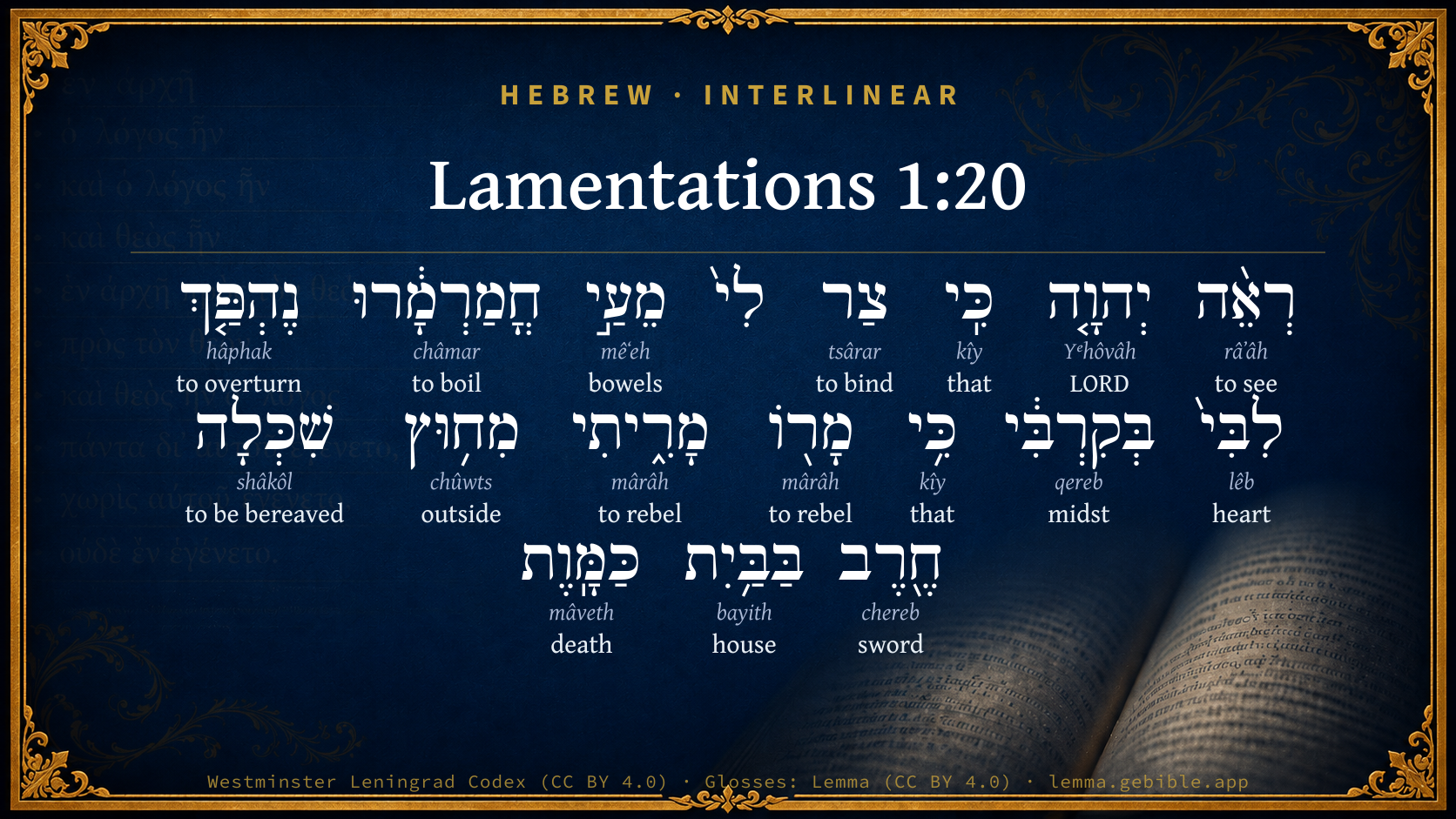
Hebrew (Westminster Leningrad Codex) Lamentations 1:20 appears in the Hebrew Old Testament. The text above is from the Westminster Leningrad Codex. Each word links to its Strong’s number, a concise gloss, and parsing drawn from the Open Scriptures Hebrew Bible morphology. Click any word for its full Brown-Driver-Briggs (BDB) entry.
Download image
Cite this verse

Lamentations 1:20 (World English Bible). Public Domain. Lemma interlinear Bible study tool, https://lemma.gebible.app/v/lamentations/1/20.

Show BibTeX & RIS
BibTeX
RIS
English Translation
See, Yahweh; for I am in distress; my heart is troubled; My heart is turned within me; for I have grievously rebelled: Abroad the sword bereaves, at home there is as death.
World English Bible · Public Domain
Download a study sheet

One document with this verse’s original text, its word-by-word gloss line, the meaning frame, cross-references with their text, attributed commentary, and full source and license credits — printable, and it pastes into notes with its structure intact.

This verse Autodidact and up

Study sheet (.html) Plain text (.txt)

A passage Seminary Student

Up to 50 verses in one chapter. A passage sheet keeps up to 6 commentary sources and 12 cross-references per verse, in the order this page ranks them, and says so on the sheet whenever that leaves anything out. Ask for a single verse and you get the Autodidact verse sheet above.

Everything on this page stays free to read, with no account — the sheet is a download of what is already on screen, not access to it.

Want to remove ads? Support Godless Engineer
Compare translations 3

The same verse in 3 English versions, stacked beneath the original-language interlinear above. Click any original word for its lexicon entry.

Each is an independent rendering of the whole verse — the interlinear is not word-aligned to these translations.

Highlighted words mark where these versions differ — a whole-verse word diff, not a word-by-word alignment.

  • World English Bible Public Domain
    See, Yahweh; for I am in distress; my heart is troubled; My heart is turned within me; for I have grievously rebelled: Abroad the sword bereaves, at home there is as death.
  • King James Version Public Domain
    Behold, O LORD; for I am in distress: my bowels are troubled; mine heart is turned within me; for I have grievously rebelled: abroad the sword bereaveth, at home there is as death.
  • unfoldingWord Literal Text CC BY-SA 4.0
    See, Yahweh, for I am in distress; my inward parts are churning; my heart has been overturned within me, for I have bitterly rebelled. Outside the sword bereaves; inside is like death. SIN

unfoldingWord Literal Text — © unfoldingWord, licensed CC BY-SA 4.0. Word-aligned USFM3 via Door43 (git.door43.org/unfoldingWord/en_ult).

Versions to compare (up to 4)

3 of 4 selected

Show all 18 translations

Every available English version of this verse, each an independent rendering of the whole verse.

  • World English Bible Public Domain
    See, Yahweh; for I am in distress; my heart is troubled; My heart is turned within me; for I have grievously rebelled: Abroad the sword bereaves, at home there is as death.
  • Berean Standard Bible Public Domain
    See, O LORD, how distressed I am! I am churning within; my heart is pounding within me, for I have been most rebellious. Outside, the sword bereaves; inside, there is death.
  • Majority Standard Bible Public Domain
    See, O LORD, how distressed I am! I am churning within; my heart is pounding within me, for I have been most rebellious. Outside, the sword bereaves; inside, there is death.
  • King James Version Public Domain
    Behold, O LORD; for I am in distress: my bowels are troubled; mine heart is turned within me; for I have grievously rebelled: abroad the sword bereaveth, at home there is as death.
  • American Standard Version (1901) Public Domain
    Behold, O Jehovah; for I am in distress; my heart is troubled; My heart is turned within me; for I have grievously rebelled: Abroad the sword bereaveth, at home there is as death.
  • Revised Version (1885) Public Domain
    Behold, O LORD; for I am in distress; my bowels are troubled; mine heart is turned within me; for I have grievously rebelled: abroad the sword bereaveth, at home there is as death.
  • Geneva Bible (1599) Public Domain
    Behold, O Lord, howe I am troubled: my bowels swell: mine heart is turned within me, for I am ful of heauinesse: the sword spoyleth abroad, as death doeth at home.
  • Douay-Rheims (1899) Public Domain
    Res. Behold, O Lord, for I am in distress, my bowels are troubled: my heart is turned within me, for I am full of bitterness: abroad the sword destroyeth, and at home there is death alike.
  • Young's Literal Translation Public Domain
    See, O Jehovah, for distress `is' to me, My bowels have been troubled, Turned hath been my heart in my midst, For I have greatly provoked, From without bereaved hath the sword, In the house `it is' as death.
  • Literal Standard Version CC BY-SA 4.0
    See, O YHWH, for distress [is] to me, || My bowels have been troubled, || My heart has been turned in my midst, || For I have greatly provoked, || From outside the sword has bereaved, || In the house [it is] as death.
  • Unlocked Literal Bible CC BY-SA 4.0
    Look, Yahweh, for I am in distress; my stomach churns, my heart is disturbed within me, for I have been very rebellious. Outside, the sword bereaves a mother, inside the house there is only death.
  • unfoldingWord Literal Text CC BY-SA 4.0
    See, Yahweh, for I am in distress; my inward parts are churning; my heart has been overturned within me, for I have bitterly rebelled. Outside the sword bereaves; inside is like death. SIN
  • Darby Bible Public Domain
    See, Jehovah, for I am in distress, my bowels are troubled; my heart is turned within me, for I have grievously rebelled: without, the sword hath bereaved [me], within, it is as death.
  • World Messianic Bible Public Domain
    “Look, LORD; for I am in distress. My heart is troubled. My heart turns over within me, for I have grievously rebelled. Abroad, the sword bereaves. At home, it is like death.
  • Webster's Bible Public Domain
    Behold, O LORD; for I am in distress: my bowels are troubled; my heart is turned within me; for I have grievously rebelled: abroad the sword bereaveth, at home there is as death.
  • Free Bible Version CC BY-SA 4.0
    Can't you see, Lord, how upset I am? Inside I am in turmoil; my heart is breaking because I've been so rebellious. Outside, the sword kills those I love; inside, it's like I'm living in the house of death.
  • Bible in Basic English Public Domain
    See, O Lord, for I am in trouble; the inmost parts of my body are deeply moved; my heart is turned in me; for I have been uncontrolled: outside the children are put to the sword, and in the house there is death.
  • JPS Tanakh (1917) Public Domain
    Behold, O LORD, for I am in distress, mine inwards burn; my heart is turned within me, for I have grievously rebelled. Abroad the sword bereaveth, at home there is the like of death.

Literal Standard Version (2020), Covenant Press — licensed CC BY-SA 4.0. Text via the HelloAO Bible API (eBible.org). Unlocked Literal Bible (unfoldingWord) — licensed CC BY-SA 4.0. Text via the HelloAO Bible API (eBible.org). unfoldingWord Literal Text — © unfoldingWord, licensed CC BY-SA 4.0. Word-aligned USFM3 via Door43 (git.door43.org/unfoldingWord/en_ult). Free Bible Version, Dr. Jonathan Gallagher — licensed CC BY-SA 4.0. Text via the HelloAO Bible API (eBible.org).

Word by word

More ways to search: Search by grammar → Find every occurrence → Compare this word →

Practice this passage: Drill this verse → Learn its vocabulary →

חֳמַרְמָ֔רוּ
châmar
H2560
“to boil”
Verb, Pealal, Perfect, 3rd Person, Common, Plural
Part of Speech
Verb
Stem
Pealal
Form
Perfect
Person
3rd Person
Gender
Common
Number
Plural
Full BDB Definition

Origin: a primitive root

TWOT: TWOT- 683 , 683d , 685

to boil, foam, foam up, ferment - (Qal) to boil, foam up - (Poalal) to be troubled, be in turmoil - (Poalal) to be reddened - (Qal) to daub, seal up, cover or smear with asphalt
  1. רְאֵ֨ה râʼâh H7200 “see” Verb, Qal, Imperative, 2nd Person, Masculine, Singular
  2. יְהוָ֤ה Yᵉhôvâh H3068 “LORD” Noun, Proper
  3. כִּֽי kîy H3588 “that” Conjunction
  4. צַר tsârar H6887 “distressed” Adjective, Adjective, Masculine, Singular, Absolute
  5. מֵעַ֣י mêʻeh H4578 “bowels · my” Noun, Common, Masculine, Plural, Construct + Suffix, Personal, 1st Person, Common, Singular
  6. נֶהְפַּ֤ךְ hâphak H2015 “to overturn” Verb, Niphal, Perfect, 3rd Person, Masculine, Singular
  7. לִבִּי֙ lêb H3820 “heart · my” Noun, Common, Masculine, Singular, Construct + Suffix, Personal, 1st Person, Common, Singular
  8. בְּקִרְבִּ֔י qereb H7130 “in/at · midst · my” Preposition + Noun, Common, Masculine, Singular, Construct + Suffix, Personal, 1st Person, Common, Singular
  9. כִּ֥י kîy H3588 “that” Conjunction
  10. מָר֖וֹ mârâh H4784 “to rebel” Verb, Qal, Infinitive Absolute
  11. מָרִ֑יתִי mârâh H4784 “to rebel” Verb, Qal, Perfect, 1st Person, Common, Singular
  12. מִח֥וּץ chûwts H2351 “from · outside” Preposition + Noun, Common, Masculine, Singular, Absolute
  13. שִׁכְּלָה shâkôl H7921 “to be bereaved” Verb, Piel, Perfect, 3rd Person, Feminine, Singular
  14. חֶ֖רֶב chereb H2719 “sword” Noun, Common, Feminine, Singular, Absolute
  15. בַּבַּ֥יִת bayith H1004 “in/at the · house” Preposition, Determined + Noun, Common, Masculine, Singular, Absolute
  16. כַּמָּֽוֶת mâveth H4194 “like/as the · death” Preposition, Determined + Noun, Common, Masculine, Singular, Absolute

About this verse

These counts appear in no published source. They are computed here, from the morphology-tagged text and Lemma’s own curated glosses. What Lemma adds →

18
words
15
distinct lemmas
Prophets
section

Notable vocabulary

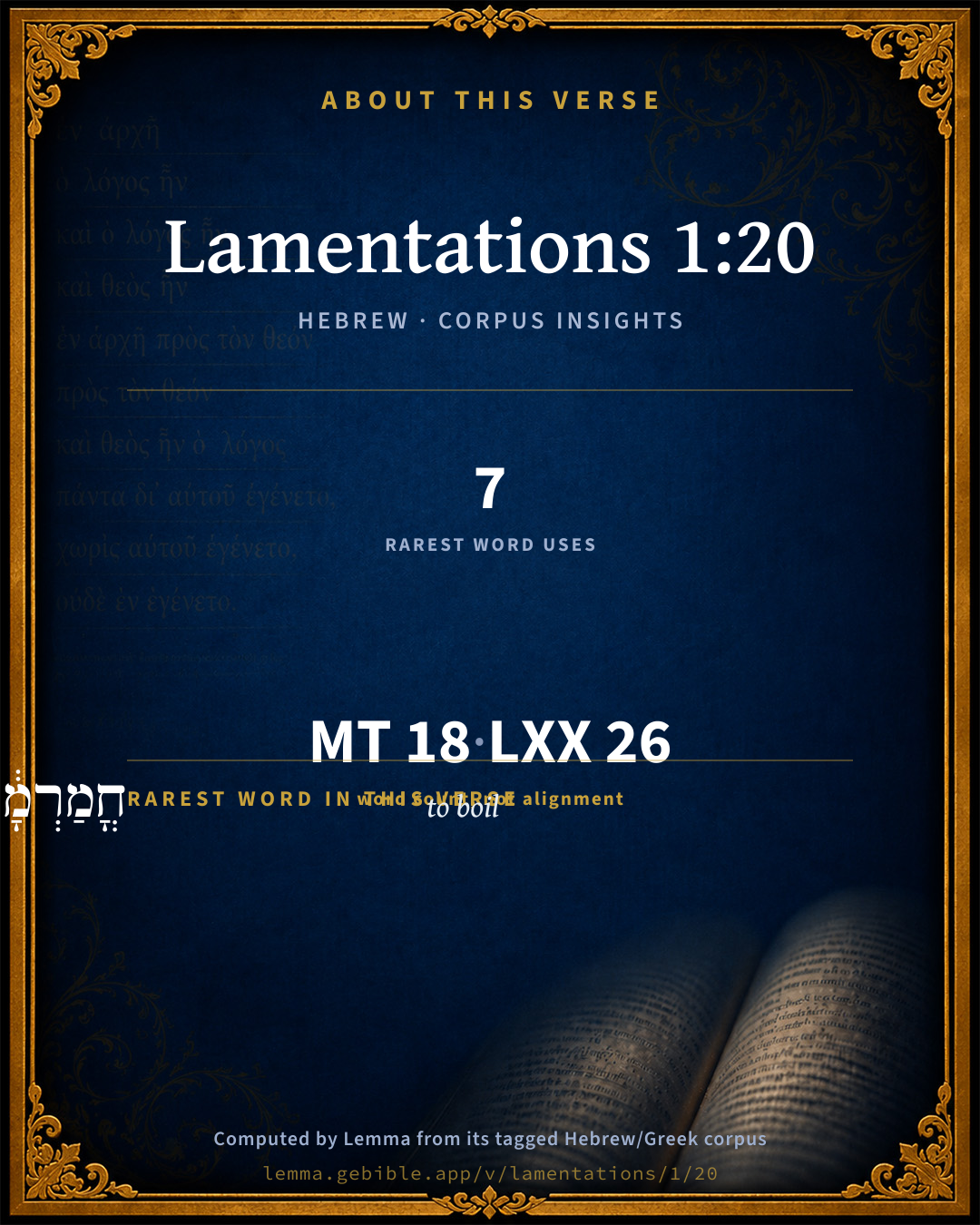
The rarest word here is חֳמַרְמָ֔רוּ to boil H2560 — appearing just 7 times in the whole Hebrew Bible.

Shared distinctive vocabulary

חֳמַרְמָ֔רוּ to boil H2560 occurs in 6 verses of the Hebrew Bible. Also found in:

Grammatical profile

  • 6 verbs
  • 8 nouns
  • 1 adjective
  • 1 preposition
  • 2 conjunctions

Verb forms

  • רְאֵ֨ה Qal · Imperative
  • חֳמַרְמָ֔רוּ Pealal · Perfect
  • נֶהְפַּ֤ךְ Niphal · Perfect
  • מָר֖וֹ Qal · Infinitive Absolute
  • מָרִ֑יתִי Qal · Perfect
  • שִׁכְּלָה Piel · Perfect

Repetition

Words recur within this verse — often emphatic in Hebrew:

  • מָר֖וֹ to rebel H4784 ×2
  • כִּֽי that H3588 ×2

Hebrew & Septuagint length

In English translation the verse runs 32 words from the Hebrew and 36 from the Septuagint (LXX English) — closely comparable.

A rough comparison of the two English renderings, which tokenize alike — not a word-level alignment.

Word counts can differ between the Hebrew and the Greek without any difference in meaning — e.g. the Hebrew direct-object marker אֵת has no separate Greek word, and Greek often adds the article ὁ.

In the original languages it is 18 Hebrew tokens and 26 Greek tokens — but the two are counted differently (Hebrew bundles its prefixes and suffixes into one token; the Greek is in lemma form), so that isn’t a like-for-like length.

Cross-references

27

Topical passages linked to Lamentations 1:20 in the Treasury of Scripture Knowledge — connected by theme and wording, ordered by reader-vote popularity; previews shown in the World English Bible.

  • Lamentations 2:11 My eyes do fail with tears, my heart is troubled; My liver is poured on the earth, because of the destruction of the daughter of my people, Because the young children and the infants swoon in the streets of the city.
  • Deuteronomy 32:25 Outside shall the sword bereave, In the chambers terror; [It shall destroy] both young man and virgin, The suckling with the man of gray hairs.
  • Proverbs 28:13 He who conceals his sins doesn't prosper, But whoever confesses and renounces them finds mercy.
  • Isaiah 16:11 Why my heart sounds like a harp for Moab, and my inward parts for Kir Heres.
  • Ezekiel 7:15 The sword is outside, and the pestilence and the famine within: he who is in the field shall die with the sword: and he who is in the city, famine and pestilence shall devour him.
  • Job 30:27 My heart is troubled, and doesn't rest. Days of affliction have come on me.
  • Jeremiah 4:19 My anguish, my anguish! I am pained at my very heart; my heart is disquieted in me; I can't hold my peace; because you have heard, O my soul, the sound of the trumpet, the alarm of war.
  • Leviticus 26:40–42 "'If they confess their iniquity, and the iniquity of their fathers, in their trespass which they trespassed against me, and also that, because they walked contrary to me,
  • 1 Kings 8:47–50 yet if they shall repent themselves in the land where they are carried captive, and turn again, and make supplication to you in the land of those who carried them captive, saying, We have sinned, and have done perversely, we have dealt wickedly;
  • Job 33:27 He sings before men, and says, 'I have sinned, and perverted that which was right, And it didn't profit me.
  • Psalms 22:14 I am poured out like water. All my bones are out of joint. My heart is like wax; It is melted within me.
  • Psalms 51:3–4 For I know my transgressions. My sin is constantly before me.
  • Isaiah 38:14 Like a swallow [or] a crane, so did I chatter; I did moan as a dove; my eyes fail [with looking] upward: Lord, I am oppressed, be my collateral.
  • Jeremiah 2:35 Yet you said, I am innocent; surely his anger is turned away from me. Behold, I will enter into judgment with you, because you say, I have not sinned.
  • Jeremiah 3:13 Only acknowledge your iniquity, that you have transgressed against Yahweh your God, and have scattered your ways to the strangers under every green tree, and you have not obeyed my voice, says Yahweh.
  • Jeremiah 9:21–22 For death is come up into our windows, it is entered into our palaces; to cut off the children from outside, [and] the young men from the streets.
  • Jeremiah 14:18 If I go forth into the field, then, behold, the slain with the sword! and if I enter into the city, then, behold, those who are sick with famine! for both the prophet and the priest go about in the land, and have no knowledge.
  • Jeremiah 31:20 Is Ephraim my dear son? is he a darling child? for as often as I speak against him, I do earnestly remember him still: therefore my heart yearns for him; I will surely have mercy on him, says Yahweh.
  • Jeremiah 48:36 Therefore my heart sounds for Moab like pipes, and my heart sounds like pipes for the men of Kir Heres: therefore the abundance that he has gotten is perished.
  • Lamentations 1:9 Her filthiness was in her skirts; she didn't remember her latter end; Therefore is she come down wonderfully; she has no comforter: See, Yahweh, my affliction; for the enemy has magnified himself.
  • Lamentations 1:11 All her people sigh, they seek bread; They have given their pleasant things for food to refresh the soul: Look, Yahweh, and see; for I am become abject.
  • Lamentations 1:18 Yahweh is righteous; for I have rebelled against his commandment: Please hear all you peoples, and see my sorrow: My virgins and my young men are gone into captivity.
  • Lamentations 4:9–10 Those who are killed with the sword are better than those who are killed with hunger; For these pine away, stricken through, for want of the fruits of the field.
  • Hosea 11:8 "How can I give you up, Ephraim? How can I hand you over, Israel? How can I make you like Admah? How can I make you like Zeboiim? My heart is turned within me, My compassion is aroused.
  • Habakkuk 3:16 I heard, and my body trembled. My lips quivered at the voice. Rottenness enters into my bones, and I tremble in my place, Because I must wait quietly for the day of trouble, For the coming up of the people who invade us.
  • Luke 15:18–19 I will get up and go to my father, and will tell him, "Father, I have sinned against heaven, and in your sight.
  • Luke 18:13–14 But the tax collector, standing far away, wouldn't even lift up his eyes to heaven, but beat his breast, saying, 'God, be merciful to me, a sinner!'

Cross-references courtesy of OpenBible.info (CC BY 4.0).

Hebrew and Greek witnesses Masoretic Hebrew ↔ Greek Septuagint

The same verse in the two great witnesses to the Old Testament, shown verse-for-verse.

These are two independent witnesses, not word-aligned to each other, and the Septuagint is shown in lemma (dictionary) form.

Hebrew Lamentations 1:20 Masoretic · Westminster Leningrad Codex

רְאֵ֨ה יְהוָ֤ה כִּֽי צַר לִי֙ מֵעַ֣י חֳמַרְמָ֔רוּ נֶהְפַּ֤ךְ לִבִּי֙ בְּקִרְבִּ֔י כִּ֥י מָר֖וֹ מָרִ֑יתִי מִח֥וּץ שִׁכְּלָה חֶ֖רֶב בַּבַּ֥יִת כַּמָּֽוֶת

See, Yahweh; for I am in distress; my heart is troubled; My heart is turned within me; for I have grievously rebelled: Abroad the sword bereaves, at home there is as death.

World English Bible · Public Domain

Greek LXX Lamentations 1:20 Septuagint · lemma form

ὁράω κύριος ὅτι θλίβω ὁ κοιλία ἐγώ ταράσσω καί ὁ καρδία ἐγώ στρέφω ἐν ἐγώ ὅτι παραπικραίνω παραπικραίνω ἔξωθεν ἀτεκνόω ἐγώ μάχαιρα ὥσπερ θάνατος ἐν οἶκος

RHECHS. Behold, O Lord; for I am afflicted: my belly is troubled, and my heart is turned within me; for I have been grievously rebellious: abroad the sword has bereaved me, even as death at home.

LXX2012 (modern English Septuagint) · Public Domain

Hebrew: Westminster Leningrad Codex (CC BY 4.0). Greek: Septuagint (public domain); English from LXX2012 (modern English Septuagint) (Public Domain). How the Septuagint differs from the Hebrew →

Commentary

Notes on Lamentations 1:20 from classic Christian and Jewish commentators (each source and its license shown beneath its notes). The classic Christian expositions comment on the surrounding passage and are grouped to its opening verse, so a note may address several verses; the Jewish commentaries on the Tanakh (Rashi and others) are per-verse, so they appear only where the commentator wrote on this verse.

Lemma curates 59 commentaries, every one of them public domain or Creative Commons licensed, each selected and text-cleaned for this edition rather than reprinted as found. About our sources →

Trapp's Complete Commentary

John Trapp

Lam 1:20 Behold, O LORD; for I [am] in distress: my bowels are troubled; mine heart is turned within me; for I have grievously rebelled: abroad the sword bereaveth, at home [there is] as death.

Ver. 20. Behold, O Lord, for I am in distress.] Thus ever and anon she is lifting up her soul to God, by a holy apostrophe, in some short yet pithy expressions. And surely if a long look toward God speedeth, {Psa 34:4-5 Jon 2:4; Jon 2:7} how much more a hearty ejaculation, as here!

My bowels are troubled.] Lutulant, bulliunt, vel intumescunt: non solum fluctuant, aut strepunt, ut alibi. My bowels boil and bubble, or are thick and muddy, as waters are after and in a tempest: or it is a metaphor from mortar made by mingling water with lime and sand. She was in a great perturbation, and sought ease by submitting to God’s justice, and imploring his mercy.

Mine heart is turned within me.] Or, Turneth itself upside down. See Hos 11:8.

For I have grievously rebelled.] This was the right way to get ease and settle all within - viz., to confess sin with aggravation, putting in weight, laying on load.

Abroad the sword bereaveth, at home there is as death.] Famine especially, which is worse than the sword. {Lam 4:9}

“ Et plurima mortis imago. ”

“Even the most intense image of death.”

R. Solomon interpreteth it of evil angels.

John Trapp, A Commentary or Exposition upon All the Books of the Old and New Testament (1647–1656) — public domain. Text from a community e-Sword module.

Joseph Benson's Commentary

Lam 1:20. Behold, O Lord, for I am in distress — Take cognizance of my case, and use such means for my relief as thou pleasest. It is a matter of comfort to us, that the troubles which oppress our spirits are perfectly known to God, and that his eye is continually upon them. Abroad the sword bereaveth, at home there is as death — Thus was Moses’s prediction, Deu 32:25, fulfilled, The sword without, and terror within, shall destroy both the young man and the virgin, the suckling also, with the man of gray hairs. Virgil describes a similar scene, when he says,

“ — — Crudelis ubique Luctus, ubique pavor, et plurima mortis imago.” ÆN. 2:368.

“All parts resound with tumults, plaints, and fears; And grisly death in sundry shapes appears.” DRYDEN.

By death, in this clause, the pestilence is meant, as in Jer 15:2, where see the note: death acting, as it were, in propria persona, in its own proper person, and not by the instrumentality of another, as when a person is slain by the sword. So our great poet, in his description of a lazar-house,

“ — — — — — — — — — — Despair

‘Tended the sick, busiest from couch to couch; And over them triumphant death his dart Shook — — — — — — .”

PARADISE LOST, book 11. 50:489, &c.

Instead of, At home there is as death, Lowth proposes reading, there is certain death, observing, that the particle of similitude in the Scriptures sometimes implies a strong affirmation, as Joh 1:14, We beheld his glory, the glory as of the only begotten of the Father, meaning such a glory as could belong to none but the Son of God.

Joseph Benson's Commentary on the Old and New Testaments (1811–1818) — public domain. Text from a community e-Sword module.

Keil & Delitzsch

C. F. Keil & F. Delitzsch

Since neither comfort nor advice is to be found with men, Jerusalem makes her complaint of need to God the Lord. "See, Jahveh, that I am distressed. My bowels glow." חמרמרוּ, the passive enhancing form, from חמר, is found, besides, only in Lam 2:11, where the clause before us is repeated, and in Job 16:16, where it is used of the countenance, and can only mean to be glowing red; it is scarcely legitimate to derive it from חמר, Arab. h[mr, to be made red, and must rather be referred to Arab. chmr, to ferment, rise into froth; for even in Psa 55:9 חמר does not mean to be red, but to rise into froth. מעים, "bowels," are the nobler portions of the internal organs of the body, the seat of the affections; cf. Delitzsch's Biblical Psychology (Clark's translation), p. 314ff. "My heart has turned within me" is an expression used in Hos 11:8 to designate the feeling of compassion; but here it indicates the most severe internal pain, which becomes thus agonizing through the consciousness of its being deserved on account of resistance to God. מרו for מרה, like בּכו ekil, Jer 22:10; Jer 30:19, etc. Both forms occur together in other verbs also; cf. Olshausen, Gram. 245, h [Ewald, 238, e; Gesen., 75, Rem. 2]. But the judgment also is fearful; for "without (מחוּץ, foris, i.e., in the streets and the open country) the sword renders childless," through the slaughter of the troops; "within (בּבּית, in the houses) כּמּות, like death." It is difficult to account for the use of כּ; for neither the כ of comparison nor the so-called כveritatis affords a suitable meaning; and the transposition of the words into sicut mors intus (Rosenm׬ller, after Lצwe and Wolfsohn) is an arbitrary change. Death, mentioned in connection with the sword, does not mean death in general, but special forms of death through maladies and plagues, as in Jer 15:2; Jer 18:21, not merely the fever of hunger, Jer 14:18; on the other hand, cf. Eze 7:15, "the sword without, pestilence and hunger within." But the difficulty connected with כּמּות is not thereby removed. The verb שׁכּל belongs to both clauses; but "the sword" cannot also be the subject of the second clause, of which the nominative must be כּמּות, "all that is like death," i.e., everything besides the sword that kills, all other causes of death, - pestilences, famine, etc. כּ is used as in כּמראה, Dan 10:18. That this is the meaning is shown by a comparison of the present passage with Deu 32:25, which must have been before the writer's mind, so that he took the words of the first clause, viz., "without, the sword bereaves," almost as they stood, but changed וּמחדרים into בּבּית כּמּות, - thus preferring "what is like death," instead of "terror," to describe the cause of destruction. Calvin long ago hit the sense in his paraphrase multae mortes, and the accompanying explanation: utitur nota similitudinis, quasi diceret: nihil domi occurrere nisi mortale (more correctly mortiferum). Much light is thrown on the expression by the parallel adduced by Kalkschmidt from Aeneid, ii. 368, 369: crudelis ubique Luctus, ubique pavor, et plurima mortis imago.

From speaking of friends, a transition is made in Lam 1:21 to enemies. Regarding the explanation of Rosenmller, audiverunt quidem amici mei, a me implorati Lam 1:19, quod gemens ego...imo sunt omnes hostes mei, Thenius observes that it introduces too much. This remark is still more applicable to his own interpretation: "People (certainly) hear how I sigh, (yet) I have no comforter." The antithesis introduced by the insertion of "yet" destroys the simplicity of arrangement among the clauses, although C. B. Michaelis and Gerlach also explain the passage in the same manner. The subject of the words, "they have heard," in the first clause, is not the friends who are said in Lam 1:19 to have been called upon for help, nor those designated in the second clause of Lam 1:21 as "all mine enemies," but persons unnamed, who are only characterized in the second clause as enemies, because they rejoice over the calamity which they have heard of as having befallen Jerusalem. The first clause forms the medium of transition from the faithless friends (Lam 1:19) to the open enemies (Lam 1:21); hence the subject is left undefined, so that one may think of friends and enemies. The foes rejoice that God has brought the evil on her. The words 'הבאת וגו, which follow, cannot also be dependent on כּי ("that Thou hast brought the day which Thou hast announced"), inasmuch as the last clause, "and they shall be like me," does not harmonize with them. Indeed, Ngelsbach and Gerlach, who assume that this is the connection of the clause "Thou hast brought," etc., take 'ויהיוּ כ adversatively: "but they shall be like me." If, however, "they shall be," etc., were intended to form an antithesis to "all mine enemies have heard," etc., the former clause would be introduced by והם. The mere change of tense is insufficient to prove the point. It must further be borne in mind, that in such a case there would be introduced by the words "and they shall be," etc., a new series of ideas, the second great division of the prayer; but this is opposed by the arrangement of the clauses. The second portion of the prayer cannot be attached to the end of the verse. The new series of thoughts begins rather with "Thou hast brought," which the Syriac has rendered by the imperative, venire fac. Similarly Luther translates: "then (therefore) let the day come." C. B. Michaelis, Rosenmller, Pareau, etc., also take the words optatively, referring to the Arabic idiom, according to which a wish is expressed in a vivid manner by the perfect. This optative use of the perfect certainly cannot be shown to exist in the Hebrew; but perhaps it may be employed to mark what is viewed as certain to follow, in which case the Germans use the present. The use of the perfect shows that the occurrence expected is regarded as so certain to happen, that it is represented as if it had already taken place. The perfects in Lam 3:56-61 are taken in this sense by nearly all expositors. Similarly we take the clause now before us to mean, "Thou bringest on the day which Thou hast proclaimed (announced)," i.e., the day of judgment on the nations, Jer 25, "so that they become like me," i.e., so that the foes who rejoice over my misfortune suffer the same fate as myself. "The day [which] Thou hast proclaimed" has been to specifically rendered in the Vulgate, adduxisti diem consolationis, probably with a reference of the proclamation to Isa 40:2. - After this expression of certainty regarding the coming of a day of punishment for her enemies, there follows, Lam 1:22, the request that all the evil they have done to Jerusalem may come before the face of God, in order that He may punish it (cf. Psa 109:15 with Lam 1:14), - do to them as He has done to Jerusalem, because of her transgressions. The clause which assigns the reason ("for many are my sighs," etc.) does not refer to that which immediately precedes; for neither the request that retribution should be taken, nor the confession of guilt ("for all my transgressions"), can be accounted fore by pointing to the deep misery of Jerusalem, inasmuch as her sighing and sickness are not brought on her by her enemies, but are the result of the sufferings ordained by God regarding her. The words contain the ground of the request that God would look on the misery (Lam 1:20), and show to the wretched one the compassion which men refuse her. לבּי is exactly the same expression as that in Jer 8:18; cf. also Isa 1:5. The reason thus given for making the entreaty forms an abrupt termination, and with these words the sound of lamentation dies away.

Keil & Delitzsch — Biblical Commentary on the Old Testament (1861–1891) — public domain (CC PDM 1.0). Text via the HelloAO Bible API. (Old Testament only.)

Tyndale Open Study Notes

Tyndale Open Resources

1:20 The leaders and people of Judah had rebelled (Jer 2:17; 5:6, 23) by rejecting the one true God and his commandments and by resisting the invaders God had sent (2 Kgs 24:1, 20; 2 Chr 36:13).

Tyndale Open Study Notes — © Tyndale Open Resources, licensed CC BY-SA 4.0. Text via the HelloAO Bible API.

Jamieson, Fausset & Brown

Robert Jamieson, A. R. Fausset & David Brown

bowels . . . troubled-- (Job 30:27; Isa 16:11; Jer 4:19; Jer 31:20). Extreme mental distress affects the bowels and the whole internal frame.

heart . . . turned-- (Hos 11:8); is agitated or fluttered.

abroad . . . sword . . . at home . . . as death-- (Deu 32:25; Eze 7:15). The "as" does not modify, but intensifies. "Abroad the sword bereaveth, at home as it were death itself" (personified), in the form of famine and pestilence (Kg2 25:3; Jer 14:18; Jer 52:6). So Hab 2:5, "as death" [MICHAELIS].

Jamieson, Fausset & Brown — Commentary Critical and Explanatory on the Whole Bible (1871) — public domain (CC PDM 1.0). Text via the HelloAO Bible API.

Adam Clarke's Commentary

Verse 20. Abroad the sword bereaveth] WAR is through the country; and at home death; the pestilence and famine rage in the city; calamity in every shape is fallen upon me.

Virgil represents the calamities of Troy under the same image: -

______ Nec soli poenas dant sanguine Teucri:

Quondam etiam victis redit in praecordia virtus;

Victoresque cadunt Danai. Crudelis ubique

Luctus, ubique Pavor, et plurima mortis imago.

AEneid. lib. ii. 366.

"Not only Trojans fall; but, in their turn,

The vanquished triumph, and the victors mourn.

Ours take new courage from despair and night;

Confused the fortune is, confused the fight.

All parts resound with tumults, plaints, and fears;

And grisly death in sundry shapes appears."

DRYDEN.

So Milton -

"_____________________ Despair

Tended the sick, busiest from couch to couch;

And over them triumphant Death his dart Shook."

Par. Lost, B. xi. 489.

Jeremiah, Jer 9:21, uses the same image: -

Death is come up into our windows:

He hath entered our palaces,

To cut off the infants without,

And the young men in our streets.

So Silius Italicus, II. 548: -

Mors graditur, vasto pandens cava guttura rletu,

Casuroque inhians populo.

"Death stalks along, and opens his hideous throat to

gulp down the people."

Adam Clarke's Commentary on the Bible (1810–1826) — public domain. Text from a community e-Sword/MySword module.

John Calvin's Commentaries

The people turn again to pray God: and what has been before said ought to be remembered, that these lamentations of Jeremiah differ from the complaints of the ungodly; because the faithful first acknowledge that they are justly chastised by God’s hand, and secondly, they trust in his mercy and implore his aid. For by these two marks the Church is distinguished from the unbelieving, even by repentance and faith. To sigh and to mourn in adversities, and to lament also their miseries, are common to both; but the children of God differ greatly from the ungodly, because they humble themselves under his mighty hand, and confess that they deserve to suffer punishment; and further, they cast not away the hope of salvation, but implore his mercy. Then the Prophet introduces again the people as praying God to look on them. For the ungodly pour forth their complaints into the air; and when at any time nature dictates to them that they ought to address God, yet no prayer arises from a sincere heart.

There is no doubt but that the Prophet here shewed to the faithful how they were to lament their common miseries, even so as patiently to bear the chastisements of God, and also to seek deliverance from him, though they had provoked his wrath. For when we see that we are pressed down by God’s hand, we do not murmur, but the knowledge of our sins humbles us, and faith moderates our mourning, which would otherwise exceed moderation. And when we thus humbly flee to God, we in a manner unburden our sorrows into his bosom, as it is said in the Psalms, “Cast (or roll) on God thy cares.” (Psalm 55:22.)

He then says first, See, Jehovah, for affliction is to me. He then expresses the manner of the affliction, because his bowels were bound, or troubled. The word is from, חמרchemer, which is doubled. Some derive it from חמור, chemur, an ass, and so render it “bound,” as when a. burden is fastened on an ass. But more probable is the opinion of those who derive the word from mortar or cement, for as cement is made by mixing water with lime and sand, and stirring them together, so by a metaphor the bowels are said to be stirred or troubled; and this explanation agrees better with what follows — for it is added, my heart is overturned. The reason is given, because the people by rebelling had rebelled, that is, had been very rebellious against God. We have said that the complaints of the godly differ from those of the ungodly, for they not only pray to God, but make also a sincere confession, so as to make it evident that they are justly chastised by God’s hand. At the beginning of the verse the faithful prayed, and now again they declare that they deserved what they suffered, because they had been very rebellious. Then Jeremiah proceeds with what he had begun to say respecting the grievousness of their punishment, Abroad, or without, he says, the sword bereaves, and at home it is like death; that is, “When we go abroad, the sword meets us; and when we hide ourselves at home, there also many deaths surround us.” He uses the particle of likeness, as, or like; as though he had said that nothing met them at home but what was deadly. It now follows, —

John Calvin's Commentaries (1540-1563) — public domain. Text from the Calvin Translation Society English edition (1840s-50s) via the Christian Classics Ethereal Library (ccel.org). Calvin's coverage is partial (roughly two-thirds of the Bible); uncommented books and verses are honest gaps, never fabricated. The 19th-century editor's footnotes and remarks are omitted so the notes are faithfully Calvin's own voice.

Ellicott's Commentary for English Readers

(20) Behold, O Lord . . .—Deserted by men, the mourner appeals to Jehovah. “Bowels” and “heart” are used almost as synonymous for the deepest emotions of the soul. The word for “troubled,” elsewhere (Psa_75:8) used of colour, might, perhaps, be better rendered inflamed.

At home there is as death.—The “as” seems inserted to give the emphasis of the undefined. It is not death pure and simple that makes each home tremble, but the “plurima mortis imago” (Virg. Aen. ii. 369), the starvation, disease, exhaustion, which all were deadly, i.e. deathlike, in their working.

A Bible Commentary for English Readers, edited by Charles John Ellicott (1878–1897) — public domain. Text from a community e-Sword module.

The Cambridge Bible for Schools and Colleges

gen. ed. J. J. S. Perowne

20. With description of her distress Zion combines prayer, appealing to Jehovah for redress.

my bowels] See on Jer_31:20.

are troubled] lit. are in a ferment.

is turned] cannot rest, is violently agitated.

at home there is as death] As violent death is imminent for those who stir abroad, so even those who remain within are like to die of pestilence. See Jer_9:21, and for note on this special sense of death Jer_15:2. The “as” (in Heb. a consonantal prefix) is hard to interpret and should perhaps be omitted.

The Cambridge Bible for Schools and Colleges (gen. ed. J. J. S. Perowne; Cambridge University Press, 1878–1918) — public domain. Text from a community e-Sword module.

John Gill's Exposition

Behold, O Lord, for I am in distress,.... Thus she turns from one to another; sometimes she addresses strangers, people that pass by; sometimes she calls to her lovers; and at other times to God, which is best of all, to have pity and compassion on her in her distress; and from whom it may be most expected, who is a God of grace and mercy:

my bowels are troubled; as the sea, agitated by winds, which casts up mire and dirt; or as any waters, moved by anything whatsoever, become thick and muddy; or like wine in fermentation; so the word (l), in the Arabic language, signifies, expressive of great disturbance, confusion, and uneasiness:

mine heart is turned within me; has no rest nor peace:

for I have grievously rebelled; against God and his word; her sins were greatly aggravated, and these lay heavy on her mind and conscience, and greatly distressed her:

abroad the sword bereaveth; this, and what follows in the next clause, describe the state and condition of the Jews, while the city was besieged; without it, the sword of the Chaldeans bereaved mothers of their children, and children of their parents, and left them desolate:

at home there is as death; within the city, and in the houses of it, the famine raged, which was as death, and worse than immediate death; it was a lingering one: or, "in the house was certain death" (m); for the "caph" here is not a mere note of similitude, but of certainty and reality; to abide at home was sure and certain death, nothing else could be expected. The Targum is

"within the famine kills like the destroying angel that is appointed over death;''

see Heb 2:14; and Jarchi interprets it of the fear of demons and noxious spirits, and the angels of death.

(l) "fermentavit, commiscuit, alteravit, turbavique mentem", Castel. col. 1294. (m) "in domo mors ipsa", Munster; "plane mors"; Junius & Tremellius.

John Gill's Exposition of the Whole Bible (1746–1763) — public domain (CC PDM 1.0). Text via the HelloAO Bible API.

Albert Barnes' Notes on the Bible

Troubled - Or, inflamed with sorrow.

Turned within me - Agitated violently.

At home there is as death - i. e. “in the house” there are pale pining forms, wasting with hunger, and presenting the appearance of death.

Albert Barnes' Notes on the Bible (1834–1885) — public domain. Text from a community e-Sword/MySword module.

Haydock's Catholic Bible Commentary

Alike, by famine, &c. (Calmet) (Worthington) --- Ubique pavor et plurima mortis imago. (Virgil, Æneid ii.)

George Leo Haydock (1774–1849), Haydock's Catholic Family Bible and Commentary, 1859 edition — public domain. Excludes Psalms (Douay-Rheims chapter numbering differs from Protestant) and Deuterocanonical books (Catholic canon only).

Matthew Poole's English Annotations

The petition is of the same nature as before, a petition for mercy, as the product of that pity and compassion which extreme misery begets in good souls, (and is ascribed unto God, though found in him in a much more perfect degree, Psa 78:38; 86:15; 111:4) through the eyes affecting the heart. The argument the prophet useth is drawn from the misery this people was now in, which he expresseth metaphorically, telling us their bowels were troubled, their heart turned, signifying the more inward disturbance of their mind; or more plainly, and that both generally, saying they were in distress, and more particularly by the great judgments of the sword and famine, the sword in the field, the famine in the city; unless the sword alone be meant both without and within the gates of the city. In all this the church justifieth God, confessing this was but the righteous product of her sin, by which, she having formerly subjected herself to God, had grievously rebelled; for as all men are born subjects to God, so by their sins they are become rebels; so it is a great aggravation of men’s rebellion against the Lord, when they have formerly taken an oath of fealty to the Lord, and, as Moses said, avouched the Lord as their God.

Matthew Poole's English Annotations on the Holy Bible (1683–1685) — public domain. Text from a community e-Sword/MySword module.

Whedon's Commentary on the Bible

Daniel D. Whedon

20. Abroad the sword… at home… as death — Why “as” is introduced here does not clearly appear, but the general thought is plain.

Daniel D. Whedon (gen. ed.), Commentary on the Old and New Testaments (1874–1909) — public domain. Text from a community e-Sword module.

The Pulpit Commentary

My bowels. The vital parts, especially the heart, as the seat of the affections, like splagcna . Are troubled; literally, are made to boil. Job_30:27, "My bowels boil" (a different word, however). Is turned; or, turns itself; i.e. palpitates violently. At home there is as death. So Jer_9:21, "For death is come up into our windows, and is entered into our palaces." By "death," when distinguished, as here, from "the sword," pestilence is meant; so e.g. in Jer_15:2 Jer_43:11. But the poet says here, not that "there is death," but merely as death," i.e. a mild form of pestilence, not the famine typhus itself. Or, perhaps, he means "every form of death" (Virgil"s "plurima mortis imago").

The cry of the contrite.

Trouble, when it leads to an inquiry into its cause, when it prompts to submission and to repentance, proves a means of grace. The cry of suffering and distress may have no moral significance; the cry of contrition and of supplication is a sign of spiritual impression, and is a step towards spiritual recovery.

I THE OCCASION OF AFFLICTION AND CONTRITION. This is here specified, and the reality and severity are manifest. Within, i.e. in the homes and streets of the city, there is dearth; without, i.e. in the field, there is destruction by the sword. Thus in two strokes national calamity and disaster are depicted.

II THE TOKENS OF AFFLICTION AND CONTRITION. Man"s bodily nature is expressive of his spiritual state. Severe suffering and distress display themselves in organic, physical disturbance: The prophet feels in his bodily frame the disturbing effects of the trials he has undergone, the lively sympathy he has experienced.

III THE CONFESSION TO WHICH AFFLICTION AND CONTRITION LEAD. Identifying the nation with himself, the prophet exclaims, "I have grievously rebelled." There is candour and justice, there is submissiveness, there is spiritual discernment, in this outspoken acknowledgment. No excuse, no extenuation, no complaint, is here, but a plain confession of ill desert. Rebels against a rightful authority, against a just, forbearing Sovereign, what could the Jews expect but such humiliation as they actually experienced? "If we confess our sins, he is faithful and just to forgive,

IV THE CRY OF AFFLICTION AND OF CONTRITION.

1. It is a cry unto the Lord. Judah had looked for earthly friends and helpers, and had learned by bitter experience the vanity of such expectations. And now Judah sought the Lord whom by sin and rebellion she had offended.

2. It is an entreaty for Divine regard and consideration. What had happened was indeed by permission of Heaven. But the regard implored was one of sympathy, commiseration, and kindness.

3. It is a cry for deliverance. It is dictated by the assurance that he and only he who wounded can heal and comfort and restore. T.

The Pulpit Commentary (1880–1919), ed. H.D.M. Spence-Jones & Joseph S. Exell — public domain. Text from a community e-Sword module.

John Wesley's Explanatory Notes

Death - By famine and pestilence.

John Wesley, Explanatory Notes Upon the Whole Bible (1754–1765) — public domain. Text via the GEBible commentary corpus.

unfoldingWord translationNotes

Door43 World Missions Community

General Information:

In this section Jerusalem is portrayed as a woman speaking about herself. (See: Personification)

Look, Yahweh, for I am in distress

Jerusalem continues to talk about herself as if she were a woman, but now talks directly to Yahweh. (See: Personification)

my stomach churns

The word "churn" means to move around violently, normally in a circular rotation. This does not mean the stomach is literally churning, but describes how the woman, representing Jerusalem, feels. AT: "my insides ache" or "my stomach hurts" (See: Metaphor)

my heart is disturbed within me

Here the woman, representing Jerusalem, refers to her "heart" to emphasize her feelings. AT: "my heart is broken" or "I am extremely sad" (See: Synecdoche)

the sword bereaves a mother

The "sword" represents the enemy. AT: "the enemy kills a mother's children" (See: Metonymy)

inside the house there is only death

Possible meanings are 1) "inside the house, everyone is dying" or 2) "and inside the house the dead people are kept" (See: Assumed Knowledge and Implicit Information)

translationWords

heart

rebel

sword

die

unfoldingWord translationNotes — © Distant Shores Media and the Door43 World Missions Community, licensed CC BY-SA 4.0. Source: git.door43.org/Door43/en_tn.

Rashi

Rabbi Shlomo Yitzchaki (Rashi)

burn Heb. חֳמַרְמָרוּ, they became shriveled, and there is an expression like this in the language of the Mishnah (Hul. 3:3): “It fell into the fire and its intestines were scorched (וְנֶחְמְרוּ).”

in the house it is like death Within the house was fear of demons and destructive beings and angels of death, and from without, the enemy’s sword was bereaving them.

Rashi on the Tanakh — English translations: “The Judaica Press complete Tanach with Rashi, translated by A. J. Rosenberg” (CC BY 4.0); “Pentateuch with Rashi's commentary by M. Rosenbaum and A.M. Silbermann, 1929-1934” (public domain); “The Metsudah Tanach series, Lakewood, N.J” (CC BY 4.0); and “The Book of Joshua, Metsudah Publications, 1997” (CC BY 4.0). Text via Sefaria.

Lesson kit

Teaching starters — assembled from the data on this page, not authored interpretation. Every prompt links to the verse data it draws on. Edit before teaching.

Lamentations, in the Prophets, opens this verse with 18 words (15 distinct Hebrew lemmas). Its most distinctive word is châmar (“to boil”). A historical commentator’s framing appears above. Read the whole chapter for the surrounding context.

Discussion questions

  1. The word châmar carries the sense “to boil.” How does it shape the verse?
  2. Exodus 2:3 shares the word «to boil» with this verse. How do the two illuminate each other?
  3. “to rebel” occurs 2× in this one verse. What is the effect of the repetition?
  4. The translations on this page render this verse differently — a whole-verse word diff, not a word-by-word alignment. What might account for the different wordings?
  5. The verb «רְאֵ֨ה» is Qal Imperative. How does its form color the action?
  6. Reading how Trapp's Complete Commentary and Joseph Benson's Commentary read this verse, where do the two commentators agree and where do they part?

Things to notice

Reading settings

Reading text

Shown beneath each verse's original-language words.

Old Testament
Old Testament edition

Read the OT as the Masoretic Hebrew (MT) or the Greek Septuagint (LXX).

English shown for the Greek Septuagint (in the Hebrew ↔ Greek comparison).

Comparing translations? Open the Compare panel on any verse page to stack up to four side by side.