
Proverbs 15:31

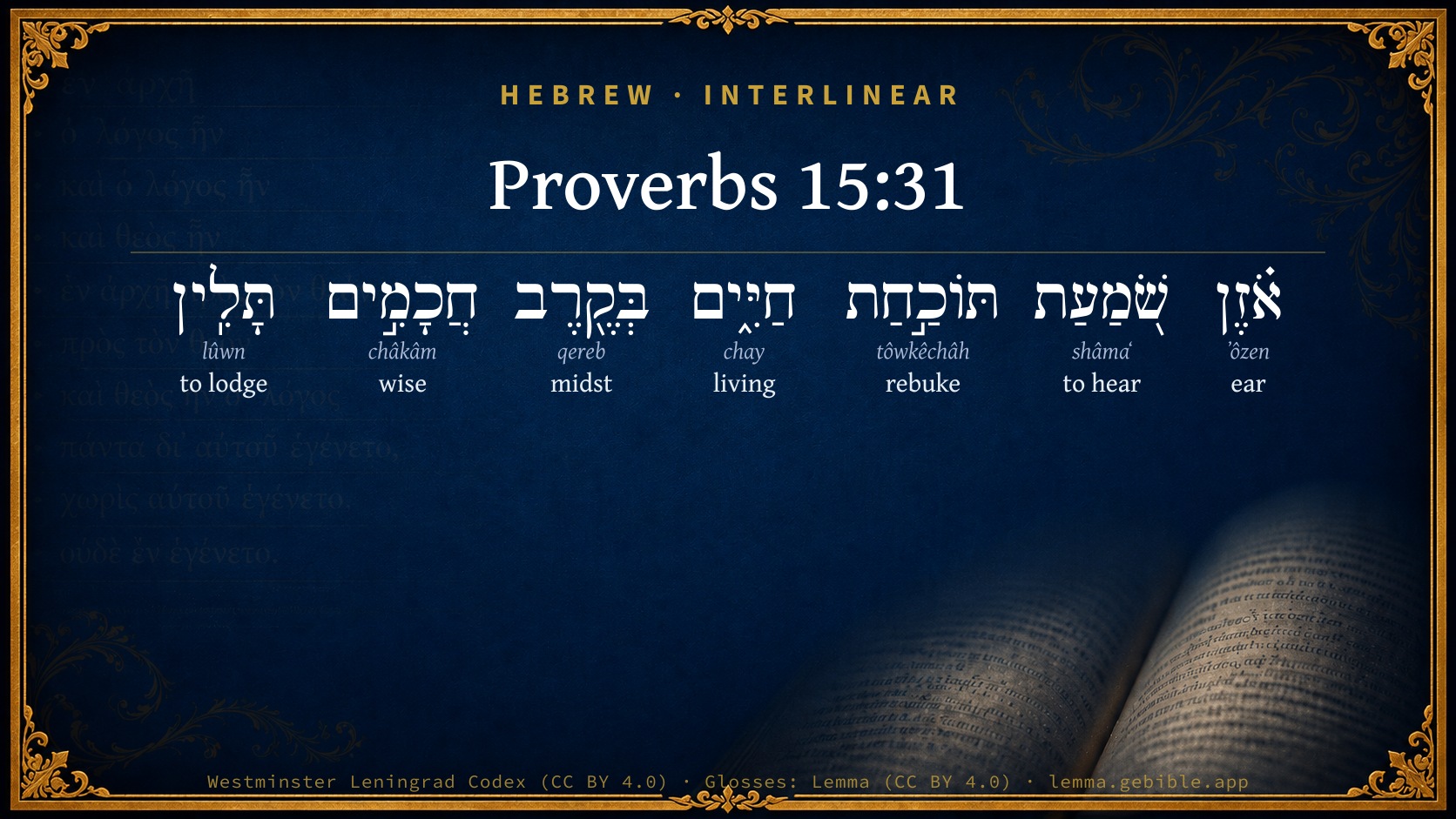
Hebrew (Westminster Leningrad Codex) Proverbs 15:31 appears in the Hebrew Old Testament. The text above is from the Westminster Leningrad Codex. Each word links to its Strong’s number, a concise gloss, and parsing drawn from the Open Scriptures Hebrew Bible morphology. Click any word for its full Brown-Driver-Briggs (BDB) entry.
Download image
Cite this verse

Proverbs 15:31 (World English Bible). Public Domain. Lemma interlinear Bible study tool, https://lemma.gebible.app/v/proverbs/15/31.

Show BibTeX & RIS
BibTeX
RIS
English Translation
The ear that listens to reproof lives, And will be at home among the wise.
World English Bible · Public Domain
Download a study sheet

One document with this verse’s original text, its word-by-word gloss line, the meaning frame, cross-references with their text, attributed commentary, and full source and license credits — printable, and it pastes into notes with its structure intact.

This verse Autodidact and up

Study sheet (.html) Plain text (.txt)

A passage Seminary Student

Up to 50 verses in one chapter. A passage sheet keeps up to 6 commentary sources and 12 cross-references per verse, in the order this page ranks them, and says so on the sheet whenever that leaves anything out. Ask for a single verse and you get the Autodidact verse sheet above.

Everything on this page stays free to read, with no account — the sheet is a download of what is already on screen, not access to it.

Want to remove ads? Support Godless Engineer
Compare translations 3

The same verse in 3 English versions, stacked beneath the original-language interlinear above. Click any original word for its lexicon entry.

Each is an independent rendering of the whole verse — the interlinear is not word-aligned to these translations.

Highlighted words mark where these versions differ — a whole-verse word diff, not a word-by-word alignment.

  • World English Bible Public Domain
    The ear that listens to reproof lives, And will be at home among the wise.
  • King James Version Public Domain
    The ear that heareth the reproof of life abideth among the wise.
  • unfoldingWord Literal Text CC BY-SA 4.0
    An ear hearing the rebuke of life will lodge in the midst of the wise ones.

unfoldingWord Literal Text — © unfoldingWord, licensed CC BY-SA 4.0. Word-aligned USFM3 via Door43 (git.door43.org/unfoldingWord/en_ult).

Versions to compare (up to 4)

3 of 4 selected

Show all 18 translations

Every available English version of this verse, each an independent rendering of the whole verse.

  • World English Bible Public Domain
    The ear that listens to reproof lives, And will be at home among the wise.
  • Berean Standard Bible Public Domain
    He who listens to life-giving reproof will dwell among the wise.
  • Majority Standard Bible Public Domain
    He who listens to life-giving reproof will dwell among the wise.
  • King James Version Public Domain
    The ear that heareth the reproof of life abideth among the wise.
  • American Standard Version (1901) Public Domain
    The ear that hearkeneth to the reproof of life Shall abide among the wise.
  • Revised Version (1885) Public Domain
    The ear that hearkeneth to the reproof of life shall abide among the wise.
  • Geneva Bible (1599) Public Domain
    The eare that hearkeneth to the correction of life, shall lodge among the wise.
  • Douay-Rheims (1899) Public Domain
    The ear that heareth the reproofs of life, shall abide in the midst of the wise.
  • Young's Literal Translation Public Domain
    An ear that is hearing the reproof of life Doth lodge among the wise.
  • Literal Standard Version CC BY-SA 4.0
    An ear that is hearing the reproof of life || Lodges among the wise.
  • Unlocked Literal Bible CC BY-SA 4.0
    If you pay attention when someone corrects how you live, you will remain among wise people.
  • unfoldingWord Literal Text CC BY-SA 4.0
    An ear hearing the rebuke of life will lodge in the midst of the wise ones.
  • Darby Bible Public Domain
    The ear that heareth the reproof of life shall abide among the wise.
  • World Messianic Bible Public Domain
    The ear that listens to reproof lives, and will be at home among the wise.
  • Webster's Bible Public Domain
    The ear that heareth the reproof of life abideth among the wise.
  • Free Bible Version CC BY-SA 4.0
    If you pay attention to positive advice you'll be one of the wise.
  • Bible in Basic English Public Domain
    The man whose ear is open to the teaching of life will have his place among the wise.
  • JPS Tanakh (1917) Public Domain
    The ear that hearkeneth to the reproof of life abideth among the wise.

Literal Standard Version (2020), Covenant Press — licensed CC BY-SA 4.0. Text via the HelloAO Bible API (eBible.org). Unlocked Literal Bible (unfoldingWord) — licensed CC BY-SA 4.0. Text via the HelloAO Bible API (eBible.org). unfoldingWord Literal Text — © unfoldingWord, licensed CC BY-SA 4.0. Word-aligned USFM3 via Door43 (git.door43.org/unfoldingWord/en_ult). Free Bible Version, Dr. Jonathan Gallagher — licensed CC BY-SA 4.0. Text via the HelloAO Bible API (eBible.org).

Word by word

More ways to search: Search by grammar → Find every occurrence → Compare this word →

Practice this passage: Drill this verse → Learn its vocabulary →

About this verse

These counts appear in no published source. They are computed here, from the morphology-tagged text and Lemma’s own curated glosses. What Lemma adds →

7
words
7
distinct lemmas
Wisdom
section

Shared distinctive vocabulary

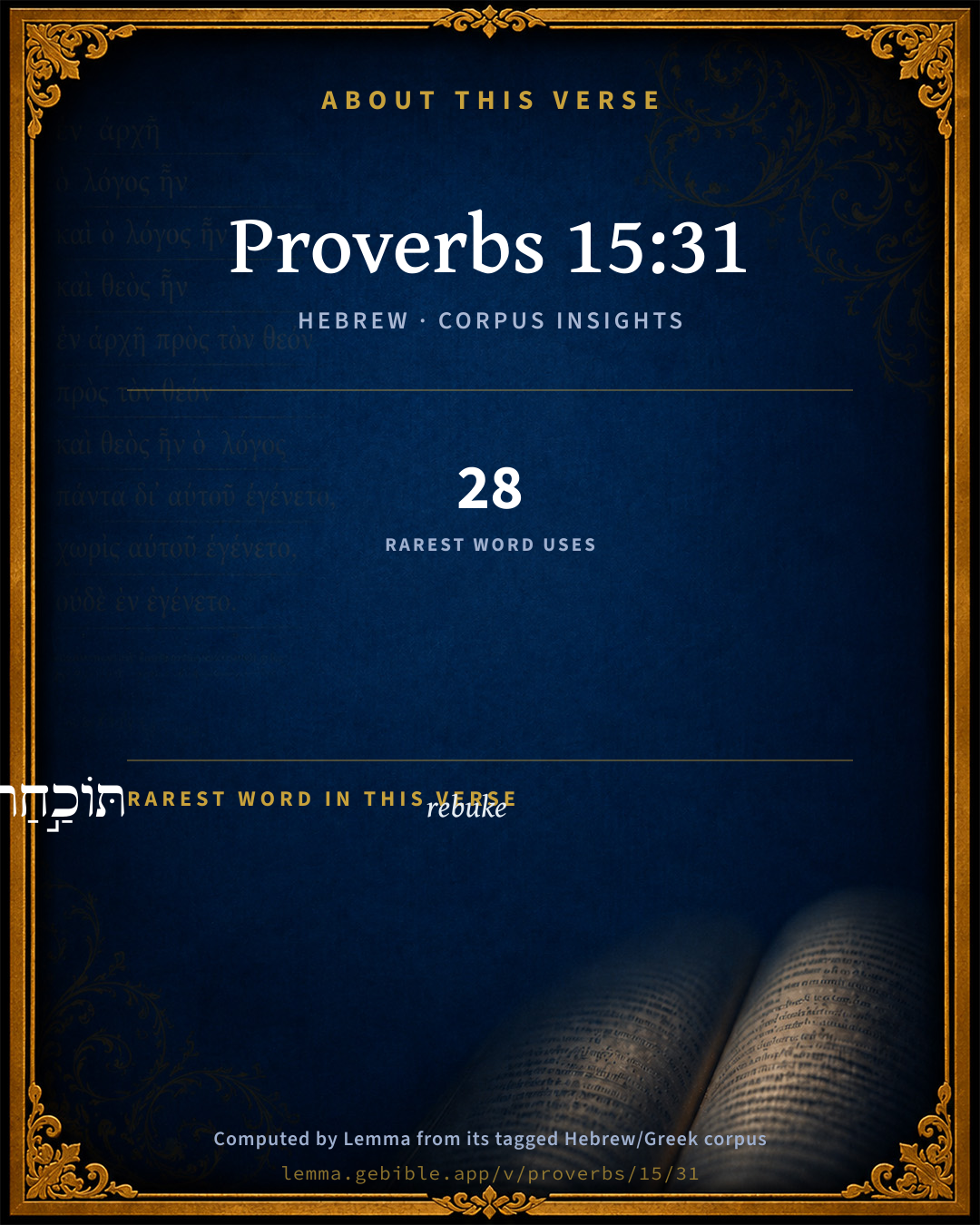
תּוֹכַ֣חַת rebuke H8433 occurs in 28 verses of the Hebrew Bible. Also found in:

Grammatical profile

  • 2 verbs
  • 4 nouns
  • 1 adjective

Verb forms

  • שֹׁ֭מַעַת Qal · Participle Active
  • תָּלִֽין Qal · Imperfect

Cross-references

9

Topical passages linked to Proverbs 15:31 in the Treasury of Scripture Knowledge — connected by theme and wording, ordered by reader-vote popularity; previews shown in the World English Bible.

  • Proverbs 15:5 A fool despises his father's correction, But he who heeds reproof shows prudence.
  • Proverbs 25:12 As an ear-ring of gold, and an ornament of fine gold, So is a wise reprover to an obedient ear.
  • Proverbs 9:8–9 Don't reprove a scoffer, lest he hate you. Reprove a wise man, and he will love you.
  • Proverbs 19:20 Listen to counsel and receive instruction, That you may be wise in your latter end.
  • John 15:3–4 You are already pruned clean because of the word which I have spoken to you.
  • Proverbs 1:23 Turn at my reproof. Behold, I will pour out my spirit on you. I will make known my words to you.
  • Proverbs 13:20 One who walks with wise men grows wise, But a companion of fools suffers harm.
  • Isaiah 55:3 Turn your ear, and come to me; hear, and your soul shall live: and I will make an everlasting covenant with you, even the sure mercies of David.
  • 1 John 2:19 They went out from us, but they didn't belong to us; for if they had belonged to us, they would have continued with us. But they left, that they might be revealed that none of them belong to us.

Cross-references courtesy of OpenBible.info (CC BY 4.0).

Hebrew and Greek witnesses Masoretic Hebrew ↔ Greek Septuagint

The same verse in the two great witnesses to the Old Testament, shown verse-for-verse.

These are two independent witnesses, not word-aligned to each other, and the Septuagint is shown in lemma (dictionary) form.

Hebrew Proverbs 15:31 Masoretic · Westminster Leningrad Codex

אֹ֗זֶן שֹׁ֭מַעַת תּוֹכַ֣חַת חַיִּ֑ים בְּקֶ֖רֶב חֲכָמִ֣ים תָּלִֽין

The ear that listens to reproof lives, And will be at home among the wise.

World English Bible · Public Domain

On this verse, The Pulpit Commentary discusses the Septuagint’s reading. Read the note in Commentary ↓

Hebrew: Westminster Leningrad Codex (CC BY 4.0). Greek: Septuagint (public domain); English from a public-domain English Septuagint. How the Septuagint differs from the Hebrew →

Commentary

Notes on Proverbs 15:31 from classic Christian and Jewish commentators (each source and its license shown beneath its notes). The classic Christian expositions comment on the surrounding passage and are grouped to its opening verse, so a note may address several verses; the Jewish commentaries on the Tanakh (Rashi and others) are per-verse, so they appear only where the commentator wrote on this verse.

Lemma curates 59 commentaries, every one of them public domain or Creative Commons licensed, each selected and text-cleaned for this edition rather than reprinted as found. About our sources →

Trapp's Complete Commentary

John Trapp

Pro 15:31 The ear that heareth the reproof of life abideth among the wise.

Ver. 31. The ear that heareth the reproof of llfe.] That is, lively and life giving reproofs. Veritas aspera est, verum amaritudo eius utilior et integris sensibus gratior quam meritricantis linguae distillans favus; { a} - Truth is sharp, but be it bitter, yet it is better and more savoury to sound senses than the honey drops of a flattering tongue.

{a} Joh. Sarif., de ungis curialium .

John Trapp, A Commentary or Exposition upon All the Books of the Old and New Testament (1647–1656) — public domain. Text from a community e-Sword module.

Joseph Benson's Commentary

Pro 15:31-33. The ear that heareth the reproof of life — The man that hearkens to and delights in that reproof and good counsel which lead to life; abideth among the wise — He will thereby be made wise, and be esteemed one of that number: or rather, he seeks and delights in the company and conversation of the wise, by whom he may be admonished; as, on the contrary, fools, who hate reproof, avoid and abhor the society of wise men and reprovers, Amo 5:10. He that refuseth instruction despiseth his own soul — Which he thereby exposes to the danger of utter destruction, and so shows his folly; but he that heareth, &c., getteth understanding — Whereby he saves his soul. Hebrew, קונה לב, possesseth a heart, which the Hebrews make the seat of wisdom. The fear of the Lord is the instruction, &c. — Doth instruct men in, or lead them to, true wisdom, whence it is said to be the beginning of wisdom; and before honour — Or, the ready way to honour, both from God and men; is humility — Whereby men submit to God, and yield to men, which gains them love and respect; whereas pride procures them hatred and contempt, both from God and man.

Joseph Benson's Commentary on the Old and New Testaments (1811–1818) — public domain. Text from a community e-Sword module.

The Preacher's Complete Homiletical Commentary

Joseph S. Exell (gen. ed.)

CRITICAL NOTES.—

Pro_15:33. Instruction of wisdom, rather a discipline of wisdom,” or “a training to wisdom.”

MAIN HOMILETICS OF THE PARAGRAPH.—Pro_15:31-33

HOW TO GIVE AND TAKE REPROOF

I. Reproof is good when it is given with a good intention and when it is given wisely. Those who undertake to handle the amputating knife should be men who are intent upon the healing of the patient, and must also know where to cut and how much to cut, otherwise the operation may tend to death rather than to life. The reprover, if he would administer a “reproof of life,” must be wise and kind. He must desire to do good to the man whom he reproves, he must know how to administer the reproof, and must leave off reproving as soon as the necessary wound has been inflicted; if he does not, he may injure the soul instead of destroying the sin.

II. He who takes such reproof displays the highest wisdom and the truest humility. We admire the fortitude of a man who will bear without a murmur a painful operation for the sake of the good that will come to him afterwards. We praise him for the pluck and courage which he shows in enduring bravely, that which we know gives him intense pain of body. And we ought to give as much praise to him who will submit to reproof in a spirit of humility, for there is nothing which is more unpalatable or painful to a man’s spirit. Nothing is a surer sign of true wisdom than such submission.

III. He who will not submit to such reproof can never attain to true honour. There can be no honour where there is ignorance, and there can be no knowledge where there is an unwillingness to receive reproof. The greatest kings and statesmen, who are now enthroned by the honour and submission of millions of their fellow-creatures, had once to submit to the instruction of their nurses and tutors. There is no honour in holding a high position unless he who holds it knows how to fill it worthily; and such knowledge can only be acquired by stooping not only to instruction but to reproof, which is always a necessary element of instruction. (For fuller treatment of the subject of these verses, see Homiletics on chapters Pro_3:11-12; Pro_12:1; Pro_13:18; Pro_15:10. Pages 247, 323, 410, etc.).

OUTLINES AND SUGGESTIVE COMMENTS

Pro_15:31. There is a reproof not of life, but of death, when hatred seeketh disgrace or ruin by it, and when it is used, as St. Bernard speaketh, not to instruction in the spirit of meekness, but to destruction in the spirit of fury. When it is reproach, and not reproof, it amendeth not, but hardeneth the offender in his wickedness. But with the wise there is the reproof, not of death, but of life; that is, direction unto a virtuous life, and teaching true wisdom, which is the life of the soul. The words of the wise, saith the Preacher, are as nails fastened: for as nails are driven in, but it is not so much to make a hole as to fasten and strengthen; so the words of the wise in reproof do pierce, but it is not so much to wound, as to fasten their reproof, and to give strength unto it.—Jermin.

Oh, it is a blessed thing to have others tell us of our faults, and as it were to pull us out of the fire with violence, as Jude speaks; rather to pull us out with violence, with sharp rebukes, than we should perish in our sins. If a man be to weed his ground, he sees need of the benefit of others; if a man be to demolish his house, he will be thankful to others for their help; so he that is to pull down his corruption, that old house, he should be thankful to others that will tell him, “This is rotten, and this is to blame;” who, if he be not thankful for seasonable reproof, he knows not what self-judging means. If any man be so uncivil when a man shows him a spot on his garment to grow choleric, will we not judge him to be an unreasonable man? And so when a man shall be told, “This will hinder your comfort another day;” if men were not spiritually besotted, would they swell and be angry against such a man?—Sibbes.

Pro_15:32. Wilt thou destroy that for which Christ died? (1Co_8:11). What shall a man give in exchange for his soul? There is no great matter in the earth but man; nothing great in man but his soul, saith Faverinus. “Whose image and superscription is it” but God’s? “Give,” therefore, “to God the things that are God’s,” by delivering it up to discipline.… “Suffer,” saith the great apostle, “the word of exhortation;” suffer them in God’s name, sharp though they be, and set on with some more than ordinary earnestness. Better it is that the vine should bleed, than die. Certes, “When the Lord shall have done to you all the good that He hath spoken concerning you, and hath brought you to His kingdom, this shall be no grief unto you, nor offence of heart,” as He said in a like case (1Sa_25:30-31), that you have hearkened to instruction, and been bettered by reproof.—Trapp.

There are two things that cause men to rage against reproof.

1. Guilt of the sin objected. Guilt makes men angry when they are searched, and, like horses that are galled, to kick if they be but touched. The mildest waters are troublesome to sore eyes. There is scarce a more probable sign that the crime objected is true than wrath and bitterness against the person that charges, us with it.

2. Love to sin makes men impatient under reproof. When a person’s sin is to him as “the apple of his eye,” no wonder that he be offended at any that touch it.—Swinnock.

Pro_15:33. Abigail was not made David’s wife till she thought it honour enough to wash the feet of the meanest of David’s servants (1Sa_25:40). Moses must be forty years a stranger in Midian before he become king in Jeshurun.… Luther observed that ever, for most part, before God set him upon any special service for the good of the Church he had some sore fit of sickness. Surely as the lower the ebb the higher the tide; so the lower any descend in humiliation the higher they shall ascend in exaltation; the lower this foundation of humility is laid the higher shall the roof of honour be overlaid.—Trapp.

Not only doth humility go before honour in the course of things, but is also before honour in the dignity and excellency of it. So that when humility hath brought a man to honour even then his greatest honour is humility.—Jermin.

“Reproof,” which has been twice used, and “instruction,” or rather discipline, which is now made to balance it in these last important texts, have a respect of painfulness: and Solomon, in this verse, tempers that pain, by showing what discipline really is:—“The fear of Jehovah.” “Fear hath torment,” says the apostle John (1Jn_4:18). That fear is not altogether the fear of our text, but is a part of it. I do not remember the fear of the Almighty as a title applied in heaven. “The fear of Jehovah” has some particle of painfulness; and that painfulness makes it of the nature of “discipline.” The best discipline of the saints is the abiding fear of the Almighty. The proverb seems to imply that it will not last always; that it is painful; and that we shall not continue pained; that it is necessary for us to be under just that gentle sort of discipline that fear can give while we are in this world. And that necessity he states, in that “before glory is affliction.” Not honour (as in the English version), so much as weight, or “glory.” Not humility, but primarily, toil; ergo, more generally, “affliction.” “We must through much tribulation enter into the kingdom of God” (Act_14:22).—Miller.

“I am not worthy,” is the voice of the saints. They know God, and God knows them. Moses was the meekest man upon earth, and therefore God is said to know him by name (Exo_33:17). “I am less than the least of all thy mercies,” saith Jacob (Gen_32:10). Lo, he was honoured to be father of the twelve tribes, and heir of the blessing. “Who am I, O Lord?” says David. He was advanced from that lowly conceit to be king of Israel. “I am not worthy to loose the latchet of Christ’s shoe,” saith John Baptist (Mat_3:11). Lo, he was esteemed worthy to lay his hand on Christ’s head. “I am not worthy that thou shouldest come under my roof,” says the centurion, therefore Christ commended him. “I have not found so great faith; no, not in Israel (Mat_8:8). “I am the least of the apostles,” saith Paul; “not worthy to be called an apostle” (1Co_15:9). Therefore he is honoured with the title of the apostle. “Behold the handmaid of the Lord,” saith the holy virgin; therefore she was honoured to be the mother of the Lord, and to have all generations call her blessed. This non sum dignus, the humble annihilation of themselves, hath gotten them the honour of saints. In spiritual graces let us study to be great, and not to know it, as the fixed stars are everyone bigger than the earth, yet appear to us less than torches. Not to be high-minded in high deserts is the way to blessed preferment. Humility is not only a virtue itself, but a vessel to contain other virtues; like embers, which keep the fire alive that is hidden under it. It emptieth itself by a modest estimation of its own worth, that Christ may fill it. It wrestleth with God, like Jacob, and wins by yielding; the lower it stoops to the ground the more advantage it gets to obtain the blessing. All our pride, O Lord, is from the want of knowing Thee. The leper casts himself down, and Christ bids him arise. Humility is the gentleman-usher to glory. God that sends away the rich empty from His gates loves to “fill the hungry with good things” (Luk_1:53). The air passeth by the full vessel, and only filleth that is empty. This is the difference between the proud and beggars; both agree in not having, differ in craving. The proud are pauperes spiritus, the humble are pauperes spiritu. “Blessed are,” not the poor spirits, but “the poor in spirit, for theirs is the kingdom of heaven,” (Mat_5:3). Such as felt their wants sought and besought God for supply. “Every valley shall be filled, and every mountain be brought low” (Luk_3:5). The lowly mind shall be exalted, the high-towering ambitious shall be thrown down. How should God say to the merchant that glories in his wealth, to the usurer that admireth his moneys, to the gallant that wonders that his good clothes do not prefer him, “Arise!” Alas! they are up already; they were never down. A dwarf in a great throng, seeming low on his knees, was bidden by the prince to stand up; alas! he was before at his highest. God cannot be so mistaken as to encourage their standing up who never yet had the manners to cast themselves down. Says Augustine, “Descend, that ye may rise up to God; for you have fallen by rising up against God.” He that is a mountebank must level himself even with the ground; if humbleness hath once thrown him down and brought him to his knees, he shall hear the patron and pattern of humbleness comforting him with a surge—“Arise.…” The guest that sets himself down at the lower end of the table shall hear the feast-maker kindly remove him, “Friend, sit up higher” (Luk_14:10). If Esther fall at Ahasuerus’ feet, he will take her by the hand, and bid her arise. When Peter fell down at Jesus’ knees, saying, “Depart from me; I am a sinful man, O, Lord” (Luk_5:8-10), he presently was raised up with, “Fear not, thou shalt catch men.”.… Who is heard to say with Paul, “I am the chief of sinners?” (1Ti_1:15) such a humble confession scarce heard of. But Christ had given him a surge on his former humbling: “Arise and bear My name before Gentiles and kings,” etc. Let us all thus cast ourselves down in humility, that the Lord may say to us in mercy, “Arise.”—Adams.

The more humble, the fitter to come to God, and He the more willing to come unto the soul and dwell in it. The highest heavens are the habitation of God s glory; and the humble heart hath the next honour, to be the habitation of His grace.—Leighton.

The truly humble spirit is, in society, to the proud and haughty, what the valley is to the mountain: if less observed, more sheltered and more blessed, valleys see the stars more brightly than the mountains that often veil their proud heads with clouds. The mountains filter the waters upon which the valleys live, and send down in soft music to their ears the stormy thunders that beat with violence on their lofty brow. The great sun stoops to the valleys and touches them with a warmth which it denies to the high hills; and kind nature, which leaves the towering heights amidst the cold desolations of death, endows the humble vales with richest life, and robes them in the enchanting costume of sweetest flowers.—Dr. David Thomas.

You must go to honour before humility. This is the law—the law of God. It cannot be changed. It has its analogies in the material creation. Every height has its corresponding depth. As far as the Andes pierce into the sky, so far do the valleys of the Pacific, at their base, go down into the heart of the earth. If the branches of a tree rise high in the air, its roots must penetrate to a corresponding depth in the ground; and the necessity is reciprocal. The higher the branches are, the deeper go the roots; and the deeper the roots are, the higher go the branches. This law pervades the moral administration as well as the higher works of God. The child Jesus is set for the fall and the rising again of many in Israel; but it is first the fall and then the rising; for “before honour is humility.” Fall they must at the feet of the Crucified before they can rise and reign as the children of the Great King.… There are two mountains in the land of Israel, equal in height, and standing near each other, with a deep, narrow valley between. At an interesting point in the people’s history, one of these mountains bore the curse, and the other received the blessing (Deu_11:26-29). If you had stood then on Ebal, where the curse was lying, you could not have escaped to Gerizim to enjoy the blessing without going down to the bottom of the intervening gorge. There was a way for the pilgrim from the curse to the blessing, if he were willing to pass through the valley of humiliation; but there was no flight through the air, so as to escape the going down. These things are an allegory. All men are at first in their own judgments on a lofty place, but the curse hangs over the mountains of their pride.… All the saved are also on a lofty height, but God dwells among them, and great is the peace of His children. All who have reached this mountain have been in the deep. They sowed in tears before they went forth rejoicing to bear home the sheaves.—Arnot.

The Preacher's Complete Homiletical Commentary (gen. ed. Joseph S. Exell; Funk & Wagnalls, c. 1892) — public domain (pre-1929). A full-Bible homiletical/sermon-outline anthology covering 65 of 66 books (2 John is absent from the source module). Text from a community e-Sword module.

Geneva Bible (1599)

Geneva Bible translators

That suffereth himself to be admonished by God’s word, which bringeth life: and so amendeth.

Geneva Bible (1599) marginal notes — public domain. Text via Bolls.life.

Matthew Henry's Commentary

Note, 1. It is the character of a wise man that he is very willing to be reproved, and therefore chooses to converse with those that, both by their words and example, will show him what is amiss in him: The ear that can take the reproof will love the reprover. Faithful friendly reproofs are here called the reproofs of life, not only because they are to be given in a lively manner, and with a prudent zeal (and we must reprove by our lives as well as by our doctrine), but because, where they are well-taken, they are means of spiritual life, and lead to eternal life, and (as some think) to distinguish them from rebukes and reproaches for well-doing, which are rather reproofs of death, which we must not regard nor be influenced by. 2. Those that are so wise as to bear reproof well will hereby be made wiser (Pro 9:9), and come at length to be numbered among the wise men of the age, and will have both ability and authority to reprove and instruct others. Those that learn well, and obey well, are likely in time to teach well and rule well.

Matthew Henry's Commentary on the Whole Bible (1708–1710) — public domain (CC PDM 1.0). Text via the HelloAO Bible API.

Jamieson, Fausset & Brown

Robert Jamieson, A. R. Fausset & David Brown

(Compare Pro 10:17).

reproof of life--which leads to life.

abideth . . . wise--is numbered among them.

Jamieson, Fausset & Brown — Commentary Critical and Explanatory on the Whole Bible (1871) — public domain (CC PDM 1.0). Text via the HelloAO Bible API.

Adam Clarke's Commentary

Verse 31. The ear that heareth the reproof] That receives it gratefully and obeys it. "Advice is for them that will take it," so says one of our own old proverbs; and the meaning here is nearly the same.

Adam Clarke's Commentary on the Bible (1810–1826) — public domain. Text from a community e-Sword/MySword module.

Ellicott's Commentary for English Readers

(31) The ear that heareth the reproof of life—i.e., one which does not refuse reproof, or instruction, which leads to life. (Comp. Pro_6:23.) The “ear” is put for the person, as in Job_29:11.

A Bible Commentary for English Readers, edited by Charles John Ellicott (1878–1897) — public domain. Text from a community e-Sword module.

The Cambridge Bible for Schools and Colleges

gen. ed. J. J. S. Perowne

31. of life] i.e. which tends to life. So, the instruction of wisdom=the instruction which leads to, or bestows wisdom, Pro_15:33 below.

The Cambridge Bible for Schools and Colleges (gen. ed. J. J. S. Perowne; Cambridge University Press, 1878–1918) — public domain. Text from a community e-Sword module.

John Gill's Exposition

The ear that heareth the reproof of life,.... That is given according to the word of life, in a warm, fervent, and lively manner, with zeal, and in good earnest; which reproves the life of another by his own, as well as by words; and which tends to the spiritual and eternal life of the person reproved; being taken, a man that diligently hearkens to, kindly and cordially receives, and cheerfully obeys such reproof given him,

abideth among the wise; he not only chooseth to be among them, that he may have the advantage of their wise counsels and reproofs, but he becomes wise himself thereby, and attains to the character of a wise man, and is numbered among them; such a man abides in the house of wisdom, the church of God, and attends upon and has conversation with the wise dispensers of the word, and shall have a part with them in the church above, in the kingdom of heaven, where the wise will shine as the firmament; the word here used does not denote a lodging for a night, as it sometimes signifies, but a perpetual abiding.

John Gill's Exposition of the Whole Bible (1746–1763) — public domain (CC PDM 1.0). Text via the HelloAO Bible API.

Albert Barnes' Notes on the Bible

The reproof of life - i. e., The reproof that leads to, or gives life, rather than that which comes from life and its experience.

Albert Barnes' Notes on the Bible (1834–1885) — public domain. Text from a community e-Sword/MySword module.

Matthew Poole's English Annotations

The ear that heareth; the man that hearkeneth to it, and delights in it.

The reproof of life; that reproof and good counsel which leads to life.

Abideth among the wise, Heb. shall or will abide, &. c. Either,

1. He will thereby be made wise, and be esteemed one of that number. Or rather,

2. He seeketh and delighteth in the company and conversation of the wise, by whom he may be admonished; as, on the contrary, fools, who hate reproof, do avoid and abhor the society of wise men and reprovers, Amo 5:10.

Matthew Poole's English Annotations on the Holy Bible (1683–1685) — public domain. Text from a community e-Sword/MySword module.

Whedon's Commentary on the Bible

Daniel D. Whedon

31. The reproof of life — Life-giving; such as tendeth to life. Some think, however, that it may mean sharp, strong, or vigorous reproof, one that bears sharp reproof of his faults.

Abideth (shall dwell) among the wise — Shall be one of them. Comp. Pro_6:23; Pro_13:20.

Ear — The person who hears.

Daniel D. Whedon (gen. ed.), Commentary on the Old and New Testaments (1874–1909) — public domain. Text from a community e-Sword module.

The Pulpit Commentary

The ear that heareth (hearkeneth to) the reproof of life abideth among the wise. (Pro_6:23) The reproof, or instruction, of life is that which teaches the true way of pleasing God, which is indeed the only life worth living. The ear, by synecdoche, is put for the person. One who attends to and profits by such admonition may be reckoned among the wise, and rejoices to be conversant with them. Wordsworth finds a more recondite sense here: the ear of the wise dwells, lodges, passes the night (Pro_19:23) in their heart, whereas the heart of fools is in their mouth. (Pro_14:33) This verse is omitted in the Septuagint, though it is found in the other Greek versions and the Latin Vulgate.

The Pulpit Commentary (1880–1919), ed. H.D.M. Spence-Jones & Joseph S. Exell — public domain. Text from a community e-Sword module.

John Wesley's Explanatory Notes

The ear - The man that hearkens to that reproof which leads to life, seeks and delights in the company of the wise.

John Wesley, Explanatory Notes Upon the Whole Bible (1754–1765) — public domain. Text via the GEBible commentary corpus.

Keil & Delitzsch

C. F. Keil & F. Delitzsch

31 An ear which heareth the doctrine of life

Keeps itself in the circle of the wise.

As, Pro 6:33, תוכחות מוסר means instructions aiming at discipline, so here תּוכחת חיּים means instructions which have life as their end, i.e., as showing how one may attain unto true life; Hitzig's חכם, for חיים, is a fancy. Is now the meaning this, that the ear which willingly hears and receives such doctrine of life will come to dwell among the wise, i.e., that such an one (for אזן is synecdoche partis pro persona, as Job 29:11) will have his residence among wise men, as being one of them, inter eos sedem firmam habebit iisque annumerabitur (Fl.)? By such a rendering, one is surprised at the harshness of the synecdoche, as well as at the circumstantiality of the expression (cf. Pro 13:20, יחכּם). On the contrary, this corresponds with the thought that one who willingly permits to be said to him what he must do and suffer in order that he may be a partaker of life, on this account remains most gladly in the circle of the wise, and there has his appropriate place. The "passing the night" (לין, cogn. ליל, Syr. Targ. בּוּת, Arab. bât) is also frequently elsewhere the designation of prolonged stay, e.g., Isa 1:21. בּקרב is here different in signification from that it had in Pro 14:23, where it meant "in the heart." In the lxx this proverb is wanting. The other Greek translations have οὖς ἀκοῦον ἐλέγχους χωῆς ἐν μέσῳ σοφῶν αὐλισθήσεται. Similarly the Syr., Targ., Jerome, Venet., and Luther, admitting both renderings, but, since they render in the fut., bringing nearer the idea of prediction (Midrash: זוכה לישׁב בישׁיבת חכמים) than of description of character.

Keil & Delitzsch — Biblical Commentary on the Old Testament (1861–1891) — public domain (CC PDM 1.0). Text via the HelloAO Bible API. (Old Testament only.)

Bridges on Proverbs

Charles Bridges

What a contrast to the "scorner" lately described, who "goeth not unto the wise!" (Pro 15:12 .) Naturally we are unteachable, neither knowing, nor caring to know. But the LORD gives humility and self-knowledge. Our unteachableness yields. Light pours in. We learn the meaning of words before familiar to us only in sound. The circumcised ear now heareth the reproof that tends to life (Pro 6:23 ), and welcomes the medicine. (Pro 15:5 ; Pro 12:18 . Psa 141:5 .) This exercise of reproof is the law of social life; a component part of the love of our neighbour (Lev 19:17-18 ); the bounden obligation to be "our brother’s keeper" to the utmost of our power.†1 The mode of receiving reproof is a test of principle. Humility, sincerity, self-knowledge — the exercise or the defect of these graces — is brought out to our honour or dishonour. Beautiful indeed is the sight of "a wise reprover upon an obedient ear."†2 The man of God abode with the wise. He took his meek reprover to be his wife.†3 He honoured the faithful messenger of his Father’s rod with his highest confidence. The Apostle’s affectionate testimony to his reproving brother shewed, that he had heard the reproof of life.†4 This Considerate and humble temper always gets understanding.†5 Nothing teaches like experience; and no experience is more useful, because none so abasing, as rebuke.†6

Reproof indeed may be considered one of the wholesome bitters of life.†7 Thoughtless gaiety may prefer "the song of fools" to "the rebuke of the wise."†8 But after-reflection will shew the wisdom of honouring those, who deal faithfully with our faults, though it may be with somewhat of severity; rather than those, who would soothe us with the poisoned sweets of flattery, and wink at or encourage our wayward follies. (Pro 27:5-6 .) Unhappily however for a man, a want of real sincerity is his nature. He has no hearty desire to be set right. He concludes a hollow truce with his conscience, dreading its painful disturbance. He throws a protective cover over all his faults, thus shielding his most dangerous enemies. In this unfavorable state of mind he refuseth instruction, because contrary to flattery, and despiseth his own soul. (Pro 15:10 .) Many are the examples of this ruinous folly.†9 The fool will not indeed own the charge. But does he not underrate its high value and imminent danger, when he despises God’s warning and provision for its salvation? (Mat 16:26 .) "Be thou instructed, O Jerusalem, lest my soul depart from thee." (Jer 6:8 . Zep 3:2 .)

Footnotes:

†1 This obligation was repudiated by the first murderer. Gen 4:9 .

†2 Pro 25:12.

†3 1Sa 25:39-42 .

†4 2Sa 12:7-12 . 1Ki 1:32 . Compare Pro 28:23 .

†5 Gal 2:11, with 2Pe 3:15 .

†6 Pro 1:5; Pro 9:9 ; Pro 12:1 .

†7 Pro 29:15. Rev 3:19 .

†8 Compare Ecc 7:5 .

†9 The young man, Pro 5:11-13 ; Korah and his party, Num 16:12-14, Num 16:31-33 ; Zedekiah. Jer 27:17 ; Jer 38:14-23, with Jer 39:1-7 .

Charles Bridges, An Exposition of the Book of Proverbs (1846) — public domain. Text from a community e-Sword module.

Kretzmann's Popular Commentary

Paul E. Kretzmann

v. 31. The ear that heareth the reproof of life, a censure or correction which points out the way to life, abideth among the wise, belongs to their circle on account of the wisdom thus gained.

Paul E. Kretzmann, Popular Commentary of the Bible (1921–1924) — public domain. Text from a community e-Sword module.

unfoldingWord translationNotes

Door43 World Missions Community

you will remain among wise people

Possible meanings are 1) people will continue to consider you to be a wise person or 2) you will continue to enjoy the company of wise people.

listens to correction

The word "correction" can be translated with a verbal phrase. AT: "listens when others correct him" (See: Abstract Nouns)

translationWords

life

wise

discipline

unfoldingWord translationNotes — © Distant Shores Media and the Door43 World Missions Community, licensed CC BY-SA 4.0. Source: git.door43.org/Door43/en_tn.

Lesson kit

Teaching starters — assembled from the data on this page, not authored interpretation. Every prompt links to the verse data it draws on. Edit before teaching.

Proverbs, in the Wisdom, opens this verse with 7 words (7 distinct Hebrew lemmas). Its most distinctive word is tôwkêchâh (“rebuke”). A historical commentator’s framing appears above. Read the whole chapter for the surrounding context.

Discussion questions

  1. How does “rebuke” (tôwkêchâh) shape what this verse is saying?
  2. How does 2 Kings 19:3, which shares the word «rebuke», read alongside this verse?
  3. The translations on this page render this verse differently — a whole-verse word diff, not a word-by-word alignment. What might account for the different wordings?
  4. «שֹׁ֭מַעַת» is a Qal Participle Active verb. How does that grammatical form shape the action described?
  5. Compare how Trapp's Complete Commentary and Joseph Benson's Commentary read this verse. Where do they agree or differ?

Things to notice

Reading settings

Reading text

Shown beneath each verse's original-language words.

Old Testament
Old Testament edition

Read the OT as the Masoretic Hebrew (MT) or the Greek Septuagint (LXX).

English shown for the Greek Septuagint (in the Hebrew ↔ Greek comparison).

Comparing translations? Open the Compare panel on any verse page to stack up to four side by side.