
Jeremiah 23:9

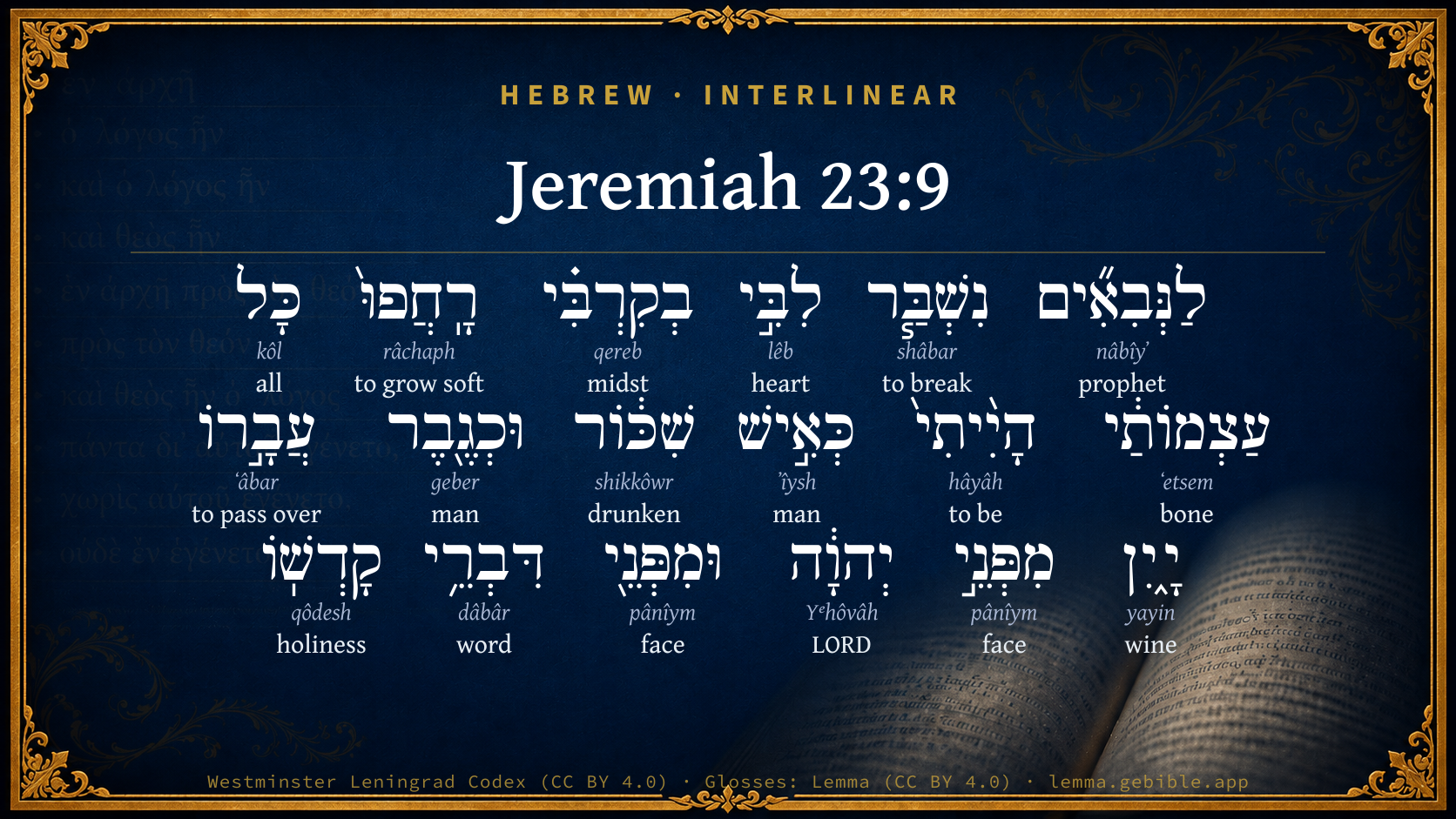
Hebrew (Westminster Leningrad Codex) Jeremiah 23:9 appears in the Hebrew Old Testament. The text above is from the Westminster Leningrad Codex. Each word links to its Strong’s number, a concise gloss, and parsing drawn from the Open Scriptures Hebrew Bible morphology. Click any word for its full Brown-Driver-Briggs (BDB) entry.
Download image
Cite this verse

Jeremiah 23:9 (World English Bible). Public Domain. Lemma interlinear Bible study tool, https://lemma.gebible.app/v/jeremiah/23/9.

Show BibTeX & RIS
BibTeX
RIS
English Translation
Concerning the prophets. My heart within me is broken, all my bones shake; I am like a drunken man, and like a man whom wine has overcome, because of Yahweh, and because of his holy words.
World English Bible · Public Domain
Download a study sheet

One document with this verse’s original text, its word-by-word gloss line, the meaning frame, cross-references with their text, attributed commentary, and full source and license credits — printable, and it pastes into notes with its structure intact.

This verse Autodidact and up

Study sheet (.html) Plain text (.txt)

A passage Seminary Student

Up to 50 verses in one chapter. A passage sheet keeps up to 6 commentary sources and 12 cross-references per verse, in the order this page ranks them, and says so on the sheet whenever that leaves anything out. Ask for a single verse and you get the Autodidact verse sheet above.

Everything on this page stays free to read, with no account — the sheet is a download of what is already on screen, not access to it.

Want to remove ads? Support Godless Engineer
Compare translations 3

The same verse in 3 English versions, stacked beneath the original-language interlinear above. Click any original word for its lexicon entry.

Each is an independent rendering of the whole verse — the interlinear is not word-aligned to these translations.

Highlighted words mark where these versions differ — a whole-verse word diff, not a word-by-word alignment.

  • World English Bible Public Domain
    Concerning the prophets. My heart within me is broken, all my bones shake; I am like a drunken man, and like a man whom wine has overcome, because of Yahweh, and because of his holy words.
  • King James Version Public Domain
    Mine heart within me is broken because of the prophets; all my bones shake; I am like a drunken man, and like a man whom wine hath overcome, because of the LORD, and because of the words of his holiness.
  • unfoldingWord Literal Text CC BY-SA 4.0
    Concerning the prophets: My heart is broken within me; all my bones tremble. I have become like a drunken man, and like a man whom wine has overcome, because of the face of Yahweh and because of the face of his holy words.

unfoldingWord Literal Text — © unfoldingWord, licensed CC BY-SA 4.0. Word-aligned USFM3 via Door43 (git.door43.org/unfoldingWord/en_ult).

Versions to compare (up to 4)

3 of 4 selected

Show all 18 translations

Every available English version of this verse, each an independent rendering of the whole verse.

  • World English Bible Public Domain
    Concerning the prophets. My heart within me is broken, all my bones shake; I am like a drunken man, and like a man whom wine has overcome, because of Yahweh, and because of his holy words.
  • Berean Standard Bible Public Domain
    As for the prophets: My heart is broken within me, and all my bones tremble. I have become like a drunkard, like a man overcome by wine, because of the LORD, because of His holy words.
  • Majority Standard Bible Public Domain
    As for the prophets: My heart is broken within me, and all my bones tremble. I have become like a drunkard, like a man overcome by wine, because of the LORD, because of His holy words.
  • King James Version Public Domain
    Mine heart within me is broken because of the prophets; all my bones shake; I am like a drunken man, and like a man whom wine hath overcome, because of the LORD, and because of the words of his holiness.
  • American Standard Version (1901) Public Domain
    Concerning the prophets. My heart within me is broken, all my bones shake; I am like a drunken man, and like a man whom wine hath overcome, because of Jehovah, and because of his holy words.
  • Revised Version (1885) Public Domain
    Concerning the prophets. Mine heart within me is broken, all my bones shake; I am like a drunken man, and like a man whom wine hath overcome; because of the LORD, and because of his holy words.
  • Geneva Bible (1599) Public Domain
    Mine heart breaketh within mee, because of the prophets, all my bones shake: I am like a drunken man (and like a man whome wine hath ouercome) for the presence of the Lord and for his holie wordes.
  • Douay-Rheims (1899) Public Domain
    To the prophets: My heart is broken within me, all my bones tremble: I am become as a drunken man, and as a man full of wine, at the presence of the Lord, and at the presence of his holy words.
  • Young's Literal Translation Public Domain
    In reference to the prophets: Broken hath been my heart in my midst, Fluttered have all my bones, I have been as a man -- a drunkard, And as a man -- wine hath passed over him, Because of Jehovah, and of His holy words.
  • Literal Standard Version CC BY-SA 4.0
    In reference to the prophets: My heart has been broken in my midst, || All my bones have fluttered, || I have been as a man—a drunkard, || And as a man—wine has passed over him, || Because of YHWH, and of His holy words.
  • Unlocked Literal Bible CC BY-SA 4.0
    Regarding the prophets, my heart is broken in me, and all of my bones tremble. I have become like a drunk man, like a man whom wine has overpowered, because of Yahweh and his holy words.
  • unfoldingWord Literal Text CC BY-SA 4.0
    Concerning the prophets: My heart is broken within me; all my bones tremble. I have become like a drunken man, and like a man whom wine has overcome, because of the face of Yahweh and because of the face of his holy words.
  • Darby Bible Public Domain
    Concerning the prophets: My heart within me is broken; all my bones shake; I am like a drunken man, and like a man whom wine hath overcome; because of Jehovah, and because of the words of his holiness.
  • World Messianic Bible Public Domain
    Concerning the prophets: My heart within me is broken. All my bones shake. I am like a drunken man, and like a man whom wine has overcome, because of the LORD, and because of his holy words.
  • Webster's Bible Public Domain
    My heart within me is broken because of the prophets; all my bones shake; I am like a drunken man, and like a man whom wine hath overcome, because of the LORD, and because of the words of his holiness.
  • Free Bible Version CC BY-SA 4.0
    When it comes to the prophets: I'm really disturbed—I'm shaking inside! I stagger like a drunk, like someone who's had too much wine, because of what the Lord is like, because of his holy words.
  • Bible in Basic English Public Domain
    About the prophets. My heart is broken in me, all my bones are shaking; I am like a man full of strong drink, like a man overcome by wine; because of the Lord, and because of his holy words.
  • JPS Tanakh (1917) Public Domain
    Concerning the prophets. My heart within me is broken, all my bones shake; I am like a drunken man, and like a man whom wine hath overcome; because of the LORD, and because of His holy words.

Literal Standard Version (2020), Covenant Press — licensed CC BY-SA 4.0. Text via the HelloAO Bible API (eBible.org). Unlocked Literal Bible (unfoldingWord) — licensed CC BY-SA 4.0. Text via the HelloAO Bible API (eBible.org). unfoldingWord Literal Text — © unfoldingWord, licensed CC BY-SA 4.0. Word-aligned USFM3 via Door43 (git.door43.org/unfoldingWord/en_ult). Free Bible Version, Dr. Jonathan Gallagher — licensed CC BY-SA 4.0. Text via the HelloAO Bible API (eBible.org).

Word by word

More ways to search: Search by grammar → Find every occurrence → Compare this word →

Practice this passage: Drill this verse → Learn its vocabulary →

רָֽחֲפוּ֙
râchaph
H7363
“to grow soft”
Verb, Qal, Perfect, 3rd Person, Common, Plural
Part of Speech
Verb
Stem
Qal
Form
Perfect
Person
3rd Person
Gender
Common
Number
Plural
Full BDB Definition

Origin: a primitive root

TWOT: 2148 , 2149

(Qal) to grow soft, relax - (Piel) to hover
  1. לַנְּבִאִ֞ים nâbîyʼ H5030 “to/for the · prophets” Preposition, Determined + Noun, Common, Masculine, Plural, Absolute
  2. נִשְׁבַּ֧ר shâbar H7665 “to break” Verb, Niphal, Perfect, 3rd Person, Masculine, Singular
  3. לִבִּ֣י lêb H3820 “heart · my” Noun, Common, Masculine, Singular, Construct + Suffix, Personal, 1st Person, Common, Singular
  4. בְקִרְבִּ֗י qereb H7130 “in/at · midst · my” Preposition + Noun, Common, Masculine, Singular, Construct + Suffix, Personal, 1st Person, Common, Singular
  5. כָּל kôl H3605 “all of” Noun, Common, Masculine, Singular, Construct
  6. עַצְמוֹתַ֔י ʻetsem H6106 “bones · my” Noun, Common, Feminine, Plural, Construct + Suffix, Personal, 1st Person, Common, Singular
  7. הָיִ֨יתִי֙ hâyâh H1961 “to be” Verb, Qal, Perfect, 1st Person, Common, Singular
  8. כְּאִ֣ישׁ ʼîysh H376 “like/as · man” Preposition + Noun, Common, Masculine, Singular, Absolute
  9. שִׁכּ֔וֹר shikkôwr H7910 “drunken” Adjective, Adjective, Masculine, Singular, Absolute
  10. וּכְגֶ֖בֶר geber H1397 “and · like/as · man” Conjunction + Preposition + Noun, Common, Masculine, Singular, Absolute
  11. עֲבָ֣רוֹ ʻâbar H5674 “to pass over · him” Verb, Qal, Perfect, 3rd Person, Masculine, Singular + Suffix, Personal, 3rd Person, Masculine, Singular
  12. יָ֑יִן yayin H3196 “wine” Noun, Common, Masculine, Singular, Absolute
  13. מִפְּנֵ֣י pânîym H6440 “from · face(s) of” Preposition + Noun, Common, Both, Plural, Construct
  14. יְהוָ֔ה Yᵉhôvâh H3068 “LORD” Noun, Proper
  15. וּמִפְּנֵ֖י pânîym H6440 “and · from · face(s) of” Conjunction + Preposition + Noun, Common, Both, Plural, Construct
  16. דִּבְרֵ֥י dâbâr H1697 “words of” Noun, Common, Masculine, Plural, Construct
  17. קָדְשֽׁוֹ qôdesh H6944 “holiness · his” Noun, Common, Masculine, Singular, Construct + Suffix, Personal, 3rd Person, Masculine, Singular

About this verse

These counts appear in no published source. They are computed here, from the morphology-tagged text and Lemma’s own curated glosses. What Lemma adds →

18
words
17
distinct lemmas
Prophets
section

Notable vocabulary

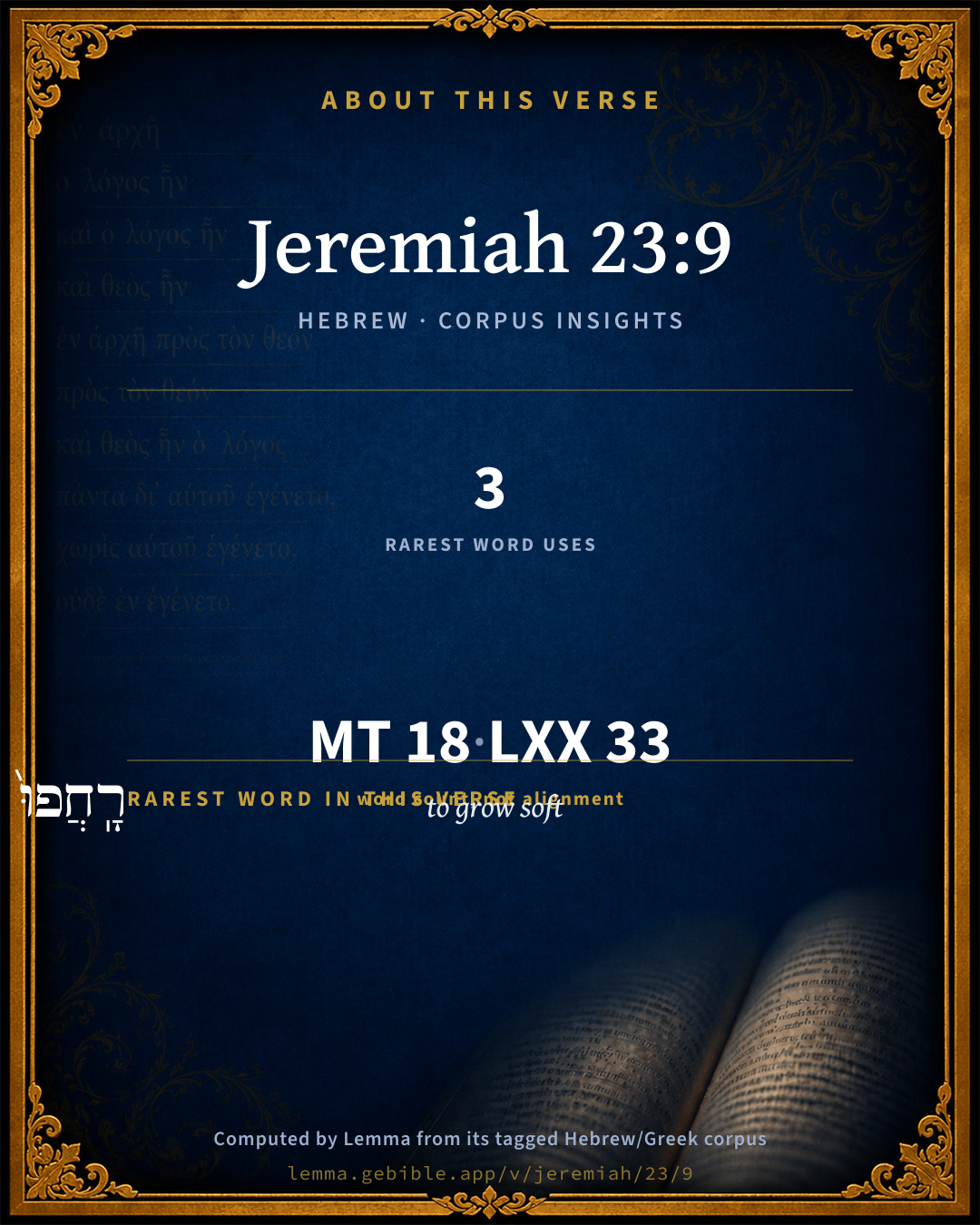
The rarest word here is רָֽחֲפוּ֙ to grow soft H7363 — appearing just 3 times in the whole Hebrew Bible.

Shared distinctive vocabulary

רָֽחֲפוּ֙ to grow soft H7363 occurs in 3 verses of the Hebrew Bible. Also found in:

Grammatical profile

  • 4 verbs
  • 13 nouns
  • 1 adjective

Verb forms

  • נִשְׁבַּ֧ר Niphal · Perfect
  • רָֽחֲפוּ֙ Qal · Perfect
  • הָיִ֨יתִי֙ Qal · Perfect
  • עֲבָ֣רוֹ Qal · Perfect

Repetition

A word recurs within this verse — often emphatic in Hebrew:

  • מִפְּנֵ֣י face H6440 ×2

Hebrew & Septuagint length

In the original languages it is 18 Hebrew tokens and 33 Greek tokens — but the two are counted differently (Hebrew bundles its prefixes and suffixes into one token; the Greek is in lemma form), so that isn’t a like-for-like length.

Cross-references

16

Topical passages linked to Jeremiah 23:9 in the Treasury of Scripture Knowledge — connected by theme and wording, ordered by reader-vote popularity; previews shown in the World English Bible.

  • Habakkuk 3:16 I heard, and my body trembled. My lips quivered at the voice. Rottenness enters into my bones, and I tremble in my place, Because I must wait quietly for the day of trouble, For the coming up of the people who invade us.
  • Psalms 60:3 You have shown your people hard things. You have made us drink the wine that makes us stagger.
  • Isaiah 51:21 Therefore hear now this, you afflicted, and drunken, but now with wine:
  • Lamentations 3:15 He has filled me with bitterness, he has sated me with wormwood.
  • Daniel 8:27 I, Daniel, fainted, and was sick certain days; then I rose up, and did the king's business: and I wondered at the vision, but none understood it.
  • 2 Kings 22:19–20 because your heart was tender, and you did humble yourself before Yahweh, when you heard what I spoke against this place, and against the inhabitants of it, that they should become a desolation and a curse, and have torn your clothes, and wept before me; I also have heard you, says Yahweh.
  • Isaiah 6:5 Then I said, "Woe is me! For I am undone, because I am a man of unclean lips, and I dwell in the midst of a people of unclean lips: for my eyes have seen the King, Yahweh of Hosts!"
  • Isaiah 28:1 Woe to the crown of pride of the drunkards of Ephraim, and to the fading flower of his glorious beauty, which is on the head of the fat valley of those who are overcome with wine!
  • Isaiah 29:9 Stay you and wonder; take your pleasure and be blind: they are drunken, but not with wine; they stagger, but not with strong drink.
  • Jeremiah 5:31 the prophets prophesy falsely, and the priests bear rule by their means; and my people love to have it so: and what will you do in the end of it?
  • Jeremiah 9:1 Oh that my head were waters, and my eyes a spring of tears, that I might weep day and night for the slain of the daughter of my people!
  • Jeremiah 14:17–18 You shall say this word to them, Let my eyes run down with tears night and day, and let them not cease; for the virgin daughter of my people is broken with a great breach, with a very grievous wound.
  • Jeremiah 25:15–18 For thus says Yahweh, the God of Israel, to me: take this cup of the wine of wrath at my hand, and cause all the nations, to whom I send you, to drink it.
  • Ezekiel 9:4 Yahweh said to him, Go through the midst of the city, through the midst of Jerusalem, and set a mark on the foreheads of the men that sigh and that cry over all the abominations that are done in the midst of it.
  • Ezekiel 9:6 kill utterly the old man, the young man and the virgin, and little children and women; but don't come near any man on whom is the mark: and begin at my sanctuary. Then they began at the old men that were before the house.
  • Romans 7:9 I was alive apart from the law once, but when the commandment came, sin revived, and I died.

Cross-references courtesy of OpenBible.info (CC BY 4.0).

Hebrew and Greek witnesses Masoretic Hebrew ↔ Greek Septuagint

The same verse in the two great witnesses to the Old Testament, shown verse-for-verse.

These are two independent witnesses, not word-aligned to each other, and the Septuagint is shown in lemma (dictionary) form.

Hebrew Jeremiah 23:9 Masoretic · Westminster Leningrad Codex

לַנְּבִאִ֞ים נִשְׁבַּ֧ר לִבִּ֣י בְקִרְבִּ֗י רָֽחֲפוּ֙ כָּל עַצְמוֹתַ֔י הָיִ֨יתִי֙ כְּאִ֣ישׁ שִׁכּ֔וֹר וּכְגֶ֖בֶר עֲבָ֣רוֹ יָ֑יִן מִפְּנֵ֣י יְהוָ֔ה וּמִפְּנֵ֖י דִּבְרֵ֥י קָדְשֽׁוֹ

Concerning the prophets. My heart within me is broken, all my bones shake; I am like a drunken man, and like a man whom wine has overcome, because of Yahweh, and because of his holy words.

World English Bible · Public Domain

Greek LXX Structure differs

In the Septuagint, Jeremiah is about an eighth shorter than the Hebrew and arranges its material differently — the Oracles Against the Nations (Hebrew chapters 46–51) appear in the middle of the Greek book, after 25:13. Because the chapter and verse boundaries do not line up, a verse-for-verse comparison with the Hebrew is not shown.

A verse-for-verse comparison isn’t shown here because the chapters and verses don’t line up. Switch to the LXX edition with the MT / LXX toggle above to read the Greek directly.

On this verse, Keil & Delitzsch discusses the Septuagint’s reading. Read the note in Commentary ↓

Hebrew: Westminster Leningrad Codex (CC BY 4.0). Greek: Septuagint (public domain); English from a public-domain English Septuagint. How the Septuagint differs from the Hebrew →

Targum (Aramaic paraphrase)

1

The Targum is the ancient Jewish Aramaic paraphrase of the Hebrew Scriptures — an interpretive translation, not the Hebrew text itself. Onkelos (literal) and Pseudo-Jonathan (expansive) render the Torah, and Jonathan the Prophets. Coverage is partial: where no permissively-licensed English translation exists for a verse, only the Aramaic is shown. This is verse-level text, not a word-by-word alignment to the Hebrew.

  1. Targum Jonathan Prophets (Joshua–Malachi)
    מִן קָדָם נְבִיֵי שַׁקְרָא אִתְּבַר לִבִּי בִּמְעֵי זָעוּ כָּל גַרְמֵי הֲוֵיתִי כִּגְבַר רָוֵי וּכְגַבְרָא דְמִשְׁתַּטֵי מִן קֳדָם חַמְרֵיהּ מִן קֳדָם יְיָ וּמִן קֳדָם פִּתְגָמֵי קוּדְשֵׁיהּ:

    (no public-domain English translation for this verse)

    Targum Jonathan — Aramaic: “Mikraot Gedolot” (public domain). English: “Sefaria Community Translation” (CC0 1.0 (public-domain dedication)); “London "Chaldee Paraphrase," 1871” (public domain). Text via Sefaria.

Commentary

Notes on Jeremiah 23:9 from classic Christian and Jewish commentators (each source and its license shown beneath its notes). The classic Christian expositions comment on the surrounding passage and are grouped to its opening verse, so a note may address several verses; the Jewish commentaries on the Tanakh (Rashi and others) are per-verse, so they appear only where the commentator wrote on this verse.

Lemma curates 59 commentaries, every one of them public domain or Creative Commons licensed, each selected and text-cleaned for this edition rather than reprinted as found. About our sources →

Matthew Henry's Commentary

Here is a long lesson for the false prophets. As none were more bitter and spiteful against God's true prophets than they, so there were none on whom the true prophets were more severe, and justly. The prophet had complained to God of those false prophets (Jer 14:13), and had often foretold that they should be involved in the common ruin; but here they have woes of their own.

I. He expresses the deep concern that he was under upon this account, and what a trouble it was to him to see men who pretended to a divine commission and inspiration ruining themselves, and the people among whom they dwelt, by their falsehood and treachery (Jer 23:9): My heart within me is broken; I am like a drunken man. His head was in confusion with wonder and astonishment; his heart was under oppression with grief and vexation. Jeremiah was a man that laid things much to heart, and what was any way threatening to his country made a deep impression upon his spirits. He is here in trouble, 1. Because of the prophets and their sin, the false doctrine they preached, the wicked lives they lived; especially it filled him with horror to hear them making use of God's name and pretending to have their instruction from him. Never was the Lord so abused, and the words of his holiness, as by these men. Note, The dishonour done to God's name, and the profanation of his holy word, are the greatest grief imaginable to a gracious soul. 2. "Because of the Lord, and his judgments, which by this means are brought in upon us like a deluge." He trembled to think of the ruin and desolation which were coming from the face of the Lord (so the word is) and from the face of the word of his holiness, which will be inflicted by the power of God's wrath, according to the threatenings of his word, confirmed by his holiness. Note, Even those that have God for them cannot but tremble to think of the misery of those that have God against them.

II. He laments the abounding abominable wickedness of the land and the present tokens of God's displeasure they were under for it (Jer 23:10): The land is full of adulterers; it is full both of spiritual and corporal whoredom. They go a whoring from God, and, having cast off the fear of him, no marvel that they abandon themselves to all manner of lewdness; and, having dishonoured themselves and their own bodies, they dishonour God and his name by rash and false swearing, because of which the land mourns. Both perjury and common swearing are sins for which a land must mourn in true repentance or it will be made to mourn under the judgments of God. Their land mourned now under the judgment of famine; the pleasant places, or rather the pastures, or (as some read it) the habitations of the wilderness, are dried up for want of rain, and yet we see no signs of repentance. They answer not the end of the correction. The tenour and tendency of men's conversations are sinful, their course continues evil, as bad as ever, and they will not be diverted from it. They have a great deal of resolution, but it is turned the wrong way; they are zealously affected, but not in a good thing: Their force is not right; their heart is fully set in them to do evil, and they are not valiant for the truth, have not courage enough to break off their evil courses, though they see God thus contending with them.

III. He charges it all upon the prophets and priests, especially the prophets. They are both profane (Jer 23:11); the priests profane the ordinances of God they pretend to administer; the prophets profane the word of God they pretend to deliver; their converse and all their conversation are profane, and then it is not strange that the people are so debauched. They both play the hypocrite (so some read it); under sacred pretensions they carry on the vilest designs; yea, not only in their own houses, and the bad houses they frequent, but in my house have I found their wickedness; in the temple, where the priests ministered, where the prophets prophesied, there were they guilty both of idolatry and immorality. See a woeful instance in Hophni and Phinehas, Sa1 2:22. God searches his house, and what wickedness is there he will find it out; and the nearer it is to him the more offensive it is. Two things are charged upon them: - 1. That they taught people to sin by their examples. He compares them with the prophets of Samaria, the head city of the kingdom of the ten tribes, which had been long since laid waste. It was the folly of the prophets of Samaria that they prophesied in Baal, in Baal's name; so Ahab's prophets did, and so they caused my people Israel to err, to forsake the service of the true God and to worship Baal, Jer 23:13. Now the prophets of Jerusalem did not do so; they prophesied in the name of the true God, and valued themselves upon that, that they were not like the prophets of Samaria, who prophesied in Baal; but what the better, when they debauched the nation as much by their immoralities as the other had done by their idolatries? It is a horrible thing in the prophets of Jerusalem that they make use of the name of the holy God, and yet wallow in all manner of impurity; they make nothing of committing adultery. They make use of the name of the God of truth, and yet walk in lies; they not only prophesy lies, but in their common conversation one cannot believe a word they say. It is all either jest and banter or fraud and design. Thus they encourage sinners to go on in their wicked ways; for every one will say, "Surely we may do as the prophets do; who can expect that we should be better than our teachers?" By this means it is that none returns from his wickedness; but they all say that they shall have peace, though they go on, for their prophets tell them so. By this means Judah and Jerusalem have become as Sodom and Gomorrah, that were wicked, and sinners before the Lord exceedingly; and God looked upon them accordingly as fit for nothing but to be destroyed, as they were, with fire and brimstone. 2. That they encouraged people in sin by their false prophecies. They made themselves believe that there was no harm, no danger in sin, and practiced accordingly; and then no marvel that they made others believe so too (Jer 23:16): They speak a vision of their own heart; it is the product of their own invention, and agrees with their own inclination, but it is not out of the mouth of the Lord; he never dictated it to them, nor did it agree either with the law of Moses or with what God has spoken by other prophets. They tell sinners that it shall be well with them though they persist in their sins, Jer 23:17. See here who those are that they encourage - those that despise God, that slight his authority, and have low and mean thoughts of his institutions, and those that walk after the imagination of their own heart, that are worshippers of idols and slaves to their own lusts; those that are devoted to their pleasures put contempt upon their God. Yet see how these prophets caressed and flattered them: they should have been still saying, There is no peace to those that go on in their evil ways - Those that despise God shall be lightly esteemed - Woe, and a thousand woes, to them; but they still said, You shall have peace; no evil shall come upon you. And, which was worst of all, they told them, God has said so, so making him to patronize sin, and to contradict himself. Note, Those that are resolved to go on in their evil ways will justly be given up to believe the strong delusions of those who tell them that they shall have peace though they go on.

IV. God disowns all that these false prophets said to sooth people up in their sins (Jer 23:21): I have not sent these prophets; they never had any mission from God. They were not only not sent by him on this errand, but they were never sent by him on any errand; he never had employed them in any service or business for him; and, as to this matter, whereas they pretended to have instructions from him to assure this people of peace, he declares that he never gave them any such instructions. Yet they were very forward - they ran; they were very bold - they prophesied without any of that difficulty with which the true prophets sometimes struggled. They said to sinners, You shall have peace. But (Jer 23:18): "Who hath stood in the counsel of the Lord? Who of you has, that are so confident of this? You deliver this message with a great deal of assurance; but have you consulted God about it? No; you never considered whether it be agreeable to the discoveries God has made of himself, whether it will consist with the honour of his holiness and justice, to let sinners go unpunished. You have not perceived and heard his word, nor marked that; you have not compared this with the scripture; if you had taken notice of that, and of the constant tenour of it, you would never have delivered such a message." The prophets themselves must try the spirits by the touchstone of the law and of the testimony, as well as those to whom they prophesy; but which of those did so that prophesied of peace? That they did not stand in God's counsel nor hear his word is proved afterwards, Jer 23:22. If they had stood in my counsel, as they pretend, 1. They would have made the scriptures their standard: They would have caused my people to hear my words, and would have conscientiously kept closely to them. But, not speaking according to that rule, it is a plain evidence that there is no light in them. 2. They would have made the conversion of souls their business, and would have aimed at that in all their preaching. They would have done all they could to turn people from their evil way in general and from all the particular evil of their doings. They would have encouraged and assisted the reformation of manners, would have made this their scope in all their preaching, to part between men and their sins; but it appeared that this was a thing they never aimed at, but, on the contrary, to encourage sinners in their sins. 3. They would have had some seals of their ministry. This sense our translation gives it: If they had stood in my counsel, and the words they had preached had been my words, then they should have turned them from their evil way; a divine power should have gone along with the word for the conviction of sinners. God will bless his own institutions. Yet this is no certain rule; Jeremiah himself, though God sent him, prevailed with but few to turn from their evil way.

V. God threatens to punish these prophets for their wickedness. They promised the people peace; and to show them the folly of that God tells them that they should have no peace themselves. They were very unfit to warrant the people, and pass their word to them that no evil shall come upon them, when all evil is coming upon themselves and they are not aware of it, Jer 23:12. Because the prophets and priests are profane, therefore their ways shall be unto them as slippery ways in the darkness. Those that undertake to lead others, because they mislead them, and know they do so, shall themselves have no comfort in their way. 1. They pretend to show others the way, but they shall themselves be in the dark, or in a mist; their light or sight shall fail, so that they shall not be able to look before them, shall have no forecast for themselves. 2. They pretend to give assurances to others, but they themselves shall find no firm footing: Their ways shall be to them as slippery ways, in which they shall not go with any steadiness, safety, or satisfaction. 3. They pretend to make the people easy with their flatteries, but they shall themselves be uneasy: They shall be driven, forced forward as captives, or making their escape as those that are pursued, and they shall fall in the way by which they hoped to escape, and so fall into the enemies' hands. 4. They pretend to prevent the evil that threatens others, but God will bring evil upon them, even the year of their visitation, the time fixed for calling them to an account; such a time is fixed concerning all that do not judge themselves, and it will be an evil time. The year of visitation is the year of recompenses. It is further threatened (Jer 23:15), I will feed them with wormwood, or poison, with that which is not only nauseous, but noxious, and make them drink waters of gall, or (as some read it) juice of hemlock; see Jer 9:15. Justly is the cup of trembling put into their hand first, for from the prophets of Jerusalem, who should have been patterns of piety and every thing that is praiseworthy, even from them has profaneness gone forth into all the lands. Nothing more effectually debauches a nation than the debauchery of ministers.

VI. The people are here warned not to give any credit to these false prophets; for, though they flattered them with hopes of impunity, the judgments of God would certainly break out against them, unless they repented (Jer 23:16): "Take notice of what God says, and hearken not to the words of these prophets; for you will find, in the issue, that God's word shall stand, and not theirs. God's word will make you serious, but they make you vain, feed you with vain hopes, which will fail you at last. They tell you, No evil shall come upon you; but hear what God says (Jer 23:19), Behold, a whirlwind of the Lord has gone forth in fury. They tell you, All shall be calm and serene; but God tells you, There is a storm coming, a whirlwind of the Lord, of his sending, and therefore there is no standing before it. It is a whirlwind raised by divine wrath; it has gone forth in fury, a wind that is brought forth out of the treasuries of divine vengeance; and therefore it is a grievous whirlwind, and shall light heavily, with rain and hail, upon the head of the wicked, which they cannot avoid nor find any shelter from." It shall fall upon the wicked prophets themselves who deceived the people, and the wicked people who suffered themselves to be deceived. A horrible tempest shall be the portion of their cup, Psa 11:6. This sentence is bound on as irreversible (Jer 23:20): The anger of the Lord shall not return, for the decree has gone forth. God will not alter his mind, nor suffer his anger to be turned away, till he have executed the sentence and performed the thoughts of his heart. God's whirlwind, when it comes down from heaven, returns not thither, but accomplishes that for which he sent it, Isa 55:11. This they will not consider now; but in the latter days you shall consider it perfectly, consider it with understanding (so the word is) or with consideration. Note, Those that will not fear the threatenings shall feel the execution of them, and will then perfectly understand what they will not now admit the evidence of, what a fearful thing it is to fall into the hands of a just and jealous God. Those that will not consider in time will be made to consider when it is too late. Son, remember.

VII. Several things are here offered to the consideration of these false prophets for their conviction, that, if possible, they might be brought to recant their error and acknowledge the cheat they had put upon God's people.

1. Let them consider that though they may impose upon men God is too wise to be imposed upon. Men cannot see through their fallacies, but God can and does. Here,

(1.) God asserts his own omnipresence and omniscience in general, Jer 23:23, Jer 23:24. When they told the people that no evil should befall them though they went on in their evil ways they went upon atheistical principles, that the Lord doth not see their sin, that he cannot judge through the dark cloud, that he will not require it; and therefore they must be taught the first principles of their religion, and confronted with the most incontestable self-evident truths. [1.] That though God's throne is prepared in the heavens, and this earth seems to be at a distance from him, yet he is a God here in this lower world, which seems to be afar off, as well as in the upper world, which seems to be at hand, Jer 23:23. The eye of God is the same on earth that it is in heaven. Here it runs to and fro as well as there (Ch2 16:9); and what is in the minds of men, whose spirits are veiled in flesh, is as clearly seen by him as what is in the mind of angels, those unveiled spirits above that surround his throne. The power of God is the same on earth among its inhabitants that it is in heaven among its armies. With us nearness and distance make a great difference both in our observations and in our operations, but it is not so with God; to him darkness and light, at hand and afar off, are both alike. [2.] That, how ingenious and industrious soever men are to disguise themselves and their own characters and counsels, they cannot possibly be concealed from God's all-seeing eye (Jer 23:24): "Can any hide himself in the secret places of the earth, that I shall not see him? Can any hide his projects and intentions in the secret places of the heart, that I shall not see them?" No arts of concealment can hide men from the eye of God, nor deceive his judgment of them. [3.] That he is every where present; he does not only rule heaven and earth, and uphold both by his universal providence, but he fills heaven and earth by his essential presence, Psa 139:7, Psa 139:8, etc. No place can either include him or exclude him.

(2.) He applies this to these prophets, who had a notable art of disguising themselves (Jer 23:25, Jer 23:26): I have heard what the prophets said that prophesy lies in my name. They thought that he was so wholly taken up with the other world that he had no leisure to take cognizance of what passed in this. But God will make them know that he knows all their impostures, all the shams they have put upon the world, under colour of divine revelation. What they intended to humour the people with they pretended to have had from God in a dream, when there was no such thing. This they could not discover. If a man tell me that he dreamed so and so, I cannot contradict him; he knows I cannot. But God discovered the fraud. Perhaps the false prophets whispered what they had to say in the ears of such as were their confidants, saying, So and so I have dreamed; but God overheard them. The heart-searching eye of God traced them in all the methods they took to deceive the people, and he cries out, How long? Shall I always bear with them? Is it in the hearts of those prophets (so some read it) to be ever prophesying lies and prophesying the deceits of their own hearts? Will they never see what an affront they put upon God, what an abuse they put upon the people, and what judgments they are preparing for themselves?

2. Let them consider that their palming upon people counterfeit revelations, and fathering their own fancies upon divine inspiration, was the ready way to bring all religion into contempt and make men turn atheists and infidels; and this was the thing they really intended, though they frequently made mention of the name of God, and prefaced all they said with, Thus saith the Lord. Yet, says God, They think to cause my people to forget my name by their dreams. They designed to draw people off from the worship of God, from all regard to God's laws and ordinances and the true prophets, as their fathers forgot God's name for Baal. Note, The great thing Satan aims at is to make people forget God, and all that whereby he has made himself known; and he has many subtle methods to bring them to this. Sometimes he does it by setting up false gods (bring men in love with Baal, and they soon forget the name of God), sometimes by misrepresenting the true God, as if he were altogether such a one as ourselves. Pretenses to new revelation may prove as dangerous to religion as the denying of all revelation; and false prophets in God's name may perhaps do more mischief to the power of godliness than false prophets in Baal's name, as being less guarded against.

3. Let them consider what a vast difference there was between their prophecies and those that were delivered by the true prophets of the Lord (Jer 23:28): The prophet that has a dream, which was the way of inspiration that the false prophets most pretended to, if he has a dream, let him tell it as a dream; so Mr. Gataker reads it. "Let him lay no more stress upon it than men do upon their dreams, nor expect any more regard to be had to it. Let them not say that it is from God, nor call their foolish dreams divine oracles. But let the true prophet, that has my word, speak my word faithfully, speak it as a truth" (so some read it): "let him keep closely to his instructions, and you will soon perceive a vast difference between the dreams that the false prophets tell and the divine dictates which the true prophets deliver. He that pretends to have a message from God, whether by dream or voice, let him declare it, and it will easily appear which is of God and which is not. Those that have spiritual senses exercised will be able to distinguish; for what is the chaff to the wheat? The promises of peace which these prophets make to you are no more to be compared to God's promises than chaff to wheat." Men's fancies are light, and vain, and worthless, as the chaff which the wind drives away. But the word of God has substance in it; it is of value, is food for the soul, the bread of life. Wheat was the staple commodity of Canaan, that valley of vision, Deu 8:8; Eze 27:17. There is as much difference between the vain fancies of men and the pure word of God as between the chaff and the wheat. It follows (Jer 23:29), Is not my word like a fire, saith the Lord? Is their word so? Has it the power and efficacy that the word of God has? No; nothing like it; there is no more comparison than between painted fire and real fire. Theirs is like an ignis fatuus - a deceiving meteor, leading men into by-paths and dangerous precipices. Note, The word of God is like fire. The law was a fiery law (Deu 33:2), and of the gospel Christ says, I have come to send fire on the earth, Luk 12:49. Fire has different effects, according as the matter is on which it works; it hardens clay, but softens wax; it consumes the dross, but purifies the gold. So the word of God is to some a savour of life unto life, to others of death unto death. God appeals here to the consciences of those to whom the word was sent: "Is not my word like fire? Has it not been so to you? Zac 1:6. Speak as you have found." It is compared likewise to a hammer breaking the rock in pieces. The unhumbled heart of man is like a rock; if it will not be melted by the word of God as the fire, it will be broken to pieces by it as the hammer. Whatever opposition is given to the word, it will be borne down and broken to pieces.

4. Let them consider that while they went on in this course God was against them. Three times they are told this, Jer 23:30, Jer 23:31, Jer 23:32. Behold, I am against the prophets. They pretended to be for God, and made use of his name, but were really against him; he looks upon them as they were really, and is against them. How can they be long safe, or at all easy, that have a God of almighty power against them? While these prophets were promising peace to the people God was proclaiming war against them. They stand indicted here, (1.) For robbery: They steal my word every one from his neighbour. Some understand it of that word of God which the good prophets preached; they stole their sermons, their expressions, and mingled them with their own, as hucksters mingle bad wares with some that are good, to make them vendible. Those that were strangers to the spirit of the true prophets mimicked their language, picked up some good sayings of theirs, and delivered them to the people as if they had been their own, but with an ill grace; they were not of a piece with the rest of their discourses. The legs of the lame are not equal, so is a parable in the mouth of fools, Pro 26:7. Others understand it of the word of God as it was received and entertained by some of the people; they stole it out of their hearts, as the wicked one in the parable is said to steal the good seed of the word, Mat 13:19. By their insinuations they diminished the authority, and so weakened the efficacy, of the word of God upon the minds of those that seemed to be under convictions by it. (2.) They stand indicted for counterfeiting the broad seal. Therefore God is against them (Jer 23:31), because they use their tongues at their pleasure in their discourses to the people; they say what they themselves think fit, and then father it upon God, pretend they had it from him, and say, He saith it. Some read it, They smooth their tongues; they are very complaisant to the people, and say nothing but what is pleasing and plausible; they never reprove them nor threaten them, but their words are smoother than butter. Thus they ingratiate themselves with them, and get money by them; and they have the impudence and impiety to make God the patron of their lies; they say, "He saith so." What greater indignity can be done to the God of truth than to lay the brats of the father of lies at his door? (3.) They stand indicted as common cheats (Jer 23:32): I am against them, for they prophesy false dreams, pretending that to be a divine inspiration which is but an invention of their own. This is a horrid fraud; nor will it excuse them to say, Caveat emptor - Let the buyer take care of himself, and Si populus vult decipi, decipiatur - If people will be deceived, let them. No; it is the people's fault that they err, that they take things upon trust, and do not try the spirits; but it is much more the prophets' fault that they cause God's people to err by their lies and by their lightness, by the flatteries of their preaching soothing them up in their sins, and by the looseness and lewdness of their conversation encouraging them to persist in them. [1.] God disowns their having any commission from him: I sent them not, nor commanded them; they are not God's messengers, nor is what they say his message. [2.] He therefore justly denies his blessing with them: Therefore they shall not profit this people at all. All the profit they aim at is to make them easy; but they shall not so much as do that, for God's providences will at the same time be making them uneasy. They do not profit this people (so some read it); and more is implied than is expressed; they not only do them no good, but do them a great deal of hurt. Note, Those that corrupt the word of God, while they pretend to preach it, are so far from edifying the church that they do it the greatest mischief imaginable.

Matthew Henry's Commentary on the Whole Bible (1708–1710) — public domain (CC PDM 1.0). Text via the HelloAO Bible API.

The Cambridge Bible for Schools and Colleges

gen. ed. J. J. S. Perowne

9. his holy words] the words which He in the holiness of His nature had put forth concerning the wicked doings of the false prophets.

Jer_23:9-40. Condemnation of the prophets

Following on the prophecies relating to successive kings of Judah, we have a section dealing with the iniquities of a class who also grievously misled the nation. The passage doubtless contains much that is genuine, but, from the diffuseness of style, especially in the latter part, it may be safely inferred that additional matter has been inserted. Commentators, however, are by no means agreed as to the amount of the latter. Du. omits all after Jer_23:15, Co. nearly all after Jer_23:24, Gi. Jer_23:30-40, while the last-named also rejects Jer_23:18-21. Jer_23:9-17 and again 23–29 are in Ḳinah rhythm. Elsewhere metre is for the most part irregular or absent. The collection of utterances, so far as genuine, may have probably belonged to the last part of Zedekiah’s reign.

The section may be thus subdivided. (i) Jer_23:9-15. Jeremiah is undone and nerveless because of the Lord’s message to a land whose profligacy has brought on it a curse. The Temple itself is polluted by the iniquities of prophets and priests. They shall be as men driven in the dark along slippery ways till they fall. The prophets of Samaria led the people astray by alleged prophecies of their false deity, while the prophets of Jerusalem shock Jehovah still more by immorality, lying, and the encouragement of others in permanent evil-doing. They have reached the infamy of the cities of the plain. They have infected all the land; therefore shall wormwood and gall be their food. (ii) Jer_23:16-18. It is from the prophets’ own imaginations and not from Jehovah that their pleasing promises of immunity from evil come. Who is there who has visited His heavenly abode, there to learn His purposes? (iii) Jer_23:19-20. Jehovah’s wrath shall break, like a storm, on the head of the wicked, and shall not be recalled till His purpose is fully achieved. (iv) Jer_23:21-24. Those prophets were not commissioned nor inspired by the Lord; else they would have delivered His rebuke of the people’s sins. He is omnipresent. They cannot escape His observation. (v) Jer_23:25-29. How long shall they adduce dreams, dreams forsooth, in support of their lying predictions, making the real character of Jehovah to be forgotten by the people, even as their fathers thought of Him as though He were no better than one of the Baals? Let the dream be told, and let Jehovah’s message be told as well; but let the utterances which embody the two be sharply distinguished, as stubble from wheat. Jehovah’s word is as fire, and as a hammer which breaketh the rocks. (vi) Jer_23:30-32. He is against the prophets who steal their announcements from the true prophets, and with ready tongue claim that they are from Him, who lead His people astray with delusive dreams and claims to Divine authority. They have not His commission, and so are without value. (vii) Jer_23:33-40. When asked, What is the Lord’s burden, Jeremiah will answer, It is ye, and He will rid Himself of you as such. All who use the word “burden” shall be punished. The message shall be expressed in the simplest language, and your use of the word “burden” shall recoil upon yourselves. If ye nevertheless persist in its use, ye shall be banished for ever in disgrace from this ancestral city and from Jehovah’s presence.

The Cambridge Bible for Schools and Colleges (gen. ed. J. J. S. Perowne; Cambridge University Press, 1878–1918) — public domain. Text from a community e-Sword module.

Trapp's Complete Commentary

John Trapp

Jer 23:9 Mine heart within me is broken because of the prophets; all my bones shake; I am like a drunken man, and like a man whom wine hath overcome, because of the LORD, and because of the words of his holiness.

Ver. 9. My heart within me is broken.] Utitur exordiolo pathetico et tragico prorsus. Being to inveigh against the priests and false prophets, those great corrupters of the people, he useth this pathetic preface, Cordicitus et medullitus doles, I am grieved to the very heart, &c.

All my bones shake.] Heb., Hover or flutter, as birds do, They shake and shudder with extreme fear and horror. Totus contremisco.

I am like a drunken man.] Totus perturbatus sum, I am not myself, not able to stand high alone.

Because of the Lord.] Through zeal of his glory.

And because of the words of his holiness.] His holy words so shamefully slighted, his dreadful threats especially.

John Trapp, A Commentary or Exposition upon All the Books of the Old and New Testament (1647–1656) — public domain. Text from a community e-Sword module.

Albert Barnes' Notes on the Bible

Because of the prophets - Rather, concerning “the prophets.” These words should come first, as being the title of this portion of the prophecy Jer. 23:9-40.

Albert Barnes' Notes on the Bible (1834–1885) — public domain. Text from a community e-Sword/MySword module.

Joseph Benson's Commentary

Jer 23:9. My heart within me is broken — This seems to be the beginning of a new discourse against the false prophets, with whom afterward the priests are joined. The first word of it in the Hebrew, לנבאים, is rendered by the Vulgate, Ad prophetas, To the prophets, as if it were the title of the following prophecy. In this Jeremiah describes the terror and concern which were upon him when he considered the horrible sin of these prophets in pretending a divine mission when they had received none, and in uttering as messages from God what were really their own inventions, and in direct opposition to every thing God had spoken. And he declares that, upon a view of their guilt, and of the evils they were bringing on themselves and their country, he was in trouble and agitation, like that of a man who had lost his reason through intoxication.

Joseph Benson's Commentary on the Old and New Testaments (1811–1818) — public domain. Text from a community e-Sword module.

Whedon's Commentary on the Bible

Daniel D. Whedon

THE FALSE PROPHETS, Jer_23:9-40.

9. This verse is tamely rendered in the Authorized Version. Its opening sentences stand: Concerning the prophets, broken is my heart within me; all my bones shake. The same radical word which is here rendered shake, is, in Gen_1:2, “moved,” and in Deu_32:11, “fluttereth.” The sense here is, to shake in a helpless and tottering manner, and so is kindred to the following sentence: I am like a drunken man.

Daniel D. Whedon (gen. ed.), Commentary on the Old and New Testaments (1874–1909) — public domain. Text from a community e-Sword module.

Keil & Delitzsch

C. F. Keil & F. Delitzsch

Against the False Prophets. - Next to the kings, the pseudo-prophets, who flattered the people's carnal longings, have done most to contribute to the fall of the realm. Therefore Jeremiah passes directly from his discourse against the wicked kings to rebuking the false prophets; and if we may presume from the main substance, the latter discourse belongs to the same time as the former. It begins

Jer 23:9-11

With a description of the pernicious practices of these persons. - Jer 23:9. "Concerning the prophets. Broken is mine heart within me; all my bones totter. I am become like a drunken man, and like a man whom wine hath overcome, because of Jahveh and because of His holy words. Jer 23:10. For of adulterers the land is full, for because of the curse the land withereth, the pastures of the wilderness dry up; and their course is become evil, and their strength not right. Jer 23:11. For both prophet and priest are profane; yea, in mine house found I their wickedness, saith Jahveh. Jer 23:12. Therefore their way shall be to them as slippery places in darkness, they shall be thrown down and fall therein; for I bring evil upon them, the year of their visitation, saith Jahveh. Jer 23:13. In the prophets of Samaria saw I folly; they prophesied in the name of Baal, and led my people Israel astray. Jer 23:14. But in the prophets of Jerusalem saw I an horrible thing, committing adultery and walking in falsehood, and they strengthen the hands of the wicked, that none returneth from his wickedness. They are all become to me as Sodom, and the inhabitants thereof as Gomorrah. Jer 23:15. Therefore thus saith Jahveh of hosts concerning the prophets: Behold, I feed them with wormwood, and give them to drink water of bitterness; for from the prophets of Jerusalem is profaneness gone forth over all the land."

"Concerning the prophets" is the heading, as in Jer 46:2; Jer 48:1; Jer 49:1, Jer 49:7, Jer 49:23, Jer 49:28; and corresponds to the woe uttered against the wicked shepherds, Jer 23:1. It refers to the entire portion vv. 9-40, which is thus distinguished from the oracles concerning the kings, Jer 21:1-14 and 22. It might indeed be joined, according to the accents, with what follows: because of the prophets is my heart broken; but as the cause of Jeremiah's deep agitation is given at the end of the second half-verse: because of Jahveh, etc., it is not likely the seer would in one sentence have given two different and quite separate reasons. The brokenness of his heart denotes the profoundest inward emotion yet not despondency by reason of sin and misery, like "a broken heart" in Psa 34:19; Psa 51:19, etc., but because of God's wrath at the impious lives of the pseudo-prophets. This has overcome him, and this he must publish. This wrath had broken his heart and seized on all his bones, so that they nervelessly tremble, and he resembles a drunken man who can no longer stand firm on his feet. He feels himself inwardly quite downcast; he not only feels the horrors of the judgment that is to befall the false prophets and corrupt priests who lead the people astray, but knows well the dreadful sufferings the people too will have to endure. The verb רחף occurs only twice in the Piel besides in the present passage; in Gen 1:2, of the Spirit of God that in the beginning of creation brooded over the waters of the earth, and Deu 32:11, of the eagle that flutters over her young - in Arabic rchf, to be soft. The root meaning of the word is doubtless: to be flaccid; here accordingly, to totter, to sway to and fro. "Because of Jahveh" is more fully explained by "because of the words of His holiness," i.e., the words which God as holy has made known to him regarding the unholy ongoings of the pseudo-prophets. - From Jer 23:10 onwards come the sayings of God which have so terribly agitated the prophet. The land is full of adulterers. Adultery in the literal sense is mentioned by way of example, as a reckless transgression of God's commands, then much in vogue, whereby the moral foundations of the kingdom were broken up. In Jer 23:14 the prophets are said to commit adultery and walk in lying, cf. Jer 29:23 and Jer 5:7. By reason of this vice a curse lies on the land, under which it is withering away. The clause "for because of the curse," etc., is not to be taken as parenthesis (Ng.), but as co-ordinate with the previous clause, giving the second, or rather the chief ground, why Jeremiah is so deeply distressed. The reason of this is not so much the prevailing moral corruption, as the curse lying on the land because of the moral corruption of its inhabitants. אלה is not perjury (Chald., Rashi, Kimchi), but the curse wherewith God punishes the transgression of His covenant laws, cf. Jer 11:3, Jer 11:8, Deu 28:15., Jer 29:19. The words are modelled after Isa 24:4.; and הארץ is not the population, but the land itself, which suffers under God's curse, and which is visited with drought; cf. Jer 12:4. The next words point to drought. נאות מדבּר as in Jer 9:9. By ותּהי the further description of the people's depravity is attached to the first clause of the verse. Their course is become evil; their running or racing, i.e., the aim and endeavour of the ungodly. The suffix on this word מרוּצתם refers not to "adulterers," but ad sensum to the inhabitants of the land. Their strength is not-right, i.e., they are strong, valiant in wrong; cf. Jer 9:2. For - so goes Jer 23:11 - both prophets and priests, who should lead the people in the right way, are profane, and desecrate by their wickedness even the house of God, presumably by idolatry; cf. Jer 32:34. There is no reason for thinking here, as Hitz. does, of adultery practised in the temple.

Jer 23:12

For this the Lord will punish them. Their way shall be to them as slippery places in darkness. This threatening is after the manner of Psa 35:6, where חשׁך are joined, changed by Jeremiah to the words in the text. The passage cited shows that we may not separate בּאפלה from חלקלקּות, as Ew. does, to join it to the following ידּחוּ. Their way shall resemble slippery places in the dark, when one may readily slip and fall. Besides, they are to be thrust, pushed, so that they must fall on the slippery path (ידּחוּ from דּחח = דּחה, Psa 35:5; "therein" to be referred to "their way"). The clause: "for I bring evil," etc., is formed after Jer 11:23.

Jer 23:13-15

To display the vileness of the prophets, these are parallelized with the prophets of Samaria. The latter did foolishly (תּפלה, prop. of that which is unsalted, insipid, Job 6:6, hence irrational, insulsum), since they prophesied, being inspired by Baal the no-god, and by such prophesying led the people into error; cf. Kg1 18:19. Much more horrible is the conduct of the prophets of Jerusalem, who commit adultery, walk in lying, and strengthen the wicked in their wickedness, not merely by their delusive pretences (cf. Jer 23:17, Jer 6:14; Jer 14:13), but also by their immoral lives, so that no one turns from his wickedness, cf. Eze 13:22. לבלתּי is here and in Jer 27:18, as in ex. 20:20, construed, contrary to the usage everywhere else, not with the infin., but with the verb. fin. As the prophets, instead of converting the wicked, only confirmed them in their sins, therefore all the inhabitants of Judah or Jerusalem are become as corrupt as Sodom and Gomorrah. "They all" are not the prophets, but the inhabitants of Judah or Jerusalem; and "the inhabitants thereof" are those of the capital, cf. Deu 32:32; Isa 1:10. On the seducers the Lord will therefore inflict punishment, because impiousness has gone forth from them over the whole land. With the punishment threatened in Jer 23:15, cf. Jer 9:14.

Jer 23:16-20

Warning against the lying prophecies of the prophets. - Jer 23:16. "Thus saith Jahveh of hosts: Hearken not unto the words of the prophets that prophesy unto you! They deceive you; a vision of their heart they speak, not out of the mouth of Jahveh. Jer 23:17. They say still unto my despisers: 'Jahveh hath spoken: Peace shall ye have;' and unto every one that walketh in the stubbornness of his heart they say: 'There shall no evil come upon you.' Jer 23:18. For who hath stood in Jahveh's counsel, that he might have seen and heard His word? who hath marked my word and heard it? Jer 23:19. Behold a tempest from Jahveh, fury goeth forth, and eddying whirlwind shall hurl itself upon the head of the wicked. Jer 23:20. The anger of God shall not turn till He have done and till He have performed the thoughts of His heart. At the end of the days shall ye be well aware of this. Jer 23:21. I have not sent the prophets, yet they ran; I have not spoken to them, yet they prophesied. Jer 23:22. But if they had stood in my counsel, they would publish my words to my people and bring them back from their evil way and from the evil of their doings."

The warning against these prophets is founded in Jer 23:16 on the fact that they give out the thoughts of their own hearts to be divine revelation, and promise peace and prosperity to all stiff-necked sinners. מהבּלים, lit., they make you vain, i.e., make you to yield yourselves to vain delusion, seduce you to false confidence. This they do by their speaking visions, i.e., revelations of their heart, not what God has spoken, revealed to them. As an illustration of this, Jer 23:17 tells that they prophesy continued peace or well-being to the despisers of God. The infin. abs. אמור after the verb. fin. intimates the duration or repetition of the thing. דּבּר יהוה are words of the false prophets, with which they give out that their prophesyings are God's word. Since we nowhere else find sayings of Jahveh introduced by דּבּר יהוה, but usually by 'כּה אמר י, the lxx have taken offence at that formula, and, reading דבר, join the words with למנאצי: τοῖς ἀπωθουμένοις τὸν λόγον κυρίου. To this reading Hitz. and Gr. give the preference over the Masoretic; but they have not noticed that they thus get an unsuitable sense. For דבר יהוה in prophetic language never denotes the Mosaic law or the "moral law" (Hitz.), but the word of God published by the prophets. By their view of "word of Jahveh" they would here obtain the self-inconsistent thought: to the despisers of divine revelation they proclaim as revelation. The Masoretic reading is clearly right; and Jeremiah chose the unusual introductory formula to distinguish the language of the pseudo-prophets from that of the true prophets of the Lord. וכל־הלך ב' is prefixed absolutely: and as concerning every one that walks...they say, for: and to every one...they say. On the "stubbornness of their heart," see on Jer 3:17. With the speech of the false prophets, cf. Jer 14:13 and Jer 6:14. - In Jer 23:18 a more comprehensive reason is given to show that these prophets are not publishing God's decrees. The question: Who hath stood? has negative force = None hath stood. By this Jeremiah does not deny the possibility of this universally, but only of the false prophets (Hitz.). This limitation of the words is suggested by the context. To the true prophets the Lord reveals His סוד, Amo 3:7. ויראוישׁמע are not to be taken jussively: let him see and hear (Hitz.), for the foregoing interrogation is not a conditional clause introducing a command. The imperfects with ו are clauses of consequence or design, and after a preceding perfect should be rendered in English by the conditional of the pluperfect. Seeing the word of God refers to prophetic vision. The second question is appended without at all conveying any inference from what precedes; and in it the second verb (with ו consec.) is simply a strengthening of the first: who hath hearkened to my word and heard it? The Masoretes have quite unnecessarily changed the Chet. דּברי .tehC into דּברו. In the graphic representation of the prophets, the transition to the direct speech of God, and conversely, is no unusual thing. The change of ויּשׁמע into ישׁמע, unnecessary and even improper as it is, is preferred by Graf and Ng., inasmuch as they take the interrogative מי in both clauses in the sense of quisquis and understand the verse thus: He who has but stood in the counsel of the Lord, let him see and hear His word (i.e., he must see and hear His word); and he that hath marked my word, let him publish it (i.e., he must publish it). This exposition becomes only then necessary, if we leave the context out of view and regard the question as being to the effect that no one has stood in God's counsel - which Jeremiah could not mean. Not to speak of the change of the text necessary for carrying it through, this view does not even give a suitable sense. If the clause: He that has stood in the counsel of the Lord, he must proclaim His word, is to be regarded as having a demonstrative force, then the principal idea must be supplied, thus namely: "and it is impossible that it should be favourable to those who despise it." In Jer 23:19 Jeremiah publishes a real word of the Lord, which sounds very differently from the words of the false prophets. A tempest from Jahveh will burst over the heads of the evil-doers, and the wrath of God will not cease until it has accomplished the divine decree. "A tempest from Jahveh" is defined by "fury" in apposition as being a manifestation of God's wrath; and the whole first clause is further expanded in the second part of the verse. The tempest from Jahveh goes forth, i.e., breaks out, and as whirling tornado or eddying whirlwind bursts over the head of the wicked. יחוּל is to be taken in accordance with מתחולל: twist, whirl, cf. Sa2 3:29. "The thoughts of His heart" must not be limited to what God has decreed de interitu populi (Calv.); it comprehends God's whole redemptive plan in His people's regard-not merely the overthrow of the kingdom of Judah, but also the purification of the people by means of judgments and the final glorification of His kingdom. To this future the next clause points: at the end of the days ye shall have clear knowledge of this. "The end of the days" is not merely the completion of the period in which we now are (Hitz., Gr. Ng., etc.), but, as universally, the end of the times, i.e., the Messianic future, the last period of the world's history which opens at the close of the present aeon; see on Gen 49:1; Num 24:14, etc. התבּונן is strengthened by בּינה yb dene: attain to insight, come to clearer knowledge.

Jer 23:21-22

From the word of the Lord proclaimed in Jer 23:19. it appears that the prophets who prophesy peace or well-being to the despisers of God are not sent and inspired by God. If they had stood in the counsel of God, and so had truly learnt God's word, they must have published it and turned the people from its evil way. This completely proves the statement of Jer 23:16, that the preachers of peace deceive the people. Then follows -

Jer 23:23-29

Jer 23:23-32, in continuation, an intimation that God knows and will punish the lying practices of these prophets. - Jer 23:23. "Am I then a God near at hand, saith Jahveh, and not a God afar off? Jer 23:24. Or can any hide himself in secret, that I cannot see him? saith Jahveh. Do not I will the heaven and the earth? saith Jahveh. Jer 23:25. I have heard what the prophets say, that prophesy falsehood in my name, saying: I have dreamed, I have dreamed. Jer 23:26. How long? Have they it in their mind, the prophets of the deceit of their heart, Jer 23:27. Do they think to make my people forget my name by their dreams which they tell one to the other, as their fathers forgot my name by Baal? Jer 23:28. The prophet that hath a dream, let him tell a dream; and he that hath my word, let him speak my word in truth. What is the straw to the corn? saith Jahveh. Jer 23:29. Is not thus my word - as fire, saith Jahveh, and as a hammer that dasheth the rock in pieces? Jer 23:30. Therefore, behold, I am against the prophets that steal my words one from the other. Jer 23:31. Behold, I am against the prophets, saith Jahveh, that take their tongues and say: God's word. Jer 23:32. Behold, I am against the prophets that prophesy lying dreams, saith Jahve, and tell them, and lead my people astray with their lies and their boasting, whom yet I have not sent nor commanded them, and they bring no good to this people, saith Jahveh."

The force of the question: Am I a God at hand, not afar off? is seen from what follows. Far and near are here in their local, not their temporal signification. A god near at hand is one whose domain and whose knowledge do not extend far; a God afar off, one who sees and works into the far distance. The question, which has an affirmative force, is explained by the statement of Jer 23:24 : I fill heaven and earth. Hitz. insists on understanding "near at hand" of temporal nearness, after Deu 32:17 : a God who is not far hence, a newly appeared God; and he supposes that, since in the east, from of old, knowledge is that which is known by experience, therefore the greatness of one's knowledge depends on one's advancement in years (Job 15:7, Job 15:10; Job 12:12, etc.); and God, he says, is the Ancient of days, Dan 7:9. But this line of thought is wholly foreign to the present passage. It is not wealth of knowledge as the result of long life or old age that God claims for Himself in Jer 23:24, but the power of seeing into that which is hidden so that none can conceal himself from Him, or omniscience. The design with which God here dwells on His omniscience and omnipresence too (cf. Kg1 8:27; Isa 66:1) is shown in Jer 23:25. The false prophets went so far with their lying predictions, that it might appear as if God did not hear or see their words and deeds. The Lord exposes this delusion by calling His omniscience to mind in the words: I have heard how they prophesy falsehood in my name and say, I have dreamed, i.e., a dream sent by God, have had a revelation in dreams, whereas according to Jer 23:26 the dream was the deceit of their heart - "spun out of their own heart" (Hitz.). Jer 23:26 is variously interpreted. Hitz. supposes that the interrogative ה (in הישׁ) is made subordinate in the clause, and that the question is expressed with a double interrogative. He translates: How long still is there anything left in the heart of the prophets? as much as to say: how long have they materials for this? But there is a total want of illustrations in point for this subordination and doubling of the interrogative; and the force given to the ישׁ is quite arbitrary, since we should have had some intimation of what it was that was present in their hearts. Even the repetition of the interrogative particles is unexplained, and the connecting of ישׁ with a participle, instead of with the infinitive with ל, cannot be defended by means of passages where החל is joined with an adjective and the idea "to be" has to be supplied. L. de Dieu, followed by Seb. Schmidt, Chr. B. Mich., Ros., Maur., Umbr., Graf, was right in taking "How long" by itself as an aposiopesis: how long, sc. shall this go on? and in beginning a new question with הישׁ, a question continued and completed by the further question: "Do they think," etc., Jer 23:27. Is it in the heart of the prophets, i.e., have the prophets a mind to prophesy falsehood? do they mean to make men forget my name? Against holding Jer 23:27 as a resumption of the question there is no well-founded objection. Ng. affirms that after החשׁבים we must in that case have here הם as recapitulation of the subject; but that is rendered unnecessary by the subject's being contained in the immediately preceding words. The conjecture propounded by Ng., to change הישׁ into האשׁ: how long still is the fire in the heart of the prophets? needs no refutation. To make to forget the name of the Lord is: so to banish the Lord, as seen in His government and works, from the people's heart, that He is no longer feared and honoured. By their dreams which they relate one to the other, i.e., not one prophet to the other, but the prophet to his fellow-man amongst the people. בּבּעל, because of the Baal, whom their fathers made their god, cf. Jdg 3:7; Sa1 12:9. - These lies the prophets ought to cease. Jer 23:28. Each is to speak what he has, what is given him. He that has a dream is to tell the dream, and he that has God's word should tell it. Dream as opposed to word of the Lord is an ordinary dream, the fiction of one's own heart; not a dream-revelation given by God, which the pseudo-prophets represented their dreams to be. These dreams are as different from God's word as straw is from corn. This clause is supported, Jer 23:29, by a statement of the nature of God's word. It is thus (כּה), namely, as fire and as a hammer that smashes the rocks. The sense of these words is not this: the word of God is strong enough by itself, needs no human addition, or: it will burn as fire the straw of the man's word mixed with it. There is here no question of the mixing of God's word with man's word. The false prophets did not mingle the two, but gave out their man's word for God's. Nor, by laying stress on the indwelling power of the word of God, does Jeremiah merely give his hearers a characteristic by which they may distinguish genuine prophecy; he seeks besides to make them know that the word of the Lord which he proclaims will make an end of the lying prophets' work. Thus understood, Jer 23:29 forms a stepping-stone to the threatenings uttered in Jer 23:30-32 against the lying prophets. The comparison to fire does not refer to the reflex influence which the word exerts on the speaker, so as that we should with Rashi and Ros. cf. Jer 20:9; the fire comes before us as that which consumes all man's work that will not stand the test; cf. Co1 3:12. The comparison to a hammer which smashes the rock shows the power of God, which overcomes all that is earthly, even what is firmest and hardest; cf. Heb 4:12. Its effect and accomplishment nothing can hinder.

Jer 23:30-32

Threatening of punishment. לכן does not connect with Jer 23:29, but with the main idea of the previous verses, the conduct of the false prophets there exposed. הנני על, behold, I will be against them, will come upon them as an enemy; cf. Eze 5:8. The practice of these prophets is characterized in three ways, yet without marking out three classes of unworthy men. One habit of theirs is that of stealing the word of God one from another. Not inspired of God themselves, they tried to appropriate words of God from other prophets in order to give their own utterances the character of divine oracles. Another is: they take their tongues and say, God's word, i.e., they use their tongues to speak pretended words from God. The verb ינאמוּ occurs only here; elsewhere only the participle נאם, and that almost always joined with יהוה in the sig. effatum Domini; here without it, but in the same sense. The root meaning of נאם is disputed. Connected etymologically with נהם, המה, it doubtlessly denotes originally, that which is whispered, Jahveh's secret confidential communication; but it is constantly used, not for the word of God as silently inspired by God, but as softly uttered by the prophet. The meaning is not: their prophesying is "mere wagging of the tongue, talk according to their own caprice" (Graf); but: they give out their sayings for God's, whereas God speaks neither to nor by them. Finally, their third way of doing consists in feigning revelations by means of dreams, which are but deceptive dreams. At this point the discourse falls back on the description in Jer 23:26. The words "and lead my people astray" refer to all their three ways of acting before characterized. פּחזוּת is their boasting of revelations from God. Then comes

Jer 23:33-37

A rebuke of their mockery at Jeremiah's threatening predictions. - Jer 23:33. "And when this people, or the prophet, or a priest ask thee, saying: What is the burden of Jahveh? then say to them: What the burden is - now I will cast you off, saith Jahveh. Jer 23:34. And the prophet, the priest, and the people that shall say: burden of Jahveh, on that man will I visit it and on his house. Jer 23:35. Thus shall ye say each to the other, and each to his brother: What hath Jahveh answered, and what hath Jahveh spoken? Jer 23:36. But burden of Jahveh shall ye mention no more, for a burden to every one shall his own word be; and ye wrest the words of the living God Jahveh of hosts, our God. Jer 23:37. Thus shalt thou say to the prophet: What hath Jahveh answered thee, and what hath He spoken? Jer 23:38. But if ye say: burden of Jahveh, therefore thus saith Jahveh: Because ye say this word: burden of Jahveh, and yet I have sent unto you, saying, Ye shall not say: burden of Jahveh; Jer 23:39. Therefore, behold, I will utterly forget you, and cast away from my face you and this city that I gave you and your fathers, Jer 23:40. And will lay upon you everlasting reproach, and everlasting, never-to-be-forgotten disgrace."

The word משּׂא, from נשׂא, lift up, bear, sig. burden, and, like the phrase: lift up the voice, means a saying of weighty or dread import. The word has the latter sig. in the headings to the prophecies of threatening character; see on Nah 1:1, where this meaning of the word in the headings is asserted, and the widespread opinion that it means effatum is refuted. Jeremiah's adversaries - as appears from these verses - used the word "burden" of his prophetic sayings by way of mockery, meaning burdensome prophecies, in order to throw ridicule on the prophet's speeches, by them regarded as offensive. Thus if the people, or a prophet, or a priest ask: What is the burden of Jahveh, i.e., how runs it, or what does it contain? he is to answer: The Lord saith: I will cast you off, i.e., disburden myself of you, as it were - the idea of "burden" being kept up in the answer to the question. The article on the word prophet is used to show that the word is used generally of the class of prophets at large. The את in the answering clause is nota accus., the following phrase being designedly repeated from the question; and hence the unusual combination את־מה. The sense is: as regards the question what the burden is, I will cast you away. There is no reason to alter the text to fit the lxx translation: ὑμεῖς ἐστὲ τὸ λῆμμα, or Vulg.: vos estis onus, as Cappell., J. D. Mich., Hitz., Gr., etc., do. The lxx rendering is based, not on another reading, but on another division of the words, viz., אתם המשׂא. - In Jer 23:34 the meaning of this answer is more fully explained. On every one that uses the word "burden" in this sneering way God will avenge the sneer, and not only on his person, but on his house, his family as well. In Jer 23:35 they are told how they are to speak of prophecy. Jer 23:36. They are no longer to make use of the phrase "burden of Jahveh," "for the burden shall his word be to each one," i.e., the word "burden" will be to each who uses it a burden that crushes him down. "And ye wrest," etc., is part of the reason for what is said: and ye have = for ye have wrested the words of the living God. The clause is properly a corollary which tells what happens when they use the forbidden word.

Jer 23:38-40

In case they, in spite of the prohibition, persist in the use of the forbidden word, i.e., to not cease their mockery of God's word, then the punishment set forth in Jer 23:33 is certainly to come on them. In the threat אתכם נשׁיתי there is a manifestly designed word-play on משּׂא. lxx, Vulg., Syr. have therefore rendered as if from נשׂיתי נשׂא (or נשׂאתי) instead: ἐγὼ λαμβάνω, ego tollam vos portans. One cod. gives נשׂא, and Ew., Hitz., Graf, Ng., etc., hold this reading to be right; but hardly with justice. The Chald. has expressed the reading of the text in its ארטושׁ יתכון מרטשׁ, et relinquam vos relinquendo. And the form נשׁיתי is explained only by reading נשׁא (נשׁה); not by נשׂא, for this verb keeps its א everywhere, save with the one exception of נשׂוּי, Psa 32:1, formed after the parallel כסוּי. The assertion that the reading in the text gives no good sense is unfounded. I will utterly forget you is much more in keeping than: I will utterly lift you up, carry you forth. - With Jer 23:40, cf. Jer 20:11.

Keil & Delitzsch — Biblical Commentary on the Old Testament (1861–1891) — public domain (CC PDM 1.0). Text via the HelloAO Bible API. (Old Testament only.)

Lange's Commentary on the Holy Scriptures

2. Against the False Prophets (Jer_23:9-40.)

a. The Blind Leaders of the Blind

Jer_23:9-15

9          Against the Prophets:—

Broken is my heart in my breast, all my bones quake,10

I am become like a drunken man, and a man whom wine has overcome.

Because of Jehovah and because of his holy words.

10     For the land is full of adulterers.

(For on account of the curse11 the land mourns,

The pastures of the desert are dried up:)

And their course is become evil and their might not right.

11     For both prophet and priest are profane,

Even in my house have I found their wickedness, saith Jehovah.

12     Therefore their way shall be to them as slippery places in the dark;

They shall be driven12 that they fall therein;

For I shall bring calamity upon them in the year of their visitation,

Saith Jehovah.

13     Also in the prophets of Samaria have I seen perversity.13

They prophesied14 by Baal and led my people Israel astray.

14     But in the prophets of Jerusalem I saw what is horrible;

Adultery and dealing in falsehood,—

They strengthened the hands of the evil-doers,

That they did not turn15 every one from his wickedness.

They are all become to me like Sodom,

And their inhabitants like Gomorrah.

15     Therefore saith Jehovah Zebaoth thus concerning the prophets:

Behold, I feed them with absinthe [wormwood],

And give them poison-water to drink,

For from the prophets of Jerusalem profanation has gone out over the whole land.

EXEGETICAL AND CRITICAL

The prophet begins by describing his feelings at the reception of this revelation. His sensations were those of a man of broken heart, or of a drunken man (Jer_23:9). By this introduction we obtain a standard, by which to measure the importance of the following passage. First the moral condition of the people is described as very bad, especially from the prevalence of adultery. (Punishment of this the prevalent drought) (Jer_23:10). How could it be otherwise when the spiritual leaders of the people, prophets and priests were themselves profane men, who even desecrated the sanctuary with their crimes? (Jer_23:11). Therefore in the corresponding period punishment must come upon them also (Jer_23:12). Even the prophets in Samaria had led the people of Israel astray by their scandalous behaviour (Jer_23:13). The prophets of Jerusalem, however, had in the point of popular seduction, accomplished something truly horrible. Not only had they gone before with their example of wickedness, but had actually strengthened the evil-doers in their wickedness and restrained them from conversion, so that the nation had become to the Lord like Sodom and Gomorrah (Jer_23:14). Therefore, as the profaners of the land, they must be given poison to drink and be fed with bitterness (Jer_23:15).

Jer_23:9. Against the prophets … holy words. To connect, as indicated by the accents, broken with against the prophets, is not grammatically impossible (comp. ex. gr.Jer_31:20), but not altogether appropriate in meaning. For a broken heart does not signify anger or indignation (which is the only state of mind Jeremiah could be supposed to be in towards the false prophets), but humiliation, anxiety, care. Comp. Ps. 34:19; 51:19; 60:21; Isa_61:1. But it becomes perfectly clear that we have here a superscription before us, when we observe that evidently the whole section, Jer_23:9-40, as relating to the prophets, is opposed to the preceding as relating to the kings, that the title consequently states the main purport, not only of the next verses, but of the whole following discourse. Such superscriptions are moreover common in the book of this prophet: Jer_46:2; Jer_48:1; Jer_49:1; Jer_49:7; Jer_49:23; Jer_49:28.—By holy words are meant the revelation contained in what follows. What shocked the prophet to such an unusual degree was doubtless a glance granted him into the depths of human depravity and on the other hand of the divine wrath. Comp. Jer_4:19; Jer_8:18 sqq.

Jer_23:10-12. For the land is full … visitation, saith Jehovah.—For is causal. But since the reason of the prophet’s great shock is not expressed in the next sentence only, but in the whole of what follows also, For is to be referred to the entire following discourse.—Adulterers.

That this crime prevailed most extensively is evident from Jer_5:7-8; Jer_9:1; Jer_29:23. Where, however, אֱמוּנָה in this respect is not discovered, it is difficult to find it in other respects, and especially in relation to God. Comp. rems. on Jer_5:1.—For on account, etc. This sentence to dried up is to be regarded as a parenthesis. From the general calamity of drought may be argued the presence of a general guiltiness. Moreover, both the indication of the drought, which looks like a demonstratio ad oculos and the leading back to the false prophets (Jer_23:11), reminds us very strongly of Jer_14:2; Jer_14:13-18.—And their course is connected with “full of adulterers.” Their thought and endeavor generally (their walking and running, comp. Jer_8:6; Pro_1:16; Isa_59:7; Rom_9:16) is directed to evil, therefore itself evil; they are strong only for that which is not right. Comp. rems. on Jer_8:6.—For both prophet, etc. This sentence states the reason why the moral corruption is so general: it cannot be otherwise, since the teachers and leaders of the people are not only themselves profane and godless, but practise their ungodliness even in the sanctuary, the most influential centre of theocratic life. Therefore the prophet says directly in Jer_23:15, From the prophets of Jerusalem is gone forth profanation over the whole land. Evidently profanation is there used with reference to profane here. On the subject comp. Jer_32:34; Eze_8:3 sqq. The priests are moreover mentioned only incidentally; in the whole subsequent part of the discourse Jeremiah speaks only of the prophets. Perhaps the juxtaposition of the two is only a reminiscence from Jer_14:18, where alone the expression occurs.—In the dark. Comp. Psa_35:6 [Thomson, The Land and the Book, I., p. 106].—Year of visitation. Comp. Jer_11:23. It is apparent from this expression that the visitation is still in the indefinite future.

Jer_23:13-15. Also in the prophets of Samaria … over the whole land. In these verses it is more particularly shown how the corruption extended from the prophets over the whole country. At the same time its merited punishment is announced to them.—The ו here (Also) and at the beginning of Jer_23:14 (But) correspond, but the whole sentences are not parallel, for it could not be said: Both in the prophets of Samaria I see perversity, and in the prophets of Jerusalem what is horrible, the latter clause containing a climax. The expression is founded on a mingling of two ways of speaking, “both in the prophets of Samaria I see what is bad, and in the prophets of Jerusalem,” and “in the prophets of Samaria I see תפלה, but in the prophets of Jerusalem evenשׁערורה.” Both are confounded in the sentence: both in the prophets of Samaria I see what is bad, and in the prophets of Jerusalem what is horrible.—We cannot well render these modes of expression word for word. Comp. the parallel, equally unfavorable for Judah, in Jer_3:6-10.—By Baal. Comp. rems. on Jer_2:8.—Led astray. In this leading astray by moans of prophecy in the name of idols is the point of connection between Jer_23:10-11.—Horrible. Comp. Jer_5:30.—Strengthened, etc. They thus not only seduced the people into wickedness by their example, but sustained them therein by the authority of their example and detained them from repentance.—The subject of are become is the prophets, while their must refer to Jerusalem—The comparison with Sodom and Gomorrah is here as in Zep_2:9, yet with this difference, that they are here the emblem of moral corruption, there of outward desolation.—Poison-water. Comp. Jer_8:14; Jer_9:14.—Profanation. Comp. Jer_3:9. In this last causal sentence (for from the prophets of Jerusalem has profanation gone out), the fundamental though! of the strophe again comes out clearly.

DOCTRINAL AND ETHICAL

1. On Jer_21:2. “King Zedekiah sends word to Jeremiah, that the Lord is to do according to all His miracles, that Nebuchadnezzar may withdraw. A demand rather cavalierly made in such evil circumstances. But the noble are so unfortunate! It is indeed as though it only depended on them to arrange matters with God; as if He were only waiting for them, as if it were a point of honor not to be over-hasty, but first to await a little extremity …. It is a very necessary observance for a servant of the Lord, that he try his superiors, whether there is any trace remaining in them of having been once baptized, well brought up and instructed in the fear of the Lord. If he observe anything of this kind, he must insist upon it and especially not allow them to deal too familiarly with the Judge of all the earth, but plainly demonstrate to them their insufficiency and nothingness, if they measure themselves by Him. Though Zedekiah had spoken so superficially, Jeremiah answered him without hesitation, definitely and positively, and accustomed him to a different manner of dealing with the Lord.” Zinzendorf. “When the ungodly desire God’s help, they commonly appeal not to His saving power to heal them, but to His miraculous power to save them, while they persist in their impenitence.” Starke.

2. On Jer_21:8. “It is pure grace on the part of God, when He leaves to man the choice between the good and the evil; not that it is permitted him to choose the evil, but that he may choose freely the good, which he is under obligation to do, Deu_30:19.” Starke. “God lays before us the way of life and the way of death. The way of life is however always contrary to human reason, and that on which it sees merely death and shame. … If thou wilt save thyself thou must leave the false Jerusalem, fallen under the judgment, and seek thy life where there seems to be only death. He who would save his life must lose it, and he who devotes it for the sake of the truth will save it.” Diedrich.

3. On Jer_21:11-14. “To be such a king is to be an abomination to the Lord, and severe judgment will follow. God appoints magistrates for His service and for the use of men; he who only seeks his own enjoyment in office, is lost. Jerusalem, situated on rocks in the midst of a plain, looks secure; but against God neither rocks avail nor aught else. The fire will break out even in them, and consume all around, together with the forest of cedar-houses in the city. The corruption is seated within, and therefore proceeds from within outwards, so that nothing of the former stock can remain. What shall a government do which no longer bears the sword of justice? What shall a church do which is no longer founded on God’s truth as its only power?” Diedrich. Comp. moreover on the whole of Jeremiah 24. the extended moral reflections of Cyrillus Alex. περὶ τῆς ἐν πνεύματι καὶ ἀληθ. προσκυνήσεως. Lib. I.

4. On Jer_22:1. “Jeremiah is to deliver a sermon at court, in which he reminds the king of his office of magistrate, in which he is to administer justice to every man.” Cramer.

It was no easy task for Jeremiah to go into the lions’ den and deliver such an uncourtly message to him. We are reminded of the prophet Jonah. But Jeremiah did not flee as he did.

5. On Jer_22:1-3. [“But we ought the more carefully to notice this passage, that we may learn to strengthen ourselves against bad examples, lest the impiety of men should overturn our faith; when we see in God’s church things in such disorder, that those who glory in the name of God are become like robbers, we must beware lest we become on this account alienated from true religion. We must, indeed, desert such monsters, but we must take care lest God’s word, through men’s wickedness, should lose its value in our esteem. We ought then to remember the admonition of Christ, to hear the Scribes and Pharisees who sat in Moses’ seat (Mat_23:2).” Calvin.—S. R. A.]

6. On Jer_22:10. [“Dying saints may be justly envied, while living sinners are justly pitied. And so dismal perhaps the prospect of the times may be, that tears even for a Josiah, even for a Jesus, must be restrained, that they may be reserved for ourselves and our children (Luk_23:28).” Henry.—S. R. A.]

“Nequaquam gentilis plangendus est atque Judæus, qui in ecclesia non fuerunt et simul mortui sunt, de quibus Salvator dicit: dimitte mortuos sepelire mortuos suos (Mat_8:22). Sed eos plange, qui per scelera atque peccata egrediuntur de ecclesia et nolunt ultra reverti ad earn damnatione vitiorum.” Hieron. Epist. 46 ad Rusticam. “Nolite flere mortuum, sed plorate raptorem avarum, pecuniæ sitientem et inexplebilem auri cupidinem. Cur mortuos inutiliter ploramus? Eos ploremus, qui in melius mutari possunt.” Basilius Seleucensis. Comp. Basil, Magn. Homil. 4 de Gratiarum actione post dimid.—Ghislerus.

7. On Jer_22:6-9. “God does not spare even the authorities. For though He has said that they are gods, when they do not rightly administer their office they must die like men (Psa_82:6) … No cedars are too high for God, no splendor too mighty; He can destroy all at once, and overturn, and overturn, and overturn. Eze_21:27,” Cramer.

Another passage from which it is seen how perverse and unjustifiable is the illusion that God’s election is a surety against His anger, and a permit to any wilfulness. The individual representatives of the objects of divine election should never forget that God can march over their carcases, and the ruins of their glory, to the fulfilment of His promise, and that He can rebuild on a higher stage, what He has destroyed on a lower. Comp. remarks on Jer_22:24.

8. On Jer_22:13-19. It is blasphemy to imagine that God will be frère et compagnon to all princes as such, and that He has a predilection for them as of His own kind. Does He not say to his majesty the king of Judah, with whom, in respect of the eminence of his dynasty and throne no other prince of earth could compare, that he should be buried like an ass, dragged and cast out before the gates of Jerusalem? This Jehoiakim was however an aristocrat, a heartless, selfish tyrant, who for his own pleasure trampled divine and human rights under foot. If such things were done in the green tree, what shall be done in the dry?

“He who builds his house with other people’s property, collects stones for his grave.” Cramer.

9. On Jer_22:14. [“It was a proof of luxury when men began to indulge in superfluities. In old times the windows were small; for use only was regarded by frugal men; but afterwards a sort of madness possessed the minds of many, so that they sought to be suspended as it were in the air. And hence they began to have wider windows. The thing in itself, as I have said, is not what God condemns; but we must ever remember, that men never go to excesses in external things, except when their hearts are infected with pride, so that they do not regard what is useful, what is becoming, but are carried away by fondness for excess.” Calvin.—S. R. A.]

10. On Jer_22:15. “God may grant the great lords a preference in eating and drinking and the splendor of royal courts, but it is not His will that these be regarded as the main things, but that true religion, right and justice must have the precedence;—this is the Lord’s work. But cursed is he who does the Lord’s work remissly. Jer_48:10.” Cramer.

11. On Jer_22:17. “Description of haughty, proud, magnificent, merciless and tyrannical lords and rulers, who are accomplices of thieves.” Cramer.

12. On Jer_22:19. [“God would have burial a proof to distinguish us from brute animals even after death, as we in life excel them, and as our condition is much nobler than that of the brute creation. Burial is also a pledge as it were of immortality; for when man’s body is laid hid in the earth, it is as it were a mirror of a future life. Since then burial is an evidence of God’s grace and favor towards mankind, it is on the other hand a sign of a curse, when burial is denied.” Calvin.—S. R. A.]

13. On Jer_22:24. “Great lords often imagine that they not only sit in the bosom of God, but that they are a pearl in His crown; or as the prophet says here, God’s signet-ring. Therefore, it is impossible that they should not succeed in their designs. But God looks not on the person of the princes, and knows the magnificent no more than the poor. Job_34:19.” Cramer.

14. On Jer_22:28. [“What is idolized will, first or last, be despised and broken, what is unjustly honored will be justly contemned, and rivals with God will be the scorn of man. Whatever we idolize we shall be disappointed in, and then shall despise.” Henry.—S. R. A.]

“The compliment is a very poor one for a king, who thinks somewhat of himself, and to whom it in a certain measure pertains that he be honored….But here it is the word of the Lord, and in consideration of these words it is declared in 2Ch_36:12, to be evil on the part of Zedekiah, that he did not humble himself before Jeremiah. Teachers must be much on their guard against assuming such purely prophetic, that is, extraordinary acts. It cost the servants of the Lord many a death, who were obliged thus to employ themselves, and when it is easy for one to ape it without a divine calling he thus betrays his frivolity and incompetence, if not his pride and delusion.” Zinzendorf.

15. On Jer_22:28-30. Irenæus (Adv. Hær. 3:30) uses this passage to prove that the Lord could not have been Joseph’s natural son, for otherwise he would have fallen under the curse of this passage, and appear as one not entitled to dominion (“qui eum dicunt ex Joseph generatum et in eo habere spem, abdicatos se faciunt a regno, sub maledictione et increpatione decidentes, quæ erga Jechoniam et in semen ejus est”). Basil the Great (Epist. ad Amphilochium) endeavors to show that this passage, with its declaration that none of Jeconiah’s descendants should sit on David’s throne, is not in contradiction to the prophecy of Jacob (Gen_49:10), that a ruler should not be lacking from Judah, till He came for whom the nations were hoping. Basil distinguishes in this relation between dominion and royal dignity.—The former continued, the latter ceased, and this period of, so to speak, latent royalty, was the bridge to the present, in which Christ rules in an invisible manner, but yet in real power and glory as royal priest, and at the same time represents Himself as the fulfilment of the hope of the nations. In like manner John of Damascus concludes that according to this passage there could be no prospect of the fulfilment of the promise in Gen_49:10, if Mary had not virgineo modo borne the scion of David, who however was not to occupy the visible throne of David. (Orat. II. in Nativ. B. Mariæ p. med.)—Ambrose finally (Comment. in Ev. Luc. L. III. cap. ult.) raises the question how Jeremiah could say, that ex semine Jechoniæ neminem regnaturum esse, since Christ was of the seed of Jeconiah and reigned? He answers: “Illic (Jer_22:30) futuros ex semine Jechoniæ posteros non negatur et ideo de semine ejus est Christus (comp. Mat_1:11), et quod regnavit Christus, non contra prophetiam est, non enim seculari honore regnavit, nee in Jechoniæ sedibus sedit, sed regnavit in sede David.” Ghislerus.

16. On Jer_23:2. “Nonnulli præsmles gregis quosdam pro peccato a communione ceiciunt, ut pæniteant, sed quali sorte vivere debeant ad melius exhortando non visitant. Quibus congrue increpans sermo divinus comminatur: pastores, qui pascunt populum meum, vos dispersistis gregem meum, ejecistis et non visitastis eum.” Isidor. Hisp. de summo bono she LL. sentt. Cap. 46. Ghislerus.

17. On Jer_23:5-6. Eusebius (Dem. Ev. VII. 9) remarks that Christ among all the descendants of David is the only one, who rules over the whole earth, and everywhere not only preaches justice and righteousness by His doctrine but is Himself also the author of the rising [of the Sun] of righteousness for all, according to Psa_72:7 : ἀνατελεῖ ἐν ταῖς ἡμέραις αὐτοῦ δικαιοσύνη, καὶ πλῆθος εἰρήνης ἕως οὗ ἀνταναιρεθῇ ἡ σελήνη (LXX.) Cyril of Alex. (Glaphyr. in Gen. I. p. 133) explains Ἰωσεδέκ as justitia Dei, in so far as we are made righteous in Him, not for the sake of the works of righteousness that we have done, but according to His great mercy. Rom_3:24; Tit_3:5.

18. On Jer_23:6. [“If we regard God in Himself, He is indeed righteous, but not our righteousness. If we desire to have God as our righteousness, we must seek Christ; for this cannot be found except in Him. … Paul says that He has been given or made to us righteousness,—for what end? that we might be made the righteousness of God in Him. (1Co_1:30). Since, then, Christ is made our righteousness, and we are counted the righteousness of God in Him, we hence learn how properly and fitly it has been said that He would be Jehovah, not only that the power of His divinity might defend us, but also that we might become righteous in Him, for He is not only righteous for Himself, but He is our righteousness.” Calvin. See also a long note in Wordsworth, to show that Jehovah our Righteousness refers to Christ;—S. R. A.]

“The character of a true church is when the Lytrum, the ransom-money of Jesus Christ, is known and valued by all, and when they have written this secret, foolish and absolutely inscrutable to reason, in the heart with the finger of the living God: that Jesus by His blood has taken away the sins of the world. ‘O let it ne’er escape my thought, at what a price my soul was bought.’ This is the evening and morning prayer of every church, which is a true sister from above.” Zinzendorf.

19. On Jer_23:5-8. “The return under Ezra was also a fulfilment of this promise, but inferior and preliminary: not all came, and those who did come brought their sins back with them. They were still under the Law and had to wait for Righteousness; still in their return they had a pledge that the Messiah was yet to come and prepare the true city of peace. Now, however, all has been long fulfilled and we can enjoy it perfectly, if we have the mind for it. We have now a country of which no tyrant can rob us; our walk and citizenship is in heaven. We have been delivered from all our suffering, when we sit down at the feet of Jesus to hear His word. Then there is a power of resurrection within us, So that we can fly with our souls beyond the world and laugh at all our foes. For Christ has made us righteous by His daily forgiveness, so that we may also bring ourselves daily into heaven. Yea verily, the kingdom of heaven is come very nigh unto us! Jeremiah then longed to see and hear this more nearly, and now we can have it.” Diedrich.

20. On Jer_23:9. “Great love renders God’s servant so ardent, that he deals powerful blows on the seducers. He does not think that he has struck a wasp’s nest and embittered his life here forever, for he has a higher life and gives the lower one willingly for love. Yet all the world will hold him for an incorrigible and mad enthusiast, who spares no one. He says himself that he is as it were drunk with God and His word, when he on the other hand contemplates the country.” Diedrich.

21. On Jer_23:11. “They are rogues. They know how to find subterfuges, and I would like to see him who accuses a false and unfaithful teacher, and manages his own case so that he does not himself come into the dilemma.” Zinzendorf.

22. On Jer_23:13-14. “In the prophets of Samaria I see folly. This is the character which the Lord gives to error, false religion, heterodoxy. But in the prophets of Jerusalem I find abomination. This is the description of the or thodox, when they apply their doctrine, so that either the wicked are strengthened or no one is converted.” Zinzendorf.

23. On Jer_23:15. “From the prophets of Jerusalem hypocrisy goes forth into all the land. This is the natural consequence of the superiority, which the consistories, academies, ministers, etc., have and in due measure ought to have, that when they become corrupt they communicate their corruption to the whole region, and it is apparent in the whole land what sort of theologians sit at the helm.” Zinzendorf.

24. On Jer_23:16. Listen not to the words of the prophets, they deceive you. Luther says (Altenb. Tom. II. p. 330): “But a Christian has so much power that he may and ought to come forward even among Christians and teach, where he sees that the teacher himself is wanting,” etc.; and “The hearers altogether have the right to judge and decide concerning all doctrine. Therefore the priests and liveried Christians have snatched this office to themselves; because, if this office remained in the church, the aforesaid could retain nothing for their own.” (Altenb. Tom. II. p. 508).—The exercise of this right on the part of members of the church has its difficulties. May not misunderstanding, ignorance, even wickedness cause this to be a heavy and unjust pressure on the ministers of the word, and thus mediately tend to the injury of the church? Certainly. Still it is better for the church to exercise this right than not to do so. The former is a sign of spiritual life, the latter of spiritual death. It will be easier to find a corrective for some extravagances than to save a church become religiously indifferent from the fate of Laodicea (Rev_3:16).

25. On Jer_23:16. [“But here a question may be raised, How can the common people understand that some speak from God’s mouth, and that others propound their own glosses? I answer, That the doctrine of the Law was then sufficient to guide the minds of the people, provided they closed not their eyes; and if the Law was sufficient at that time, God does now most surely give us a clearer light by His prophets, and especially by His Gospel.” Calvin—S. R. A.]

26. On Jer_23:17. “The pastors, who are welcome and gladly seen at a rich man’s table, wish him in fact long life, good health, and all prosperity. What they wish they prophesy. This is not unnatural; but he who is softened by it is ill-advised.” Zinzendorf.

27. On Jer_23:21. [“There is a twofold call; one is internal, the other belongs to order, and may therefore be called external or ecclesiastical. But the external call is never legitimate, except it be preceded by the internal; for it does not belong to us to create prophets, or apostles, or pastors, as this is the special work of the Holy Spirit. … But it often happens that the call of God is sufficient, especially for a time. For when there is no church, there is no remedy for the evil, except God raise up extraordinary teachers.” Calvin.—S. R. A.]

28. On Jer_23:22. “If I knew that my teacher was a most abominable miscreant, personally, and in heart the worst enemy of God in his parish; so long as, for any reason, he preaches, expounds, develops, inculcates the word of God; even though he should betray here and there in his expressions, that this word was not dwelling in him; if only he does not ex professo at one time throw down what at another time he teaches of good and true quasi aliud agendo: I assure you before the Lord that I should fear to censure his preaching.” Zinzendorf.

29. On Jer_23:23. “ God’s essential attribute is Omnipresence. For He is higher than heaven, what canst thou do? deeper than hell, what canst thou know? Longer than the earth and broader than the sea (Job_4:8). And He is not far from every one of us (Act_17:27).” Cramer.—“We often think God is quite far from us, when He is yet near to us, has us in His arms, presses us to His heart and kisses us.” Luther.—“ When we think the Sun of righteousness, Jesus, is not risen, and is still behind the mountain, and will not come to us, He is yet nearest to us. The Lord is nigh unto them that are of a broken heart. (Psa_34:19) ”—“Deus et omni et nullo loco “—” Cuncta Deus replens molem se fundit in omnem.” MS. notes to my copy of Cramer’s Bibel.—“ Si vis peccare, O homo, quære tibi locum, ubi Deus non videat.” Augustine.

30. On Jer_23:28. [“When any one rejects the wheat because it is covered with chaff, and who will pity him who says that he has indeed wheat on his floor, but that it is mixed with chaff, and therefore not fit for food? … If we be negligent, and think that it is a sufficient excuse for despising the Word of God, because Satan brings in his fallacies, we shall perish in our sloth like him who neglects to cleanse his wheat that he might turn it to bread.” Calvin.—S. R. A.]

He who cannot restrain his mouth or his ink let him expectorate. But let him say openly and honestly that they are his own dreams, which he preaches. The false prophets certainly know that mere falsehood is empty straw. They therefore always mingle some of the genuine word of God amongst it. An unavailing mixture! It is in this mingling that Satan’s highest art is displayed, so that he at the same time furthers his own work and testifies against himself. Comp. Genesis 3

31. On Jer_23:29. God’s word is the highest reality, life and power, while the dreams of the false prophets are pretence, death and weakness. God’s word is therefore compared to a fire which burns, warms, and enlightens, so that it burns up the hardest flint, melts the thickest ice, illuminates the deepest obscurities. It is compared further to a hammer which crushes the hardest rocks into sand.—He who mingles God’s wheat among his straw, will find that the wheat will become fire and burn up the straw (1Co_3:12-15). He Who handles the word of the Lord purely, let him not despair if he sees before him hearts of adamant (Zec_7:12). He who seeks peace is not ashamed to bow beneath the hammer of the word. For the destructive power of the word applies to that in us which is opposed to God, while the God-related elements are loosed and set free by those very crushing blows.—He, however, to whom the peace of God is an object of derision, may feed on the straw of this world. But how will it be when finally the day comes that God will come upon him with fire and hammer? What then remains to him as the result of his straw-diet, which is in a condition to withstand the blows of the hammer and the fire?

Help, Lord, against Thy scornful foes,

Who seek our souls to lead astray;

Whose mockeries at mortal woes

Will end in terrible dismay!

Grant that Thy holy word may root

Deep in our hearts, and richer fruit

May ever bear to endless day.

“God’s word converts, all other doctrine befools.” Luther.

32. On Jer_23:29. “God’s word in general is like a fire: the more it is urged the more widely and brightly it extends. God has caused His word to be proclaimed to the world as a matter, which they can dispense with as little as fire. Fire often smoulders long in secret before it breaks out, thus the power of the divine word operates in its time. God’s word can make people as warm as if glowing coals lay upon them; it shines as brightly upon them, as if a lamp were held under their eyes; it tells every one the truth and purifies from all vices. He who deals evilly with God’s word burns himself by it, he who opposes it is consumed by it. But the word of God is as little to blame as a lamp or a fire when an unskilful person is burned by it. Yet it happens that often it will not be suffered in the world, then there is fire in all the streets. That is the unhappy fire of persecution, which is kindled incidentally in the world by the preaching of the Gospel.” Jos. Conr. Schaller, Pastor at Cautendorf, Sermons on the Gospels, 1742.

33. On Jer_23:30. “Teachers and preachers are not to steal their sermons from other books, but take them from the Bible, and testify that which they speak from their inward experience (Joh_3:11). False teachers steal God’s word, inventing a foreign meaning for it, and using this for the palliation of their errors.” Starke—“Hinc illi ζῆλοι at auctions, who can obtain this or that good book, this or that manuscript? Here they are thus declared to be plagiarios; and they are necessarily so because they are not taught of God. But I would rather they would steal from true men of God than from each other.”—Zinzendorf.

34. On Jer_23:33-40. “ When the word of God becomes intolerable to men, then men in their turn become intolerable to our Lord God; yea, they are no more than inutile pondus terræ, which the land can no more bear, therefore they must be winnowed out, Jer_15:17.” Cramer.

35. On Jer_24:5-7. “ He who willingly and readily resigns himself to the will of God even to the cross, may escape misfortune. But he who opposes himself to the hand of God cannot escape.” Cramer.—“The captives are dearest to God. By the first greater affliction He prepares their souls for repentance and radical conversion, so that He has in them again His people and inheritance. O the gracious God, that He allows even those who on account of sin must be so deeply degraded and rendered slaves, even in such humiliation to be His people! The captives are forgiven their opposition to God; they are separated from the number of nations existing in the world, politically they are dead and banished to the interior. Now, God will show them what His love can do; they shall return, and in true nearness to God be His true Israel.” Diedrich.

36. On Jer_24:7. [“Since He affirms that He would give them a heart to understand, we hence learn that men are by nature blind, and also that when they are blinded by the devil they cannot return to the right way, and that they cannot be otherwise capable of light than by having God to illuminate them by His Spirit. … This passage also shows, that we cannot really turn to God until we acknowledge Him to be the Judge; for until the sinner sets himself before God’s tribunal he will never be touched with the feeling of true repentance. … Though God rules the whole world. He yet declares that He is the God of the Church; and the faithful whom He has adopted He favors with this high distinction, that they are His people; and He does this that they may be persuaded that there is safety in Him, according to what is said by Habakkuk, ‘Thou art our God, we shall not die’ (Hab_1:12). And of this sentence Christ Himself is the best interpreter, when He says, that He is not the God of the dead, but of the living (Luk_20:38).” Calvin.—S. R. A.]

HOMILETICAL AND PRACTICAL

1. On Jer_21:8. This text may be used on all occasions when an important decision is to be made or on the entrance on a new section of life, as, e. g., at synods, diets, New Years, beginning of the church-year, at confirmations, weddings, installations, etc. What the present day demands and promises: I. It demands from us an important choice. II. It promises us, according as we choose, life or death.

2. On Jer_22:2-9. In how far the divine election is conditional and unconditional. I. It is conditional with respect to individual elected men, places, things. For 1, these become partakers of the salvation promised by the election only by behaviour well-pleasing to God; 2, if they behave in a manner displeasing to God, the election does not protect them from destruction. II. The election is unconditional with respect to the eternal ideas lying at the foundation of the single appearances, and their absolute realizations.

3. On Jer_22:24. [Payson:—“The punishment of the impenitent inevitable and justifiable. I. To mention some awful instances in which God has verified this declaration: (a), the apostate angels; (b) our first parents; (c) destruction of mankind by the flood; (d) the children of Israel; (e) Moses, David, the disobedient prophet, Christ. II. Some of the reasons for such a declaration. Not a disposition to give pain or desire for revenge. It is the nature and tendency of sin to produce misery.”—S. R. A.]

4. On Jer_23:5-6. The Son of David. What the prophet declares of Him is fourfold: 1. He will Himself be righteous; 2. He will rule well as king and execute judgment and righteousness; 3. He will be our righteousness; 4. Under Him shall Judah be helped and Israel dwell safely.

5. On Jer_23:14. [Lathrop: “The horrible guilt of those who strengthen the hands of the wicked. 1. All sin is horrible in its nature. 2. This is to oppose the government of the Almighty. 3. It directly tends to the misery of mankind. 4. It supports the cause of the Evil Spirit. 5. It is to become partakers of their sins. 6. It is horrible as directly contrary to the command of God, and marked with His peculiar abhorrence.”—S. R. A.]

6. On Jer_23:23-24. The Omnipresence of God. 1. What it means. God is everywhere present, (a). He fills heaven and earth; (b) there is no removal from Him in space; (c) nothing is hidden from Him. 2. There is in this for us (a) a glorious consolation, (b) an earnest admonition. [Charnock, Jortin, and Wesley have sermons on this text, all of very similar outline. The following are Jortin’s practical conclusions; “ This doctrine 1. Should lead us to seek to resemble God’s perfections 2. Should deter us from sin. 3. Should teach us humility. 4. Should encourage us to reliance and contentment, to faith and hope.”—S. R. A.]

7. On Jer_23:29-30. God’s Word and man’s word. 1. The former is life and power (wheat, fire, hammer). The latter pretence and weakness (dream, straw). 2. The two are not to be mixed with each other. [Cecil: This shows 1. The vanity of all human imaginations in religion, (a). What do they afford to man? (b). How much do they hinder? 2. The energy of spiritual truth. Let us entreat God that our estimate may be practical.—S. R. A.]

8. On Jer_24:1-10. The good and bad figs an emblem of humanity well-pleasing and displeasing to God. 1. The prisoners and broken-hearted are, like the good figs, well-pleasing to God. For (a) they know the Lord and turn to Him; (b) He is their God and they are His people. 2. Those who dwell proudly and securely are displeasing to God, like the bad figs. For (a) they live on in foolish blindness; (b) they challenge the judgment of God.

Footnotes:

[10]Jer_23:9.—רחפו. kal here only. Elsewhere Piel only occurs; Gen_1:2; Deu_32:11. The radical meaning seems to be flaccidus, debilis, mollis fuit. Comp. the Arabic rachapha=mollis, tenuis fuit, and רחם.

[11]Jer_23:10.—The LXX., Syriac, and Arab. read אֵלָה instead of אָלָה. So also Hitzig and Meier. אלָה, however, merely designates the effect as indirect, occasioned by the curse, with reference to Deu_28:15-68; Deu_29:19-28.

[12]Jer_23:12.—יִדִּהוּ from דָּחַה, comp. Olshausen, § 265 e.

[13]Jer_23:13.—תִפְלָה, insulsum, insipidum [unsavoriness]. Besides only in Job_1:22; Job_24:12.

[14]Jer_23:13.—הנבאו. Comp. Naegelsb. Gr., § 23, Anm. 9; Eze_37:10.

[15]Jer_23:14.—לבלתי שׁבו. This construction is found besides only in Jer_27:18; Eze_13:3. In Eze_13:22, where these words are quoted, we read לְבִלְתִּי־שׁוּבּ, but we are not therefore to assume an error here. The finite verb is admissible, because a condition, which actually existed, is to be designated.

Lange's Commentary on the Holy Scriptures (Critical, Doctrinal, and Homiletical), ed. John Peter Lange, English translation edited by Philip Schaff (1864–1880) — public domain. Text from a community e-Sword module.

The Annotated Bible

Arno C. Gaebelein

CHAPTER 23:9-40

Condemnation of the False Prophets

1. Jeremiah’s lament on account of the false prophets (Jer 23:9-14)

2. The condemnation of these prophets (Jer 23:15-32)

3. Forgotten and forsaken (Jer 23:33-40)

Jer 23:9-14. The prophet is overwhelmed because of the wicked prophets, because in the LORD’s house wickedness was found. The false prophets of Samaria had led the people into idolatry and the prophets of Judah were guilty of all kinds of immoralities. Like priests, like people; they all became unto the Lord as Sodom, and the inhabitants of Jerusalem like Gomorrah.

Jer 23:15-32. They will be fed with wormwood and will have to drink gall. On account of their false message of peace (Jer 23:17-18), the whirlwind of divine judgment will fall upon them and upon the head of the wicked. They prophesied lies in the name of Jehovah; they were prophets of the deceit of their own heart. They tried to make the people forget the Name of Jehovah. Such is today still the work of apostate teachers, who speak out of the deceit of their hearts, who prophesy lies and who aim at the Name which is above every Name. How different is the word of the Lord, from the idle dreams of these false prophets. “Is not My word like as a fire? saith the LORD; and like a hammer that breaketh the rock in pieces?” (Jer 23:29). Three times the Lord declares He is against these prophets (Jer 23:30-32) .

Jer 23:33-40. If they ask the question, “What is the burden of the LORD?” the answer is to be, “I will cast you off.” The burden, or word of the Lord is not to be mentioned again to them. They will be utterly forgotten and forsaken, with everlasting reproach and perpetual shame upon them.

Arno C. Gaebelein, The Annotated Bible (1913–1922) — public domain. Text from a community e-Sword module.

Tyndale Open Study Notes

Tyndale Open Resources

23:9-32 These short poems and interjections appear to be excerpts from a session in which the Lord prepared Jeremiah to prosecute the false prophets of Jerusalem. Because these leaders had misused the Lord’s name, they incurred his wrath (Exod 20:7).

23:9-10 Jeremiah stood in the Lord’s presence, shocked by the severity of the Lord’s decrees of doom on the religious leaders.

Tyndale Open Study Notes — © Tyndale Open Resources, licensed CC BY-SA 4.0. Text via the HelloAO Bible API.

Geneva Bible (1599)

Geneva Bible translators

Hebrew, passed over or troubled.

Meaning, the false prophets which deceive the people: wherein appeareth his great love toward his nation, read Jer. 14:13.

Geneva Bible (1599) marginal notes — public domain. Text via Bolls.life.

Jamieson, Fausset & Brown

Robert Jamieson, A. R. Fausset & David Brown

because of the prophets--so the Masorites and Targum. But Vulgate, Septuagint, &c., make this the inscription of the prophecy, CONCERNING THE PROPHETS: as in Jer 46:2; Jer 48:1; Jer 49:1. Jeremiah expresses his horror at the so-called "prophets" not warning the people, though iniquity so fearfully abounded, soon to be followed by awful judgments.

bones shake-- (Hab 3:16).

drunken--God's judgments are represented as stupefying like wine. The effects of the Holy Spirit also are compared to those of wine (Act 2:17). In both cases ecstasy was produced. This accounts for the denial of wine to those likely to be inspired, Nazarites, &c. (Luk 1:15). It was necessary to put it out of men's power to ascribe inspired ecstasy to the effects of wine.

because of . . . words of . . . holiness--because of Jehovah's holy words, wherewith He threatened severe penalties, soon to be inflicted, against the breakers of His law.

Jamieson, Fausset & Brown — Commentary Critical and Explanatory on the Whole Bible (1871) — public domain (CC PDM 1.0). Text via the HelloAO Bible API.

Adam Clarke's Commentary

Verse 9. Mine heart within me is broken because of the prophets] The first word of this clause is לנבאים lannebiim, which we incorporate with the whole clause, and translate, "Because of the prophets." But as a new prophecy begins here, it is evident that the word is the title to this prophecy; and is thus distinguished both by Blayney and Dahler, CONCERNING THE PROPHETS. This discourse was delivered probably in the reign of Jehoiakim.

All my bones shake] He was terrified even by his own message, and shocked at the profanity of the false prophets.

Adam Clarke's Commentary on the Bible (1810–1826) — public domain. Text from a community e-Sword/MySword module.

John Calvin's Commentaries

The Prophet here again inveighs against the wickedness of the people; but as the prophets by their flatteries had then led astray the king and his princes, as well as the people, the Prophet directed his discourse to them, and says that his heart was troubled on account of the prophets We know that men think themselves half absolved when no one severely reproves them. When, therefore, the prophets ceased from their work, there was so great a security among the whole people, that there was no fear of God in them. This is the reason why the Prophet now says that his heart was troubled on account of so much indifference; for the prophets were, as it is said elsewhere, like dumb dogs; they overlooked the most grievous and the most atrocious sins, they made no effort to restore the people to the right way. Troubled, then, he says, is my heart for the prophets; a heavier judgment awaited them, for they ought to have been the instruments of God’s Spirit, the heralds of his judgments; they ought to have undertaken his cause by using exhortations, reproofs, and threatenings.

There is yet no doubt but that what is said ought to be extended to the whole body of the people. But Jeremiah wished to begin with the prophets, as though he had said that it was monstrous that the prophets boasted that they were God’s ministers, and yet were dumb in the midst of so much wickedness. On account of the prophets, he says, broken is my heart Then he says that his bones were disjointed. In the first chapter of Genesis, when Moses speaks of the Spirit as moving on the waters, he uses the same verb, but in a different conjugation. However this may be, it is most suitable to say that his bones were disjointed. And we know that the bones are tied together by sinews, that they may not be moved from their places; for the loosening of one bone renders the whole body almost useless. He meant, then, by this kind of speaking, to express the most painful perturbation of mind, as though he had said that what he had, as the firmost and strongest thing, was become weak and altogether feeble.

He afterwards compares himself to a drunken man; by which metaphor he understands that he was completely stunned, and that all his senses were taken from him. And he adds, over whom wine has passed The verb עבר, ober, means to pass beyond; but to pass over is its meaning here. He who is overcome by immoderate drinking seems as though he was drowned; for when one falls under the water, he is no more sunk than he who drowns his brain with wine; for drunkenness is like a grave, inasmuch as it holds the whole man under its power. Yet the Prophet meant no other thing than that this monstrous thing rendered those astonied who were of a sane and sound mind, and that it also shook and disjointed all the members, and terrified and confounded minds otherwise quiet and tranquil. For, certainly, Jeremiah was a wise man, and was also endued with courage, so that he would not have quailed under every evil though great; nor could he have been easily overwhelmed with stupor like a drunken man. Hence by these comparisons he shows how dreadful and monstrous it was, that the prophets were so unconcerned as not to say a word, when they saw that impiety and contempt of God were so rampant, when they saw the whole land defiled with every kind of wickedness, as we shall presently see.

Then he says, On account of Jehovah, and on account of the words of his holiness By saying, on account of Jehovah, he brings God before them as a judge and avenger; as though he had said, “If they believe that there is a God in heaven, it is a wonder that they are so brutish as to dare to boast of his name, and yet silently to allow heaven and earth to be mingled together. Where, then, is their reason, when they dare so heedlessly to profess a name so fearful and awful? for whenever God’s name is mentioned, there ought to come into their minds not only his goodness and mercy, but also his severity, and then his power, which is dreadful to all the wicked. As then these men dare thus to trifle with God, must not their stupidity be monstrous?” What, then, the Prophet means is this, — that it was a wonder that the prophets undertook their office, and yet had no concern for the glory of God.

And he adds, On account of the words of his holiness Men would seek easiness were not God to rouse them by his word. But as the Law had been written for the Jews, as these false prophets knew that if they wished rightly to perform their work, they ought to have been the expounders of the Law — as these things were sufficiently known, the Prophet justly refers here to the word of God, as though he would put a bridle in their mouths, lest they should, after their usual manner, evade what a bare profession of God’s name implied. Since, then, God had testified in his Law how he would have his people ruled, how was it that these prophets were not terrified by God’s words? And as hypocrites not only despise God himself, and depreciate his glory, but also disregard the doctrine of his law, the Prophet adorns God’s words with a remarkable encomium, calling his words the words of his holiness And he thus calls God’s words holy, and therefore inviolable, in order that the ungodly might know, that a dreadful vengeance was nigh them, because they disregarded both God and his holy words. It follows —

John Calvin's Commentaries (1540-1563) — public domain. Text from the Calvin Translation Society English edition (1840s-50s) via the Christian Classics Ethereal Library (ccel.org). Calvin's coverage is partial (roughly two-thirds of the Bible); uncommented books and verses are honest gaps, never fabricated. The 19th-century editor's footnotes and remarks are omitted so the notes are faithfully Calvin's own voice.

Ellicott's Commentary for English Readers

(9) Mine heart within me is broken . . .—The abrupt transition shows that we are entering on an entirely new section. In the Hebrew order and punctuation of the words this is shown still more clearly—Concerning the prophets: My heart is broken within me—the first words being the superscription and title of what follows. The four clauses describe the varied phenomena of horror and amazement, and then comes the cause of the horror—the contrast between the words of Jehovah and His holiness on the one side, and the wickedness of priests and prophets on the other. The whole section is the complement of that which denounced the wickedness of the pastors—i.e., of the civil rulers—in Jer_23:1-4.

A Bible Commentary for English Readers, edited by Charles John Ellicott (1878–1897) — public domain. Text from a community e-Sword module.

John Gill's Exposition

Mine heart within me is broken because of the prophets,.... The false prophets, as the Targum rightly interprets it. The Vulgate Latin version renders it, "to the prophets"; and makes a stop there; which agrees with the original (l); so that it may be considered as the title of what follows; it being directed to them by the prophet, to let them know his concern for them; to expose their sin, and reclaim them; who was so affected with their case, that his "heart" within him was "broken" with grief and sorrow, because of their false doctrines and wicked lives; and because of the mischief they did the people, and the ruin they brought upon them, and themselves also:

all my bones shake; with dread and horror at the iniquities committed and the judgments approaching. The word, as Jarchi says, signifies such a fluttering motion as is made by the wings of a bird hovering over its nest. The same word is used in Gen 1:2; which Ben Melech refers to here. The prophet shuddered at their dreadful impiety, and at the thoughts of what was coming upon them on that account:

I am like a drunken man; that can neither speak nor stand; that knows not what to say, or which way to go; so confused and astonished was the prophet at what he saw was doing by them, and was likely to befall them:

and like a man whom wine hath overcome; or, "has passed over" (m); like waves and billows, so that he is drowned in it, and mastered by it:

because of the Lord, and because of the words of his holiness: because of the dishonour done to his holy name, and holy truths; because of the profanation of both in the mouths of these false prophets; they pretending to come in the name of the Lord, and to speak his words; and because of the dreadful judgments which he, the prophet, was sent to denounce against them from the Lord.

(l) "ad prophetas", V. L. "quod ad prophetat ipsos", Junius & Tremellius; "ad prophetas quod attinet", Piscator. (m) So Kimchi and Ben Melech. "pertransivit", Vatablus, Montanus; "super quem transiit vinum", Pagninus, Calvin; "penetravit", Schmidt.

John Gill's Exposition of the Whole Bible (1746–1763) — public domain (CC PDM 1.0). Text via the HelloAO Bible API.

Haydock's Catholic Bible Commentary

Prophets of falsehood. He directs his discourse to them, and afterwards to the priests, being filled with amazement at their impending ruin.

George Leo Haydock (1774–1849), Haydock's Catholic Family Bible and Commentary, 1859 edition — public domain. Excludes Psalms (Douay-Rheims chapter numbering differs from Protestant) and Deuterocanonical books (Catholic canon only).

Matthew Poole's English Annotations

The prophet having denounced the wrath of God against the wicked rulers of Judah under the notion of pastors, cometh here to discharge the like trust with reference to those orders of persons amongst the Jews, whose office it was, or at least who took upon them, to reveal the mind and will of God to people, and who were upon that account called

prophets: for these he declares a great passion and trouble; either for their sake, in prospect of that vengeance of God which he saw was like to be poured out upon them; or for the people’s sake, who had been deceived by their unfaithful revelations of the Divine will, and led into wickedness by their vile examples. For this he saith his

heart was broken, his bones shaked. And he was even astonished and stupified, and like a drunken man he knew not what he did; he was so stricken at the apprehensions of the wrath of the Lord ready to be revealed against them; and to consider what words the holy God had put into his mouth to speak against them.

Matthew Poole's English Annotations on the Holy Bible (1683–1685) — public domain. Text from a community e-Sword/MySword module.

The Pulpit Commentary

Vers. 9-40. These verses form a complete prophecy, the title of which Jeremiah himself supplies in the words, "Concerning the (false) prophets" (see below); comp. Jer_46:2 Jer_48:1 Jer_49:1, Jer_49:7, Jer_49:23, Jer_49:28. It is true the rendering of the Authorized Version (ver. 9), Mine heart within me is broken because of the prophets, is not purely arbitrary; it is favored by the exegetical tradition represented by the Hebrew accents. But it is not probable that two entirely different causes should be given for the prophet"s deep emotion (see the latter part of the verse). Besides, "breaking of the heart" is nowhere a sign of anger (as Authorized Version would suggest), but either of grief. (see on Jer_8:20, or, as the context implies here, physical disturbance at the solemn message of Jehovah comp. Jer_6:11 Jer_20:9) All my bones shake. It is a very uncommon verb, occurring only twice elsewhere. (Gen_1:2 Deu_32:11, in Piel) The words of his holiness; co, his words of holiness; i.e. his holy words, the words of the Holy One on the unholy doings of the false prophets.

The Pulpit Commentary (1880–1919), ed. H.D.M. Spence-Jones & Joseph S. Exell — public domain. Text from a community e-Sword module.

John Wesley's Explanatory Notes

Like a man - And he was even astonished and stupefied, and like a drunken man, at the apprehensions of the wrath of the Lord ready to be revealed against them, and considering also what words the holy God had put into his mouth, to speak against them.

John Wesley, Explanatory Notes Upon the Whole Bible (1754–1765) — public domain. Text via the GEBible commentary corpus.

Kretzmann's Popular Commentary

Paul E. Kretzmann

Against the False Prophets

v. 9. Mine heart within me is broken because of the prophets, the inscription of this entire section being "Concerning the Prophets," all my bones shake, in deep agitation and horror; I am like a drunken man and like a man whom wine hath overcome, because of the Lord and because of the words of His holiness, namely, because he feels in advance the terrors of the judgment which would come upon his countrymen on account of the wickedness of the false prophets.

v. 10. For the land is full of adulterers, this crime being unusually prevalent at that time, as a natural consequence of the shameless rites introduced in connection with the idolatry practiced by the false prophets; for because of swearing the land mourneth, that is, on account of the curse following such a grave transgression the land was fading away like a wilting flower, the pleasant places of the wilderness are dried up, the very pastures of the steppes no longer yielding sufficient food for the herds of cattle which usually dotted their slopes; and their course, that of both prophets and people, in practicing adultery, is evil, their thought and endeavor in general, their entire behavior, being wicked and guilty, and their force is not right, they excel in wrong and wickedness.

v. 11. For both prophet and priest are profane, void of all true consecration; yea, in My house have I found their wickedness, saith the Lord, most likely in their shameless idolatry, which they did not hesitate to practice in the very courts of the Lord’s Temple.

v. 12. Wherefore their way shall be unto them as slippery ways in the darkness, their false doctrine and their sinful life proving their downfall; they shall be driven on and fall therein, that is, they would be pushed and thus brought to fall in their own transgressions; for I will bring evil upon them, even the year of their visitation, saith the Lord, so that His calamity would strike them at the appointed time, at the time of Jehovah’s punishment. In order to emphasize the wickedness of the prophets, they are now compared with the prophets of Samaria, the religion of which was a strange mixture of Jehovah cult and heathen abominations.

v. 13. And I have seen folly in the prophets of Samaria, perversity and absurdity, the teaching of insipid doctrines; they prophesied in Baal, insisting that they were inspired by this idol, and caused My people Israel to err. Cf 1Ki 18:19 ff. But the behavior of the prophets of Judah is still more terrible.

v. 14. I have seen also in the prophets of Jerusalem an horrible thing, an abomination which filled him with loathing: they commit adultery and walk in lies, in an utterly immoral and hypocritical life; they strengthen also the hands of evil-doers, instead of reproving and converting them, that none doth return from his wickedness; they are all of them unto Me as Sodom and the inhabitants thereof as Gomorrah, the essence of all putrid wickedness.

v. 16. Therefore, thus saith the Lord of hosts concerning the prophets, the leaders in wickedness, the seducers of the people, Behold, I will feed them with wormwood and make them drink the water of gall, poison water, Cf. Jer 9:14; for from the prophets of Jerusalem is profaneness gone forth into all the land, so that profligacy was practiced everywhere; the Holy Land was desecrated and the Word of the Lord blasphemed, even as it is today in consequence of similar behavior on the part of men who call themselves ministers of the Word.

v. 16. Thus saith the Lord of hosts, in warning the true believers against the deception of the false prophets. Hearken not unto the words of the prophets that prophesy unto you; they make you vain, deceiving them, seducing them to the vanity of idolatry; they speak a vision of their own heart, revelations of their own imagination, and not out of the mouth of the Lord, their so-called messages to the people being made without authorization of Jehovah.

v. 17. They say still unto them that despise Me, to the outspoken enemies of the Lord, The Lord hath said, Ye shall have peace, be safe from harm; and they say unto every one that walketh after the imagination of his own heart, in the stubbornness of a willful disobedience to the Lord’s will. No evil shall come upon you, thus proclaiming a security which the Lord had expressly denied them.

v. 18. For who hath stood in the counsel of the Lord, when He made His plans concerning the punishment of the wicked, and hath perceived and heard His Word? The answer implied is an emphatic no, so far as the false prophets are concerned. Who hath marked His Word and heard it? The prophet again denies that any of these false, self-appointed prophets can be mouthpieces of Jehovah. Jeremiah, on the contrary, now proclaims a word of the Lord which is entirely different in content from the inventions of the false prophets.

v. 19. Behold, a whirlwind of the Lord is gone forth in fury, even a grievous whirlwind! or, "Behold a storm from Jehovah! Fury goes forth and a whirling storm"; it shall fall grievously upon the head of the wicked, falling upon the ungodly, hurled upon them to their utter destruction.

v. 20. The anger of the Lord shall not return, not cease from carrying out His judgment, until He have executed and till He have performed the thoughts of His heart, everything that He had planned with regard to the destruction of Judah and Jerusalem. In the latter days, at the time when His judgment would strike the people, ye shall consider it perfectly, becoming fully aware of the truth of His threats. At the same time the Lord denies that He has in any way authorized the deceivers of His people.

v. 21. I have not sent these prophets, they had not been commissioned as His messengers, yet they ran, unnaturally eager to carry out their self-imposed task; I have not spoken to them, yet they prophesied, insisting that they possessed the prophetic spirit of the true God.

v. 22. But if they had stood in My counsel and had caused My people to hear My words, proclaiming them as they were truly revealed, then they should have turned them from their evil way and from the evil of their doings, in other words, they would preach repentance from idolatry instead of confirming the people in their false security, which has ever been a trick of such as falsely proclaimed themselves messengers of the Lord. To give weight to these reproofs, the Lord now shows why it is that He is familiar with the hypocritical conduct of the false prophets.

v. 23. Am I a God at hand, saith the Lord, one whose power is limited to a small circle, and not a God afar off? whose power and understanding is unlimited.

v. 24. Can any hide himself in secret places that I shall not see him? saith the Lord. It was a foolish idea to think that the all-knowing God would not know his whereabouts. Do not I fill heaven and earth? saith the Lord, nothing being hidden from His omniscient gaze, from His omnipresence. With these attributes at His disposal, the Lord is naturally familiar with the acts and thoughts of all men everywhere.

v. 25. I have heard what the prophets said that prophesy lies in My name saying, I have dreamed, I have dreamed, offering the dross of their own imagination instead of the gold of God’s Word.

v. 26. How long shall this be in the heart of the prophets that prophesy lies? Yea, they are prophets of the deceit of their own heart, with which they lead men astray,

v. 27. which think to cause My people to forget My name by their dreams which they tell every man to his neighbor, since they substituted them for the truth revealed in the Word of the Lord, as their fathers have forgotten My name for Baal. Cf Jdg 3:7; Jdg 8:33-34. The Lord now sets forth the principle which is to guide those who claim for themselves the authority of His messengers.

v. 28. The prophet that hath a dream, let him tell a dream, frankly relating it as such, without indulging in extravagant assertions; and he that hath My Word, being entrusted with its proclamation, let him speak My Word faithfully, in sincerity and truth. What is the chaff to the wheat? saith the Lord. The dreams of the false prophets are chaff, empty straw; God’s Word. alone is the grain, the real substance. And still more the Lord asserts in characterizing His Word, the only message that has the right to be proclaimed as the eternal truth.

v. 29. Is not My Word like as a fire? saith the Lord, devouring and destroying all the philosophy of men which will not stand the test of His eternal truth, and like a hammer that breaketh the rock in pieces? its power overcoming even the hardest and the strongest fabric of men’s imagination. Cf Heb 4:12.

v. 30. Therefore, because the false prophets were practicing deceit and seducing the people, behold, I am against the prophets, saith the Lord, that steal My words, every one from his neighbor. They appropriated the inspired sayings of the true prophets in order to give their own oracles a show of right.

v. 31. Behold, I am against the prophets, saith the Lord, that use their tongues and say, He saith, literally, "that take their own tongues and utter a divine oracle," asserting that they were proclaiming messages from the true God, when they were setting forth nothing but their own inventions.

v. 32. Behold, I am against them that prophesy false dreams, saith the Lord, insisting that the fabric of their own thoughts was to be accepted as God’s revelation, and do tell them, and cause My people, as the Lord still calls them for the sake of the true believers in their midst, to err by their lies and by their lightness, by their boastful and wanton inventions; yet I sent them not nor commanded them; therefore they shall not profit this people at all, saith the Lord, a most emphatic statement that their activity would result in nothing but injury to the people.

v. 33. And when this people or the prophet or a priest, either the common people or one of their spiritual leaders, shall ask thee, saying, What is the burden of the Lord? according to a custom by which the prophet was asked concerning some probable new revelations, which they purposely designated as an unpleasant burden, thou shalt then say unto them, What burden? or, "Thou shalt tell them what the burden of Jehovah is," namely, I will even forsake you, saith the Lord, an unloading of the burden, a rejecting of the people.

v. 34. And as for the prophet and the priest and the people that shall say, The burden of the Lord, in blasphemous mockery of His solemn announcement, I will even punish that man and his house, all the members of a man’s family who are guilty with him.

v. 35. Thus shall ye say, every one to his neighbor and every one to his brother, What hath the Lord answered? and, What hath the Lord spoken? thus showing the proper respect for the prophecy of Jehovah.

v. 36. And the burden of the Lord shall ye mention no more, no more toss this expression about in mockery; for every man’s word shall be his burden, that is, this expression, if used in such a jeering sense, would become a burden to such a scorner, heavy enough to bear him down to the ground; for ye have perverted the words of the living God, of the Lord of hosts, our God, whose majesty is here emphatically declared, to give added weight to His proclamation.

v. 37. Thus shalt thou say to the prophet, What hath the Lord answered thee? and, What hath the Lord spoken? That alone was the proper way of speaking to Jehovah’s messenger.

v. 38. But since ye say, The burden of the Lord, persisting in their meanness in spite of the Lord’s express command, therefore, thus saith the Lord, Because ye say this word, The burden of the Lord, and I have sent unto you, saying, Ye shall not say, The burden of the Lord,

v. 39. therefore, behold, I, even I, spoken with great solemnity and impressiveness, will utterly forget you, rather, "I will altogether lift you up and burden you," and I will forsake you, thrusting them with great force, and the city that I gave you and your fathers, and cast you out of My presence;

v. 40. and I will bring an everlasting reproach upon you and a perpetual shame, namely, on the part of all her enemies and all the witnesses of her downfall, which shall not be forgotten. A similar fate awaits those who in our days purposely follow the lead of the false prophets and join them in jeering and mocking those who confess the truth of God’s Word.

Paul E. Kretzmann, Popular Commentary of the Bible (1921–1924) — public domain. Text from a community e-Sword module.

unfoldingWord translationNotes

Door43 World Missions Community

General Information:

In verses 9-32 Jeremiah delivers Yahweh's message to the false prophets and the priests. Jeremiah is speaking in verse 9, but it is not clear if verse 10 are the words of Jeremiah or of Yahweh.

Regarding the prophets, my heart is broken in me, and all of my bones tremble

The prophet speaks of his heart being broken and his bones trembling because he is afraid of the judgment that will result from the lies of the false prophets. AT: "I have great fear for what will happen because of the false prophets" (See: Metonymy)

my heart is broken in me

This idiom refers to deep sadness. AT: "I am very sad" (See: Idiom)

all of my bones tremble

Here trembling is associated with fear. AT: "I am very afraid" (See: Metonymy)

I have become like a drunk man, like a man whom wine has overpowered

People who are drunk are not able to control themselves. Likewise, Jeremiah has lost control of himself out of fear of Yahweh's punishment. AT: "I am like a drunk man; I cannot control myself" (See: Simile)

the land is full of adulterers

The land is spoken of as if it were a container and the adulterers were objects that filled the container completely. That is, everyone in the land is an adulterer, which in turn is an exaggeration for very many people being adulterers. (See: Hyperbole and Generalization)

adulterers

This word here probably has two senses. It has the literal meaning that the men in the nation had committed adultery against their own wives, and it also has the figurative meaning that they had abandoned Yahweh in order to worship idols. (See: Metaphor)

the land is dried up

Some modern versions interpret this Hebrew phrase as "the land mourns."

These prophets' paths are wicked

The wicked actions of the false prophets are spoken of as if they were walking on an evil path. AT: "These prophets are doing things that are wicked" (See: Metaphor)

translationWords

prophet

heart

drunk

wine

holy

word

adultery

mourn

desert

power

unfoldingWord translationNotes — © Distant Shores Media and the Door43 World Missions Community, licensed CC BY-SA 4.0. Source: git.door43.org/Door43/en_tn.

Rashi

Rabbi Shlomo Yitzchaki (Rashi)

Because of the prophets my heart is broken within me Because of the words of the prophets who say, “You shall have peace,” my heart is broken. shake sway like the wings of a bird who hovers over his nest, (trenblent in O.F.) tremble.

because of the Lord For I heard from Him this evil decree.

Rashi on the Tanakh — English translations: “The Judaica Press complete Tanach with Rashi, translated by A. J. Rosenberg” (CC BY 4.0); “Pentateuch with Rashi's commentary by M. Rosenbaum and A.M. Silbermann, 1929-1934” (public domain); “The Metsudah Tanach series, Lakewood, N.J” (CC BY 4.0); and “The Book of Joshua, Metsudah Publications, 1997” (CC BY 4.0). Text via Sefaria.

Lesson kit

Teaching starters — assembled from the data on this page, not authored interpretation. Every prompt links to the verse data it draws on. Edit before teaching.

Jeremiah, in the Prophets, opens this verse with 18 words (17 distinct Hebrew lemmas). Its most distinctive word is râchaph (“to grow soft”). A historical commentator’s framing appears above. Read the whole chapter for the surrounding context.

Discussion questions

  1. The word râchaph carries the sense “to grow soft.” How does it shape the verse?
  2. How does Genesis 1:2, which shares the word «to grow soft», read alongside this verse?
  3. What does the repetition of “face” (2× in this one verse) do in this verse?
  4. The translations on this page render this verse differently — a whole-verse word diff, not a word-by-word alignment. What might account for the different wordings?
  5. «נִשְׁבַּ֧ר» is a Niphal Perfect verb. How does that grammatical form shape the action described?
  6. Compare how Matthew Henry's Commentary and The Cambridge Bible for Schools and Colleges read this verse. Where do they agree or differ?

Things to notice

Reading settings

Reading text

Shown beneath each verse's original-language words.

Old Testament
Old Testament edition

Read the OT as the Masoretic Hebrew (MT) or the Greek Septuagint (LXX).

English shown for the Greek Septuagint (in the Hebrew ↔ Greek comparison).

Comparing translations? Open the Compare panel on any verse page to stack up to four side by side.