
Psalms 110:2

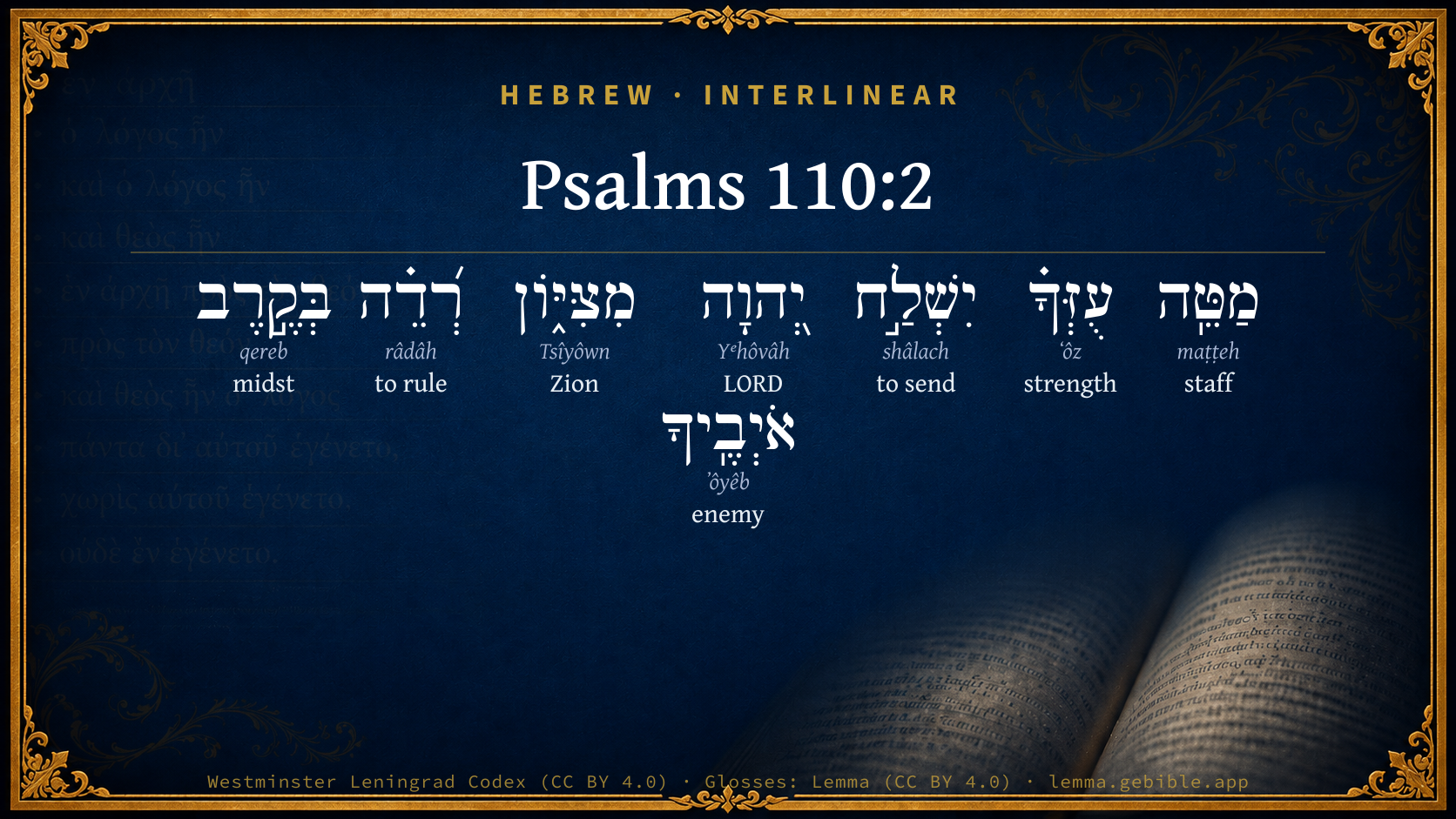
Hebrew (Westminster Leningrad Codex) Psalms 110:2 appears in the Hebrew Old Testament. The text above is from the Westminster Leningrad Codex. Each word links to its Strong’s number, a concise gloss, and parsing drawn from the Open Scriptures Hebrew Bible morphology. Click any word for its full Brown-Driver-Briggs (BDB) entry.
Download image
Cite this verse

Psalms 110:2 (World English Bible). Public Domain. Lemma interlinear Bible study tool, https://lemma.gebible.app/v/psalms/110/2.

Show BibTeX & RIS
BibTeX
RIS
English Translation
Yahweh will send forth the rod of your strength out of Zion. Rule in the midst of your enemies.
World English Bible · Public Domain
Download a study sheet

One document with this verse’s original text, its word-by-word gloss line, the meaning frame, cross-references with their text, attributed commentary, and full source and license credits — printable, and it pastes into notes with its structure intact.

This verse Autodidact and up

Study sheet (.html) Plain text (.txt)

A passage Seminary Student

Up to 50 verses in one chapter. A passage sheet keeps up to 6 commentary sources and 12 cross-references per verse, in the order this page ranks them, and says so on the sheet whenever that leaves anything out. Ask for a single verse and you get the Autodidact verse sheet above.

Everything on this page stays free to read, with no account — the sheet is a download of what is already on screen, not access to it.

Want to remove ads? Support Godless Engineer
Compare translations 3

The same verse in 3 English versions, stacked beneath the original-language interlinear above. Click any original word for its lexicon entry.

Each is an independent rendering of the whole verse — the interlinear is not word-aligned to these translations.

Highlighted words mark where these versions differ — a whole-verse word diff, not a word-by-word alignment.

  • World English Bible Public Domain
    Yahweh will send forth the rod of your strength out of Zion. Rule in the midst of your enemies.
  • King James Version Public Domain
    The LORD shall send the rod of thy strength out of Zion: rule thou in the midst of thine enemies.
  • unfoldingWord Literal Text CC BY-SA 4.0
    Yahweh will stretch out the scepter of your strength from Zion; rule in the midst of your enemies!

unfoldingWord Literal Text — © unfoldingWord, licensed CC BY-SA 4.0. Word-aligned USFM3 via Door43 (git.door43.org/unfoldingWord/en_ult).

Versions to compare (up to 4)

3 of 4 selected

Show all 18 translations

Every available English version of this verse, each an independent rendering of the whole verse.

  • World English Bible Public Domain
    Yahweh will send forth the rod of your strength out of Zion. Rule in the midst of your enemies.
  • Berean Standard Bible Public Domain
    The LORD extends Your mighty scepter from Zion: “Rule in the midst of Your enemies.”
  • Majority Standard Bible Public Domain
    The LORD extends Your mighty scepter from Zion: “Rule in the midst of Your enemies.”
  • King James Version Public Domain
    The LORD shall send the rod of thy strength out of Zion: rule thou in the midst of thine enemies.
  • American Standard Version (1901) Public Domain
    Jehovah will send forth the rod of thy strength out of Zion: Rule thou in the midst of thine enemies.
  • Revised Version (1885) Public Domain
    The LORD shall send forth the rod of thy strength out of Zion: rule thou in the midst of thine enemies.
  • Geneva Bible (1599) Public Domain
    The Lord shall send the rod of thy power out of Zion: be thou ruler in the middes of thine enemies.
  • Douay-Rheims (1899) Public Domain
    The Lord will send forth the sceptre of thy power out of Sion: rule thou in the midst of thy enemies.
  • Young's Literal Translation Public Domain
    The rod of thy strength doth Jehovah send from Zion, Rule in the midst of thine enemies.
  • Literal Standard Version CC BY-SA 4.0
    YHWH sends the rod of Your strength from Zion, || Rule in the midst of Your enemies.
  • Unlocked Literal Bible CC BY-SA 4.0
    Yahweh will hold out the scepter of your strength from Zion; rule among your enemies.
  • unfoldingWord Literal Text CC BY-SA 4.0
    Yahweh will stretch out the scepter of your strength from Zion; rule in the midst of your enemies!
  • Darby Bible Public Domain
    Jehovah shall send the sceptre of thy might out of Zion: rule in the midst of thine enemies.
  • World Messianic Bible Public Domain
    The LORD will send out the rod of your strength out of Zion. Rule among your enemies.
  • Webster's Bible Public Domain
    The LORD will send the rod of thy strength out of Zion: rule thou in the midst of thy enemies.
  • Free Bible Version CC BY-SA 4.0
    The Lord will expand your royal power from Zion; you will rule over your enemies.
  • Bible in Basic English Public Domain
    The Lord will send out the rod of your strength from Zion; be king over your haters.
  • JPS Tanakh (1917) Public Domain
    The rod of Thy strength the LORD will send out of Zion: 'Rule thou in the midst of thine enemies.'

Literal Standard Version (2020), Covenant Press — licensed CC BY-SA 4.0. Text via the HelloAO Bible API (eBible.org). Unlocked Literal Bible (unfoldingWord) — licensed CC BY-SA 4.0. Text via the HelloAO Bible API (eBible.org). unfoldingWord Literal Text — © unfoldingWord, licensed CC BY-SA 4.0. Word-aligned USFM3 via Door43 (git.door43.org/unfoldingWord/en_ult). Free Bible Version, Dr. Jonathan Gallagher — licensed CC BY-SA 4.0. Text via the HelloAO Bible API (eBible.org).

Word by word

More ways to search: Search by grammar → Find every occurrence → Compare this word →

Practice this passage: Drill this verse → Learn its vocabulary →

About this verse

These counts appear in no published source. They are computed here, from the morphology-tagged text and Lemma’s own curated glosses. What Lemma adds →

8
words
8
distinct lemmas
Wisdom
section

Shared distinctive vocabulary

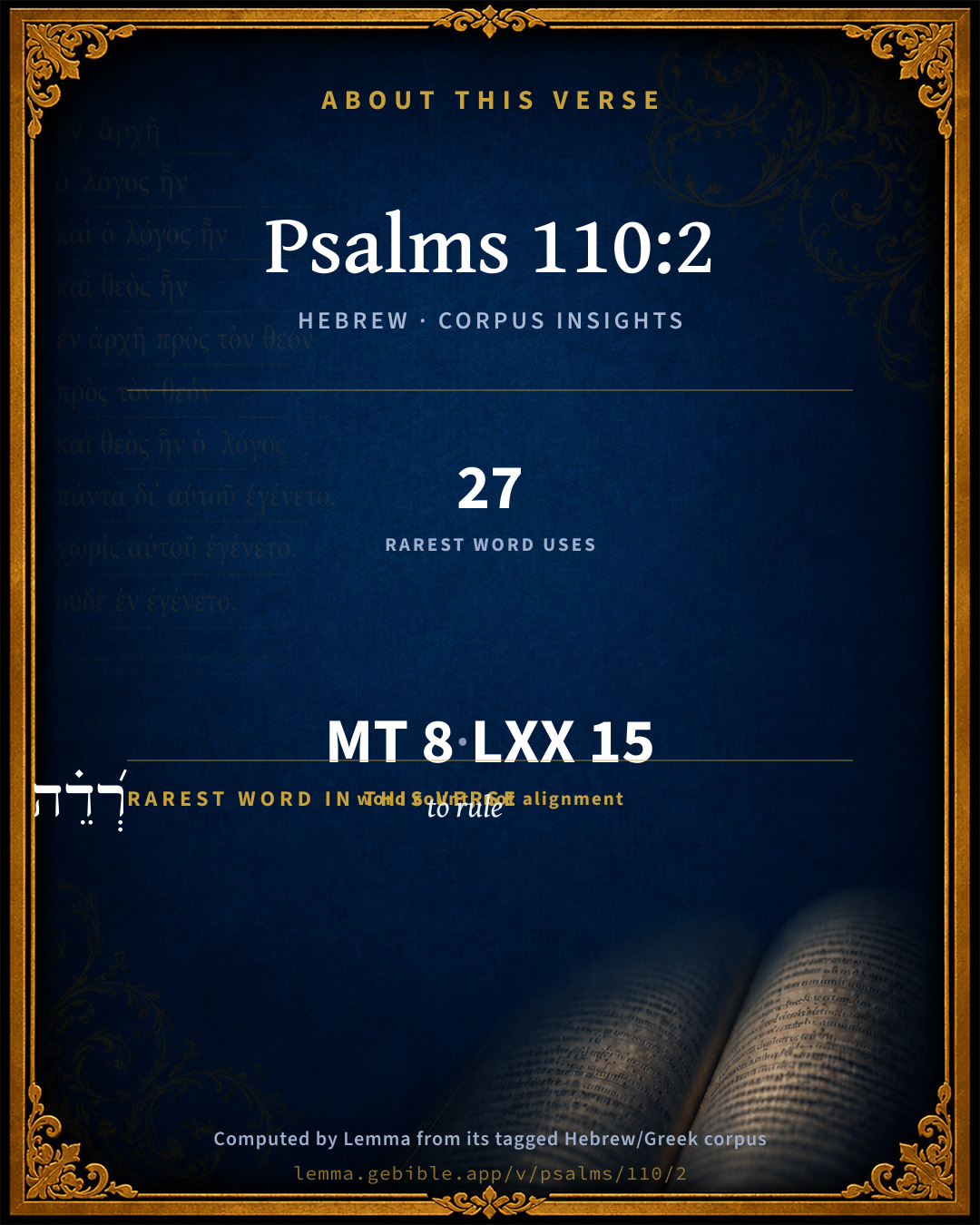
רְ֝דֵ֗ה to rule H7287 occurs in 25 verses of the Hebrew Bible. Also found in:

Grammatical profile

  • 3 verbs
  • 5 nouns

Verb forms

  • יִשְׁלַ֣ח Qal · Imperfect
  • רְ֝דֵ֗ה Qal · Imperative
  • אֹיְבֶֽיךָ Qal · Participle Active

Hebrew & Septuagint length

In English translation the verse runs 19 words from the Hebrew and 22 from the Septuagint (LXX English) — closely comparable.

A rough comparison of the two English renderings, which tokenize alike — not a word-level alignment.

Word counts can differ between the Hebrew and the Greek without any difference in meaning — e.g. the Hebrew direct-object marker אֵת has no separate Greek word, and Greek often adds the article ὁ.

In the original languages it is 8 Hebrew tokens and 15 Greek tokens — but the two are counted differently (Hebrew bundles its prefixes and suffixes into one token; the Greek is in lemma form), so that isn’t a like-for-like length.

Cross-references

17

Topical passages linked to Psalms 110:2 in the Treasury of Scripture Knowledge — connected by theme and wording, ordered by reader-vote popularity; previews shown in the World English Bible.

  • Jeremiah 48:17 All you who are round about him, bemoan him, and all you who know his name; say, How is the strong staff broken, the beautiful rod!
  • 2 Corinthians 10:4–5 for the weapons of our warfare are not of the flesh, but mighty before God to the throwing down of strongholds,
  • Matthew 28:18–20 Jesus came to them and spoke to them, saying, "All authority has been given to me in heaven and on earth.
  • Psalms 2:8–9 Ask of me, and I will give the nations for your inheritance, The uttermost parts of the earth for your possession.
  • Psalms 45:5–6 Your arrows are sharp. The nations fall under you, with arrows in the heart of the king's enemies.
  • Psalms 72:8 He shall have dominion also from sea to sea, From the River to the ends of the earth.
  • Exodus 8:5 Yahweh said to Moses, "Tell Aaron, 'Stretch forth your hand with your rod over the rivers, over the streams, and over the pools, and cause frogs to come up on the land of Egypt.'"
  • Psalms 22:28–29 For the kingdom is Yahweh's. He is the ruler over the nations.
  • Isaiah 2:3 Many peoples shall go and say, "Come, let's go up to the mountain of Yahweh, To the house of the God of Jacob; And he will teach us of his ways, And we will walk in his paths. For out of Zion the law shall go forth, And the word of Yahweh from Jerusalem.
  • Ezekiel 19:14 Fire is gone out of the rods of its branches, it has devoured its fruit, so that there is in it no strong rod to be a scepter to rule. This is a lamentation, and shall be for a lamentation.
  • Ezekiel 47:1 He brought me back to the door of the house; and, behold, waters issued out from under the threshold of the house eastward; (for the forefront of the house was toward the east;) and the waters came down from under, from the right side of the house, on the south of the altar.
  • Micah 4:2 Many nations will go and say, "Come, and let us go up to the mountain of Yahweh, And to the house of the God of Jacob; And he will teach us of his ways, And we will walk in his paths." For out of Zion will go forth the law, And the word of Yahweh from Jerusalem;
  • Acts 2:34–37 For David didn't ascend into the heavens, but he says himself, 'The Lord said to my Lord, "Sit by my right hand,
  • Romans 1:16 For I am not ashamed of the Gospel of Christ, for it is the power of God for salvation for everyone who believes; for the Jew first, and also for the Greek.
  • 1 Corinthians 1:23–24 but we preach Christ crucified; a stumbling block to Jews, and foolishness to Greeks,
  • 1 Thessalonians 2:13 For this cause we also thank God without ceasing, that, when you received from us the word of the message of God, you accepted it not as the word of men, but, as it is in truth, the word of God, which also works in you who believe.
  • 1 Peter 1:12 To them it was revealed, that not to themselves, but to you, did they minister these things, which now have been announced to you through those who preached the Gospel to you by the Holy Spirit sent out from heaven; which things angels desire to look into.

Cross-references courtesy of OpenBible.info (CC BY 4.0).

Hebrew and Greek witnesses Masoretic Hebrew ↔ Greek Septuagint

The same verse in the two great witnesses to the Old Testament, shown verse-for-verse.

You’re reading Greek Psalm 109 (Hebrew Psalm 110). The Septuagint counts the superscription, so verse numbers can differ from the Hebrew — chapter-level alignment, not verse-by-verse. Numbering follows Rahlfs.

These are two independent witnesses, not word-aligned to each other, and the Septuagint is shown in lemma (dictionary) form.

Hebrew Psalms 110:2 Masoretic · Westminster Leningrad Codex

מַטֵּֽה עֻזְּךָ֗ יִשְׁלַ֣ח יְ֭הוָה מִצִּיּ֑וֹן רְ֝דֵ֗ה בְּקֶ֣רֶב אֹיְבֶֽיךָ

Yahweh will send forth the rod of your strength out of Zion. Rule in the midst of your enemies.

World English Bible · Public Domain

Greek LXX Greek Psalm 109:2 Septuagint · lemma form

ῥάβδος δύναμις σύ ἐκ ἀποστέλλω κύριος ἐκ σιων καί κατακυριεύω ἐν μέσος ὁ ἐχθρός σύ

The Lord shall send out a rod of power for you out of Sion: rule you in the midst of your enemies.

LXX2012 (modern English Septuagint) · Public Domain

On this verse, The Treasury of David discusses the Septuagint’s reading. Read the note in Commentary ↓

Hebrew: Westminster Leningrad Codex (CC BY 4.0). Greek: Septuagint (public domain); English from LXX2012 (modern English Septuagint) (Public Domain). How the Septuagint differs from the Hebrew →

Commentary

Notes on Psalms 110:2 from classic Christian and Jewish commentators (each source and its license shown beneath its notes). The classic Christian expositions comment on the surrounding passage and are grouped to its opening verse, so a note may address several verses; the Jewish commentaries on the Tanakh (Rashi and others) are per-verse, so they appear only where the commentator wrote on this verse.

Lemma curates 59 commentaries, every one of them public domain or Creative Commons licensed, each selected and text-cleaned for this edition rather than reprinted as found. About our sources →

Trapp's Complete Commentary

John Trapp

Psa 110:2 The LORD shall send the rod of thy strength out of Zion: rule thou in the midst of thine enemies.

Ver. 2. The Lord shall send the rod of thy strength] That is, the gospel, that sceptre of Christ’s kingdom, that power of God to salvation, unto as many as believe, mighty through God to work wonders, 2Co 10:5 Act 20:32, even the preaching of Christ’s cross.

Out of Zion] For salvation is of the Jews, Joh 4:22 Isa 2:3 Mic 4:1-2 Abide ye in Jerusalem till, &c., Act 1:8

Rule thou in the midst of thine enemies] Among Jews, Pagans, Turks, Papagans; those that will not bend, let them break; those that will not stoop to thy government, let them feel thy power, Psa 45:5.

John Trapp, A Commentary or Exposition upon All the Books of the Old and New Testament (1647–1656) — public domain. Text from a community e-Sword module.

The Biblical Illustrator

Joseph S. Exell

Psa_110:2-3

The Lord shall send the rod of Thy strength out of Zion: rule Thou in the midst of Thine enemies.

Messiahs sceptre and kingdom

The kingship of Christ is a twofold kingship. It is essential and it is hereditary. The one belongs to Him as God, the other belongs to Him as Mediator. The first is founded upon the Divinity of His Person, the second upon the dignity of His work. Hence the first is eternal, the second conferred.

I. The sceptre of Christ, the power which wields it, and the place of its appearing.

1. The sceptre is the symbol of royalty and is of even greater antiquity than the crown. Homer speaks of it as that sacred rod of kings. Christs sceptre is His Gospel. It is the Word of the Lord which is powerful, a Gospel which is the power of God unto salvation, Jehovahs rod of strength, mighty for the pulling down of Satans strongholds.

2. This sceptre is wielded by no feeble hand. To subdue the will of an alien world required an agency yet more powerful than that which created the universe and will raise the dead. Its sentiments, prejudices, habits, interests, pleasures, sins, form a positive quantity of antagonism. Hence the conversion of a soul from Satan to God is a miracle of miracles. The humanly impossible becomes the Divinely accomplished. The Holy Ghost wields the sceptre.

3. This sceptre was to appear out of Zion, and from thence by gradual conquests extend its influence over the entire earth. On Zion the apostles received their commission to preach; there they remained until power came upon them; there the first Gospel sermon was preached, and at the first swaying of this sceptre three thousand souls were added to the Lord; there the first Gospel Church was founded, almost under the shadow of the recent cross, and from thence this mystical sceptre went forth into all lands.

II. The establishment of His kingdom. The psalmist describes its position and its people.

1. Its position.

(1) It is a position of conflict. Rule Thou in the midst of Thine enemies. In heaven He rules in the midst of friends. All the angels of God do worship Him. Here His kingdom is a beleaguered kingdom.

(2) It is a position of conquest. He rules. The sceptre has civilized where it has not converted men. It has quickened the conscience and entered into the life of nations. Education, liberty, philanthropy, and the sanctities of domestic life have resulted from its benign rule.

(3) It is a position of continuance. The positions thrown up against it are airy fabrics. Reared by vanity, they will be overthrown by time.

2. Its people.

(1) Their disposition--willing.

(2) Character--holy.

(3) Influence. The meaning of the similitude is that the people of Christ, full of a young and ardent vigour, should appear upon the earth in multitudinous number and fertilizing influence as the drops of dew at the dawn of day. (E. T. Carrier.)

The Biblical Illustrator, edited by Joseph S. Exell (c. 1880s–1900s) — public domain. Text from a community e-Sword module.

Joseph Benson's Commentary

Psa 110:2. The Lord shall send — Or, send forth, the rod of thy strength —

Thy strong or powerful rod: that is, thy sceptre or kingly power, Isa 10:24; Jer 48:17. But then, as the kingdom of Christ is not carnal, or of this world, Joh 18:36, but spiritual; so this rod or sceptre is nothing else but his word or gospel, published by himself, or by his apostles and ministers, and accompanied with his Spirit, by which the Messiah set up and established his kingdom: see Isa 2:3; Isa 11:4; Mic 4:2; 2Co 10:4; 2Th 2:8. Hence this gospel is called the word of the kingdom, Mat 13:19; and the power of God, Rom 1:16. David, having spoken of the Messiah, Psa 110:1, in this verse addresses his speech to him. Out of Zion — From Jerusalem, which is frequently understood by the name of Zion. Here the kingdom of the Messiah was to be first established, according to the predictions of the prophets, and from hence the rod of his strength, the gospel word, was to be sent forth into all the parts and kingdoms of the world, to bring in the Gentiles, which also the prophets had foretold, as Isa 2:3, and in divers of the foregoing Psalms, as has been already frequently observed and proved. Rule thou in the midst of thine enemies — Or, Thou shalt rule, the imperative being put for the future, as is often the case elsewhere. Christ rules partly by his grace, converting some, and setting up his kingdom in their hearts, that kingdom which is righteousness, peace, and joy in the Holy Ghost; and partly by his powerful providence, whereby he defends his church and people, and subdues and punishes all their adversaries; in the midst of whom he is here said to rule, to signify that, though they should do what in them lay to oppose his kingdom, they should not be able to hinder the erection and establishment of it, but should bring ruin upon themselves by opposing it.

Joseph Benson's Commentary on the Old and New Testaments (1811–1818) — public domain. Text from a community e-Sword module.

J. A. Alexander on Psalms

Joseph Addison Alexander

2. (Psa 110:2) The rod of thy strength will Jehovah send forth from Zion; rule thou in the midst of thine enemies. The Psalmist now addresses the Messiah directly. The idea latent in the figures of the first verb, namely that of power, is here expressed. The word translated rod never means a sceptre, as the synonymous term sometimes does, from which it is distinguished by Ezekiel (Eze 19:11), but a rod of correction and of chastisement. See Jer 48:12, and compare Isa 9:4; Isa 10:5; Isa 10:15; Isa 14:4-5, Eze 7:10-11. It is here named as the instrument with which the foes are to be subdued. Compare Psa 2:9. There may be an allusion to the rod of Moses. See Exo 14:16; Exo 14:21, and compare Isa 10:24; Isa 10:26. The rod of thy strength, or thy rod of strength, thy strong rod, or rather the rod by means of which thine own strength is to be exerted. As this strength is not human but divine, it is said to be sent forth by Jehovah out of Zion, considered as his earthly residence, the seat of the theocracy. See above, on Psa 20:2. The verb translated rule is not applied in usage to a peaceful reign, but to coercive or compulsory dominion over conquered enemies. See above, on Psa 49:14, and compare Num 24:19. The imperative here involves prediction in its strongest form. As if he had said, All is ready for the conquest; there is no resistance; there can be no doubt of the result; rule, therefore, in the midst thine enemies, i.e. over the very enemies by whom thou art surrounded, and who threatened to dethrone thee.

Joseph Addison Alexander, The Psalms Translated and Explained (1850) — public domain. Text from a community e-Sword module.

Tyndale Open Study Notes

Tyndale Open Resources

110:2-3 The kingdom will expand and increase, beginning from Jerusalem, until all enemies are conquered.

Tyndale Open Study Notes — © Tyndale Open Resources, licensed CC BY-SA 4.0. Text via the HelloAO Bible API.

Geneva Bible (1599)

Geneva Bible translators

And thence it shalt stretch through all the world: and this power chiefly standeth in the preaching of his word.

Geneva Bible (1599) marginal notes — public domain. Text via Bolls.life.

Adam Clarke's Commentary

Verse 2. The rod of thy strength] The Gospel - the doctrine of Christ crucified; which is the powerful sceptre of the Lord that bought us; is quick and powerful, sharper than any two-edged sword; and is the power of God to salvation to all them that believe.

The kingdom of our Lord was to be founded in Zion, and thence, by gradual conquests, to be extended over the whole earth. It was in Zion the preaching of the Gospel first began; and it is by the Gospel that Christ rules, even in the midst of his enemies; for the Gospel extends a moralizing influence over multitudes who do not receive it to their salvation.

Adam Clarke's Commentary on the Bible (1810–1826) — public domain. Text from a community e-Sword/MySword module.

John Calvin's Commentaries

2 Jehovah shall send out of Zion the scepter of thy power. The Psalmist not only confirms, in different terms, what he stated above, but also adds, that Christ’s kingdom shall be vastly extended, because God would make his scepter stretch far and wide. David did indeed render not a few of the surrounding nations tributaries to him, but still his kingdom, when contrasted with other monarchies, was always confined within narrow limits. There is in the words an implied contrast, as if he had said, that Christ should not reign as King upon mount Zion only, because God would cause his power to extend to the remotest regions of the earth. And for this reason it is denominated the scepter of his power, and how astonishing was it, that though the whole world was leagued in opposition to Christ’s kingdom, it yet continued to spread and prosper. In a word, David here animates the hearts of the godly against being dispirited by the foolhardy attempts on the part of those who presume to introduce discord and disorder into the kingdom of Christ; for he shows them that God will put forth his invincible power for the maintaining of the glory of his sacred throne. What time, then, our minds are agitated by various commotions, let us learn confidently to repose on this support, that however much the world may rage against Christ, it will never be able to hurl him from the right hand of the Father. Moreover, as he does not reign on his own account, but for our salvation, we may rest assured that we will be protected and preserved from all ills under the guardianship of this invincible King. Doubtless our condition in this world is connected with many hardships; but as it is the will of God that Christ’s kingdom should be encompassed with many enemies, and that too with the design of keeping us in a state of constant warfare, it becomes us to exercise patience and meekness; and assured of God’s aid, boldly to set at nought the rage of the whole world. From this passage we are instructed as to the calling of the Gentiles. Because, if God had not told us in this place respecting the extension of Christ’s kingdom, we would not this day have been classed among his people. But as the wall is broken down, (Ephesians 2:14) and the gospel promulgated, we have been gathered together into the body of the Church, and Christ’s power is put forth to uphold and defend us.

John Calvin's Commentaries (1540-1563) — public domain. Text from the Calvin Translation Society English edition (1840s-50s) via the Christian Classics Ethereal Library (ccel.org). Calvin's coverage is partial (roughly two-thirds of the Bible); uncommented books and verses are honest gaps, never fabricated. The 19th-century editor's footnotes and remarks are omitted so the notes are faithfully Calvin's own voice.

Ellicott's Commentary for English Readers

(2) Send.—The verb should be here rendered stretch, as in Gen_22:10; Gen_48:14, and frequently of stretching out the hand, often with hostile intent. The poet here speaks in his own person, addressing the King, to whom the oracle has just been announced.

Rod of thy strength—i.e., the sceptre, which is the emblem of royal power and sway. (See Jer_48:17.) The word “staff” is different from that rendered “rod,” in Psa_2:9; and the image is not, as there, necessarily of a weapon of destruction, but only of kingly rule, as in Psa_45:6.

Rule thou . . .—It is better to take these words as a quotation, and understand them as spoken of Jehovah. In the picture before us the Divine King seats the earthly monarch by His side, and taking his sceptre from his hand, stretches it in token of the wide empire he is to administer from Zion, where they sit enthroned, over the surrounding nations, and bids him assume the offered sway, in spite of the foes that surround him at present. The expression “in the midst,” instead of “over,” implies the condition under which the sovereignty was to be assumed, as also does the rest of the psalm, proceeding to describe the wars by which ultimate triumph over the hostile tribes would be secured.

A Bible Commentary for English Readers, edited by Charles John Ellicott (1878–1897) — public domain. Text from a community e-Sword module.

The Cambridge Bible for Schools and Colleges

gen. ed. J. J. S. Perowne

2. The sceptre of thy strength shall Jehovah stretch forth (or, send forth) out of Zion] The poet speaks, expanding the oracle. The rod or sceptre is the symbol of authority and power, the instrument of chastisement. (Cp. Isa_10:24; Isa_10:26; and Psa_2:9, though the Heb. word there is different.) Jehovah wields it on the king’s behalf. “He giveth strength unto his king” (1Sa_2:10). For the phrase rod of thy strength, cp. Jer_48:17; Eze_19:12; Eze_19:14.

out of Zion] The capital of the new kingdom. Cp. Psa_2:6.

rule thou in the midst of thine enemies] Supply saying before this clause. Jehovah speaks. The command is virtually a promise. Though enemies surround the king on every side, he is fearlessly to assume his sovereignty, and victoriously to exercise it. The word for ‘rule’ is used of Solomon in 1Ki_4:24; cp. also Num_24:19; Psa_72:8 (A.V. have dominion).

The Cambridge Bible for Schools and Colleges (gen. ed. J. J. S. Perowne; Cambridge University Press, 1878–1918) — public domain. Text from a community e-Sword module.

John Gill's Exposition

The Lord shall send the rod of thy strength out of Zion,.... His royal and powerful sceptre, called the sceptre of righteousness, Psa 45:6 and is no other than the Gospel, the power of God unto salvation; and which is mighty through him, for the reducing souls to the obedience of Christ; when it comes with power, and works effectually. This was first preached in Zion, or Jerusalem, and went out from thence into all parts of the world; the first ministers of it had their commission there, and were sent from thence to publish it all over the world; see Isa 2:3, by means of which the kingdom of Christ was set up and spread in the world; with this rod and sceptre in his hand, he went forth with his ministers, conquering and to conquer, Rev 6:2. The Jews (r) own this rod to be a rod in the hand of the Messiah, which they seem to understand literally; and have a fabulous notion of its being the same that Jacob, Judah, Moses, Aaron, David, and so every king of Judah, had, down to the destruction of the temple: the Targum in the king's Bible is,

"the Word of the Lord shall send, &c.''

the essential Word.

Rule thou in the midst of thine enemies; or, "thou shalt rule", as the Targum and Arabic version; in the hearts of those who, in their unregenerate state, are enemies: but the arrows of his word being sharp in them, they are brought to submit to him; the everlasting doors are caused to open; he enters in, takes possession of their hearts, and rules there. Or this may be understood of his church in the world, which is his kingdom, and lies surrounded with enemies on all hands; but, in spite of them, and all their opposition, he will support his kingdom and interest.

(r) Jelammedenu apud Yalkut in oc. Bemidbar Rabba, fol. 224. 1. Vid. Bereshit Rabba, fol. 75. 1.

John Gill's Exposition of the Whole Bible (1746–1763) — public domain (CC PDM 1.0). Text via the HelloAO Bible API.

Albert Barnes' Notes on the Bible

The Lord shall send the rod of thy strength out of Zion - The scepter of thy power; that with which thou shalt rule. It will be given to thee by Yahweh; and it will be given to thee, as it were, “out of Zion;” that is, as proceeding from the church, and as derived from that. It will be an appointment connected with the church, and will be “as if” the church had conferred it on thee. The idea is, that the Messiah would receive, as it were, his designation, authority, commission, power from the church. He would spring from it Isa 11:1; would act for it; would do what was needful for its good; would wield the power which properly belongs to the church on the earth. Compare the notes at Psa 2:9.

Rule thou in the midst of thine enemies - Set up thy power over them, and reign in them. This is a commission to set up a kingdom “in the very midst” of those who were his enemies; in the hearts of those who had been and were rebellious. His kingdom is set up not by destroying them, but by “subduing” them so that they become his willing servants. They yield to him, and he rules over them. It is not here a commission to cut them off, but one much more difficult of execution - to make them his friends, and to dispose them to submit to his authority. Mere “power” may crush people; it requires more than that to make rebels willingly submissive, and to dispose them voluntarily to obey.

Albert Barnes' Notes on the Bible (1834–1885) — public domain. Text from a community e-Sword/MySword module.

Matthew Poole's English Annotations

Send; or, send forth, into the world. The rod of thy strength; thy strong or powerful rod, by a usual Hebraism. And the rod is put for his sceptre, or kingly power, as it is Isa 10:24 Jer 48:17; Eze 7:10,11; 19:11,12. But as the kingdom of Christ is not carnal, or of this world, Joh 18:36, but spiritual; so this rod or sceptre is nothing else but his word published by himself, or by his apostles and ministers, and accompanied with his Spirit, by which the Messias did his great exploits, and set up and established his kingdom, converting some of his enemies, and confounding and destroying others of them, by that same instrument, as is manifest by comparing Isa 2:3; 11:4; Mic 4:2; 2Co 10:4; 2Th 2:8. Hence this word is called the word of the kingdom, Mat 13:19, and the power of God, Rom 1:16. David having spoken of the Messias, Psa 110:1, now turneth his speech to him. Out of Zion; from Jerusalem, which is frequently understood by the name of Zion, which was an eminent and venerable part of it, as Psa 48:13; 87:2; 102:13,16, &c.; where the sceptre of the Messias was first to be established according to the predictions of the prophets, Psa 2:6,8; 48:3; Isa 2:3, &c.; to which the event exactly answered, Luk 24:47; Act 1:4; 2:1,2, &c.; and from whence it was to be sent forth into all the parts and kingdoms of the world, to bring in the Gentiles, which also the prophets had foretold, as Isa 2:3, and in divers of the foregoing Psalms, as hath been already frequently observed and proved.

Rule thou; thou shalt rule; the imperative being here put for the future, as it is Gen 12:12; Psa 37:27, and oft elsewhere. For this is not a command, but a prediction or a promise that he shall rule; which he doth partly by his grace, converting some, and so ruling their hearts by his word and Spirit, and subduing their lusts in them, and their external enemies for them; and partly by his powerful providence, whereby he defends his church and people, and subdues and punisheth all their adversaries.

In the midst of thine enemies; who shall see it, and do what they can to oppose thy dominion, but shall never be able to hinder it, but shall split themselves against it.

Matthew Poole's English Annotations on the Holy Bible (1683–1685) — public domain. Text from a community e-Sword/MySword module.

The Treasury of David

Charles H. Spurgeon

Ver. 2. The LORD shall send the rod of thy strength out of Zion. It is in and through the church that for the present the power of the Messiah is known. Jehovah has given to Jesus all authority in the midst of his people, whom he rules with his royal sceptre, and this power goes forth with divine energy from the church for the ingathering of the elect, and the subduing of all evil. We have need to pray for the sending out of the rod of divine strength. It was by his rod that Moses smote the Egyptians, and wrought wonders for Israel, and even so whenever the Lord Jesus sends forth the rod of his strength, our spiritual enemies are overcome. There may be an allusion here to Aaron's rod which budded and so proved his power; this was laid up in the ark, but our Lord's rod is sent forth to subdue his foes. This promise began to be fulfilled at Pentecost, and it continues even to this day, and shall yet have a grander fulfilment. O God of eternal might, let the strength of our Lord Jesus be more clearly seen, and let the nations see it as coming forth out of the midst of thy feeble people, even from Zion, the place of thine abode.

Rule thou in the midst of thine enemies as he does whenever his mighty sceptre of grace is stretched forth to renew and save them. Moses' rod brought water out of the flinty rock, and the gospel of Jesus soon causes repentance to flow in rivers from the once hardened heart of man. Or the text may mean that though the church is situated in the midst of a hostile world, yet it exerts a great influence, it continues to manifest an inward majesty, and is after all the ruling power among the nations because the shout of a king is in her midst. Jesus, however hated by men, is still the King of kings. His rule is over even the most unwilling, so as to overrule their fiercest opposition to the advancement of Iris cause. Jesus, it appears from this text, is not inactive during his session at Jehovah's right hand, but in his own way proves the abiding nature of his kingdom both in Zion and from Zion, both among his friends and his foes. We look for the clearer manifestation of his almighty power in the latter days; but even in these waiting times we rejoice that to the Lord all power is given in heaven and in earth.

Ver. 2. The rod of thy strength, or rather, "The sceptre of thy might", i.e., of "Thy kingly majesty, "as in Jer 48:17; Eze 19:14. Chrysostom plays upon the word rabdov (LXX) as a rod of strength and consolation, as in Ps 23:4; a rod of chastisement, as in Ps 2:9, 1Co 4:21; a symbol of kingly rule, as in Isa 11:1, Ps 45:6. It was by this rod, he says, that the disciples wrought when they subdued the world, in obedience to the command, "Go and make disciples of all nations"; a rod far more powerful than that of Moses, "for that divided rivers, this brake in pieces the ungodliness of the world." And then with profound truth he adds, "Nor would one err who should call the Cross the rod of power; for this rod converted sea and land, and filled them with a vast power. Armed with this rod, the Apostles went forth throughout the world, and accomplished ali that they did, beginning at Jerusalem." The Cross, which to men seemed the very emblem of shame and weakness, was, in truth, the power of God. J.J. Stewart Perowne.

Ver. 2. The rod of thy strength. The power of this sceptre and word of Christ appeareth greatly in the saving of his elect... So mightily hath it prevailed and overruled the minds of men against nature, and reason, and learning, and wisdom, and custom, and whatsoever else is strong to hold men in the liking of those things which they have once received and followed, as that they have been content to renounce the devotions which their forefathers had so long embraced; to cast away the gods which themselves had devoutly served; to stop their ears against the contrary motives and persuasions of father and mother; to harden their hearts against the kneeling and weeping and embracing of wife and children; to forego their honours, and inheritances, yea, and their lives also, rather than lose that peace and joy of heart which the same word of Christ had ministered unto them. Yea, how strange is it, and how greatly doth it commend the power of this word, to see weakness hereby prevailing against strength, simplicity against policy; to see the lamb standing without fear before the lion, the gentle turtle before the devouring kite; women and children and weaklings before the great monarchs and potentates of the world, not fearing their threatening words, nor dreading their tormenting hands, but boldly uttering the word of their testimony (Re 12:11), in despite of all their fury, and never yielding to shrink from it, by anything that could be devised against them. The word of God in their hearts gave them courage and resolution and strength to go through fire and water, to bear all adventures of wind and weather, and howsoever they seemed to be beaten against the rocks, yet they escaped shipwreck, and arrived safe at the haven of their desire. Robert Abbot.

Ver. 2. Out of Zion. We need not say much about how the omniscience of God is displayed in the wonderful fact, that in the very land of the covenantin the very midst of that people who rejected and crucified the Saviour, the first church of Christ on earth was established. What would cavillers and blasphemers have said, had it been otherwise? had the Christian community been formed in any of the heathen countries? Would it not have been considered as a fiction of the idolatrous priests? Israel scattered among the nations, and the Church of Christ having begun in Zion at Jerusalem, are the most wonderful and enduring monuments, and incontestable witnesses of the truth of Christianity. Benjamin Weiss.

Ver. 2. From his ruling in the midst of enemies we learn that the kingdom of Christ in this life is the kingdom of the Cross, of persecutions, and of dangers. Enemies are never wanting, not only external adversaries, but also spiritual and eternal; and therefore great sorrow is always awaiting the godly. In this most terrible conflict, however, their minds are lifted up by this consolation, viz., that the rod of the kingdom is strong, and cannot be overcome by any force or power; yea, more, albeit assailed with contendings and all kinds of storms, it will continue stable, firm, and perpetual: and there will always be a Church among men, which will fear and worship this King; because the experience of all the ages teaches, that this kingdom has the more grown and increased the more it has been opposed, according to that saying of Basil, en taiv yliqesi mallon yallei h ekklhsia, the Church flourishes more by tribulation. Rivetus.

Ver. 2. Rule thou in the midst of thine enemies. Set up thy power over them and reign in them. This is a commission to set up a kingdom in the very midst of those who were his enemies; in the hearts of those who had been and were rebellious. His kingdom is set up not by destroying them, but by subduing them, so that they become his willing servants. They yield to him, and he rules over them. It is not here a commission to cut them off, but one much more difficult of execution, to make them his friends, and to dispose them to submit to his authority. Mere power may crush men; It requires more than that to make rebels willingly submissive, and to dispose them voluntarily to obey. Albert Barnes.

Ver. 2.

1. What is that rod? The gospel (Illustrated by Moses' rod).

2. Who sends it? "The Lord."

3. Whence it comes? Out of the church of God.

4. What is the result? Jesus reigns.

Psalms 110:3*

Charles H. Spurgeon's The Treasury of David (1869–1885) — public domain. Psalms only. Text from a community e-Sword/MySword module.

Whedon's Commentary on the Bible

Daniel D. Whedon

2. The Lord shall send—Jehovah shall send, not Adonoh. It declares what Jehovah will do through Adonah, or what Adonah or Messiah shall do in Jehovah’s name.

Rod of thy strength—The sceptre of Messiah, representing the strength and sovereignty of Jehovah’s government.

Out of Zion—The Church, the seat both of theocratic and Messianic dominion. Here the gospel was planted, and from hence it was spread abroad among the nations. Luk_24:46-47; Acts 2. The Jews referred this verse to Messiah. “According to Bereshith Rabba, on Gen_38:18, the sceptre of the kingdom which the Lord sends out of Zion is the King Messiah, of whom Isaiah (Isa_11:1,) speaks: ‘There shall go forth a rod out of the stem of Jesse.’ So according to Bammidbar Rabba, ‘the rod of Aaron is preserved that it may be in the hand of King Messiah, which is the meaning of the rod of strength.’”—Perowne.

Rule thou—Have thou dominion. The address is to Adonah, Christ, and the imperative form of the verb, whether uttered by Jehovah or as a prediction of the psalmist, expresses the certain investiture of divine government in Christ, as in Psa_2:7-8; Psa_2:12; Psa_72:8.

In the midst of thine enemies—Christ’s willing people are not associated in one compact nationality, or commonwealth, defined by geographical limits, but dispersed throughout the world and intermixed with the enemies of the cross. Still he maintains his Church amidst the hostile nations, ruling the latter with a rod of iron, as in Psa_2:7-8; Psa_2:12; Psa_72:8

Daniel D. Whedon (gen. ed.), Commentary on the Old and New Testaments (1874–1909) — public domain. Text from a community e-Sword module.

The Pulpit Commentary

The Lord shall send the rod of thy strength out of Zion. "The rod of thy strength," or "thy strong scepter," is the same thing as "thy ruling power". (see Jer_48:17 Eze_19:11) The ruling power of Messiah was to go forth from Jerusalem. (Act_1:4-8 Act_2:1-4) Rule thou in the midst of thine enemies. Ac cording to Professor Cheyne, these are the words of Jehovah a continuation of the address in ver. 1; but they are more gene rally regarded as the words of the writer of the psalm, i.e., according to our exegesis, of David. He calls on the Messiah to take his power and reign.

God in world-success.

Messiah does but illustrate universal human experience. He is successful, but it is God who gives him his success. "The Lord shall send the rod of thy strength out of Zion." This inmost truth of things is too often disregarded. The pious soul fully recognizes it and rejoices in it. His refrain in all life"s toils and successes is this, "The Lord of hosts is with us, the God of Jacob is our Refuge.

I WORLD-SUCCESS IS LARGELY DUE TO GOOD FORTUNE. Some men seem born to succeed. We can find no reason, in either their ability or their character, why they should succeed when others fail. We speak of their "good luck." Take any department of life, business, or profession, and we plainly see that some are the children of fortune. They seem born favorites, and they are the world"s favorites as long as they live. This may, indeed, be an incorrect view to take; we only note that it is the common and usual view. There may be reasons, in character and in entrusted mission, which are simply beyond our discernment and appraisement. Now men may look on the success of Messiah, and say of it, "It is only a piece of good fortune. He just happened to fit to the needs of his age.

II WORLD-SUCCESS IS LARGELY DUE TO ENERGY. Many a man, by the force of his own vitality, and by the concentration of his powers, has mastered disabilities and difficulties, and gained for himself a place. The energy that is quick-witted to seize opportunities, skilful to use opportunities, and persistent in carrying out resolves, seldom fails to win world-success. And it may be said of the success of Messiah It is sufficiently explained by the vital force that was in him, by his energy and enterprise. The boast of Nebuchadnezzar has many and many a time been repeated since his day, "Is not this great Babylon which I have builded?

III WORLD-SUCCESS IS REALLY DUE TO DIVINE PERMISSION, ARRANGEMENT, AND AID. But the discernment of this comes only to those whose eyes have been spirituality opened. The success of Messiah really has explanation, "The Lord sends the rod of his strength out of Zion.

1. There is no such thing as good fortune. Everything stands in Divine adjustment. A man"s "destiny" is the arrangement of infinite wisdom.

2. Back of a man"s energy is the Divine vitalizing. A man"s bodily health and mental power are absolutely in God"s hands, and are God"s providings. Man plans, but he must lean on God for power to execute his plans. God may say, "This night shall thy soul be required of thee. R.T.

The Pulpit Commentary (1880–1919), ed. H.D.M. Spence-Jones & Joseph S. Exell — public domain. Text from a community e-Sword module.

John Wesley's Explanatory Notes

The rod - Thy strong or powerful rod, and the rod is put for his scepter, or kingly power: but as the kingdom of Christ is not carnal, but spiritual, so this scepter is nothing else but his word. Zion - From Jerusalem.

John Wesley, Explanatory Notes Upon the Whole Bible (1754–1765) — public domain. Text via the GEBible commentary corpus.

unfoldingWord translationNotes

Door43 World Missions Community

General Information:

David continues speaking to the king.

Yahweh will hold out the scepter of your strength

Here David speaks of Yahweh extending the area that the king rules as holding out his scepter. AT: "Yahweh will extend the area over which you powerfully rule" (See: Assumed Knowledge and Implicit Information)

rule among your enemies

"King, rule among your enemies." This is spoken to the king as a command.

of their own free will

"by their own choice." This means that they will chose to follow the king.

on the day of your power

This refers to the day that the king will lead his armies into battle. This can be stated clearly. AT: "on the day that you lead your armies into battle" (See: Assumed Knowledge and Implicit Information)

from the womb of the dawn ... like the dew

David describes the dew as a baby to whom the dawn gives birth. AT: "in the morning ... like the dew" (See: Personification)

from the womb of the dawn your youth will be to you like the dew

David is telling the king that he will have youthful strength each morning by comparing it to how the dew appears early each morning. AT: "each morning you will be filled with youthful strength to sustain you just like each morning the dew appears to water and sustain the earth" (See: Metaphor)

translationWords

scepter

Zion

people group

holy

power

womb

like

unfoldingWord translationNotes — © Distant Shores Media and the Door43 World Missions Community, licensed CC BY-SA 4.0. Source: git.door43.org/Door43/en_tn.

Rashi

Rabbi Shlomo Yitzchaki (Rashi)

The staff of [This is] an expression of support, as (above 105:16): “every staff of bread.”

The staff of your might the Lord will send from Zion When you return from the war and your men are weary and in pursuit, the Lord will send you Malchizedek, king of Salem, to bring out bread and wine (Gen. 14:14).

rule in the war.

in the midst of your enemies safely.

Rashi on the Tanakh — English translations: “The Judaica Press complete Tanach with Rashi, translated by A. J. Rosenberg” (CC BY 4.0); “Pentateuch with Rashi's commentary by M. Rosenbaum and A.M. Silbermann, 1929-1934” (public domain); “The Metsudah Tanach series, Lakewood, N.J” (CC BY 4.0); and “The Book of Joshua, Metsudah Publications, 1997” (CC BY 4.0). Text via Sefaria.

Lesson kit

Teaching starters — assembled from the data on this page, not authored interpretation. Every prompt links to the verse data it draws on. Edit before teaching.

Psalms, in the Wisdom, opens this verse with 8 words (8 distinct Hebrew lemmas). Its most distinctive word is râdâh (“to rule”). A historical commentator’s framing appears above. Read the whole chapter for the surrounding context.

Discussion questions

  1. How does “to rule” (râdâh) shape what this verse is saying?
  2. Genesis 1:26 shares the word «to rule» with this verse. How do the two illuminate each other?
  3. These translations render this verse differently; the difference is in the English rendering, not the original. What questions does that raise?
  4. The verb «יִשְׁלַ֣ח» is Qal Imperfect. How does its form color the action?
  5. Reading how Trapp's Complete Commentary and The Biblical Illustrator read this verse, where do the two commentators agree and where do they part?

Things to notice

Reading settings

Reading text

Shown beneath each verse's original-language words.

Old Testament
Old Testament edition

Read the OT as the Masoretic Hebrew (MT) or the Greek Septuagint (LXX).

English shown for the Greek Septuagint (in the Hebrew ↔ Greek comparison).

Comparing translations? Open the Compare panel on any verse page to stack up to four side by side.