

Luke 10:11
Greek (Tischendorf 8th ed.) Luke 10:11 appears in the Greek New Testament. The text above is from the Tischendorf 8th edition. Each word links to its Strong’s number and a concise gloss. Click any word for its full Thayer’s Greek Lexicon entry.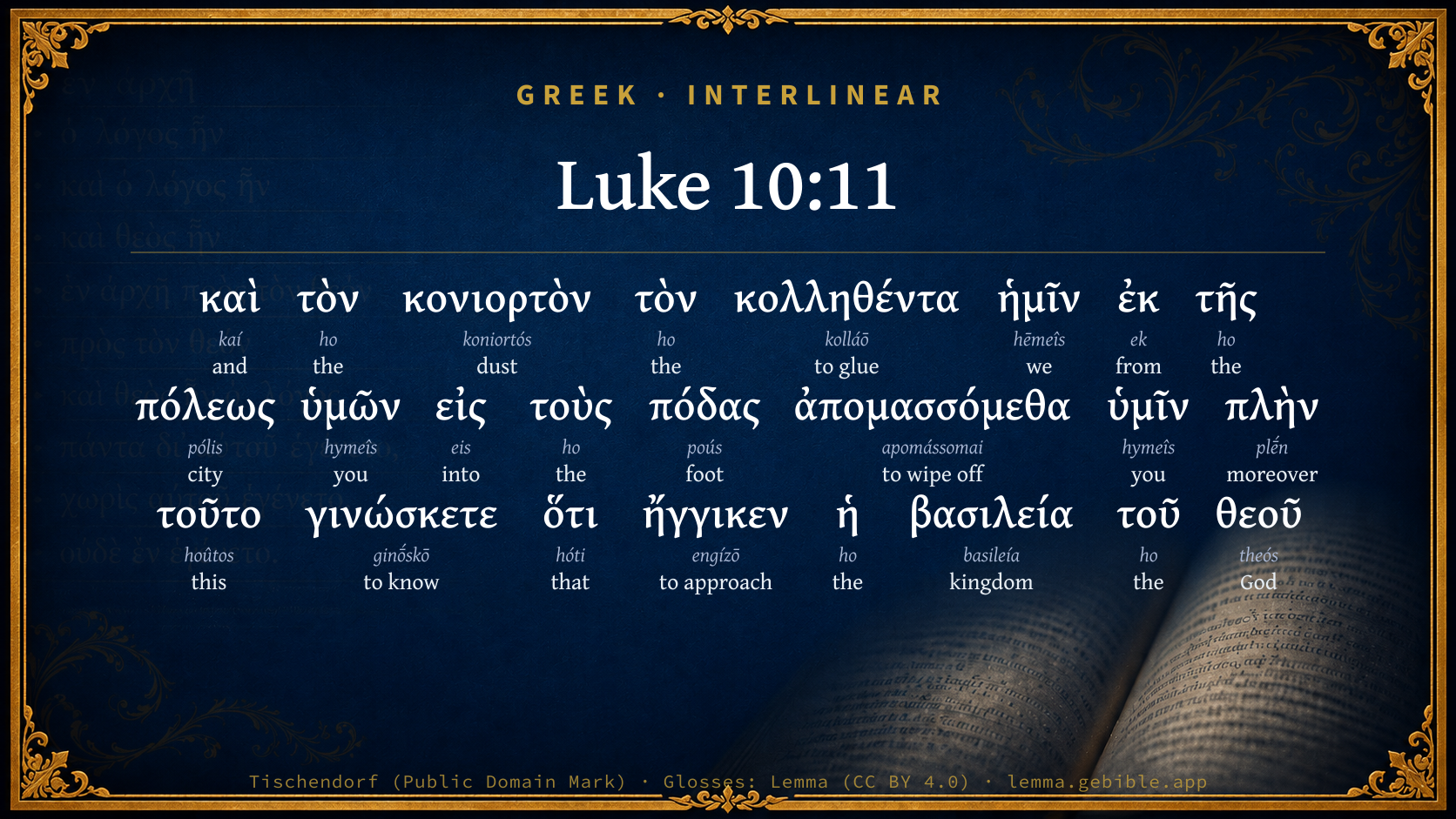
'Even the dust from your city that clings to us, we wipe off against you. Nevertheless know this, that the Kingdom of God has come near to you.'
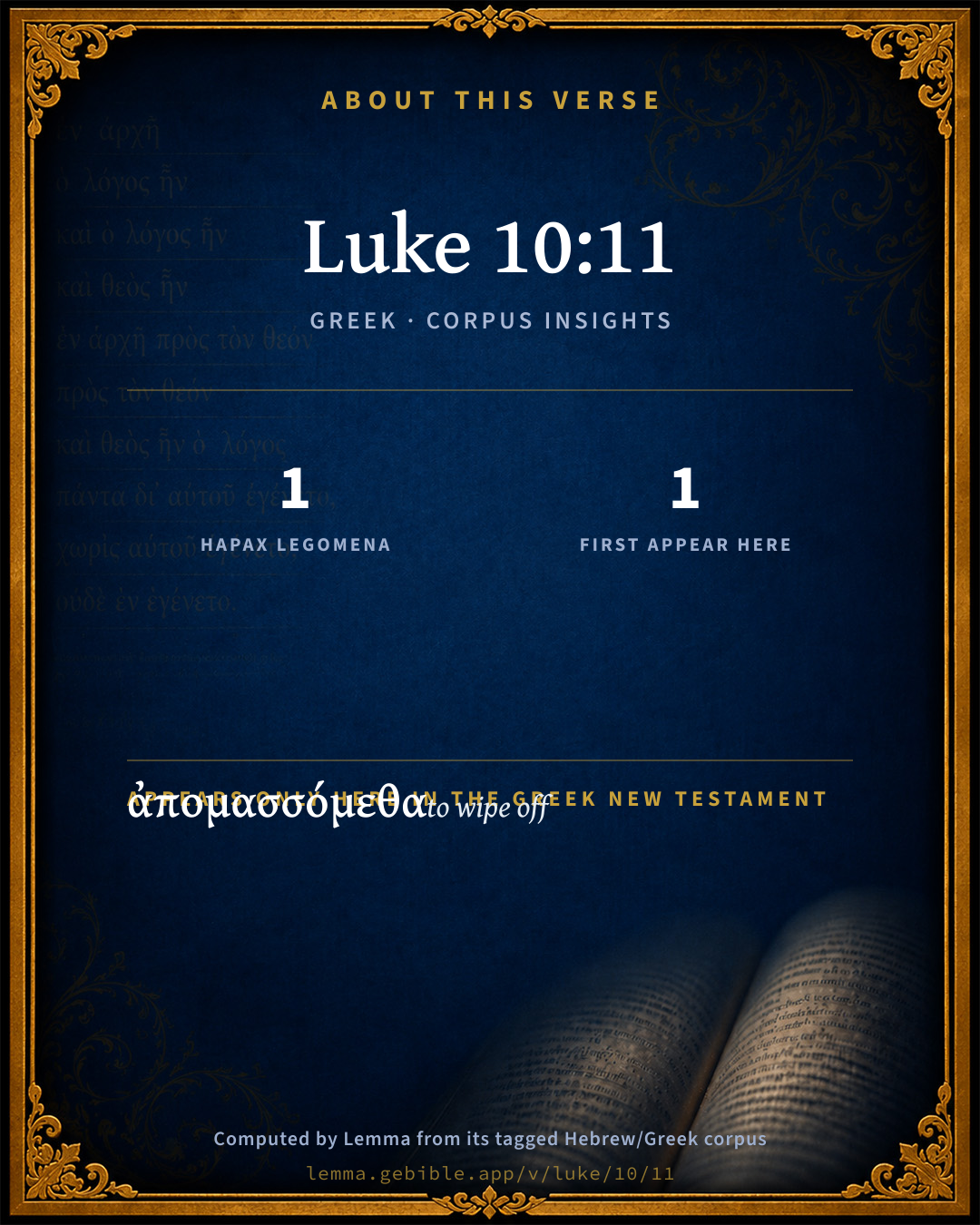
- 1 hapax legomenon — only here in the Greek New Testament
- 1 first appearance in the Greek New Testament
Download a study sheet
One document with this verse’s original text, its word-by-word gloss line, the meaning frame, cross-references with their text, attributed commentary, and full source and license credits — printable, and it pastes into notes with its structure intact.
This verse Autodidact and up
A passage Seminary Student
Up to 50 verses in one chapter. A passage sheet keeps up to 6 commentary sources and 12 cross-references per verse, in the order this page ranks them, and says so on the sheet whenever that leaves anything out. Ask for a single verse and you get the Autodidact verse sheet above.
Everything on this page stays free to read, with no account — the sheet is a download of what is already on screen, not access to it.
Compare translations 3
The same verse in 3 English versions, stacked beneath the original-language interlinear above. Click any original word for its lexicon entry.
Each is an independent rendering of the whole verse — the interlinear is not word-aligned to these translations.
Highlighted words mark where these versions differ — a whole-verse word diff, not a word-by-word alignment.
-
World English Bible Public Domain
'Even the dust from your city that clings to us, we wipe off against you. Nevertheless know this, that the Kingdom of God has come near to you.'
-
King James Version Public Domain
Even the very dust of your city, which cleaveth on us, we do wipe off against you: notwithstanding be ye sure of this, that the kingdom of God is come nigh unto you.
-
unfoldingWord Literal Text CC BY-SA 4.0
‘Even the dust that clings to us from your city on our feet we wipe off against you! But know this, that the kingdom of God has come near.’
unfoldingWord Literal Text — © unfoldingWord, licensed CC BY-SA 4.0. Word-aligned USFM3 via Door43 (git.door43.org/unfoldingWord/en_ult).
Show all 19 translations
Every available English version of this verse, each an independent rendering of the whole verse.
-
World English Bible Public Domain
'Even the dust from your city that clings to us, we wipe off against you. Nevertheless know this, that the Kingdom of God has come near to you.'
-
Berean Standard Bible Public Domain
‘Even the dust of your town that clings to our feet, we wipe off as a testimony against you. Yet be sure of this: The kingdom of God is near.’
-
Majority Standard Bible Public Domain
‘Even the dust of your town that clings to us, we wipe off as a testimony against you. Yet be sure of this: The kingdom of God is near to you.’
-
King James Version Public Domain
Even the very dust of your city, which cleaveth on us, we do wipe off against you: notwithstanding be ye sure of this, that the kingdom of God is come nigh unto you.
-
American Standard Version (1901) Public Domain
Even the dust from your city, that cleaveth to our feet, we wipe off against you: nevertheless know this, that the kingdom of God is come nigh.
-
Revised Version (1885) Public Domain
Even the dust from your city, that cleaveth to our feet, we do wipe off against you: howbeit know this, that the kingdom of God is come nigh.
-
Geneva Bible (1599) Public Domain
Euen the very dust, which cleaueth on vs of your citie, we wipe off against you: notwithstanding knowe this, that the kingdome of God was come neere vnto you.
-
Douay-Rheims (1899) Public Domain
Even the very dust of your city that cleaveth to us, we wipe off against you. Yet know this, that the kingdom of God is at hand.
-
Young's Literal Translation Public Domain
And the dust that hath cleaved to us, from your city, we do wipe off against you, but this know ye, that the reign of God hath come nigh to you;
-
Literal Standard Version CC BY-SA 4.0
And the dust that has cleaved to us from your city, we wipe off against you, but know this, that the Kingdom of God has come near to you;
-
Unlocked Literal Bible CC BY-SA 4.0
'Even the dust from your town that clings to our feet we wipe off against you! But know this: The kingdom of God has come near.'
-
unfoldingWord Literal Text CC BY-SA 4.0
‘Even the dust that clings to us from your city on our feet we wipe off against you! But know this, that the kingdom of God has come near.’
-
Darby Bible Public Domain
Even the dust of your city, which cleaves to us on the feet, do we shake off against you; but know this, that the kingdom of God is come nigh.
-
World Messianic Bible Public Domain
‘Even the dust from your city that clings to us, we wipe off against you. Nevertheless know this, that God’s Kingdom has come near to you.’
-
Webster's Bible Public Domain
Even the very dust of your city which cleaveth on us, we do wipe off against you: notwithstanding, be ye sure of this, that the kingdom of God is come nigh to you.
-
Free Bible Version CC BY-SA 4.0
‘We are wiping off even the dust from your town that clings to our feet to show you our disapproval. But you should recognize this: God's kingdom has come.’
-
Bible in Basic English Public Domain
Even the dust of your town, which is on our feet, we put off as a witness against you; but be certain of this, that the kingdom of God is near.
-
Text-Critical English NT CC BY 4.0
‘Even the dust that clings to us from your town we wipe off against you. Yet know this: The kingdom of God has drawn near to you.’
-
Tyndale New Testament (1534) Public Domain
even the very dust which cleaveth on vs of your citie we wipe of agaynst you: Not withstondinge marke this that the kyngdome of God was come nie vpon you.
Literal Standard Version (2020), Covenant Press — licensed CC BY-SA 4.0. Text via the HelloAO Bible API (eBible.org). Unlocked Literal Bible (unfoldingWord) — licensed CC BY-SA 4.0. Text via the HelloAO Bible API (eBible.org). unfoldingWord Literal Text — © unfoldingWord, licensed CC BY-SA 4.0. Word-aligned USFM3 via Door43 (git.door43.org/unfoldingWord/en_ult). Free Bible Version, Dr. Jonathan Gallagher — licensed CC BY-SA 4.0. Text via the HelloAO Bible API (eBible.org).
Word by word
More ways to search: Search by grammar → Find every occurrence → Compare this word →
Practice this passage: Drill this verse → Learn its vocabulary →
- Appears 1× in the Greek New Testament
- First appears here
- Part of Speech
- Verb
- Tense
- Present
- Voice
- Middle
- Mood
- Indicative
- Person
- 1st person
- Number
- Plural
Full Thayer's Definition
- καὶ kaí G2532 “and” Conjunction
- τὸν ho G3588 “the” Article, Accusative, Singular, Masculine
- κονιορτὸν koniortós G2868 “dust” Noun, Accusative, Singular, Masculine
- τὸν ho G3588 “the” Article, Accusative, Singular, Masculine
- κολληθέντα kolláō G2853 “to glue” Verb, Aorist, Passive, Participle, Accusative, Singular, Masculine
- ἡμῖν hēmeîs G2249 “we” Personal pronoun, 1st person, Dative, Plural
- ἐκ ek G1537 “from” Preposition
- τῆς ho G3588 “the” Article, Genitive, Singular, Feminine
- πόλεως pólis G4172 “city” Noun, Genitive, Singular, Feminine
- ὑμῶν hymeîs G5210 “you” Personal pronoun, 2nd person, Genitive, Plural
- εἰς eis G1519 “into” Preposition
- τοὺς ho G3588 “the” Article, Accusative, Plural, Masculine
- πόδας poús G4228 “foot” Noun, Accusative, Plural, Masculine
- ἀπομασσόμεθα apomássomai G631 “to wipe off” Verb, Present, Middle, Indicative, 1st person, Plural
- ὑμῖν hymeîs G5210 “you” Personal pronoun, 2nd person, Dative, Plural
- πλὴν plḗn G4133 “moreover” Adverb
- τοῦτο hoûtos G3778 “this” Demonstrative pronoun, Accusative, Singular, Neuter
- γινώσκετε ginṓskō G1097 “to know” Verb, Present, Active, Imperative, 2nd person, Plural
- ὅτι hóti G3754 “that” Conjunction
- ἤγγικεν engízō G1448 “to approach” Verb, Perfect, Active, Indicative, 3rd person, Singular
- ἡ ho G3588 “the” Article, Nominative, Singular, Feminine
- βασιλεία basileía G932 “kingdom” Noun, Nominative, Singular, Feminine
- τοῦ ho G3588 “the” Article, Genitive, Singular, Masculine
- θεοῦ theós G2316 “God” Noun, Genitive, Singular, Masculine
About this verse
These counts appear in no published source. They are computed here, from the morphology-tagged text and Lemma’s own curated glosses. What Lemma adds →
- 24
- words
- 18
- distinct lemmas
- Gospels
- section
Notable vocabulary
1 hapax legomenon — a word that appears only here in the entire Greek New Testament:
- ἀπομασσόμεθα to wipe off G631
First appearance in Scripture
This word makes its first canonical appearance in the Greek New Testament here:
- ἀπομασσόμεθα to wipe off G631
Shared distinctive vocabulary
κονιορτὸν dust G2868 occurs in 5 verses of the Greek New Testament. Also found in:
Cross-references
10Topical passages linked to Luke 10:11 in the Treasury of Scripture Knowledge — connected by theme and wording, ordered by reader-vote popularity; previews shown in the World English Bible.
- Luke 10:9 Heal the sick who are therein, and tell them, 'The Kingdom of God has come near to you.'
- Acts 13:51 But they shook off the dust of their feet against them, and came to Iconium.
- Deuteronomy 30:11–14 For this commandment which I command you this day, it is not too hard for you, neither is it far off.
- Matthew 10:14 Whoever doesn't receive you, nor hear your words, as you go out of that house or that city, shake off the dust from your feet.
- Mark 6:11 Whoever will not receive you nor hear you, as you depart from there, shake off the dust that is under your feet for a testimony against them. Assuredly, I tell you, it will be more tolerable for Sodom and Gomorrah in the day of judgment than for that city!"
- Acts 13:26 Brothers, children of the stock of Abraham, and those among you who fear God, the word of this salvation is sent out to you.
- Acts 13:40 Beware therefore, lest that come on you which is spoken in the prophets:
- Acts 13:46 Paul and Barnabas spoke out boldly, and said, "It was necessary that God's word should be spoken to you first. Since indeed you thrust it from you, and judge yourselves unworthy of eternal life, behold, we turn to the Gentiles.
- Romans 10:8 But what does it say? "The word is near you, in your mouth, and in your heart;" that is, the word of faith, which we preach:
- Hebrews 1:3 His Son is the radiance of his glory, the very image of his substance, and upholding all things by the word of his power, when he had by himself made purification for our sins, sat down on the right hand of the Majesty on high;
Cross-references courtesy of OpenBible.info (CC BY 4.0).
Where the printed editions differ
2 variantsPlaces in this verse where the major printed Greek editions disagree on the wording in a way that affects the translation — a comparison of editions, not a manuscript-by-manuscript collation. The editions are the modern critical texts (Nestlé-Aland 28/27, SBL, Westcott-Hort, Tregelles, Tyndale House) and the traditional texts behind the KJV (the Textus Receptus and the Byzantine/Majority text). It is not a claim about which reading is original.
-
Extra text
εἰς τοὺς πόδας
“to the feet”
In NA28NA27TynSBLWHTreg Not in TRByzεἰς τοὺς πόδας (eis tous podas) 'to the feet' is only in older manuscripts (NA28+NA27+Tyn+SBL+WH+Treg)
-
Extra text
ἐφ᾽ ὑμᾶς
“upon you”
In TRByz Not in NA28NA27TynSBLWHTregἐφ᾽ ὑμᾶς (eph᾽ humas) 'upon you' is only in traditional manuscripts (TR+Byz)
Textual data: Translators Amalgamated Greek New Testament (STEPBible TAGNT) · CC BY 4.0.
Lesson kit
Teaching starters — assembled from the data on this page, not authored interpretation. Every prompt links to the verse data it draws on. Edit before teaching.
Luke, in the Gospels, opens this verse with 24 words (18 distinct Greek lemmas). Its most distinctive word is apomássomai (“to wipe off”). A historical commentator’s framing appears above. Read the whole chapter for the surrounding context.
Discussion questions
- The word apomássomai carries the sense “to wipe off.” How does it shape the verse?
- This verse holds 1 word here found nowhere else in the Greek New Testament. What might the rare word draw attention to?
- The word “to wipe off” first appears here in Scripture. What is being introduced at this debut?
- Matthew 10:14 shares the word «dust» with this verse. How do the two illuminate each other?
- “the” occurs 6× in this one verse. What is the effect of the repetition?
- These translations render this verse differently. What is at stake in choosing one wording over another?
- Reading how Tyndale Open Study Notes and Bengel's Gnomon read this verse, where do the two commentators agree and where do they part?
Things to notice
- 1 word in this verse appears nowhere else in the Greek New Testament.
- 1 word makes its first canonical appearance in Scripture here.
- These translations choose different wording for 13 words in this verse.
- “the” occurs 6× in this single verse.
- 18 distinct Greek lemmas span 24 words in this verse.
Commentary
Notes on Luke 10:11 from classic Christian and Jewish commentators (each source and its license shown beneath its notes). The classic Christian expositions comment on the surrounding passage and are grouped to its opening verse, so a note may address several verses; the Jewish commentaries on the Tanakh (Rashi and others) are per-verse, so they appear only where the commentator wrote on this verse.
Lemma curates 59 commentaries, every one of them public domain or Creative Commons licensed, each selected and text-cleaned for this edition rather than reprinted as found. About our sources →
Tyndale Open Study Notes
Tyndale Open Resources
Tyndale Open Study Notes — © Tyndale Open Resources, licensed CC BY-SA 4.0. Text via the HelloAO Bible API.
Bengel's Gnomon
Johann Albrecht Bengel
Bengel's Gnomon of the New Testament — English translation (T&T Clark, Edinburgh, 1860) — public domain. Text from a community e-Sword module.
Geneva Bible (1599)
Geneva Bible translators
Geneva Bible (1599) marginal notes — public domain. Text via Bolls.life.
Adam Clarke's Commentary
Adam Clarke's Commentary on the Bible (1810–1826) — public domain. Text from a community e-Sword/MySword module.
Ellicott's Commentary for English Readers
A Bible Commentary for English Readers, edited by Charles John Ellicott (1878–1897) — public domain. Text from a community e-Sword module.
The Cambridge Bible for Schools and Colleges
gen. ed. J. J. S. Perowne
The Cambridge Bible for Schools and Colleges (gen. ed. J. J. S. Perowne; Cambridge University Press, 1878–1918) — public domain. Text from a community e-Sword module.
John Gill's Exposition
John Gill's Exposition of the Whole Bible (1746–1763) — public domain (CC PDM 1.0). Text via the HelloAO Bible API.
Trapp's Complete Commentary
John Trapp
John Trapp, A Commentary or Exposition upon All the Books of the Old and New Testament (1647–1656) — public domain. Text from a community e-Sword module.
John Wesley's Explanatory Notes
John Wesley, Explanatory Notes Upon the Whole Bible (1754–1765) — public domain. Text via the GEBible commentary corpus.
Cambridge Greek Testament for Schools and Colleges
Cambridge Greek Testament for Schools and Colleges (Cambridge University Press, 1896; 21 vols, various authors incl. Carr, Maclear, Plummer, Farrar, Lumby, Moule, M. R. James, Simcox) — public domain. Text from a community e-Sword module.
Alford’s Greek Testament
Henry Alford
Henry Alford, The Greek Testament (1849–1861) — public domain. Text from a community e-Sword module.
International Critical Commentary
International Critical Commentary — older volumes (1896–1929), various authors — public domain. Text from a community e-Sword module.
Vincent's Word Studies in the New Testament
Marvin R. Vincent
Marvin R. Vincent, Word Studies in the New Testament (1887–1900) — public domain. Text from a community e-Sword/MySword module.