
Luke 11:49

Greek (Tischendorf 8th ed.) Luke 11:49 appears in the Greek New Testament. The text above is from the Tischendorf 8th edition. Each word links to its Strong’s number and a concise gloss. Click any word for its full Thayer’s Greek Lexicon entry.
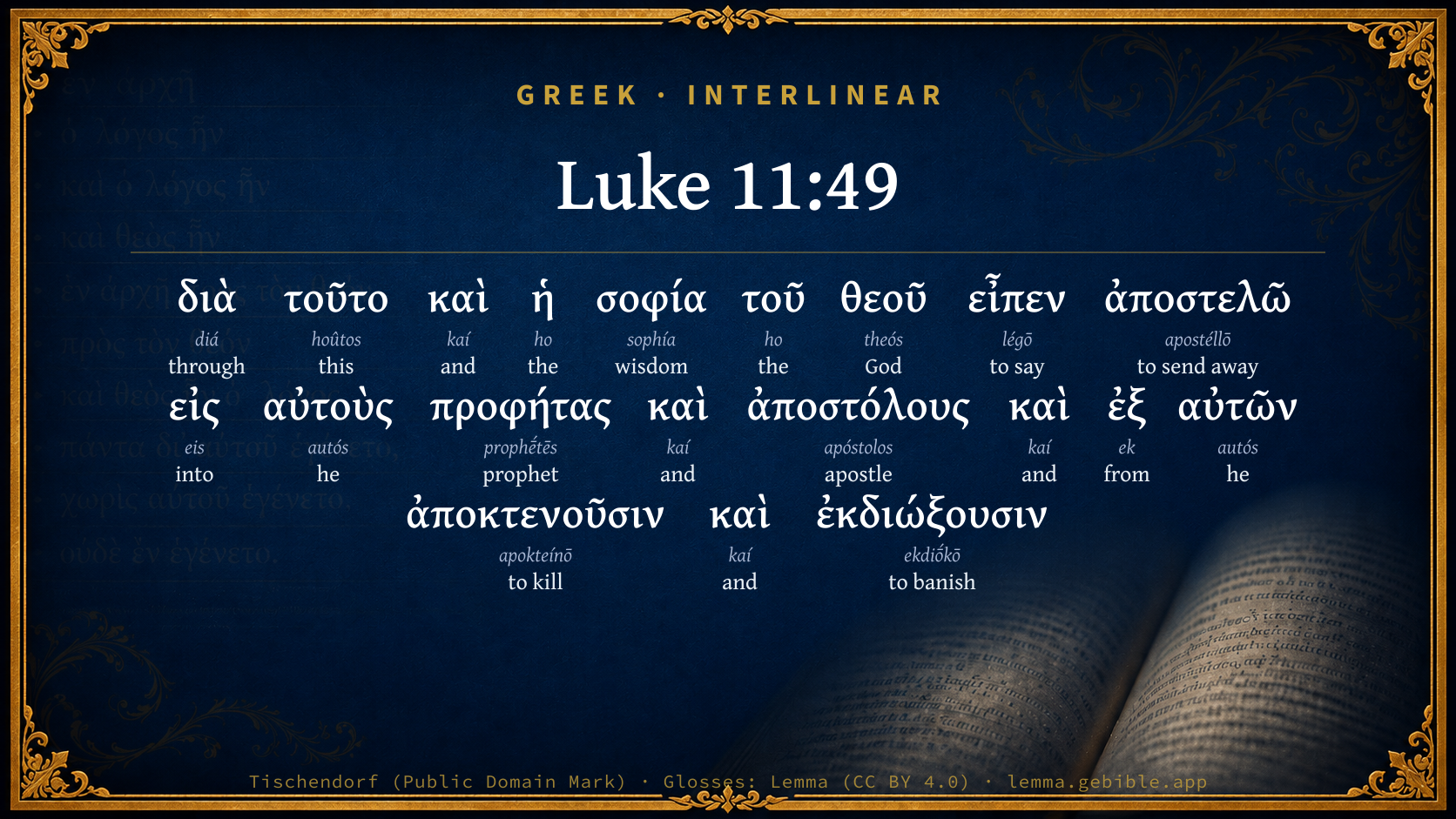
Download image
Cite this verse

Luke 11:49 (World English Bible). Public Domain. Lemma interlinear Bible study tool, https://lemma.gebible.app/v/luke/11/49.

Show BibTeX & RIS
BibTeX
RIS
English Translation
Therefore also the wisdom of God said, 'I will send to them prophets and apostles; and some of them they will kill and persecute,
World English Bible · Public Domain
Highlights
  • 1 first appearance in the Greek New Testament
Full analysis ↓
Download a study sheet

One document with this verse’s original text, its word-by-word gloss line, the meaning frame, cross-references with their text, attributed commentary, and full source and license credits — printable, and it pastes into notes with its structure intact.

This verse Autodidact and up

Study sheet (.html) Plain text (.txt)

A passage Seminary Student

Up to 50 verses in one chapter. A passage sheet keeps up to 6 commentary sources and 12 cross-references per verse, in the order this page ranks them, and says so on the sheet whenever that leaves anything out. Ask for a single verse and you get the Autodidact verse sheet above.

Everything on this page stays free to read, with no account — the sheet is a download of what is already on screen, not access to it.

Want to remove ads? Support Godless Engineer
Compare translations 3

The same verse in 3 English versions, stacked beneath the original-language interlinear above. Click any original word for its lexicon entry.

Each is an independent rendering of the whole verse — the interlinear is not word-aligned to these translations.

Highlighted words mark where these versions differ — a whole-verse word diff, not a word-by-word alignment.

  • World English Bible Public Domain
    Therefore also the wisdom of God said, 'I will send to them prophets and apostles; and some of them they will kill and persecute,
  • King James Version Public Domain
    Therefore also said the wisdom of God, I will send them prophets and apostles, and some of them they shall slay and persecute:
  • unfoldingWord Literal Text CC BY-SA 4.0
    Because of this, the wisdom of God also said, ‘I will send to them prophets and apostles, and some of them they will kill and persecute’

unfoldingWord Literal Text — © unfoldingWord, licensed CC BY-SA 4.0. Word-aligned USFM3 via Door43 (git.door43.org/unfoldingWord/en_ult).

Versions to compare (up to 4)

3 of 4 selected

Show all 19 translations

Every available English version of this verse, each an independent rendering of the whole verse.

  • World English Bible Public Domain
    Therefore also the wisdom of God said, 'I will send to them prophets and apostles; and some of them they will kill and persecute,
  • Berean Standard Bible Public Domain
    Because of this, the wisdom of God said, ‘I will send them prophets and apostles; some of them they will kill and others they will persecute.’
  • Majority Standard Bible Public Domain
    Because of this, the wisdom of God said, ‘I will send them prophets and apostles; some of them they will kill and others they will persecute.’
  • King James Version Public Domain
    Therefore also said the wisdom of God, I will send them prophets and apostles, and some of them they shall slay and persecute:
  • American Standard Version (1901) Public Domain
    Therefore also said the wisdom of God, I will send unto them prophets and apostles; and `some' of them they shall kill and persecute;
  • Revised Version (1885) Public Domain
    Therefore also said the wisdom of God, I will send unto them prophets and apostles; and some of them they shall kill and persecute;
  • Geneva Bible (1599) Public Domain
    Therefore said the wisedome of God, I wil sende them Prophets and Apostles, and of them they shall slaie, and persecute away,
  • Douay-Rheims (1899) Public Domain
    For this cause also the wisdom of God said: I will send to them prophets and apostles; and some of them they will kill and persecute.
  • Young's Literal Translation Public Domain
    because of this also the wisdom of God said: I will send to them prophets, and apostles, and some of them they shall kill and persecute,
  • Literal Standard Version CC BY-SA 4.0
    because of this also the wisdom of God said: I will send to them prophets, and apostles, and some of them they will kill and persecute,
  • Unlocked Literal Bible CC BY-SA 4.0
    For this reason also, God's wisdom said, 'I will send to them prophets and apostles, and they will persecute and kill some of them.'
  • unfoldingWord Literal Text CC BY-SA 4.0
    Because of this, the wisdom of God also said, ‘I will send to them prophets and apostles, and some of them they will kill and persecute’
  • Darby Bible Public Domain
    For this reason also the wisdom of God has said, I will send to them prophets and apostles, and of these shall they kill and drive out by persecution,
  • World Messianic Bible Public Domain
    Therefore also the wisdom of God said, ‘I will send to them prophets and emissaries; and some of them they will kill and persecute,
  • Webster's Bible Public Domain
    Therefore also said the wisdom of God, I will send them prophets and apostles, and some of them they will slay and persecute:
  • Free Bible Version CC BY-SA 4.0
    This is why God in his wisdom said, ‘I will send them prophets and apostles; some they will kill, and others they will persecute.’
  • Bible in Basic English Public Domain
    For this reason the wisdom of God has said, I will send them prophets and teachers, and to some of them they will give death and cruel pains;
  • Text-Critical English NT CC BY 4.0
    That is why the wisdom of God said, ‘I will send them prophets and apostles, some of whom they will kill and some of whom they will persecute.’
  • Tyndale New Testament (1534) Public Domain
    Therfore sayde the wisdome of God: I will send them Prophetes and Apostles and of them they shall slee and persecute:

Literal Standard Version (2020), Covenant Press — licensed CC BY-SA 4.0. Text via the HelloAO Bible API (eBible.org). Unlocked Literal Bible (unfoldingWord) — licensed CC BY-SA 4.0. Text via the HelloAO Bible API (eBible.org). unfoldingWord Literal Text — © unfoldingWord, licensed CC BY-SA 4.0. Word-aligned USFM3 via Door43 (git.door43.org/unfoldingWord/en_ult). Free Bible Version, Dr. Jonathan Gallagher — licensed CC BY-SA 4.0. Text via the HelloAO Bible API (eBible.org).

Word by word

More ways to search: Search by grammar → Find every occurrence → Compare this word →

Practice this passage: Drill this verse → Learn its vocabulary →

ἐκδιώξουσιν
ekdiṓkō
G1559
“to banish”
Verb, Future, Active, Indicative, 3rd person, Plural
Part of Speech
Verb
Tense
Future
Voice
Active
Mood
Indicative
Person
3rd person
Number
Plural
Full Thayer's Definition

Origin: from G1537 and G1377

TDNT: None

1. to drive out, banish 2. to pursue a. to persecute, oppress with calamities
  1. διὰ diá G1223 “through” Preposition
  2. τοῦτο hoûtos G3778 “this” Demonstrative pronoun, Accusative, Singular, Neuter
  3. καὶ kaí G2532 “and” Conjunction
  4. ἡ ho G3588 “the” Article, Nominative, Singular, Feminine
  5. σοφία sophía G4678 “wisdom” Noun, Nominative, Singular, Feminine
  6. τοῦ ho G3588 “the” Article, Genitive, Singular, Masculine
  7. θεοῦ theós G2316 “God” Noun, Genitive, Singular, Masculine
  8. εἶπεν légō G3004 “to say” Verb, Aorist, Active, Indicative, 3rd person, Singular
  9. ἀποστελῶ apostéllō G649 “to send away” Verb, Future, Active, Indicative, 1st person, Singular
  10. εἰς eis G1519 “into” Preposition
  11. αὐτοὺς autós G846 “he” Personal pronoun, Accusative, Plural, Masculine
  12. προφήτας prophḗtēs G4396 “prophet” Noun, Accusative, Plural, Masculine
  13. καὶ kaí G2532 “and” Conjunction
  14. ἀποστόλους apóstolos G652 “apostle” Noun, Accusative, Plural, Masculine
  15. καὶ kaí G2532 “and” Conjunction
  16. ἐξ ek G1537 “from” Preposition
  17. αὐτῶν autós G846 “he” Personal pronoun, Genitive, Plural, Masculine
  18. ἀποκτενοῦσιν apokteínō G615 “to kill” Verb, Future, Active, Indicative, 3rd person, Plural
  19. καὶ kaí G2532 “and” Conjunction

About this verse

These counts appear in no published source. They are computed here, from the morphology-tagged text and Lemma’s own curated glosses. What Lemma adds →

20
words
15
distinct lemmas
Gospels
section

Notable vocabulary

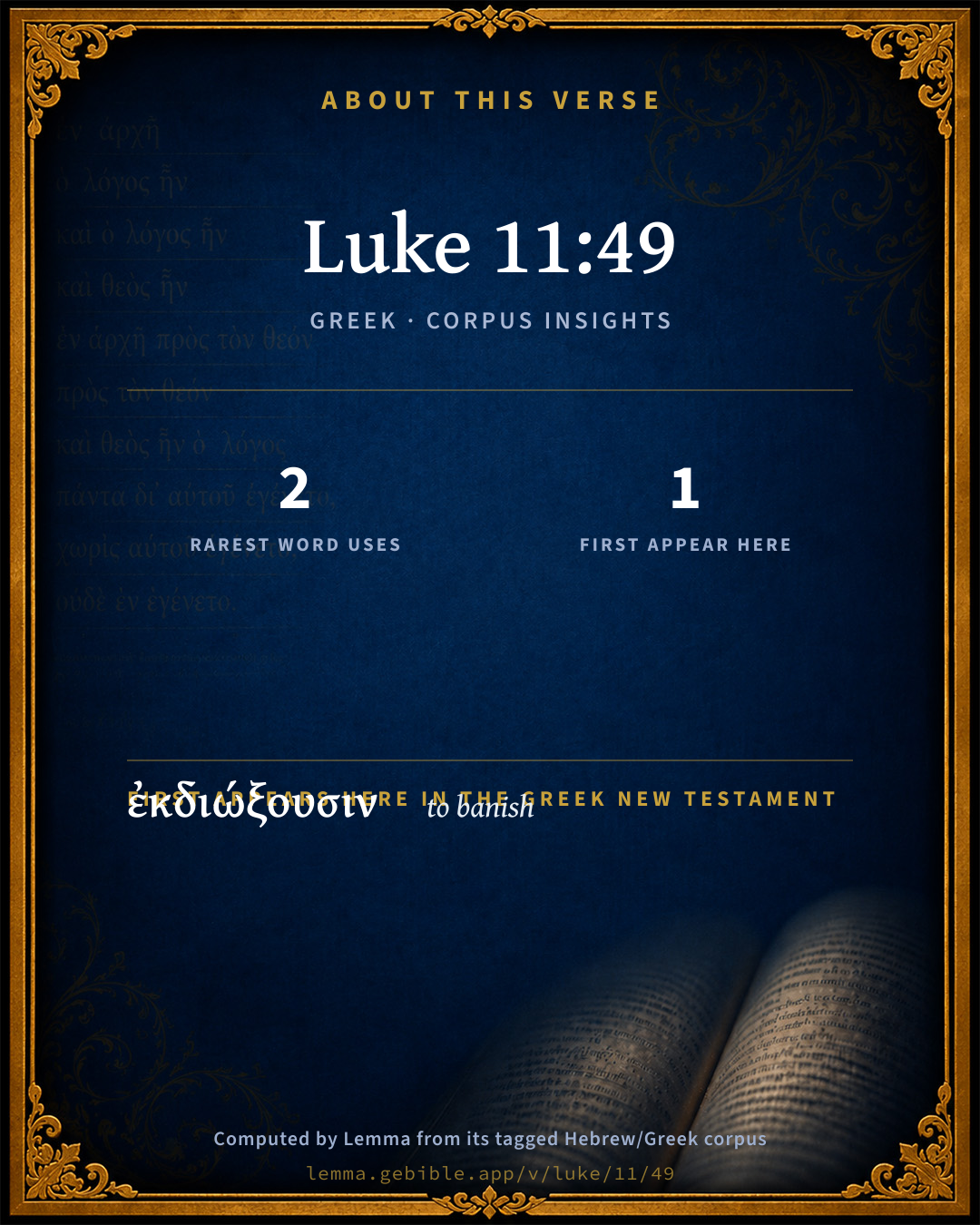
The rarest word here is ἐκδιώξουσιν to banish G1559 — appearing just 2 times in the whole Greek New Testament.

First appearance in Scripture

This word makes its first canonical appearance in the Greek New Testament here:

  • ἐκδιώξουσιν to banish G1559

Shared distinctive vocabulary

ἐκδιώξουσιν to banish G1559 occurs in 2 verses of the Greek New Testament. Also found in:
Repetition

Words recur within this verse:

Cross-references

20

Topical passages linked to Luke 11:49 in the Treasury of Scripture Knowledge — connected by theme and wording, ordered by reader-vote popularity; previews shown in the World English Bible.

  • 1 Corinthians 1:30 But of him, you are in Christ Jesus, who was made to us wisdom from God, and righteousness and sanctification, and redemption:
  • Colossians 2:3 in whom are all the treasures of wisdom and knowledge hidden.
  • 1 Corinthians 1:24 but to those who are called, both Jews and Greeks, Christ is the power of God and the wisdom of God.
  • Ephesians 4:11 He gave some to be apostles; and some, prophets; and some, evangelists; and some, shepherds and teachers;
  • Proverbs 1:2–6 To know wisdom and instruction; To discern the words of understanding;
  • Proverbs 9:1–3 Wisdom has built her house. She has carved out her seven pillars.
  • Matthew 22:6 and the rest grabbed his servants, and treated them shamefully, and killed them.
  • Matthew 23:34–36 Therefore, behold, I send to you prophets, wise men, and scribes. Some of them you will kill and crucify; and some of them you will scourge in your synagogues, and persecute from city to city;
  • Luke 24:47 and that repentance and remission of sins should be preached in his name to all the nations, beginning at Jerusalem.
  • Acts 1:8 But you will receive power when the Holy Spirit has come upon you. You will be witnesses to me in Jerusalem, in all Judea and Samaria, and to the uttermost parts of the earth."
  • Acts 7:57–8:1 But they cried out with a loud voice, and stopped their ears, and rushed at him with one accord.
  • Acts 8:3 But Saul ravaged the assembly, entering into every house, and dragged both men and women off to prison.
  • Acts 9:1–2 But Saul, still breathing threats and slaughter against the disciples of the Lord, went to the high priest,
  • Acts 22:20 When the blood of Stephen, your witness, was shed, I also was standing by, and consenting to his death, and guarding the cloaks of those who killed him.'
  • Acts 26:10–11 This I also did in Jerusalem. I both shut up many of the saints in prisons, having received authority from the chief priests, and when they were put to death I gave my vote against them.
  • Proverbs 8:1–12 Doesn't wisdom cry out? Doesn't understanding raise her voice?
  • Luke 21:16–17 You will be handed over even by parents, brothers, relatives, and friends. Some of you they will cause to be put to death.
  • John 16:2 They will put you out of the synagogues. Yes, the time comes that whoever kills you will think that he offers service to God.
  • Acts 12:1–2 Now about that time, Herod the king stretched out his hands to oppress some of the assembly.
  • 2 Corinthians 11:24–25 Five times from the Jews I received forty stripes minus one.

Cross-references courtesy of OpenBible.info (CC BY 4.0).

Commentary

Notes on Luke 11:49 from classic Christian and Jewish commentators (each source and its license shown beneath its notes). The classic Christian expositions comment on the surrounding passage and are grouped to its opening verse, so a note may address several verses; the Jewish commentaries on the Tanakh (Rashi and others) are per-verse, so they appear only where the commentator wrote on this verse.

Lemma curates 59 commentaries, every one of them public domain or Creative Commons licensed, each selected and text-cleaned for this edition rather than reprinted as found. About our sources →

Tyndale Open Study Notes

Tyndale Open Resources

11:49 The quotation is not explicitly from the Old Testament.

Tyndale Open Study Notes — © Tyndale Open Resources, licensed CC BY-SA 4.0. Text via the HelloAO Bible API.

Bengel's Gnomon

Johann Albrecht Bengel

Luk 11:49. Ἡ σοφία τοῦ Θεοῦ, the Wisdom of God) A sweet designation. The קהלת, Koheleth or Ecclesiastes: the Preacher that gathers together assemblies. See ch. Luk 13:34.—εἶπεν, said) See Mat 23:34, note.—προφήτας, prophets) who existed under the Old Testament.—ἀποστόλους, apostles) who exist under the New Testament.—ἐκδιώξουσιν) they shall by persecution cast out. A word of frequent occurrence in the LXX.

Bengel's Gnomon of the New Testament — English translation (T&T Clark, Edinburgh, 1860) — public domain. Text from a community e-Sword module.

Meyer's Critical & Exegetical Commentary

Heinrich August Wilhelm Meyer

Luk_11:49-51. See on Mat_23:34-39.

διὰ τοῦτο] on account of this your agreement with your fathers as murderers of the prophets, which affinity the wisdom of God had in view when it gave its judgment. Under the guidance of the doctors of the law, the people among whom the gospel teachers were sent (εἰς αὐτούς) rejected these latter, etc. See Luk_11:52.

ἡ σοφία τ. Θεοῦ] Doubtless a quotation, as is proved by εἶπεν and αὐτούς, but not from the Old Testament, since no such passage occurs in it (Olshausen mentions 2Ch_24:19 interrogatively, but what a difference!), and quotations from the Old Testament are never introduced by ἡ σοφία τ. Θεοῦ.[147] To suppose a lost Jewish writing, however, which either may have had this title (Ewald, Bleek, Baumgarten-Crusius, Weizsäcker) or may have introduced the חכמת יהוה as speaking (Paulus),[148] is contrary to the analogy of all the rest of the quotations made by Jesus, as well as to the evangelical tradition itself, which, according to Mat_23:34, attributed these words to Jesus. Accordingly, it is to be supposed (Neander, L. J. p. 655; Gess, Person Chr. p. 29; comp. also Ritschl, Evang. Marcions, p. 89) that Jesus is here quoting one of His own earlier utterances (observe the past tense εἶπεν), so that He represents the wisdom, of God (Wis_7:27; Mat_11:19; Luk_7:35) as having spoken through Him. Allied to this is the idea of the λόγος. According to this, however, the original form of the passage is not to be found in Luke (Olshausen, Bleek); for while Matthew gives this remarkable utterance in a directly present form, Lukes method of recording it transfers to the mouth of Jesus what rather was a later mode of citing it, and gives it in the shape of a result of reflective theology akin to the doctrine of the Logos.[149]

ἐκδιώξ.] to drive out of the land.

ἽΝΑ ἘΚΖΗΤ. Κ.Τ.Λ.] an appointment in the divine decree. The expression corresponds to the Hebrew בִּקֵּשׁ דָּם, 2Sa_4:11; Eze_3:18; Eze_3:20, which sets forth the vengeance for blood.

The series of prophets in the more general sense begins with Abel as the first holy man.

[147] The passage is very inaccurately treated by Köstlin, p. 163, according to whom Luke has here heaped misunderstanding on misunderstanding. He is said to have referred the entire utterance to the Old Testament prophets, and on that account to have placed before it κ. ἡ σοφία τ. Θεοῦ εἶπεν, in order to give to it the character of an ancient prophecy, which, however, had no existence at all, etc.

[148] Strauss also, in Hilgenfelds Zeitschrift, 1863, p. 87 ff., who is thinking entirely of a Christian document.

[149] The utterance in Matthew, ἐγὼ ἀποστέλλω κ.τ.λ., was historically indicated in the Church by: ἡ σοφία τοῦ Θεοῦ εἶπεν· ἀποστελῶ κ.τ.λ. And Luke here makes Jesus Himself speak in this later mode of indicating it. It is a ὕστερον πρότερον in form. According to Hofmann, Schriftbew. I. p. 101 (comp. also Schegg), Jesus announces Gods counsel in the form of a word of God. Comp. Grotius and van Hengel, Annot. p. 16 f. To this view εἰς αὐτούς (instead of εἰς ὑμᾶς) would certainly not be opposed, since those whom the speech concerned might be opposed as third persons to the wisdom of God which was speaking. But instead of εἶπεν might be expected λέγει; for now through Jesus the divine wisdom would declare its counsel (Heb_3:10, to which Hofmann refers, is different, because there εἶπον in connection with προσώχθισα actually relates to the past). Moreover, if by ἡ σοφία τοῦ Θεοῦ were not meant the personal wisdom of God that appeared in Christ, and emitted the utterance, it would not be conceivable why it should not simply have been said: διὰ τοῦτο καὶ ὁ Θεὸς λέγει. Nowhere else in the New Testament is a declaration of God called a declaration of the divine wisdom. Besides, according to Mat_23:34, Jesus is the subject of ἀποστελῶ; and this is also the case in the passage before us, if ἡ σοφία τ. Θεοῦ is understood of the person of Christ as being the personal self-revelation of the divine wisdom. Christ sends to His Church the prophets and apostles (Luk_10:3), Eph_4:11. Riggenbachs explanation (Stud. u. Krit. 1855, p. 599 f.) is similar to that of Hofmann,though more correct in taking the σοφία τ. Θεοῦ in the Logos-sense, but interpreting the past tense εἶπεν by an at all times arbitrarily supplied.

Meyer — Critical and Exegetical Commentary on the New Testament — English translation by Peter Christie, edited by Frederick Crombie (T&T Clark, 1880) — public domain. Text from a community e-Sword module.

Expositor's Greek Testament

ed. W. Robertson Nicoll

Luk 11:49 . ἡ σοφία τ . Θ .: vide notes on Mat 23:34 . ἀποστόλους , apostles, instead of wise men and scribes in Mt. ἐκδιώξουσιν , they shall drive out (of the land), in place of Mt.’s σταυρώσετε .

The Expositor's Greek Testament, edited by W. Robertson Nicoll (1897–1910) — public domain. Text from a community e-Sword module.

Geneva Bible (1599)

Geneva Bible translators

They shall so vex them and trouble them, that at length they shall banish them.

Geneva Bible (1599) marginal notes — public domain. Text via Bolls.life.

Jamieson, Fausset & Brown

Robert Jamieson, A. R. Fausset & David Brown

said the wisdom, &c.--a remarkable variation of the words in Mat 23:34, "Behold I SEND." As there seems plainly an allusion to ancient warnings of what God would do with so incorrigible a people, so here Christ, stepping majestically into the place of God, so to speak, says, "Now I am going to carry all that out." Could this be other than the Lord of Israel in the flesh?

Jamieson, Fausset & Brown — Commentary Critical and Explanatory on the Whole Bible (1871) — public domain (CC PDM 1.0). Text via the HelloAO Bible API.

Adam Clarke's Commentary

Verse 49. The wisdom of God] These seem to be Luke's words, and to mean that Jesus, the wisdom of God, (as he is called, 1Co 1:24,) added the words which follow here, on that occasion: and this interpretation of the words is agreeable to that of Matthew, who makes Jesus speak in his own person: Wherefore behold, I send you prophets, &c., Mt 23:34. See the note there, and see Bishop PEARCE.

Adam Clarke's Commentary on the Bible (1810–1826) — public domain. Text from a community e-Sword/MySword module.

Ellicott's Commentary for English Readers

(49-51) Therefore also said the wisdom of God.—The words that follow are in the main the same as those of Mat_23:34-36, where see Notes. There are, however, some remarkable variations, each of which suggests some questions of interest. (1) The words here appear at first sight as if they were a quotation from a book recognised as of divine authority, and not a few critics have supposed that there was such a book, bearing the title of “The Wisdom of God,” either when our Lord spoke, or when St. Luke wrote. On the other hand there is no trace of the existence of a book with that name; and if it had been prominent enough to be quoted, as it seems to be quoted here, it could scarcely have failed to have left its impress elsewhere. On the whole, then, it seems best to look on the words as a solemn utterance which our Lord’s human soul had received as an oracle from God, and which was therefore proclaimed by Him as coming from His Wisdom. His words that “Wisdom is justified of her children” (Mat_11:19), present, it is obvious, another example of the same way of speaking of the divine purpose. (2) For “the prophets, and wise men, and scribes” of St. Matthew, we have here “prophets and apostles.” The combination points to a Christian, not a pre-Christian, terminology, and is the first example of the union of the two terms that afterwards became normal. (See Note on Luk_10:1.) It goes some way, it may be remarked, to confirm the view suggested in that Note, that two distinct bodies, known respectively as “Prophets” and “Apostles,” had already been appointed, and that as the Twelve answered to the latter, so did the Seventy to the former.

Some of them shall they slay and persecute.—Note, as perhaps characteristic of St. Luke, the absence of the specific forms of persecution, “crucifying” and “scourging in the synagogues.”

A Bible Commentary for English Readers, edited by Charles John Ellicott (1878–1897) — public domain. Text from a community e-Sword module.

The Cambridge Bible for Schools and Colleges

gen. ed. J. J. S. Perowne

49. the wisdom of God] There is an allusion to 2Ch_24:20-22 (comp, 2Ch_36:14-21), but as the exact passage nowhere occurs in the O. T. some suppose that our Lord quotes (1) from a lost book called ‘The Wisdom of God’ (Ewald, Bleek, &c.); or (2) from previous words of His own; or (3) from the Gospel of St Matthew (see Mat_23:34); or (4) from the Book of Proverbs (Luk_1:20-31). It is a general paraphrase of the tenor of several O. T. passages.

some of them they shall slay and persecute] See on Luk_6:23.

The Cambridge Bible for Schools and Colleges (gen. ed. J. J. S. Perowne; Cambridge University Press, 1878–1918) — public domain. Text from a community e-Sword module.

John Gill's Exposition

From the blood of Abel,.... "Righteous Abel", as in Mat 23:35 and so read the Arabic version here, and two manuscripts in the Bodleian library, and three of Stephens's copies; the Persic version renders it, "innocent Abel": he is mentioned because he was the first man that was slain, and he was slain because of his righteousness.

Unto the blood of Zacharias; in the Cambridge copy of Beza's, it is added, "the son of Barachias", as in Mat 23:35 and so the Arabic version, "the son of Barasciah"; who he was; see Gill on Mat 23:35.

which perished between the altar and the temple; or "the house", that is, the holy place: and the Ethiopic version renders it, "the holy house"; here he died, being slain by the Jews; see the note, as before.

Verily I say unto you, it shall be required of this generation; as it was at the time of the destruction of Jerusalem.

John Gill's Exposition of the Whole Bible (1746–1763) — public domain (CC PDM 1.0). Text via the HelloAO Bible API.

Trapp's Complete Commentary

John Trapp

49 Therefore also said the wisdom of God, I will send them prophets and apostles, and some of them they shall slay and persecute:

Ver. 49. Therefore also said the wisdom of God] That is, Christ himself, the essential wisdom of his Father, Mat 23:34.

John Trapp, A Commentary or Exposition upon All the Books of the Old and New Testament (1647–1656) — public domain. Text from a community e-Sword module.

Haydock's Catholic Bible Commentary

The wisdom of God said. In St. Matthew it is, Behold I send to you prophets and wise men; and in this passage of St. Luke, the wisdom of God saith, I will send, &c.: thus is Christ truly the wisdom of the Almighty God. (St. Ambrose)

George Leo Haydock (1774–1849), Haydock's Catholic Family Bible and Commentary, 1859 edition — public domain. Excludes Psalms (Douay-Rheims chapter numbering differs from Protestant) and Deuterocanonical books (Catholic canon only).

Whedon's Commentary on the Bible

Daniel D. Whedon

49. The wisdom of God—The wisdom of God, speaking in 2Ch_24:19, of which Jesus here gives an amplification in the same spirit of divine or avenging wisdom.

Daniel D. Whedon (gen. ed.), Commentary on the Old and New Testaments (1874–1909) — public domain. Text from a community e-Sword module.

The Pulpit Commentary

Therefore also said the wisdom of God, I will send them prophets. in other words, "Because of the determined, irreconcilable hatred of you Pharisees, and the people whom you guide, to all that is noble and true and real; because, in spite of your seeming piety, you are fast rooted in impietyTherefore said the wisdom of God, I will send. The expression, "wisdom of God," has been a difficulty to commentators. The words have been referred

(1) to a quotation of the Lord"s from a lost apocryphal book of that name; but we have no instance of Jesus ever quoting from an apocryphal book, known or unknown.

(2) St. Luke is here quoting from the similar passage in St. Matthew"s Gospel, which, when he was compiling his Gospel, lay before him, and alludes to the earlier memoir as "The Wisdom of God." Against this we have no proof that St. Luke ever saw St. Matthew"s Gospel, but a strong probability exists to the contrary; besides which, the expression is never used by an apostolic writer in such a sense.

(3) A reference is here intended to the Book of Proverbs, which in the early Church was known by the title of "The Wisdom of God," and the passage referred to is Luk_1:20 and Luk_1:31. Putting aside all these, it seems best to consider the expression simply as a solemn utterance of the Lord, in which he identifies himself with the "Wisdom of God." And this certainly is borne out by a comparison with the report of St. Matthew of a similar announcement made by Jesus on another occasion. (Mat_23:34) There we read that the Master said, "Behold, I send unto you prophets," etc. The I is emphatic, and betrays the Divine self-consciousness of Jesus. For a moment the poor Rabbi of Galilee is forgotten, and in his lofty indignation, in his profound sorrow over the stubborn heart of Israel, on both the occasions in which he is reported to have spoken these words of awful prophecy, the Redeemer identifies Himself with God. St. Matthew, "Wherefore, behold, I send unto you prophets," etc.; St. Luke, "Therefore also said the Wisdom of God, I will send them prophets," etc. The form of the prediction and the original thought were both, no doubt, derived by Jesus from the solemn passage in 2Ch_24:19, "Yet he sent prophets to them, to bring them again unto the Lord; ... but they would not give ear," etc. This was followed immediately by the account of the preaching of Zechariah (the instance chosen here by the Lord, ver. 51), and how the faithful witness was stoned by the people in the court of the house of the Lord. (2Ch_24:20, 2Ch_24:21) And apostles, and some of them they shall slay and persecute. The title "apostle" is joined here with the well-known title of "prophet." The earthly reward that these his servants, the apostles, will meet with at the hands of the people of Israel will be the same as that meted out to those old martyr-prophets, viz. persecution and death.

The Pulpit Commentary (1880–1919), ed. H.D.M. Spence-Jones & Joseph S. Exell — public domain. Text from a community e-Sword module.

John Wesley's Explanatory Notes

The wisdom of God, agreeably to this, hath said - In many places of Scripture, though not in these very words, I will send them prophets - Chiefly under the Old Testament: and apostles - Under the New. Matt. xxiii, 34.

John Wesley, Explanatory Notes Upon the Whole Bible (1754–1765) — public domain. Text via the GEBible commentary corpus.

Kretzmann's Popular Commentary

Paul E. Kretzmann

The last woe and its effect:

v. 49. Therefore also said the Wisdom of God, I will send them prophets and apostles, and some of them they shall slay and persecute;

v. 50. that the blood of all the prophets which was shed from the foundation of the world may be required of this generation,

v. 51. from the blood of Abel unto the blood of Zacharias, which perished between the altar and the Temple. Verily I say unto you, It shall be required of this generation.

v. 52. Woe unto you, lawyers! For ye have taken away the key of knowledge; ye entered not in yourselves, and them that were entering in ye hindered.

v. 53. And as He said these things unto them, the scribes and the Pharisees began to urge Him vehemently, and to provoke Him to speak of many things,

v. 54. laying wait for Him, and seeking to catch something out of His mouth, that they might accuse Him.

Jesus here revealed to the lawyers the counsel of God; for He Himself, the personal Wisdom, was the representative of the council of the Trinity. The children had inherited the character, the evil disposition, of their fathers, and therefore the iniquity of the fathers was visited upon the children. The blood of all the righteous people and of all the prophets since the beginning of the world, from the blood of Abel, the son of Adam, to the blood of Zechariah, 2Ch 24:20-21, would be required at the hands of the present generation. Most solemn and impressive is the prophecy of Jesus, which was fulfilled so terribly in the destruction of the city. The Jews of the time of Jesus had received a greater measure of God’s mercy than the Jews of old. They had seen and heard the Messiah Himself, and would have an opportunity to hear also the apostles. But their hatred and bloodthirstiness was even greater than that of their fathers; they utterly despised and rejected God’s visitation of grace. What a warning to them that despise the preaching of the Gospel in our days! And still Jesus continues His rebuke. The lawyers had taken away the key of understanding of Scriptures. The words of prophecy concerning the Messiah were so plain that the people might have gained the proper understanding themselves, if they had been permitted to study without hindrance. But here the teachers stepped in with their false, carnal interpretation of the Bible and deprived the people of the knowledge of salvation. They themselves did not enter, and they hindered such as were anxious to enter. How like the sectarian teachers of our days, especially among the Papists!

Small wonder that the scribes and Pharisees began to be very angry at the Lord. wherever they could, they plied Him with crafty questions, in the hope that He would give ill-considered answers. They were literally lying in wait, assiduously watching every word out of His mouth, in order to find some reason for accusing Him. That is the hatred which the truth, and he that speaks the truth, must expect at all times. The example of Christ is encouraging.

Summary.Jesus gives His disciples a lesson in prayer, casts out a dumb devil, and rebukes the Pharisees, issues a warning to all the Jews, and utters a series of woes against the Pharisees and lawyers.

Paul E. Kretzmann, Popular Commentary of the Bible (1921–1924) — public domain. Text from a community e-Sword module.

unfoldingWord translationNotes

Door43 World Missions Community

For this reason

This refers back to the previous statement that the teachers of the law burdened people with rules.

God's wisdom said

"wisdom" is treated as if it was able to speak for God. AT: "God in his wisdom said" or "God wisely said" (See: Personification)

I will send to them prophets and apostles

"I will send prophets and apostles to my people." God had declared beforehand that he would send prophets and apostles to the ancestors of the Jewish audience to whom Jesus was speaking.

they will persecute and kill some of them

"my people will persecute and kill some of the prophets and apostles." God had declared beforehand that the ancestors of the Jewish audience to whom Jesus was speaking would persecute and kill the prophets and apostles.

This generation, then, will be held responsible for all the blood of the prophets shed

The people to whom Jesus is speaking will be held responsible for the murder of the prophets by their ancestors. AT: "Therefore, God will hold this generation responsible for all the deaths of the prophets that people have killed" (See: Metonymy and Active or Passive)

the blood of the prophets shed

The "blood ... shed" refers to the blood spilled when they were killed. AT: "the murder of the prophets" (See: Metonymy)

Zechariah

This was probably the priest in the Old Testament who rebuked the people of Israel for idolatry. This was not the Father of John the Baptist.

who was killed

This could be stated in active form. AT: "that the people killed" (See: Active or Passive)

translationWords

God

wise

send

prophet

apostle

persecute

generation

blood

Abel

Zechariah (OT)

altar

sanctuary

unfoldingWord translationNotes — © Distant Shores Media and the Door43 World Missions Community, licensed CC BY-SA 4.0. Source: git.door43.org/Door43/en_tn.

Cambridge Greek Testament for Schools and Colleges

49–51. These verses were arbitrarily omitted by Marcion.

49. ἡ σοφία τοῦ θεοῦ. Comp. Luk 7:35. There is an allusion to 2Ch 24:20-22 (comp. 2Ch 36:14-21), or perhaps to Pro 1:20-31. But as the exact passage nowhere occurs in the O.T. some suppose that our Lord quotes (1) from a lost book called ‘The Wisdom of God’ (Ewald, Bleek, &c.); or (2) from previous words of His own; or (3) from the Gospel of St Matthew (see Mat 23:34); or (4) from the Book of Proverbs (Luk 1:20-31). The clause is a general paraphrase of the tenor of several O.T. passages. In 1Co 1:24 Christ is called “the Wisdom of God.”

ἐξ αὐτῶν ἀποκτενοῦσιν καὶ ἐκδιώξουσιν. See on Luk 6:23. St Luke omits the σταυρώσετε which is found in Mat 23:34.

Cambridge Greek Testament for Schools and Colleges (Cambridge University Press, 1896; 21 vols, various authors incl. Carr, Maclear, Plummer, Farrar, Lumby, Moule, M. R. James, Simcox) — public domain. Text from a community e-Sword module.

International Critical Commentary

49. διὰ τοῦτο καί. “Because of your complicity with your fathers’ murderous deeds, there is this confirmation of the Woe just pronounced.” comp. Mat 23:34.

ἡ σοφία τοῦ Θεοῦ εἶπεν Ἀποστελῶ. The words are here ascribed to the “Wisdom of God” are in Mat 23:34 Christ’s own words, spoken on a later occasion. It is improbable that Christ is here quoting what He said on some previous occasion. Nowhere does He style Himself “the Wisdom of God”; nor does any Evangelist give Him this title; nor does Θεοῦ σοφίαν or σοφρία ἀπὸ Θεοῦ (1Co 1:24, 1Co 1:30) warrant us in asserting that this was a common designation of Christ among the first Christians, so that tradition might have substituted this name for the ἐγώ used by Jesus. That He is quoting from a lost book called “The Wisdom of God” is still less probable.2 Written words would be introduced with λέγει rather than εἶπεν, and the context seems to imply some Divine utterance. In the O.T. no such words are found; for Pro 1:20-31; 2Ch 24:20-22, 2Ch 36:14-21 are quite inadequate. And we obtain nothing tangible when we make the passage “a general paraphrase of the tenor of several O.T. passages.” Rather it is of the Divine Providence (Pro 8:22-31), sending Prophets to the Jewish Church and Apostles to the Christian Church, that Jesus here speaks : “God in His wisdom said.” Comp. 7:35. Jesus here speaks with confident knowledge of the Divine counsels: comp. 10:22, 15:7, 10.

ἀποστόλους. Mt. has σοφοὺς καὶ γραμματεῖς, and mentions Crucifixion and scourging along with death and persecution. By coupling the persecuted Apostles with the persecuted Prophets, Jesus once more indicates the solidarity of the Pharisees with their wicked forefathers: comp. Mat 5:12. For ἐξ αὐτῶν (τινας) comp. Joh 16:17 ; 2Jn 1:4; Rev 2:10. For διώξουσιν (א; B C L X) in the sense of “persecute” comp. 21:12; Act 7:52, Act 7:9:4, Act 7:22:4, Act 7:7, etc.

International Critical Commentary — older volumes (1896–1929), various authors — public domain. Text from a community e-Sword module.

Lesson kit

Teaching starters — assembled from the data on this page, not authored interpretation. Every prompt links to the verse data it draws on. Edit before teaching.

Luke, in the Gospels, opens this verse with 20 words (15 distinct Greek lemmas). Its most distinctive word is ekdiṓkō (“to banish”). A historical commentator’s framing appears above. Read the whole chapter for the surrounding context.

Discussion questions

  1. How does “to banish” (ekdiṓkō) shape what this verse is saying?
  2. The word “to banish” first appears here in Scripture. What is being introduced at this debut?
  3. 1 Thessalonians 2:15 shares the word «to banish» with this verse. How do the two illuminate each other?
  4. “and” occurs 4× in this one verse. What is the effect of the repetition?
  5. These translations render this verse differently. What is at stake in choosing one wording over another?
  6. Reading how Tyndale Open Study Notes and Bengel's Gnomon read this verse, where do the two commentators agree and where do they part?

Things to notice

  • 1 word makes its first canonical appearance in Scripture here.
  • These translations choose different wording for 5 words in this verse.
  • “and” occurs 4× in this single verse.
  • 15 distinct Greek lemmas span 20 words in this verse.

Reading settings

Reading text

Shown beneath each verse's original-language words.

Old Testament
Old Testament edition

Read the OT as the Masoretic Hebrew (MT) or the Greek Septuagint (LXX).

English shown for the Greek Septuagint (in the Hebrew ↔ Greek comparison).

Comparing translations? Open the Compare panel on any verse page to stack up to four side by side.