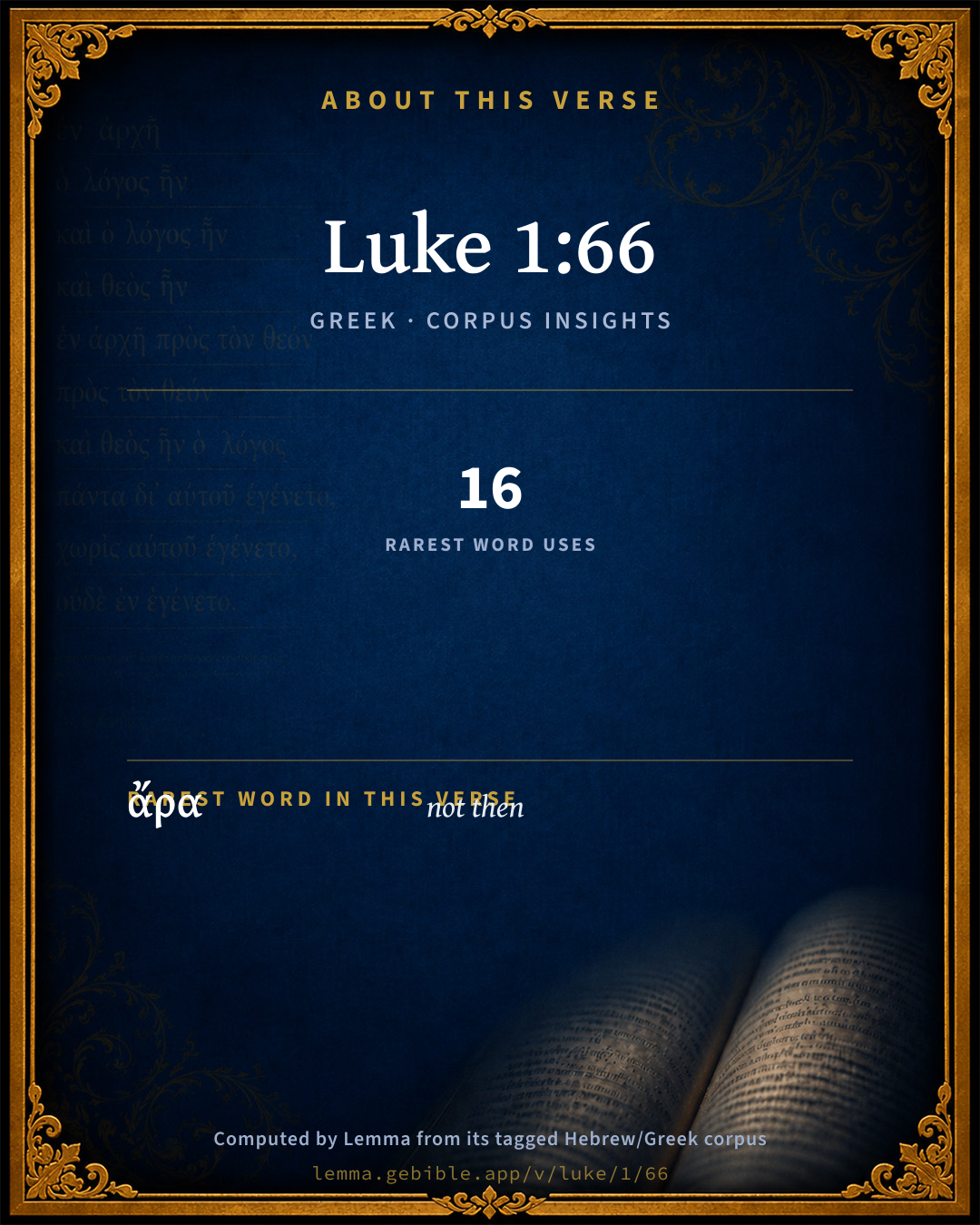
Luke 1:66

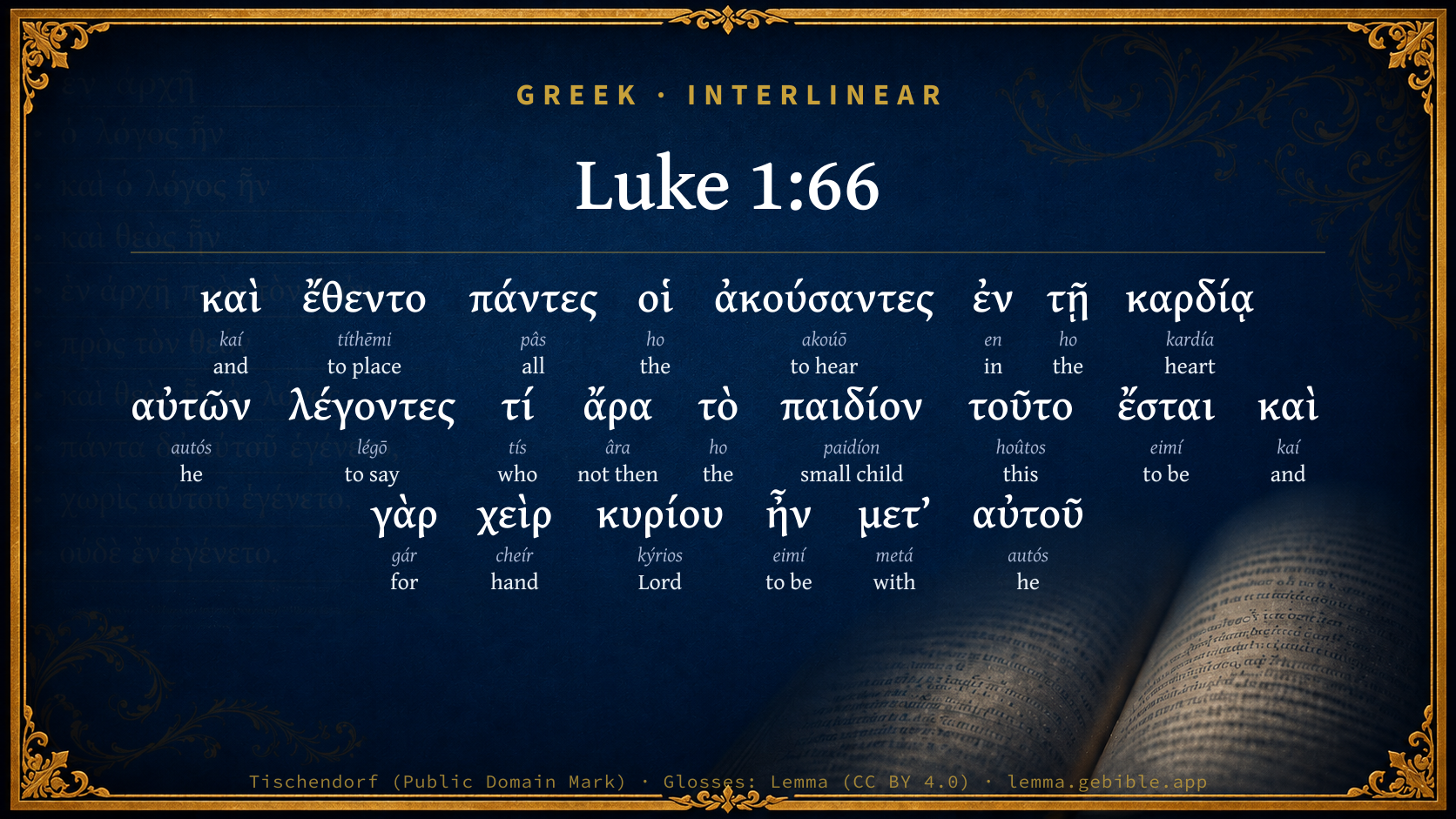
Greek (Tischendorf 8th ed.) Luke 1:66 appears in the Greek New Testament. The text above is from the Tischendorf 8th edition. Each word links to its Strong’s number and a concise gloss. Click any word for its full Thayer’s Greek Lexicon entry.
Download image
Cite this verse

Luke 1:66 (World English Bible). Public Domain. Lemma interlinear Bible study tool, https://lemma.gebible.app/v/luke/1/66.

Show BibTeX & RIS
BibTeX
RIS
English Translation
All who heard them laid them up in their heart, saying, "What then will this child be?" The hand of the Lord was with him.
World English Bible · Public Domain
Download a study sheet

One document with this verse’s original text, its word-by-word gloss line, the meaning frame, cross-references with their text, attributed commentary, and full source and license credits — printable, and it pastes into notes with its structure intact.

This verse Autodidact and up

Study sheet (.html) Plain text (.txt)

A passage Seminary Student

Up to 50 verses in one chapter. A passage sheet keeps up to 6 commentary sources and 12 cross-references per verse, in the order this page ranks them, and says so on the sheet whenever that leaves anything out. Ask for a single verse and you get the Autodidact verse sheet above.

Everything on this page stays free to read, with no account — the sheet is a download of what is already on screen, not access to it.

Want to remove ads? Support Godless Engineer
Compare translations 3

The same verse in 3 English versions, stacked beneath the original-language interlinear above. Click any original word for its lexicon entry.

Each is an independent rendering of the whole verse — the interlinear is not word-aligned to these translations.

Highlighted words mark where these versions differ — a whole-verse word diff, not a word-by-word alignment.

  • World English Bible Public Domain
    All who heard them laid them up in their heart, saying, "What then will this child be?" The hand of the Lord was with him.
  • King James Version Public Domain
    And all they that heard them laid them up in their hearts, saying, What manner of child shall this be! And the hand of the Lord was with him.
  • unfoldingWord Literal Text CC BY-SA 4.0
    And all the ones having heard stored in their hearts, saying, “What then will this child become?” For indeed the hand of the Lord was with him.

unfoldingWord Literal Text — © unfoldingWord, licensed CC BY-SA 4.0. Word-aligned USFM3 via Door43 (git.door43.org/unfoldingWord/en_ult).

Versions to compare (up to 4)

3 of 4 selected

Show all 19 translations

Every available English version of this verse, each an independent rendering of the whole verse.

  • World English Bible Public Domain
    All who heard them laid them up in their heart, saying, "What then will this child be?" The hand of the Lord was with him.
  • Berean Standard Bible Public Domain
    And all who heard this wondered in their hearts and asked, “What then will this child become?” For the Lord’s hand was with him.
  • Majority Standard Bible Public Domain
    And all who heard this wondered in their hearts and asked, “What then will this child become?” And the Lord’s hand was with him.
  • King James Version Public Domain
    And all they that heard them laid them up in their hearts, saying, What manner of child shall this be! And the hand of the Lord was with him.
  • American Standard Version (1901) Public Domain
    And all that heard them laid them up in their heart, saying, What then shall this child be? For the hand of the Lord was with him.
  • Revised Version (1885) Public Domain
    And all that heard them laid them up in their heart, saying, What then shall this child be? For the hand of the Lord was with him.
  • Geneva Bible (1599) Public Domain
    And al they that heard them, laid them vp in their hearts, saying, What maner childe shall this be! and the hand of the Lord was with him.
  • Douay-Rheims (1899) Public Domain
    And all they that had heard them laid them up in their heart, saying: What an one, think ye, shall this child be? For the hand of the Lord was with him.
  • Young's Literal Translation Public Domain
    and all who heard did lay them up in their hearts, saying, `What then shall this child be?' and the hand of the Lord was with him.
  • Literal Standard Version CC BY-SA 4.0
    and all who heard laid them up in their hearts, saying, “What then will this child be?” And the hand of the LORD was with him.
  • Unlocked Literal Bible CC BY-SA 4.0
    All who heard them stored them in their hearts, saying, “What then will this child become?” For the hand of the Lord was with him.
  • unfoldingWord Literal Text CC BY-SA 4.0
    And all the ones having heard stored in their hearts, saying, “What then will this child become?” For indeed the hand of the Lord was with him.
  • Darby Bible Public Domain
    And all who heard them laid them up in their heart, saying, What then will this child be? And [the] Lord's hand was with him.
  • World Messianic Bible Public Domain
    All who heard them laid them up in their heart, saying, “What then will this child be?” The hand of the Lord was with him.
  • Webster's Bible Public Domain
    And all they that had heard them, laid them up in their hearts, saying, What manner of child will this be! And the hand of the Lord was with him.
  • Free Bible Version CC BY-SA 4.0
    Everyone who heard the news wondered what it meant. “What will the little boy grow up to be?” they asked, for it was clear he was very special to God.
  • Bible in Basic English Public Domain
    And all who had word of them kept them in their minds and said, What will this child be? For the hand of the Lord was with him.
  • Text-Critical English NT CC BY 4.0
    All who heard about this laid it up in their hearts, saying, “What then will this child become?” And the hand of the Lord was with him.
  • Tyndale New Testament (1534) Public Domain
    and all they that herde the layde them vp in their hertes saying: What maner chylde shall this be? And the honde of the lorde was with him.

Literal Standard Version (2020), Covenant Press — licensed CC BY-SA 4.0. Text via the HelloAO Bible API (eBible.org). Unlocked Literal Bible (unfoldingWord) — licensed CC BY-SA 4.0. Text via the HelloAO Bible API (eBible.org). unfoldingWord Literal Text — © unfoldingWord, licensed CC BY-SA 4.0. Word-aligned USFM3 via Door43 (git.door43.org/unfoldingWord/en_ult). Free Bible Version, Dr. Jonathan Gallagher — licensed CC BY-SA 4.0. Text via the HelloAO Bible API (eBible.org).

Word by word

More ways to search: Search by grammar → Find every occurrence → Compare this word →

Practice this passage: Drill this verse → Learn its vocabulary →

ἄρα
âra
G687
“not then”
Particle, Interrogative
Part of Speech
Particle
Degree
Interrogative
Full Thayer's Definition

Origin: a form of G686 , denoting an interrogation to which a negative answer is presumed

TDNT: None

1. a Greek interrogative particle that implies anxiety or impatience on the part of the questioner
  1. καὶ kaí G2532 “and” Conjunction
  2. ἔθεντο títhēmi G5087 “to place” Verb, Aorist, Middle, Indicative, 3rd person, Plural
  3. πάντες pâs G3956 “all” Adjective, Nominative, Plural, Masculine
  4. οἱ ho G3588 “the” Article, Nominative, Plural, Masculine
  5. ἀκούσαντες akoúō G191 “to hear” Verb, Aorist, Active, Participle, Nominative, Plural, Masculine
  6. ἐν en G1722 “in” Preposition
  7. τῇ ho G3588 “the” Article, Dative, Singular, Feminine
  8. καρδίᾳ kardía G2588 “heart” Noun, Dative, Singular, Feminine
  9. αὐτῶν autós G846 “he” Personal pronoun, Genitive, Plural, Masculine
  10. λέγοντες légō G3004 “to say” Verb, Present, Active, Participle, Nominative, Plural, Masculine
  11. τί tís G5101 “who” Interrogative pronoun, Nominative, Singular, Neuter
  12. τὸ ho G3588 “the” Article, Nominative, Singular, Neuter
  13. παιδίον paidíon G3813 “small child” Noun, Nominative, Singular, Neuter
  14. τοῦτο hoûtos G3778 “this” Demonstrative pronoun, Nominative, Singular, Neuter
  15. ἔσται eimí G1510 “to be” Verb, Future, Middle deponent, Indicative, 3rd person, Singular
  16. καὶ kaí G2532 “and” Conjunction
  17. γὰρ gár G1063 “for” Conjunction
  18. χεὶρ cheír G5495 “hand” Noun, Nominative, Singular, Feminine
  19. κυρίου kýrios G2962 “Lord” Noun, Genitive, Singular, Masculine
  20. ἦν eimí G1510 “to be” Verb, Imperfect, Active, Indicative, 3rd person, Singular
  21. μετ’ metá G3326 “with” Preposition
  22. αὐτοῦ autós G846 “he” Personal pronoun, Genitive, Singular, Masculine

About this verse

These counts appear in no published source. They are computed here, from the morphology-tagged text and Lemma’s own curated glosses. What Lemma adds →

23
words
18
distinct lemmas
Gospels
section

Notable vocabulary

The rarest word here is ἄρα not then G687 — appearing just 16 times in the whole Greek New Testament.

Shared distinctive vocabulary

ἄρα not then G687 occurs in 16 verses of the Greek New Testament. Also found in:

Repetition

Words recur within this verse:

  • ἔσται to be G1510 ×2
  • οἱ the G3588 ×3
  • καὶ and G2532 ×2
  • αὐτῶν he G846 ×2

Cross-references

15

Topical passages linked to Luke 1:66 in the Treasury of Scripture Knowledge — connected by theme and wording, ordered by reader-vote popularity; previews shown in the World English Bible.

  • Acts 11:21 The hand of the Lord was with them, and a great number believed and turned to the Lord.
  • Luke 2:19 But Mary kept all these sayings, pondering them in her heart.
  • Luke 2:51 And he went down with them, and came to Nazareth. He was subject to them, and his mother kept all these sayings in her heart.
  • Genesis 37:11 His brothers envied him; but his father kept this saying in mind.
  • Genesis 39:2 Yahweh was with Joseph, and he was a prosperous man. He was in the house of his master the Egyptian.
  • Judges 13:24–25 The woman bore a son, and named him Samson: and the child grew, and Yahweh blessed him.
  • 1 Samuel 2:18 But Samuel ministered before Yahweh, being a child, girded with a linen ephod.
  • 1 Kings 18:46 and the hand of Yahweh was on Elijah; and he girded up his loins, and ran before Ahab to the entrance of Jezreel.
  • Psalms 89:21 With whom my hand shall be established. My arm will also strengthen him.
  • Psalms 119:11 I have hidden your word in my heart, That I might not sin against you.
  • Luke 1:80 The child was growing, and becoming strong in spirit, and was in the desert until the day of his public appearance to Israel.
  • Luke 2:40 The child was growing, and was becoming strong in spirit, being filled with wisdom, and the grace of God was upon him.
  • Luke 9:44 "Let these words sink into your ears, for the Son of Man will be delivered up into the hands of men."
  • 1 Samuel 16:18 Then answered one of the young men, and said, Behold, I have seen a son of Jesse the Bethlehemite, who is skillful in playing, and a mighty man of valor, and a man of war, and prudent in speech, and a comely person; and Yahweh is with him.
  • Psalms 80:17 Let your hand be on the man of your right hand, On the son of man whom you made strong for yourself.

Cross-references courtesy of OpenBible.info (CC BY 4.0).

Commentary

Notes on Luke 1:66 from classic Christian and Jewish commentators (each source and its license shown beneath its notes). The classic Christian expositions comment on the surrounding passage and are grouped to its opening verse, so a note may address several verses; the Jewish commentaries on the Tanakh (Rashi and others) are per-verse, so they appear only where the commentator wrote on this verse.

Lemma curates 59 commentaries, every one of them public domain or Creative Commons licensed, each selected and text-cleaned for this edition rather than reprinted as found. About our sources →

The Biblical Illustrator

Joseph S. Exell

Luk_1:66

What manner of child shall this be?

--

Great expectations

When a child is born (as we say) to the purple; when an heir to the throne is announced; or when we stand beside the cradle of some unconscious little successor to a great historic title, to a vast estate, or to accumulated wealth of other kinds--how do we busy ourselves with speculations as to what may be in store for such a child? Descending to lower strata in social life, how common it is to forecast a great future, if the child should early display great ability, high intellectual gifts, special aptitudes for a particular branch of study! Yet very often, in such cases, the thoughts we harbour are but the most foolish castles in the air. We direct our hopes to external things; we dazzle our imagination with splendid prospects of a great career; and by greatness mean publicity, honours, wealth, rank, and a frequent mention in the newspapers. Ah, how mistaken, how ill-judged, how far below (not above) the true mark are our fond anticipations for our children. Let us try to learn this lesson from the text. What was it, probably, that the friends and neighbours of this distinguished priestly family expected for the new-born child? We can hardly doubt what it would be, when we reflect on the circumstances of the time. So pious a circle, and one so conversant with the Temple and its services, as these familiar friends of the priest Zacharias, would be sure to tinge all their thoughts with religion. And, therefore, in their answers among themselves to this question, we may confidently assume that a high spiritual destination would be assigned to him as a champion of Israel against the world. Surely this child, they may have said, will become--as Joab was to David--a mighty and unconquered captain in the armies of the coming Messiah; his sword will be red with the blood of Jehovahs enemies; and, like the heathen before Judas Maccabaeus, so the bated Roman legions will go down before his avenging onset. Or, should their thoughts take a more peaceful turn, The child, they might say, will be (like his father) a faithful priest of God; and will fulfil, in the future history of our nation, as prominent a part as Zadok and Jehoiada in the days of old. At the very least, he will be a writer of books--such as Daniel, or The Book of Enoch--books that will touch the heart of Israel to the very quick; or, it may be, a preacher, a prophet, an Elijah--a prominent, a powerful, a striking, an impressive personage, ever to the front when some conflict shall be imminent with the false priests of Baal, or when the modern Jezebels and Ahabs are to be publicly smitten with the curse of an avenging God. But if such dreams were among their sanguine anticipations for this wonderful child, we know how utterly they were mistaken. The event has taught us how much more spiritual, how much more worthy of all these wonderful antecedents, was the result than these pious Jews had been able to imagine. The result was this: first, for many long years no publicity at all, but a quiet and meditative life in the wilderness; and after that preparation was complete, even then no protracted public ministry amid obedient and awe-stricken crowds, but a brief mission to prepare the way for Him who was to come, abruptly closed by imprisonment; and after that, no dramatic execution, while tearful multitudes pressed around the scaffold to dip their handkerchiefs in the martyrs blood, but only a swift stroke amid the dungeons gloom, a ghastly comedy of horror when a dancing-girl brought in upon a charger the prophets head, and a secret burial by a handful of terrified disciples. Such is the irony of history. Such is the answer to the question of the text. (Canon G. H. Curteis.)

Internal history of the Baptist

There are, for every man that lives upon this earth, two histories unfolding simultaneously. There is the external history of his career; and there is the internal history of his character, of his soul. In the case of the Baptist, as in every other case, we can only read the mysterious secrets of the hidden man, by the few visible tokens that are given us. Now, in the Gospels we have five tokens given, by the help of which we can reconstruct the whole character of the man.

I. WE HAVE THE FACT OF HIS FAITHFUL, UNSELFISH SURRENDER OF PRIVACY AND OF SWEET, SERENE MEDITATION ALONE WITH NATURE AND WITH GOD, AT THE CLEAR CALL TO IRKSOME PUBLIC DUTY. It is no easy task to preach repentance to swaying and restless crowds. It is not pleasant to stand as a public target for questioners of every kind, and casuists of every degree, to shoot their arrows at. Yet thus stood John the Baptist. His answers in public show that he had not misused his opportunities in retirement.

II. ANOTHER TOKEN OF HIS PERSONAL CHARACTER, WHICH IS FURNISHED IN THE GOSPELS, IS HIS LOYALTY. Look not to me, but to another who is greater than I. A sign of the noblest self-devotion. This worship of a higher Being guards the heart against all approaches of vanity and self-worship, and repels every base thought of self-interest.

III. THERE IS YET ANOTHER CHARACTERISTIC IN THE BAPTIST, WHICH BRINGS HIM INTO VERY CLOSE CONTACT WITH MANY LOYAL YET TROUBLED SOULS AT THE PRESENT DAY. It seems that, at one time, he was even afflicted with doubt (Mat_11:2-3). Most kindly, gently, and patiently was that question answered by our Lord. And we may, therefore, gather encouragement for ourselves under any similar difficulties. We may be sure that if we, in like manner, take an honest and straightforward course, not letting our doubts withdraw us from our Saviour, but rather bring us nearer and closer to Him, we shall receive the same gentle and sufficient reply, an appeal to personal experience, to what we have ourselves heard and seen.

IV. ANOTHER CHARACTERISTIC OF THIS SAINTLY MAN IS TO BE FOUND IN HIS COURAGEOUS REBUKE OF SIN, EVEN WHEN IT WAS DRAPED AND GILDED AND DISGUISED UNDER WELL-SEEMING NAMES, IN THE PALACES OF RINGS.

V. BUT THE MOST STRIKING FEATURE OF ALL IN HIS CHARACTER WAS HIS SELF-EFFACEMENT. We know too well that even self-denial is a virtue of high and difficult attainment. Much more difficult is a genuine and unaffected self-humiliation. But most difficult of all is self-effacement in Christ--that spiritual depth, attained also by. St. Paul, which says (feeling what it says) I live; yet not I, but Christ liveth in me. The Baptist is a type of those who resolve, at all risks, to discharge their duty and to deliver the message entrusted to them by God, without one single thought of self, or one transient wish to appear themselves in the matter. No indolence; no cowardice; but they are content to be only a voice --to preach Gods Word, not their own, to pursue some truth which is not to enhance their own reputation; to advocate some cause which is not to redound to their own advantage. (Canon G. H. Curteis.)

The future of a child

Stars have been interrogated and thought to prophesy and proclaim the future of a child, so that to this day born under an unlucky star is passed into a proverb.

I. THE DEVELOPMENT OF CHILDHOOD. What, then, shall this child be?

1. What God designs it. God had a plan of life for this child of Zacharias and Elisabeth.

2. What training makes it. The fashioning power of parents and teachers is very great. Gods plan may be marred in our hands. The life of John Stuart Mill proclaims the wonderful power that a parent can wield over the plastic nature of the child, and how instruction and training may shape a life. Great men owe much to pious parents like Zacharias and Elisabeth.

II. THE PROVIDENCE OF GOD WITH CHILDHOOD. For the hand of the Lord was with him. This stimulated the question. Curiosity as to the future of a child becomes greater when there are--

1. Marks of the supernatural. This was the case with John.

2. Tokens of the Divine protection. The myth of Romulus and Remus, suckled in their infancy by a she-wolf, enshrines a truth--those destined for greatness are under the special protection of the Almighty. The apostolic John Wesley was miraculously saved in childhood from a burning house.

3. Early evidences of greatness. Providence is shown in such evidences, leading, as they often do, to special care in education. This is what all should desire for their children, that the hand of the Lord may be with them. (Canon Vernon Hutton, M. A.)

A question and answer at the birth of a child

1. The natural question--What manner of child shall this be?

2. The satisfactory answer- The hand of the Lord will be with him. (Van Oosterzee.)

What manner of child shall this be?

1. How far above our asking is the Divine gift very often!

2. How wonderful are the possibilities for weal or woe in a child! Shall our children prove John Baptists, voices for Christ? or shall they falsify our own allegiance to Him?

3. How blessed it is to have a child associated with Christ from the outset! I covet for our children this association with the Lord. I would have His name, His story, His words, His gospel, their earliest memories and their dearest child-experiences.

4. What of kindred dedication of children to-day? Where are the Abrams, Hannahs, and Zachariases of this age? How few Christian parents yield their children up to the service of God?

5. How many of those who feared and asked What manner of child? &c., received him and received the Lord? One asks wistfully, whether, when the thirty years were passed, and John the Baptist, and then the Lord came forth, many or any watched for their coming and welcomed their manifestation. I gladly believe that some would, some must. (A. B.Grosart, DD.)

A sermon to parents

What manner of child shall this be? Will it grow up to manhood or womanhood, or will the flower be nipped in the bud? And if it grow to mans estate, what kind of a man will it make? Wise, virtuous, useful; or foolish, vicious, profligate? Such questions as these associated with the birth of childhood. The true parent will not be content simply with asking What manner, &c., but realizing that the answer to that question depends very largely upon home-training and influence, will set to work to make that training and influence of such a character as will, under God, produce the best results. To assist you in this work will now be my aim. I begin by reminding you that your child is fearfully and wonderfully made. It is a Trinity in Unity. It is made up of three parts. And each of these parts must be cultivated and developed in order to a complete and noble manhood.

I. YOUR CHILD HAS A BODY THAT REQUIRES TO BE BUILT UP AND PERFECTED.

II. YOUR CHILD HAS A SOUL THAT NEEDS TO BE DEVELOPED AND CULTURED. By the soul I mean that moral and intellectual part of your childs nature which distinguishes it from, and raises it above, the brutes that perish.

III. Your CHILD HAS A SPIRITUAL NATURE WHICH NEEDS TO BE ENCOURAGED AND FOSTERED AND CAREFULLY AND PRAYERFULLY WATCHED OVER. Observe--

1. This threefold development should be simultaneous.

2. We should begin early, should look for signs of early piety, and should interpret these as indications that God Himself is at work in their young hearts. Our children have visions of God much earlier than we are accustomed to think. Let us encourage them to foster these visions, to listen to the voice of God within, to respond to the wooings of His love. This done, we need not trouble ourselves with the question, What manner, &c., but may safely and joyfully leave our children in Gods hands, feeling assured that

His grace will prove more than sufficient for all their needs, that His love will never see them want any good thing, and that His spirit, which has begun the good work in their souls, will carry it on to perfection. (W. Fox.)

A sermon to children

Every boy and girl might well ask about himself or herself, What manner, &c. I want you to think about what you are going to be. It is not chance that decides. The fruit comes out of the blossom; the flower out of the bud; the man out of the child. You are beginning now to be the men and women that you will be. Here are some things that you can do, or get done for you. For we can go for help to One who is able to do very much more than we ask or think.

I. MEND THE LITTLE FAULTS NOW.

II. BE NOW WHAT YOU WOULD LIKE TO BE WHEN YOU ARE GROWN UP.

1. Be truthful.

2. Be kind and pleasant.

III. TAKE WITH YOU TWO THINGS MORE WONDERFUL THAN ANY OTHER GIFTS THAT YOU EVER READ OR HEARD OF.

1. A golden key--PRAYER.

2. A charm which I would have you wear not next to your heart, but in the heart itself. The charm is this--try always to please Jesus.

IV. And yet the most wonderful part remains, that if we come to Jesus, and seek Him as our Saviour and Helper, the child will become an angel of God. (Mark Guy Pearse.)

Indications in childhood

Childhood shows the man as morning shows the day. Moses, Joseph, Samuel, David, Obadiah, Josiah, Daniel, Shadrach, Meshach, Abednego, John the Baptist, John the Apostle, Timothy, Washington, John Wesley, and multitudes of other goodly children have lived to be men famous for their godliness and usefulness. The Arabians put an ant into the hand of a new-born infant and say, May the boy turn out clever and skilful. We pray that from the childhood blossoms we have in our homes and schools there may develop flowers which will fill every circle where they move with fragrance, spiritual beauty, and joy; or that, in other cases, the buds now attach ing themselves to some branch which is joined to the True Vine, may be twigs or branches themselves in years to come, bearing fruit for the glory of God and the benefit of mankind. (H. R. Burton.)

A child misjudged

A poor doctor, who had met with great misfortunes, lay on his deathbed, saddened by the thought that he was leaving a large family behind him, without any provision for its maintenance. Not long before his death, his youngest child was born, a scrawny, puny babe, weighing five or six pounds. The mother was worn out, and was apparently to be left poor, friendless, and alone, with her great family of little ones. But--that baby! Every one said: What a mercy if that child should die! What can she do with it? What a blessing if it should die! The poor mother almost thought so too. But the unwelcome babe would not die. He made a struggle for life, and won the battle. To-day his memory is revered as that of Dr. John Todd, the author of The Students Manual, and of other works of eminent usefulness, by means of which, being dead, he yet speaketh. No mother knows what she has in her cradle. (Baxendales Anecdotes.)

The mystery of moral development

The beginning of Neros reign was marked by acts of the greatest kindness and condescension; by affability, complaisance, and popularity. The object of his administration seemed to be the good of his people; and when he was desired to sign his name to a list of malefactors that were to be executed, he exclaimed, I wish to heaven I could not write I He was an enemy to flattery, and when the Senate liberally commended the wisdom of his government, Nero desired them to keep their praises until he deserved them. Yet this was the wretch who assassinated his mother, who set fire to Rome, and destroyed multitudes of men, women, and children, and threw the odium of that dreadful action upon the Christians. The cruelties he exercised towards them were beyond description, while he seemed to be the only one who enjoyed the tragical spectacle. Oh, human depravity, what a monster! Divine grace alone can change it and make it holy. (Handbook to Scripture Doctrines.)

The Biblical Illustrator, edited by Joseph S. Exell (c. 1880s–1900s) — public domain. Text from a community e-Sword module.

Tyndale Open Study Notes

Tyndale Open Resources

1:66 the hand of the Lord: This anthropomorphism (describing God with human characteristics, cp. 1:51) meant that God was at work in John’s life.

Tyndale Open Study Notes — © Tyndale Open Resources, licensed CC BY-SA 4.0. Text via the HelloAO Bible API.

Bengel's Gnomon

Johann Albrecht Bengel

Luk 1:66. Ἔθεντο, laid up) A most wholesome study [deliberation]: that the connection of the several events should be carefully observed after long intervals elapsing in the Divine operations. Comp. ch. Luk 2:18-19.

Bengel's Gnomon of the New Testament — English translation (T&T Clark, Edinburgh, 1860) — public domain. Text from a community e-Sword module.

Expositor's Greek Testament

ed. W. Robertson Nicoll

Luk 1:66 . τί ἄρα , etc.: what, in view of all these unusual circumstances, will this child come to? A most natural question. They felt sure all things portended an uncommon future for this child: “omina principiis inesse solent”. καὶ γὰρ , etc.: a reflection of the evangelist justifying the wistful questioning of the hill folk = they might well ask, for indeed the hand of the Lord was with him.

The Expositor's Greek Testament, edited by W. Robertson Nicoll (1897–1910) — public domain. Text from a community e-Sword module.

Geneva Bible (1599)

Geneva Bible translators

That is, the present favor of God, and a singular kind of virtue appeared in him.

Thought upon them diligently and earnestly, and as it were, printed them in their hearts.

Geneva Bible (1599) marginal notes — public domain. Text via Bolls.life.

Jamieson, Fausset & Brown

Robert Jamieson, A. R. Fausset & David Brown

hand of the Lord was with him--by special tokens marking him out as one destined to some great work (Kg1 18:46; Kg2 3:15; Act 11:21).

Jamieson, Fausset & Brown — Commentary Critical and Explanatory on the Whole Bible (1871) — public domain (CC PDM 1.0). Text via the HelloAO Bible API.

Adam Clarke's Commentary

Verse 66. What manner of child shall this be!] As there have been so many extraordinary things in his conception and birth, surely God has designed him for some extraordinary purpose. These things they laid up in their heart, patiently waiting to see what God would work.

The hand of the Lord was with him.] God defended and prospered him in all things, and the prophetic spirit began to rest upon him.

Adam Clarke's Commentary on the Bible (1810–1826) — public domain. Text from a community e-Sword/MySword module.

Ellicott's Commentary for English Readers

(66) What manner of child shall this be!—Better, what shall this child be! The question was not, what kind of child He should be, but what the child would grow to.

And the hand of the Lord was with him.—Some good MSS. give, “for the hand of the Lord,” as giving the reason for the previous question. The “hand” implies, in the familiar language of the Old Testament (e.g., Jdg_2:15; 2Ch_30:12; Ezr_7:9), what we more commonly call the “guidance” or the “providence” of God. The phrase was essentially a Hebrew one; one of the vivid anthropomorphic idioms which they could use more boldly than other nations, because they had clearer thoughts of God as not made after the similitude of men (Deu_4:12).

A Bible Commentary for English Readers, edited by Charles John Ellicott (1878–1897) — public domain. Text from a community e-Sword module.

The Cambridge Bible for Schools and Colleges

gen. ed. J. J. S. Perowne

66. What manner of child] Rather, What then will this child be?

And] Rather, For indeed, with א, B, C, D, L, which read καὶ γάρ.

the hand of the Lord was with him] The turn of expression is Hebraistic, as throughout the chapter. Comp. Luk_13:11; Act_11:21. “Let thy hand be upon the man of thy right hand,” Psa_80:17.

The Cambridge Bible for Schools and Colleges (gen. ed. J. J. S. Perowne; Cambridge University Press, 1878–1918) — public domain. Text from a community e-Sword module.

John Gill's Exposition

And all they that heard them,.... The above things, laid them up in their hearts; treasured them up in their memories, and often thought of them in their minds, what should be the meaning, and what would be the issue of them:

saying, what manner of child shall this be? what will he be, or come to? and what is it that he shall do? surely he must be designed in providence to be put into some high station, and some eminent work and service; since so many, and such great things, have gone before, and attended his birth:

and the hand of the Lord was with him; which may intend the special care, and peculiar providence of God in preserving his life, giving him health, causing him to grow strong and robust, and in stature of body, and in endowments of mind; and also the communications of grace unto him, and the gracious presence of God with him, so soon as he was capable of enjoying them; as likewise a spirit of prophecy, which is sometimes signified by the hand of the Lord; and the extraordinary gifts of the Spirit, which, in process of time, appeared in him, qualifying him for his high office and work: the hand of the Lord, with the Jews, is the Holy Ghost: thus they interpret Ch1 28:19 "all in writing", this is the "Masora"; "from the hand of the Lord", , "this is the Holy Ghost". (w).

(w) T. Hieros. Megilla, fol. 70. 1.

John Gill's Exposition of the Whole Bible (1746–1763) — public domain (CC PDM 1.0). Text via the HelloAO Bible API.

Trapp's Complete Commentary

John Trapp

66 And all they that heard them laid them up in their hearts, saying, What manner of child shall this be! And the hand of the Lord was with him.

Ver. 66. And the hand of the Lord] That is, his grace and blessing. He had the honour to be Legis et gratiae fibula, as Chrysologus hath it; the buckle and boundary of the law and gospel.

John Trapp, A Commentary or Exposition upon All the Books of the Old and New Testament (1647–1656) — public domain. Text from a community e-Sword module.

Albert Barnes' Notes on the Bible

What manner of child ... - Such were the remarkable circumstances of his birth that they apprehended that he would be distinguished as a prophet, or that great events would result from his life.

The hand of the Lord was with him - The word “hand” is used to denote “aid, protection, favor.” We stretch out the hand to aid those whom we wish to help. The expression here means that God “aided” him, “protected” him, or showed him favor. Some think that these words are a part of the speech of the neighbors - “What manner of child shall this be? God is so evidently with him!”

Albert Barnes' Notes on the Bible (1834–1885) — public domain. Text from a community e-Sword/MySword module.

Whedon's Commentary on the Bible

Daniel D. Whedon

66. What manner of child—Doubtless these facts were still remembered by many when John finally came forth as a prophet, and stirred the nation with his powerful preaching.

The hand of the Lord—This is Luke’s statement, not the people’s. For Josephus’s account of the baptism and fame of John, see note on Mat_4:3.

Daniel D. Whedon (gen. ed.), Commentary on the Old and New Testaments (1874–1909) — public domain. Text from a community e-Sword module.

The Pulpit Commentary

And the hand of the Lord was with him. This kind of pause in the history is one of the peculiarities of St. Luke"s style. We meet with it several times in the gospel story and in the history of the Acts. They are vivid pictures in a few words of what happened to an individual, to a family, or to a cause, during often a long. course of years. Here the story of the childhood of the great pioneer of Christ is briefly sketched out; in it all, and through it all, there was one guiding hand the Lord"s. The expression, "hand of the Lord," was peculiarly a Hebrew thought one of the vivid anthropomorphic idioms which, as has been aptly remarked, they could use more boldly than other nations, because they had clearer thoughts of God as not made after the similitude of men. (Deu_4:12) Maimonides, the great Jewish writer of the twelfth century, in his "Yad Hachazakah," says, "And there was under his feet; (Exo_24:10) written with the finger of God; (Exo_31:18) the hand of the Lord; (Exo_9:3) the eyes of the Lord; (Deu_11:12) the ears of the Lord. (Num_11:18) All these are used with reference to the intellectual capacity of the sons of men, who can comprehend only corporeal beings; so that the Law spoke in the language of the sons of men, and all these are expressions merely, just as, If I whet my glittering sword; (Deu_32:41) for has he, then, a sword? or does he slay with a sword? Certainly not: this is only a figure; and thus all are figures". ("Yad," Luk_1:8)

The Pulpit Commentary (1880–1919), ed. H.D.M. Spence-Jones & Joseph S. Exell — public domain. Text from a community e-Sword module.

John Wesley's Explanatory Notes

The hand of the Lord - The peculiar power and blessing of God.

John Wesley, Explanatory Notes Upon the Whole Bible (1754–1765) — public domain. Text via the GEBible commentary corpus.

Cambridge Greek Testament for Schools and Colleges

66. ἐν τῇ καρδίᾳ αὐτῶν. Comp. Luk 2:19. The use of καρδίᾳ for φρεσὶ is a Hebraism. 1Sa 21:12.

Τί ἄρα τὸ παιδίον τοῦτο ἔσται; The ἄρα expresses wonderment, and is thoroughly classical, Luk 8:25, Luk 12:42. Τίς might have been used for τί by the common sense-construction (κατὰ σύνεσιν), but the τί expresses more surprise. Comp. Mat 28:19, ἔθνη—αὐτούς, Gal 4:19, τεκνία … οὕς. Winer, p. 176. ‘What then will this child be?’ The question implies, not “What manner of child,” (as in A. V[41]), but ‘to what kind of man will this child grow?’ Vulg[42] Quis, putas, puer iste erit?

[41] A. V. Authorised Version.

[42] Vulg. Vulgate.

καὶ γάρ. For indeed. (אBCDL.)

χεὶρ κυρίου ἧν μετ’ αὐτοῦ. The turn of expression is Hebraistic, as throughout the chapter. Comp. Luk 13:11; Act 11:21. “Let thy hand be upon the man of thy right hand,” Psa 80:17.

Cambridge Greek Testament for Schools and Colleges (Cambridge University Press, 1896; 21 vols, various authors incl. Carr, Maclear, Plummer, Farrar, Lumby, Moule, M. R. James, Simcox) — public domain. Text from a community e-Sword module.

Alford’s Greek Testament

Henry Alford

66.] λέγοντες carries a slightly logical force with it;—almost = ‘for they said.’

ἄρα refers back to the circumstances which have happened—What then shall, &c.: see ch. 8:25: Act 12:18.

καὶ γὰρ χεὶρ κ.…, a remark inserted by the Evangelist himself, not a further saying of the speakers in the verse before, as Kuinoel and others maintain. The γάρ refers back to the question just asked, q. d., ‘And they might well enquire thus, for’ &c.

Henry Alford, The Greek Testament (1849–1861) — public domain. Text from a community e-Sword module.

International Critical Commentary

66. ἔθεντο πάντες οἱ ἀκούσαντες ἐν τῇ καρδίᾳ αὐτῶν . Comp. 2:19. We find all three prepositions with this phrase, ἐν, ἐπὶ, and εἰς: ἔθετο Δαυεὶδ τὰ ῥήματα ἐν τῇ καρδίᾳ αὐτοῦ (1Sa 21:12); ἔθετο Δανιὴλ ἐπὶ τὴν καρδίαν αὐτοῦ (Dan 1:8); τίθεσθε εἰς τὴν καρδίαν ὑμῶν (Mal 2:2). Lk. is fond of constructions with ἐν τῇ κ. or ἐν ταῖς κ. (2:19, 3:15, 5:22, 21:14; comp. 2:51, 24:38). In Hom. we have both θεῖναί τι and θέσθαι τι, either ἐν φρεσί or ἐν στήθεσσι. Note that, not only is πᾶς or ἅπας a favourite word with Lk., but either form combined with a participle of ἀκούω is also freq. and characteristic (2:18, 47, 4:28, 6:47, 7:29, 20:45; Act 5:5, Act 5:11, Act 5:9:21, Act 5:10:44, Act 5:26:29; comp. Act 4:4, Act 18:8). See on 6:30.

Τί ἄρα τὸ παιδίον τοῦτο ἔσται; Not τίς; the neut. makes the question more indefinite and comprehensive: comp. τί ἄρα ὁ Πέτρος ἐγένετο (Act 12:18). The ἄρα, igitur, means “in these circumstances”; 8:25, 12:42, 22:23.

καὶ γὰρ χεὶρ Κυρίου ἦν μετʼ αὐτοῦ. “For besides all that,” i.e. in addition to the marvels which attended his birth. This is a remark of the Evangelist, who is wont now and then to interpose in this manner: comp. 2:50, 3:15, 7:39, 16:14, 20:20, 23:12. The recognition that John was under special Divine influence caused the question, τί ἄρα ἔσται; to be often repeated in after times. Here, as in Act 11:21, χεὶρ Κυρίου is followed by μετά, and the meaning is that the Divine power interposes to guide and bless. See small print on 1:20 for other parallels between Gospel and Acts. Where the preposition which follows is ἐπί, the Divine interposition is generally one of punishment (Act 13:11; Jdg 2:15; 1Sa 5:3, 1Sa 5:6, 1Sa 5:7:13; Exo 7:4, Exo 7:5). But this is by no means always the case (2Ki 3:15; Ezr 7:6, Ezr 7:8:22, 31), least of all where χείρ has the epithet ἀγαθή (Ezr 7:9, Ezr 7:28, Ezr 7:8:18). In N.T. χεὶρ Κυρίου is peculiar to Lk. (Act 11:21, Act 11:13:11; comp. 4:28, 30).

International Critical Commentary — older volumes (1896–1929), various authors — public domain. Text from a community e-Sword module.

Lesson kit

Teaching starters — assembled from the data on this page, not authored interpretation. Every prompt links to the verse data it draws on. Edit before teaching.

Luke, in the Gospels, opens this verse with 23 words (18 distinct Greek lemmas). Its most distinctive word is âra (“not then”). A historical commentator’s framing appears above. Read the whole chapter for the surrounding context.

Discussion questions

  1. How does “not then” (âra) shape what this verse is saying?
  2. Matthew 18:1 shares the word «not then» with this verse. How do the two illuminate each other?
  3. “to be” occurs 2× in this one verse. What is the effect of the repetition?
  4. These translations render this verse differently. What is at stake in choosing one wording over another?
  5. Reading how The Biblical Illustrator and Tyndale Open Study Notes read this verse, where do the two commentators agree and where do they part?

Things to notice

Reading settings

Reading text

Shown beneath each verse's original-language words.

Old Testament
Old Testament edition

Read the OT as the Masoretic Hebrew (MT) or the Greek Septuagint (LXX).

English shown for the Greek Septuagint (in the Hebrew ↔ Greek comparison).

Comparing translations? Open the Compare panel on any verse page to stack up to four side by side.