

Luke 16:1
Greek (Tischendorf 8th ed.) Luke 16:1 appears in the Greek New Testament. The text above is from the Tischendorf 8th edition. Each word links to its Strong’s number and a concise gloss. Click any word for its full Thayer’s Greek Lexicon entry.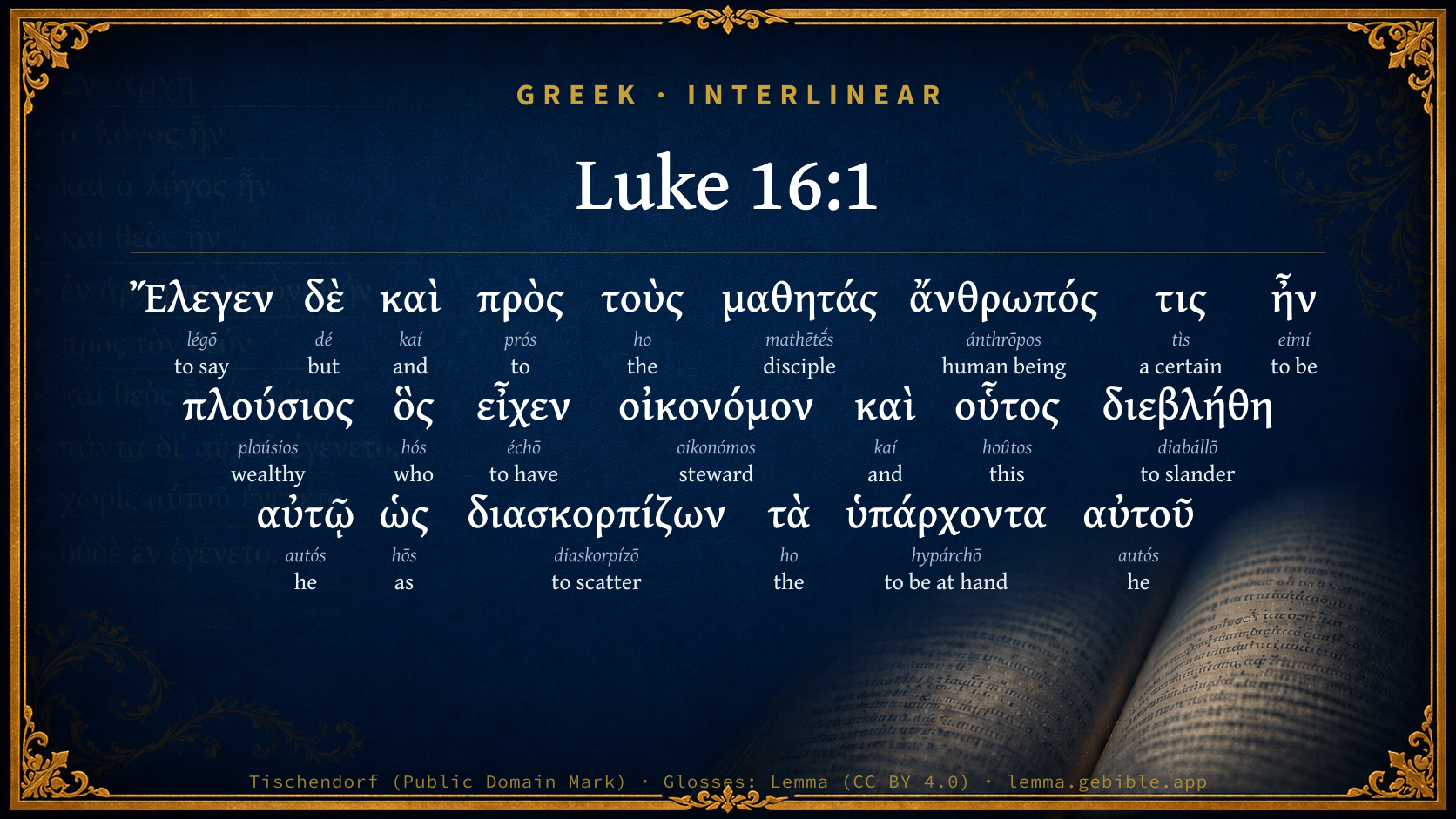
He also said to his disciples, "There was a certain rich man who had a manager. An accusation was made to him that this man was wasting his possessions.
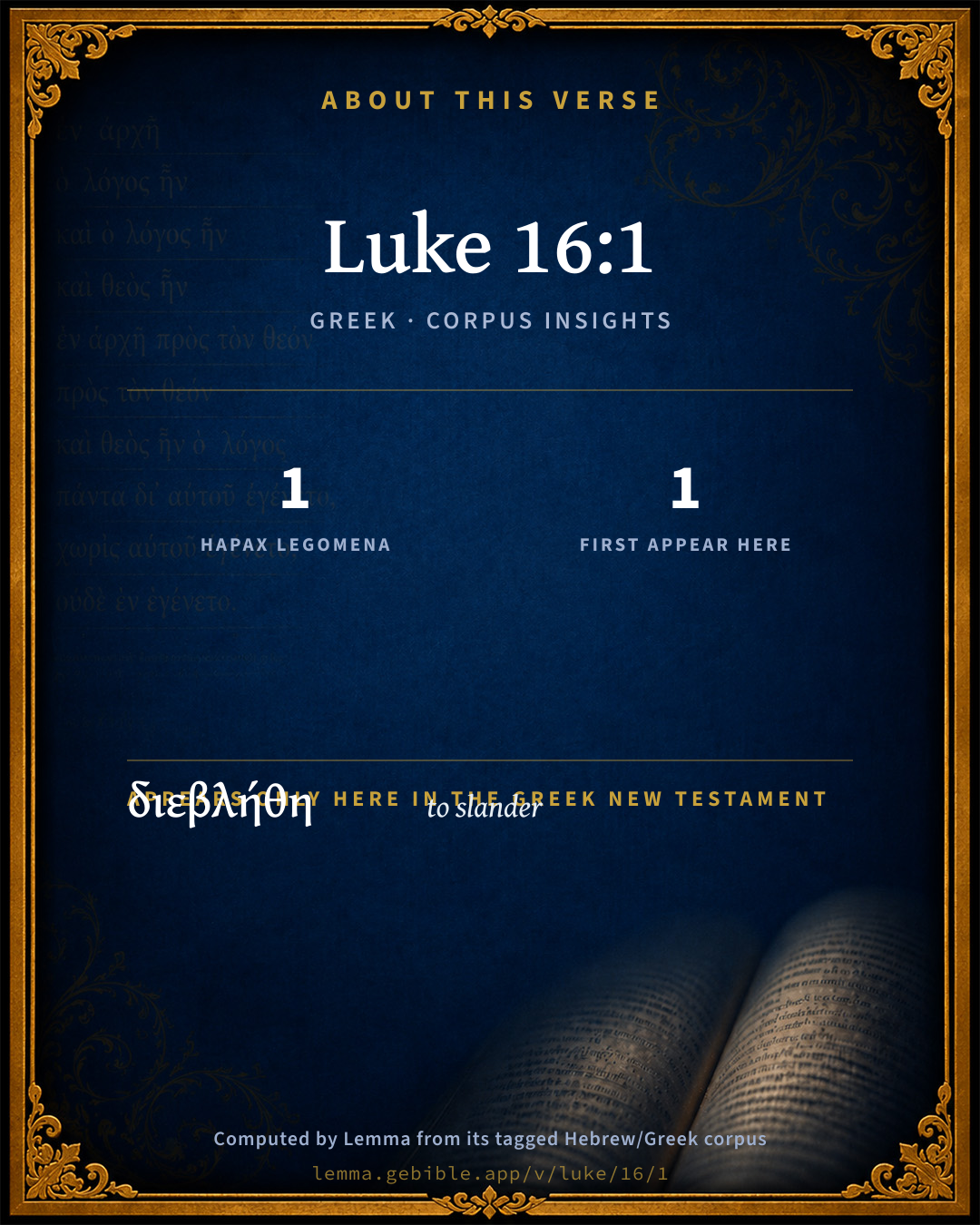
- 1 hapax legomenon — only here in the Greek New Testament
- 1 first appearance in the Greek New Testament
Download a study sheet
One document with this verse’s original text, its word-by-word gloss line, the meaning frame, cross-references with their text, attributed commentary, and full source and license credits — printable, and it pastes into notes with its structure intact.
This verse Autodidact and up
A passage Seminary Student
Up to 50 verses in one chapter. A passage sheet keeps up to 6 commentary sources and 12 cross-references per verse, in the order this page ranks them, and says so on the sheet whenever that leaves anything out. Ask for a single verse and you get the Autodidact verse sheet above.
Everything on this page stays free to read, with no account — the sheet is a download of what is already on screen, not access to it.
Compare translations 3
The same verse in 3 English versions, stacked beneath the original-language interlinear above. Click any original word for its lexicon entry.
Each is an independent rendering of the whole verse — the interlinear is not word-aligned to these translations.
Highlighted words mark where these versions differ — a whole-verse word diff, not a word-by-word alignment.
-
World English Bible Public Domain
He also said to his disciples, "There was a certain rich man who had a manager. An accusation was made to him that this man was wasting his possessions.
-
King James Version Public Domain
And he said also unto his disciples, There was a certain rich man, which had a steward; and the same was accused unto him that he had wasted his goods.
-
unfoldingWord Literal Text CC BY-SA 4.0
And he also said to the disciples, “There was a certain rich man who had a manager, and he was reported to him as wasting his possessions.
unfoldingWord Literal Text — © unfoldingWord, licensed CC BY-SA 4.0. Word-aligned USFM3 via Door43 (git.door43.org/unfoldingWord/en_ult).
Show all 19 translations
Every available English version of this verse, each an independent rendering of the whole verse.
-
World English Bible Public Domain
He also said to his disciples, "There was a certain rich man who had a manager. An accusation was made to him that this man was wasting his possessions.
-
Berean Standard Bible Public Domain
Jesus also said to His disciples, “There was a rich man whose manager was accused of wasting his possessions.
-
Majority Standard Bible Public Domain
Jesus also said to His disciples, “There was a rich man whose manager was accused of wasting his possessions.
-
King James Version Public Domain
And he said also unto his disciples, There was a certain rich man, which had a steward; and the same was accused unto him that he had wasted his goods.
-
American Standard Version (1901) Public Domain
And he said also unto the disciples, There was a certain rich man, who had a steward; and the same was accused unto him that he was wasting his goods.
-
Revised Version (1885) Public Domain
And he said also unto the disciples, There was a certain rich man, which had a steward; and the same was accused unto him that he was wasting his goods.
-
Geneva Bible (1599) Public Domain
And he sayde also vnto his disciples, There was a certaine riche man, which had a stewarde, and he was accused vnto him, that he wasted his goods.
-
Douay-Rheims (1899) Public Domain
And he said also to his disciples: There was a certain rich man who had a steward: and the same was accused unto him, that he had wasted his goods.
-
Young's Literal Translation Public Domain
And he said also unto his disciples, `A certain man was rich, who had a steward, and he was accused to him as scattering his goods;
-
Literal Standard Version CC BY-SA 4.0
And He also said to His disciples, “A certain man was rich, who had a steward, and he was accused to him as scattering his goods;
-
Unlocked Literal Bible CC BY-SA 4.0
Jesus also said to the disciples, “There was a certain rich man who had a manager, and it was reported to him that this manager was wasting his possessions.
-
unfoldingWord Literal Text CC BY-SA 4.0
And he also said to the disciples, “There was a certain rich man who had a manager, and he was reported to him as wasting his possessions.
-
Darby Bible Public Domain
And he said also to [his] disciples, There was a certain rich man who had a steward, and *he* was accused to him as wasting his goods.
-
World Messianic Bible Public Domain
He also said to his disciples, “There was a certain rich man who had a manager. An accusation was made to him that this man was wasting his possessions.
-
Webster's Bible Public Domain
And he said also to his disciples, There was a certain rich man who had a steward; and the same was accused to him that he had wasted his goods.
-
Free Bible Version CC BY-SA 4.0
Jesus told his disciples this story. “There was once a rich man whose manager was accused of wasting what belonged to his master.
-
Bible in Basic English Public Domain
And another time he said to the disciples, There was a certain man of great wealth who had a servant; and it was said to him that this servant was wasting his goods.
-
Text-Critical English NT CC BY 4.0
Then Jesus said to his disciples, “There was a rich man whose steward was accused of squandering his possessions.
-
Tyndale New Testament (1534) Public Domain
And he sayd also vnto his disciples. Ther was a certayne rych man which had a stewarde that was acused vnto him that he had wasted his goodes.
Literal Standard Version (2020), Covenant Press — licensed CC BY-SA 4.0. Text via the HelloAO Bible API (eBible.org). Unlocked Literal Bible (unfoldingWord) — licensed CC BY-SA 4.0. Text via the HelloAO Bible API (eBible.org). unfoldingWord Literal Text — © unfoldingWord, licensed CC BY-SA 4.0. Word-aligned USFM3 via Door43 (git.door43.org/unfoldingWord/en_ult). Free Bible Version, Dr. Jonathan Gallagher — licensed CC BY-SA 4.0. Text via the HelloAO Bible API (eBible.org).
Word by word
More ways to search: Search by grammar → Find every occurrence → Compare this word →
Practice this passage: Drill this verse → Learn its vocabulary →
- Appears 1× in the Greek New Testament
- First appears here
- Part of Speech
- Verb
- Tense
- Aorist
- Voice
- Passive
- Mood
- Indicative
- Person
- 3rd person
- Number
- Singular
Full Thayer's Definition
- Ἔλεγεν légō G3004 “to say” Verb, Imperfect, Active, Indicative, 3rd person, Singular
- δὲ dé G1161 “but” Conjunction
- καὶ kaí G2532 “and” Conjunction
- πρὸς prós G4314 “to” Preposition
- τοὺς ho G3588 “the” Article, Accusative, Plural, Masculine
- μαθητάς mathētḗs G3101 “disciple” Noun, Accusative, Plural, Masculine
- ἄνθρωπός ánthrōpos G444 “human being” Noun, Nominative, Singular, Masculine
- τις tìs G5100 “a certain” Indefinite pronoun, Nominative, Singular, Masculine
- ἦν eimí G1510 “to be” Verb, Imperfect, Active, Indicative, 3rd person, Singular
- πλούσιος ploúsios G4145 “wealthy” Adjective, Nominative, Singular, Masculine
- ὃς hós G3739 “who” Relative pronoun, Nominative, Singular, Masculine
- εἶχεν échō G2192 “to have” Verb, Imperfect, Active, Indicative, 3rd person, Singular
- οἰκονόμον oikonómos G3623 “steward” Noun, Accusative, Singular, Masculine
- καὶ kaí G2532 “and” Conjunction
- οὗτος hoûtos G3778 “this” Demonstrative pronoun, Nominative, Singular, Masculine
- διεβλήθη diabállō G1225 “to slander” Verb, Aorist, Passive, Indicative, 3rd person, Singular
- αὐτῷ autós G846 “he” Personal pronoun, Dative, Singular, Masculine
- ὡς hōs G5613 “as” Adverb
- διασκορπίζων diaskorpízō G1287 “to scatter” Verb, Present, Active, Participle, Nominative, Singular, Masculine
- τὰ ho G3588 “the” Article, Accusative, Plural, Neuter
- ὑπάρχοντα hypárchō G5225 “to be at hand” Verb, Present, Active, Participle, Accusative, Plural, Neuter
- αὐτοῦ autós G846 “he” Personal pronoun, Genitive, Singular, Masculine
About this verse
These counts appear in no published source. They are computed here, from the morphology-tagged text and Lemma’s own curated glosses. What Lemma adds →
- 22
- words
- 19
- distinct lemmas
- Gospels
- section
Notable vocabulary
1 hapax legomenon — a word that appears only here in the entire Greek New Testament:
- διεβλήθη to slander G1225
First appearance in Scripture
This word makes its first canonical appearance in the Greek New Testament here:
- διεβλήθη to slander G1225
Shared distinctive vocabulary
διασκορπίζων to scatter G1287 occurs in 9 verses of the Greek New Testament. Also found in:
Cross-references
17Topical passages linked to Luke 16:1 in the Treasury of Scripture Knowledge — connected by theme and wording, ordered by reader-vote popularity; previews shown in the World English Bible.
- 1 Peter 4:10 According as each has received a gift, be ministering it among yourselves, as good stewards of the grace of God in its various forms.
- Matthew 25:14–30 "For it is like a man, going into another country, who called his own servants, and entrusted his goods to them.
- Luke 12:42 The Lord said, "Who then is the faithful and wise steward, whom his lord will set over his household, to give them their portion of food at the right times?
- 1 Corinthians 4:1–2 So let a man think of us as Christ's servants, and stewards of God's mysteries.
- James 4:3 You ask, and don't receive, because you ask with wrong motives, so that you may spend it for your pleasures.
- Titus 1:7 For the overseer must be blameless, as God's steward; not self-pleasing, not easily angered, not given to wine, not violent, not greedy for dishonest gain;
- Luke 15:13 Not many days after, the younger son gathered all of this together and traveled into a far country. There he wasted his property with riotous living.
- Luke 15:30 But when this, your son, came, who has devoured your living with prostitutes, you killed the fattened calf for him.'
- Proverbs 18:9 One who is slack in his work Is brother to him who is a master of destruction.
- Matthew 18:23–24 Therefore the Kingdom of Heaven is like a certain king, who wanted to reconcile accounts with his servants.
- Luke 19:20 Another came, saying, 'Lord, behold, your mina, which I kept laid away in a handkerchief,
- Genesis 43:19 They came near to the steward of Joseph's house, and they spoke to him at the door of the house,
- 1 Chronicles 28:1 David assembled all the princes of Israel, the princes of the tribes, and the captains of the companies who served the king by division, and the captains of thousands, and the captains of hundreds, and the rulers over all the substance and possessions of the king and of his sons, with the officers, and the mighty men, even all the mighty men of valor, to Jerusalem.
- Hosea 2:8 For she did not know that I gave her the grain, the new wine, and the oil, And multiplied to her silver and gold, which they used for Baal.
- Luke 8:3 and Joanna, the wife of Chuzas, Herod's steward; Susanna; and many others; who ministered to them from their possessions.
- Luke 16:19 "Now there was a certain rich man, and he was clothed in purple and fine linen, living in luxury every day.
- Genesis 15:2 Abram said, "Lord Yahweh, what will you give me, seeing I go childless, and he who will inherit my estate is Eliezer of Damascus?"
Cross-references courtesy of OpenBible.info (CC BY 4.0).
Lesson kit
Teaching starters — assembled from the data on this page, not authored interpretation. Every prompt links to the verse data it draws on. Edit before teaching.
Luke, in the Gospels, opens this verse with 22 words (19 distinct Greek lemmas). Its most distinctive word is diabállō (“to slander”). A historical commentator’s framing appears above. Read the whole chapter for the surrounding context.
Discussion questions
- The word diabállō carries the sense “to slander.” How does it shape the verse?
- 1 word here appears nowhere else in the Greek New Testament. Why might the author reach for such rare wording?
- This is the first place “to slander” appears in Scripture (first appears here). What does its debut here establish?
- How does Matthew 25:24, which shares the word «to scatter», read alongside this verse?
- What does the repetition of “and” (2× in this one verse) do in this verse?
- The translations on this page render this verse differently — a whole-verse word diff, not a word-by-word alignment. What might account for the different wordings?
- Compare how Matthew Henry's Commentary and The Cambridge Bible for Schools and Colleges read this verse. Where do they agree or differ?
Things to notice
- 1 word in this verse appears nowhere else in the Greek New Testament.
- 1 word makes its first canonical appearance in Scripture here.
- These translations choose different wording for 13 words in this verse.
- “and” occurs 2× in this single verse.
- 19 distinct Greek lemmas span 22 words in this verse.
Commentary
Notes on Luke 16:1 from classic Christian and Jewish commentators (each source and its license shown beneath its notes). The classic Christian expositions comment on the surrounding passage and are grouped to its opening verse, so a note may address several verses; the Jewish commentaries on the Tanakh (Rashi and others) are per-verse, so they appear only where the commentator wrote on this verse.
Lemma curates 59 commentaries, every one of them public domain or Creative Commons licensed, each selected and text-cleaned for this edition rather than reprinted as found. About our sources →
Matthew Henry's Commentary
Matthew Henry's Commentary on the Whole Bible (1708–1710) — public domain (CC PDM 1.0). Text via the HelloAO Bible API.
The Cambridge Bible for Schools and Colleges
gen. ed. J. J. S. Perowne
The Cambridge Bible for Schools and Colleges (gen. ed. J. J. S. Perowne; Cambridge University Press, 1878–1918) — public domain. Text from a community e-Sword module.
Albert Barnes' Notes on the Bible
Albert Barnes' Notes on the Bible (1834–1885) — public domain. Text from a community e-Sword/MySword module.
The Biblical Illustrator
Joseph S. Exell
The Biblical Illustrator, edited by Joseph S. Exell (c. 1880s–1900s) — public domain. Text from a community e-Sword module.
Joseph Benson's Commentary
Joseph Benson's Commentary on the Old and New Testaments (1811–1818) — public domain. Text from a community e-Sword module.
Whedon's Commentary on the Bible
Daniel D. Whedon
Daniel D. Whedon (gen. ed.), Commentary on the Old and New Testaments (1874–1909) — public domain. Text from a community e-Sword module.
The Pulpit Commentary
The Pulpit Commentary (1880–1919), ed. H.D.M. Spence-Jones & Joseph S. Exell — public domain. Text from a community e-Sword module.
The Preacher's Complete Homiletical Commentary
Joseph S. Exell (gen. ed.)
The Preacher's Complete Homiletical Commentary (gen. ed. Joseph S. Exell; Funk & Wagnalls, c. 1892) — public domain (pre-1929). A full-Bible homiletical/sermon-outline anthology covering 65 of 66 books (2 John is absent from the source module). Text from a community e-Sword module.
Lange's Commentary on the Holy Scriptures
Lange's Commentary on the Holy Scriptures (Critical, Doctrinal, and Homiletical), ed. John Peter Lange, English translation edited by Philip Schaff (1864–1880) — public domain. Text from a community e-Sword module.
The Annotated Bible
Arno C. Gaebelein
Arno C. Gaebelein, The Annotated Bible (1913–1922) — public domain. Text from a community e-Sword module.
Godbey's Commentary on the New Testament
William B. Godbey
William B. Godbey, Commentary on the New Testament (1896–1900) — public domain. Text from a community e-Sword module.
Tyndale Open Study Notes
Tyndale Open Resources
Tyndale Open Study Notes — © Tyndale Open Resources, licensed CC BY-SA 4.0. Text via the HelloAO Bible API.
Bengel's Gnomon
Johann Albrecht Bengel
Bengel's Gnomon of the New Testament — English translation (T&T Clark, Edinburgh, 1860) — public domain. Text from a community e-Sword module.
Meyer's Critical & Exegetical Commentary
Heinrich August Wilhelm Meyer
Meyer — Critical and Exegetical Commentary on the New Testament — English translation by Peter Christie, edited by Frederick Crombie (T&T Clark, 1880) — public domain. Text from a community e-Sword module.
Expositor's Greek Testament
ed. W. Robertson Nicoll
The Expositor's Greek Testament, edited by W. Robertson Nicoll (1897–1910) — public domain. Text from a community e-Sword module.
Cambridge Greek Testament for Schools and Colleges
Cambridge Greek Testament for Schools and Colleges (Cambridge University Press, 1896; 21 vols, various authors incl. Carr, Maclear, Plummer, Farrar, Lumby, Moule, M. R. James, Simcox) — public domain. Text from a community e-Sword module.
Alford’s Greek Testament
Henry Alford
Henry Alford, The Greek Testament (1849–1861) — public domain. Text from a community e-Sword module.
International Critical Commentary
International Critical Commentary — older volumes (1896–1929), various authors — public domain. Text from a community e-Sword module.
Godet's Commentaries
Frédéric Louis Godet
Frédéric Louis Godet — Commentaries on Luke, John, Romans, and 1 Corinthians — English translation (T&T Clark, Edinburgh, 1870s–1890s) — public domain. Text from a community e-Sword module.
Geneva Bible (1599)
Geneva Bible translators
Geneva Bible (1599) marginal notes — public domain. Text via Bolls.life.
Adam Clarke's Commentary
Adam Clarke's Commentary on the Bible (1810–1826) — public domain. Text from a community e-Sword/MySword module.
Ellicott's Commentary for English Readers
A Bible Commentary for English Readers, edited by Charles John Ellicott (1878–1897) — public domain. Text from a community e-Sword module.
Trapp's Complete Commentary
John Trapp
John Trapp, A Commentary or Exposition upon All the Books of the Old and New Testament (1647–1656) — public domain. Text from a community e-Sword module.
Haydock's Catholic Bible Commentary
George Leo Haydock (1774–1849), Haydock's Catholic Family Bible and Commentary, 1859 edition — public domain. Excludes Psalms (Douay-Rheims chapter numbering differs from Protestant) and Deuterocanonical books (Catholic canon only).
Matthew Poole's English Annotations
Matthew Poole's English Annotations on the Holy Bible (1683–1685) — public domain. Text from a community e-Sword/MySword module.
Dummelow's Commentary on the Holy Bible
J. R. Dummelow
J. R. Dummelow, A Commentary on the Holy Bible (Macmillan, 1909) — public domain. Text from a community e-Sword module.
John Wesley's Explanatory Notes
John Wesley, Explanatory Notes Upon the Whole Bible (1754–1765) — public domain. Text via the GEBible commentary corpus.
Kretzmann's Popular Commentary
Paul E. Kretzmann
Paul E. Kretzmann, Popular Commentary of the Bible (1921–1924) — public domain. Text from a community e-Sword module.
The Sermon Bible
William Robertson Nicoll (ed.)
The Sermon Bible, ed. William Robertson Nicoll (1888–1900) — public domain. Text from a community e-Sword module.
Burkitt's Expository Notes on the New Testament
William Burkitt
William Burkitt's Expository Notes on the New Testament (1700–1703) — public domain. Text from a community e-Sword module.
McGarvey & Pendleton's Commentaries
J. W. McGarvey
J. W. McGarvey (with Philip Y. Pendleton), Commentaries on the New Testament (The Fourfold Gospel, 1914; Acts; and the epistles) — public domain. Text from a community e-Sword/MySword module.
Darby's Synopsis of the New Testament
John Nelson Darby
John Nelson Darby — Synopsis of the Books of the Bible: the New Testament (c. 1857–1862) — public domain. Text from a community e-Sword module.
The People's New Testament
B. W. Johnson
B. W. Johnson's The People's New Testament with Notes (1889–1891) — public domain. Electronic text from the Christian Classics Ethereal Library (CCEL) ThML edition.
unfoldingWord translationNotes
Door43 World Missions Community
unfoldingWord translationNotes — © Distant Shores Media and the Door43 World Missions Community, licensed CC BY-SA 4.0. Source: git.door43.org/Door43/en_tn.
Vincent's Word Studies in the New Testament
Marvin R. Vincent
Marvin R. Vincent, Word Studies in the New Testament (1887–1900) — public domain. Text from a community e-Sword/MySword module.