Luke 22:17

Greek (Tischendorf 8th ed.) Luke 22:17 appears in the Greek New Testament. The text above is from the Tischendorf 8th edition. Each word links to its Strong’s number and a concise gloss. Click any word for its full Thayer’s Greek Lexicon entry.
Download image
Cite this verse

Luke 22:17 (World English Bible). Public Domain. Lemma interlinear Bible study tool, https://lemma.gebible.app/v/luke/22/17.

Show BibTeX & RIS
BibTeX
RIS
English Translation
He received a cup, and when he had given thanks, he said, "Take this, and share it among yourselves,
World English Bible · Public Domain
Download a study sheet

One document with this verse’s original text, its word-by-word gloss line, the meaning frame, cross-references with their text, attributed commentary, and full source and license credits — printable, and it pastes into notes with its structure intact.

This verse Autodidact and up

Study sheet (.html) Plain text (.txt)

A passage Seminary Student

Up to 50 verses in one chapter. A passage sheet keeps up to 6 commentary sources and 12 cross-references per verse, in the order this page ranks them, and says so on the sheet whenever that leaves anything out. Ask for a single verse and you get the Autodidact verse sheet above.

Everything on this page stays free to read, with no account — the sheet is a download of what is already on screen, not access to it.

Want to remove ads? Support Godless Engineer
Compare translations 3

The same verse in 3 English versions, stacked beneath the original-language interlinear above. Click any original word for its lexicon entry.

Each is an independent rendering of the whole verse — the interlinear is not word-aligned to these translations.

Highlighted words mark where these versions differ — a whole-verse word diff, not a word-by-word alignment.

  • World English Bible Public Domain
    He received a cup, and when he had given thanks, he said, "Take this, and share it among yourselves,
  • King James Version Public Domain
    And he took the cup, and gave thanks, and said, Take this, and divide it among yourselves:
  • unfoldingWord Literal Text CC BY-SA 4.0
    And having taken a cup having given thanks, he said, “Take this, and divide among yourselves.

unfoldingWord Literal Text — © unfoldingWord, licensed CC BY-SA 4.0. Word-aligned USFM3 via Door43 (git.door43.org/unfoldingWord/en_ult).

Versions to compare (up to 4)

3 of 4 selected

Show all 19 translations

Every available English version of this verse, each an independent rendering of the whole verse.

  • World English Bible Public Domain
    He received a cup, and when he had given thanks, he said, "Take this, and share it among yourselves,
  • Berean Standard Bible Public Domain
    After taking the cup, He gave thanks and said, “Take this and divide it among yourselves.
  • Majority Standard Bible Public Domain
    After taking the cup, He gave thanks and said, “Take this and divide it among yourselves.
  • King James Version Public Domain
    And he took the cup, and gave thanks, and said, Take this, and divide it among yourselves:
  • American Standard Version (1901) Public Domain
    And he received a cup, and when he had given thanks, he said, Take this, and divide it among yourselves:
  • Revised Version (1885) Public Domain
    And he received a cup, and when he had given thanks, he said, Take this, and divide it among yourselves:
  • Geneva Bible (1599) Public Domain
    And hee tooke the cup, and gaue thankes, and said, Take this, and deuide it among you,
  • Douay-Rheims (1899) Public Domain
    And having taken the chalice, he gave thanks, and said: Take, and divide it among you:
  • Young's Literal Translation Public Domain
    And having taken a cup, having given thanks, he said, `Take this and divide to yourselves,
  • Literal Standard Version CC BY-SA 4.0
    And having taken a cup, having given thanks, He said, “Take this and divide to yourselves,
  • Unlocked Literal Bible CC BY-SA 4.0
    Then Jesus took a cup, and when he had given thanks, he said, “Take this, and share it among yourselves.
  • unfoldingWord Literal Text CC BY-SA 4.0
    And having taken a cup having given thanks, he said, “Take this, and divide among yourselves.
  • Darby Bible Public Domain
    And having received a cup, when he had given thanks he said, Take this and divide it among yourselves.
  • World Messianic Bible Public Domain
    He received a cup, and when he had given thanks, he said, “Take this and share it among yourselves,
  • Webster's Bible Public Domain
    And he took the cup, and gave thanks, and said, Take this, and divide it among yourselves.
  • Free Bible Version CC BY-SA 4.0
    Jesus took the cup, and after he had given thanks, he said, “Take this and share it among yourselves.
  • Bible in Basic English Public Domain
    And he took a cup and, having given praise, he said, Make division of this among yourselves;
  • Text-Critical English NT CC BY 4.0
    Then he took a cup, and after giving thanks he said, “Take this and divide it among yourselves.
  • Tyndale New Testament (1534) Public Domain
    And he toke the cup and gave thankes and sayde. Take this and devyde it amonge you.

Literal Standard Version (2020), Covenant Press — licensed CC BY-SA 4.0. Text via the HelloAO Bible API (eBible.org). Unlocked Literal Bible (unfoldingWord) — licensed CC BY-SA 4.0. Text via the HelloAO Bible API (eBible.org). unfoldingWord Literal Text — © unfoldingWord, licensed CC BY-SA 4.0. Word-aligned USFM3 via Door43 (git.door43.org/unfoldingWord/en_ult). Free Bible Version, Dr. Jonathan Gallagher — licensed CC BY-SA 4.0. Text via the HelloAO Bible API (eBible.org).

Word by word

More ways to search: Search by grammar → Find every occurrence → Compare this word →

Practice this passage: Drill this verse → Learn its vocabulary →

διαμερίσατε
diamerízō
G1266
“to divide”
Verb, Aorist, Active, Imperative, 2nd person, Plural
Part of Speech
Verb
Tense
Aorist
Voice
Active
Mood
Imperative
Person
2nd person
Number
Plural
Full Thayer's Definition

Origin: from G1223 and G3307

TDNT: None

1. to cleave asunder, cut in pieces 2. to be divided into opposing parts, to be at variance, in dissension 3. to distribute
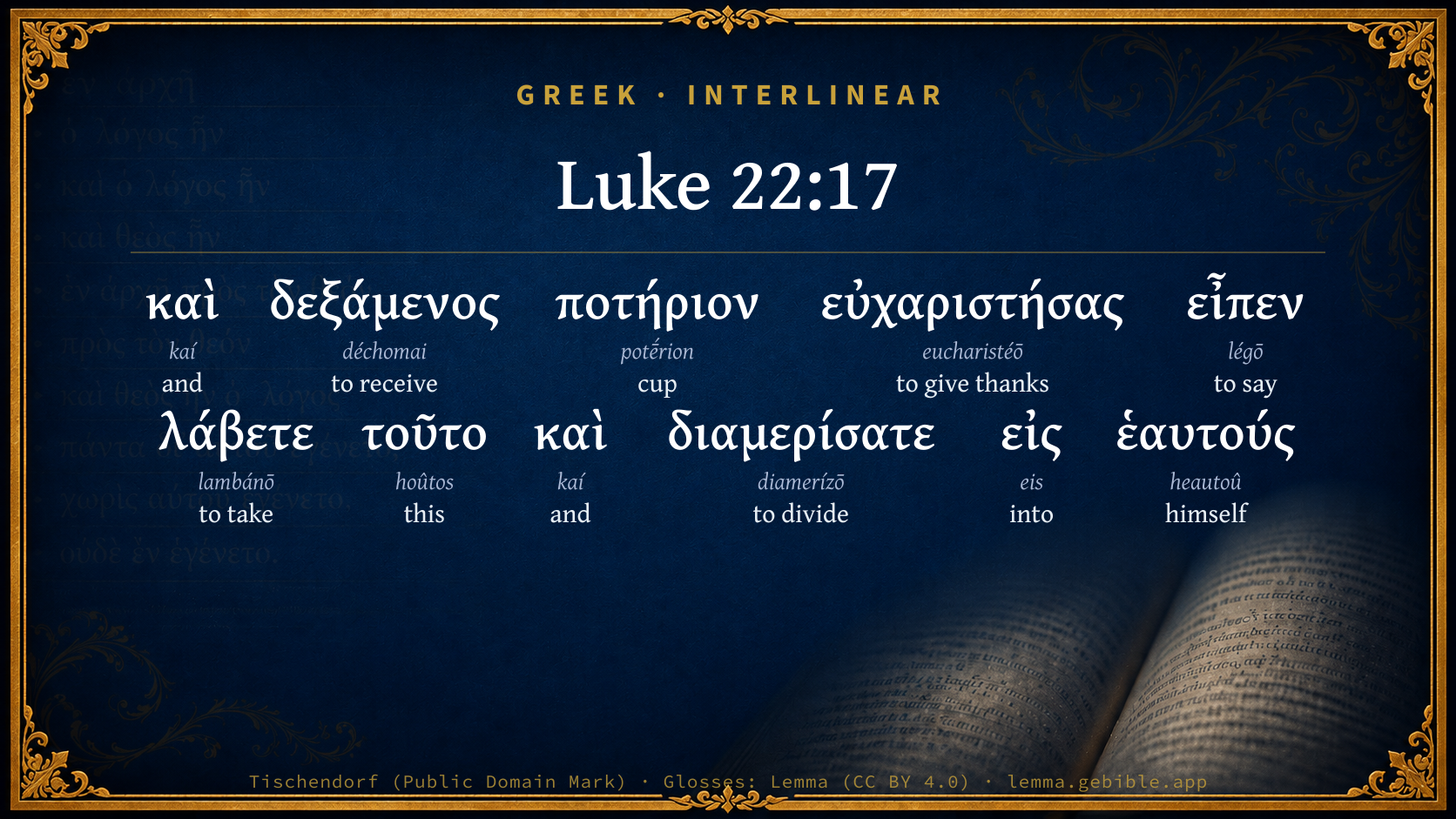
  1. καὶ kaí G2532 “and” Conjunction
  2. δεξάμενος déchomai G1209 “to receive” Verb, Aorist, Middle deponent, Participle, Nominative, Singular, Masculine
  3. ποτήριον potḗrion G4221 “cup” Noun, Accusative, Singular, Neuter
  4. εὐχαριστήσας eucharistéō G2168 “to give thanks” Verb, Aorist, Active, Participle, Nominative, Singular, Masculine
  5. εἶπεν légō G3004 “to say” Verb, Aorist, Active, Indicative, 3rd person, Singular
  6. λάβετε lambánō G2983 “to take” Verb, Aorist, Active, Imperative, 2nd person, Plural
  7. τοῦτο hoûtos G3778 “this” Demonstrative pronoun, Accusative, Singular, Neuter
  8. καὶ kaí G2532 “and” Conjunction
  9. εἰς eis G1519 “into” Preposition
  10. ἑαυτούς heautoû G1438 “himself” Reflexive pronoun, 2nd person, Accusative, Plural, Masculine

About this verse

These counts appear in no published source. They are computed here, from the morphology-tagged text and Lemma’s own curated glosses. What Lemma adds →

11
words
10
distinct lemmas
Gospels
section

Notable vocabulary

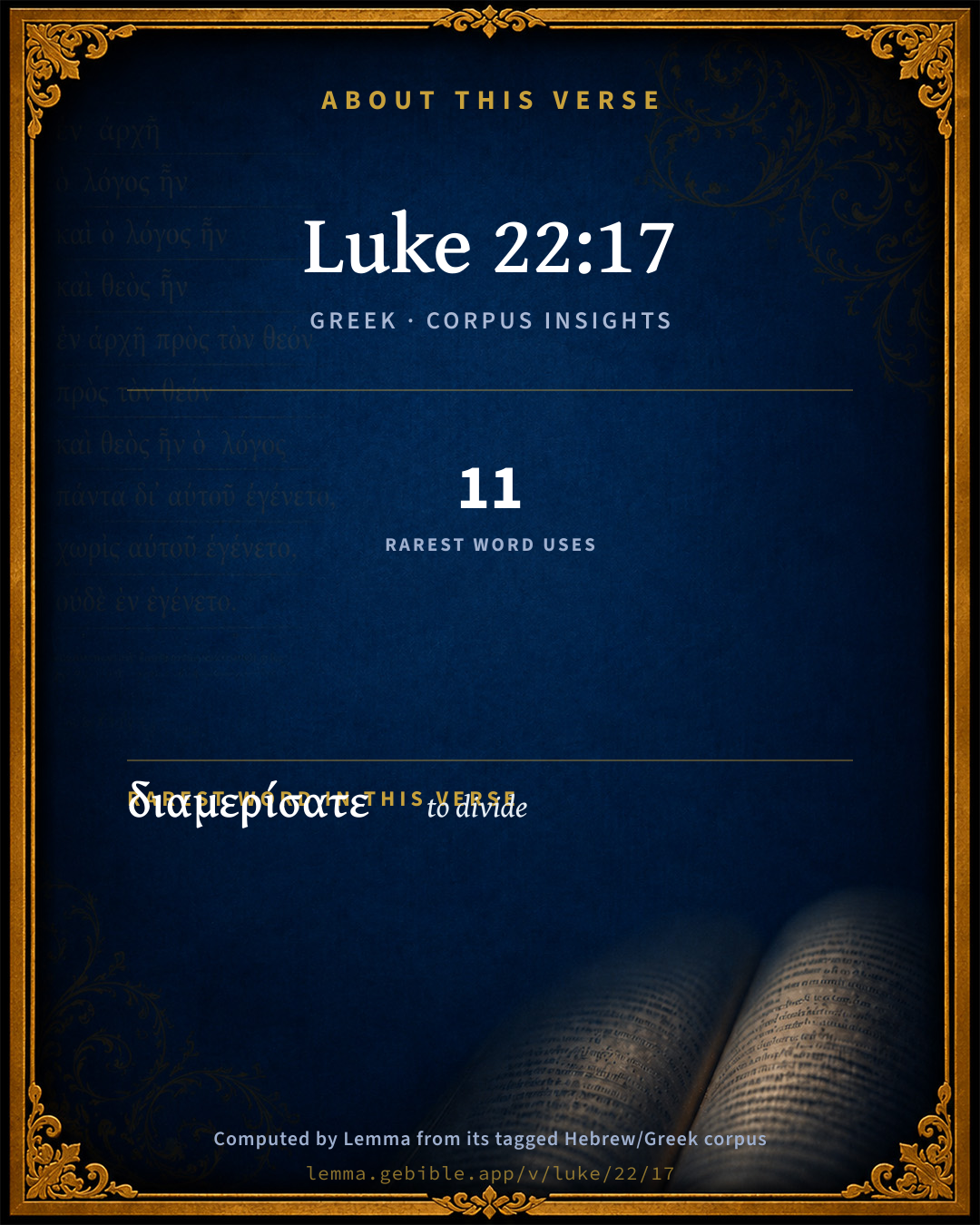
The rarest word here is διαμερίσατε to divide G1266 — appearing just 11 times in the whole Greek New Testament.

Shared distinctive vocabulary

διαμερίσατε to divide G1266 occurs in 11 verses of the Greek New Testament. Also found in:

Repetition

A word recurs within this verse:

Cross-references

9

Topical passages linked to Luke 22:17 in the Treasury of Scripture Knowledge — connected by theme and wording, ordered by reader-vote popularity; previews shown in the World English Bible.

  • Psalms 116:13 I will take the cup of salvation, and call on the name of Yahweh.
  • Luke 22:19 He took bread, and when he had given thanks, he broke it, and gave to them, saying, "This is my body which is given for you. Do this in memory of me."
  • Deuteronomy 8:10 You shall eat and be full, and you shall bless Yahweh your God for the good land which he has given you.
  • Jeremiah 16:7 neither shall men break [bread] for them in mourning, to comfort them for the dead; neither shall men give them the cup of consolation to drink for their father or for their mother.
  • Luke 9:16 He took the five loaves and the two fish, and looking up to the sky, he blessed them, and broke them, and gave them to the disciples to set before the multitude.
  • Romans 14:6 He who observes the day, observes it to the Lord; and he who does not observe the day, to the Lord he does not observe it. He who eats, eats to the Lord, for he gives God thanks. He who doesn't eat, to the Lord he doesn't eat, and gives God thanks.
  • 1 Timothy 4:4–5 For every creature of God is good, and nothing is to be rejected, if it is received with thanksgiving.
  • 1 Samuel 9:13 as soon as you are come into the city, you shall immediately find him, before he goes up to the high place to eat; for the people will not eat until he come, because he does bless the sacrifice; [and] afterwards they eat who are invited. Now therefore get you up; for at this time you shall find him.
  • Psalms 23:5 You prepare a table before me in the presence of my enemies. You anoint my head with oil. My cup runs over.

Cross-references courtesy of OpenBible.info (CC BY 4.0).

Commentary

Notes on Luke 22:17 from classic Christian and Jewish commentators (each source and its license shown beneath its notes). The classic Christian expositions comment on the surrounding passage and are grouped to its opening verse, so a note may address several verses; the Jewish commentaries on the Tanakh (Rashi and others) are per-verse, so they appear only where the commentator wrote on this verse.

Lemma curates 59 commentaries, every one of them public domain or Creative Commons licensed, each selected and text-cleaned for this edition rather than reprinted as found. About our sources →

Tyndale Open Study Notes

Tyndale Open Resources

22:17 he took a cup of wine: The traditional Passover celebration used four cups of wine—at the opening benediction, after the Passover explanation, after the meal, and after a concluding psalm. This was probably the first cup that introduced the ceremony.

Tyndale Open Study Notes — © Tyndale Open Resources, licensed CC BY-SA 4.0. Text via the HelloAO Bible API.

Bengel's Gnomon

Johann Albrecht Bengel

Luk 22:17. Δεξάμενος) Δέχομαι is said of that which is afforded or presented to another. Jesus acted, as the Head of the family: He caused the cup to be presented (held out) to Him.—ἑαυτοῖς, yourselves) He seems to have Himself drunk first. Comp. the preceding verses, but not also, Luk 22:20. Comp. Mat 26:26, note. [“Jesus, when giving the bread and wine, is not said to have Himself eaten and drunk, for it was not for Himself that His body and blood were to be offered.”]

Bengel's Gnomon of the New Testament — English translation (T&T Clark, Edinburgh, 1860) — public domain. Text from a community e-Sword module.

Expositor's Greek Testament

ed. W. Robertson Nicoll

Luk 22:17 . δεξάμενος , having received from the hand of another (different from λαβὼν , Luk 22:19 ), handed to Him that He might drink. εὐχαριστήσας , this solemn act gives to the handing round of the cup here mentioned the character of a prelude to the Holy Supper: (“quaedam quasi prolusio S. Coenae,” Beng. in reference to Luk 22:15-18 ). If the reading of [184] and some Old Latin codd. which makes Luk 22:19 stop at σῶμά μου and omits Luk 22:20 be the true text ( vide critical notes above), then Lk.’s account of the institution really begins in Luk 22:17 , and what happened according to it was this: Jesus first sent round the cup, saying: take this and divide it among yourselves, then took bread, broke it, and gave it to the disciples, saying: this is my body. In this version two things are to be noted: first, the inversion of the actions; second, the omission of all reference to the blood in connection with the wine. The existence of such a reading as that of D and the Old Latin version raises questions, not only as to Lk.’s text, but as to church practice in the Apostolic age and afterwards; or, assuming as a possibility that Lk. wrote as D represents, have we here another instance of editorial discretion shrinking from imputing to Jesus the idea of drinking His blood? If with D we omit all that follows σῶμά μου , then it results that Lk. has left out all the words of our Lord setting forth the significance of His death uttered (1) at Caesarea Philippi; (2) on the occasion of the request of Zebedee’s sons; (3) the anointing at Bethany; (4) the institution of the Supper. (2) and (3) are omitted altogether, and (1) is so reported as to make the lesson non-apparent.

[184] Codex Bezae

The Expositor's Greek Testament, edited by W. Robertson Nicoll (1897–1910) — public domain. Text from a community e-Sword module.

Jamieson, Fausset & Brown

Robert Jamieson, A. R. Fausset & David Brown

took the cup--the first of several partaken of in this service.

divide it among, &c.--that is, It is to be your last as well as Mine, "until the Kingdom of God come," or as it is beautifully given in Mat 26:29, "until that day when I shall drink it new with you in my Father's kingdom." It was the point of transition between two economies and their two great festivals, the one about to close for ever, the other immediately to open and run its majestic career until from earth it be transferred to heaven.

Jamieson, Fausset & Brown — Commentary Critical and Explanatory on the Whole Bible (1871) — public domain (CC PDM 1.0). Text via the HelloAO Bible API.

Adam Clarke's Commentary

Verse 17. He took the cup] This was not the sacramental cup, for that was taken after supper, Lu 22:20, but was the cup which was ordinarily taken before supper.

Divide it among yourselves] Pass the cup from one to another; thus the cup which Christ gave to the first person on his right hand continued to be handed from one to another, till it came to the last person on his left.

Adam Clarke's Commentary on the Bible (1810–1826) — public domain. Text from a community e-Sword/MySword module.

Ellicott's Commentary for English Readers

(17) Take this, and divide it among yourselves.—The cup was probably the first of the three cups of wine, or wine mingled with water, which Jewish custom had added to the ritual of the Passover. As being a distinct act from that of Luk_22:20, it is natural to infer that it had a distinct symbolic meaning. Looking to the fact that wine is partly the symbol, partly the antithesis, of spiritual energy in its highest form (comp. Zec_9:17; Act_2:13; Eph_5:18), and to the re-appearance of the same somewhat exceptional word for “divide,” in the tongues “parted, or divided, or distributed” (“cloven” is a mistranslation), in Act_2:3, we may see in this cup the symbol of the bestowal of the spiritual powers which each of the disciples was to receive, according to the gift of the self-same Spirit, who “divideth to every man severally as He will” (the Greek word in 1Co_12:11 is, however, different, though expressing the same thought), just as the second was the pledge of a yet closer fellowship with His own divine life.

A Bible Commentary for English Readers, edited by Charles John Ellicott (1878–1897) — public domain. Text from a community e-Sword module.

The Cambridge Bible for Schools and Colleges

gen. ed. J. J. S. Perowne

17. he took the cup, and gave thanks] Literally, “and after receiving the cup, and giving thanks.” From eucharistein comes our word Eucharist.

The main customs of the Jewish Passover are as follows:—(1) Each drinks a cup of wine—‘the cup of consecration’—over which the master of the house pronounces a blessing. (2) Hands are washed, and a table carried in, on which are placed bitter herbs, cakes of unleavened bread, the Charoseth (a dish made of dates, raisins, and vinegar), the paschal lamb, and the flesh of the Chagigah or feast-offering. (3) The father dips a morsel of unleavened bread and bitter herbs, about the size of an olive, in the Charoseth, eats it with a benediction, and distributes a similar ‘sop’ to all present. (4) A second cup of wine is poured out, and the youngest present asks the meaning of the service, to which the father replies. (5) The first part of the Hallel (Psalms 107—114) is sung. (6) Grace is said, and a benediction again pronounced; after which the father distributes bitter herbs and unleavened bread dipped in the Charoseth. (7) The Paschal lamb is eaten, and a third cup of wine handed round. (8) After another thanksgiving, a fourth cup—the cup of joy—is drunk. (9) The rest of the Hallel (Psalms 115-118.) is sung.

The cup mentioned in this verse has been supposed to be the third cup of wine in the Jewish ceremonial; and the actual chalice of the Eucharist (the “cup of blessing,” 1Co_10:16, Cos ha-Berachah) is identified with the fourth cup. We also see in the Last Supper the benediction, and possibly the Hallel (Mat_26:30). But (1) the identifications are somewhat precarious. (2) There is no certainty that the “Sacrificial Passover” thus observed by the Jews was identical in ceremonial with the “Memorial Passover” which now alone they are able to observe.

The Cambridge Bible for Schools and Colleges (gen. ed. J. J. S. Perowne; Cambridge University Press, 1878–1918) — public domain. Text from a community e-Sword module.

John Gill's Exposition

For I say unto you, I will not drink of the fruit of the vine,.... That is, wine; see the blessing at the passover cup in the notes on the preceding verse:

until the kingdom of God shall come; with power, as in Mar 9:1 in the resurrection of Christ from the dead; in his exaltation and session at God's right hand; in the pouring forth of the Spirit on the apostles; in the conversion of great multitudes, both in Judea, and in the Gentile world; in the destruction of the Jews; in the latter day glory; and in the ultimate state of happiness and bliss in the world to come. The Ethiopic version reads, "until I drink it new in the kingdom of God"; as in Mar 14:25.

John Gill's Exposition of the Whole Bible (1746–1763) — public domain (CC PDM 1.0). Text via the HelloAO Bible API.

Trapp's Complete Commentary

John Trapp

17 And he took the cup, and gave thanks, and said, Take this, and divide it among yourselves:

Ver. 17. And he took the cup] The cup of the common supper, Joh 13:2-3.

John Trapp, A Commentary or Exposition upon All the Books of the Old and New Testament (1647–1656) — public domain. Text from a community e-Sword module.

Albert Barnes' Notes on the Bible

And he took the cup and gave thanks - This was not the “sacramental” cup, for that was taken “after” supper, Luk 22:20. This was one of the cups which were usually taken during the celebration of the Passover, and pertained to that observance. “After” he had kept this in the usual manner, he instituted the supper which bears his name, using the bread and wine which had been prepared for the Passover, and thus ingrafted the Lord’s Supper on the Passover, or superseded the Passover by another ordinance, which was intended to be perpetual.

Albert Barnes' Notes on the Bible (1834–1885) — public domain. Text from a community e-Sword/MySword module.

Haydock's Catholic Bible Commentary

Taken the chalice. This is not the chalice of his blood, (the latter is spoken of ver. 20, and 1 Corinthians xi. 25.) but it is the cup which the master of the repast blessed with ceremony, then drank of it, and gave it to all the guests. The modern Jews still observe this custom; not only on the Pasch, but on all other great feasts. The father of the family pours wine into a cup, takes it in his right hand, elevates it, blesses it, tastes, and gives it round to the invited. Our Saviour on this occasion complies with the custom;; and after supper takes the chalice, which he converts into his own blood. (Calmet)

George Leo Haydock (1774–1849), Haydock's Catholic Family Bible and Commentary, 1859 edition — public domain. Excludes Psalms (Douay-Rheims chapter numbering differs from Protestant) and Deuterocanonical books (Catholic canon only).

Whedon's Commentary on the Bible

Daniel D. Whedon

17. And he took the cup—The passover cup.

Divide it among yourselves— He drank it not himself.

Daniel D. Whedon (gen. ed.), Commentary on the Old and New Testaments (1874–1909) — public domain. Text from a community e-Sword module.

John Wesley's Explanatory Notes

And he took the cup - That cup which used to be brought at the beginning of the paschal solemnity, and said, Take this and divide it among yourselves; for I will not drink - As if he had said, Do not expect me to drink of it: I will drink no more before I die.

John Wesley, Explanatory Notes Upon the Whole Bible (1754–1765) — public domain. Text via the GEBible commentary corpus.

unfoldingWord translationNotes

Door43 World Missions Community

took a cup

"picked up a cup of wine"

when he had given thanks

"when he had given thanks to God"

he said

"he said to his apostles"

share it among yourselves

They were to share the contents of the cup, and not the cup itself. AT: "share the wine in the cup among yourselves" or "each of you drink some of the wine from the cup" (See: Metonymy)

For I say to you

This phrase is used to emphasize the importance of what Jesus will say next.

fruit of the vine

This refers to the juice that is squeezed from the grapes that grow on grapevines. Wine is made from fermented grape juice.

until the kingdom of God comes

"until God establishes his kingdom" or "until God rules in his kingdom"

translationWords

fruit

vine

kingdom of God

unfoldingWord translationNotes — © Distant Shores Media and the Door43 World Missions Community, licensed CC BY-SA 4.0. Source: git.door43.org/Door43/en_tn.

Cambridge Greek Testament for Schools and Colleges

17. ποτήριον. So אBCL Ti[373] W.H[374] &c. τὸ ποτ. AD La[375]

[373] Ti. Tischendorf.

[374] W.H. Westcott and Hort.

[375] La. Lachmann.

17. δεξάμενος ποτήριον εὐχαριστήσας. Literally, “and after receiving a cup, and giving thanks.” From εὐχαριστεῖν comes our word Eucharist. The word δεξάμενος (differing from λαβὼν in Luk 22:19) seems to imply that the cup was handed to Him.

The main customs of the Jewish Passover are as follows:—(1) Each drinks a cup of wine—‘the cup of consecration’—over which the master of the house pronounces a blessing. (2) Hands are washed, and a table carried in, on which are placed bitter herbs, cakes of unleavened bread, the Charoseth (a dish made of dates, raisins, and vinegar), the paschal lamb, and the flesh of the Chagigah or thank-offering. (3) The father dips a morsel of unleavened bread and bitter herbs, about the size of an olive, in the Charoseth, eats it with a benediction, and distributes a similar ‘sop’ to all present. (4) A second cup of wine is poured out, and the youngest present asks the meaning of the service, to which the father replies. (5) The first part of the Hallel (Psalms 107-114) is sung. (6) Grace is said, and a benediction again pronounced; after which the father distributes bitter herbs and unleavened bread dipped in the Charoseth. (7) The Paschal lamb is eaten, and a third cup of wine handed round. (8) After another thanksgiving, a fourth cup—the cup of joy—is drunk. (9) The rest of the Hallel (Psalms 115-118) is sung.

The cup mentioned in this verse has been supposed to be the third cup of wine in the Jewish ceremonial; and the actual chalice of the Eucharist (the “cup of blessing,” 1Co 10:16, Cos ha-Berâchah) is identified with the fourth cup. We also see in the Last Supper the benediction, and possibly the Hallel (Mat 26:30). But (1) the identifications are somewhat precarious. (2) There is no certainty that the “Sacrificial Passover” then observed by the Jews was identical in ceremonial with the “Memorial Passover” which now alone they are able to observe.

Cambridge Greek Testament for Schools and Colleges (Cambridge University Press, 1896; 21 vols, various authors incl. Carr, Maclear, Plummer, Farrar, Lumby, Moule, M. R. James, Simcox) — public domain. Text from a community e-Sword module.

Alford’s Greek Testament

Henry Alford

17.] Some (e.g. De Wette) suppose that it is here implied that our Lord did not drink of the cup Himself. But surely this cannot be so. The two members of the speech are strictly parallel: and if He desired to eat the Passover with them, He would also drink of the cup, which formed a usual part of the ceremonial. This seems to me to be implied in δεξάμενος: λαβών is the word used by all afterwards, when He did not partake of the bread and wine. This most important addition in our narrative, amounts I believe to a solemn declaration of the fulfilment of the Passover rite, in both its usual divisions,—the eating the flesh of the lamb, and drinking the cup of thanksgiving. Henceforward, He who fulfilled the Law for man will no more eat and drink of it. I remark this, in order further to observe that this division of the cup is not only not identical with, but has no reference to, the subsequent one in ver. 20. That was the institution of a new rite;—this the abrogation of an old one, now fulfilled, or about to be so, in the person of the true Lamb of God.

This is generally supposed to have been the first cup in the Passover-meal, with which the whole was introduced.

On the possible connexion of this speech of our Lord with the celebration of the Passover at this particular time, see note on Mat 26:17.

After these verses, in order of time, follows the washing of the disciples’ feet in Joh 13:1-20, referred to in our ver. 27.

19,

Henry Alford, The Greek Testament (1849–1861) — public domain. Text from a community e-Sword module.

International Critical Commentary

17. δεξάμενος. It was handed to Him: contrast λαβών, ver. 19 (schanz). It is usual to consider this as the first or second of the four cups that were handed round during the paschal meal; the eucharistic cup being identified with the third or fourth. But we are in doubt (1) as to what the paschal ritual was at this time; (2) as to the extent to which Jesus followed the paschal ritual in this highly exceptional celebration; (3) as to the text of this passage, especially as to whether Lk. records two cups or only one: so that identifications of this kind are very precarious. In any case, Lk. mentions a cup before the breaking of the bread, whether this be the eucharistic cup or not: and S. Paul twice mentions the cup first (1Co 10:16, 1Co 10:21), although in his account of the institution he follows the usual order (1Co 11:23). In the Διδαχή the cup is placed first (9:2: see Schaff’s 3rd ed. PP. 58-61, 191).

εὐχαριστήσας. This seems to imply the eucharistic cup. All three have εὐχαριστήσας of the cup. Lk. repeats it of the bread. where Mt. and Mk. have εὐλογήσας.

In the Jewish ritual the person who presided began by asking a blessing on the feast; then blessed, drank, and passed the first cup. Then Psa 113. and 114. were sung and the bitter herbs eaten, followed by the second cup. After which the president explained the meaning of the feast: and some think that for this explanation of the old rite Jesus substituted the institution of the new one. After eating of the lamb and unleavened cakes came the thanksgiving for the meal and the blessing and drinking of the third cup. Lastly, the singing of Ps. 115.-118. followed by the fourth cup: and there as sometimes a fifth.

διαμερίσατε. Comp. Act 2:45; Jdg 5:30 Followed by εἰς ἑαυτούς, it expresses more strongly than the mid. (23:34; Mat 27:35) the fact of mutual distribution. In some texts (AD etc.) εἰς ἑαυτούς has been altered into the more usual dat. (Joh 19:24; Act 2:45). The distribution would be made by each drinking in turn, rather than by each pouring some into a cup of his own. The εἰς ἑαυτούς perhaps corresponds to the πάντες of Mt. and Mk. Πίετε (ἔπιον) ἐξ αὐτοῦ πάντες.

International Critical Commentary — older volumes (1896–1929), various authors — public domain. Text from a community e-Sword module.

Lesson kit

Teaching starters — assembled from the data on this page, not authored interpretation. Every prompt links to the verse data it draws on. Edit before teaching.

Luke, in the Gospels, opens this verse with 11 words (10 distinct Greek lemmas). Its most distinctive word is diamerízō (“to divide”). A historical commentator’s framing appears above. Read the whole chapter for the surrounding context.

Discussion questions

  1. How does “to divide” (diamerízō) shape what this verse is saying?
  2. How does Matthew 27:35, which shares the word «to divide», read alongside this verse?
  3. What does the repetition of “and” (2× in this one verse) do in this verse?
  4. These translations render this verse differently. What is at stake in choosing one wording over another?
  5. Compare how Tyndale Open Study Notes and Bengel's Gnomon read this verse. Where do they agree or differ?

Things to notice

Reading settings

Reading text

Shown beneath each verse's original-language words.

Old Testament
Old Testament edition

Read the OT as the Masoretic Hebrew (MT) or the Greek Septuagint (LXX).

English shown for the Greek Septuagint (in the Hebrew ↔ Greek comparison).

Comparing translations? Open the Compare panel on any verse page to stack up to four side by side.