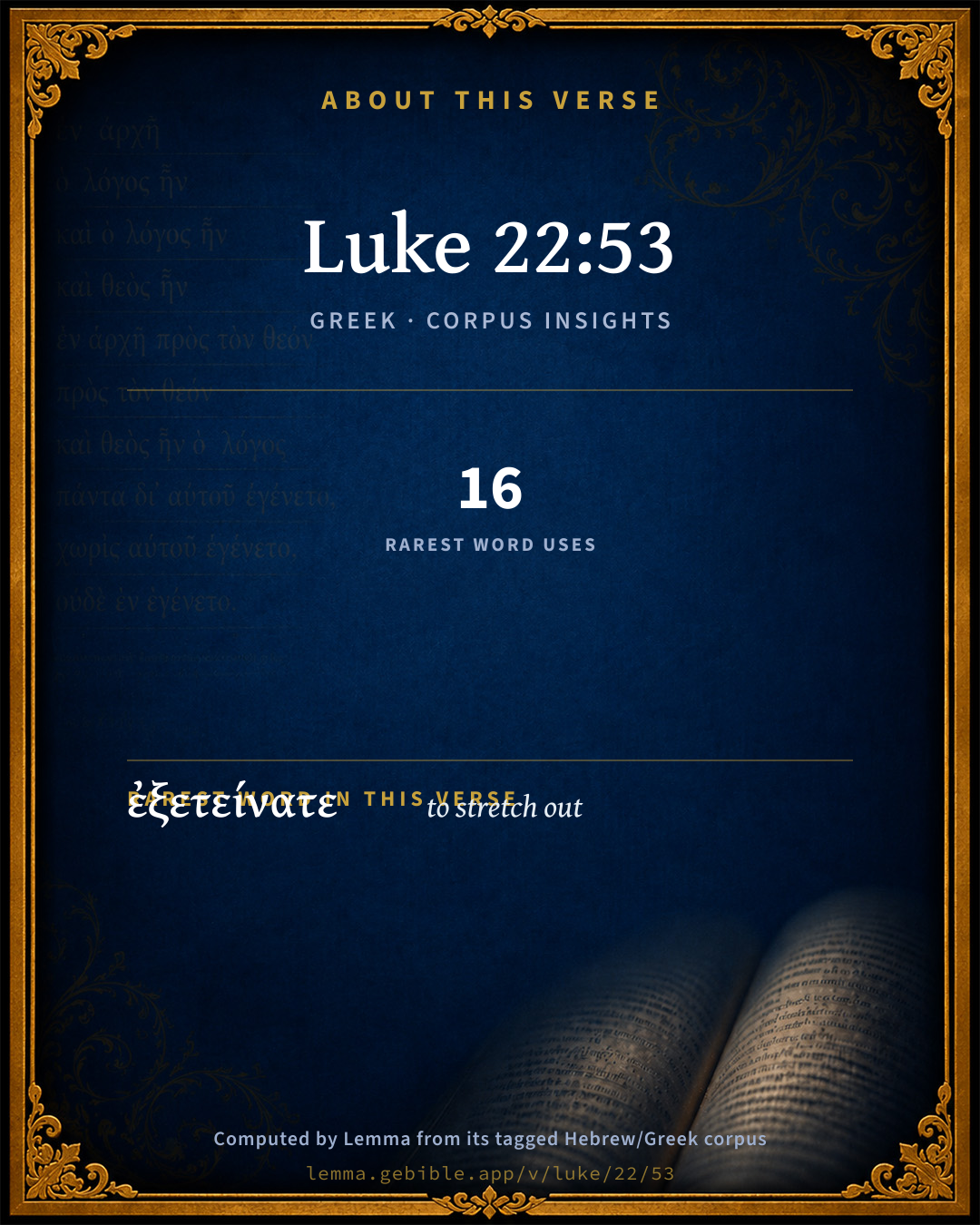
Luke 22:53

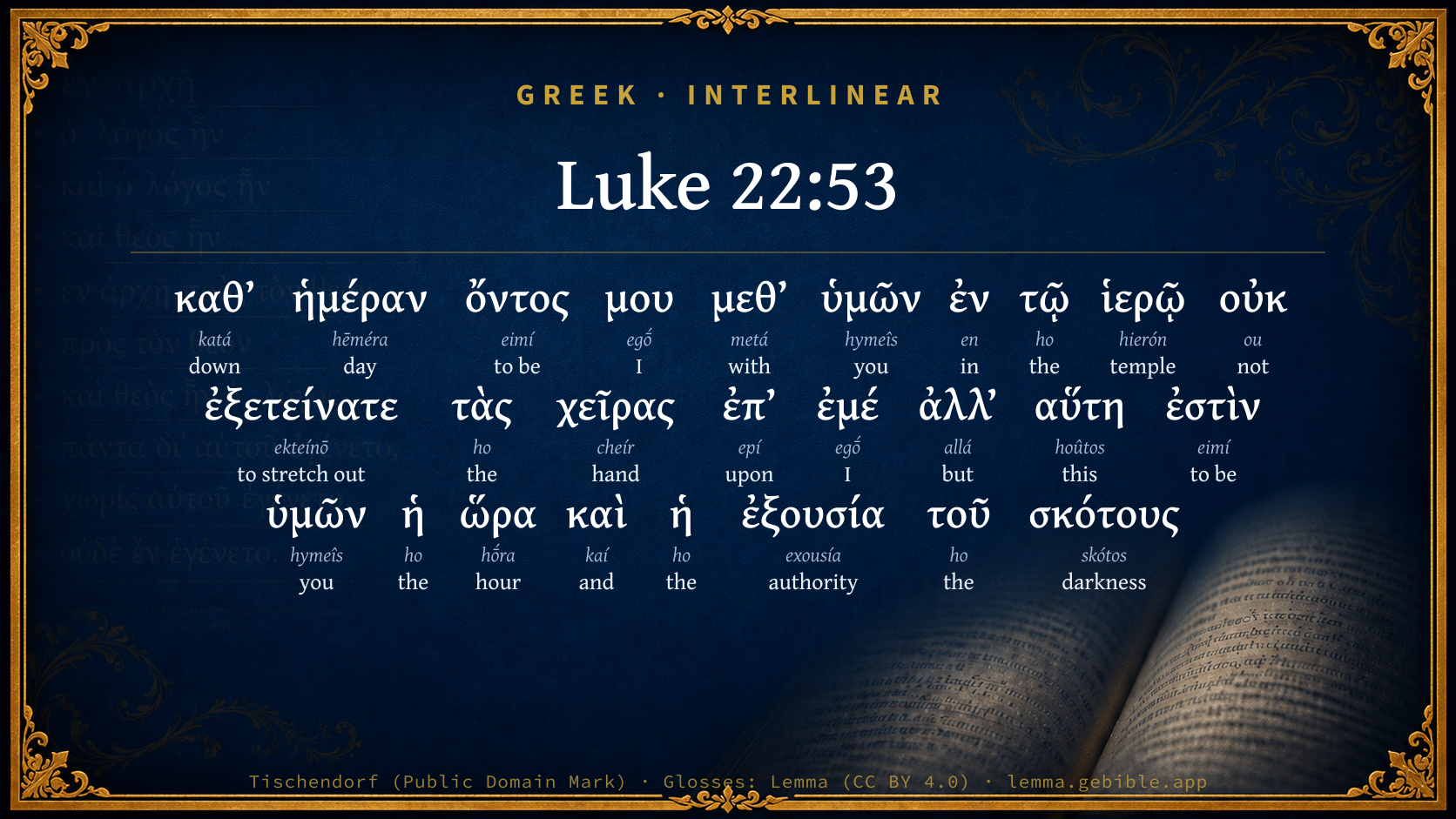
Greek (Tischendorf 8th ed.) Luke 22:53 appears in the Greek New Testament. The text above is from the Tischendorf 8th edition. Each word links to its Strong’s number and a concise gloss. Click any word for its full Thayer’s Greek Lexicon entry.
Download image
Cite this verse

Luke 22:53 (World English Bible). Public Domain. Lemma interlinear Bible study tool, https://lemma.gebible.app/v/luke/22/53.

Show BibTeX & RIS
BibTeX
RIS
English Translation
When I was with you in the temple daily, you didn't stretch out your hands against me. But this is your hour, and the power of darkness."
World English Bible · Public Domain
Download a study sheet

One document with this verse’s original text, its word-by-word gloss line, the meaning frame, cross-references with their text, attributed commentary, and full source and license credits — printable, and it pastes into notes with its structure intact.

This verse Autodidact and up

Study sheet (.html) Plain text (.txt)

A passage Seminary Student

Up to 50 verses in one chapter. A passage sheet keeps up to 6 commentary sources and 12 cross-references per verse, in the order this page ranks them, and says so on the sheet whenever that leaves anything out. Ask for a single verse and you get the Autodidact verse sheet above.

Everything on this page stays free to read, with no account — the sheet is a download of what is already on screen, not access to it.

Want to remove ads? Support Godless Engineer
Compare translations 3

The same verse in 3 English versions, stacked beneath the original-language interlinear above. Click any original word for its lexicon entry.

Each is an independent rendering of the whole verse — the interlinear is not word-aligned to these translations.

Highlighted words mark where these versions differ — a whole-verse word diff, not a word-by-word alignment.

  • World English Bible Public Domain
    When I was with you in the temple daily, you didn't stretch out your hands against me. But this is your hour, and the power of darkness."
  • King James Version Public Domain
    When I was daily with you in the temple, ye stretched forth no hands against me: but this is your hour, and the power of darkness.
  • unfoldingWord Literal Text CC BY-SA 4.0
    I being with you each day in the temple, you did not lay hands on me. But this is your hour, and the authority of the darkness.”

unfoldingWord Literal Text — © unfoldingWord, licensed CC BY-SA 4.0. Word-aligned USFM3 via Door43 (git.door43.org/unfoldingWord/en_ult).

Versions to compare (up to 4)

3 of 4 selected

Show all 19 translations

Every available English version of this verse, each an independent rendering of the whole verse.

  • World English Bible Public Domain
    When I was with you in the temple daily, you didn't stretch out your hands against me. But this is your hour, and the power of darkness."
  • Berean Standard Bible Public Domain
    Every day I was with you in the temple courts, and you did not lay a hand on Me. But this hour belongs to you and to the power of darkness.”
  • Majority Standard Bible Public Domain
    Every day I was with you in the temple courts, and you did not lay a hand on Me. But this hour belongs to you and to the power of darkness.”
  • King James Version Public Domain
    When I was daily with you in the temple, ye stretched forth no hands against me: but this is your hour, and the power of darkness.
  • American Standard Version (1901) Public Domain
    When I was daily with you in the temple, ye stretched not forth your hands against me: but this is your hour, and the power of darkness.
  • Revised Version (1885) Public Domain
    When I was daily with you in the temple, ye stretched not forth your hands against me: but this is your hour, and the power of darkness.
  • Geneva Bible (1599) Public Domain
    When I was dayly with you in the Temple, yee stretched not foorth the handes against mee: but this is your very houre, and the power of darkenesse.
  • Douay-Rheims (1899) Public Domain
    When I was daily with you in the temple, you did not stretch forth your hands against me: but this is your hour, and the power of darkness.
  • Young's Literal Translation Public Domain
    while daily I was with you in the temple, ye did stretch forth no hands against me; but this is your hour and the power of the darkness.'
  • Literal Standard Version CC BY-SA 4.0
    While daily I was with you in the temple, you stretched forth no hands against Me; but this is your hour and the power of the darkness.”
  • Unlocked Literal Bible CC BY-SA 4.0
    When I was daily with you in the temple, you did not lay your hands on me. But this is your hour, and the authority of darkness.”
  • unfoldingWord Literal Text CC BY-SA 4.0
    I being with you each day in the temple, you did not lay hands on me. But this is your hour, and the authority of the darkness.”
  • Darby Bible Public Domain
    When I was day by day with you in the temple ye did not stretch out your hands against me; but this is your hour and the power of darkness.
  • World Messianic Bible Public Domain
    When I was with you in the temple daily, you didn’t stretch out your hands against me. But this is your hour, and the power of darkness.”
  • Webster's Bible Public Domain
    When I was daily with you in the temple, ye stretched forth no hands against me: but this is your hour, and the power of darkness.
  • Free Bible Version CC BY-SA 4.0
    “You didn't arrest me before, even though I was with you in the Temple every day. But this is your moment now, the time when darkness is in power.”
  • Bible in Basic English Public Domain
    When I was in the Temple with you every day, your hands were not stretched out against me: but this is your hour, and the authority of the dark power.
  • Text-Critical English NT CC BY 4.0
    I was with you daily in the temple courts, and you did not lay a hand on me. But this is your hour, when the power of darkness reigns.”
  • Tyndale New Testament (1534) Public Domain
    When I was dayly with you in the temple ye stretched not forth hondes agaynst me. But this is even youre very houre and the power of darcknes.

Literal Standard Version (2020), Covenant Press — licensed CC BY-SA 4.0. Text via the HelloAO Bible API (eBible.org). Unlocked Literal Bible (unfoldingWord) — licensed CC BY-SA 4.0. Text via the HelloAO Bible API (eBible.org). unfoldingWord Literal Text — © unfoldingWord, licensed CC BY-SA 4.0. Word-aligned USFM3 via Door43 (git.door43.org/unfoldingWord/en_ult). Free Bible Version, Dr. Jonathan Gallagher — licensed CC BY-SA 4.0. Text via the HelloAO Bible API (eBible.org).

Word by word

More ways to search: Search by grammar → Find every occurrence → Compare this word →

Practice this passage: Drill this verse → Learn its vocabulary →

ἐξετείνατε
ekteínō
G1614
“to stretch out”
Verb, Aorist, Active, Indicative, 2nd person, Plural
Part of Speech
Verb
Tense
Aorist
Voice
Active
Mood
Indicative
Person
2nd person
Number
Plural
Full Thayer's Definition

Origin: from G1537 and teino (to stretch)

TDNT: 09:40,2

1. to stretch out, stretch forth a. over, towards, against one
  1. καθ’ katá G2596 “down” Preposition
  2. ἡμέραν hēméra G2250 “day” Noun, Accusative, Singular, Feminine
  3. ὄντος eimí G1510 “to be” Verb, Present, Active, Participle, Genitive, Singular, Masculine
  4. μου egṓ G1473 “I” Personal pronoun, 1st person, Genitive, Singular
  5. μεθ’ metá G3326 “with” Preposition
  6. ὑμῶν hymeîs G5210 “you” Personal pronoun, 2nd person, Genitive, Plural
  7. ἐν en G1722 “in” Preposition
  8. τῷ ho G3588 “the” Article, Dative, Singular, Neuter
  9. ἱερῷ hierón G2411 “temple” Noun, Dative, Singular, Neuter
  10. οὐκ ou G3756 “not” Particle, Negative
  11. τὰς ho G3588 “the” Article, Accusative, Plural, Feminine
  12. χεῖρας cheír G5495 “hand” Noun, Accusative, Plural, Feminine
  13. ἐπ’ epí G1909 “upon” Preposition
  14. ἐμέ egṓ G1473 “I” Personal pronoun, 1st person, Accusative, Singular
  15. ἀλλ’ allá G235 “but” Conjunction
  16. αὕτη hoûtos G3778 “this” Demonstrative pronoun, Nominative, Singular, Feminine
  17. ἐστὶν eimí G1510 “to be” Verb, Present, Active, Indicative, 3rd person, Singular
  18. ὑμῶν hymeîs G5210 “you” Personal pronoun, 2nd person, Genitive, Plural
  19. ἡ ho G3588 “the” Article, Nominative, Singular, Feminine
  20. ὥρα hṓra G5610 “hour” Noun, Nominative, Singular, Feminine
  21. καὶ kaí G2532 “and” Conjunction
  22. ἡ ho G3588 “the” Article, Nominative, Singular, Feminine
  23. ἐξουσία exousía G1849 “authority” Noun, Nominative, Singular, Feminine
  24. τοῦ ho G3588 “the” Article, Genitive, Singular, Neuter
  25. σκότους skótos G4655 “darkness” Noun, Genitive, Singular, Neuter

About this verse

These counts appear in no published source. They are computed here, from the morphology-tagged text and Lemma’s own curated glosses. What Lemma adds →

26
words
19
distinct lemmas
Gospels
section

Notable vocabulary

The rarest word here is ἐξετείνατε to stretch out G1614 — appearing just 16 times in the whole Greek New Testament.

Shared distinctive vocabulary

ἐξετείνατε to stretch out G1614 occurs in 14 verses of the Greek New Testament. Also found in:

Repetition

Words recur within this verse:

Cross-references

17

Topical passages linked to Luke 22:53 in the Treasury of Scripture Knowledge — connected by theme and wording, ordered by reader-vote popularity; previews shown in the World English Bible.

  • Ephesians 6:12 For our wrestling is not against flesh and blood, but against the principalities, against the powers, against the world's rulers of the darkness of this age, and against the spiritual hosts of wickedness in the heavenly places.
  • John 7:45 The officers therefore came to the chief priests and Pharisees, and they said to them, "Why didn't you bring him?"
  • John 12:27 "Now my soul is troubled. What shall I say? 'Father, save me from this time?' But for this cause I came to this time.
  • John 16:20–22 Most assuredly I tell you, that you will weep and lament, but the world will rejoice. You will be sorrowful, but your sorrow will be turned into joy.
  • Acts 26:18 to open their eyes, that they may turn from darkness to light and from the power of Satan to God, that they may receive remission of sins and an inheritance among those who are sanctified by faith in me.'
  • 2 Corinthians 4:3–6 Even if our Gospel is veiled, it is veiled in those who perish;
  • Colossians 1:13 who delivered us out of the power of darkness, and translated us into the Kingdom of the Son of his love;
  • Judges 16:21–30 The Philistines laid hold on him, and put out his eyes; and they brought him down to Gaza, and bound him with fetters of brass; and he did grind in the prison-house.
  • Job 20:5 That the triumphing of the wicked is short, The joy of the godless but for a moment?
  • Matthew 21:12–15 Jesus entered into the temple of God, and drove out all of those who sold and bought in the temple, and overthrew the money-changers' tables and the seats of those who sold the doves.
  • Matthew 21:23 When he had come into the temple, the chief priests and the elders of the people came to him as he was teaching, and said, "By what authority do you do these things? Who gave you this authority?"
  • Matthew 21:45–46 When the chief priests and the Pharisees heard his parables, they perceived that he spoke about them.
  • Luke 21:37–38 Every day Jesus was teaching in the temple, and every night he would go out and spend the night on the mountain that is called Olivet.
  • John 7:25–26 Therefore some of them of Jerusalem said, "Isn't this he whom they seek to kill?
  • John 7:30 They sought therefore to take him; but no one laid a hand on him, because his hour had not yet come.
  • John 14:30 I will no more speak much with you, for the prince of the world comes, and he has nothing in me.
  • Revelation 12:9–12 The great dragon was thrown down, the old serpent, he who is called the devil and Satan, the deceiver of the whole world. He was thrown down to the earth, and his angels were thrown down with him.

Cross-references courtesy of OpenBible.info (CC BY 4.0).

Commentary

Notes on Luke 22:53 from classic Christian and Jewish commentators (each source and its license shown beneath its notes). The classic Christian expositions comment on the surrounding passage and are grouped to its opening verse, so a note may address several verses; the Jewish commentaries on the Tanakh (Rashi and others) are per-verse, so they appear only where the commentator wrote on this verse.

Lemma curates 59 commentaries, every one of them public domain or Creative Commons licensed, each selected and text-cleaned for this edition rather than reprinted as found. About our sources →

MacLaren's Expositions of Holy Scripture

Alexander MacLaren

Luke

GETHSEMANE

THE CROSS THE VICTORY AND DEFEAT OF DARKNESS

Luk 22:53.

The darkness was the right time for so dark a deed. The surface meaning of these pathetic and far-reaching words of our Lord’s in the garden to His captors is to point the correspondence between the season and the act. As He has just said, ‘He had been daily with them in the Temple,’ but in the blaze of the noontide they laid no hands upon Him. They found a congenial hour in the midnight. But the words go a great deal deeper than allusive symbolism of that sort. Looking at them as giving us a little glimpse into the thoughts and feelings of Christ, we can scarcely help tracing in them the very clear consciousness that He was the Light, and that all antagonism to Him was the work of darkness in an eminent and especial sense. But whilst this unobscured consciousness, which no mere man could venture so unqualifiedly to assert, is manifest in the words, there is also in them, to my ear, a tone of majestic resignation, as if He said, ‘There! do your worst!’ and bowed His head, as a man might do, standing breast high in the sea, that the wave might roll over Him. And there is in them, too, a shrinking as of horror from the surging upon Him of the black tide to which He bows His head.

But whilst thus pathetic and significant in their indication of the feelings of our Lord, they have a wider and a deeper meaning still, I think, if we ponder them; inasmuch as they open before us some aspects of His sufferings and eminently of His Cross, which it becomes us all to lay to heart. And it is to these that I desire to turn your attention for a few moments.

I. I see in them, then, first, this great thought, that the Cross of Jesus Christ is the centre and the meeting-point for the energies of three worlds.

‘This is your hour.’ Now our Lord habitually speaks of His sufferings, and of other points in His life, as being ‘My hour,’ by which, of course, He means the time appointed to Him by God for the doing of an appointed work. And that idea is distinctly to be attached to the use of the word here. But, on the other hand, there is emphasis laid on ‘your,’ and that hour is thereby designated as a time in which they could do as they would. It was their opportunity, or, as we say in our colloquialism, now was their time when, unhindered, they might carry into effect their purposes.

So there is given us the thought of His passion and death as being the most eminent and awful instance of men being left unchecked to work out whatsoever was in their evil hearts, and to carry into effect their blackest purposes.

But, on the other hand, there goes with the phrase the idea to which I have already referred; and ‘this is their hour,’ not merely in the sense that it was their opportunity, but also that it was the hour appointed by God and allotted them for their doing the thing which their unhindered evil passions impelled them to do. And so we are brought face to face with the most eminent instance of that great puzzle that runs through all life-how God works out His lofty designs by means of responsible agents, ‘making the wrath of men to praise Him,’ and girding Himself with the remainder.

Nor is that all. For the next words of my text bring in a third set of powers as in operation. ‘This is your hour’ lets us see man overarched by the abyss of the heavens, ‘and the power of darkness’ lets us see the deep and awful forces that are working beneath and surging upwards into humanity, and opens the subterranean volcanoes. I do not say that there is any reference here to a personal Antagonist of good, in whom these dark tendencies are focussed, but there is a distinct reference to ‘the darkness’ as a whole, a kind of organic whole, which operates upon men. Even when they think themselves to be freest, and are carrying out their own wicked designs, they are but the slaves of impulses that come straight from the dark kingdom. If I may turn from the immediate purpose of my sermon for a moment, I pray you to consider that solemn aspect of our life, a film between two firmaments, like the earth with the waters above and the waters beneath. On the one side it is open and pervious to heavenly influences, and moulded by the overarching and sovereign will, and on the other side it is all honeycombed beneath with, and open to, the uprisings of evil, straight from the bottomless pit.

But if we turn to the more immediate purpose of the words, think for a moment of the solemn and wonderful aspect which the Cross of Christ assumes, thus contemplated. Three worlds focus their energies upon it-heaven, earth, hell. Looked at from one side it is all radiant and glorious, as the transcendent exhibition of the divine love and sweetness and sacrifice and righteousness and tenderness. But the sunshine that plays upon it shifts and passes, and looked at from another point of view it is swathed in blackness, as the most awful display of man’s unbridled antagonism to the good. And looked at from yet another, it assumes a still more lurid aspect as the last stroke which the kingdom of darkness attempted to strike in defence of its ancient and solitary reign. So earth, heaven, hell, the God that works through man’s evil passions, and yet does not acquit them though He utilises them to a lofty issue; man that is evil and thinks himself free; and the kingdom of darkness that uses him as its slave-all hare part in that cross, which is thus the result of such diametrically opposite forces.

The divine government which reached its most beneficent ends through the unbridled antagonism of sinful men, and made even the dark counsels of the kingdom of darkness tributary to the diffusion of the light, works ever in the same fashion. Antagonism and obedience both work out its purposes. Let us learn to bow before that all-encompassing Providence in whose great scheme both are included. Let us not confuse ourselves by the attempt to make plain to our reason the harmony of the two certain facts-man’s freedom and God’s sovereignty. Enough for us to remember that the sin is none the less though the issue may coincide with the divine purpose, for sin lies in the motive, which is ours, not in the unintended result, which is God’s. Enough for us to realise the tremendous solemnity of the lives we live, with all sweet heavenly influences falling on them from above, and all sulphurous suggestions rising into them from the fires beneath, and to see to it that we keep our hearts open to the one, and fast closed against the other.

‘This is your hour’-a time in which you feel yourselves free, and yet are instruments in the hands of God, and also are tools in the claws of evil.

II. Still further, my text brings before us the thought that the Cross is the high-water mark of man’s sin.

‘This is the power of darkness’-the specimen instance of what it would and can do. Strange to think that, amidst all the black catalogue of evil deeds that have been done in this world from the beginning, there is one deed which is the worst, and that it is this one! Not that the doers were ‘sinners above all men’: for that is a question of knowledge and of motives, but that the deed in itself was the worst thing that ever man did. Of course I take for granted the belief that Jesus Christ is the Son of God; that He came from heaven, that He lived a life of perfect purity and beauty, and that He died on the Cross as the Gospel tells us. And taking these things for granted, is it not true that His rejection, His condemnation, and His death do throw the most awful and solemn light upon what poor humanity left to itself, and yielding to the suggestions and the impulses of the kingdom of darkness, does when it comes in contact with the Light?

It is the great crucial instance of the incapacity of the average man to behold spiritual beauty and lofty elevation of character. People lament over the blindness of embruted souls to natural beauty, to art, to high thinking, and so on; but all these, tragic as they are, are nothing as compared with this stunning fact, that perfect righteousness and perfect tenderness and ideal beauty of character walked about the world for thirty and three years, and that all the wise and religious men who came across Him thought that the best thing they could do was to crucify Him. So it has ever been from the days of Cain and Abel. As the Apostle John asks, ‘Wherefore slew be him?’ For a very good reason, ‘Because his own works were evil, and his brother’s righteous.’ That is reason enough for killing any prophets and righteous men. It was so in the past, and in modified forms it is so today. The plain fact is that humanity has in it a depth of incapacity to behold, and of angry indisposition to admire, lofty and noble lives. The power of the darkness to blind men is set forth once in the superlative degree that we may all beware of it in the lower instances, by that fact, the most tragical in the history of the world, ‘the Light shineth in the darkness, and the darkness apprehendeth it not.’

And not only does that Cross mark the high-water mark of man’s blindness, and of man’s hatred to the lofty and the true and the good, but it marks, too, the awful power that seems, by the very make of the world, to be lodged on the side of evil and against good. The dice seem to be so terribly loaded. Virtue and beauty and truth and tenderness, and all that is noble and lofty and heart-appealing, have no chance against a mere piece of savage brutality. And that fact, which has been repeated over and over again from the beginning, and so largely makes the misery of mankind, reaches its very climax, and most solemn and awful illustration, in the fact that a handful of ruffians and a detachment of Roman soldiers were able to put an end to the life of God manifest in the flesh. If we have nothing more to say about Jesus than that He lived upon earth and did works of goodness and of beauty for a few short years, and then died, and there an end, it seems to me that the story of the Death of Christ is the most despairing page in the whole history of humanity, and that it accentuates and makes still more dreadful the dreadful old puzzle of how it comes that, in a world with a God in it, evil seems to be so riotously preponderant and good seems to be ever trodden under foot. Either the Death of Christ, if He died and did not rise again, is the strongest argument in the history of mankind for rank atheism, or else it is true that He rose, the King of humanity, glorified and exalted by the vain attempts of His foes.

And now notice that this high-water mark, as I have called it, or climax of human sin, was reached through very common and ordinary transgressions. Judas betrayed Christ because he had always felt uncomfortable with his earthly tendencies beside that pure spirit, and also because he wanted to jingle the thirty pieces of silver in his pocket. The priests did Him to death because He claimed the Messiahship and to be the Son of God, and their formalism rose against Him, and their blindness to all spiritual elevation made them hate Him. Pilate sent Him to the Cross because he was a coward, and thought that the life of a Jewish peasant was a small thing to give in order to secure his position. And the mob howled at His heels, and wagged their heads as they passed by, oblivious of His miracles and His benevolence, simply because of the vulgar hatred of anything that is lofty, and because they were so absorbed in material things that they had no eyes for that radiant beauty. In the whole list of these motives there is not a sin that you and I do not commit, nor is there any one of them which may not be reproduced, and as a matter of fact, is reproduced, by hundreds and thousands in this professedly Christian land.

Oh, brethren! the actual murderers are not the worst criminals, though their deed be the worst, considered in itself. Those Roman soldiers who nailed His hands to the Cross, and went back to their barracks that night, quite comfortable and unconscious that they had been doing anything beyond their routine military duty, were innocent and white-handed compared with the men and women among us, who, with the additional evidence of the Cross, and the empty grave, and the throne in the heavens, and the Christian Church, still stand aloof and say, ‘We see no beauty in Him that we should desire Him.’ Take care lest your attitude to Jesus Christ bring the level of your criminality close up to that high-water mark, or carry it even beyond it, for it is possible to ‘crucify the Son of God afresh,’ and they who do so have the greater guilt.

III. Now, lastly, my text suggests that the temporary triumph of the darkness is the eternal victory of the light.

‘This is your hour’-not the next. ‘This is your hour.’ Sixty minutes tick, and it will be gone. When Christ was beaten He was Conqueror, and as He looked upon His Cross He said, ‘I have overcome the world.’ The eclipse which hung over the little hill and the land of Palestine, during the long hours of that slowly passing day, ended before He died. And His death was but the passing for a brief moment of the shadow of death across the bright luminary which, when the shadow has passed, shines out and ‘with new spangled beams, flames in the forehead of the morning sky.’ The darkness triumphed, and in its triumph it was overcome.

He, by dying, is the death of death. This Jonah inflicted a mortal wound on the loathly monster in whose maw He lay for three days. He, by bearing the penalty of sin, takes away the penalty of it for us all. He, in the quenching of the light of His life in the night of death, reveals God more than even He did in His life, and is never more truly the Illuminator of mankind than when He lies in the darkness of the grave and brings immortality to light. He, by His death, delivers men from the kingdom of darkness, and translates them into His own kingdom; giving them new powers for holiness, new hopes, inspiriting them to rebellion against the tyrants that have dominion over them; and thus conquering when He falls. The power of the darkness is broken like a crested wave, toppling over at its highest and dissolving in ineffectual spray.

So we have encouragement for all momentary checks and defeats, if there be such in our experience, when we are doing Christ’s work. The history of the Church repeats in all ages, generation after generation, the same law to which the Master submitted: ‘Except a corn of wheat fall into the ground and die it abideth alone; but if it die it bringeth forth much fruit.’ We conquer when we are overcome; Christ conquered so, and His servants after Him.

And now apply all these principles which I have so imperfectly stated to your own personal lives. Men and the kingdom of darkness over-reached and outwitted themselves when they slew Jesus Christ. And so all antagonism to Him, whether it be theoretical or whether it be practical, and alienation of heart only, is suicidal folly. When it most succeeds it is nearest the breaking point of utter failure, like a man sawing off the branch on which he sits. Every man that sets himself against God in Christ, either to argue Him down and talk Him out of existence, or to ‘break His bands asunder and cast away His cords,’ has begun a Sisyphean task which will never come to any good. All sin is essentially irrational and opposed to the whole motion of the universe, and must necessarily be annihilated and come to nothing. The coarse title of one of our old English plays carries a great truth in it; ‘The Devil is an Ass,’ and for the man that obeys the kingdom of darkness the right epitaph is ‘Thou fool! Oh, brothers! do not fling yourselves into that hopeless struggle. Put yourselves on the right side in this age-long conflict, of which the issue was determined before evil was, and was accomplished when Christ died. For be sure of this, that as certainly as ‘The darkness is past, and the true Light now shineth,’ so certainly all they that fight against the light-and all men fight against it who shut their eyes to it-are engaged in a conflict of which only one issue is possible, and that is defeat, bitter, complete, absolute. Rather let us all, though we be evil, and though there be a bad self in us that knows itself to be evil and hates the Light-let us all go to it. It may pain the eye, but it is the only cure for the ophthalmia. Let us go to it, spread ourselves out before it, and say, ‘Search me, O Christ, and try me, and see if there be any wicked way in me. Lead me, a blind man, into the light.’ And His answer will come: ‘I am the Light of the world; he that followeth Me shall not walk in darkness, but shall have the Light of life.’

Alexander MacLaren, Expositions of Holy Scripture (1904–1910) — public domain. Text from a community e-Sword module.

Bengel's Gnomon

Johann Albrecht Bengel

Luk 22:53. Ὑμῶν, your hour) An hour not given to you before, [although long ago looked and waited for by you.—V. g.]—ἡ ἐξουσία τοῦ σκότους, the power of darkness) Joh 9:4 [“The night cometh, when no man can work”], Luk 14:30 [“The prince of this world”]: of darkness, that is to say, of Satan.[250] The abstract put for the concrete. An allusion to the time in which he spake, viz. the night.

[250] Eph 6:12, “The rulers of the darkness of this world.”—E. and T.

Bengel's Gnomon of the New Testament — English translation (T&T Clark, Edinburgh, 1860) — public domain. Text from a community e-Sword module.

Expositor's Greek Testament

ed. W. Robertson Nicoll

Luk 22:53 . ἀλλʼ αὕτη ἐστὶν , etc.: the leading words in this elliptical sentence are τοῦ σκότους , which qualify both ὥρα and ἐξουσία . Two things are said: your hour is an hour of darkness, and your power is a power of darkness. There is an allusion to the time they had chosen for the apprehension, night, not day, but the physical darkness is for Jesus only an emblem of moral darkness. He says in effect: why should I complain of being captured as a robber in the dark by men whose whole nature and ways are dark and false?

The Expositor's Greek Testament, edited by W. Robertson Nicoll (1897–1910) — public domain. Text from a community e-Sword module.

Geneva Bible (1599)

Geneva Bible translators

The power that was given to darkness, to oppress the light for a season.

Geneva Bible (1599) marginal notes — public domain. Text via Bolls.life.

Adam Clarke's Commentary

Verse 53. I was daily with you in the temple] Alluding to the four preceding days, during the whole of which he taught in the temple, see Lu 21:37, and Mt 21:17.

This is your hour, and the power of darkness.] That is, the time in which you are permitted to unrein your malice; which ye could not do before, because God did not permit you; and so perfectly are ye under his control that neither you nor the prince of darkness can proceed a hair's breadth against me but through this permission: see at the end of the chapter. What a comfortable thought is it to the followers of Christ, that neither men nor demons can act against them but by the permission of their heavenly Father, and that he will not suffer any of those who trust in him to be tried above what they are able to bear, and will make the trial issue in their greater salvation, and in his glory!

Adam Clarke's Commentary on the Bible (1810–1826) — public domain. Text from a community e-Sword/MySword module.

Ellicott's Commentary for English Readers

(53) This is your hour, and the power of darkness.—The words are peculiar to St. Luke in this connection, but they present a point of coincidence, (1) as regards the phrase, with St. Paul (Col_1:13); and (2) as regards the thought, with St. John (Joh_14:30). In identifying the power that worked through human instruments against Him with darkness, our Lord virtually claims to be Himself the Light (Joh_8:12).

A Bible Commentary for English Readers, edited by Charles John Ellicott (1878–1897) — public domain. Text from a community e-Sword module.

The Cambridge Bible for Schools and Colleges

gen. ed. J. J. S. Perowne

53. this is your hour, and the power of darkness] A reproach to them for their base, illegal, midnight secrecy. St Luke omits the incident of the young man with the sindon cast round his naked body, Mar_14:51-52.

the power of darkness] Rather, the authority (exousia). The power is not independent, but delegated or permitted, since the Death of Christ is part of a divine plan (Joh_18:4; Joh_19:11, &c.).

The Cambridge Bible for Schools and Colleges (gen. ed. J. J. S. Perowne; Cambridge University Press, 1878–1918) — public domain. Text from a community e-Sword module.

John Gill's Exposition

Then took they him, and led him,.... The band of soldiers, the captain, and the officers of the Jews, laid hold on Jesus, and bound him, Joh 18:12 and led him out of the garden; notwithstanding the miracle he had wrought, and the humanity he had shown in healing the servant's ear; and notwithstanding his moving address to the chiefs of them; and indeed, this was a confirmation of his last words; for by this it appeared, that now was their time, and power was given to them, as the emissaries of Satan, to act against him:

and brought him into the high priest's house; where the sanhedrim were assembled; but this was not in the temple where they used to sit: it is true, indeed, that the chamber in the temple, called the chamber "Parhedrin", or "Palhedrin", was, , "the dwelling house" of the high priest, seven days before the day of atonement (k); and this was also called the "chamber of the counsellors" (l); so that had the time of year agreed, it might have been thought that this was the place that Jesus was led to; but here the high priest did not usually dwell, and it is manifestly distinguished from his own house: for it is said (m),

"seven days before the day of atonement, they separate, or remove the high priest, "from his house", to the chamber of "Palhedrin";''

See Gill on Mat 26:3.

And Peter followed afar off; See Gill on Mat 26:58.

(k) T. Bab. Yoma, fol. 10. 1. Maimon. Hilch, Mezuza, c. 6. sect. 6. (l) T. Bab, Yoma, fol. 8. 2. (m) Misna Yoma, c. 1. sect. 1.

John Gill's Exposition of the Whole Bible (1746–1763) — public domain (CC PDM 1.0). Text via the HelloAO Bible API.

Trapp's Complete Commentary

John Trapp

53 When I was daily with you in the temple, ye stretched forth no hands against me: but this is your hour, and the power of darkness.

Ver. 53. And the power of darkness] The "dark places of the earth are full of the habitations of cruelty," Psa 74:20. Creatures kept in the dark are fierce and furious. Had they known, they would never have crucified the Lord of glory, 1Co 2:8; "I did it ignorantly," saith Paul concerning his persecuting the saints, 1Ti 1:13.

John Trapp, A Commentary or Exposition upon All the Books of the Old and New Testament (1647–1656) — public domain. Text from a community e-Sword module.

Whedon's Commentary on the Bible

Daniel D. Whedon

53. But this is your hour, and the power of darkness—This is your long-sought hour to destroy me; this is the Satanic power of darkness which co-operates with you. Is there a contrast between daylight and darkness? My teaching accords with the light; your deeds with the darkness.

Daniel D. Whedon (gen. ed.), Commentary on the Old and New Testaments (1874–1909) — public domain. Text from a community e-Sword module.

The Pulpit Commentary

When I was daily with you in the temple, ye stretched forth no hands against me: but this is your hour, and the power of darkness. These words of the Lord may signify, "It was from a cowardly fear of the people whom you felt were my friends that you did not dare to arrest me in the full light of day." But it is better to take the last clause as possessing a deeper meaning: "I have often been in your power before, when, without concealment, I taught publicly in that sacred house where you are the appointed guardians; you never dared to lay hands on me then. But this, I know, is your hour, the moment God has given up to you to effect this sad triumph, and this (i.e. the power by which you work) is the power or" darkness (i.e. the power of the spirit of darkness).

The power of spiritual darkness.

As our Lord, declining to avail himself of the physical forces at his command, surrendered himself to the will of his assailants, he used an expression which was full of spiritual significance. "This is your hour," he said, "and the power of darkness." By this he intimated

(1) that the hour of his enemies" triumph had arrived the brief hour of their outward success and inward exultation, the dark hour of his humiliation and visible defeat; and

(2) that this passing hour was simultaneous with the prevalence of the power of darkness. Wicked men were to triumph because the forces of guilty error were for the time prevailing. We look at

I THE POWER OF DARKNESS.

1. Its spiritual nature. It is a state of spiritual blindness. We may not, with a great Greek philosopher, resolve all evil into error; but we may say that sin is continually, is universally, springing from inward blindness. Men do not see the truth; they call good evil, and evil good; they have the most false imaginations concerning all objects, from the Divine Being himself to the lowliest human duty; and hence they go far astray.

2. Its most glaring manifestations. It lays its unholy hand on innocence, on Divine Love itself, and leads it away to trial and crucifixion. It conducts the devoted servant of Christ to the brutal judge, to the shameful scaffold, to the devouring flame. It arms a vast multitude of men and leads them forth to a vain and useless strife, shedding human blood and wasting human labor, as if Christ would be pleased or could be served by such means as these. It covers with the sacred name of religion a system that holds millions of human beings in a degrading bondage. It sanctions all the sinful institutions the world has seen and suffered from.

3. Its most deplorable effects. These are not found in the deeds and the sufferings of men, but rather in their souls; the worst issue of spiritual misconception is in the utter darkness of spirit in which it ends. "If the light that is in us be darkness, how great must that darkness be!" It means

(1) False thoughts. Here were men who should have known better thinking the worst things of Jesus Christ judging him to he a criminal, to be a traitor, to be a blasphemer; and there are men amongst us who, under the power of error, think altogether wrong thoughts of God and of the Savior thoughts which do him wrong, which misrepresent him to the mind, which repel rather than attract the soul.

(2) Bad feelings. Here were men indulging in feelings of positive and perfect hatred against Jesus Christ; and there are men, misled by the power of darkness, hating instead of loving the Father of spirits, repelled from instead of being drawn towards good and true souls whom they have grievously misunderstood.

(3) Wrong purposes of heart. Under this malignant influence men are purposing to injure their fellow-men. Instead of resolving to rescue, to raise, to ennoble them,-they determine to put them down or to hold them down, to lay a hard hand upon them and keep them harmless because helpless. It is in the blinding, misleading, deteriorating effects upon the soul itself that the very worst results of darkness are to be seen.

II OUR HOPE CONCERNING IT. The "power of darkness" was coincident with "the hour" of the enemies of our Lord. And that was but an hour; it was limited to the brief period of the Passion. Then came Christ"s glorious hour the hour of his resurrection; the hour of his ascent to the right hand of Power. The prevalence of this evil power of darkness is limited in time; it will not last for ever. Innocence, purity, truth, love, righteousness, may be led away to trial and death, as they were then in the Person of Jesus Christ; but the hour of their resurrection and their triumph will arrive. Let faithful labor do its noble part, and let calm and Christian patience bring its priceless contribution, and another hour will strike than that of the foes of Christ, and another power than that of moral darkness will take the scepter and rule the world. C.

The Pulpit Commentary (1880–1919), ed. H.D.M. Spence-Jones & Joseph S. Exell — public domain. Text from a community e-Sword module.

John Wesley's Explanatory Notes

This is your hour - Before which ye could not take me: and the power of darkness - The time when Satan has power.

John Wesley, Explanatory Notes Upon the Whole Bible (1754–1765) — public domain. Text via the GEBible commentary corpus.

Cambridge Greek Testament for Schools and Colleges

53. αὕτη ἐστὶν ὑμῶν ἡ ὥρα. A reproach to them for their base, illegal, midnight secrecy. St Luke omits the incident of the young man with the σινδὼν cast round his naked body, Mar 14:51-52.

ἡ ἐξουσία τοῦ σκότους. ‘The authority’ (or rather, here, the licence) ‘of darkness.’—On this bad sense of ἐξουσία see Bishop Lightfoot’s note on Col 1:13 where St Chrysostom paraphrases it by τυραννίς. The power is not independent, but delegated or permitted, since the Death of Christ is part of a divine plan (Joh 18:4; Joh 19:11, &c.).

Cambridge Greek Testament for Schools and Colleges (Cambridge University Press, 1896; 21 vols, various authors incl. Carr, Maclear, Plummer, Farrar, Lumby, Moule, M. R. James, Simcox) — public domain. Text from a community e-Sword module.

Alford’s Greek Testament

Henry Alford

53.] There is an important addition here to the other reports of our Lord’s speech;—ἀλλὰ … σκότους. It stands here instead of the declaration that this was done that the Scriptures might be fulfilled (Matt. ver. 56: Mark ver. 49). The inner sense of those words is indeed implied here—but we cannot venture to say that our report is of the same saying.

Our Lord here distinguishes between the power exercised over Him by men, and that by the Evil One:—but so as to make the ἐξουσία which rules over them to be that of darkness—while His own assertion of this shews that all was by the determinate counsel and foreknowledge of God. In the word σκότος there is also an allusion to the time—midnight. Compare with this declaration of the power of darkness over Him, the declaration, in ch. 4:13, that the devil left Him ἄχρι καιροῦ.

Henry Alford, The Greek Testament (1849–1861) — public domain. Text from a community e-Sword module.

International Critical Commentary

53. Every point tells: “Every day there was abundant opportunity; you yourselves were there; the place was the most public in the city; and you made no attempt to touch Me.” The sentence is certainly not a question (Hahn). Tisch. does not make even the first part, from ὡς to ξύλων, a question: so also Wic. and Cran.

ἀλλʼ αὕτη ἐστίν. “But the explanation of such outrageous conduct is not difficult. This is your hour of success allowed by God; and it coincides with that allowed to the power of darkness.” So Euthym ὥρα ἐν ἐν ᾗ δύναμιν ἐλάβετε κατʼ ἐμοῦ θεόθεν· comp. Joh 8:44. Perhaps there is an intimation that the night is a fit season for such work: comp. Joh 13:30, and see Schanz, p. 529.

ἡ ἐξουσία τοῦ σκότους. See Lft. on Col 1:13, where the same phrase occurs. He points out that ἐξουσία is sometimes used of unrestrained and tyrannical power, as well as of delegated and constitutional power. But the latter may be the meaning here. It is by Divine permission that Satan is ὁ ἄρχων τοῦ τοῦ κόσμοι τούτου (Joh 14:30).

Lk. omits the flight of all the disciples, which Mt. and Mk record. This is further evidence, if any be needed, that Lk. exhibits no animus against the Twelve. See on ver. 45 and 6:13.

International Critical Commentary — older volumes (1896–1929), various authors — public domain. Text from a community e-Sword module.

Lesson kit

Teaching starters — assembled from the data on this page, not authored interpretation. Every prompt links to the verse data it draws on. Edit before teaching.

Luke, in the Gospels, opens this verse with 26 words (19 distinct Greek lemmas). Its most distinctive word is ekteínō (“to stretch out”). A historical commentator’s framing appears above. Read the whole chapter for the surrounding context.

Discussion questions

  1. The word ekteínō carries the sense “to stretch out.” How does it shape the verse?
  2. How does Matthew 8:3, which shares the word «to stretch out», read alongside this verse?
  3. What does the repetition of “to be” (2× in this one verse) do in this verse?
  4. These translations render this verse differently; the difference is in the English rendering, not the original. What questions does that raise?
  5. Compare how MacLaren's Expositions of Holy Scripture and Bengel's Gnomon read this verse. Where do they agree or differ?

Things to notice

Reading settings

Reading text

Shown beneath each verse's original-language words.

Old Testament
Old Testament edition

Read the OT as the Masoretic Hebrew (MT) or the Greek Septuagint (LXX).

English shown for the Greek Septuagint (in the Hebrew ↔ Greek comparison).

Comparing translations? Open the Compare panel on any verse page to stack up to four side by side.