Luke 2:12

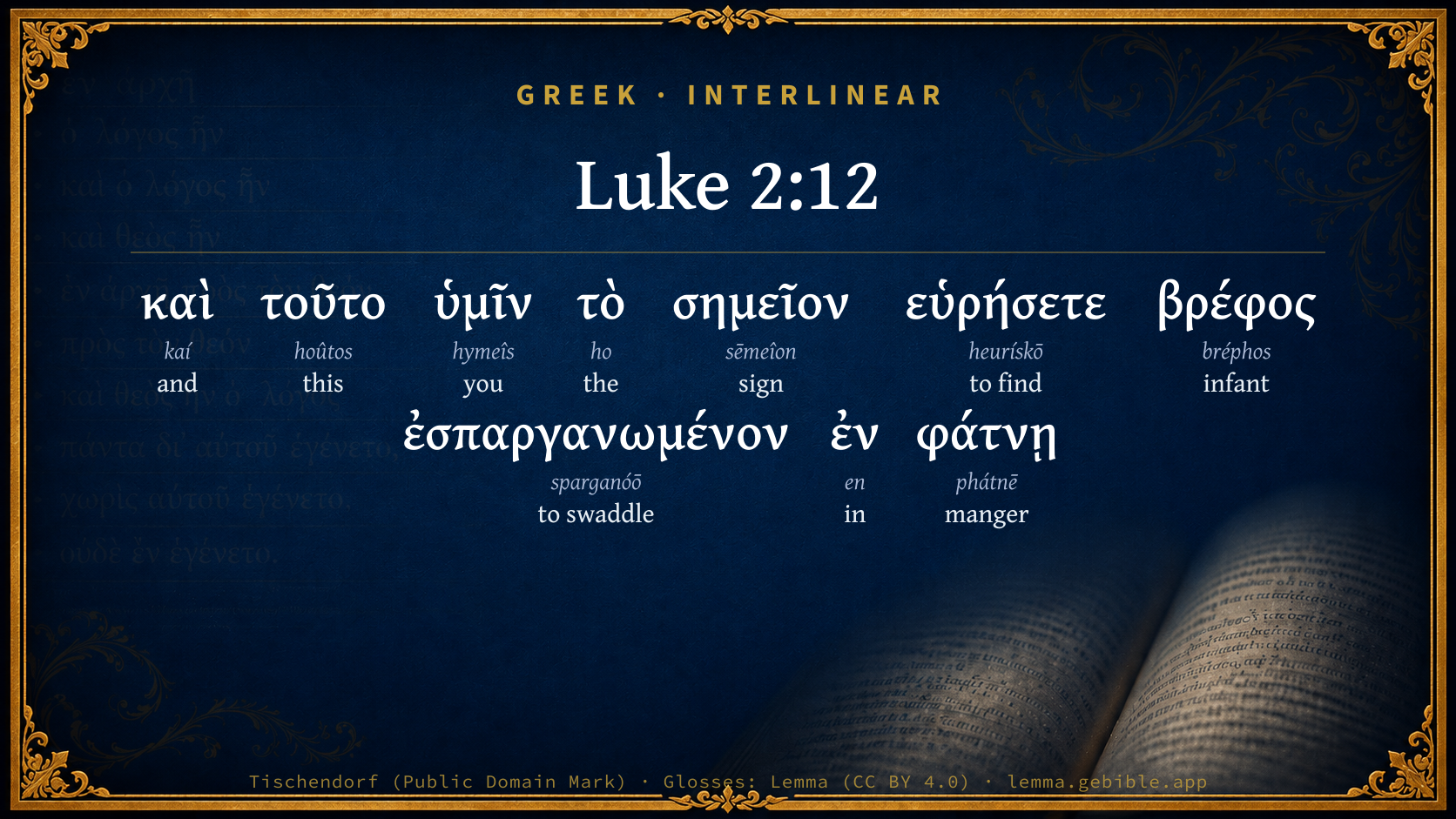
Greek (Tischendorf 8th ed.) Luke 2:12 appears in the Greek New Testament. The text above is from the Tischendorf 8th edition. Each word links to its Strong’s number and a concise gloss. Click any word for its full Thayer’s Greek Lexicon entry.
Download image
Cite this verse

Luke 2:12 (World English Bible). Public Domain. Lemma interlinear Bible study tool, https://lemma.gebible.app/v/luke/2/12.

Show BibTeX & RIS
BibTeX
RIS
English Translation
This is the sign to you: you will find a baby wrapped in strips of cloth, lying in a feeding trough."
World English Bible · Public Domain
Download a study sheet

One document with this verse’s original text, its word-by-word gloss line, the meaning frame, cross-references with their text, attributed commentary, and full source and license credits — printable, and it pastes into notes with its structure intact.

This verse Autodidact and up

Study sheet (.html) Plain text (.txt)

A passage Seminary Student

Up to 50 verses in one chapter. A passage sheet keeps up to 6 commentary sources and 12 cross-references per verse, in the order this page ranks them, and says so on the sheet whenever that leaves anything out. Ask for a single verse and you get the Autodidact verse sheet above.

Everything on this page stays free to read, with no account — the sheet is a download of what is already on screen, not access to it.

Want to remove ads? Support Godless Engineer
Compare translations 3

The same verse in 3 English versions, stacked beneath the original-language interlinear above. Click any original word for its lexicon entry.

Each is an independent rendering of the whole verse — the interlinear is not word-aligned to these translations.

Highlighted words mark where these versions differ — a whole-verse word diff, not a word-by-word alignment.

  • World English Bible Public Domain
    This is the sign to you: you will find a baby wrapped in strips of cloth, lying in a feeding trough."
  • King James Version Public Domain
    And this shall be a sign unto you; Ye shall find the babe wrapped in swaddling clothes, lying in a manger.
  • unfoldingWord Literal Text CC BY-SA 4.0
    And this the sign to you: You will find a baby wrapped in strips of cloth and lying in a manger.”

unfoldingWord Literal Text — © unfoldingWord, licensed CC BY-SA 4.0. Word-aligned USFM3 via Door43 (git.door43.org/unfoldingWord/en_ult).

Versions to compare (up to 4)

3 of 4 selected

Show all 19 translations

Every available English version of this verse, each an independent rendering of the whole verse.

  • World English Bible Public Domain
    This is the sign to you: you will find a baby wrapped in strips of cloth, lying in a feeding trough."
  • Berean Standard Bible Public Domain
    And this will be a sign to you: You will find a baby wrapped in swaddling cloths and lying in a manger.”
  • Majority Standard Bible Public Domain
    And this will be the sign to you: You will find a baby wrapped in swaddling cloths and lying in a manger.”
  • King James Version Public Domain
    And this shall be a sign unto you; Ye shall find the babe wrapped in swaddling clothes, lying in a manger.
  • American Standard Version (1901) Public Domain
    And this `is' the sign unto you: Ye shall find a babe wrapped in swaddling clothes, and lying in a manger.
  • Revised Version (1885) Public Domain
    And this is the sign unto you; Ye shall find a babe wrapped in swaddling clothes, and lying in a manger.
  • Geneva Bible (1599) Public Domain
    And this shalbe a signe to you, Yee shall finde the babe swadled, and laid in a cratch.
  • Douay-Rheims (1899) Public Domain
    And this shall be a sign unto you. You shall find the infant wrapped in swaddling clothes, and laid in a manger.
  • Young's Literal Translation Public Domain
    and this `is' to you the sign: Ye shall find a babe wrapped up, lying in the manger.'
  • Literal Standard Version CC BY-SA 4.0
    And this [is] the sign to you: you will find a Baby wrapped up, lying in the manger.”
  • Unlocked Literal Bible CC BY-SA 4.0
    This is the sign that will be given to you: You will find a baby wrapped in strips of cloth and lying in a manger.”
  • unfoldingWord Literal Text CC BY-SA 4.0
    And this the sign to you: You will find a baby wrapped in strips of cloth and lying in a manger.”
  • Darby Bible Public Domain
    And this is the sign to you: ye shall find a babe wrapped in swaddling-clothes, and lying in a manger.
  • World Messianic Bible Public Domain
    This is the sign to you: you will find a baby wrapped in strips of cloth, lying in a feeding trough.”
  • Webster's Bible Public Domain
    And this shall be a sign to you; Ye shall find the babe wrapped in swaddling-clothes, lying in a manger.
  • Free Bible Version CC BY-SA 4.0
    You will recognize him by this sign: you will find the child wrapped in strips of cloth and lying in a manger.”
  • Bible in Basic English Public Domain
    And this is the sign to you: you will see a young child folded in linen, in the place where the cattle have their food.
  • Text-Critical English NT CC BY 4.0
    This will be the sign for you: You will find a baby wrapped in swaddling cloths and lying in a manger.”
  • Tyndale New Testament (1534) Public Domain
    And take this for a signe: ye hall fynde the chylde swadled and layed in a manger.

Literal Standard Version (2020), Covenant Press — licensed CC BY-SA 4.0. Text via the HelloAO Bible API (eBible.org). Unlocked Literal Bible (unfoldingWord) — licensed CC BY-SA 4.0. Text via the HelloAO Bible API (eBible.org). unfoldingWord Literal Text — © unfoldingWord, licensed CC BY-SA 4.0. Word-aligned USFM3 via Door43 (git.door43.org/unfoldingWord/en_ult). Free Bible Version, Dr. Jonathan Gallagher — licensed CC BY-SA 4.0. Text via the HelloAO Bible API (eBible.org).

Word by word

More ways to search: Search by grammar → Find every occurrence → Compare this word →

Practice this passage: Drill this verse → Learn its vocabulary →

About this verse

These counts appear in no published source. They are computed here, from the morphology-tagged text and Lemma’s own curated glosses. What Lemma adds →

10
words
10
distinct lemmas
Gospels
section

Notable vocabulary

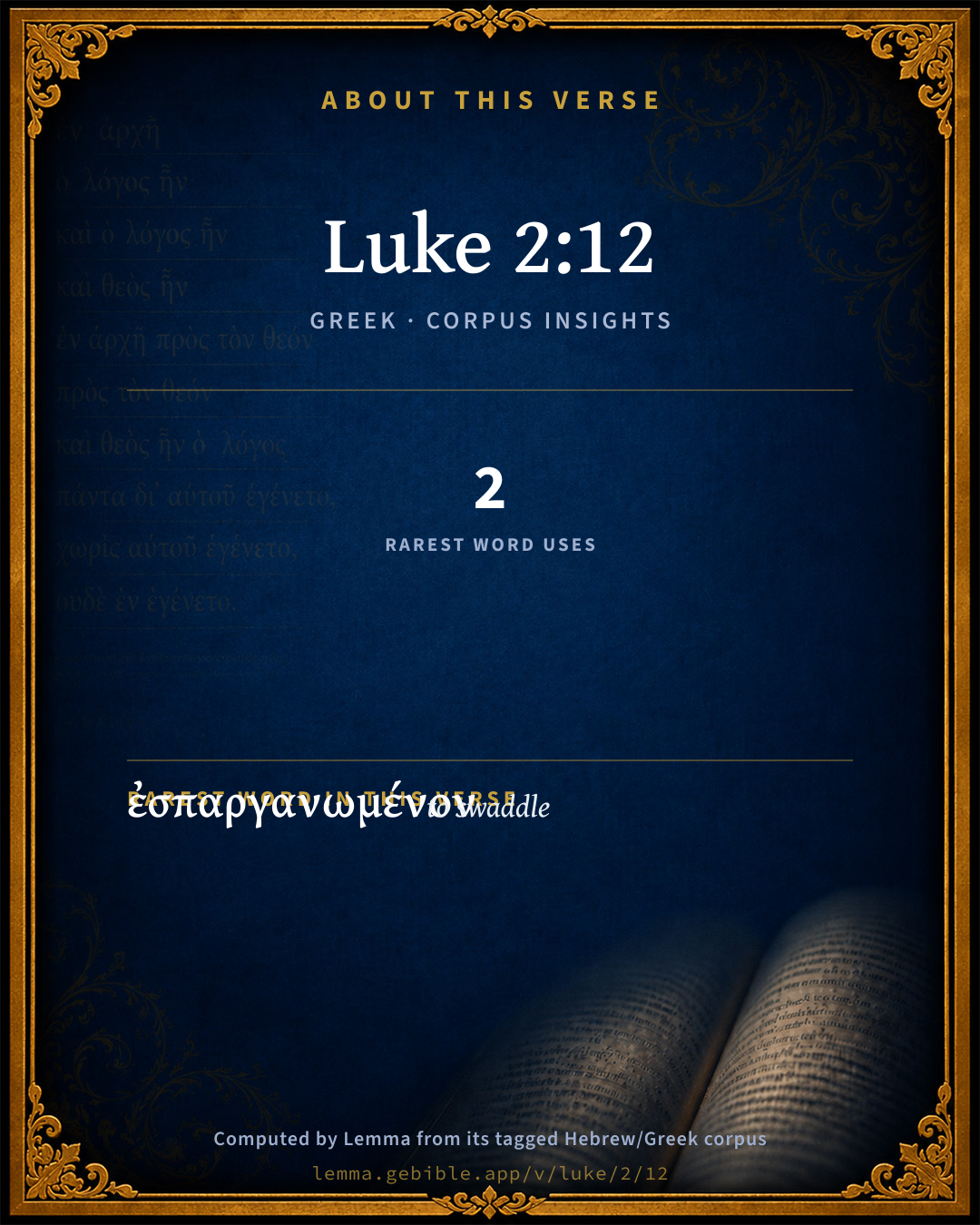
The rarest word here is ἐσπαργανωμένον to swaddle G4683 — appearing just 2 times in the whole Greek New Testament.

Shared distinctive vocabulary

ἐσπαργανωμένον to swaddle G4683 occurs in 2 verses of the Greek New Testament. Also found in:

Cross-references

8

Topical passages linked to Luke 2:12 in the Treasury of Scripture Knowledge — connected by theme and wording, ordered by reader-vote popularity; previews shown in the World English Bible.

  • Isaiah 7:14 Therefore the Lord himself will give you a sign. Behold, the virgin will conceive, and bear a son, and shall call his name Immanuel.
  • Isaiah 53:1–2 Who has believed our message? and to whom has the arm of Yahweh been revealed?
  • Isaiah 7:11 "Ask a sign of Yahweh your God; ask it either in the depth, or in the height above."
  • Psalms 22:6 But I am a worm, and no man; A reproach of men, and despised by the people.
  • 1 Samuel 2:34 This shall be the sign to you, that shall come on your two sons, on Hophni and Phinehas: in one day they shall die both of them.
  • 1 Samuel 10:2–7 When you are departed from me today, then you shall find two men by Rachel's tomb, in the border of Benjamin at Zelzah; and they will tell you, The donkeys which you went to seek are found; and, behold, your father has left off caring for the donkeys, and is anxious for you, saying, What shall I do for my son?
  • 2 Kings 19:29 This shall be the sign to you: You shall eat this year that which grows of itself, and in the second year that which springs of the same; and in the third year sow you, and reap, and plant vineyards, and eat the fruit of it.
  • 2 Kings 20:8 Hezekiah said to Isaiah, What shall be the sign that Yahweh will heal me, and that I shall go up to the house of Yahweh the third day?

Cross-references courtesy of OpenBible.info (CC BY 4.0).

Commentary

Notes on Luke 2:12 from classic Christian and Jewish commentators (each source and its license shown beneath its notes). The classic Christian expositions comment on the surrounding passage and are grouped to its opening verse, so a note may address several verses; the Jewish commentaries on the Tanakh (Rashi and others) are per-verse, so they appear only where the commentator wrote on this verse.

Lemma curates 59 commentaries, every one of them public domain or Creative Commons licensed, each selected and text-cleaned for this edition rather than reprinted as found. About our sources →

The Biblical Illustrator

Joseph S. Exell

Luk_2:12

And this shall be a sign unto you.

--What the angels said to the shepherds was, This shall be the sign unto you; ye shall find a babe, a babe like any other, wrapped in swaddling clothes, differing from other babes only in the lowliness of His birth, lying in a manger. The absence of any adventitious source of interest, anything awe-inspiring in the circumstances of the birth of Christ, was no mere casual incident; it was eminently significant, characteristic of His life, a symbol of His sway. The identification of signs with wonders was the common error of the Jews. All Israel was expectant of the Messiah. The reason why they received Him not was that they could not recognize the Divine in the ordinary. A babe was born in Bethlehem: only by those who shared the mothers prophetic insight was the mystery of Gods interposition seen in His birth. Angels sang of His advent; their song was mute save to the listening ear of a few shepherds. And this is the common error of us all. He that receiveth a prophet, says Christ, in the name of a prophet, shall receive a prophets reward. Yes, we respond, that is well; we all shall know a prophet when we see him. But Christ also says, Whoso shall receive a little child in My name re-ceiveth Me. He who is blind to the Christ in the little child may also fail to see the prophet when he comes. Such as Christ was manifested here, such did He ever continue. He would steal into the life of humanity as a babe twines round a mothers heart. He would draw men to Him by the charm and sweetness of human sanctity; and to those who were thus attracted to Him and abode in His fellowship, there came at length the revelation that this was the Divine. The cross lay hidden in the manger of Bethlehem. He was already bearing the only cross a babe can bear, poverty and mans contempt; sweetened by a mothers care, the symbol of that affection of pious hearts which never failed Him throughout His vexed and troubled history; and hallowed by the Fathers approval of the well-beloved Son, in whom, now as ever, He was well pleased. The sacrificial purpose and saving energy of His life already appeared. Though He was rich, yet for our sakes, &c. The mother of Jesus and the adoring shepherds must have been struck by the contrast between the honour of His annunciation and the meanness of His birth; between the splendours of the angelic host, and the manger where He lay. Eighteen centuries of Christian history have taught us that herein is no contrast, but profound consistency. What honour could the world have rendered the Son of God which would not have more sharply contrasted with His character and mission than poverty and the worlds neglect? There is nothing in common between Christ and the luxury of wealth, the ostentation of a palace, the statecraft of a Court. The manger of Bethlehem is the sign of the Messiah; the lowly, self-accepted lot of Jesus is the seal of His divinity. Men soar, God stoops; ambition is human, condescension is Divine. When God reveals Himself for mans salvation it can only be by sacrifice; and the more complete the sacrifice, the fuller is the revelation. (A. Mackennal, D. D.)

The sign of Jesus Christ

What a wonderful contrast between this verse and that which follows! What greatness on the one side, what humility on the other! That humility is the sign of the greatness.

I. The sign of humility by which the entrance of Jesus into the world was announced, is found throughout the whole course of His history.

II. The same contrast is found in the institutions which Jesus has left to preserve in His Church the remembrance of His benefits.

III. There is, again, this same contrast of grandeur and humility to mark, with a Divine seal, the Church of Jesus Christ.

1. In its origin, composed of obscure persons from lowest ranks of a small unknown people.

2. As it exists to-day wherever the true Church is to be found.

IV. The same sign of humility will enable us to recognize the worship with which God is pleased.

V. The sign of humility which is constantly found in Christ, and in all that springs from Christ, must be found also among His disciples. (Horace Monod.)

Lessons of the holy manger

At the cradle of Christianity, we may observe something of the predestined form both of Christian doctrine and Christian life. In the bud we trace the probable shape and colour of the coming flower. When standing at the source of a river we can determine at least the general direction of its course. In the Sacred Infancy, too, we may discern, without risk of indulgence in over-fanciful analogies, a typical portraiture of the Christian creed, and a precious lesson for good Christian living. To the theologian and the practical Christian, the sign of the manger and of the swaddling clothes is at least as full of meaning now as it was of old to the shepherds of Bethlehem.

I. LOOK THEN AT THE CREED OF THE CHURCH. It has two sides, two aspects. It is one thing to sight, another to faith. To sight, it is wrapped in swaddling clothes and laid in a manger. To faith, it is revealed from heaven as supernatural and Divine.

II. Consider THE MORAL IMPORT OF THE MANGER-BED OF THE INFANT JESUS. The world-wide principle of spiritual death needed to be expelled by a stronger and not less universal principle. It demanded a regenerating force, resting not on theory but on fact, a principle human in its form and action, but Divine in its strength and origin. Such a privilege we find in the Babe, wrapped, &c. This was indeed the Divine Word, engrafted on human nature, and able to save the souls of men. The Incarnation was the source of a moral revolution. By saving man it was destined to save human society. It confronted sensuality by endurance and mortification. It confronted covetousness by putting honour upon poverty. It taught men that a mans highest life consisteth not in the abundance of the things that he possesseth. But its great lesson was a lesson of humility. In the humiliation of the Highest, the nations read the truth which the incarnate Lord taught in words:--Except ye be converted, and become as little children, ye cannot enter into the kingdom of heaven. For us men humility is the law of progress, because it is the admission of truth. At Christs manger may we learn the blessed temper which makes faith, repentance, perseverance, easy, and to which are promised the crowns of glory, worn by the blessed around His throne. (Canon Liddon.)

The babe: A Christmastide meditation

The Incarnation was the great event in the worlds history. Nothing can rival in interest to us the coming of God in our mortal flesh; the shadowing of Deity in a human form, so that we might see Him; the manifestation of Deity in a saving love, so that we might be drawn to Him; the shinings in our humanity of a Divine purity; which should at once reveal to us our sins; and deliver us from their power.

I. OUR SAVIOUR WAS A REAL MAN. All are alike at birth--babes. Christ came as we came. He passed through the entire experience of human life, starting from the cradle, right up to and beyond the tomb.

II. OUR SAVIOUR WAS SIMPLY A MAN. Ye shall find the babe: just a babe, no more. No accident of birth limited Jesus to any part of the community; there were none of those things about Him on which men pride themselves. He belongs to all, however humble, obscure, poor, simple, needy.

III. HE WAS A LOVING MAN. A babe is the emblem of the mightiest thing on earth--love--the sunshine of the Divine radience.

IV. He was, for the most part, A REJECTED MAN. There never seemed to be any room for Him, from His birth onwards.

V. HE IS ALL IN ALL TO THOSE WHO RECEIVE HIM.

1. To find this Babe will be the beginning of truest peace to our own hearts.

2. To find this Babe will be the beginning for us of a better, nobler life.

3. To find this Babe will give to us the true spirit of brotherhood and charity. (R. Tuck, B. A.)

The sign of the manger

Let us think what is the connection here. A sign--a signal: how so? In what sense did the mode and circumstance of the birth make it typical of the thing which Christ comes to do? What is that thing which Christ comes to do? He has come to be the God-man, the Redeemer, the Emmanuel, and the Saviour--the God for us, and God with us, and God in us--of the fallen, the sinful, the erring and straying man. Now, to be this, He must first incorporate Himself with men, take the flesh and blood, the nature and body and spirit of the race which He comes to save. He must first of all incorporate Himself--not with a man, or a few men, but with humanity--with man as man, and not with certain privileged specimens and choice individuals of the race. He has come to undo the fall. He has come to bear the sins, to wipe away the tears, to take the sting out of the death of the Adam race as a whole; therefore He must not only take flesh and blood--become one of us and live our very life: that is not enough. He must go down to the very rock from which we are hewn, and He must put on our nature--not in its ornamental but in its bare form--not as it may deck itself in the embellishment of rank or wealth, of social distinction or philosophical culture, but as it is in itself and in the commonest experiences of its humblest children. If the Divine Saviour had appeared in any other form than this, He would have misled men as to the thing which He came to do, and as to the relation in which He desired to stand as to the lower and the lowest portions of the human family. The sign of the helpless babe and the manger cradle was no capricious or accidental idea; for, inasmuch as it is Christ the Lord, therefore ye shall find Him not in the miraculous strength of an instantaneous maturity, and not in the guest-chambers of a kings palace, but as a babe wrapped in swaddling clothes and lying in a manger. There was a connection and a congruity between the sign and the reality; for thus it was that Christ became, not the faith of a few, but the Saviour of all. None are poorer, none are humbler, none are less learned, none are less noble after the flesh, than He. None can say now, His is the religion of the educated--of the philosophical--of kings and princes--His is the religion which admits or which favours a position of comfort or respectability, and I am none of these, so Christ is not for me. And when, at this Christmas season, wealth surrounds itself with all its luxuries of mind and body, and thinks it much if, for a moment and in the most perfunctory way, it remembers the poor, we feel how slight must be the hold of these self-indulgers upon the faith which they profess to honour. If we would know the mystery of Christmas; if we would read the riddle of the angel; if we would know why he said, The Saviour is born, and the sign is the manger, we should turn our steps to some poor mans chamber with its highbacked chair and its open Bible. We shall hear that man say, Oh, I love both to be abased and to abound. I am instructed both to be full and to be hungry, for Christ the Lord was born this day for our salvation, and His first earthly resting place was a yard and a manger. (Dean Vaughan.)

Divine things veiled under earthly forms

This shall be your sign: not the march of a conqueror, not the splendour of a king, but the Babe wrapped in swaddling bands and lying in a manger! Wherever God is, the presence is secret. What, for example, is the Book of God--the Bible--but an example of this sanctity in commonness: a heap of leaves, marked with ink and hand, stamped with signs for sounds, multiplied by printing-press and steam-engine, conveyed hither and thither by railways, bought and sold in shops, tossed from hand to hand in schools and homes, lost and dissipated by vulgar wear and tear? But go back to its composition. What was the Bible as it came forth originally, book by book, and chapter by chapter, from the mind which thought, and from the hand which wrote it? Was it not written, after all, both in composition and in dictation, like any other work of poetry or philosophy, of history or fiction--by the brain and nerve power of common-human beings? Was it not given forth line by line from the lips of a Paul sitting at the tent-making, or some other evangelist alternating between preaching and handicraft--by the utterance of sounds in an imperfect human language to some obscure Persis or other amanuensis reporting? Yet in that Book of books, thus material, thus earthly, thus human in its circumstances, there lies concealed the very breath and spirit of God Himself, mighty to stir hearts, and mighty to regenerate souls. The swathing bands of sense and time enclose the living and moving power which is of eternity, which is Divine. Nay, the sign of the true Deity is the fact that the form is human. Take another example of this from another of Gods instruments of communication. What is that vessel for holding common water, which is the appendage of every Christian place of worship? Is there anything in that laver--that font--but what is of the earth, and of the very commonest of all earths gifts for refreshing and purifying? What can be the use, some might inquire, of bringing that earthly water into the House of Gods worship, as though we had forgotten our Masters own words, God is a Spirit? What significance can there be--certainly what virtue--in sprinkling those few drops of common water upon the forehead of a child, with or without a particular form of sacred words accompanying? What, again, can be less intelligible than that sight of that little frugal table of common bread and common wine, standing there in front of the congregation? How can eating and drinking in Gods house affect, in any degree, for good the soul of the worshipper? We can but answer that Christ our Master commanded the one sacrament as the appointed way of dedicating a new life to His service, and that He appointed the other sacrament as commemorative of His own death and passion--as instrumental, also, in nourishing the soul that in it feeds upon Him by faith. And though it would be presumptuous, indeed, to attach any value to a form of mans invention, we feel that the presumption would be all the other way if we neglected an ordinance of Jesus Christ, because it was either too mysterious for us, or too carnal. Nay, we can almost read in the very simplicity a signal of His working, who, when He came on earth came as a babe wrapped in swaddling clothes, and made it a sign of His presence that He was lying in a manger. But the same thing which is true of the Bible and of the sacraments, is true also of the Church and of the Christian. Where is it, we ask, that God in Christ dwells most certainly, most personally, on this earth? It is no word of mans invention which answers, to the Church--Ye, collectively, are the temple of God, and, to the Christian your body is the shrine of the Holy Ghost, which is in you. Yet if we look at the men and the women and the children thus spoken to, we see nothing but human beings, frail and fallen, occupied for a large part of their life in the employments and the relaxations, in the talk and in the seeking, which are common alike to the righteous and the wicked, and which would equally be theirs if they had neither faith nor heaven. The treasure of the Divine light is always held in earthen vessels; not until the pitcher is broken at the fountain shall the full radiance shine out so as to be read of all men. Meanwhile the sign of God is the commonness. Christ came not to take men out of the world, but to consecrate and keep them in it. Coming to redeem earth, He takes earth as it is: not the ideal, but the real; and makes this the very token of His being amongst us--that we find a helpless babe and a manger cradle. (Dean Vaughan.)

The practice of swathing infants

When the Gospels were translated in our venerable version, it did not occur to any of the translators that the word swaddling clothes would ever be an obsolete word, needing to be illustrated by a description of ancient or foreign customs. And yet so it is at this day. The usage which is alluded to in this word is to us entirely strange. Few things among the old world customs, I venture to say, strike some of us as more outlandish--more pitiable even--more entirely removed from our notions of good care and right training--than the swaddling of little helpless babies, as it is practised, for instance, in Germany. I do not believe an American mother can generally pass one of those poor little Wickelkinder, strapped down on its back to a pillow by spiral after spiral of convoluted bandages, without longing to apply the scissors and let the little prisoner go free. And yet it is only a few generations since this way of treating new-born children prevailed, with variations and aggravations, in all nations, even the most civilized. We owe our own emancipation, in this land and century, from this and other artificial traditions, to no other single influence so much as to a remarkable book published in the middle of the last century by a citizen of Geneva--the Emile of Jean Jacques Rousseau. It speaks thus of the universally prevalent treatment of an infant child as it had continued to his day: Scarcely does the child begin to enjoy the liberty of moving and stretching its limbs, when it is placed anew in confinement. It is wound in swaddling clothes, and laid down with its head fixed, its legs extended, its arms at its sides. It is surrounded with clothes and bandages of all sorts that prevent it from changing its position. It is a good thing if they do not even draw the bands so tight as to hinder respiration, and if they have the foresight to lay it on its side to avoid the danger of strangulation … The inaction and constraint in which the childs limbs are confined must necessarily disturb the circulation, hinder the child from gaining strength, and affect its constitution … Is it possible that such cruel constraint can fail to affect the character of the child, as well as its physical temperament? Its first conscious feeling is a feeling of pain and suffering. It finds nothing but hindrances to the motions which it craves. More wretched than a criminal in irons, it frets and cries. The first gifts it receives are fetters; the first treatment it experiences is torture. Such was the practice of a hundred years ago in the highest families of the most civilized country in the world. In many lands, partly owing to this very protest, the practice is better now. But in the slow-going East the common practice of the nursery is no better, and it is probably no worse than it was nineteen hundred years ago. But it is worse than anything we ever see or hear of ill this part of the world. In fact, it comes nearer to the binding of an Indian papoose to a board, than to anything that we are accustomed to see in the families of Christendom. Once wound around with these swathing-bands, sometimes with an addition of fresh earth against the skin, and packed in their cradles like a little mummy in its coffin, the poor little babies are expected to stay there, all cries and complaints notwithstanding; they are not removed by their mothers even for such necessary occasions as to be fed. I have heard pitiful stories told by missionaries wives, and by missionary physicians, in the East, of the sufferings of little infants in consequence of the obstinate persistence of parents in a usage which we clearly see to be so unreasonable and unnatural. (Leonard W. Bacon.)

The sign of the swaddling clothes

Is it not strange, you will ask, that when the shepherds were given a sign by which they should know their new-born Saviour, they should be told, not of something distinguishing Him from all children beside, but of something common to all the infants that were born that night in all Judea? Ye shall find wrapped in swaddling clothes. Why not say, according to the instincts of heathen mythology, Ye shall know Him by the bees that gather to suck the honey of His lips, or the strangled serpents that lie about His cradle? Why not say, according to the suggestions of Christian legend and art, Ye shall know Him by the aspect of supernatural majesty, which it shall be the dream and the disappointment of all the worlds artists to attempt to portray? Or, Ye shall know Him by tile halo of celestial light beaming from His brow, as in the Holy Night of Correggio, and filling the rude stall with an unearthly brightness? Or, Ye shall know Him by some accessories worthy of so royal a birth, by gifts of gold and myrrh and frankincense that strew the humble shed? The very question brings its answer: You are to know Him from all these natural dreams of a fond imagination, from the hopeful prognostications of Hebrew mothers, or the impatient fancies of fanatics, or the artful fictions of impostors taking advantage of the general expectation with which the very atmosphere of Palestine was saturated, to set forth some feigned Messiah--you are to know Him from all these by the fact that He is just the opposite of all such imaginings--that He is to all appearance just a helpless human infant, the most helpless thing in the whole creation, bound and bandaged in swaddling clothes. And if you would know how to distinguish Him from other such, it is not by His grandeur but by His poverty. There is no room in the inn for such as He; and they have laid Him in the manger, among the cattle The sign given to the shepherds is a sign also to us--that we find the Holy Child wrapped in swaddling clothes. Illustrious men have sometimes had an honest pride in inscribing upon their escutchon, beneath a noble crest, the symbol of the humble mechanic rank in which they had their origin. So the Church of Christ, beneath the diadem of supreme royalty, quarters upon its shield, beside the cross and the thongs, the manger and the swaddling bands, and invites the world to read the blazon. That family group which the painters of every later age have been essaying to depict--the carpenter with his simple, uninquisitive faith obedient to heavenly visions, the pure Virgin with her unskilled maiden tenderness pondering strange memories in her heart, both leaning over the Wonderful, but understanding not the saying which He speaks to them--these speak over again to us the language of that prophet who first called his child Immanuel, Behold we and the Child whom the Lord hath given us are for signs and for wonders from the Lord of hosts. (Leonard W. Bacon.)

Naturalness of the truly great

To illustrate the use of such a sign as was given to the shepherds, let me suppose some traveller accustomed to the splendour and reserve of royal courts visiting the city of Washington, and asking, on his way to the White House, how he should find the President. We should tell him, You may know him by this sign. He is a plain man, plainly dressed in a black suit, and you will find him in the centre of the thickest crowd, and everybody coming up to shako hands with him. First, he is not distinguished in the way you expect him to be; and, secondly, he is unmistakably distinguished in just the opposite way. But for some such sign as this our traveller might naturally mistake for the President some attache of a South American Embassy standing apart in a halo of dignity and a light blaze of gold lace. This wrapped in swaddling-clothes and lying in a manger was just the sign the shepherds needed. And we do well if, looking for the Christ, we take heed to it ourselves. We are not yet safe from the error of them of old time, who thought to find the Lord clothed in soft raiment and dwelling in kings palaces. (Leonard W. Bacon.)

Christs humility

In His nativity, and in His temptation (Mar_1:13), Christ was among beasts. Believers, ambitious of high place, forget their Masters cradle. A manger is here honoured above a thousand glittering thrones. It is an ornament of His royalty, a throne of His glory.

He comes in humility; He reigns in humility; He leads by humility. The manger and the cross are stumbling-blocks to many. His infancy and death are still rocks, wrecking human pride. (Van Doren.)

The sign of the Incarnation

Christmas is full of surprises. It brings in, as no other event ever did, the element of mystery, of wonder. Its testimony is, God became manifest in the flesh. The Eternal Word was joined with a perfect human nature. The miracle of the Incarnation transcends every other that has been and will be wrought. It is in itself a wonder so great that all the accompaniments of the birth of Jesus sink into comparative insignificance. We are, I fear, inclined to forget the majesty of the fact in the strangeness of its surroundings. We count it a wonderful thing that He should have been born in the stable of a country inn, whereas the real wonder is that such a birth should take place anywhere, and so I ask you to contemplate one of the signs by which the shepherds of Bethlehem were to find and know the incarnate God--Ye shall find the babe wrapped in swaddling clothes.

I. It reminds us, by way of analogy, of a fact which constitutes the most trying element in the mystery of the Incarnation, namely, that GOD THEREBY CAME WITHIN CERTAIN LIMITATIONS. HOW an uncreated and omnipresent, that is, a boundless, Infinite Being could be contracted within the circumference of a human life is the most puzzling problem of revelation. The impossibility of our understanding this is a temptation, not perhaps to deny, but to forget the deeper meaning of the Christmas feast. Remember, then, that within these swathing bands which encircled the infant form of Jesus there was bound the nature of a Being more than human, even God Himself. Men may call this an unreasonable tax upon our faith. It is rather a sign of Gods condescension to human weakness. The whole secret of the history of idolatry among the Jews and the Gentiles was a longing for some visible manifestation of Him whom they felt they must worship. Man instinctively longs for some incarnate form, some Word of his Maker manifest in the flesh, some finite manifestation of the Infinite Father. And the birth of Jesus, the enshrining of God within a human form, the swathing of that power, which otherwise knows no bounds, was but an answer to mans desire.

II. The sign holds good, not only of the nature of Christ, but likewise of THE LIFE WHICH, FROM FIRST TO LAST, HE LIVED. That also was like every purely human life, hemmed in. It unfolded according to the ordinary laws of growth. His babyhood was as real as His manhood. He increased in wisdom as well as stature. He learned gradually the wisdom which all the world now confesses. The common idea which people have of Jesus is that, being Divine, He was exempt from the ordinary conditions of common men; that He never knew constraint; that there were no barriers opposing Him, no bands fettering the free exercise of that Divine power which lay hidden within Him. Yet duty was sometimes hard for Him. He longed to do things which He might not attempt, because the higher and more spiritual dictates of His conscience forbade it. The kingdoms of this world and their glory looked as fair and tempting to His soul as they do to ours. But the law of righteousness, the swathing-bands of duty, the rules of obedience which God throws around us, likewise constrained Him.

III. The manner of the Incarnation shows GODS ESTIMATE OF HUMAN NATURE. If you are ever tempted to despise human nature because you see it now and then wearing disagreeable phases, or to think ill of, nay, to slight, your friends, remember Gods estimate of them. He does not thus stoop and toil to save the worthless. From being a King He descended to the lowest form of human life, entered the world in utter helplessness, was wrapped in swaddling clothes, and during all His development here on earth never rose above that form of a servant which He had taken. And He did all this, because even fallen man was dearer to His heart than the world of lost angels. (E. E. Johnson, M. A.)

Great things from small beginnings

Not, Ye shall find the angel in the heavens, the king on his throne, the young prince in a palace, the commander at the head of his armies, but the babe in a manger. How strange are Gods ways of working out His strange plans! It is not by might, nor by power, that His agencies accomplish their vast work. The least things are often the greatest in His providence (1Co_1:27-29). It may be the shepherd boy with his sling who gains victory over the mailed giant in whose presence the whole army of Israel stands trembling; it may be the tinker in Bedford Jail who writes a masterpiece in religious literature, to be honoured for centuries for its work and its worth; it may be the unschooled clerk from a Boston shoe-store who proclaims the gospel with a fervency and power which the best-cultured divines of all Christendom have not attained to; or it may be in the most unprepossessing child of your school or class that the grandest possibilities for the kingdom of Christ to-day lie hid. (H. C. Trumbull.)

The fitness of the sign

This shall be the sign, saith the angel. Shall be; but should it be this? No; how should it be? Let us see. Why, this shall be the sign; ye shall find the Child, not in these clouts or cratch, but in a crimson mantle, in a cradle of ivory. That, lo, were somewhat Saviour-like I But in vain take we upon us to teach the angel; we would have--we know not what. We forget St. Augustines distingue tempera; as the time is the angel is right, and a fitter sign could not be assigned. Would we have had Him come in power and great glory? and so He will come, but not now. He that cometh here in clouts will one day come in the clouds. But now His coming was for another end, and so to be in another manner. His coming now was to visit us in great humility, and so His sign to be according. Nay, then, I say, first go to the nature of a sign; if Christ had come in His excellency, that had been no sign, no more than the sun in the firmament shining in his full strength. Contrary to the course of nature it must be, else it is no sign. The sun eclipsed, the sun in sackcloth; that is signum in sole, the sign indeed (Luk_21:25). And that is the sign here: the Sun of Righteousness entering into His eclipse begins to be darkened in His first point, the point of His nativity. This is the sign, say I, and that had been none. (Bishop Lancelot Andrewes.)

The sign nothing; the treasure all

Make of the sign what ye will; it skills not what it be, never so mean. In the nature of a sign there is nothing, but it may be such; all is in the thing signified. So it carry us to a rich signature, and worth the finding, what matter how mean the sign be? We are sent to a crib, not to an empty crib; Christ is in it. Be the sign never so simple, the signature it carries us to makes amends. Any sign with such a signatnm. And I know not the man so squeamish, but if, in his stable and under his manger, there were a treasure hid, and he were sure of it, but thither he would, and pluck up the planks, and dig and rake for it, and be never a whir offended with the homeliness of the place. If, then, Christ be a treasure, as in Him are all the treasures of the wisdom and bounty of God, what skills it what be His sign. With this, with any other, Christ is worth the finding. He is not worthy of Christ who will not go anywhither to find Christ. (Bishop Lancelot Andrewes.)

Christ born in a manger

At midnight from one of the galleries of the sky a chant broke forth. To an ordinary observer there was no reason for such a celestial demonstration. If there had been such brilliant and mighty recognition at an advent in the House of Pharaoh, or at an advent in the House of Caesar, or the House of Hapsburg, or the House of Stuart, we would not so much have wondered; but a barn seems too poor a centre for such delicate and archangelic circumference. The stage seems too small for so great an act, the music too grand for such unappreciative auditors, the windows of the stable too rude to be serenaded by other worlds.

I. THAT NIGHT IN THE BETHLEHEM MANGER WAS BORN ENCOURAGEMENT FOR ALL THE POORLY STARTED. He had only two friends--they His parents. No satin-lined cradle, no delicate attentions, but straw and the cattle, and the coarse joke and banter of the camel drivers. From the depths of that poverty He rose, until to-day He is honoured in all Christendom, and sits on the imperial throne in heaven. Do you know that the vast majority of the worlds deliverers had barnlike birthplaces? Luther, the emancipator of religion, born among the mines. Shakespeare, the emancipator of literature, born in a humble home at Stratford-on-Avon. Columbus, the discoverer of a world, born in poverty at Genoa. Hogarth, the discoverer of how to make art accumulative and administrative of virtue, born in a humble home at Westminster. Kitto and Prideaux, whose keys unlocked new apartments in the Holy Scriptures which had never been entered, born in want. Yea, I have to tell you that nine out of ten of the worlds deliverers were born in want. I stir your holy ambitions to-day, and I want to tell you, although the whole world may be opposed to you, and inside and outside of your occupations or professions there may be those who would hinder your ascent, on your side and enlisted in your behalf are the sympathetic heart and the almighty arm of One who, one Christmas night about eighteen hundred and eighty years ago, was wrapped in swaddling clothes and laid in a manger. Oh, what magnificent encouragement for the poorly started!

II. Again, I have to tell you that IS THAT VILLAGE BARN THAT NIGHT WAS BORN GOODWILL TO MEN, whether you call it kindness, or forbearance, or forgiveness, or geniality, or affection, or love. It says, Sheathe your swords, dismount your guns, dismantle your batteries, turn the warship Constellation, that carried shot and shell, into a grain ship to take food to famishing Ireland, hook your cavalry horses to the plough, use your deadly gunpowder in blasting rocks and in patriotic celebration, stop your lawsuits, quit writing anonymous letters, extract the sting from your sarcasm, let your wit coruscate but never burn, drop all the harsh words out of your vocabulary--Goodwill to men.

III. Again, I remark that BORN THAT CHRISTMAS NIGHT IN THE VILLAGE BARN WAS SYMPATHETIC UNION WITH OTHER WORLDS. Move that supernatural grouping of the cloud banks over Bethlehem, and from the special trains that ran down to the scene I find that our world is beautifully and gloriously and magnificently surrounded. The meteors are with us, for one of them ran to point down to the birthplace. The heavens are with us, because at the thought of our redemption they roll hosannas out of the midnight sky.

IV. Again, I remark that THAT NIGHT BORN IN THAT VILLAGE BARN WAS THE OFFENDERS HOPE. Some sermonizers may say I ought to have projected this thought at the beginning of the sermon. Oh, no! I wanted you to rise toward it. I wanted you to examine the cornelians and the jaspers and the emeralds and the sardonyx before I showed you the Kohinoor--the crown jewel of the ages. Oh, that jewel had a very poor setting! The cub of the bear is born amid the grand old pillars of the forest, the whelp of a lion takes its first step from the jungle of luxuriant leaf and wild flower, the kid of the goat is born in cavern chandeliered with stalactite and pillared with stalagmite. Christ was born in a bare barn. Yet that nativity was the offenders hope. Over the door of heaven are written these words, None but the sinless may enter here. Oh, horror, you say, that shuts us out! No. Christ came to the world in one door, and He departed through another door. He came through the door of the manger, and He departed through the door of the sepulchre; and His one business was so to wash away our sin that after we are dead there will be no more sin about us than about the eternal God. I know that is putting it strongly, but that is what I understand by full remission. All erased, all washed away, all scoured out, all gone. Oh! now I see what the manger was. Not so high the gilded and jewelled and embroidered cradle of the Henrys of England, or the Louis of France, or the Fredericks of Prussia. Now I find out that that Bethlehem crib fed not so much the oxen of the stall as the white horses of Apocalyptic vision. Now I find the swaddling clothes enlarging and emblazing into an imperial robe for a conqueror. (Dr. Talmage.)

The Child in the manger

I. Learn from this story of the birth of Jesus, in the first place, that INDIGENCE IS NOT ALWAYS SIGNIFICANT OF DEGRADATION. When princes are born, heralds pro claim it, and flags wave it, and cannon thunder it, and illuminations set cities on fire with the tidings; but when Christ was born there was no demonstration of earthly honour or homage. Poor, and, if possible, getting poorer, and yet the recognition of the angel host proves the truth of the proposition that indigence is no sign of degradation. In all ages of the world there have been great hearts throbbing under rags, gentle spirits under rough exterior, gold in the quartz, Parian marble in the quarry, and in the very stables of poverty wonders of excellence that have been the joy of the heavenly host. Poetry, and science, and law, and constitutions, and commerce, like Christ, were born in a manger. Great thoughts that seem to have been the axle-tree on which the centuries turned, started in some obscure corner, and had Herods who tried to slay them, and Iscariots who betrayed them, and Pilates who unjustly condemned them, and rabbles who crucified them, and sepulchres which confined them until they broke forth again in glorious resurrection. Men are, like wheat, worth all the more for being flailed. Strong character, like the rhododendron, is an alpine plant which grows best in the tempest. There arc a great many men who are now standing in the front rank of the Church of God who would have been utterly useless had they not been ground and hammered in the foundries of disaster.

II. Again, I learn from the text that IT IS WHEN WE ARE ENGAGED IN OUR LAWFUL OCCUPATIONS THAT WE HAVE DIVINE MANIFESTATIONS MADE TO US. If these shepherds had gone that night into the village, and risked their flocks among the wolves, they would not have heard the song of the angels. In other words, he sees most of God and heaven who minds his own business! We are all shepherds, and we have large flocks of cares, and we must tend them. I know there are a great many busy men who say, Oh, if I had only time, I would be good. If I had the days and the months and the years to devote to the subject of religion, I should be one of the best of Christians. A great mistake are you making. The busiest men are generally the best men. There is no point from which you can get clearer views of duty than at the merchants counter, or the accountants table, or on the masons wall.

III. Again, the story of the text STRIKES AT THE POPULAR FALLACY THAT THE RELIGION OF CHRIST IS DOLOROUS AND GRIEF-INFUSING. The music that broke through that famous birth-night was not a dirge, but an anthem. It shook joy over the midnight hills. It not only dropped among the shepherds, but it sprang upward among the thrones. The robe of righteousness is not black. The religious life is not all weeping and sighing, and cross-bearing and warfare. Christianity does not frown on amusements and recreations. It quenches no light. It defaces no heart. Among the happy it is the happiest. Heaven itself is only a warmer love and a brighter joy.

IV. Again, I learn from this subject, WHAT GLORIOUS ENDINGS COME FROM SMALL AND INSIGNIFICANT BEGINNINGS. The New Testament Church was on a small scale. The fishermen watched it. Small beginnings, but glorious endings. A throne linked to a manger. Mansions of light at Gods right hand associated with stables of poverty.

V. I learn, finally, from this story of the birth of Christ, THE GLORIOUS RESULT OF A SAVIOURS MISSION. Have you ever thought how strangely this song of peace must have sounded to the Roman Empire? Why, that Roman Empire gloried in its arms, and boasted of the number of men it had slain, and with triumph looked at conquered provinces. Sicily, Sardinia, Corsica, Macedonia, Egypt, had bowed to her sword, and crouched at the cry of her war eagles. Their highest honours had been bestowed upon Fabius and Scipio and Caesar. It was men of blood and carnage that they honoured. With what contempt they must have looked upon a kingdom the chief principle of which was to be goodwill to men, and upon the unarmed, penniless Christ, who, in Nazarene garb, was about to start out for the conquest of the nations. If all the blood which has been shed in battle were gathered together in one great lake, it would bear up a navy. The blow that struck Abel into the dust has had its echo in the carnage of all the centuries. If we could take our stand on some high mountain of earth, and have all the armies of other ages pass along, what a spectacle! There go the hosts of the Israelites through scores of Red Seas, one of them of water, the rest of blood. There go the armies of Cyrus, lifting their infuriate yell over prostrate Babylon. There goes Alexander, with his innumerable host, conquering all but himself, and making the earth to reel under the battle gash of Persepolis and Chaeronia. There goes the great Frenchman, down through Egypt like one of its own plagues, and up through Russia like one of its own ice-blasts. Host after host. Tramp tramp, tramp. Coming down to our day, I appeal to the grave-trench under the shadow of Sebastopol, and turning to India I show you fallen Delhi, and Allahabad, and the inhuman Sepoys, and the regiments of Havelock avenging the insulted flag of Great Britain. On this, the day before Christmas, I bring you good tidings of great joy. A Saviour for the lost. Medicine for the sick. Light for the blind. Harbour for the bestormed. Eternal life for the dead. (Dr. Talmage.)

The Biblical Illustrator, edited by Joseph S. Exell (c. 1880s–1900s) — public domain. Text from a community e-Sword module.

Tyndale Open Study Notes

Tyndale Open Resources

2:12 this sign: Shepherds would appreciate the paradox and incongruity between the security of strips of cloth and the lowly circumstances of lying in a manger. Seeing a baby in such a setting was very unusual—a fitting sign that God was at work.

Tyndale Open Study Notes — © Tyndale Open Resources, licensed CC BY-SA 4.0. Text via the HelloAO Bible API.

Bengel's Gnomon

Johann Albrecht Bengel

Luk 2:12. Σημεῖον, a sign) Even the lowly garb itself was a sign to believers.—βρέφος, a babe) The article is not added. [But Engl. Vers. the babe.]

Bengel's Gnomon of the New Testament — English translation (T&T Clark, Edinburgh, 1860) — public domain. Text from a community e-Sword module.

Expositor's Greek Testament

ed. W. Robertson Nicoll

Luk 2:12 . σημεῖον , the sign just that which might, but for forewarning, have been a stumbling block; the Saviour and Lord lying in a crib, in a cattle stall, or cave! So Hahn, but Godet and Schanz take “sign” merely in the sense of means of identification.

The Expositor's Greek Testament, edited by W. Robertson Nicoll (1897–1910) — public domain. Text from a community e-Sword module.

Jamieson, Fausset & Brown

Robert Jamieson, A. R. Fausset & David Brown

a sign--"the sign."

the babe--"a Babe."

a manger--"the manger." The sign was to consist, it seems, solely in the overpowering contrast between the things just said of Him and the lowly condition in which they would find Him--Him whose goings forth have been from of old, from everlasting, "ye shall find a Babe"; whom the heaven of heavens cannot contain, "wrapt in swaddling bands"; the "Saviour, Christ the Lord," lying in a manger! Thus early were these amazing contrasts, which are His chosen style, held forth. (See Co2 8:9.)

Jamieson, Fausset & Brown — Commentary Critical and Explanatory on the Whole Bible (1871) — public domain (CC PDM 1.0). Text via the HelloAO Bible API.

Adam Clarke's Commentary

Verse 12. This shall be a sign (or token) unto you] You shall find this glorious person, however strange it may appear, wrapped in swaddling clothes, lying in a stable! It is by humility that Christ comes to reign; and this is the only way into his kingdom! Pride is the character of all the children of Adam: humility the mark of the Son of God, and of all his followers. Christ came in the way of humility to destroy that pride which is the root of evil in the souls of men. And thus, according to the old medical aphorism, "Opposites are destroyed by their opposites."

Adam Clarke's Commentary on the Bible (1810–1826) — public domain. Text from a community e-Sword/MySword module.

Ellicott's Commentary for English Readers

(12) This shall be a sign unto you.—The sign was not such in itself, but became so by its agreement with the prediction. It was something exceptional that a new-born infant should be found, not in a cradle, but in a manger; still stranger that that infant babe should be the heir of the House of David.

A Bible Commentary for English Readers, edited by Charles John Ellicott (1878–1897) — public domain. Text from a community e-Sword module.

The Cambridge Bible for Schools and Colleges

gen. ed. J. J. S. Perowne

12. a sign] Rather, the sign.

the babe] Rather, a babe.

The Cambridge Bible for Schools and Colleges (gen. ed. J. J. S. Perowne; Cambridge University Press, 1878–1918) — public domain. Text from a community e-Sword module.

John Gill's Exposition

And this shall be a sign unto you,.... When they should come to Bethlehem, and to the inn where Joseph and Mary were:

ye shall find the babe wrapped in swaddling clothes, lying in a manger; for though there might be many other children, in the inn, yet none else in swaddling clothes, at least lying in a manger: this sign would distinguish the new born Saviour from all others; had not the angel given them this direction, they would never have thought to have looked for, and found: him in such a place: and moreover, it might have been a stumbling to them, and an objection with them against his being Christ, the Lord, had they not been told beforehand where he was; but by this means this objection was prevented, and this stumbling block was removed out of the way, and they were prepared to see him, embrace, and believe in him, in this mean condition.

John Gill's Exposition of the Whole Bible (1746–1763) — public domain (CC PDM 1.0). Text via the HelloAO Bible API.

Trapp's Complete Commentary

John Trapp

12 And this shall be a sign unto you; Ye shall find the babe wrapped in swaddling clothes, lying in a manger.

Ver. 12. Wrapped in swaddling clothes] In vilibus et veteribus indumentis, saith Ludolphus. {See Trapp on "Luk 2:7"}

John Trapp, A Commentary or Exposition upon All the Books of the Old and New Testament (1647–1656) — public domain. Text from a community e-Sword module.

Albert Barnes' Notes on the Bible

This shall be a sign ... - The evidence by which you shall know the child is that you will find him wrapped in swaddling clothes and lying in a manger.

Albert Barnes' Notes on the Bible (1834–1885) — public domain. Text from a community e-Sword/MySword module.

Haydock's Catholic Bible Commentary

On the eastern side of the town of Bethlehem, say St. Justin, St. Jerome, &c. there was a cave cut in the side of a rock, in which was a manger used by the people of those environs; so that these shepherds easily understood the angel, who told them they should find him laid in a manger. Sts. Jerome, Gregory of Nazianzus, Cyril, say that they found the child between an ox and an ass, according to the version of the Septuagint. Habacuc iii. 2.: You shall find him laid between two beasts. In the place where this crib was, St. Helen built a magnificent church in honour of the blessed Virgin Mary. Ven. Bede says that she built another in honour of the tree shepherds; whence St. Bernard concludes, that there were only three shepherds that came to adore the divine infant in the manger. (Tirinus) --- It might be necessary to give them notice of this humble appearance of the Messias, to encourage them to go and pay him their homage. (Barradius)

George Leo Haydock (1774–1849), Haydock's Catholic Family Bible and Commentary, 1859 edition — public domain. Excludes Psalms (Douay-Rheims chapter numbering differs from Protestant) and Deuterocanonical books (Catholic canon only).

Whedon's Commentary on the Bible

Daniel D. Whedon

12. The sign was not itself a miraculous one, but the prediction of it was so. The thing which they would find would be such a verification of the prediction as to attest itself true, and show them that the real Christ was found. The babe, the swaddle, and the manger were the three tokens.

Daniel D. Whedon (gen. ed.), Commentary on the Old and New Testaments (1874–1909) — public domain. Text from a community e-Sword module.

The Pulpit Commentary

Lying in a manger. This was to be the sign. On that night there would, perhaps, be no other children born in the Bethlehem village; certainly the shepherds would find no other newly born infant cradled in a manger.

The Pulpit Commentary (1880–1919), ed. H.D.M. Spence-Jones & Joseph S. Exell — public domain. Text from a community e-Sword module.

The People's New Testament

B. W. Johnson

12. A sign unto you. The sign was not itself a miraculous one, but the prediction of it was so. The babe, the swaddle, and the manger were the three tokens.

B. W. Johnson's The People's New Testament with Notes (1889–1891) — public domain. Electronic text from the Christian Classics Ethereal Library (CCEL) ThML edition.

Cambridge Greek Testament for Schools and Colleges

12. τὸ σημεῖον, ‘the sign.’ Comp. Isa 7:14.

βρέφος, ‘a babe.’

ἐσπαργανωμένον. The participle is here regarded as an adjective, and is followed by κείμενον.

Cambridge Greek Testament for Schools and Colleges (Cambridge University Press, 1896; 21 vols, various authors incl. Carr, Maclear, Plummer, Farrar, Lumby, Moule, M. R. James, Simcox) — public domain. Text from a community e-Sword module.

Alford’s Greek Testament

Henry Alford

12.] Olshausen hazards a conjecture that the stable or cave may possibly have belonged to these shepherds. But I think the words ἕως ., ver. 15, do not look as if Bethlehem were their home. It seems clear that the spot was somehow known to them by the angel’s description.

βρέφος—not ‘the child;’—the angel in giving the sign, generalizes the term—they were to know the truth of his words, by finding a child wrapped in swaddling clothes, lying in a manger.

Henry Alford, The Greek Testament (1849–1861) — public domain. Text from a community e-Sword module.

International Critical Commentary

12. καὶ τοῦτο ὑμῖν τὸ σημεῖον. ΒΞ omit the τό. Sign for what? By which to prove that what is announced is true, rather than by which to find the Child. It was all-important that they should be convinced as to the first point; about the other there would be no great difficulty.—εὑρήσετε βρέφος. “Ye shall find a babe,” “not the babe,” as most English Versions and Luther; Wiclif has “a yunge child.” This is the first mention of it; in ver. 16 the art. is right. In N.T., as in class. Grk., βρέφος is more often a newlyborn child (18:15; Act 7:19; 2Ti 3:15; 1Pe 2:2) than an unborn child (Luk 1:41, Luk 1:44); in LXX it is always the former (1 Mac. 1:61; Mal_2 Mac. 6:10; 3 Mac. 5:49; 4 Mac. 4:25), unless Ecclus. 19:11 be an exception. Aquila follows the same usage (Psa 8:3, 16:14; Isa 65:20).—ἐσπαργανωμένον καὶ κείμενον ἐν φάτνῃ. Both points are part of the sign. The first participle is no more an adjective than the second. No art. with φάτνῃ: the shepherds have not heard of it before.

International Critical Commentary — older volumes (1896–1929), various authors — public domain. Text from a community e-Sword module.

Vincent's Word Studies in the New Testament

Marvin R. Vincent

Sign [σημειον] . See on Mt 11:20.

The babe [βρεφος] . See on 1Pe 2:2. Rev., properly, "a babe." No article.

Marvin R. Vincent, Word Studies in the New Testament (1887–1900) — public domain. Text from a community e-Sword/MySword module.

Lesson kit

Teaching starters — assembled from the data on this page, not authored interpretation. Every prompt links to the verse data it draws on. Edit before teaching.

Luke, in the Gospels, opens this verse with 10 words (10 distinct Greek lemmas). Its most distinctive word is sparganóō (“to swaddle”). A historical commentator’s framing appears above. Read the whole chapter for the surrounding context.

Discussion questions

  1. What does “to swaddle” (sparganóō) contribute to the verse as a whole?
  2. Luke 2:7 shares the word «to swaddle» with this verse. How do the two illuminate each other?
  3. These translations render this verse differently. What is at stake in choosing one wording over another?
  4. Reading how The Biblical Illustrator and Tyndale Open Study Notes read this verse, where do the two commentators agree and where do they part?

Things to notice

Reading settings

Reading text

Shown beneath each verse's original-language words.

Old Testament
Old Testament edition

Read the OT as the Masoretic Hebrew (MT) or the Greek Septuagint (LXX).

English shown for the Greek Septuagint (in the Hebrew ↔ Greek comparison).

Comparing translations? Open the Compare panel on any verse page to stack up to four side by side.