
Luke 1:18

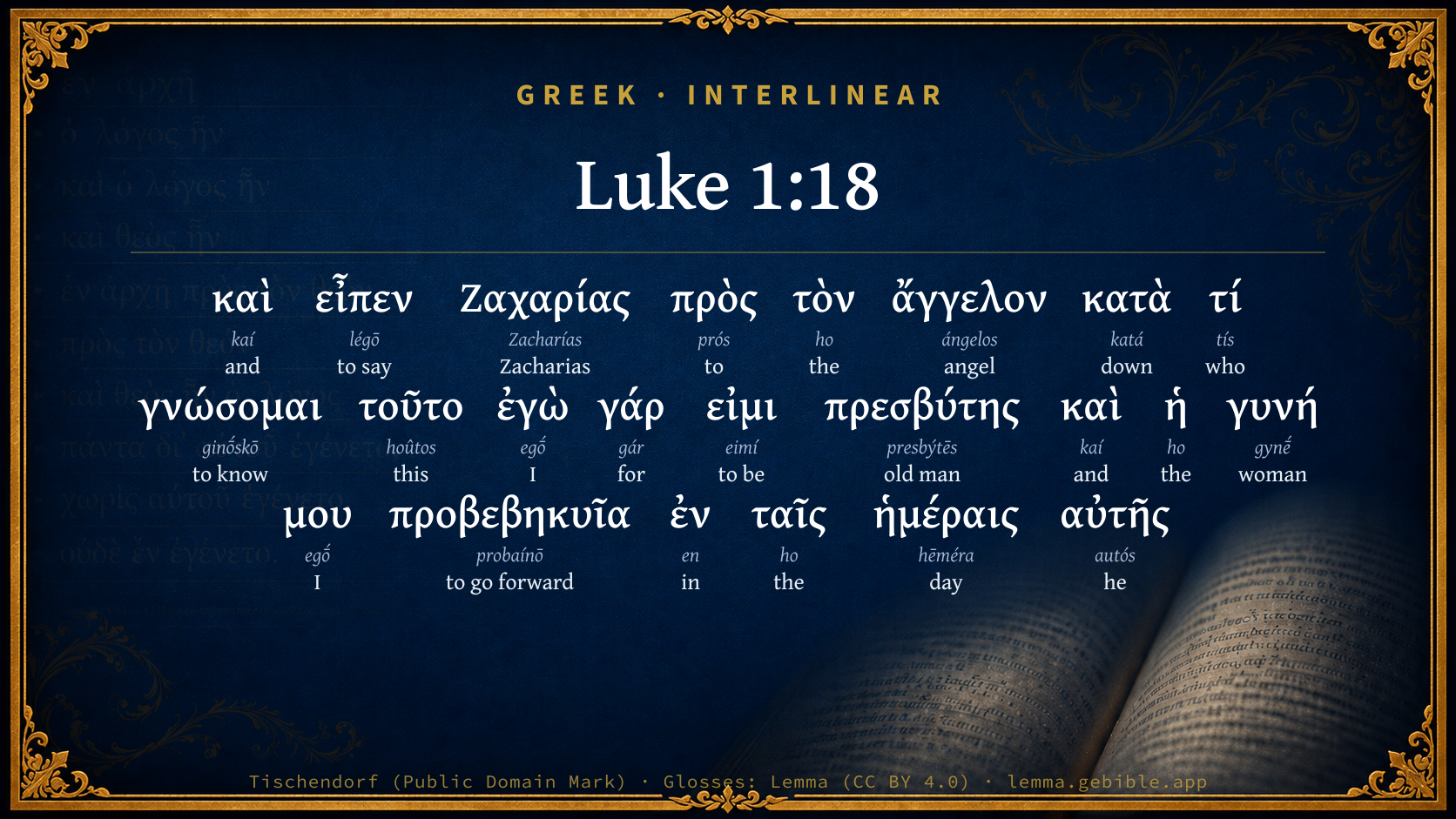
Greek (Tischendorf 8th ed.) Luke 1:18 appears in the Greek New Testament. The text above is from the Tischendorf 8th edition. Each word links to its Strong’s number and a concise gloss. Click any word for its full Thayer’s Greek Lexicon entry.
Download image
Cite this verse

Luke 1:18 (World English Bible). Public Domain. Lemma interlinear Bible study tool, https://lemma.gebible.app/v/luke/1/18.

Show BibTeX & RIS
BibTeX
RIS
English Translation
Zacharias said to the angel, "How can I be sure of this? For I am an old man, and my wife is well advanced in years."
World English Bible · Public Domain
Highlights
  • 1 first appearance in the Greek New Testament
Full analysis ↓
Download a study sheet

One document with this verse’s original text, its word-by-word gloss line, the meaning frame, cross-references with their text, attributed commentary, and full source and license credits — printable, and it pastes into notes with its structure intact.

This verse Autodidact and up

Study sheet (.html) Plain text (.txt)

A passage Seminary Student

Up to 50 verses in one chapter. A passage sheet keeps up to 6 commentary sources and 12 cross-references per verse, in the order this page ranks them, and says so on the sheet whenever that leaves anything out. Ask for a single verse and you get the Autodidact verse sheet above.

Everything on this page stays free to read, with no account — the sheet is a download of what is already on screen, not access to it.

Want to remove ads? Support Godless Engineer
Compare translations 3

The same verse in 3 English versions, stacked beneath the original-language interlinear above. Click any original word for its lexicon entry.

Each is an independent rendering of the whole verse — the interlinear is not word-aligned to these translations.

Highlighted words mark where these versions differ — a whole-verse word diff, not a word-by-word alignment.

  • World English Bible Public Domain
    Zacharias said to the angel, "How can I be sure of this? For I am an old man, and my wife is well advanced in years."
  • King James Version Public Domain
    And Zacharias said unto the angel, Whereby shall I know this? for I am an old man, and my wife well stricken in years.
  • unfoldingWord Literal Text CC BY-SA 4.0
    Then Zechariah said to the angel, “How will I know this? For I am an old man, and my wife is advanced in her days.”

unfoldingWord Literal Text — © unfoldingWord, licensed CC BY-SA 4.0. Word-aligned USFM3 via Door43 (git.door43.org/unfoldingWord/en_ult).

Versions to compare (up to 4)

3 of 4 selected

Show all 19 translations

Every available English version of this verse, each an independent rendering of the whole verse.

  • World English Bible Public Domain
    Zacharias said to the angel, "How can I be sure of this? For I am an old man, and my wife is well advanced in years."
  • Berean Standard Bible Public Domain
    “How can I be sure of this?” Zechariah asked the angel. “I am an old man, and my wife is well along in years.”
  • Majority Standard Bible Public Domain
    “How can I be sure of this?” Zechariah asked the angel. “I am an old man, and my wife is well along in years.”
  • King James Version Public Domain
    And Zacharias said unto the angel, Whereby shall I know this? for I am an old man, and my wife well stricken in years.
  • American Standard Version (1901) Public Domain
    And Zacharias said unto the angel, Whereby shall I know this? for I am an old man, and my wife well stricken in years.
  • Revised Version (1885) Public Domain
    And Zacharias said unto the angel, Whereby shall I know this? for I am an old man, and my wife well stricken in years.
  • Geneva Bible (1599) Public Domain
    Then Zacharias said vnto ye Angel, Whereby shall I knowe this? for I am an olde man, and my wife is of a great age.
  • Douay-Rheims (1899) Public Domain
    And Zachary said to the angel: Whereby shall I know this? for I am an old man, and my wife is advanced in years.
  • Young's Literal Translation Public Domain
    And Zacharias said unto the messenger, `Whereby shall I know this? for I am aged, and my wife is advanced in her days?'
  • Literal Standard Version CC BY-SA 4.0
    And Zacharias said to the messenger, “Whereby will I know this? For I am aged, and my wife is advanced in her days?”
  • Unlocked Literal Bible CC BY-SA 4.0
    Zechariah said to the angel, “How can I know this? For I am an old man and my wife is very old.”
  • unfoldingWord Literal Text CC BY-SA 4.0
    Then Zechariah said to the angel, “How will I know this? For I am an old man, and my wife is advanced in her days.”
  • Darby Bible Public Domain
    And Zacharias said to the angel, How shall I know this, for *I* am an old man, and my wife advanced in years?
  • World Messianic Bible Public Domain
    Zechariah said to the angel, “How can I be sure of this? For I am an old man, and my wife is well advanced in years.”
  • Webster's Bible Public Domain
    And Zacharias said to the angel, By what shall I know this? for I am an old man, and my wife far advanced in years.
  • Free Bible Version CC BY-SA 4.0
    “How can I be sure about this?” Zechariah asked the angel. “I'm an old man, and my wife is getting old too.”
  • Bible in Basic English Public Domain
    And Zacharias said to the angel, How may I be certain of this? For I am an old man, and my wife is far on in years.
  • Text-Critical English NT CC BY 4.0
    Zechariah said to the angel, “How can I know this for certain? For I am an old man, and my wife is advanced in her days.”
  • Tyndale New Testament (1534) Public Domain
    And Zacharias sayde vnto the angell: Wher by shall I knowe this? seinge that I am olde and my wyfe well stricken in yeares.

Literal Standard Version (2020), Covenant Press — licensed CC BY-SA 4.0. Text via the HelloAO Bible API (eBible.org). Unlocked Literal Bible (unfoldingWord) — licensed CC BY-SA 4.0. Text via the HelloAO Bible API (eBible.org). unfoldingWord Literal Text — © unfoldingWord, licensed CC BY-SA 4.0. Word-aligned USFM3 via Door43 (git.door43.org/unfoldingWord/en_ult). Free Bible Version, Dr. Jonathan Gallagher — licensed CC BY-SA 4.0. Text via the HelloAO Bible API (eBible.org).

Word by word

More ways to search: Search by grammar → Find every occurrence → Compare this word →

Practice this passage: Drill this verse → Learn its vocabulary →

πρεσβύτης
presbýtēs
G4246
“old man”
Noun, Nominative, Singular, Masculine
Part of Speech
Noun
Case
Nominative
Number
Singular
Gender
Masculine
Full Thayer's Definition

Origin: from the same as G4245

TDNT: 17:23,9

1. an old man, an aged man 2. ambassador
  1. καὶ kaí G2532 “and” Conjunction
  2. εἶπεν légō G3004 “to say” Verb, Aorist, Active, Indicative, 3rd person, Singular
  3. Ζαχαρίας Zacharías G2197 “Zacharias” Noun, Nominative, Singular, Masculine
  4. πρὸς prós G4314 “to” Preposition
  5. τὸν ho G3588 “the” Article, Accusative, Singular, Masculine
  6. ἄγγελον ángelos G32 “angel” Noun, Accusative, Singular, Masculine
  7. κατὰ katá G2596 “down” Preposition
  8. τί tís G5101 “who” Interrogative pronoun, Accusative, Singular, Neuter
  9. γνώσομαι ginṓskō G1097 “to know” Verb, Future, Middle deponent, Indicative, 1st person, Singular
  10. τοῦτο hoûtos G3778 “this” Demonstrative pronoun, Accusative, Singular, Neuter
  11. ἐγὼ egṓ G1473 “I” Personal pronoun, 1st person, Nominative, Singular
  12. γάρ gár G1063 “for” Conjunction
  13. εἰμι eimí G1510 “to be” Verb, Present, Active, Indicative, 1st person, Singular
  14. καὶ kaí G2532 “and” Conjunction
  15. ἡ ho G3588 “the” Article, Nominative, Singular, Feminine
  16. γυνή gynḗ G1135 “woman” Noun, Nominative, Singular, Feminine
  17. μου egṓ G1473 “I” Personal pronoun, 1st person, Genitive, Singular
  18. προβεβηκυῖα probaínō G4260 “to go forward” Verb, Perfect, Active, Participle, Nominative, Singular, Feminine
  19. ἐν en G1722 “in” Preposition
  20. ταῖς ho G3588 “the” Article, Dative, Plural, Feminine
  21. ἡμέραις hēméra G2250 “day” Noun, Dative, Plural, Feminine
  22. αὐτῆς autós G846 “he” Personal pronoun, Genitive, Singular, Feminine

About this verse

These counts appear in no published source. They are computed here, from the morphology-tagged text and Lemma’s own curated glosses. What Lemma adds →

23
words
19
distinct lemmas
Gospels
section

Notable vocabulary

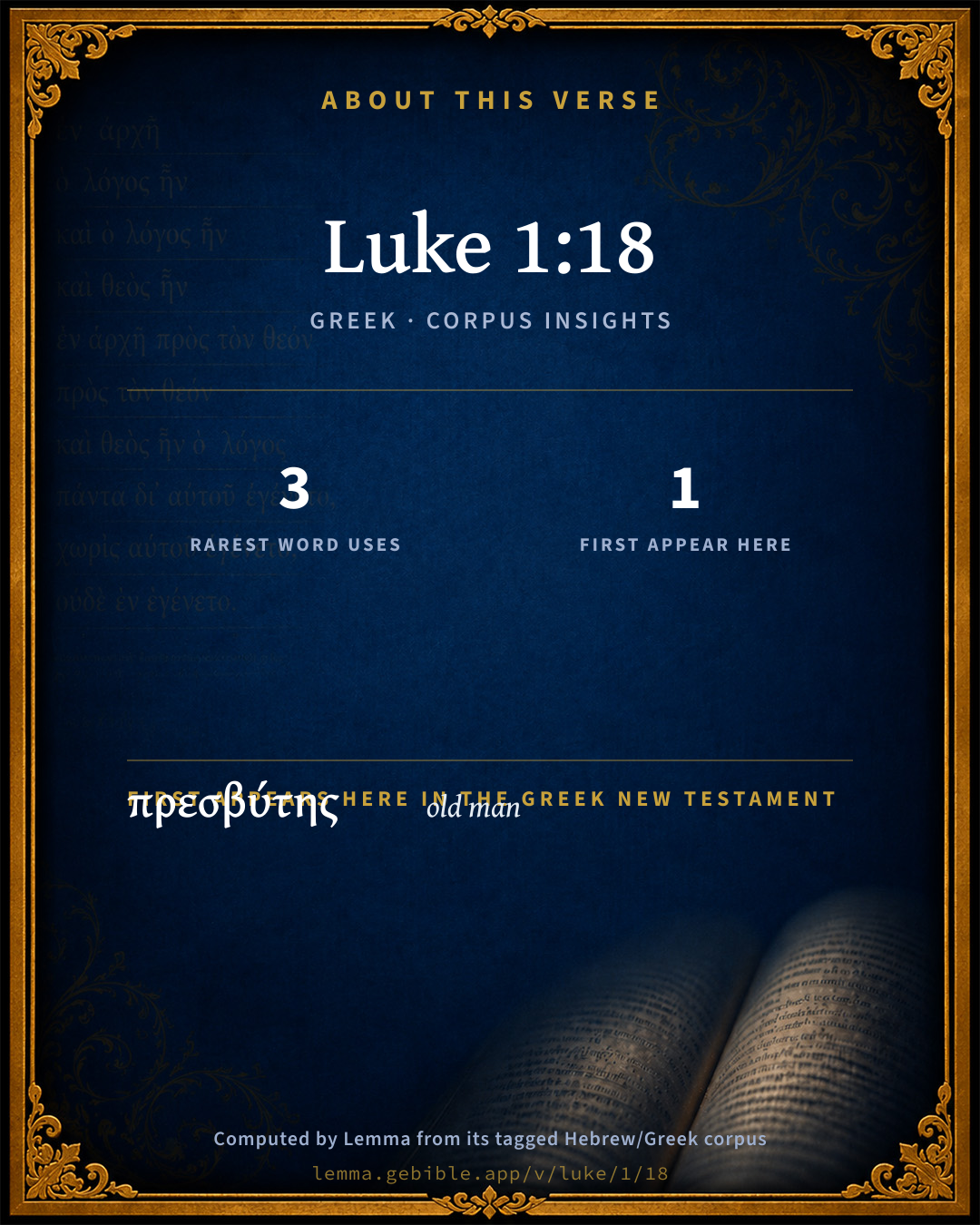
The rarest word here is πρεσβύτης old man G4246 — appearing just 3 times in the whole Greek New Testament.

First appearance in Scripture

This word makes its first canonical appearance in the Greek New Testament here:

  • πρεσβύτης old man G4246

Shared distinctive vocabulary

πρεσβύτης old man G4246 occurs in 3 verses of the Greek New Testament. Also found in:
Repetition

Words recur within this verse:

Cross-references

10

Topical passages linked to Luke 1:18 in the Treasury of Scripture Knowledge — connected by theme and wording, ordered by reader-vote popularity; previews shown in the World English Bible.

  • Genesis 17:17 Then Abraham fell on his face, and laughed, and said in his heart, "Will a child be born to him who is one hundred years old? Will Sarah, who is ninety years old, give birth?"
  • Genesis 18:12 Sarah laughed within herself, saying, "After I have grown old will I have pleasure, my lord being old also?"
  • Isaiah 38:22 Hezekiah also had said, What is the sign that I shall go up to the house of Yahweh?
  • Luke 1:7 But they had no child, because Elizabeth was barren, and they both were well advanced in years.
  • 2 Kings 7:2 Then the captain on whose hand the king leaned answered the man of God, and said, Behold, if Yahweh should make windows in heaven, might this thing be? He said, Behold, you shall see it with your eyes, but shall not eat of it.
  • Luke 1:34 Mary said to the angel, "How can this be, seeing I am a virgin?"
  • Romans 4:19 Without being weakened in faith, he didn't consider his own body, already having been worn out, (he being about a hundred years old), and the deadness of Sarah's womb.
  • Judges 6:36–40 Gideon said to God, If you will save Israel by my hand, as you have spoken,
  • Genesis 15:8 He said, "Lord Yahweh, how will I know that I will inherit it?"
  • Numbers 11:21–23 Moses said, The people, among whom I am, are six hundred thousand footmen; and you have said, I will give them flesh, that they may eat a whole month.

Cross-references courtesy of OpenBible.info (CC BY 4.0).

Commentary

Notes on Luke 1:18 from classic Christian and Jewish commentators (each source and its license shown beneath its notes). The classic Christian expositions comment on the surrounding passage and are grouped to its opening verse, so a note may address several verses; the Jewish commentaries on the Tanakh (Rashi and others) are per-verse, so they appear only where the commentator wrote on this verse.

Lemma curates 59 commentaries, every one of them public domain or Creative Commons licensed, each selected and text-cleaned for this edition rather than reprinted as found. About our sources →

Joseph Benson's Commentary

Luk 1:18-20. Zacharias said, Whereby shall I know this? — In how different a spirit did the blessed Virgin say, How shall this be? Zacharias disbelieved the prediction, as appears from Luk 1:20, and therefore was justly punished: Mary had no doubt of the fulfilment of what was foretold, but only inquired concerning the manner of it. And the angel said, I am Gabriel — “I am the same servant of God (so the name Gabriel signifies, being, by interpretation, vir Dei, a man or servant of God) who, as the Scripture informs thee, appeared anciently to the Prophet Daniel with a message concerning the Messiah. And now I am not come of myself, but I am sent of God to communicate to thee the glad tidings of the near accomplishment of the things which I long ago showed to Daniel at a great distance. Thou, therefore, whose advanced age ought to have been venerable by an advanced knowledge of divine things, as well as by a strong faith in the power of God, art deserving of much blame, for calling in question the truth of my message, especially as by the prophecies of Daniel thou mightest have understood that this is the period determined for the coming of the Messiah and his forerunner.” There seems to be a remarkable gradation in the angel’s words here, enhancing the guilt of Zacharias’s unbelief. As if he had said, I am Gabriel, a holy angel of God, yea, one of the highest order, even of those who stand in the presence of God. Not only so, but I am now peculiarly sent from God, and that with a message to thee in particular: nay, and to show thee glad tidings, such as ought to be received with the greatest joy and readiness. And behold thou shalt be dumb — The original word, κωφος, signifies deaf as well as dumb: and it seems plain that he was as unable to hear as he was to speak; for his friends were obliged to make signs to him, that he might understand them, Luk 1:62. Thus the angel gave him a sign, which was also a chastisement of his offence. Because he had sinned with his lips, the angel struck him dumb, declaring that he should continue so till the message, the truth of which he doubted, was verified by the accomplishment.

Joseph Benson's Commentary on the Old and New Testaments (1811–1818) — public domain. Text from a community e-Sword module.

Bengel's Gnomon

Johann Albrecht Bengel

Luk 1:18. Κατὰ τί γνώσομαι) So LXX., Gen 15:8. The question of Zacharias is one affecting the very fact itself, thus betraying that he laboured under a want of faith: the πῶς, how, which Mary started as a question, was accompanied with faith: comp. Luk 1:34 [How?] with 45 [“Blessed is she that believed.”]

Bengel's Gnomon of the New Testament — English translation (T&T Clark, Edinburgh, 1860) — public domain. Text from a community e-Sword module.

Meyer's Critical & Exegetical Commentary

Heinrich August Wilhelm Meyer

Luk_1:18. Like Abrahams question, Gen_15:8.

κατὰ τί] According to what. Zacharias asks after a σημεῖον (Luk_2:12), in conformity with which he should know that what had been promised (τοῦτο)in other words, the birth of a son, with whom the indicated destination of Elias should associate itselfhad really occurred.

Meyer — Critical and Exegetical Commentary on the New Testament — English translation by Peter Christie, edited by Frederick Crombie (T&T Clark, 1880) — public domain. Text from a community e-Sword module.

Expositor's Greek Testament

ed. W. Robertson Nicoll

Luk 1:18-20 . Zechariah doubts . The angel’s dazzling promise of a son, and even of a son with such a career, might be but a reflection of Zechariah’s own secret desire and hope; yet when his day-dream is objectified it seems too good and great to be true. This also is true to human nature, which alternates between high hope and deep despair, according as faith or sense has the upper hand.

The Expositor's Greek Testament, edited by W. Robertson Nicoll (1897–1910) — public domain. Text from a community e-Sword module.

Godet's Commentaries

Frédéric Louis Godet

2. vers. 18-22 relate the manner in which the promise is received; and first, the objection of Zacharias (Luk 1:18); next, his punishment (Luk 1:19-20); lastly, the effect produced upon the people by this latter circumstance.

Vers. 18-20. “And Zacharias said unto the angel, Whereby shall I know this? for I am an old man, and my wife well stricken in years. And the angel answering, said unto him, I am Gabriel, that stand in the presence of God; and am sent to speak unto thee, and to show thee these glad tidings. And, behold, thou shalt be dumb, and not able to speak, until the day that these things shall be performed, because thou believest not my words, which shall be fulfilled in their season.”

Abraham, Gideon, and Hezekiah had asked for signs (Genesis 15; Judges 6; 2 Kings 20) without being blamed. God had of Himself granted one to Moses (Exodus 4), and offered one to Ahaz (Isaiah 7). Why, if this was lawful in all these cases, was it not so in this? There is a maxim of human law which says, Si duo faciunt idem, non est idem. There are different degrees of responsibility, either according to the degree of development of the individual or of the age, or according to the character of the divine manifestation. God alone can determine these degrees. It appears from the 19th verse that the appearance of the being who spoke to Zacharias ought of itself to have been a sufficient sign. In any case this difference from the similar accounts in the Old Testament proves that our narrative was not artificially drawn up in imitation of them. The sign requested is designated by the preposition κατά, according to, as the norm of knowledge. The γάρ, for, refers to this idea understood: I have need of such a sign. Yet Zacharias prayed for this very thing which now, when promised by God, appears impossible to him. It is an inconsistency, but one in keeping with the laws of our moral nature. The narrative, Acts 12, in which we see the church of Jerusalem praying for the deliverance of Peter, and refusing to believe it when granted, presents a similar case.

In order to make Zacharias feel the seriousness of his fault, the angel (Luk 1:19) refers to two things: his dignity as a divine messenger, and the nature of his message.—᾿Εγώ, I, coming first, brings his person into prominence. But he immediately adds, that stand, in the presence of God, to show that it is not he who is offended, but God who has sent him.

The name Gabriel is composed of גָּבַר, H1504 and אֵל, H446: vir Dei, the mighty messenger of God. The Bible knows of only two heavenly personages who are invested with a name, Gabriel (Dan 8:16; Dan 9:21) and Michael (Dan 10:13; Dan 10:21; Dan 12:1; Jud 1:9; Rev 12:7). This latter name (מִי, H4769) signifies, who is like God? Here the critic asks sarcastically whether Hebrew is spoken in heaven? But these names are evidently symbolical; they convey to us the character and functions of these personalities. When we speak to any one, it is naturally with a view to be understood. When heaven communicates with earth, it is obliged to borrow the language of earth. According to the name given him, Gabriel is the mighty servant of God employed to promote His work here below. It is in this capacity that he appears to Daniel, when he comes to announce to him the restoration of Jerusalem; it is he also who promises Mary the birth of the Saviour. In all these circumstances he appears as the heavenly evangelist. The part of Gabriel is positive; that of Michael is negative. Michael is, as his name indicates, the destroyer of every one who dares to equal, that is, to oppose God. Such is his mission in Daniel, where he contends against the powers hostile to Israel; such also is it in Jude and in the Apocalypse, where he fights, as the champion of God, against Satan, the author of idolatry: Gabriel builds up, Michael overthrows. The former is the forerunner of Jehovah the Saviour, the latter of Jehovah the Judge. Do not these two heavenly personages remind us of the two angels who accompanied Jehovah (Genesis 18) when He came to announce to Abraham, on the one hand, the birth of Isaac, and, on the other, the destruction of Sodom? Biblical angelology makes mention of no other persons belonging to the upper world. But this wise sobriety did not satisfy later Judaism; it knew besides an angel Uriel, who gives good counsel, and an angel Raphael, who works bodily cures. The Persian angelology is richer still. It reckons no less than seven superior spirits or amschaspands. How, then, can it be maintained that the Jewish angelology is a Persian importation? History does not advance from the complicated to the simple. Besides, the narrative, Genesis 18, in which the two archangels appear, is prior to the contact of Israel with the Persian religion. Lastly, the idea represented by these two personages is essentially Jewish. These two notions, of a work of grace personified in Gabriel, and of a work of judgment personified in Michael, have their roots in the depths of Jewish monotheism.

The term to stand before God indicates a permanent function (Isa 6:2). This messenger is one of the servants of God nearest His throne. This superior dignity necessarily rests on a higher degree of holiness. We may compare 1Ki 17:1, where Elijah says, “The Lord before whom 1 stand.” Jesus expresses Himself in a similar manner (Matthew 18) respecting the guardian angels of the little ones: “Their angels do always behold the face of my Father which is in heaven.”

Such a being deserves to be taken at his word; how much more when he is the bearer of a message which is to fulfil the desires of him to whom he is sent, and answer his earnest supplication (Luk 1:19 b)!

The chastisement inflicted on Zacharias (Luk 1:20) is at the same time to serve as a sign to him. ᾿Ιδού, behold, indicates the unexpected character of this dispensation. Σιωπιῶν, not speaking, denotes simply the fact; μὴ δυνάμενος, not being able to speak, discloses its cause; this silence will not be voluntary.—Οἵτινες, which, as such, that is to say, as being the words of such a being as I am. It may seem that with the future shall be fulfilled, the preposition ἐν is required, and not εἰς. But εἰς indicates that the performance of the promise will begin immediately in order to its completion at the appointed time; comp. Rom 6:22, εἰς ἁγιασμόν. Καιρός, their season, refers not only to the time (χρόνος), but to the entire circumstances in which this fulfilment will take place.

There is not a word in this speech of the angel which is not at once simple and worthy of the mouth into which it is put. It is not after this fashion that man makes heaven speak when he is inventing; only read the apocryphal writings!

Frédéric Louis Godet — Commentaries on Luke, John, Romans, and 1 Corinthians — English translation (T&T Clark, Edinburgh, 1870s–1890s) — public domain. Text from a community e-Sword module.

Jamieson, Fausset & Brown

Robert Jamieson, A. R. Fausset & David Brown

Whereby, &c.--Mary believed what was far harder without a sign. Abraham, though older, and doubtless Sarah, too, when the same promise was made to him, "staggered not at the promise of God through unbelief, but was strong in faith, giving glory to God." This was that in which Zacharias failed.

Jamieson, Fausset & Brown — Commentary Critical and Explanatory on the Whole Bible (1871) — public domain (CC PDM 1.0). Text via the HelloAO Bible API.

Adam Clarke's Commentary

Verse 18. Whereby shall I know this?] All things are possible to God: no natural impediment can have any power when God has declared he will accomplish his purpose. He has a right to be believed on his own word alone; and it is impious, when we are convinced that it is his word, to demand a sign or pledge for its fulfilment.

Adam Clarke's Commentary on the Bible (1810–1826) — public domain. Text from a community e-Sword/MySword module.

The Cambridge Bible for Schools and Colleges

gen. ed. J. J. S. Perowne

18. for I am an old man] So “Abraham fell upon his face, and laughed, and said in his heart, Shall a child be born unto him that is a hundred years old?” Gen_17:17. But he had believed the original promise (Gen_15:6) though he asked for a confirmation of it (Luk_1:8). “He believed … God who quickeneth the dead,” Rom_4:17.

The Cambridge Bible for Schools and Colleges (gen. ed. J. J. S. Perowne; Cambridge University Press, 1878–1918) — public domain. Text from a community e-Sword module.

John Gill's Exposition

And Zacharias said unto the angel, whereby shall I know this?.... Notwithstanding such an appearance of an angel to him, which in those times was not so usual, and this in the holy place; and the things themselves which were told him, and these as the return of prayer; yet he distrusted, and wanted a sign, whereby he might know the truth of them, as the Jews were generally desirous of, and as the father of them was; who expressed himself in much such language, on a certain occasion, as this his son did; see Gen 15:8.

For I am an old man; at least sixty years of age; for with the Jews, sixty years were reckoned, "for old age" (w); and a man of these years, was accounted an old man: and the Jewish Rabbins observe (x), that the word for old age in Job 30:2 is by "gematry, sixty"; that is, the letters of the word, numerically make so much. The Mahometan writers, as before observed on Luk 1:7 make him to be ninety nine years of age: he was not discharged from service; the Levites were at fifty, but not the priests; blemishes, as the Jewish writers say (y), made them unfit for service, but years did not: and even the law concerning the Levites, they say (z), only respected the time they carried the sanctuary from place to place, and not future generations; and that they are disqualified neither by blemishes, nor by years, only by voice, for singing of the song; but then they might be among the porters; so that they were not on that account laid aside from all service:

and my wife well stricken in years. The Mahometan writers, as before, say, she was "eighty nine"; a like objection Abraham made, though he afterwards got over it, and was strong in faith, giving glory to God, believing in his power and faithfulness; see Gen 17:17.

(w) Misn. Abot, c. 5. sect. 21. & Maimon. in ib. (x) R. Sol. Urbin. Ohel Moed, fol. 24. 2. (y) T. Bab. Cholin, fol. 24. 1. (z) Maimon. Hilch. Cele Hamikdash, c. 3. sect. 8.

John Gill's Exposition of the Whole Bible (1746–1763) — public domain (CC PDM 1.0). Text via the HelloAO Bible API.

Trapp's Complete Commentary

John Trapp

18 And Zacharias said unto the angel, Whereby shall I know this? for I am an old man, and my wife well stricken in years.

Ver. 18. For I am an old man] Thus reason will be encroaching upon the bounds of faith, till she be taken captive by infidelity. Drive, therefore, Hagar out of doors.

John Trapp, A Commentary or Exposition upon All the Books of the Old and New Testament (1647–1656) — public domain. Text from a community e-Sword module.

Albert Barnes' Notes on the Bible

Whereby shall I know this? - The thing was improbable, and he desired “evidence” that it would take place. The testimony of an “angel,” and in such a place, should have been proof enough; but people are slow to believe the testimony of heavenly messengers. As a consequence of not believing, he was struck mute.

Albert Barnes' Notes on the Bible (1834–1885) — public domain. Text from a community e-Sword/MySword module.

Haydock's Catholic Bible Commentary

Whereby shall I know this? Zacharias could not question the Divine Power, but he doubted of what the angel told him. (Witham) --- It was customary with the Jews, when they heard that any wonderful event was to take place, to inquire whether the Almighty had manifested his will by any supernatural sign. Zacharias puts this question to the angel, not through any doubt concerning the omnipotence of God, but because what was promised could not be compassed in the natural order of things: for, I am an old man and my wife is advanced in years. (Dionysius)

George Leo Haydock (1774–1849), Haydock's Catholic Family Bible and Commentary, 1859 edition — public domain. Excludes Psalms (Douay-Rheims chapter numbering differs from Protestant) and Deuterocanonical books (Catholic canon only).

Matthew Poole's English Annotations

The words are much the same with those of Abraham, Gen 15:8, Whereby shall I know that I shall inherit it, viz. the land of Canaan? And Mary, Luk 1:34, when the same angel had told her she should have a child, Luk 1:31, saith, How shall this be, seeing I know not a man? Gideon also asked a sign, Jdg 6:17. To our appearance and judgment there seemeth no great difference betwixt these and Zacharias in this place asking a sign, only Zacharias here opposeth his own sense and reason to the words of the angel, yet we shall hear a different issue of this question, or answer to it.

Matthew Poole's English Annotations on the Holy Bible (1683–1685) — public domain. Text from a community e-Sword/MySword module.

Whedon's Commentary on the Bible

Daniel D. Whedon

18. Whereby shall I know?—This bold putting the angel to the proof was a want of proper faith. The fact that the angelic visitant knew his prayer, the splendour of his person, and the tremor of Zacharias, were vouchers sufficient. Strauss notes that Zacharias’s Greek words here are precisely the same with the Greek words of Abraham, according to the Septuagint in Gen_15:8, and asks why Abraham was gratified and Zacharias punished. Grotius had answered Strauss’s question centuries before it was asked. Abraham had been instructed by no previous example; Zacharias was instructed by the example of Abraham, which as a priest he was bound to understand. But Zacharias’s penalty, like his fault, was slight. It was discipline rather than punishment. And Grotius, literal as is his spirit, finds in the dumbness and beckoning of Zacharias a type of the then existing silence of prophecy, leaving the nation to the premonitions of the rites and ceremonies alone until the Messiah be born.

Daniel D. Whedon (gen. ed.), Commentary on the Old and New Testaments (1874–1909) — public domain. Text from a community e-Sword module.

The Pulpit Commentary

Whereby shall I know this? for I am an old man. There was something evidently blamable in this hesitation on the part of Zacharias to receive the angel"s promise. It seems as though the radiant glory of the messenger, as he stood before the curtain of the silent sanctuary in his awful beauty, ought to have convinced the doubting old man of the truth of the strange message. The words of the angel, which follow, seem to imply this. What! do you doubt my message? "I am Gabriel, who stand in the presence of the Eternal." Others in Old Testament story before for instance, Abraham (Ge 15) and Gideon (Jud_1:6) had seen and listened to an angel, had at first doubted, but had received in consequence no rebuke, no punishment, for their want of faith. Zacharias was, however, condemned, we learn, to a long period of dumbness.

The Pulpit Commentary (1880–1919), ed. H.D.M. Spence-Jones & Joseph S. Exell — public domain. Text from a community e-Sword module.

John Wesley's Explanatory Notes

Zacharias said, Whereby shall I know this? - In how different a spirit did the blessed virgin say, How shall this be? Zacharias disbelieved the fact: Mary had no doubt of the thing; but only inquired concerning the manner of it.

John Wesley, Explanatory Notes Upon the Whole Bible (1754–1765) — public domain. Text via the GEBible commentary corpus.

Kretzmann's Popular Commentary

Paul E. Kretzmann

The doubts of Zacharias:

v. 18. And Zacharias said unto the angel, Whereby shall I know this? For I am an old man, and my wife well stricken in years.

v. 19. And the angel, answering, said unto him, I am Gabriel, that stand in the presence of God, and am sent to speak unto thee, and to show thee these glad tidings.

v. 20. And, behold, thou shalt be dumb, and not able to speak, until the day that these things shall be performed, because thou believest not my words, which shall be fulfilled in their season.

The announcement of the angel and the enthusiasm with which he delivered his message overwhelmed the aged priest. Hoping against hope, he had continued his importunate appeals for progeny even beyond the usual term of life. But now that his prayers were to be answered beyond his fondest expectations, the greatness of the miracle created doubt in his mind. It suddenly seemed too good to be true, the course of nature could not be set aside; and therefore he labored under a lack of faith. He asks: By what means shall I know this? He wanted some concrete evidence, some definite sign which would give him the immediate assurance of the realization of his hopes. For now that his faith had been shaken, he argues from the standpoint of human reason, that he himself was an old man and that his wife was far advanced in her days, that the predicted event could therefore not well take place. Zacharias received the sign he asked for more quickly than he had anticipated. With solemn impressiveness the angel explains to him the reason why his message should have been believed implicitly. For Gabriel was his name, which means the might of the strong God. Zacharias, being familiar with the books of the prophets, would understand the name and all it stood for, Dan 8:16; Dan 9:21. Gabriel belonged to the blessed angels that stand in the presence of God, that are confirmed in eternal bliss before the throne of God. He was present, not on his own initiative or in his own interest, but as the messenger of the strong God, who could accomplish every purpose and subdue all things to Himself. He had come to bring to Zacharias truly good, joyful tidings. Since, therefore, Zacharias, without considering this fact, had chosen to doubt the message, the sign that he required would be in the nature of a severe, though temporal and ’temporary punishment: total dumbness, until the time that all this would come to pass, for, as the angel once more emphasizes, the matter foretold would surely be fulfilled in its season, at the time appointed by God.

Paul E. Kretzmann, Popular Commentary of the Bible (1921–1924) — public domain. Text from a community e-Sword module.

Burkitt's Expository Notes on the New Testament

William Burkitt

Observe here, Zacharias being slow to believe so strange a message; asks the angel, by what sign he should know that this thing, so far above the usual course of nature, should come to pass?

The angel answers, that he was dispatched by God as a messenger extraordinary, to declare this good news to him. And seeing he was so hard to believe it, and required a sign, he should have it, but such an one as should be a punishment of his unbelief, as well as a sign to confirm his faith; namely, he should from thenceforeward, to the birth of the child, be dumb and deaf, as the original word signifies; because he had not hearkened to the angel’s speech, he was struck deaf; and because he had gain-said it, he was made dumb.

Learn hence, that the word of God in the mouth of his messengers is God’s own word, and as such to be received and believed.

2. That not believing their word, is a sin which God will severely punish; it is all one not to believe God, and not to believe the messengers of God speaking from him. Some expositors will have this dumbness of Zacharias to be prefigurative. The priest, at the dismission of the people, when the service of the temple was finished, was to pronounce the blessing recorded, Num 6:24-25 which when Zacharias was about to do, he was struck dumb and could not perform it; signifying thereby, that the silencing of the Levitical priesthood was now at hand: that they must expect another kind of worship, and that he who was able to bless indeed, namely, the Messias, was near at hand.

Observe lastly, that though Zacharias ceased to speak, yet he did not cease to minister; he takes not his dumbness for a dismission, but stays out the eight days of his course, knowing that the service of his heart and hand would be accepted of that God which had bereaved him of his tongue. The powers which we have we must make use of in the public service of God, who will accept us according to what we have; pardoning our infirmity, and rewarding our sincerity.

William Burkitt's Expository Notes on the New Testament (1700–1703) — public domain. Text from a community e-Sword module.

Godbey's Commentary on the New Testament

William B. Godbey

DOUBT & DUMBNESS ALWAYS CO-EXISTENT

18-20. Here we see that Zacharias evinced his doubt of Gabriel’s communication by asking a sign. O how many people now doubt God and wait for signs, instead of taking Him at His word and rejoicing in His promises! The result in the case of Zacharias was, that he became dumb, and so remained till the birth of John the Baptist. If you ever doubt God, you will forfeit your testimony, and become a poor dummy in the meetings. You can recognize it definitely in all cases. So fast as the people give way to doubt, they forfeit their testimony, becoming dumb. Real faith always tells its own story. How common to find whole Churches dumb, thus evidencing the lamentable fact that, if they ever had faith, they have permitted the enemy to steal it away from them! Without faith there is no salvation. Hence you see that all dumb Churches are proper missionary ground. You must get their tongues loose, or they forfeit the hope of salvation.

21-23. Here we see that the words of Gabriel were signally verified when Zacharias, sure enough, was dumb, because he had disbelieved the word of the Lord spoken by the archangel. Be sure you believe all of God’s Word, and keep your testimony ever ringing clear, as otherwise you forfeit your salvation.

24,25. Here we find that when Elizabeth realized pregnancy, she went into retirement five months. Why was this? Evidently that she might enjoy uninterrupted communion with God, fasting, praying, and meditating, thus sinking away into His will, adoring His majesty, and contemplating His glory; meanwhile seeking that extraordinary enduement of grace requisite to qualify her for the immeasurable responsibilities of motherhood, and especially the maternity, training, and education of such a man as she knew, by the revelation of Gabriel, that her son would be. In that age of the world, and the ensuing fifteen hundred years, monastic seclusion for spiritual blessings was very common. We seriously feel the need of it now, in this age of superficiality. Nothing is really so much needed on the part of God’s people, and especially the ministry of God’s people, at the present day, as uninterrupted communion with God. Certainly the reproach of her sterility was gloriously removed in the birth of such a man as John the Baptist, the prince of prophets, and even more the precursor of the world’s Redeemer. We have in the birth of John the Baptist a repetition of that supernatural intervention of the Holy Ghost which characterized the birth of Isaac. In that case, however, the faith of Abraham was robust and triumphant, that of Sarah somewhat staggering through unbelief; whereas, in the case of John the Baptist, Zacharias’s faith flickered seriously, while that of Elizabeth is unimpeached, and, as we have good reason to believe, was athletic throughout.

William B. Godbey, Commentary on the New Testament (1896–1900) — public domain. Text from a community e-Sword module.

The People's New Testament

B. W. Johnson

18. Whereby shall I know this? He wanted a sign.

B. W. Johnson's The People's New Testament with Notes (1889–1891) — public domain. Electronic text from the Christian Classics Ethereal Library (CCEL) ThML edition.

unfoldingWord translationNotes

Door43 World Missions Community

How can I know this?

"How can I know for sure that what you said will happen?" Here, "know" means to learn by experience, suggesting Zechariah was asking for a sign as proof. AT: "What can you do to prove to me that this will happen?"

I am Gabriel, who stands in the presence of God

This is stated as a rebuke to Zechariah. The presence of Gabriel, coming directly from God, should be enough proof for Zechariah.

who stands

"who serves"

I was sent to speak to you

This can be stated in active form. AT: "God sent me to speak to you" (See: Active or Passive)

Behold

"Pay attention, because what I am about to say is both true and important"

silent, unable to speak

These mean the same thing, and are repeated to emphasize the completeness of his silence. AT: "completely unable to speak" or "not able to speak at all" (See: Doublet)

not believe my words

"not believe what I said"

at the right time

"at the appointed time"

translationWords

Zechariah (NT)

angel

Gabriel

God

send

believe

word

fulfill

unfoldingWord translationNotes — © Distant Shores Media and the Door43 World Missions Community, licensed CC BY-SA 4.0. Source: git.door43.org/Door43/en_tn.

Cambridge Greek Testament for Schools and Colleges

18. ἐγὼ γάρ εἰμι πρεσβύτης. The emphasis is on the I, which is therefore expressed. So “Abraham fell upon his face, and laughed, and said in his heart, Shall a child be born unto him that is a hundred years old?” Gen 17:17. But he had believed the original promise (Gen 15:6) though he asked for a confirmation of it (Luk 1:8). “He believed … God who quickeneth the dead,” Rom 4:17.

ἐν ταῖς ἡμέραις αὐτῆς. This is a Hebraism.

Cambridge Greek Testament for Schools and Colleges (Cambridge University Press, 1896; 21 vols, various authors incl. Carr, Maclear, Plummer, Farrar, Lumby, Moule, M. R. James, Simcox) — public domain. Text from a community e-Sword module.

Alford’s Greek Testament

Henry Alford

18.] The birth of John, involving human generation, but prophetically announced, and supernatural, answers to the birth of Isaac in the O.T.

But Abraham’s faith was a strong contrast to the unbelief of Zacharias: see Rom 4:19. De Wette, without noticing the above remark (which is Olshausen’s), says, “the same doubt, which Abraham also entertained in a similar case;” so that we have here, as often elsewhere, in the interpretation of Scripture (Gen 15:6, Gen 15:8; Gen 17:17; Gen 18:12), De Wette versus Paul (Rom. as above):—the fact being, that the case Gen 15:8 was not similar.

πρεσβύτης] The Levites (see Num 4:3; Num 8:24, Num 8:25) became superannuated at the age of fifty: but it appears, by extracts from the Rabbinical writings given by Lightfoot, that this was not the case with the priests.

Henry Alford, The Greek Testament (1849–1861) — public domain. Text from a community e-Sword module.

International Critical Commentary

18. κατὰ τί γνώσομαι τοῦτο; The very question asked by Abraham (Gen 15:8): “In accordance with what shall I obtain knowledge of this?” i.e. What shall be in harmony with it, so as to be a sign of it? Comp. the cases of Gideon (Jdg 6:36-39) and of Hezekiah (2Ki 20:8), who asked for signs; also of Moses (Exo 4:2-6) and of Ahaz (Isa 7:11), to whom signs were given unasked. The spirit in which such requests are made may vary much, although the form of request may be the same; and the fact that Zacharias had all these instances to instruct him made his unbelief the less excusable. By his ἐγὼ γάρ εἰμι, κ.τ.λ., he almost implies that the Angel must have forgotten the fact.

International Critical Commentary — older volumes (1896–1929), various authors — public domain. Text from a community e-Sword module.

Vincent's Word Studies in the New Testament

Marvin R. Vincent

Whereby [κατα τι] . Lit., according to what? It demands a standard of knowledge, a sign.

For. I require a sign, for I am old.

Marvin R. Vincent, Word Studies in the New Testament (1887–1900) — public domain. Text from a community e-Sword/MySword module.

Lesson kit

Teaching starters — assembled from the data on this page, not authored interpretation. Every prompt links to the verse data it draws on. Edit before teaching.

Luke, in the Gospels, opens this verse with 23 words (19 distinct Greek lemmas). Its most distinctive word is presbýtēs (“old man”). A historical commentator’s framing appears above. Read the whole chapter for the surrounding context.

Discussion questions

  1. What does “old man” (presbýtēs) contribute to the verse as a whole?
  2. This is the first place “old man” appears in Scripture (first appears here). What does its debut here establish?
  3. How does Titus 2:2, which shares the word «old man», read alongside this verse?
  4. What does the repetition of “the” (3× in this one verse) do in this verse?
  5. These translations render this verse differently. What is at stake in choosing one wording over another?
  6. Compare how Joseph Benson's Commentary and Bengel's Gnomon read this verse. Where do they agree or differ?

Things to notice

  • 1 word makes its first canonical appearance in Scripture here.
  • These translations choose different wording for 14 words in this verse.
  • “the” occurs 3× in this single verse.
  • 19 distinct Greek lemmas span 23 words in this verse.

Reading settings

Reading text

Shown beneath each verse's original-language words.

Old Testament
Old Testament edition

Read the OT as the Masoretic Hebrew (MT) or the Greek Septuagint (LXX).

English shown for the Greek Septuagint (in the Hebrew ↔ Greek comparison).

Comparing translations? Open the Compare panel on any verse page to stack up to four side by side.