
Luke 1:19

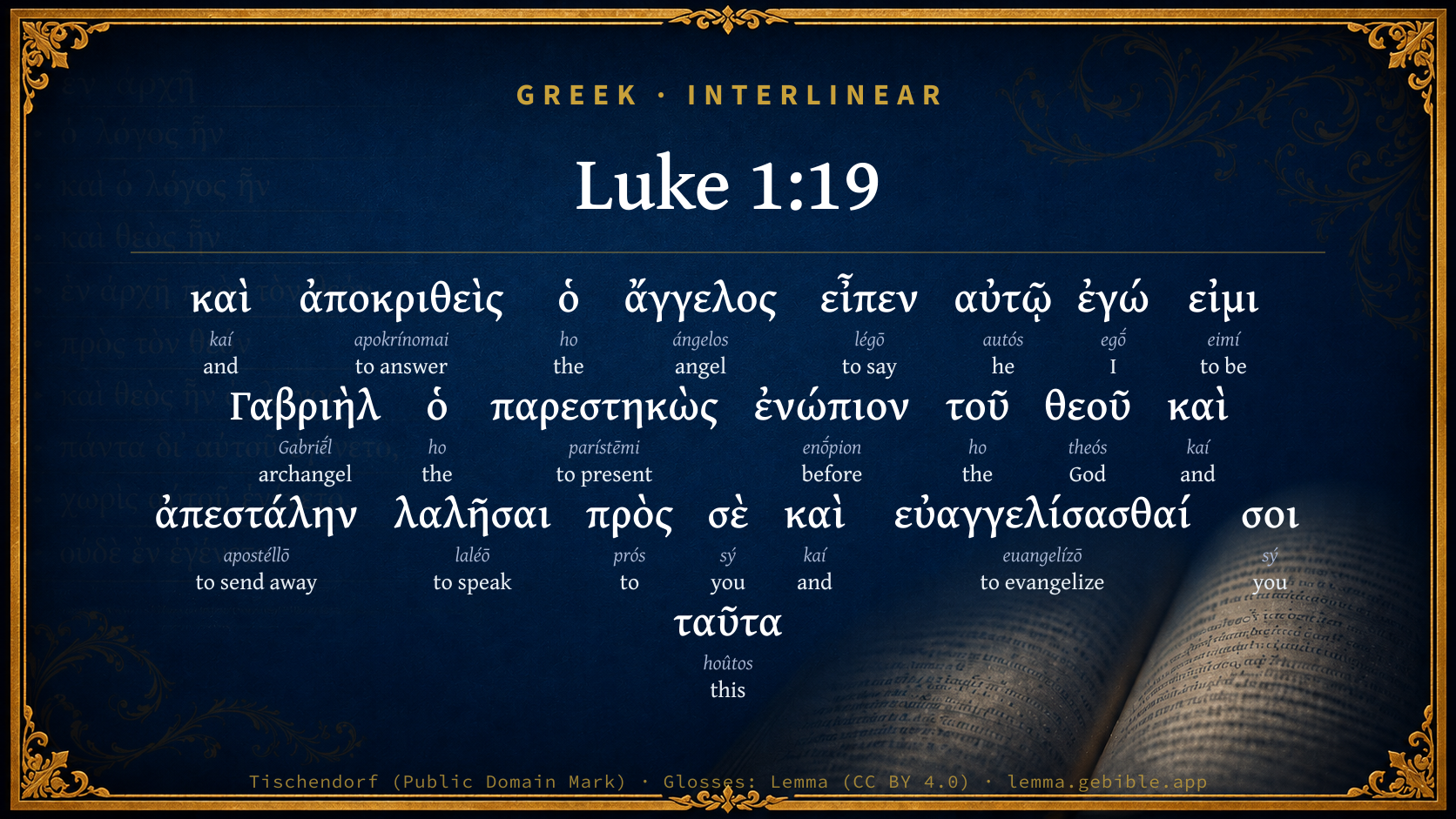
Greek (Tischendorf 8th ed.) Luke 1:19 appears in the Greek New Testament. The text above is from the Tischendorf 8th edition. Each word links to its Strong’s number and a concise gloss. Click any word for its full Thayer’s Greek Lexicon entry.
Download image
Cite this verse

Luke 1:19 (World English Bible). Public Domain. Lemma interlinear Bible study tool, https://lemma.gebible.app/v/luke/1/19.

Show BibTeX & RIS
BibTeX
RIS
English Translation
The angel answered him, "I am Gabriel, who stands in the presence of God. I was sent to speak to you, and to bring you this good news.
World English Bible · Public Domain
Highlights
  • 1 first appearance in the Greek New Testament
Full analysis ↓
Download a study sheet

One document with this verse’s original text, its word-by-word gloss line, the meaning frame, cross-references with their text, attributed commentary, and full source and license credits — printable, and it pastes into notes with its structure intact.

This verse Autodidact and up

Study sheet (.html) Plain text (.txt)

A passage Seminary Student

Up to 50 verses in one chapter. A passage sheet keeps up to 6 commentary sources and 12 cross-references per verse, in the order this page ranks them, and says so on the sheet whenever that leaves anything out. Ask for a single verse and you get the Autodidact verse sheet above.

Everything on this page stays free to read, with no account — the sheet is a download of what is already on screen, not access to it.

Want to remove ads? Support Godless Engineer
Compare translations 3

The same verse in 3 English versions, stacked beneath the original-language interlinear above. Click any original word for its lexicon entry.

Each is an independent rendering of the whole verse — the interlinear is not word-aligned to these translations.

Highlighted words mark where these versions differ — a whole-verse word diff, not a word-by-word alignment.

  • World English Bible Public Domain
    The angel answered him, "I am Gabriel, who stands in the presence of God. I was sent to speak to you, and to bring you this good news.
  • King James Version Public Domain
    And the angel answering said unto him, I am Gabriel, that stand in the presence of God; and am sent to speak unto thee, and to shew thee these glad tidings.
  • unfoldingWord Literal Text CC BY-SA 4.0
    And answering, the angel said to him, “I am Gabriel, the one standing before God, and I was sent to speak to you and to bring you this good news.

unfoldingWord Literal Text — © unfoldingWord, licensed CC BY-SA 4.0. Word-aligned USFM3 via Door43 (git.door43.org/unfoldingWord/en_ult).

Versions to compare (up to 4)

3 of 4 selected

Show all 19 translations

Every available English version of this verse, each an independent rendering of the whole verse.

  • World English Bible Public Domain
    The angel answered him, "I am Gabriel, who stands in the presence of God. I was sent to speak to you, and to bring you this good news.
  • Berean Standard Bible Public Domain
    “I am Gabriel,” replied the angel. “I stand in the presence of God, and I have been sent to speak to you and to bring you this good news.
  • Majority Standard Bible Public Domain
    “I am Gabriel,” replied the angel. “I stand in the presence of God, and I have been sent to speak to you and to bring you this good news.
  • King James Version Public Domain
    And the angel answering said unto him, I am Gabriel, that stand in the presence of God; and am sent to speak unto thee, and to shew thee these glad tidings.
  • American Standard Version (1901) Public Domain
    And the angel answering said unto him, I am Gabriel, that stand in the presence of God; and I was sent to speak unto thee, and to bring thee these good tidings.
  • Revised Version (1885) Public Domain
    And the angel answering said unto him, I am Gabriel, that stand in the presence of God; and I was sent to speak unto thee, and to bring thee these good tidings.
  • Geneva Bible (1599) Public Domain
    And the Angell answered, and sayde vnto him, I am Gabriel that stand in the presence of God, and am sent to speake vnto thee, and to shew thee these good tidings.
  • Douay-Rheims (1899) Public Domain
    And the angel answering, said to him: I am Gabriel, who stand before God: and am sent to speak to thee, and to bring thee these good tidings.
  • Young's Literal Translation Public Domain
    And the messenger answering said to him, `I am Gabriel, who have been standing near before God, and I was sent to speak unto thee, and to proclaim these good news to thee,
  • Literal Standard Version CC BY-SA 4.0
    And the messenger answering said to him, “I am Gabriel, who has been standing near before God, and I was sent to speak to you, and to proclaim this good news to you,
  • Unlocked Literal Bible CC BY-SA 4.0
    The angel answered and said to him, “I am Gabriel, who stands in the presence of God. I was sent to speak to you, to bring you this good news.
  • unfoldingWord Literal Text CC BY-SA 4.0
    And answering, the angel said to him, “I am Gabriel, the one standing before God, and I was sent to speak to you and to bring you this good news.
  • Darby Bible Public Domain
    And the angel answering, said to him, *I* am Gabriel, who stand before God, and I have been sent to speak to thee, and to bring these glad tidings to thee;
  • World Messianic Bible Public Domain
    The angel answered him, “I am Gabriel, who stands in the presence of God. I was sent to speak to you and to bring you this good news.
  • Webster's Bible Public Domain
    And the angel answering, said to him, I am Gabriel, who stand in the presence of God; and am sent to speak to thee, and to show thee these glad tidings.
  • Free Bible Version CC BY-SA 4.0
    “I am Gabriel,” the angel replied. “I stand in God's presence, and I was sent to speak to you and give you this good news.
  • Bible in Basic English Public Domain
    And the angel, answering, said, I am Gabriel, whose place is before God; I have been sent to say these words to you and to give you this good news.
  • Text-Critical English NT CC BY 4.0
    The angel answered him, “I am Gabriel. I stand in the presence of God and was sent to speak to yoʋ and bring yoʋ this good news.
  • Tyndale New Testament (1534) Public Domain
    And the angell answered and sayde vnto him: I am Gabriell that stonde in the presens of God and am sent to speake vnto the: and to shewe the these glad tydinges.

Literal Standard Version (2020), Covenant Press — licensed CC BY-SA 4.0. Text via the HelloAO Bible API (eBible.org). Unlocked Literal Bible (unfoldingWord) — licensed CC BY-SA 4.0. Text via the HelloAO Bible API (eBible.org). unfoldingWord Literal Text — © unfoldingWord, licensed CC BY-SA 4.0. Word-aligned USFM3 via Door43 (git.door43.org/unfoldingWord/en_ult). Free Bible Version, Dr. Jonathan Gallagher — licensed CC BY-SA 4.0. Text via the HelloAO Bible API (eBible.org).

Word by word

More ways to search: Search by grammar → Find every occurrence → Compare this word →

Practice this passage: Drill this verse → Learn its vocabulary →

Γαβριὴλ
Gabriḗl
G1043
“archangel”
Noun, Proper, indeclinable
Part of Speech
Noun · Proper, indeclinable
Full Thayer's Definition

Origin: of hebrew origin H1403

TDNT: None

Gabriel = "man of God" 1. one of the angel princes or chiefs of the angels
  1. καὶ kaí G2532 “and” Conjunction
  2. ἀποκριθεὶς apokrínomai G611 “to answer” Verb, Aorist, Passive deponent, Participle, Nominative, Singular, Masculine
  3. ὁ ho G3588 “the” Article, Nominative, Singular, Masculine
  4. ἄγγελος ángelos G32 “angel” Noun, Nominative, Singular, Masculine
  5. εἶπεν légō G3004 “to say” Verb, Aorist, Active, Indicative, 3rd person, Singular
  6. αὐτῷ autós G846 “he” Personal pronoun, Dative, Singular, Masculine
  7. ἐγώ egṓ G1473 “I” Personal pronoun, 1st person, Nominative, Singular
  8. εἰμι eimí G1510 “to be” Verb, Present, Active, Indicative, 1st person, Singular
  9. ὁ ho G3588 “the” Article, Nominative, Singular, Masculine
  10. παρεστηκὼς parístēmi G3936 “to present” Verb, Perfect, Active, Participle, Nominative, Singular, Masculine
  11. ἐνώπιον enṓpion G1799 “before” Adverb
  12. τοῦ ho G3588 “the” Article, Genitive, Singular, Masculine
  13. θεοῦ theós G2316 “God” Noun, Genitive, Singular, Masculine
  14. καὶ kaí G2532 “and” Conjunction
  15. ἀπεστάλην apostéllō G649 “to send away” Verb, Aorist, Passive, Indicative, 1st person, Singular
  16. λαλῆσαι laléō G2980 “to speak” Verb, Aorist, Active, Infinitive
  17. πρὸς prós G4314 “to” Preposition
  18. σὲ sý G4771 “you” Personal pronoun, 2nd person, Accusative, Singular
  19. καὶ kaí G2532 “and” Conjunction
  20. εὐαγγελίσασθαί euangelízō G2097 “to evangelize” Verb, Aorist, Middle, Infinitive
  21. σοι sý G4771 “you” Personal pronoun, 2nd person, Dative, Singular
  22. ταῦτα hoûtos G3778 “this” Demonstrative pronoun, Accusative, Plural, Neuter

About this verse

These counts appear in no published source. They are computed here, from the morphology-tagged text and Lemma’s own curated glosses. What Lemma adds →

23
words
18
distinct lemmas
Gospels
section

Notable vocabulary

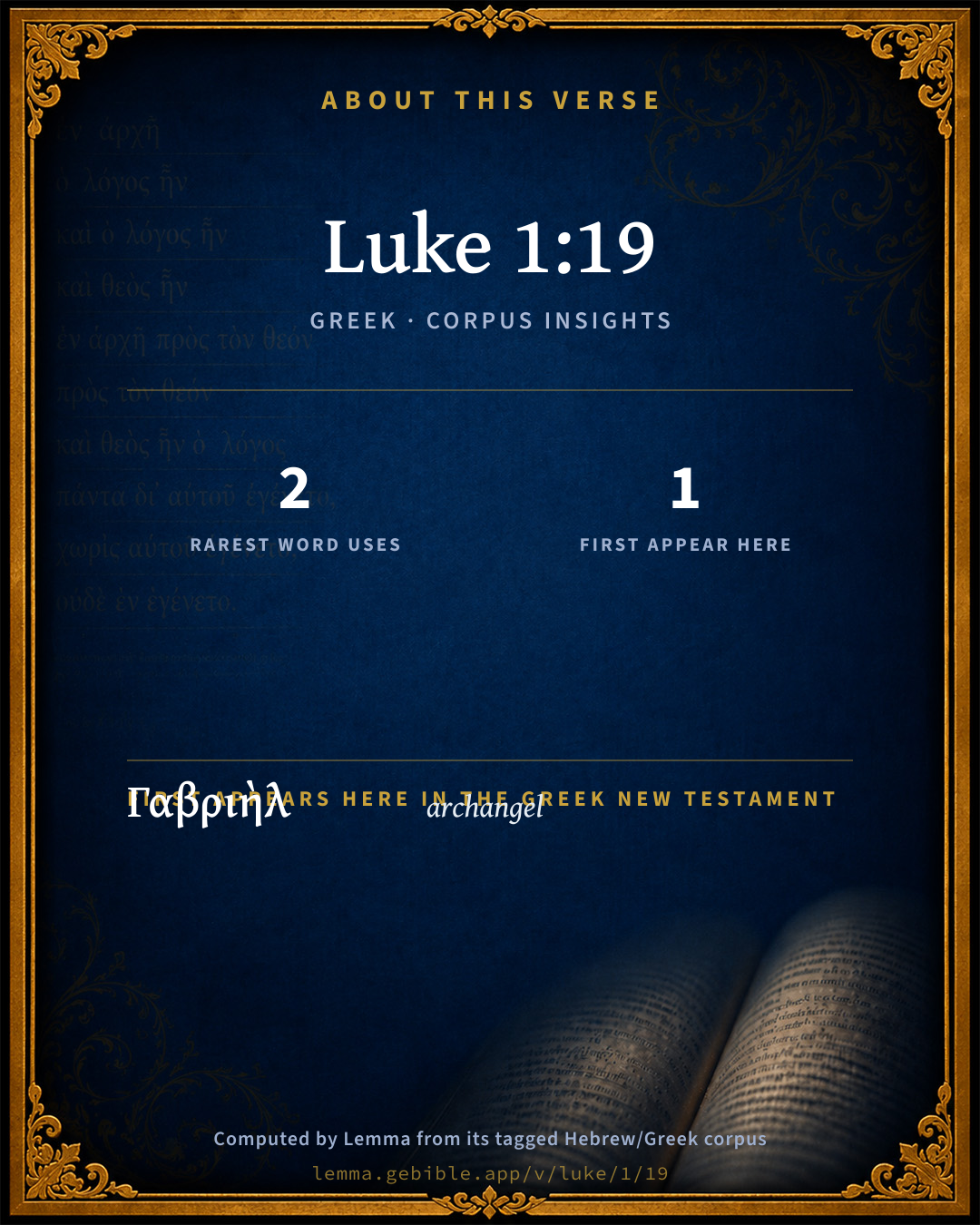
The rarest word here is Γαβριὴλ archangel G1043 — appearing just 2 times in the whole Greek New Testament.

First appearance in Scripture

This word makes its first canonical appearance in the Greek New Testament here:

  • Γαβριὴλ archangel G1043

Shared distinctive vocabulary

Γαβριὴλ archangel G1043 occurs in 2 verses of the Greek New Testament. Also found in:
Repetition

Words recur within this verse:

Cross-references

6

Topical passages linked to Luke 1:19 in the Treasury of Scripture Knowledge — connected by theme and wording, ordered by reader-vote popularity; previews shown in the World English Bible.

  • Luke 1:26 Now in the sixth month, the angel Gabriel was sent from God to a city of Galilee, named Nazareth,
  • Matthew 18:10 See that you don't despise one of these little ones, for I tell you that in heaven their angels always see the face of my Father who is in heaven.
  • Daniel 8:16 I heard a man's voice between [the banks of] the Ulai, which called, and said, Gabriel, make this man to understand the vision.
  • Daniel 9:21–23 yes, while I was speaking in prayer, the man Gabriel, whom I had seen in the vision at the beginning, being caused to fly swiftly, touched me about the time of the evening offering.
  • Luke 2:10 The angel said to them, "Don't be afraid, for behold, I bring you good news of great joy which will be to all the people.
  • Hebrews 4:14 Having then a great high priest, who has passed through the heavens, Jesus, the Son of God, let us hold tightly to our confession.

Cross-references courtesy of OpenBible.info (CC BY 4.0).

Commentary

Notes on Luke 1:19 from classic Christian and Jewish commentators (each source and its license shown beneath its notes). The classic Christian expositions comment on the surrounding passage and are grouped to its opening verse, so a note may address several verses; the Jewish commentaries on the Tanakh (Rashi and others) are per-verse, so they appear only where the commentator wrote on this verse.

Lemma curates 59 commentaries, every one of them public domain or Creative Commons licensed, each selected and text-cleaned for this edition rather than reprinted as found. About our sources →

The Biblical Illustrator

Joseph S. Exell

Luk_1:19-23

I am Gabriel, that stand in the presence of God

I am Gabriel.

Names of angels

The name Gabriel signifies The mighty messenger of God. The Bible knows of only two heavenly personages who are invested with a name: Gabriel (Dan_8:16; Dan_9:21), and Michael (Dan_10:13; Jud_1:9, &c.). This latter namesignifies, Who is like God? Here the critic asks sarcastically whether Hebrew is spoken in heaven? But these names are evidently symbolical; they convey to us the character and functions of these personalities. When we speak to any one, it is naturally with a view to be understood. When heaven communicates with earth, it is obliged to borrow the language of earth. According to the name given him, Gabriel is the mighty servant of God, employed to promote His work here below. It is in this capacity that he appears to Daniel when he comes to announce to him the restoration of Jerusalem; it is he also who promises Mary the birth of the Saviour. In all these circumstances he appears as the heavenly evangelist., The part of Gabriel is positive; that of Michael is negative. Michael is, as his name indicates, the destroyer of every one who dares to equal, i.e., to oppose God. Such is his mission in Daniel, where he contends against the powers hostile to Israel; such also is it in Jude and in the Apocalypse, where he fights, as the champion of God, against Satan, the author of idolatry. Gabriel builds up; Michael overthrows. The former is the forerunner of Jehovah the Saviour; the latter, of Jehovah the Judge. (F. Godet, D. D.)

And Zacharias said unto the angel,

The circumstances under which Zacharias doubted, seem to have been very much like those under which Abraham believed; and as Abraham believed God, and it was counted to him for righteousness; so Zacharias disbelieved, and it was counted to him for sin. And if it be thought that such a sin was heavily punished, it is to be observed

(1) that we are not sufficient judges of any sin and of the punishment due to it;

(2) that the dumbness of Zachariah was not merely a punishment, but also a sign; it was a punishment for want of faith, but it was at the same time a medicine to strengthen and confirm him. So it may often be, in the merciful providence of God, that the bitter draughts of His displeasure are tonics for the souls health. (Bishop Goodwin.)

I am Gabriel,

We have heard of this angel before, and we lose something unless we look back to the circumstances with which he was previously connected. This, then, was the same angel who appeared to Daniel, to explain to him the time that was to elapse until the coming of the Messiah (Dan_9:21-27). This being the case, we see at once the special fitness that the same angel should be employed to announce the near accomplishment of that which he had so long predicted. It is the same angel, moreover, who was sent a few months later to announce the birth of the Messiah Himself, as now of His harbinger. The same considerations apply to both transactions. (Dr. Kitto.)

The judgment on Zacharias

Zacharias is a striking example of the ills a good man may have to suffer as the result of his unbelief.

I. CONSIDER HIS CHARACTER AND POSITION. He was a genuine believer. He was well instructed and greatly enlightened. He held a high office as priest. He had been peculiarly favoured. Soothing comfort had just been administered to him. This comfort had been given in answer to his own petition. He staggered at a promise which others implicitly believed.

II. WHAT THEN WAS THE FAULT OF ZACHARIAS? His fault was that he looked at the difficulty.

III. CONSIDER HIS PENALTY. Mercy tempered judgment. He was not struck dead, and the chastisement did not invalidate the promise. Do not be satisfied with being weak in faith. Let the utter unbeliever tremble. If a good man was struck dumb for unbelief, what will become of you who have no faith at all? (C. H. Spurgeon.)

If incredulity, much more open doubt and disbelief, were now thus dealt with, how awfully numerous would be the additions to the family of the dumb! (A. B. Grosart, LL. D.)

He had seen a vision

But evidently this was not the ecstasy of a visionary man who imagined simply what he desired; for when the promise was made, he doubted and questioned. (Lyman Abbot.)

He beckoned unto them

To have a child thou deemst so strange a thing,

That thou art made a child for wondering.

Whilst for a sign too eagerly thou dost call,

Except by sign thou canst not ask at all.

(Richard Crashaw.)

Remained speechless

That tongue which moved the doubt, must be tied up. He shall ask no more questions for forty weeks. (Bishop Hall.)

Telling the news at home

I can conceive the rapid gladness with which Zacharias, when his office for the week was fulfilled, sped up Olivet and across the rolling plain towards Bethlehem, and up to the hill-country of Judaea, with the strange and wondrous message that a twenty or thirty years old prayer was about to be answered in Gods gift of a son to them. How Elisabeth received the intelligence is left, with fine modesty, in silence. His stylus would tell what his tongue could not. (A. B.Grosart, LL. D.)

Grieving because of unbelief

1. Christians are saying to the world either that God is false to his promises, or that God is true. You dishonour him by unbelief. You honour him by faith, the utmost honour you can give him. A German writer gives this incident in the life of Johannes Bruce, the founder of the order of the Carmelites, who, though a Romish priest, was a saint indeed, distinguished for his love to God and his faith. The convent was poor; and the friars, dependent on charity for daily bread, were often compelled to console themselves with the passage, Man does not live by bread alone. One day the brethren found, when they had assembled for dinner, that their whole stock of food was a single piece of dry bread. They sat down; they asked Gods blessing upon their crust. Then Johannes arose, and poured forth such words of encouragement and consolation concerning the love of Christ and the great promises He had given His people, that all of them arose delighted and refreshed, and, without partaking of their bread, returned to their cells. They had scarcely reached them, when the bell rang at the convent-gate, and a man entered with a large basket of provisions, which were carried, with a letter, to the prior, who was on his knees praying. He read, the letter dropped from his hands, and he began to weep bitterly. The porter, surprised, said, Why do you weep? Have you not often said that we should weep for nothing but our sins? Johannes replied, Brother, I do not weep without reason. Think how weak the Lord must see our faith to be, since He is unwilling to see us suffer want a single day without sending visible aid. He foresaw that before evening we should despond, unless He sent immediate help to our faith by means of this charitable gift. It is because we possess so little confidence in the rich Lord in whom we are encouraged to trust, that my tears flow. (From sermon by Charles Finney.)

Unbelief a sin

Mr. Marshall, author of a treatise on Sanctification, in his early years, was under great distress for a long time, through a consciousness of guilt and a dread of the Divine displeasure. At last, mentioning his case to Dr. Thomas Goodwin, and lamenting the greatness of his sins, that able divine replied, You have forgotten the greatest sin of all, the sin of unbelief, in refusing to believe in Christ, and rely on His atonement and righteousness for your acceptance with God. This word in season banished his fears. He looked to Jesus, and was filled with joy and peace in believing! (Handbook to Scripture Doctrines.)

As soon as the days of his ministration were accomplished: Trusting God and continuing in duty

A friend of mine once asked the wife of Havelock how her husband bore himself during the terrible conflicts in India. She replied, I know not. But I know he is trusting in God and doing his duty. These glorious words may bind us all together; wherever we are, if those who know us best can say with certainty, when asked about us, They are trusting in God and doing their duty, we shall have the blessed peace that was given to Havelock. (Dean Stanley.)

Sticking to duty

An artilleryman at Waterloo was asked what he had seen. He replied that he saw nothing but smoke. The artilleryman was next asked what he had been doing. He replied that he had just blazed away at his own gun. (T. Guthrie, D. D.)

Dumb

Here is a sign for incredulity: he had been as good have believed without a sign. (Bishop Andrewes.)

Belief

If, then, utter unbelief is utter repression of the best in man, and if further partial belief is partial escape from this galling bondage, what must complete faith in God be, entire acceptance of His Son as Eternal Righteousness, unclouded hope in the perpetuated life of the soul, but the free expression, the joyous utterance, the complete realization of the whole spiritual life of man? Whatever destroys the best in human life cannot be true. It is impossible to believe that the best life of the individual, the family, the nation; it is impossible to believe that the heroism of the solitary soul fighting its solitary but momentous battles, the purity and sweetness and selfsacrifice of home, the advancing righteousness of our land and all lands--spring out of beliefs that are a fountain of lies. Whatever destroys human life must be a lie; whatever builds it into strength and beauty must be true. Human life, in order to complete realization of its best possibilities, needs a God, needs a Christ, needs a hereafter, needs Supreme Love as its minister, needs a supreme manifestation of that Love, and a timely future in which to do its will and enjoy its ministrations. The Jewish priest asked for a sign whereby he might know the angels message to be true. The sign came. Dumbness was his sign. The amazed soul, trying to believe, and yet afraid, in accepting the faith of its fathers, of building its hope upon a dream, asks for a sign. The sign is given; the dumbness that falls upon the speaking, singing spirit is the sign that unbelief is disease. The priest silent at the altar, with his prayers unsaid, his thoughts unspoken, his praise unsung, his worship unuttered, is but the type of the soul in the dumbness of doubt, in the paralysis of unbelief, its whole best life denied expression, and shrivelling under the doom of an eternal sentence of repression and death. The priest at the altar, but no longer silent; the priest at the altar, naming his firstborn, his tongue loosed and uttering in sublime, prophetic strains his whole grateful life--is a type of the soul that has found the utterance of faith, from which all paralysis, all dumbness, has passed away, whose thought, feeling, and volition, mind, heart, and will, are winning their noblest expression; whose whole life is in the attainment of its eternal satisfaction. (G. A. Gordon.)

The Biblical Illustrator, edited by Joseph S. Exell (c. 1880s–1900s) — public domain. Text from a community e-Sword module.

Tyndale Open Study Notes

Tyndale Open Resources

1:19 I am Gabriel! Two angels are named in Scripture: Gabriel (Dan 8:16; 9:21) and Michael (Dan 10:13; 12:1; Jude 1:9; Rev 12:7).

Tyndale Open Study Notes — © Tyndale Open Resources, licensed CC BY-SA 4.0. Text via the HelloAO Bible API.

Bengel's Gnomon

Johann Albrecht Bengel

Luk 1:19. Γαβριὴλ, Gabriel) The reason why Zacharias ought not to have had any unbelief, is the authority of the heavenly messenger. The name is compounded of גבר and אל, and indicates the main object of his embassy, viz. concerning the incarnation of the Son of God, אל is גבר, God is man. Gabriel had appeared to Daniel also. It was the same angel, and he came on the same business.—ὁ παρεστηκὼς, who am wont to stand in attendance) Seven angels stand in the presence of God, Rev 8:2. One of these, Gabriel, stands in attendance [adstat, stands by], or stands with the six others.—ἀπεστάλην, I have been sent) Luk 1:26; Heb 1:14.—εὐαγγελίσασθαι, to show thee these glad tidings) Thus marking the beginning of the Gospel [= Glad tidings]: ch. Luk 2:10; Luk 2:17, Luk 3:18; Mar 1:1.

Bengel's Gnomon of the New Testament — English translation (T&T Clark, Edinburgh, 1860) — public domain. Text from a community e-Sword module.

Meyer's Critical & Exegetical Commentary

Heinrich August Wilhelm Meyer

Luk_1:19-20. The angel now discloses to Zacharias what angel he is, by way of justifying the announcement of penalty which he has then to add.

Γαβριήλ] נַּבְרִיאֵל, vir Dei, one of the seven angel-princes (שָׂרִים) or archangels (comp. Auberlen in Herzogs Encykl. IV. p. 634[20]), who stand for service at the throne of God (ἐνώπιον τ. Θεοῦ), as His primary servants (Ὁ ΠΑΡΕΣΤΗΚΏς, comp. thereon Rev_8:2, and see Valckenaer), Dan_8:16; Dan_9:21. Comp. Fritzsche on Tob_12:15. Nomina angelorum ascenderunt in manum Israelis ex Babylone, Ros Hassana, f. 56, 4; Enoch 20. See later Jewish fictions in respect to Gabriel, set forth in Eisenmenger, entdecktes Judenth. II. p. 363 ff., 378 ff., 390, 874.

σιωπῶν] It is only the subsequent Κ. ΜῊ ΔΥΝΆΜ. ΛΑΛῆΣΑΙ that defines this more precisely as dumbness, which, however, is not apoplectic caused by the terror (Paulus), nor the consequence of the agitating effect of the vision (Lange), which consequence he himself recognised as a punishment; but it is a miraculous penalty.

ἀνθʼ ὧν] for the reason (by way of retribution) that; Luk_19:44; Act_12:23; 2Th_2:10; Hermann, ad Viger. p. 710; Ellendt, Lex. Soph. I. p. 170. The difficulties felt on account of the harshness of this measure (Paulus, Strauss, Bruno Bauer, comp. also de Wette), with which the impunity of others, such as Abraham and Sarah, has been compared, are, when the matter is historically viewed, not to be got rid of either by the assumption of a greater guilt which the Omniscient recognised (Calvin, comp. Lange, L. J. II. 1, p. 65, and even as early as Augustine), or by an appeal to the lesser age of Zacharias (Hoffmann), and the like; but to be referred to the counsel of God (Rom_11:33 f.), whose various measures do not indeed disclose themselves to human judgment, but at any rate admit of the reflection that, the nearer the dawn of the Messianic time, the more inviolably must the requirement of faith in the promiseand the promise was here given through an angel and a priestcome into prominent relief.

οἵτινες] qualitative (Kühner, II. p. 407), ita comparati ut, wherein is implied a reference that justifies the penal measure.

εἰς τ. καιρὸν αὐτ.] denotes the space of time appointed for the ΛΌΓΟΙ, till the completion of which it is still to hold that their fulfilment is setting in. Comp. the classical Ἐς ΚΑΙΡΌΝ, ΕἸς ΧΡΌΝΟΝ, ΕἸς ἙΣΠΈΡΑΝ, and the like, Bernhardy, p. 216. See also Luk_13:9.

[20] Hofmann, Schriftbew. I. p. 343 f., makes some unimportant objections against the accuracy of the explanation of archangels. See in opposition to him, Hahn, Theol. d. N. T. I. p. 286.

Meyer — Critical and Exegetical Commentary on the New Testament — English translation by Peter Christie, edited by Frederick Crombie (T&T Clark, 1880) — public domain. Text from a community e-Sword module.

Expositor's Greek Testament

ed. W. Robertson Nicoll

Luk 1:19 . ἀποκριθεὶς : the very natural scepticism of Zechariah is treated as a fault. Γαβριὴλ : the naming of angels is characteristic of the later stage of Judaism ( vide Dan 8:16 ; Dan 10:21 ).

The Expositor's Greek Testament, edited by W. Robertson Nicoll (1897–1910) — public domain. Text from a community e-Sword module.

Geneva Bible (1599)

Geneva Bible translators

That appears, for so the Hebrews use this word (to stand) meaning that they are ready to do his commandment.

Geneva Bible (1599) marginal notes — public domain. Text via Bolls.life.

Jamieson, Fausset & Brown

Robert Jamieson, A. R. Fausset & David Brown

Gabriel--signifying "man of God," the same who appeared to Daniel at the time of incense (Dan 9:21) and to Mary (Luk 1:26).

stand, &c.--as his attendant (compare Kg1 17:1).

Jamieson, Fausset & Brown — Commentary Critical and Explanatory on the Whole Bible (1871) — public domain (CC PDM 1.0). Text via the HelloAO Bible API.

Adam Clarke's Commentary

Verse 19. I am Gabriel] This angel is mentioned, Da 8:16; Da 9:21. The original גבריאל is exceedingly expressive: it is compounded of גבורה geburah, and אל el, the might of the strong God. An angel with such a name was exceedingly proper for the occasion; as it pointed out that all-prevalent power by which the strong God could accomplish every purpose, and subdue all things to himself.

That stand in the presence of God] This is in allusion to the case of the prime minister of an eastern monarch, who alone has access to his master at all times; and is therefore said, in the eastern phrase, to see the presence, or to be in the presence. From the allusion we may conceive the angel Gabriel to be in a state of high favour and trust before God.

Adam Clarke's Commentary on the Bible (1810–1826) — public domain. Text from a community e-Sword/MySword module.

Ellicott's Commentary for English Readers

(19) I am Gabriel.—No names of angels appear in the Old Testament till after the Babylonian Exile. Then we have Gabriel (= “the strong one—or the hero—of God”), in Dan_8:16; Michael (= “who is like unto God?”), in Dan_10:21; Dan_12:1; Raphael (= “the healer of God”—i.e., the divine healer), in Tob_12:15, as one of the seven holy angels which present the prayers of the saints. As having appeared in the prophecies which, more than any others, were the germ of the Messianic expectations which the people cherished, there was a fitness in the mission now given to Gabriel to prepare the way for the Messiah’s coming.

That stand in the presence of God.—The imagery was drawn from the customs of an Eastern Court, in which those stood who were the most honoured ministers of the king, while others fell prostrate in silent homage. (Comp. the “angel of His presence “in Isa_63:9, with our Lord’s language as to the angels that “behold the face” of His Father, Mat_18:10.)

To shew thee these glad tidings.—Literally, to evangelise. The word is memorable as the first utterance, as far as the Gospel records are concerned, of that which was to be the watchword of the kingdom. It was not, however, a new word, and its employment here was, in part at least, determined by Isaiah’s use of it (Isa_40:9; Isa_61:1).

A Bible Commentary for English Readers, edited by Charles John Ellicott (1878–1897) — public domain. Text from a community e-Sword module.

The Cambridge Bible for Schools and Colleges

gen. ed. J. J. S. Perowne

19. Gabriel] The name means ‘Hero of God.’ He is also mentioned in Luk_1:26, and in Dan_8:16; Dan_9:21-23 (‘idem Angelus, idem negotium,’ Bengel). The only other Angel or Archangel (1Th_4:16; Judges 9) named in Scripture is Michael (‘Who is like God?’ Dan_10:21). In the Book of Enoch we read of ‘the four great Archangels Michael, Uriel, Raphael, Gabriel,’ and so too in Pirke Rabbi Eliezer, iv. In Tob_12:15, “I am Raphael (Healer of God), one of the seven holy Angels which present the prayers of the saints, and which go in and out before the glory of the Holy One.” Since Michael was despatched on messages of wrath and Gabriel on messages of mercy, the Jews had the beautiful saying that “Gabriel flew with two wings, but Michael with only one.”

that stand in the presence of God; and am sent to speak unto thee] He was thus one of the “Angels of the Presence” (Isa_63:9; cf. Mat_18:10),

“One of the Seven

Who in God’s presence, nearest to His throne,

Stand ready at command, and are His eyes

That run through all the heavens, and down to the earth

Bear His swift errands over moist and dry,

O’er sea and land.”

Milton, Paradise Lost, iii. 650.

See Rev_8:2; Dan_7:10; 1Ki_22:19. The supposed resemblance to the Amshaspands in the Zendavesta is shewn by Dr Mill to be purely superficial. Mythical Interpretation, p. 127.

to shew thee these glad tidings] The word euangelisasthai ‘to preach the Gospel’ is common in St Luke and St Paul, but elsewhere is only found in 1Pe_1:12; Mat_11:5. It comes from the LXX. (Isa_40:9; Isa_61:1).

The Cambridge Bible for Schools and Colleges (gen. ed. J. J. S. Perowne; Cambridge University Press, 1878–1918) — public domain. Text from a community e-Sword module.

John Gill's Exposition

And the angel answering, said unto him, I am Gabriel,.... The name of an angel well known to Zacharias from Daniel's prophecies, Dan 8:16 and is the first time we read of the name of an angel: the Jews say (a), the names of angels came out of Babylon, by the means of the Israelites; and it was there that Daniel became acquainted with this name of Gabriel, and also of Michael. Frequent mention is made of Gabriel in the Jewish writings (b): were there a particular angel appointed over conception, as the Jews say (c) there is, one would be ready to think it should be Gabriel, since he was sent to declare the conception and birth both of John the Baptist, and of our Lord Jesus Christ: the name of that angel the Jews indeed say (d) is Lilah; but yet the Cabalistic doctors (e) affirm, that that angel is under Gabriel. In what language this angel spoke to Zacharias, and afterwards to Mary, may be a needless inquiry; but since the Syriac language was generally spoken, and understood by the Jews at this time, it is highly reasonable that he spoke to them in that. The Jews have a notion, that none of the ministering angels understand the Syriac language, excepting Gabriel; and he, they say, understood seventy languages (f). Now the angel, by making mention of his name, puts Zacharias in mind of the prophecy of Daniel concerning the coming of the Messiah, which he had from him; and whereas his name signified, "a man of God", or "the power", or "strength of God", or "God is my strength", he suggests unto him, that he ought not to have distrusted his Words, since with God all things are possible: he adds,

that stand in the presence of God; beholding his face, hearkening to his voice, and ministering to him, and so had this affair immediately from him: and therefore he had no reason to doubt of the accomplishment of it. Gabriel, according to the Jews, is one of the four angels that surround the throne of God: their names are Michael, Uriel, Raphael, and Gabriel (g),

"Michael they place at his right hand, and Uriel at his left hand, and Gabriel, before him, (in his presence, as he here says of himself,) over against the kingdom of Judah, and Moses and Aaron, who were in the east (of the camp of Israel); and why is his name called Gabriel? of Judah it is written, Ch1 5:2 "for Judah", "prevailed above his brethren"; and of Moses it is written, Lev 1:1 "and God called unto Moses"; and it is written, Isa 9:6 "and shall call his name Wonderful, Counselor, the mighty God, lo! Gabriel".

And am sent to speak unto thee, and to show unto thee these glad tidings: wherefore, on account of his name, his office, and his mission, especially the subject of it being welcome news, good tidings, what he said ought to have obtained credit with him. Gabriel was one of the ministering spirits sent to minister to them that were heirs of salvation; his messages were messages of mercy, grace and love; he was not a minister of the wrath and vengeance of God, but of his favour. Agreeably to this the Jews say of him, that his name Gabriel is, by "gematry", or numerically, the same with "merciful" (h): he is called, in the Talmud (i), "the decisive spirit", and is said to have three names, Piskon, Itmon, and Sigron. He is called Piskon, because he decides, or determines judgment against them that are above; and Itmon, because he stops up the sins of the Israelites; and Sigron, because when he shuts (the gates of judgment) there is none can open again. Hence also they say, that he is the angel that is appointed over water which quenches fire. The Targumist on Job 25:2 paraphrases the words thus:

"Michael on the right hand, who is over fire; and Gabriel on the left hand, who is over water; and the holy creatures mingle fire and water, and by his dominion and fear, make peace in his heaven of heavens.

(a) T. Hicros. Rosh Hashana, fol. 56. 4. (b) Targum Jon. in Exod. xxiv. 10. Targum in Esth. iv. 12. & in Psal. cxxxvii. 8. T. Bab. Sanhedrin, fol. 19. 2. Shemot Rabba, fol. 91. 2. Sithre Toro in Zohar in Gen. fol. 65. 3. & 66. 2. (c) Targum in Job. iii. 3. (d) T. Bab. Nidda, fol. 16. 2. (e) Lex. Cabbal. p. 230. (f) T. Bab. Sota, fol. 33. 1. & Tosephot in Sabbat, fol. 12. 2. (g) Bernidbar Rabba, sect. 2. fol. 179. 1. (h) Lex. Cabbal. p. 230. (i) T. Bab. Sanhedrin, fol. 44. 2.

John Gill's Exposition of the Whole Bible (1746–1763) — public domain (CC PDM 1.0). Text via the HelloAO Bible API.

Trapp's Complete Commentary

John Trapp

19 And the angel answering said unto him, I am Gabriel, that stand in the presence of God; and am sent to speak unto thee, and to shew thee these glad tidings.

Ver. 19. That stand in the presence of God] Ut apparitor, ab apparendo, ready pressed to any service.

John Trapp, A Commentary or Exposition upon All the Books of the Old and New Testament (1647–1656) — public domain. Text from a community e-Sword module.

Albert Barnes' Notes on the Bible

I am Gabriel - The word “Gabriel” is made up of two Hebrew words, and signifies “man of God.” This angel is mentioned as having been deputed to inform “Daniel” that his prayers were heard. See the notes at Dan 8:16; Dan 9:21.

That stand in the presence of God - To stand in the presence of one is a phrase denoting “honor” or “favor.” To be admitted to the presence of a king, or to be with him, was a token of favor. So to stand before God signifies merely that he was honored or favored by God. He was permitted to come near him, and to see much of his glory. Compare 1Ki 10:8; 1Ki 12:6; 1Ki 17:1; Pro 22:29.

And am sent ... - The angels are “ministering spirits” sent forth to minister for them who shall be heirs of salvation,” Heb 1:7, Heb 1:14. They delight to do the will of God, and one way of doing that will is by aiding his children here, by succoring the afflicted, and by defending those who are in danger. There is no more absurdity or impropriety in supposing that angels may render such aid, than there is in supposing that good people may assist one another; and there can be no doubt that it affords high pleasure to the angels of God to be “permitted” to aid those who are treading the dangerous and trying path which leads to eternity. Holiness is the same as benevolence, and holy beings seek and love opportunities to do good to their fellow creatures. In the eye of holy beings all God’s creatures are parts of one great family, and whenever they can do them good they rejoice in the opportunity, at any sacrifice.

These glad tidings - This good news respecting the birth of a son.

Albert Barnes' Notes on the Bible (1834–1885) — public domain. Text from a community e-Sword/MySword module.

Haydock's Catholic Bible Commentary

The name Gabriel signifies, the strength of God; or, God is my strength. The angels are sometimes styled by proper names, in order to shew their respective duties; thus, no angel could better be appointed to declare the precursor, as also the Messias himself, than he who was styled the power of God: since he came to declare the coming of one who was to destroy the power of the devil, and overthrow his kingdom. (Nicholas of Lyra) See Tobit xii. 15; Apocalypse i. 4. and viii. 2.

George Leo Haydock (1774–1849), Haydock's Catholic Family Bible and Commentary, 1859 edition — public domain. Excludes Psalms (Douay-Rheims chapter numbering differs from Protestant) and Deuterocanonical books (Catholic canon only).

Matthew Poole's English Annotations

It is by some observed, that before the captivity of Babylon we read of no name of any angel, who have no names as we have, but assume names to declare the nature of their ministration; and that Gabriel signifieth, the power, or the strength, of God, because the declaring of the gospel, which the apostle declares the power of God to salvation, Rom 1:16, seemeth to have been his peculiar ministration. We read of this Gabriel, Dan 8:16; 9:21, where we find him foretelling the Messias, and the working of man’s redemption; to which prophecies he doubtless refers Zacharias in saying,

I am Gabriel. We again shall meet with him Luk 1:26,27, six months after this, appearing to the virgin Mary, and telling her she should bring forth the Messiah. He addeth,

that stand in the presence of God. As the good angels always behold the presence of our heavenly Father, (as our Saviour tells us), and are ready to be sent about his messages, (whence is the name of angels), they are called God’s ministers, Psa 103:21; 104:4.

And am sent to speak unto thee, and to show thee these glad tidings: God sent me on purpose to declare this thing to thee. Which Zacharias might have known by the time and place when he appeared; at the time of prayer, at the altar in the holy place, where the evil angels used not to show themselves.

And, behold, thou shalt be dumb, and not able to speak, until the day that these things shall be performed. Divines have perplexed themselves to give a just account of this signal punishment of so good a man; whether they have said enough to satisfaction I cannot tell. Abraham, upon the same question, was gratified with a sign, Gen 15:8,9; so was Gideon, Jdg 6:17. Where there is no difference in the words, or in a fact, there may be a great difference in the heart, and its inward habit and motions, from which those words proceed, and we must allow God to see that better than we can discern it by the words. Before Abraham’s time, we read of no such experience of God’s power in such cases, neither do we find that Abraham desired a sign as to this, that God would give him a child, but only as to the Lord’s giving his posterity Canaan. Besides that, it is said, Luk 1:6, he believed, and it was counted to him for righteousness; and the apostle extols his faith, Rom 4:19-21; Being not weak in faith, he considered not his own body now dead, when he was about an hundred years old, neither the deadness of Sarah’s womb: he staggered not at the promise through unbelief; but was strong in faith, giving glory to God; being fully persuaded that, what he had promised, he was able to perform. So as he asked not a sign for the begetting of a faith in him, he believed the Lord without a sight, only, fearing his own heart, he asked a sign for the further increase and confirmation of his faith. Besides, Zacharias’s punishment was gentle, and of that nature that it also carried with it an answer to his desire: it was only the privation of speech, until the words of the angel should be fulfilled.

Because thou believest not my words. The words of God by his messengers are to be believed, and the not believing their words, which they speak truly from him, and as so sent, is a sin God will severely punish. It is all one not to believe God, as not to believe those whom he sends, speaking what he bids them.

Which shall be fulfilled in their season. The unbelief of men shall not make the word and promise of God of no effect; but God’s promises have their seasons, before which we must not expect the accomplishment of them, Hab 2:3.

Matthew Poole's English Annotations on the Holy Bible (1683–1685) — public domain. Text from a community e-Sword/MySword module.

Whedon's Commentary on the Bible

Daniel D. Whedon

19. Gabriel—See note on Mat_1:20.

In the presence of God—See note on Mat_18:10.

Shalt be dumb—Literally, shalt be silent. The word rendered speechless in Luk_1:22, signifies both deaf and dumb. As his ear had refused the angel’s message, he shall be rendered deaf; and as he had uttered a bold and faithless speech, so a divine silence shall reprove him. Well for us often might it be, if some such gentle admonitory judgment should check our loquacity and teach us a wise silence. Zacharias’s punishment shall have a side of blessing to it. It shall be a sign to him that God will be better than his faith; a sign to others that the hope of Israel is drawing nigh. Similarly, by supernatural interviews, Jacob was made lame, and Saul of Tarsus was struck blind. These were the severe side of a gracious visitation. They remind us that we are sinners, even when we receive the tokens of God’s favour. And they tell us what we deserve in spite of the blessings that we get.

Daniel D. Whedon (gen. ed.), Commentary on the Old and New Testaments (1874–1909) — public domain. Text from a community e-Sword module.

The Pulpit Commentary

I am Gabriel. The meaning of the name Gabriel is "Hero of God," or "Mighty One of God." In the canonical books only two of the heavenly ones are mentioned by name. Gabriel (here and Dan_8:16 and Dan_9:21) and Michael, which signifies "Who is like God". (Jud_1:9 Rev_12:7; and in Dan_10:13, 21 12:1) Of these two blessed spirits whose names are revealed to us in the Word of God, their appointed work seems to be in connection with the human race and its enemies. Gabriel is the special messenger of good news. He comes to Daniel, and tells him of the restoration of Jerusalem; to Zacharias, and announces the birth of his son, and declares what his glorious office would consist in; to Mary of Nazareth, and foretells the nativity. Michael, on the other hand, appears as the warrior of God. In the Book of Daniel he wars with the enemies of the people of the Lord; in Jude and in the Revelation of St. John he is the victorious antagonist of Satan the enemy of the Eternal. The Jews have a striking saying that Gabriel flies with two wings, but Michael with only one; so God is swift in sending angels of peace and of joy, of which blessed company the archangel Gabriel is the representative, while the messengers of his wrath and punishment, among whom Michael holds a chief place, come slowly. That stand in the presence of God. "One of the seven Who in God"s presence, nearest to his throne, Stand ready at command, and are his eyes That run through all the heavens, and down to the earth Bear his swift commands, over moist and dry, O"er sea and land. ("Paradise Lost," 3. 650.)

Milton derived his knowledge of the seven from the apocryphal Book of Tobit, where in Luk_12:15 we read, "I am Raphael, one of the seven holy angels, which present the prayers of the saints, and which go in and out before the glory of the Holy One." In the very ancient Book of Enoch we read of the names of the four great archangels, Michael, Gabriel, Uriel, and Raphael.

The Pulpit Commentary (1880–1919), ed. H.D.M. Spence-Jones & Joseph S. Exell — public domain. Text from a community e-Sword module.

John Wesley's Explanatory Notes

I am Gabriel, that stand in the presence of God - Seven angels thus stand before God, Rev. vii, 2; who seem the highest of all. There seems to be a remarkable gradation in the words, enhancing the guilt of Zacharias's unbelief. As if he had said, I am Gabriel, a holy angel of God: yea, one of the highest order. Not only so, but am now peculiarly sent from God; and that with a message to thee in particular. Nay, and to show thee glad tidings, such as ought to be received with the greatest joy and readiness.

John Wesley, Explanatory Notes Upon the Whole Bible (1754–1765) — public domain. Text via the GEBible commentary corpus.

Scofield Reference Notes

C. I. Scofield

angel

(See Scofield "Heb 1:4")

The Scofield Reference Bible (1917 edition), notes by C. I. Scofield — public domain. Text from a community e-Sword module.

The People's New Testament

B. W. Johnson

19. I am Gabriel, that stand in the presence of God. The word of such a messenger was sign enough. He is named also in Dan. 8:15–18. Seven angels “stand before God” (Rev. 8:2).

B. W. Johnson's The People's New Testament with Notes (1889–1891) — public domain. Electronic text from the Christian Classics Ethereal Library (CCEL) ThML edition.

Cambridge Greek Testament for Schools and Colleges

19. ἀποκριθείς. This aor. pass. part. is constantly used in the N. T. for the aor. mid. part. ἀποκρινάμενος. Veitch, Greek Verbs, p. 78, says that the earliest instance of this use is in Maco, a poet of the later comedy. In Hellenistic Greek the force of the middle voice is to some extent obliterated.

Γαβριήλ. Vir dei. The name means ‘Hero of God.’ He is also mentioned in Luk 1:26, and in Dan 8:16; Dan 9:21-23 (“idem Angelus, idem negotium,” Bengel). The only other Angel or Archangel (1Th 4:16; Jud 1:9) named in Scripture is Michael (‘Who is like God?’ Dan 10:21). In the Book of Enoch we read of ‘the four great Archangels (Sarîm or Princes) Michael, Uriel, Raphael, Gabriel,’ and so too in Pirke Rabbi Eliezer, IV. In Tob 12:15, “I am Raphael (one whom God heals), one of the seven holy Angels which present the prayers of the saints, and which go in and out before the glory of the Holy One.” Since Michael was despatched on messages of wrath and Gabriel on messages of mercy, the Jews had the beautiful saying that “Gabriel flew with two wings, but Michael with only one.”

ὁ παρεστηκὼς ἐνώπιον τοῦ θεοῦ, καὶ ἀπεστάλην λαλῆσαι πρὸς σὲ. He was thus one of the “Angels of the Presence” (Isa 63:9; cf. Mat 18:10).

“One of the Seven

Who in God’s presence, nearest to His throne,

Stand ready at command, and are His eyes

That run through all the heavens, and down to the earth

Bear His swift errands over moist and dry,

O’er sea and land.”

MILTON, Paradise Lost, III. 650.

See Rev 8:2; Dan 7:10; 1Ki 22:19. The supposed resemblance to the Amshaspands in the Zendavesta is shewn by Dr Mill to be purely superficial. Mythical Interpretation, p. 127.

εὐαγγελίσασθαί σοι ταῦτα. The word εὐαγγελίσασθαι, ‘to preach the Gospel,’ is common in St Luke and St Paul, but elsewhere is not often found. It comes from the LXX[30] (Isa 40:9; Isa 61:1). In the R. V[31] it is rendered “to bring thee these good tidings,” and εὐαγγέλιον is “good,” rather than “glad tidings.” It would be an anachronism here to render it by “preach the Gospel.”

[30] LXX. Septuagint.

[31] R. V. Revised Version.

Cambridge Greek Testament for Schools and Colleges (Cambridge University Press, 1896; 21 vols, various authors incl. Carr, Maclear, Plummer, Farrar, Lumby, Moule, M. R. James, Simcox) — public domain. Text from a community e-Sword module.

Alford’s Greek Testament

Henry Alford

19.] Γαβριήλ = נַּבִרִיאֵל, Man of God: see Dan 8:16; Dan 9:21, also Tobit 12:15.

The names of the angels, say the Rabbis, came up with Israel from Babylon. We first read of both Michael and Gabriel in the book of Daniel. But we are not therefore to suppose that they were borrowed from any heathen system, as Strauss and the rationalists have done; the fact being, that the persons and order of the angels were known long before, and their names formed matter of subsequent revelation to Daniel: see Professor Mill’s Vindication of Luke, 1, § 4, and note A; also Josh. 5:13-16.

ὁ παρεστ. ἐν. τ. θ., one of the chief angels near the throne of God. They are called seven in Tobit (ibid.): see Dr. Mill’s Tract, as above.

Henry Alford, The Greek Testament (1849–1861) — public domain. Text from a community e-Sword module.

International Critical Commentary

19. ἀποκριθεὶς ὁ ἄγγελος εἶπεν In Attic ἀποκρίνομαι, in Homeric and Ionic ὑποκρίνομαι, is used in the sense of “answering.” In N.T. ὑποκρίνομαι. occurs only once (20:20), and there of “acting a part,” not “answering”: comp. 2 Mac. 5:25. But ἀποκριθείς for the class. ἀποκρινάμενος (which is rare in N.T.) marks the decay of the middle voice. In bibl. Grk. the middle voice is dying; in mod. Grk. it is dead. Machon, a comic poet about B.C. 250, is perhaps the earliest writer who uses ἀπεκρίθην like ἀπεκρινάμην in the sense of “replied, answered.” In LXX, as in N.T., ἀπεκρινάμην is rare (Jdg 5:29 [A] ; 1Ki 2:1 ; 1Ch 10:13). See Veitch, Greek Verbs, p. 78.

19. Ἐγώ εἰμι Γαβριήλ. Gabriel answers his ἐγώ εἰμι with another. “Thou art old, and not likely to have children, but I am one whose word is to be believed”: ἀγγέλῳ ἀπιστεῖς, καὶ τῷ ἀποστείλαντι (Eus.). The names of two heavenly beings are given us in Scripture, Gabriel (Dan 8:16, Dan 9:21) and Michael (Dan 10:13, Dan 10:21, Dan 10:12:1 ; Jud 1:9 ; Rev 12:7) ; other names were given in the later Jewish tradition. It is one thing to admit that such names are of foreign origin, quite another to assert that the belief which they represent is an importation. Gabriel, the “Man of God,” seems to be the representative of angelic ministry to man; Michael, “Who is like God,” the representative of angelic opposition to Satan. In Scripture Gabriel is the angel of mercy, Michael the angel of judgment. In Jewish legend the reverse is the case proving that the Bible does not borrow Jewish fables. In the Targums Gabriel destroys Sennacherib’s army; in the O.T. he instructs and comforts Daniel. The Rabbis said that Michael flies in one flight, Gabriel in two, Elijah in four, and Death in eight; i.e. mercy is swifter than judgment, and judgment is swifter than destruction. See Hastings, D.B. i. p. 97; D.C.G. i. p. 55.

ὁ παρεστηκὼς ἐνώπιον τοῦ Θεοῦ. See on ver. 15. Gabriel is “the angel of His presence” (Isa 43:9; comp. Mat 18:10). “Standing before” implies ministering. In LXX the regular phrase is παραστῆναι ἐνώπιον (Job 1:6, which is a close parallel to this; 1Ki 17:1, 1Ki 17:18:15 ; 2Ki 3:14, 2Ki 5:16). It is also used of service to a king (1Ki 10:8). But when Gehazi “stood before his master,” we have παρειστήκει πρὸς τὸν κύριον αὐτοῦ (2Ki 5:25).

Only here and 9:27 does Lk. use the unsyncopated form of the perf. part of ἴστημι and its compounds. Elsewhere he prefers ὲστώς to ὲστηκώς (1:11, 5:1, 2, 18:13; Act 4:14, Act 7:55, etc.). In Mat 27:47 and Mar 9:1 and 11:5, ὲστηκότων is the right reading. In Jn. the unsyncopated form is common.

ἀπεστάλην λαλῆσαι πρὸς σὲ καὶ εὐαγγελίσασθαί σοι ταῦτα. This reminds Zacharias of the extraordinary favour shown to him, and so coldly welcomed by him. It is the first use in the Gospel narrative of the word which was henceforward to be so current, and to mean so much. In LXX it is used of any good tidings (2Sa 1:20; 1Ch 10:9), but especially of communications respecting the Messiah (Isa 40:9, Isa 52:7, Isa 60:6, Isa 61:1). See on 2:10 and 3:18.

International Critical Commentary — older volumes (1896–1929), various authors — public domain. Text from a community e-Sword module.

Vincent's Word Studies in the New Testament

Marvin R. Vincent

Gabriel. Meaning man of God. In Jewish tradition the guardian of the sacred treasury. Michael (see on Jude 1:9) is the destroyer, the champion of God against evil, the minister of wrath. Gabriel is the messenger of peace and restoration. See Dan 8:16; Dan 9:21. "The former is the forerunner of Jehovah the Judge; the latter of Jehovah the Savior" (Godet).

Marvin R. Vincent, Word Studies in the New Testament (1887–1900) — public domain. Text from a community e-Sword/MySword module.

Lesson kit

Teaching starters — assembled from the data on this page, not authored interpretation. Every prompt links to the verse data it draws on. Edit before teaching.

Luke, in the Gospels, opens this verse with 23 words (18 distinct Greek lemmas). Its most distinctive word is Gabriḗl (“archangel”). A historical commentator’s framing appears above. Read the whole chapter for the surrounding context.

Discussion questions

  1. What does “archangel” (Gabriḗl) contribute to the verse as a whole?
  2. The word “archangel” first appears here in Scripture. What is being introduced at this debut?
  3. Luke 1:26 shares the word «archangel» with this verse. How do the two illuminate each other?
  4. “and” occurs 3× in this one verse. What is the effect of the repetition?
  5. These translations render this verse differently; the difference is in the English rendering, not the original. What questions does that raise?
  6. Reading how The Biblical Illustrator and Tyndale Open Study Notes read this verse, where do the two commentators agree and where do they part?

Things to notice

  • 1 word makes its first canonical appearance in Scripture here.
  • These translations choose different wording for 17 words in this verse.
  • “and” occurs 3× in this single verse.
  • 18 distinct Greek lemmas span 23 words in this verse.

Reading settings

Reading text

Shown beneath each verse's original-language words.

Old Testament
Old Testament edition

Read the OT as the Masoretic Hebrew (MT) or the Greek Septuagint (LXX).

English shown for the Greek Septuagint (in the Hebrew ↔ Greek comparison).

Comparing translations? Open the Compare panel on any verse page to stack up to four side by side.